In July, 2003, the Accreditation Council for Graduate Medical Education introduced work-hour restrictions. These work-hour restrictions limit work hours to 80 hours weekly, call frequency to no more than one in every 3 days, 30-hour continuous shifts (24 hours of call plus 6 hours), and a minimum of 10 hours off between shifts.Reference Philibert, Friedmann and Williams 1 These restrictions were developed after a body of research suggested that extended work hours negatively impacted resident safety and patient safety. Studies since the Accreditation Council for Graduate Medical Education work-hour restrictions came into effect have demonstrated that resident quality of life has improved,Reference Dola, Nelson, Lauterbach, Degefu and Pridjian 2 but they are not necessarily better rested.Reference Landrigan, Fahrenkopf and Lewin 3 , Reference Desai, Feldman and Brown 4 Since their implementation in 2003, there has been considerable concern that work-hour restrictions negatively impact graduate medical education.Reference Fletcher, Underwood, Davis, Mangrulkar, McMahon and Saint 5 , Reference Fitzgibbons, Chen, Jagsi and Weinstein 6 The procedural-based specialties have worried that residents may not have enough exposure and experience in the operating room; several studies have demonstrated that this is not the case for both general surgical residents and surgical subspecialty fellows.Reference Durkin, McDonald, Munoz and Mahvi 7 – Reference Miulli and Valcore 9
Surveys of paediatric residency programme directors regarding the 2003 Accreditation Council for Graduate Medical Education duty-hour regulations reveal that they observed a negative impact on resident education;Reference Samuels, Chi, Rauch, Palfrey and Shelov 10 however, a large prospective investigation of the impact of duty hours on graduate medical education demonstrated that after implementation of work-hour restrictions, residents across specialties had more time available to conduct research while also noting that residents perceived a negative impact on their education after work-hour restrictions were approved.Reference Fitzgibbons, Chen, Jagsi and Weinstein 6 , Reference Jagsi, Shapiro, Weissman, Dorer and Weinstein 11 , Reference Namdari, Baldwin, Weinraub and Mehta 12
To our knowledge, there has not been an evaluation of the effect of work hours on paediatric subspecialty fellows’ academic productivity. The American Board of Pediatrics has a scholarly requirement for all paediatric subspecialty fellows in order for them to be eligible for certification in their paediatric subspecialty. Specifically, the American Board of Pediatrics requires that all fellows engage in an area of research where they develop a hypothesis, gather and analyse data, derive and defend conclusions, place conclusions in the context of what is known, and present their work in oral or written form. 13 Before 1 July, 2004, all subspecialty fellows had to demonstrate meaningful accomplishment in research; this could be demonstrated by a first-author “hypothesis-driven” research paper accepted for publication in a peer-reviewed journal. In addition, a first-author paper that was submitted but not yet accepted was also acceptable. Finally, a research progress report was also considered acceptable as long as the fellow was no >2 years from the completion of his or her fellowship. After 2004, fellows had to have a local Scholarship Oversight Committee that was responsible for overseeing and assessing the scholarly activities of each fellow and ensuring that the American Board of Pediatrics requirements were met. The “work products” that were acceptable for certification included the following: a peer-reviewed publication in which a fellow played a substantial role, an in-depth manuscript describing a completed project, a thesis or dissertation written in connection with pursuit of an advanced degree, and a progress report for projects of exceptional complexity. 13 We sought to examine the impact of work-hour restrictions on the scholarly productivity of paediatric cardiology fellows during their fellowship.
Methods
We reviewed all 63 fellows in the Accreditation Council for Graduate Medical Education-approved paediatric cardiology fellowship programme at Boston Children’s Hospital from 1998 to 2007. This is a 3-year fellowship programme with 11 months of research during the 3 years. Many fellows continue their training with a “4th year” of subspecialty training; this additional year was not considered part of fellowship training in our study. This study was deemed exempt by the Boston Children’s Hospital Institutional Review Board, given that all information was published and publically available.
Names of paediatric cardiology fellows for the 5 years preceding the 2003 work-hour restrictions and the 5 years after work-hour restrictions were obtained from the fellowship coordinator. PubMed was searched for peer-reviewed publications for each of the 63 fellows. We included both case reports and clinical studies; however, we did separate out case reports from clinical studies in parts of our analysis. In addition, only publications published during the 3 years of fellowship and 3 years after fellowship were included. We extended the time period beyond fellowship, given that scholarly work is frequently first presented in abstract form at a national meeting and then submitted to journals, which is often rejected initially, and then re-submitted to other journals, which is then accepted with revisions, all of which can prolong the period of time from actual project completion to final publication beyond the 3-year clinical fellowship. Work that had originated in paediatric residency was not included. Work that originated from an institution other than Boston Children’s Hospital was also excluded. Work was counted if the fellow was the first or senior author of the peer-reviewed publication. Citations were reviewed individually to verify the fellow’s authorship and the institution where the research originated. In addition, we collected data on what paediatric cardiology subspecialty the fellow ultimately elected. Finally, we reviewed our compliance with the 2003 Accreditation Council for Graduate Medical Education work-hour guidelines after their implementation.
We used Mann–Whitney t-tests to evaluate whether there was any difference in the total number of publications before and after Accreditation Council for Graduate Medical Education work-hour restrictions. In addition, we performed subgroup analysis by ultimate subspecialty to see whether there was a difference in the number of publications among paediatric cardiology subspecialties and analysed using the Kruskal–Wallis statistic.
Results
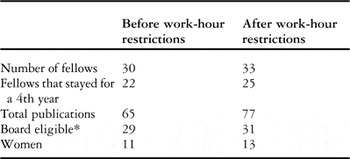
In total, 63 fellows were in the categorical paediatric cardiology fellowship at Boston Children’s Hospital between 1998 and 2007; 30 fellows were in the pre-Accreditation Council for Graduate Medical Education work-hour restrictions group (1998–2002) and 33 were in the group post-work-hour restrictions group (2003–2007). Table 1 describes the basic demographic information about the fellows before and after work-hour restrictions. There were 65 publications before work-hour restrictions and 77 publications after work-hour restrictions. Among all, three fellows were not board eligible during the study period – one fellow before work-hour restrictions and two fellows after work-hour restrictions.
Basic demographics before/after work-hour restrictions (n=63).

* Fellows whose paediatric residency training did not occur at an American or Canadian institution are not eligible for board certification by the American Board of Pediatrics
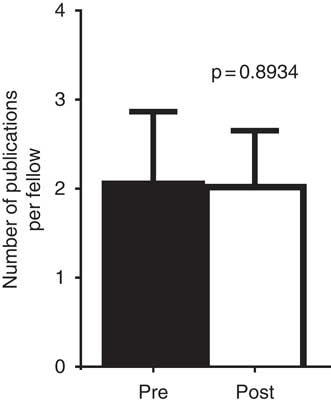
Before work-hour restrictions, the mean number of publications per fellow – excluding case reports – was 2.1 (±2.2), median 1 publication (with a range from 0 to 11 publications), with 87% of fellows publishing within the time period. After work-hour restrictions, the mean was 2.0 (±1.8), median 2 publications (with a range from 0 to 9 publications), with 79% of fellows publishing within the time period (Fig 1). There was no difference in the number of publications before and after work-hour restrictions for either all publications – clinical studies and case reports (p=0.6) – or just clinical studies – excluding case reports (p=0.89). There were two senior-authored fellow publications, both before 2003. Finally, there was no statistical difference in the number of fellow first- or senior-authored publications before and after work-hour restrictions for either women or fellows who elected to do a 4th year at our institution.
Mean number of publications per fellow before and after work-hour restrictions.

We also looked at how many fellows published work that originated from fellowship within the 3-year period of their fellowship. Before work-hour restrictions, eight (27%) fellows published scholarly work during fellowship. After work-hour restrictions, 11 (30%) fellows published scholarly work.
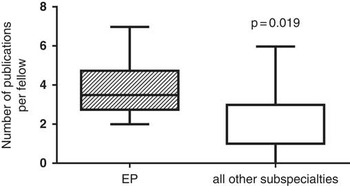
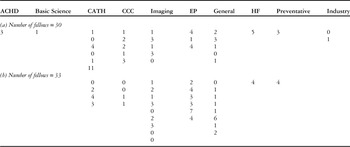
We then analysed whether there was a difference in publication number before and after work-hour restrictions among ultimate paediatric cardiac subspecialty: electrophysiology, adult congenital, heart failure, basic science, cardiac catheterisation, cardiac critical care, non-invasive imaging, general paediatric cardiologists, and preventative cardiology (Table 2). By subspecialty career choice, fellows who elected electrophysiology, preventative cardiology, and heart failure always published. Those who chose cardiac critical care, non-invasive imaging, and general paediatric cardiology did not always publish first-authored manuscripts within 6 years of starting fellowship. There was no era pattern in the publication numbers of fellows who elected adult congenital, basic science, or cardiac catheterisation. Analysis between subspecialty career choice and publication number before work-hour restrictions did not demonstrate a statistically significant difference (p=0.3). There was, however, a difference between subspecialty election after work-hour restrictions (p=0.04). Specifically, fellows who elected to go into electrophysiology were more likely to publish as a first or senior author during the 6 years compared with fellows with other career choices (p=0.019) in the post-work-hour restrictions era (Fig 2).
Number of publications by fellows who selected electrophysiology versus all other subspecialty choices, after work-hour restrictions. EP=electrophysiology.

Subspecialty number of publications before work-hour restrictions (excluding case reports).

ACHD=adult congenital heart disease; CATH=cardiac catheterisation; CCC=cardiac critical care; EP=electrophysiology; HF=heart failure/transplant
Each cell represents the number of publications by an individual fellow in the discipline listed
During the post-work-hour restriction era, there were no Accreditation Council for Graduate Medical Education citations related to work-hour violations.
Discussion
Since the implementation of work-hour regulations, the total number of paediatric cardiology fellow first- and senior-authored publications has not changed significantly at one institution. To our knowledge, this is the first study to specifically look at the effect of work-hour restrictions on paediatric subspecialty academic productivity – measured by first- and senior-authored publications. The two primary arguments for the institution of work-hour restrictions were the potential beneficial effects on resident and patient safety and the potential to improve academic productivity. We did not evaluate fellow or patient safety in our study. Our study failed to demonstrate either a beneficial or a deleterious effect on overall academic productivity as measured by first or senior authorship of a peer-reviewed journal publication. Importantly, our study also demonstrated that most fellows published their research after the 3-year period of their fellowship. The American Board of Pediatrics before 2004 approved manuscripts that had been submitted to peer-reviewed journals but not yet accepted. After 2004, an “in-depth manuscript describing a completed project” 13 was also acceptable for subspecialty certification. These requirements would appear to be an acknowledgment by the American Board of Pediatrics that even with Scholarship Oversight Committee it is challenging for fellows to conduct research, analyse the data, and publish a manuscript within the time period of fellowship.
There are inherent limitations to this study. Our methodology does not account for fellows whose projects were never published. The American Board of Pediatrics scholarly activity requirement can be met in several ways, only one of which requires publication of hypothesis-driven research. In addition, we were unable to evaluate the actual amount of time spent on academic endeavours. Moreover, we only searched articles published that were available on PubMed; one fellow in the pre-work-hour restriction era published 11 papers, which may have skewed the results. Finally, this was only a review of first- or senior-author publications at one large academic institution and in one paediatric subspecialty, and the results may not be generalisable to other centres or paediatric subspecialty fellowships.
Although we did not find any statistically significant difference in the number of publications before and after work-hour changes, we did notice that the ultimate subspecialty choice within paediatric cardiology seemed to make a difference in the academic productivity of fellows in training. Specifically, fellows who selected electrophysiology, preventative cardiology, and heart failure always published during the study period both before and after work-hour restrictions. The exact reasons for this are not clear, but may be related to the research databases that exist for these subspecialties or that fellows in electrophysiology and heart failure are involved in an additional year of training, often at the same institution, making it easier for them to continue with their categorical fellowship research and get it published in a timely manner. Finally, we did demonstrate that the majority of fellows both before and after work-hour restrictions were successful in publishing manuscripts in peer-reviewed journals within 6 years of starting fellowship.
Conclusions
At a single academic institution, work-hour restrictions did not result in a significant change in the academic productivity of categorical paediatric cardiology fellows.
Acknowledgment
None.
Financial Support
This research received no specific grant from any funding agency, commercial, or not-for-profit sectors.
Conflicts of Interest
None.