Introduction
The relationship between personality and affective disorders is complex. Personality features may result from, predispose an individual to, or modify the clinical picture of an affective illness, or be an attenuated expression of an affective disorder (Enns & Cox, Reference Enns and Cox1997). In genetic studies, personality might be used as a putative endophenotype for affective disorders (Savitz & Ramesar, Reference Savitz and Ramesar2006). Cloninger's unified biopsychosocial theory of personality (Cloninger et al. Reference Cloninger, Svrakic and Przybeck1993) postulates four temperament and three character dimensions, measured by self-rating questionnaire, the latest version being the Temperament and Character Inventory – Revised (TCI-R). The different temperament dimensions are defined in terms of basic stimulus–response characteristics. Novelty seeking (NS) is thought to be related to the behavioural activation system, harm avoidance (HA) to the behavioural inhibition system, reward dependence (RD) to the behavioural maintenance system, and persistence (P) to perseverance in behaviour despite frustration and fatigue. Of the character dimensions, self-directedness (SD) refers to an individual's ability to control, regulate and adapt their behaviour in accord with chosen goals and values, cooperativeness (C) to their tendency towards social tolerance, empathy, compassion and helpfulness, and self-transcendence (ST) to their identification with nature and ability to accept ambiguity and uncertainty.
The relationship between major depressive disorder (MDD) and the dimensions of temperament and character has been examined widely (Supplementary Table 1, available online). High HA and low SD have most consistently been associated with MDD (Farmer et al. Reference Farmer, Mahmood, Redman, Harris, Sadler and McGuffin2003). Otherwise, these former studies have reported conflicting findings, as MDD patients have scored with different combinations higher or lower in NS, RD, ST or C or lower in P than controls. Moreover, the scores of temperament and character have been demonstrated to be affected by current mood (Brown et al. Reference Brown, Svrakic, Przybeck and Cloninger1992). However, the findings for MDD patients are not necessarily valid for bipolar disorder (BD) patients, as several differences exist between MDD and BD, e.g. in psychopathology, brain imaging, heritability and clinical symptoms (Goodwin & Jamison, Reference Goodwin and Jamison2007). Presence of depressive or manic symptoms at evaluation may also influence personality measures and confound comparisons to some degree.
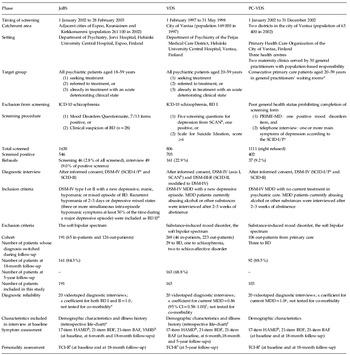
Methods used in the JoBS, the VDS and the PC-VDS

JoBS, Jorvi Bipolar Study; VDS, Vantaa Depression Study; PC-VDS, Vantaa Primary Care Depression Study; ICD, International Classification of Diseases; BD, bipolar disorder; SCAN, World Health Organization Schedules for Clinical Assessment in Neuropsychiatry, version 2.0; PRIME-MD, Primary Care Evaluation of Mental Disorders; SCID-I/P, Structured Clinical Interview for DSM-IV Axis I Disorders, research version, patient edition with psychotic screen; SCID-II, Structured Clinical Interview for DSM-IV Personality Disorders; MDD, major depressive disorder; CI, confidence interval; HAMD, Hamilton Depression Rating Scale; BAI, Beck Anxiety Inventory; YMRS, Young Mania Rating Scale; BDI, Beck Depression Inventory; TCI-R, Temperament and Character Inventory-Revised.
a From the primary PC-VDS cohort, only patients meeting the full criteria of MDD and aged under 60 years were included; additionally one patient already in the VDS cohort was excluded.
b Wing et al. (Reference Wing, Babor, Brugha, Burke, Cooper, Giel, Jablenski, Regier and Sartorius1990).cFirst et al. (Reference First, Spitzer, Gibbon and Williams2002).dBenazzi & Akiskal (Reference Benazzi and Akiskal2001). eMantere et al. (Reference Mantere, Suominen, Leppämäki, Valtonen, Arvilommi and Isometsä2004). fMelartin et al. (Reference Melartin, Rytsälä, Leskelä, Lestelä-Mielonen, Sokero and Isometsä2002). gVuorilehto et al. (Reference Vuorilehto, Melartin and Isometsä2005). hHamilton (Reference Hamilton1960). iBeck et al. (Reference Beck, Ward, Mendelson, Mock and Erbaugh1961). jBeck et al. (Reference Beck, Epstein, Brown and Steer1988). kYoung et al. (Reference Young, Biggs, Ziegler and Meyer1978). lCloninger (Reference Cloninger1994).
The previous studies in BD patients (Supplementary Table 1) have reported mixed findings. Relative to controls, BD patients have scored with different combinations higher or lower in NS, RD or SD, or lower in P or SD, or higher in HA or ST. Compared with unipolar patients, BD patients have had either equal scores in all dimensions, or lower HA, SD or ST scores, or higher NS or ST scores. However, the differences between the groups have mostly not been pronounced. Moreover, two reports (Serretti et al. Reference Serretti, Mandelli, Lorenzi, Landoni, Calati, Insacco and Cloninger2006; Mula et al. Reference Mula, Pini, Monteleone, Iazzetta, Preve, Tortorella, Amato, Di Paolo, Conversano, Rucci, Cassano and Maj2008) comparing BD I and II patients observed no differences between patient groups in any temperament or character dimensions, whereas one study (Savitz et al. Reference Savitz, van der Merwe and Ramesar2008) found BD I patients to have higher HA scores than BD II patients, and another study (Engström et al. Reference Engström, Brändström, Sigvardsson, Cloninger and Nylander2004) found BD I patients to have lower HA4 (fatigability and asthenia) and higher NS2 (impulsiveness), SD3 (resourcefulness) and SD5 (congruent second nature) scores than BD II patients. Thus, bipolar/unipolar differences may be more subtle than those between the main dimensions, but due to multiple comparisons involved, there is also a risk of spurious findings being reported. Overall, to what degree the temperament and character of BD and MDD patients or BD I and II patients differ from each other remains unclear.
Most of the earlier studies that have explored the relationship between MDD or BD and the dimensions of temperament and character (Supplementary Table 1) have had some major methodological limitations, which may in part explain the inconsistency in findings. The sample sizes have been small or moderate, patients have mostly been from tertiary care, and the possible influence of residual depressive and manic symptoms on personality evaluation has been statistically controlled in only two out of 11 studies. Moreover, BD subtypes I and II have been investigated separately in only five of the 18 studies. Thus, it is difficult to generalize the findings from these previous reports to all MDD, BD I and BD II patients.
The aim of this study was to investigate for the first time potential differences in temperament and character between MDD and BD patients and healthy controls by comparing three patient cohorts and a general population sample. We hypothesized HA and SD to be a common indicator of vulnerability for all mood disorders, with both BD and MDD patients likely to differ from the general population. We also expected that level of NS would increase along with the rate of manic symptoms and that the level of NS would be highest in BD I. To test these hypotheses, we compared (1) MDD and BD patients with normal controls, (2) BD patients with MDD patients, and (3) BD I patients with BD II patients.
Method
Our patients came from three separate but comparable cohorts and a general population survey, all conducted in two adjacent cities within the capital region of Finland. Those with BD came from the Jorvi Bipolar Study (JoBS) and those with MDD from the Vantaa Depression Study (VDS) and the Vantaa Primary Care Depression Study (PC-VDS). All of these are collaborative research projects of the Mood Disorder Research Unit of the Department of Mental Health and Substance Use of the National Institute of Health and Welfare, Helsinki, Finland, with the last author (E.I.) as the principal investigator. The research protocols for the JoBS, PC-VDS and the general population survey study were approved by the Ethics Committee of Helsinki University Central Hospital, and that for the VDS by the Ethics Committee of Peijas Medical Care District.
The detailed methodologies have been described elsewhere for the JoBS (Mantere et al. Reference Mantere, Suominen, Leppämäki, Valtonen, Arvilommi and Isometsä2004, Reference Mantere, Suominen, Valtonen, Arvilommi, Leppämäki, Melartin and Isometsä2008), VDS (Melartin et al. Reference Melartin, Rytsälä, Leskelä, Lestelä-Mielonen, Sokero and Isometsä2002; Holma et al. Reference Holma, Holma, Melartin, Rytsälä and Isometsä2008), PC-VDS (Vuorilehto et al. Reference Vuorilehto, Melartin and Isometsä2005, Reference Vuorilehto, Melartin, Rytsälä and Isometsä2007, Reference Vuorilehto, Melartin and Isometsä2009) and the general population survey (Jylhä & Isometsä, Reference Jylhä and Isometsä2006). A summary of these is provided in Table 1.
JoBS, VDS and PC-VDS cohorts
Screening and baseline evaluation
In brief, patients were screened for BD (JoBS) or MDD (VDS and PC-VDS) in an acute mood episode. After a positive screen or suspicion of an incident episode, the patient was fully informed about the study project and written informed consent was obtained. In the second phase, a diagnosis was made by using all available information from face-to-face interviews and psychiatric records; if the diagnosis was uncertain, other informants were contacted. Information was also gathered on demographic characteristics, illness history using a retrospective life-chart and current symptomatology. The final baseline cohorts consisted of 191 DSM-IV BD I and II patients and 375 MDD patients (Table 1).
Follow-up
After baseline assessments, patients were interviewed at 6 and 18 months (JoBS, VDS and PC-VDS) and at 5 years (VDS). All available data of course of illness were then integrated into the form of a graphic life-chart based on DSM-IV criteria (Holma et al. Reference Holma, Holma, Melartin, Rytsälä and Isometsä2008; Mantere et al. Reference Mantere, Suominen, Valtonen, Arvilommi, Leppämäki, Melartin and Isometsä2008; Vuorilehto et al. Reference Vuorilehto, Melartin and Isometsä2009). The type of mood disorder was re-examined; i.e. a change from MDD to BD I or BD II as well as from BD II to BD I was recorded. Criteria for a hypomanic phase were the same as in the DSM-IV, except for a duration criterion of at least 2 days.
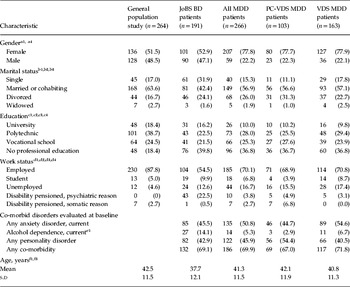
Of the 191 BD subjects with a current phase initially included in the study, 161 participated also in the 18-month follow-up interview. They were somewhat older [mean 39.0 (s.d.=11.9) years v. 33.7 (s.d.=12.1) years, t=2.711, degrees of freedom (df)=189, p=0.007] than non-participants; no other differences were evident in sociodemographic, clinical or personality characteristics. Of the 375 individuals with current MDD initially included in the study, 35 were excluded in follow-up since their diagnosis switched to BD. Of the remaining 340 MDD patients, 92 from the PC-VDS were followed up for 18 months and 163 from the VDS were followed for 5 years. Patients who dropped out from the follow-up had scored slightly higher on the baseline Beck Anxiety Inventory (BAI) [22.7 (s.d.=10.3) v. 19.9 (s.d.=11.9), t=1.996, p=0.047] and ST scale [75.6 (s.d.=11.1) v. 63.9 (s.d.=14.4), t=3.625, p<0.001], and were slightly more often unemployed (25.8% v. 16.7%), students (7.9% v. 6.8%) or pensioned (14.9% v. 6.4%, difference overall p=0.005), or single (24.5% v. 15.3%) or widowed (5.3% v. 1.9%, difference overall p=0.023), and had more often current alcohol dependence (21.3% v. 5.3%, χ2=20.454, df=1, p<0.001), but did not differ significantly (p>0.05) in other sociodemographic variables or on the Beck Depression Inventory (BDI), Hamilton Depression Rating Scale (HAMD) or other TCI-R scales. The sociodemographic characteristics of the patients of the JoBS, PC-VDS and VDS cohorts, and the respondents of the general population survey study are shown in Table 2.
Sociodemographic and some clinical characteristics of the general population study (n=264), the JoBS (n=191), and unipolar depressive patients combined and separately from the PC-VDS (n=103) and the VDS (n=163)

Data are given as number of participants (percentage).
JoBS, Jorvi Bipolar Study; VDS, Vantaa Depression Study; PC-VDS, Vantaa Primary Care Depression Study; BD, bipolar disorder; MDD, major depressive disorder; s.d., standard deviation; df, degrees of freedom.
Significance: BD patients v. all MDD patients: a1 χ2=31.469, df=1, p<0.001; b1 χ2=18.544, df=3, p<0.001, missing data 4/266; c1 Missing data 5/266; d1 χ2=43.055, df=4, p<0.001, missing data 2/266; e1 χ2=10.717, df=1, p=0.001; f1t=−3.265, df=455, p=0.001.
Significance: PC-VDS v. VDS: b2 Missing data 4/103; c2 missing data 5/103; d2 χ2=13.744, df=4, p=0.008, missing data 2/163.
Significance: general population v. BD patients: b3 χ2=23.346, df=3, p<0.001; c3 χ2=28.216, df=3, p<0.001, missing data 3/264; d3 χ2=91.272, df=4, p<0.001, missing data 2/264; f3t=4.320, df=453, p<0.001.
Significance: general population v. MDD patients: a4 χ2=40.156, df=1, p<0.001; c4 χ2=27.077, df=3, p<0.001, missing data 3/264; d4 χ2=33.965, df=4, p<0.001, missing data 2/264.
Personality assessment
Personality was assessed by using the TCI-R (Cloninger, Reference Cloninger1994). The inventory was mailed to all subjects and the patients returned it at the interview. When filling in the TCI-R, all patients from the clinical cohorts as well as participants in the general population survey were instructed to think of the way they would typically act or feel (Table 1).
General population survey
A total of 900 participants (300 from Espoo, 600 from Vantaa) aged 20–70 years were randomly drawn from the Population Register Centre in Finland in 2003 (Jylhä & Isometsä, Reference Jylhä and Isometsä2006). The general population of these two cities is similar to the rest of the country, except that Espoo has slightly higher levels of education and employment. Only participants aged 20–60 years (n=816) were included here. A self-report booklet containing questions on sociodemographic characteristics, the BAI, the BDI, the TCI-R and an inquiry about whether the participant had ever had a physician-diagnosed mental disorder (yes/no) was mailed to all subjects.
Altogether 308 participants responded and gave their informed consent. Non-responders were younger than responders [mean age 41.4 (s.d.=10.6) years v. 42.5 (s.d.=11.5) years, t=−4.387, p<0.001] and more often male (62.3% v. 48.5%, χ2=16.7487, df=1, p<0.001), but no difference was present in the area of residence within the city (Jylhä & Isometsä, Reference Jylhä and Isometsä2006). Participants who reported having a physician-diagnosed mental disorder (44/308) were excluded; thus, 264 participants were included in this study.
Study design
To minimize the effect of mood, each patient's personality dimensions were determined at an index interview conducted when the HAMD scores (PC-VDS) or HAMD and Young Mania Rating Scale (YMRS) scores (JoBS) were at a minimum. In the case of only a single evaluation (general population survey, VDS), this was used as the index interview.
Statistical methods
The one-way ANOVA test and Student's t test (independent samples and paired samples) were used to test significance for continuous variables. The Pearson's χ2 test and Fisher's exact test were used to evaluate categorical and non-parametric data. Cohen's d was used to indicate the standardized difference between two means. Cronbach's α was applied to assess internal consistency. Cronbach's α for the scales used was good both in patient cohorts and in the general population group at all time points (TCI-R, 0.81–0.94; BDI, 0.86–0.95; BAI, 0.89–0.93; HAMD, 0.70–0.88; YMRS, 0.59–0.88). The 18-month test–retest reliability coefficients of the TCI-R in the JoBS and PC-VDS were, despite variations in patients' symptom status between measurements, all acceptable (0.58–0.83) (data available upon request).
Several multinomial logistic (being an MDD or BD patient or normal control as independent variable) and logistic (being a BD or MDD patient, or BD I or BD II patient as independent variable) regression analyses were performed, all including possible confounding sociodemographic (age, gender, education, work status, and marital status) and symptom (BDI and BAI) variables as covariates. In addition, temperament and character scores from the index interview also served as dependent factors. Logistic regression models were performed also with HAMD and YMRS (BD I and II comparison) scores from the index interview, but the results did not change. Potential gender differences for main dimensions were studied by adding an interaction term to the models. Sensitivity analyses were also performed, both with a subgroup of exclusively euthymic patients (HAMD score ⩽7 and YMRS score ⩽7), as well as with BD patients either with or without lithium, valproate or atypical antipsychotics, or with MDD patients with or without antidepressants. The results did not change. In analysing the TCI scales and the subscales, seven and 29 comparisons were made, respectively; therefore, Bonferroni corrections were made and the significance levels were set to more conservative levels of 0.007 and 0.002, respectively. SPSS software, version 17.0 (SPSS Inc., USA), was used.
Results
Comparisons of BD and MDD patients with the general population group
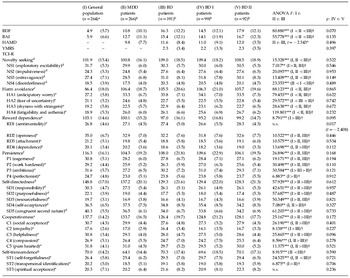
Both BD and MDD patients scored higher on HA (d=1.0 and d=1.1, respectively) and lower on P (d=0.4 and d=0.7, respectively), SD (d=1.0 and d=0.6, respectively) and C (d=0.7 and d=0.3, respectively) than subjects from the general population, whereas only BD patients scored higher on NS (d=0.4) and lower on RD (d=0.3) (Table 3 and Supplementary Fig. 1).
BDI, BAI, HAMD, YMRS and TCI-R scores of the general population sample, all BD patients, BD I and BD II patients, and unipolar MDD patients

Data are given as mean (standard deviation).
BDI, Beck Depression Inventory; BAI, Beck Anxiety Inventory; HAMD, Hamilton Depression Scale; YMRS, Young Mania Rating Scale; TCI-R, Temperament and Character Inventory-Revised; BD, bipolar disorder; MDD, major depressive disorder; ANOVA, analysis of variance; NS, novelty seeking; HA, harm avoidance; RD, reward dependence; n.s., non-significant; P, persistence; SD, self-directedness; C, cooperativeness; ST, self-transcendence.
a Baseline score. b Interview, when HAMD at minimum or baseline score. c Missing data 1/264. d Missing data 18/266, 5/191, 3/99, 2/92. e Missing data 17/266, 5/191, 3/99, 2/92. f Missing data 1/264, 17/266, 5/191. gmissing data 1/264, 18/266, 5/191.
* p<0.05, ** p=0.001, *** p<0.001.
† Significant differences based on post-hoc (Tukey) group comparisons.
Multinomial logistic regression models
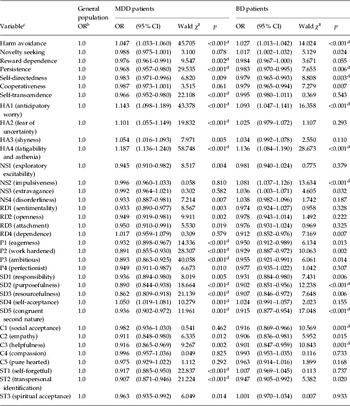
In a multinomial logistic regression model comparing BD and MDD patients and normal controls (Table 4), being a BD or MDD patient was associated with higher HA and lower P. In a sensitivity analysis with MDD and BD patients without co-morbid current alcohol dependence, the association between lower P and being an MDD patient remained significant [odds ratio (OR) 0.969, p<0.001] and also as a trend for being a BD patient (OR 0.984, p=0.016). Moreover, being a BD patient was associated with lower SD, and being an MDD patient was associated with lower RD and lower ST. For females, being a BD or MDD patient was not associated with lower SD. No other gender differences existed. The associations of subscale level of the TCI are shown in Table 4.
Multinomial logistic regression models for the ‘trait effect’Footnote a

BD, Bipolar disorder; MDD, major depressive disorder; OR, odds ratio; CI, confidence interval; HA, harm avoidance; NS, novelty seeking; RD, reward dependence; P, persistence; SD, self-directedness; C, cooperativeness; ST, self-transcendence.
a Variables entered separately into the model. Adjusted for possible confounding sociodemographic factors (age, gender, education, work status, marital status), and the scores of Beck Depression Inventory and Beck Anxiety Inventory, as the temperament and character scores might be influenced by these symptom scores.
b Reference group.
c At index interview, when scores on the Young Mania Rating Scale and/or Hamilton Depression Scale were at a minimum or baseline score.
d Statistically significant after Bonferroni correction.
Comparisons between BD and MDD patients
BD patients scored higher on NS (d=0.5) and ST (d=0.4) and lower on SD (d=0.4) and C (d=0.4) than MDD patients (Table 3).
Logistic regression model
In a logistic regression model after controlling for age, gender, education, work status, marital status, current alcohol dependence, and BDI and BAI scores, being a BD patient was associated with lower HA (OR 0.980, p=0.002) and higher NS (OR 1.027, p<0.001) and ST (OR 1.028, p<0.001). No gender differences existed.
In the subscale level of TCI, being a BD patient was associated with lower HA2 (fear of uncertainty; OR 0.926, p=0.001) and RD4 (dependence; OR 0.893, p=0.001), and higher NS2 (impulsiveness; OR 1.075, p<0.001), NS4 (disorderliness; OR 1.116, p<0.001), P3 (ambitious; OR 1.062, p<0.001) and ST1 (self-forgetfulness; OR 1.090, p<0.001).
Comparisons between BD I and BD II patients
No differences were present in TCI scores between BD I and II patients.
Logistic regression model
In the logistic regression model after controlling for age, gender and BDI (or HAMD), BAI and (or not) YMRS scores, no difference was found in TCI scores between BD I and BD II patients. No gender differences existed.
Discussion
We found that patients with BD or MDD had markedly higher levels of HA and lower levels of P than subjects in the general population. Moreover, being a BD patient was associated with lower SD, and being an MDD patient was associated with lower RD and ST. These differences persisted after controlling for potentially confounding sociodemographic factors and symptoms of depression and anxiety. Compared with MDD patients, BD patients scored higher on NS and ST and lower on HA. We observed no differences in the scores of TCI between BD I and BD II patients.
Unlike previous studies, we were able to compare in the same study temperament and character in BD I, BD II and MDD patients and controls, and could control for the possible confounding effect of depressive, anxiety and manic symptoms. Other major strengths of our study were the relatively large size and good representativeness of the BD and MDD cohorts and the few drop-outs. The JoBS comprised a cohort of 191 in- and out-patients with BD, effectively representing all psychiatric patients with a new episode of BD in three Finnish cities. Altogether, 84% of the BD patients and 75% of the MDD patients of the two cohorts could be interviewed at two time points. The general population sample was randomly drawn and represented the suburban and urban populations of two large Finnish cities.
There were also limitations. The response rate (37.7%) and sample size (n=264) of the general population sample were moderate. Although the overlap of the personality scores between the general population sample and patient cohort corresponded to those of other studies (Hansenne & Bianchi, Reference Hansenne and Bianchi2009), the question of how much the moderate response rate biased the personality profiles of the general population sample in a healthier direction remains unknown. Small differences were also present between responders of the general population survey and the general population in sociodemographic characteristics. The patients' clinical symptom state or pharmacotherapies might also influence their personality scores and, in theory, bias our findings. However, we conducted sensitivity analyses for both factors, and these did not change the results. Moreover, we deliberately excluded patients with soft bipolar spectrum disorders from the bipolar cohort. Finally, a post-morbid change of personality in BD and MDD patients cannot be excluded.
Compared with the general population group, the patterns of temperament and character dimensions between BD and MDD patients were more similar than different. This finding is in line with some (Goel et al. Reference Goel, Terman and Terman2003; Evans et al. Reference Evans, Akiskal, Keck, McElroy, Sadovnick, Remick and Kelsoe2005; Nowakowska et al. Reference Nowakowska, Strong, Santosa, Wang and Ketter2005), but not all former studies (Serretti et al. Reference Serretti, Mandelli, Lorenzi, Landoni, Calati, Insacco and Cloninger2006). It appears that the only exception in the similarity is NS, where BD patients scored higher and MDD patients lower than the general population, but due to stringent multiple testing limits, the differences were not statistically significant. However, the difference between BD and MDD patients in NS was significant, even after controlling for symptoms of depression and anxiety and other confounding sociodemographic factors. Whether high NS in MDD patients would predict the switch of diagnosis to BD remains unknown. There were no differences between BD I and BD II patients in temperament or character, in accordance with some (Serretti et al. Reference Serretti, Mandelli, Lorenzi, Landoni, Calati, Insacco and Cloninger2006; Mula et al. Reference Mula, Pini, Monteleone, Iazzetta, Preve, Tortorella, Amato, Di Paolo, Conversano, Rucci, Cassano and Maj2008), but not all previous reports (Engström et al. Reference Engström, Brändström, Sigvardsson, Cloninger and Nylander2004; Savitz et al. Reference Savitz, van der Merwe and Ramesar2008). Although these findings are also in line with our previous study that found no differences in the level of neuroticism or extraversion between the MDD or BD I or BD II patient cohorts (Jylhä el al. Reference Jylhä, Mantere, Melartin, Suominen, Vuorilehto, Arvilommi, Leppämäki, Valtonen, Rytsälä and Isometsä2010), we cannot exclude the possibilities that these patient groups might differ in affective temperaments (Rihmer et al. Reference Rihmer, Akiskal, Rihmer and Akiskal2010) not investigated, or that soft bipolar spectrum patients could differ from those studied.
Both patient cohorts had a higher level of HA than the general population group, in accordance with most earlier studies (e.g. Young et al. Reference Young, Bagby, Cooke, Parker, Levitt and Joffe1995; Janowsky et al. Reference Janowsky, Morter, Hong and Howe1999; Evans et al. Reference Evans, Akiskal, Keck, McElroy, Sadovnick, Remick and Kelsoe2005), but in some no difference between controls and either MDD (Nery et al. Reference Nery, Hatch, Nicoletti, Monkul, Najt, Matsuo, Cloninger and Soares2009), manic (Strakowski et al. Reference Strakowski, Faedda, Tohen, Goodwin and Stoll1992) or BD (Osher et al. Reference Osher, Lefkifker and Kotler1999; Serretti et al. Reference Serretti, Mandelli, Lorenzi, Landoni, Calati, Insacco and Cloninger2006; Sayin et al. Reference Sayin, Kuruoglu, Yazici Gulec and Aslan2007) patients was found. The effect size for differences in HA between the subjects of the general population and BD or MDD patients was large, in line with previous studies (Young et al. Reference Young, Bagby, Cooke, Parker, Levitt and Joffe1995; Nowakowska et al. Reference Nowakowska, Strong, Santosa, Wang and Ketter2005). Nevertheless, nearly 45% of the distribution of HA scores of BD or MDD patients overlap those of the general population. Compared with MDD patients, BD patients scored somewhat lower in HA, in agreement with some (Strakowski et al. Reference Strakowski, Faedda, Tohen, Goodwin and Stoll1992; Janowsky et al. Reference Janowsky, Morter, Hong and Howe1999; Mula et al. Reference Mula, Pini, Monteleone, Iazzetta, Preve, Tortorella, Amato, Di Paolo, Conversano, Rucci, Cassano and Maj2008), but not all earlier reports (Young et al. Reference Young, Bagby, Cooke, Parker, Levitt and Joffe1995; Evans et al. Reference Evans, Akiskal, Keck, McElroy, Sadovnick, Remick and Kelsoe2005; Savitz et al. Reference Savitz, van der Merwe and Ramesar2008), where no difference was found. However, the effect size between the patient groups was small. The difference in HA between MDD and BD patients was most pronounced on the HA2 subscale of TCI-R, indicating that BD patients might be more confident and prefer to take more risks than MDD patients. Overall, although high HA, representing increased sensitivity to and difficulty coping with the impact of negative life events, was associated with BD and MDD, to what degree it is a risk indicator for BD and MDD is unknown and requires further prospective studies.
Patients with BD or MDD scored lower in P than subjects of the general population group. The difference in the P scores was clear, but not pronounced. The effect sizes for the differences of P between subjects of the general population and BD (d=0.4) or MDD patients (d=0.7) were moderate, in line with previous studies (d=0.6, Osher et al. Reference Osher, Lefkifker and Kotler1999; d=0.5, Agosti & McGrath, Reference Agosti and McGrath2002). As co-morbid alcohol disorders have been found to be associated with low P in BD patients (Nery et al. Reference Nery, Hatch, Glahn, Nicoletti, Monkul, Najt, Fonseca, Bowden, Cloninger and Soares2008), we made the comparisons also with MDD and BD patients without co-morbid current alcohol dependence. The result remained significant for MDD patients and also as a trend for BD patients. In only three previous studies has P been found to be lower among mood disorder patients than among controls, two studies comparing published norms with either MDD (Agosti & McGrath, Reference Agosti and McGrath2002) or BD (Osher et al. Reference Osher, Cloninger and Belmaker1996) patients and one comparing volunteers with euthymic BD patients (Osher et al. Reference Osher, Lefkifker and Kotler1999). Most of the previous studies comparing mood disorder patients and controls have been done either with the Tridimensional Personality Questionnaire, where P was scored as a component of RD, or with the Temperament and Character Inventory, where P was scored on its own scale, but only with eight items, whereas in TCI-R P is scored on four subscales with 35 items and with a five-point Likert scale instead of true/false statements (Cloninger, Reference Cloninger1994; Pelissolo et al. Reference Pelissolo, Mallet, Baleyte, Michel, Cloninger, Allilaire and Jouvent2005). Thus, the psychometric properties and predictive value of TCI-R for the P scale might be better than those in the former versions of the instrument (Pelissolo et al. Reference Pelissolo, Mallet, Baleyte, Michel, Cloninger, Allilaire and Jouvent2005). To our knowledge, one previous study (Hansenne & Bianchi, Reference Hansenne and Bianchi2009) comparing MDD patients and controls has been done with TCI-R. In this study, both depressed and remitted MDD patients had lower P than controls, but the latter difference was not significant, perhaps due to the small (n=20) number of remitted patients. Whether low P, representing a low level of perseverance and repetitive behaviours even in response to intermittent reward, is a true risk indicator for mood disorders requires further replication studies with TCI-R.
The higher NS level among BD patients than among MDD patients is consistent with some (Young et al. Reference Young, Bagby, Cooke, Parker, Levitt and Joffe1995; Janowsky et al. Reference Janowsky, Morter, Hong and Howe1999; Evans et al. Reference Evans, Akiskal, Keck, McElroy, Sadovnick, Remick and Kelsoe2005), but not all previous studies (Goel et al. Reference Goel, Terman and Terman2003; Nowakowska et al. Reference Nowakowska, Strong, Santosa, Wang and Ketter2005), where no difference was found between MDD and BD patients, perhaps due to small sample size. Although the effect size of the difference in NS scores between BD and MDD patients was moderate, in line with an earlier report (d=0.6; Young et al. Reference Young, Bagby, Cooke, Parker, Levitt and Joffe1995), the overlap of the distributions of NS scores between BD and MDD patients was significant, nearly 70%. Of the subscales of TCI-R, the most pronounced differences between BD and MDD patients were in NS2 and NS4, suggesting that relative to MDD patients, BD patients might be more excitable, impulsive, quick-tempered and disorderly.
In RD and in the character dimensions, some, albeit relatively small, differences existed between the patient and control groups. Compared with controls, RD level was lower among MDD patients and as a trend also among BD patients, in line with some (Farmer et al. Reference Farmer, Mahmood, Redman, Harris, Sadler and McGuffin2003; Engström et al. Reference Engström, Brändström, Sigvardsson, Cloninger and Nylander2004; Serretti et al. Reference Serretti, Mandelli, Lorenzi, Landoni, Calati, Insacco and Cloninger2006), but not all earlier studies (Young et al. Reference Young, Bagby, Cooke, Parker, Levitt and Joffe1995; Evans et al. Reference Evans, Akiskal, Keck, McElroy, Sadovnick, Remick and Kelsoe2005; Nowakowska et al. Reference Nowakowska, Strong, Santosa, Wang and Ketter2005), where no difference was found between patients and controls. However, the effect size for the difference between MDD or BD patients and controls was small (d=0.2 and d=0.4, respectively). SD scores were lower in BD patients and as a trend also in MDD patients than general population subjects, in accordance with most (Hansenne et al. Reference Hansenne, Reggers, Pinto, Kjiri, Ajamier and Ansseau1999; Farmer et al. Reference Farmer, Mahmood, Redman, Harris, Sadler and McGuffin2003; Evans et al. Reference Evans, Akiskal, Keck, McElroy, Sadovnick, Remick and Kelsoe2005), but not all previous reports (Serretti et al. Reference Serretti, Mandelli, Lorenzi, Landoni, Calati, Insacco and Cloninger2006), where BD patients have scored higher than controls. Moreover, as a trend, the level of C was lower in both patient groups than in the general population group, consistent with some (e.g. Hansenne et al. Reference Hansenne, Reggers, Pinto, Kjiri, Ajamier and Ansseau1999; Kusunoki et al. Reference Kusunoki, Sato, Taga, Yoshida, Komori, Narita, Hirano, Iwata and Ozaki2000; Nery et al. Reference Nery, Hatch, Glahn, Nicoletti, Monkul, Najt, Fonseca, Bowden, Cloninger and Soares2008), but not all former studies (Farmer et al. Reference Farmer, Mahmood, Redman, Harris, Sadler and McGuffin2003; Nowakowska et al. Reference Nowakowska, Strong, Santosa, Wang and Ketter2005), where no differences between MDD or BD patients and controls were found. Finally, MDD patients scored lower on ST than subjects of the general population or BD patients. In earlier reports, the findings have been mixed, as MDD patients have scored higher (Hansenne et al. Reference Hansenne, Reggers, Pinto, Kjiri, Ajamier and Ansseau1999; Evans et al. Reference Evans, Akiskal, Keck, McElroy, Sadovnick, Remick and Kelsoe2005), lower (Richter et al. Reference Richter, Eisemann and Richter2000; Serretti et al. Reference Serretti, Mandelli, Lorenzi, Landoni, Calati, Insacco and Cloninger2006) or similarly (Kimura et al. Reference Kimura, Sato, Takahashi, Narita, Hirano and Goto2000; Sato et al. Reference Sato, Narita, Hirano, Kusunoki, Sakado and Uehara2001; Agosti & McGrath, Reference Agosti and McGrath2002) compared with control subjects, and lower (Nowakowska et al. Reference Nowakowska, Strong, Santosa, Wang and Ketter2005) or similarly (Evans et al. Reference Evans, Akiskal, Keck, McElroy, Sadovnick, Remick and Kelsoe2005) compared with BD patients. Overall, it seems that compared with general population subjects the levels of RD, SD and C are lower among affective disorder patients and that of ST is lower in MDD than BD patients.
In conclusion, the pattern of temperament and character dimensions between BD and MDD patients showed more similarities than differences. However, both patient groups were different from the general population. The most pronounced difference was in the NS dimension, where BD patients scored higher than MDD patients. Temperament and character dimensions are unlikely to differ between BD I and BD II patients.
Note
Supplementary material accompanies this paper on the Journal's website (http://journals.cambridge.org/psm).
Acknowledgements
This study was supported by research grants from the Academy of Finland and the Department of Psychiatry at Helsinki University Central Hospital.
Declaration of Interest
None.