In South America, the invasive feral pig (Sus scrofa Linnaeus) has become established in Argentina, Uruguay, Paraguay and in a wide range within Brazil, along the southern half of the Atlantic Forest, in the cerrado (savanna) and in the Pantanal wetland. The geographical ranges of the two most common South American native peccary (Tayassu pecari Link and Pecari tajacu Linnaeus) overlap almost entirely, and the feral pig now co-occurs with them in several areas. Because feral pig, white-lipped and collared peccary are considered ecological equivalents, there has been much speculation about possible competitive interactions among them (Desbiez et al. Reference DESBIEZ, SANTOS, KEUROGHLIAN and BODMER2009, Sicuro & Oliveira Reference SICURO and OLIVEIRA2002).
Peccary species and feral pig share similar diets (Keuroghlian & Eaton Reference KEUROGHLIAN and EATON2008), foraging behaviours (Kiltie Reference KILTIE1982), digestive systems and efficiencies (Bodmer Reference BODMER1991a, Elston et al. Reference ELSTON, KLINKSIEK and HEWITT2005) and seed and animal-matter consumption (Bodmer Reference BODMER1991a, Reference BODMER1991b). Sicuro & Oliveira (Reference SICURO and OLIVEIRA2002) have suggested that differences in cranial morphology between peccary species and the pig could result in different bite forces, and consequently, in differential capacity to consume hard seeds, but this hypothesis was refuted by Desbiez & Keuroghlian (Reference DESBIEZ and KEUROGHLIAN2009). It is important to notice that differential habitat and micro-habitat use has been found to be relevant to decrease competition between peccary species and pig (Desbiez et al. Reference DESBIEZ, SANTOS, KEUROGHLIAN and BODMER2009, Oliveira-Santos Reference OLIVEIRA-SANTOS2009). However, in the Pantanal, Desbiez et al. (Reference DESBIEZ, SANTOS, KEUROGHLIAN and BODMER2009) showed a high dietary overlap (~90%) between feral pig and both peccary species during dry and rainy seasons, and Oliveira-Santos (Reference OLIVEIRA-SANTOS2009) showed that these species are active all day long, suggesting that interspecific encounters must be common.
Several niche dimensions of feral pig, white-lipped and collared peccary have been investigated, and there appears to be large overlap among these species. However, because the pig and these two peccary species have large home ranges, live in structured herds with tens to hundreds of individuals, and exhibit coordinated displays of herd attack and defence, one can hypothesize that interference competition leads to inverse co-occurrence patterns among these species. Although exploitative competition is frequently investigated in studies of animal coexistence (Schoener Reference SCHOENER1983), interference competition can also be an important determinant of community structure (Carothers & Jaksic Reference CAROTHERS and JAKSIC1984). Apart from the extreme case of interspecific killing (Palomares & Caro Reference PALOMARES and CARO1999), a dominant species, in interference competition, can decrease a subordinate species’ access to resources. In this case, subordinate species that have high emigration capacity and live in a heterogeneous habitat may present behaviour displacements (Abrams & Chen Reference ABRAMS and CHEN2002). If the disputed resources are scarce or spatially aggregated, the interference can be maximized and a larger species may take advantage of a direct size effect (Valeix et al. Reference VALEIX, CHAMAILLÉ-JAMMES and FRITZ2007).
In this study we investigated the pattern of co-occurrence, incorporating habitat covariates and imperfect detection, between two native peccary species and the invasive feral pig during two contrasting seasons (dry and rainy) in the Pantanal wetland. As the three species present differences in body size and herd size, we hypothesized a dominance rank among them. We expected the smaller-bodied species, collared peccary (18 kg), that lives in small herds (mean = 6 individuals, n = 18, range = 4–9), would be subordinate to the feral pig, that presents larger body size (50 kg) and larger herd size (mean = 8 individuals, n = 22, range = 4–16). In contrast we hypothesized that as the white-lipped peccary presents intermediate body size (35 kg), but can reach herd size up to 120 individuals (mean = 55 individuals, n = 18, range = 33–88), it would not be subordinate to the pig. We also hypothesized that the patterns of inverse co-occurrence would be more evident during the period of food and water scarcity (dry season).
The study was carried out in the Pantanal, the world's largest wetland, at the Nhecolandia subregion (18°59′S, 56°39′W). The vegetation is characterized by a mosaic of flooded and non-flooded grasslands, forest and savanna interspersed by seasonal and temporary lakes with freshwater or alkaline and brackish waters. The average annual temperature is 26 °C and average annual rainfall is 1100 mm, but 80% of the annual rainfall occurs from December to May. The sampled area comprises five private ranches that use the natural landscape for raising cattle at low densities (0.25–0.35 head ha−1). We established a regular square grid with 50 camera-trap stations (Tigrinus®) (7 × 7 trap-stations, plus one trap just outside the grid) to monitor the presence of feral pig and two peccary species (grid area = 8000 ha) from March to May 2009 (rainy season) and from August to October 2009 (dry season). The trap stations were systematically placed 1.5–2 km apart and the camera-traps were programmed to monitor 24 h d−1 and to record the date and time of each photograph. Each trap station was monitored continuously for 30 d in each season, totalling an effort of 1500 camera-trap days by season.
We characterized the habitat spatial structure of each trap station using a LANDSAT TM satellite image (20-m resolution) recorded in March 2009 and classified with the Spring 4.3 program (National Institute for Spatial Studies, Brazil). We established a circular area (200 ha, 800-m radius) around each trap station to quantify individually the availability of forest and water bodies (in percentage). We also established two 50-m transects around each trap station to quantify the availability of the palm Attalea phalerata Mart. ex Spreng. The presence or absence of this palm was counted at 0.5-m intervals along each transect to provide a measure of palm cover (in percentage). Attalea phalerata is a large-seeded palm that dominates the understorey and produces fruits throughout the year. Its fruit is the one consumed most often by the three species studied (Desbiez et al. Reference DESBIEZ, SANTOS, KEUROGHLIAN and BODMER2009).
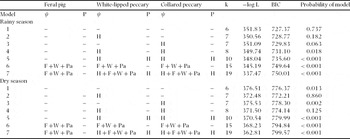
We modelled the pattern of co-occurrence of feral pig and the two peccary species. We took into account errors in detection and the effects of spatial habitat covariates on species occurrence, using the hierarchical parameterization proposed by Waddle et al. (Reference WADDLE, DORAZIO, WALLS, RICE, BEAUCHAMP, SCHUMAN and MAZZOTTI2010). We divided the 30 d of monitoring by each camera-trap station into six periods of 5 d each, in order to generate detection histories for each species. Each trap station was associated with its respective set of habitat covariates. We compared several models in each season to estimate the occurrence probability and detection probability of each species, as well as the effect of habitat covariates on species occurrence and the effect of feral pig presence on the occurrence and detection probability of two peccary species (Table 1). The models were compared using the Bayesian information criterion (BIC), which was used to approximate the posterior model probability. The source code (written in R) for fitting the models is available from the authors.
Comparison of models fit to the detections probabilities of feral pig, white-lipped peccary and collared peccary during the rainy and dry season. Models differ by their effects of covariates (F = forest, W = water, Pa = palm, H = occurrence of feral pig, (–) = no covariates effect) on probabilities of species occurrence (ψ) and species detection probability (P). The maximized log-likelihood function is denoted by log L. Model comparisons are based on the Bayesian information criterion (BIC), which is used to approximate the posterior model probability. k = number of parameters.

During the rainy season, 133 records of collared peccary (36/50 trap-stations), 19 of white-lipped peccary (8/50 stations) and 112 of feral pig (25/50) were taken. During the dry season, 123 records of collared peccary (29/50), 69 of white-lipped peccary (16/50 stations) and 97 of feral pig (26/50) were taken. In the rainy season, we found no evidence that either habitat covariates or the presence of feral pig influenced the occurrence of the two peccary species (Table 1, rainy season, model 1). According to the model with the highest posterior probability (model 1), collared peccary and feral pig presented higher occurrence probability (0.73, 95% CI = 0.56–0.85, and 0.53, 95% CI = 0.38–0.67, respectively) than the white-lipped peccary (0.18, 95% CI = 0.08–0.33). In the dry season, the model with the highest posterior probability (model 2, dry season, Table 1) suggests that the presence of feral pig influenced the occurrence of white-lipped peccary, but not of collared peccary (Likelihood ratio test Model 1 × Model 2 = 8.06, P = 0.005). According to this model, the odds of white-lipped peccary occurrence was 10 times higher in the presence of feral pig than in its absence (log odds ratio = 2.32, 95% CI = 0.28–4.36). White-lipped peccary occurrence was 0.11 (95% CI = 0.02–0.42) in the feral pig absence, and 0.56 (95% CI = 0.33–0.75) when feral pig was present. The estimated occurrence probabilities of collared peccary and feral pig in the dry season were similar to those for the rainy season (0.63, 95% CI = 0.47–0.77, and 0.56, 95% CI = 0.41–0.71, respectively). We found no effect of the presence of feral pig on the detection probability of two peccary species in either season (Table 1), and the detection probabilities of each species were similar between seasons (rainy season: collared peccary 0.35, 95% CI = 0.28–0.43, white-lipped peccary 0.29, 95% CI = 0.16–0.46, and feral pig 0.36, 95% CI = 0.28–0.44); dry season: collared peccary 0.36, 95% CI = 0.29–0.45, white-lipped peccary 0.32, 95% CI = 0.22–0.43, and feral pig 0.36, 95% CI = 0.29–0.45).
Our statistical analysis suggests that collared peccary and feral pig were more prevalent than white-lipped peccary in the Pantanal and that the invasive pig is well established in the landscape. Tobler et al. (Reference TOBLER, CARRILHO-PERCASTEGUI and POWELL2009) reported similar estimates of occurrence for collared peccary (0.75) and higher estimates for white-lipped peccary (0.94) in the Amazon Basin. Since the Pantanal presents vegetation mainly formed by open and shrub savannas (~80%), it is expected that white-lipped peccary, a forest dweller, could present lower occurrence than observed in more forested ecosystems. In the Pantanal, the feral pig is believed to be associated with open areas and water bodies, the collared peccary is more related to forest and forest edges, and the white-lipped peccary is thought to occupy mainly forested areas (Desbiez et al. Reference DESBIEZ, SANTOS, KEUROGHLIAN and BODMER2009, Reference DESBIEZ, TOMAS and BODMER2010). However, no habitat covariate appeared to influence species occurrence probabilities. Pigs and peccaries are highly vagile animals, walking several km d−1 and crossing and foraging in open grasslands, forested areas and around lakes (personal observation by VHF tracking). Collared peccary and feral pig home-range sizes are only up to 200 ha, which helps to ensure that our model's demographic closure assumption was satisfied. In contrast, the home ranges of white-lipped peccary are thought to be larger (2000–7000 ha), at least over multiple years (Jácomo Reference JÁCOMO2004). Our brief sampling period (30 d) reduces the chance demographic closure was violated because a peccary herd does not use its entire home range over short periods of time. However, the high vagility of the species studied, mainly white-lipped peccary, could have masked the effect of habitat covariates on species occurrence. On the other hand, habitat covariates may have influenced local abundance or density of feral pig and the two peccary species without affecting their occurrence probabilities (Desbiez et al. Reference DESBIEZ, TOMAS and BODMER2010).
Food habits and habitat requirements have been considered the main aspects to allow coexistence between mammal species; however, the positive and negative interactions between the species may also have relevance in mammalian community structure (Case & Gilpin Reference CASE and GILPIN1974). Carothers & Jaksic (Reference CAROTHERS and JAKSIC1984) have highlighted the importance of time and spatial avoidance in territorial mammals that present aggressive behaviours. In these cases, a dominant species could interfere in habitat and time use of a subordinate, and consequently, in how abundant and widespread it could be. Although we expected negative relationships among feral pig and the two peccary species due to the high overlaps in their diets, diel activities and their social organization, we found no evidence of competitive interactions. Rather, we found a positive association between the occurrences of white-lipped peccary and feral pig in the dry season.
The prevalence of interference or facilitation interactions among herbivores, mainly among grazing ungulates, is a long-running debate (Arsenault & Owen-Smith Reference ARSENAULT and OWEN-SMITH2002). The herbivory by one species can modify the vegetation, either increasing or decreasing its profitability to the other species. Because of the biomass sum of each herd of pigs or peccaries, they function ecologically as mega-herbivores in the Neotropics, and as ecosystem engineers (with large home-ranges, intense herbivory and rooting-wallowing behaviour) they can alter the habitat structure and make it more attractive to other species (Beck Reference BECK2006). Pigs could facilitate the occurrence of the white-lipped peccary in a way still not understood, but we have no empirical support to speculate on mechanisms of facilitation among browsing or more generalist herbivores (Arsenault & Owen-Smith Reference ARSENAULT and OWEN-SMITH2002). On the other hand, the pattern of co-occurrence that we have inferred may represent overlapping habitat preferences for unobserved micro-habitat covariates, where coexistence would be maintained either by resource partitioning or by extremely abundant resources, with no direct interference in either case (Chesson Reference CHESSON2000). For example, during the season of scarcity, a local boom of fruits or small puddles could attract both peccaries and pigs to specific localities. Nonetheless, if they were attracted because of habitat characteristics or if the feral pig could facilitate the presence of the white-lipped peccary, they would share areas with no interference, at least in the scale at which this study was made (landscape occupancy during 60 d). It is possible that interference could occur in a smaller scale, where the peccary and pig could use the same site at different moments in time. Our results show a preliminary picture, where we rejected interference regarding the use of the same sites within a season. Perhaps, hourly data gained from GPS tracking of movements of peccary and feral pig herds could reveal some kind of dominance relation between these species.
The feral pig has been considered a threat to peccary conservation in the Pantanal, often reaching high abundance (~ 5 ind. km−2) (Desbiez et al. Reference DESBIEZ, TOMAS and BODMER2010, Oliveira-Santos Reference OLIVEIRA-SANTOS2009). However, the failure to demonstrate a negative association between feral pig and the two peccary species, in this study, suggests that interference competition was absent at this temporal and spatial scale, even during a period of severe scarcity of water and food. Although the invasive pig is widespread on the landscape, the two peccary species maintain densities as high (4–6 ind. km−2) as those recorded in Amazonian areas free of hunting and feral pig (Desbiez et al. Reference DESBIEZ, TOMAS and BODMER2010, Oliveira-Santos Reference OLIVEIRA-SANTOS2009), corroborating our findings that the presence of pigs does not appear to have a negative impact on the two peccary species.
ACKNOWLEDGEMENTS
We thank EMBRAPA Pantanal for financial and logistic support, and the owners of Ipanema, Chatelodo, Dom Valdir and Porto Alegre ranches for allowing the present study within their lands. LGROS is supported by CNPq.