Introduction
Organisations exhibiting a lack of ethical behaviour often have a poor reputation, low societal trust in their business, more litigations and significant financial losses (Rodgers, Söderbom, & Guiral, Reference Rodgers, Söderbom and Guiral2015). Therefore, achieving higher ethical standards, shared by all organisational members, is highly important (Trevino & Nelson, Reference Trevino and Nelson2016). However, ensuring ethical behaviour within organisations is not easy (Ferrell, Reference Ferrell, Peterson and Ferrell2005) as it largely depends on employees' attitude and desire to cooperate (Collier & Esteban, Reference Collier and Esteban2007). Coming from different social and professional backgrounds, employees bring their own moral and ethical values to the workplace (Lefkowitz & Lowman, Reference Lefkowitz, Lowman, Farr and Tippins2010), and organisations, therefore, often have to invest much effort to ensure their employees act in accordance with organisational norms and guidelines rather than their personal values and ethics (Beeri, Dayan, Vigoda-Gadot, & Werner, Reference Beeri, Dayan, Vigoda-Gadot and Werner2013).
Prior research has shown that organisational policies and practices may play an important role in instilling ethical workplace behaviour by selecting, socialising, and training employees and reinforcing desirable conduct (Jamali & El Dirani, Reference Jamali, El Dirani, Amann and Stachowicz-Stanusch2013; Parkes & Davis, Reference Parkes and Davis2013). A growing body of literature also suggests that corporate social responsibility (CSR) initiatives may catalyse employees' ethical behaviour (Valentine & Fleischman, Reference Valentine and Fleischman2008) and respond to emerging ethical issues (Rodgers, Söderbom, & Guiral, Reference Rodgers, Söderbom and Guiral2015). CSR is conceptualised as the ‘context-specific organisational actions and policies that take into account stakeholders' expectations and the triple bottom line of economic, social, and environmental performance’ (Aguinis, Reference Aguinis and Zedeck2011, p. 855). Therefore, CSR helps the organisation create business and social value by engaging with stakeholders and influencing their behaviour (El Akremi, Gond, Swaen, De Roeck, & Igalens, Reference El Akremi, Gond, Swaen, De Roeck and Igalens2018).
Given that employees are important internal stakeholders that turn ‘a firm's CSR investments into business and social value’ (De Roeck & Farooq, Reference De Roeck and Farooq2018, p. 923), previous research has investigated how CSR influences employees' performance-orientated (Gond, El Akremi, Swaen, & Babu, Reference Gond, El Akremi, Swaen and Babu2017) and pro-social behaviour (Newman, Miao, Hofman, & Zhu, Reference Newman, Miao, Hofman and Zhu2016; Paillé, Boiral, & Chen, Reference Paillé, Boiral and Chen2013). However, there is a lack of research on how CSR facilitates ethical behaviour at the employee level.
This study seeks to address this issue by examining the mechanism through which CSR affects employee ethical behaviour. Specifically, drawing on social learning theory (SLT; Bandura and Walters, Reference Bandura and Walters1977) which argues that people learn behaviour from their environment through observations of others, we examine (1) how employees perceived organisational CSR facilitates their ethical behaviour and (2) how employee commitment towards the organisation serves as an effective mechanism through which perceived organisational CSR can have a significant impact on employee ethical behaviour. Moreover, drawing on the contingency perspective of organisational commitment (Sungu, Weng, & Xu, Reference Sungu, Weng and Xu2019), we investigate how the relationship between employee commitment and ethical behaviour is contingent on co-workers' ethical behaviour.
Our research makes three contributions by addressing these questions. First, by exploring the relationship between employee perceived corporate social responsibility (PCSR) and ethical behaviour, this study builds on previous research in the micro-CSR literature that focuses on individual-level CSR outcomes such as commitment, engagement, and job satisfaction (John, Qadeer, Shahzadi, & Jia, Reference John, Qadeer, Shahzadi and Jia2019). We, therefore, address the call to examine individual-level CSR outcomes beyond performance-oriented ones (De Roeck & Farooq, Reference De Roeck and Farooq2018). Second, our research adds to the micro-CSR literature by identifying employee commitment as the mechanism that links CSR to employee ethical behaviour. Employee commitment to an organisation is ‘a force that binds an individual to the target and to a course of action of relevance to that target’ (Meyer, Becker, & Van Dick, Reference Meyer, Becker and Van Dick2006, p. 666). It relates to positive individual outcomes through establishing positive relationships between the individual and the organisation (Hunter & Thatcher, 2007). Although prior research has examined the relationship between CSR and organisational commitment (e.g., Sasidharan Dhanesh, Reference Sasidharan Dhanesh2012) and between commitment and ethical behaviour (e.g., Chye Koh and Boo, Reference Chye Koh and Boo2004), it is unclear how CSR integrates with employee commitment to enhance employee ethical behaviour. Third, our study contributes to the contingent perspective of organisational commitment by clarifying the interactive effects of employee commitment and co-workers' ethical behaviour on employee ethical behaviour. Indeed, co-workers' conduct may create boundary conditions for the impact of organisational ethics-related variables (e.g., ethical leadership) on employees (Mostafa, Farley, & Zaharie, Reference Mostafa, Farley and Zaharie2020). Our study sheds more light on how co-workers' ethical behaviour may reduce the influence of employee commitment upon employee ethical behaviour.
Theoretical background and hypothesis development
Theoretical background
Workplace ethics are moral codes guiding employee behaviour such as conduct and decision-making (Young, Hassan, & Hatmaker, Reference Young, Hassan and Hatmaker2021). Conforming to ethical guidelines does not only apply to employees, but to the organisation as well. Adherence to ethical standards is important for business success. High ethics lets customers know they are a priority (Afiuc, Bonsu, Manu, Knight, Panda, & Blankson, Reference Afiuc, Bonsu, Manu, Knight, Panda and Blankson2020). Moreover, most professionals will not remain in a business which is not perceived to be ethically upstanding by society, as this may risk their own societal recognised moral and ethical standards (Lefkowitz & Lowman, Reference Lefkowitz, Lowman, Farr and Tippins2010). Ethical standards within an organisation can improve performance and productivity, prevent bullying and discrimination, and help to resolve conflict (Crane, Matten, Glozer, & Spence, Reference Crane, Matten, Glozer and Spence2019; Snellman, Reference Snellman2015; Waheed & Zhang, Reference Waheed and Zhang2020). Although good business ethics can yield positive outcomes for organisations, employee misconduct and fraud can incur serious financial and reputational losses. Therefore, the question of how ethical standards can be achieved across organisations is extremely important (De Cremer & Vandekerckhove, Reference De Cremer and Vandekerckhove2017; Trevino & Nelson, Reference Trevino and Nelson2016).
The antecedents of ethical behaviour are complex and can exist at different levels, including individual (personal values and moral development of employees), the issue at hand (the urgency and intensity of ethical issue to be addressed), and organisational (Ferrell, Reference Ferrell, Peterson and Ferrell2005; Kish-Gephart, Harrison, & Treviño, Reference Kish-Gephart, Harrison and Treviño2010). At the organisational level, studies mostly look at three types of antecedents: codes of conduct, organisational leadership, and organisational culture. The literature generally supports the important role of codes of conduct in developing employee ethical behaviour (Stevens, Reference Stevens2008). Kish-Gephart, Harrison, and Treviño's (Reference Kish-Gephart, Harrison and Treviño2010) meta-analysis suggests that changes in employee behaviour ensue when organisations enforce codes of conduct. Codes of conduct communicate organisational expectations towards behaviour to employees. Moreover, they facilitate the identification of unethical behaviour and, in doing so, have a positive impact on employees' attitudes towards ethical behaviour (Lin, Clay, Hajli, & Dadgar, Reference Lin, Clay, Hajli and Dadgar2016). Codes of conduct and managerial enactment of ethical standards (as leaders serve as role models for employees), may impact employees ethical behaviour through their perception of the organisational ethical climate (Newman, Allen, & Miao, Reference Newman, Allen and Miao2015; Remišová, Lašáková, & Kirchmayer, Reference Remišová, Lašáková and Kirchmayer2019).
On the contrary, CSR programmes can play an indispensable role, as they positively influence employees' perceptions of the organisation's ethical climate (Hansen, Dunford, Alge, & Jackson, Reference Hansen, Dunford, Alge and Jackson2016). Indeed, organisational ethical responsibilities are one of CSR's key domains, which incorporates economic, legal, and discretional dimensions (Carroll, Reference Carroll1991). From its inception, the concept of CSR has had a strong normative underpinning (Bansal & Song, Reference Bansal and Song2017), which was further enhanced by its integration with stakeholder theory (Freeman, Reference Freeman2010), the human rights movement, and the concept of sustainable development (Brundtland, Reference Brundtland1985). This moral uprightness is CSR theory's bedrock obligation and is premised on the corporate ideology that a business is a social citizen. When a business becomes profitable and fulfils its legal obligations, CSR suggests it must also fulfil its moral requirements such as improved employee benefits, higher wages, or not dealing with unscrupulous companies (Visser, Reference Visser, Rahbek and Huniche2006).
Consequently, implementing CSR programmes that address all four domains of responsibility implies that organisations are implementing CSR normative principles to instil an ethical climate, which may influence employee behaviour (Lin & Liu, Reference Lin and Liu2019), such as normative conduct and accountability (Evans, Davis, & Frink, Reference Evans, Davis and Frink2011). CSR may serve as an important organisational framework that supports organisational policies and practices to develop employee ethical behaviour (Guerci, Radaelli, Siletti, Cirella, & Rami Shani, Reference Guerci, Radaelli, Siletti, Cirella and Rami Shani2015) by facilitating social learning of ethical behaviour (Sukserm & Takahashi, Reference Sukserm and Takahashi2012). Therefore, the translation of CSR into employee ethical behaviour is underpinned by SLT (Bandura & Walters, Reference Bandura and Walters1977).
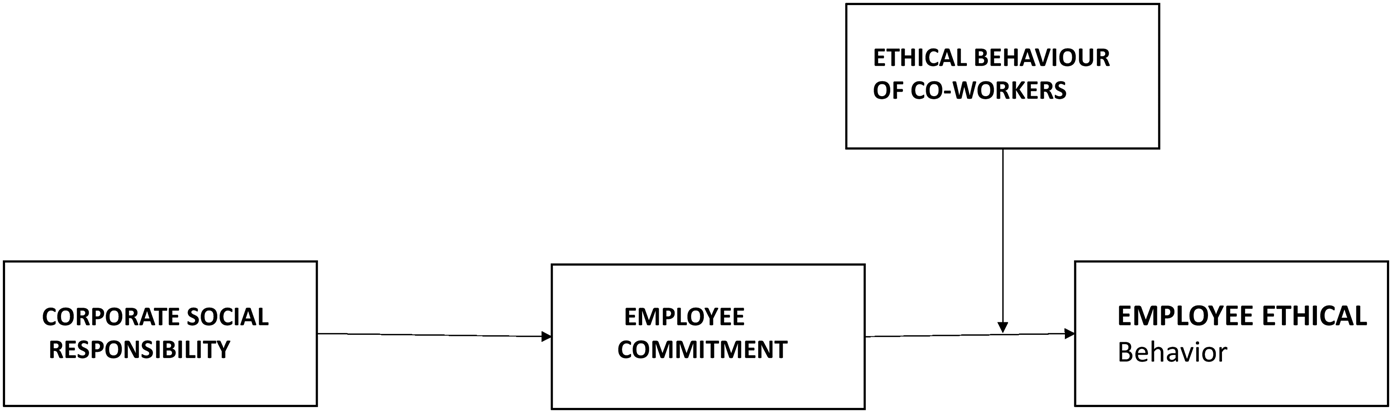
SLT suggests that individual behaviour results from the interaction between personal and situational factors (Hanna, Crittenden, & Crittenden, Reference Hanna, Crittenden and Crittenden2013), with individuals learning behaviour through observation and imitation (Bandura & Walters, Reference Bandura and Walters1977). Individuals notice some behaviour, retain it in their memory, reproduce it and subsequently receive either positive or negative reinforcement, which makes them repeat the learned behaviour in the future or, on the contrary, refrain from it. Employees can learn ethical standards from the cues created by ethical organisational activities, which demonstrate appropriate and valued behaviour (Evans, Goodman, & Davis, Reference Evans, Goodman and Davis2010). For example, studies suggest that employees notice an organisation's ethical stance during their socialisation period, which improves their perception of person–organisation ethical fit (Coldwell, Williamson, & Talbot, Reference Coldwell, A. L., Williamson and Talbot2019). Promoting CSR participation among employees fosters employees' understanding of organisational goals and expectations through their commitment to the organisation (John et al., Reference John, Qadeer, Shahzadi and Jia2019) and boosts their confidence in learning from co-workers (Sukserm & Takahashi, Reference Sukserm and Takahashi2012). According to SLT, social learning serves as the foundation upon which individuals perceive and develop ethical standards (Tafolli & Grabner-Kräuter, Reference Tafolli and Grabner-Kräuter2020). Drawing on these perspectives, we develop a conceptual framework shown in Figure 1 to examine the relationships between PCSR, employee commitment, and employee and co-worker ethical behaviour.
Conceptual framework.

Hypothesis development
PCSR, employee commitment, and employee ethical behaviour
CSR positively affects employees' commitment to their organisations (Farooq, Farooq, & Cheffi, Reference Farooq, Farooq and Cheffi2019; Zhang, Di Fan, & Zhu, Reference Zhang, Di Fan and Zhu2014). Employees want to identify themselves with organisations that are positively perceived by society (Lin & Liu, Reference Lin and Liu2019). Being part of a responsible organisation increases employees' self-esteem (Brammer, Millington, & Rayton, Reference Brammer, Millington and Rayton2007) and organisational pride (Edwards & Kudret, Reference Edwards and Kudret2017). Thus, employees may want to stay with this organisation demonstrating continuance commitment. When employees perceive organisations as socially responsible, they report a higher perception of their fit with this organisation and its culture (Tanwar & Kumar, Reference Tanwar and Kumar2019) and stronger identification with the organisation (Zhao, Lee, & Moon, Reference Zhao, Lee and Moon2019), which enhances commitment. CSR's moral roots were found to strengthen employee commitment, especially when ethics is important to employees and they have a high moral attentiveness (Uçkun, Arslan, & Yener, Reference Uçkun, Arslan and Yener2020).
Sol, Beers, and Wals (Reference Sol, Beers and Wals2013) found commitment to be one of the important properties of social learning as this is associated with passion, motivation, feelings of attachment, and desire to apply effort to learn. Commitment can create a strong motivation for social learning. Individuals are more likely to pay attention to normative expectations and behave according to them when they feel an attachment to the group representing these norms (Stok & de Ridder, Reference Stok, de Ridder, Sassenberg and Vliek2019). SLT suggests that modelled behaviour needs to be positively reinforced for learning to occur, or at least individuals should expect this positive reinforcement. The expectation of reinforcement creates motivation for learning and reproducing the behaviour (Bandura & Walters, Reference Bandura and Walters1977). For committed employees, maintaining their membership in organisations is of high importance (Meyer & Allen, Reference Meyer and Allen1991) and may serve as motivation for learning organisational norms. Committed employees are more likely to value learning behaviours that align with organisational values and practices.
Drawing on SLT, we argue that organisational commitment developed by PCSR may enhance employees' motivation to learn how to fit their behaviour with their organisation's ethical policies and practices. Previous studies demonstrate that employee loyalty and commitment are important prerequisites of ethical behaviour (Vallejo-Martos & Puentes-Poyatos, Reference Vallejo-Martos and Puentes-Poyatos2014). In this regard, Husin and Kernain (Reference Husin and Kernain2019) found that organisational commitment enhances Islamic work ethic principles. Gill, Meyer, Lee, Shin, and Yoon (Reference Gill, Meyer, Lee, Shin and Yoon2011) observed that employees with an affective organisational commitment are less likely to get involved in deviant behaviour and misconduct. Also, employees are more likely to engage in whistle-blowing behaviour to report and remedy their colleagues' wrongdoings when they have higher organisational commitment (Alleyne, Reference Alleyne2016). In contrast, if employees are not committed to their organisation, they may not conform to organisational values (Chun, Shin, Choi, & Kim, Reference Chun, Shin, Choi and Kim2013).
Building on these studies, we expect that PCSR will strengthen employees' organisational commitment, which in turn will positively impact employees' ethical behaviour as they will be motivated to learn how to ensure that their behaviour fits organisational policies and practices. Nonetheless, there is a limited understanding of how PCSR manifests itself in firms' strategic behaviours to ensure ethical compliance. Although the direct effects of PCSR on employee ethical behaviour could represent an aggregation of various outcomes resulting from PCSR, a partial mediation model controls for such direct effects while enabling theorising concerning the unique effects of PCSR on employee ethical behaviour through employee commitment. Taken together, we argue that the impact of PCSR on employee ethical behaviour can occur through employee commitment. Both PCSR and employee commitment will improve employee ethical behaviour adherence. However, a meaningful portion of employee ethical behaviour is explained by the partial mediating effect of employee commitment in CSR compliance organisations. Therefore, we hypothesise:
Hypothesis 1. Employee commitment partially mediates the relationship between PCSR and employee ethical behaviour.
The moderating effects of co-worker ethical behaviour
In organisations, social learning mainly occurs between co-workers, as they have more contact (Hanna, Crittenden, & Crittenden, Reference Hanna, Crittenden and Crittenden2013). This is also true for learning ethical behaviour. Goldstein, Cialdini, and Griskevicius (Reference Goldstein, Cialdini and Griskevicius2008) showed that people are more willing to follow the normative requirements related to environmental protection when informed that people with whom they identify demonstrate the same behaviour. Fu, Deshpande, and Zhao (Reference Fu, Deshpande and Zhao2011) concluded that co-workers' attitudes profoundly influenced their attitude towards work. Other studies also found that co-worker influence significantly impacts employees' ethical behaviour and decision-making (Deshpande, Joseph, & Prasad, Reference Deshpande, Joseph and Prasad2006) as employees pay attention to their leaders' and colleagues' behaviour, trying to align their behaviour with the behaviour demonstrated by referent others (Stok & de Ridder, Reference Stok, de Ridder, Sassenberg and Vliek2019). Fassin, Van Rossem, and Buelens (Reference Fassin, Van Rossem and Buelens2011) noted that business ethics emanated from employees' cumulated influential ethical behaviour on each other derived out of workplace social learning. If co-workers' ethical behaviour is perceived by an employee as strong, the link between employee commitment to the organisation and their ethical behaviour will be stronger (Mayer, Nurmohamed, Treviño, Shapiro, & Schminke, Reference Mayer, Nurmohamed, Treviño, Shapiro and Schminke2013). Based on the premises of SLT, O'Fallon and Butterfield (Reference O'Fallon and Butterfield2005) proposed co-worker influence as an important moderator of employee ethical behaviour. Therefore, we hypothesise:
Hypothesis 2: Co-worker ethical behaviour positively moderates the relationship between employee commitment and employee ethical behaviour.
Methods
Sample and data collection
To test our hypotheses, we focus on employees from organisations in Ghana, where CSR is still in its early stages (Agyemang & Ansong, Reference Agyemang and Ansong2017). So far, CSR activities in Ghana have primarily focused on environmental issues and philanthropy, to the exclusion of employee ethical behaviour and employee commitment (Abugre & Nyuur, Reference Abugre and Nyuur2015), providing a rich context for research. Furthermore, Ghana is currently undergoing processes of ethical management and CSR transformation. Through CSR initiatives, various sectors of the economy (particularly education) receive significant investment, with the mining sector making significant contributions (Tian, Pekyi, Chen, Sun, & Wang, Reference Tian, Pekyi, Chen, Sun and Wang2021).
To collect data, we first developed the questionnaire by adapting validated items from the literature (see below). Following the tailored design method (Dillman, Reference Dillman2011), we conducted a pilot study with three academic professionals and five listed companies' managers to establish question clarity and finalise the questionnaire. The final questionnaire had 27 questions across five sections (CSR engagement in the workplace; ethical behaviour of employees; ethical behaviour of co-workers; employee organisational commitment; participant demographics and industry).
We targeted companies in The Ghana Club 100, which represents Ghana's largest listed companies, the first adopters of CSR (Ofori, S-Darko, & Nyuur, Reference Ofori, S-Darko and Nyuur2014). We chose the companies from Ghana Club 100 as they are required to list their CSR activities. We contacted human resource (HR) managers in each company to explain our research purpose and invite the company to participate. Of the 100 companies, 67 agreed. With these HR managers' help, 550 paper and pencil questionnaires were distributed to employees. Participants were assured of the confidentiality of their responses in the consent form attached to the survey.
In the end, we received 342 responses, giving a response rate of 68.4%. Forty-two responses were omitted due to significant missing data on key constructs, leading to a usable sample of 300. In the final sample, employees were from 67 companies across various industries (agriculture 47 participants from 12 companies; manufacturing 42 from 9; energy and natural resources 42 from 9; construction 38 from 7; information and communication technology 37 from 9; hospitality 35 from 8; financial services 31 from 7; health 28 from 6). Of the sample, 59.3% were male and 40.7% female. The mean age was 36.9 years and 84.4% had worked with their respective companies for less than 10 years.
Measures
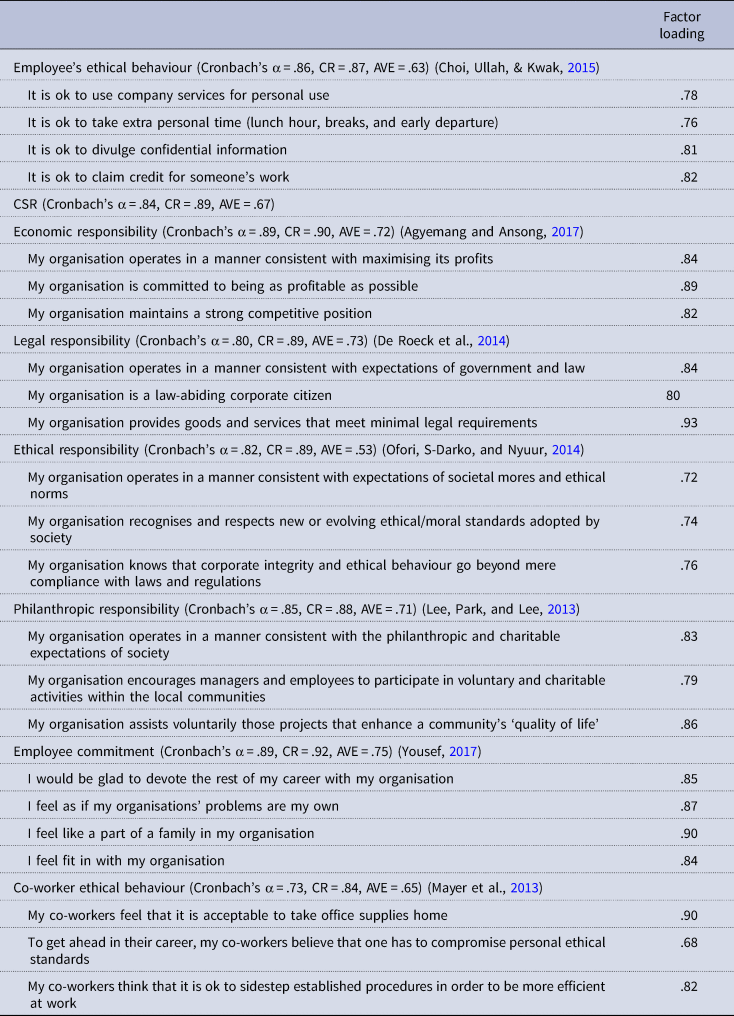
All the constructs in this research were measured using previously validated scales. A 7-point Likert scale (1 = ‘strongly disagree’ to 7 = ‘strongly agree’) was used (see Table 1).
Measurement of constructs validity and reliability

Employee ethical behaviour
Employee ethical behaviour was measured with a four-item scale (α = .86) adapted from (Choi, Ullah, & Kwak, Reference Choi, Ullah and Kwak2015). As shown in Table 1, a sample item for this scale is, ‘It is okay to use company services for personal use’.
Corporate social responsibility
In line with prior research (e.g., Jeon, Lee, and Jeong, Reference Jeon, Lee and Jeong2020), CSR was measured as a second-order construct. The first-order measurement consists of four constructs: economic, legal, ethical, and philanthropic responsibility (Carroll, Reference Carroll2016). We used items developed by prior research; economic responsibility (α = .89) from Agyemang and Ansong (Reference Agyemang and Ansong2017), legal responsibility (α = .80) from De Roeck, Marique, Stinglhamber, and Swaen (Reference De Roeck, Marique, Stinglhamber and Swaen2014), ethical responsibility (α = .82) from Ofori, S-Darko, and Nyuur (Reference Ofori, S-Darko and Nyuur2014), and philanthropic responsibility (α = .85) from Lee, Park, and Lee (Reference Lee, Park and Lee2013).
Employee commitment
Employee commitment was measured using Yousef's (Reference Yousef2017) four-item scale (α = .89). A sample item is ‘I feel a strong sense of belonging to my organisation’.
Co-work ethical behaviour
Co-worker ethical behaviour was measured with a three-item scale (α = .73) adapted from Mayer et al. (Reference Mayer, Nurmohamed, Treviño, Shapiro and Schminke2013). A sample scale item is ‘my co-workers think that it is okay to sidestep established procedures in order to be more efficient at work’.
Control variables
In line with previous studies, we controlled for employee tenure (Morton, Goodwin, Kellond, Close, & Collins, Reference Morton, Goodwin, Kellond, Close and Collins2011) and gender (Kahreh, Babania, Tive, & Mirmehdi, Reference Kahreh, Babania, Tive and Mirmehdi2014) as these might affect employee ethical behaviour and commitment. Employee tenure was measured as the number of years that the employee had worked for the company, while gender was measured as a dummy variable in which 1 = male and 0 = female.
Results
We used partial least squares structural equation modelling (PLS-SEM) to conduct data analysis, as the primary purpose of the study was to develop a moderated mediation framework to explore how PCSR integrates with employee commitment to facilitate employee ethical behaviour and how co-workers' ethical behaviour impacts the effects of employee commitment on their ethical behaviour. PLS-SEM is a variance-based and ‘prediction-orientated’ approach (Schlittgen, Ringle, Sarstedt, & Becker, Reference Schlittgen, Ringle, Sarstedt and Becker2016, p. 4583) that offers much greater flexibility testing such complex model (Hair, Hult, Ringle, Sarstedt, & Thiele, Reference Hair, Hult, Ringle, Sarstedt and Thiele2017). PLS-SEM not only allows us to assess the quality of the measurement model in terms of reliability and validity, but also evaluate the structural model wherein we test our hypotheses.
Assessment of the measurement model
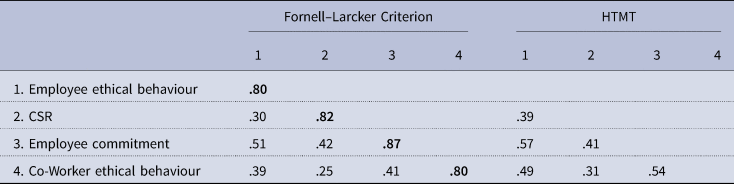
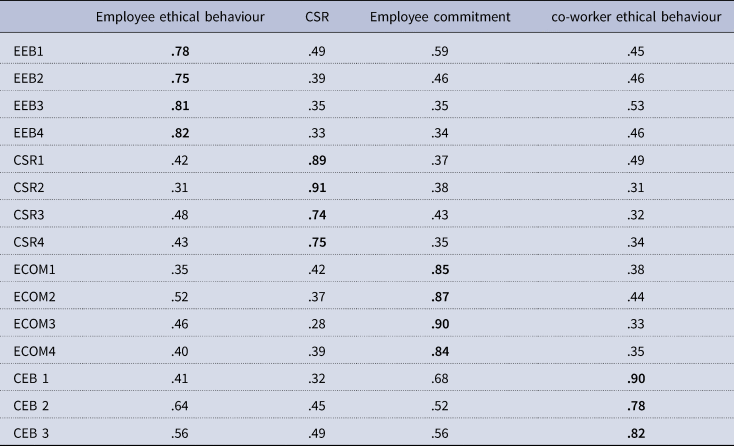
We took several steps to assess our measurement model. First, we measured the reliability of the construct using both Cronbach's alphas (α) and composite reliability (CR). The results in Table 1 show that all of the alpha (the minimum α = .73) and the CR (the minimum CR = .84) values for first-order and second-order constructs are above the threshold of .7 (Hair et al., Reference Hair, Hult, Ringle, Sarstedt and Thiele2017), demonstrating satisfactory reliability. Second, we measured convergent validity by the average variance extracted (AVE). As shown in Table 1, AVE values for all first- and second-order constructs (Min(AVE) = .53) are higher than the threshold of .5 (Fornell & Larcker, Reference Fornell and Larcker1981), suggesting convergent validity. Third, discriminant validity was tested with the Fornell–Larcker criterion, the heterotrait–monotrait (HTMT), and the cross-loadings. As shown in Table 2, the square root of the AVE of each construct was higher than the construct's highest correlation with any other construct, while the maximum value of HTMT is .57, which is much smaller than the threshold of .85 (Henseler, Ringle, & Sarstedt, Reference Henseler, Ringle and Sarstedt2015). The cross-loadings of all items in Table 3 load higher on their respective constructs than on any other constructs. Taken together, these results demonstrate discriminant validity.
Fornell–Larcker Criterion and HTMT)

Bold diagonal elements are the square root of Average Variance Extracted.
Cross-loadings

ECOM, employee commitment; CEB, co-worker ethical behaviour; EEB, employee ethical behaviour; CSR, corporate social responsibility.
The results marked in bold indicate where the highest value is expected.
Common method bias (CMB)
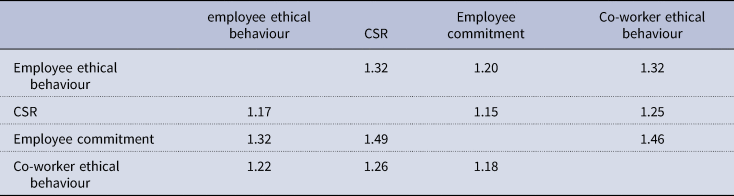
We checked for CMB in three ways. Following Podsakoff, MacKenzie, Lee, and Podsakoff's (Reference Podsakoff, MacKenzie, Lee and Podsakoff2003) suggestion, we conducted a pilot study to control for item ambiguity. Moreover, we used items from the literature to measure our constructs and separated items related to the questionnaire's same construct. Then, we conducted Harman's single-factor test on the conceptualised constructs. The results indicate there are seven factors together explaining 82% covariance, while the most covariance explained by one factor is 33%. Finally, with SmartPLS, we conducted a full collinearity test (Kock, Reference Kock2015) in which if all inner variance inflation factors (VIFs) values are lower than 3.3, the model can be considered free of CMB. The results in Table 4 show that the maximum inner VIF value is 1.49, confirming that CMB is not a concern in this research.
Full collinearity VIF value

Analytical model
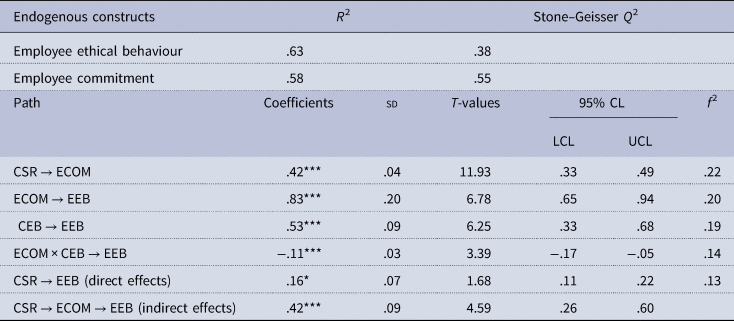
The structural model was estimated by examining the variance explained (R 2) in the endogenous variables, and the Stone–Geisser Q 2 value (Q 2). The significance of the path coefficients was assessed with the 5000 sub-sample bootstrap method (Hair et al., Reference Hair, Hult, Ringle, Sarstedt and Thiele2017). The results in Table 5 show that the model explains a significant amount of variance for employee ethical behaviour (R 2 = .63) and employee commitment (R 2 = .58). The positive values of Q 2 (for employee ethical behaviour: Q 2 = .38; for employee commitment: Q 2 = .54) further suggest that the model has predictive relevance of the reflective endogenous constructs.
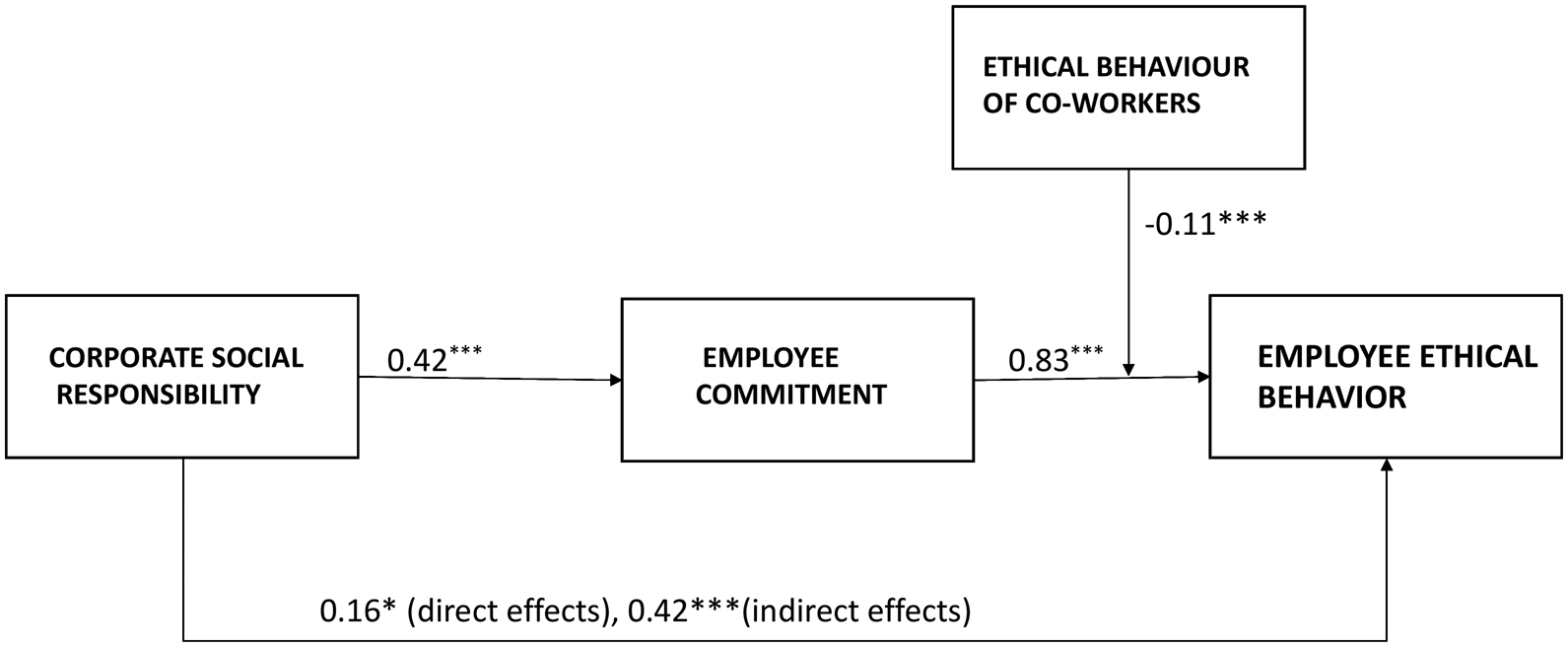
Hypothesis 1 predicts the mediating effects of employee commitment on the relationship between CSR and employee ethical behaviour. The results in Table 5 and Figure 2 demonstrate the positive and significant effects of CSR on employee commitment (β = .42, p < .001) with the effect size of f 2 = .22, and of employee commitment with employee ethical behaviour (β = .83, p < .001; f 2 = .20). The indirect effects of CSR on employee ethical behaviour through employee commitment are also positive (indirect effects (β = .42, p < .001) with the 95% confidence interval (CI), which does not include the point of zero (LCI = .26, UCI = .60). The direct relationship between CSR and employee ethical behaviour is significant (β = .16, p < .05; f 2 = .13) when employee commitment is controlled, confirming that employee commitment is a partial mediator in the CSR–employee ethical behaviour relationship. Thus, Hypothesis 1 is supported.
Pictorial results of PLS-SEM.
Note: CEB -> EEB: 0.53***. Significant level: p* < .05, p** < .01, p*** < .001; two-tailed test. Employee Ethical Behaviour (EEB), Co-worker Ethical Behaviour (CEB).

Structural equation modelling results

sd, standard deviation; CI, confidence interval; LCI, lower confidence interval; UCL, upper confidence interval; ECOM, employee commitment; EEB, employee ethical behaviour; CEB, co-worker ethical behaviour.
Note: *p < .05, **p < .01, ***p < .001; two-tailed test.
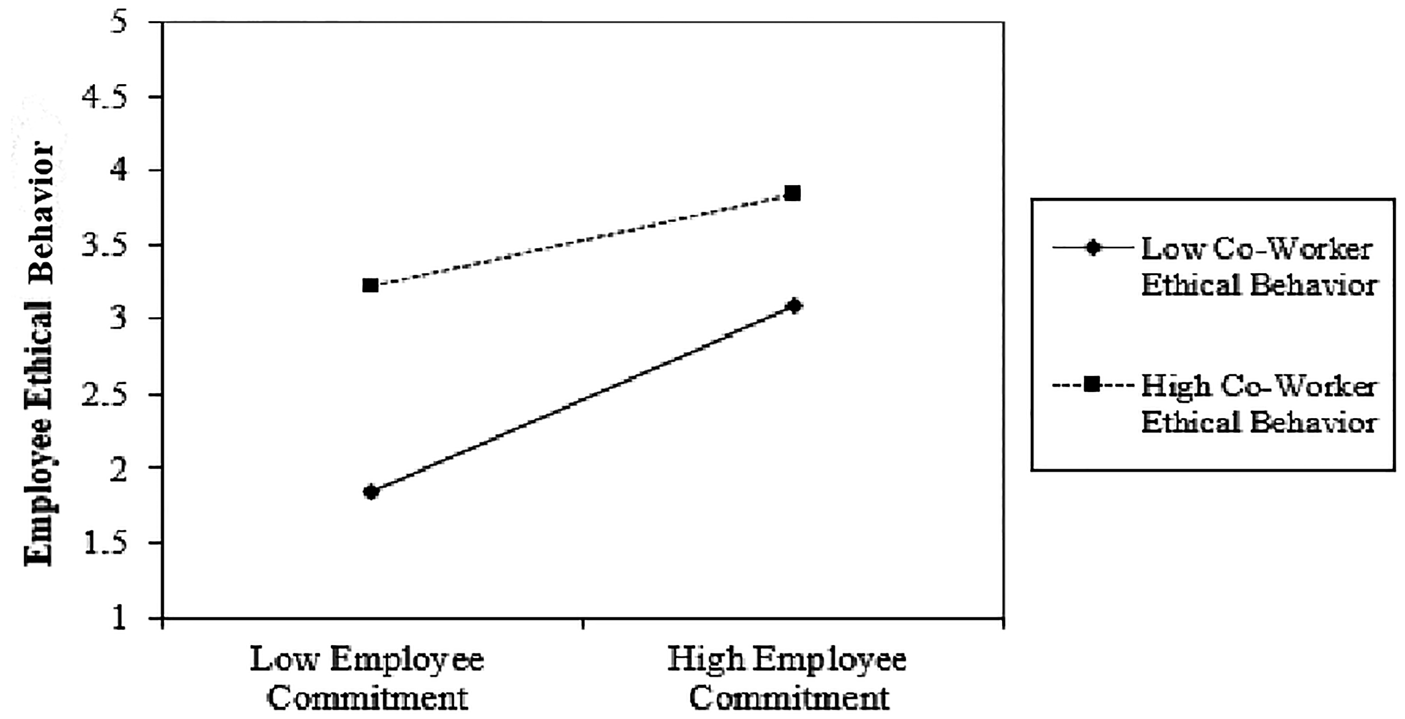
Hypothesis 2 proposes that co-worker's ethical behaviour positively moderates the relationship between employee commitment and ethical behaviour. However, as shown in Table 5 and Figure 2, the interaction of co-worker ethical behaviour and employee commitment while being significant is negatively associated with employee ethical behaviour (β = −.11, p < .001). As shown in Figure 3, comparing the standardised regression coefficients of a high co-worker ethical behaviour (β = .69, p < .001) and a low co-worker ethical behaviour (β = .35, p < .001), the relationship between employee commitment and employee ethical behaviour are both significant. The dual significance of the cross-level moderation, plotting the relationship between employee commitment and employee ethical behaviour with high and low co-worker ethical behaviour, is indicative that employee commitment is crucial in determining ethical compliance when employees do not observe the ethical behaviour of their co-workers. These somewhat counter-intuitive findings will be discussed in the next section.
The moderating effect of co-worker ethical behaviour.

Discussion and conclusion
Building on the CSR and SLT (Chen & Hung-Baesecke, Reference Chen and Hung-Baesecke2014), we examined the effects of PCSR on employee ethical behaviour. Although prior research has acknowledged the importance of PCSR in fostering employees' ‘favourable attitudes and behaviour toward the organisation’ (De Roeck & Farooq, Reference De Roeck and Farooq2018, p. 932), there is a lack of empirical studies on how PCSR affects employees' ethical behaviour. Our research adds to this literature by conducting an employee level analysis to show how PCSR has a significant impact on employee ethical behaviour. Our findings show the positive effects of PCSR on employee commitment which offers new evidence for the significant relationship between PCSR and employee commitment to the organisation (Limpanitgul, Boonchoo, & Photiyarach, Reference Limpanitgul, Boonchoo and Photiyarach2014). More importantly, PCSR may have both positive and negative impacts on employee behaviour (e.g., Appelbaum, Iaconi, and Matousek, Reference Appelbaum, Iaconi and Matousek2007), PCSR alone might not provide a full explanation for employee ethical behaviour. As a result, the current study sheds light on employee organisational commitment as a cognitive mechanism through which PCSR may influence employee ethical behaviour. Furthermore, contrary to previous research that found positive moderating effects of co-workers normative behaviour on others' behaviour (Stok & de Ridder, Reference Stok, de Ridder, Sassenberg and Vliek2019), our findings show that when co-workers' ethical behaviour is strong, the impact of employees' commitment on employee ethical behaviour is reduced because learning from co-workers is easier than learning from the organisation through commitment (Mayer et al., Reference Mayer, Nurmohamed, Treviño, Shapiro and Schminke2013).
Theoretical implications
Our research has at least two theoretical implications. The first contribution is to the current debate on the effects of CSR on micro-level behavioural outcomes by employing employee commitment as a mechanism through which PCSR significantly enhances employee ethical behaviour. The findings of PCSR–employee commitment–employee ethical behaviour relationship help explain how CSR can raise employee commitment towards the vision of the organisation (Su & Swanson, Reference Su and Swanson2019), strengthening employee ethical behaviour. On the one hand, we extend our understanding of the effects of CSR by confirming that PCSR not only facilitates organisational behaviour (OB) outcomes, including organisational commitment (Kim, Song, & Lee, Reference Kim, Song and Lee2016), but also helps to form employees' ethical behaviour, which is ‘beyond OB outcomes’ (De Roeck & Farooq, Reference De Roeck and Farooq2018, p. 932). On the other hand, the findings of the partial mediating effects of employee commitment on the relationship between PCSR and employee ethical behaviour provide us with a better understanding of how CSR influences the implementation of ethical behaviour at the individual level. Such that committed employees are more willing to learn from the organisation to ensure that their behaviour is aligned with organisational expectations and culture. Employee commitment hence allows employees to align their PCSR with their own ethical behaviour.
Another contribution is the recognition of the negative effects of co-workers' ethical behaviour on the relationship between employee commitment and ethical behaviour. This finding implies that when co-workers exhibit high levels of ethical behaviour, other employees have more opportunities to directly learn and replicate this ethical behaviour and decision-making of referent others (Trevino, Reference Trevino1986). This may be especially true for those with low commitment, who are more likely to follow observed social norms such as those presented by co-workers' ethical behaviour to behave ethically (Limpanitgul, Boonchoo, & Photiyarach, Reference Limpanitgul, Boonchoo and Photiyarach2014). In contrast, when co-workers' ethical behaviour is weak, commitment to the organisation becomes a catalyst for employees to learn from the organisation and demonstrate ethical behaviour. Moreover, committed employees tend to have lower needs to comply with their co-workers or rely on co-workers' information and behaviour (Liu, Liang, Wang, & Xue, Reference Liu, Liang, Wang and Xue2021). As a result, our research shows the nuanced interaction between the influence of organisational commitment and co-worker behaviour of workplace ethics, possibly opening new avenues for research on the impact of descriptive norms at the workplace.
Practical implications
The study shows that PCSR activities increase employee loyalty to their organisation, influencing their obligation to engage in ethical behaviour. Organisational CSR involvement and specific CSR actions must be actively communicated within organisations because employees learn ethical behaviour from these. The role of HR managers in this communication is critical. HR managers can raise CSR awareness by developing internal CSR communication campaigns, induction and training programmes, and engaging employees in organisational CSR activities. The study's findings also demonstrate the importance of co-worker ethical behaviour. Employees learn from one another, so positive ethical behaviour and social learning must be encouraged, and potentially rewarded. Using CSR principles to develop organisational culture can help to drive learning behaviour within the organisation. Hence, we recommend that organisations should give more attention to meeting CSR objectives. This is important given that the level of CSR undertakings reported by the respondents was not extensive. In an era where firms are battling with worker attrition and high turnover rates (Goldstein, Cialdini, & Griskevicius, Reference Goldstein, Cialdini and Griskevicius2008), strong employee commitment and loyalty will be vital, especially among top qualified personnel.
Limitations and directions for future studies
This study has several limitations that could be addressed in future research. First, this study employed a cross-sectional design. This limits the possibility of making strong conclusions about causal relationships between the variables of interests. Future longitudinal studies involving data collection over several waves from the same participants could identify causal relationships between CSR and employees' ethical behaviour (Zhao, Lee, & Moon, Reference Zhao, Lee and Moon2019). Also, the generalisability of findings is limited by collecting data from only one country. Although to achieve the aims of this research, it was important to collect data from a developing country. Comparing the findings with other developing countries would allow for a more nuanced understanding of the role and status of CSR in developing countries. Third, we have studied the influence of various CSR dimensions (economic, legal, ethical, and philanthropic) at the aggregated level. There is a possibility that different dimensions of CSR may have different influences on employees. Future research might investigate the impact of each of these CSR dimensions. Although this study focused on the individual-level mediator, such contextual variables of team climate or social setting could mediate the relationship between CSR and ethical behaviour. Taking into account CSR's focus on stakeholder interests and values, it would seem appropriate to also explore how CSR impacts the ethical behaviour of employees towards other stakeholders, such as customers, suppliers, or local communities.
We believe that future research can also look at how employees perceive and influence similar approaches to CSR adopted by different organisations as a result of normative, coercive, or memetic mechanisms of isomorphism. Previous research has identified some obstacles to the implementation of codes of conduct in different countries or parts of supply chains (Lin et al., Reference Lin, Clay, Hajli and Dadgar2016). In this regard, whether uniform codes of ethics that ignore national or organisational culture specifics have a positive or negative impact on employees' perceptions of organisational ethical values and subsequent behaviour is a question worth investigating. Finally, we suggest that future research should explore the moderating role of co-worker ethical behaviour in the relationship between PCSR, organisational commitment, and employees' ethical behaviour. Although our findings suggest that co-worker ethical behaviour is an important condition for organisational CSR's impact on employees' ethical behaviour, the nuances of this impact need to be investigated and explained further.
Conclusion
Organisations in developing countries are often encouraged to adopt CSR by their partners from developed countries. However, whether these endeavours payoff is not clear. Although there have been studies on CSR in recent years in Ghana, they are fragmented (Agyemang & Ansong, Reference Agyemang and Ansong2017). This study used a sample of 300 employees of companies listed in the Ghana Club 100 to identify CSR's role in instilling employee ethical behaviour. Our research provides insights into how CSR affects non-performance-based workplace outcomes of employee ethical behaviour through organisational commitment. This study, therefore, adds to the instrumentalist perspective of CSR and provides support for SLT, which suggests that employees are likely to model the behaviours they observe in their organisation and that organisational commitment is a strong predictor of employee ethical behaviour. Moreover, we found that effective interaction between organisational commitment and co-worker ethical behaviour is important for employee ethical behaviour. This study may serve as an initiative for future research on employee consequences of CSR.
Christian Agyapong Sarfo is a PhD Candidate at Otago University, New Zealand with a keen interest in open innovation, performance measures, financing innovation strategies, and strategic entrepreneurship. He has published in Academy of Management Proceedings and International Journal of Electronic Business, among others.
Dr. Jing A. Zhang is a Senior Lecturer in strategic innovation and entrepreneurship in Otago Business School, University of Otago. Her primary research interests include strategic innovation management, innovation ambidexterity, human capital and innovation, entrepreneurial capital, and competitiveness of emerging market firms. She has published in Industrial Marketing Management, Journal of Business Research, Technological Forecasting & Social Change, Journal of Business Ethics, R&D Management, and International Journal of Human Resource Management, among others.
Dr. Nataliya Podgorodnichenko is a Lecturer in DBA programme at the Otago Business School, University of Otago. Her primary research interests include corporate social responsibility, sustainability, human resource management, sustainable and green human resource management, and lean thinking. She has published in Production Planning and Control, Human Resource Management Review, and Employee Relations.
Dr. Paula O’Kane is a Senior Lecturer in Human Resource Management at the University of Otago in Dunedin (New Zealand). Her expertise lies in human resource management across a range of areas including performance management, social media and the future of work. She has extensive expertise in Computer-Aided Qualitative Data Analysis and has published in Organizational Research Methods, Human Resource Management Journal and Studies in Higher Education, Human Resource Development Quarterly, and Personnel Review, among others.
Kizito Kwabena Osei-Fosu recently graduated with his MPhil in Human Resource Management, focusing on organisational CSR. He currently serves as the HR manager for nante3-Gh Company.