Introduction
Behçet's disease is a chronic, multisystem, inflammatory condition in which recurrent mouth ulcers are associated with genital ulcers, skin lesions and uveitis.Reference James1–Reference Marshall3 The prevalence of Behçet's disease indicates a marked geographical variation. There are thought to be about 2000 patients in the UK, but the prevalence is much higher in Japan (10 per 100 000 population) and Turkey (8–38 per 100 000 population).Reference Marshall3–Reference Dagli, Eryilmaz, Tanrikulu, Aydin, Gonul and Gul5
The cause of Behçet's disease remains unknown; however, viral agents, and immunological and bacterial factors have been cited as contributing to its development.Reference James1, Reference Dagli, Eryilmaz, Tanrikulu, Aydin, Gonul and Gul5 It is now recognised that many organs may be affected by a generalised vasculitis of small vessels.Reference Arca and Gur2–Reference Soylu, Ersoz and Erken4 This condition manifests as the infiltration of vessel walls by mononuclear cells, and later by polymorphonuclear cells, increased permeability of the vessel wall and abnormalities in platelet function.Reference James1, Reference Arca and Gur2
Dagli et al. reported that hearing is commonly impaired in Behçet's disease, and the rates of hearing loss vary between 12 and 80 per cent.Reference Dagli, Eryilmaz, Tanrikulu, Aydin, Gonul and Gul5 According to Kulahli et al., high-frequency sensorineural hearing loss (SNHL) is the major type of hearing loss encountered among these patients.Reference Kulahli, Balci, Koseoglu, Yuce, Cagli and Senturk6 Inner-ear or vestibulocochlear system involvement has also been reported in the literature.Reference Arca and Gur2, Reference Ak, Harputluoglu, Oghan and Baykal7
This study aimed to determine the characteristics of hearing loss and cochlear status in patients with Behçet's disease.
Materials and methods
Study design
Twenty-six patients who met the diagnostic criteria of the International Study Group for Behçet's Disease,8 and 25 age-matched healthy controls, were included in this study. The Behçet's disease patients were consecutive cases admitted to the department of dermatology. Patients with a history of cranial trauma, exposure to noise, ear infection, metabolic disease, systemic disease (such as diabetes mellitus), hearing loss before diagnosis of Behçet's disease, and ototoxic drug use were excluded from the study. The control group consisted of volunteers selected from the hospital staff. The medical history of control subjects was normal and there were no consistent audiological complaints. The pure tone average thresholds of all controls were normal. All patients underwent clinical otorhinolaryngological and systemic examination. Otoscopic examination findings were normal, with intact, mobile tympanic membranes in both groups.
Outcome parameters
The audiological evaluation of Behçet's disease patients and control subjects included pure tone audiometry, auditory brainstem-evoked response (ABR) assessment and distortion product otoacoustic emission (DPOAE) testing.
All audiological evaluations were performed at frequencies of 0.25, 0.5, 1, 2, 4 and 8 kHz, using an AC-40 diagnostic audiometer (Interacoustics, Assens, Denmark) in a standard sound-treated cabin. The first evaluation was performed with an impedance meter (AZ 26; Interacoustics). Normal middle-ear function and acoustic reflex results were recorded. Those patients and controls with normal peak compliance, peak pressure, gradient, ear canal volume and acoustic reflexes (obtained by immittance measures), as defined by the American Speech–Language–Hearing Association, were included in the study.9 A threshold of more than 30 dB at two frequencies on the pure tone audiogram was accepted as SNHL.
The DPOAEs were measured using a GSI Audera™ evoked potentials system (on ‘general diagnostic’ mode). The amplitudes and growth functions of DPOAEs at 2f1-f2 were elicited by two primary tones f1 and f2, with a constant frequency ratio of f2/f1 = 1.22, and varying geometric mean values of 1, 1.5, 2, 4, 6 and 8 kHz. Stimulus intensities were L1 = 65 dB and L2 = 55 dB (L1-L2 10 dB).
The ABR testing was performed in a quiet room using the GSI Audera system. Abrasive paste was applied to clean the skin. Electrodes were then placed (using an electrolytic paste and adhesive tape) on the vertex, and on the right and left mastoids. Electrode impedance values were checked; these were required to be below 5 kohm. The tone-click stimulus was set at 80 dB HL to measure waves I and V and their latency times. The click stimulus was delivered at a frequency of 11.1 per second. Noise was applied to the opposite headphone at 40 dB. The test was repeated three times and the best overlapping responses were used for analysis.
Statistical analysis
Data were analysed using SPSS® software, version 11.5 for Windows. Statistical significance was accepted for p values less than 0.05. Normal distribution of the continuous variables was determined using the Shapiro–Wilk test. The mean values for patients and controls were compared using the Student's t-test. The median values for patients and controls were compared using the Mann–Whitney U test. Nominal variables were analysed with the use of the Pearson chi-square test. The results of left and right ears in the patient group were compared using a dependent t-test and the Wilcoxon signed rank test.
Results
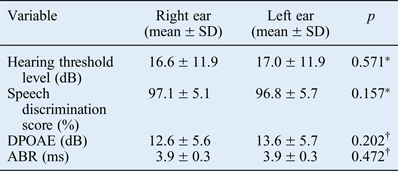
Twenty-six patients with Behçet's disease (9 male and 17 female) and 25 age-matched healthy controls (12 male and 13 female) were included in the study. The mean age of the two groups was comparable (patients, 43.2 ± 10.4 years; controls, 42.5 ± 8.6 years). The comparison of left and right ears in the patient group revealed no significant difference (p > 0.05, Table I). The mean period of disease was 7.8 years. The duration of Behçet's disease was not significantly different between those patients with or without inner-ear involvement (p > 0.05).
Hearing threshold level (HTL) results for the patient and control groups.

Comparison of patients' right and left ear results
*Wilcoxon signed rank test; †dependent t-test. SD = standard deviation; DPOAE = distortion product otoacoustic emission; ABR = auditory brainstem-evoked response
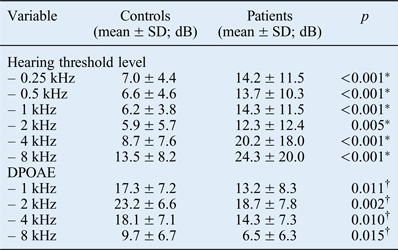
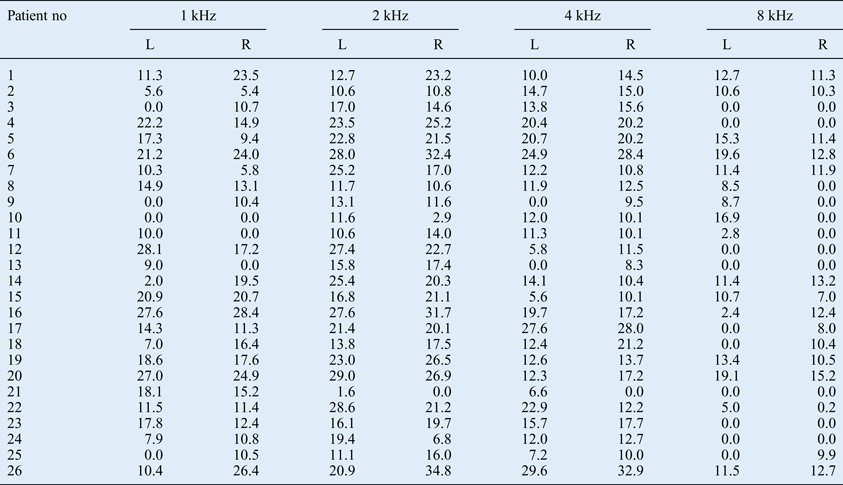
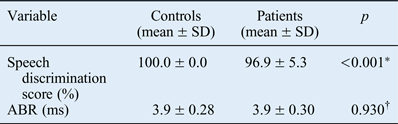
Audiometric pure tone thresholds of the patients and controls were significantly different at all frequencies (p < 0.05, Table II). The assessment of pure tone thresholds revealed the presence of SNHL (more than 30 dB at a minimum of 2 frequencies) in 6 of the 26 Behçet's disease patients (23 per cent). Hearing loss in the patient group was bilateral in five cases and unilateral in one case. The most significant decreases were recorded at frequencies of 4 kHz and 8 kHz (p < 0.05, Figure 1). Three patients with Behçet's disease had SNHL at all frequencies, two had high-frequency SNHL (4 kHz and 8 kHz) and one showed SNHL at speech frequencies (0.5 kHz and 2 kHz). Compared with the control group, the distortion product otoacoustic emission (DPOAE) responses of the Behçet's disease patients with SNHL were significantly lower at all frequencies (p < 0.05), indicating weaker outer hair cell motility. The DPOAE findings of the patients are shown in Table III. The ABR findings did not disclose any inner-ear involvement. There were no significant differences between the two groups in terms of the I–V interpeak latencies at all frequencies (p > 0.05). Table IV shows the mean values of the ABR results, the speech discrimination scores and the p values.
Comparison of patient and control groups' hearing threshold levels and DPOAE results
*Mann–Whitney U test; †Student's t-test. DPOAE = distortion product otoacoustic emission; SD = standard deviation
Patients' DPOAE results
Data represent means. DPOAE = distortion product otoacoustic emission; no = number; L = left ear decibels; R = right ear decibels
Comparison of patient and control groups' speech discrimination scores and ABR results
*Mann–Whitney U test; †Student's t-test. ABR = auditory brainstem-evoked response; SD = standard deviation
Discussion
The findings of the present study indicate that audiological involvement is not uncommon in Behçet's disease patients, compared with healthy controls. It has been reported in previous studies that hearing can be affected in 12–80 per cent of patients with Behçet's disease.Reference Gemignani, Berrettini, Bruschini, Sellari-Franceschini, Fusari and Piragine10, Reference Evereklioglu, Cokkeser, Doganay, Er and Kizilay11 Soylu et al. reported that 20 of 72 Behçet's disease patients showed some degree of hearing loss, although not all of them were aware of it. Significant hearing losses were recorded at frequencies of 0.25, 0.5, 2 and 4 kHz. Hearing loss was one-sided in 13 of the patients, while it occurred in both ears in the other 7 patients.Reference Soylu, Ersoz and Erken4 In our study, six patients (23 per cent) had SNHL. Hearing loss was bilateral in five cases and unilateral in one case. The most significant decreases were recorded at frequencies of 4 kHz and 8 kHz.
Behçet's disease can also involve lesions or inflammation of the inner ear, with vestibular and/or cochlear problems.Reference Dagli, Eryilmaz, Tanrikulu, Aydin, Gonul and Gul5, Reference Kulahli, Balci, Koseoglu, Yuce, Cagli and Senturk6, Reference Evereklioglu, Cokkeser, Doganay, Er and Kizilay11–Reference Choung, Cho, Park, Choi, Shin and Lee14 Gemignani et al. stated that sudden or temporary deafness can be a first sign of Behçet's disease.Reference Gemignani, Berrettini, Bruschini, Sellari-Franceschini, Fusari and Piragine10 Narváez et al. suggested that hearing impairment in patients with Behçet's disease should be treated quickly to prevent permanent hearing loss.Reference Narváez, Valverde-García, Alegre-Sancho, Juanola, Clavaguera and Roig-Escofet15 Brama and Fainaru reported that inner-ear involvement was observed more commonly in older patients with longer disease duration.Reference Brama and Fainaru16 There was a statistically significant difference in hearing loss at high frequencies when compared with speech frequencies in that study. However, another study found no correlation between duration of the disease and hearing loss (duration of the disease was over five years for all patients).Reference Ak, Harputluoglu, Oghan and Baykal7 In our study, duration of Behçet's disease was not significantly different between those patients with or without inner-ear involvement (p > 0.05). This result may be associated with the stage at which the clinical findings of Behçet's disease were detected.
Although several studies have reported hearing loss in patients with Behçet's disease, there are relatively few studies on distortion product otoacoustic emissions (DPOAEs).Reference Dagli, Eryilmaz, Tanrikulu, Aydin, Gonul and Gul5 Measurements of DPOAEs correspond closely with the physiological state of the outer hair cells of the cochlea. Normal DPOAE results provide extremely strong evidence of normal cochlear function.Reference Kimberley17 Dagli et al. showed a significant difference in DPOAE results between Behçet's disease patients and controls.Reference Dagli, Eryilmaz, Tanrikulu, Aydin, Gonul and Gul5 We also found significant differences in the DPOAE results between the patients and controls, at all frequencies (p < 0.05). These results are a strong indicator of cochlear involvement in patients with Behçet's disease.
• This study aimed to determine the characteristics of hearing loss in Behçet's disease patients
• Pure tone and speech audiometry, tympanometry, distortion product otoacoustic emission testing, and auditory brainstem-evoked response (ABR) assessment were conducted in patients and controls
• The ABR results were not significantly different between the patients and controls
• Audiological involvement was more frequent in Behçet's disease patients than in healthy controls
The ABR assessment is a simple, objective and non-invasive test of the neural pathway, which allows the prediction of the psychoacoustic threshold via the electrophysiological threshold. The ABR assessment was used to evaluate the presence of retrocochlear lesions.Reference Kulahli, Balci, Koseoglu, Yuce, Cagli and Senturk6, Reference Evereklioglu, Cokkeser, Doganay, Er and Kizilay11 There was no statistically significant difference between the ABR results of the patients and controls in our study (p > 0.05). We found no evidence of retrocochlear lesions in the six patients with SNHL; this finding is similar to that reported in another study.Reference Evereklioglu, Cokkeser, Doganay, Er and Kizilay11
Conclusion
Most patients with Behçet's disease will exhibit other otolaryngological symptoms, hearing loss in particular. This article elucidates the level of hearing loss and cochlear involvement in Behçet's disease. We believe that audiological assessment and management may be helpful in the diagnosis and treatment of patients with Behçet's disease.