INTRODUCTION
Impulse control disorders (ICD) are also considered “behavioral addictions” (Brewer & Potenza, Reference Brewer and Potenza2008). Other psychiatric disorders, such as bulimia nervosa (BN), share many clinical similarities with ICD. Goodman (Reference Goodman2008) has posited that substance use disorders, BN, pathological gambling (PG), and sexual addiction all share an underlying biopsychosocial process: the addictive process. This theory proposes that there is an interaction of impairment on three functional levels: motivation reward, affect regulation, and behavioral inhibition. Other authors have also suggested that PG and BN demonstrate abnormalities of the brain’s reward system similar to addictive disorders (Koob & Le Moal, Reference Koob and Le Moal2008).
Both PG and BN patients frequently demonstrate elevated impulsivity and behavioral disinhibition. Recent studies suggest that impulsivity is not a unitary construct but that it involves at least two separate factors (i.e., “rash impulsiveness” and “sensitivity to reward”; Dawe et al., Reference Dawe, Gullo and Loxton2004). Several questionnaires have been proposed to measure the dimensions of impulsivity, including the Barratt Impulsiveness Scales-11 (Patton et al., Reference Patton, Stanford and Barratt1995), the Sensation Seeking Scales (Zuckerman et al., Reference Zuckerman, Eysenck and Eysenck1978), the UPPS Impulsive Behavior Scale (Whiteside & Lynam, Reference Whiteside and Lynam2001), and others. However, to date, no consensus about the specific factors characterizing impulsivity has been achieved.
This overlap of apparently different psychiatric disorders adds confusion to their current categorical considerations. The study of endophenotypes may help shed light on their classification. In this regard, neuropsychological performance is a recognized endophenotype for psychiatric studies (Gottesman & Gould, Reference Gottesman and Gould2003).
Neurocognitive studies of PG report deficits in cognitive inhibition, complex executive functions, attention, and decision making (e.g., Brand et al., Reference Brand, Kalbe, Labudda, Fujiwara, Kessler and Markowitsch2005). Kertzman et al. (2006) reported slower performance in a reverse variant of the Stroop test in relation to healthy controls (HCs). Marazziti et al. (Reference Marazziti, Catena Dell’osso, Conversano, Consoli, Vivarelli, Mungai, Di Nasso and Golia2008) found that PG demonstrated more Wisconsin Card Sorting Test (WCST) perseverative errors compared with HCs.
In comparison to neurocognitive research in PG, there is a paucity of research investigating executive functions in BN. Diminished decision making (greater risk-taking, similar to PG), poor perceptual shift and mental flexibility, attentional biases, poor executive functioning, and weak central coherence (Duchesne et al., Reference Duchesne, Mattos, Fontenelle, Veiga, Rizo and Appolinario2004; Roberts et al., Reference Roberts, Tchanturia, Stahl, Southgate and Treasure2007) have been described. Only Ferraro et al. (Reference Ferraro, Wonderlich and Jocic1997) examined WCST performance in BN, finding reduced performance relative to HCs, but the authors did not specify the indices analyzed. A review of the literature reveals no studies examining cognitive inhibition with the Stroop test in BN; studies using this test focus on food- and weight-related attentional biases of bulimics but do not explicitly explore cognitive inhibition.
Given the phenotypical and possibly endophenotypical overlap across disorders of impulse control, there is a need for comparative studies focused on these disorders (Goodman, Reference Goodman2008). In fact, the literature confirms the comorbidity and shared vulnerability of PG or BN and substance use disorders (Hudson et al., Reference Hudson, Hiripi, Pope and Kessler2007). However, very little research examining the comorbidity and common manifestations of BN and PG exists.
Our previous research (Álvarez-Moya et al., Reference Álvarez-Moya, Jimenez-Murcia, Granero, Vallejo, Krug, Bulik and Fernandez-Aranda2007; Fernández-Aranda et al., 2006) suggests that PG and BN may be more closely associated in females than males at a personality level. In addition, the differing distribution of sex in these clinical groups (Peláez-Fernández et al., Reference Peláez-Fernández, Labrador and Raich2007; Petry et al., Reference Petry, Stinson and Grant2005) creates difficulty in recruiting PG females and BN males. Considering these phenotypical similarities and the possible role of sex in determining these similarities, the objective of the present study was to explore similarities and differences in executive functioning in female PG and BN patients, relative to HC females. Our aim was to identify a possible endophenotypical basis for phenotypical similarities between both disorders. We hypothesized that the BN and PG clinical groups would demonstrate executive functioning deficits compared to HC females.
METHODS
Participants
The present study focused on females, given the difficulty of recruiting BN males. The sample consisted of 15 female BN patients, 15 female PG patients, and 15 HC females. BN and PG patients were recruited from an Eating Disorders Unit and a Pathological Gambling Unit (University Hospital of Bellvitge, Spain). Participants were consecutive patients seeking treatment for their respective pathologies and were diagnosed according to Diagnostic and Statistical Manual, 4th Edition-TR. Forty percent of the BN patients and 53.4% PG patients were taking psychiatric medication, primarily antidepressants (selective serotonin reuptake inhibitors; 75% of PG patients and 50% of BN patients) or benzodiazepines (37.5% of PG patients and 50% of BN patients). No HC participant was taking psychiatric medication.
Exclusion criteria were male sex; history of neurological disorder or head injury, psychotic disorder, or comorbidity among PG and BN; or history of substance abuse in the previous 3 months. HC females were recruited through advertisements in a local newspaper and screened for history of psychiatric disorders prior to the assessment using the General Health Questionnaire-28 (GHQ-28; Goldberg, Reference Goldberg1981).
In the BN group, 66.7% were of purging type and 33.3% nonpurging. Mean age of disorder onset was 20.8 years (SD = 9.4), and mean duration of BN was 12.7 years (SD = 8.0). Mean total score on the Eating Disorders Inventory-2 (Garner, Reference Garner1991) was 101.0 (SD = 47.4), and mean body mass index was 26.3 (SD = 6.0). Mean score in the Symptom Check List—90 items—Revised (SCL-90-R; Derogatis, Reference Derogatis1977) Global Severity Index (GSI) was 2.1 (SD = 0.5).
PG patients were mainly slot machine gamblers (60%). 30% had several gambling problems (slot machines, bingo, and lotteries), and 10% were primarily bingo gamblers. Mean age of onset was 39.9 years (SD = 11.2), and mean duration of the disorder was 3.7 years (SD = 3.3). Mean score on the South Oaks Gambling Screen (Lesieur & Blume, Reference Lesieur and Blume1987) was 11.2 (SD = 3.4). Mean score in the SCL-90-R GSI was 1.8 (SD = 1.0).
The recruitment phase was from January to December 2007.
Instruments
Stroop Color and Word Test (SCWT; Golden, Reference Golden1978)
The Stroop test measures cognitive flexibility, resistance to interference from outside stimuli, creativity, and psychopathology. It consists of a Word Page (first list) with color words printed in black ink; a Color Page (second list) with “Xs” printed in red, blue, or green; and a Color–Word Page (third list) with names of colors printed in an incongruent color. The examinee must read the words or name the ink colors as quickly as possible within a time limit (45 s). The test yields three scores based on the number of items completed on each of the three stimulus sheets. In addition, an Interference score, which is useful in determining the individual’s cognitive flexibility, creativity, and reaction to cognitive pressures, can also be calculated. For the present study, this score was computed according to the following formula: #items third list − ((#Words × #Colors)/(#Words + #Colors)).
Wisconsin Card Sorting Test (Heaton, Reference Heaton1981)
The WCST is used primarily to assess perseveration and abstract thinking. It is considered a measure of executive function because of its reported sensitivity to frontal systems dysfunction, though some authors contend that no specific cognitive or neural correlates can be derived from its indices (Barceló & Knight, Reference Barceló and Knight2002). The WCST assesses the following functions: strategic planning, organized searching, utilizing environmental feedback to shift cognitive sets, directing behavior toward achieving a goal, and modulating impulsive responding. The materials consist of two decks of 64 cards that are numbered from 1 to 64 on the lower left corner of the reverse side to ensure a standard order of presentation. The examinee must sort response cards to four key cards according to color, form, or number (categories) and alter their approach as shifts in the sorting principle occur. The examiner gives the only feedback of CORRECT or INCORRECT on every trial. The test continues until the examinee completes 6 categories or 128 trials. The WCST provides objective scores for overall success and for specific sources of difficulty in the task (e.g., inefficient initial conceptualization, perseveration, failure to maintain cognitive set).
Procedure
This study was approved by the University Hospital of Bellvitge Ethics Committee, and written informed consent was obtained from all participants. Clinical groups were first assessed with a semi-structured face-to-face interview as part of the usual treatment. This interview is usually performed by psychologists or psychiatrists (minimum of 10 years of specialization in PG or eating disorders). Exclusion criteria for the current study were identified at this time.
All participants underwent assessment with the WCST and the SCWT in a quiet laboratory. HC females were also administered the GHQ-28. An experienced neuropsychologist administered all tests. The Wechsler Adult Intelligence Scale (Third Version) Vocabulary subtest was also administered as a measure of estimated intelligence.
Statistical Analyses
Age, education, and estimated intelligence were first compared among groups to determine if differences in these factors required statistical controlling. Analysis of covariance was then utilized to measure differences in neuropsychological performance adjusting for group differences. Performance on the WCST and the SCWT was also compared across those who were on medication and those who were not in order to ascertain any effect of this variable on neuropsychological performance. The association between SCL-90-R GSI and neuropsychological performance was also measured (in the clinical groups) with Pearson product-moment correlations to control for any potential confounding association between general psychopathological state and neuropsychological performance. p Values of .05 were utilized in all cases. The statistical power of the present study was .684.
RESULTS
No statistically significant differences in neuropsychological performance due to current psychiatric medication in the clinical groups were observed. Similarly, no significant associations emerged between general psychopathological state (as measured by the SCL-90-R GSI) and neuropsychological performance in the clinical groups.
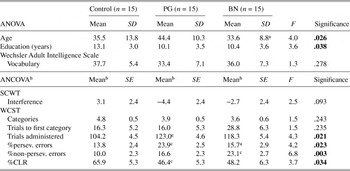
As shown in Table 1, the groups did not statistically differ with respect to estimated intellectual functioning. Groups did differ with respect to age and years of education; however, post hoc comparisons did not reach statistical significance for years of education.
Sociodemographic and neuropsychological comparison of the groups: results of analysis of variance (ANOVA) and analysis of covariance (ANCOVA) (adjusting for age and education) procedures (df = 2)

Note.
%persev. errors, % perseverative errors; %non-persev. errors, % nonperseverative errors; CLR, conceptual-level responses; SCWT, Stroop Color and Word Test; SD, standard deviation; SE, standard error; WCST, Wisconsin Card Sorting Test.
a Statistically different in comparison to PG.
b Adjusted for age and education.
c Statistically different in comparison to healthy controls.
Statistical differences were observed in WCST number of trials administered, percentage of perseverative and nonperseverative errors (NPE), and conceptual-level responses. A slight trend toward significance was observed in SCWT Interference. Adjusted post hoc comparisons revealed that PG differed statistically from BN patients and HC females in percentage of perseverative errors (p = .050, p = .017, respectively), required administration of a greater number of trials to complete the task (p = .033) than HC individuals, and also exhibited a trend toward lower percentage of conceptual-level responses (p = .055) than HC individuals. In contrast, BN patients showed the highest percentage of NPE relative to HC females (p = .008). PG patients tended to demonstrate the lowest SCWT Interference score (p = .059), suggesting poorer cognitive inhibition.
DISCUSSION
The present study provides preliminary results comparing executive function in females with disorders of impulse control (i.e., PG and BN). As expected, both clinical groups showed WCST impairments in relation to control females. SCWT impairments were less apparent and evidenced only by PG females.
Consistent with the literature (Marazziti et al., Reference Marazziti, Catena Dell’osso, Conversano, Consoli, Vivarelli, Mungai, Di Nasso and Golia2008), PG females demonstrated the poorest executive functioning (i.e., poorer concept formation, more perseverative errors and a trend to reduced cognitive inhibition).
BN patients showed the highest number of NPE. The reason for the latter finding is not entirely clear. Traditionally, perseverative errors are considered an index of prefrontal damage (Lie et al., Reference Lie, Specht, Marshall and Fink2006; Nagahama et al., Reference Nagahama, Okina, Suzuki, Nabatame and Matsuda2005), while the meaning of NPE remains controversial and has received little attention in the literature. Although most consider that NPE are not an indicator of prefrontal functioning, others argue that random errors (a type of NPE) could indeed reflect prefrontal impairment (Barceló & Knight, Reference Barceló and Knight2002).
Perseverative behavior has been associated with attentional set-shifting abilities (Nagahama et al., Reference Nagahama, Okina, Suzuki, Nabatame and Matsuda2005), and low number of categories achieved on the WCST is frequently attributed to perseverative errors/tendencies. However, prefrontal patients may be susceptible to distraction and interference by external stimuli. This susceptibility may yield impairments in set maintenance and/or degradation of the information about the previous dimension, which is associated with difficulties in online maintenance of information in the working memory (Lie et al., Reference Lie, Specht, Marshall and Fink2006). Low number of categories achieved on the WCST may thus also derive from NPE (Barceló & Knight, Reference Barceló and Knight2002).
The present results suggest that females with disorders of impulse control (i.e., BN and PG) show executive dysfunction that is potentially related to attentional set-shifting. However, the cause of the difficulty in attention shifting appears to be of a different nature in PG versus BN. PG females tend to perseverate in the previously correct dimension, while BN females exhibit difficulty maintaining the ongoing set (higher distractibility/susceptibility to interference of stimuli features). Both types of errors are related to neural networks that control attentional set-shifting but may have different specific correlates (Barceló & Knight, Reference Barceló and Knight2002).
The clinical similarity of both PG and BN has led some authors to suggest a common underlying process (Goodman, Reference Goodman2008). However, group comparisons do not take into account sex differences, which are especially marked in these disorders at a clinical level (Fernández-Aranda et al., Reference Fernández-Aranda, Aitken, Badía, Giménez, Solano, Collier, Treasure and Vallejo2004; Granero et al., Reference Granero, Penelo, Martínez-Giménez, Álvarez-Moya, Gómez-Peña, Aymamí, Bueno, Fernández-Aranda and Jiménez-Murcia2009). The groups are frequently compared irrespective of their sex distribution. Only occasional adjustments for sex are performed, but interaction effects have not been measured, introducing a possible bias in the characterization of female PG and male BN patients.
Regarding BN, the present results are partially supported by literature reporting impairments in selective attention and executive functions (Duchesne et al., Reference Duchesne, Mattos, Fontenelle, Veiga, Rizo and Appolinario2004). We found no impairments in perceptual shift and mental flexibility, as suggested by Roberts et al. (Reference Roberts, Tchanturia, Stahl, Southgate and Treasure2007). However, the higher number of WCST NPE may be interpreted as an index of reduced attentional control that may contribute to diminished perceptual shift.
Limitations of the present study include the small sample size and the use of only female individuals. An analysis stratified by sex would have been useful; however, it is highly difficult to recruit treatment-seeking BN males (even more difficult than recruiting treatment-seeking PG females, who are also rare). In fact, the small sample size of the current study derives from the difficulty recruiting PG females fulfilling inclusion criteria and who were willing to participate (only 9% PG patients seeking treatment in our unit are females). As such, Type II errors may be possible, given an estimated statistical power of .684, which requires interpretation of these results with caution. In addition, Axis I comorbidity was not specifically measured in the clinical groups, although the possible confounding effect of such comorbidity was controlled for by correlating the SCL-90-R GSI with WCST and SCWT performance, which yielded no significant relationships.
In conclusion, our results suggest that females with PG and BN show executive impairments at the level of attentional shifting/control, but differ in the specific type of deficit. PG females are more impaired overall, and show greater perseverative tendencies, while BN females appear more susceptible to distraction and may demonstrate difficulty in maintaining information about ongoing rules. Given that no neuropsychological studies comparing BN and PG have been conducted to date, further investigation is necessary to confirm this hypothesis. The specific neuropsychological profile of PG females has not yet been examined. Considering the inconsistencies regarding the neuropsychological characteristics of PG in general, further research is needed, particularly with special attention to sex differences. Clinical interventions for these patients should take into account their cognitive deficits in order to enhance treatment effectiveness. Cognitive remediation is currently being carried out in eating-disordered patients with promising results (Tchanturia et al., Reference Tchanturia, Davies and Campbell2007), but no interventions of this type have been conducted in PG patients. The present results are preliminary and need further confirmation to tailor specific treatments for these deficits.
ACKNOWLEDGMENTS
We want to acknowledge Dr. Mary B. Spitznagel and the INS editorial service for their valuable help in language editing. The first author was supported by a Juan de la Cierva fellowship (Ministry of Science and Technology, Spanish government; Ref. 1048). CIBERObn is an initiative of Instituto Salud Carlos III. This research was partially funded by the European Commission under the VIIth Framework Program (Playmancer Project/FP7-ICT-215839-2007).