

INTRODUCTION
The genus Bythocaris has been reviewed by authors such as Bowman & Manning (Reference Bowman and Manning1972), Abele & Martin Reference Abele and Martin1989, Fransen (Reference Fransen1993) and Sokolov (Reference Sokolov2000) including in total 16 species. According to Fransen (Reference Fransen1993) these are: Bythocaris akidopleura Fransen, 1993; B. cosmetops Holthuis, Reference Holthuis1951; B. cryonesus Bowman & Manning, Reference Bowman and Manning1972; B. curvirostris Kobjakova, 1957; B. elegans Bryazgin, 1982; B. floridensis Abele & Martin, Reference Abele and Martin1989; B. gorei Abele & Martin, Reference Abele and Martin1989; B. gracilis Smith, 1885; B. grumanti Burukovsky, 1966; B. irene Retowsky, 1946; B. kobjakovae Sokolov, Reference Sokolov2000; B. leucopis G.O. Sars, 1879 (B. biruli Kobjakova, 1964 is considered a junior synonym); B. miserabilis Abele & Martin, Reference Abele and Martin1989; B. nana Smith, 1885; B. payeri (Heller, 1875) and B. simplicirostris G.O. Sars, 1870 (B. spinipleura Squires, 1990 is considered a junior synonym). Sokolov, (Reference Sokolov2000) considered B. biruli as a good species and B. elegans as a junior synonym because the described differences are within the morphological variation of B. biruli. Keys for species identification were provided in all these studies. De Grave et al. (Reference De Grave, Pentcheff, Ahyong, Chan, Crandall, Dworschak, Felder, Feldmann, Fransen, Goulding, Lemaitre, Low, Martin, Ng, Schweitzer, Tan, Tshudy and Wetzer2009) mention 17 species within the genus, and De Grave & Türkay (Reference De Grave and Türkay2011) (in WoRM) consider B. biruli and B. elegans as valid species.
In general, Bythocaris species are known to inhabit deep waters. The European species (9) show a sub-Arctic to high Arctic distribution, in the North Atlantic Ocean from Ireland northwards (see previous references and MarBEF website: http://www.marbef.org/data/aphia.php?p=taxdetails&id=106983; in this latter B. cosmetops is not included); whereas Bythocaris cosmetops is a tropical African species with a circalittoral bathymetric distribution. This decapod was described by Holthuis (Reference Holthuis1951) from a single ovigerous female sampled off Sierra Leone, at 74–78 m depth, on muddy-sand bottoms. Later de Saint Laurent (Reference de Saint Laurent, Laubier and Monniot1985) found four specimens of Bythocaris sp. on the slope of the northern Bay of Biscay and, more recently, d'Udekem d'Acoz & Sorbe (Reference d' Udekem d'Acoz and Sorbe2004) collected (in 2002) one female of B. cosmetops on the ‘Grande Vasière’ (an OSPAR (OSlo and PARis Convention) area of interest located on the shelf of the northern Bay of Biscay) at 120–121 m, which represents the second known record of this species (or third, if the Saint Laurent's specimens belong to this species) and the first for European waters.
MATERIALS AND METHODS
The sampled area is located in southern Spain (the northern margin of the Alboran Sea), near to the marine Site of Community Importance named ‘Acantilados y fondos marinos de Calahonda-Castell de Ferro’ (cliffs and sea-beds of Calahonda-Castell de Ferro), Granada, Spain, included within the Nature 2000 network (code ES6140014, Official Journal of the EU, Commission Decision of 22.12.2009). As mentioned by Cano (Reference Cano1977, Reference Cano1978a, Reference Canob) this sector is characterized by seasonal upwellings of cold waters rich in nutrients.
Samples were taken using a small heavy rock dredge, with a rectangular frame of 42 × 22 cm and equipped with a 4 mm mesh size net. Trawling time was 5 minutes for each haul (during daytime and at sunset) at a speed of about 1.8 knots, which represents a trawl length of about 278 m and an estimated swept area of about 117 m2. In total, twelve stations with replicates were analysed.
Temperature of near-bottom waters was measured with a conductivity–temperature–depth probe and sediment granulometry was determined with a column of standard sieves.
A stereoscopic microscope and a light camera were used to measure the carapace length (CL) and total length (TL) (from the posterior margin of the ocular orbit to the posterior margin of the carapace and distal part of telson respectively).
RESULTS AND DISCUSSION
Abiotic results
The sampled area is covered by muddy-medium sands sediments with bioclasts (Figure 1). In July–October, the near-bottom temperatures and salinities registered at 56–69 m depth fluctuated between 13.8°C and 15.4°C and between 38.0 and 36.9 respectively. At the sampling area of B. cosmetops specimens, temperatures and salinities values were 15.4°C and 36.9 respectively (October 2010, 62 m depth).
Granulometric composition of the sediment collected at the B. cosmetops sampling area (–59 m, 36°41.48′N/03°21.27′W) in the superficial layer (0–2 cm) and below (2–6 cm). 1, gravel; 2, very coarse sand; 3, coarse sand; 4, medium sand; 5, fine sand; 6, very fine sand; and 7, muddy sand.

Biotic results
Within the decapods material collected at the sampling station, three specimens of Bythocaris cosmetops were caught. These represent the first record of the genus and species for Spain and the Mediterranean Sea.
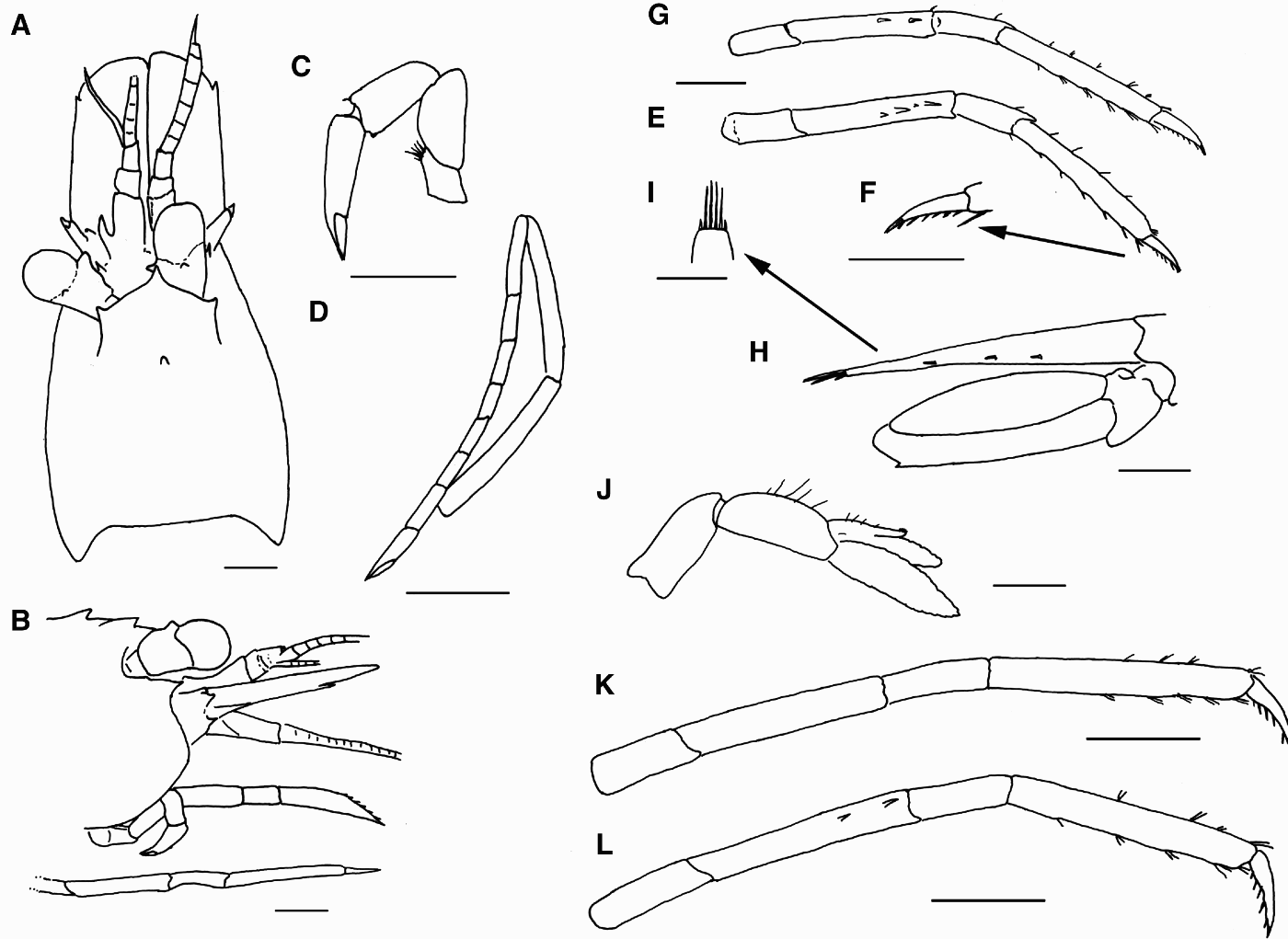
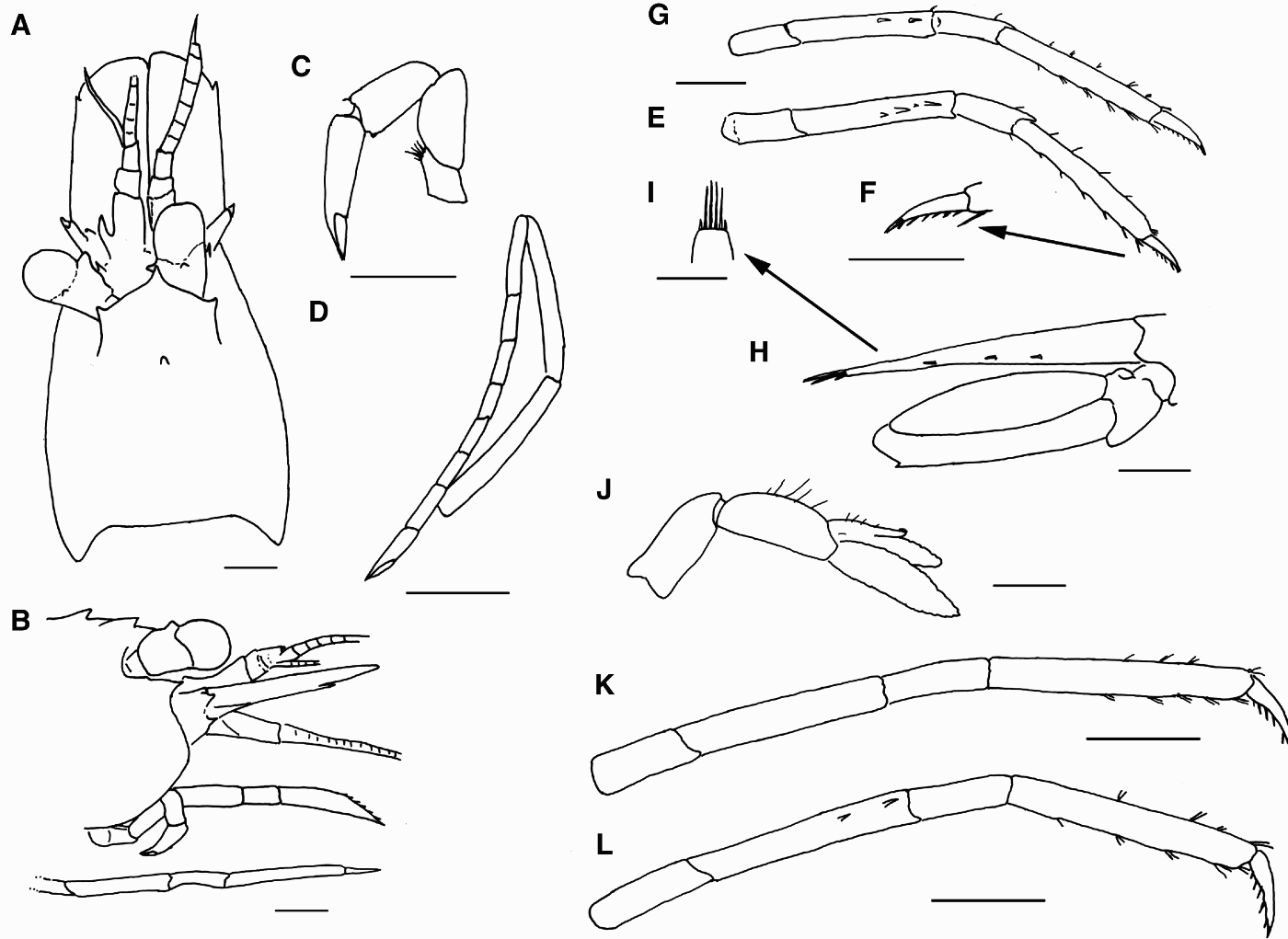
Bythocaris cosmetops Holthuis Reference Holthuis1951. (A) Dorsal view of carapace; (B) antero-lateral view of carapace; (C) first left pereopod; (D) second left pereopod; (E) fourth right pereopod; (F) dactylus of this fourth pereopod; (G) fifth right pereopod; (H) lateral view of telson and right uropods; (I) detail of distal part of telson; (J) second right pleopod; (K) fifth right pereopod; (L) fourth right pereopod. (A, B, C, D, E, F, G, H and I) ovigerous female (exemplar 1); (J, K and L) immature female (exemplar 3). All scales 0.5 mm.
Photographs of largest ovigerous female (exemplar 1) (A) and immature female (exemplar 3) (B), in the latter the chromatophore pattern could be observed (size of the specimens in text).

MATERIAL EXAMINED
Three specimens: 2 ovigerous females (exemplar 1: TL = 12 mm, CL = 2.4 mm; exemplar 2: TL = 12 mm, CL = 2.35 mm) and one immature female (exemplar 3: TL = 9.7 mm, CL = 2.3 mm). Station 2.3 (off Calahonda, Granada littoral, southern Spain) 36° 41.44′N/03° 21.27′W, 61 m depth, 26 October 2010, sampling carried out at sunset.
This is the only species of the genus without hepatic, branchiostegal and pterygostomial spines on the cephalothorax. The carapace presents an anterior truncated tooth at middle. The rostrum is short, not reaching the well pigmented cornea and reaching only the basis of stylocerites. Supraorbital teeth are located laterally, forming a wing-like expansion with the rostrum. The eyestalk shows an evident mesial expansion.
REMARKS
The morphology of our specimens is in general in accordance with the descriptions of Holthuis (Reference Holthuis1951) and d'Udekem d'Acoz & Sorbe (Reference d' Udekem d'Acoz and Sorbe2004), which are based on one specimen each (and not complete). However, we have found some differences. The rostrum (Figure 2A) is similar to the rostrum of the Biscayan specimens, and slightly longer than the rostrum of the African holotype. The expansion on mesial side of eyestalk is, apparently, less developed than in the previously described specimens and conical–triangular shaped (process neither elliptical, as in the Biscayan specimen, nor quadrangular compressed, as in the holotype). Also, it is ornamented with a small antero-dorsal lobe (not previously mentioned). The third maxilliped reaches almost to the end of the scaphocerite (Figure 2B).
Our specimens have conserved some of their pereopods (P). P1 and P2 are present in all specimens. P1 (Figure 2C) are in agreement with the previous description, short and reaching to about the base of the scaphocerite (rounded distally with the tooth far from the edge of the lamella), dactylus slightly less than half propodus length; carpus slightly shorter than propodus (finger omitted) and similar to merus; isquio with 5 disto-ventral outer spines (7 in Biscayan specimen, 1 in holotype). P2 basis with 1 strong distoventral seta, merus entire; carpus divided in 7 articles in our three specimens (Figure 2D) (8 in the Biscayan and African specimens). P3 lost in all specimens. P4 and P5 (right legs) only conserved in exemplar 1 (ovigerous female) and exemplar 3 (immature female). P4 (Figure 2E, L) merus with 4 (2 of these are very small—exemplar 1) or 2 (exemplar 3) distal ventro-lateral-outer spines (3 spines in Biscayan specimen); merus longer than carpus. P5 (Figure 2G, K) merus with 2 (exemplar 1) or 0 (exemplar 3) distal ventro-lateral outer spines (no previous data on this leg exist). P4 and P5 carpus and propodus with similar length. P4 merus and isquio are longer than those of P5. P4 and P5 dactylus (Figure 2F) with terminal unguis and 6–7 ventral spines (8 in Biscayan specimens). Second pleuron broadly rounded, tucked inward for spawning protection (Figure 3A) and with a small medio-ventral pointed lobe (broadly rounded in African specimen, pointed in Biscayan specimen). Subsequent pleura posteriorly produced and more or less pointed or slightly rounded (posteriorly pointed in both African and Biscayan specimens). Telson (Figure 2H, I) 1.7 times as long as sixth abdominal segment, with three pairs of spines close to the dorso-lateral margin (only two in a lateral margin of a female, the second was not present) and with a straight distal margin armed with 6 spines, the lateral ones much shorter.
The morphological differences found could probably be attributed to individual differences, since variations of important and taxonomic characters have been described in several species of this genus (Sivertsen & Holthuis, Reference Sivertsen and Holthuis1956; Fransen, Reference Fransen1993; Sokolov, Reference Sokolov2000). For example, the number of carpal articles of second pereopod could be variable, even different on the left and right pereopod in B. leucopis (among others); the pleuron morphology of abdominal segments could also be variable in B. irene, B curvirostris, among others.
Two females of our collection were ovigerous, each bearing eggs in a different developmental stage. In one of the females, the egg diameter ranged between 1.8 × 1.1 and 1.9 × 1.3. In the second, bearing eggs near hatching (embryos with large, visible eyes), the egg diameter reached values of 2.5 × 1.6 mm. Related to the developmental stage of embryos, these egg dimensions are significantly higher than values mentioned by Holthuis (Reference Holthuis1951) and d'Udekem d'Acoz & Sorbe (2004) (range: 0.6–0.9 mm). The number of eggs in our ovigerous females was 8 and 18 (the lower value refers to the female with eggs near hatching, some of them probably lost). According to available data, the breeding season is between September and October in European waters, and December in African waters.
Our fixed specimens are ornamented with chromatophores, which show a clear pattern in the smaller specimen (Figure 3B). On the carapace (lateral view) small chromatophores follow a sloping line, from postero-dorsal to antero-ventral. Other chromatophore lines are also visible from the postero-dorsal or half postero-dorsal to medio-ventral margin of the abdominal segments 1 to 4, in the middle of the sixth, and in telson and uropods. This pattern continues in adults but is more diffuse, because they show more chromatophores.
The adult females preserved in alcohol show dark brown/reddish spots, mainly in abdominal segments (Figure 3A). On segment 1, there is a postero-dorsal spot and another postero-ventral patch on each side. On segment 2 there is a medio-dorsal spot and a large ventral patch on the pleura (more intense in the middle anterior part). On segment 3 there is an antero-dorsal spot and a discontinuous strip on the posterior margin (as dorsal and lateral separated spots or patches). Segments 5 and 6 have a more or less marked posterior strip or patch, not reaching the ventral margin. Uropod exopods have median spots, while endopods show a larger stain.
This species apparently shows a nocturnal behaviour. At our sampling stations replicates were carried out at different times of the day but specimens were only caught at sunset. These observations are consistent with those of d'Udekem d'Acoz & Sorbe (Reference d' Udekem d'Acoz and Sorbe2004), mentioning that this species was exclusively caught in a night-time haul (absent in 24 daytime hauls)
In relation to the habitat, the Biscayan specimen collected by d'Udekem d'Acoz & Sorbe (Reference d' Udekem d'Acoz and Sorbe2004) was found in a cold bottom water mass (lower than 11.5°C), in agreement with habitat thermal characteristics known for other Bythocaris species, with the probable exception of the African specimen of B. cosmetops (local near-bottom temperature not given). In our sampling area, the water temperature fluctuated between 13.8 and 15.4°C, in a probably intermediate range between European (Bay of Biscay) and African areas. Depth and substratum are similar in the three areas, demonstrating that this circalittoral species lives on muddy-medium sand between 61 to 121 m depth.
This new record of another Atlantic species in the Alboran Sea ratifies the strong influence of the Atlantic water mass in the area, and confirms this sea as a ‘hot spot’ of European biodiversity.
ACKNOWLEDGEMENTS
This study was developed under the collaboration agreement between the Andalusian Council for Agriculture and Fisheries and the Spanish Institute of Oceanography (IEO), for the project entitled ‘Preliminary study for the protection, management and determination of a fishing reserve in the marine area of the municipalities of Calahonda and Castell de Ferro, Granada Province’. Thanks are also due to the anonymous referees for their comments and corrections and to Sandra Meneaud, teacher of English at the University of Málaga for reviewing the manuscript.