


Introduction
There is literature suggesting that CBT is effective in the treatment of panic disorder, and comprehensive multi-component CBT programmes have been proven to be superior to single component behaviourally oriented therapies (Barlow, Gorman, Shear and Woods, Reference Barlow, Gorman, Shear and Woods2000; Newman, Kenardy, Herman and Taylor, Reference Newman, Kenardy, Herman and Taylor1997; Mitte, Reference Mitte2005; Otto and Deveney, Reference Otto and Deveney2005). In panic disorder, CBT aims to modify catastrophic cognitions related to bodily sensations, thus leading to symptom reduction. CBT leads to improvement in such cognitive domains as interpretation bias, appraisals of physical danger, and loss of control, leading to overall change in panic related cognitions (Clark et al., Reference Clark, Salkovskis, Ost, Breitholz, Koehler and Westling1997; Wenzel, Sharp, Sokol and Beck, Reference Wenzel, Sharp, Sokol and Beck2006). However, it is unclear whether change in cognition instigates symptomatic change and the pattern of such change (Hofmann et al., Reference Hofmann, Suvak, Barlow, Shear, Meuret and Rosenfield2007; Salkovskis, Clark and Hackmann, Reference Salkovskis, Clark and Hackmann1991). In an attempt to study the pattern of change, Adler, Craske, Kirshenbaum and Barlow (Reference Adler, Craske, Kirshenbaum and Barlow1989) examined the patterns of change in panic anticipation and panic attacks in a 15-week CBT programme. It was found that anticipation of panic responded earlier to treatment than panic frequency, and continued to decrease throughout the treatment, independent of panic symptoms; however, anticipation of panic remitted late compared to panic frequency, indicating that overall it takes longer to improve. There is increasing evidence supporting the fact that cognitive change occurs over the course of CBT and it precedes and predicts changes in clinical symptomatology through change in automatic panic associations that results in schema shift (Hoffart, Reference Hoffart1998; Teachman, Marker and Smith-Janik, Reference Teachman, Marker and Smith-Janik2008). These findings support cognitive models of anxiety that propose that symptom reduction is associated with, and preceded by, change in the maladaptive schemata (Young, Reference Young1999). Furthermore, changes in dysfunctional beliefs and self-efficacy seem to precede the changes in panic apprehension both in participants undergoing exposure and cognitive restructuring (Bouchard et al., Reference Bouchard, Gauthier, Nouwen, Ivers, Vallières and Simard2007). Similarly, Casey, Oei, Newcombe and Kenardy (Reference Casey, Oei, Newcombe and Kenardy2004) found that changes in both panic self-efficacy and interpretation bias predicted symptom reduction during the first 6 weeks of therapy, supporting the hypothesis that cognitive change precedes clinical improvement. Similarly, with regard to the pattern of change in symptomatology following multicomponent CBT, Penava, Otto, Maki and Pollack (Reference Penava, Otto, Maki and Pollack1998) reported that in the first 2 weeks overall panic disorder severity, panic frequency and anticipatory anxiety improved; situational avoidance improved in 3 weeks, and significant changes in the panic symptoms were seen in 4 weeks. However, in this study most of the components were introduced within the first few sessions (1–3) so the impact of each of these components could not be established. Overall, there is evidence that cognitive change plays a role in the overall improvement and changes in cognitions precede and predict improvement in the overall symptomatology. However, it is not clear whether, just as change in cognitions mediates a reduction in panic symptoms, reduction in symptoms further influences changes in cognitions (Meulenbeek, Spinhoven, Smit, Van Balkom and Cuijpers, Reference Meulenbeek, Spinhoven, Smit, Van Balkom and Cuijpers2010; Teachman, Marker and Clerkin, Reference Teachman, Marker and Clerkin2010).
In a study comparing relaxation training and cognitive therapy, Stanley et al. (Reference Stanley, Beck, Averill, Baldwin, Deagle and Stadler1996) reported that, although relaxation training resulted in greater reduction in state anxiety and agoraphobic fear in the first few weeks, cognitive therapy resulted in better and faster reduction in state anxiety, agoraphobic fears, panic frequency and social fears during the second half and the overall course of therapy. As regards the role of each of the components in overall improvement there is no significant difference between the exposure therapy alone and CBT (Öst, Thulin and Ramnerö, Reference Öst, Thulin and Ramnerö2004); cognitive therapy and interoceptive exposure were found to be equally effective (Arntz, Reference Arntz2002). There does not seem to be a significant difference between exposure and cognitive restructuring on the rate of change in clinical, behavioural and cognitive variables (Bouchard et al., Reference Bouchard, Gauthier, Laberge, French, Pelletier and Godbout1996, Reference Bouchard, Gauthier, Nouwen, Ivers, Vallières and Simard2007). This could be attributed to the role of cognitive change in both these techniques leading to an understanding that sensations are innocuous and to the creation of new representations.
There is a paucity of research examining the role of specific components in symptom reduction and the process of change. It is known that cognitive change plays an important role in symptom reduction and such a change can be achieved through behavioural and cognitive strategies. Studies examining the mediating and predictive role of cognitions have used pre–post comparison design, which does not provide information about the patterns of change in overall panic symptomatology (e.g. Hofmann et al., Reference Hofmann, Suvak, Barlow, Shear, Meuret and Rosenfield2007; Penava et al., Reference Penava, Otto, Maki and Pollack1998). The present study is therefore an attempt to assess the temporal patterns of change during cognitive behaviour therapy across the symptom domains and between the groups.
Aims
The present study attempts to examine the process of change in clinical symptomatology, cognitions and panic behaviours during a CBT therapy programme for a sample of panic disorder subjects. This study employed a two-group design with multiple baseline assessments to examine the pattern of change in the above variables across time, and also to understand the role of the sequential addition of cognitive and behavioural strategies aimed at cognitive change and impact on the panic related symptomatology.
Method
Participants
Thirty participants (15 each in CBT and BT groups) gave informed consent to take part in this study. These participants were recruited from the Departments of Psychiatry, National Institute of Mental Health and Neurosciences (NIMHANS) and St. John's Medical College Hospital, Bangalore, India. The following inclusion criteria were adopted: age range 18–55 years, knowledge of English and/or the local language, fulfilling the ICD-10 diagnostic criteria for research (WHO, 1993) for panic disorder with or without agoraphobia, with or without depression or dysthymia, and current panic disorder severity of at least 2 on the panic disorder symptom severity scale (Shear et al., Reference Shear, Brown, Barlow, Money, Sholomskas and Woods1997). Exclusion criteria included a history of psychotic disorders, psychoactive substance use disorders, hypertension, hypothyroidism and prior exposure to psychological interventions for panic disorder. A total of 314 subjects were screened. These details and sample characteristics are provided elsewhere (Manjula, Kumaraiah, Prasadarao and Raguram, Reference Manjula, Kumaraiah, Prasadarao and Raguram2009). This research was approved by the Institutional research ethics committee.
Measures
Semi-Structured Interview Schedule (SSIS). A questionnaire with 43 items assessing socio-demographic details, family history, personal history and comprehensive clinical history was developed. Responses were then analysed.
Panic Disorder Severity Scale (PDSS; Shear et al., Reference Shear, Brown, Barlow, Money, Sholomskas and Woods1997). PDSS is a 7-item instrument to rate the core features of panic disorder. Items provided data on variables such as frequency of panic attacks, distress caused by panic, anticipatory anxiety, agoraphobic fear/avoidance, and work and social impairment. Each item was rated on a 0–4 scale, where 0 indicates “none or not present” to 4 indicating “extreme, pervasive near constant symptoms, disabling/incapacitating”. A composite score is established by averaging the scores on all seven items. The internal consistency is 0.65, inter-rater reliability is 0.87, convergent and discriminant validity is 0.55 with Anxiety Disorders Interview Schedule.
Texas Panic Attack Record Form (TPARF; Margraf, Taylor, Ehlers, Roth and Agras, Reference Margraf, Taylor, Ehlers, Roth and Agras1987). This is a structured diary to be maintained by the subjects; for each occurrence of panic episode, the subject is asked to record date, time, duration, severity of symptoms experienced, setting parameters (e.g. place, activity), bodily sensation, thoughts and the ways in which he/she dealt with the panic attack.
Anxiety Sensitivity Index (ASI; Peterson and Reiss, Reference Peterson and Reiss1993). ASI is a dispositional measure of tendencies to misinterpret bodily sensations that arise from the belief that these sensations have harmful somatic, psychological and social consequences. The scale consists of 16 items rated on a 0–4 scale, where 0 indicates “very little” and 4 “very much”; higher scores indicate more severe anxiety sensitivity. Total score ranges from 0–64. Test re-test reliability for 2-weeks and 3-years is established. The mean for panic patients is 36.6 (SD: 12.3), the moderate ASI being 16 or higher (within one SD of the mean of panic disorder).
Agoraphobic Cognitions Questionnaire (ACQ; Chambless, Caputo, Bright and Gallagher, Reference Chambless, Caputo, Bright and Gallagher1984). ACQ consists of 14 catastrophic thoughts, for example, “having a heart attack” and “losing control”. Each item is rated on a 5-point scale, ranging from “not frightened or worried” to “extremely frightened” by sensations. Each participant's score is determined by totalling the scores on all items, with higher scores indicating greater frequency of negative cognitions. The norms for panic disorder and agoraphobia are 2.43 (±0.63). ACQ has good internal consistency (cronbach α = 0.80) and test-retest reliability (r = 0.7).
Panic Appraisal Inventory (PAI; Telch, Reference Telch1987). The PAI assesses cognitive appraisal patterns of panic sufferers on: 1) anticipated panic; 2) panic consequences; and 3) panic coping. The scale has 45 items rated on a 0 (no chance of panic occurring) to 100 (definite panic occurrence) scale. The total score is the average of all items. The overall scale and the subscales have high test-retest reliability (r ranging from 0.81–0.86) and high internal consistency (α = 0.88–0.94).
Behavioural Avoidance Checklist (BAC). The BAC checklist was developed to assess agoraphobic avoidance and safety behaviours used by the subjects experiencing panic. This checklist has two sections: a) agoraphobic avoidance (BAC-A has 34 items to assess agoraphobic avoidance of places and situations); b) safety behaviours (BAC-SB has 16 items to assess safety seeking behaviours). The checklist is rated on a 5-point scale, where 1 indicates “never” and 5 “always”. The maximum score possible on avoidance subscale is 170, the minimum is 34; on the safety behaviours subscale the maximum is 80 and the minimum is 16; a higher score indicates greater avoidance and safety seeking behaviours. Items included in this checklist were validated by two experienced clinicians in mental health and the checklist was trialled during the pilot phase and was found useful.
Procedure
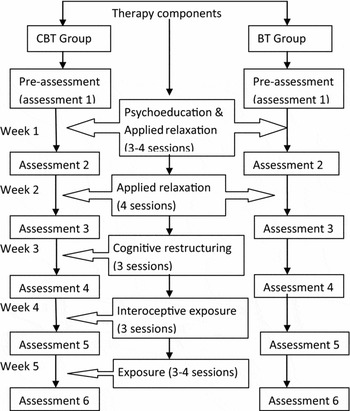
Both drug naïve (50% of the CBT group and 60% of BT group) and subjects on medication (stabilized for a minimum period of 2 months, with minimal improvement, i.e. at least 2 on PDSS) were sequentially assigned to two groups. The CBT group received the comprehensive multi-component cognitive behaviour therapy programme consisting of Psychoeducation, Applied Relaxation, Cognitive Restructuring, Interoceptive Exposure and Exposure in vivo. This intervention programme was developed based on Barlow and Craske (Reference Barlow and Craske1988). The investigators modified the therapy programme with the permission of the original authors; modifications included the addition of applied relaxation and increased frequency of sessions in order to reduce the total duration of therapy and to facilitate an individual format of therapy. The intervention programme consisted of 15–20 sessions carried out for a period of 5 weeks. Subjects in the BT group were provided with psychoeducation and applied relaxation (8–12 sessions). The therapeutic components were introduced at consecutive weeks; details of assessments and introduction of therapy components are provided in Figure 1. Subjects who completed a minimum of 15 therapy sessions in the CBT group and 8 sessions in the BT group with all six assessments were considered as completers. The average duration of sessions was 1 hour; assessments were carried out at the end of each week. The tools ACQ, ASI, PAI and BAC were used as outcome measures and TPARF was used as a continuous measure. The intervention programme and assessments were carried out by the first author. At the end of 5 weeks participants who did not show improvement in the BT group were offered CBT, and those who were drug naïve were referred back to the referral source for further medication management.
Therapy and assessments in CBT and BT groups

Statistical analysis
Both quantitative and qualitative analyses were conducted; quantitative analysis was done using Statistical Package for Social Sciences 10.0 version (SPSS 10.0). Data from the multiple baseline assessments of the two groups including the outcome measures and information from diary were compared using independent samples t tests. Multiple paired t tests were carried out in each group to see the changes on various domains at different points in time, with a Bonferroni's correction resulting in a p value of .007. Chi-square tests were used for the information obtained from the diary. The change across weeks between the groups was assessed using repeated measures Analysis of Variance.
Results
Demographics
Both groups were comparable on variables such as age, gender, marital status, education, employment, income and diagnosis. Panic disorder was the primary diagnosis in 67% and 87% in the CBT and BT groups respectively; 20% of the CBT group and 6.7% of the BT group had a diagnosis of panic disorder with agoraphobia; 13% of the CBT and 6.7% of the BT group had panic disorder with dysthymia. The average duration of panic disorder in the CBT group was 8.3 months and in BT group it was 7.67 months. In CBT and BT groups, 93% and 87% participants, respectively, had a frequency of at least two panic attacks every week. The average severity of panic on PDSS was 3.10 (±0.51) and 3.28 (±0.48) in CBT and BT groups respectively, indicating severe distress and disability.
Changes in cognitive and behavioural domains across time
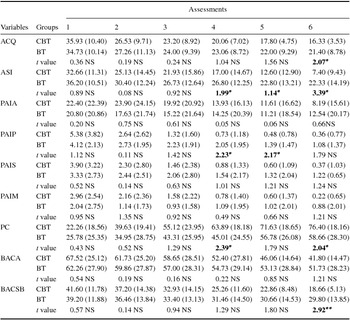
Results show that there is a consistent change in the CBT group from assessment 1 to 6; although change was evident in the BT group up to assessment 3, such change did not subsequently continue (Table 1). However, the difference in scores between the groups at various points of the assessment was not significant.
Means, SDs, and t-values of the two groups across the weeks on outcome measures

Notes: ACQ –Agoraphobic cognitions questionnaire; ASI-Anxiety sensitivity index; PAIA-Panic appraisal inventory, anticipated panic subscale; PAIP-PAI physical consequences subscale; PAIS – social consequences subscale; PAIM – Mental consequences subscale; PC- Panic coping; BACA – Behavioural avoidance checklist, agoraphobic avoidance subscale; BACSB – Safety behaviours subscale. SDs are given in the parenthesis, *p ≤ .05, **p ≤ .01, NS = not significant
On the ACQ, the difference between the groups was statistically significant (t = 2.07, p ≤ .05) at the last assessment. In the CBT group significant change was seen on ASI from week 4 onwards, as indicated by a consistent reduction in the mean scores in this group. However, such a change was not seen in the BT group and the scores levelled off from week 4 onwards.
On the anticipated panic (as measured by the PAIA subscale of PAI), the difference between the groups was not significant at any point in time; this may be because this score was low at the initial assessment. On the physical consequences subscale, however, there was significant difference at 4th (t = 2.23, p ≤ .01) and 5th (t = 2.17, p ≤ .01) week, which was noted during the last week. Similarly, there was no significant difference on social and loss of mental control subscales. The CBT group had significantly higher scores on coping with panic compared to the BT group, and it became significant from the 4th week onwards.
Although there was no difference in the avoidance between the groups (BAC), there was significant difference on safety behaviours at 5th week (t = 2.92, p ≤ .01), with the CBT group showing significant change. On the repeated measures ANOVA there is significant change across weeks in both the groups on all variables (significant time effect) but no group x time interaction was evident.
Change in panic symptoms, response patterns, cognitions, and handling patterns across time
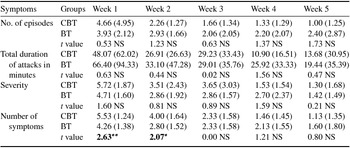
Data from panic diary were analysed and are provided in Table 2. As evident, no significant differences were seen between these two groups; however, there is a trend for reduction in the number of panic episodes, duration and the severity of panic episodes, and the number of symptoms experienced from week 1 to 5 in both groups.
Means, SDs, and t-values of panic symptoms across assessments

Notes: SDs are given in the parenthesis, *p ≤ .05, **p ≤ .01, NS = not significant
Repeated measures analyses indicated no significant difference between the groups on the above variables across the weeks. However, significant change was seen across the weeks in both the groups on the following variables: number of panic attacks (F(4,122) −8.57, p < .001), duration of panic (F(4,122) −5.53, p < .001), severity of panic (F(4,122) −19.91, p < .001) and the number of symptoms experienced (F(4,122) −37.95, p < .001). The number of participants experiencing panic episodes in the presence of specific triggers (e.g. when alone, travelling, crowded and closed places, bodily sensations, while sleeping, tension and stress, thoughts about health and seeing others in ill health, and social situations) decreased to zero in the CBT group by the end of 5 weeks; in the BT group, however, 6.7%–20% of subjects continued to report panic episodes in the above situations. In both these groups panic attacks tended to have occurred in a small percentage of subjects spontaneously, without the presence of any trigger (13.3% and 26.7%, respectively) or when they were involved in “physical hard work” (13.3% and 20%, respectively).
Similarly, in the CBT group the frequency of dysfunctional thoughts (e.g. falling down, something bad happening, heart attack, going crazy, having physical illness, people observing, dying, losing control, breathlessness and nervous breakdown) decreased to zero, whereas some subjects in the BT group (6.7–20%) continued to report such dysfunctional thoughts. A greater number of subjects (33.3%) in the CBT group reported better “confidence” in managing their panic episodes compared to the BT group (6.7%).
It was also noted that most subjects in the CBT group stopped using safety seeking behaviours (such as taking help/looking for transport, visiting a doctor, taking rest/lying down, avoiding and stopping work and eating food), with only 13.4% subjects continuing to use such behaviours; most subjects reported adopting healthy coping strategies such as continuing work, distracting/going out, deep breathing and relaxing (46.7%). In the BT group, 66.7% continued to use safety seeking behaviours at the end of 5 weeks, with only 26.8% reporting the use of healthy coping strategies.
Within group comparison of change at different points in time
Paired t tests were carried out between 1st and 2nd, 2nd and 3rd, 3rd and 4th, 4th and 5th, 5th and 6th and 3rd and 6th assessments to evaluate the role of addition of specific components of therapy.
At the 2nd assessment the CBT group showed significant reduction on variables ASI (t = 3.93, p < .002), ACQ (t = 5.92, p < .001) and PAIS (t = 3.40, p < .004) whereas in the BT group such a changer was noted only on PAIP (t = 3.50, p < .003). At the 3rd assessment the CBT group showed significant improvement on ACQ (t = 3.78, p < .002), PAIP (t = 3.24, p < .006) and BACSB (t = 5.07, p < .001) and no such change was evident in the BT group. From 3rd to 4th assessment there was no significant change in either of the groups. From 4th to 5th assessment, the CBT group had significant change on the panic coping subscale of PAI (t = 3.13, p < .007) and no such change was evident in the BT group. From 5th to 6th assessment significant change was evident on ASI (t = 3.26, p < .006) and BACSB (t = 3.11, p < .007) in the CBT group and not in the BT group. Third and 6th assessments were compared to see the impact of the addition of specific cognitive components in the CBT group; the results showed that in the CBT group there was significant change on ASI (t = 4.86, p < .001), ACQ (t = 4.12, p < .001), PAIP (t = 3.26, p < .006), PC (t = 3.25, p < .006) and BACSB (t = 4.09, p < .001), whereas in the BT group significant change was seen only on PAIP (t = 3.54, p < .003) and BACSB (t = 3.67, p < 0.003).
Discussion
The present study attempted to examine the process of change in the CBT programme for panic disorder, exploring the temporal patterns, changes in clinical symptomatology, cognitions and panic behaviours. It also attempted to explore the contribution of each of the components when introduced during the process of therapy over time. The two-group format was used to examine the contribution of the components.
Although change was evident in both the groups across time, the pattern of change seems to vary. The pattern of change was consistent in both groups until assessment 3 (both groups received the same components) and, following this point, the CBT group showed a consistently upward trend in improvement whereas the BT group tended to level-off on variables such as ACQ, ASI, PC and BACSB (Table 1). It is evident that the difference on ACQ becomes significant only at postassessment (6th assessment), whereas the difference on ASI was significant from the 4th assessment onwards, and ratings on panic coping from the 4th assessment onwards, indicating the impact of cognitive restructuring and exposure, introduced in the 3rd and 4th week, in bringing about changes in the cognitions related to panic. There was also a significant reduction in utilization of safety behaviours at the 5th week i.e. following the introduction of both cognitive restructuring and exposure, indicating that along with cognitive restructuring, exposure to disconfirmatory experiences is also crucial in bringing changes in behaviours and that they do operate together (Bouchard et al., Reference Bouchard, Gauthier, Nouwen, Ivers, Vallières and Simard2007).
Findings from this study point out that, although strategies such as psychoeducation and relaxation may help in alleviating panic related symptoms initially, such a change does not seem to be maintained unless specific cognitively focused techniques such as cognitive restructuring and exposure to the feared situations are incorporated into the treatment programme (e.g. Dannon, Iancu and Grunhaus, Reference Dannon, Iancu and Grunhaus2002). Thus, interventions aimed at cognitive change may result in greater and long lasting effect on panic related symptoms (e.g. Stanley et al., Reference Stanley, Beck, Averill, Baldwin, Deagle and Stadler1996). The findings support the cognitive model of panic symptoms that proposes that change in catastrophic misinterpretations predicts reduction in overall symptom severity (Teachman et al., Reference Teachman, Marker and Clerkin2010).
With regard to the degree of change, it is evident that within 4–5 weeks of therapy, the scores of the CBT group fell within the average range, which was not the case with the BT group. It is also interesting to note that, although different components are introduced at different points in time, these variables seem to take 4–5 weeks to reduce to a functional range, indicating that 4–5 weeks is required for improvement to be seen on all aspects of panic, which is in agreement with previous studies (e.g. Penava et al., Reference Penava, Otto, Maki and Pollack1998).
Although the CBT group had fewer panic related symptoms compared to the BT group at postassessment, the difference was not significant; this may be due to the small sample size and the short follow-up period. It may also be explained in terms of the safety behaviours used as it is evident that the participants in the BT group continued to use the safety behaviours, a strategy that is said to maintain the cognitions and thus the symptoms (e.g. Salkovskis, Clark and Gelder, Reference Salkovskis, Clark and Gelder1996). Over the course of treatment, the triggers listed at preassessment resulted in panic less often in the CBT as compared to the BT group, which also indicates the cognitive change (threat perception) in the CBT group. In addition, the CBT group endorses the use of more adaptive thoughts and healthy coping methods that lead to a reduction in the catastrophic cognitions, which is supposed to play an important role in symptom reduction (e.g. Casey et al., Reference Casey, Oei, Newcombe and Kenardy2004; Hino, Takeuchi and Yamanouchi, Reference Hino, Takeuchi and Yamanouchi2002).
In terms of the significant changes observed across the weeks, in the 1st and 2nd week the changes in the cognitive domains (anxiety sensitivity, agoraphobic cognitions and appraisal of social consequences) were seen in the CBT group and there were significant changes in panic symptoms and appraisal of physical consequences in the BT group. The findings reflect on the content of the information provided while introducing the participants to the CBT and BT model; for example, emphasis on the thoughts and exposure given in the CBT group as against the symptoms and relaxation in the BT group. The findings reflect on the fact that information/education itself can influence the symptoms (e.g. Dannon et al., Reference Dannon, Iancu and Grunhaus2002). In the third week Cognitive Restructuring (CR) was added; there was no significant change and in the 4th week; there was, however, significant improvement with respect to panic coping in the CBT group, which may be explained as a cumulative effect of the CR and interoceptive exposure. While CR reduces the catastrophic misinterpretation and attention bias, interoceptive exposure is known to inoculate against the unexpected or undesired bodily sensations and also to provide evidence for these sensations not being dangerous (e.g. Craske, Rowe, Lewin and Noriega-Dimitri, Reference Craske, Rowe, Lewin and Noriega-Dimitri1997). In the 5th week safety behaviours showed significant change, which may be understood as the combined effect of CR aiding the interoceptive and in vivo exposure in modifying the catastrophic beliefs, and thus resulting in a reduction of the safety behaviours.
Limitations
The study has certain limitations. The small sample size might have contributed to the statistically nonsignificant differences across assessments. Since the CBT group was treated with a multicomponent therapeutic approach, it is difficult to comment on which individual component would have led to greater symptom reduction and overall change or whether it a cumulative effect of all the components? Since the number of sessions in the BT group was fewer compared to the CBT group, the impact of time spent in therapy itself contributing to the change as a non-specific factor cannot be ruled out. Similarly, the study does not answer the question as to whether exposure based techniques or cognitive restructuring leads to greater improvement. However, the question does not seem to be important as the literature has shown that both are equally efficacious – either in combination or alone (Bouchard et al., Reference Bouchard, Gauthier, Laberge, French, Pelletier and Godbout1996, Reference Bouchard, Gauthier, Nouwen, Ivers, Vallières and Simard2007; Norton and Price, Reference Norton and Price2007) in terms of the amount of change.
The strengths of the study include regular baseline assessments and the fact that only the subjects completing all the assessments and therapy within the specified time were considered as completers. This ensures uniformity in the assessments, number of sessions, and the time duration. Therapy was time limited (5 weeks) and specific techniques were introduced at specified time periods. This helped in understanding the relative contribution of cognitive restructuring and exposure techniques. As treatment components aimed at cognitive change are introduced after 2 weeks, and the BT group was considered as a control group, further improvement observed after the 3rd week can be attributed to cognitive restructuring and exposure techniques.



Comments
No Comments have been published for this article.