

1 Introduction
In their contribution to this special issue, De Smet & Van de Velde suggest that the analysability of a morphologically complex word is an indicator of how easily that word is primed by elements that are formed by the same word formation process. To illustrate, hearing or reading the words roughly, equally and luckily within a short span of time should activate the word formation process of ly-suffixation in the listener's mind, so that the subsequent production of fully compositional ly-adverbs, as for instance permanently or comfortably, should become relatively more likely. Yet the same experience should not lead to increased usage of non-compositional ly-adverbs such as lately. Evidence for this idea comes from psycholinguistic studies (e.g. Gonnerman et al. Reference Gonnerman, Seidenberg and Andersen2007), which demonstrate that fully compositional derivatives strongly prime their morphological bases (i.e. boldly primes bold), whereas priming is weaker for non-compositional derivatives (i.e. hardly and hard). In a similar vein, Jaeger & Snider (Reference Jaeger, Snider, Wolter and Thorson2007) show that ditransitive constructions with less frequent ditransitive verbs result in a stronger priming effect than constructions with typical ditransitive verbs. De Smet & Van de Velde set out to test whether this general effect can be demonstrated on the basis of synchronic and diachronic corpus data. Specifically, their research question is whether diachronic changes in the compositionality of a linguistic unit lead to concomitant changes in sensitivity to priming. Some English ly-adverbs have undergone a trajectory towards greater opaqueness. A prominent example is actually (Traugott & Dasher Reference Traugott and Dasher2002: 169), whose present-day use as a discourse marker relates only very vaguely to its base adjective. The prediction is that diachronic corpora reveal how elements such as actually shed their sensitivity to priming as they become semantically less compositional. The way De Smet & Van de Velde measure sensitivity to priming is straightforward: given a ly-adverb such as boldly, how many other ly-adverbs appear in its immediate left context of 100 words? If the figure is higher than would be expected by chance, we have an element that is highly sensitive to priming; if the figure is lower than expected, we have low sensitivity to priming. We expect the former case for compositional adverbs such as boldly and permanently, and the latter for relatively opaque ones such as actually and only.
De Smet & Van de Velde present corpus data that appear to confirm this prediction both for synchrony and for diachrony. My hedging in the above statement is due to the way in which De Smet & Van de Velde operationalized semantic compositionality, which, as they acknowledge, is not a trivial thing to measure. Quoting Bybee (Reference Bybee2006), they take text frequency as a proxy for compositionality, which is in accordance with the observation that certain high-frequency adverbs such as really and only are low in compositionality, whereas new ly-adverb formations (such as perhaps pentadecagonally ‘in a way of having fifteen sides’) are by necessity infrequent and highly compositional. Yet it is here that I part ways with De Smet & Van de Velde. While I fully share their hypothesis that priming sensitivity and compositionality are correlated (see Hilpert Reference Hilpert2015: 27), I will argue in the next sections that there is in fact no such correlation between priming sensitivity and text frequency.
2 A replication of De Smet & Van de Velde's synchronic study
In section 4 of their article, De Smet & Van de Velde analysed the 250 most frequent ly-adverbs from the Hansard Corpus in terms of their priming sensitivity. They chose a left context window of 500 characters and determined the normalized ratio of ly-adverbs in that context for each adverb in their database. Their table 1 shows that low priming sensitivity is in evidence for opaque adverbs such as really, barely and hardly. They fit a regression model with three predictors, namely (1) frequency, (2) adverb-to-base ratio and (3) a measure of phonological analyzability of base and suffix. Frequency emerges as the most powerful predictor, in the expected direction of higher frequency correlating with lower priming sensitivity. While the effect is very small, the result should be taken seriously.
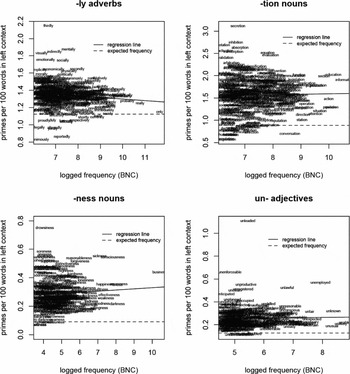
I decided to replicate De Smet & Van de Velde's synchronic study on the basis of the British National Corpus.Footnote 1 As in the original study, I extracted all ly-adverbs from the corpus and focused on the most frequent elements, in my case 322 adverbs. Corresponding to De Smet & Van de Velde's 500-character left-context window, I chose 100 words to the left of each occurrence. For each adverb, I aggregated the contexts and determined the normalized ratio of primes, as well as the expected ratio, given the overall corpus frequency of ly-adverbs. I then fitted a simple linear regression in which only the logged frequency of the adverbs was included as a predictor variable. In order to arrive at a broader picture, I decided to do the same for three other word formation processes, namely nominalization with the suffix (a)tion, nominalization with the suffix -ness, and negative adjective formation with the prefix un-. The graphs in figure 1 display the results of this procedure.
Priming sensitivity and text frequency across four word formation processes

The first panel of figure 1 replicates De Smet & Van de Velde's results almost exactly. Even some of the elements that De Smet & Van de Velde mention as exceptionally sensitive to priming (indirectly, mentally, socially, economically) can be made out in the upper left corner of the graph. The graph shows that the negative correlation between priming sensitivity and text frequency in ly-adverbs holds in the same way across the Hansard Corpus and the BNC. The effect of text frequency is significant (p = 0.022), the R-squared value is lower than in the original study (adjusted R2 = 0.013). What is robustly apparent, on the other hand, is that across the entire set, only very few items have fewer primes than expected in their left contexts. This is highly suggestive evidence that there is a priming effect that affects ly-adverbs, and indeed the other three word formation processes that are investigated here. In each case, the broken line that indicates the expected frequency is below the centre of the observed distribution. The regression lines, however, do not confirm a general effect of frequency. Neither of the three other regression analyses reaches significance, which suggests that the effect that is visible in ly-adverbs is most likely due to some other intervening variable. The main conclusion from this replication is that text frequency does not appear to be a reliable proxy for compositionality. There is no general correlation between frequency and priming sensitivity.
3 A replication of De Smet & Van de Velde's diachronic study
The main theoretical claim of De Smet & Van de Velde's article is that priming sensitivity should change over time, in lock-step with changes in the compositionality of a linguistic item. In section 5 of their article, they extend their synchronic analysis to diachrony and investigate how ly-adverbs have changed in frequency and priming sensitivity between 1950 and 2005. They use the same measures that were employed in the synchronic study and calculate diachronic linear slopes for both variables. To illustrate, in the Hansard Corpus, the adverb practically shows a diachronic decrease in frequency (which is expressed through a negative linear slope) but it shows a diachronic increase in priming sensitivity (which is expressed through a positive linear slope). Each adverb in the database is thus associated with values for two variables, and De Smet & Van de Velde show that these variables are related. A linear regression determines that increasing frequency has the expected effect of decreasing priming sensitivity. De Smet & Van de Velde conclude that changes in frequency bring about changes in compositionality, which are then reflected changes in priming sensitivity.
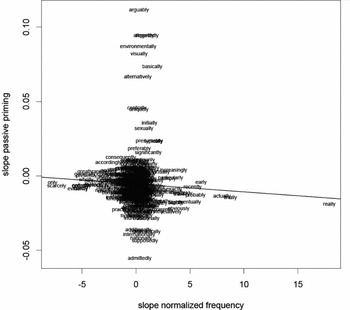
In order to replicate this diachronic study, I made use of the Corpus of Historical American English (COHA), which gave me a larger time window than the fifty-five years analysed by De Smet & Van de Velde. Specifically, I used data from the fifteen decades between the 1860s and the 2000s, which are the decades that are most comparable in both composition and size. For each of the 322 ly-adverbs in my database, I determined normalized frequencies and ratios of primes in the left context according to the procedures that were described in the previous sections. Following De Smet & Van de Velde's methodology, I calculated linear slopes on the basis of the time series for frequency and priming sensitivity and fitted a linear regression model that investigates how the two variables correlate. Figure 2 visualizes the result of this process.
Priming sensitivity and text frequency in ly-adverbs in diachrony

The graph shows that the adverb arguably has undergone the strongest increase in priming sensitivity, whereas admittedly has undergone the strongest decrease. Both have hardly changed in frequency. The adverb only has decreased in frequency while really has increased, but neither change much in terms of priming sensitivity. The regression line in figure 2 suggests an overall negative relation between priming sensitivity and frequency, but unlike in De Smet & Van de Velde's study, a linear regression on the basis of the underlying data does not confirm a significant effect of frequency on priming sensitivity (adjusted R2 = 0.0006, p = 0.278). This means that the purported effect of frequency change on priming sensitivity does not hold generally.
At this point I would like to voice a theoretical point where I disagree with De Smet & Van de Velde. In my view, it is a priori unlikely that a frequency decrease would go together with an increase in compositionality. Word meanings are in some ways like scrambled eggs. Once the meaning of a complex word is opaque, unscrambling it is quite hard to do. Even when a word such as only decreases in frequency, the morphemic boundaries between the base and the suffix will not reappear. So in order to check whether a possible correlation of increasing frequency and decreasing priming sensitivity could have been masked by elements that decrease in frequency but do not increase in priming sensitivity, I removed all adverbs with negative frequency slopes from the data set and reran the regression analysis on the basis of all adverbs with positive slopes. Yet, also in this analysis, there was no significant effect (adjusted R2 = 0.0023, p = 0.233).
4 Conclusions
De Smet & Van de Velde acknowledge that much of the variation in compositionality cannot be captured by frequency or frequency change. The replications in the preceding sections confirm that statement and suggest that text frequency does not correlate with priming sensitivity. It is of course important to consider whether this result can to some extent be explained by characteristics of the data that was used. As De Smet & Van de Velde (p.c.) rightly point out, the replication was done on the basis of written data, which differ from speech in the amount of processing pressure that is exerted on the language user. Also, orthography may provide a stronger cue to analysability than speech: when a reader encounters a word such as action, both the stem act- and the suffix -tion are immediately apparent. Hearing the phonemic sequence /ʃən/ is not a completely reliable cue that the suffix -tion is being pronounced, as words such as freshen or kitchen contain the sequence as well.
While I see problems in De Smet & Van de Velde's operationalization of compositionality in terms of frequency, I completely agree with them on the fundamental questions that are raised by their article. Diachronic corpus data provide a rather unique window into the minds of speakers who lived long ago. Certain cognitive processes, including priming, but also surprisal, chunking, routinization and categorization are in fact visible in offline, textual data, and De Smet & Van de Velde's approach, which starts with psycholinguistic evidence and explores how this evidence can be brought to bear on the study of diachronic corpus data, strikes me as being right on track. The availability of sizable diachronic corpora and the growing mutual awareness between psycholinguists, historical linguists and computational linguists will surely drive this research programme forward in the coming years.