1 Introduction
Online reading activities in SLA have been found to be beneficial mainly due to the wide access they provide to authentic language materials that are available through the Internet, the access to grammatical and vocabulary explanations, the association of multimedia representations and plain text, access to self-paced reading (Levy & Stockwell, Reference Levy and Stockwell2006), and online dictionaries (Chun, Reference Chun2001). While online reading (screen reading) was initially found to be between 20% and 30% slower than reading from printed materials, based on ‘90s technology, more recent studies have concluded that the speed of both online reading and paper reading were comparable, and this is mainly attributed to advances in technology and screen quality (see Kandil, Reference Kandil2003).
According to Gerjets and Scheiter (Reference Gerjets and Scheiter2003), an effective hypertext-based instructional design has the potential to minimize students’ cognitive load leading to faster reading speed. However, it is hard to determine, as Sawaki (Reference Sawaki2001) argued, whether or not reading from a computer is helpful in improving students’ reading speed and comprehension, as there are several factors involved such as the nature of the reading task, the characteristics of the students, and the computer requirements. Online ESL reading could also be affected by the breadth of an individual student’s vocabulary. Moreover, online ESL reading materials may contain popup windows that give further explanations, underlined or distinctively colored words, hyperlinks to other pages or sites such as online dictionaries or glossaries, illustrative figures and images, video and audio files, and so on. Some of these features can distract students and inhibit effective reading due to the increase in cognitive load (Akbulut, Reference Akbulut2007). On the other hand, web pages that follow a sound instructional design informed by research can considerably enhance ESL students’ reading skills (see Akbulut, Reference Akbulut2007; Chun, Reference Chun2001; Gerjets, Scheiter, & Catrambone, Reference Gerjets, Scheiter and Catrambone2004). This paper reports the results of a preliminary study designed to find out how specific instructional formats affect ESL students’ reading comprehension, in an effort to inform online instructional designers. Most importantly, the study aims to provide preliminary evidence on the cognitive overload that ESL students may suffer while being exposed to online reading resources.
2 Background
Cognitive Load Theory (CLT), as defined by Pillay (Reference Pillay1994), relates to the requirement of mental effort for successful completion of a task. According to Sweller (Reference Sweller1988), CLT assumes that optimum learning takes place when the cognitive load on the working memory is kept at its minimum level so that the needed information can be stored for longer periods. CLT primarily claims that lack of knowledge about the human cognitive structure contributes to instructional design ineffectiveness, and that traditional instructional techniques do not take into consideration the limitations of the human cognitive structure and its influence on working memory (Schnotz & Kürschner, Reference Schnotz and Kürschner2007).
CLT posits that limited working memory (short-term memory) cannot operate more than four elements at a time and for no more than a few seconds (Van Merrienboer & Sweller, Reference Van Merrienboer and Sweller2005). It has also been argued that important information obtained from the unlimited long-term memory is processed according to the capacity and limitations of the short-term working memory. Moreover, multiple pieces of information can be simultaneously held in working memory by individualizing multiple elements of knowledge into a single element, which determines the intrinsic cognitive load (Gerjets et al., Reference Gerjets, Scheiter and Catrambone2004).
CLT has been an influential and practical interpretation of the human cognitive system, how it is constructed, and how these different constructions interact with one another. Moreover, CLT explores how different instructional designs may contribute to an increased cognitive load. Research based on CLT has investigated methods of reducing students’ cognitive loads and thereby improving their learning outcomes. As CLT caters for both visual and verbal representations of information, with the advent of multimedia – as an effective integration of both visual and verbal representations – researchers have developed a multimedia-based learning theory, which has significant theoretical and learning implications. According to Moreno and Valdez (Reference Moreno and Valdez2005), the Cognitive Theory of Multimedia Learning (CTML) enables learners to select from multimedia-based cognitive processes that could lead to meaningful learning. These cognitive processes include the selection of relevant information, its organization into coherent representations, and the integration of these representations with existing knowledge. Moreover, CTML could also enhance the cognitive connection between short-term working memory and long-term permanent memory. On the other hand, it could also be argued that “the processing demands required by interactive multimedia may exceed the processing capacity of the cognitive system and prevent learning” (Moreno & Valdez, Reference Moreno and Valdez2005: 37).
Since multimedia-based instruction involves substantial amounts of on-screen text, researchers have investigated different aspects of online reading in both first language (L1) and second language (L2) instruction (e.g. Chun, Reference Chun2001; Coady & Tozcu, Reference Coady and Tozcu2004; Constantinescu, Reference Constantinescu2007) such as reading speed and comprehension, and how these could affect and be affected by cognitive load. In other words, research, including the present study, has attempted to investigate the correlation between the achievement of a satisfactory, or faster, reading speed and a reduced cognitive load, and how cognitive load can be affected by different reading formats. Time spent on the learning task as well as learning outcomes are crucial in revealing this correlation. However, Chun and Payne (Reference Chun and Payne2004) have also argued that other factors like individual differences and different annotations of online reading have an impact on learners’ cognitive load, which may also affect reading speed.
In language learning, researchers like Yeung, Jin, and Sweller (Reference Yeung, Jin and Sweller1997) have found that different instructional designs have different effects in a language learning task such as the split-attention effect, which takes place – in reading – when learners are exposed to multiple (and mainly distinctive) sources of information. In such a process, a greater cognitive load is anticipated as the two or more sources of information must be mentally integrated before comprehension of the text can occur. Consequently mental integration might involve a considerable cognitive load on working memory (Schnotz & Kürschner, Reference Schnotz and Kürschner2007). In the study conducted by Yeung et al. (Reference Yeung, Jin and Sweller1997), it was found that an integrated format improved reading comprehension for both native speakers and non-native speakers.
Furthermore, Coady and Tozcu (Reference Coady and Tozcu2004) argued that both L1 and L2 reading share a universal model of word recognition that both native and non-native speakers work with during reading. In other words, vocabulary acquisition relies heavily on how frequently specific words are utilized and this is important for effective reading. Coady and Tozcu (Reference Coady and Tozcu2004) also claimed that “less frequent vocabulary items can be learned through incidental encounters in context (with some strategy training as an aid) via extensive reading, but only after automaticity in high-frequency or core vocabulary has been acquired” (op. cit.: 480). Hence, repetition and frequent exposure to new words through multimedia-based online reading could also contribute to an increased cognitive load, especially for non-native speakers who are attempting to translate and process information at the same time (Coady & Tozcu, Reference Coady and Tozcu2004). On the other hand, Constantinescu (Reference Constantinescu2007) found that the implementation of multimedia can help not only with recalling new words, but it can also facilitate reading comprehension. Likewise, the use of the computer for reading, as Coady and Tozcu (Reference Coady and Tozcu2004) point out, can considerably increase a student’s vocabulary, as well as their reading speed and comprehension. The next section provides a review of the factors affecting online L2 reading.
2.1 Factors affecting L2 online reading
Several factors have been found to affect L2 online reading and the cognitive load associated with online multimedia-based reading. Chun’s (Reference Chun2001) study, for instance, indicated that the time spent on reading and the number of words looked up were lower for high ability students. Students’ differing abilities were shown by Ozono and Ito (Reference Ozono and Ito2003) to have an impact on reading comprehension as well as cognitive load. They found that low ability students tend to guess more frequently than high ability students and this increases the cognitive load. Ardac and Unal (Reference Ardac and Unal2008) found that students with a higher memory capacity acquire more information than their low memory capacity counterparts, while L2 proficiency plays a crucial role in online reading comprehension as well as vocabulary acquisition (Coady & Tozcu, Reference Coady and Tozcu2004; Chun & Payne, Reference Chun and Payne2004). Akbulut (Reference Akbulut2007) found a correlation between the efficacy of multimedia instruction and reading comprehension, particularly for advanced L2 learners. Furthermore, different layouts of web pages and how online text is presented can also affect students’ cognitive styles. For example, Graff (Reference Graff2003) found that students’ different cognitive styles are greatly influenced by the design of the hypertext and that certain designs, such as hierarchical architecture, are influential in reducing cognitive load and facilitating online reading. Three-dimensional designs were associated with a higher cognitive load than two-dimensional ones due to the additional characteristics of the design (Keller, Gerjets, Scheiter & Garsoffky, Reference Keller, Gerjets, Scheiter and Garsoffky2006). Other design factors such as color and sound were also found to have an impact on L2 online reading. For example, Van Schaik and Ling (Reference Van Schaik and Ling2003) pointed out that the more familiar the link color and page design, the less the cognitive load; therefore, web designers of instructional material should stick to standard web usability, screen layout and navigation in order to maintain students’ browsing familiarity.
Different representations of glossaries and the use of online dictionaries can all influence L2 reading comprehension and cognitive load. Chun (Reference Chun2001) found that internally-designed glossaries, online dictionaries and narrations help to improve reading comprehension and also improve recall of new vocabulary. It could be argued that integrative glossaries and dictionaries may not involve a higher cognitive load as they appear to lead to better L2 reading comprehension.
Another factor that was found to have an impact on L2 online reading and cognitive load is the amount of text displayed on-screen. Ardac and Unal (Reference Ardac and Unal2008) found that students with high memory gained more information and performed better while working on whole-text reading than low memory students, whereas short-text reading was helpful in reducing low memory students’ cognitive load. Likewise, Mikk (Reference Mikk2008) found a strong relationship between lengthy sentences and working memory overload, and this affected reading comprehension.
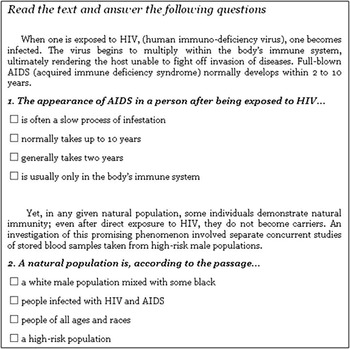
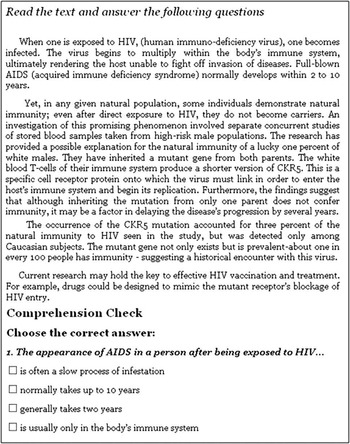
In a study conducted by Hung (Reference Hung2007), an integrated format (in which questions were integrated physically into relevant paragraphs) was found to effectively reduce extraneous cognitive load, while a split-attention format (a reading passage followed by comprehension questions) was found to increase extraneous cognitive load. For more clarification, the integrated format simply divides the text into several parts, and each part is followed by relevant comprehension question(s), whereas the split attention format adopts the traditional way of presenting the text as a whole followed by comprehension questions (see Figures 1 and 2).
A screen shot showing the Integrated Format

A screen shot showing the Split-Attention Format

Hung’s study involved EFL students in a traditional paper-based reading task, so the effects of the two reading formats were not investigated in an online reading environment. The present study is a preliminary exploration of what happens when these two formats are applied in an online multimedia environment.
3 The study
Based on previous research in the field of cognitive load theory and multimedia learning, the present study was designed to find out whether:
1. A reading task in the Integrated format is more effective than in the Split-Attention format in facilitating L2 online reading particularly for ESL students at an intermediate level of proficiency.
2. The use of an online dictionary with either of the two online reading formats (Integrated format and Split-Attention format) will have an impact on students’ reading comprehension and speed.
The current study implemented a post-test-only experimental design, in which participants were randomly assigned to four instructional formats:
a. Split-Attention Format –No Dictionary (SAND);
b. Split-Attention Format – Online Dictionary (SAOD);
c. Integrated Format – No Dictionary (IFND); and
d. Integrated Format – Online Dictionary (IFOD).
This design was meant to account for the cause-and-effect relationship between the different reading formats and students’ cognitive load as this was reflected in their performance in the reading comprehension task.
The study described in this paper is a preliminary pilot study and it was carried out with thirteen male and seven female ESL students aged between 19 and 28 years. Participants came from different countries (i.e. Taiwan, Japan, China, Korea, Hong Kong, Saudi Arabia, UAE, and Germany) and they were studying a General English course at an intermediate level (Levels 4 and 5) at the Institute of Continuing and TESOL Education (ICTE), The University of Queensland, Australia. While this was a relatively small sample, it was deemed sufficient for the testing of the instruments and the overall design of the study.
3.1 Materials
Each of the four conditions comprised a reading task, a set of comprehension questions, and a vocabulary test. All of the components were accessible online.
For the reading comprehension test, a reading text was chosen from a University of Cambridge Language Examination Syndicate (UCLES) preparation textbook suitable for students at an intermediate proficiency level. The four-paragraph text consisted of 262 words and there were five multiple-choice comprehension questions. The two reading formats chosen for this study were adapted from Hung (Reference Hung2007). For the Split-Attention formats (SAND and SAOD), the online text was shown on one webpage and the comprehension questions were shown on a separate webpage. Subjects could switch from one webpage to the other as many times as they wanted (see Appendix A). For the Integrated formats (IFND and IFOD) the text was divided into four parts. After each part, the comprehension question(s) related to that part were given on the same webpage (see Appendix B).
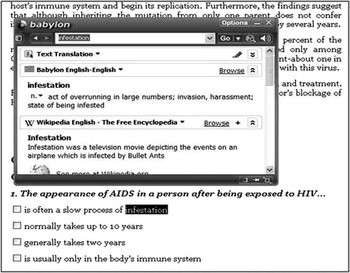
Both the SAOD and IFOD instructional designs allowed subjects to access the Babylon 7® online dictionary at any point during the reading task and during answering the comprehension questions. The Babylon online dictionary is easy to use and it provides instant access to word meanings, synonyms, translations, and audio pronunciation for every word in any text (see Figure 3).
A screen shot showing how the Babylon online dictionary works

Following the reading comprehension test in each of the four conditions, a vocabulary test was administered adapted from Plass, Chun, Mayer and Leutner (Reference Plass, Chun, Mayer and Leutner2003). The vocabulary test consisted of five sentences that were selected from the text (see Appendix C). Each sentence had an underlined word, and subjects were asked to match that word with the correct synonym (four choices per item were provided: a correct synonym and three distractors). The vocabulary test was placed on a separate webpage, which did not allow for backward navigation, i.e. once students left the reading test (the text and comprehension questions) they had to move on to the vocabulary test and could not move back to the text or use the online dictionary.
The twenty participants were randomly assigned to one of the four groups, SAND, SAOD, IFND, and IFOD. Each participant completed the task individually. After a brief demonstration and information session by the researcher, the participant was allowed to access the test webpages and complete the tasks. The number of back-and-forth navigations of the SAND and SAOD groups was automatically recorded. The time each participant spent on each stage of the test was also recorded. Moreover, the online dictionary reported how many and which words had been looked up by each participant.
4 Results
The dependent variables for this study included scores on the reading and vocabulary tests, looked-up words for the SAOD and IFOD groups, the number of back-and-forth navigations for the SAND and SAOD groups and, most importantly, the time spent on the reading and vocabulary tests. Consequently, one-way between-groups ANOVA was used for the analysis of the data. In order to compare a two-group only variable (e.g. use of online dictionary and navigation), a t-test was used.
4.1 Reading comprehension test
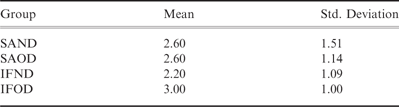
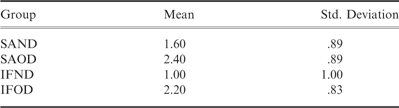
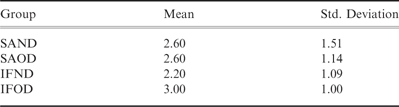
Each correct answer in the multiple-choice reading comprehension test received a score of 1, and the maximum score in this test was 5. A one-way ANOVA was used to compare the reading comprehension test scores across all four groups, and it was not found to be statistically significant (F = 0.368, df = 3, p = 0.777). Table 1 shows the mean scores and standard deviations for the reading comprehension test by group.
Reading test: Mean scores and standard deviations for each group
N = 20.
Table 1 shows that the subjects in the Split-Attention formats (SAND and SAOD) achieved similar results in the reading comprehension test, while the IFOD group performed better than all the other groups. The largest mean value difference was between the Integrated format groups (IFOD and IFND) with subjects who had access to the online dictionary performing far better than the subjects who had no dictionary access.
4.2 Vocabulary test
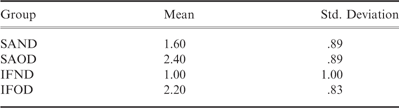
Each correct answer on the vocabulary test received a score of 1 with 5 being the maximum score for this test. The analysis of the vocabulary test results indicated that the differences across the four groups were not statistically significant (F = 2.42, df = 3, p = 0.104). Table 2 shows the mean scores and standard deviations for the vocabulary test by group.
Vocabulary Test: Mean scores and standard deviations by group
N = 20.
Table 2 indicates that both the SAND and IFND groups (the groups with no access to the online dictionary during the reading task) performed lower than the other two groups (SAOD and IFOD) who were allowed to use the online dictionary during the reading task.
4.3 Reading test speed
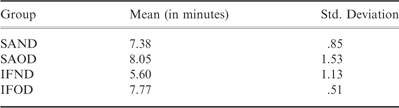
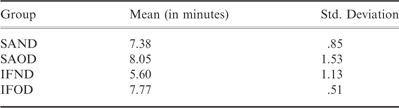
A one-way ANOVA across the four groups indicated a statistically significant difference across groups with respect to the amount of time spent on the reading test (F = 5.28, df = 3, p = 0.01, ηp 2 = .49). Table 3 shows the mean scores and standard deviations by group.
Reading test speed: Mean scores and standard deviations by group
N = 20.
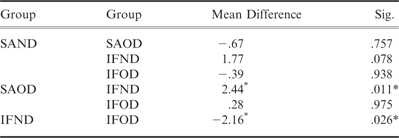
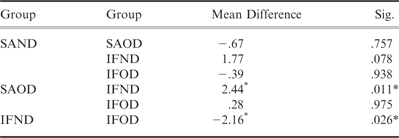
As can be seen from Table 3, the Split-Attention format group with online dictionary access (SAOD) took the longest time to complete the reading test (M = 8.05), while the Integrated format group without online dictionary access (IFND) was the fastest (M = 5.60). The mean scores also show that the two Split-Attention conditions (SAND and SAOD) were slower than the corresponding Integrated format conditions (IFND and IFOD). The partial eta squared also showed a medium effect size. Further between-group comparisons revealed that there is a statistically significant difference between the SAOD and IFND groups (p = 0.011) and between the IFND and IFOD groups (p = 0.026) with the groups that had access to the online dictionary being slower in the reading test. There was no significant difference found in the reading test speed between the two groups with access to the online dictionary (SAOD and IFOD), (p = 0.975). Table 4 reports the results of the multiple between-group comparisons.
Reading speed: Multiple between-group comparisons
N = 20.
*Significant at the .05 level.
4.4 Vocabulary test speed
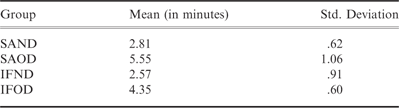
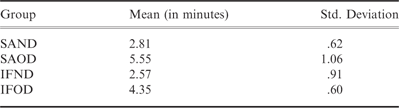
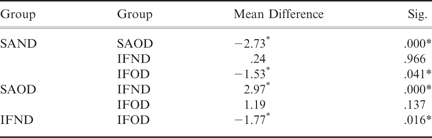
A one-way ANOVA revealed that there was a significant statistical difference across the four groups (F = 14.5, df = 3, p = 0.001, ηp 2 = .73) with regards to their vocabulary test speed and the partial eta squared value indicated a large effect size. Table 5 shows the mean scores and standard deviations by group and Table 6 reports the results of the multiple between-group comparisons. As with the results on the reading test speed, access to the online dictionary during the reading test had a significant effect on the vocabulary test speed.
Vocabulary test speed: Mean scores and standard deviations by group
N = 20.
Vocabulary test speed: Multiple between-group comparisons
N = 20.
*Significant at the .05 level.
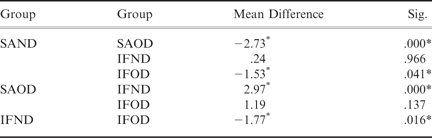
There was a significant difference between the two Split-Attention format groups (SAND and SAOD) (p = 0.000) and between the two Integrated format groups (IFND and IFOD) (p = 0.016). There was also a significant difference between the SAND and IFOD groups (p = 0.041). However, there was no statistically significant difference between the SAND and IFND groups (p = 0.966) or the SAOD and IFOD groups (p = 0.137). These results indicate that the groups that had access to the online dictionary during the reading task (SAOD and IFOD), took the longest time to answer the questions in the vocabulary test.
4.5 Use of online dictionary
The two groups of participants with access to the online dictionary (SAOD and IFOD) were further compared using a t-test. The difference between the SAOD and IFOD groups in the number of looked-up words approached statistical significance (t = 2.05, df = 8, p = 0.074, Cohen’s d = 0.54) with students in the Split-Attention format looking up about 30% more words than students in the Integrated format. There was a medium effect size and Table 7 shows the mean scores and standard deviations by group.
Use of online dictionary: Mean scores and standard deviations by group

N = 10.
*Number of looked-up words.
4.6 Navigation
A t-test was used to compare the mean scores with regards to navigation (i.e. the number of times participants in the Split-Attention conditions (SAND and SAOD) switched back and forth while doing the reading test). The analysis showed that the difference approaches statistical significance (t = 2.25, df = 8, p = 0.055, Cohen’s d = 0.58) with the group that had access to the online dictionary (SAOD) switching between pages far less than the group without dictionary access (SAND). The effect size was found to be large and Table 8 presents the mean scores and standard deviations by group.
Navigation: Mean scores and standard deviations by group

N = 10.
*Number of times subjects switched between web pages.
5 Discussion
The present study hypothesized that the implementation of the Integrated reading format would help ESL students to achieve better reading outcomes. This hypothesis was based on Hung’s (Reference Hung2007) study in which the subjects in the Integrated format condition outperformed the subjects in the Split-Attention condition in a traditional paper-based reading test. In this preliminary study too, the subjects tested under the IFOD condition (Integrated format with access to Online Dictionary) performed better than subjects tested under all other conditions in the reading comprehension test. According to Hung (Reference Hung2007), cognitive load is reduced by using an integrated format in reading comprehension tasks, while a split-attention format “imposes a heavy extraneous load that interferes with comprehension” (op. cit.: 136). In this study, the subjects in the Split-Attention format switched between the text and the questions four to six times on average (see Table 7), and they were significantly slower in their reading comprehension test than the subjects tested under the Integrated format conditions (see Table 3). Both these results taken together support the view that subjects in the Split-Attention format did experience an increase in cognitive load leading to diminished performance.
In a study conducted by Pollock, Chandler and Sweller (Reference Pollock, Chandler and Sweller2002), it was found that the use of the isolated elements condition (no emphasis on interaction between elements) and the interacting elements condition (emphasis on interaction between elements) in order to assimilate complex information, has a fluctuating influence on L2 students’ understanding. Consequently, Pollock et al. (Reference Pollock, Chandler and Sweller2002) concluded that “information is better learnt through the isolated elements instructional method”, particularly for inexperienced students (op. cit.: 83). In the present study, it is possible that the Integrated format resulted in the less-interactivity-between-elements method and as such it did not impose a working memory overload (see also Sweller, Van Merriënboer & Paas, Reference Sweller, Van Merriënboer and Paas1998). Moreover, just like the isolated elements condition, the Integrated format used in this study can facilitate reading because it deals with the text as multiple chunks and this can result in cognitive load reduction. On the other hand, both the interacting elements condition and the Split-Attention format are aimed at enhancing text interactivity, which may imply an increased cognitive overload. However, it is important to note that in an integrated instructional format text coherence and connectedness need to be maintained. According to Graff (Reference Graff2003), students’ cognitive and individual differences affect the way they process information. For example, analytically minded students are able to apprehend concepts in parts, but would have difficulty in integrating these concepts into complete wholes. One interpretation of Graff’s finding is that some students in the Integrated format may find it hard to mentally integrate the “fragmented” text (i.e., multiple passages each followed by a set of questions) into a single unit. Moreover, the fragmentation of the text into smaller units, as claimed by Graff (Reference Graff2003), may decrease the overall meaningfulness of the text. This could explain why some study participants in the Integrated format (students in the IFND & IFOD groups) reported at the end of the test that they had a poor understanding of the passage as a whole.
Several researchers have found a correlation between the time spent on a reading task and cognitive load (see, for example, Moreno, Reference Moreno2004; Chun, Reference Chun2001; Coady & Tozcu, Reference Coady and Tozcu2004). In other words, the more time spent on a reading task, the more the cognitive load, and vice versa. In this study, subjects tested under the Integrated format conditions (IFND and IFOD) were consistently faster in the reading comprehension test (see Table 1) and the vocabulary test (see Table 2) than the subjects tested under the Split-Attention formats (SAND and SAOD). This is another piece of evidence to suggest that the Split-Attention format imposes a higher cognitive load on the learner. Current findings also suggest that the incorporation of other aids such as an online dictionary can lead to better performance, at least for the Integrated format, as subjects tested under the IFOD condition performed better than the subjects tested under the IFND condition (see Table 2). By and large, the results of the present study support previous findings that reported the Integrated format as superior to the Split-Attention format. For the intermediate ESL students in this study, the Integrated format appeared to lower their cognitive load by reducing the split-attention effect and assisting their reading comprehension.
In this study, the use of the online dictionary considerably increased the amount of time spent on the reading comprehension test by students in the SAOD and IFOD groups. It appears that the use of the online dictionary did not affect the subjects’ performance on the reading test under the Split-Attention conditions (i.e., SAND and SAOD had identical means), while in the Integrated format the subjects who had access to the online dictionary (IFOD) performed better than those who did not have access to the dictionary (IFND). Thus there seems to be an interaction between the integrated format and the use of the online dictionary. It is possible that in the Split-Attention format, the subjects experienced a high cognitive load due to the reading format which in turn reduced the effectiveness of the online dictionary, resulting in no difference in performance between subjects who had access to the online dictionary and those who lacked access. In the Integrated format, the cognitive load was reduced, allowing the use of the online dictionary to have a more pronounced effect on the subjects’ performance.
With regards to the vocabulary test results, the subjects who had access to the online dictionary outperformed those who lacked access in both the Split-Attention and the Integrated formats. This is consistent with the results from other studies (Chun, Reference Chun2001; Akbulut, Reference Akbulut2007; Peters, Reference Peters2007), in which access to an online dictionary had a positive impact on ESL students’ reading comprehension. According to DeStefano and LeFevre (Reference DeStefano and LeFevre2007), the use of an online dictionary could make the reading task slower, due to an increase in task difficulty. In this study, access to the online dictionary for subjects in both the Split-Attention and the Integrated formats (SAOD and IFOD) substantially increased the amount of time spent on the reading comprehension test. So, even though ESL students in this study benefited from the use of the online dictionary, this had a negative impact on their reading speed. Akbulut (Reference Akbulut2007) found that the use of an online dictionary and glossaries cannot only improve reading comprehension, but can also impede efficient comprehension. In this study, the use of the online dictionary with each of the reading formats was intended to examine its influence on the subjects’ cognitive load and reading speed, but it was not expected to impose a cognitive overload or to slow down the students’ reading speed, due to the fact that it did not require students to browse other Web pages to look up difficult words. Instead, an immediate pop-up window appeared by just pressing the Ctrl key and clicking the Right-Mouse on a word. Unlike copy-and-paste dictionaries, as Chun (Reference Chun2001) found, students look up words more frequently if the dictionary provides immediate meanings or does not require navigation to other Web pages. However, it appears that the use of the online dictionary in the present study did increase task difficulty, as subjects who had access to the dictionary required more time to complete the reading comprehension test. Peters (Reference Peters2007), in her study, implemented a similar online dictionary (‘click on a word’) to the one used in this study. Similarly to the present study, her study found that the use of the online dictionary did not result in a faster reading speed.
The study of the participants’ look-up behavior revealed that students in the Split-Attention format looked up more words than their counterparts in the Integrated format. This again lends support to the view that the Integrated format is more effective for reading comprehension than the Split-Attention format, as subjects tested under the IFOD condition did not need to look up as many words as the subjects in the SAOD condition. It could be argued, then, that students in the Integrated format found it easier to answer the questions, and they looked up fewer words than students in the Split-Attention format thanks to the effectiveness of both the integrated format and the access to the online dictionary.
With regards to the vocabulary test, Peters (Reference Peters2007) found that intentional, rather than incidental, vocabulary learning implied more looked-up words and higher memory ability. The present study demonstrates a correlation between the use of an online dictionary and high scores in the vocabulary test in both the Split-Attention and the Integrated formats, with subjects who had access to the online dictionary during the reading test performing better than the subjects without access to the dictionary (no subjects had access to the dictionary during the vocabulary test). Based on these results, it could be argued that access to the online dictionary in this study increased students’ intentional look-up of words and consequently enhanced their noticing of specific words, which was reflected in their better performance on the vocabulary test. In other words, the present study suggests that the use of the online dictionary can improve students’ working memory and recall of new information.
Without access to the online dictionary, the students in the SAND and IFND groups relied heavily on guessing during the reading test and the vocabulary test. Hasler, Kersten and Sweller (Reference Hasler, Kersten and Sweller2007) argued that students’ reliance on guessing involves randomness and consequently results in high extraneous cognitive load. However, in the present study, the subjects in the SAND and IFND groups completed the reading and vocabulary tests in a shorter time compared to the SAOD and IFOD groups. A high extraneous cognitive load, as Hasler et al. (Reference Hasler, Kersten and Sweller2007) have suggested, would have resulted in students in SAND and IFND taking longer to complete the tests. Based on these preliminary results, the present study shows that there is no relationship between guessing and students’ cognitive overload.
6 Conclusion
While extraneous cognitive load depends upon factors such as students’ different cognitive abilities and individual differences such as level of English proficiency and age, the present study showed that an integrated reading format, in which a reading text is physically integrated with the comprehension questions, can enhance reading comprehension by reducing the students’ extraneous cognitive load. A split-attention format, on the other hand, can cause split-effect and a cognitive overload as students have to navigate between Web pages in order to complete a typical reading comprehension ESL task on different Web pages. The present study also suggests that access to an online dictionary during an online reading comprehension task can have a positive impact on ESL students’ reading comprehension, but it does increase task difficulty and consequently students’ cognitive load. As shown in this preliminary study, the combination of an integrated format for an online reading task and simple, easy, instantaneous access to an online dictionary is most efficient in terms of increasing both reading performance and vocabulary acquisition in ESL students.
The findings of the present study have practical implications for software and webpage designers. One important assumption of Cognitive Load Theory is that learning takes place when all redundant and seductive elements can be eliminated (Brünken, Plass & Leutner, Reference Brünken, Plass and Leutner2004). In order to effectively design online materials for ESL students, instructional designers need to consider what formats and technology affordances enhance learning. The present study has provided support for the use of integrated formats in reading comprehension ESL tasks. Furthermore, based on the study findings, the design of future online dictionaries should include more interactive multimedia-based elements, such as instantaneous access to word definitions, as these can be helpful in cognitive load reduction. Moreover, the study emphasizes that ESL teachers should be aware of which instructional design would accommodate their students the most. Furthermore, L2 students should be exposed to a wide range of options and tools, such as bilingual online dictionaries, that interactive web-based reading can offer.
Despite the useful findings, the present study is not without its limitations. Firstly, due to time constraints, the number of participants was small (N = 20) with participants tested under each of the four conditions limited to five. Consequently, findings of the study cannot confidently be generalized. A study with a larger sample size of participants (at least 20 participants per condition) would be able to detect significant statistical effects in the application of the different formats. In the present study, the Integrated format was found to be superior to the Split-Attention format with intermediate ESL students. Yeung et al. (Reference Yeung, Jin and Sweller1997) point out that the effectiveness of the integrated format differs depending on the learner’s expertise. Future studies should explore the impact of the integrated format and online vocabulary access on students with different levels of English proficiency. Furthermore, this study consisted predominantly of ESL students who came from a Chinese or Arabic L1 background. Both these L1 groups have a different script from English, and the Arabic group read from right to left. These factors could have affected the participants’ cognitive load. A future study could compare groups of students who belong to Chinese, Arabic and European L1 backgrounds in order to detect whether any differences in cognitive load could be attributed to L1 background. Finally, the present study implemented a limited number of multimedia-based annotations or representational tools such as the audio pronunciation provided by the online dictionary. Future studies could include more multimedia-based tools in order to assess the impact of these tools on cognitive load. The results of the present study with regards to the efficiency of the integrated format demand further investigation. Future studies could explore how overall text coherence can be better maintained in the integrated format.
Notwithstanding its limitations, this preliminary study has attempted to explore the interaction of online instructional format and cognitive load and how different reading formats and access to multimedia tools can affect ESL students’ language performance.
Appendix A
Reading Comprehension Test – Split-Attention format
Improvement in AIDS Cure
Read the text and then answer the questions
When one is exposed to HIV, (human immuno-deficiency virus), one becomes infected. The virus begins to multiply within the body’s immune system, ultimately rendering the host unable to fight off invasion of diseases. Full-blown AIDS (acquired immune deficiency syndrome) normally develops within 2 to 10 years.
Yet, in any given natural population, some individuals demonstrate natural immunity; even after direct exposure to HIV, they do not become carriers. An investigation of this promising phenomenon involved separate concurrent studies of stored blood samples taken from high-risk male populations. The research has provided a possible explanation for the natural immunity of a lucky one percent of white males. They have inherited a mutant gene from both parents. The white blood T-cells of their immune system produce a shorter version of CKR5. This is a specific cell receptor protein onto which the virus must link in order to enter the host’s immune system and begin its replication. Furthermore, the findings suggest that although inheriting the mutation from only one parent does not confer immunity, it may be a factor in delaying the disease’s progression by several years.
The occurrence of the CKR5 mutation accounted for three percent of the natural immunity to HIV seen in the study, but was detected only among Caucasian subjects. The mutant gene not only exists but is prevalent – about one in every 100 people has immunity – suggesting a historical encounter with this virus.
Current research may hold the key to effective HIV vaccination and treatment. For example, drugs could be designed to mimic the mutant receptor’s blockage of HIV entry.

Appendix B
Reading Comprehension Test – Integrated format
Improvement in AIDS Cure
Read the text and then answer the questions.
When one is exposed to HIV, (human immuno-deficiency virus), one becomes infected. The virus begins to multiply within the body’s immune system, ultimately rendering the host unable to fight off invasion of diseases. Full-blown AIDS (acquired immune deficiency syndrome) normally develops within 2 to 10 years.

Appendix C
The Vocabulary Test