More women are gaining access to political power around the world, affording them increased opportunities to shape domestic and foreign policies. This trend has sparked optimism that women’s increased inclusion in positions of power will help shift international politics away from military interventions and toward social and humanitarian issues (Slaughter Reference Slaughter2012). Research on gender and foreign policy lends some credence to this optimism. Indeed, across the globe, women’s representation in parliament is associated with lower levels of defense spending (Clayton and Zetterberg Reference Clayton and Zetterberg2018; Koch and Fulton Reference Koch and Fulton2011), greater contributions to combating climate change (Mavisakalyan and Tarverdi Reference Mavisakalyan and Tarverdi2019), less involvement in violent international conflict (Caprioli Reference Caprioli2000; Regan and Paskeviciute Reference Regan and Paskeviciute2003), lower tariffs (Betz, Fortunato, and O’Brien Reference Betz, Fortunato and O’Brien2021; Imamverdiyeva, Pinto, and Shea Reference Imamverdiyeva, Pinto and Shea2021), and more spending on global humanitarian actions (Breuning Reference Breuning2001; Shea and Christian Reference Shea and Christian2017). Together, these findings show a consistent relationship between gender, legislative representation, and foreign policy. However, the underpinnings of this relationship are not well understood.
One explanation for the association between women’s representation and foreign policy outcomes is the women’s values thesis, which contends that women politicians hold distinct foreign policy preferences and that these preferences lead women in office to behave in ways that shift policy in a more humanitarian fashion (Breuning Reference Breuning2001; see also Hicks, Hicks, and Maldonado Reference Hicks, Hicks and Maldonado2016; Koch and Fulton Reference Koch and Fulton2011; Togeby Reference Togeby1994). Complementing the women’s values thesis is the social equity thesis (Breuning Reference Breuning2001; Lu and Breuning Reference Lu and Breuning2014). This thesis holds that it is a country’s underlying values and preferences for equality that lead to both increases in women’s representation and more humanitarian policy. While these two explanations are often examined jointly, in this article, we focus our attention on the women’s values thesis and test whether women legislators exhibit different (more humanitarian) legislative behaviors compared with men.
While public opinion research offers support for the conclusion that women in the general public are more altruistic and supportive of peaceful and humanitarian foreign policy (Andreoni and Vesterlund Reference Andreoni and Vesterlund2001; Eichenberg Reference Eichenberg2016; Lizotte, Eichenberg, and Stoll Reference Lizotte, Eichenberg and Stoll2020), we know much less about how these results generalize or transport to political elites.Footnote 1 Moreover, to the extent that women do shift foreign policy agendas in a more humanitarian direction, we know very little about how they do this.Footnote 2 To address these points, we examine the behavior of female legislators across four types of legislative behaviors: roll-call voting (1981–2008), bill (co)sponsorship (1985–2008), participation in legislative hearings (2007–19), and oversight of the U.S. aid bureaucracy (2007–14). Not only do these behaviors represent distinct ways that women could influence foreign policy, they also vary in terms of their level of visibility and the amount of discretion afforded to legislators. We argue that if women legislators hold distinct foreign policy preferences, and these preferences meaningfully shift the tenor of foreign policy, then we should observe gender differences somewhere in the policy process. In drawing on a diverse set of legislative behaviors, we acknowledge that there are multiple ways that legislators can influence foreign policy.
Our focus on specific legislative behaviors rather than aggregate-level outcomes allows us to build upon past research on gender and foreign aid and speak directly to the ongoing debate in the literature between the women’s values and social equity theses. In the study most similar to our own, Lu and Breuning (Reference Lu and Breuning2014) explore this question by comparing the relationship between women’s inclusion in legislatures and key cabinet posts with aid expenditures. They conclude that the relationship between gender and aid expenditures is likely rooted in social equity after observing that although women’s presence in legislative politics is positively associated with foreign aid, women heads of foreign-policy-related ministries (presumably the women with the greatest policy influence in this area) are not. While this research certainly provides insights into the present study, it does not allow us to understand how gender may influence the specific behaviors of elites. Rather than making cross-institutional comparisons, we directly examine individual legislators’ behaviors in a single institution across multiple forums.
Our analysis focuses on legislative behavior in the U.S. House of Representatives in the context of development aid. We focus on the United States because it is the largest overall donor of development aid, and it is a country that still has a relatively small, yet increasing, share of women in the national legislature. If the women’s values thesis holds, we would predict that U.S. foreign policy will become more and more humanitarian at the margin. Our focus on the case of development aid is consistent with other research on gender and foreign policy, and development aid is often the outcome of interest in studies that seek to disentangle the women’s values and social equity theses (e.g., Breuning Reference Breuning2001; Lu and Breuning Reference Lu and Breuning2014). Understanding these dynamics is important not only for our understanding of the relationships between donor and recipient countries, but also for our understanding of foreign policy generally. While the general public is often not terribly attuned to the dynamics of foreign aid, shifts in foreign policy toward aid (and presumably away from conflict and military intervention) have important global political consequences.
Our results provide almost no evidence that women act any differently than men in using legislative levers to influence U.S. aid policy. Across a series of models, differences in behavior are often tiny (mean estimates), at times opposite to the expected direction, noisy, and almost always statistically insignificant. Additional analyses across political parties and time periods do not reveal any noteworthy heterogeneity in the association between a legislator’s gender and their behavior in the context of foreign aid.Footnote 3 Given the breadth of legislative behaviors we examine, our results provide little support for the women’s values thesis, at least in the United States. While our analyses do not allow us to address preferences per se, they do allow us to assess the manifestation of preferences in the policy-making process.Footnote 4 The fact that we see almost no differences between men and women legislators—even in the context of activities that are highly discretionary and less visible, such as monitoring the U.S. Agency for International Development (USAID)—challenges arguments that women legislators have distinct, more humanitarian preferences than men in the case of development aid and suggests that the optimism for a more humanitarian foreign policy as women enter the legislature in the United States should be scaled back.
While our focus is on development aid, our results also speak to women’s representation and U.S. foreign policy more broadly. Because aid is relatively low in salience and perhaps the foreign policy area least associated with masculinity, the electoral and institutional constraints faced by legislators should be weakest in this context. The fact that we find almost no evidence of women legislators promoting aid suggests that we should not expect gender differences to manifest in other foreign policy domains, where electoral, partisan, and other institutional constraints are stronger. Indeed, a study on voting on military matters in the U.S. Congress finds that gender differences largely disappear after accounting for legislators’ party affiliations (Bendix and Jeong Reference Bendix and Jeong2020).
Beyond this contribution to our understanding of the present and future of U.S. foreign policy, the article engages with broader debates about the explanations for the observed relationships between women representations and foreign policy (see also Lu and Bruening Reference Lu and Breuning2014). Our results clearly demonstrate the usefulness in analyzing individual politicians to directly test key mechanisms in these explanations (Bendix and Jeong Reference Bendix and Jeong2020; Imamverdiyeva, Pinto, and Shea Reference Imamverdiyeva, Pinto and Shea2021). In addition, while our analyses are limited to the United States, our failure to find evidence for the women’s value thesis call for more attention to alternative explanations and to potential scope conditions.
GENDER AND DEVELOPMENT AID
The relationship between women’s representation and foreign policy has been documented in a range of policy domains, including defense spending (Clayton and Zetterberg Reference Clayton and Zetterberg2018; Koch Reference Koch1997), tariffs (Betz, Fortunato, and O’Brien Reference Betz, Fortunato and O’Brien2021; Imamverdiyeva, Pinto, and Shea Reference Imamverdiyeva, Pinto and Shea2021), climate change cooperation (Mavisakalyan and Tarverdi Reference Mavisakalyan and Tarverdi2019), use of force (Caprioli Reference Caprioli2000; Caprioli and Boyer Reference Caprioli and Boyer2001; Regan and Paskeviciute Reference Regan and Paskeviciute2003), and humanitarian intervention (Shea and Christian Reference Shea and Christian2017). The common thread is that greater legislative representation for women is associated with a more humanitarian and peaceful foreign policy. Prominently, many studies report fairly consistent, positive associations between women’s seats shares in national legislatures and aid expenditures (Breuning Reference Breuning2001; Fuchs and Richert Reference Fuchs and Richert2018; Hicks, Hicks, and Maldonado Reference Hicks, Hicks and Maldonado2016; Lu and Breuning Reference Lu and Breuning2014; Okundaye and Breuning Reference Okundaye and Breuning2021; Yoon and Moon Reference Yoon and Moon2019; but see Fuchs, Dreher, and Nunnenkamp Reference Fuchs, Dreher and Nunnenkamp2014; Lundsgaarde, Breunig, and Prakash Reference Lundsgaarde, Breunig and Prakash2007).Footnote 5 A similar association is found with higher aid quality, an important dimension of foreign aid that assesses how well a given amount of aid is targeted to serve those most in need (Heinrich and Kobayashi Reference Heinrich and Kobayashi2022; Hicks, Hicks, and Maldonado Reference Hicks, Hicks and Maldonado2016).Footnote 6 Unfortunately, our understanding of the mechanisms that produce these associations is scant.
In her foundational work, Breuning (Reference Breuning2001) provides two explanations for the observed relationship between women’s representation and development aid, and almost all scholarship on the topic—whether implicitly or explicitly—draws on one of them. The first, which is the focus of the present article, is the women’s values thesis. It contends that women politicians hold distinct foreign policy preferences, which manifest in observable differences in legislative output. The second, the social equity thesis, argues that overarching societal preferences and attitudes toward equality lead to higher expenditures on foreign aid and to more women in legislatures. In this article, we focus on testing the mechanisms of the women’s values thesis.
The women’s values thesis holds that women parliamentarians have more development-minded preferences and act to further development goals. Research commonly draws on evidence that women are more altruistic toward others, particularly in contexts in which social distance is high—as would be the case with foreign aid (Eckel and Grossman Reference Eckel and Grossman1998; Engel Reference Engel2011)—and are more inequality averse than men (Andreoni and Vesterlund Reference Andreoni and Vesterlund2001; Dufwenberg and Muren Reference Dufwenberg and Muren2006). Moreover, women hold more favorable attitudes toward domestic policies that promote equity and equality (Inglehart and Norris Reference Inglehart and Norris2000; Luttmer and Singhal Reference Luttmer and Singhal2011) and development aid than men (Bauhr, Charron, and Nasiritousi Reference Bauhr, Charron and Nasiritousi2013; Paxton and Knack Reference Paxton and Knack2012).Footnote 7 Most of these studies focus on ordinary citizens rather than elites. The few elite studies that exist report mixed evidence (Bashevkin Reference Bashevkin2014; Holsti and Rosenau Reference Holsti and Rosenau1981; McGlen and Sarkees Reference McGlen and Sarkees1993).
On the other hand, the social equity thesis argues that overarching societal preferences and attitudes toward social equity lead countries to invest more in foreign aid, while also creating a political environment that is more conducive to women’s emergence in politics (Breuning Reference Breuning2001; Lu and Breuning Reference Lu and Breuning2014). This explanation calls into question the claim that women’s legislative actions would be different from men’s, implying that gender-based compositional differences do not cause differences in foreign aid outcomes, and indeed in foreign policy outcomes more broadly. In their study of the relationship between gender and foreign aid expenditure, Lu and Breuning (Reference Lu and Breuning2014) find that while the percentage of women serving in parliament is associated with increased aid, female foreign ministers are associated with decreases in aid. Because foreign ministers are more powerful than rank-and-file parliamentarians, they conclude that this indicates the social equity thesis is the more compelling explanation. Making comparisons across positions however may miss potentially important nuances. Women are not randomly selected to hold ministerial positions (see Goddard Reference Goddard2019), and it could be the case that the type of women who are selected for these positions deviate from rank-and-file members in important ways.
Building on past research, we contribute to this debate by focusing on the behaviors of individual legislators. Assuming that gendered mass attitudes extend to elites, research has focused on women’s overall presence in the parliament rather than the behavior of individual legislators that ought to give rise to the observed country-level outcomes. Yet, the women’s value thesis posits a specific mechanism based on individual politicians’ behavior in parliament. We argue that a shift toward individual legislators is a productive way to evaluate the women’s value thesis and, ultimately, to contribute to the broader debate about women’s representation and foreign policy.
We are not the first to study the behaviors of individual legislators to shed light on the relationship between gender and foreign policy. Notably, three prior studies systematically examine the individual behavior of legislators, but the evidence for the role of gender in foreign policy is mixed and limited in scope. Bendix and Jeong (Reference Bendix and Jeong2020) analyze roll-call votes on security-related bills in the U.S. Congress and report limited evidence of gendered differences in voting behavior after accounting for legislators’ routine backgrounds, such as their party affiliation. Angevine (Reference Angevine2017) and Imamverdiyeva, Pinto, and Shea (Reference Imamverdiyeva, Pinto and Shea2021) analyze voting and sponsorship of bills that deal with foreign women as policy targets and find evidence that women legislators are more likely than men to vote on and introduce such legislation, respectively. While these insights are useful, there are other forums available in which legislators can influence policy making, and it is unclear whether the results extend to other, broader policy domains like foreign aid. Most notably, our study departs from these previous studies by examining multiple forms of legislative behavior that vary in important ways, which we outline next.
GENDER, LEGISLATIVE BEHAVIOR, AND FOREIGN AID
The women’s values thesis implies that if women’s presence causes an increase in aid expenditures, we should see men and women legislators engaging in observably different behaviors at the individual level. To test for such differences, we focus our attention on the behaviors of legislators in the U.S. House of Representatives. Though women remain underrepresented in the United States, especially in comparison with other nations, their inclusion has been increasing over the last several decades. Moreover, if the link between women’s inclusion and foreign aid is rooted in individual-level differences, we should still be able to observe differences in behaviors even in contexts such as Congress, though as we note later, it is important to account for the institutional and contextual constraints (women) legislators face.
We focus our attention on the U.S. case for two reasons. First, there is great availability of data across many forms of legislative behavior (e.g., roll-call voting, hearings, bill cosponsorship, bureaucratic interventions) that are not readily available in other countries. We acknowledge that there are many paths through which legislators can effectuate their preferences, either through policy discussion, creation, or implementation. Thus, in order to determine whether and how women influence foreign aid expenditures, accounting for these multiple paths is essential.
Second, the U.S. House of Representatives has been researched more extensively compared with other national parliaments, enabling us to draw on an extensive knowledge to guide our inquiry. In particular, despite the strong partisanship and extent of women’s underrepresentation in the U.S. Congress, existing work documents that gender differences do manifest in women’s behavior in Congress in some instances: the types of bills women (co)sponsor (Swers Reference Swers2002), the types of topics women discuss (Pearson and Dancey Reference Pearson and Dancey2011), and the tone used to talk about women’s issues (Dietrich, Hayes, and O’Brien Reference Dietrich, Hayes and O’Brien2019). Collectively, this work suggests that while institutional constraints might shape the ways in which women’s behavior in office can diverge from men’s, these factors are not so strong as to create uniformity. In other words, if women hold distinct preferences on foreign aid, as assumed by the women’s values theses, there should be some opportunity for them to act on these preferences.
In our analysis, we examine four legislative behaviors, all of which could be used to influence policy creation or implementation related to foreign aid: roll-call voting, bill (co)sponsorship, participation in legislative hearings, and contacting bureaucratic agencies. We select these behaviors because they vary considerably on two key dimensions: visibility and partisan control. Partisanship is the dominant organizing feature in American politics, making it important to take visibility and institutional control seriously. For example, behaviors that are highly visible, such as bill cosponsorship, may disincentivize women from acting on pro-aid preferences if those preferences diverge from their party. Conversely, men might be incentivized to act in a pro-aid fashion (whether or not they hold this preference) if it matches their party. In either case, this would reduce differences in the behaviors observed from men and women legislators. In contrast, low-visibility behaviors, such as monitoring bureaucratic agencies, may allow differences in preferences to manifest as these types of behaviors are less likely to be monitored by party leaders and to draw ire in cases in which representatives act in a manner discordant with the party.Footnote 8
Likewise, the ability of political parties to structure behavior could influence whether we see women engaging in different behaviors than men, even if they hold different preferences. For example, in the case of “agenda-response” behaviors such as roll-call voting, parties have the ability to structure not only how bills are voted on, but which bills come up for a vote (see Osborn Reference Osborn2012; Snyder and Groseclose Reference Snyder and Groseclose2000). Because of the high degree of control afforded to parties and the structured nature of the choice set offered to legislators in these contexts, party cohesion should be high, which may limit the observance of gendered differences in behavior. In contrast, “agenda-setting” behaviors, such as bill (co)sponsorship, are (relatively) less structured by parties in government and offer legislators more discretion in pursuing their policy interests (see Osborn Reference Osborn2012).
In the sections that follow, we test for differences between men and women for each of our four legislative behaviors. Roll-call voting—a highly visible, highly structured act—represents the hardest case for the women’s values thesis. Bureaucratic oversight, in contrast, represents the easiest test in that it is a low-visibility act that is not structured by party elites. By examining an array of legislative behaviors that vary across several dimensions, we argue that if women legislators truly hold distinct preferences on foreign aid, we should see differences emerge in at least one of the behaviors we look at.
Roll-Call Voting
The first channel through which legislators can affect aid outlays that we study is roll-call voting on foreign aid bills. Roll-call voting offers the hardest test for the women’s values thesis as it is highly visible and structured by political parties (Osborn Reference Osborn2012; Snyder and Groseclose Reference Snyder and Groseclose2000). Both these features should act as constraints on legislators to act on their preferences. Indeed, to the extent that scholars have observed gendered differences in roll-call voting in Congress, the results have been mixed. While early scholarship found that women were more liberal than their male counterparts (Frankovic Reference Frankovic1977; Welch Reference Welch1985), other research finds that, at this stage of the legislative process, gendered differences are minimal, and factors such as partisanship and ideology are more important predictors of women’s (and men’s) roll-call behaviors. Indeed, Frederick (Reference Frederick2009) reports that to the extent that men and women do engage in different roll-call behaviors, these differences have been diminishing over time as Congress has become increasingly ideologically polarized.
At the same time, scholars have observed gender differences in roll-call voting patterns in some circumstances. For example, Swers (Reference Swers1998) finds that after accounting for partisanship, district characteristics, and a host of other controls, congresswomen are more likely to vote in support of women’s issues bills. Likewise, Frederick (Reference Frederick2015, 103) finds that while men and women who represent similar districts have “virtually indistinguishable voting records on the liberal-conservative policy dimension,” women are more supportive of legislation dealing with women’s interests than men. While not necessarily categorized as a women’s issue in much of the literature, we note that development aid is often related to women’s issues through its impact on women, children, and issues such as education and health care. For that reason, we expect women to advocate for aid to a greater extent than men through their roll-call votes, if women legislators hold more pro-aid preferences compared with their male counterparts.Footnote 9
We start with roll-call data collected by Milner and Tingley (Reference Milner and Tingley2015), the most comprehensive data set for bills related to foreign aid in the House of Representatives. The temporal domain spans the 97th to 110th Congresses. We restrict our attention to “economic aid” bills, which deal mostly with amendments to proposals on aid appropriations that to seek a change in aid appropriations.Footnote 10 Some bills seek increases to aid generally, whereas others seek decreases. For each legislator in a Congress, and for each bill, we record whether the vote is a “yay” for an outcome that would lead to an “increase” in aid compared with the opposite vote, whether one votes “nay” on such outcome. Abstentions are also possible. We aggregate the votes so that we have the shares of yay and nay votes for each person in each Congress (scaled by 100).
We augment this data set by adding a legislator’s gender as well as legislator-specific and constituency-level data, which prior work has theorized and examined to have effects on legislative action on foreign aid and on the probability of electing a woman representative. For legislator-specific variables, we include the legislator’s age, ideology (first dimension DW-NOMINATE score), race, whether the legislator was a freshman member, whether the legislator was born outside the United States, whether the legislator served in a party leadership position,Footnote 11 and whether the legislator served on the appropriations or foreign affairs committee. For district-level variables, we obtain the percentage of people born abroad in the district, percentage with a bachelor’s degree or above, percentage Hispanic population, percentage white population, and percentage of the district that is urban. Further, we develop a prosperity score to measure economic well-being at the district level.Footnote 12 , Footnote 13 Finally, we add the state-level social and economic liberalism scores provided by Caughey and Warshaw (Reference Caughey and Warshaw2016), the percentage of the state that voted for the Democratic presidential candidate in the most recent presidential election,Footnote 14 and whether a legislator was from a state in the U.S. South.
The resulting data set has 4,232 legislator-Congress observations, spanning the 97th to 110th Congresses (1981–2008). A total of 424 of these observations come from 136 unique women.Footnote 15 A first glance at the data suggests a strong imbalance by gender across all covariates (Figure A.1). If the pattern of imbalance is related to preferences on foreign aid as well, which we would expect for several covariates, then this selection effect causes problems for inference. We take two approaches to remedy these issues, leading to a doubly robust estimation of the effect of a legislator’s gender on roll-call voting behavior. First, we reweight the male legislators’ observations such that the averages of covariates match those in the women legislators’ data.Footnote 16 We use entropy balancing to balance the prespecified moments of the “untreated” sample (i.e., male legislators) to those of the “treated” sample (i.e., female legislators) (Hainmueller Reference Hainmueller2012). We conduct this reweighting within strata of party and Congress, ensuring that women legislators are only compared against copartisans in the same Congress. The advantage of entropy balancing is that, unlike matching, it targets covariate imbalance directly, a potential source of confoundedness and bias. Figure A.1 shows how the sizable differences in the raw data largely disappear after reweighing. Second, we include an indicator capturing the party affiliation of each member of Congress as well as an indicator capturing the specific Congress (e.g., the 115th) in which a legislator served. Including the latter allows us to account for all Congress specific factors such as the overall percentage of women serving. A larger control set uses almost all of the same variables that we used for reweighing.Footnote 17 We estimate the models using ordinary least squares (OLS), bootstrap-clustering residuals by party-Congress. We obtain estimates from each imputed data set, pooling the estimates for a final result.
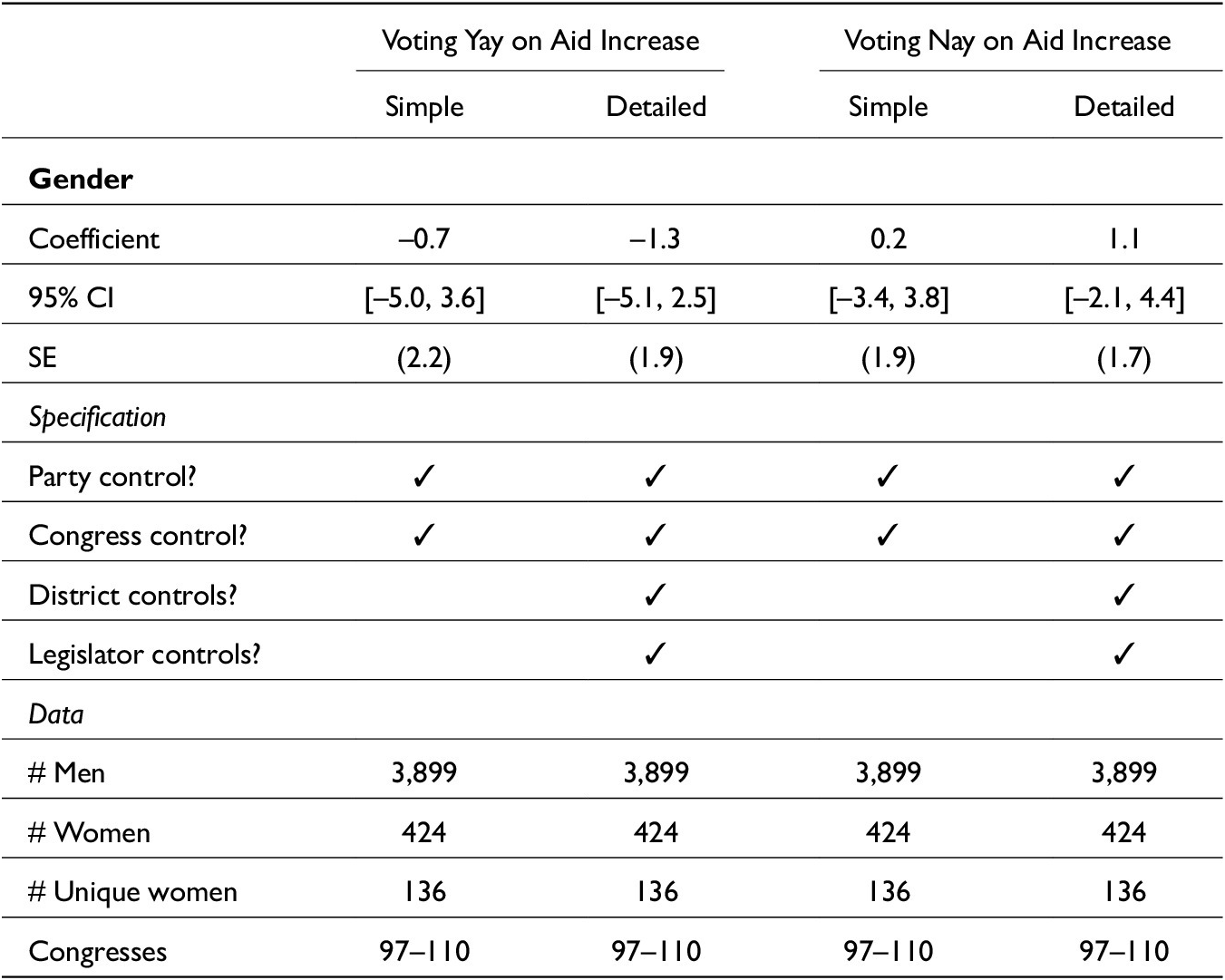
Table 1 gives the results for our main estimates. The first column shows the coefficient when regressing the percentage of yay votes cast for aid-increase bills on a female indicator as well as controls for the Congress and the legislator’s party (i.e., using the simple model specification). The coefficient is –0.7, which suggests that a woman legislator casts less than 1 percentage point fewer votes for bills that would increase foreign aid. To get a sense of the magnitude of this, consider that in 2021, there were 101 women in the House of Representatives. Crudely, our estimates suggest that there would be one less vote for an aid-increase bill compared with when the whole chamber consisted of men or if there were no gender differences. The effect is tiny, and the uncertainty estimates show that the coefficient is statistically insignificant, as the confidence interval contains zero and the standard error is almost four times the absolute value of the coefficient.Footnote 18
Estimates for gender effects in roll-call voting on foreign aid using all observations

Notes: The table reports the estimated coefficients on legislator gender (1 = female). The simple model specifications in columns 2 and 4 includes indicators for party affiliation and Congresses. The detailed specifications in columns 3 and 5 further include legislator-specific (age, DW-NOMINATE, freshman, race/ethnicity, foreign affairs/appropriations committee, born abroad) and district-specific variables (percentages foreign born, with college degrees, white, prosperity score, in the South, Democratic vote share in the last presidential election, state social, and economic liberalism).
The share of nay votes under the simple covariate specification (column 3) shows a similar pattern. Its magnitude is tiny, and the estimate is also statistically insignificant. Adding the additional legislator-specific and district-specific covariates to either model (columns 2 and 4) increases the respective point estimate (absolute value) but reduces the standard error. The estimates remain statistically insignificant.
Bill Cosponsorship
Having uncovered no evidence of gendered differences in roll-call voting, we next analyze cosponsorship of bills. Like roll-call voting, cosponsorship is a highly visible act. However, unlike roll-call voting, cosponsorship offers legislators more flexibility. Majority parties exert strong control over which bills are voted on, but the decision to create or sign on to cosponsor a piece of legislation and determine the content of the bill offers legislators relatively more agency. Therefore, we might expect differential preferences on aid to manifest in the types of policies legislators (co)sponsor, even if we do not observe differences in roll-call behaviors when these bills eventually come up for a vote. Indeed, in her study, Swers (Reference Swers1998) finds the largest differences between congressmen and congresswomen at this stage of the legislative process.
Existing evidence suggests that women use (co)sponsorship as a means to promote women’s issues in a way that is distinct from congressmen (Celis Reference Celis2006; Franceschet and Piscopo Reference Franceschet and Piscopo2008; Swers and Larson Reference Swers, Larson, Thomas and Wilcox2005; Volden, Wiseman, and Wittmer Reference Volden, Wiseman and Wittmer2016). Congresswomen are more likely to (co)sponsor feminist legislation (Swers Reference Swers2002; Wolbrecht Reference Wolbrecht2002) and more likely to sponsor bills related to “women’s issues” such as education, health care, and child care (Swers Reference Swers2002, Reference Swers2016; Swers and Larson Reference Swers, Larson, Thomas and Wilcox2005). Angevine (Reference Angevine2017) shows parallel patterns in foreign policy, where women are more likely to sponsor bills in which foreign women are the policy target. Thus, if women legislators have different preferences on foreign aid, (co)sponsorship may be a viable avenue to pursue these preferences.
Unlike for roll-call votes, we could not draw on existing research to determine which bills address foreign aid. We first identified bills of potential interest to us out of the universe of bills. We started with the Congressional Bills Project (Adler and Wilkerson Reference Adler and Wilkerson2013), which categorizes bills based on topic using the coding system of the Policy Agendas Project/Comparative Agendas Project. For each Congress between the 97th and 110th, we sampled one-third of all bills labeled as either “International Affairs” or “Foreign Aid.” We then hired workers via Amazon’s MTurk platform to code whether each bill was about development aid or not, and if it was, we asked them to code whether the bill increased, decreased, or left the level of aid the same. This gives us 135 aid-increase bills and 39 aid-decrease bills, which we analyze separately. (See Section B of the appendix for details of this crowdsourced coding process.) Then, we used the Cosponsorships Network Data compiled by Fowler (Reference Fowler2006a, Reference Fowler2006b) to identify all sponsors and cosponsors of all bills that came before Congress.
As before, we aggregate the item-specific choices to the legislator-Congress level, calculating the percentage of aid-increase and aid-decrease bills that a person (co)sponsored (scaled by 100). The covariates and model specifications are like before. In Figure A.1, we show that entropy balancing again reduces gender imbalances in this data set.
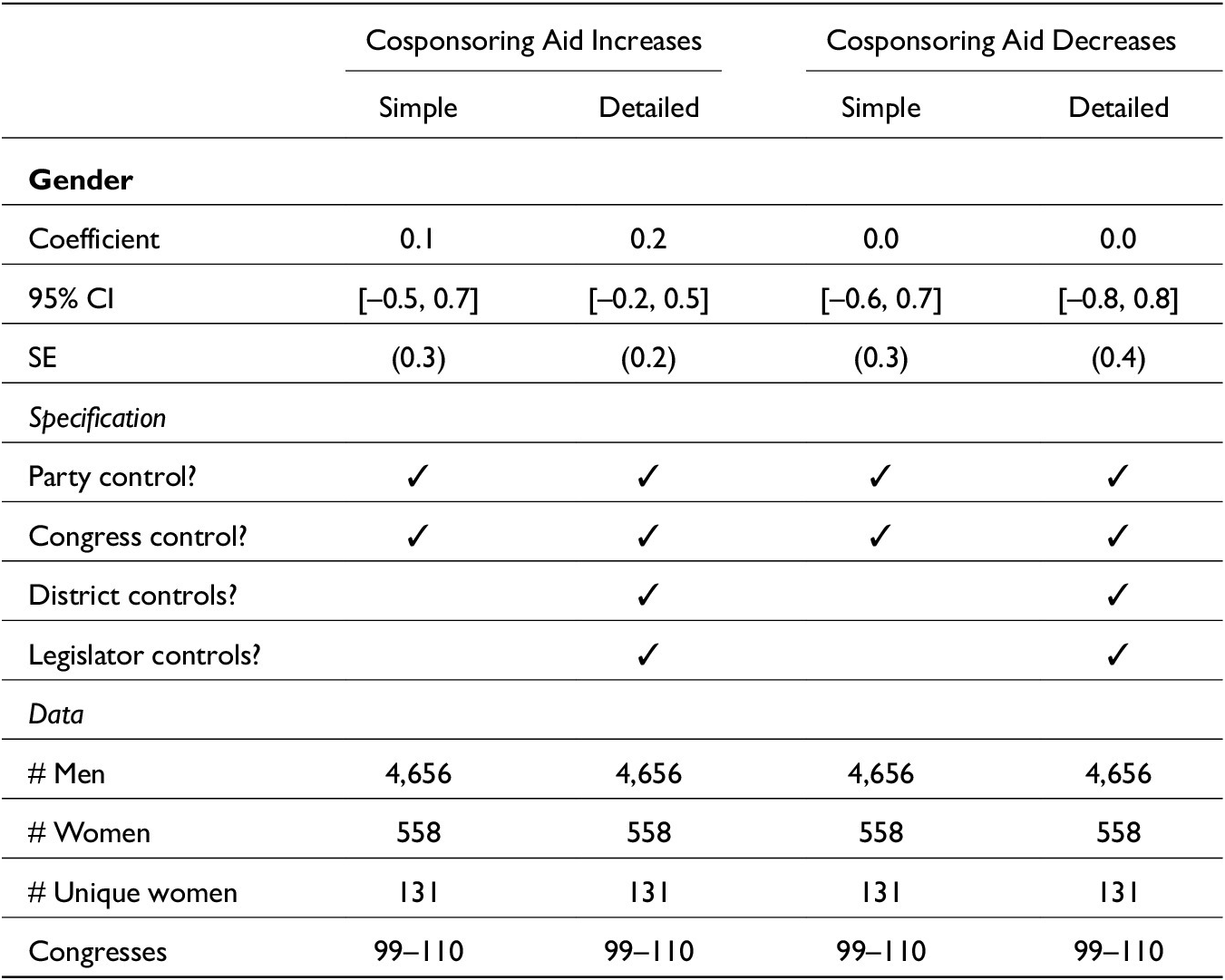
The results echo those from the roll-call votes, as Table 2 shows. For legislation to increase or decrease aid, gender does not make a difference for the shares of either type that a legislator signs on to (co)sponsor. The point estimates are tiny in magnitude and statistically indistinguishable from zero.
Estimates for gender effects in cosponsoring legislation on foreign aid using all observations.

Note: This table is constructed like Table 1.
Congressional Hearings
So far, we have found no evidence that women legislators are more likely to promote foreign aid or to prevent cuts to aid compared with men. We now shift our attention to behaviors related to policy implementation, which are relatively less visible. Examining the implementation stage of the policy process is essential because the bureaucratic agencies handling aid have considerable discretion over the implementation of aid policy (Arel-Bundock, Atkinson, and Potter Reference Arel-Bundock, Atkinson and Potter2015; Fuchs and Richert Reference Fuchs and Richert2018; Van Belle Reference Van Belle2004). Legislative activities, such as making inquiries about policy implementation in hearings and directly contacting bureaucratic agencies, can essentially work as oversight of the aid bureaucracy (Milner and Tingley Reference Milner and Tingley2015, chap. 3). Thus, to the extent that women’s presence in legislatures is linked to aid expenditures, we must understand not only what bills are passed, but the practical reality of how those bills are implemented.
We turn our attention to participation in hearings. Even though it is visible behavior, most hearings are rarely attended by members of the committee and do not typically gain the attention of the public. In this sense, legislators may be more free to act on their preferences in this forum as they are unlikely to attract attention. At the same time, however, the extent to which women participate in these hearings is still structured by institutional factors. Literature on deliberation shows that women’s participation its effectiveness in deliberative settings depends on the behavior of male legislators, the composition of the group, as well as the rules structuring discussion (Karpowitz, Mandelberg, and Shake Reference Karpowitz, Mendelberg and Shaker2012; Kathlene Reference Kathlene1994, Reference Kathlene1995). Thus, while legislators are afforded relatively more discretion by virtue of hearings being a low-visibility activity, participation in these venues still represents a context in which some other subtle institutional constraints are present.
We examine two questions in the context of hearings. First, we are interested in whether, among all members of the committees holding a given hearing, women legislators are more likely than men to participate in the hearing by making any comments and inquiries about policy implementation. Second, we examine whether women legislators express greater support for aid than men when women legislators do participate in those hearings.
We collected transcripts of hearings in which senior personnel from USAID or the Millennium Challenge Corporation appear by accessing the ProQuest Congressional Database. First, we obtained 120 hearing transcripts dating back to 1970 in which “US-AID” and “Millennium Challenge” appeared as keywords. Next, we examined titles and synopses to find those that covered topics relevant to the study.Footnote 19 This produced 25 hearings in the House and Senate,Footnote 20 a number that drops to 12 when restricting attention to those held by the House of Representatives. While we can use these 12 for the attendance of meetings, the number declines to 10 when examining expressed attitudes as this analysis necessitates that a hearing is attended by at least one woman and one man legislator.
Our first analysis concerns whether, among all members of the committees holding a given hearing, women legislators were more likely to participate at all. For this, we assemble a data set with the potential attendee-hearing as the unit of analysis. This yields a data set of 424 men and 63 women legislator observations, spanning the 110th to 115th Congresses (2007–19). The outcome variable is an indicator of whether the legislator participated in the hearing or not, which we analyze with linear probability models on reweighed data (scaling the 1 response by 100).Footnote 21
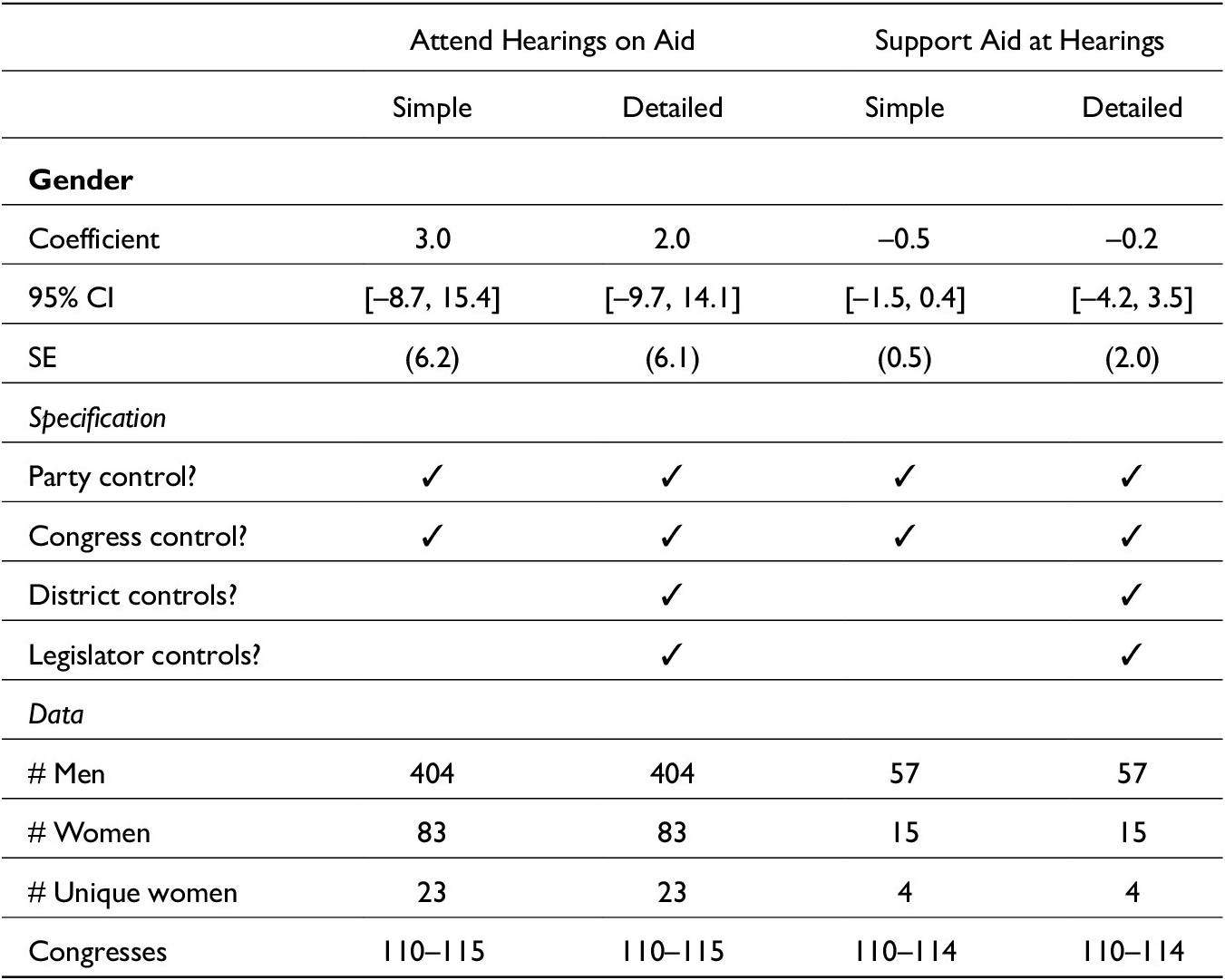
The second analysis concerns the positivity toward aid expressed by the attending legislators. Since attendance at these meetings is rare, the sample size drops dramatically (56 and 16 men and women legislator observations, respectively). We measure the expressed sentiment for each legislator in each hearing by coding random samples of speech fragments. For every speaker in every hearing, the authors coded speech fragments (three sentences by an attendee in a row) as negative, neutral, or positive about development aid, or not about aid. Three authors each coded about 15% of the 6,251 possible fragments, and two others about 10%. We then estimate the latent aid sentiment at the speaker-level in a hearing via a measurement model to remove coder-specific idiosyncrasies (Caughey and Warshaw Reference Caughey and Warshaw2015) (see Section C of the appendix for full details). Specifically, we use the positively coded expressions among all coded utterances (by coder) to estimate positive aid attitudes. These latent attitudes are scaled to a standard normal distribution. These latent attitudes are examined as before, relying on reweighed data and linear regression models.Footnote 22 Table 3 gives the results. The gender effects on attending an aid-related hearing are tiny once again as well as statistically insignificant from zero, with standard errors about 3 and 10 times the sizes of the coefficients under the two specifications. The expressed sentiments are lower for women legislators by about half a standard deviation of the outcome scale—a direction opposite to what the women’s values thesis predicts—but with again large standard errors.
Estimates for gender effects in attendance and attitudes in aid-related hearings using all observations.

Note: This table is constructed like Table 1.
Before moving on to our last analyses, a few remarks are in order. First, our data collection revealed that only 25 hearings were relevant to development aid in the 23-year period we examined (Senate and House), and only 12 are usable for our research here. This corroborates our claim that development aid is low in salience in the eyes of members of the Congress, suggesting that the electoral and institutional constraints should be relatively weak. That is, if women legislators have preferences for promoting aid, they should feel relatively free to act on such preferences in the hearings that do take place. Yet, the share of women attending those hearings is low. Second, it merits repeating how few observations there are in the analysis of expressed sentiments. Presumably just a few hearings taking place now or in the future could change the results we present.
Monitoring USAID
Our final analysis concerns lobbying bureaucratic agencies. Contacting and lobbying bureaucracies on behalf of (groups of) constituents represents another opportunity for legislators to shape policy implementation. While we found no gendered differences in participation and expressed sentiments in congressional hearings, we noted that these are still contexts in which institutional structures are likely to shape legislative behavior. Informal, direct contact with the bureaucracy, however, is not a structured activity, which means that legislators have far more autonomy in exercising their preferences. Moreover, such activities are not visible, meaning that the constraints legislators face when engaging in these behaviors are minimal. However, such legislative requests can have influence on policy decisions and implementation by U.S. bureaucracies (Mills and Kalaf-Hughes Reference Mills and Kalaf-Hughes2015; Ritchie and You Reference Ritchie and You2019).
We anticipate that if women hold distinct foreign policy preferences and want to act on such preferences, contacting agencies handling foreign aid should be one of the easiest ways to affect policy change. Evidence from Lowande, Ritchie, and Lauterbach (Reference Lowande, Ritchie and Lauterbach2019) indicates that women do indeed contact bureaucracies in a manner that differs from men, often in ways that can be seen as acting for women’s interests. In the analysis that follows, we test whether women use this avenue to influence the implementation of pro-aid policy.
In the analysis of direct intervention with the bureaucracy, we probed whether women legislators are more likely to monitor the primary bureaucracy for aid, USAID, than men. Our analysis of bureaucratic oversight activities draws on data collected by Lowande (Reference Lowande2018), who filed Freedom of Information Act requests for records of contacts made by individual members of Congress to USAID between 2007 and 2014.Footnote 23 These contacts are requests by legislators to elicit some type of response from USAID, including congressional casework and general inquiries related to policy. A “casework” contact is defined as a request made by a legislator on behalf of a particular constituent or a group of constituents, while a “policy” contact as an inquiry about policies but not serving particular constituents. We analyzed any request and only the policy-related subsets.
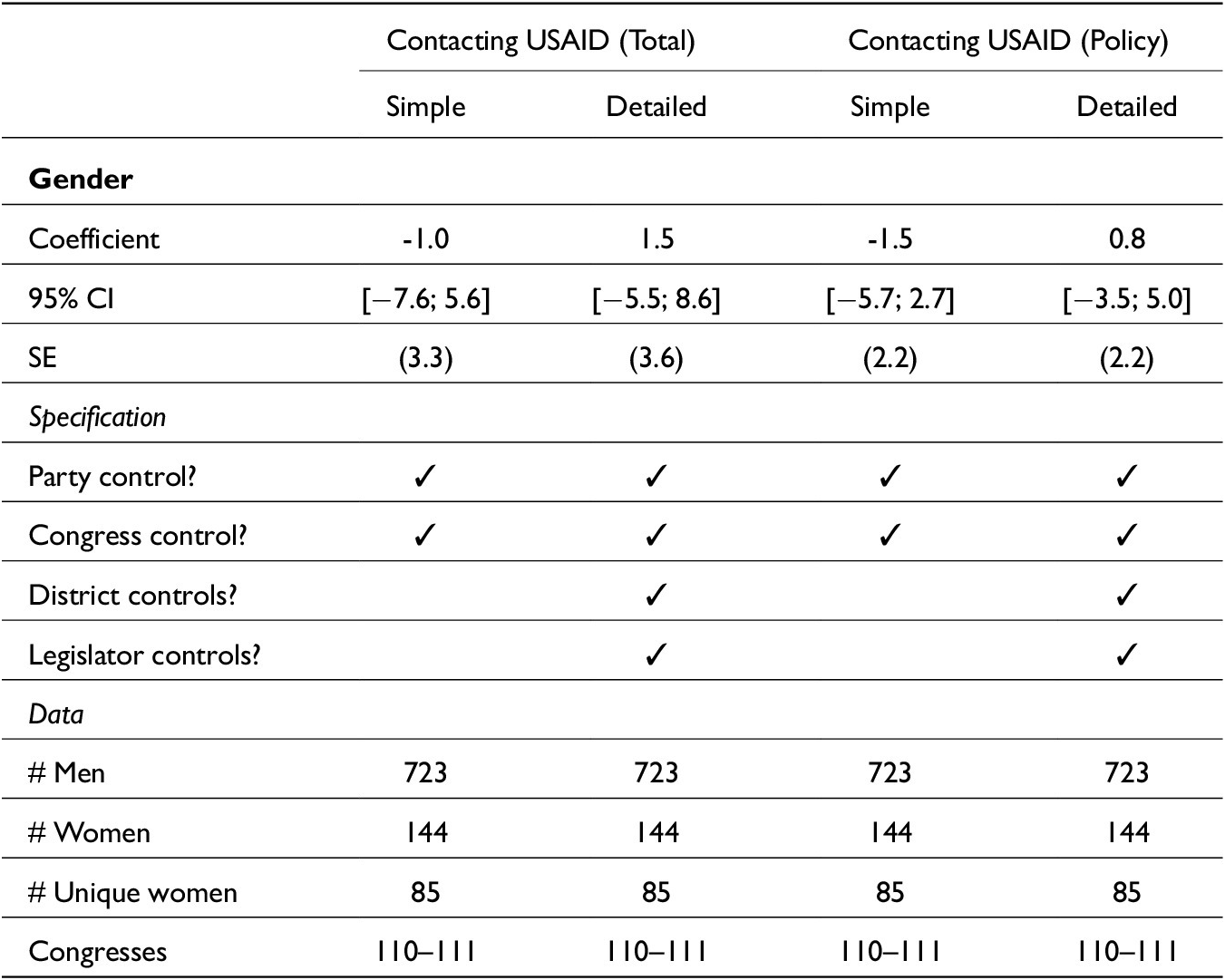
We examined these indicators (scaled by 100) of legislative activity the same as before. Once again, entropy balancing reduced imbalances in this data set as well (Figure A.1). We used two binary outcomes, namely whether one contacted USAID at all or specifically about policy. Table 4 gives the results for all House members. The first two columns examine any request made to USAID, the latter two only policy-related ones. Once again, the gender-based differences are tiny, and confidence intervals include zero.
Estimates for gender effects in contacting USAID using all observations.

Note: The table is constructed like Table 1.
Heterogeneity over Time and by Party
Over the course of the maximal temporal dimension of our data, much has changed. Not only have there been different partisan constellations of which party holds the presidency and each chamber of Congress, the number of women in Congress has been increasing, a phenomenon motivating this particular study. Even though partisan constellations are only weakly associated with aggregate aid flows in the United States (Gibler and Miller Reference Gibler and Miller2012; Goldstein and Moss Reference Goldstein and Moss2005), the particular targets, emphases, and language surrounding development has varied across Congresses and presidential administrations. As a result, we want to examine whether our results are masking important and interesting partisan and temporal heterogeneity (Neumayer and Plümper Reference Neumayer and Plümper2017, chap. 12).
The first set of examinations repeat the previous analyses after subsetting the data sets. We do so by party (see Sections E and F of the appendix) and for recent cases (since the 106th Congress; see Section G of the appendix). The results are essentially the same as discussed earlier, characterized by many small point estimates and statistical insignificance across each outcome and each set of control variables. Because of the smaller sample sizes, some confidence intervals become quite wide.
The one deviation comes when examining Republican legislators contacting USAID (Table A.12, columns 1 and 2). Republican women are 7.4 to 8.0 percentage points more likely to contact USAID over any matter than their male counterparts in the party. While statistically significant, the magnitude is substantively small. Assuming 30 Republican women for this back-of-the-envelope calculation, the estimated gender effect increases the number of inquiries with USAID by about two per Congress compared with the absence of an effect. This number is tiny given that there are around 100 such inquiries in total from Congress. However, one should not overinterpret this one deviation. We examine eight outcomes, two covariate model specifications, and three subsets (two by party, one by time period). Yielding 8 × 2 × 3 = 48 gender coefficients, it is possible that this result is due to chance.
The second examination tackles over-time heterogeneity more directly. Given that in some years, the observations is small, we employ an approach that “squeezes” information more efficiently out of the existing data. For one, for each outcome, we split the data by the gender of the legislator and estimate a model that connects all our demographics and biographical covariates to the outcome. Subsequent poststratification using female legislators’ observed covariates (for each Congress) in both the male and female models gives us an efficient estimate of the gender effect. For the other, we rely on a statistical model that is more efficient at extracting information by ignoring variables with weak predictive power and by discovering nonlinearities (Bisbee Reference Bisbee2019). Specifically, we use random forest models for this (Montgomery and Olivella, Reference Montgomery and Olivella2018).
More formally, let fo,c,g
(Xi
) be the predictive function for a given outcome in a given Congress that relies on observations of a specific gender ({m, f}) that takes as input Xi
, a vector of covariates (district demographics, biographical details). For each j ∈ J who is a female member of the cth Congress, we calculate μ
o,c ≡ fo,c,f
(Xj
) − fo,c,m
(Xj
). Averaged over all female members, we obtain the gender effect for a given outcome in the cth Congress, (
 $ \sum_{j\in J} $
μ
o,c
)/|J|. We use a 1,000 nonparametric iterations for each combination of outcome and gender, saving the mean and 95% confidence intervals as results.Footnote
24
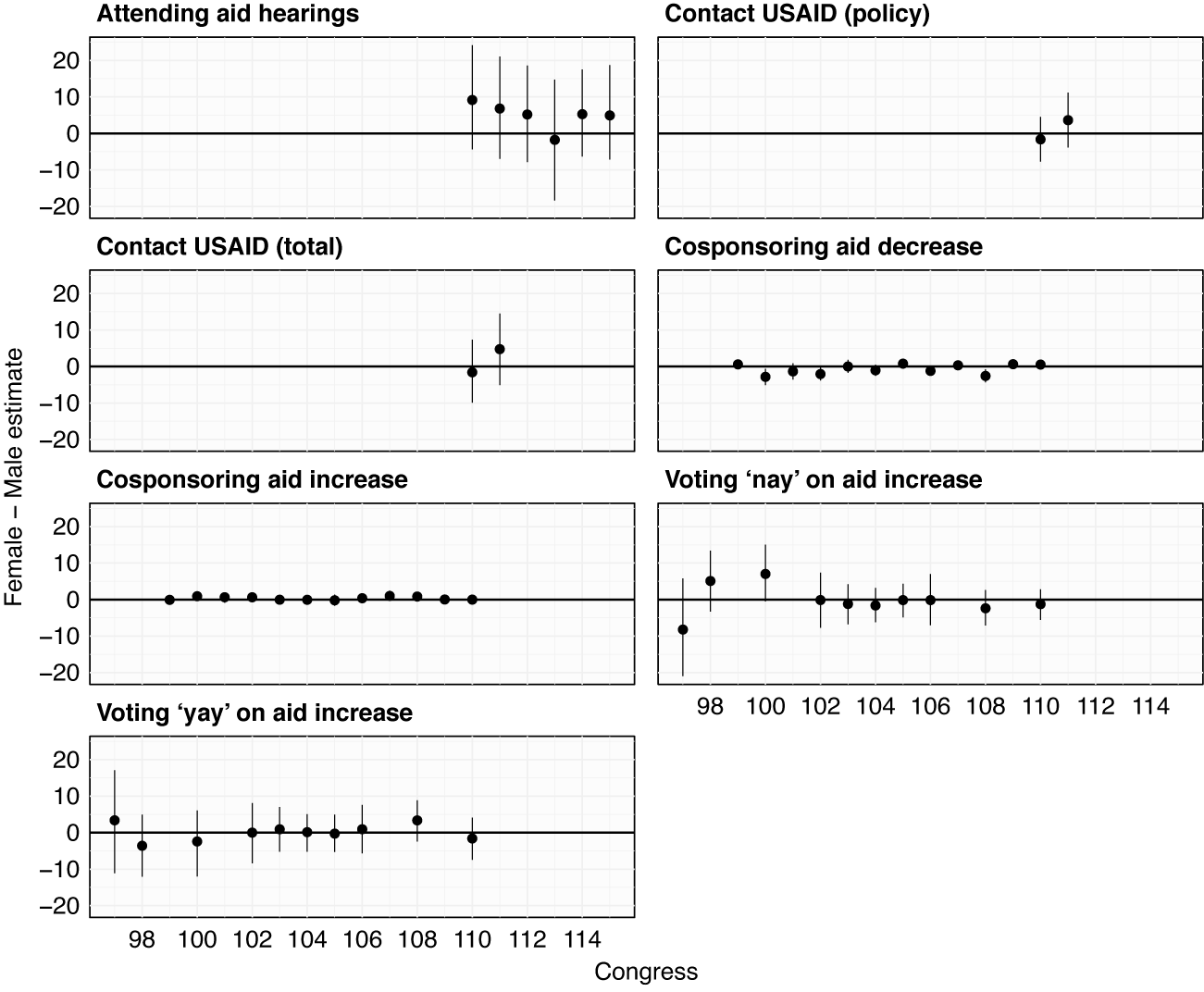
Figure 1 shows the results for all outcomes over time, except for the sentiments expressed at the hearings as the data set is too small for this type of analysis. Each panel gives the results for one outcome. In each, the y-axis indicates the difference between the estimate for the woman and man legislators (i.e., μ o,c ), which is either a difference in shares (cosponsoring, roll calls) or probabilities (attending hearings, contacting USAID); the x-axis denotes the Congress number.
Gender effects in legislative behavior across Congresses; random forest estimates. Each panel plots the difference in expected values if the legislator is female compared with male, estimated separably for every Congress in the sample for our outcome phenomenon. The y-axis shows either a difference in shares (cosponsoring, roll calls) or probabilities (attending hearings, contacting USAID). The dot gives the mean, and the line denotes the 95% confidence interval.

Across almost all Congresses and outcomes, there is no detectable difference in legislative behavior by the gender of the legislators. As in our aggregated results (which control for temporal idiosyncrasies), male and female legislators attending aid-related hearings to a similar extent, contact USAID to comparable extents, and cosponsor and vote alike. The only deviation was the 100th Congress, during which female legislators voted against aid-increasing bills about 10 percentage points more often than their male colleagues. Given the number of estimates we provide in this section, one should not overinterpret this outlying case; however, even if one wanted to focus on it, the direction goes in the direction opposite of the women’s value thesis.
DISCUSSION
Under the women’s value thesis, an increase in the number of women in a legislature should lead to more—and higher quality—development aid because women politicians more actively promote international development than their male counterparts. However, across legislative modes of influence, women legislators were generally not observed to be significantly more supportive of foreign aid. Estimates using a doubly robust reweighing approach (Zhao and Percival Reference Zhao and Percival2017) and random forests show very similar pictures, increasing our confidence in the overall conclusions. The lack of gender-based differences in legislative behavior on foreign aid provides no support for the key mechanism in the women’s value thesis, at least in the important case of the United States.
These behavioral results also have an important implication for one of the assumptions underlying the women’s value thesis. If U.S. women legislators had distinct preferences over aid policy, as assumed in the women’s value thesis, but feared taking highly visible stances, there are channels, such as participating in hearings and directly contacting USAID, where their activities are considerably less visible but still can have influence on policy. Yet, our analyses of these forums show that men and women legislators essentially do not behave differently even in these contexts. Therefore, the room for maintaining the assumption that women and men politicians have different preferences shrinks in light of the evidence from the diverse forms of legislative behavior.
Of course, there are other potential reasons why U.S. women legislators might choose not to act on their distinct preferences (if they hold them). First, women politicians may mask their true preferences for fear of electoral backlash. After all, the primary goal of any politicians is to survive in office. While foreign aid in and of itself is a topic that is often low in salience for the general public, advocating for international development at the expense of promoting other, salient issues might harm politicians electorally, women in particular, by reinforcing feminine stereotypes that voters generally do not deem favorably in selecting leaders (Bauer Reference Bauer2020; Eagly and Karau Reference Eagly and Karau2002; Vinkenburg et al. Reference Vinkenburg, Van Engen, Eagly and Johannesen-Schmidt2011). Promoting international development may fall into the category of feminine stereotypes.
In a companion paper, we examined this possibility of electoral backlash by studying whether it benefits or harms a legislator’s election prospects to advocate for international development (Stauffer et al. Reference Stauffer, Kobayashi, Martin-Morales, Lankes, Heinrich and Goodwinn.d.). Using a conjoint experiment, we analyze how voters select legislators to represent them in Congress based on bundles of political messages by legislators of differing genders (and parties). We find little evidence that any legislator, man or woman, is systematically punished, or rewarded, for promoting international development in their communication with constituents. Therefore, any legislator in the United States should be able to advocate for international development without fear of electoral backlash. This is particularly the case when we consider the low salience of aid to the general public relative to other issues. If voters do not respond (positively or negatively) to politicians’ stances on aid when they are given this information directly, we have little reason to think most voters would be attuned to—or seek out—the stances of their elected officials on this specific issue. Yet, women legislators do not advocate for development issues any differently than their male counterparts, as the results of this study show. Thus, U.S. women legislators are likely not masking their preferences for fear of sanction at the ballot box.
Second, women politicians may be masking their true preferences because of the lack of a critical mass of women necessary to translate women’s preferences into policy change. However, critical mass theories have historically been contested (Childs and Krook, Reference Childs and Lena Krook2008), with some arguing that gender differences are more likely to manifest when women are fewer in number (Crowley, Reference Crowley2004). We also note that despite women’s underrepresentation in the U.S. Congress, many studies do find evidence of gendered differences in behavior (Dietrich, Hayes, and O’Brien Reference Dietrich, Hayes and O’Brien2019; Frederick Reference Frederick2015; Pearson and Dancey Reference Pearson and Dancey2011; Swers Reference Swers2002). Our results using later years, when the share of woman legislators is higher, are the same as before, suggesting that changes at the observed margins of the mass are not consequential. While we can only advance our indirect evidence contra the critical mass argument here, the room for maintaining the foundational assumption of the women’s value thesis is considerably small.
CONCLUSION
A growing number of women serve in the U.S. Congress and in parliaments around the globe. This upward rise has raised an important question for scholars and practitioners who are interested in the politics of foreign policy. Will women reorient foreign policy toward more humanitarian issues? We tackle this question directly in this paper by examining multiple behaviors from members of the U.S. House of Representatives. Given the United States’ status as one of the largest donor countries—and the growing number of women serving in Congress—understanding the dynamics between women’s inclusion and aid outcomes in this context is particularly important. Our analysis reveals virtually no gendered differences in how U.S. legislators approach development aid, even in contexts in which they have high degrees of discretion and would be able to act without drawing attention to themselves. These findings strongly suggest that the recent and future increases in women’s representation in U.S. Congress are unlikely to lead to a greater emphasis on international development (or increased aid expenditures) by the U.S. government.
This study also helps shed light onto some of the broader debates in the literature on gender and foreign policy. Researchers have grappled with, debated, and interrogated competing explanations to explain observed relationships between gender, representation, and foreign policy. Our findings provide no support for one prominent explanation, the women’s value thesis. An alternative account is the social equity thesis (Breuning Reference Breuning2001; Brysk and Mehta Reference Brysk and Mehta2014; Caprioli Reference Caprioli2000; Koch and Fulton Reference Koch and Fulton2011; Lu and Breuning Reference Lu and Breuning2014), which holds that societal attitudes toward social equity lead countries to pursue more humanitarian and peaceful foreign policies, while also creating a political environment that is more conducive to women’s emergence in politics. While we do not evaluate this explanation directly in this article, our results suggest that the social equity thesis is a more fruitful framework for future research, which we should also do more to examine societal preferences as determinants of foreign policies.Footnote 25 This is consistent with past scholarship by Lu and Breuning (Reference Lu and Breuning2014), who also suggest that the social equity thesis may play more of a role in explaining the relationship between gender and donor country generosity than the women’s values thesis.
While the United States is the largest contributor to global development aid, it is important to consider to which extent our results are transportable to other aid donors, such as Germany, United Kingdom, Japan, and the European Union. One obvious feature of the U.S. case might limit the transportability is that U.S. citizens have historically been among the least enthusiastic supporters of development assistance compared with people in other donor countries. This lack of enthusiasm might tamp down legislative incentives to act in a pro-aid fashion, or actively disincentivize such behavior. By contrast, voters in other donors are generally more supportive and may be more willing to reward politicians, especially women, for emphasizing international development. These differences might also be compounded in cases in which development aid is a higher salience issue, compared with the United States, where foreign aid is not typically a high-salience issue in elections. While this scenario is possible, many other donors have proportional electoral systems (or some variant thereof) in which political parties have strong influence on legislators’ behavior. This means that the role voters play in shaping the behaviors of individual legislators is smaller compared with those in the United States. That said, this alternative causal mechanism could be at work despite the powerful role played by political parties. Research on a wider variety of donors would generate useful insights into the relationship between gender and foreign aid.
More generally, our study demonstrates the benefits of shifting the level of analysis from the country level to individual politicians. We call for future research to unpack the “black box” and study women in foreign policy making to better adjudicate between competing explanations (Smith Reference Smith2020; Williams Reference Williams and Thies2017). At the same time, our findings call for greater attention to the social equity thesis, which studies have so far tested at the macro level (Brysk and Mehta Reference Brysk and Mehta2014; Caprioli Reference Caprioli2000; Koch and Fulton Reference Koch and Fulton2011; Lu and Breuning Reference Lu and Breuning2014). Here, a shift toward the individual level would be productive as well. For example, in the context of development aid, the thesis would imply several hypotheses, including that citizens who support gender equality should be more likely to support development aid. A better understanding of the micro-foundation of these prominent explanations is strongly needed in the literature on gender and foreign policy.
Supplementary Materials
To view supplementary material for this article, please visit http://doi.org/10.1017/S1743923X22000290.