The explosive rise in immigration worldwide over the last two decades has led to significant changes in the demographic composition of many developed countries. The political consequences of these shifts are profound, including the formation and electoral success of anti-immigrant parties in Western Europe, the passage of the UK’s referendum to leave the European Union, and now President Trump’s drive to dramatically tighten US immigration policy after his election in 2016.
Debates about threats posed by immigrants have become a regular feature of election campaigns, and were especially prominent in the 2016 US and 2017 Dutch elections. Then, as for many years before, political rhetoric about the issue was rife with cues highlighting both cultural differences between natives and newcomers, and the potentially negative economic consequences of increasing immigration.
The causal antecedents of mass opinion about immigration have received some careful attention, but comprehensive, comparative analyses are still rare, and most such attempts are survey-based correlational studies rather than experiments that can isolate specific causal mechanisms. One core debate focuses on the economic versus ethno-cultural drivers of opposition to new immigrants in advanced industrial nations. In this article, we present results from the largest systematic, cross-national and controlled experimental study of these explanations to date.
We conducted a series of survey experiments, fielded in nearly identical ways across eleven countries on four continents: Australia, Canada, Denmark, France, Japan, Korea, Norway, Spain, Switzerland, United Kingdom and the United States. Evidence from several of these individual country studies has presented elsewhere.Footnote 1 In addition, a collection of seven of these country studies focused on a separate hypothesis: the notion that ‘person positivity’ could explain why respondents express more favorable views towards individual immigrants than towards immigration policies in general.Footnote 2 The present article is the first complete analysis of all eleven countries in the omnibus study, adding evidence from several European countries in which immigration politics has become highly salient and contentious.Footnote 3
Our main goal is to consider several specific economic threat hypotheses. Our results highlight an explanation for public opposition to immigration worldwide that has emerged in several individual country studies. Sociotropic economic concerns, stemming from the perceived burden that newcomers represent to the nation as a whole, seem to drive opposition in advanced industrialized democracies around the world.Footnote 4 At every SES level among our respondents, and across all the institutional systems under study, higher-skilled immigrants are strongly preferred. This pervasive pattern is broadly inconsistent with hypotheses based on narrow economic threats to particular native occupational groups, including the labor market competition hypothesis, concerns about the tax burden immigrants pose to those who pay a larger share of the social welfare costs for newcomers, or welfare chauvinism among native beneficiaries worried about competition for those scarce resources.
We also consider the impact of cultural forces. Observationally speaking, racial animus has been shown to play a consistently large role in opposition to immigration in countries.Footnote 5 Cultural differences between specific newcomers and the majority native population strongly predict opposition to immigration in many places and over time. Still, such differences are often highly correlated with the economic threats discussed above, and we know little about which differences matter most in the constellation of forces labeled ‘cultural threats’. One of our goals, therefore, is to isolate and test factors that are often assumed to be driving cultural threats. Since one common ‘marker’ of racial difference is skin tone, we carefully manipulate it in our experiments, while holding other dimensions of difference constant. We also compare reactions to immigrants from Muslim-majority countries with those from non-Muslim nations. We are thus able to see the extent to which, beyond simply knowing if an immigrant is ethnically different, skin tone and religious affiliation matter.
We find that an immigrant’s skin tone matters little on its own once the respondent knows that he hails from an ethnically distinct nation. However, immigrants from Muslim-majority countries are opposed at higher rates than other countries around the world. Finally, as many prior studies have shown, the correlation between self-reported racial animus and opposition to immigration remains robust.
ECONOMIC VERSUS CULTURAL DRIVERS OF IMMIGRATION OPINION
Comprehensive reviews of the literature exploring the antecedents of immigration opinion have appeared relatively recently,Footnote 6 so we undertake just a brief overview here.
Economic Explanations
A substantial body of work has evaluated economic explanations for opposition to immigration in democratic publics. These explanations can generally be divided into two categories. The first focuses on the direct impact of competition between natives and newcomers for jobs and wages, while the second involves those who bear the costs of social welfare that newcomers demand.
1. Labor Market Competition Hypothesis
First, natives might oppose immigration most strongly when they compete directly with newcomers for jobs and wages. Consistent with this expectation is the well-established regularity that working-class citizens in the United States oppose immigration more than their wealthier countrymen, presumably because working-class immigrants represent a large proportion of newcomers.Footnote 7 Economic status is also correlated with support for immigration openness in Germany.Footnote 8 Malhotra et al. find that natives working in the tech sector are less enthusiastic than others about immigrants holding H1 visas, presumably because these newcomers compete for high-tech jobs.Footnote 9 Mayda finds that SES is most strongly correlated with support in countries where the difference between native and immigrant skill levels is largest.Footnote 10
While the above results are consistent with the Labor Market Competition hypothesis, alternative explanations for these findings have been offered. First, economists have found that newcomers typically have only a small impact on wages and employment,Footnote 11 and that impact is highly contingent on contextual factors like the size and diversity of the national economy. Secondly, most observational studies cannot isolate variation in, or the impact of, immigrant skills.Footnote 12
Careful work by Hainmueller and Hiscox has addressed some of these concerns. They find very little support for the notion that employment competition with newcomers drives immigration policy opinion, at least in the United States and Europe.Footnote 13 In European Social Survey data from 2003 they find high-skilled natives express greater support for immigration than their low-skilled countrymen regardless of the mix of low- versus high-skilled newcomers.Footnote 14 In a U.S. survey experiment, they find again that highly educated natives are more receptive to immigration regardless of immigrant skill levels.Footnote 15
2. The Tax Burden Hypothesis
Other work has focused on the possibility that the impact of economic self-interest operates through concerns about the tax burden that new immigrants place on high-SES natives. For example, wealthy citizens may oppose immigration most in places where an influx of low-skilled newcomers is likely to boost social welfare costs.Footnote 16 Again, however, recent studies have offered little support for this hypothesis.Footnote 17 First, the fiscal implications of increasing immigration in a given nation are not obvious, since immigrants bring many economic benefits that offset their burden on domestic social welfare programs. Secondly, that low-skilled immigrants do not trigger greater opposition among high-SES natives, even in places with the most generous social welfare regimes.Footnote 18 Instead, all natives seem to prefer high- over low-skilled immigrants. Harell et al. also find that higher-skilled immigrants are strongly preferred in Canada and the United States.Footnote 19
As it is most often discussed in the existing literature, the Tax Burden hypothesis is focused on the behavior of high-SES natives. A less-attended-to corollary is the welfare chauvinism of low-SES natives concerned about sharing a fixed (or narrowing) social welfare pie.Footnote 20 To the extent this operates, we would expect to see anti-immigrant sentiment most concentrated among low-SES natives, ceteris paribus.
Of course, if the Welfare Chauvinism and Tax Burden effects occur simultaneously, we might observe anti-immigrant attitudes among natives regardless of SES. If taxes on the wealthy are the central concern, then we should primarily see high-SES natives motivated by what they might have to give. If a fixed or shrinking social welfare pie is of central concern, then we should primarily see low-SES natives motivated by what they might not get. Note, however, that such effects are unlikely to occur simultaneously in any given country. In countries with flexible social welfare systems that expand to accommodate newcomers, the Tax Burden hypothesis should dominate because the wealthy will indeed pay more. In countries with fixed systems, the Welfare Chauvinism effect should be greatest because poor natives will be forced to share with newcomers. Since the flexibility of the welfare regime in a given country can only take on one value at a time, and since most systems are slow to change, opposition should not be equally strong among low- and high-SES natives. If it is, and especially if it is across countries with a variety of social welfare regimes, then a different process must be at work.
3. The Sociotropic Economic Threat Hypothesis
We suspect that if economic threats operate on public opinion at the societal level. For many, immigrants represent a sociotropic economic threat to the places where the respondent lives, rather than on them individually. Wong raises the important possibility that threats to a citizen’s ‘imagined community’, which might vary from neighborhood to more expansive geographic boundaries, will matter most.Footnote 21 The media may influence which communities are important as well, since some evidence shows that national-level media narratives about immigration interact with changing local immigrant density, essentially priming conflict in some geographic areas but not others.Footnote 22 While our data do not allow us to examine smaller geographic units, such effects would help explain sociotropic findings in various country-level studies.
Observational evidence suggests that sociotropic economic concerns underlie opposition to immigration. Mass perceptions about the state of the economy are linked to variation in support for immigration policy openness.Footnote 23 Opposition to immigration also increases during national economic crises,Footnote 24 and tracks with the business cycle.Footnote 25 California’s anti-immigration Proposition 187, dubbed the ‘Save our State’ initiative, may also have received unusually robust support due to the state’s already strained educational, health and transportation infrastructure in the early 1990s.Footnote 26 Yet not all evidence points in this direction. Sides and Citrin find that the state of the economy and the total number of recent immigrants in twenty-two European countries are uncorrelated with average sentiments towards newcomers.Footnote 27
Cultural Explanations
A literature exploring ethno-cultural explanations for immigration opinion has developed mostly in parallel with the one just reviewed. The most general and perhaps least controversial claim in this line of work is that symbolic values linked to group identities, conflicts, and prejudice lead citizens to oppose immigration even if it does not represent an economic threat.Footnote 28 Ethnocentrism, therefore, is put forth as the dominant alternative explanation to the economic hypotheses reviewed above.Footnote 29 A set of symbolic attitudes – including specific group animositiesFootnote 30 or general ethnocentrismFootnote 31 – has been shown to drive anti-immigrant sentiments in the United States, independent of the economic costs and benefits immigrants may bring to their new homeland.
Indeed, racial animosity often seems to overwhelm economic concerns as a predictor of hostility towards new immigrants.Footnote 32 Survey-based studies of the United States and European countries consistently show that attitudes about non-whites are powerful predictors of support for immigration.Footnote 33 Experimental work has also demonstrated the power of racial cues in the immigration debate. Brader, Valentino and Suhay manipulate images of immigrants in a news story that emphasizes either the costs or benefits of immigration for America’s economy and culture.Footnote 34 They find that Latino immigrants make white Americans more anxious than those who hail from Europe, even when the social benefits/costs from immigration are held constant. Finally, a few studies have uncovered an interaction between economic and cultural forces: economic stressors can sometimes activate existing negative group sentiments,Footnote 35 or directly boost negative group attitudes which then drive up opposition to immigration.Footnote 36
The general consensus, therefore, is that racial/ethnic ‘others’ are considered undesirable immigrants in most single-country studies. We still know little, however, about which dimensions of difference are most important, since existing studies often compare immigrants who are different on many different dimensions, confounding economic and cultural threats (as in the Brader et al. study that compares white European immigrants with those from Mexico).Footnote 37
We focus on two dimensions of cultural difference. One obvious marker of difference is skin color, which has been shown to influence the evaluations of political candidates in the United States.Footnote 38 However, few studies to date have explored whether purely visual markers of ethnicity, above and beyond other potential sources of cultural threat, alter reactions to immigrants. Ostfeld manipulates a variety of phenotypic markers and finds that Americans marginally disfavor those with non-European features, though much larger effects spring from information about whether immigrants are assimilating into American culture.Footnote 39 Hopkins also manipulates immigrant skin tone and found it had very little effect on policy opinions in a US sample.Footnote 40 We replicate this hypothesis across all eleven countries in our sample.
Another increasingly important dimension of cultural threat comes from religious distinctions, especially among immigrants from Muslim-majority countries. Since 9/11, the threat of Islamic terrorism has played an important role in the political strategies and rhetoric of many immigrant-receiving nations. The analysis that follows thus explores reactions to Muslim immigrants as well.
HYPOTHESES
We first test the Labor Market Competition hypothesis: opposition to immigration will be greatest among natives employed in job sectors similar to those of newcomers. Secondly, we examine the Tax Burden hypothesis: high-SES natives will oppose low-skilled immigrants most strongly, since the former pay disproportionately for any expansion of social welfare to serve such newcomers. Thirdly, we test the Welfare Chauvinism hypothesis: low-SES natives will oppose low-skilled immigrants most due to competition for nationally fixed social welfare benefits. Finally, we test the Sociotropic Economic Threat hypothesis: Regardless of their own socio-economic status, natives will prefer high- over low-skilled immigrants across all countries.
If sociotropic economic concerns are operating, we might also expect them to be exacerbated when low-skilled immigrants are accompanied by children, but this effect should similar for natives at different levels of SES. High-skilled immigrants with dependents would presumably not pose additional social welfare costs, so we would not expect such cues to influence opinion. Further, the presence of children in an immigrant’s family should not exacerbate concerns about job market competition. Our experimental design allows us to test these additional expectations. Finally, we perform additional analysis to test the Sociotropic Economic Threat hypothesis by examining whether the effect of immigrant skill level is constant across countries with more or less flexible welfare provision systems.
As mentioned above, we examine the impact of three factors related to cultural threat: skin complexion, religious difference and racial animus. We first explore whether immigrants with darker skin and/or Muslim religious affiliation (conveyed through Middle Eastern origin) are penalized compared to those with lighter skinned or non-Muslim national origins. We also expect respondents with conservative racial views – in this case those who score highly on the racial resentment scale – to oppose immigrants most strongly. Finally, we explore the possibility that economic and ethnocentric forces interact to alter opinions about immigration. For example, cultural threats may matter most in reaction to low-skilled immigrants, as other research has found.Footnote 41
DATA AND METHODS
The effects of economic versus cultural forces are difficult to isolate in observational research. We thus deploy experiments that manipulate these factors independently in each country. Our studies span a wide range of developed democracies. Except for the few comparative studies from Europe cited above, most evidence about antecedents of immigration opinion is still drawn predominantly from the United States. The broadly cross-national quality of the current collection is perhaps its strongest feature, since it allows us to explore the degree to which a specific explanation generalizes across a wide variety of countries with different histories, governmental institutions, economies, cultures and immigration patterns. The article therefore makes at least three substantial contributions: (1) we conduct comparable experiments in eleven countries on four continents, (2) these experiments precisely compare the relative causal impact of economic threats and ethnic cues and (3) we examine heterogeneity in the impact of these cues across natives of different levels of socioeconomic status.
As previously mentioned, we drew online samples in each country (Australia, Canada, Denmark, France, Japan, Korea, Norway, Spain, Switzerland, United Kingdom and the United States). In all but four (France, Japan, Korea, Switzerland) we contracted with YouGov, an international survey firm that employs a matching technique for drawing respondents from self-selected online panels. In the remaining four countries where YouGov does not maintain a presence, samples were collected via individual firms that were able to match the methodology of YouGov quite closely.Footnote 42 Most of our studies were conducted during 2010, but a few were conducted between 2011 and 2013.
The online survey platform was necessary in order to present the visual racial cue – skin complexion – in conjunction with textual information about immigrants. Details about the methodology by which YouGov produces representative web samples are available in Vavreck and Iyengar.Footnote 43 YouGov samples have been found to match census-based population parameters quite closely; therefore we are comfortable presenting country-level descriptives below (see Table 3). That said, our focus here is mostly on the causal effects of experimental manipulations of skill level, skin complexion, family status and religious affiliation. A main benefit of using YouGov is that samples span a broad and diverse cross section of the population in each country.
We delivered our manipulations through vignettes about immigrants containing text and images varying the skill level (high and low), family status (single or married with children), national origin (Middle Eastern versus Latin American/Asian) and racial phenotype (Afrocentric, non-Afrocentric) of an individual immigrant. We prepared a brief paragraph describing specific individuals hoping to come to the countries in our study. Participants read two short vignettes (ten sentences each, approximately 125 words), describing two different individuals hoping to emigrate in the near future.
Both vignettes described immigrants of the same occupational status and skin tone. In other words, each subject read about immigrants at only one level of skill and of similar complexion in the 2*2 factorial, between-subjects design. Both immigrants were described as young men seeking to obtain temporary employment in the respondent’s county with the hope of eventually acquiring citizenship. In the high-status condition, one immigrant worked as a computer programmer while the other was an engineer. In the low-status vignettes, immigrants worked in construction or landscaping. We also randomly described one of the immigrants in each pair of vignettes as married with small children.
Subjects read the following introduction: ‘Now we want to ask you some questions about a couple of individuals who are interested in coming to <respondent’s country> as immigrants. The first candidate is <immigrant’s name>. Please take a minute and read about his background.’ Table 1 contains the details of our manipulations. The examples are from the US study, but the language in every country study was as similar to these as possible after translation. Elements other than job skill were varied across treatments (name, country of origin, family status), and these are italicized in the table but not in the version the respondent read. The order of the vignettes was varied randomly. Each vignette was accompanied by a photograph that varied the complexion of the immigrant.
Experimental Manipulations

Note: words in italics vary across treatments. Respondents receive either (a) two high-status vignettes, or (b) two low-status vignettes. With the between-subjects skill manipulation, there are two additional (orthogonal) manipulations: (1) immigrant name, source country and school name (ethnicity cues), and (2) the (non-) mention of the immigrant’s wife and kids (family status cue).
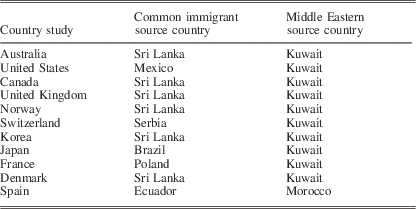
To maximize the relevance and realism of the vignettes, we chose immigrants from a non-Muslim majority country that would be recognizable to most respondents as a common sending nation. The second vignette described an immigrant from the Middle East. In all countries except Spain, this second immigrant came from Kuwait. In Spain, the Muslim immigrant hailed from Morocco. The Middle Eastern cue enables us to evaluate the distinct reaction to Muslim immigrants. The Kuwaiti immigrant provides a conservative test, since this country is not typically viewed as a source of radicalism. These comparisons are within subjects, because each respondent read one vignette about a Middle Eastern immigrant and one from another country (for example, Sri Lanka, Mexico, Serbia, Brazil, Poland and Ecuador). Table 2 displays the national origin of each immigrant in the vignettes for each country.
Country of Origin for Immigrants in Vignettes for each Nation Study

We manipulated racial complexion precisely and subtly in order to construct a conservative test of the hypothesis that skin complexion, above and beyond other dimensions of ethnic difference, influences tolerance towards immigrants. It is important to note that the immigrants in these vignettes were ethnically distinct from the majority native population (white European, Australian or Asian). This makes for a particularly precise test of the independent role of skin color.
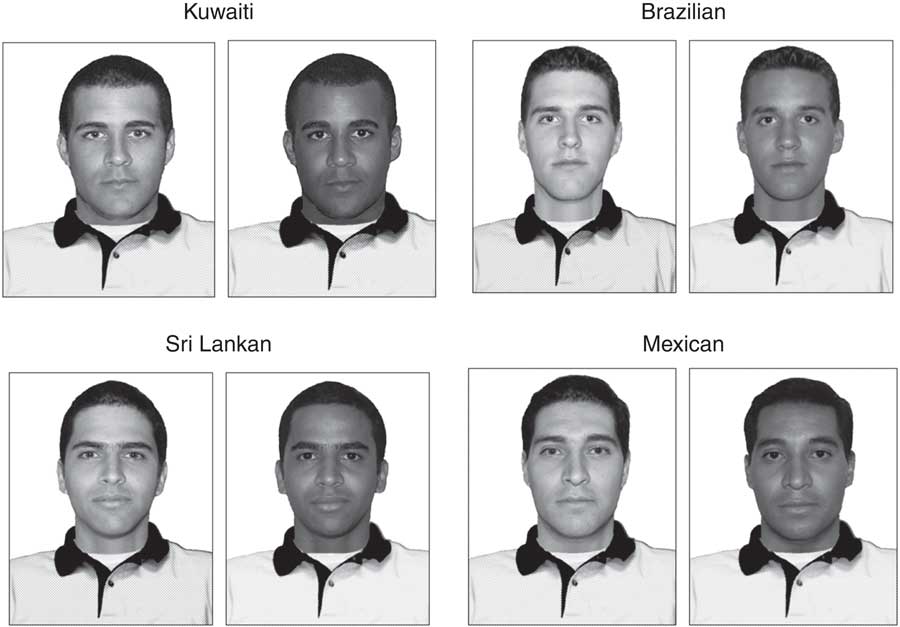
To manipulate skin tone, we first selected photographs of six young males to represent the eight nationality groups featured in the vignettes. The pictures used to represent the Moroccan immigrant in the Spanish study and the Kuwaiti in most other studies are identical; the picture used to create the Brazilian image in the Japanese study and the Mexican image in the US study are also identical. Next, we selected a stereotypic Afrocentric and Eurocentric young male face from a database of photographs that had been rated for stereotypicality, attractiveness and age by American college students. The two images we selected were rated similarly on all three attributes. We then used statistical morphing software (FaceGen) to combine the image of each immigrant with either the stereotypically African or European image. Figure 1 displays an example of our complexion manipulation for the Kuwaiti immigrant. On the far left appears the Afro-centric face used in every country, and on the far right is the Eurocentric face we selected. On the middle left, we have a typical Kuwaiti face morphed 60:40 with the African image. On the middle right, we combine the same Kuwaiti image with the European face, using the same ratio (60 percent Kuwaiti, 40 percent European). The resulting visual manipulation simply conveyed more or less Afrocentric/Eurocentric facial features in a typical immigrant face without altering any other characteristics.Footnote 44
Example of facial Afrocentrism/Eurocentrism manipulation: the Kuwaiti applicant

Based on prior experience with face morphing,Footnote 45 this procedure provided a subtle but sufficiently visible manipulation of non-verbal racial cues. Our operational indicator of Afrocentrism is the ‘face-mean-value’ (FMV) score. Values range from 0 (lightest) to 1 (darkest). In the South Asian-Eurocentric condition, the average FMV score was 0.55; in the Afrocentric condition it was 0.71. The corresponding entries for the Middle Eastern condition were 0.56 and 0.73, respectively. Figure 2 displays all six image pairings used in the eleven countries.
Complexion manipulations for immigrants used in all country studies

As an additional manipulation check, we provided photographs to a separate sample of judges from around the world drawn from Amazon Mechanical Turk (MTurk). We asked these MTurk workers to rate the pictures according to complexion and attractiveness. All eight images were rated by at least ninety out of a total of 128 judges, and no judge rated a single image twice. The sample was split evenly between American and international judges. MTurk workers rated all the faces on a scale ranging from ‘extremely dark’ to ‘extremely light’ and from ‘very attractive’ to ‘very unattractive’. The dark–light ratings differed significantly across the two levels of the Afrocentrism/Eurocentrism manipulation (p<0.01), but there were no differences in the ratings of attractiveness between the Afrocentric versus Eurocentric faces.
After reading each vignette, participants answered three questions to gauge attitudes about permitting the individual to enter the country for work and, eventually, to gain citizenship. The first question asked ‘Given what you know about <applicant’s name> do you think his application for a work permit should be approved or rejected?’ (Approved, Rejected, Can’t Say). The answers to this question were scored 2 for approving, 0 for rejecting and 1 for undecided. The second question asked ‘If his application were approved, for how long should he be permitted to work?’ (6 months, 1 year, 2 years, or 3 years). These answers were coded 6 months=0, 1 year=1, 2 years=2, 3 years=3. Finally, respondents were asked ‘Assume that <applicant’s name> comes to the US on a work permit and then he decides to apply for American citizenship. Do you think his citizenship application should be approved or rejected?’ (Approved, Rejected, Can’t Say). The answers to this question were scored 2 for approve, 0 for reject and 1 for undecided. Each question was rescaled from 0 to 1, and then the three questions were summed and again rescaled to produce a 0–1 Immigrant Approval Scale for each candidate.Footnote 46 These items formed a highly reliable scale (Cronbach’s Alpha=0.84 and 0.85 for the first and second candidates, respectively).
We also measured the SES of our respondents in each country, since our hypotheses posit that the impact of immigrants’ job status will vary across levels of native SES. We measure respondent SES using dichotomous indicators of education, occupation and income. We coded education as less than college versus at least some college. Education is the only measure of SES available for all countries. Occupation was coded as blue collar or service equal to ‘low’ and professional or skilled labor as ‘high’. This measure was available for eight countries: Australia, Canada, Denmark, France, Japan, Korea, the UK and the US. Income was coded as low for below the country’s median income and high for above. Respondent income was available for all countries except Norway. While these binary measures are blunt indicators of SES, they are appropriate for making comparisons across so many countries with different educational, occupational and income distributions.Footnote 47
As mentioned above, each respondent read two vignettes, so our analytic strategy combines reactions to both. We model effects using a pooled analysis in which each respondent–vignette combination is a separate case. In other words, each vignette is treated as a case in a within-subjects experimental design. In total we have over 30,000 respondent–vignette pairs (although the total differs slightly across models due to missing data in some independent variables such as income); within-country estimations rely on between 1,500 and 6,800 respondent–vignette pairs, depending on the country. This panel estimation strategy is ideally suited to capturing the impact of racial cues, alongside other factors, averaged across multiple vignettes. The estimation relies on a multilevel mixed-effects regression, fit using maximum likelihood, with random effects for respondents alongside fixed effects for (1) treatments and (2) a limited set of control and/or moderating variables. Within-country estimations are unweighted, but the combined results use weighting that ensures each country contributes equally to the omibus results.
RESULTS
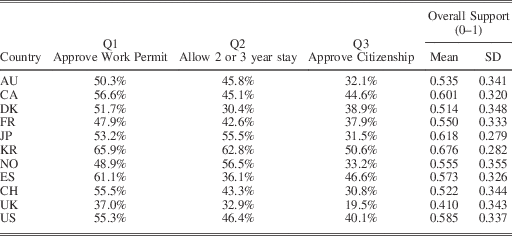
We first examine support for the immigrants described in our vignettes across all the countries studied. Table 3 displays mean responses for each country on three indicators: approval of a work permit, allowing the immigrant to say 2 or 3 years (as opposed to 1 year or less), and approving citizenship. Since each respondent in each country read two vignettes, these percentages capture the average response to both of the vignettes they read. The pattern of results across countries is identical if we report reactions to either the first or second immigrant presented to each respondent.
Immigrant Support across Countries

Note: based on country-level results, unweighted. Q1 shows the percent of respondents that approves of the immigrant’s work permit application. Q2 shows the percent of respondents that believes the permit should be extended for 2 years or more (See preceding notes about recoded responses in DK. Also, note that percentages in Q2 can exceed those in Q1 since respondents saying ‘can’t say’ in the first question may still approve of 2 or more years of work in the second question.) Q3 shows the percent of respondents that approves of the immigrant’s citizenship application.
Table 3 suggests that support for the immigrants in our vignettes was surprisingly high in many of the countries we studied. Support was lowest in the UK, where only 37 percent of citizens approved of a work permit. Support for granting the work permit was highest in Korea, at nearly 66 percent. That said, in eight out of the eleven countries, at least 50 percent of the sample supported granting a work permit. Similarly large pluralities, and often majorities, in each country thought the immigrants they read about should be allowed into the country for at least 2 years to work. The lowest support on this dimension came from Denmark, at 30 percent and the UK, at 33 percent. Again, Korea topped the scale at 63 percent. Finally, support for granting citizenship is displayed in the third column of Table 3. Here we find somewhat less enthusiasm, with support ranging from a low of just under 20 percent in the UK to a high of 50 percent in Korea. Seven out of eleven countries fell between 30 and 40 percent support on this dimension.
Table 3 also displays the mean score on the scale we constructed from the combined answers to these three questions. Recall that a score of 0 on the overall support scale indicates the respondent would reject the immigrant’s application for a work permit, would choose the shortest time available in country if the application were approved (6 months), and would also reject the immigrant’s application for citizenship. A 1 on the scale would mean the individual would approve the work permit, favor allowing him to remain 3 years in country, and also approve his application for citizenship. Table 3 indicates that nearly all of the countries in our study fall near the middle of this 0–1 scale. There is a great deal of variation within countries in responses to each of these questions. The standard deviations for each country run from a low of 0.28 to a high of 0.36. This means that while support for these immigrants is often quite substantial, a significant number of participants still take the most restrictive position in each country.
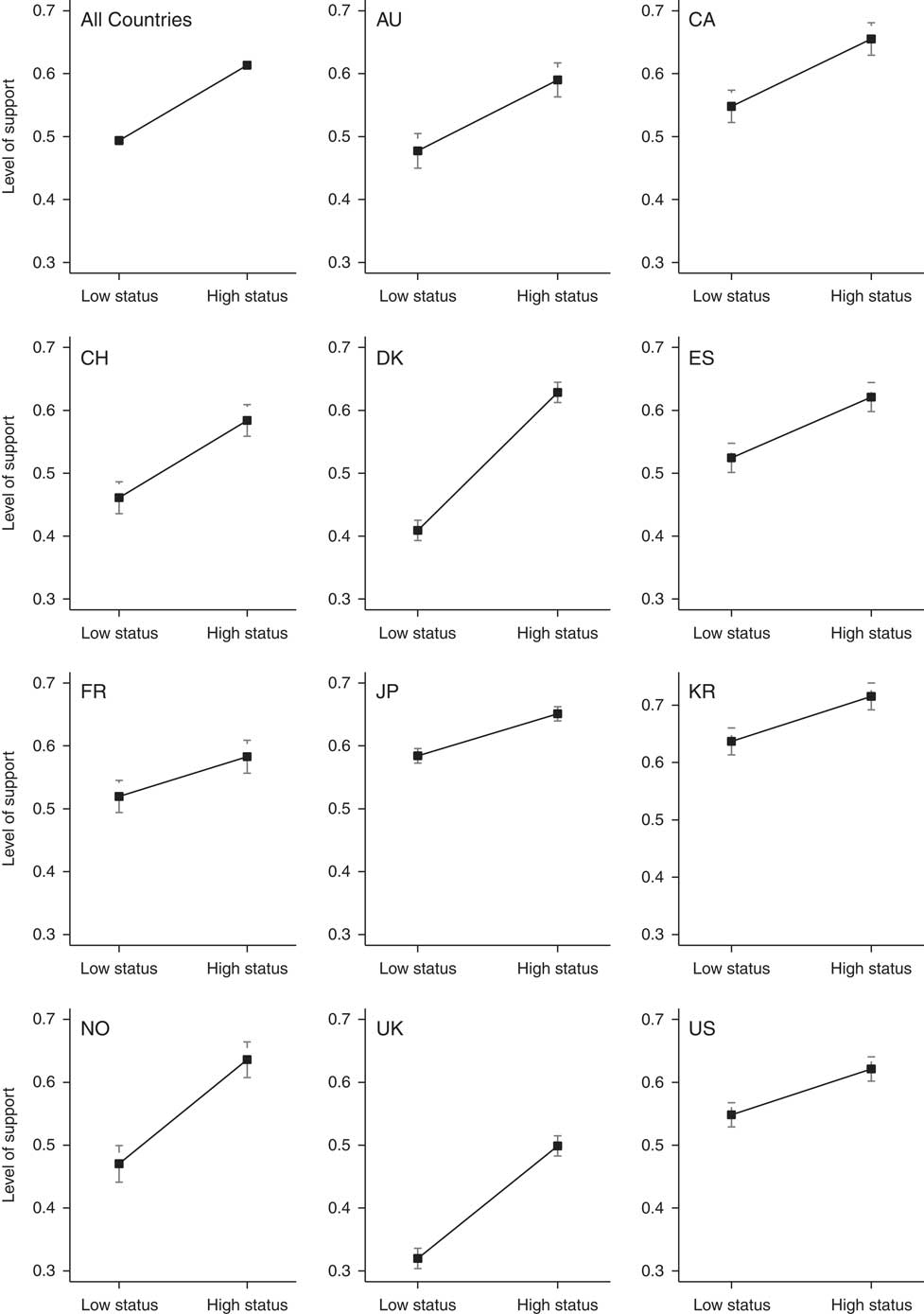
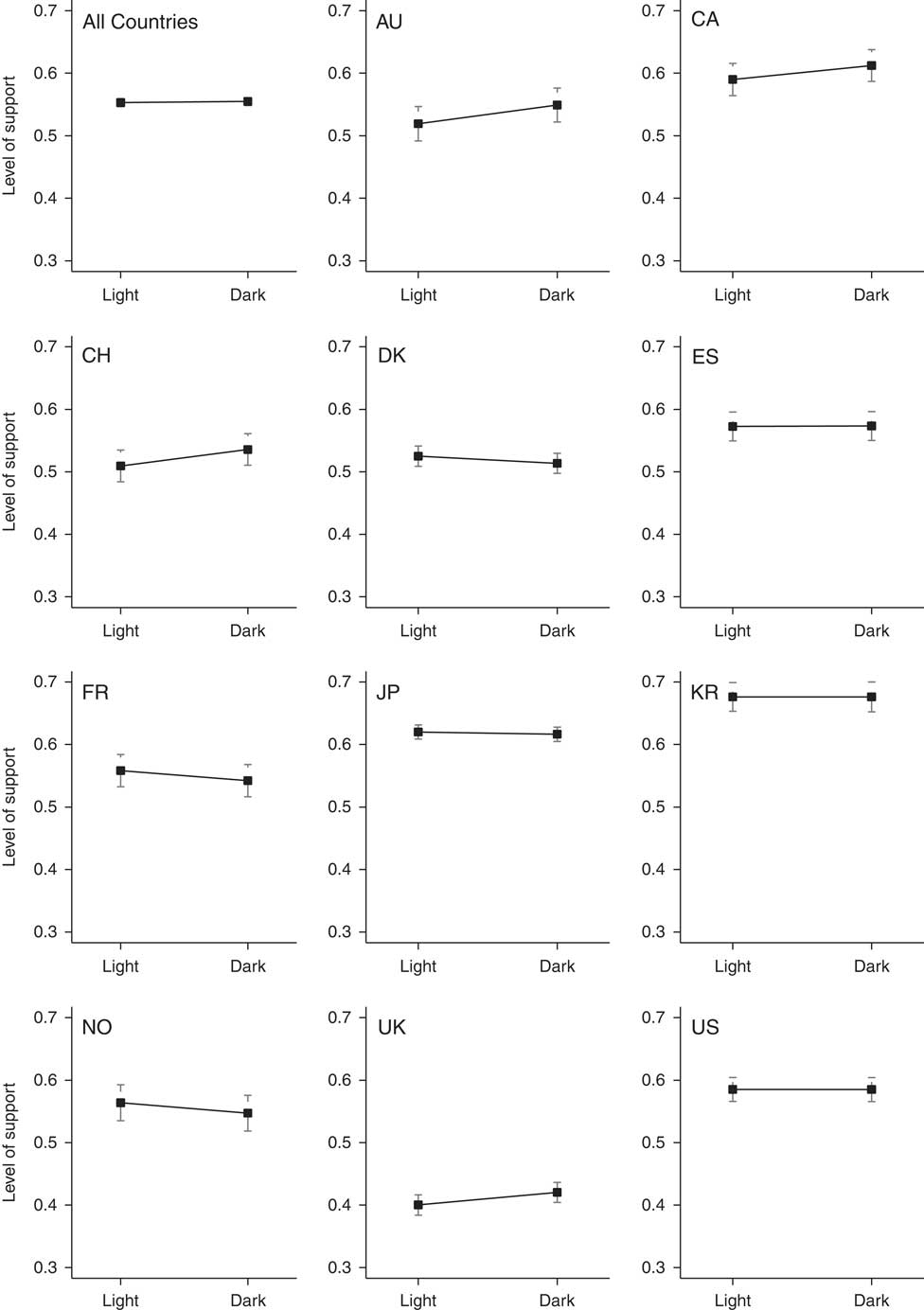
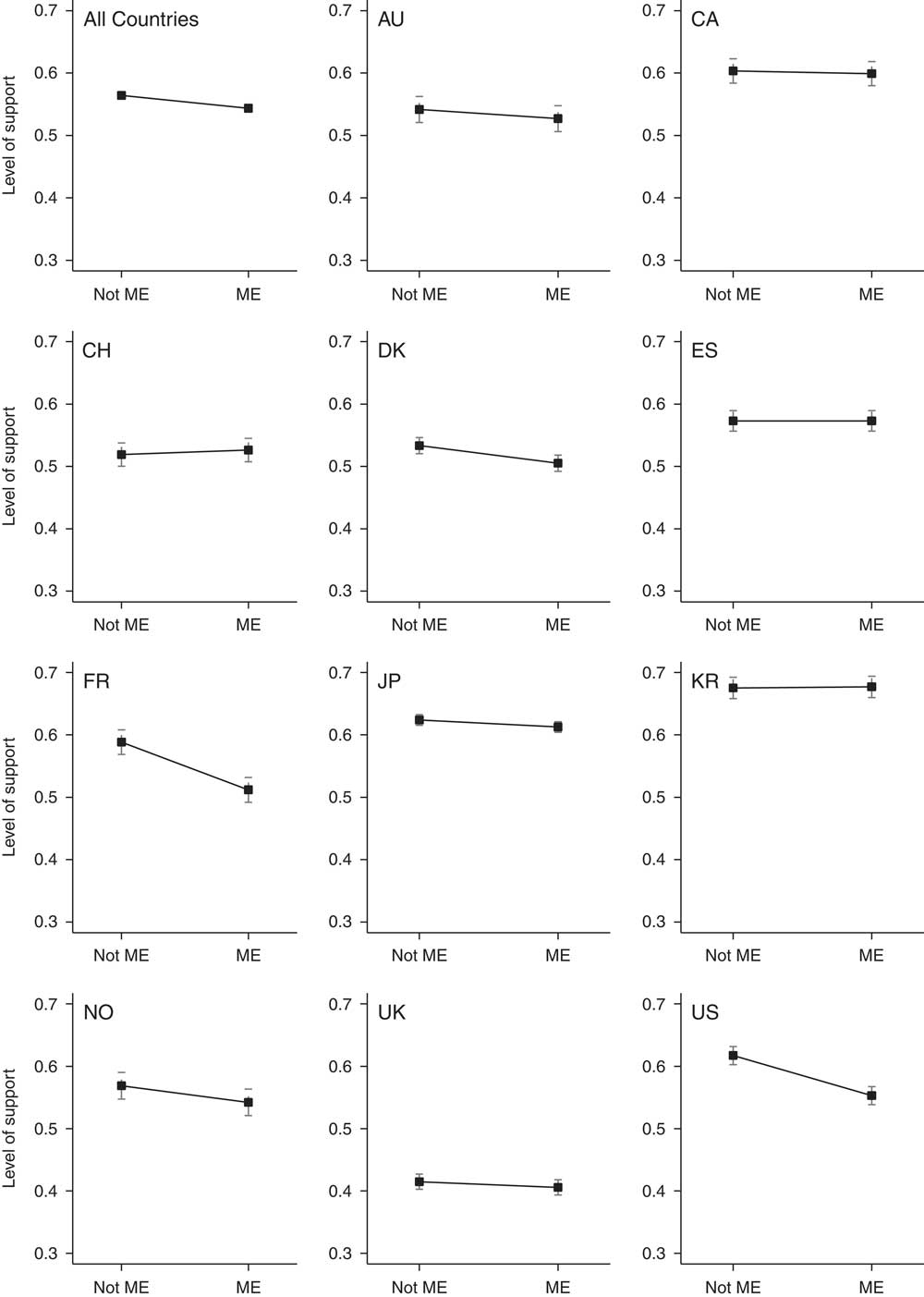
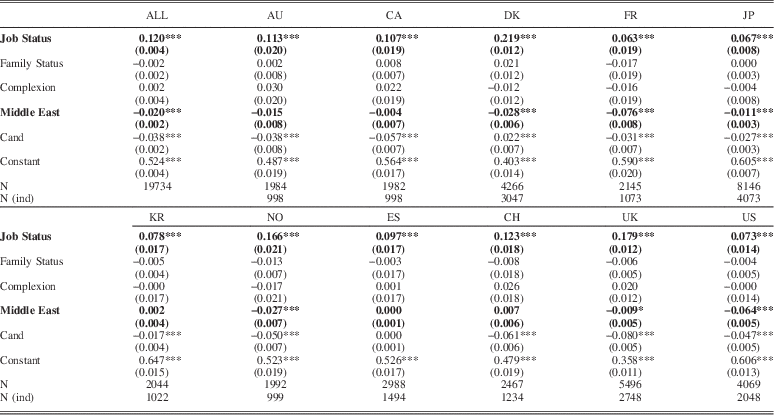
We next turn to the experimental results for each of the main effects of interest including immigrant skill level, family status, skin complexion, Middle East origin and vignette order. Average main effects across all eleven countries are captured in models presented in Table 4. Based on these mean differences, Figures 3, 4 and 5 display the impact of skill level, complexion and nationality for each country.
Average treatment effect of job status by country

Average treatment effect of skin complexion by country

Average treatment effect of Middle Eastern origin, by country

The Main Effects of Job Status, Family Status, Complexion and Middle Eastern Origin

Note: cells contain coefficients (with standard errors in parentheses) from a mixed-effects multiple regression estimated using GLS. *p<0.05; **p< 0.01; ***p<0.001
Even given the considerable variation in support accros countries, the results in Table 4 make clear that the effect of candidate job status is quite consistent– in spite of cultural, linguistic, and ethnic differences among both destination countries and the particular immigrants crossing their borders. Skill level has a large effect – ceteris paribus, the shift from a low- to a high-status job is associated with an average increase in support of 0.12 (on the 0–1 scale). Country-specific models indicate statistically significant effects in every country. This is especially evident in Figure 3. The effect ranges from a low of 0.06 in France to a high of nearly 0.22 in Denmark.
The main effect of skin complexion, displayed in Figure 4, is also very consistent across all the countries in our study – and it is consistently close to zero. This does not change if we allow the impact of racial cues to be contingent on occupational skill, to see if darker-skinned, low-skilled immigrants are the least preferred. This interaction has been demonstrated in other work,Footnote 48 but we find little evidence for it here: the only two interactions that are significant – in Switzerland and the UK – are in the opposite direction. The results from these models are available in Appendix Table 2. These effects also do not vary by level of racial animus: those who express the most negative attitudes towards non-whites in general are not more sensitive to the skin tone than those with more positive attitudes. This is an important result, because it gives us more confidence that skin tone, above and beyond other dimensions of cultural difference, does not dramatically influence immigration opinion.
The Middle Eastern cue, in contrast, proves significant in many countries, including Denmark, France, Japan, Norway, UK and the US, as shown in Figure 5 and Table 4. The coefficient is negative in eight of the eleven countries, and is significant on average (−0.02, p<0.05). The modest average effect masks significant cross-country variation, however. French (−0.08) and American respondents (−0.06) impose substantial penalties on immigrants from the Middle East. The effect is surprisingly small in Switzerland, given recent anti-immigrant policy developments there. These effects are all the more impressive given that the Muslim-majority country we use in each study, Kuwait, is not known as a hotbed of anti-Western sentiment.
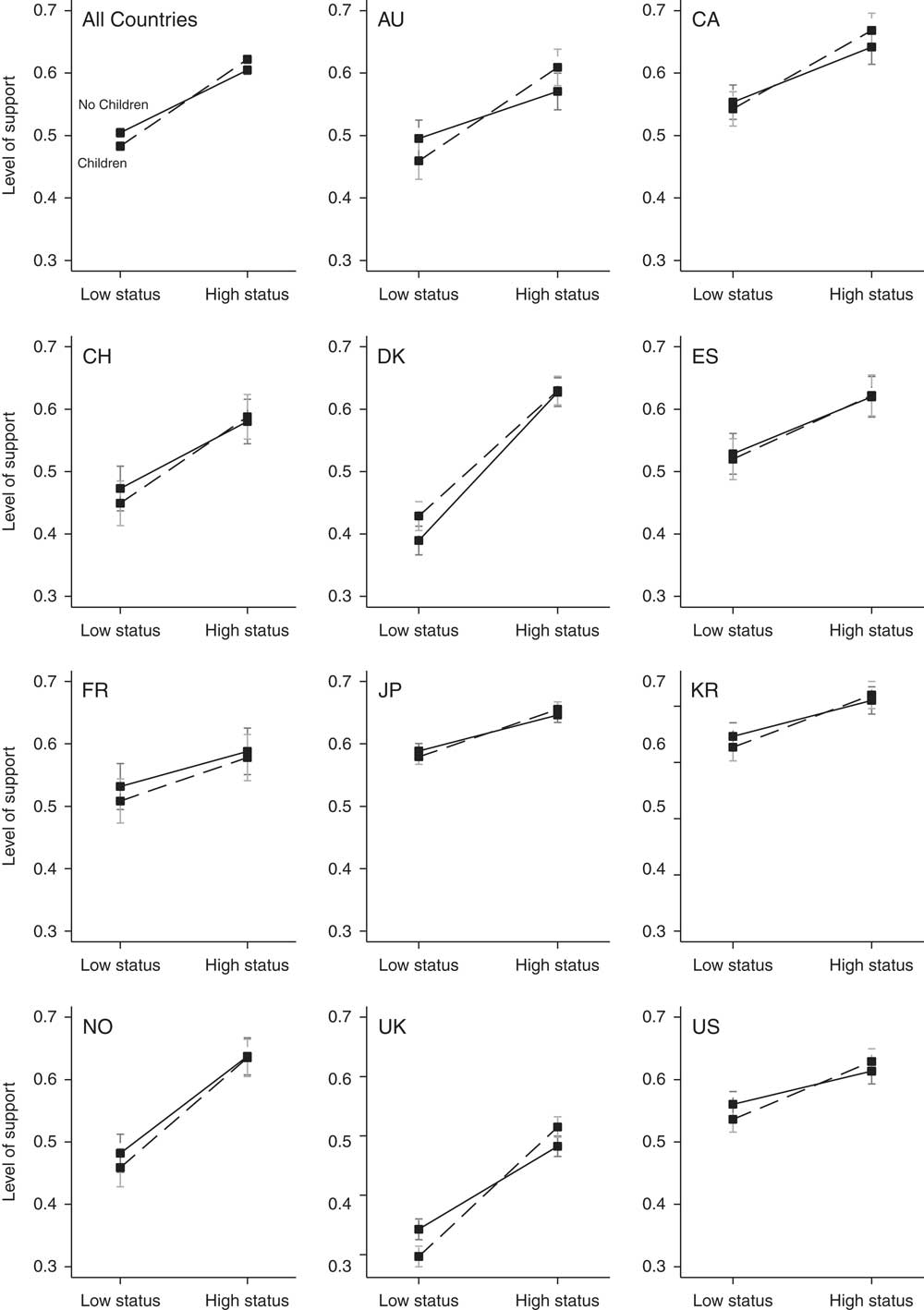
Next we turn to the argument about perceived sociotropic concerns – the impact of new immigrants on the domestic economy as a whole. Recall that we expected natives to be especially averse to unskilled immigrants with dependents. Statistically speaking, we anticipated a positive interaction between immigrant skill and family status. The results (displayed in Appendix Table 2) are consistent with this expectation: the presence of a wife and children reduces support when the immigrant is of low skill, but not when he is highly skilled. This is consistent with the notion that many publics, as a whole, are especially wary of lower-skilled immigrants with large families who might represent a larger burden on the nation’s economy. The individual country effects are displayed in Figure 6, and the interaction of interest is statistically significant for six of the eleven countries. Note also that the interaction is not stronger in countries with large social welfare states, as the Tax Burden hypothesis might presume. The interaction is large in the United States, Norway and Denmark – places with much more generous welfare systems. This suggests the effect is not narrowly egocentric, because publics that are especially vulnerable to high tax rates are not increasingly opposed.
Average treatment effect of family status, moderated by job status by country

The final row of coefficients in Table 4 shows the difference in levels of support for the second (versus the first) immigrant vignette presented to each respondent. The second vignette elicits significantly less support than the first (roughly −0.04 less, on average), and since vignette order was randomly assigned, this effect is independent of immigrant job status, complexion, national origin and family status. This order effect is significant in all countries except Spain. One possible interpretation is that the immigrant in the second vignette triggers even greater concern about the society-wide burdens associated with immigration.
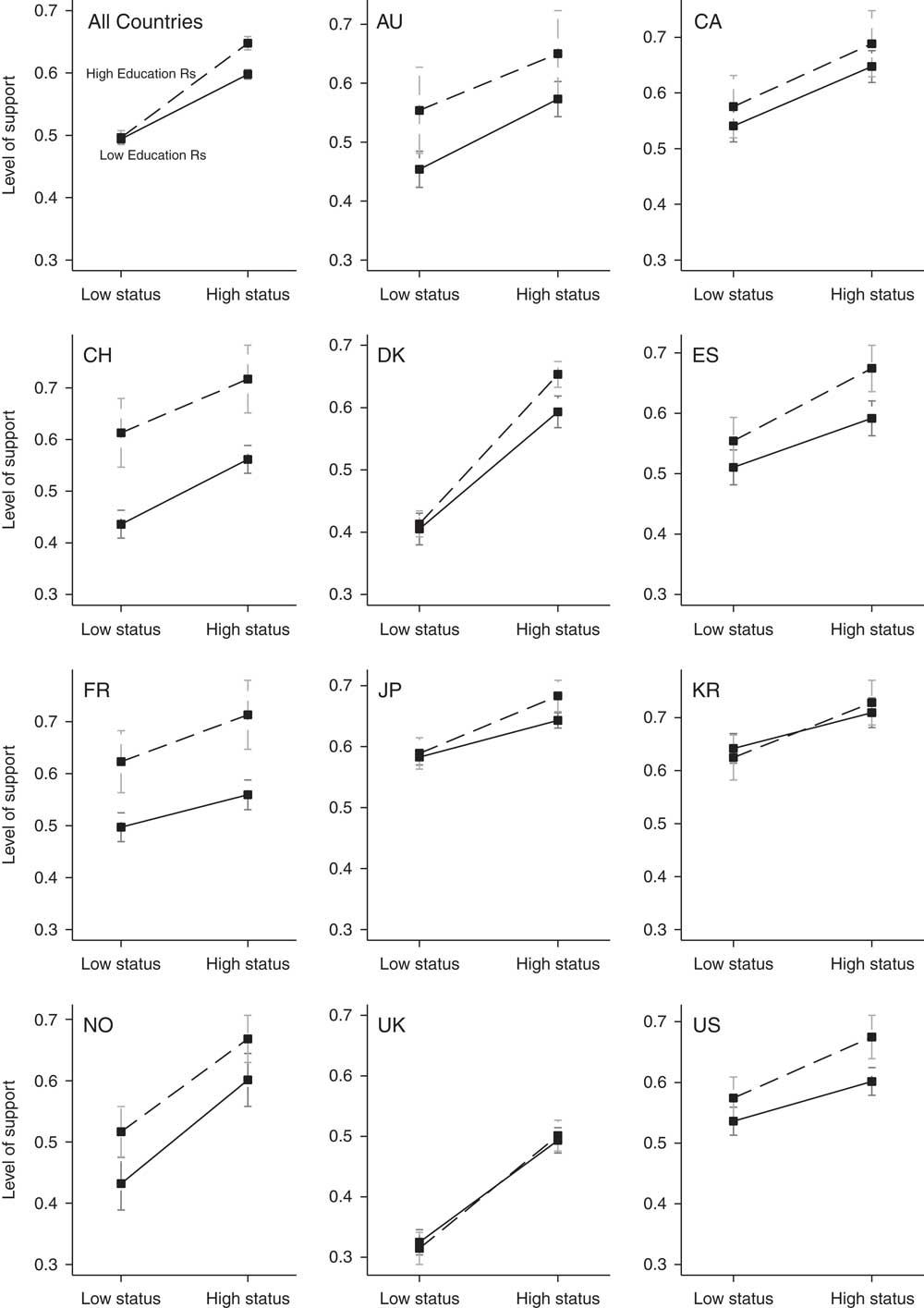
The results so far reveal the overwhelming importance of job status in accounting for immigrant support cross-nationally. Recall, however, that the logic of the Labor Market Competition hypothesis suggests natives should be most threatened by, and therefore react most strongly against, newcomers who compete directly for employment opportunities in the natives’ SES stratum. Testing this possibility requires an interaction between immigrant job status and native SES. If labor market competition drives immigration support, then support for high-occupational-status immigrants will be lower among high- versus low-SES natives, while the reverse should be true for low-occupational-status immigrants.
Models including the key interactions for testing the Labor Market Competition hypothesis are included in Appendix Tables 3–5. The critical results are presented in Figure 7. Do natives oppose immigrants who pose a greater competitive risk to their own employment prospects or salaries? Our evidence suggests not. In no country do we observe a negative interaction between job status and respondent SES. We present the results for education in Figure 7. Indeed, and contrary to the expectations, high-SES natives are often significantly more enthusiastic than low-SES natives about admitting immigrants of high job status. The combined estimation in the top left panel of Figure 7 shows a small but significant positive interaction between respondent education and the immigrant’s job status. One might presume this result counts as mild support for the Tax Burden hypothesis, since those who are most likely to bear the costs of a larger social welfare state should be expected to prefer higher-skilled immigrants. That said, there is no significant interaction between immigrant job status and our other measures of SES status, occupation and income, and even the results for education are only significant in the combined estimation, not the by-country results (see Appendix Table 3). In summary, the predominant impact of immigrant job status is unmoderated by the respondent’s SES.
Average treatment effect of job status, moderated by respondent education

The weight of the evidence points towards the Sociotropic Economic Threat hypothesis. We nevertheless need to explore one further possibility – that Tax Burden and Welfare Chauvinism processes are operating simultaneously. We think this explanation is not consistent with the general pattern, because the actual flexibility of the social welfare pie in each country is constant. Therefore, one would expect one of these native groups to respond more powerfully to the low-skilled immigrant than the other based on the flexibility of the social welfare state to increase the total amount of benefits available. Since countries vary in the degree to which they alter the size of the welfare pie based on changes in demand due to immigration or other forces, we would not expect such a consistent pattern to emerge across all these countries.
We can, however, further explore how sensitive high-SES natives are to particular aspects of the economic threat posed by immigrants. In the pretest questionnaires, we asked respondents to think about the impact of immigrants on their country (on taxes and jobs) from the two countries that we would subsequently mention in the vignettes. Note that because these concerns were asked in the pretest, responses could not be affected by the manipulation. We expect that most respondents assume that most immigrants are of low skill, and so they should be thinking of low-skilled immigrants as they respond to these questions about the consequences of immigration in general.
Appendix Table 6 includes models of ‘openness to immigration’ on measures of concern about (1) immigrants increasing taxes and (2) immigrants taking jobs away from citizens. The models allow each to interact with measures of SES. If the Tax Burden hypothesis were correct, we would expect the interaction between taxes and the respondent’s income to be negative and significant, since the impact of tax concerns on tolerance should be most steeply negative among high-SES natives. We do not find this to be the case. Both variables are negatively associated with openness to immigration, as we would expect, but tax concerns are not better predictors of opposition among high-SES natives, nor are concerns about jobs a better predictor among low-SES natives.
The absence of any significant variation in country-level results is also of significance. Countries in our sample range from quite modest and inflexible welfare states (for example, the United States) to very comprehensive ones (for example, Denmark); they notably include examples from each of Esping-Anderson’sFootnote 49 classic ‘three worlds of welfare capitalism’: liberal, such as the United States, Canada and Switzerland; Christian democratic, including France and Spain; and social democratic, including Denmark, Norway and Switzerland. If welfare-chauvinistic accounts were operating, we would expect poorer respondents in less generous welfare regimes to be especially concerned about sharing a small pie, and thus to oppose low-skilled immigrants far more than wealthy natives would. Alternatively, in high-tax, social democratic welfare states, wealthy respondents might be more motivated by tax-related issues and should thus oppose low-skilled immigrants more than less wealthy natives. However, no clear pattern consistent with these hypotheses emerges across our countries. Rather, all of our results point in the same direction: low-skilled immigrants are less preferred in all countries and about equally among both low- and high-SES native groups.
DISCUSSION, AND A FURTHER TEST OF THE IMPACT OF RACE
Our findings are clearest about the way in which economic concerns impact attitudes towards immigrants. On the cultural threat side, we find that skin tone had little effect but religious affiliation was significant. The result on skin tone is quite consistent with both Hopkins and Ostfeld,Footnote 50 who found relatively modest effects on most dependent variables of interest. Still, we would not conclude based on these results that racial concerns are irrelevant to most publics. One final piece of evidence on this point comes from five of our country studies – Canada, France, Spain, the United Kingdom and the United States – which included indicators of citizens’ racial attitudes that are independent of their attitudes about immigrants. In these countries we can examine whether racial sentiments, rather than attitudes about immigrants per se, are linked to views about the immigrants described in our vignettes. In the United States we asked the standard 4-item agree–disagree racial resentment tapping attitudes about blacks.Footnote 51 In Canada, France, Spain and the United Kingdom, we used a slightly modified version of the scale, with a three-item battery focusing on ‘minorities’ in order to make the items applicable to those other countries.Footnote 52 Each of these sets of items was additively combined and similarly rescaled to run from 0–1. Appendix Table 7 includes results from country-by-country models of immigrant support including treatment effects alongside racial resentment, as well as demographic controls (gender, age, education and income). This evidence makes it clear that racial attitudes remain a powerful determinant of opinions about immigrants. Moving from low to high levels of symbolic racism decreases support for the target immigrants by between 0.3 and nearly 0.6 on the one-unit dependent variable. These associations dwarf the experimental effects of job status. Indeed, in every country where we measured attitudes about blacks or minorities, anti-minority resentment was by far the strongest predictor of opposition to admitting the immigrants described in the vignettes. Clearly, racial animus remains a force in immigration politics, despite the null results we find for skin complexion.
Skin complexion may simply have little effect when other dimensions of cultural difference are salient, as they typically are in the real world. All our vignettes feature immigrants from countries that would be seen as racially or ethnically distinct to begin with. In some sense, then, the immigrants in these vignettes are ethnic “others” compared to the majority group. Complexion is thus but one of a larger set of cues relevant to cultural distinction that drives immigration opinion, and it does not seem to be of overriding importance.
Our experiments nevertheless reveal powerful effects of job status – and, most importantly, effects consistent with recent studies that land on sociotropic economic concerns. As in Hainmueller and Hiscox’s work,Footnote 53 whose findings are limited to the United States, we find a powerful, independent role for cues about skill level that is invariant across natives’ SES levels– this time, in eleven countries and across four continents. Low-skilled immigrants, regardless of their eagerness to work and willingness to speak a new language, features which we held constant across all vignettes, trigger substantially more opposition and resistance.
The study’s most significant contribution to the literature is the strong and consistent support for the Sociotropic Economic Threat hypothesis across such a broad range of countries. One might argue that we cannot rule out the possibility that respondents reacted to the skill manipulation with only economic concerns in mind. This has been our interpretation, certainly, but we acknowledge the possibility that ‘low-skilled immigrant’ may not be a purely economic cue – it may carry also a set of associated socio-cultural stereotypes as well. To what extent is this economic cue purely economic? We are able to explore this indirectly: if there were a socio-cultural component to our skill manipulation, we would expect the treatment to be moderated, at least in part, by respondents’ racial attitudes. In other words, the low-skill immigrant would be opposed even more strongly by respondents high in racial animus. A slight adjustment of Appendix Table 7 models offers the necessary test. Appendix Table 8 displays the results of models that add an interaction between our measure of racial animus and the job status treatment. In no country does ethnocentrism moderate the effect on job status. This reassures us that the job status manipulation is indeed primarily interpreted as an economic (rather than socio-cultural) cue.Footnote 54
What are the implications of our core finding? Immigration attitudes have real-world consequences, of course, and considering the policy consequences of our findings is thus an important objective. One consequence associated with this pattern is that programs that privilege high-skilled immigrants – focusing on admitting only newcomers with very high levels of wealth and/or skill – are likely to be more popular than those with other goals, such as family reunification. Some US experts have already suggested that a shift towards policies that favor high-skilled immigrants would be beneficial economically,Footnote 55 for instance, and this policy trend is evident cross-nationally as well. Indeed, August 2017 policy proposals from the Trump administration illustrate the popularity of a ‘points’-based immigration policy. Of course, just because a shift towards economically focused immigration policy is popular does not mean it will come without a human cost.
Another objective must be to better understand the mechanisms underlying sociotropic economic effects. Our article has provided powerful evidence of the significance of an economic threat that is not directly about one’s personal economic situation. These findings are consistent with the literature on the importance of sociotropic versus egocentric economic concerns in presidential voting.Footnote 56 However, we still lack a strong theoretical account for how these concerns affect preferences. One possibility is that individuals connect sociotropic concerns with their individual future economic prospects – meaning that concerns about sociotropic economic threats are signals of one’s own prospective economic situation. Another possibility is that sociotropic concerns reflect a more nationalistic, group-based commitment: citizens may be genuinely worried about the economic success of the nation as a whole because they identify with that collective. It is important for future work to examine the causal mechanisms underlying this process more fully.