On a sweltering August day in 1858, a man by the name of José Alejo Contreras and his legal counsel filed a freedom suit in the musty offices of the First District Court in Santiago de Cuba.Footnote 1 At the time, Santiago was the second largest urban area in Cuba, and yet, to the foreign visitor, this underdeveloped Caribbean borderland surrounded by lush tropical forests, small coffee and tobacco farms, and undercapitalized sugar plantations must have felt years away from Havana's splendor and bustle. According to José Alejo's legal counsel, the deceased owner, Nicolás Contreras, had treated the litigant as if he had been free, with the intention of manumitting him formally by testament, but Nicolás Contreras died unexpectedly and intestate. His heirs then quickly proceeded to sell José Alejo to another party, likely with the intention of raising further bureaucratic hurdles to a potential freedom suit. However, with support from legal counsel, José Alejo took his case to the courts. His only evidence was his reputation in the local community as a slave who had been held “as if free,” and three witnesses who could confirm that Nicolás Contreras had promised him his freedom.
In Santiago, the judge found against José Alejo Contreras on grounds that his freedom was a gift in prospect of death (donatio causa mortis). As such, the owner's gift would have had to be witnessed by five to seven individuals.Footnote 2 Falling short of the required number, José Alejo lost the case at this level, but nevertheless managed to take it to the Appellate Court in Havana. There, his counsel included two liberal lawyers who argued that the deceased's promise of freedom was not a gift, but rather remuneration for José Alejo's services; therefore, the laws that ruled testamentary dispositions and deathbed acts of donation did not apply. Two reliable testimonies would be sufficient evidence for the existence of such a debt, the two lawyers argued.Footnote 3 The risky legal strategy paid dividends: the litigant won his freedom papers after six years of legal wrangling.
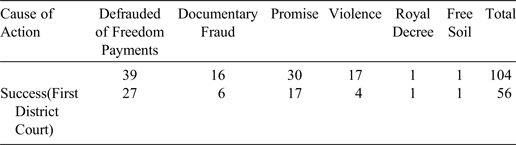
By approaching José Alejo's manumission as debt repayment rather than as manumission by grace, the lawyers equated it to a commercial transaction. This was a savvy argumentative twist. Freedom litigants were most successful when they claimed that their masters or their masters’ descendants had defrauded them of payments that they had made toward their manumission. Other arguments (such as an owner's acts of violence, or sevicia, claims of an owner's documentary fraud or of descendants’ failure to fulfill testamentary dispositions) yielded less success. In this case, however, no actual cash-based freedom payments had occurred. Instead, the legal counsel monetized the labor that José Alejo had been supposed to do for his master by virtue of his ascribed status as a slave.Footnote 4 In the two lawyers’ calculation, with the money that the litigant could have saved by working for himself a day a week, as permitted by law, he would have been able to purchase his freedom. Instead, he preferred to work for his owner day in and day out, from a sense of loyalty. Now, he rightly expected to be paid for his loyal behavior.
José Alejo's freedom case was not an oddity in the Cuban courts of the time. Approximately one third of freedom litigants who filed suits in the city of Santiago de Cuba between the early 1820s and the late 1860s and whose records have been preserved (30 out of 104 suits) argued that their deceased owners had orally promised to manumit them (see Table 1) . More than half of the litigants were successful at the first district court level (seventeen out of thirty). José Alejo's success on appeal is surprising, because most similar cases were turned down at that level. His case might, therefore, signal the appellate court's greater eagerness to favor freedom litigants in such cases. Most cases were filed by women (twenty-one out of thirty) who were more likely to be domestic slaves.
Freedom Suits Filed in Santiago's First District Court Between 1817 and 1868 That Have Been Preserved at the ANC and AHPSC.

This article makes two arguments. It first shows that by the middle of the nineteenth century, freedom litigants tried to monetize acts of manumission by grace, which they approached as a deferred payout of gradually accrued wages. Manumissions by grace tended to reward affective labor (loyalty, affection) and to be granted to domestic slaves. Across Cuba, as in other parts of Spanish America, slaves had made sustained efforts to monetize the labor that they did for their owners through self-purchase.Footnote 5 The monetization of affective work stands out among such efforts because it challenged key hierarchies at the heart of the institution of slavery.
Manumission by grace had long existed across Spanish America, with one's public fama (reputation) and Catholic virtue being, by and large, key to success.Footnote 6 Such manumission acts were a policing mechanism through which slaveholders bestowed privileges on some slaves who displayed ostensibly commendable behavior. Even though tacit transactional logics informed the terms of manumissions by grace, owners had traditionally couched such acts in paternalistic terms. In this vein, then, manumission by grace was a privilege that occupied a sphere of exchange separate from the ordinary slave market or ordinary self-purchase. This separate sphere of exchange was thought to be, for the most part, a domestic and affective realm in which a slave's emotional labor was supposed to transcend transactional thinking by being akin to the self-giving labor of a family member.Footnote 7 The legal cases presented here suggest that litigants revealed the presence of the market logic in domestic slavery, showing that slavery was an economic institution even in such instances in which it appeared to be intertwined with kinship and domesticity. These cases also challenged the assumption that the master–slave hierarchy was natural: if slaves acted loyally, it was not out of a sense of blind commitment, but rather because of careful calculation. Finally, by monetizing labor that was supposed to be affective, freedom litigants were also turning the privilege to obtain manumission by grace, which masters had arbitrary control over, into a right: if slaves could have done other kinds of paid work, as permitted by law, doing affective labor was a choice that entailed forfeiting these other paid possibilities, which masters, the courts, and the community ended up taking account of. Yet, unlike markets in other kinds of labor, the market in emotional labor remained more socially embedded. As such, assessing its value required more witnesses, which, in turn, could be a double-edged sword. For some such witnesses, certain behaviors were best left unmonetized if one were not to lose one's honor.
This article also argues that by the 1880s, oral manumissions by grace, such as the one negotiated by Alejo and Nicolás Contreras, would become a blueprint for general emancipation across the island. The notion of a merit-based right touted by Alejo Contreras and his legal counsel was likely partially inspired by Enlightenment ideologies of natural rights to freedom and property that had been percolating throughout Spanish America starting with the mid-to-late eighteenth century. Across the Americas, Enlightenment and later liberal ideologies of freedom coincided with higher levels of litigiousness and insurgency among people held in slavery.Footnote 8 Moreover, with the proliferation of free soil territories across the Americas, some individuals held in bondage used mobility across legal jurisdictions and status-related ambiguities that such mobility could open up to claim freedom.Footnote 9 But enslaved people's claims to rights did not necessarily arise in response to philosophical debates about merit versus ascribed status taking place in Europe alone. Early in the colonial process, authorities and slaveholders had accepted slaves’ access to certain privileges, such as land, the goods that slaves made in their spare time, and gradual self-purchase (coartación), as customs necessary to protect the public peace.Footnote 10 Freedom litigants expanded the tenor of such customary privileges, redefined them as rights that resonated with liberal ideologies, and formalized them through the courts and insurgency. This article suggests that domestic spaces, where manumissions by grace were most likely to be negotiated, were at the heart of this process, and informed the politics of emancipation beyond the household.
Social theorists and political activists have long discussed the value of care work, household work, and intimacy to social reproduction while calling for greater recognition for care workers, for the most part women.Footnote 11 Recently, as such labor has become increasingly commodified, some scholars have critiqued the corrosive impact of the market on intimacy, thereby suggesting that a separation of market and non-market spheres could be possible, and had existed in the past.Footnote 12 Others have questioned the idea that such separation is possible, and have pointed out the political implications of assuming it.Footnote 13 The absence of such a separation is an insight that enslaved women in nineteenth century eastern Cuba and likely in other slave societies of the time were all too familiar with. Their court efforts constitute a little-remembered precedent for some of our present-day feminist concerns.
A Caribbean Borderland: Santiago de Cuba, 1820s-60s
At the turn of the nineteenth century, Eastern Cuba was, by most measures, a Caribbean borderland, operating outside yet in the orbit of the island's sugar economy.Footnote 14 Despite being the second largest urban center in Cuba, Santiago remained an area of low investment and reduced official presence. Through contraband trade and occasional neutral trade agreements, it was more deeply connected to the English and French Caribbean than to the rest of the island or to other Spanish possessions well into the first decade of the nineteenth century.Footnote 15 Yet, the city was too strategic a port to be left unruled, even though the amount of investment in fortifications and policing paled in comparison with Havana's. Notwithstanding its status as the second largest city on the island and the seat of the Eastern Department (Departamento Oriental) after 1607, countless official visitors and royal administrators described it as “poor and miserable,” barely a “village” (aldea), a “ruin” (ruina), or a terra incognita.Footnote 16 A combination of political factors, especially the relative power of Havana in capturing state investment in the form of the Mexican silver subsidy (situado), had doomed the first efforts to establish sugar plantations in sixteenth century Santiago.Footnote 17 Furthermore, Santiago had remained consistently marginalized in the official distribution of slaves through the state-controlled slave trading system (known as the asiento system).Footnote 18
By the late eighteenth century, as they were witnessing the fabulous wealth that sugar planters in Jamaica, Saint-Domingue, and Western Cuba were amassing, Santiago's elites understood that slave labor could make large-scale economies in the Caribbean. Their fortunes did begin to shift with more lax trading regulations,Footnote 19 but it was Santiago's proximity to the insurgencies on Hispaniola (which would come to be known as the Haitian Revolution) that truly provided local economic elites with the chance to try their hand at plantation agriculture. As the wealthy plantation system in the French colony entered crisis, its fragments filtered into the networks of privateering and contraband that had long been Eastern Cuba's life blood.Footnote 20 Throughout the 1790s and early 1800s, Saint-Domingue refugees to Cuba would also provide Santiago with the long called-for resource to stimulate the coffee economy: captive labor. Yet, in spite of this investment, coffee planting in Santiago only took off after 1817. In 1809, in the wake of the Napoleonic occupation of the Iberian Peninsula, the captain general of Cuba ousted the French population on the island. The planters in Santiago departed for New Orleans, but some returned in 1817, when the Spanish crown introduced a colonization initiative designed to populate remote areas and to reduce the demographic weight of the population of color.Footnote 21 It is for this reason that this article's chronological starting point is 1817, a threshold in the region's economic history. The refugees’ return coincided with extremely high prices for coffee on the global markets. Unsurprisingly, coffee plantations went through an unprecedented boom. By the late 1820s, there were more slaves in Eastern Cuba than there had ever been in the region's colonial history.Footnote 22 But even so, rates of economic growth there remained significantly below those of the Havana region, with local elites complaining about the crown's negligible investments in this area.Footnote 23 During the 1830s, the introduction of United States tariffs on Cuban coffee, Brazil's entry into the global coffee markets, and natural calamities brought Eastern Cuba's large coffee producers to an economic standstill.Footnote 24
Although Santiago's relative underdevelopment remained landholders’ bane, it did open up spaces of freedom for enslaved individuals and for smallholders and land renters, many of whom were free people of color. Manumission rates spiked four times between the late 1820s and the early 1860s.Footnote 25 The number of free people of color more than doubled, from approximately 17,000 in 1828 to more than 36,000 by the mid-1840s. Their weight in the population also increased from approximately one quarter to more than one third. During the same time period, the slave population declined from approximately 38,000 to approximately 32,000, and from constituting a little more than one half to constituting one third of the total population.Footnote 26 By comparison, Havana's free people of color constituted approximately one fifth of the total local population in 1861.Footnote 27
In Santiago, the expanding free population of color contributed to self-reproducing manumission rates, because slaves often relied on free family members to help them make freedom payments.Footnote 28 The pervasiveness of manumission and the example of a large free population of color likely encouraged some amount of restiveness among enslaved people who were eager to negotiate more flexible laboring arrangements with masters. On their part, slaveholders agreed to enter such negotiations, as the competitiveness of Cuban coffee was shrinking on the global markets and they had a surplus labor force on their properties.Footnote 29 Even though some slaves were sold to West-Central Cuba to work on sugar plantations, the rate of growth of the free population of color suggests that many others on the eastern side of the island bought themselves out of slavery. To adjudicate the legitimacy of informal master–slave contracts, judges relied on the letter of the formal law as well as age-old customary community norms.
The Judicial System in Santiago
Early modern Spanish law, like other legal regimes of the time, was pluralistic: the multiple and frequently overlapping jurisdictions (e.g., royal, ecclesiastical, and military) were matched by an equally diverse body of legal sources invoked in the courts.Footnote 30 The distinction between the legal and the extralegal was flexible, with customary law playing a key role well into the nineteenth century.Footnote 31 The primary goal of such early modern pluralistic legal systems was to manage conflict among different social groups and jurisdictions through equity, and thereby promote the public good.Footnote 32 To that end, laws were supposed to be followed in spirit, which meant that adjudication was casuistic: judges took account of circumstances and of the litigants’ and defendants’ status and the responsibilities and privileges that came with that status.Footnote 33 Within a legal system based on natural law, rights were not inherent in the individual. Rather, they were distributed with the aim of maintaining balance and order. When order was disturbed, rights (or rather, privileges) could be suspended as well.
Spanish codes contained several openings that could work in the interests of freedom litigants. Las Siete Partidas had established that slavery was an abhorrent man-made institution and, as such, contrary to nature. For this reason, it proposed several avenues for freedom and encouraged judges to favor freedom whenever they were in doubt. The paths to manumission were: (1) good conduct (by which the authors referred to the provision of incriminating information regarding the behavior of counterfeiters, possible political traitors, or eloping virgins); (2) injury, granted to slaves whose masters had severely maimed them; (3) marriage to a free woman in the presence of the owner, as long as the owner remained silent about the enslaved spouse's status; (4) religious ordination; and (5) lapse of time (or prescription).Footnote 34
Beyond Las Siete Partidas, slave litigants could access an array of edicts, laws, royal orders, and legal procedures that the crown had introduced since the 1520s, and that had been designed to curb the power of colonial elites and to promote harmony among the different sectors of colonial society.Footnote 35 One such measure that had first emerged in medieval Iberia was expedited legal redress for people deemed to be miserables, social dependents with limited or no capacity to sue.Footnote 36 Levels of litigiousness in Spanish America suggest that social dependents were aware of existing protective provisions and became heavily invested in the colonial legal system. In the early modern period, slaves sued to keep their families together, to uphold owners’ promises, or to prevent former owners from re-enslaving them after they had completed their freedom payments.Footnote 37 Many pursued their cases in the jurisdictions where they were most likely to find a sympathetic audience, usually the ecclesiastical courts.Footnote 38 Their savvy forum shopping suggests an understanding of the judicial process and of colonial governance.
Slave litigants, like other dependents (women, indigenous people, minors), did not have the legal capacity to sue. In civil cases against their own masters, they needed to convince legal counsel, who had the capacity to represent them, to pick up their cases. Connections with elite slave owners, with prominent members of the community, or with local legal intermediaries were key to a litigant's successful access of the courts. As historian Michelle McKinley has argued, “the essential scaffolding of the early modern Iberoamerican system of justice” was an “architecture of paternalism.”Footnote 39 Unsurprisingly, it was domestic slaves who were most capable of securing access to the courts and winning freedom suits.
A range of legal intermediaries (scribes, notaries) enabled freedom litigants and slaves to learn about the legal process. Such intermediaries were usually literate individuals who lacked state-sanctioned legal credentials, but knew the court system and could draft petitions. In Cuba, colonial authorities blamed the high levels of litigiousness on such intermediaries known as picapleitos.Footnote 40 Because they encouraged the local population to file suits even in the absence of clear legal grounds, authorities across Spanish America described legal intermediaries as a plague of sorts. But even though potentially exploitative, picapleitos’ activities democratized access to the justice system, spread knowledge about how the law worked, and put pressure on the local authorities to respond to humble petitioners.
Until the second half of the eighteenth century, in Cuba, any lawyer or picapleito could represent a person held in captivity in a freedom suit. At some point between the 1760s and 1789, the local council's office of the síndico procurador took up this particular assignment.Footnote 41 Since 1540, the procuradores had been responsible for maintaining the public peace. They represented “the public good” against encroaching private interests. For example, the office counted among its attributions the fair pricing of staples in the local markets or the maintenance of open access to the commons. By assigning the role of representing enslaved individuals acting against their masters to the síndico procurador, lawmakers implied that freedom suits were a matter of public order and policing. Although the crown repealed the 1789 act that instituted the síndico procurador as slaves’ legal representative, local authorities in Santiago decided to keep it in place. One possible explanation for the retention of the act and of the síndico’s function was the tension between small property holders and plantation owners.Footnote 42 Because the former still occupied key positions in the local town council, they might have been eager to curb the consolidation of a plantation elite by providing slaves with easier paths to the legal process. However, the streamlining of justice for litigants held in captivity could have its downsides: when the síndicos had conflicting interests with the litigants (for example, they could be related to the litigant's master), the litigants usually had to go all the way to the appellate court to make sure that they had access to justice.
Throughout the eighteenth century, litigiousness among slaves and social dependents increased significantly across Spanish America. Historians have attributed this shift to the circulation of new ideologies of natural rights in the Spanish Empire during the Bourbon Reforms, the Wars of Independence, and nineteenth-century liberal reforms in Cuba and the new independent republics.Footnote 43 The Bourbon-issued 1789 legal code designed to manage the relationship between masters and slaves eroded masters’ hold by emphasizing that slaves could appeal to the courts when they had been subjected to extreme acts of cruelty (sevicia). Las Siete Partidas had also banned sevicia.Footnote 44 The new act, however, provided better mechanisms of implementation for this measure. Underlying the measure was a secularized vision of universal humanity (and with it, of some basic universal human rights). Both in Santiago (where the courts continued to use the 1789 royal order), and in other parts of Spanish America where it was suspended, the number of freedom suits brought to the courts on account of sevicia increased throughout the late eighteenth and nineteenth centuries.Footnote 45 Moreover, the Bourbon reformers moved to rationalize and centralize the legal system. They did not simply eradicate customary rights, but did, however, try to fix them and formalize them, thereby reducing the power of the community to interfere in their allocation.Footnote 46 On their own end, freedom litigants used the crown's impetus against slaveholder violence to expand and formalize customary privileges. So, for example, in the modernized Bourbon courts, slave litigants might argue that a master's denial of a slave's access to a plot of land or to free time indicated the owner's cruelty.Footnote 47
Among all customary rights that would open up most opportunities for slaves inside the courtroom, coartación (or the right to purchase oneself in instalments) stood out. It created opportunities to monetize slave labor. Coartación was an agreement according to which slaves would pay a fixed amount of money in instalments toward their freedom. Enslaved individuals would provide a down payment to initiate the coartación proceedings. The practice enabled slaves to fix their price based on their market value at the time when they drew the notarized coartación agreement. Masters benefitted from this arrangement because they got access to slaves’ savings and they could more easily discipline them.Footnote 48 Access to coartación would come to shape other conditional freedom contracts that did not necessarily involve self-purchase.
Although coartación appeared in the record as early as the 1590s and various eighteenth century laws made references to it, the right to it and to a peculium—monies that slaves would use to make payments toward their freedom—remained relatively poorly defined in law until 1842. That year, the captain general of the island formalized other customary practices, most importantly the right to work for oneself to buy freedom.Footnote 49 The document implied that slaves had the right to own resources and to contract some amount of their labor out to individuals other than their owners. Even though the right to a peculium remained more ambiguous, in practice, slaves’ informal ownership of resources was widespread and acknowledged in a range of official settings.Footnote 50
In Santiago, notarized coartación agreements remained almost nonexistent in the record. Moreover, few slaves who purchased their freedom were listed as coartado in manumission letters. Occasionally, coartado slaves appeared as such in bills of sale; however, given the rarity of coartación contracts in notarial registers, it is likely that such contracts remained oral and un-notarized. Such arrangements posed dangers to the more vulnerable side: the slave who might find it harder to prove the terms in case of conflict. And yet, approximately 55% of freedoms in Santiago between 1828 and 1868 were for pay, which suggests that slaves did not shy away from them.Footnote 51
Other conditional manumission arrangements had to take account of a slaves’ ability to buy themselves in instalments and the choice to forgo this, giving slaves some leverage. A slaves’ higher-than-average services toward their owners in return for later free manumission could mean that those slaves were taking time away from other forms of paid labor that could have helped them save money to buy freedom in instalments instead. In such an instance, freedom could be seen as an apt form of remuneration, rather than as a gift, turning the litigant into a creditor. The impact of coartación should thus not be assessed only with reference to the number of slaves who freed themselves through payment.Footnote 52 It could also be used to negotiate other legal openings and to gradually monetize labor that slaves did for their own masters, rather than just outside the household.
Proving a Promise to Freedom in Practice
The refashioning of manumissions by grace into contractual commercial transactions was a two-pronged process that was structured around witness testimonies. Litigants had to first make a master's oral promise carry as much weight as a written agreement. Las Siete Partidas had established that masters’ promises to their slaves had no binding power. However, judges in the First District Court accepted that if such promises had been witnessed by enough credible individuals, an oral promise could be sufficient ground for a freedom claim.Footnote 53 The customary belief that oral promises could be tantamount to a freedom letter likely stemmed from a statute in Las Siete Partidas according to which owners could free slaves in private in front of at least five witnesses.Footnote 54 Most of the slave plaintiffs and their legal counsel described in this article reinterpreted this procedure. They would provide fewer than five witnesses to an oral promise of freedom. Moreover, in most cases, the witnesses had become aware of the plaintiff's freedom in separate circumstances and had not participated in a private freedom-granting ceremony. Witnesses could make or break a promise-based freedom suit, because they served as the main conveyors of a litigant's reputation in the community.
When refashioning an owner's promise as a commercial transaction, freedom litigants also had to redefine an owner's philanthropy as his or her monetary and social debt to the slave. They usually did so by pointing out that they had foregone customary rights or that they had developed specific skills that enabled an estate's success, but the market in and of itself did not serve as the sole tool for measuring the worth of a slave's work for the master. Rather, patrons and the community still assessed the labor that a slave did for his or her master in terms of its emotional, social, and honor-bestowing qualities as well as its economic value. Freedom litigants lived in a world in which their economic value was tied to their commodification on the slave market, a mechanism whose workings many understood and navigated with savvy as they bargained about their manumission price.Footnote 55 Enslaved people, especially those living in urban areas, were aware of the workings of markets more generally,Footnote 56 but they also knew that the transactions underlying some forms of labor, especially emotional labor, were less visible. Their efforts to reveal such transactions did yield results inside the courts. By the 1850s, the courts recognized that some manumissions by grace were transactional. For example, some lawyers and judges distinguished between a simple freedom and a remunerative (remunerativa) freedom, which confirms that they embraced the notion that a master could be indebted to a slave. When, for example, Demeteria Portuondo claimed that her former owner's descendants re-enslaved her after her deceased owner had freed her through an oral agreement, the síndico argued that her freedom was special: it was “a remuneration and as such equivalent to a legitimate debt that one had to pay as if it were sacred” (“tiene calidad de remunerativa equivalente a una deuda legítima y sagrada, que debe pagarse religiosamente”).Footnote 57 Freedom as remuneration could work well, especially when slaves did not have to compete against other creditors. Sometimes, when they were pitted against other debt holders on an estate, they were still relegated to secondary status and could only obtain their freedoms once the other debts had been paid out.Footnote 58 However, in some instances, especially when the planter had cohabited and fathered children with a slave, judges in the First District Court did provide priority to the slave over other creditors.Footnote 59
Freedom litigants commonly argued that holding managerial roles in the running of estates in return for future freedom entailed highly skilled labor, responsibility, and giving up paid employment outside the household. They thus occasionally suggested that their loyalty impeded them from raising the resources necessary for coartación. This was the case of a man by the name of Juan Bautista Pauvert. He won his freedom suit on account that his owner, Oscar Pauvert, had treated him “as if” he were free for an unspecified number of years while he was running his owner's tobacco farms.Footnote 60 Oscar Pauvert had entrusted Juan Bautista with the task of cultivating tobacco fields and of overseeing other slaves’ labor, had allowed him to travel between properties freely, and had made him exempt from physical punishment. Upon his death, however, Oscar Pauvert's brother, Eduardo, took possession of Juan Bautista and tried to sell him to the local copper mines. Several local planters testified that they had seen Juan Bautista act “as if” he were a free person for several years and that they were convinced that Oscar Pauvert had intended to provide him with a manumission letter. Neither the síndico nor the judge considered the number of years that he had been treated “as if” free, which suggests that they did not think that the laws of freedom by prescription were applicable here. Instead, the witnesses emphasized the litigant's economic value to the estate, the autonomy that he had acquired by virtue of the labor that he had done, and his trustworthiness.
Another similar case reveals more details about what life must have been like for individuals caught in an ambiguous social status between slavery and freedom: treated by their owners “as if” they were free and known to be as such in the community, but without being granted a manumission letter. In 1829, Andrés Villalón came before the courts of Santiago claiming that on his deathbed, his now-deceased owner had granted him freedom in the presence of several witnesses.Footnote 61 The owner could not draw the freedom letter because the notary did not arrive to their rural residence on time. The heirs then postponed drafting the letter on grounds that the estate had to be partitioned first; however, they treated Villalón “as if” he were free in the meantime. For six years, Villalón, who was a sugar technician on the family's mill, had lived like a free person: he managed the mill, was made exempt from physical punishment, was appointed as an administrator in charge of twenty-two slaves, had his own house, could live and move around the countryside as he pleased, served as a sexton in the local church, and was listed as free in the 1828 local census. Villalón carefully documented this information through letter exchanges with former plantation administrators, the lieutenant of the village who had collected census data, the local priest, and family members who were ready to testify that they had heard his former owner's promise on his deathbed and who expressed feelings of affection toward Andrés. The litigant had clearly cultivated an extensive social network with reputed and prominent members of the community who did not shy away from lending him their support, even if that meant pitting themselves against the former owner's heirs. Villalón and the witnesses who rallied to his side emphasized his technical work for the mill as well as his honorable reputation in the community, as evidenced by his religious behavior and proximity to local prelates and some of the former owner's family. Again, witnesses did not consider the freedom litigant's economic value independently of his moral attributes. The file did not contain the outcome of the trial; it is possible that the parties reached an out-of-court settlement.
The economics and the legal framework underlying slavery were gendered: women were more likely to work as wet nurses, as domestic laborers, or in a cash-based urban economy that could provide them with financial resources and social networks necessary to pursue a lawsuit.Footnote 62 More than half (58%) of the manumission letters issued in Santiago between the late 1820s and the late 1860s were for women.Footnote 63 In other slave societies, women formed the majority of manumissions as well.Footnote 64 Moreover, some legal protections enshrined in Las Siete Partidas were gendered, providing female litigants with more avenues for freedom.Footnote 65 Unsurprisingly then, most freedom suits brought on account of an oral promise were filed by female litigants (twenty-one out of thirty).
Teresa Leveque was one litigant who was successful because of her ability to draw on elite support.Footnote 66 A certain Collinet had purchased her on the local slave market when she had arrived from the West African coast. He baptized her as a free person and treated her en el concepto de libre (“as if she were free”). When he died , his sister tried to sell Teresa away, on grounds that “nobody purchases slaves born in Africa with the intention of freeing them” (“hasta inverosímil es que nadie compre negros bozales para libertarlos”). Several local planters who had tried to purchase Collinet's property explained that the deceased had informed them that Teresa was free. Moreover, some of the witnesses invoked publicly held knowledge about Teresa's free status: even though they themselves had never heard Collinet mention her free status, they had heard neighbors and friends mention it. Particularly surprising in these proceedings was the court's neglect of baptismal records as evidence for Teresa's freedom, given that her owner had supposedly treated her as free since her very arrival on Cuban shores. Lawyers had long debated the legitimacy of baptismal records as evidence for free or color status,Footnote 67 because of prelates’ supposed gullibility or corruptibility.Footnote 68 Public reputation and hearsay carried more weight than the ecclesiastical registers.
In some suits, enslaved women claimed freedom on the grounds that masters had promised it to them in return for cohabitation. Soledad Abad's freedom suit illustrates the dangers posed by this tactic. Soledad argued that she had agreed to enter into an amorous relationship with Antonio Abad in exchange for her freedom.Footnote 69 At the time, Antonio Abad's father owned Soledad and her two children. Antonio Abad decided to buy the freedom of her two children from his father and continued promising Soledad that he would free her once he inherited her, but after Abad's father died, he failed to keep his word. When the síndico claimed that Abad was bound to fulfill his promise, Abad did not argue that a promise to a slave could not have the power of contract. Rather, he said that he had not made a promise to begin with, even though he had had an amorous relationship with the litigant. Soledad's testimony could not be trusted, he argued, given her interest in the case. But the judge in Santiago called in two witnesses who had overheard Abad mention the promise. The deceased father's testamentary executor was one of them. In turn, Abad brought in three witnesses who attacked Soledad's reputation in the community. But the first district court judge decided in Soledad's favor, taking his cue from the two individuals who had testified for her. When Abad appealed in Puerto Principe, Soledad's advantage was reversed. Soledad's case dragged through the court of appeals for ten years. By the end, not only did she lose her freedom, she also became severely impoverished, with a blind father trying to support her and her children through a lengthy lawsuit and illness.
In Soledad's case, as well as in some other freedom suits based on the cohabitation of master and slave, síndicos approached freedom as part of a transaction necessary to restore the injured moral personhood of the enslaved woman. They argued that by cohabiting with the litigants, the owners had effectively prostituted them.Footnote 70 Las Siete Partidas granted freedom to slaves whom slave owners had forced into prostitution.Footnote 71 However, during the eighteenth century, the Council of the Indies, the supreme legislative body for the Americas, decided that this law did not apply in the colonies and that litigants could aspire to a change in owners at most.Footnote 72 In Santiago, however, síndicos and judges at the lower district court level still invoked the Las Siete Partidas statute. They pointed out that because a slave could not give her consent to an amorous relationship with her owner, such relations were tantamount to sex through deceit or seduction (estupro). According to this rationale, the freedom letter that the slave received would have been the equivalent of a dowry, a payment that men found guilty of estupro had to make to free women whom they had dishonored.Footnote 73 This legal argument relied on analogical thinking. Síndicos looked beyond the laws of slavery to laws that applied to free people, and tried to expand the tenor of those laws to slaves. However, this transactional approach concealed the violence of the encounter and assumed that a freedom letter was sufficient reparation for it. Even so, only two out of six lawsuits filed on this ground were successful at the lower district court level. At the Appellate Court in Puerto Príncipe, success never occurred. Judges were vehemently opposed to this argument on grounds that it encouraged vice and litigiousness among slave women, and not because the law itself had been revoked.Footnote 74 The síndicos’ attempt to expand laws that applied to free women to include enslaved women was, therefore, thwarted, leaving slave women legally marked as more vulnerable victims of sexual violence. Moreover, because sexual labor was considered to be dishonorable, women who invoked it as an argument had a more difficult time winning in the courts.
There were other more successful freedom suits based on the claim of cohabitation in which the female litigants argued that male owners and female slaves had drawn a different kind of contract, whose currency was domestic labor not sex. Some female slaves decided to forego coartación or paid employment or market activities outside the household in order to dedicate themselves to the slave owner in return for future freedom. That they had cohabited with the owner and had had children could serve as further evidence of their dedication to the household, rather than as evidence of prostitution. Judges in the First District Court were very amenable to recognizing such arguments as valid promises of freedom if enough well-positioned social patrons could confirm them. Cecilia Hinet and her three daughters received their freedom letters after prominent planters testified that their former owner and husband/father had organized a special baptism for the little girls, that at his dinner table “there had been no color-based prejudices,” and that Cecilia had been the household's mistress.Footnote 75
In yet another instance, Aspasia and Modestina de la Caridad managed to gain their freedom after the síndico collected five witness accounts confirming Santiago Miniet's desire to free them prior to his death. Miniet had left a letter stating their freedom, which he had signed in front of two close friends, Monsieur Lontoine and Monsieur Bontille. The síndico then managed to find three other witnesses who claimed to have heard Miniet refer to Aspasia as his wife, and to Modestina as his daughter: one was a local priest, another was a free woman of color and local property holder, and a third was a local planter.Footnote 76 Again, these witnesses portrayed Aspasia as the mistress of the household.
In yet another case whose outcome remains unknown, a woman named Camila brought forth three witnesses, planters and plantation administrators, who confirmed that she had cohabited with a certain master by the name of Berís, had had children with him, but even more importantly, had worked day in and day out for him. According to a certain Mademoiselle Mélanie, “on his estate, he treated her as his wife, mentioned to her manumission because he always had her work for him without allowing her to take holidays or to work on her vegetable garden, as is customary, and because he wanted to remunerate her for the affection he had for her given that he had had three children with her.”Footnote 77 Other witnesses confirmed her observations.
A woman by the name María Merced Villes also claimed her freedom on account of having managed her owner's household and having provided him with considerable loans. When she entered the office of the local syndic in Santiago de Cuba in 1824 to claim her freedom, she arrived prepared.Footnote 78 She had carefully assembled promissory notes made to her name and had informed the síndico of census returns listing her as free. She had also lined up neighbors, friends, and fellow house residents to testify that José Antonio Mustelier, her nominal owner, had long promised her freedom and had treated her “as if” she were free. Prior to his death, Mustelier had cohabitated and parented two children with Villes. Mustelier's affections had been matched by his financial dependence on her. Indeed, Villes had managed her owner's and her own finances with so much savvy that she had become his creditor for several large documented loans. The receipts recording her owner's debts to her and the census returns in which she had been listed as a free person, likely because she had managed the household slaves while her informal husband/owner was in the countryside, were key to Villes's success in the courtroom.Footnote 79 However, they could not trump the barriers to a claim of paternity. Although she and her children gained their freedom, the court denied them any rights to the property of the deceased.
Other litigants who did not have powerful patrons at their side lost in the First District Court. For example, Magdalena Reveirote lost her freedom claim after failing to provide what the court considered to be credible testimonies. Her main proof rested on her daughter's free manumission, which, she argued, was evidence of the owner's paternity. Two slaves and the plantation administrator testified that Magdalena Reveirote had cohabited with José Reveirote who treated the two with visible affection. However, other acquaintances of the deceased claimed that they had never overheard him refer to her as free.Footnote 80 In other cases, a relatively isolated life in the countryside made it impossible for the litigant to have a good enough network of witnesses.Footnote 81 In another suit, a woman from Venezuela did not have the local connections who could confirm her owner's promise. All her witnesses were new arrivals.Footnote 82
At first sight, these freedom lawsuits do not appear to alter existing power relations substantially. Such cases resembled coartación agreements. Like the coartación agreement, freedoms by grace ensured that slaves would be disciplined and would provide a particular kind of service well. By serving as witnesses who confirmed a promise or a slave owner's intent to free, other slave owners had to assent to the slaves’ shift in status. But coartación and promise-based freedom also contained the seeds of a subversive idea: that the work that slaves were forced to do for their masters by virtue of their ascribed status had monetary value that slaves could collect in the form of a debt. If slaves could be property holders who held rights and could monetize their own labor, they were, after all, not so different from free individuals. Moreover, by monetizing affective labor, the freedom litigants were also questioning the emotional and cultural hold that the master–slave hierarchy was supposed to have over them.
Slaves’ Right to Contract, Extrajudicial Violence in Santiago, and Gradual Emancipation
In an 1833 law suit, at a time of widespread fear of a Haitian invasion, a lawyer acting on behalf of a Santiago slaveholder argued that slaves were more likely to turn to the courts to petition for freedom during maroon attacks.Footnote 83 Perhaps the lawyer was trying to convince the courts to discount the freedom suit that it was reviewing as lacking grounds, but it is also possible that the specter of extrajudicial violence informed enslaved people's own use of the courts. Slaveholders negotiated conditional freedom agreements with slaves for a variety of reasons. The relative scarcity of labor in Santiago and economic underdevelopment were two of them. But masters might have used conditional freedoms as a way of incentivizing slaves to remain loyal in an area with widespread marronage. By the mid-nineteenth century, Santiago had been home to the longest-lasting maroon communities in Cuba. In 1800, approximately 1,000 slaves who had belonged to the king and operated copper mines in the province had obtained their en-masse freedom by royal decree after prolonged marronage.Footnote 84 The mountainous terrain of eastern Cuba and the limited policing offered ample opportunities for slaves eager to flee plantation labor.
The 1860s brought a new wave of panic, this time following news about the United States Civil War and general emancipation. It should not be that surprising, therefore, that Ricardo Lancís and Antonio Carlos Ferrer made a relatively bold legal argument in the Appellate Court on behalf of Alejo Contreras. Rumors about the United States Civil War and impending general emancipation had been making the news across the island.Footnote 85 In Santiago, some lawyers had used the news about the United States to make judges more responsive to freedom suits. For example, in 1864, Quintina Granda, a recently freed woman, hired a lawyer to sue for her sons’ freedom and to complain about the activities of the síndico procurador who had refused to take up their freedom suits.Footnote 86 Granda's former owner had promised her and her sons freedom on his deathbed. His heirs, however, refused to free the sons. The síndico explained that he had refused to take up Quintina Granda's case because he was afraid of providing more room for questioning the institution of slavery than there already was. In response, writing through her lawyer, Leopoldo Augusto Arteaga, Granda argued that the “síndico was parodying ideas that people were fighting for arms-in-hand in the neighboring nation founded by the immortal Washington,” an ominous warning for the court. If the courts were not ready to listen, litigants might resort to extrajudicial means to get justice, the way slaves to the north were doing.
Insurgency in the Western Hemisphere and the impending general emancipation pushed some Spanish intellectual elites to reconsider the effects of slavery on Cuba's economy. Throughout the first half of the 1860s, liberal ideologues across the Spanish Empire argued that free labor was essential to economic development. Several political economists who were part of the newly formed Abolitionist Society in Madrid explained that slavery reduced laborers’ incentives to work well and therefore eroded the economy in the long term. Although some of these abolitionists still embraced the notion that race-based differences were universal, they nevertheless argued that slavery contradicted workers’ desire to enjoy the fruits of their labor. For political economists such as Laureano Figuerola, this desire was universally shared across status differences.Footnote 87 Similarly, writing in 1866, the Cuba-born liberal Francisco de Armas y Céspedes argued that slavery was a moral sin that eroded the character of slaves and slave owners alike. Precisely because slaves had limited rights over their labor, they were more likely to fall into vices as a way of making up for their inability to enjoy the fruits of their labor. On the other hand, slave owners fell into vice simply because they could wield too much power over others. Moreover, de Armas argued, slavery was also an economic liability that destroyed capital and reduced productivity. It discouraged high levels of division of labor and careful labor planning (which could only occur with free labor) and resulted in the wasting of capital on slave markets.
De Armas did not recommend immediate general emancipation. Rather, he supported a coartación-based emancipation system that would supposedly discipline freed people, and help them overcome their previous vices and acquire good habits.Footnote 88 He assumed that slaves were new to contracts and clearly refused to give more than a partial nod to an informal economy of rights that had long existed in Cuba. Moreover, for him, as for other Cuban elite reformers, gradual emancipation would be ideally stretched out over a long period of time so that owners should not lose too much of their revenue.
With the beginning of the War of Independence in eastern Cuba in 1868, many slaveholders started turning toward slaves’ age-old practices to contain the risk of insurgency. Liberals across the island, including Alejo Contreras’ and Quintina Granda's lawyers, joined the insurgent army, as did a growing number of slaves.Footnote 89 As slaves were deserting rural properties, masters started to offer working arrangements that could outcompete the insurgents’ promises of freedom.Footnote 90 As it turns out, some of these arrangements looked remarkably similar to the promise-based freedom that some masters had granted slaves, especially those working inside urban households, before the war. In 1878, 10 years after the beginning of the insurgency, several prominent slave owners in Santiago, such as José Bueno y Blanco, explained to the Spanish Cortes that they had promised local slaves the right to become free as long as they would do salaried work for the masters for four more years.Footnote 91
Indeed, the 1880 Ley de Patronato renamed slaves as patrocinados and mandated that they still had to work for former masters for a number of years. The law established that slavery would come to an end only in 1888; until then, a percentage of the individuals still held in slavery would be freed through a lottery-based system every few years.Footnote 92 The patrocinados could, however, pay pre-established amounts of money to free themselves, if they wanted to, without having to negotiate their price with their owners. They also received small stipendia from their owners. Many took up the initiative to buy their freedom, accelerating the process of gradual emancipation to the extent that the colonial authorities decided to call for general emancipation two years earlier than they had anticipated. Slavery was fully abolished in Cuba in 1886.Footnote 93
Conclusion
Between the late 1810s, when coffee plantations proliferated and slavery expanded, and the 1860s, by which point slavery had contracted, throughout Santiago de Cuba, slaves and their legal counsel used openings created by a shrinking plantation economy and by the legal system to draw and enforce informal contracts with masters. The freedom suits described here illustrate freedom litigants’ efforts to monetize emotional labor, thereby revealing its tacit transactional logics. Slaveholders had tried to conceal these logics by describing the rewards that they provided to slaves engaged in such labor as a paternalistically bestowed privilege (manumission by grace), rather than as a right. By foregoing time spent accumulating resources toward coartación to loyally dedicate themselves to their owners, some slaves argued that they had acquired the right to free manumission. Through this move, they expanded the meaning of labor to include care work, and questioned the emotional hold that the master–slave relation was assumed to have over them.
By monetizing affective labor, litigants and their legal counsel challenged several fundamental tenets of the institution of slavery. They emphasized that they could draw a contract with their owners that the community would then arbitrate; they challenged the power and fixity of owners’ title deeds by showing that oral agreements played a more important role; they invoked meritorious behavior to challenge fixed hierarchies; and they questioned the assumption that the master–slave relationship was natural and therefore profoundly emotional.
Legal challenges in and of themselves did not completely undermine the institution of slavery in Cuba; enslaved people did look to insurgency and conspiracy as ways of expanding their access to justice.Footnote 94 However, such legal actions did erode the institution of slavery from within. Promise-based freedoms such as the one negotiated by José Alejo Contreras would resonate with legislators penning gradual emancipation laws in the Spanish Cortes in the late 1870s and early 1880s. By that point, slaveholders finally had to accept that slaves on the verge of becoming free could act like contract-bearing individuals. Households had been crucial spaces for the emergence of this particular idea. The freedom suits presented here also suggest that slave societies might have been among the first spaces in which individuals, especially enslaved women, considered the meaning of the term “labor” in a broad sense, to include care work and affective behavior within the household. This insight would become key to feminist mobilization in the late nineteenth and throughout the twentieth century.