‘Fabii, where do you take me in such a rush, tired as I am? You, there, you are that Greatest One (Maximus), the one man who saved the state for us by delaying. Others, I trust, will hammer out bronzes that breathe more peaceably. They will draw living faces from marble. They will be better at pleading cases, and with pointers they will mark out the movements of the heavens and predict the rising of the constellations. But you, Roman, remember — your arts will be these — to guide Earth's peoples by your rule; to impose upon them the ways of peace; to spare the subjected and fight down the defiant.’ Father Anchises says these things, and as they look on in wonder he adds: ‘look there, see how distinguished Marcellus is as he advances with the spolia opima …’ (Aen. 6.845–55)
Near the end of the Heldenschau (‘Parade of Heroes’) that constitutes the final underworld episode of Aeneid 6, Anchises takes a short (seven-line) break from describing the parade that passes before his eyes in order to spell out some of the basic lessons that he would like his son to take away from all that he has given him to see. By this point in the parade the demands of his task, an unrelenting, forward review of an empire without end, have caught up with the old teacher. Anchises admits to being exhausted (fessum, l. 845), unable to keep pace with the members of the gens Fabia as they go racing off to be born. The rare, successive anapaests of l. 845 (rapitis Fabii) emphasize just how hurried the Fabians are, and the molossus midway in the next line (cunctando) slows the pace to a trudge; as the word for ‘delay’ produces a metrical delay, all the while it emphasizes the irony of what Anchises has just given his son to see: Fabius ‘The Delayer’ in a breathless hurry to get born so that he can do what he does best: slow things down.Footnote 1 His father's knowing joke is surely lost on Aeneas. But it is directly after the pause marked by cunctando, within the short breathing space that Anchises makes for his worn out self, that he issues his famous excudent alii claim: ‘others, I trust, will hammer out bronzes that breathe more softly’, and so on.
It is this passage, well hammered on the anvils of scholarship, that I will focus on in this paper. I quote the passage in full above, with a small cushion of context both before and after, because it is the main purpose of this paper to demonstrate just how curiously the lessons taught by Anchises align with the specific moment in the parade where he pauses to teach them. Much has been said, and much of that quite insightfully, about the passage's many connections to the larger Heldenschau or ‘Parade of Heroes’ within which it occurs, functioning as an epilogue or retrospective very near the parade's end. But very little has been said about its connections to the exact context within which it occurs, standing as it does between the description of the gens Fabia racing off to be born, and immediately before Anchises points to the most prominent and conspicuous member of the Marcellan branch of the Claudian clan, only to have Aeneas ask ‘who is that other young man there at his side, the one with his head clouded in a shroud of gloom?’ The main question I want to pose in this paper is, how is Marcellus the right man to step into Anchises' field of view here, in order to serve the specific exemplary purposes that Anchises uses him to serve? How well does he suit these purposes? In the process of working through these questions, I hope to show that there are multiple strong and fine-grained connections to be drawn between the assertions of Anchises' ‘others will hammer out’ priamel and the specific career achievements of Marcellus, and I hope further to show that these connections do as much to establish Marcellus as the perfect negative illustration of the values being touted as they do to prove him the right man to exemplify them: pulling one way is the iconic version of Marcellus as he is pointed to by Anchises, but pulling the other are multiple complex and highly problematic versions of the man that emerged from the culture wars of the late Republic, beginning already in Marcellus' own lifetime, and that are recalled with a high degree of specificity by Anchises' excudent alii priamel.Footnote 2
But before heading off to show this, I must make clear that the Marcellus under review in this paper is not the Marcellus who tends to grab the bulk of attention in studies of the parade's end: Marcellus the Younger. Rather, it is the man who is his spitting, bigger image and exact namesake: Marcus Claudius Marcellus, awarded the spolia opima for killing his Celtic rival, Viridomarus, in single combat at the Battle of Clastidium in 222 b.c.e. When it comes to the end of Virgil's parade, scholars tend to hurry past this far more prominent and eye-catching Marcellus, much as Aeneas does, on their way to analysing the young boy who lurks in his shadow, Augustus' young heir apparent: all at once his nephew, son-in-law, and (some have thought, though the evidence is not secure) his adopted son.Footnote 3 But for the duration of this paper the focus will be on the man Anchises points to in this passage, the one he wants Aeneas to look at, offering him as a particularly eye-catching example of the Roman mores that he wants his son to take note of, to learn from, and follow.
I divide the study that follows into four parts, narrowing my focus as I go from a wide-angle view of the parade in its larger context (within Book 6, and within the epic as a whole), to a much tighter focus on the elder Marcellus as the capstone and final exemplification of the parade. In Part I I set the general context of the Heldenschau, paying particular attention to the various lines of sight that the spectacle invites readers to take as a means of reckoning with what they are given to see, and in Part II I look at the parade's figuration as a scene of instruction: a Roman father passing on values to his son by pointing to high-achieving ancestors who are perlustrated by teacher and student in a series of highly legible, monumental poses. The idea that specific features of the parade are fashioned after the practices of a traditional aristocratic Roman education, and with strong reference to the ancestral parades of Roman aristocratic funerals, has been well established by recent scholarship, but more remains to be said about the limits and peculiarities of the funerary education that Aeneas receives from Anchises, and how those limits and peculiarities relate to the specific needs of the story, especially in the crucial matter of how the story will end. In Part III I proceed to explore the particular values that Marcellus is made to exemplify in foreshadowing that end, and I will demonstrate that there is a remarkably loud silence that can be heard to issue from what Anchises leaves unsaid about Marcellus in the direct aftermath of his excudent alii priamel, where multiple memories of Marcellus (mere general truisms, not ascribable to him if he is left unmentioned, but highly ascribable to him if he is) wait to be cued. It is by the uncanny timing of Marcellus' arrival that these memories are activated, and that the Roman values trumpeted in the priamel are assigned a body to parade in. In fact that is why Anchises points to him, i.e. to illustrate the points he has just made. But what Anchises shows to his son is a version of the man that leaves unspoken and out of the picture all of the further memories that his timely arrival activates, and it is here, in the remarkable tension between what is ‘shown’ of Marcellus and what is ‘known’ of him more generally, that the loud silence, to which I refer above, is heard: experienced as a dramatic irony that needs to be reckoned with as a meaningful feature of the poetry. In Part IV of this paper (the conclusion) I will relate the memory work of these lines to certain larger patterns of problematic and painful things being left unsaid in the Aeneid (and of characters being ‘helpfully’ left in the dark), only to stand out all the more by being left unsaid. The main point of comparison here will be to the doors of Apollo's temple at Cumae, the ecphrasis that serves as the bookend, on the front side, to the visual tour that concludes the book. There, too, in the supple and utterly lifelike carvings of a Greek master artist, the last hero, another boy of high promise who died before his time, has been left out of the picture and uncarved. And yet, like the younger Marcellus at the parade's end, he fails to stay hidden.
I SETTING THE SCENE
First, the larger context. Having just met up with his father in a high, purple-lit meadow peopled by once great Trojans working out to the tunes of Orpheus, Aeneas looks down from the sun-drenched heights of Elysium to see what Anchises has been studying down below.Footnote 4 Far in the distance, he catches sight of a thicket of woods bustling with activity. Beside the grove runs a river, and streaming towards the grove he sees a gigantic ‘troop’ of men, swarming over the site like bees as they ‘settle upon’ (insidunt, l. 708) the flowers of a summer meadow. That same word, insidere, meaning ‘to sit or settle upon’ (e.g. as bees on flowers, or persons on chairs) in OLD s.v. 1 means ‘to occupy (a strategic position) with armed forces' in OLD s.v. 2.Footnote 5 The military language of troops and occupying forces tells us ‘how’ Aeneas sees what he sees, putting us in his emotional line of sight. Aeneas takes fright at the sight, not because bees are portentious,Footnote 6 but because the men gathering below are so very army-like in their swarming appearance.Footnote 7 As we descend with Aeneas and Anchises into the valley below and mount the conveniently placed tumulus of l. 754, we see that these souls constitute a military parade: they are ascending to the world above not to write poems or invent things or heal the sick, but to make war, and impose Roman ways. Taking them as they come, face-on, from Silvius Aeneas, with his untipped wooden spear at the front of the parade, to the two Marcelli in full military dress at the parade's end, these souls are, with few exceptions, dressed for battle.Footnote 8 They are, in the eyes of Aeneas, a massive ‘army on the move’ (tanto agmine, l. 712).Footnote 9 Not since his days peering out from atop the walls of Troy has Aeneas seen anything like it: towards the horizon far below, a broad plain, sliced through by a river, and teeming with soldiers in swarms, complete with a tumulus (in that earlier case, the tomb of Hector).Footnote 10 It all looks much too familiar, and the sight sends a post-traumatic shudder down his spine (horrescit visu subito, l. 710). But there are other emotional lines of sight to be reckoned with here, in places and activities much closer to home for Virgil's first readers qua visualizers.Footnote 11 In the aftermath of the funeral to which the parade's tail-end refers, the same sketchy clues add up to a different shudder-inducing vista: looking out from the Capitoline Hill, far below to the north, a broad plain cut through by a river, beside which stands a crowded grove of cedar enclosing a tumulus approached by a long line of men in full military dress, actors sporting the gear and wearing the imagines of both the Julian and Claudian clans.Footnote 12 Positioned at the parade's end, and the last to arrive at the tumulus, none other than the young Marcellus himself; not to pass into the upper world this time, but to leave it for the world below.
II THE RITUAL/EDUCATIONAL STRUCTURES OF THE HELDENSCHAU
So much for setting the general scene. The task now is to move in closer and examine how the claims made by Anchises in his excudent alii priamel take up with, and reflect back upon, what he has given Aeneas to see in the parade. The funereal aspects of Virgil's parade of heroes have been noted by many scholars, and Anchises' activity in picking out the faces of the not-yet-embodied as they head towards the tumulus, telling his son who they are, and what they will achieve, has been thought to resemble the visual-educational practices of Romans watching ancestral imagines march by in the procession of a noble Roman's funeral, parading first from the house to the forum, then from the forum to the family tomb outside the city walls.Footnote 13 Denis Feeney captures the connection of narrative (mythic) scenario to cultural practice in a snapshot taken at street level: ‘Aeneas has the individuals pointed out and explained to him by his father, as would any son in a Roman street, watching the procession go by.’Footnote 14
A substantial number of heroes in the parade are described by Anchises in ways that cannot but refer to specific works of art well known to Virgil's public, as well as to the specific tituli or identifying ‘tags’ that were attached to those works to name the person in question, and to the laudatory elogia that summarized their res gestae. Footnote 15 All of this, I think, gives special point to Anchises’ claim that others, presumably the Greeks of a later time, will produce marble portrait sculptures that have ‘faces that are alive’ (vivos vultus, l. 848) and that they will give a softer, more supple and lifelike look to their statues in bronze.Footnote 16 If the comparison here, as I think it must be, is with the monumental, funereal, and teacherly-exemplary ‘look’ of all that Anchises has just given us to see, then we must concede Anchises' point: those old Roman imagines (the oldest of which were of painted wax, not marble or bronze) are remarkably ‘stiff’ by comparison. And if they seem much less supple and ‘alive’ in their expressions than do the portraits sculpted by the Greeks, it is because they may, in some especially ‘gaunt’ cases, have been lifted from the actual faces of the dead.Footnote 17 At the very least, they capture values and achievements that Romans associated with advanced age.Footnote 18 But much the same could be said of men represented as military champions in equestrian or triumphal pose: such images have nothing softly emotive or supple about them.Footnote 19 This, the archaic stiffness of republican Roman art as Anchises describes it, has nothing to do with a lack of artistic ‘skill’ per se, and everything to do with the way Anchises construes (for his son's Roman edification) the cultural purposes and functions of art in Rome. Here we must understand that Anchises is donning a traditional Roman mask of his own, voicing the concerns of the stern, military-minded republican Roman that he is urging Aeneas to become.Footnote 20 Portraits of great men, Anchises insists, should capture and monumentalize what was great about them when they were alive. To be thus monumentalized you must be dead, having served your family and country selflessly, and well. The presumption built into the priamel's first claim about the plastic arts is that serious ‘hard’ deeds are done by hard-looking, serious, and seriously scarred, men. The stiffer the image, the better the man. Their faces, staring out with expressions of ‘ennobled verism’ and/or profound disapproval from inside the atria of noble homes, and from tombs in the family plot, are not to be valued for the aesthetic pleasure that they give.Footnote 21 They are to be used as teaching tools, props for the replication of unsoft and unyielding values (duritia, constantia, gravitas), and valued for daring to look so unapologetically Roman in whatever present moment they stare out upon. Such monuments (and here one automatically thinks of Livy's prologue) are highly legible repositories of inherited values, things to think with, to teach with, and to be corrected by. Let others worry about making them pretty and emotionally expressive, Anchises says. They do so not because they are better artists, but because they are softer men, incapable of self-rule.
Denis Feeney follows Horsfall (following von Albrecht following Oppenheimer) in categorizing the entirety of the historical vision that Anchises treats his son to in the Heldenschau of Book 6 as a ‘genealogical protreptic, using historical exempla and the promise of glory to steer Aeneas towards virtuous rule’.Footnote 22 I would add that the protreptic, in this case, is heavily on the side of military virtues, with very little emphasis on anything that does not have to do with fighting bravely and selflessly for the cause of Rome and its imperium sine fine.Footnote 23 That ‘empire without end’ has yet to take on its physical existence. Like the souls parading forward to fight it into existence, Rome's imperium has yet to acquire a physical body. It is an idea waiting to be realized by the hard-nosed and selfless heroes who are passing into the upper world. For his part, Aeneas must see all this and take it into his soul as a passion for future glory (famae venientis amore, l. 889), so that he may take up his sword as one of those selfless, empire-building heroes he has been given to see.Footnote 24 In fact he must give rise to those heroes as their auctor generis, ‘founder of the family line’, and an exemplum for them to follow. Unless he models the behaviour he has seen in them to them, none of it happens. Unless he earns his own death mask, the parade disappears. And that is why he is being given to see the future of Rome in the flattened-out, militarizing way he is being given to see it, as so much military work to be done: enemies to be warred into submission, peace to be imposed, Roman institutions to be carried forward past every conceivable boundary. This is the lesson he must take back into the upper world; a lesson about sacrificing your body to an eternal cause, putting all your worldly effort into the one thing that lasts: not the soul in this case, as it was for Plato in his Myth of Er, but Rome herself.Footnote 25
Connections linking Anchises' protreptic to the ways of a republican Roman ‘exemplary’ education (an education that was always backwards-looking and ‘funereal’ at its core) have been well explored by scholars. But, as far as I know, no one has remarked on just how topsy-turvy and decidedly ‘wrong’ that same education is from a traditional Roman perspective.Footnote 26 Consider: all the emphasis in such an education is on replication, looking to the past as a model for the present and future. For that to happen you need not just an elder to teach and a student to learn, but a graveyard full of Roman ancestors to teach with. That is where the problem lies. Aeneas has no Romans in his past. Only Trojans. Thus, in order to become the Roman he must become to fight the battles he must fight, Aeneas must look not to his ancestors (his maiores), but to his descendants (his minores). The young, in this case, are assigned the task of instructing the old, and it is hard to imagine anything less Roman than that.Footnote 27 In addition, the basic funerary rôles have been switched, in that the task of lauding the passing members of the parade has fallen to the father. As many scholars have noted, Virgil's mythic reversal in this case calls to mind the ‘tragic’ scenario that played out at the younger Marcellus' funeral, where it was Augustus, the grieving Priam/Evander-figure, who took up the son's traditional rôle by conducting a tour of the boy's illustrious ancestors. Everyone in the audience that day knew that the scene playing out before them was the reverse of what had been scripted: it was the younger Marcellus who, when the time came, was supposed to speak in praise of Augustus. That is the way the succession was set up to work. But, as Seneca reminds Marcia, in consoling her over the loss of her son, one merely hopes that ‘they (sc. one's children) will be the ones to perform your last rights, and that you will be praised by your sons (laudari te a liberis tuis)’. But what one has to prepare for, he adds, is the opposite: putting your child on the pyre (Sen., Dial. 6.17.7). Seneca's language here helps alert us to the oddly mixed message that Servius manages to fold into his description of the second of the two ‘intentions’ that, he claims, Virgil had in writing the Aeneid: namely, ‘to praise Augustus by (way of) his parents/ancestors (Augustum laudare a parentibus)’. At first glance, the project is a straightforward Pindaric one: that of orienting praise into the present from the past ‘by way of ancestors', i.e. ‘by glowing reference to them’. The best mechanism for doing that, in Rome, was the aristocratic funeral. And yet, that same project was given a radical turn by Virgil when he put key elements of the poem's praise of Augustus into the mouth of Anchises, a mythic progenitor of Augustus' family line, so as to literalize a parentibus as praise actually spoken ‘by (Augustus') ancestors'. Within a Roman setting, where the main public setting for praise a liberis or a parentibus was the aristocratic funeral, Servius' language describes not only the task that Virgil set for himself in writing his Aeneid, but the solution that he worked out for solving that task's core problem: how to praise a man who was still very much alive, as if he were already dead.Footnote 28 One lets the dead do the praising.
It is only in Aeneas' future where lessons about winning empires rather than losing them are to be found, and that is why Aeneas must visit his father in the underworld, in order to look upon the future as if it were his past. Within the mind-bending wormhole that is the Aeneid, everyone he sees in the parade has already looked to him as their auctor generis and exemplum. Footnote 29 They have soaked in his imago, studied his achievements, and taken their cues about how to be an empire-builder, from him. He learns from them so that they can learn from him. One of the reasons that this has serious implications for the further literary-qua-cultural workings of the poem is that it provides a way of connecting the poem's two halves, and for understanding the tug-of-war inside Aeneas that pulls his character from one extreme to another in the poem's second, ‘Iliadic’ half, swinging him from a responsible alius Hector at one moment to an alius Achilles at another.Footnote 30 If Aeneas is at times consumed by a bloodlust that causes him to lose sight of his pious cause and to hack fathers down atop their sons on the same bloody pile, it is because that is who he is, because that is what Romans do. It is a fact of their history, and he is the auctor who gives rise to their conflicted kind by taking in the highs and lows of the Heldenschau of who they are: a people steadily committed to their (and their gods') own communal/familial cause, except when they fly off into fits of brother killing brother for the sake of avenging a father, or in the name of some other bloody piety. To rid Aeneas of his Achillean furor would be to rob Rome of Romulus and Caesar, and to rid the Heldenschau of Romulus and Caesar would be to rob Aeneas of his Achillean furor. My point here is not to locate some New Critical unity that helps harmonize the poem's two halves and explain away its (and its main character's) spectacular contradictions. Rather, it is to underscore the poem's capacity to scrutinize Roman readers by means of Aeneas' character, by noting that his cruelties and contradictions are, in the end, a reflection upon themselves.
III THE LESSONS AND LIMITS OF THE ‘OTHERS WILL HAMMER OUT’ PRIAMEL
Returning to the excudent alii priamel, we see that Anchises does not bother to name the artisans who pursue non-military arts. Given the incessant pointing and naming that surrounds the priamel on both sides, their dismissal as so many anonymous ‘others’ stands out as a slight, evincing a mindset that dismisses men of their kind as unworthy of a nomen (‘a name’, OLD s.v. 1–9 = ‘fame’ OLD s.v. 10–12). About the existence of such men Anchises can only speculate (credo equidem), not because they belong to some unknowable future, but because they do not belong to the parade: they are not there to be pointed to because they are not ‘other’ Romans, but Greeks pursuing arts that Romans took up with as skills brilliantly mastered by others, but never quite ‘entirely’ or comfortably their own (tota nostra).Footnote 31 By holding these arts at arms length and cautioning against their Roman pursuit, Anchises locates the provenance of future suspicions and animosities towards defeated Greeks in a mythic past where the Greeks are, in fact, the ones who do the defeating of gullible Trojans (future Romans) by means of oratorical treachery (Sinon) and technical craft (Ulysses and his wooden horse, divina Palladis arte, 2.15). By situating this attitude in his own past, Anchises provides both an exemplum to be followed (most obviously by the elder Cato), as well as an originary rationale (an aetion) for a certain strand of later Roman political thought.Footnote 32
After the sculptural arts in marble and bronze, the first pursuit that Anchises urges his son to leave to the Greeks has to do with pleading cases in courts (not oratory per se, but forensic oratory) and the second with mapping the heavens by means of geometrical measurements and mathematical calculations. The second of these was a key ingredient of Greek paideia that never really caught on in the education of Roman élites,Footnote 33 and the training of young men for forensic careers by means of rhetorical handbooks and mock trials, pleading cases both pro and con, was never not a thing to be worried about and/or vociferously deplored by Romans of a more conservative bent — one remembers Cato's famous dictum ‘tene rem, verba sequentur’, ‘keep to the topic, words will follow’, advice passed on from an elderly father to his son, ‘ad Marcum filium’.Footnote 34 Anchises warns his son against pursuing these crafty and highly specialized (suspiciously theoretical and ‘ethereal’) arts, then he points directly at the elder Marcellus as if to imply that he is the visible embodiment of the lessons just taught, and that Aeneas must take care to remember (memento).Footnote 35 The imperative memento ‘make sure to remember’ calls to mind the monumental purposes of the Roman art that Aeneas has been given to see (men as monumenta, and physical monuments as a means of reminding and remembering), but it also raises questions about the narratological set-up of who is talking to whom in these lines. Who is this unnamed ‘you, o Roman (tu, Romane)’ of l. 851?Footnote 36 On what basis do we assume it is Aeneas, and not one of the souls passing by? It is they, after all, who are ‘Roman’ in a way that Aeneas can never be (nowhere else in the epic is Aeneas referred to as a ‘Roman’), and they are the ones who are decidedly memory-challenged at that very moment, heading off as they are to drink from the river Lethe, thus to forget the better part of whatever it is that they have learned in their fore-life among the dead. What is to say, then, that the ‘You, Roman’ being urged to remember that Romans pursue the arts of empire, not the arts of Greek paideia, is not, in fact, Fabius Maximus Cunctator, the man whom Anchises is directly addressing right as he launches into his famous priamel? Or perhaps he is to be thought of as calling ahead to Marcellus just as he pops into view. In either case, the narratological scenario may be one of indirect instruction rather than direct: Aeneas taking in lessons that are being urged upon someone else.
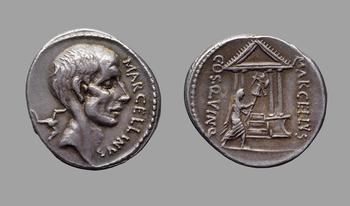
In the end, these narratological worries are of little consequence, as the clear target of the lessons that are laid out in the priamel is Aeneas. He is the one who needs to hear them, whether they are addressed to him directly or not. But it is with these narratological worries in mind that I would like now to follow Anchises' lead and actually ‘look at’ Marcellus, just as Anchises orders Aeneas to do (aspice), in order to see what Anchises would have him see. A precise visual analogue to Anchises' description in words can be found on a denarius of 50 b.c.e., issued by the moneyer, Publius Cornelius Lentulus Marcellinus (Fig. 1).
Denarius of 50 b.c.e. Obverse: portrait of Marcus Claudius Marcellus. Reverse: a scene from 222 b.c.e. showing Marcellus dedicating the spolia opima taken from Viridomarus, at the temple of Jupiter Feretrius. Scale 3:1. (Image courtesy of the Yale University Art Gallery, ©)

On the obverse one sees the gaunt and dead-serious imago of the elder Marcellus, and on the reverse he is pictured in action, playing upon his near-unique association with Romulus by dedicating the spolia opima in the temple of Jupiter Feretrius.Footnote 37 This denarius, lauding Marcus Claudius Marcellus as ‘five-times consul’ (cos quinque), was issued during the consulship of Gaius Claudius Marcellus, husband of Octavia and (as of 42 b.c.e., eight years after the coin's issue) father of Marcus, the younger Marcellus. In his recent book From Republic to Empire, John Pollini uses this particular coin type to illustrate the idea that ‘in the late Republic it became common to represent ancestors on coins, with naturalistic images in all likelihood based on a wax ancestral mask or sculpted portrait’.Footnote 38 The image on the coin makes clear that what Anchises is urging Aeneas to look at, in illustration of his ‘leave the Greeks to their fine arts' thesis, is a particular, highly legible version of the great man that many in Virgil's audience would have known from various media: statues, signet-rings and coins, certainly, but also from the recent revivification of the elder Marcellus as a stand-out member of the ghostly parade at the younger Marcellus' funeral. Harriet Flower has recently argued concerning the image on the coin that ‘it is possible that the iconography of Marcellus in front of the temple of Jupiter Feretrius was derived from another, much larger work of art, such as a painting’.Footnote 39 It is a near certainty that the man was later monumentalized in exactly this pose, carrying the trophy of his enemy's arms, within the gallery of Roman heroes of the Forum of Augustus.Footnote 40
That is how the elder Marcellus was known ‘iconically’ to Virgil's audience: as the third and last Roman since Romulus to cut down an enemy commander in single combat, and strip him of his gear. It is in that pose that the elder Marcellus gets spotted as the parade's brightly-lit dénouement, and Anchises apparently intends him, captured in that exact pose, as the last and decisive imago that he needs Aeneas to see.Footnote 41 But then the boy comes into view, leaving much more to be said. Given what we know of the Aeneid and its incessant habits of patterning and prolepsis, one sees why Anchises (which is to say Virgil) might want to end the parade exactly where he attempts to end it, with the elder Marcellus bearing the spolia opima. That image puts us in mind of the heartless (or is it pious, necessary, and selfless?) last imperializing act of the epic itself. Taken as Anchises intends it, as the last crucial lesson that he must have his boy learn before sending him back to the world above, one sees why Anchises needs to end on a Marcellan note. For the epic to end, and the empire to begin, Aeneas must find himself in the last image that Anchises points out. He needs to plunge his sword into the fallen Turnus, and strip him of his arms. In fact, there were not just two Romans before Marcellus to kill enemy commanders in battle and strip them of their gear, there were three: Romulus, Cossus, and Aeneas. But that only works if you count Aeneas not as a Trojan, but a Roman, and Turnus as a foreign enemy, and thus not a (proto-)Roman.Footnote 42 Clearly much more could be said here about a dead young boy's suddenly coming into view both at the end of the parade (the younger Marcellus in the shadow of his spoil-laden ancestor) and at the poem's end (Pallas remembered via the spoils worn by Turnus), but a fuller study of that corresponsion (Pallas as Marcellus) will have to wait for another time. More on the younger Marcellus will follow below.
To this point the focus has been on taking Marcellus exactly as Anchises would have us take him: as an oak-hewn icon of selfless military virtus, parading the spoils of an enemy combatant. But there were other sides to the man, aspects of his public character and achievements that the picture we are given to see leaves unrendered and unspoken. As Harriet Flower has brilliantly shown, the positive traditions that gathered up around the figure of Marcellus were offset by equally strong negative traditions that sought to denigrate his achievements and destroy his fame. The existence of such wildly divergent versions of the same man, she shows, ‘reflect[s] differing cultural and political concerns of later generations as they reassessed the past for their own political purposes'.Footnote 43 By taking these alternate traditions into account, we will see that there is much about Marcellus that does not lend itself to teaching the rigid Roman lessons that Anchises uses him to teach. In fact, as Mary Jaeger has pointed out, much of what Marcellus came to represent in the culture wars of the second and first centuries b.c.e. speaks directly against the lessons that Anchises is trying to teach with him, countering those lessons in no uncertain way.Footnote 44 One notes, for example, that the emphasis in the monumentum illustre pointed to by Anchises rests entirely on Clastidium, and that he says nothing about Marcellus' other, perhaps even his most famous, military exploit,Footnote 45 as the conqueror of Syracuse in 212 b.c.e., a feat that was lavishly celebrated in 211 by an ‘Alban’ triumph and ovatio in the city of Rome.Footnote 46
Ancient sources are powerfully divided over this Marcellus. Fabius Pictor, Rome's first historian, seems to have taken the side of his relative Cunctator, and that of the Scipiones, to the disadvantage of Marcellus in his late third- or early second-century history of Rome.Footnote 47 Early in the second century the elder Cato attacked Marcellus mercilessly for the rapacity of his sack of Syracuse, while at the same time Ennius seems to have featured him in a positive way in his Annales. Footnote 48 Slightly later, and here we finally have some firm ground to stand on, Polybius took special pains to denigrate Marcellus at every turn, as did Coelius Antipater, the late second-century annalist who found Marcellus irresponsible and prone to recklessness even in the act of handing Hannibal his first significant defeat, at Nola in 215 b.c.e.Footnote 49 But Marcellus comes off quite well in Livy and Plutarch especially, though both of these later writers acknowledge that the man was a source of much controversy in his own day as well as in theirs.Footnote 50 Other writers who took a special interest in Marcellus include Posidonius, Valerius Maximus, and even (if Plutarch can be believed) Augustus himself.Footnote 51
Nearer the tail-end of a centuries-long tradition of Marcellus analysis, in the first paragraph of his biography of Marcellus Plutarch offers a picture of the man that is roughly analogous to, and in certain ways uncannily reminiscent of, the one promoted by Anchises in Aeneid 6. But the picture darkens considerably as Plutarch goes on to explain that Romans faulted Marcellus not only for despoiling Syracuse of its treasures, and parading statues of the gods ‘like captives’ in his triumph, but for introducing a simple people ‘accustomed only to war or agriculture’ to the fine arts, so that they became ‘idle and full of glib talk about arts and artists’. Instead of taking offence at such censure, Plutarch says, ‘Marcellus spoke of this with pride even to the Greeks, declaring that he had taught the ignorant Romans to admire and honour the wonderful and beautiful productions of Greece’ (Plut., Marc. 19.3–5, trans. Perrin (1917)). The problem that this raises for Anchises' exemplification of his excudent alii lesson via Marcellus is obvious: in another telling, pointed to as the art-mad despoiler of Syracuse in 212 b.c.e. rather than the killer of Viridomarus in 222, Marcellus goes from being the very best illustration of Anchises' ‘leave gorgeous statuary to the Greeks’ lesson to being arguably the worst illustration of the very same lesson. All depends on which side of the culture war you choose to see him from, and how far down into the man's career you are willing to go.
Much of the hostility that we see ‘quoted’ from anonymous others by Plutarch in the passage cited above (in what is otherwise a very positive account) is likely to have been there, and in a very big way, already in Fabius Pictor.Footnote 52 The battle lines over his legacy were drawn and fought over already in Marcellus' own lifetime. In the early second century b.c.e. the elder Cato loudly opposed Marcellus' introduction of statues from Syracuse as a menace to the state,Footnote 53 and by the mid-second century we see ample anti-Marcellus sentiment larded into the pages of Polybius. As Harriet Flower has pointed out: ‘[Polybius] does not ignore Marcellus but systematically denigrates his achievements, and does so both in the narrative he constructs and in the editorial/authorial comments he makes.'Footnote 54 Already in Polybius, the case against Marcellus centres primarily on his unrestrained depredations of some of the city's most legendary works of art.Footnote 55 And yet there was another event that took place during the sack of Syracuse that quickly (quoting Jaeger) ‘became a focal point of Roman shame and regret’.Footnote 56 Namely, the thoughtless killing of Archimedes, a bumblingly wonderful old scholar who, in the chaos of the city's last day, was burst in upon by violent, muscle-bound Roman soldiers while drawing geometrical diagrams in the dust with his radius. Sources are divided over the extent to which Marcellus should be blamed for his death, but it is clear that he came in for much criticism on this point already in his own day. Later sources are fairly even-handed: none makes Marcellus directly responsible for the death of Syracuse's most famous citizen, by that time an international treasure, esteemed by all men of learning for his studies of geometry and astronomy. And yet, as Mary Jaeger has pointed out, they expend extraordinary effort in attempting to absolve Marcellus from responsibility for Archimedes' death. Whether responsible or not, the special relevance of the elder Marcellus to the specific lessons that Anchises teaches is easy to make out: mapping the heavens with pointers and predicting the rising of the constellations by mathematical means is precisely the territory of Greek paideia over which Archimedes presided as a living legend. Until Marcellus came along. The historians would have us believe that Archimedes was happened upon working out problems in the dust when he was killed by Marcellus' soldiers.Footnote 57 So again, as we look to Marcellus — not the icon, but the embattled and much talked about public figure — for the specific lesson that Anchises wants to teach with him, what do we actually see? The man who thoughtlessly war-mongered his way through Syracuse, crushing whatever human treasures stood in his way? Or do we see the man who took special pains to save Archimedes, but failed to do so, then wept when reminded of his demise and personally saw to his burial?Footnote 58 According to the account given by Philus near the beginning of Cicero's de Republica, from the huge spoils that he hauled off from Syracuse (‘ex tanta praeda domum suam deportavisset’, de Rep. 1.21), Marcellus kept just one precious artifact for himself: a spherical globe of the heavens, made by Archimedes' own hand.
The same ancient sources who tell of Archimedes' senseless death, figuring him as helpless and hopelessly impractical, all agree that his geometrical and mathematical skills played a huge rôle in repelling the Roman assault and delaying the city's fall. Archimedes, they say, was responsible for the design and construction of numerous deadly war machines, such as long-range catapults and machines that grappled Roman ships and lifted them from the water.Footnote 59 Livy famously begins his account of the siege of Syracuse by saying that ‘the first assault would have met with success, had not one man been there in Syracuse at the time: Archimedes, who was unrivalled as an observer of the heavenly constellations, and yet he was also an amazing inventor and maker of machines of war’.Footnote 60 Livy, who comes close to ad verbum translation of Polybius in these lines, is amazed that the mild-mannered mathematician should have been able to repel the Roman attack and mastermind the destruction of so many ships.Footnote 61 After suffering huge losses in the initial assault, Marcellus decided to blockade the city and starve it into submission. Having set the blockade, he departed to attack other parts of Sicily that had thrown in with the Carthaginians.
For his part, and quite unlike Livy, Polybius is not amazed by the fact that Archimedes' mathematical studies turned out to have such lethal, real-world applications. When he resumes his account of the sack of Syracuse at 8.37 (after a lacuna), the first thing that Polybius gives his reader to see is Marcellus standing outside the walls that had defied him earlier in the same year, doing a mathematical calculation: he has just ‘counted the courses of masonry (Ἐξηριθμήσατο τοὺς δόμους)’ on a vulnerable spot along the wall in order to calculate the exact distance from the ground to the battlements on top. Then, Polybius continues, Marcellus has ladders built for exactly the height needed to scale the wall. He then works out the perfect moment for launching the assault, under the cover of night, in the aftermath of a festival of Artemis that leaves the Syracusans underfed and passed out from excessive drinking, something that Marcellus had anticipated. He sends a small party ahead with two ladders custom-made to scale the walls (Polybius mentions these ladders five times in the space of a page and a half). Other Roman soldiers follow. They take the battlements and towers, then descend down to the Hexapyli unnoticed; the gates are opened, Romans pour through them, and the rest, as they say, is history (except that here it is not history, because Polybius' account breaks off right at this point).
Why does Polybius put so much emphasis on the ladders, and the calculation of their exact height? To make that calculation Marcellus cannot have just ‘counted the courses of masonry’ (the Greek quoted above) in order to make ladders of the correct size. A section is missing from the end of this first paragraph, and in that missing section Polybius surely had to point out that, in order to get the size of the ladders right, Marcellus had to imagine them leaning against a wall so as to form a triangle. The height of the ladders had to be taller than the height of the wall by just so much, and to determine exactly by how much, he had to do some very basic geometrical calculation using what we now know as the Pythagorean theorem. Putting emphasis where it does, Polybius' account is all about Marcellus adapting to the mathematical expertise of Archimedes, in order to defeat Archimedes. It is a practical illustration of a lesson that Polybius will develop at great length in the very next book, where in section 19 he insists that the arts of a successful general must include mastery of the basics of astronomy, not only for properly timing battles, but for understanding that eclipses are natural phenomena, not portents sent from the gods; and geometry, where again the emphasis is on getting siege ladders made of exactly the right height. He gives several examples of foolish generals of the past who lost battles precisely because they did not know the basics of astronomy and geometry that could have helped them win.Footnote 62
It is in this one facet of his sack of Syracuse that Polybius, otherwise hostile to the man, seems to give Marcellus rare full credit. And the basic lesson he teaches with Marcellus is obvious: he took the city not by pounding it with Roman muscle, but by carefully calculating the best way to infiltrate and unleash that muscle after having been put to shame by Archimedes in the initial assault. In Polybius' telling, Marcellus became Archimedes in order to defeat him, imbibing just enough of Archimedes' own paideia to tilt the balance towards the Roman side. The tale is perhaps as tall as the ladders that it builds, but it makes clear just how fully loaded and malleable Marcellus was as a symbol to fight with in the culture wars of the second century and beyond.
IV ON REDUCING MEN INTO MONUMENTS
In Book 11 of the Odyssey, having been instructed by Circe, the epic's wandering hero makes his way to the underworld to see Teiresias, who gives him information crucial to his finding, and taking back, his home. In Book 6 of the Aeneid, having been instructed by Helenus, Aeneas makes his way to Hades to see Anchises, who tells him that he has a home to fight for in Italy, and that the fight for that home will be much bigger than he realizes, carried forward by his descendants beyond the borders of any world that he knows. Odyssean memories provide basic coordinates, even as they are radically departed from and remade.Footnote 63 At times these memories of Odysseus' nostos are subsumed by other memories that provide new structures for readers to orient themselves by within an ever-changing, yet always strangely familiar, landscape. Odysseus' visit to the underworld in Odyssey 11, the teichoscopia of Iliad 3, Plato's Myth of Er, and its Ciceronian counterpart in the ‘Dream of Scipio’ (de Republica 6) are among the more obvious and better studied of literary memories that pop into view in the Heldenschau, helping readers thread their way along.Footnote 64 But along that path these memories are encountered not merely as patterns and points of interest that have been met up with before in books, but as memories radically re-imagined both ‘by’ and ‘as’ the cultural traditions of Rome: the Roman aristocratic funeral, republican hero galleries and atria with their tituli and elogia, the Roman triumph, the censor's recognitio equitum, and so on.Footnote 65 Perhaps more so than anywhere else in the Aeneid, in the Heldenschau of Book 6, Roman cultural structures are worked into patterns remembered from books, and book memories are made over as cultural practice.
Anchises' Marcellus, we have seen, is not every Roman's Marcellus. He is the man that Anchises needs Aeneas to see, rendered as an icon, an instrument of culture, for the promotion of certain values. But the specific values that this ‘instrumentalized’ Marcellus is tasked with illustrating rustle with memories from late in his career that run directly counter to the imago offered by Anchises. These memories, we have seen, bring to mind versions of the man that featured him promoting exactly those frivolous, non-Roman things that Anchises uses him to urge ‘remembering’ Romans to eschew. As Mary Jaeger, the one scholar to have noted and probed into these ironies, has shown, even the one item on Anchises' list that bears no obvious Marcellan stamp (i.e. technical expertise in pleading court cases) has strong associations with Syracuse.Footnote 66 For it was in Syracuse that Corax and/or Tisias devised the first handbook(s) on the ‘Art of Rhetoric’ (ἡ τέχνη λόγων), and it was from Sicily that these arts made their way to Athens, where they were much deplored by later moralists, such as Plato.Footnote 67 Among the several ironies produced by Marcellus' failure to neatly match up to his exemplary purpose, there is a dramatic irony that finds viewers/readers of Anchises' hero tour knowing important things that Aeneas himself does not (on which, more below). But there is another conjoined irony that finds readers being made aware of how partial, ideologically angled, and untrue to life the shown version of the man is.Footnote 68 This latter (‘Romantic’) irony is perhaps the more provocative, precisely because there is nothing particularly noteworthy about Marcellus' having been radically reduced and spiffed up for public view. The same might be said of all the monumenta illustria that Anchises has given his son to see, just as it might be said of their many counterparts in marble and bronze decorating the various public and private hero galleries of Rome, such as (somewhat later, but rightly considered relevant) the Forum of Augustus. For without such radical reductions of men into monuments emblazoned with ‘expertly reticent’ elogia, Romans would have no monumenta to put on display.Footnote 69 The Marcellus of the Heldenschau has had the greater part of himself pared away as so much un-cooperative human scree. But some of the most colourful of his unsuitable bits have been left to hide in plain sight by Virgil, touched on by the provocative ‘Marcellan’ associations of the excudent alii priamel. But why leave them there to be noticed, or passed over?Footnote 70 There are many ways one could go with this, but I prefer to think that the ironies inherent in these lines, if picked up on, invite readers of the Heldenschau to look into themselves as consumers of, and revellers in, Anchises' blatantly patriotic tour of Rome's rise to greatness. In the tension that holds between what is shown of Marcellus by Anchises and what was known of him from multiple other tellings, (we)/Virgil's Roman readers must come face to face with (our)/their own penchant for telling, and wanting to be told, and to buy into, useful lies: lies of omission and creative un-remembering, told for the sake of making instruments of culture (Roman ‘monuments’) out of mere Roman men.
Often in Virgil, it is the tail-end of a scene of extended viewing where especially eye-catching and sorrowful things suddenly come into view: Penthesileia, for example, spotted still fighting at the end of the temple ecphrasis in Book 1; Camilla astride her horse at the parade's end that concludes Book 7; the belt of Pallas spotted in the epic's last lines. The sudden, sad appearance of the younger Marcellus at the end of the Heldenschau hews to the same general patternFootnote 71 (a pattern that derives ultimately from HomerFootnote 72 ), but its closest counterpart in the Aeneid is the scene of extended gazing to which the Heldenschau serves as a bookend at the close of the same book. On the doors of Apollo's temple, Daedalus has carved his own most glorious achievements: Pasiphaë’s cow, the labyrinth cleverly threaded, and so on, contrivances of high Greek ars/τέχνη, utterly unlike the stiff, empire-inspiring imagines studied at the book's end. Anyone reading that story, panel by panel, would have to be amazed by the hero's achievements, just as Aeneas clearly is. But that same reader, again like Aeneas, would also be left completely in the dark about what happens to be the one most famous episode of Daedalus' legend: the death of Icarus by means of the most magnificent of the artist's many contrivances, i.e. the wings that he devised for his escape from Crete, and that he fixed as wings of victory, and symbols of vows fulfilled, inside the temple at Cumae. It turns out that this, his life's greatest achievement, is also his biggest failure and cause of regret, and a story much too sad for him to tell. And thus, what he carves on the temple doors, as a public spectacle of his life, is a partial truth: a hero story neatly set off in panels, all about Daedalus' clever adventures in monster making (the cow), monster trapping (the labyrinth), and monster killing (not Ariadne's thread, but his, and with no sign of Theseus anywhere in sight).Footnote 73 It is a story where his inventions save young boys and girls from being killed, and do not kill them; where that sort of devastating pathos is encountered at the story's beginning (‘septena … corpora natorum’, ll. 21–2), as something gotten away from, thanks to our hero, rather than at its end. And yet, considering that it is so untrue to the whole of his real life, the story that Daedalus carves ends up being unusually clunky for the work of a master artist. By writing it the way he does, leaving the last panel uncarved, he has deliberately chosen not to supply the final, master touch that would have given the work a neatly balanced, interlocking chiastic structure (A/B/main verb/b/a)Footnote 74 that one might expect of a story crafted by someone of his calibre: (A) dead children; (B) hero undertakes to save children; (main verb) the monster is slain; (b) hero undertakes to save child; (a) dead child.Footnote 75 As a decision taken by the world's greatest artist, the choice to leave Icarus uncarved stands out as deliberately ruinous, like a slash running through a masterwork, inflicted by the artist's own hand. The ideal opportunity for achieving a perfect harmonization of art with the artist's own real life has been skipped over by Daedalus, left as a panel that he refuses to finish on the monument of his life's greatest works.
Monuments do not remember, they ‘warn’ and ‘remind’.Footnote 76 By definition, they are cues to memory, and not the thing itself. As such, they do not ‘keep’ memories as so many things collected and held in store. Recent studies of memory in Virgil have not only explored how the Aeneid crafts a new collective historical monument for Rome (looking especially at what gets played up, forgotten, and/or repressed in the process of monumentalization), but they have also shown how remembering is itself an act of construction: not a matter of calling up facts and experiences from the past (mere ‘recall’ of stockpiled items), but an active process of reshaping the past and imposing fresh interpretations on those facts and experiences; a process more about doing (selecting, forgetting, re-interpreting, re-narrativizing) than receiving.Footnote 77 In other words, it is not just the monuments' artisans, such as Daedalus and Anchises, who create in the crafting of cultural reminders, but those who engage with their works are equally creative in the memories they make from those reminders.
Perhaps the best example of the personally constructivist nature of ‘remembering’ in the Aeneid is to be found early on in the poem, when Aeneas scans the temple frieze at Carthage (Aen. 1.453–93). There Aeneas sees the war that destroyed his life painted as a strictly sequential narrative (ex ordine, l. 456), but he does not work through the events depicted in the order in which they are laid out. Instead he picks out whatever details happen to catch his eye: an elderly king threatened by brutish violence on all sides; Greeks slaughtering men in their sleep, ambushing and killing mere children, terrifying pious Trojan women, and selling princely corpses to devastated relatives in return for piles of gold. Aeneas sees no heroism here, only Greek bloodthirstiness, greed, and brutality. As Alessandro Schiesaro has recently argued, in a brilliant reading of this scene as a study in the workings of memory, Aeneas is not (just) reading a story, he is telling one, using the images of the frieze as a series of ‘passive props for an active re-enactment’ of his past.Footnote 78 What we end up with, then, is a version of Troy's fall that is profoundly shaped by the viewer's emotional state, told as a tragic tale where men who are otherwise the greatest of Greek heroes have nothing heroic about them. Instead they are devious killers and violent marauders, not because that is how they are represented on the frieze, but because that is the way that Aeneas remembers them. That is, in fact, what he sees, and his way of ‘seeing’ his past in the ecphrasis in Book 1 becomes his way of ‘telling’ the story of Troy's fall in Book 2, as a crime pulled off by bloodthirsty liars who butcher children and relish the slaughter of helpless old men.
Aeneas engages with the frieze as a monument to Trojan sorrow (sunt lacrimae rerum, l. 462), but that has little if anything to do with the purposes of the frieze, or with what the artists can reasonably be presumed to have intended. This is Juno's temple, after all. The fall of Troy is her greatest triumph. That is why Troy's destruction is pictured on the temple wall: not because the Carthaginians somehow feel compelled to remind viewers of the sorrows of Juno's greatest enemy, but because they want to celebrate Juno's magnificent powers in crushing them. The bloodier the representation the better. But Aeneas sees none of that. In fact, his failure to pick out a single god in the course of his sorrowful and disgusted reading of the frieze is one of the scene's most remarkable features — and yet, to my knowledge, no scholar has ever raised this issue as a problem worth pondering. How can a frieze relating the events of Homer's Iliad not have gods here and there at least, if not depicted in nearly every scene, looking down from Olympus, coaching heroes, and fighting battles? How can Juno not have been depicted on her own temple frieze as the central, and most eye-catching, figure of all? Gods must have been everywhere on this frieze, and yet they are nowhere in sight. Their absence, I suggest, is less a matter of Carthaginian (Semitic) artisans refusing to represent the divine than it is a matter of how Aeneas engages with the frieze from his own angry, and deeply traumatized, perspective. From that perspective he can see no gods orchestrating Troy's destruction. He sees only a cruel and utterly ‘godless’ mistake, no matter how many gods he may actually see before him on the frieze itself. Their absence from (his relating of) the temple ecphrasis of Book 1 becomes all the more pronounced when one considers how absurdly ‘theomachic’ and god-driven the depiction of Actium is on Aeneas' shield in Book 8.Footnote 79 In poring over the details of the shield, Aeneas sees gods brightly pictured at the centre of the work's central scene, dominating a battle that many Romans remembered from their own lived experience. None of the combatants who fought at Actium (one suspects) could recall seeing massively large gods, anthropomorphic, dog-headed, or otherwise, clashing on either side. For those who fought the battle, it was all just the ugly mess of war. Obviously the change from Book 1 to Book 8 in Aeneas' way of seeing things is drastic, and deserves much more study than I can devote to it here. It may have something to do with Vulcan's choice to depict future events in a (Homeric) mode that puts gods front and centre. But it may also have to do with changes in Aeneas himself, or with the shield's being for him not a reminder of past experiences (a monumentum), but a scene pointing to a future (Virgil's own recent past) that Aeneas cannot begin to comprehend. This time there is no Anchises on hand to steer his vision and interpret what he sees.
I say all of this about the complex ways of crafting monuments, and making memories from them, because all that I have said about the Aeneid’s inset artisans, and the inset readers who interpret their works, might be said about the craftwork of Virgil himself, as a maker of the Aeneid, and the rôle that readers play in taking up with the work's ‘reminders’ and converting them into ‘memories’ of many (often radically opposed) kinds. As we have seen, the elder Marcellus, as Anchises gives Aeneas to see him, is a product of Anchises' own handicraft: an icon of values heavily struck, so as to be rugged, unchallengeable, and unyielding. Wanting to end on a high (Ennian/triumphal) note, Anchises steers his son's gaze towards the dazzling glare of a Roman empire-builder parading his enemy's spoils.Footnote 80 But what Aeneas catches sight of, and makes his father explain to him, is the curiously downcast figure at the dazzling man's side, so easily lost in the glare of his halo. Like his artisan counterpart in Daedalus, Anchises chose to leave the dead boy unrendered, thinking that his was a tale too sad to tell, and no suitable way to end the kind of story that he was trying to tell. The sudden appearance of the younger Marcellus is that last master stroke that Daedalus could not bring himself to provide; an unexpected, sorrowful coda that defies being made sense of as the handicraft of Providence, and the end to which everything leads. Like a baleful star rising at the parade's end, the younger Marcellus points to what lies ahead for Aeneas, and for the poem's darkly disorienting end: to those beautiful young men that Aeneas will sadly see killed, and to those other beautiful young men that he will see to killing, and to stripping of their spoils. Looked back upon from its last scene, from the place where Anchises has the least control of it, the Heldenschau seems much less certain in the sense it makes, and in the values it puts on display. The sudden appearance of the younger Marcellus lets us know that things ‘inconvenient’ to the story have been left out, and that other versions of Rome's story might be constructed from things that have been helpfully kept from our view.Footnote 81 For his part, the elder Marcellus shows traces of having been ‘willed into convenience’ for the sake of the story that he is needed to tell. In both cases, the stories of the Marcelli are told in ways that call attention to the repairs and helpful elisions that have gone into their figuration as heroes. In telling their stories the way he tells them, Virgil lets us in on a dirty secret: that Roman heroes are ‘made’ rather than just ‘are’. That says something about the way Virgil writes, certainly, but more importantly it touches on the work that readers must do to authorize Virgil's (or any other author's) ‘parade of heroes’ as heroic. In any such parade, the work of spotting ‘heroes’, and of assigning values to their achievements, falls to readers, whether that is fully in keeping with, or in spite of, whatever the writer writes, and whatever guidance he (or any inset guide, such as Anchises) provides.Footnote 82 How that authoring/authorizing work is performed, and thus the sense that is made of the parade, will depend largely upon where we/Roman readers fix our sights, and from atop whose tumulus we choose to view the parade. In the end, that is where meanings happen, where values are assigned, and ‘heroic’ epics are written: what one viewer goggles at as an underworld Heldenschau rising gloriously into the light, another looks upon as the hell that Rome will unleash (because it did unleash it) on the world.