Implications
This study attempts to be of practical value for the transport of suckling lambs, considering animal welfare of lambs as well as the economical aspects of improving meat quality and reducing costs of transport. European Union establishes a minimum space allowance per head of 0.20 m2 for lambs over 26 kg of live weight, but operators can reduce this minimum without any regulation in small lambs. The results of this study show that stocking density could be reduced up to 0.12 m2/head to transport suckling lambs weighting 14 kg, showing no negative effects on the stress response and meat quality. More research in this field should be carried out to define minimum space requirements for suckling lambs during transport.
Introduction
Suckling lamb is a traditional food product of the Mediterranean area. Lambs are produced from traditional milk breeds and are slaughtered usually 30 to 45 days after birth. The final phase in the production chain of suckling lamb is transport to the slaughterhouse.
The transport and associated handling of lambs not only includes physical stress but also emotional stress caused by loading and unloading, noise, vibration and social disruption. These stressors can have adverse effects on animal welfare (Hails, Reference Hails1978). Transport results in stress and muscular fatigue, which are typically quantified through a variety of physiological parameters such as heart rate, adrenaline, cortisol, creatine kinase (CK), lactate dehydrogenase (LDH) or behavioural anomalies (Broom et al., Reference Broom, Goode, Hall, Lloyd and Parrott1996). Bórnez et al. (Reference Bórnez, Linares and Vergara2009) have shown that transport increases adrenaline, glucose and CK levels in light lambs. In addition, transport can result in mortality, carcass damage and deterioration of meat quality producing major economic losses. The stress produced by pre-slaughter transport and handling may cause depletion of muscle glycogen resulting in elevated pH in meat post mortem (Warriss, Reference Warriss1990). Meat with a high ultimate pH (24 to 48 h post mortem) is typically referred to as DFD (dark, firm and dry) meat. DFD meat is unattractive to consumers due to its dark colour and dry appearance and is more susceptible to bacterial deterioration. Numerous authors have demonstrated the effect of transportation and animal handling at the slaughterhouse on various parameters of meat quality (Warriss et al., Reference Warriss, Kesting, Young, Bevins and Bevins1990; Ruiz de la Torre et al., Reference Ruiz de la Torre, Velarde, Manteca, Diestre, Gispert, Hall and Broom2001).
Current animal welfare regulations set strict rules on transport conditions for most animals, but they are vague regarding suckling animals. Thus, Council Regulation (EC) N° 1/2005 does not define parameters such as stocking density for this kind of animal. This regulation indicates that for small lambs, an area of <0.2 m2/animal may be provided. A report by the Scientific Committee on Animal Health and Animal Welfare (SCAHAW) proposed that the space allowance for lambs with a 10 to 14 kg live weight (suckling lambs) should be 0.11 to 0.14 m2/animal on journeys <4 h, and 0.14 to 0.18 m2/animal for journeys of 4 to 12 h (SCAHAW, 2002).
Stocking density during transport is one of the most important factors influencing welfare (Hall and Bradshaw, Reference Hall and Bradshaw1998). High stocking density does not allow animals to lie down comfortably and can negatively affect animal welfare (Knowles et al., Reference Knowles, Brown, Warriss, Phillips, Dolan, Hunt, Ford, Edwards and Watkins1995). However, when animals travel at low stocking density, they can lie down and move, but their welfare may still be at risk if driving techniques are poor (Grandin and Gallo, Reference Grandin and Gallo2003). Stocking density is an economical important point, because reducing space can reduce costs of transport. In general, smaller space allowances lead to lower unit costs of transport since more animals can be carried in the vehicle (SCAHAW, 2002). Transport time has also been considered one of the critical points affecting animal welfare during transport to the slaughterhouse (Hall and Bradshaw, Reference Hall and Bradshaw1998). There are few studies on the response of young lambs to transport by road. In Spain, this topic is particularly important as around 25% of slaughtered lambs are suckling lambs. In Spain, suckling lambs are produced on dairy sheep farms and are usually slaughtered in an abattoir close to the farm; therefore, they undergo short journeys. However, at certain times of the year, December (Christmas), March and April (Easter) the demand for this product increases, which means lambs come from farms further away and are transported even more than 8 h, from France, Italy, Portugal, etc.
The aim of this study is to evaluate the effects of transport time (short transport (30 min) and longer (5 h)) and stocking density (0.12, 0.20 and 0.25 m2/lamb) on blood parameters and meat quality in the commercial transport of suckling lambs to the slaughterhouse. Two of the stocking densities used (0.12 and 0.20 m2/lamb) reflect the European Union (EU) and SCAHAW recommendations described above, and a lower stocking density (0.25 m2/lamb) was studied to evaluate possible improvements to animal welfare.
Material and methods
Experimental design
Seventy-two male suckling Assaf lambs with a live weight between 12 and 14 kg were used in the experiment. Lambs were raised exclusively on milk from their dams. Two days before slaughter, lambs were individually weighed (farm live weight, FLW). After weighing, trained personnel collected blood samples from the jugular vein in order to determine the pre-transport blood parameter levels (initial). The process lasted approximately 1 min for each animal and all efforts were made to avoid excessive stress. Lambs were randomly assigned to transport groups. Animals were with their dams until they were loaded into an experimental lorry for transportation by road to the commercial slaughterhouse.
Four journeys were carried out, two lasting 30 min and two 5 h. The trials were performed during four consecutive weeks in March to April, rotating short and long transport durations. In each transport, lambs were distributed at random in three stocking densities (0.12, 0.20 and 0.25 m2/lamb; 6 lambs per stocking density). In each transport, the stocking densities were distributed in front, middle and rear on the left side of the lorry in the lower floor. In order to minimize the effect of location in the truck, the position of the three stocking densities were different for both journeys for the same transport time. Thus, in the journeys of 30 min, the positions were 0.12, 0.20 and 0.25 m2/lamb for front, middle and rear locations, respectively, in the first journey and in the second one were 0.25, 0.12 and 0.20 m2/lamb for front, middle and rear locations, respectively. In the journeys of 5 h, the position in the first trip were 0.20, 0.25 and 0.12 m2/lamb for front, middle and rear locations, respectively, and in the second were 0.25, 0.20 and 0.12 m2/lamb for front, middle and rear locations, respectively. Lambs were individually loading into the lorry early in the morning at an environmental temperature of 10°C to 12°C.
The transport vehicle (three-wheeler rigid chassis) had three floors. Vents for natural ventilation were located alongside the full length of the truck body on both sides and on each floor.
Slaughter procedures
After transport, lambs were unloaded and blood samples were taken again (final) from the jugular vein by trained personnel. Lambs were then weighed in order to obtain the slaughter live weight (SLW). Subsequently, animals were electrically stunned while being held individually in a restrainer and slaughtered by severing the carotid arteries and jugular veins. After slaughter and dressing, hot carcass (HCW), liver and spleen weights were recorded. Immediately, pH was measured (pH 0 h) using a penetrating electrode adapted to a portable pH meter (HI 9025, Hanna Instruments, S.L., Gipuzkoa, Spain) on different muscles: Musculus longisimus thoracis et lumborum (L) between 13th thoracic and first lumbar vertebrae, Musculus semitendinosus (ST) and Musculus psoas major (PM). pH was recorded at 45 min, 3 h and 24 h after slaughter. Carcasses were stored at 4°C for 24 h and the cold carcass weights (CCWs) were recorded to calculate dressing percentage (CCW/SW × 100) and chilling losses ((HCW − CCW)/HCW × 100).
Blood sample analyses
Blood samples were collected in tubes containing EDTA (ethylene diaminotetraacetic acid) and refrigerated until centrifugation (within 2 h collection) in order to separate the plasma. Plasma was stored in 1.5 ml Eppendorf tubes at −20°C until analysis. The determination of total cortisol was carried out by enzyme immunoassay (Radim, S.p.A., Roma, Italy). This method is 100% specific to cortisol and showed 1.2% of cross-reactions with cortisone and 1.1% with corticosterone. The intra-assay precision was <0.07 for cortisol concentrations between 0.5 and 150 ng/ml. Levels of CK and LDH were measured on a Roche/Hitachi 717 Chemistry Analyzer (Roche diagnostics GmbH, Mannheim, Germany), using Boehringer Mannhein reagents.
Meat quality evaluation
At 24-h post mortem, M. longissimus was excised from both sides of the carcasses. The left side was used for initial meat quality analyses, and the right side was placed on styrofoam trays, overwrapped using an oxygen-permeable polyvinyl chloride film and aged for 5 days at 4°C. All parameters were measured in non-aged and aged meat. The samples used for the measurement of cooking loss and texture were vacuum-packed and frozen at −20°C until analysis.
CIE L*a*b* colour was measured after 1 h blooming by a Minolta CM 2600d reflectometer-colorimeter (I.T.A. Aquateknica, S.A. Valencia, Spain) (illuminant: D65; visual angle: 10°). The colour coordinates were expressed as L* (lightness), a* (redness) and b* (yellowness). Chroma (C*) and hue-angle (h*) values were calculated as C* = (a*2 + b*2)1/2 and h* = tan−1 (b*/a*), respectively.
Water-holding capacity (WHC) was measured as pressure loss, expressed as the percentage of expelled juice after compression, using the Grau and Hamm method (Grau and Hamm, Reference Grau and Hamm1953) and cooking loss expressed as the percentage of loss related to the initial weight (Cañeque and Sañudo, Reference Cañeque and Sañudo2001). A piece of meat around 30 g was cooked for 30 min in a water bath maintained at 75°C; previously, samples were thawed at 4°C for 24 h in their bags.
Texture analyses were performed on cooked meat samples (as described above) using the Texture Analyser Mod. TA.XT2 (Stable Micro Systems, Ltd, Surrey, UK) equipped with a Warner-Brazler (WB) blade. Samples (1×1 cm in cross-section) were cut parallel to the muscle fibre direction. The parameters measured were maximum shear force (kg/cm2) and shear firmness (kg/s cm2).
Lipid oxidation was determined by thiobarbituric acid-reactive substance (TBARS) value according to the 2-thiobarbituric acid method of Maraschiello et al. (Reference Maraschiello, Sarraga and García Regueiro1999). Results are the averages of two determinations for each sample and are expressed as milligram malonaldehyde per kilogram muscle (mg MDA/kg).
Statistical analyses
Data were statistically analysed using the GLM procedure of the SAS/STAT (2003). The model included the effects of transport time (short transport, 30 min and long transport, 5 h) and stocking density (0.12, 0.20 and 0.25 m2/lamb) and their interactions. Day of transport was included in the model and removed because it was not significant. Results are presented for each main factor (transport time and stocking density) as interaction between transport time and stocking density was not significant except for pressure loss. SLW was included in the model as a covariate and was only significant for carcass quality measures. If the effect of stocking density was significant, the three stocking densities were compared using Student–Newman–Keuls test.
Results
Blood analyses
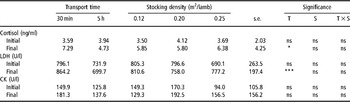
Pre-transport levels (initial) of the blood parameters were similar among groups (Table 1). However, after transport, plasma concentration of cortisol was significantly (P < 0.05) higher in suckling lambs transported for 30 min than those transported for 5 h. The plasma activity of LDH was also highest for the lambs subjected to short transport (P < 0.001).
Plasma cortisol concentration and lactate dehydrogenase and creatine kinase activities of suckling lambs in relation to transport time and stocking density

CK = creatine kinase; LDH = lactate dehydrogenase; ns = non-significant; S = stocking density; T = transport time.
Initial: pre-transport level; Final: after unloading in slaughterhouse.
*P < 0.05; ***P < 0.001.
Carcass quality
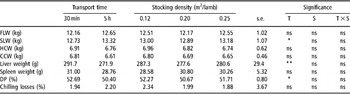
HCW and CCW were similar among treatments, with an average of 6.83 and 6.71 kg, respectively. Transport time significantly affected some carcass quality parameters, and there was no significant effect of stocking density on carcass quality parameters (Table 2). Lambs transported for 30 min had higher liver weights and dressing percentages than lambs transported for 5 h (P < 0.01 and P < 0.05, respectively).
Carcass quality parameters of suckling lambs in relation to transport time and stocking density

CCW = cold carcass weight; DP = dressing percentage; FLW = farm live weight; HCW = hot carcass weight; ns = not significant; S = stocking density; SLW = Slaughter live weight; T = transport time.
DP (%): CCW/SW × 100; Chilling losses (%): (HCW − CCW)/HCW × 100.
*P < 0.05; **P < 0.01.
pH values
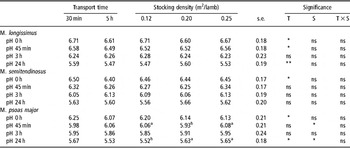
Table 3 shows pH values of L, ST and PM according to transport time and stocking density. The 24-h pH values were in a normal range for lamb with mean values of 5.53, 5.62 and 5.60 in L, ST and PM, respectively. Only one case of DFD meat (pH at 24 h >6.00) was detected in one animal transported for 30 min at low density (0.25 m2/lamb) with values of 6.25, 6.48 and 6.41 in L, ST and PM, respectively.
pH in Musculus longisimus, Musculus semitendinosus and Musculus psoas major in relation to transport time and stocking density

ns = not significant; S = stocking density; T = transport time.
*P < 0.05; **P < 0.01; ***P < 0.001.
a, bLeast square means in the same row with different superscript letters are different (P < 0.05).
In L, transport time affected pH 0 h (P < 0.05), 45 min (P < 0.05) and 24 h pH (P < 0.01), and lambs transported for 30 min showed the highest values. In ST, only initial pH was affected by transport time (P < 0.05). On the other hand, in PM, initial and 24 h pH were affected by transport time (P < 0.05), with lambs transported for 30 min showing the highest values. Stocking density affected 45 min and 24 h pH (P < 0.05) in PM. Lambs transported at 0.20 m2/lamb had the lowest pH at 45 min and animals transported at high density (0.12 m2/lamb) had the lowest pH at 24 h.
Meat quality
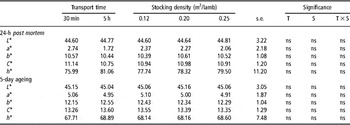
The effect of transport time and stocking density on meat colour parameters at 24-h post mortem and after 5 days of ageing are presented in Table 4. At 24-h post mortem, some colour parameters were slightly affected by transport time, as animals transported for 30 min tended to have higher a* value (P = 0.056) and lower hue (h*) value (P = 0.065) than animals transported for 5 h.
Colour parameters of Musculus longisimus in relation to transport time and stocking density

ns = not significant; S = stocking density; T = transport time.
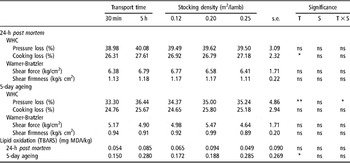
Cooking loss was initially (24-h post mortem) affected by transport time; however, neither pressure loss nor texture parameters were affected (Table 5). Lambs transported for 30 min had lower cooking loss than those transported for 5 h. Nevertheless, after 5 days of ageing, an interaction between transport time and stocking density for pressure loss (P < 0.05) was observed. Thus, lambs transported at low stocking density (0.25 m2/lamb) for 30 min had the lowest pressure loss (31.47%), whereas lambs transported at low stocking density (0.25 m2/lamb) for 5 h had the highest pressure loss (38.82%; data not shown in table).
Water-holding capacity, texture parameters and lipid oxidation of Musculus longisimus in relation to transport time and stocking density

MDA = malonaldehyde; ns = not significant; S = stocking density; T = transport time; TBARS = thiobarbituric acid-reactive substance; WHC = water holding capacity.
*P < 0.05; **P < 0.01.
Transport time was found to affect lipid oxidation (Table 5). TBARS values were similar for the two journey times at 24-h post mortem, but when meat was aged for 5 days, animals transported for 5 h had higher TBARS values than animals transported for 30 min (P < 0.05). Lipid oxidation was not affected by stocking density.
Discussion
Blood analyses
Plasma cortisol concentrations have been used as a reliable indicator of stress in lamb (Fordham et al., Reference Fordham, Lincoln, Ssewannyana and Rodway1989). Furthermore, LDH activity is associated with stress and muscle fatigue (weariness) (Broom, Reference Broom2000). In our study, plasma cortisol and LDH were higher at the conclusion of 30 min transport compared to lambs transported 5 h. This suggests that lambs transported over the shorter duration had not had sufficient time to habituate to the transport conditions. Hall et al. (Reference Hall, Broom, Goode, Lloyd, Parrott and Rodway1999) reported in long journeys of sheep plasma cortisol concentration increased soon after loading and commencement of travel, but it declined along transport. According to Broom et al. (Reference Broom, Goode, Hall, Lloyd and Parrott1996), when sheep were loaded onto a vehicle for the first time, elevated plasma and salivary cortisol levels were found for at least the first hour and fell as the journey progressed. During transport, animals will gradually relax and recover from the stress of loading (Bradshaw et al., Reference Bradshaw, Hall and Broom1996). Sanz et al. (Reference Sanz, Verde, Sáez and Sañudo1996) in young bull and Gregory (Reference Gregory1998) for all species reported that in short journeys animals can have less time to adapt to the new situation than longer ones, obtaining higher stress response. In pigs, LDH increased after loading and declined in lairage until to achieve resting level (Kim et al., Reference Kim, Woo and Lee2004; Averos et al., Reference Averos, Herranz, Sanchez, Comella and Gosalvez2007). Nevertheless, while Kim et al. (Reference Kim, Woo and Lee2004) observed that LDH was greater in pigs transported 3 h than those transported only for 1 h, Averos et al. (Reference Averos, Herranz, Sanchez, Comella and Gosalvez2007) did not find differences due to transport duration comparing 1 h transport with 13 h.
CK is released into the blood in response to muscle damage, e.g., bruising, and during vigorous exercise (Broom et al., Reference Broom, Goode, Hall, Lloyd and Parrott1996). In our study, CK was similar between transport times, suggesting that minimal muscle trauma had occurred during transport and handling and that the experiment was carried out in good conditions. Furthermore, Warriss et al. (Reference Warriss, Brown, Knowles, Kestin, Edwards, Dolan and Phillips1995) showed in cattle that plasma CK activity increased commensurate with journey duration, suggesting that maintenance of posture in the moving vehicle is physically demanding. Whereas, Warriss et al. (Reference Warriss, Brown, Knowles, Kestin, Edwards, Dolan and Phillips1995) studied transport length up to 15 h, the 5 h transport time in the present experiment may not be long enough to increase plasma CK activity or because the stress response of lambs differed to cattle. Cockram et al. (Reference Cockram, Kent, Waran, McGilp, Jackson, Amory, Southall, O’Riordan, McConnell and Wilkins1999) observed no significant differences in CK activity in lambs transported for 15 h compared to non-transported lambs, because in the transported lambs, the number of potentially traumatic events was low.
The stocking densities used in this study had no effect on blood parameters. Ibañez et al. (Reference Ibañez, De la Fuente, Thos and Gonzalez de Chavarri2002) did not find any effect of stocking density on plasma cortisol concentration in the transport of suckling lambs but found that LDH concentration was higher in lambs transported at low than at high stocking density. The differences with our results could be attributable to differences in the experimental procedure. The study by Ibañez et al. (Reference Ibañez, De la Fuente, Thos and Gonzalez de Chavarri2002) included a rest period in lairage (1.5 and 3 h), and the blood samples were taken during bleeding. Tarrant et al. (Reference Tarrant, Kenny, Harrington and Murphy1992) found in steers transported for 24 h by road that animals transported at high stocking density (585 kg/m2) had higher plasma cortisol and CK than those transported at 500 or 448 kg/m2. They explained that at 585 kg/m2, freedom of movement was severely restricted. In contrast, any of the stocking densities used in this study did not have a significant effect on blood parameters. This might be due to the differences among the three stocking densities being insufficient to show physiological differences or those stocking densities affected to lambs in the same way. Cockram et al. (Reference Cockram, Kent, Goddard, Waran, McGilp, Jackson, Muwanga and Prytherch1996) reported that weaned lambs transported for 12 h at four space allowances (0.22, 0.27, 0.31 and 0.41 m2/sheep) did not affect on plasma cortisol concentration and plasma CK activity.
Carcass quality
Suckling lambs transported for 5 h had lower liver weights and dressing percentages than those transported for 30 min. This may be due to higher tissue dehydration due to longer food and water deprivation. According to Warriss (Reference Warriss1990), both the mobilisation of tissues to provide energy for maintaining the vital functions of the body and the dehydration that may occur during transport lead to losses in potential carcass yield and weight of edible offal such as the liver. In our study, in the period between leaving the farm and slaughter, the suckling lambs were wholly deprived of food and water. In goats, Kadim et al. (Reference Kadim, Mahgoub, Al-Kindi, Al-Marzooqi and Al-Saqri2006) observed lower shrinkage in animals transported for 2 h than in non-transported animals due to tissue dehydration during transport at high ambient temperatures (37°C). In pigs, Mota-Rojas et al. (Reference Mota-Rojas, Becerril, Lemus, Sánchez, González, Olmos, Ramírez and Alonso-Spilsbury2006) evidenced best carcass yields when transportation time was shorter in mid-summer transport. In our study, environmental temperature was not high (10°C to 12°C), but the animals in this study were very young and pre-ruminant. Non-ruminants, such as pigs, and pre-ruminants, such as suckling lambs, are more susceptible than ruminants to short periods of food and water deprivation, because rumen acts as a reservoir of potential nutrients and water (Gregory, Reference Gregory1998). Besides, young animals need more water than adults due to their body structure, they are growing faster and their metabolism is also faster than that of older animals; consequently, young animals are more prone to dehydration than older ones (Kent and Ewbank, Reference Kent and Ewbank1983).
pH values
The pH in the muscle of a living animal is around 7.0, but when an animal is slaughtered, the pH falls in the muscles as a consequence of anaerobic glycolysis. Therefore, the ultimate pH in meat is dependent on the pre-slaugther glycogen concentration in muscle. Transportation stress causes depletion of muscle glycogen and results in the formation of dark-cutting meat in sheep (Warriss et al., Reference Warriss, Kesting, Young, Bevins and Bevins1990). However, under the conditions of our study, glycogen depletion was not sufficient to increase meat pH above the normal expected range. Thus, in the pH at 0 h, 45 min, 3 and 24 h was in the normal range reported by other authors for suckling lambs (Díaz et al., Reference Díaz, Velasco, Pérez, Lauzurica, Huidobro and Cañeque2003). In addition, Brown et al. (Reference Brown, Bevis and Warriss1990) noted that the incidence of DFD is low for young ruminants.
However, transport time affected pH values where lambs subjected to long transport had the lowest pH at 0 h in the three muscles studied, and the lowest ultimate pH in L and PM. As was explained above, lambs transported for 5 h could be dehydrated and muscular glycogen reserves would have been mobilised, these facts could increase the accumulation of lactate and protons causing fatigue in the muscle (Gregory, Reference Gregory1998). In a fatigued muscle, the initial pH may be as low as 6.5 to 6.3 (Juel, Reference Juel1996).
Transport affected in different ways to the three muscles studied. This may be due to the different muscle fibre types of the muscles studied. The muscles involved in movements (walking and standing up), such as ST, have a high proportion of α-white fibres with high glycogen storage (Gregory, Reference Gregory1998). These muscles are better equipped to obtain energy by anaerobic metabolism, and, as a result, transport had practically no effect on them.
Postural muscles, such as L or PM, have a high proportion of β-red fibres with low glycogen storage and are therefore more susceptible to depletion of energy reserves (Gregory, Reference Gregory1998). In PM, muscle pH was affected by transport time and also by stocking density. Thus, lambs transported at high density (0.12 m2/lamb) had lower pH at 24 h compared to lambs transported at lower stocking densities (0.20 and 0.25 m2/lamb), in PM. Low stocking density allows lambs to walk, and factors such as lorry movements might have caused them to move in order to keep their balance, producing a decrease in muscle glycogen and consequently high ultimate pH. Ibañez et al. (Reference Ibañez, De la Fuente, Thos and Gonzalez de Chavarri2002), in suckling lambs transported at 0.25 and 0.125 m2/lamb, found a higher number of lambs walking at low stocking density. One lamb subjected to the short journey and allocated at low density (0.25 m2/lamb) showed DFD meat (high ultimate pH), which could confirm these data.
Meat quality
Meat colour is one of the most important criteria in initial selection by the consumer. Colour can be affected by factors related to pre-slaughter handling such as transport (Warriss et al., Reference Warriss, Kesting, Young, Bevins and Bevins1990). Few studies have considered the effect of transport on meat colour in young ruminants. Kannan et al. (Reference Kannan, Kouakou, Terrill and Gelaye2003) observed in transported young (2 h) goats lower a* and chroma values than in on non-transported animals, but this effect was not found in old goats. In this study, the factors studied regarding transport have not had a great effect on colour parameters. Lambs transported for 30 min tended to have slightly darker red meat (higher a* and lower h*) than animals transported for 5 h in non-aged meat. According to Ledward et al. (Reference Ledward, Johnston and Knight1992), meat that has a higher pH will be darker because there is less free water to reflect light, and enzymes that use oxygen are more active, resulting in less oxygenation of the surface myoglobin. There were only slight differences, although significant, in 24-h pH values between animals transported for 30 min and for 5 h, and it could be associated to very slight differences in meat colour between both transport time, a tendency to be darker red meat (higher a* and lower h*) from lambs transported for 30 min than for 5 h. The little effect of transport time on colour parameters was not observed when the meat was aged for 5 days.
Several studies have demonstrated that as muscle pH increases there is an accompanying increase in water-binding capacity of the muscle proteins (Wierbicki and Deatherage, Reference Wierbicki and Deatherage1958). WHC at 24 h post mortem of meat from lambs transported for 30 min was higher than those from lambs transported for 5 h. Although pressure loss was not significantly affected by the factors studied, cooking loss was lower in lambs transported for 30 min than in those transported for 5 h. Decreased cooking loss is a reflection of the increased WHC associated with meat of high ultimate pH (Bouton et al., Reference Bouton, Harris and Shorthose1971). As explained above, at higher muscle pH (lambs transported for 30 min), proteins are able to bind more strongly with water, allowing less free water. In heavier lambs (47 kg), Apple et al. (Reference Apple, Dikeman, Minton, McMurphy, Fedde, Leith and Unruh1995) observed that meat from restrained and isolated lambs had higher pH and lower cooking loss than meat from non-isolated lambs. Nevertheless, María et al. (Reference María, Villarroel, Sañudo, Olleta and Gebresenbet2003) in beef transported for 30 min, 3 and 6 h did not find a significant effect of transport time on ultimate pH or pressure loss.
Transport time and stocking density did not affect meat texture parameters. Findings here are similar to those of María et al. (Reference María, Villarroel, Sañudo, Olleta and Gebresenbet2003), who found no significant effect of transport time on WB values, in beef. In goats, Kannan et al. (Reference Kannan, Kouakou, Terrill and Gelaye2003) did not find significant differences in shear force of transported animals compared with non-transported ones. On the contrary, Kadim et al. (Reference Kadim, Mahgoub, Al-Kindi, Al-Marzooqi and Al-Saqri2006) found that meat from transported goats was tougher than that from non-transported.
In relation to lipid oxidation, animals transported for 5 h had twofold higher TBARS values than animals transported for 30 min when meat was aged for 5 days. This means that the meat from animals transported for longer journeys suffered higher lipid oxidation than the meat from those transported for 30 min. As noted above, animal transport involves absence of food and water supply, and a transport time of 5 h involves a fasting period longer than transport of 30 min. During the fasting period, lambs mobilise their body energy reserves, first glycogen storages and then fat deposits. Mobilisation of fat deposits increases free fatty acids in plasma (Cockram et al., Reference Cockram, Kent, Jackson, Goddard, Doherty, McGilp, Fox, Studdert Kennedy, McConnell and O’Riordan1997) and also in muscle cells. These fatty acids released by lipolysis are more susceptible to lipid oxidation (Nawar, Reference Nawar1996). In lipid oxidation reactions, the rate of oxidation increases as the reaction proceeds (Fernández et al., Reference Fernández, Pérez-Álvarez and Fernández-López1997). Moreover, the inherent antioxidative defence system of biological tissues decreases after death and, as a result, the differences in TBARS values were more evident after 5 days ageing.
Conclusions
In the conditions of this study, loading and initial transport caused significant stress response in suckling lambs, ‘emotional’ stress response was reduced over the time course of the journey, nevertheless other parameters related to dehydration and hunger could be increased over journey time. There was a decrease in meat quality of lamb due to transport time; however, this decrease was minor and probably of no practical significance. There was no effect of stocking density during transport on the physiological response of lambs and measurements of meat quality. If driving conditions are good, a stocking density during transport of 0.12 m2/lambs appears to be satisfactory for suckling lambs (10 to 14 kg) that are transported for journey up to 5 h to the slaughterhouse.
Acknowledgements
We thank Cristina Otero and Gabriel de la Iglesia for their technical support. Our thanks also to Magnus S.A. and their processing plant staff for their help and cooperation in this study. This research was funded by an INIA project (RTA2005-00069-C2).