1. The 1970 German Pavilion and Auditorium at Osaka
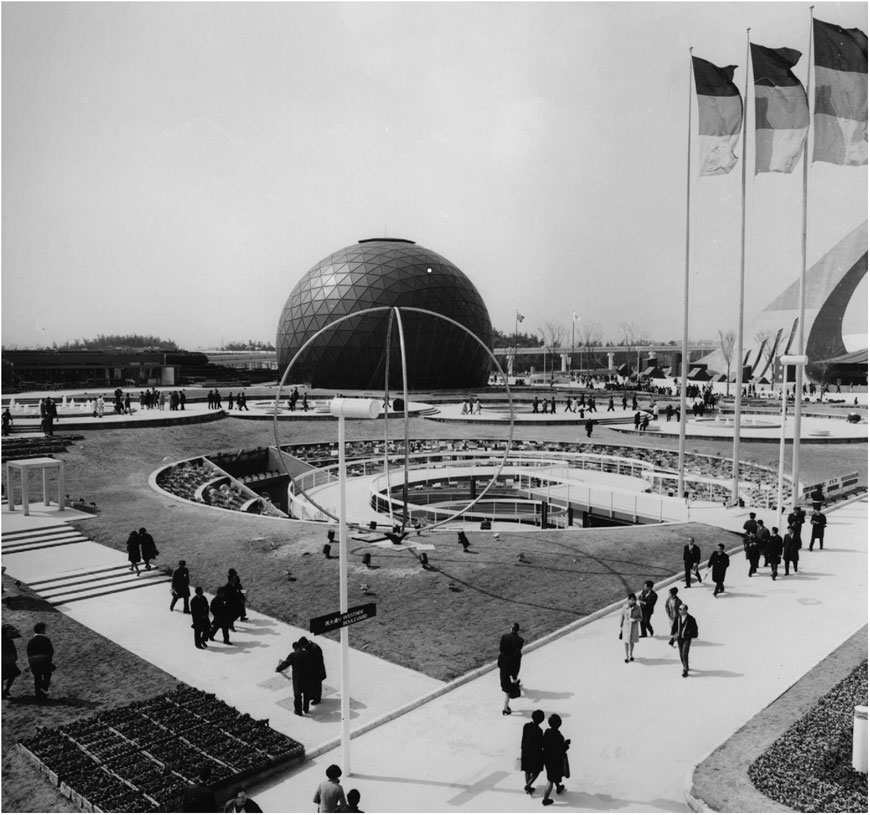
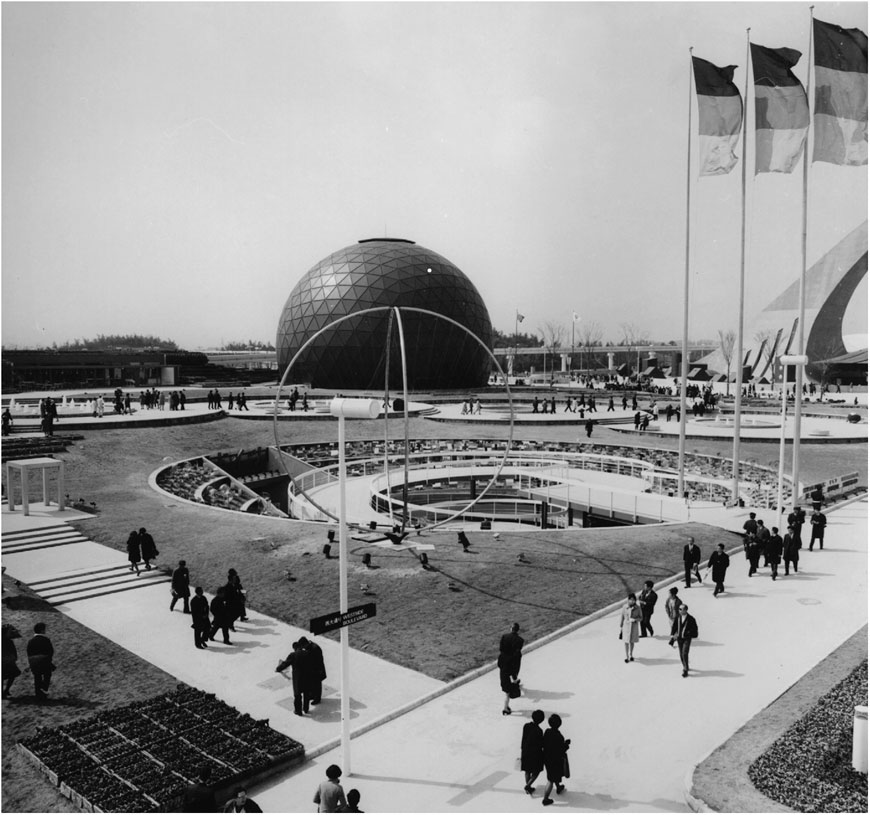
Stockhausen’s involvement at the World’s Fair in Osaka in 1970 was one of both co-designer and artistic director of performances at the auditorium of the German pavilion. The striking, partially submerged blue spherical auditorium was designed in collaboration with architect Fritz Bornemann, acoustician Fritz Winckel and engineer Max Mengeringhausen (figure 1). The physical structure of the geodesic dome was constructed from a steel truss ‘space’ frame, and the electroacoustic infrastructure located within included over 50 loudspeakers located above and below the audience, as well as a lattice of light sources (designed by artist Otto Piene) all controlled from a single command desk.
German pavilion, World’s Fair, Osaka 1970.
Stockhausen had worked with Bornemann firstly at the 1968 Summer Courses for New Music Darmstadt to develop the idea of the auditorium’s capabilities, as well as to resolve the greater architectural programme of the site (Bornemann Reference Bornemann1970: 1,492). The theme developed by the German planning group for the pavilion, Gärten der Musik, was somewhat manifest in Bornemann’s initial ideas for the architecture:
I wanted to create no building at all. I would of rather have had radar-frozen air, but we are not yet capable of that, so I tried the next best thing … People suggested that we could save a lot of money by setting up our location like a football field with a cheap fencing made from hardboard at each end, at the place where the goals would have been. Visitors would enter at one end, receive audio-visual helmets, and float across the other end, they would be relieved of the helmets and leave with the idea that the German pavilion was the most unbelievable thing in the world. (Pieter van Wesemael Reference Van Wesemael2001: 600)
In Bornemann’s final design the pavilion became a series of five underground circular spaces with the only discernible topological feature sitting above ground being the striking blue dome of the auditorium. In a firm reaction against the architectonic gesture that permeated many of the other pavilion designs, and the superficial sensation Bornemann considered evident in the ephemeral megastructures of the Expo, the site’s architectural programme sought to create an off-Expo experience through both an exploration of the garden as a contemplative ephemeral device for reflection, and a literal immersion/emersion into the advancements of contemporary German electroacoustic music.
That the auditorium’s impact above ground was striking and immediate was suitably mirrored inside, where, under Stockhausen’s stipulations the interior would house enough loudspeakers to create a immersive sound field that relied on utilising rings of loudspeakers that extended well above and below the seated position of the audience. Loudspeaker layers could be controlled via a spherical sensor or a rotation mill at the control desk, and allowed any geometric combination of loudspeaker groups (i.e. as circles, spirals or through diagonals) to be utilised (for example as circular, spiral or diagonal trajectories). The resulting capabilities of the system produced an immersive audiovisual experience where dramatic movements of sound and light literally produced sonorous explosions in space that anticipate the later Klangbomben of Oktophonie (1990/91).
Concerts at the auditorium ran throughout 5 March–13 September, and in addition to performances of Stockhausen’s Hymnen, Stimmung, Kontakte, Kurzwellen, Carré, Telemusik, Aus Den Sieben Tagen and Spiral, the two works Pole für 2 and Expo für 3 were completed especially for the sound projection capabilities of the site.Footnote 1 In addition to these works, contemporary tape pieces by other German composers were also performed, including works by Boris Blacher, Erhard Grosskopf, Bernd Alois Zimmermann and Gerd Zacher.
2. Experiments in Representing Process
Though Stockhausen showed only a functionalist attitude towards technological innovations for musical sound production throughout the 1960s and 1970s, his interest in novel forms for musical notation predate the 1970 Osaka auditorium works. Beginning in 1959, a mobile transparency was used in Refrain, to allow a multi-configurable recourse of material (printed on a transparency) to ‘interact’ with the fixed score at different points between performances, creating indeterminacy in respect to performance.Footnote 2 Such novel types of notation developed by Stockhausen were often utilised across pieces. For example, in the progression from Kurzwellen (1968) to Spiral, Pole and Expo (1970), new symbols are introduced into the already standardised notational nomenclature as a means to extend and augment the work’s design space. Similarly, because of Stockhausen’s continued interest in refining his notation, the compositional structure for each successive work becomes more dependent on the specific performer-led transformations and reiterations embodied in the new notation. By the completion of Spiral, Stockhausen had a fully developed notational paradigm that visualised four generalised musical parameters that acted as catalysts for the thematic structuring of a work. For Spiral, Pole and Expo these parameters are:
• rhythmic segmentation;
• duration of an event;
• pitch-space and/or register; and
• dynamic envelope.
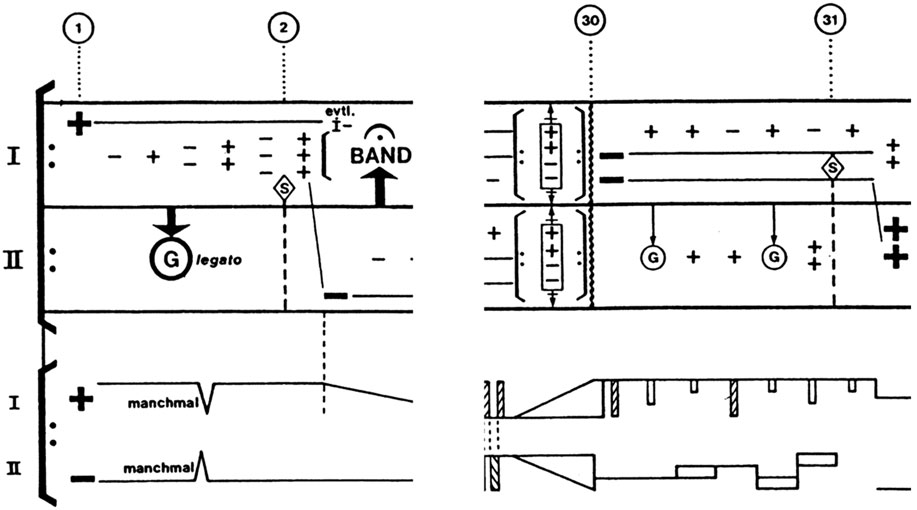
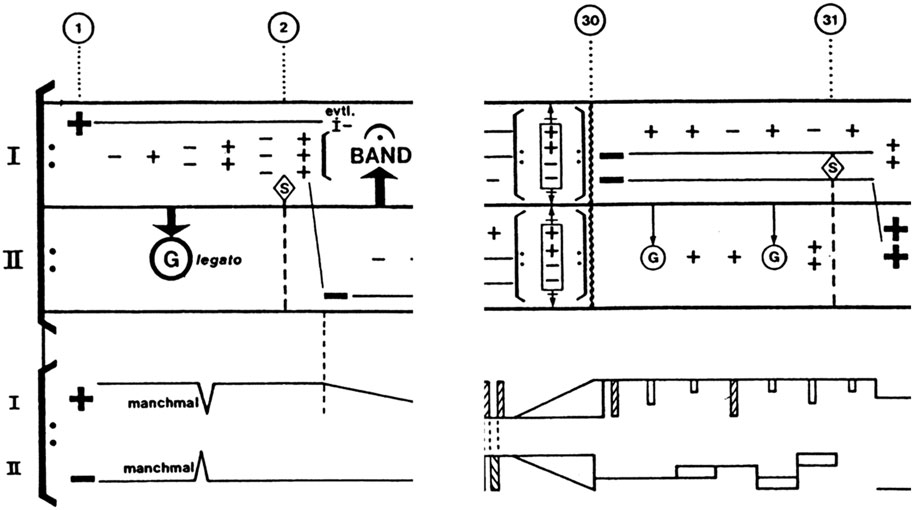
These parameters become further developed with the duo and trio works that follow Spiral by the addition of indications for interactions among players through the passing of materials, cues for echoing, and parallel movement as well as the use of repetitive signals for demarcating points within the form (figure 2). Consequently, these notational endeavours create even greater demands for the performers who must communicate large sonic structures littered with cross-referenced points of articulation, develop crucial dynamic envelopes, and have the ability to track and transform multiple musical parameters concurrently across the entire, often lengthy, timeline of the work. But the primary conceptual framework common between Kurzwellen, Spiral, Pole and Expo remains the use of the short-wave radio as progenitor for thematic materials: either through direct electronic transformation of short-wave signals, or through instrumental/vocal imitation and development.
Score excerpts from Pole für 2 showing: (a) complementary parallel transformation between player I, and player II sound projection; (b) combination of sound walls and loudspeaker layers as a complement and occasional parallel to players I and II. © Stockhausen Foundation for Music, 51515 Kuerten, Germany (www.stockhausen.org).
This apparent relinquishing of control on the design of the compositional objects (that is, the work’s thematic materials) in Spiral, Pole and Expo was, no doubt, a result in part of Stockhausen’s confidence in the personnel performing the works to masterfully capture and interpret the fundamental transformations of his four generalised musical parameters. As Fox has elaborated,
Characteristic of all these works is an openness of form in which processes of transformation of musical materials are elaborately composed but the materials for transformation are much less tightly prescribed. This openness reflects both the era in which these scores were written …, and Stockhausen’s collegial respect for musicians such as Aloys Kontarsky, Johannes Fritsch and Rolf Gelhaar. (Fox Reference Fox2000: 16–24)
Similarly, because of Stockhausen’s level of co-management instigated in the technical preparation and rehearsal of these works, a more pervasive communication of the composer’s desired intentions could be revealed during the performances in Osaka. Perhaps also, due to the appearance of new electronic instruments, or the capabilities of the new spherical auditorium, a new aesthetics of transformation is manifest in the musical structure of these three works in a seemingly more exacting, or at least more distinct fashion than those preceding works such as Plus Minus or Kurzwellen. Though Stockhausen is still merely indicating the larger transformational goal of each work in the notation, an ever-increasing engagement in the subtle connections between events is explored. As such, Stockhausen focuses on how thematic recollection and development becomes a musical shape and an audible foil to the dynamic and complex sounds of the short-wave radio. This is taken further in the works composed for Osaka, in which thematic transformation is transmediated from the discrete confines of musical space, and usurped to create an aural environment in which time and movement act to build an ephemeral architecture through the three-dimensional projection of sound sources.
2.1. Sound diffusion and Pole
At the point at which Stockhausen’s notational experiments were moving towards a structural apogee – that is, via a highly considered negotiation of pitch-space, dynamic flux and temporal articulation (both in the micro and macro sense) – the work Pole introduces a new processing layer. As a complement to the graphic nature of the music score, Stockhausen creates a system for the notation of sound projection in three dimensions based on the use of loudspeaker regions defined within the six discrete layers of the Osaka auditorium. The two layers below the audience contain two concentric circles of loudspeakers on the lowest level (plus subwoofers), and another circle just below the floor. The other four layers extended well above the seated listeners, providing an immersive acoustic space in which dynamic sound trajectories could radiate through three dimensions.
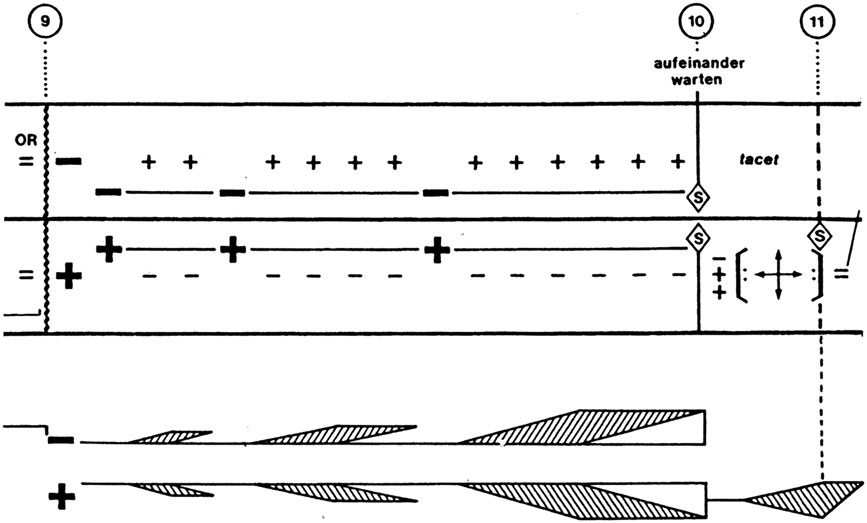
Pole extends the notational conventions of Spiral by usurping the graphic representation of thematic transformation of musical materials for new sound projection strategies (figure 3). What becomes innovative about Pole is the transmediation of this musical notation device as a means to spatialise the projection of the performer’s sound sources. Because of the loudspeaker infrastructure at Osaka, the control of the soundfield was sophisticated enough to allow for myriad acoustic typologies to be pre-composed or improvised, as well as for the instantaneous transformation from one state to another – sounds perceived as being located in various parts of the interior could be rapidly moved upwards and downwards, or seem to spread and clump throughout sections of the walls in quick transformational succession. This meant that Stockhausen, as Klangmeister, could instantaneously construct an aural architecture through the development of ephemeral acoustic conditions. In turn, transformations in music-space are potentially mapped and transmediated for the construction of dynamic spatial auditory experiences within the architectural site. Consequently, one can read Pole as primarily concerned with the connections and disconnections between the performers, their short-wave radio (as driver of thematic materials), and the ephemeral acoustic spaces they co-curate.
Moments 9–11 of Pole für 2 (page 1). © Stockhausen Foundation for Music, 51515 Kuerten, Germany (www.stockhausen.org).
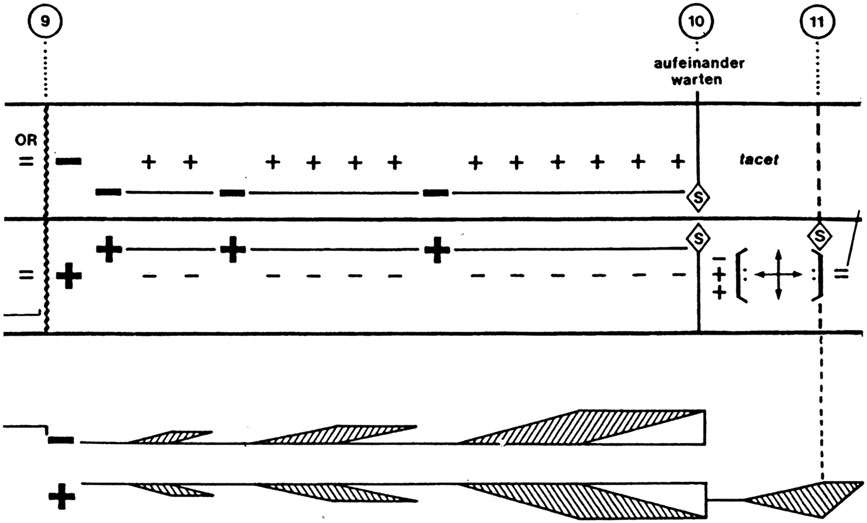
Each performer of the Pole has their sound projected into the auditorium through one stratified hemisphere of the six loudspeaker layers that sit at azimuth 90° and −90° to the orientation of the audience. This means that both performers each have six assignable sound layers within their hemisphere that may be activated as an entire field, or as individual layers, or as individual loudspeakers. This hemispherical division of the space is perhaps the most obvious allusion to the title of the work, though at the same time it allows listeners and the sound projectionist a definitive spatiotemporal tracking of each player’s sound sources. Following from the musical score, extremes of register are notated for the sound projectionist to which the signs of + and − represent the highest and lowest layers of loudspeakers. By using this system, loudspeaker fields or transitions are indicated through lines (curved or straight), or polygons (hashed to suggest a fully operational field, empty to indicate only the extremities of the field). These spatial representations of loudspeaker groups are interpreted according to their length and height to indicate the depth of the field (that is, the number of loudspeaker layers), duration (as referenced against the parts of the performers), and trajectory. Numerous sections in the score suggest both a free use of sound projection (marked ad lib.), as well as the possibility of connecting individual loudspeaker point-sources to create vertical or horizontal trajectories; such as between moments 34 and 35 (see sound projection score in figure 11).
The site specificity of the work makes it a rare example of how an appropriate tangible architecture becomes the necessary medium for the realisation of the piece. However, to allow for a legacy of future performances, Stockhausen gives a number of alternative loudspeaker infrastructure designs that create a similar listener perspective for alternative spaces. In each of the projected designs, Stockhausen is careful to resolve completely the nature of the original auditorium’s structure as a vehicle to deliver a vertical movement of sound sources by maintaining the sense of poles of activity generated by the two players’ material in the y-axis. Any new sound design for the work then must conventionalise both the sense of the two discrete hemispheres to which each player belongs, and the capability for moving sounds dynamically within these fields.
Just as the musical score is singularly concerned with thematic development and transformation, so too is the sound projection score, which seemingly transmediates the graphic nomenclature interpreted by the musicians, only now used by the sound projectionist for the services of pure spatial development. Stockhausen’s role, then, for the Klangmeister in Pole, Spiral and Expo is as an additional performer. As such, the nature of sound projection as a means to craft, suggest and manipulate acoustic space becomes an important issue for all the composer’s subsequent works.
3. Between music and architectural space
Considering Bornemann’s original desire for the German pavilion to be the ultimate anti-architectonic statement, the resulting auditorium’s geodesic dome comes very close by allowing for a large interior volume to be constructed with a relatively small surface area. This means that the tangible materiality of the building accounts for only a small part of the viewable architecture. This aligns well with the attitude of the dome’s inventor, Buckminster Fuller, whose design philosophy favoured the ephemeralisation of technological advancements by ‘doing more with less’ (Brand Reference Brand1999: 93–9). Subsequently, the auditorium becomes merely a vessel or site for an unseen ephemeral architecture that is activated through sound source projection. Whereas Bornemann’s original concept had people floating through space, the resultant auditorium allowed for sounds seemingly to float across the interior and simultaneously to suggest different scales of room and listening perspective.
This technological achievement certainly created the opportunity for Stockhausen to begin an investigation into the connection between space as a function of tangible materials (that is, the physical, tactile boundaries of containment), and the intangible (the nature of sound as a kinetic and ephemeral phenomenon). The pavilion became a device for which the intersection of music-space and architectural space could challenge Stockhausen’s assertion that ‘there are no sounds in space, but rather space is in the sounds’ (Worrall Reference Worrall1998: 93–9). Similarly, as it was a three-dimensional sound laboratory, myriad spatial processes and auditory transformations could be explored in real-time in performance situations. Stockhausen was intimately aware of the precedent set by Xenakis, Le Corbusier and Varèse at the 1958 Philips Pavilion in Brussels, and no doubt sought to further the ‘intimate links between music and architecture, thereby showing the potential for previously unimagined developments in both fields’ (Giannoukakis and Zannos Reference Giannoukakis and Zannos2007: 359–66). Indeed, Stoianova and Kohl have noted in Stockhausen’s later LICHT cycle of a ‘striving for a synthesis of, on the one hand, an extremely clear architectonic formal conception and, on the other, a specifically sonic-gestural conception of movement’ (Stoianova and Kohl Reference Stoianova and Kohl1999: 179–212). Thus the composer’s predilection for the organisation of gestures of movement and auditory zones of activity naturally produce ephemeral transformations of interior space. Using such techniques within the infrastructure at Osaka produced particularly striking acoustic typologies because of the myriad ways in which the pavilion’s interior could be articulated during a performance. Whereas Xenakis, Le Corbusier and Varèse relied on the visitor experience of the pavilion as an installation, much of the experience at the Osaka pavilion relied on the real-time production of sound-space, and therefore on the act of performance.Footnote 3
Though the sound projection score of Pole is succinct in its account of the trajectory of audio outputs within the loudspeaker layers, to appreciate the architectural spatiality of the work one must also account for the interior space as the range, or container within which the work operates. Producing a three-dimensional spatial mapping of Stockhausen’s sound-projection score may assist in a qualitative architectonic analysis of the spatial processes operating within Pole. Stockhausen presents the performers of the work with indications about the state of musical parameters in transformation. The sound projection score similarly indicates the spatial transformation of point/field sources. A simple approach to using the sound projection score for a digital architectonic realisation involves using the line work of the projection score (referenced against its context) as a structural frame for the generation of surfaces. This procedure may enable an ontological investigation from the viewpoint of an architectural process emanating from a musical context. While new architectural form-generating procedures are inevitably gained, such an approach may also serve as a novel spatial model that interrogates aspects of morphology and typology inherent in Pole’s sound projection geometries.
3.1. Non-uniform rational B-spline modelling
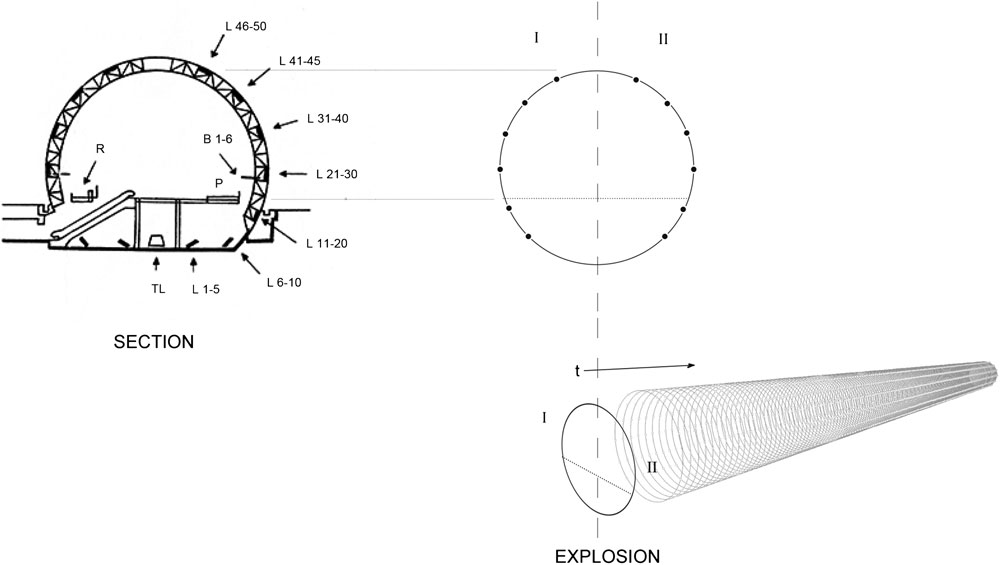
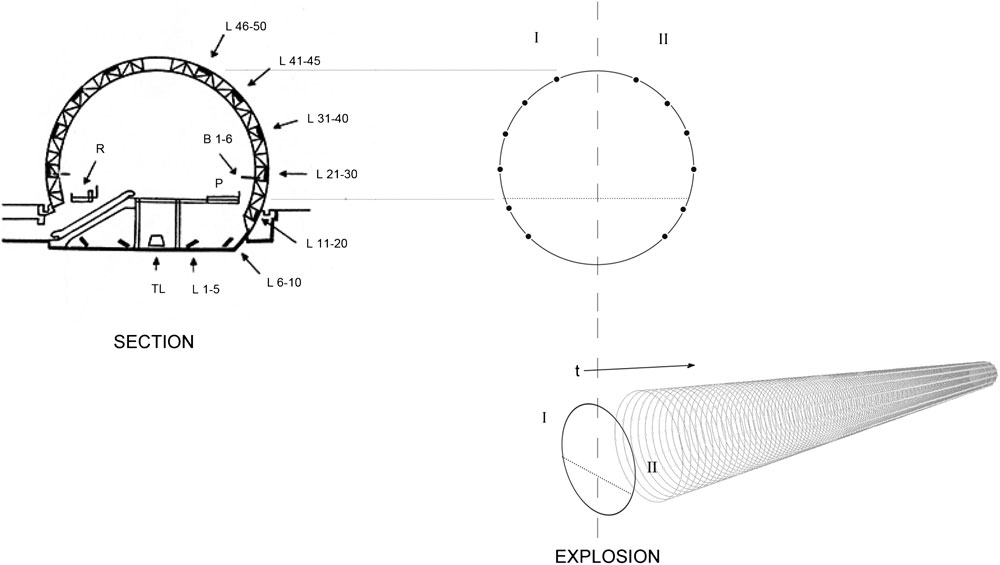
As an increasingly pervasive tool for the digital negotiation of form generation within architectural praxis, NURBS (non-uniform rational B-spline) modelling provides a creative means of building surfaces through mesh generation and lofting algorithms.Footnote 4 To transmediate Pole’s sound projection geometries with lofting algorithms means using the projection score as a line-work representation of structure. The loudspeaker amplitude indications within the score can be projected into three dimensions through the use of a section drawing of the auditorium as a structural template (see figure 4). By adapting the standardised exploded viewpoint, the section (as a slice of the structure), can be offset as a function of time, in turn homogenizing each of Pole’s formal parts. The separation of each section allows for a tracking of the nominal point of origin of the loudspeaker outputs in the z- and y-axis under f(x) = t. A result of this mapping is the creation of a spatiotemporal edge that becomes an underlying structure for the architectonic visualisation methodology. In the software program Rhinoceros, these spatiotemporal edges become control-points-driven polylines. To generate a surface that tracks the movement of the structure requires a lofting algorithm (with the option of building a closed or open loft with tight or loose geometry) that will generate a surface between lines and/or control-points. By using a closed lofting algorithm the first selected control-point/polyline is connected to the final control-point/polyline, thus producing a continuous surface whose geometry is function of the wrapping of edge boundaries.
Construction of the diffusion model’s superstructure through an exploded viewpoint (as a function of time) of German pavilion’s auditorium (World’s Fair, Osaka 1970): six layers are extracted into two hemispheres whereby layer 1 is simplified to a single stratum rather than subdivided.
4. Form Analysis
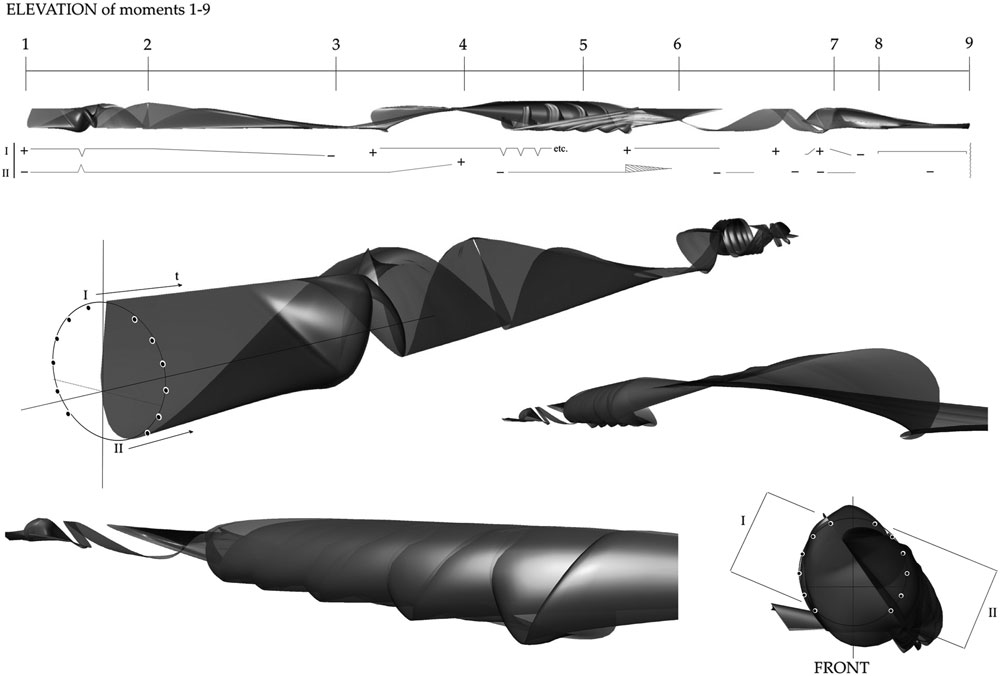
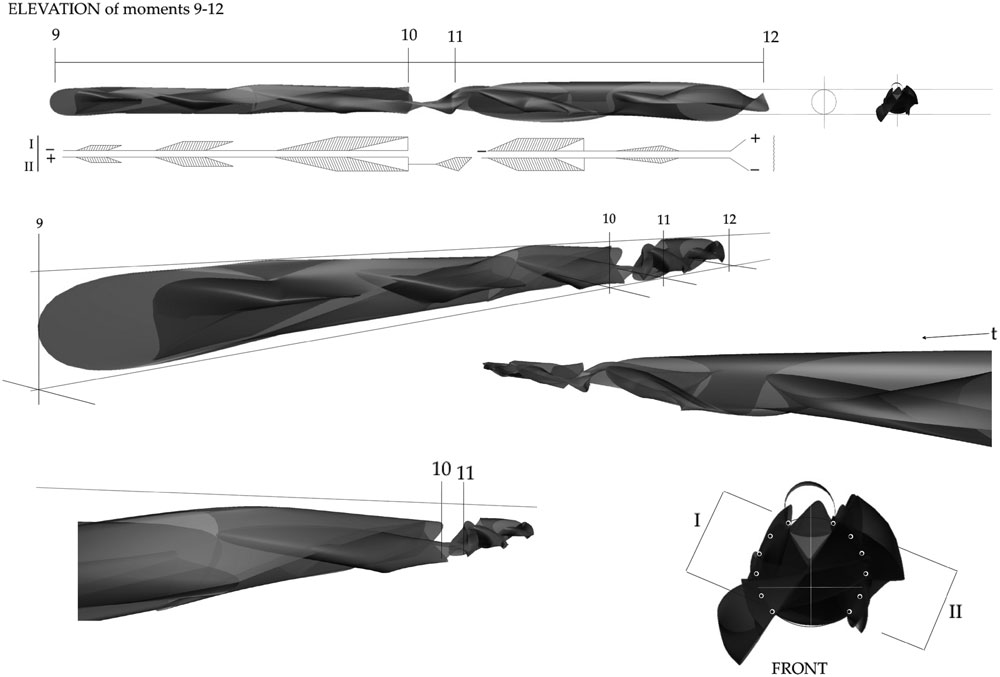
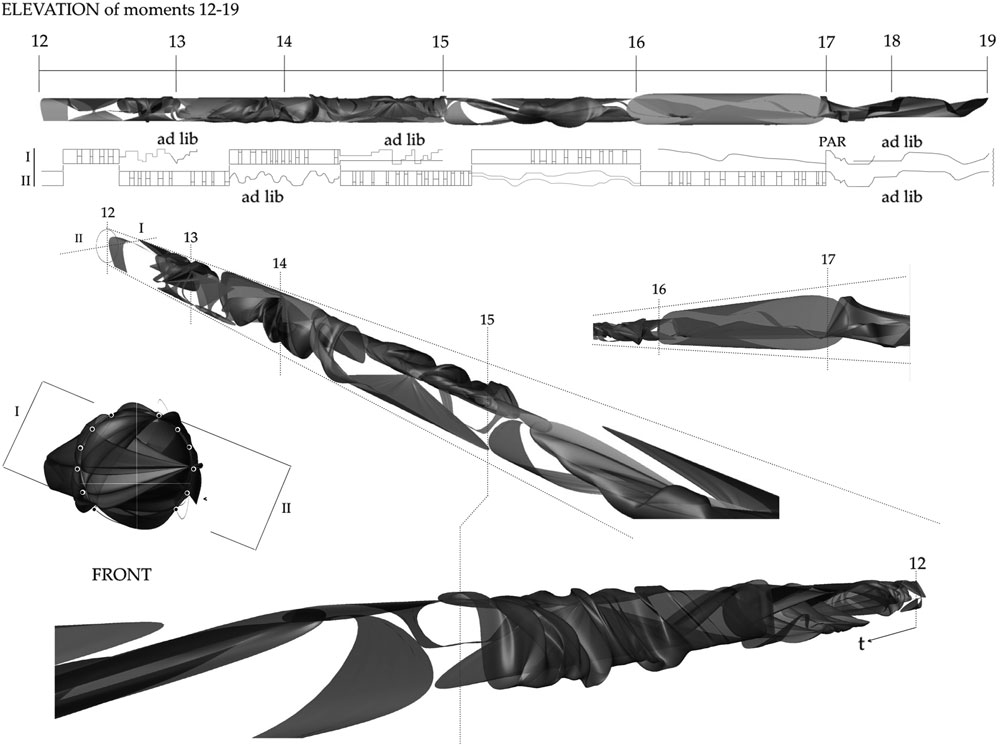
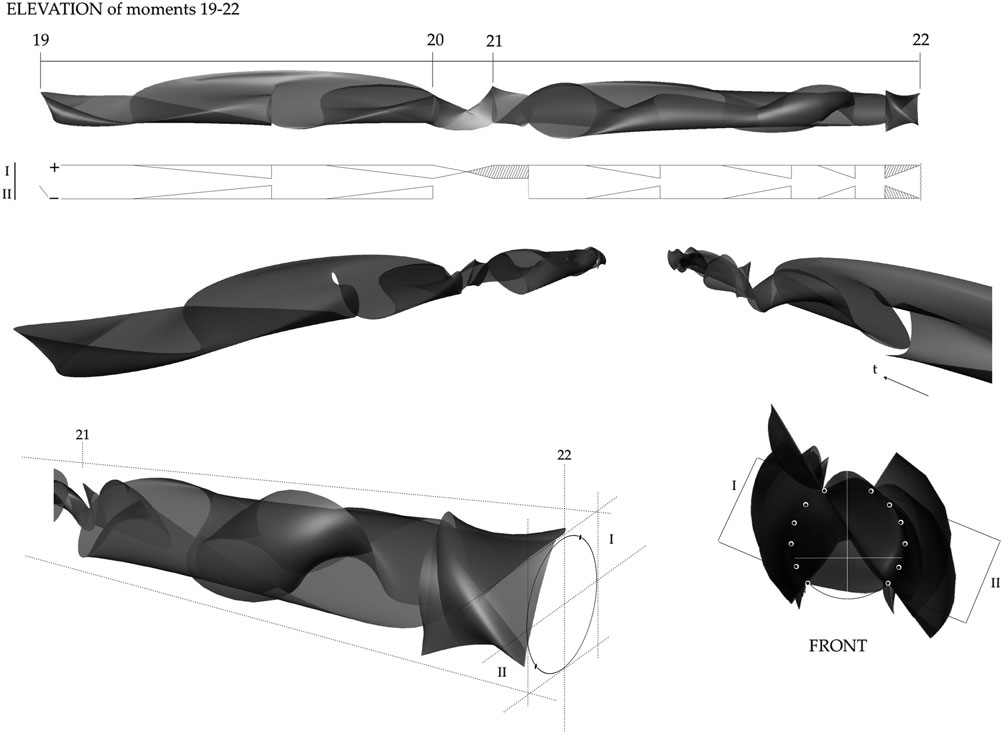
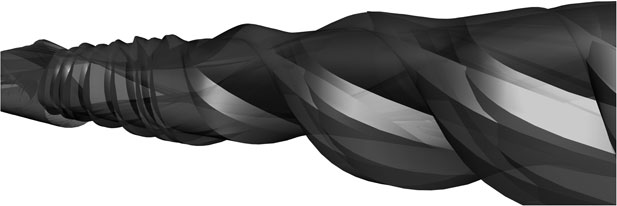
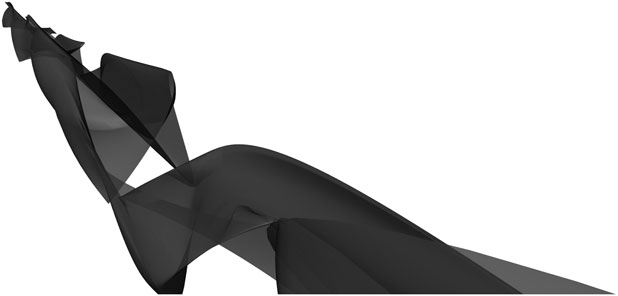
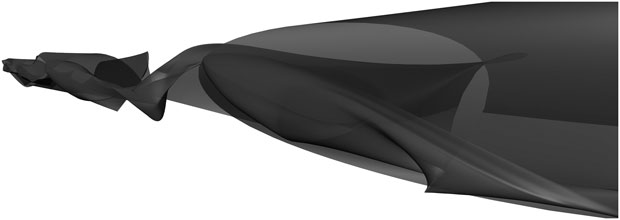
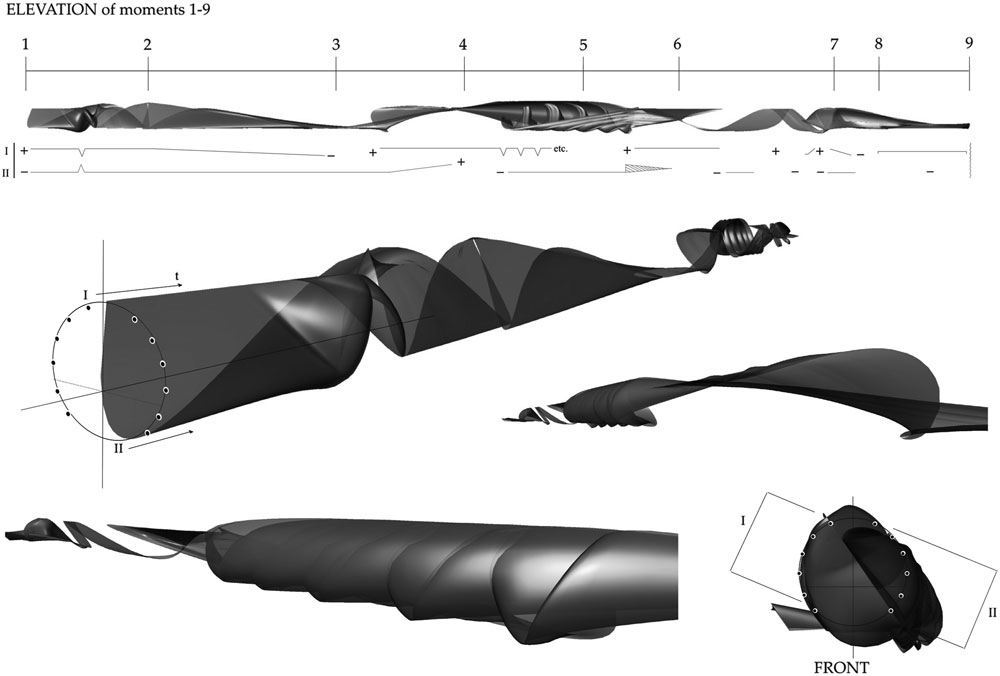
The NURBS realisations of Stockhausen’s sound projection score in figures 5–11 map the projection score as a complex manifold of self-intersecting surfaces. Considering the manner in which they articulate the auditorium’s section-template can reveal in visual, and architectonic terms, geometric predilections within Pole. Similarly, the models can also account for the unexpected and striking inconsistencies of software-driven transmediation procedures. As a three-dimensional visual account of the sound-projection processes of Pole, each model is a structurally connected mapping of the numbered moments of the work. These moments are additionally grouped according to Stockhausen’s suggested delineation of performable sections. A cursory account of the formal or architectonic connections and disconnections between models shows a proclivity towards two (expected) poles of typology. These states are fluid, however, and occur both as a:
NURBS model of moments 1–9 of Pole für 2: front, elevation and perspective viewpoints.
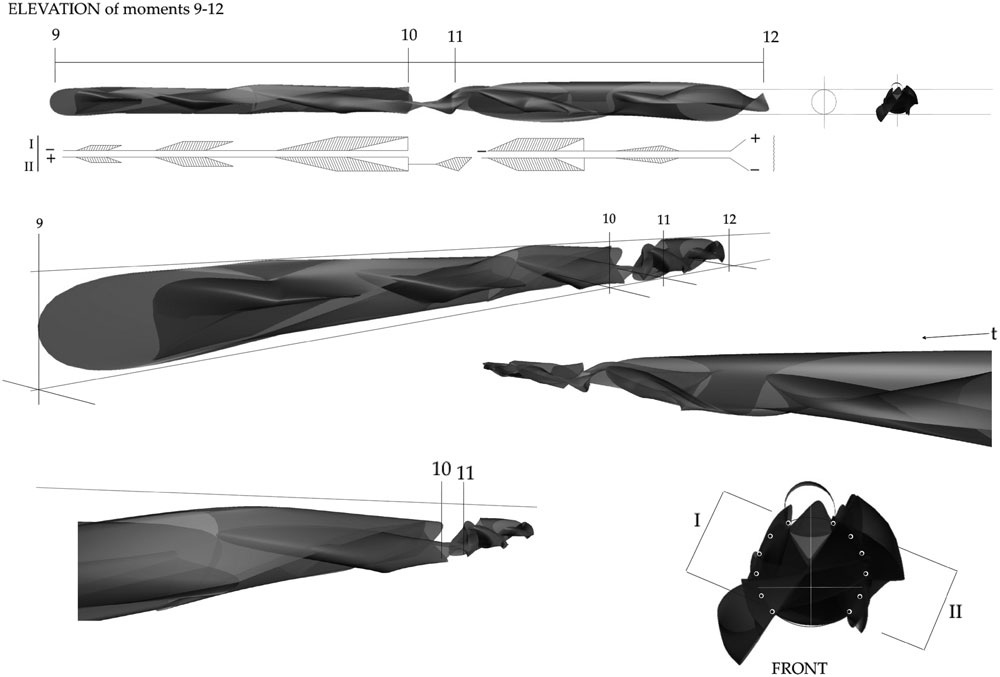
NURBS model of moments 9–12 of Pole für 2: front, elevation and perspective viewpoints.
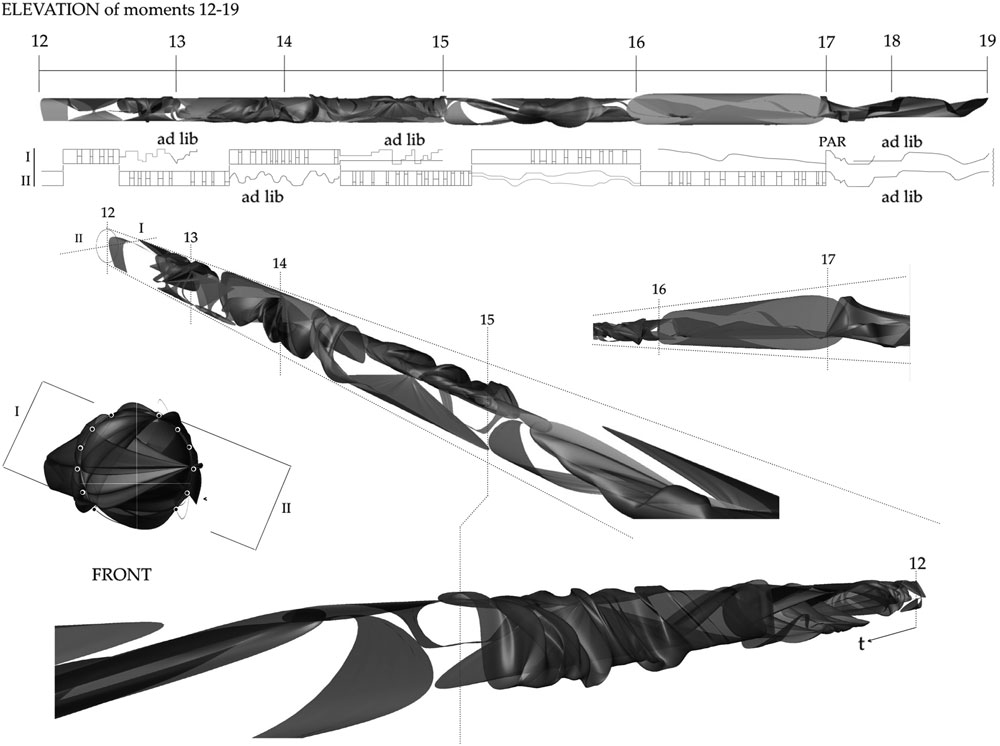
NURBS model of moments 12–19 of Pole für 2: front, elevation and perspective viewpoints.
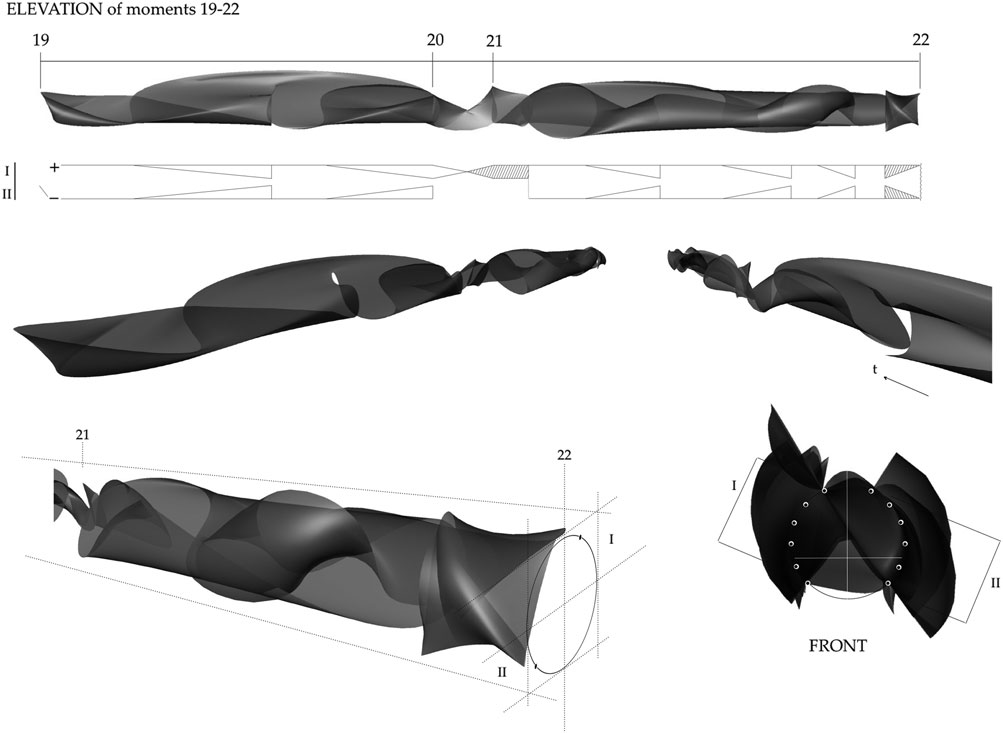
NURBS model of moments 19–22 of Pole für 2: front, elevation and perspective viewpoints.
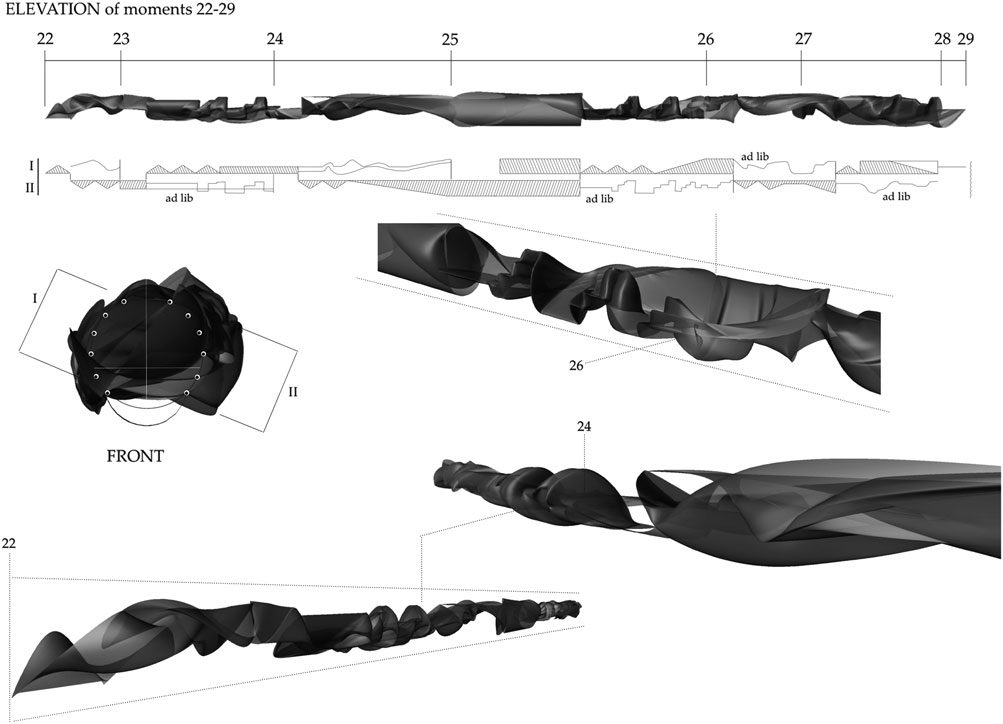
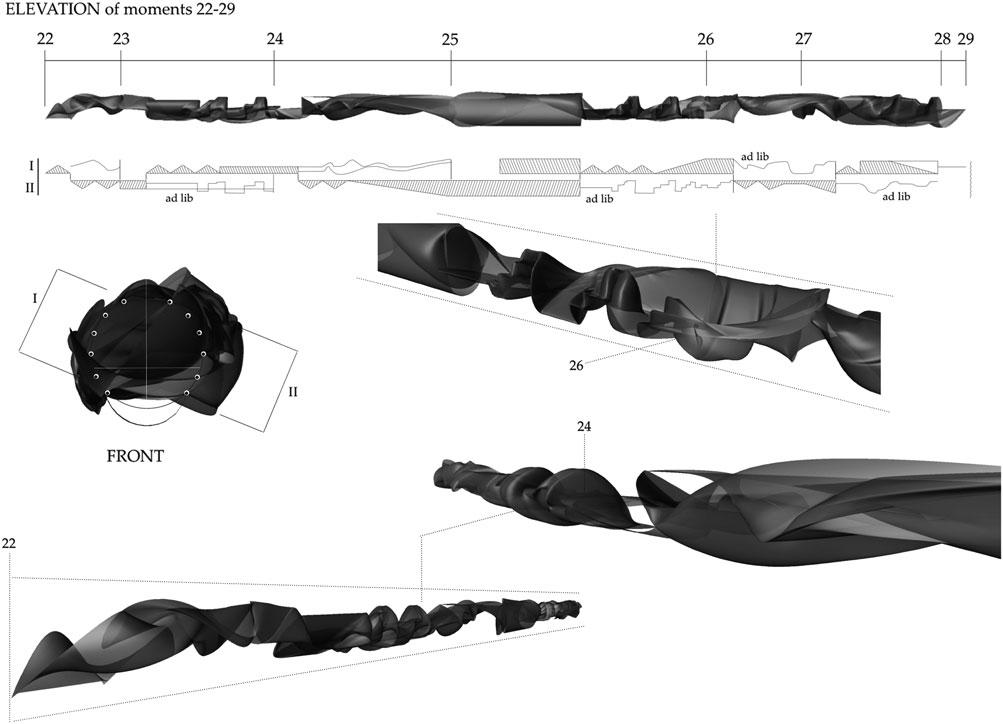
NURBS model of moments 22–29 of Pole für 2: front, elevation and perspective viewpoints.
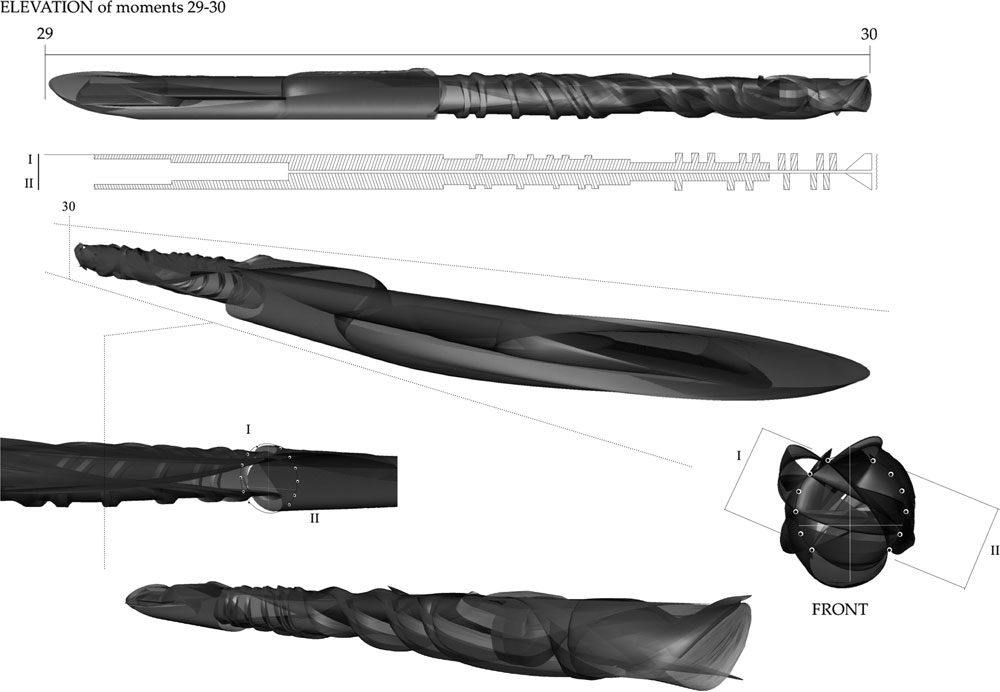
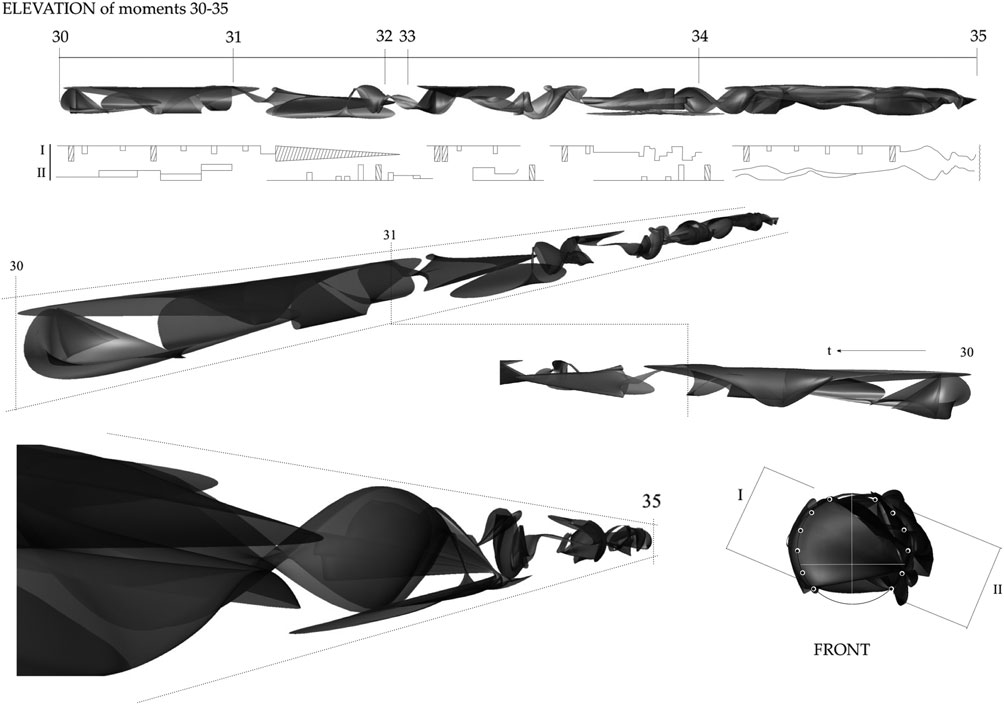
NURBS model of moments 29–30 of Pole für 2: front, elevation and perspective viewpoints.
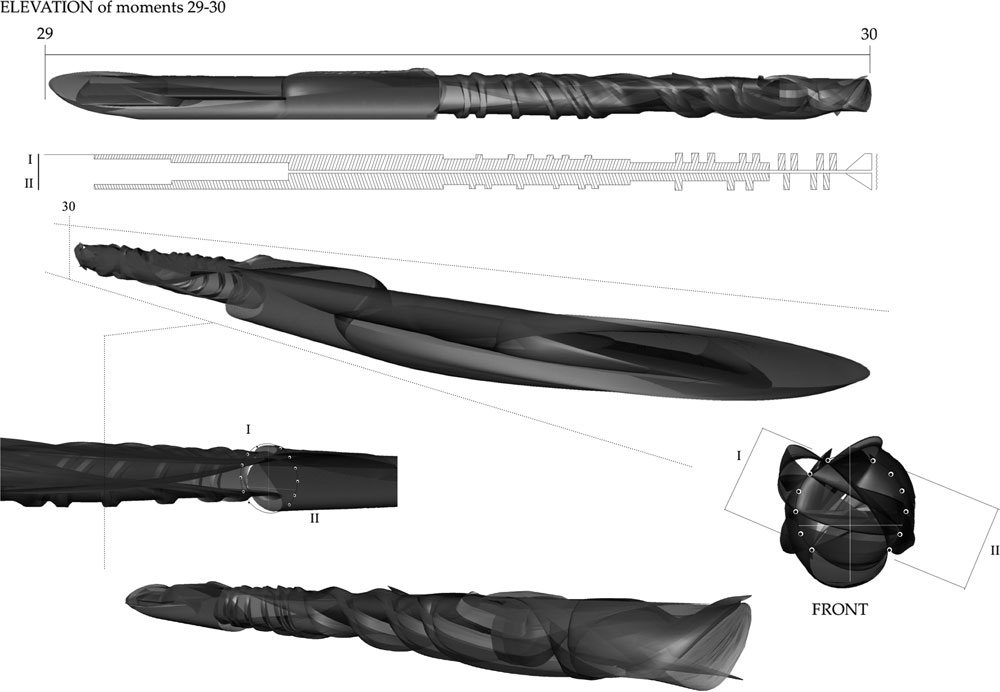
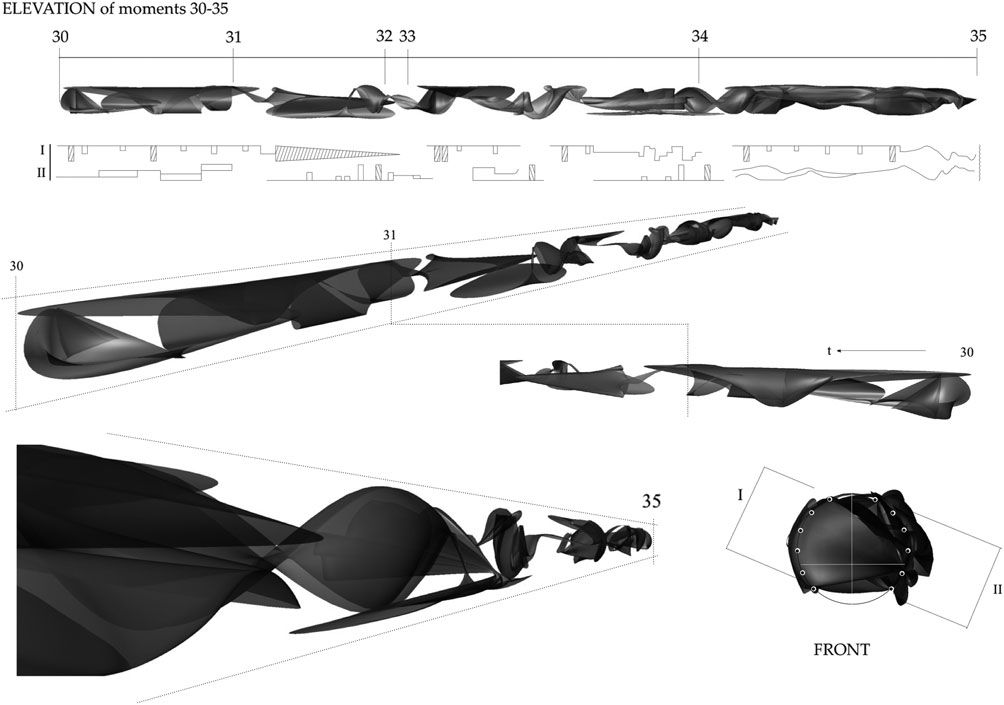
NURBS model of moments 30–35 of Pole für 2: front, elevation and perspective viewpoints.
• complex (an embellished, fragmented, discontinuous state); and a
• simplex (a planar, flowing, continuous state).
A further examination of these distinct formal typologies reveals a localised set of surface characteristics. By tracing the surface articulations of the models, three discernable parameters can be used to describe the two states of a surface through its:
• manifold (degree of surface uniformity/intersection);
• volume (the flux of void spaces); and
• envelope (the degree of topological variation).
By inverting Stockhausen’s schematic approach to composition in Pole, whereby generalised musical parameters serve to drive the flux in the musical form, here I suggest three spatial parameters to track the flux in the architectonic form.
Manifold refers to the surface, or surfaces, created from the Rhinoceros lofting algorithm, and uniformity (continuity) by the surface that extends across the leading edge of the object. For moments 1–9 (figure 5), 9–12 (figure 6) and 19–22 (figure 8), the obvious visual congruency between the models is a manifestation of the gradual spatial transitions of the sound projection structure within these sections. Only occasional brief interruptions in this uniform unfolding of architectonic structure occur (for example, moments 4–5, figure 5). For each of these sections, loudspeaker fields for each player open gradually in time, reducing any sense of spatiotemporal fragmentation. Similarly, because the line of symmetry is located at the listener level, a relatively uniform manifold is produced.
Volume can be defined in terms of enclosure, or degree of interiority present within a model. Whereas the nature of the moments 1–9 present few, if any chances for the auditorium’s loudspeaker walls to be active simultaneously in both hemispheres across all layers, moments 12–19 (figure 7) and 29–30 (figure 10) are primarily concerned with the extended use of the loudspeaker walls as a continual presence. At moments 25 and 29, a complete sustained opening of the entire loudspeaker field of the auditorium occurs, articulating Pole’s point of maximal sound-surface area.
For understanding envelope, I primarily mean the deviations within the y-axis of the models’ surfaces or spatiotemporal edges when read in elevation. This is a measure of the flux density of the loudspeaker wall, and its relative surface area. In moments 9–12 and 19–22, for example, the evidence of uniform, simple edges, and gradual openings in the loudspeaker fields by layers cause the subsequent deviations in envelope to be restrained and subtle.
What becomes clear, then, in the Rhinoceros models is the intimate nexus of surface as a function of structure. In spite of the manner in which the lofting algorithm of the sound projection geometries causes a further composing out, and slight embellishment to the skeleton of the models,Footnote 5 the overall manifestation of spatial dynamics inherent in the sound projection score becomes mapped within the models. Examining them more closely reveals that Stockhausen’s underlying sound projection geometries are highly varied. It appears that extending the normative temporal considerations of musical form into a three-dimensional case enables Stockhausen to continually reconstruct the architectural scale of the listening environment. This becomes a means, then, for Stockhausen to evoke and recall distinct spatial auditory experiences within a work potentially using connections and transformations in music-space to drive articulations of the interior. It is in this context that Stockhausen becomes progenitor of the spatiotemporal architectonic object, acting in a fashion akin to Barry Blesser’s notion of the aural architect (Blesser Reference Blesser2007).
4.1. Morphology
In Pole’s opening section (moments 1–9, figure 5), Stockhausen’s sound projection design situates the source of player I at the extreme opposite state to player II. This immediately creates an aural environment in which the rest of the section may comfortably explore the myriad states or transitions between these poles. It similarly accentuates the nature of the work’s title in an aurally arresting fashion. The section operates through a linear exploration of the auditorium’s interior with only a small appearance of a complete loudspeaker field occurring in moment 5. This linearity features heavily in the section, and, in terms of the typology, section 1 is a complete and contained spatial exploration that operates on inverse vertical engagements between the players’ sound diffusion patterns.
The interconnection and transition between the architectonic typologies in Pole can be further investigated through an examination of the relationship between the NURBS models of section 1 and section 2. The smooth continuities between moments established in the majority of section 1 are similarly present in section 2, though now somewhat more embellished. The projection score again relies on secure, distinct edges of the loudspeaker walls being present in section 2, but expands the transitions initiated in section 1 through sound-field expansion/contractions, rather than a linear trajectory of movement.
The use of field transitions consequently creates voids, and therefore containment (volume), such that the morphology of section 1 through section 2 is manufactured through a spatial transformation for which the typology remains a constant simplex, though the move from linear trajectory to surface fields produces some manifold aberrations. A likewise simplex typology is also present in section 4 (moments 19–22, figure 8). Here, there is reference to the linear trajectories of movement up and down the sound wall hemispheres for each player, as in section 1, though Stockhausen slightly elaborates the process by anchoring each player’s sound projection geometry to the loudspeaker wall’s polar extremities. Again, in reference to section 1, some appearances of surface fields occur (for example within moment 21), in addition to the creation of a volume via the model’s encapsulating manifold.
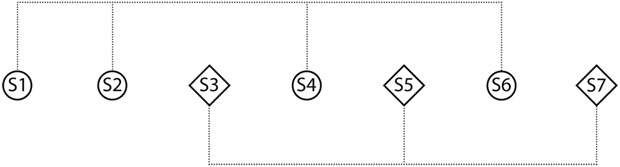
The visualised spatial processes of Pole become even clearer through an examination of the interleaving morphology between sections 1, 2, 4 and 6 compared to sections 3, 5 and 7 (see figure 12). By section 3 (moments 12–19, figure 7), the geometry of the model has progressed into a seemingly fragmentary episode. Here, the manifold has become discontinuous, though due to the nature of the sound projection geometry the degree of containment has increased dramatically in addition to the complexity of the envelope. The change in typology has seen the envelope of the model become activated in a way that is reflected in the original sound projection score – section 3 is primarily governed by the exploration of individual layers of the loudspeaker circles within the auditorium. The ostensive spatial processes within the projection score here, then, are concerned with both a definition of the extremities of the loudspeaker walls (as in section 1 and 4), and the opening of intermediate layers in both hemispheres in a quasi-pointillist fashion. This approach is further augmented with free, linear trajectories of sound throughout the entire loudspeaker walls (marked by Stockhausen as ad lib. trajectories). The model’s resulting folds, and non-uniform deformations across the surface are in stark contrast to the previous section (figure 6), where loudspeaker fields for each player open gradually and uniformly in time. Indeed, section 3 is primarily an exploration of spatial embellishment, both perhaps as an immediate contrastive device, and as a new process to actuate the continued spatial morphology of Pole.
Typological states derived from six NURBS models of Pole für 2, where S1 = moments 1–9; S2 = moments 9–12; S3 = moments 12–19; S4 = moments 19–22; S5 = moments 22–29; and S6 = moments 30–35.

This transition in the typology of the NURBS models (between complex and simplex forms of spatial composition) also further connects the processes of the final two complex sections (5 and 7) to the previous processes of section 3. In section 5 (moments 22–29, figures 9 and 15), a combination of the spatial transformation used in the first three sections is incorporated into the sound projection schema. The resulting model shows signs of volume and encapsulation (at moment 25, one of the spatial maxima of Pole), complex envelope shape and development through stepwise layer movements (for example, as in moment 23), and a relatively continuous manifold created by the hemispherical combination of linear trajectories and larger explorations of the loudspeaker walls.
For the final section (section 7; moments 30–35; figure 11), Stockhausen’s projection score again points to previous techniques. By referencing the pointillist technique of section 3 in a manner that uses an exploration of the surface as the equivalent of an architectonic structure, varying layers of the sound-surface are momentarily revealed at myriad depths, both in a linear fashion and as a field. The resulting envelope creates a fragmentary surface that is discontinuous. The further use of free linear trajectories in combination with diffusion fields briefly allows for volumes of containment across the model, though in contrast to the relatively few stable areas of the surface (for example, moments 30 and 34) the envelope sustains a complexity not seen in any of the other sections.
Stockhausen’s vacillation between using the auditorium’s loudspeaker infrastructure to create sonorous sub-regions, or for the dynamic linear movement of point sources, is the key feature most readily visualised and mapped in the NURBS models described here. The models readily reveal tautness between sections within Pole because of the way in which spatial processes are engaged from earlier established moments. The complexity of the transmediated sound projection manifold reaches an apogee in sections 3, 5 and 7, though it is true that within any given section a process of spatial development is readily detectable, however subtle. Stockhausen’s design approach thus establishes an identifiable relational framework for spatial transformations across the complete unfolding of Pole. Through the NURBS models, a transmediation of the micro and macro form classes inherent in the sound projection score’s geometry is revealed. Additionally, they document the composer’s seeming use of musical devices such as recapitulation, embellishment and dynamic contrasts to build momentary aural architectures as articulations of the interior acoustic space.
5. Non-standard architectures
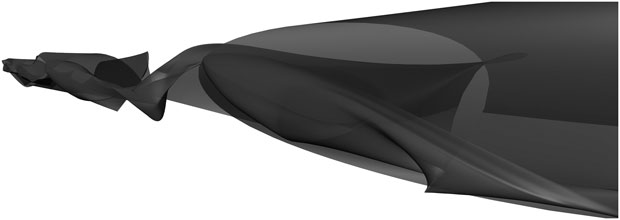
It may seem like a striking irony that in spite of Bornemann’s triumphant success at negating the superficialities of the traditions of World’s Fair pavilion designs, a complex architectonic series of forms has emerged from this study. But, as the auditory experience of a work like Pole lies very much in the listener’s ability to comprehend momentary acoustic structures, the NURBS modelling of sound projection geometries presented here are not intended to capture nor account for any of those more complex aspects of auditory spatiality. What such modelling can achieve, though, is the hitherto unexplored nature of sound projection as a three-dimensional process capable of generating ephemeral architectonic structures visualised within a site context (see manifold details in figures 13–19). Even when this context becomes abstracted through the use of a section-template, the nature of the sound projection geometries within Pole can be immediately recognised as ones that, when transmediated, reveal inherent three-dimensional spatial processes and typologies.
Karlheinz Stockhausen, Pole für 2, NURBS model showing perspective detail of moments 30–35.

Karlheinz Stockhausen, Pole für 2, NURBS model showing perspective view of moments 1–9.

Karlheinz Stockhausen, Pole für 2, NURBS model showing perspective detail of moments 22–29.

Karlheinz Stockhausen, Pole für 2, NURBS model showing perspective detail of moments 29–30.
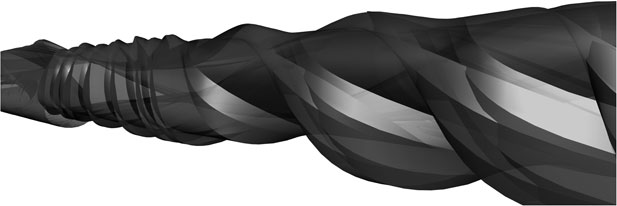
Karlheinz Stockhausen, Pole für 2, NURBS model showing perspective detail of moments 12–19.

Karlheinz Stockhausen, Pole für 2, NURBS model showing perspective detail of moments 9–12.
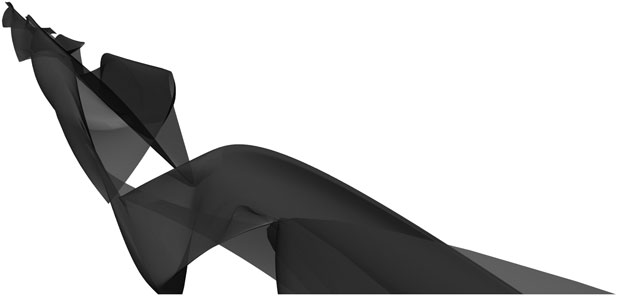
Karlheinz Stockhausen, Pole für 2, NURBS model showing perspective detail of moments 19–22.
It is Stockhausen’s structural considerations, then, that naturally become three-dimensional in Pole, where the spatial projection of music into tangible space takes on qualities of an ephemeral non-standard architecture. In such an ephemeral architecture gesture, line and sound-surface become spatial elements, that when configured and strategically combined recall, develop and embody the auditorium’s physical structure with an aurally produced equivalent. But the works composed specifically for Osaka also mark a beginning point for Stockhausen’s championing of the role of Klangmeister. For works such as Pole, Spiral and Expo the sound projectionist becomes a second, third or fourth performer, crafting the acoustic space in a similar manner in which the instrumentalists or singers craft musical space.
But in spite of the seemingly innovative synthesis achieved between architectonic concepts and electroacoustic strategies at Osaka by Stockhausen and Bornemann, architectural designers utilising spatial auditory information have yet still to establish a similar paradigm that at once squarely challenges the traditional approach of acoustic engineering within the built environment. Moreover, contemporary attempts at the translation of music into architecture have revealed how the superficial use of generalised musical parameters for proportional relationships within architecture are not particularly convincing.Footnote 6 Robert Benson’s call for a new spatiality in architecture in which temporality becomes a catalyst for new design explorations seems closely aligned with Stockhausen’s spatial collaborative aesthetic:
But it seems to me that we much more desperately need a new perception of space that suggests a heightened sense of time and existence, that accounts for the totality of the human being as a thinking, feeling and willing creature in a world of more than three dimensions. This would be the most liberating instrumentality imaginable for contemporary architecture because it would establish a frame of reference against which we could measure, and by means of which we could control the ever-changing and ephemeral aspects of information. (Benson Reference Benson1987: 6–7)
Similarly, Stockhausen, as progenitor of Barry Blesser’s notion of the aural architect (Blesser Reference Blesser2007) finds a resonance in the composer’s exploration of sound-space, though for Stockhausen design and spatiality were used as a means to express the aesthetics of an extended musical system, rather than for the design of architecture for human inhabitation. But, nonetheless, Blesser’s sense of the potential of aural architecture to unify the disciplines of music and architecture through the act of spatial composition are innovative, and particularly pertinent for his conception of music as a generator of three-dimensional sound objects:
The composer must explore the nature of three-dimensional space in the same way that he extended the nature of timbre space. Because space is now an explicit, rather than implicit, artistic dimension, equivalent to a set of new musical instruments, it will take many generations for it to be refined and accepted. It will be a future cultural norm. (Blesser Reference Blesser2001: 867–903)
6. Conclusions
My initial intentions for the use of NURBS modelling of sound projection geometry in Stockhausen’s Pole was to generate a digital proto-architecture that utilised a novel approach to form generation while retaining a close contact to the nature of architectural modelling as a means for design research. In architectural terms, the models are more like design exercises than representations of a resolved structure. But being in this state makes them valuable as analytic design tools for visualising the inherent spatial processes within Pole. The method by which they have been constructed – that is, as digital negotiations of virtual space – allude in some fashion to the intangible nature of sound projection, and the difficulties of representing sound geometries in visual, architectonic terms. But, because of the allowance for deviations of surface form through the closed lofting algorithms in Rhinoceros, the transmediation of the sound projection score of Pole has ultimately enabled a series of models to serve as an artefact of the nexus of praxis between architectural considerations of spatiality and musical conceptions of transformation.