1. Introduction
The familiar question of “What do we know when we know a language?” requires a new perspective when we consider the case of receptive bilinguals: “What do we know when we (sort of) know a language but don't speak it?” This study examines intuitions about morphosyntactic well-formedness in heritage receptive bilinguals. The label of heritage speakers pertains to language acquisition history, referring to individuals exposed from childhood, by family transmission, to a minority language that they acquire, often in an incomplete manner (Valdes, Reference Valdes2000). Receptive bilingualism (also termed “passive bilingualism”) refers to language proficiency at the extreme of asymmetric bilingualism, where an individual is fully fluent in one language, but demonstrates only receptive competence (i.e., comprehension without production) in the other. Receptive bilingualism results from attrition or incomplete acquisition in either L1 or L2 (we distinguish L1 and L2 as pertaining to the order of acquisition, regardless of proficiency).
Receptive bilingualism is a common scenario in heritage or minority languages, such as spoken by the immigrant and indigenous communities of North America. We investigate the case of Labrador Inuttitut, an endangered dialect of InuktitutFootnote 1 (Andersen & Johns, Reference Andersen and Johns2005). In Labrador Inuit communities, both Inuttitut and English are spoken, but many residents have only partially acquired Inuttitut (and/or lost previously acquired abilities in Inuttitut), even though most of them were exposed to Inuttitut from birth or early childhood, either as the only language or simultaneously with English. Some such individuals report good comprehension skills in Inuttitut, including the ability to translate it into English, but no ability to produce speech in Inuttitut beyond isolated words and common expressions. They seem to be bilinguals in speech comprehension, but monolinguals in speech production.
We seek to examine the nature of language knowledge in these receptive bilinguals (RBs). Is grammar part of the language knowledge in radically asymmetric bilingualism? Does RBs’ professed ability to “understand everything” include some knowledge of morphosyntactic patterns? Or, on the contrary, is their comprehension based on vocabulary knowledge coupled with extensive use of context in familiar situations, in the absence of actual grammar? The present study focuses on morphemes required for syntactic well-formedness, but with limited interpretive value, restricted to certain contexts. To examine RBs’ awareness of the basic components of their receptive language, we test their ability to detect structural violations involving agreement, case and the relative ordering of morphemes.
Between the two extreme possibilities, one of specific production deficits coupled with intact grammar, and the second of receptive vocabulary working alongside the ability to interpret familiar situations and contexts, but no actual grammar, an intermediate characterization is the most plausible scenario. RBs may possess differentially affected grammatical competence, as is the case of heritage bilinguals with speaking abilities, where certain grammatical properties appear to be missing, simplified or reanalyzed (Montrul, Reference Montrul2002a, Reference Montrul, Schmid, Köpke, Keijzer and Weilemarb, Reference Montrul2004; Polinsky, Reference Polinsky2006a; Polinsky & Kagan, Reference Polinsky and Kagan2007).
In this article, we first present a discussion of dysfluent bilingualism in general, followed by a brief overview of the relevant properties of Labrador Inuttitut. We then report a study on the language history of receptive bilinguals, their language use and their assessment of language skills, followed by an untimed sentence comparison study testing whether RBs are sensitive to morphosyntactic violations in their receptive language. Last, we discuss the implications of our findings for the psycholinguistics of bilingualism and for language revitalization.
2. Dysfluent bilingualism
2.1 Incomplete grammars
Work on the weaker language of bilinguals has emerged as part of a body of research on the characteristics of grammar in various bilingual populations and the role of transfer and dominance: bilingual children (Meisel, Reference Meisel2007; Yip & Matthews, Reference Yip and Matthews2000), second language learners in contrast with heritage speakers (Cuza, Reference Cuza2008; Montrul Reference Montrul, Schmid, Köpke, Keijzer and Weilemar2002b, Reference Montrul2005) and those whose L1 underwent attrition (Köpke, Schmid, Keijzer & Dostert, Reference Köpke, Schmid, Keijzer and Dostert2007; Schmid, Köpke, Keijzer & Weilemar, Reference Schmid, Köpke, Keijzer and Weilemar2004). The general observation is that different kinds of bilingual experience correspond to specific outcomes in terms of grammatical knowledge.
Bilingual language experience has several components: order of acquisition, age of onset of exposure for each language, amount of exposure, maintenance, and length and age of interruptions of exposure. Bilingual populations thus show immense variation, but there is consensus that low levels of exposure are often associated with low proficiency, via either incomplete acquisition or attrition. At the lower end of the L1 proficiency continuum, two main types of dysfluent bilinguals have been investigated. One includes low- to intermediate-proficiency speakers with incomplete grammars, with both receptive and productive abilities, although limited. The other type includes speakers with low exposure to the language who did not acquire it, known as overhearers.
For heritage speakers, the grammar of their weak language is systematically different from that of fluent speakers of that language. Those whose language underwent attrition and incomplete learners show similar patterns of deviance from the baseline language, but the two populations may differ (Montrul, Reference Montrul2002a, Reference Montrul, Schmid, Köpke, Keijzer and Weilemarb; Polinsky, Reference Polinsky2007a, Reference Polinskyb). In both cases, morphosyntactic deficits in speech production typically include loss of grammatical contrasts, functional omissions, reduction in allomorphic variation and shift in preferences towards rigid word order, analytic forms and periphrastic constructions (Andersen, Reference Andersen, Lambert and Freed1982; Bullock & Toribio, Reference Bullock, Toribio, Gess and Arteaga2006; Hagen & de Bot, Reference Hagen and de Bot1990; Maher, Reference Maher, Seliger and Vago1991; Polinsky, Reference Polinsky2006a, Reference Polinskyb; Schmid, Reference Schmid2002). Some of these deficits (loss of or change in grammatical contrasts, ignoring functional morphemes) have also been found in comprehension and grammaticality judgment studies (Montrul, Reference Montrul2002a; Polinsky, Reference Polinsky2007b, Reference Polinsky, Antonenko, Bailyn and Bethin2008; Polinsky & Kagan, Reference Polinsky and Kagan2007).
Data on low-proficiency heritage Russian speakers in the USA reveal problems with a wide range of areas in production (Polinsky, Reference Polinsky2006a). Case and aspect were reanalyzed (simplified), and certain distinctions were lost; for example, some speakers retained only the structural cases, others only the most unmarked case. In lieu of the flexible word order characteristic of Russian, heritage speakers produced almost exclusively SV(O). These findings support observations of recurrent structural similarities across heritage languages, as discussed in Polinsky and Kagan (Reference Polinsky and Kagan2007). In comprehension (Polinsky, Reference Polinsky2007b, Reference Polinsky, Antonenko, Bailyn and Bethin2008), Russian heritage speakers had difficulties identifying heads of relative clauses (especially object relative clauses), and agents and patients in passives. These speakers appear to disregard morphological cues in comprehension. Polinsky (Reference Polinsky2006a) includes data on grammaticality judgments as part of interviews with low-proficiency heritage speakers of Russian. They were generally not sensitive to grammar violations, either accepting all sentences, or not answering. Sensitivity was present only for basic rules such as those involving subject–verb agreement and negation. Speakers who had fully acquired Russian before undergoing attrition were qualitatively different from those whose acquisition of Russian was interrupted.
Well beyond these low-proficiency cases is the case of childhood overhearers, who grew up hearing a language regularly during childhood, but who never communicated in that language. A few existing studies have explored whether overhearers have any advantages when learning that language at a later point. Au, Knightly, Jun and Oh (Reference Au, Knightly, Jun and Oh2002) tested childhood overhearers of Spanish, who later in adolescence started learning Spanish at school, then continued at university. Compared to novice learners who did not have exposure to Spanish until the start of instruction, overhearers had more target-like phonological production, but no advantage in morphosyntax, measured in the production of number and gender agreement in DPs and in grammaticality judgments. Apart from testing their knowledge of “childhood slang”, there was no systematic assessment of comprehension abilities at the outset. The authors also note that pure overhearers are difficult to find, and that their subjects could typically say some words and common phrases in Spanish. One can infer that the overhearers in that study were not receptive bilinguals before learning Spanish in the classroom, but there exist other documented cases of overhearers who developed receptive knowledge of the overheard language (Schlegel, Reference Schlegel2004).
While there are no studies on adult heritage speakers or attrition of Inuktitut, work on the acquisition of Inuktitut as a minority language in Arctic Quebec (where Inuktitut is much better maintained than in Labrador) shows the features of successful acquisition in childhood in these communities, and some links between language success and community size. Allen, Crago and Pesco (Reference Allen, Crago and Pesco2006) compared narrations in Inuktitut by elementary and middle school students, and adults, in large and in small Inuit communities. Older students made fewer errors and used more words, but there was no difference in grammatical complexity (mean word length in morphemes) between eighth-graders to third-graders, while adults’ narratives showed higher complexity. Interestingly, the most common errors in the adolescent group were incorrect case marking (especially the use of locative instead of allative) and using the plural person marker on the verb instead of the dual. Finally, children from small communities performed better than children from large communities, presumably because of the reduced presence of English and/or French in these smaller communities.
2.2 Language shift and receptive bilingualism among Labrador Inuit
Our study took place in Nain, one of the small Inuit communities in Nunatsiavut (and its administrative capital), the Inuit autonomous area in the province of Newfoundland and Labrador, Canada. In Nunatsiavut, a reduction in the transmission of the local language has increasingly been taking place. Most Nain residents are Inuit or of mixed Inuit–European heritage, descendants of European settlers who came to live among Labrador Inuit generations ago, adopted the Inuit way of life and married Inuit (Johns & Mazurkewich, Reference Johns, Mazurkewich, Hinton and Hale2001). In the late 1700s, Moravian missionaries, who already spoke the West Greenlandic dialect of Inuktitut, established mission stations in Labrador. Inuit children were educated in Labrador Inuttitut, while settler children were educated in English. When the province joined Canada in 1949, English became the obligatory language of instruction, replacing Inuttitut in the school system (Johns & Mazurkewich, Reference Johns, Mazurkewich, Hinton and Hale2001).
Early contact with Europeans and assimilation policies led to the decline of Labrador Inuttitut. Currently, Inuttitut in Nain is not used as much as local Inuktitut dialects in other regions, such as Nunavik (Arctic Quebec) or Nunavut. According to Statistics Canada, only 26.6% of Labrador Inuit reported knowledge of Inuttitut in 2006, compared to 90% in Nunavut and 99% in Nunavik. English dominates in all spheres in Nunatsiavut. With the exception of some elders, most residents can speak English. In contrast, many are not fluent in Inuttitut or do not speak it at all, especially within the younger generations. Most fluent speakers of Inuttitut are over 35 (Andersen & Johns, Reference Andersen and Johns2005). A language survey in Labrador Inuit communities in 1999–2000 (Andersen, Reference Andersen2004) showed that only 15% of those who answered the survey had Inuttitut as their first language, and only 9.5% claimed to speak Inuttitut at home. In the language survey, 1.6% of the respondents reported that they only understand Inuttitut, but Andersen and Johns (Reference Andersen and Johns2005) suggest that this number may be greater. One difficult feature of Labrador Inuit communities has been the negative attitude of fluent speakers towards non-fluent speech in Inuttitut. In the past, older fluent speakers have been described as producing negative reactions to non-fluent speakers’ attempts to speak Inuttitut, so that non-fluent speakers reported being discouraged from trying. However, there are also indications that attitudes have recently been changing as community members realize how endangered their language is and learn to appreciate the effort that heritage speakers put into trying to communicate in the language.
Johns and Mazurkewich (Reference Johns, Mazurkewich, Hinton and Hale2001) describe a characteristic RB population among Labrador Inuit enrolled in Inuttitut language classes. Some students in these classes were described as having “extensive passive knowledge and even a wide vocabulary”, but lacking “the ability to make sentences in the language”. These students are ahead of L2 learners in the beginning, but fall behind later, when grammar is introduced.
2.3 The production–comprehension asymmetries
How is it possible for individuals to comprehend but truly be unable to speak? Speech production and speech comprehension rely on the same linguistic knowledge but are different processes. In psycholinguistic experiments, reaction times are typically longer and error rates higher for production tasks. Within any language an individual speaks, comprehension vocabulary is larger than productive vocabulary (Laufer, Reference Laufer1998; Laufer & Paribakht, Reference Laufer and Paribakht1998). In early language development, preferential looking studies have shown that young babies have sensitivity to word order and certain morphological forms before they are able to produce multiword utterances (Golinkoff, Hirsh-Pasek, & Schweisguth, Reference Golinkoff, Hirsh-Pasek, Schweisguth, Weissenborn and Hoehle2001; Hirsh-Pasek & Golinkoff, Reference Hirsh-Pasek, Golinkoff, McDaniel, McKee and Cairns1996; and others). This is not to say that the asymmetry in child language acquisition is one-way only: production of certain categories, such as pronouns, can become adultlike before comprehension (see Hendriks & Spenader, Reference Hendriks and Spenader2006).
This asymmetry is evident in bilingual lexical processing. In L2 lexical processing, it is easier to translate words from a non-dominant L2 to L1 than the reverse. Data indicate that reaction times are shorter, and fewer errors are made (De Groot & Keijzer, Reference De Groot and Keijzer2000; Kroll & Dussias, Reference Kroll, Dussias, Bhatia and Ritchie2004), This indicates that it is less costly to recognize a word from the weaker language in comprehension than to retrieve that word for production.
There is also evidence that comprehension and production may be asymmetrically affected in language attrition, so that production skills are more affected than comprehension skills. Ammerlaan (Reference Ammerlaan1996) and Hulsen (Reference Hulsen2000) found evidence of such asymmetries in lexical retrieval. Finally, heritage speakers tend to have better listening than speaking skills (Polinsky & Kagan, Reference Polinsky and Kagan2007, inter alia). However, these studies are on bilinguals that have some degree of speaking proficiency, and leave open the question of how far a comprehension–production asymmetry can go in bilinguals. Will a speaker without production still possess intuitions about the structure of utterances? To what extent are intuitions intact, and to what extent do they show deficits?
3. Core features of Labrador Inuttitut grammar
A great deal of attention has been given recently to the question of domain vulnerability in transfer and attrition in bilinguals. Which aspects of the grammar of Labrador Inuttitut might be retained, if any, in a population of non-speaking comprehenders of the language? Given our focus on the lowest extreme of language knowledge, we concentrate on properties that are central to clausal structure and frequent in input, such as agreement, case and tense. Previous studies on attrition suggest that even such central properties of grammar can be subject to processes of language loss. Subject–verb agreement and case marking are often affected to various degrees, more in incomplete acquisition (Polinsky, Reference Polinsky2006a, Reference Polinsky2007a, Reference Polinsky, Antonenko, Bailyn and Bethin2008) and child language attrition (Anderson, Reference Anderson2001; Bolonyai, Reference Bolonyai2000, Reference Bolonyai2002), less in adult attrition (Levine, Reference Levine2000; Pelc, Reference Pelc2002; Schmid, Reference Schmid2002; Schmitt, Reference Schmitt, Schmid, Köpke, Keijzer and Weilemar2004), with patterns of omission and use of incorrect markers. Allen et al. (Reference Allen, Crago and Pesco2006) show that case and agreement can be affected even in high-proficiency incomplete acquisition in Inuktitut. Finally, word order is another relevant domain of inquiry, since loss of word order flexibility has been found in heritage speakers (Polinsky, Reference Polinsky2006a).
It is not clear to what extent predictions can be made across language types. Labrador Inuttitut is a dialect of Inuktitut, a member of the Eskimo-Aleut family and thus a polysynthetic language, with rich nominal and verbal morphology in an order of magnitude well beyond the most inflected European languages normally considered in bilingual studies. Word order in Labrador Inuttitut is syntactically free, but governed by information structure. In contrast, morpheme order within the word is only somewhat flexible, with some key restrictions. Within the verb, the order is roughly as follows:
(1) Root-(Manner)-(Aspect)-(Tense)-(Neg)-[Agr+Mood]
The root is the leftmost morpheme, and the portmanteau agreement+mood marker is the rightmost, followed only by sentential enclitics, such as -tauk “also, too”. The agreement+mood marker is the only portmanteau morpheme in the verb, as verbal morphemes (or combinations of morphemes) tend to have one function each, as is typical of agglutinative languages. Agreement+mood morphemes simultaneously encode number and person agreement with the subject (and, in some cases, object and subject combined), fused with mood (which encompasses clause type such as declarative, interrogative, imperative, as well as several kinds of dependent clause modalities). The agreement+mood morpheme has a rigidly fixed position and is syntactically obligatory: no verb can appear without it (Labrador Inuttitut does not have infinitives or any other non-agreeing forms). Morphemes between the root and the agreement+mood (tense, aspect, negation, manner, intensifiers and others), often called postbases in Inuktitut literature, are not obligatory for syntactic reasons, but are required to express certain meanings. A verb can have any number of such morphemes (as in (2)), or none at all (i.e., only a root and an agreement+mood marker, as in (3)).
(2) Ilinniavvi-mut pisu-Katta-lau-ngngi-langaFootnote 2 school-allative walk-iter.-dist.past-neg-1sg. neg.declFootnote 3
“I usually didn't walk to school”
(3) Pisu-ttuk
walk-3sg.part
“He is walking”
The order of postbases can sometimes vary, unlike the position of the agreement+mood morpheme. Changing the order of postbases results either in a different meaning, as the relative scope of postbases shifts (Fortescue, Reference Fortescue1980), or in ungrammaticality, depending on which postbases are involved. For example, negation always appears to the right of tense in Labrador Inuttitut; negation to the left of tense is ungrammatical. Other dialects allow this possibility (Barkey, Reference Barkey2008).
Therefore, in a language like Inuttitut, morpheme order would be a more relevant test of retention of the language. Morpheme order is here as important as the position of closed-class words in a sentence in languages with fixed word order. Most studies of incomplete acquisition and attrition involve non-agglutinative, non-polysynthetic languages, possessing much smaller inventories of morphemes that are assigned fixed positions within a word. Thus, we have no direct empirical source for predictions about the extent to which morpheme order can be affected in polysynthetic languages. However, differential sensitivity to ordering of Inuttitut morphemes could be predicted according to their status. Knowledge of the portmanteau agreement+mood morpheme, with its fixed position, inflectional properties and obligatory status, is less likely to be lost than other verbal suffixes, which might have variable positions within the verb.
We consider next grammatical case. Inuktitut in general is an ergative language, but Labrador Inuttitut tends to favour antipassive sentences, where case marking is very similar to the nominative–accusative pattern (Johns, Reference Johns2001). In such sentences, absolutive functions similarly to nominative, and the case used to mark the object of an antipassive sentence, to accusative. The latter case is often referred to as the -mik case (-mik is its singular form). The absolutive case marker is phonologically null for singular nouns.
(4) Johnny illu-mik taku-juk
Johnny-abs house-mik see-part.3sg
“Johnny sees a house”
Thus, the most basic cases in Inuttitut are absolutive, the -mik case (object case in antipassive constructions) and ergative; we speculate that these may have a better chance of being retained than others such as locative, allative, etc. Since the singular absolutive is a null form, it may be possible that such forms surface even if the speakers have not yet represented grammatical case as a category. The -mik object case may or may not be present in an incomplete grammar. If it is, it is possibly linked to proficiency, as happens to accusative in incomplete Russian (Polinsky, Reference Polinsky2006a). Ergative is likely to be difficult for these speakers, since it is less common in the Labrador dialect than in the other dialects of Inuktitut.
4. Method
4.1 Participants
Twenty residents of Nain, Labrador, responded to calls for speakers “who can understand but not speak” Inuttitut. In addition, eight fluent Inuttitut–English bilinguals participated as a control group. Participants responded to an orally presented questionnaire on language use, language skills and language history. An interview format was preferred to written or computer tasks, since the latter would not be considered culturally ideal or even appropriate for this population due to a lower level of formal education and computer skills.
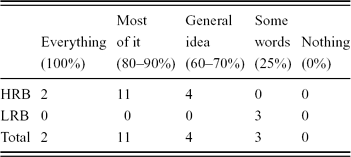
To assess the fit of these respondents to our study goals, we analyzed the data on participants’ self-assessment of their language comprehension and language production skills. When asked the question about how much they felt they understood, the participants were invited to select one of the following levels of comprehension: “everything”, “most of it”, “general idea”, “some words” or “nothing”. Some participants, in addition to choosing among these levels, also estimated their comprehension in terms of percentage of the input. Both types of reports are conflated in Table 1. Most speakers reported understanding most of what they hear, estimating their comprehension in the 80–90% range. Three participants behaved differently from others, describing themselves as having poor comprehension skills. These speakers, according to their self-assessment, understand about 25% of what they hear (or ‘some words’), do not always get the main idea and do not speak Inuttitut at all. On the basis of this split in the data, the participants were separated post-hoc into the high-competence receptive bilinguals (HRBs) and the low-competence receptive bilinguals (LRBs). The latter were treated as outliers, and their data is reported separately.
Self-assessment of comprehension skills.

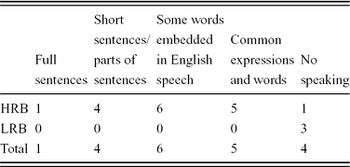
In terms of their assessment of their own speaking proficiency, as shown in Table 2, most of these participants reported having very limited speaking abilities. The three receptive bilinguals with low comprehension noted that they had no speaking abilities at all.
Self-assessment of production skills.

When RBs are addressed in Inuttitut, they usually reply in English (unless the answer is easy enough for them to produce). Eleven RBs (among those sixteen who reported productive abilities) reported that usually their production consisted of isolated words (that can be embedded in an English sentence) or common expressions. This is how one HRB in our study described her production in Inuttitut: “English and broken half Inuttitut in the middle. The main word . . . Could be like ‘play out’: let's go anenguak Footnote 4 ‘let's go play out’. . .”
“Difficulty putting words together” (i.e., producing phrases and sentences) was seen by the participants as the main obstacle to speech production in Inuttitut (rather than a small vocabulary or reaction of others).
The participants identified a variety of situations where they had current access to listening to Inuttitut: relatives (13), elders (9), home (8), radio (5), work (3). Ten were among the younger siblings in the family where parents and older siblings were speakers. Most of them (16) had received some Inuttitut instruction or otherwise participated in some instructional activity in Inuttitut, such as sewing classes. Neither of these characteristics had a clear impact on their bilingual assessment or performance in the grammaticality judgment test.
In terms of language history, five out of twenty participants were sequential learners who started learning English later than Inuttitut, but this only associated with small differences in their self-assessment or overall performance in the grammaticality judgment task. The language history interview revealed two major acquisition scenarios that led these participants to a current status as receptive bilinguals. One scenario is incomplete acquisition (from birth or later) – the case where a person never acquired Inuttitut completely and never produced speech in Inuttitut (except a few words), but only listened to speech in Inuttitut, possibly as an overhearer. The other type is interrupted acquisition accompanied by early attrition – the case where early childhood bilingual or monolingual speakers of Inuttitut shifted to English later (typically when they started school) and underwent severe attrition of the speaking skills they had acquired in Inuttitut. Ten HRBs and one LRB belonged to the first type, five HRBs and two LRBs to the second type, and two HRBs could not be categorized, because they could not remember if they ever were speakers or not. However, being a speaker in childhood or not had no clear effects on their performance in the grammaticality judgment task.
4.2 Materials
In order to test RBs’ morphosyntactic knowledge and sensitivity to violations of morphosyntactic rules, we conducted a comparative grammaticality judgment task, where RBs had to judge sentences presented in minimal pairs. Participants were asked to point out which sentence of the pair, if any, was bad, rather than judging one sentence at a time on a graded scale. The stimuli sentences differed only in the variable under consideration (in one morpheme or in morpheme/word order), either with both sentences grammatical, or one of them ungrammatical.Footnote 5 The goal of this feature was to reduce factors other than grammaticality that could cause speakers to accept or reject a sentence (Altenberg & Vago, Reference Altenberg, Vago, Schmid, Köpke, Keijzer and Weilemar2004).
Grammatical and ungrammatical sentences in our materials were generated with the assistance of fluent speakers of Inuttitut from the same community. These individuals are experienced language consultants, and their reported intuitions were subsequently validated by the answers of the eight fluent participants in the control group. These consultants were instructed to avoid any forms and phrases that were fixed expressions and could be stored as a whole.
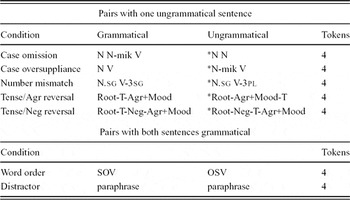
For this task, twenty-eight pairs of sentences were used, distributed in seven conditions, with four sentence pairs per condition. The first five conditions tested morphosyntactic violations, and contained one grammatical sentence and one ungrammatical, resulting from a minimal difference in one morpheme or the order of two morphemes. Conditions 1–2 involve nominal case, and conditions 3–5 involve verbal morphology, the domains established as vulnerable in attrition studies. In condition 6 (word order) and the distractor condition, both sentences in each pair are grammatical, and could be considered as syntactic or lexical paraphrases of each other.
The order of sentences within pairs was counterbalanced. In each condition with ungrammatical sentences, relative order of presentation of the grammatical and the ungrammatical token was balanced across items. In the word order condition, two pairs started with SOV, and two with OSV.
A pre-test was performed on the materials in order to determine the degree of ungrammaticality. A fluent speaker was presented with the pairs of sentences used in the test, and asked to judge whether an ungrammatical sentence was slightly worse or much worse than its grammatical counterpart (the study participants reacted negatively to this request, becoming impatient, so it was removed from the actual study). All instances of tense and agreement+mood reversal were judged as a severe violation, while tense and negation reversal together with both conditions involving case were judged inconsistently (sometimes as “slightly worse”, sometimes as “much worse”). Finally, number agreement mismatch was judged as a less severe violation.
In the first condition, case marker omission, the -mik case morpheme is present on the direct object DP in the grammatical sentence and missing in the ungrammatical one. The purpose of this condition was to test whether RBs are sensitive to case morphology, and specifically, to case omission: Do they notice when a required morpheme is missing? In the sentences used in the case omission condition, -mik is not necessary to identify the theta-roles of the arguments, because the sentences are constructed so that theta-roles can be recovered from the animacy of the nominals involved. The grammatical sentence contains the subject DP in absolutive and the object DP in the -mik case. In the ungrammatical sentence, both DPs have the zero morpheme, i.e., the absolutive form is target but the -mik morpheme is missing on the second DP.
(5) -mik case marker omission
a. Grammatical: N N-mik V
Johnny illu-mik taku-juk
Johnny-abs house-MIK see-part.3sg
“Johnny sees a house”
b. Ungrammatical: *N N V
*Johnny illuk taku-juk
Johnny-abs house-ABS see-part.3sg
The second condition, -mik case oversuppliance, tests sensitivity to case morphology in a different way. It targets the possibility that when RBs hear a pair of sentences in which one sentence has the -mik morpheme where the other does not, they might accept the one with -mik even without knowing what this morpheme is, on the basis of a general preference for more morphologically complex forms. However, if they know what the function of -mik is, they should be able to correctly reject it when it appears in the wrong environment. In the case oversuppliance condition, verbs have intransitive agreement and are actually intransitive. The subject in the grammatical sentence is in the absolutive case (i.e., the zero form). In the ungrammatical token, this subject appears with the -mik case, making the sentence uninterpretable.
(6) -mik case marker oversuppliance
a. Grammatical: N V
Angutik iju-juk.
man-ABS laugh-part.3sg
“A man is laughing”
b. Ungrammatical: *N-mik V
*Anguti-mik iju-juk
man-MIK laugh-part.3sg
The third condition, number agreement mismatch, contained pairs of sentences that differed only in the form of the agreement+mood marker. This condition aims to test sensitivity to agreement morphemes when they do not contribute to interpretation but simply agree with the subject argument. The question here is whether RBs pay attention to feature mismatches between the subject and the agreement morpheme. All sentences in this condition have a third person singular subject, and the verb in the grammatical sentence is also in the third person singular (participial mood, intransitive agreement). In the ungrammatical sentence, the verb appears in the third person plural.
(7) Number mismatch in subject–verb agreement
a. Grammatical: N-sg V-3sg
Sugusik sini-juk
child-abs sleep-part.3SG
“The/a child is sleeping”
b. Ungrammatical: *N-sg V-3pl
*Sugusik sini-juitFootnote 6
child-abs sleep-part.3PL
In the fourth and fifth conditions, sentences within each pair differ in the order of two morphemes within the verb. These conditions target RBs’ sensitivity to morpheme ordering where these alterations lead to ungrammaticality. The fourth condition tested sensitivity to ordering of tense and portmanteau agreement+mood morphemes. In the grammatical sentence, the tense morpheme (distant past) was to the left of the agreement+mood morpheme (participial mood, third person singular). In the ungrammatical sentence, the order was reversed.
(8) Tense and agreement+mood reversal
a. Grammatical: Root – T – Agr+Mood
Mary pualu-mik asiuji-lau-ttuk.
Mary-abs mitten-mik lose-DIST.PAST-PART.3SG
“Mary lost her mitten”
b. Ungrammatical: *Root – Agr+Mood – T
*Mary pualu-mik asiuji-ju-lauk.Footnote 7
Mary-abs mitten-mik lose-PART.3SG-DIST.PAST
The fifth condition tested sensitivity to ordering of tense and negation morphemes. In the grammatical sentence, negation appears to the right of tense, between tense and agreement+mood. In the ungrammatical sentence, the order is reversed. The pre-test showed that in this case, language consultants rate ungrammaticality as less severe than in the previous condition.
(9) Tense and negation reversal
a. Grammatical: Root – T – Neg – Agr+Mood
Sally pingiga-kKau-ngi-ttuk
Sally-abs worry-REC.PAST-NEG-PART.3SG
“Sally didn't worry”
b. Ungrammatical: *Root – Neg – T – Agr+Mood
*Sally pingiga-ngngi-kKau-juk
Sally-abs worry-NEG-REC.PAST-PART.3SG
Two additional conditions contained sentence pairs where both items are grammatical. In the sixth condition, word order flexibility, the members of each pair differed in the order of the subject and the object: one sentence had the more canonical SOV order, the other, less frequent OSV order. While SOV is more felicitous without a context (out-of-the-blue), both orders are grammatical. This condition, besides removing the bias that each pair has an ungrammatical member, tested whether RBs’ grammars allow flexibility in word order, or if they are limited to one order only.
(10) Word order
a. SOV
Tommy tuttu-mik Kuki-sima-juk.
Tommy-ABS caribou-MIK shoot-perf.-part.3sg
“Tommy shot a/the caribou”
b. OSV
Tuttu-mik Tommy Kuki-sima-juk.
caribou-MIK Tommy-ABS shoot-perf.-part.3sg
“Tommy shot a/the caribou”/“As for the caribou, Tommy shot it”
The seventh condition was a set of distractor pairs. In this condition, members of each pair are lexical paraphrases of each other. This condition was added to increase the number of pairs in which both members are grammatical, so as to remove the bias for rejection of one of the members in every pair.
(11) Paraphrases
a. Niviatsiak immu-mik imi-juk.
girl-abs milk-mik drink-part.3sg
“A girl is drinking milk”
b. Niviatsiak immu-tu-ttuk.
girl-abs milk-consume-part.3sg
“A girl is drinking milk”
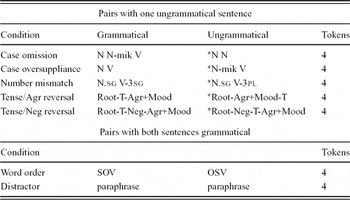
A summary of the materials for the grammaticality judgment task is presented in Table 3.
Materials for grammaticality judgments.
Our predictions are that, if RBs truly have no syntax at all, they will not be able to establish preferences on the basis of grammatical features or rules, and either accept all sentences or perform randomly. If, on the contrary, they have full syntactic competence in comprehension, they should show performance comparable to that of fluent speakers. An incomplete grammar might result in intermediate scores, possibly with varying performance across syntactic violations. In the case of an incomplete grammar, it is also reasonable to expect some degree of inconsistency in judgments within participants, which may indicate uncertainty (as suggested for L2 by Alanen, Reference Alanen1999; Han, Reference Han2000; Sorace, Reference Sorace, Ritchie and Bhatia1996; and for attrition by Altenberg & Vago, Reference Altenberg, Vago, Schmid, Köpke, Keijzer and Weilemar2004).
4.3 Procedure
Participants were tested individually in a quiet location. They listened to audio-recorded stimuli that were read by a fluent Inuttitut speaker from the same community as the participants. Many receptive bilinguals are not literate in Inuttitut, which precludes the use of reading tasks.
Instructions were given in English, and participants were also asked to provide their responses in English. Using the RBs’ stronger language for the task presentation and response aimed to maximize performance. Participants heard a pre-recorded pair of sentences. They were instructed to decide whether both stimuli in a pair were good/correct/well-formed sentences, of the kind that people can actually say, or whether any of them was bad/incorrect, or contained a mistake. That is, they had three choices: (i) both sentences are good; (ii) first is bad, second is good; (3) first is good, second is bad. Once they answered, the experimenter presented the next pair of sentences. The responses were audio-recorded and later transcribed.
An untimed task was deemed more appropriate for this population, for which online tasks would not be suitable. It is likely that the request to react fast, especially together with the need to use a computer, would create unnecessary stress for participants, who are not as familiar with language testing and the use of computers as typical study participants who are university-educated urban residents. Furthermore, using an online task might hamper the recruitment of participants (Leslie Saxon, December 2009, p.c.).
4.4 Data analysis
The data were transcribed and coded. First, the number of target answers was identified for the set of conditions that contained ungrammatical sentences (case omission, case oversuppliance, agreement mismatch, tense/agreement reversal and tense/negation reversal) for each participant. Non-target answers for these conditions included preference for the ungrammatical token and acceptance of both the grammatical and the ungrammatical member of a pair of sentences, and also rejecting both sentences in a pair and declining to answer with statements such as “I don't know” and “I don't understand”.
The word order condition elicited large variation among fluent speakers, unlike with the first five conditions, and was thus analyzed separately. In the word order condition, the best answer would be “both are correct”, but since SOV is more common, especially in the absence of a context, accepting only SOV would be a reasonable answer too. The answers, therefore, were not coded as target vs. non-target, but rather classified into the following five categories: accepting both; accepting SOV only; accepting OSV only; accepting neither; and no answer (i.e., answers “I don't know” or “I don't understand”). The participants were asked about the status of each of the two sentences, so only when they explicitly rejected OSV as incorrect, it was counted as “only SOV”. Answers such as “the first one is better (but the second one is OK too)” were counted as accepting both.
5. Results
The principal question was whether RBs have enough grammatical knowledge to be generally able to select sentences on the basis of intuitions of well-formedness. Generally, fluent participants consistently gave the expected answers on all items in conditions with ungrammatical sentences, with the exception of one item in the tense/negation reversal condition. For that item, four of the fluent speakers accepted both sentences (possibly because the ungrammatical sentence sounded similar to something else). This item was removed from further analysis, and the weight of the remaining three items in the tense/negation reversal condition was adjusted when calculating means (i.e., participants were given 1.33 points (rather than 1) for each target answer in this condition).
Overall, the fluent speakers performed at the ceiling level (95–100% correct answers), except one participant. Two of the fluent speakers had 100% correct answers in conditions with ungrammatical sentences, and the other five gave one non-target answer each, all on different items. The remaining speaker (#201) had the lowest score among the fluent speakers (76.7%), with four non-target answers (two of them in the tense/negation reversal condition).
We found substantial variation in individual results for the HRBs. The total score for all conditions with ungrammatical sentences ranges from 15% to 100% (mean 73.3%), with the majority (13 out of 17 HRBs) between 70% and 100%. LRBs’ total scores were much lower, ranging from 40% to 63%, (mean 49.5%).
The Wilcoxon signed rank testFootnote 8 has shown that HRBs’ performance on all conditions with ungrammatical sentences was different from chance. Chance performance here is set at 33.3%, since participants were instructed to give one of three possible answers (first good, second bad; second good, first bad; both good). Some participants used the fourth option, “neither is good”, even though it was not offered in the instructions. Thus it is possible that at least for some of them chance would be 25%, but we opted for the most conservative strategy. The Wilcoxon test revealed that the results for each condition in the HRB group was highly significantly different from chance for four of the conditions (tense/agreement reversal: V = 150, p = .0004; tense/negation reversal: V = 146, p = .0009; number agreement mismatch: V = 152, p = .0003; case oversuppliance: V = 147, p = .0008) and significantly different for the case omission condition (V = 140, p = .003). We interpret these findings to indicate that indeed HRBs are capable of grammatical intuitions.
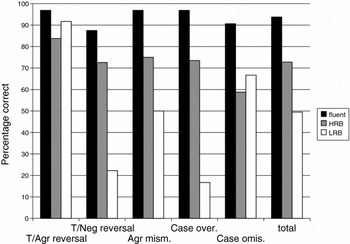
The next question to consider was whether the grammatical properties tested here have different status in RBs’ grammars. The HRBs, as well as LRBs, did exhibit differential sensitivity to morphosyntactic violations tested in this study. Table 4 shows mean scores (numbers of correct answers) for each condition. Figure 1 shows percentages of correct answers for each condition.
Mean number of correct answers in the conditions with ungrammatical sentences.

Percentages of correct answers in the conditions with ungrammatical sentences.

Since the data were binary (correct vs. incorrect), the subjects were nested within fluency groups, and the items were nested within the conditions, the HRBs’ and fluent speakers’ data on conditions with ungrammatical sentences were analyzed by means of a binary mixed-effect hierarchical logistic regression,Footnote 9 with fluency (fluent vs. HRB) and condition as fixed effects and subjects and items as random effects. (The LRBs’ data were not included in the regression because of the small number of participants.)
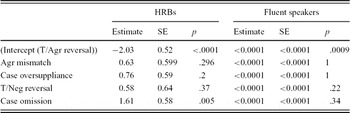
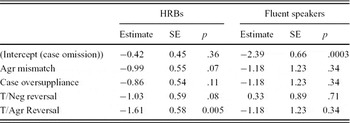
The contrast between the two groups of speakers was highly significant (the coefficient estimate for fluency was 2.03, standard error 0.6, p = .0007). HRBs’ judgments were significantly less accurate than fluent speakers’ judgments. No effect of the order of item presentation was found, when this factor was added to the regression (coefficient estimate was –0.004, standard error 0.02, p = .85). Therefore, participants showed neither fatigue nor learning effects by the end of the test, and this predictor was removed again. Some contrasts between conditions were also significant; however, an inspection of Table 5 shows that it was due to HRBs’ uneven performance, since fluent speakers show almost no difference. For more meaningful comparison of conditions, we ran separate analyses on each of the two groups of participants. For both groups, the logistic regression was fitted in two slightly different ways: the only difference was the choice of the reference level (i.e., baseline) for condition, i.e., the condition that would be compared to each of the remaining conditions. In the first case, the reference level was the condition with the highest scores, tense/agreement+mood reversal (the coefficient estimates, standard errors and p-values for HRBs and fluent speakers are presented in Table 5); in the second case, it was the condition with the lowest scores, case omission (Table 6). The conditions with medium scores were not compared to each other because they were so close that it was clear no difference could be expected.
Contrasts between T/Agr reversal and other conditions.

Contrasts between case omission and other conditions.

While there was no difference between conditions for fluent speakers, one can see a continuum of HRBs’ sensitivity to different kinds of ungrammaticality. HRBs are most sensitive to the tense/agreement+mood reversal, somewhat less to tense/negation reversal, number agreement mismatch and case oversuppliance (all three at the same level), and the least sensitive to case omission. The difference between the extremes of the continuum (tense/agreement+mood reversal and case omission) was significant; the difference between the lowest-score condition (case omission) and two of the medium-score ones (number agreement mismatch and tense/negation reversal) was marginally significant, and the difference between case omission and case oversuppliance was close to marginal.
The individual results confirmed this hierarchy. All participants except three HRBs (those with the lowest scores) had three (75%) or four (100%) correct answers in tense/agreement+mood reversal condition, while the other conditions showed more variation. Therefore, RBs’ grammar contains at least knowledge about the positions of tense and agreement+mood, and for some RBs, more. Four out of six HRBs who had no less than three (75%) correct answers in the case omission condition also had the same high score in all the other conditions (the remaining two had a score of two in one condition each: one in number agreement mismatch, and the other in tense/negation reversal). That is, only more advanced HRBs were able to detect case omission reliably.
The LRBs had a somewhat different pattern of results. They also performed best on the tense/agreement+mood ordering violation, achieving scores within the range of those of HRBs and fluent speakers. However, their scores on number agreement mismatch and especially tense/negation ordering violation were substantially lower than HRBs’ scores. All three LRB had three or more correct answers in tense/agreement+mood reversal condition. In the case omission condition, two LRBs obtained high scores, but this was not matched by sensitivity to case oversuppliance, where their scores are extremely low. Two of the three LRBs accepted sentences with an overt case marker, regardless of whether they were grammatical or not, and rejected almost all sentences with a null case marker, also regardless of grammaticality. This overall pattern suggest that these LRBs are not actually reacting to the ungrammaticality of case omission, but showing an undifferentiated preference for more inflected nominals.
Inspection of individual results also showed that no participant had any bias (e.g., always choosing the second sentence as ungrammatical).
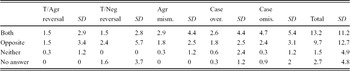
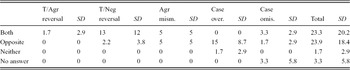
The distribution of non-target answers is summarized in Table 7 for HRBs and Table 8 for LRBs. The tables show, for each type of non-target answer, mean percentage of occurrences in each condition (“both’ means accepting both sentences; “opposite”, accepting the ungrammatical sentence; “neither”, rejecting both sentences; “no answer”, answers “I don't know”).
Mean percentage of each type of non-target answers in the conditions with ungrammatical sentences, HRB.

Mean percentage of each type of non-target answers in the conditions with ungrammatical sentences, LRB.

The most common non-target answer for HRBs was to accept both the grammatical and ungrammatical sentences in a pair. Sometimes the two sentences were taken as having different meanings, sometimes as different ways to express the same meaning. The next common non-target answer was to accept the ungrammatical member of the pair and reject the grammatical one (either because their grammar tells them so, or because they are guessing). In LRBs, both types of answers were equally common, with the former prevalent in tense/negation reversal, and the latter in case oversuppliance. There were very few other answers (“I don't know” or rejecting both sentences).
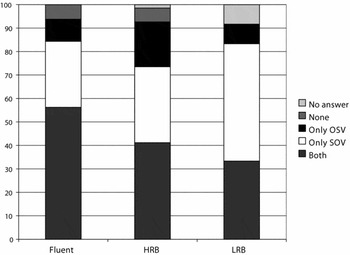
The word order flexibility condition was analyzed separately. There is much variation in all groups, including fluent speakers, both between and within participants. Not all fluent speakers accepted both orders in each pair. Some had strong preferences for only one member of these pairs, to the point that they rejected the other member. Table 9 shows the mean number of occurrences for each type of answer in the word order condition for each group of participants. Figure 2 shows mean percentage of answers of each type in each group.
Mean number of occurrences for each type of answer in word order condition.

Percentages of occurrence of each type of answer in the word order condition.

While numerically it seems that there is a tendency for HRBs, and even more for LRBs, to accept both orders somewhat less often, and the unmarked SOV order more often than fluent speakers, this difference did not achieve statistical significance.
6. Discussion
Our data show robust differences across groups. In the conditions where an ungrammatical member of a pair had to be rejected, fluent speakers performed at ceiling. HRBs, though they were capable of grammaticality judgments, judged the pairs of sentences with less accuracy than fluent speakers, and LRBs showed even less accuracy. Accuracy level varied depending on the linguistic variable that was the source of ungrammaticality. Stepping back from these differences, it seems clear that, for HRBs, lexical and pragmatic knowledge is not the only source for their comprehension: they show relatively high levels of performance, which are significantly different from chance performance. However, it is not the case either that HRBs have full access to the grammatical properties tested. Their syntactic knowledge is clearly different from that of fluent speakers. Although we found wide variation among HRBs, they all gave evidence of possessing some knowledge of the linguistic properties tested in this task. The lower accuracy and higher variability suggests that they are insecure about their intuitions, a finding consistent with Johns and Mazurkewich's (Reference Johns2001) observation that RBs in a Labrador Inuttitut language class had difficulties at the onset of explicit grammatical instruction.
As expected, LRBs performed much worse than HRBs, suggesting that there is a connection between comprehension skills and syntactic knowledge.
Receptive bilinguals in our study reacted differently to the various linguistic properties under consideration. On such a basic property as the position of verbal inflection (the agreement+mood morpheme) relative to a separate tense morpheme, HRBs and even LRBs reached target performance, at the level of fluent speakers. The following schema represents HRBs’ differential sensitivity to morphosyntactic violations, from highest to lowest.
(12)


The differences in HRBs’ sensitivity correspond to the severity of violations, as suggested by the pre-test: tense/agreement+mood reversal in the pre-test was consistently judged as a severe violation, unlike the other kinds of ungrammaticality. The tense/agreement+mood morpheme ordering violation was the easiest to detect, not only for HRBs, but even for LRBs. This is the only condition where all three groups performed at ceiling. Importantly, these results suggest that it is not the case that all ordering violations are easier to detect than other types of ungrammaticality, since the other morpheme ordering violation, tense/negation ordering, was not as easy to detect for HRBs and even less so for LRBs. The difference is likely to arise because this ordering violation involves the core morpheme agreement+mood, which is the only syntactically obligatory functional morpheme in the Inuttitut verb. In addition, this morpheme is in the salient word-final position (unless a clitic is present). Both groups of receptive bilinguals were able to detect when this morpheme did not appear in the right position. There is indication from the interviews that these comprehenders may even attend to this word-final position. Some participants reflected on their own process of understanding the language in very explicit ways, describing the processing of verbs as a sequence of steps: first identifying the root (what's going on?), then looking at the end of the word, i.e., agreement+mood morpheme (who's doing it (to whom)? + sentence type), and after that considering the things in between, the postbases that supply additional information, such as time, manner, etc. One HRB described this process during the interview:
I can pick out the main word, like if they say niuvivvi [store] or if they say something like a long big niuvivviliavungali [store-go-1sg.decl-and], I hear niuvivvi was the main point, I knew they were talking about a store. At the end, you could tell if it's a question or if it's a story, or if it's a just a comment at the end of the sentence [i.e., mood].
In comparison, the results in the agreement mismatch condition show lower levels of accuracy when it comes to the features borne by the agreement+mood morpheme. It is harder for HRBs, and even more so for LRBs, to notice when this morpheme surfaces with incorrect features (number incompatible with the number feature on the subject) than when it appears in an incorrect position.
The other morpheme ordering condition, tense and negation reversal, also proved more difficult to detect than tense/agreement+mood reversal. HRBs had lower performance in this condition, at the same level as in the number agreement mismatch condition. This suggests that HRBs are aware of the possibility of different orderings, but some of them are not aware of the ordering restrictions on these particular morphemes. Some of those HRBs who accepted both the grammatical and ungrammatical orders explicitly said that they thought both orders were good, but that the meanings were different. In a few instances, HRBs provided translations of these sentences. Strikingly, only the token with the correct order of tense and negation was actually translated as negative; the other (the ungrammatical one) was translated as its non-negative counterpart (i.e., the negation marker was ignored when in an incorrect position). This suggests that, at least for some HRBs, negation is so narrowly associated with its position in the word structure that they recognize it only when it is in the correct position. Finally, the tense/negation reversal condition was a point of contrast between HRBs and LRBs: the latter had very low scores, so the difference between the two morpheme ordering conditions is quite dramatic for this group.
HRBs’ performance on case oversuppliance was at the same level as on tense/negation reversal and number agreement mismatch, but it was lower for case omission. Errors of case omission were harder for HRBs to detect than those of comission (case oversuppliance). This parallels the pattern in child speech production: omission of functional morphemes is much more common than overuse or using incorrect morphology (Borer & Rohrbacher, Reference Borer and Rohrbacher2002).
Taking the results on the two case conditions jointly, it can be argued that case is present in HRBs’ grammars. Otherwise, the selection of answers could be random, and HRBs would perform at a chance level on both conditions involving case, which is not what we see in the data. Unlike Inuttitut verbs, which cannot appear without the agreement+mood marker, Inuttitut nouns without an overt case marker are still legitimate words, because this is the form of the singular noun in the absolutive case, with the phonologically null marker. This might be one of the factors that makes sentences with a missing -mik case marker more difficult to reject. The absence of overt phonological material might also make it more difficult to notice the contribution of the absolutive case. Alternatively, it can be said that the absolutive is unmarked and carries no features, while -mik does carry a feature. When an incorrect feature is present, it clashes with the rest of the sentence, but when a required feature is missing or not easily accessible (when the marker is phonologically null), it may be less obvious to HRBs.
LRBs showed a different pattern in the two conditions involving case: they preferred sentences with the overt case marker in both conditions, i.e., no matter if grammatical or not. The LRBs’ pattern of results suggests a lower level of knowledge. LRBs are possibly aware of the requirement for case marking and the morphosyntactic position for case. They try to fill the position, but without sensitivity to the features carried by different case markers and their actual distribution in sentences. This incomplete form of knowledge results in a preference for an overt marker, regardless of grammaticality. This can be considered as similar in nature to their knowledge about the agreement+mood morpheme: they know the position of the morpheme in the sentence structure but they know less about what it is supposed to be filled with, i.e., which features are carried by which morphemes.
With word order flexibility, there was more variation in all three groups, including fluent speakers. In languages where, as in Inuttitut, word order is flexible and depends on information structure, acceptability for different word orders may vary among native speakers. There is usually a basic, canonical word order (such as SOV/SVO in Inuttitut), which is acceptable for an out-of-the-blue sentence (like the sentences in this task), but other orders (such as OSV in Inuttitut) may or may not be accepted without an appropriate context. The variation in acceptability of SOV and OSV among the fluent speakers of Inuttitut found in this condition is therefore not surprising. RBs tend to accept only the basic order more frequently than those in the fluent speakers group. However, contrary to what was found by Polinsky (Reference Polinsky2006a) in Russian heritage speakers’ production, it is not the case that Inuttitut comprehenders were limited to a single word order, though the different sources of data (production vs. intuition) precludes making conclusions.
One possibility, suggested by two reviewers, is that the type of intuitions underlying RBs’ performance reflects knowledge of frequency distributions that is probabilistic but not grammatical in nature. For instance, one result is that performance is better with tense and agreement reversal than with tense and negation reversal, which could be due to a relatively higher frequency of the morphemes involved, as agreement is obligatory (and therefore more frequent) but negation is not. Could it be that RBs only know that, for agreement, the morpheme is found obligatorily at the end of every verb? It is important to note, when considering this possibility, that although the list of possible agreement morphemes is finite, it is sufficiently large to limit the plausibility of a purely probabilistic analysis. In Labrador Inuttitut, agreement is a combination of grammatical number (singular/dual/plural), person (three speech persons plus a reflexive/non-reflexive distinction within the third person in certain moods) and mood (eight moods; some researchers suggest more). The list of morphemes that agree only with the subject numbers eighty-four. Once we include the list of morphemes that simultaneously encode subject/object combined, the actual morpheme list of possible verb endings reaches over 500; according to Sadock (Reference Sadock, Mahieu and Tersis2009, p. 97), verb paradigms in Inuktitut are “on the order of two thousand forms”. Sensitivity to the morpheme despite the general low probability of a specific form appears to suggests that a category has emerged in the grammar of these speakers. Furthermore, the relative probability of the agreement category is higher than that of the negation markers, but the actual probability of a specific morpheme is quite low, so it is not likely that the asymmetry in the data is due to the relative frequency of the target form. Similarly, sensitivity to number agreement is not likely to be the result of probabilistic links between the five possible number forms on nominals (singular, and two allomorphs each for dual and plural) and the high number of agreement morphemes described above.
Knowledge of surface distributional associations is not a good account of successful performance in the case omission and case oversuppliance conditions either, since RBs have to know the conditions of insertion for the -mik case morpheme. The morpheme itself is the same in both conditions but the question is whether RBs know that it cannot appear on subjects of intransitive sentences, while it must appear on the objects of transitive sentences (The ball-ø (*-mik) rolled, but John-Ø rolled the ball-mik / *Ø). Here, the difference between the groups is particularly revealing: the LRBs are clearly treating -mik as an obligatory component of the word. However, the HRBs were sensitive to the contingency between the case marker and the clause configuration. Therefore, we conclude that the successful performance in the grammaticality judgment task is based on aspects of grammar, rather than on probabilistic knowledge.
7. Conclusion
Do receptive bilinguals have knowledge of grammar? Our analysis has uncovered two qualitatively different patterns among individuals at the extreme of asymmetric bilingualism. The results of the grammaticality judgment task clearly indicate that RBs possess intuitions about the grammar of their receptively known language and meet the accuracy levels of fluent speakers in some cases. While RBs show patterns of grammatical deficits, they demonstrate clear knowledge of the core properties of Inuttitut structure. The results suggest that the hypothesis that HRBs lack grammar must be rejected. Their grammars are different from the target, as in other cases of incomplete language knowledge (attrition, heritage speakers), with different linguistic variables showing different levels of deficits. When we considered the lowest-comprehension group, the LRBs, we observed that these speakers could detect ungrammaticality only when the most basic properties of Inuttitut grammar were violated, i.e., their syntactic abilities are also at the lower level. The difference between HRBs and LRBs in our study appears to be not only quantitative, but qualitative: HRBs can function in the language, even though in only one direction, but LRBs cannot, as they report extremely limited comprehension, sometimes not even understanding the main points in a conversation. The following case illustrates the difference: in a mother–daughter pair of participants, the mother (classified as HRB) reported that she translates from Inuttitut to English for her daughter (classified as LRB).
While fluent speakers’ judgments were consistently correct, RBs’ judgments were inconsistent or even consistently incorrect, indicating insecurity or lack of knowledge, respectively. This predicts problems in production with the choice of functional morphemes, if RBs try to speak. These problems can manifest themselves as errors, hesitance, long pauses or the inability to produce a constituent because they cannot choose the right morphemes that must be part of it. While RBs are likely to know which paradigm to look in (e.g., case or agreement+mood), they might not be sure which member of the paradigm to select (which value is associated with which marker). This may be one source of RBs’ limitations in speech production. If this line of speculation is correct, it may suggest that more inflected languages may have a higher threshold of language knowledge for the onset of productive skills to be available to low-level comprehenders.
The conclusions from this study are limited by our relatively small number of participants and experimental items. These limitations are set by the reality of testing an aboriginal population in a remote community, with overall lower levels of formal education, little familiarity with language research and, for many community members, feelings of discomfort about being tested on their ancestral language. We appreciate the courage and motivation of those who responded to recruitment and completed the study. However, it is important to note that the number of participants and items was still sufficient to establish both reliable differences between groups of participants as well as sensitivity to ungrammaticality, as demonstrated by levels of performance significantly different from chance. Additional validation is required for the conclusion that sensitivity to grammar is possible in the absence of language production; studies on similar populations among other linguistic communities are needed to further support this conclusion.
To conclude, our data suggest the presence of relatively sophisticated grammatical knowledge, even at the lowest end of the bilingualism continuum. This has important potential implications for language revitalization. To support RBs seeking to develop fluent proficiency in the language, pedagogical considerations must be given to the demonstrated differences in their knowledge of syntactic properties. Furthermore, tasks such as ours can be used to demonstrate to speakers themselves that they possess implicit competence. This competence can be used as a foundation for developing further skills, so that they can proceed to the acquisition of more complex structures and move from a purely receptive to a productive mode. Where possibilities for formal instruction in the language for adult RBs and heritage speakers are limited, as in Labrador Inuit communities, fluent speakers in the community can become providers of opportunities for RBs to use the language productively. Future research should continue to explore the abilities of dysfluent bilinguals, including the community and individual factors that could enhance their further language development.