Receiving so much feedback is nothing short of thrilling, and the commentators did a great job dissecting my model, criticizing its assumptions, and suggesting novel ways to improve our understanding of human life histories – my thanks to all of them. I am excited at the new opportunities for interdisciplinary integration that are clearly emerging from this lively area of research.
In the target article, I presented an updated evolutionary-developmental model of human reproductive strategies, integrating the life history framework of Belsky, Steinberg, and Draper (Belsky et al. Reference Belsky, Steinberg and Draper1991) and Chisholm (Reference Chisholm1999) with sexual selection and parental investment theory. In this model, insecure attachment in infancy and early childhood entrains reproductive strategies that are based on current reproduction and high mating effort; however, the optimal strategies (and the optimal balance of mating versus parenting effort) differ between males and females. This is reflected in a reorganization of the attachment system in middle childhood, leading to sex differences in insecure attachment styles. In particular, insecure males tend to adopt avoidant styles, whereas insecure females show higher levels of anxiety. In a parental investment/sexual selection framework, sex-specific attachment styles are adaptive both in adults, where they regulate commitment and investment in couple bonding, and in children, where they affect a suite of traits involved in same-sex peer competition. The reproductive strategy adopted by an adult individual is thought to reflect an interplay between early stress and attachment security, genotypic factors, and later experiences (see Fig. 2 of the target article). Finally, I proposed that adrenarche acts as an endocrine switch at the beginning of middle childhood, affecting the sex-specific development of attachment styles and of nascent reproductive strategies.
I begin this response by addressing major criticism, clarifying my model's assumptions, and discussing some methodological issues that had to be omitted from the target article but were often raised in the commentaries (sects. R1–R6). Then, I gather the new suggestions and ideas presented by commentators, and attempt to draw a map of the most intriguing directions for future research (sects. R7 and R8).
The idea that psychosocial stress in infancy and childhood affects the trajectory of reproductive strategies is crucially based on the concept of adaptive developmental plasticity. Penke proposes a balanced overview of the place of developmental plasticity among the many mechanisms of evolutionary adaptation. I agree with his presentation in almost every detail, and I concur that the essential question concerns the relative weight of the various mechanisms. Where we disagree is about the significance and weight of attachment, as I discuss further on (sect. R3.1). More radically, Hönekopp presents an argument purportedly showing that the plasticity mechanism I proposed cannot work as an adaptation. There are, however, several problems with Hönekopp's argument, concerning both the theoretical reasoning and the evidence cited in its support. First, the small Dogon sample he cites as evidence that attachment is unrelated to mortality was drawn from an atypical, urbanized population, and even so, 23% of the 26 infants were disorganized in 4-way coding (True Reference True1994). Second, the contention that attachment security is insensitive to environmental variation (based on a single review of cross-cultural studies, many of which took place in industrialized countries) is clearly inconsistent with the extreme insecurity proportions found in at-risk and low-socioeconomic status (SES) samples (see references in sects. 2.2 and 2.3 of the target article). Third, an evolutionary perspective challenges the idea that consistently sleeping away from parents is an “irrelevant” variable for infants; in our evolutionary past, losing physical proximity with parents was likely one of the surest signs of danger – not least, because of abandonment risk (Hrdy Reference Hrdy1999).
On the theoretical side, the “information chain” presented by Hönekopp is based on a partial rendering of my model. In the target article, I argued that environmental risk during infancy and early childhood, strongly mediated by parental behavior, affects reproductive strategies in middle childhood and early adulthood, with the possibility of later revision. Strategic flexibility in adolescence and adulthood (sect. 7.1.3; Fig. 2) makes it unnecessary to accurately predict the environment two decades or so in advance, as implied by Hönekopp; early information channels reproductive strategies in adaptive directions, but it does not “freeze” individuals onto fixed developmental courses. In addition, I tried to stress that parental behavior does not only mediate (macro-) environmental conditions, it also determines (micro-) environmental conditions (sect. 7.1.1), thus giving the child direct and valuable information about contingent risk, expected future investment (Ellis Reference Ellis2004; target article, sect. 5.4.1), and alloparental availability.
There are two more reasons why Hönekopp's argument, while interesting, may be overstated. First of all, the information chain he presents is redundant, since the correlations between (1) parental behavior and attachment and (2) attachment and adult reproductive strategy are both controlled by the child, and could well amount to 1.0 if that was in the child's interest. Thus, contrary to the argument's assumptions, there is no inherent information loss going from parental behavior to reproductive strategies. Second, acquiring direct and reliable information about environmental risks usually involves exposing oneself to those risks; and while parents are forced to do so, infants and young children should try to avoid direct exposure to danger as much as possible (letting parents do the work for them, so to speak). I agree that children can gain information by observing the environment on their own; but parental behavior (especially when sampled over many years) can still be a useful source of information at various levels, even if we still have a limited understanding of the exact ways in which such information is transmitted and encoded. Mathematical models and simulations could help immensely to clarify this issue (see sect. R7.2).
It is nevertheless true that I did not emphasize flexibility enough (see Jackson & Ellis and Flinn, Muehlenbein, & Ponzi [Flinn et al.]). Reproductive strategies in a long-lived species like ours are most likely implemented by a multi-stage process with a considerable degree of protracted plasticity. The middle childhood transition (for which I propose the label of juvenile transition; Del Giudice et al., in press) is only one of the possible “switch points” in human life history, and one of the functions of juvenility may precisely be that of allowing for social feedback about the viability and success of one's strategy (Del Giudice et al., in press). As briefly anticipated in section 7.1, life history models should now move toward a more sophisticated, truly lifespan perspective, integrating the various time frames over which reproductive decisions are made.
R1.1. The role of genetic factors
Developmental plasticity and genetic factors are, in fact, two sides of the same coin (West-Eberhard Reference West-Eberhard2003). Although my present focus was on plasticity, I also stressed that genotypic differences are expected to play multiple and important roles in shaping reproductive strategies. The work on the K-Factor cited by Figueredo, Sefcek, & Olderbak (Figueredo et al.) is especially interesting, although it would really take too much space to discuss it in detail. I will limit myself to note that Figueredo et al.'s (Reference Figueredo, Vásquez, Brumbach and Schneider2004) twin sample was composed of middle-aged people and that heritability could be substantially lower at younger ages, as it happens with other traits (e.g., general intelligence). There are also a number of issues to be considered in order to properly interpret heritability estimates; for example, high heritability may sometimes be compatible with strong causal effects of the environment on a trait (e.g., Turkheimer Reference Turkheimer and DiLalla2004). Further discussion of how genetic and environmental factors are integrated in the development of reproductive strategies can be found in Del Giudice et al. (in press).
Although behavior genetics can give fundamental contributions to the evolutionary understanding of reproductive strategies, I find Harris's arguments against life history models (and attachment theory in general) to be empirically weak and ultimately unconvincing. First of all, Harris equates non-shared variance in biometric models with extra-familial factors – a problematic interpretation that has been repeatedly challenged (for a thorough discussion, see Rutter et al. Reference Rutter, Pickles, Murray and Eaves2001; Reference Rutter, Moffitt and Caspi2006). Moreover, she ignores the consistent findings of low heritability in infants' and children's attachment styles (sect. 2.3). Harris's argument is also weakened by recent, genetically controlled studies linking family stress to age at menarche (Tither & Ellis Reference Tither and Ellis2008) and early initiation of sexual activity (D'Onofrio et al. Reference D'Onofrio, Turkheimer, Emery, Slutske, Heath, Madden and Martin2006). Importantly, both Tither and Ellis (Reference Tither and Ellis2008) and Ellis and Essex (Reference Ellis and Essex2007) controlled for SES in their samples, and the latter also directly controlled for body mass index (BMI); thus, Harris's hypothesis that SES and obesity fully account for the relationship between stress and early maturation doesn't seem to enjoy much empirical support.
R2. How big are sex differences in romantic attachment?
Sex differences in romantic attachment are an essential feature of my model: They are predicted to arise in many human populations, and are thought to result from adaptive processes. In contrast, both Beckes & Simpson and Penke argue that sex differences in attachment are small, perhaps too small to be of evolutionary significance. This issue deserves a thorough discussion. First of all, my model does not predict generalized, context-independent sex differences in attachment patterns; rather, sex differences should be mostly apparent in insecurely attached individuals, and they should peak in moderately risky environments. Since most individuals in most populations are securely attached, overall sex differences in avoidance and anxiety can be expected to be moderate at best. Turning to the empirical size of sex differences in romantic attachment, I concur that there are many inconsistent results in the literature. However, we are likely to severely underestimate the magnitude of sex differences if we fail to take into account four confounding factors: (1) the unreliability of some attachment measures, (2) the restricted nature of most research samples, (3) the effect of age, and (4) the impact of scores distribution on the magnitude of effect sizes.
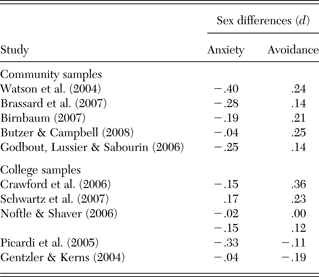
Of course, to properly address these issues one would need a systematic meta-analysis (currently in preparation); bearing this in mind, in Table R1 I summarize the effect sizes from a number of recent studies. The unreliability of romantic attachment measures is a long-known problem (e.g., Baldwin & Fehr Reference Baldwin and Fehr1995). Unfortunately, many older studies (and some new ones) employ obsolete instruments such as the single-item scales of the Relationships Questionnaire (RQ) (Bartholomew & Horowitz Reference Bartholomew and Horowitz1991); because of score unreliability, such measures provide downward-biased estimates of sex differences. In addition, the common practice of reducing continuous scores to categories is guaranteed to lose some sex-related variance in the process. At the moment, the best romantic attachment questionnaires are arguably the Experiences in Close Relationships (ECR; Brennan et al. Reference Brennan, Clark, Shaver, Simpson and Rholes1998) and the Experiences in Close Relationships - Revised (ECR-R; Fraley et al. Reference Fraley, Waller and Brennan2000); the studies included in Table R1 were selected because they employed one of these measures in the continuous form and reported some measure of association between attachment and sex (note that this is not intended as an exhaustive review, but only as a representative summary of recent studies). All effect sizes were converted to Cohen's d.Footnote 1
Effect sizes of sex differences in romantic attachment (ECR scores) in community and college samples. Positive values indicate higher scores in males.
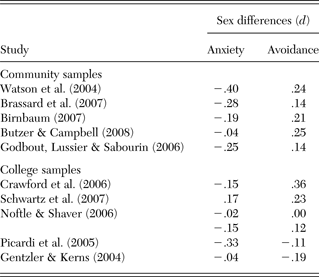
Even a casual review of the literature suggests that sex differences tend to be stronger and more consistent in community samples compared with samples of college students, which are likely to show restricted variability in many life-history-relevant characteristics (such as early family stress, present vs. future orientation, and so on).Footnote 2 Note that some of the community samples (Birnbaum Reference Birnbaum2007; Butzer & Campbell Reference Butzer and Campbell2008; Godbout et al. Reference Godbout, Lussier and Sabourin2006) included a substantial proportion of middle-aged participants; and, as I tentatively showed in section 4.3, there seems to be an age-related decrease in the magnitude of sex differences, consistent with the proposed role of sex hormones. Most of the college samples were composed of psychology students; if my hypothesis is correct and gender-typicality is associated with attachment (sect. 7.2.2), then psychology students would provide an especially poor benchmark for estimating population sex differences. Psychology is a strongly female-biased faculty, and males enrolled in psychology courses are likely to represent a restricted segment of an already restricted subpopulation. Preliminary evidence supports this possibility: In a sample I just collected, composed of 200 Italian students from a wide range of faculties (e.g., psychology, humanities, engineering, mathematics, law, and so on), sex differences in ECR scores were d=−.37 (anxiety) and d=.14 (avoidance) in the psychology subsample (N=74), and d=−.52 (anxiety) and d=.43 (avoidance) in the rest of the sample.Footnote 3
Another factor that may lead to underestimating sex differences is the non-normal distribution of attachment scores. With skewed or otherwise non-normal data, d (the standardized difference between means) can underestimate the size of group differences. For example, in the student sample described above the overall sex difference in avoidance was d=.29, which some may automatically interpret as “small”; but, due to skewed distribution in females, 74% of males showed higher avoidance scores than the median female (hardly a trivial effect). Differences in score distributions can be effectively analyzed using specific statistical methods (e.g., Handcock & Morris Reference Handcock and Morris1999); these methods should be employed much more often, especially when dealing with group differences involving non-normal variables.
To conclude, I concur with Symons & Szielasko that documenting sex differences in attachment is only the first step, and that sex-specific patterns of correlations should be systematically investigated. Unfortunately, too much attachment research still ignores or downplays the existence of sex differences, so that the relevant analyses are seldom performed (Kerns); I hope that the present work contributes to a wider appreciation of this crucial issue.
R2.1. Cultural variation
Although many studies (mostly carried out in Western countries) show evidence of sex differences in romantic attachment, life history models do not predict universal, context-independent sex differences (see Schmitt Reference Schmitt2008). As discussed in section 7.1.3, the magnitude of sex differences is expected to be contingent on environmental risk; moreover, Quinlan suggests that sex-specific patterns of risk and parental bias could also have important effects. In the cross-cultural study by Schmitt et al. (Reference Schmitt, Alcalay, Allensworth, Allik, Ault, Austers, Bennett, Bianchi, Boholst, Borg Cunen, Braeckman, Brainerd, Caral, Caron, Casullo, Cunningham, Daibo, De Backer, De Souza, Diaz-Loving, Diniz, Durkin, Echegaray, Eremsoy, Euler, Falzon, Fisher, Fowler, Fry, Fry, Ghayur, Giri, Golden, Grammer, Grimaldi, Halberstadt, Haque, Hefer, Herrera, Hertel, Hitchell, Hoffman, Hradilekova, Hudek-Kene-evi, Huffcutt, Jaafar, Jankauskaite, Kabangu-Stahel, Kardum, Khoury, Kwon, Laidra, Laireiter, Lakerveld, Lampart, Lauri, Lavallée, Lee, Leung, Locke, Locke, Luksik, Magaisa, Marcinkeviciene, Mata, Mata, McCarthy, Mills, Mkhize, Moreira, Moreira, Moya, Munyea, Noller, Olimat, Opre, Panayiotou, Petrovic, Poels, Popper, Poulimenou, P'yatokha, Raymond, Reips, Reneau, Rivera-Aragon, Rowatt, Ruch, Rus, Safir, Salas, Sambataro, Sandnabba, Schleeter, Schulmeyer, Schütz, Scrimali, Shackelford, Sharan, Shaver, Sichona, Simonetti, Sineshaw, Sookdew, Speelman, Sümer, Sümer, Supekova, Szlendak, Taylor, Timmermans, Tooke, Tsaousis, Tungaraza, Turner, Vandermassen, Vanhoomissen, Van Overwalle, Van Wesenbeek, Vasey, Verissimo, Voracek, Wan, Wang, Weiss, Wijaya, Woertment, Youn and Zupanèiè2003a; Reference Schmitt, Alcalay, Allensworth, Allik, Ault, Austers, Bennett, Bianchi, Boholst, Borg Cunen, Braeckman, Brainerd, Caral, Caron, Casullo, Cunningham, Daibo, De Backer, De Souza, Diaz-Loving, Diniz, Durkin, Echegaray, Eremsoy, Euler, Falzon, Fisher, Foley, Fowler, Fry, Fry, Ghayur, Giri, Golden, Grammer, Grimaldi, Halbertandt, Haque, Herrera, Hertel, Hitchell, Hoffmann, Hooper, Hradilekova, Hudek-Kene-Evi, Huffcutt, Jaafar, Jankauskaite, Kabangu-Stahel, Kardum, Khoury, Kwon, Laidra, Laireiter, Lakerveld, Lampert, Lauri, Lavallée, Lee, Leung, Locke, Locke, Luksik, Magaisa, Marcinkeviciene, Mata, Mata, McCarthy, Mills, Mkhize, Moreira, Moreira, Moya, Munyae, Noller, Olimat, Opre, Panayiotou, Petrovic, Poels, Popper, Poulimenou, P'Yatokha, Raymond, Reips, Reneau, Rivera-Aragon, Rowatt, Ruch, Rus, Safir, Salas, Sambataro, Sandnabba, Schleeter, Schulmeyer, Schütz, Scrimali, Shackelford, Sharan, Shaver, Sichona, Simonetti, Sineshaw, Sookdew, Speelman, Spyrou, Sümer, Sümer, Supekova, Szlendak, Taylor, Timmermans, Tooke, Tsaousis, Tungaraza, Turner, Vandermassen, Vanhoomissen, van Overwalle, Vanwesenbeeck, vasey, Verissimo, Voracek, Wan, Wang, Weiss, Wijaya, Woertman, Youn and Zupanèiè2004), East Asian samples showed small sex differences in dismissiveness and high preoccupation scores; this pattern appears to be mirrored in the Chinese data presented by Li, He, & Li (Li et al.). However, reanalysis of continuous ECR scores from their original data sets (Li, personal communication, July 7, 2008) shows that, in Chinese college students (from mixed faculties), sex differences go in the same direction as of those observed in Western samples, with higher male scores in avoidance (d=.26) and somewhat higher female scores in anxiety (d=−.12). In Li et al.'s data on white-collar workers, Chinese men report higher scores in both avoidance (d=.39) and anxiety (d=.24; details available from the author). Overall, it is possible that sex differences in attachment anxiety are reduced in Chinese people, although it would take a targeted meta-analysis (and more community samples) to put this hypothesis on firmer ground.
Provisionally taking these data at face value, the really interesting question is why East Asian samples should show this kind of pattern, which is not accounted for by my model. Some of the explanations proposed by Li et al. (e.g., government-imposed limitations on the number of children) are dubious from an evolutionary point of view. For example, the one-child policy has been implemented only from 1979, and if male reproductive strategies have evolved over phylogenetic time, such recent limitations on reproductive rate are not expected to have a strong effect on male psychology. In addition, similar distributions of attachment scores are found in nations (e.g., Taiwan, South Korea) where there is no equivalent policy (Schmitt et al. Reference Schmitt, Alcalay, Allensworth, Allik, Ault, Austers, Bennett, Bianchi, Boholst, Borg Cunen, Braeckman, Brainerd, Caral, Caron, Casullo, Cunningham, Daibo, De Backer, De Souza, Diaz-Loving, Diniz, Durkin, Echegaray, Eremsoy, Euler, Falzon, Fisher, Fowler, Fry, Fry, Ghayur, Giri, Golden, Grammer, Grimaldi, Halberstadt, Haque, Hefer, Herrera, Hertel, Hitchell, Hoffman, Hradilekova, Hudek-Kene-evi, Huffcutt, Jaafar, Jankauskaite, Kabangu-Stahel, Kardum, Khoury, Kwon, Laidra, Laireiter, Lakerveld, Lampart, Lauri, Lavallée, Lee, Leung, Locke, Locke, Luksik, Magaisa, Marcinkeviciene, Mata, Mata, McCarthy, Mills, Mkhize, Moreira, Moreira, Moya, Munyea, Noller, Olimat, Opre, Panayiotou, Petrovic, Poels, Popper, Poulimenou, P'yatokha, Raymond, Reips, Reneau, Rivera-Aragon, Rowatt, Ruch, Rus, Safir, Salas, Sambataro, Sandnabba, Schleeter, Schulmeyer, Schütz, Scrimali, Shackelford, Sharan, Shaver, Sichona, Simonetti, Sineshaw, Sookdew, Speelman, Sümer, Sümer, Supekova, Szlendak, Taylor, Timmermans, Tooke, Tsaousis, Tungaraza, Turner, Vandermassen, Vanhoomissen, Van Overwalle, Van Wesenbeek, Vasey, Verissimo, Voracek, Wan, Wang, Weiss, Wijaya, Woertment, Youn and Zupanèiè2003a; Reference Schmitt, Alcalay, Allensworth, Allik, Ault, Austers, Bennett, Bianchi, Boholst, Borg Cunen, Braeckman, Brainerd, Caral, Caron, Casullo, Cunningham, Daibo, De Backer, De Souza, Diaz-Loving, Diniz, Durkin, Echegaray, Eremsoy, Euler, Falzon, Fisher, Foley, Fowler, Fry, Fry, Ghayur, Giri, Golden, Grammer, Grimaldi, Halbertandt, Haque, Herrera, Hertel, Hitchell, Hoffmann, Hooper, Hradilekova, Hudek-Kene-Evi, Huffcutt, Jaafar, Jankauskaite, Kabangu-Stahel, Kardum, Khoury, Kwon, Laidra, Laireiter, Lakerveld, Lampert, Lauri, Lavallée, Lee, Leung, Locke, Locke, Luksik, Magaisa, Marcinkeviciene, Mata, Mata, McCarthy, Mills, Mkhize, Moreira, Moreira, Moya, Munyae, Noller, Olimat, Opre, Panayiotou, Petrovic, Poels, Popper, Poulimenou, P'Yatokha, Raymond, Reips, Reneau, Rivera-Aragon, Rowatt, Ruch, Rus, Safir, Salas, Sambataro, Sandnabba, Schleeter, Schulmeyer, Schütz, Scrimali, Shackelford, Sharan, Shaver, Sichona, Simonetti, Sineshaw, Sookdew, Speelman, Spyrou, Sümer, Sümer, Supekova, Szlendak, Taylor, Timmermans, Tooke, Tsaousis, Tungaraza, Turner, Vandermassen, Vanhoomissen, van Overwalle, Vanwesenbeeck, vasey, Verissimo, Voracek, Wan, Wang, Weiss, Wijaya, Woertman, Youn and Zupanèiè2004). These authors may be right, however, when they point to the high sex ratio (more males than females) resulting from preferences for male children.Footnote 4 High sex ratios (and preferences for male offspring) are found in many East Asian countries (e.g., South Korea, China, Taiwan; see Coale & Banister Reference Coale and Banister1996; Schmitt Reference Schmitt2005b). When reanalyzing the data by Schmitt (Reference Schmitt2005b; Schmitt et al. Reference Schmitt, Alcalay, Allensworth, Allik, Ault, Austers, Bennett, Bianchi, Boholst, Borg Cunen, Braeckman, Brainerd, Caral, Caron, Casullo, Cunningham, Daibo, De Backer, De Souza, Diaz-Loving, Diniz, Durkin, Echegaray, Eremsoy, Euler, Falzon, Fisher, Fowler, Fry, Fry, Ghayur, Giri, Golden, Grammer, Grimaldi, Halberstadt, Haque, Hefer, Herrera, Hertel, Hitchell, Hoffman, Hradilekova, Hudek-Kene-evi, Huffcutt, Jaafar, Jankauskaite, Kabangu-Stahel, Kardum, Khoury, Kwon, Laidra, Laireiter, Lakerveld, Lampart, Lauri, Lavallée, Lee, Leung, Locke, Locke, Luksik, Magaisa, Marcinkeviciene, Mata, Mata, McCarthy, Mills, Mkhize, Moreira, Moreira, Moya, Munyea, Noller, Olimat, Opre, Panayiotou, Petrovic, Poels, Popper, Poulimenou, P'yatokha, Raymond, Reips, Reneau, Rivera-Aragon, Rowatt, Ruch, Rus, Safir, Salas, Sambataro, Sandnabba, Schleeter, Schulmeyer, Schütz, Scrimali, Shackelford, Sharan, Shaver, Sichona, Simonetti, Sineshaw, Sookdew, Speelman, Sümer, Sümer, Supekova, Szlendak, Taylor, Timmermans, Tooke, Tsaousis, Tungaraza, Turner, Vandermassen, Vanhoomissen, Van Overwalle, Van Wesenbeek, Vasey, Verissimo, Voracek, Wan, Wang, Weiss, Wijaya, Woertment, Youn and Zupanèiè2003a; Reference Schmitt, Alcalay, Allensworth, Allik, Ault, Austers, Bennett, Bianchi, Boholst, Borg Cunen, Braeckman, Brainerd, Caral, Caron, Casullo, Cunningham, Daibo, De Backer, De Souza, Diaz-Loving, Diniz, Durkin, Echegaray, Eremsoy, Euler, Falzon, Fisher, Foley, Fowler, Fry, Fry, Ghayur, Giri, Golden, Grammer, Grimaldi, Halbertandt, Haque, Herrera, Hertel, Hitchell, Hoffmann, Hooper, Hradilekova, Hudek-Kene-Evi, Huffcutt, Jaafar, Jankauskaite, Kabangu-Stahel, Kardum, Khoury, Kwon, Laidra, Laireiter, Lakerveld, Lampert, Lauri, Lavallée, Lee, Leung, Locke, Locke, Luksik, Magaisa, Marcinkeviciene, Mata, Mata, McCarthy, Mills, Mkhize, Moreira, Moreira, Moya, Munyae, Noller, Olimat, Opre, Panayiotou, Petrovic, Poels, Popper, Poulimenou, P'Yatokha, Raymond, Reips, Reneau, Rivera-Aragon, Rowatt, Ruch, Rus, Safir, Salas, Sambataro, Sandnabba, Schleeter, Schulmeyer, Schütz, Scrimali, Shackelford, Sharan, Shaver, Sichona, Simonetti, Sineshaw, Sookdew, Speelman, Spyrou, Sümer, Sümer, Supekova, Szlendak, Taylor, Timmermans, Tooke, Tsaousis, Tungaraza, Turner, Vandermassen, Vanhoomissen, van Overwalle, Vanwesenbeeck, vasey, Verissimo, Voracek, Wan, Wang, Weiss, Wijaya, Woertman, Youn and Zupanèiè2004), I found that high sex ratio in a cultural region predicted higher dismissing (partial β=.29: P=.048, controlling for age) and (especially) preoccupied attachment (partial β=.36; P=.011, controlling for age). In high-sex-ratio populations, males compete to marry the few available females, the mating system tends towards high relationship stability, and sociosexuality is restricted (Schmitt Reference Schmitt2005b); one could hypothesize that, in this context, increased anxiety in males might be adaptive by helping maintaining an exclusive bond with females. Although I did not explicitly include the sex ratio in my model, it could be that it affects adult attachment in yet unknown ways; the mechanisms linking sex ratios to attachment and their interaction with environmental risk constitute a fascinating topic for future research.
From a more speculative perspective, it is also possible that population-level differences in attachment are influenced by local differences in neurophysiological parameters and genetic background. The dopamine receptor D4 7-repeat allele, for example, has been implicated in the development of disorganized attachment (see Belsky et al. Reference Belsky, Bakermans-Kranenburg and van IJzendoorn2007a; van IJzendoorn & Bakermans-Kranenburg Reference Van IJzendoorn and Bakermans-Kranenburg2006). Strikingly, this genetic variant, relatively common in Europe and Africa, and even more so in South America, is virtually absent in Asian populations (Chang et al. Reference Chang, Kidd, Livak, Pakstis and Kidd1996). Other studies indicate that the 7-repeat allele has a recent evolutionary origin (about 50,000 years ago) and that it has been subject to intense positive selection (Ding et al. Reference Ding, Chi, Grady, Morishima, Kidd, Kidd, Foldman, Spence, Schuck, Swanson, Zhang and Moyzis2002; Wang et al. Reference Wang, Ding, Flodman, Kidd, Kidd, Grady, Ryder, Spence, Swanson and Moyzis2004); moreover, some authors have proposed that selection on the 7-repeat allele could have been driven by population differences in mating systems and reproductive strategies (Harpending & Cochran Reference Harpending and Cochran2002).
Given that, in my model, sex hormones have a crucial role in the development of sex differences in attachment, it is also of interest that Asian populations tend to have relatively low androgen levels (for references, see Wang et al. Reference Wang, Christenson and Swerdloff2007). This effect seems to depend, at least in part, on dietary factors (e.g., Santner et al. Reference Santner, Albertson, Zhang, Zhang, Santulli, Wang, Demers, Shackleton and Santen1998), though social factors may also play a role; for example, through a low emphasis on competition in collectivistic societies (see Mazur & Booth Reference Mazur and Booth1998). However, recent studies have also documented ethnic variation in a number of genes involved in the sex steroids pathway (Kardia et al. Reference Kardia, Chu and Sowers2006). More research is needed to evaluate this intriguing possibility and to fully work out its evolutionary implications; interestingly, both the distribution of DRD4 alleles and the data on androgens could point to stronger selection for long-term, biparental care in Asian populations, which would be consistent with less sexually dimorphic attachment patterns (see Harpending & Cochran Reference Harpending and Cochran2002).
R2.2. Are there sex differences in middle childhood?
Bakermans-Kranenburg & van IJzendoorn present a meta-analysis of sex differences in middle childhood and early adolescence. I especially welcome their hands-on approach and the new data they present; however, their analysis suffers from a number of limitations that make it a poor test of my specific predictions. On the other hand, it also provides a perfect illustration of the subtle issues involved in testing the idea of a hormonally driven reorganization in attachment patterns.
The first issue is that of age. The studies showing significant sex differences presented in section 4.2 all involved children aged 7 years or older; I reported only one study of 6-year-olds (Toth et al. Reference Toth, Szollosi, Danis, Green and Gervai2006), but I did so in a tentative way and stressing that the effect was smaller, however suggestive. In section 4.1, it was explicitly stated that studies with children as old as six usually fail to detect sex differences. Thus, the fact that three of the studies included in Bakermans-Kranenburg & van IJzendoorn's meta-analysis involve 6-year-old children (Toth et al. Reference Toth, Szollosi, Danis, Green and Gervai2006; Bureau et al. Reference Bureau, Beliveau, Moss and Lepine2006; Gloger-Tippelt et al. 2007) predictably reduces the overall effect size.
However, age itself is not the whole story, because determining when attachment patterns become sex-biased requires careful consideration of the hormonal mechanism of adrenarche. In my model, I hypothesized that adrenarche drives the re-organization of attachment patterns. Indeed, adrenarche is the biological marker of juvenility (Bogin Reference Bogin1999; Locke & Bogin Reference Locke and Bogin2006): this implies that, just as with puberty, the juvenile transition should not be tied to a specific age, but rather, be considered as a dynamic and variable process (Del Giudice et al., in press). Adrenarche starts around 6 years of age for early-maturing children and, at age 7 years, about 50% of children have actually reached adrenarcheal state (Ellis & Essex Reference Ellis and Essex2007).Footnote 5 To further complicate things, the timing of adrenarche is likely to be geographically and ethnically variable, just as that of puberty. In particular, sexual maturation is slower in northern Europe compared with southern Europe and the United States: while the mean age of menarche is 12.0 years in Italy and 12.5 years in the United States, it is 13.2 years in the Netherlands and 13.5 years in Germany, about one year later (Parent et al. Reference Parent, Teilmann, Juul, Skakkebaek, Toppari and Bourgignon2003). Assuming (as is reasonable in absence of targeted studies) that adrenarche shows a similar time lag, sex biases in attachment patterns may not be noticeable in Dutch and German samples until about age 8 years or so. Since three of the samples in Bakermans-Kranenburg & van IJzendoorn's meta-analysis are from the Netherlands (Gilissen et al., in press: 7 year-olds; Pannebakker Reference Pannebakker2007: 7 year-olds) and Germany (Gloger-Tippelt & Konig Reference Gloger-Tippelt and Konig2007: 6 year-olds), it is quite possible that most of these children were in fact pre-adrenarcheal. In summary, any meta-analysis targeted at properly testing the developmental hypothesis proposed in the target article should explicitly take into account three key factors: (1) children's age, (2) geographic variation in maturational timing, and, when appropriate, (3) local variation in environmental risk (sect. 7.1.3).
The last issue is that of differences between measurement instruments. As acknowledged in section 4.3, sex differences in adults are only apparent with romantic attachment measures, and (as also shown by Bakermans-Kranenburg & van IJzendoorn) do not emerge with state-of-mind interviews like the Adult Attachment Interview (AAI). Explaining why this is so is a fascinating puzzle, and I hope that future research will provide a fully satisfying answer. However, many attachment researchers agree that interviews and questionnaires measure distinct attachment-related constructs (e.g., Bartholomew & Shaver Reference Bartholomew, Shaver, Simpson and Rholes1998; Bernier & Dozier Reference Bernier and Dozier2002; Carnelly & Brennan Reference Carnelly and Brennan2002); they also tend to predict different outcomes, both in couple relationships (e.g., Roisman et al. Reference Roisman, Holland, Fortuna, Fraley, Clausell and Clarke2007) and in psychopathology (e.g., Fortuna & Roisman Reference Fortuna and Roisman2008). I want to stress once more that AAI-like interviews focus on past attachment relationships and are mostly rated according to narrative qualities (e.g., coherence); that is, they assess the way people talk about their past experiences. The study by Ammaniti et al. (Reference Ammaniti, Van IJzendoorn, Speranza and Tambelli2000) included in Bakermans-Kranenburg & van IJzendoorn's meta-analysis used the Attachment Interview for Childhood and Adolescence (AICA), which is based on the same principles and asks questions such as: “Tell me about your relationship with your parents as a little child.” It is quite possible that the way children and adults talk about past relationships does not show sex differences, whereas their attitude towards current attachment figures does. Unfortunately, since Bakermans-Kranenburg & van IJzendoorn take the AAI to be the “gold standard” of adult attachment measures, they choose to ignore the data from questionnaire studies (in children as well as in adults). They also speculate that sex differences in doll-play tasks may be an artifact caused by differences in verbal abilities; however, it is difficult to see how this would account for the observed sex differences in forced-choice questionnaires such as the Coping Strategies Questionnaire (CSQ) (sect. 4.2).
R3. Attachment and reproductive strategies
In the target article, attachment patterns are presented as an integral component of adaptive, sex-specific reproductive strategies. This crucial relationship is the focus of many commentaries and of some critical appraisals. Penke and Petters & Waters question the general relationship between attachment and fitness-relevant traits and behaviors; Zayas & Ram, Campbell, and Chen & Li raise doubts on the adaptive nature of specific attachment patterns. I am not surprised that the link between attachment and reproductive strategies has turned out to be the most controversial part of my article. Attachment theorists have largely drifted away from Bowlby's original emphasis on evolutionary biology, thus making it difficult to reintegrate many attachment-related concepts and models with modern evolutionary theory. For the same reason, empirical research on attachment often focuses on variables that lack clear biological relevance, or (even more often) concentrates on psychological well-being while neglecting potentially fitness-relevant behaviors. This state of affairs demands special care in properly evaluating the relevant empirical findings. Although I argue that the extant data support the essential lines of my model, there is clearly need for more (and more biologically meaningful) evidence to settle some of the most burning empirical issues.
R3.1. The relationship between attachment, sociosexuality, and behavior
This critical issue easily lends itself to misunderstandings and confusions. Attachment has two separate roles in my model: In infants and children, it “encodes” environmental risk and parental investment, thus contributing to direct the development of reproductive strategies; in older children and adults, it is one of the traits that implement a given reproductive strategy at the behavioral level. In particular, attachment styles contribute to some aspects of behavior (e.g., aggression, self-esteem) in juveniles, and mediate the regulation of intimate couple relationships in adults (e.g., emotional commitment, investment, and requests for investment; sect. 6.3.1). Two important implications follow: (1) attachment styles are not the “cause” of all the behavioral manifestations of life history strategies; (2) the specific effects of attachment in adults primarily concern the formation, maintenance, and regulation of long-term relationships, and only secondarily the regulation of short-term sexual relationships (unfortunately, the distinction was somewhat blurred in sect. 5.2).
Although the standard approach to sociosexuality sees long- and short-term relationships on a bipolar continuum (see Simpson et al. Reference Simpson, Wilson, Winterheld, Harvey, Wenzel and Sprecher2004), things are probably much more complex. As Jackson and Kirkpatrick (Reference Jackson and Kirkpatrick2007) showed, mating strategies (already a subset of reproductive strategies) can be mapped on at least two distinct dimensions, with possible overlap and tactical admixture between the pursuit of long-term relationships and short-term sexual affairs (see also sect. 6.4.1). For example, “sexually unrestricted” females are nevertheless highly sensitive to partners' willingness to invest, tend to feel emotionally vulnerable after intercourse, and feel distressed if their partner fails to show involvement (Townsend Reference Townsend1995; Reference Townsend2005).
Until recently, most researchers have focused exclusively on short-term mating, usually measured with the Sociosexual Orientation Inventory (SOI; Simpson & Gangestad Reference Simpson and Gangestad1991). Based on the evidence reviewed in my article, however, attachment can be expected to prove much more predictive of attitudes, desires, and behaviors related to intimate, committed relationships (see Jackson & Kirkpatrick Reference Jackson and Kirkpatrick2007 for promising results). There is absolute need of instruments assessing “long-term reproductive behaviors,” that is, actions that promote couple stability and channel investment within the monogamous couple (a good example is the Partner-Specific Investment Inventory by Ellis [Reference Ellis1998]). Natural selection is not only a matter of individual fertility: offspring quantity and quality both contribute to long-term fitness (Ackerman & Kenrick; Houston & McNamara Reference Houston and McNamara1999), and tracking the dynamics of parental investment is just as important as tracking the number of one's mates.
That said, I still think that Penke's contention that “there seems to be surprisingly little evidence that romantic attachment styles actually relate to reproductive strategy-related consequential behavioral outcomes” is overstated, even with respect to short-term mating. First, he ignores the available evidence on casual sex, age of intercourse, infidelity, and sexual coercion (see sect. 5.2 in the target article and earlier here). Then, he challenges the significance of attachment on the grounds that attachment styles only predict “sociosexual attitudes,” which do not uniquely correlate with (short-term) behavioral outcomes. However, in their own research, Penke and Asendorpf (in press) found that attachment also correlated with “sociosexual desire,” which in turn did predict a number of interesting reproduction-related behaviors. Considering that they employed the single-item RQ, Penke's dismissal of attachment may be premature. Finally, when evaluating the size of correlations one must be wary of some possible statistical artifacts. As discussed earlier, attachment scores may present with skewed distributions; the same is true of sociosexual measures (e.g., Jackson & Kirkpatrick Reference Jackson and Kirkpatrick2007) and of reports of relatively infrequent behaviors (e.g., infidelity, sexual coercion). Pearson's correlation assumes normally distributed variables, and correlation coefficients can be deflated when one or both variables are skewed. If researchers do not take the appropriate statistical steps (e.g., transforming the data or computing rank correlations), they can end up underestimating the size of associations.
In a similar vein, Petters & Waters argue that correlations between attachment styles and behavioral traits like aggression or withdrawal are “very small or inflated by considerable method variance.” It is true that correlations are sometimes small (e.g., consistently around .2 in Finnegan et al. Reference Finnegan, Hodges and Perry1996), but this is not always the case; for example, Granot and Mayseless (Reference Granot and Mayseless2001) reported a threefold increase in externalizing symptom scores between the secure and avoidant attachment groups (together with other effects of similar magnitude). In both of these studies, shared method variance was not an issue, as attachment was assessed by self-report or doll-play and the other measures came from teacher and peer reports. Skewed distributions (see earlier) may also contribute to deflating effect sizes in some of the studies. At a more fundamental level, I propose that employing more ecologically relevant variables and categories (e.g., dominance-seeking and relational aggression instead of “externalizing behaviors”) is likely to yield stronger and more meaningful correlations.
To conclude this section, I want to address Petters & Waters's suggestion that attachment may not be crucial to my model, and that I should focus on the direct relationship between early stress and later reproductive behavior. In short, I don't think that such a direct relationship exists: although my focus is on reproductive strategies, attachment relationships are the primary source, filter, and buffer of stress for the child (e.g., Flinn Reference Flinn2006). Thus, it is difficult even to conceptualize early stress without considering attachment. At the same time, attachment is crucially involved in human pair-bonding, so that a full understanding of the dynamics of parental investment cannot sidestep adult attachment styles. Any theory of human reproductive strategies must deal with attachment, one way or the other.
R3.2. Are insecure patterns adaptive?
While accepting the general lines of the target article's evolutionary framework, some commentators disagree about the specific adaptive function of insecure attachment patterns. Zayas & Ram argue that neither avoidance nor short-term mating are adaptive for males; Campbell doubts that attachment anxiety can help females in eliciting male investment, and Chen & Li believe that avoidance should be more adaptive for females than anxiety.
Zayas & Ram take issue with the view that male avoidant attachment is part of an adaptive reproductive strategy, and cite a number of findings concerning the lack of correlations between avoidance and frequency of intercourse, age at first intercourse, and extra-pair affairs. The first study they cite is Tracy et al. (Reference Tracy, Shaver, Albino, Cooper and Florsheim2003); this study, however, was based on the same data set of Cooper et al. (Reference Cooper, Shaver and Collins1998), which was already criticized in section 5.2 for employing an unreliable measure of attachment, likely to misclassify as dismissing many fearful subjects, who indeed show a peculiar pattern of sexual behavior (see sect. R8). Second, they cite Bogaert and Sadava (Reference Bogaert and Sadava2002), who found no relationship between avoidant attachment and infidelity; however, in another study, Allen and Beaucom (Reference Allen and Baucom2004) reported that dismissing males had had the highest number of extra-dyadic partners. Avoidance also predicts reduced sexual fantasies about the current partner (Brassard et al. Reference Brassard, Shaver and Lussier2007) and greater romantic attraction to potential alternative partners (Overall & Sibley Reference Overall and Sibley2008).
Taken as a whole, the evidence is not as negative as implied by Zayas & Ram; of course, the relevant studies are still a handful, and more data are needed to firmly settle this issue. Third, I agree that avoidance predicts lower frequency of intercourse, but intercourse frequency has little to do with short-term mating; if anything, one should expect a negative correlation between partner variety and intercourse frequency, as already discussed by Brody and Breiterstein (Reference Brody and Breitenstein2000) and Simpson et al. (Reference Simpson, Wilson, Winterheld, Harvey, Wenzel and Sprecher2004). Looking for new partners and getting to have sex with them takes time, with a resulting trade-off between variety and frequency; and if frequent intercourse with a partner can strengthen a couple's relationship and increase intimacy (e.g., Costa & Brody Reference Costa and Brody2007; Mellen Reference Mellen1981), people engaging in low-commitment strategies should have sex with their partners less often in order to maintain a low level of intimacy. Reduced intercourse frequency may, ironically, reflect an adaptive aspect of low-investment strategies.
Another argument used by these authors to challenge the adaptiveness of casual sex is that frequent intercourse within a stable pair-bond increases the likelihood of fertilization and, therefore, reproductive success. This fails to take into account the evidence that women tend to engage in extra-pair sex precisely in their phase of maximum fertility (see Volpe & Barton). Concerning their argument that pair-bonding increases reproductive success because it promotes parental investment in offspring, I wholeheartedly agree: but my model predicts that males will shift to avoidant strategies precisely when there are cues of risk, that is, when parental investment is less likely to benefit offspring (sect. 6.3.1). While Zayas & Ram may be mixing proximate and ultimate causation when they refer to the “psychological and social benefits” of pair-bonding, they make an interesting point when they cite evidence of health-related benefits, which could have nontrivial fitness effects. Also in this case, however, their logic ultimately turns out to support my model: for if intimate pair-bonds have beneficial health effects, the latter are likely to be reaped in the long term and only when the environment is not too risky. In risky environments, the optimal behavior is to trade long-term fitness benefits (including the health-promoting effects of close relationships) for current reproduction, which is precisely what avoidant males are doing in the model.
Finally, Zayas & Ram are correct in writing that I neglected fearful attachment in my article. In many respects, fearfulness (high avoidance plus high anxiety) is a puzzle similar to that of disorganized attachment, and the two may actually be related (Simpson & Rholes Reference Simpson and Rholes2002). Further on, I address this issue in a preliminary way (sect. R8).
The hypothesis that anxious attachment in females is part of an adaptive, investment-eliciting strategy is challenged by Campbell, mostly on the basis of research showing correlations between attachment anxiety and violence toward partners. Unfortunately, nearly all the evidence she cites is from studies of borderline personality disorder (BPD). But attachment anxiety is not, as Campbell states, “a short step […] to the clinical condition of borderline personality disorder”; the latter is a serious condition with an incidence of about 2% (see Diagnostic and Statistical Manual of Mental Disorders, 4th edition, Text Revision, American Psychiatric Association 2000), whereas anxious attachment is a non-clinical trait with high frequency in normal samples. In addition, BPD appears to be strongly related to fearful attachment (see sect. R8), rather than just anxiety (Brennan & Shaver 1998; Goldenson et al. Reference Goldenson, Geffner, Foster and Clipson2007). The only non-clinical study of violence cited by Campbell is that by Orcutt et al. (Reference Orcutt, Garcia and Pickett2005), who reported an association between anxious attachment and female violence against partners. However, a closer look at their results reveals that the great majority of reported violent acts was composed of minor assaults such as “grabbed partner,” “slapped partner,” and “threw something at partner that could hurt him/her,” and engaging even once in any of these behaviors had participants classified as “violence perpetrators.” Despite these behaviors' unpleasant nature, they don't seem likely to end a romantic relationship. Indeed, they could help in maintaining a relationship if triggered by the feeling of being neglected by one's partner; and, if triggered by jealousy, in dissuading him from engaging in extra-pair activities (i.e., securing exclusive investment).
Anxious people require high levels of emotional support by their partners, over-attribute rejection during conflicts, and tend to escalate conflictual episodes (Campbell et al. Reference Campbell, Simpson, Boldry and Kashy2005); in this context, aggression and escalation may be directed precisely at preventing rejection. Thus, although I don't think that Campbell's critique undermines the logic of my model, I thank her for pointing to an omission in my account: namely, the role of anger and aggression in the relational style of attachment-anxious people. Ambivalent infants and children often alternate submission and dependency with bouts of anger toward their attachment figures, and the expression of anger is considered as an integral component of their attachment pattern (Ainswort et al. Reference Ainsworth, Blehar, Waters and Wall1978; Cassidy & Berlin Reference Cassidy and Berlin1994); data like those by Orcutt et al. (Reference Orcutt, Garcia and Pickett2005) suggest that anger may have a similar role in adult relationships as well, though more focused research is clearly needed.
Campbell then points out that, if ambivalent girls are preparing to compete for access to male investment, they could be predicted to show higher “direct or indirect” aggression toward peers. This is a well-taken point; and although extant evidence indicates that ambivalent girls engage in less physical/direct aggression with peers (Corby Reference Corby2006; Finnegan et al. Reference Finnegan, Hodges and Perry1996; Granot & Mayseless Reference Granot and Mayseless2001), I am aware of no specific data on relational aggression. Because commonly employed measures of externalizing symptoms are heavily biased toward direct aggression, it may well be that researchers have been missing a piece of the puzzle, and that ambivalent girls do engage in more relational aggression with their friends. The higher level of anxious/depressive symptoms they experience could partly follow from the resulting stress in peer relationships.
Distinguishing between direct and relational aggression may also be the key to answering the argument put forward by Chen & Li, who reason that avoidance should benefit girls and boys alike because (1) in high-risk conditions aggression can be adaptive, and (2) avoidance, but not anxiety, predicts aggression in children. Indeed, all the studies they cite measured direct and/or physical aggression, which is less typical of girls and probably less adaptive in female peer groups under most conditions. I also think that Chen & Li's position is actually more similar to mine than they acknowledge: They state that “the behavioral correlates of avoidant attachment […] are more adaptive than traits associated with ambivalent attachment […] under extreme high-risk environmental conditions.” But that is fully consistent with my model: I also predict that, under extreme risk, females will shift toward avoidance, while ambivalence should be preferred in conditions of moderate risk (sects. 6.3.1 and 7.1.3). In any event, there are differences between boys and girls in the key resources they need and in the ways they acquire them (Jackson & Ellis); we need further research to understand the possible roles of ambivalence in the context of girls' developmental trajectories. While Goetz, Perilloux, & Buss (Goetz et al.) make the plausible point that the primary evolutionary targets of ambivalence in middle childhood are parents (see also sect. 6.3.1), their statement that girls' social networks are too volatile to last into adulthood may not have been true in ancestral environments (or even in small-scale traditional societies, where choice of friends is severely limited by the small number of same-aged peers).
Campbell also questions the adaptive nature of avoidant attachment in females by suggesting that avoidance may be a forced option in absence of men able or willing to invest, and may not involve devaluing stable relationships. Research suggests that avoidant females, at least in college samples, do tend to devalue stable relationships and to deny that they are interested in them (Jackson & Kirkpatrick Reference Jackson and Kirkpatrick2007). The gang girls described by Campbell sound as if they are fearfully attached, rather than just avoidant; nevertheless, reproductive strategies can change following environmental feedback (sect. 7.1.3), and the commentary by Kang & Glassman anecdotally suggests that some homeless girls may shift from “hopeful” anxiety to avoidance when they repeatedly fail to establish a viable relationship. Whether this represents temporary reproductive suppression or an escalation in perceived environmental risk is a question for future systematic research. In the end, the observations by Campbell and Kang & Glassmann reinforce my hypothesis that female avoidance is a heterogeneous construct, and that it may reflect different kinds of underlying strategies (sect. 6.3.1); I think we are still a long way from fully understanding the development of avoidance in women.
R4. Attachment, reproduction, and neurobiology
In section 6.3.1, I speculated that women may sometimes experience reproductive suppression, and that this might correlate with shifts in attachment styles (e.g. temporary increases in avoidance). Seltzer & Pollack argue that I made a careless comparison with primates, among which suppression is induced in helpers by the presence of reproducing dominants; they then contend that humans lack specialized physiological mechanism capable of suppressing fertility. Wasser and Barash (Reference Wasser and Barash1983) were the first to propose that human females may undergo reproductive suppression following lack of social support and/or aggression by other females. Leaving aside the purely terminological issues, I don't think their hypothesis ignores the complexities of comparative biology; in a way, Seltzer & Pollack may themselves be drawing too quick a parallel between cooperative breeding in humans and in other primates. Remarkably, in the human breeding system, helpers are frequently older and more dominant individuals (e.g., grandparents, aunts); thus, the common pattern of dominant-induced reproductive suppression may rightly fail to apply to humans, and a differently tuned mechanism may be present. Moreover, Seltzer & Pollack's contention that humans lack the necessary fertility-reducing mechanisms is not warranted: there is evidence that social stress can affect reproduction in human females by reducing ovarian function, delaying ovulation, inducing spontaneous abortions and premature births (and, not least, by increasing the likelihood of abandonment or infanticide). For references, see Wasser and Barash (Reference Wasser and Barash1983), Wasser (1994), Wasser and Place (Reference Wasser, Place and Ellison2001), Hrdy (Reference Hrdy1999), Arck et al. (Reference Arck, Rose, Hertwig, Hagen, Hildebrandt and Klapp2001), and Sanders and Bruce (Reference Sanders and Bruce1997); see Ellison (Reference Ellison2001) and Vitzthum (Reference Vitzthum2008) for a discussion of “graded” fertility regulation in women.
I am also more optimistic than Seltzer & Pollack about the possibility of linking adult attachment to a relatively clear neurobiological basis. While human romantic attachment is in many respects a unique trait, it is not “seemingly unrelated to the physiological mechanisms of social behavior studied in other species.” For example, romantic attachment anxiety has been recently linked to increased oxytocin (OT) levels (Marazziti et al. Reference Marazziti, Dell'Osso, Baroni, Mungai, Catena and Rucci2006) and heightened cortisol reactivity (Quirin et al. Reference Quirin, Pruessner and Kuhl2008) – two variables with clear relevance to comparative models of pair-bonding. Speaking of oxytocin, I appreciate the suggestion by Chen & Li that this hormone may be crucially involved in the development of female (and, I think, male) attachment styles. I also agree that avoidant attachment is probably linked to low OT levels, and believe that the regulation of OT by sex hormones may be one of the causal mechanisms through which adrenarche affects attachment behavior (see also Campbell Reference Campbell2008a; Goldstein Ferber's commentary). They probably go too far, however, when they argue that OT has little or no effect on the adult brain: As recent experimental studies demonstrate, OT administration in adult humans can have remarkable effects on social perception and behavior (e.g., Domes et al. Reference Domes, Heinrichs, Michel, Berger and Herpetz2007; Guastella et al. Reference Guastella, Mitchell and Dadds2008; Kosfeld et al. Reference Kosfeld, Heinrichs, Zak, Fischbacher and Fehr2005; Zak et al. Reference Zak, Kurzban and Matzner2005). In addition, it is often difficult to know for sure whether or not OT receptors are expressed in a given brain region (see Gimpl & Fahrenholz Reference Gimpl and Fahrenholz2001).
The physiology of stress is also at the heart of Goldstein Ferber's commentary, where the proposal is made that prenatal mother–fetus interactions may prime the subsequent development of attachment and sex differences. I basically agree with Goldstein Ferber on this point (see Fig. 2), although her evolutionary reasoning appears somewhat obscure when she discusses costly signaling and the handicap principle. Finally, Petters & Waters remark that, while physiological factors can partly mediate the effects of the environment on attachment, adaptive processes can be mediated by cognitive processes as well. I totally agree with them, but different processes require different types of mechanisms: and when it comes to coordinating sexual maturation, reproduction, motivation, and social behavior (as life history strategies imply), there really is no alternative to hormones and their powerful integrative function (Flinn et al.). See Del Giudice et al. (in press) for an extended discussion of this topic.
R5. Sex differences in mating versus parenting effort
I now address a problematic aspect of the target article that was not singled out by commentators. In order to derive sex-specific predictions about life histories, I relied on Trivers' Parental Investment Theory (Trivers Reference Trivers and Campbell1972). I was unaware that, a few years before, Trivers' famous model had been shown to embed a number of fallacies, one of which I imported straight into my own article. In short, the assumption that males enjoy (on average) a higher fitness gain than females for a given investment in mating effort (sect. 6.3.1) is inaccurate, because, with an even sex ratio, the average reproductive success of males and that of females have to be equal by arithmetic necessity (see Kokko & Jennions Reference Kokko and Jennions2003; Reference Kokko and Jennions2008). This fallacy is not fatal to the model, but it requires further specification and a more complex set of assumptions. For example, investing in mating instead of parenting can be an optimal strategy for males, provided that they can reliably assess their own mating potential and adjust their strategy accordingly (Kokko & Jennions Reference Kokko and Jennions2008; Kokko, personal communication, April 9, 2008).
What are the consequences for my theory? First, this is one more reason to call for a multi-stage model with repeated sequences of strategic decision-assessment-adjustment (sect. R1). My hypothesis is that juvenility and adolescence (Symons & Szielasko; Jackson & Ellis) are especially useful as self-assessment phases (Del Giudice et al., in press). Second, the importance of self-assessment broadens the theoretical rationale for including phenotypic quality and social feedback in life-history models (Jackson & Ellis). Third, for some males (those of uncertain mating potential) who adopt avoidant strategies, the optimal tactic would not be that of eschewing parenting effort altogether; rather, these males should be more willing to cut on parenting effort and invest in mating when mating opportunities arise. The evidence that avoidant people are less involved in current relationships and more easily “tempted” by potential alternative partners (e.g., Brassard et al. Reference Brassard, Shaver and Lussier2007; Overall & Sibley Reference Overall and Sibley2008) is intriguing when viewed in this light. Of course, these considerations apply all else being equal; for example, unbalanced sex ratios can considerably alter the costs and benefits of different strategies, and so on.
R6. Miscellaneous topics
A number of specific comments and critiques were made by Figueredo et al.; I address them in turn here. With respect to the assessment of attachment, I also side with the continuous/dimensional measurement camp. I am not sure, however, that two dimensions are enough: in particular, fearful attachment may possess some qualitatively different properties, and they may be better captured by a specific scale (see sect. R8). As for the misstated sentence in section 3.1, its intended meaning is that the fitness contribution of a given trait must be weighted – costs and benefits – over the whole lifetime of an organism. Figueredo et al. are also puzzled by my discussion of age-related shifts toward paternal investment and by my (schematic) analysis of polygyny. Concerning the former, I see no particular contradiction: as discussed above (see sect. R3.1), short-term mating is only a single facet of reproductive strategies, and (depending on various social and personal factors) it can coexist with variable degrees of investment in long-term relationships and in offspring care. With respect to polygyny, the literature on human mating systems is complex and, alas, sometimes contradictory; however, in contrast to what Figueredo et al. argue, there is evidence that in polygynous systems, paternal involvement is reduced (Quinlan Reference Quinlan2007) and males contribute in smaller proportions to family subsistence (Marlowe Reference Marlowe2000; Reference Marlowe2003).
R7. Emerging perspectives
Many commentators proposed ways to advance, extend, and specify the model presented in the target article; I found their comments to be exceptionally inspiring and stimulating. Such a high degree of convergence does not happen by chance: It seems to me that a new, comprehensive theoretical synthesis on human reproductive strategies is just within reach (Ackerman & Kenrick; Jackson & Ellis; Beckes & Simpson; Goetz et al.). Here I shall try to show how a number of empirical and theoretical threads are coming together, and how this could help in shaping future research in the field.
R7.1. Theoretical integration
Reproductive strategies are not just another facet of human behavior; they lie at the very heart of developmental processes and have implications for a wide range of psychological phenomena, including some that may at first sight seem unrelated (Ackerman & Kenrick). It is not surprising, then, that understanding them requires multiple levels of analysis and a confluence of different evolutionary approaches. In the target article, I tried to work on the life-history side of the topic, and I am glad that commentators responded by making explicit some of the links I hinted at in section 6.4. I find Jackson & Ellis's complementary approach exciting, and I believe that their focus on social competition and phenotypic quality hits the target. Indeed, I reached a parallel conclusion when adjusting my model to avoid unrealistic assumptions about reproductive success (see sect. R5); this strongly suggests that the theory can be made fully consistent once we reach a sufficient level of detail.
My view (in agreement with Jackson & Ellis, Flinn et al., and Goetz et al.) is that we need a multi-stage theory, with multiple decision-assessment-adjustment phases focused on different cues at different points in development. Of course, more research (theoretical as well as empirical) is needed to gain a fuller appreciation of which cues are important and how they are conveyed – a point beautifully made by Beckes & Simpson. I agree with them that different risk factors call for different strategies, and differentiating pathogen stress from interpersonal conflict is a good place to start; I have only a few minor reservations on their present account. First, a non-obvious possibility is that the levels of attachment-related stress already contain some implicit information on the likely sources of risk, especially when both parents are considered (sect. 6.2.1). Second and related, the specific consequences of pathogen load may depend on its severity. In a life-history perspective, the crucial question is whether parental effort is repaid by offspring fitness or not; at moderate levels of pathogen stress, increasing parental care may work better than withholding it (see Quinlan Reference Quinlan2007). Third, different sources of risk are likely to covary, as suggested for example by the association of polygyny with pathogen stress (e.g., Quinlan Reference Quinlan2007), thus making tests of independent effects more difficult.
Beckes & Simpson and Volpe & Barton point to another issue neglected in the target article – that of mate preferences and mate choice. This is a bridge that needs to be crossed in order to integrate life-history and strategic-pluralism models. Fortunately, there is some promising work in this direction, investigating how attachment styles in women relates to mate preferences (Cohen & Belsky Reference Cohen and Belsky2008; Kruger Reference Kruger2008). Also in this case, actual behaviors should be assessed in addition to self-reported preferences, but I suspect that the data will ultimately reveal consistency rather than conflict between different theoretical perspectives. A crucial issue in testing hypotheses about mate preferences will be careful consideration of how reproductive strategies relate to mating styles (see sect. R3.1); for example, it is important not to conflate short-term mating (e.g., unrestrictedness at the SOI) with low-investment, present-oriented life histories. Even with this caveat in mind, Volpe & Barton's fascinating suggestion that some components of romantic attachment may fluctuate in parallel with mate preferences during the menstrual cycle is definitely worth investigating.
R7.2. A call for interdisciplinarity
A common theme in many commentaries is the need for a multidisciplinary approach to the development of reproductive strategies (e.g., Kruger). One of the beauties of evolutionary theory is that it naturally leads to interdisciplinarity, as masterfully illustrated by Wilson (Reference Wilson1998). In addition, a serious interdisciplinary perspective provides abundant constraints on hypothesis-building, thus protecting against just-so-storytelling. Despite what some critics of evolutionary psychology believe, figuring out an adaptive explanation that is simultaneously consistent with the available psychological, anthropological, and neurobiological data (in addition to general evolutionary theory) is anything but easy. Of course, theory construction also becomes exponentially harder, and some commentators have rightly pointed at some underdeveloped aspects of my account. I agree with Maestripieri, Seltzer & Pollack, and Kruger on the need for more comparative evidence from other primates, although our reproductive system is probably unique in various respects. Maestripieri provides an excellent rationale for the use of primate experiments in investigating attachment, and his data on girls' interest in infants suggest how to assess life-history hypotheses going beyond the usual focus on mating styles and menarche timing.
The importance of anthropological and cross-cultural data cannot be understated, as I hope to have shown in the target article. Quinlan's brilliant analysis of sex-specific risk and investment patterns illustrates the complex interplay among ecological factors that anthropologists are familiar with, and suggests some directions to formulate new, testable cross-cultural predictions (see also Lewis & Tooley for another application of the Trivers-Willard hypothesis). Then, when moving from the functional to the mechanistic level of analysis, it is extremely useful to investigate the neurobiological substrates of behavior (Maestripieri; Goldstein Ferber; Seltzer & Pollak; Chen & Li; Flinn et al.). True integration of human (and nonhuman) neurobiology with modern evolutionary biology still has a long way to go, although there are signs of accelerating progress. Clearly, both sides are going to greatly benefit from increased interdisciplinarity.
I don't want to convey the impression that I am neglecting the contribution of developmental psychology and, in particular, of attachment research. Despite occasional criticism, I believe that attachment researchers are in an especially favorable position to leave behind psychology's biophobia and contribute to the cutting edge of interdisciplinary research. In this context, Kerns's commentary provides a much needed developmental perspective on attachment dynamics in middle childhood. It is true that the target article concentrated on the functional and neurobiological levels at the expense of the psychological one (see also Petters & Waters). But what happens to parenting and parent–child relationships with the transition to middle childhood? And what happens to “internal working models”? Do peers have a proximate role in shaping children's attachment patterns? I am grateful to Kerns for asking these questions, and hope that research will soon provide some answers. The study of attachment development in middle childhood is still at the beginning (but see Kerns & Richardson Reference Kerns and Richardson2005); hopefully, increased attention to evolutionary questions and models will help researchers to frame their studies in a biologically relevant manner, thus contributing to testing and refining the most interesting evolutionary hypotheses on development.
Finally, I am very positive about the modeling approach proposed by Petters & Waters. If anything is lacking from current evolutionary psychology, it is formal mathematical modeling in addition to verbal theorizing. Here, the lag behind evolutionary biology at large is apparent; this forces researchers to rely on general middle-level theories (with loss of specificity), or on models originally developed for other species (with the risk of making unrealistic assumptions). My feeling is that our verbal models (mine included) are already too complex to be fully worked out without the benefit of a formal approach; and if we start adding the many layers of complexity required for realistic and detailed prediction (Quinlan; Beckes & Simpson; Goetz et al.), things are going to quickly become unmanageable. In this context, simulations can provide a useful tool to assess the consistency of theories, discover their most robust predictions, and possibly simplify them in important ways. Most likely, they will also help in understanding what aspects of the environment are really important, and how they can be effectively encoded by the developing child and his/her family (see sect. R1).
R8. The puzzle of disorganized and fearful attachment
One of the main limitations of the target article is that it leaves out of the picture both disorganization and adult fearful attachment (i.e., high levels of both anxiety and avoidance), and some commentators correctly noted this omission (Figueredo et al., Zayas & Ram, Kerns). The first crucial question about disorganization is whether or not it is adaptive. Apparently, the current consensus lies on the “no” side; and Lewis & Tooley present a reasoned argument to the effect that disorganization falls outside the expected caregiving range of humans, and may therefore lead to maladaptive and pathological behavioral outcomes.
On one hand, it is clearly possible that some forms of disorganization may be non-adaptive results of a disruption of the attachment system. On the other hand, there are at least two reasons to look for possible adaptive explanations. First, the resemblance (also noted by Lewis & Tooley) of some disorganized behaviors with mammalian defense reactions is probably not a coincidence; and second, the implicit assumption that abuse and severe neglect were more or less unknown in ancestral human families is probably incorrect. For example, Hrdy (Reference Hrdy1999) provides a sobering evolutionary account of abandonment and filicide throughout human evolution and across cultures; furthermore, step-fathering has probably been frequent in our phylogenetic history (see Miller Reference Miller2000), and this should have led to recurrent risk of violence and abuse (e.g., Daly & Wilson Reference Daly and Wilson1996). For all these reasons (and without any ethical implication), I object to the widespread idea that severe neglect or abuse are outside our species-typical parenting patterns (e.g., Scarr Reference Scarr1992). If the above is correct, it may be that disorganization represents (at least in some cases) an adaptive response to grave and persisting danger, and that its developmental correlates are tuned to the task of surviving through extreme high-risk conditions. The fact that attachment disorganization seems to represent a transitory stage for most children (e.g., Main Reference Main, Hesse, Kaplan, Grossmann, Grossmann and Waters2005; Moss et al. Reference Moss, St-Laurent, Dubois-Comtois, Cyr, Kerns and Richardson2005) could be regarded as consistent with this position.
What about fearful attachment in adults? The least that can be said is that fearfulness is not a well-understood category. I am sympathetic to Simpson and Rholes's (2002) argument that adult fearfulness may be functionally similar to infant disorganization. However, this would imply that present two-dimensional models of attachment (which do not assess anything resembling disorganization) are probably inadequate to fully capture the functional meaning of fearfulness. Indeed, it can be argued (as Feeney [Reference Feeney2002] has done) that we need more than two dimensions to adequately describe adult attachment styles; and evolutionary theory may actually provide the best guidelines for generating new items and scales.
At present, it is likely that romantic attachment questionnaires lump together phenotypically similar but functionally different patterns: for example, if my speculative hypothesis were correct, avoidance in women (with or without high anxiety levels) could sometimes represent a behavioral correlate of reproductive suppression (sect. 6.3.1). Another pertinent example is provided by developmental shifts in attachment styles (Kang & Glassman); what happens to anxious girls when they shift toward avoidance following repeated failures to establish a couple relationship? Do they become dismissing (i.e., their anxiety drops) or fearful (i.e., they maintain high anxiety coupled with increased avoidance)? For some individuals, fearfulness may represent a transitory stage, whereas for others it may be a stable condition. It quickly becomes apparent that fearfulness (as presently defined) could be a mixed category, including persons with very different histories and reproductive strategies. This may also account for the bizarre pattern of sexual behavior associated with fearfulness: for example, a close look at the results by Gentzler and Kerns (Reference Gentzler and Kerns2004) shows that high avoidance and high anxiety are found in the group of students reporting early intercourse, but also in that of students reporting no intercourse at all. In conclusion, it seems to me that in order to reach a satisfactory understanding of adult romantic attachment, we need (1) more longitudinal studies, both in the long and in the short term, and (2) more sophisticated measurement models that tap on biologically significant attachment-related constructs.
R9. Conclusion
I am glad that the target article has stimulated discussion of so many important themes. My top list of issues worthy of further investigation includes the developmental course of sex differences in attachment; the reasons for cross-cultural variation; the nature of the information transmitted from parents to children; the role and weight of genotypic factors; the flexibility of individual reproductive strategies; the differences between alternative measures of attachment and their developmental correlates; and the meaning of disorganized and fearful attachment. I will be proud if this article contributes even a little to (re)integrating attachment theory with evolutionary psychology; but, as the commentaries make evident, the study of human reproductive strategies already transcends parochial academic boundaries and involves a wide array of interdisciplinary competences. The main message I gather from this exchange is that, despite the multitude of perspectives that bear on this topic, there are striking opportunities for synthesis and complementarity. If the future delivers what the present promises, the study of human development is in for a really exciting time.