

Introduction
This article aims to demonstrate that a direct causal relation exists between the nature of political communication over immigrants and citizen responses. We hypothesize that even a mere symbolic change in communication by party actors, such as suspending negative stereotyping of immigrant out-groups – especially by those which, like the Lega in Italy, ‘own’ the immigration issue – would suffice to de-radicalize citizens' attitudes (above all, extreme hostility) toward immigrants. If this hypothesis is confirmed, we may safely deduce that parties are responsible for fueling polarized feelings about low-status immigrants. On a more theoretical level, we identify a mechanism linking intense political communication and the emergence of specifically political forms of – negative, but also positive (on the political Left) – prejudice toward immigrants. We conclude by pointing to the dangers of politicization of ethnicity, which pertains to a typically non-negotiable identity.
It is well known that manifestations of prejudice abound both in traditional and more recent European immigration countries, such as Italy (Sniderman et al., Reference Sniderman, Peri, de Figueiredo and Piazza2002; Givens, Reference Givens2007; Zick, Pettigrew and Wagner, Reference Zick, Pettigrew and Wagner2008; Schneider, Reference Schneider2008; Dancygier and Laitin, Reference Dancygier and Laitin2014; Eurobarometer 437, 2015; Caricati et al., Reference Caricati, Mancini and Marletta2017). If we adapt a classical taxonomy (Allport, Reference Allport1954) to current political circumstances and the new media environment, these manifestations of prejudice can include, in order of somewhat increasing behavioral hostility: more or less malevolent mocking, jokes, sarcasm, but also insults and verbal attacks toward ethnic out-groups; avoidance of them, for instance by school choice aiming at minimizing co-presence of immigrant children; overt discrimination in employment or housing of low-status legal immigrants; physical attacks against persons, hate crimes; policy announcements envisaging deportation of whole out-groups outside of the national borders.
Given the important repercussions of these practices and behaviors at the society level, it is crucial for social and political sciences to investigate and comprehend the diverse sources of prejudice and its nature – which is far from being single-caused or unidimensional (for excellent reviews of the rival theories of prejudice, see Pettigrew, Reference Pettigrew1998; Sniderman et al., Reference Sniderman, Piazza, Harvey, Hurwitz and Peffley1998; Krysan, Reference Krysan2000; Quillian, Reference Quillian2006; Fussell, Reference Fussell2014).
In this study, we focus in particular on the political dimension of prejudice toward ethnic out-groups, which we investigate by conducting a threefold survey experiment embedded in the ITANES (Italian National Election Studies) questionnaire for the 2018 general Italian election. We experimentally test possible variations in voters' attitudes toward low-status immigrants on the basis of randomized exposure to messages framing immigration in counter-stereotypical (i.e. positive) terms, depending on the partisan source of the message (e.g. Lega or a Left party), the target immigrant group (e.g. Africans, Romanians, etc.), and the voters' partisanship. Despite the micro/attitudinal design of this study, we also address the issue of the (macro) context in which the political dimension of prejudice has made its way; a context resulting from several years of intense politicization and mediatization of the immigration issue. In fact, we assume these two processes to act in symbiosis with each other, especially in the presence of highly partisan media (like in Italy: Hallin and Mancini, Reference Hallin and Mancini2004) and of polarized social media environments. According to a recent stream of studies, prejudice and xenophobia are liable to be boosted by the media and populist political communication (Boomgaarden and Vliegenthart, Reference Boomgaarden and Vliegenthart2009; Hameleers et al., Reference Hameleers, Bos and de Vreese2017; Matthes and Schmuck, Reference Matthes and Schmuck2017; Wirz et al., Reference Wirz, Wettstein, Schulz, Müller, Schemer, Ernst, Esser and Wirth2018).
This article claims that, as a result of this process of politicization of immigration through sustained flows of political communication by partisan and media actors, immigrants and ethnic out-groups are transformed into abstract political ‘objects’ and become, therefore, subject to politically driven cognitions and sentiment like any other political object, such as highly mediatized policy issues, but also as party candidates (who tend to be systematically disliked by out-party and supported by in-party voters: Iyengar and Barisione, Reference Iyengar and Barisione2015; Barisione, Reference Barisione2016). Contrary to a stream of scholarly literature pointing to a process of ‘racialization of politics’ (e.g. Tesler, Reference Tesler2012, Reference Tesler2013; Parker, Reference Parker2016, with particular reference to the case of president Obama), we argue that, when prejudice is political, it should not be primarily interpreted as a form of – more or less overt, more or less implicit – racism. It is rather a form of partisan/ideological categorization, such as those occurring for any other issue which favors the emergence of ‘sorted-by-party’ attitudes – for example, from the Obama administration's health-care reform in the US,Footnote 2 to the 2016 constitutional referendum in Italy.Footnote 3 In other words, beliefs and feelings about the politicized issue (i.e. immigrant out-groups) become entangled with, and virtually undistinguishable from, those pertaining to the political battle conducted by partisan actors on a daily basis. This is why political leaders and parties can be so influential in galvanizing or mitigating public emotions over immigrants, depending on how they speak about them.
As we will develop in the theoretical section, once a social ‘principle of vision and division’ (i.e. a scheme of perception and categorization) based on ethnicity has been politically activated, ethnicity will become a political principle of vision and division, with the consequence of aligning citizens' beliefs and sentiment toward immigrant out-groups with their partisan preferences and/or ideological dispositions. But, different to other policy issues pertaining value- and interest-based choices, politicization of ethnicity also has the consequence of attaching categorizations in terms of ‘friend-and-enemy groupings’ to pre-existing group identities, thus pursuing a logic very similar to that which triggers – in its most extreme manifestations – terrorism, civil war, and war acts.
It is precisely because of this political dimension that negative attitudes toward immigrants can reach extreme peaks of intensity and thus lead, in a climate of perceived political legitimation, to out-group discrimination and possible inter-group conflict. We conclude that the potentially severe societal effects of hate speech and polarizing symbolic communications aimed at sustaining politicization of the immigration issue should be neither denied, nor ignored any longer by all political actors.
Politicizing and (social-)mediatizing the immigration issue in Italy: the historical and political context of the experiment
To be sure, any study of prejudice should consider the properties of the specific historical and political context in which manifestations of prejudice arise and unfold;Footnote 4 but it should also search for causal mechanisms that may be relatively invariant across social and political systems, at least under given conditions (e.g. economic recession; sudden peaks in migration inflows; climate of ideological polarization; mobilization by party actors). By combining both aims, we use the Italian case as ‘a particular case of the possible’ (Bachelard, Reference Bachelard1949; Bourdieu and Wacquant, Reference Bourdieu and Wacquant1992), that is, as an instance, with its own particularities, of a more general pattern of regularities.
In its more general sense, the politicization of an issue involves the simultaneous increase of three inter-related elements: salience, intensity of conflict, and variety of actors involved (Van der Brug et al., Reference Van der Brug, D'Amato, Ruedin and Berkhout2015; Grande and Hutter, Reference Grande and Hutter2016). The process thus involves agenda setting power by partisan actors and the media, political polarization, and a sort of ‘contagion effect’ (Schattschneider, Reference Schattschneider1960) whereby no political and institutional actor can elude the issue any longer.
While political uses and conflicts around the immigration issue in Italy are neither new (Urso, Reference Urso2018), nor dissimilar to those experienced in other European countries (Gattinara, Reference Gattinara2016), a spectacular step forward in the politicization of this issue seems to have taken place during the 2013–2018 legislature. An important reason for this has been the League's new party leadership (Matteo Salvini) and its strategic repositioning as a radical right party with a clear anti-immigrant (and anti-Muslim) platform (Ivaldi et al., Reference Ivaldi, Lanzone and Woods2017; Albertazzi et al., Reference Albertazzi, Giovannini and Seddone2018; Padovani, Reference Padovani2018; Passarelli and Tuorto, Reference Passarelli and Tuorto2018), as well as with a populist communication style both facilitated and rewarded by the new (social) media environment (Itanes, 2018; Bobba, Reference Bobba2019). The ensuing polarization of the symbolic struggle over the public representation of low-status immigrants and refugees has seen Left and Centre-left institutional and partisan actors coming to embody, at least in the simplified terms of political communication, a rival pro-immigrant discourse.Footnote 5
The ‘social mediatization’ of the struggle – that is, its pervasive extension into social media platforms (Facebook and Twitter in particular) – has not only amplified the salience of this issue on the political agenda, but also radicalized it in its tone and stances (Barisione et al., Reference Barisione, Bellucci and Vezzoni2018). Moreover, this process of politicization driven by social mediatization of political discourse, which was highly characteristic of some of the main party leaders (e.g. Salvini, Renzi, Grillo, Di Maio; see also Bracciale and Martella, Reference Bracciale and Martella2017), imprinted on the overall immigration issue an inherently populist communication style (Mazzoleni, Reference Mazzoleni, Mazzoleni, Stewart and Horsfield2003; Jagers and Walgrave, Reference Jagers and Walgrave2007; Bos and Brants, Reference Bos and Brants2014; Kriesi and Pappas, Reference Kriesi and Pappas2015; Hameleers et al., Reference Hameleers, Bos and de Vreese2017; Stockemer and Barisione, Reference Stockemer and Barisione2017) made up of a mix of emotional mottos, sarcastic jokes, blame attributions, taboo breakings, and derogatory attacks.Footnote 6
The 2015 European refugee crisis has reinforced the salience of the immigration issue also within Italian politics, with the opposition parties – the Lega (a typical immigration ‘issue entrepreneur’: de Vries and Hobolt, Reference De Vries and Hobolt2012), but also Five Star Movement, Berlusconi's Forza Italia, and the national conservative party Fratelli d'Italia – leading daily attacks against the government (driven by the Center-left Democratic party) for its allegedly too soft immigration policies, and denouncing the number of migrants and refugees on the national territory as being too expensive, threatening, and out-of-control.
It is true that the immigration issue may be, in principle, located in a new and different cleavage dimension (e.g. the demarcation vs. integration conflict between globalization ‘losers’ and ‘winners’ in Kriesi et al., Reference Kriesi, Grande, Lachat, Dolezal, Bornschier and Frey2008). However, the Left–Right dimension traditionally prevailing in Western Europe has proved capable of assimilating new political issues (Van der Brug and Van Spanje, Reference Van der Brug and Van Spanje2009), including immigration. In fact, as it has been observed (Urso, Reference Urso2018), the pro-/anti-immigration cleavage in Italy does tend to overlap with the Left–Right dimension of the political space, which is still meaningful to a large majority of Italian voters (Baldassarri and Segatti, Reference Baldassarri, Segatti and Itanes2018). Also, the conflict may not necessarily revolve around radically different immigration – and even integration – policy positions. Rather, it could be a form of ‘symbolic polarization’ between pro-/anti-immigrant discourses propagated via populist communication networks and styles.Footnote 7
It is in this political context, one preluding to the advent, in June 2018, of the League and M5S co-driven government and its fierce anti-immigrant policies and discourses, that our experiment about the political dimension of ethnic prejudice in Italy was conducted, and its results will be analyzed.
A theoretical proposal: the political dimension of ethnic prejudice
One of the most effective definitions of prejudice remains the classical one proposed by Allport (Reference Allport1954: 9): ‘An antipathy based upon a faulty and inflexible generalization. It may be felt or expressed. It may be directed toward a group as a whole, or toward an individual because he is a member of that group’.
Prejudice, therefore, involves at the same time categorizations and attitudes, beliefs and affective orientations. Its nature is twofold, perceptual and emotional. African undocumented migrants reaching the Italian shores by boat, for instance, can be highly disliked by those who invariably perceive (and thus categorize) them as ‘scum’ and dangerous people. But out-group perception, which is closely associated with the sentiment, is neither self-evident nor given once for all. On the contrary, and especially in the absence of a direct knowledge of the out-group, it is known to be largely mediated by the influence of symbols, messages, and frames which the media, leaders of influential organizations, the State institutions, and political actors convey in an incessant communication struggle over a positive or negative representation of immigrants and, more generally, for the definition of the ‘legitimate’ values and interests in a society (Lippmann, Reference Lippmann1922; Blumer, Reference Blumer1958; Edelman, Reference Edelman1964; Castells, Reference Castells2009; Bourdieu, Reference Bourdieu2018).
Of course, the mere presence of immigrant out-groups has the power to generate hostile attitudes within a native population. There exists a huge stream of literature and research discussing the conditions under which inter-group contact is likely to increase or decrease prejudice, from Allport's classical theory (Reference Allport1954) to Pettigrew and Tropp's (Reference Pettigrew and Tropp2006) meta-analytical tests of a remarkable amount of empirical studies. The sources of prejudice are acknowledged to be diverse, and can encompass individual personality traits and value orientations such as authoritarianism (Adorno, Reference Adorno1950) or social dominance orientation (Sidanius and Pratto, Reference Sidanius, Pratto, Sniderman, Tetlock and Carmines1993); group dynamics characterized by mere in-group vs. out-group categorization (Tajfel et al., Reference Tajfel, Billig, Bundy and Flament1971; Tajfel and Turner, Reference Tajfel, Turner, Austin and Worchel1979); inter-group anxiety, fear, or sense of threat (Blumer, Reference Blumer1958; Stephan et al., Reference Stephan, Renfro, Esses, Stephan and Martin2005; Adida et al., Reference Adida, Laitin and Valfort2016); the defense of social and cultural norms reflecting ‘deep’ national values (Kinder and Sears, Reference Kinder and Sears1981); or economic competition for scarce material resources (Quillian, Reference Quillian1995), especially when the number of immigrants is relatively high (Blalock, Reference Blalock1967; Schneider, Reference Schneider2008), it has risen suddenly (Pettigrew, Reference Pettigrew1998), or it takes place in countries with no recent history of immigration (Sniderman et al., Reference Sniderman, Peri, De Figueiredo and Piazza2000). All these theories aim to identify the possible sources of prejudice while discarding the classical explanation, racism, which, at least in its explicit and biological form, is seen as superseded in advanced postindustrial societies, where the anti-racist norm has become largely dominant (from Schuman et al., Reference Schuman, Steeh, Bobo and Krysan1997 to Mayer et al., Reference Mayer, Michelat, Tiberj and Vitale2017).Footnote 8
In other words, prejudice exists, because it is inscribed in ‘things’, in the visibility of ethnic identities, in the de facto separation of groups in the social, economic, and urban spaces, and hence in the dispositions – in the forms of likes and dislikes, for instance – and perceptions that are unconsciously embodied by members of the different groups, and function as a sort of positive or negative symbolic capital (Bourdieu, Reference Bourdieu1988, Reference Bourdieu2000). Prejudice exists in ambivalence, uncertainty, doubt, anxiety, threat which people can experience when faced with unknown ethnic out-groups, and also in their cognitive dependence on judgmental shortcuts and heuristics in order to make sense of social and political reality (Kuklinski, Reference Kuklinski2001). Hence, the idea that prejudice is inscribed in the social world should not be denied or demonized.
However, prejudice, like all attitudes, is neither only a dichotomous concept (present or absent) nor only a matter of direction (positive or negative). It is also, and more importantly, a matter of degree. An implicit disposition to prejudice is not equal to an explicit and asserted hostility. Besides, another potential element of any attitude – ambivalence – tends to disappear when attitudes come to be sorted and polarized by ideological and partisan lines.Footnote 9 The removal of ambivalence is an important part of what typically happens when intense politicization takes place.
This article proposes a theoretical contribution to the study of ethnic prejudice by pointing specifically to its political dimension. We argue that prejudice can be ‘political’, that is, it can have a political origin and nature, by virtue of a two-step process: (1) political actors, namely those claiming specific ‘issue ownership’ and whose electoral success depends on popular perception of the issue's salience, activate politically the immigration issue by charging it with politically divisive symbolic meanings; when it comes to identity-based issues, this is typically made by designating ethnic minority groups as scapegoats, ‘enemies’, or in any case responsible for bearing negative consequences for the native people, as well as by sustained use of highly emotional political communications; with the consequence not only of greatly emphasizing the importance of the classificatory difference between national ‘in-groups’ and immigrant ‘out-groups’, but also of turning this difference into a new political line of division which differentiates between partisan actors in the political space. As a result of this first part of the process, (2) citizens come to apprehend and evaluate this issue primarily on the basis of their partisan allegiances and ideological orientations, that is with reference to their self-positioning in the political space. They come to see immigrants, in sum, through political–ideological lenses.
In the case of the immigration issue, we could say – by paraphrasing Bourdieu's (Reference Bourdieu2018) formula whereby the State defines the ‘principles of vision and division’ prevailing within its territory – that ethnic prejudice is political when ethnicity is constituted as a political principle of division within a society and when, as a consequence, a political principle of vision (i.e. perception and evaluation) is applied to divisions relating to ethnicity. Indeed, ethnicity is one of the possible social principles of vision (i.e. standards for the cognitive classification of social groups) and division (i.e. factors of symbolic separation) in a society.Footnote 10 But it becomes a political principle of vision and division when it is given a central salience in the political sphere, when it reaches a critical degree of intensity, and it is thus constitutive of ‘friend-and-enemy groupings’ in party politics, so that, for instance, left-wing voters come to see immigrants as their (and their parties') ‘friends’ (political in-groups), while right-wing voters see them (and left-wing voters and activists) as their (and their parties') ‘enemies’ (not only ethnic out-groups, but also political out-groups). Left-wing voters, in turn, come to perceive right-wing voters and activists as their ‘enemies’, because they are both their friends' ‘enemies’ and the enemies of their political camp.
Ethnicity becomes thus profoundly welded and entangled with politics, whereby immigrants and the Left are placed on the one side, anti-immigrants and the Right on the other; in one word, ethnicity has been politicized, and ethnic prejudice has become political. Of course, this process of political alignment does not happen mechanically, but is accompanied by opposing ideological discourses and appeals to symbols and values (e.g. solidarity, fraternity, human rights vs. security, people's interest, national cultural identity). The practical functioning, however, approaches the logic of a direct confrontation between two symbolic armies.
A Schmittian vision of domestic party politics in terms of friend–enemy groupings is inescapable, whether one likes it or not, when it comes to the dangerous game of politicization of ethnicity (Wimmer, Reference Wimmer2012), which tends to be – unlike most other political issues – inherently identity-based, often in connection with neo-nationalist and nativist (Betz, Reference Betz2019) ideas. It is precisely because they rely on a notion of collective, largely ascriptive identity (i.e. one ascribed on the basis of ‘objective’ and non-modifiable factors, such as age, sex, or ethnicity) that politicized ethnicity-based attitudes turn, by definition, into hostility and discrimination. Indeed, they entail all-inclusive, ‘inflexible’, and emotionally charged categorizations, the logic of which comes closest to that – ‘an ever present possibility’ (Schmitt, Reference Schmitt1996 [1932]) – of war, or of civil war.Footnote 11
Until the game remains within the boundaries of ordinary domestic politics, however, when prejudice is political, it does not target ethnicity as such, but ethnicity's enhanced ideological valence. In contemporary democratic environments, prejudice toward ethnic out-groups does not usually stand for racism. Barisione and Iyengar (Reference Barisione and Iyengar2016), for instance, found that right-wing Italian voters were fully available to ‘buy’ and support a dark-skinned candidate to the extent that he/she was running under their party label, and was thus legitimated by partisan affiliation. Iyengar and Westwood (Reference Iyengar and Westwood2016), by experimentally comparing decision tasks involving both political and racial out-groups, demonstrated that partisan bias can be very strong – and stronger than racial bias – even in non-political domains.
Therefore, rather than being an expression of ‘racism’, political prejudice turns immigrant out-groups into abstract political ‘objects’, such as other societal issues that have been deeply politicized. As a consequence, they come to take part in those public opinion dynamics that are often referred to as partisan ‘sorting’ (Levendusky, Reference Levendusky2009) and ‘motivated reasoning’ (Druckman et al., Reference Druckman, Peterson and Slothuus2013) in environments of political and media polarization (Prior, Reference Prior2013) – except for the fact that the notion of ‘reasoning’ may be inappropriate in this highly practical and largely unaware cognitive and affective process, whereby a more accurate definition could refer to a ‘political sympathy (or antipathy) bias’ (PSB). In these cases, information processing and political judgments can be driven, for instance, by partisan sentiment, as in the classical notion of ‘selective perception’ (Hastorf and Cantril, Reference Hastorf and Cantril1954), so that perception and evaluation of party leaders, policy proposals, and political issues (such as immigration or immigrants) depend, under certain conditions, but also to a remarkable extent, on a straightforward in-party vs. out-party (or in/out-political-side) dichotomy. What is identified with the opposite side is rejected, what belongs to their own side tends to be rewarded, by a powerful logic of in-group solidarity and out-group rejection as applied to the political realm.
Of course, many voters were undoubtedly attracted to radical right populist parties with harsh anti-immigrant stances precisely because of these stances. But the whole process of politicization of prejudice is marked by a more complex causal recursivity (i.e. a pattern of bidirectional – and mutually reinforcing – feedbacks across time), which is consistent with our two-step politicization hypothesis. A primary form of politicization is to be sought in the parties' symbolic struggles in order to gain and mobilize those voters who were more inclined, both for their social and ‘psychological’ dispositions, to turn their hitherto ‘private’ concerns about immigrants into politically organized and explicit hostility. While claiming that partisan supply created ex nihilo its own demand would be wrong, it certainly did make it explicit, louder, and actively hostile. At a second stage, these partisan citizens will be liable to read the daily events in the media and political agenda, included those concerning ethnic out-groups, through partisan/ideological lenses. This will also apply to voters of the opposing political side (i.e. the ‘post-materialist’ Left), whose pro-immigrant sentiment is first nurtured, if not created ex novo, and then boosted by daily agonistic confrontation involving their ideological side (party leaders and members, partisan media and journalists, opinion leaders, and social media influencers). Hence, the dynamic relationship between political supply and voters' demand/response is ‘genetically’ characterized by recursivity. However, at any given point in time, it is methodologically feasible to disentangle the causal effects of the first (political supply) on the latter (voters' responses), without necessarily incurring into the shallows of statistical endogeneity, that is, of potential reciprocal causation between voters' partisan preferences and their attitudes toward immigrant out-groups.
Through the threefold experiment that we present in the following section, we aimed at detecting patterns of ethnic prejudice that may not be reducible to simple endogeneity, but which reveal genuine patterns of causality of ethnicity-centered communications on the respondents' assessments of their beliefs and feelings, conditional on the latter's ideological and partisan orientations. We expect to find evidence, in other words, of possible instances whereby a political principle of vision, one based on ideological divisions and partisan alignments, can be applied to issues relating to immigrants and ethnic out-groups. This will illustrate empirically our claim that ethnic prejudice can be profoundly political.
Data and methods
The experimental design
An experimental module was embedded in the questionnaire for the ITANES online election survey prior to the 2018 Italian general election. The survey was conducted in the form of a rolling cross-section design with a national sample of voters (n = 2196) starting 48 days before Election Day, scheduled on 4 March 2018. The experimental module was completed between 6 and 15 February 2018.Footnote 12
The research design – which included three inter-related but different experiments – was based on 10 experimental conditions. Each condition presented randomized subsamples with a slightly altered version of the same question, which tapped what we identify as a key perceptual correlate of negative affective orientations toward ethnic out-groups. Indeed, a fundamental mechanism of prejudice consists of the belief that the overwhelming majority of the out-group members share the negative characteristics stereotypically ascribed to them. To be sure, even highly prejudiced individuals could acknowledge that positive counterexamples exist – for example, an out-group member they personally know and appreciate for his/her positive qualities, a favorite music or cinema celebrity, etc. However, from the prejudiced person's viewpoint, this is simply discarded as an exception to the norm (Sniderman and Carmines, 1997), and does not modify the overall negative categorization of the target group.
On the basis of these premises, we operationalized prejudice as the refusal to accept counter-stereotypical categorizations, even when they may seem plausible. Since prejudice, as we reminded, is not only a dichotomous (yes/no) and a directional (positive/negative) concept, but also a matter of degree, we measured the responses through a numeric scale (a 0–10 range that resonates well with the Italian conventional grading system). The baseline question was:
How much do you agree with the following statement: ‘The overwhelming majority of [immigrants] in Italy are good people looking for work and a better life for themselves and their families’ (0 means you don't agree at all, 10 means you completely agree).
In four of the 10 conditions (ethnic group experiment), the treatment focused on the alterations of the target group: ‘Immigrants’, ‘African immigrants’, ‘Romanian immigrants’, ‘immigrants of Muslim religion’. In the remaining six conditions (partisan clue experiment), the question was introduced by the following sentence: ‘Recently, [a politician] said that “the overwhelming majority, etc.”’ Alternatively, the source of this statement was presented as a generic ‘politician’, ‘a member of Liberi e Uguali’ (Left-wing party), the Democratic Party (Centre-left), Five Star Movement (the 2018 ‘populist’ election winner), Forza Italia (Silvio Berlusconi's Center-right party), or the Lega (the anti-immigrant radical right populist party which would form, after the election, a coalition government with the M5S). In each experimental condition, the number of respondents ranged between a minimum of 186 and a maximum of 242. Of course, each respondent was randomly assigned to only one of the 10 experimental conditions.
A third experiment (sympathetic framing experiment) is included in the research design. It is based on a second survey question, which was submitted to all respondents:
‘Thinking about the majority of immigrants in Italy, what feelings do they arouse to you on a scale from 0 to 10, where 0 means no sympathy at all and 10 means a lot of sympathy?’
The experimental treatment consisted in this case of the randomized order of the question, which immediately preceded in half of the cases, and immediately followed in the other half of the ‘good people’ question. This allowed us to test the possible impact of the latter – a statement reflecting a totally counter-stereotypical message with respect to those characterized by a populist communication style – on the respondents' self-assessed degree of sympathy/antipathy toward immigrants.
The design of the experiment can be classified as ‘manipulative’ (Sniderman, 2011), precisely because it aimed to test, for the theoretical purposes illustrated in the previous section, the effects of a slanted (or unbalanced) frame on the participants' responses. Of course, a ‘dual framing’ design would be preferable if the aim were to capture as accurately as possible the respondents' more ‘genuine’ political dispositions. This would have implied submitting also a negative formulation (e.g. too many ill-intentioned people among immigrants) of the question to other randomized subsamples. In doing so, those with fundamental anti-immigrant dispositions would have been more easily allowed to ‘recognize’ them, thus ensuring a possibly more realistic distribution of responses. However, at no stage in this study, we will refer to the average scores of the responses to the experimental treatments as an accurate picture of the Italians' overall levels of ethnic prejudice. Indeed, the objective of this study uniquely lies in the comparison between the experimental conditions and in their interactions with different subgroups of voters.
Given its ‘between-subjects’ design, moreover, the experiment also circumvents the risk of merely registering responses with a strong desirability bias, in this case in favor of immigrants and ethnic out-groups. Again, it is possible that the overall scores in terms of out-group perception and categorization, because of the potentially sensitive nature of the questions, do not always accurately reflect the respondents' more profound orientations, but our research questions and hypotheses only concern inter-condition and inter-group average gaps.
We will discuss further in the conclusions the possibility that some desirability bias affects only a specific experimental condition or subgroup of respondents.
That being said, both political culture and discourses in Italy seem far from being affected by widespread concerns over ‘political correctness’ (Sniderman et al., Reference Sniderman, Peri, de Figueiredo and Piazza2002; Iyengar and Barisione, Reference Iyengar and Barisione2015), as it is much more the case, for instance, in the US, where explicit racist claims or anti-black expressions of prejudice would be often self-censored by the interviewees themselves. Besides, when compared to the racial issue in the US, that of prejudice toward immigrants from ethnic minorities in Italy, as well as in other European countries, is historically much more recent, and therefore less obtrusive in the people's belief systems, that is, relying on less crystallized attitudes. This implies that experiments focusing on how the issue of immigrant out-groups is framed are not bound to sterile findings. On the contrary, they test the potential effects of a partly counterfactual communication environment, in which immigrant negative stereotyping in the media and in the political discourse were not the norm. Being less subject to political correctness and generating potentially higher degrees of attitude ambivalence, in sum, research on ethnic prejudice in Italy also seems to be confronted by less problematic epistemological challenges, at least to date.
By its relative simplicity, the experimental design of this study also aimed to provide a good combination of internal and external validity of results (Zelditch, Reference Zelditch, Webster and Sell2007; Mutz, Reference Mutz2011; McDermott, Reference McDermott, Druckman, Green, Kuklinski, Lupia and Lupia2011). For one thing, the presence of three different experiments (‘sympathetic framing’, ‘ethnic group’, and ‘partisan cues’ experiments) allows for distinct and relatively straightforward causal inferences for the effects detected. For another, the merely textual nature of the experiment makes its results as generalizable to the overall population – and beyond the experimental setting – as virtually any other question included in the survey questionnaire. In other words, it does not raise concerns about a lack of realism, or a sense of artificiality, that may affect not only laboratory, but also online ‘vignette’ experiments (Barisione, Reference Barisione2018).
Description of main variables
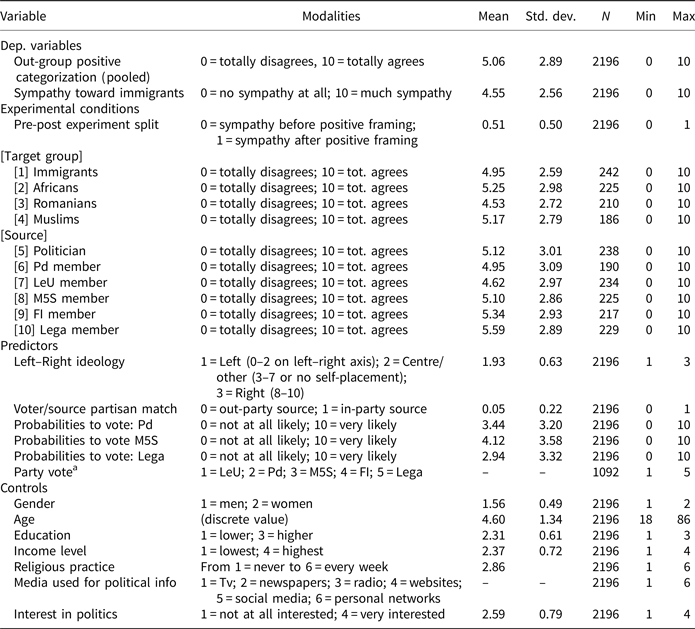
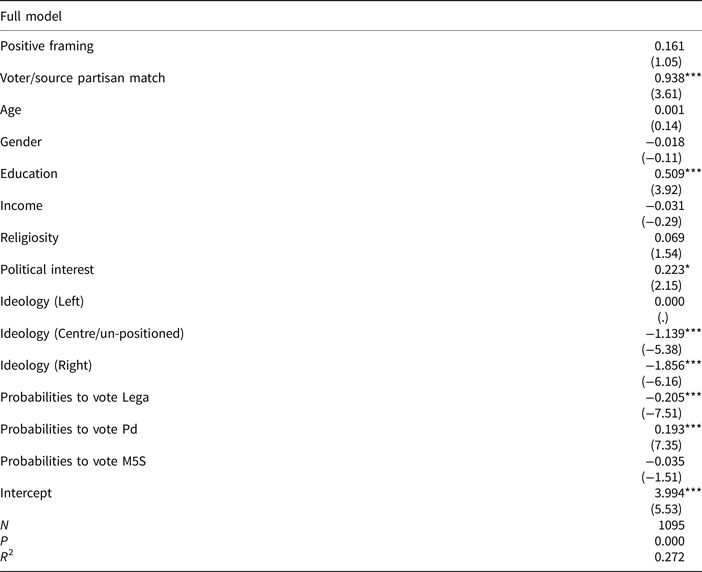
The independent variables that are key to this study are Left–Right ideology and party vote. By focusing on the political dimension of prejudice toward ethnic out-groups, this article investigates how immigrant perception and support change on the basis of the respondents' ideological and partisan affiliations. While the main grounds for this choice are theoretical, evidence drawn from a preliminary multivariate analysis also shows the prominent empirical role of these covariates. Among all independent variables presented in Table 1, Left–Right ideology systematically comes out as the strongest predictor both of agreement with sympathy toward immigrants and out-group positive categorizations. Among the other covariates, propensities to vote for the Lega and the Democratic Party also present a very strong association with these pro/anti-immigrant orientations, whereas the relationship with the Five Star Movement (which is negatively associated with immigrant approval) is much weaker, and it loses all statistical significance when both ideology and propensities to vote for the two other main parties are included in the regression models.
Description of variables and summary statistics

a LeU, Liberi e Uguali (Free and Equal, Left); Pd, Democratic Party; M5S, Five Star Movement; FI, Forza Italia; Lega, Northern League.
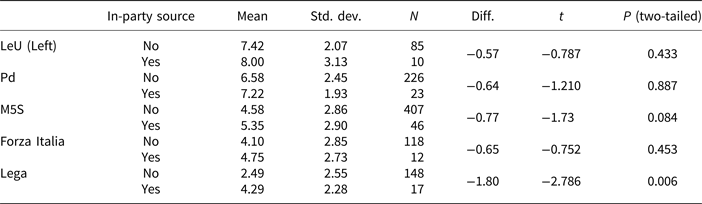
As illustrated in Table 1, the ideological variable is recoded into three categories, in order to analyze each average treatment effect by subgroups with sufficient numbers of respondents. Given the strong similarity – in their general attitudes toward immigrants, as well as in many other social and political orientations – between respondents who do not know or refuse to place themselves on the left–right axis (respectively 4.9% and 26.0%) and the more centrist voters, all these respondents were regrouped into an intermediate ‘residual’ category of ideologically moderate or un-positioned citizens. Although this is a broad and not highly homogeneous category, it functions here mainly as a control group with respect to the two main groups under study: left- and right-wing voters. As for the ‘party vote’ variable, which is only used in relation to the in- vs. out-party cue variable, it is based on voting intentions at the Italian general election to be held a few weeks after the online experiment. The number of cases for each party included in the experiment is as follows: LeU = 95; Pd = 249; M5S = 453; Fi = 130; Lega = 165. Finally, another key predictor is ‘voter/cue partisan match’, a variable which takes the value ‘1’ when the positive categorization (the partisan cue) is attributed to a politician from the party that the respondent votes for, and value ‘0’ when there is no such voter/cue equivalence.
Results
As motivated in the previous section, no univariate descriptive analysis of results will be developed in this study, which does not aim to establish whether and to what extent Italians are prejudiced, overall, against immigrant ethnic out-groups. Rather, the analysis will focus on gaps in levels of positive categorization and sympathy toward out-groups across experimental conditions and subgroups of respondents split by ideological and partisan traits. Hence, results are presented following the distinctive logic of the first two experiments, which will be crossed in turn with the third one (sympathetic framing experiment).
Ethnic group experiment
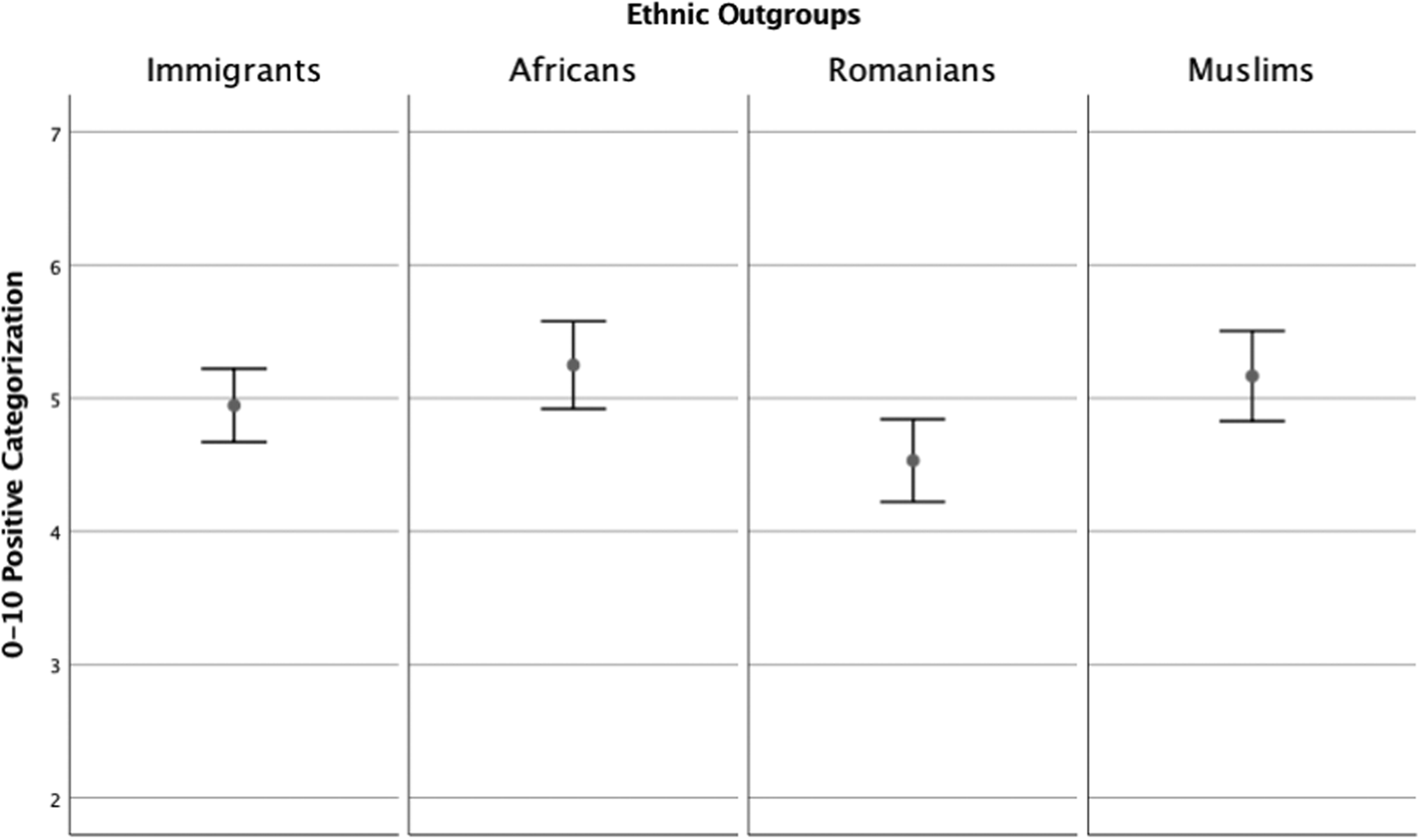
This first section of the experimental design addresses the baseline question of whether the Italians' prejudice is relatively generalized toward immigrants, or if it clearly differentiates between specific ethnic groups. To this purpose, we have randomized the target groups of the ‘good people’ question, which are generically ‘immigrants’ for a baseline group of participants, and alternatively ‘African’, ‘Romanian’, or ‘Muslim’ immigrants for the experimental groups. As Figure 1 shows, no specific group is apprehended in a significantly more negative manner than the broader category of ‘immigrants’. More or less pronounced acknowledgment of their overwhelmingly good intentions is thus relatively independent from the specific ethnic or religious group referred to. For the most part, therefore, the Italians' perception of different low-status immigrant out-groups seems to be ‘ethnicity-blind’. However, a significant gap between two specific groups – Africans and Romanians – emerges. Indeed, agreement with the positive categorization is higher for the first than for the latter [+0.72 points on the 0–10 scale, P = 0.043 as per Bonferroni analysis of variance (ANOVA) post-hoc test for multiple comparisons].
Average score on a 0–10 positive categorization scale toward immigrant out-groups by ethnicity (90% CI).

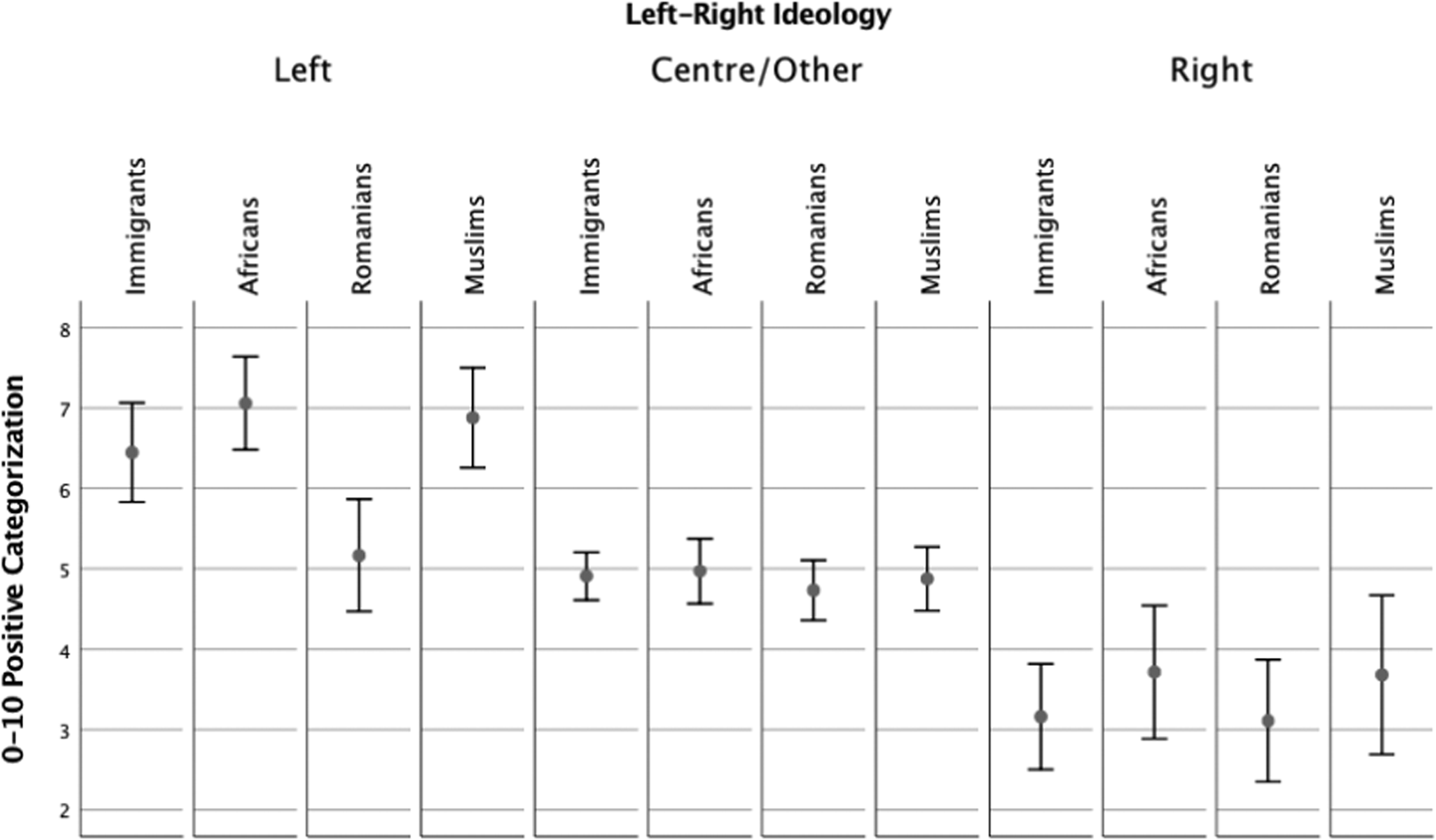
One may be tempted to interpret this result as a manifestation of a particularly negative stereotyping of Romanian immigrants in Italy, with a subsequently wide prejudice expressed by Italian respondents. However, such an ethnic group-centered interpretation would be misleading. Indeed, the fundamental explanation for this drop in positive recognition of Romanian immigrants lies in voters' political and partisan orientations. As Figure 2 shows, it is namely left–wing voters who substantively withdraw their support for immigrants in the case of Romanians, whereas the average scores among right-wing and ‘other’ voters are not significantly different across the four experimental conditions. Our only explanation for this politically selective drop in support is that, contrary to the issue of immigrants in general, and of African and Muslim immigrants in particular (Itanes, 2018), the issue of Romanian immigrants was completely absent from the election campaign and, more in general, from the political agenda in recent years.Footnote 13 As a result, while both other ideological (centrist and right-wing) categories of voters confirmed their undifferentiated prejudice toward immigrants, regardless of the latter's ethnic and religious affiliation, those on the left lacked in this case a political incentive to form and display positive generalizations about the ethnic minority. A lack of politicization (in the form of a ‘political principle of vision’), in other words, was detrimental to the activation of positive categorizations of Romanians – a recent and still low-status immigrant group in Italy in the 2010s – allowing them to be perceived as fundamentally ‘good people’.
Average score on a 0–10 positive categorization scale toward immigrant out-groups by ethnicity and respondent's Left–Right ideology (90% CI).

Partisan cue experiment
A more detailed focus on the political dimension of prejudice toward ethnic and religious out-groups in Italy is provided by the partisan cue experiment, in which the ‘good people’ statement is attributed to ‘a politician’ (baseline group) or, alternatively, to a member of the Left party (LeU), the Democratic Party (Pd), the Five Star Movement (M5S), Berlusconi's Forza Italia (FI), and the Northern League (Lega). The research questions addressed in this section are: (1) what parties, if any, have the potential to generate stronger pro-immigrant responses by endorsing positive out-group categorizations? (2) Do party voters systematically enhance their average pro-immigrant responses when the statement is attributed to an in-party member? (3) What party voters, if any, are more sensitive to in-party endorsements of ethnic out-groups?
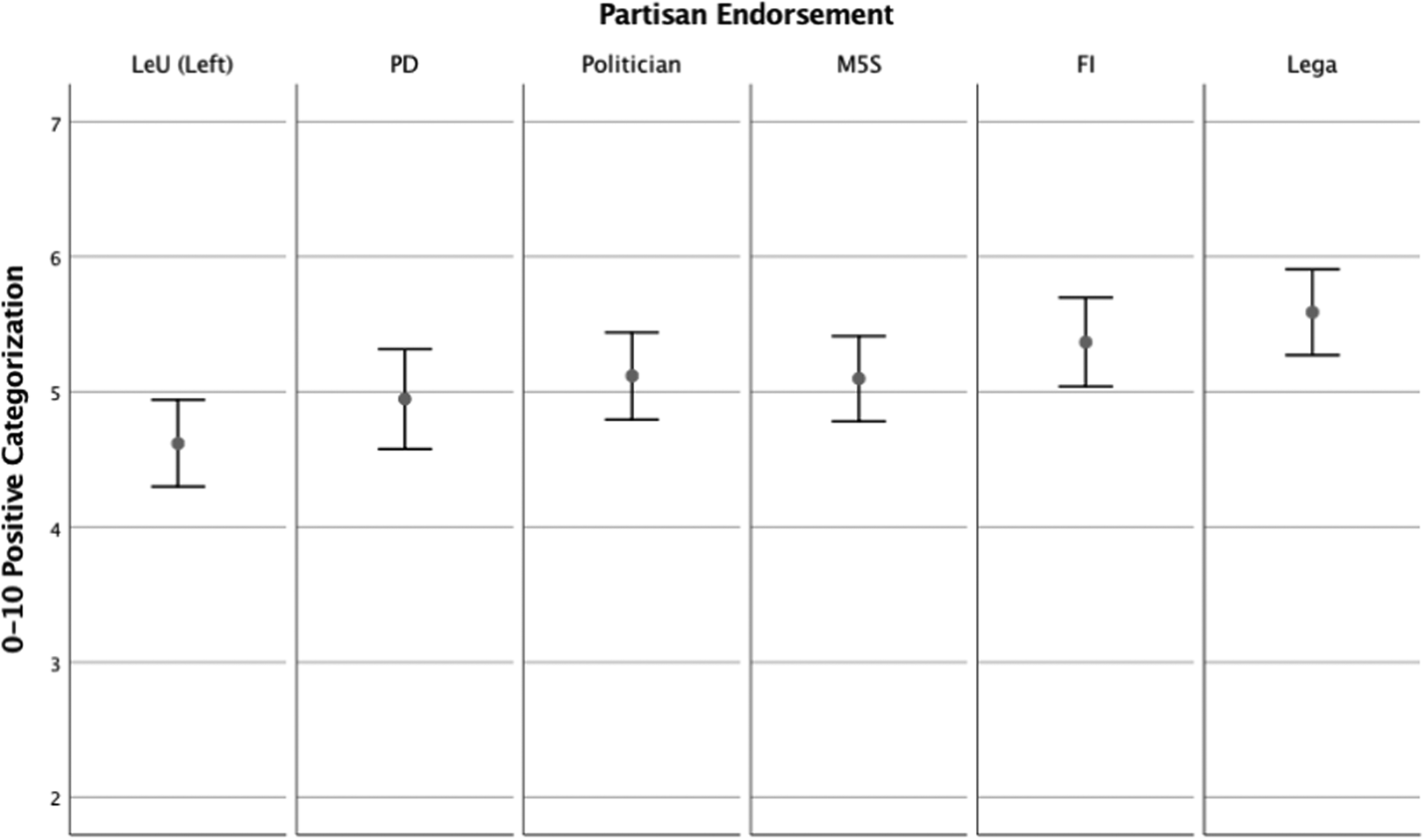
Figure 3 suggests the existence of a pattern linking partisan cues and voters' responses, the latter appearing more and more favorable as the partisan author of the endorsement goes from left (pro-immigrant) to right (anti-immigrant) parties, and with the reference group (generic politician) ranking in the middle. More detailed statistical analysis (post-ANOVA Bonferroni tests for multiple comparisons) confirms that a significant gap exists between, on the one hand, the left-party condition and, on the other, the Lega condition (0.970, P = 0.006). This finding shows that pro-immigrant cues are more effective when conveyed, rather than by political sources associated with pro-immigrant discourses, by political forces generally perceived as immigrant detractors and as having the ‘ownership’ of this issue.
Average score on a 0–10 positive categorization scale toward ethnic out-groups by a partisan source of immigrant endorsement (90% CI).

We understand this outcome as a specific case of more general and well-established social cognitive effects, such as ‘selective perception’, whereby a pro-immigrant message can be discounted as ‘obvious’, and thus appear as less credible, when pronounced by a political source stereotypically associated with a pro-immigrant discourse; and as ‘authority bias’ (Milgram, Reference Milgram1963), which predicts that greater accuracy will be attributed to the opinion of an authority figure, such as, for instance, the party allegedly endowed with ownership of an issue. In this case, therefore, the anti-stereotypical message ascribed to the Lega, a political actor known for being ‘proprietor’ of the issue and overtly hostile to immigrants, generates responses that are more favorable toward the target group. We will refer to this outcome as a ‘political adversary concession’ effect, where the effect is given by the positive impact of the ‘concession’ (or acknowledgment) made to a social group by a political adversary.
Importantly, this concession does not jeopardize per se the external validity (or the ‘mundane realism’) of the statement included in this experimental condition, since it is not unlikely to hear in the Lega's discourse blatantly non-racist statements followed by very restrictive policy propositions justified on other grounds (e.g. loss of national cultural identity, potential presence of a minority of ill-intentioned migrants, economic and social costs paid especially by the worse-off, etc.). Hence, we assume the interviewees to have understood that this was simply not the reason for the Lega's anti-immigrant stances. In other words, this is a statement that could be pronounced by a Lega party member. The main point of this paper about the impact of politicization, however, is that such explicit acknowledgement of the migrants' ‘humanity’ has not been the Lega's official line of political communication since 2013; quite the contrary.
In sum, ethnic group categorizations have a political dimension, in that they can be affected by partisan sources. But another important sign of politicization of prejudice would be given by evidence of a voters' tendency to adhere to their in-party members' statements, and this – systematically – for any party. We thus compare the average scores of the responses to the positive categorization question when the respondents share and when they do not share the source's partisanship. We find that the gap in the average score is substantive (+0.70, P = 0.0191, two-tailed) and goes in the expected direction. Not only does this result hold when controlling for the ‘question order’ effect (see the sympathetic framing experiment in the next section), but it even grows in strength (Appendix Table A1) when we estimate a regression model which includes socio-demographics (age, gender, education, income, religiosity) and political variables (left–right ideology, political interest, propensities to vote for Pd, M5S, and Lega). When holding all these variables constant, indeed, the coefficient of the in-party vs. out-party variable reaches almost 1.0 (P < 0.001), which means that the average score for in-party voters increases by virtually 1 point on the 0–10 scale of positive group categorization.Footnote 14 Overall, this confirms that voters tend to adjust their perceptions of ethnic out-groups to the cues and signals springing from the parties that they vote for.
But does this form of ‘political sympathy bias’ (PSB) apply to the same degree to voters of all main parties? We conducted further tests to compare, for each party's voters, the average scores of the dependent variable (positive categorization) in the in-party vs. out-party conditions (Appendix Table A2). While for LeU, Pd, and FI voters, the increase in the in-party condition is of around 0.6 points – but without reaching statistical significance – we find that the effect is only slightly more important (0.77) and barely significant for M5S, but that it is clearly present and strong for the League (1.80, P = 0.006, two-tailed). Hence, it is precisely the hardline anti-immigrant voters of Matteo Salvini's party who, when exposed to a pro-immigrant in-party cue, are the most inclined to improve – or to strongly soften – their assessment of ethnic out-groups. Being deeply imbued with politics, indeed, their prejudice shrinks when their political side seems less discriminatory in its rhetoric about immigrants.
Sympathetic framing experiment
Through the third experiment, we aimed to measure the ‘affective’ impact of the positive categorization conveyed by the survey question evoking the counter-stereotypical idea that ‘the overwhelming majority of immigrants are good people looking for work and a better life for them and their families’.
In order to test the effectiveness of this sympathetic framing, we compare the mean value of the responses to the second question embedded in the experiment – the feeling thermometer toward immigrants – across two randomized subgroups of the sample, one of which was required to express their degree of out-group sympathy immediately before, the other immediately after the positive categorization of immigrants. In order to maintain better consistency between the target groups of the two questions, we focused especially on the experimental conditions portraying ‘immigrants’ in general (and not specific ethnic groups) as ‘good people’.
In terms of average treatment effects, we expect the positive frame to ‘prime’ respondents on positive immigrant categorization while expressing their general sentiment toward immigrants. This would provide evidence at the same time of a framing and a priming effect (Iyengar and Kinder, Reference Iyengar and Kinder1987) of the positive categorization (‘overwhelmingly good people’ cue), which should acquire – for the only fact of being evoked – a temporary top-of-the-mind status in the respondents' cognitive process of self-assessment of their fundamental attitudes toward immigrants. However, and more importantly, we expect the effect size to be conditional on the political source of the statement. We thus applied the lesson that we learned from the political cues experiment – the ‘political adversary concession’ effect – to hypothesize that the affective impact of the sympathetic framing about migrants will be lowest when the source is a left-wing party, highest when it is Salvini's Lega.
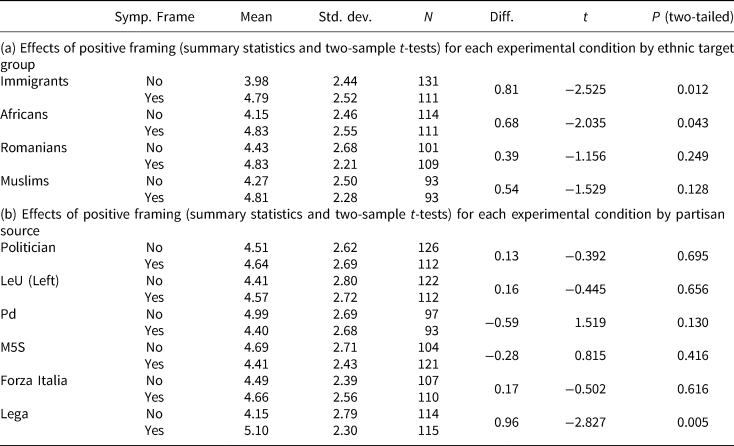
First, we find a significant average treatment effect when the target group is ‘immigrants’ and when there is no political source associated with the statement. Consistent with the framing/priming hypothesis, the average value of the thermometer score increases significantly (+0.81, t = −2.525, P = 0.012, see Appendix Table A3a) when the question with the ‘good people’ argument is presented before the question about the feeling thermometer. Our key test here, however, regards the effects conditional on the partisan source: what happens when the issue becomes associated with the political realm?
The effect of the sympathetic frame appears to be negative (−0.59) – although without reaching statistical significance (see Appendix Table A3b) – if the statement is attributed to the Democratic Party. This suggests that migrants might be discounting the negative sentiment triggered by their association with the main Center-left incumbent party, which would be severely defeated at the upcoming election. While the t-tests for all other parties are even farther from reaching statistical significance, and thus from indicating a rise in sympathy toward immigrants after exposure to the sympathetic frame, they prove clearly positive (+0.96, t = −2.827, P = 0.0051), as expected, when the alleged source is the Lega.
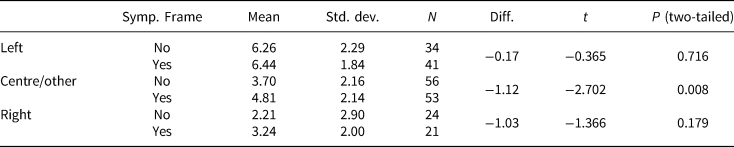
In sum, not only is a positive message about immigrants more widely accepted when it originates from the party known to be stricter on immigration rather than from any other party (political cues experiment); but, to the extent that the message has been politicized by the presence of a partisan label, it is only when it stems from the same ‘issue entrepreneur’ (Lega) that it is also effective in priming favorably, as a consequence of the ‘authority bias’ and ‘selective perception’ effects recalled in the previous experiment, the respondents' sympathy toward immigrants (sympathetic framing experiment). Moreover, when checking for conditionality on the respondents' ideological self-placement, we find that left-wing voters' self-declared sympathy is unaffected by a positive frame stemming from the Lega. It is right-wing voters and, more robustly (especially due to a higher number of cases), the more centrists that prove sensitive to this partisan frame (Appendix Table 4).Footnote 15
Conclusions
This study has focused on the political dimension of ethnic prejudice. It provided evidence of this phenomenon by showing some of its possible effects when ethnicity, instead of serving as only one of the social schemes of classification for individual cognitive purposes, is activated as a political and affectively charged ‘principle of vision and division’.
Firstly, the ‘ethnic group experiment’ has shown that the Italians' beliefs about different immigrant out-groups tend to be ethnicity-blind, with no evidence of significant inter-group gaps in their average responses. Overall, in other words, no specific ethnic or religious out-group – among those considered in this study – is the target of more pronounced hostility. However, as a consequence of a lack of politicization over a specific immigrant group – Romanians – left-wing voters appeared to be lacking an incentive, in this case, to display support for ethnic out-groups.
Secondly, the ‘partisan cues experiment’ demonstrated that party-endorsed pro-immigrant messages can make a difference in overall immigrant perception, but only when the positive categorization is ascribed, rather than to the Left party, to the party recognized as the ‘issue entrepreneur’ about – and against – immigration (what we defined as a ‘political adversary concession’ effect based on issue ownership). Even more importantly, if party voters tend to improve their views of immigrant out-groups in the presence of in-party positive cues, this happens much more markedly to the Lega voters. Their prejudice having a strong political dimension, it is also more liable to decrease as a result of less prejudiced in-party political communications.
Thirdly, in the ‘sympathetic framing experiment’, we found that the same positive categorization also leads respondents to express more positive sentiment toward immigrants, but only if the positive statement is devoid of any partisan reference or, and even more so, when it is attributed to the Lega, as a spin-off of the political adversary concession effect on the affective dimension. However, this outcome does not apply to left-wing voters, given their political resistance to the hostile partisan source of the message.
All these findings provide evidence of a direct causal relationship between the nature (i.e. contents and sources) of political communication over immigrants and citizens' affective responses toward them, depending on their political predispositions, in an environment of ethnic prejudice resulting from a sustained process of politicization.
As aforementioned, it is important to reflect on the ‘particularities’ of the Italian case as a particular instance of a more general phenomenon. Possibly, Italy presents quasi-ideal-typic patterns of politicization in the form of ideological polarization and partisan sorting, and it is thus more prone than many other Western democracies to develop this remarkable blend of political and ethnic prejudice.Footnote 16 However, Italy has experienced patterns of politicization over immigration very similar, even though belatedly, to those in other EU countries (Gattinara, Reference Gattinara2016). The Italian case, therefore, may present a particularly accentuated instance of a mechanism that is also at work – only more mildly – in other democratic systems.
It is a well-established fact, moreover, that a ‘politics of resentment’ conducted by radical right parties against social and national out-groups – as much as that conducted by populist forces against social elites and the political establishment – finds ideal working conditions in times of economic recession, when popular anxiety, fears, and frustration are logically high. Like the presence of populist-oriented media, therefore, economic crises are ‘facilitating conditions’ (Kriesi, Reference Kriesi2015) for the rise of politically mobilized prejudice against ethnic out-groups. Anti-immigrant rhetoric, in turn, resonates well with pre-existing ambivalent or negative citizens' beliefs and feelings toward immigrant out-groups, which politicization driven by parties elevates in degree – and transmutes in nature – to the state of politically permeated hostility.
Further studies should inquire into more detail about Italian left-wing voters, among whom support for ethnic out-groups is certainly not unanimous (Sniderman et al., Reference Sniderman, Peri, de Figueiredo and Piazza2002). Keeping the case of left-wing voters with xenophobic orientations aside,Footnote 17 a current criticism is that display of immigrant support on their part could reflect adherence to cultural norms of social desirability. It is possible, in other words, that some of these respondents' attitudes about immigrants are much more ambivalent, if not intimately (and may be unconsciously) negative, than what they felt ‘obliged’ to state in the survey. But our interpretation is slightly different and, rather than relying on the notion of ‘social desirability bias’ (SDB), points to the idea, which we have defined as 'political sympathy bias' (PSB), that a pro-immigrant public discourse of the Left has been cognitively internalized (or ‘incorporated’) by left-wing citizens as a political ‘principle of vision and division’, even if it does not necessarily correspond to a specific affection for ethnic out-groups (just like right-wing voters' vindicated hostility is far from necessarily being – as we repeatedly stated – a form of blatant racism, but rather the other side of a PSB, with the immigrant becoming not only a social, but also a political out-group). More importantly in behavioral terms, we believe that the expression of politically motivated positive prejudice – that is, PSB – toward out-groups will be less probably associated with the acts of practical discrimination of low-status immigrants, regardless of the more or less sincere nature of the stated support.
What political lessons can be drawn from this analysis of the political sources of prejudice? Some plausible counterfactual scenarios can be tentatively sketched. If the Lega renounced, in exchange for broader political legitimacy, both internationally and within Italian society, to pursue mere electoral payoffs by scapegoating and verbally aggressing unauthorized immigrants, and if it maintained its immigration and integration policy positions by using a less disparaging tone, manifestations of anger and resentment against all immigrants would diminish. If the M5S – which has typically been ambivalent and split over these issues – extended their political and civil rights discourse to immigrant and ethnic minorities, the perspective for them of a winning political coalition with the Centre-left would be available. If the ‘postmaterialist’ Left combined its strong ‘ethics of conviction’ with an ‘ethics of responsibility’ (Weber, Reference Weber, Owen and Strong1919) taking seriously into account some of the foreseeable consequences of its idealistic stances about immigration flows, and if it resisted the temptation to superimpose its flags and symbols on immigrants and minority out-groups while – more than legitimately – supporting them, this would possibly contribute to depolarize public beliefs and feelings about immigration.
In sum, by displacing symbolic political conflict away from such a sensitive issue, Italy, as well as other European democracies, would be able to address the issues of migrant regulation and immigrant integration by more ordinary political contention over policy making, rather than in the – potentially warmongering – terms of identity politics, when the latter is blended with ethnicity. Our normative appeal, in other words, is in favor of depoliticizing ethnicity, which means more (possibly enlightened, and not populistic, i.e. very short-term oriented) policies, but less symbolic politics about immigration; and above all, less ultra-emotional, oversimplified, hyper-categorical, and hate-speech oriented ‘social media style’ political communication over this issue.
Data
The replication dataset is available at http://thedata.harvard.edu/dvn/dv/ipsr-risp
Financial support
The research has been funded by the University of Milan (Transition Grant ‘Partenariati H2020’).
Appendix
OLS regression estimates (coefficients with standard errors in parenthesis) for positive categorization scale by socio-demographic and political variables (experimental conditions based on the source of partisan endorsement only)

Agreement with positive categorization (summary statistics and two-sample t-tests) for each experimental condition by voter/source partisan match

Effects of positive framing by (a) ethnic target group and (b) partisan source

Effects of positive framing (summary statistics and two-sample t-tests) by respondents' ideological self-placement (source of statement: Lega)