Introduction
A persistent and longstanding literature argues that the initiatives of political entrepreneurs determine whether an ethnic identity—religious, tribal, regional, linguistic, or racial—becomes an element of party competition.Footnote 1 In these accounts, ethnic cleavages emerge—that is, ethnic identities begin to predict voting behaviorFootnote 2—when entrepreneurs strategically construct ethnic-based coalitions of voters,Footnote 3 organize in response to electoral rules or institutional change,Footnote 4 or use preexisting ethnic organizations to reach voters and organize them into ethnic blocs.Footnote 5 But the direction of causality can also be reversed. The actions of entrepreneurs, institutional design, and organizational capacity can develop in response to an emerging ethnic-based coalition of voters.Footnote 6 Parties can engage in ethnic coalition-building once ethnic identities become salient in party competition and the identities encapsulate information about the costs and benefits associated with ethnicity. Electoral rules and institutional reform can be instrumentally designed by elites in power who wish to encourage party competition around ethnicity. Entrepreneurs can invest in developing organizational capacity when voters wish to organize around ethnic identities.
Evidence from around the world shows that despite the expectations of elite-centered theories, political entrepreneurs don't necessarily manage to organize voters around ethnic identities. For example, Switzerland is a multilingual country with no major linguistic parties. In India, despite several decades of violence between Hindus and Muslims, Muslims have traditionally voted for secular parties. Guatemala has no national indigenous party, despite the success of local indigenous movements. And in the United States, Hispanics and Latinos don't form a single voting bloc, despite the salience of these identities.Footnote 7 These examples challenge what appears to be a robust relationship between the incentives of entrepreneurs to organize around ethnicity and the success of ethnic parties. When does ethnicity become an element of party competition? And when do appeals by political entrepreneurs to ethnic identities fail to craft large voter coalitions?
My argument is that ethnic cleavages emerge when voters seek out parties and candidates that represent the interests associated with the voters’ ethnic identity.Footnote 8 Voters have multiple identities, such as language, gender, and class, and they face a dilemma when deciding how to vote. When government policies divide society into winners and losers based on ethnic identities, voters prioritize their ethnic identity and seek to protect their interests. Contrary to elite-centered theories that ethnic cleavages emerge because of the strategic behavior of ethnic entrepreneurs, the argument advanced in this article is that voters lead the formation of ethnic cleavages in response to government policies. Political entrepreneurs manage to organize voters into ethnic coalitions when voters are aggrieved by government policies and want to organize against those policies. To put it differently, government policies, not the initiatives of political entrepreneurs, are what cause voters to coordinate around a shared ethnic identity. To be sure, this article does not argue that social diversity determines whether ethnicity becomes a dimension of party competition. My argument is that ethnic identities become politically relevant in party competition when government policies link those ethnic identities to costs and benefits, thus producing incentives for voters to coordinate on their ethnic identity rather than their other identities or interests.
Testing the argument that government policies are the reason why ethnicity becomes a dimension of party competition poses a methodological challenge. Parties channel demands from society to the state and realize the political preferences of voters through policy-making.Footnote 9 For this reason, government policies are rarely exogenous, as political preferences and policies often affect each other. Indeed, voter preferences and policymakers' positions are shaped by the outcomes of past policiesFootnote 10 and by the expectations for costs or gains from present policies.Footnote 11 The mutual influence between preferences and policies is clearly evidenced in many theories of ethnic politics. According to these theories, political entrepreneurs and parties mobilize voters around ethnic identities based on the expectation that the party will deliver goods to members of the ethnic group.
Given the mutual influence between policy preferences and government policies, evaluating the impact of policies on preferences requires identifying cases of government policies that were neither designed based on existing policies nor intended to align voting along an ethnic identity. This identification strategy excludes cases where ethnicity was already a dimension of party competition or where elites in power or entrepreneurs in society instrumentally drove policy changes to benefit their goals. Cases that meet the selection criteria are notably rare, given the rewards to elites from competition around ethnicity and the long-term impact of pre-democratic or colonial policies on the political relevance of ethnic divisions.Footnote 12 Cases of government policies that didn't reinforce existing cleavages and weren't meant to form a new cleavage, albeit rare, make it possible to analyze the effect of government policies on the emergence of a new dimension of party competition around ethnicity.
My analysis leverages several such cases to analyze the formation, decline, and reemergence of an ethnic dimension in Prussian electoral politics between 1848 and 1874. In the culturally segmented societies of nineteenth-century Western Europe, religion was a salient ethnic identity. Catholics in Prussia were an ethnic minority that composed roughly one-third of the population in 1849, and were concentrated in the eastern and western provinces. Despite sharing a religious identity, Catholics differed in their cultural practices and ideological outlooks. The Catholics in the east were ethnically Polish and agrarian; those in the western provinces were comparatively more liberal, especially in the cities, and experienced greater economic development.
Prussia provides rare cases of plausibly exogenous government policies that were not initiated to organize Catholics around a common identity, but that instead responded to other circumstances. Religion became a dimension of party competition in Prussia on two occasions between 1848 and 1874. The first happened in 1852, when a series of decrees meant to limit the activity of a small Catholic order, the Jesuits, inadvertently affected all Catholics. The decrees appeared in secret government documents that weren't meant to become public, and Catholics regarded them as a violation of their religious freedom. The second set of policies was initiated after 1866, when Otto von Bismarck was preparing for the German unification and seeking new domestic partners. In Bismarck's changing domestic coalition, the National Liberal Party (Nationalliberale Partei, or nlp) was given influence over policy-making and was thus able to act against Catholics and the Catholic Church. Bismarck, who didn't see Catholics as a threat until after the Catholic party, the Zentrum,Footnote 13 reemerged in 1870, allowed the nlp to pursue its agenda because he wanted to distract it from gaining influence over more important issues.Footnote 14
My focus on Prussia allows me to leverage the variation in the political relevance of an ethnic identity over time within a single country-case, thus controlling for country-specific variables, and to establish the causal chain in the formation of an ethnic cleavage. Prussia is an excellent case for testing the theory that voters drive ethnic cleavage formation precisely because it is where we can expect to confirm hypotheses from elite-centered theories. Prussian politics and society were organized hierarchically around figures of authority—the priest and the nobleman. At that time, the Catholic Church controlled a broad network of clubs and associations, and Catholic voters experienced a cultural revival that gradually increased the moral authority of the parish priest. Another advantage of the Prussian case is that the cleavages emerged, declined, and reemerged in a short period during which social-structural and economic conditions remained fairly static. A focus on Prussia therefore allows me to eliminate many alternative explanations—that the cleavages emerged because of electoral rules, institutional change, or group size—and to narrow the range of possible explanations to voters or entrepreneurs. And because the research design holds constant the existence of the Zentrum between the decline of the cleavage in the 1860s and its reemergence, I can rule out the explanation that the cleavage reemerged because there was a preexisting Catholic party to which voters could turn.
Through process tracing, I test two competing hypotheses. The first, which I advance in this article, is that voters determine whether a new ethnic cleavage emerges. In the alternative hypothesis, common in elite-centered theories, entrepreneurs drive cleavage formation. The two hypotheses are mutually exclusive: evidence in support of the hypothesis that voters decide whether an ethnic cleavage emerges undermines the alternative hypothesis that entrepreneurs lead the formation of ethnic cleavages. If entrepreneurs only succeed in organizing voters around ethnicity in some cases, and voters organize around ethnicity every time they're aggrieved by government policies, then voters determine whether a new ethnic cleavage emerges, not entrepreneurs.Footnote 15
The time period begins in 1848, with the first German elections, and ends in 1874, after the Zentrum was relaunched. I find that Catholic voters organized into a Catholic coalition when they were collectively aggrieved by government policies. But when Catholics weren't the focus of government policies, the Catholic coalition weakened. This happened despite attempts by Catholic politicians, activists, and the clergy to sustain the cleavage. During those years, Zentrum candidates managed to find support only in constituencies where the parish priest's authority was high and the Progressive Party (Fortschrittspartei, pp) was weak. Over time and despite these attempts, support for the Zentrum declined and the party dissolved. The Catholic identity reemerged as an element of party competition in Prussia when Catholics were again aggrieved collectively based on their religious identity. To provide complementary evidence that the Catholic vote aligned in response to policies, I use electoral returns from Prussian state elections between 1863 and 1873 and indicators for the power of the Catholic Church. I demonstrate that the Catholic vote was aligned in response to government policies and that support for pro-Catholic candidates was stronger in constituencies with a high share of Catholics.
This article advances two new arguments. First, that voters, not political entrepreneurs, drive electoral coordination around ethnic identities; second, that voters organize around ethnic identities in response to government policies. The article makes contributions to the literature on ethnic parties and ethnicity in party competition,Footnote 16 on religion and parties,Footnote 17 on party system formation and change,Footnote 18 and on the electoral dynamics in nineteenth-century Germany.Footnote 19
The Puzzle of Ethnic Cleavage Formation
Previous theories of ethnic cleavage formation expect political parties and entrepreneurs to drive the process whereby ethnicity becomes a dimension of party competition. Dominant theories of ethnic politics have long argued that ethnicity is a useful social category for political entrepreneurs seeking to craft voter coalitions. This is because ethnic groups have clear boundaries that serve as informational cues to voters about who can benefit from the ethnic party's success.Footnote 20 Moreover, these theories view ethnic identities as instrumental to political entrepreneurs when the ethnic group is large enough to create profitable electoral coalitionsFootnote 21 or small enough that voters expect to get higher returns from voting with their ethnic group rather than with their social class.Footnote 22 Recognizing the benefits of party competition around ethnicity, these theories expect entrepreneurs to have strong incentives to craft ethnic-based voter coalitions.
Although competition around ethnicity has benefits, there are reasons to think that political entrepreneurs might prefer to establish a nonethnic support base. In many theories of ethnic politics, elites maintain ethnic coalitions based on expectations for resource delivery to the ethnic group.Footnote 23 The logic of resource distribution is useful for explaining why voters and entrepreneurs continue to coordinate around ethnicity, but it's less suitable for explaining the formation of ethnic cleavages. This is because parties are only able to deliver on promises for resource distribution if they're elected to office and manage to gain access to state resources. In practice, voters and politicians don't know for sure that a new ethnic party will be successful and thus able to deliver on its preelectoral commitments. Entrepreneurs, moreover, have incentives to avoid competition around ethnicity because such competition is volatile and can bring dramatic shifts in office-holding, ultimately leaving some ethnic groups without access to power.Footnote 24
These are just two examples of how assumptions about deliberate and strategic calculations by elites, which are common in theories of ethnic parties, don't sufficiently take into account uncertainty in electoral competition.Footnote 25 Parties and other political entrepreneurs operate in an environment with imperfect information about the electorate's preferences and the electoral strategies of other parties. Because of this, they're unsure about the ideal policy positions the party should occupy.Footnote 26
Uncertainty in electoral competition is especially high for new parties. At every election, parties and political entrepreneurs must adapt to simultaneous changes in voters’ party allegiances and the positions of other parties. Unlike experienced parties, new parties can't rely on their reputation or on interactions from previous elections to predict the success of their mobilization strategies, and in some circumstances, their own electoral success depends on the actions of other parties.Footnote 27 When political entrepreneurs struggle to predict the outcomes of their choices and their interactions with other parties, it's much harder for them to act strategically.Footnote 28
Entrepreneurs have additional reasons to avoid establishing party competition around ethnicity. For leaders of an ethnic group who want to promote their group's interests, voter coalitions based on ethnicity are unreliable. That's because voters can change the importance they assign to issues and thus switch parties between elections. A reliance on political parties might become an obstacle for group leaders because a party's own organizations can constrain its ability to act strategically, which could eventually keep the party out of power.Footnote 29 Given the choice, ethnic leaders might prefer not to rely on political parties and instead seek other channels of influence over policy-making.Footnote 30
Given that entrepreneurs struggle to act strategically and have reasons to avoid establishing competition around ethnic identities, there may be an alternative explanation for the relationship between structural conditions and ethnic cleavage formation. For example, an ethnic group's relative size can make the ethnic identity relevant in party competition not because this benefits electoral entrepreneurs, but because the group's size makes it a target of exclusion. Ethnicity can be politically relevant in party competition under high inequality when the ethnic group experiences discrimination. When this is the case, economic deprivation is a symptom of broader grievances, and accordingly, coethnics choose to vote together because their grievances are based on their ethnic identity and they want to improve their condition.Footnote 31
Beyond elite initiatives, theories of ethnic politics identify two other factors that determine whether ethnicity becomes a dimension of party competition: institutions and the availability of mass organizations. In regard to institutions, theories of ethnic politics expect entrepreneurs and voters to organize around the particular identity that yields the optimal coalition of voters based on electoral rules.Footnote 32 But electoral rules and institutions more broadly could be designed by elites in power to encourage ethnic competitionFootnote 33 or to strengthen it when ethnicity is already politically salient.Footnote 34 Furthermore, empirical studies don't find that electoral rules affect the formation of ethnic cleavages. Single-member constituencies don't suppress the formation of a new dimension of party competition when interests are geographically concentrated, as is often the case with ethnic groups,Footnote 35 and permissive electoral rules don't predict the formation of ethnic parties.Footnote 36 Proportional representation (pr) is associated with a large number of partiesFootnote 37 and greater ethnic diversity,Footnote 38 but there's little evidence to suggest that pr affects the number of cleavages. Ethnic parties are more prevalent in pr systems with ethnic diversity,Footnote 39 but ethnic voting is lower under pr.Footnote 40 Other studies found that cleavages do change when electoral rules remain fixed,Footnote 41 and are stable when electoral rules change.Footnote 42
In regard to the availability of organizations, theories of party system formation expect organizational capacity to explain the success of new parties. Organizations help a party reach a broad audience, send a consistent message to voters, and nominate candidates in a large number of constituencies. Applied to the context of culturally segmented societies, ethnic parties are expected to be electorally successful because ethnic groups often have organizations that can be captured by political entrepreneurs to facilitate the mobilization of voters around identity.Footnote 43 In addition to their broad reach, ethnic organizations possess high levels of trust, so affiliation with them gives credibility to entrepreneurs’ electoral promises.Footnote 44 But empirically, evidence on the impact of organizations is mixed. Organizational capacity was used to explain the success of Christian Democracy in Western Europe, of ethnic parties in Eastern Europe, and of the Muslim Brotherhood in Egypt.Footnote 45 But other studies show that politicians turn to developing ethnic-based links with voters because intermediaries are absentFootnote 46 and that organizations specific to an ethnic group can be captured by nonethnic opposition parties.Footnote 47
What's more, the availability of organizations is no guarantee that entrepreneurs will be capable of organizing voters. Because voters with the same ethnic identity are likely to collaborate over shared interests, the capacity to organize voters into an ethnic-based coalition is greatest when ethnicity encapsulates information to voters about the expected gains from joining an ethnic coalition, as compared to voting on other issues or identities. By this logic, the capacity of entrepreneurs to organize voters using broad organizations or their ability to nominate candidates in a large number of constituencies can evolve when identities are charged with political content and when voters sharing the same identity wish to organize around ethnicity.
Studies that focus specifically on religious cleavages and parties draw on insights from the literature on ethnic politics. Scholars have examined why religious parties emerged in Western Europe,Footnote 48 why religious cleavages persist,Footnote 49 and more recently, how the strategic behavior of Muslim parties and organizations among voters contributes to their electoral success.Footnote 50
Seymour Lipset and Stein Rokkan's argumentFootnote 51 that fundamental divisions in society determine the party system structure relies on a view of ethnic groups as monolithic—readily socially cohesive—with rigid boundaries and fixed preferences. These assumptions contradict what has become a consensus among identity scholars: that social identities, group membership, and the salience of identities are fluid and change in response to one's environment and external circumstances. Given that individuals hold multiple identities and that the degree to which they feel close to their identities changes over time, we need a finer understanding of the conditions that create cohesion between individuals who share an identity and the conditions that pressure them to break away from their existing party alignments to join an ethnic-based voter coalition. Government policies that aggrieve voters based on their identity create exactly those incentives. Such policies push voters to prioritize the aggrieved identity and to coordinate with coethnics in forming a parliamentary opposition to government policies. To be sure, the argument advanced in this article differs from cleavage theory. Although Lipset and Rokkan's seminal work expects identity-based parties to emerge because of a conflict between the central state and peripheral groups, this article demonstrates that ethnic parties emerge in response to specific policies of the political center.
A Theory of Ethnic Cleavage Formation
Scholars have long recognized that voters have multiple identities, such as class, race, language, and religion, and that these identities are linked to policy preferences.Footnote 52 When making choices at the ballot box, voters prioritize the identity they see as the most relevant, compared to their other identities and interests.Footnote 53 Ethnicity, as with other social identities, becomes politically relevant when it's linked to benefits and costs, social status, and discrimination. Voters feel closer to their ethnic identity when they believe that the material well-being or status of their ethnic group is under threat.Footnote 54
Government policies that aggrieve voters based on their ethnic identity, I argue, can create these conditions. Government policies have a crucial impact on the political relevance of ethnic identities in party competition.Footnote 55 Policies can structure political conflicts because they determine individuals’ material well-being, social status, and political rights. And as E. E. Schattschneider famously noted, new policies can reshape mass politics.Footnote 56 Government policies that divide society into winners and losers based on ethnic identities charge those identities with content about benefits and costs. Grievances from policies shape patterns of political competition because they create strong incentives for voters whose grievances are based on their ethnic identity to coordinate around their shared interestsFootnote 57 and to seek candidates who claim to protect the ethnic group's interests. Because ethnicity can't be changed to avoid the policies’ negative outcomes, voters are pressured to coordinate with others who share their ethnic identity. From this perspective, it's easy to see that group cohesion and group boundaries can crystallize in response to government policies that link the fates of voters who share an ethnic identity but might otherwise have different cultural practices, ideological outlooks, and party allegiances.Footnote 58 In other words, when the outcomes of policies depend on ethnic identities, voters seek to coordinate around ethnicity instead of other interests or identities.Footnote 59
As mentioned above, new parties face substantial uncertainty about the outcomes of their mobilization strategies and the responses of other parties. Because of this, they're likely to pursue short-term goals and to organize around salient issues and emerging voter coalitions. By organizing around a viable coalition of voters, entrepreneurs can expect to win legislative seats and thus increase their party's chance of surviving until the next election. Moreover, organizing against government policies is beneficial for new parties, which typically don't have access to power and therefore can't make credible commitments to deliver tangible goods to voters. Because of their limited access to resources, new parties are more likely to succeed by organizing voters based on nonmaterial promises to promote their interests.Footnote 60 Entrepreneurs also benefit from organizing against government policies because doing so helps them overcome the barriers to forming a national party.Footnote 61 The policies create a common goal for those voters who share an ethnic identity but are otherwise differentiated in their social class and regional identity. Because the policies produce a single focal point, entrepreneurs across multiple constituencies can coordinate their platforms and mobilization efforts around similar content and a single party.
Catholics and the State in Nineteenth-Century Prussia
With the Protestant Reformation, religion became a salient ethnic identity in the culturally segmented German-speaking regions of Europe. It played a major role in the Thirty Years’ War in the seventeenth century and remained significant in the eighteenth century, when the relationship between Catholic and Protestant communities oscillated between coexistence and conflict.Footnote 62 Catholics in mid-nineteenth-century Prussia were concentrated in the western and eastern provinces, and the Prussian elementary education system was divided by religion. Despite the importance of the Catholic identity, Catholics weren't a homogeneous group in 1848. In the eastern parts of Prussia, Catholics in Upper Silesia were ethnically Polish and had a strong regional identity that was neither German nor Polish. But in the province of Posen, the meaningful social division was between the ethnically Polish Catholics and German Protestants.Footnote 63 Compared to Catholics in the east, those in the western provinces enjoyed greater social mobility and political freedoms—a legacy of the Napoleonic occupation.Footnote 64 Middle class urban Catholics in the Rhineland saw themselves as Bürger, members of the German middle class, and shared that class's liberal values and worldview. Until the 1860s, Bürger Catholics saw no contradiction between their class identity and their religion, as “to be a good Catholic meant to be a good liberal as well.”Footnote 65 In contrast, Catholics from the lower classes were under the influence of traditional authority figures like the parish priest, who often served as village leader, teacher, and source of moral authority.Footnote 66 Unlike the lower classes who married within their religion, upper-class Catholics married within their social class; the general rule was “the higher the class, the less emphasis on religion.”Footnote 67
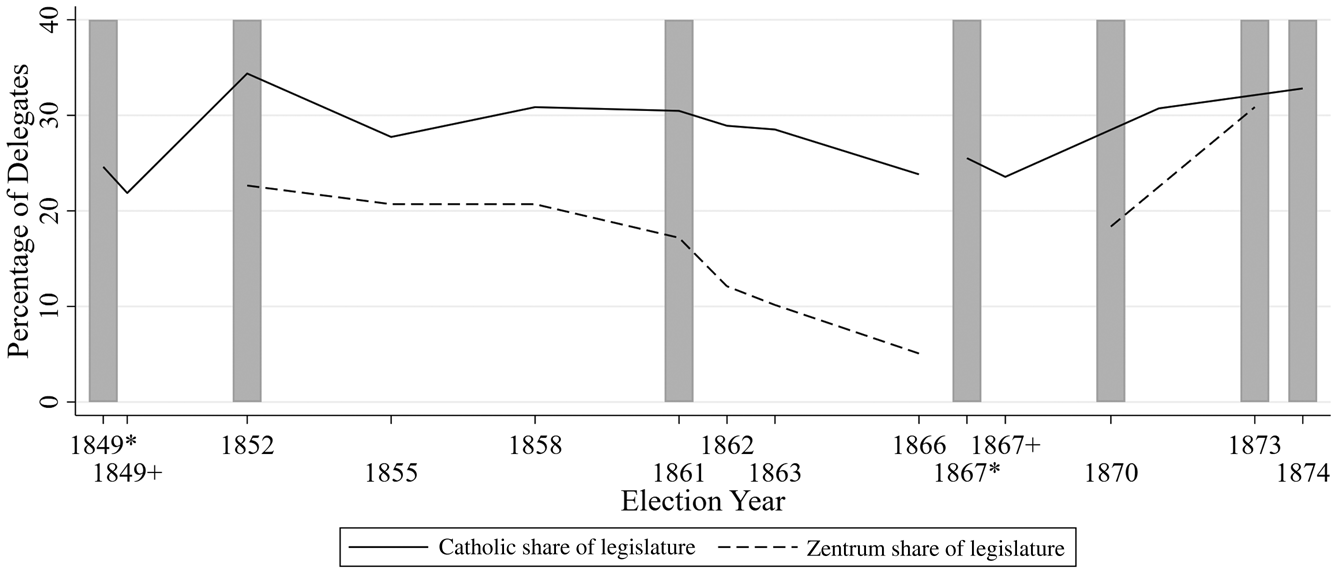
The political relevance of the Catholic identity in Prussia fluctuated between 1848 and 1874.Footnote 68 Figure 1 shows the change in the political relevance of this identity over time, measured as the percentage of Catholic and Zentrum delegates. After the first Prussian election in 1849, the share of Catholics in the Prussian lower house was 25 percent. It reached 34 percent in 1852, when the Zentrum emerged, reflecting the share of Catholics in the population. In the following years, the share of Catholics declined, despite attempts by Catholic politicians, the clergy, and laymen to sustain the Catholic voting bloc. Prior to each election, clergymen acted independently from the Church hierarchy, summoning Catholics to vote together to protect their rights and the interests of the Church, and warning that the Church was in danger of losing the special privileges that were guaranteed by the constitution.Footnote 69 The share of Catholics in the Prussian lower house increased again after 1870, when the Zentrum was revived. Another indicator of the change in the political relevance of the Catholic identity, the share of Zentrum delegates over time, shows a similar trend.
Change in the Political Relevance of the Catholic Identity in Prussia 1849–1874a
a The solid line indicates the share of Catholic representatives in the Prussian lower house (1849–1866) and in the Reichstag of Imperial Germany (1867–1874) elected in the same geographic units in Prussia. The dashed line shows the share of Zentrum delegates in the Prussian lower house from the founding elections of the party in 1852 to 1873. 1849* denotes the January election, 1849+ the July election, 1867* the February election, and 1867+ the August election. The shaded columns indicate years with especially strong attempts by political entrepreneurs to mobilize Catholic voters. More information about the data and the sources is available in section B of the supplementary material; Mor Reference Mor2022.

These patterns of Catholic alignment and dealignment can't be explained as the outcome of elite incentives or mobilizational capacity. Catholics didn't vote together in all the instances when attempts by Catholic entrepreneursFootnote 70 to organize Catholics were salient, or when Catholic associations were particularly encompassing and broad (1848/1849 and during the 1860s). As the next sections show, the gradual improvement in the parish priest's moral authority from the early 1850s didn't translate into a Catholic voting bloc. Nor was the Catholic vote in Prussia united by the exceptionally passionate rhetoric of priests and laymen in 1848, 1861, and 1870, or by the formation of a Catholic cleavage in the neighboring state of Baden in 1864.Footnote 71 What explains the patterns of Catholic alignment and dealignment are the changes in the motivation of Catholic voters in different Prussian regions and social classes to vote on the Catholic identity.
In what follows, I investigate the effect of government policies on the vote choices of Catholics and the behavior of Catholic political entrepreneurs between 1848 and 1874. To study the effect of government policies on the emergence of ethnicity as an element of party competition, we need cases in which entrepreneurs responded to circumstances they hadn't created. This selection criterion excludes policies that reflect the policy preferences of voters, government officials, or legislators, and are initiated as part of a feedback effect in which the beliefs and attitudes of elites who design new policies are shaped by existing policies.Footnote 72 Similarly excluded are cases in which elites in power instrumentally initiate policies that benefit or aggrieve particular groups, thus encouraging mobilization along a certain identity. In Prussia, for instance, conservativeFootnote 73 delegates might want to charge the Catholic identity with political content in order to create a winning coalition of Catholic voters. Alternatively, middle-class Protestant delegates might capitalize on the success of a Catholic party and rally voters against it. To address these concerns about endogeneity, I draw on accounts by contemporaneous and secondary sources, examine the circumstances in which the policies were initiated, and rule out the possibility that they were initiated to create a Catholic constituency. The rest of this section discusses how the two sets of policies that led to the alignment of Catholics at two points in time, in 1852 and after 1866, meet the criteria for case selection.
Raumer Decrees in 1852
In 1852, the Prussian government issued a set of decrees aimed at the Jesuits. These decrees, which became known as the Raumerschen Erlasse, were issued by Karl Otto von Raumer, a minister in the Prussian government. The decrees called on local governors to monitor Jesuit activity and allowed Prussian officials to expel foreign Jesuit priests who broke the law. A year later, the Jesuits’ activity in religiously mixed areas was banned, based on the suspicion that they were trying to convert Protestants. Then a third ban was placed on the participation of young Catholic priests in a seminary in Rome, the Collegium Germanicum.Footnote 74
The Jesuit order had been persecuted ever since it was established in the sixteenth century. Prussia wasn't the only European country that didn't welcome them, but it was more tolerant than other countries, such as Switzerland, which expelled the order in the nineteenth century.Footnote 75 The order was particularly disliked by the Protestant middle class because of its ties to the monarchy and its support for Rome's supremacy over the state. Protestant associations were concerned that the order was attempting to convert Protestants to Catholicism, and they wanted it monitored and constrained. Although Prussian bureaucrats saw the small order as a harmless Catholic group, they initiated the decrees to prevent conflict.Footnote 76 The goal of the decrees was to constrain the Jesuits in an effort to preserve the social order, a priority for the postrevolutionary regime—not to persecute the Catholic population as a whole. Moreover, the decrees were circulated as secret government documents that weren't meant to reach the public.Footnote 77
It's unlikely that Raumer himself or the leadership of the Prussian state meant to create a Catholic cleavage. Secondary sources don't suggest that Raumer resented Catholics; as a Prussian bureaucrat, he likely saw the order as benign. Although the relationship between the Prussian state and the Catholic church was tense, there's little reason to believe that the head of state wanted an open conflict with the Church. After the failed revolution of 1848, which ended with the survival of the authoritarian regime, the Church and the state formed an alliance against radicals who wanted to democratize Prussia. The Prussian leadership considered the Catholic Church a force of political stability, vital in sustaining the social order and blocking democratic forces. Accordingly, from 1850, the Prussian constitution included protections for freedom of religion and the Church enjoyed considerable autonomy in managing its affairs free from police surveillance.Footnote 78 Given this development, it's unlikely that the Prussian leadership wanted to aggrieve Catholics, since attacks on them would have stirred open conflict with the Catholic Church. Of course, the government expected the Church to notice that the Jesuit order's activities were being restricted. But in the early 1850s, the Jesuits were still a small and marginal order within the Church. At that time, there was tension between the order and the high clergy because the Jesuits aligned themselves with the monarchy and in some communities, the local priest even perceived their activity as outside influence.Footnote 79 Given the weak position of the Jesuits within the Church, it's likely that the Church hierarchy didn't view the decrees as a threat to its special privileges.
In addition, I rule out the possibility that liberal or conservative politicians had an interest in crafting a Catholic cleavage. Many liberals opposed the privileges of the Catholic Church and weren't prepared to protect its interests. Because the Church allied with Prussia's conservative forces, conservative delegates expected to lose seats if Catholics broke from the Conservative Party and formed a religious party.Footnote 80
Anti-Catholic Position after 1866
The triumph of Prussia over Austria in 1866 ended two decades of debate over the shape of the future German nation-state and paved the way for German unification under Prussian leadership. Given that Bismarck's traditional coalition partner, the Conservative Party, opposed national unification, he sought new domestic partners. The right wing of the pp, eager to proceed with national unification, ended the constitutional conflict with Bismarck that began in 1863 and formed the nlp.Footnote 81 No longer in opposition to Bismarck, the nlp was positioned to pursue an agenda of political modernization, which included encroaching on the Church's privileges, especially in the realm of education, and integrating Catholics into the German nation.
An ideal test of the policies’ effect on Catholics requires that the policies didn't represent public opinion so that their content wasn't correlated with voter or delegate preferences. I approximate these ideal conditions by arguing that the timing in which the nlp was able to influence policy-making in Prussia was determined by external circumstances. Although liberal delegates wished to limit the power of the Catholic Church even before 1866, they were in no position to influence policy-making. To see why this was the case, consider the following. Prussia had a semicompetitive authoritarian regimeFootnote 82 in which the executive and the upper house could veto legislation. Since the Prussian leadership had an alliance with the Church that dated from 1850, no school bill reached a floor vote until 1868.Footnote 83 Moreover, given the hostile relationship shared by the pp and Bismarck between 1862 and 1866, anti-Catholic legislation was unlikely to pass. The pp opposed the militarization of Prussia and refused to pass the state budget. In turn, Bismarck bypassed the lower house and ruled unconstitutionally until 1866. As an opposition party, the pp couldn't advance its policy agenda.
Additionally, the assumption of plausible exogeneity would be violated if Bismarck ended the conflict with right-liberals to gain support for an anti-Catholic agenda. I found no evidence that Bismarck shared the right-liberal anti-Catholic agenda in the 1860s, or that he planned to launch a war against Catholics or the Church. On the contrary, Bismarck became alarmed by the power of political Catholicism only after the Zentrum was revived in the 1870s.Footnote 84 Until then, he allowed the liberals to pursue anti-Catholic policies because it distracted them from seizing control of the Prussian lower house.Footnote 85 In sum, although the change in the government's position in 1867 was construed as being related to ethnic politics, it approximates the criteria for plausible exogeneity because (1) its timing was determined exogenously, and (2) the executive, which was controlled by Bismarck using veto power, wasn't intent on pursuing Catholics. The government's anti-Catholic position was part of a broader nation-building agenda that sought to form national institutions, to standardize currency and matrices, and to end a decades-long debate about the political boundaries of the German nation.
Evidence from Case Studies
In this section, I test my theory through process tracing that investigates the causal chain in the formation and reemergence of an ethnic cleavage in Prussia. Specifically, I test two mutually exclusive hypotheses—that voters determine whether a new cleavage emerges and that entrepreneurs drive cleavage formation.Footnote 86 Because these hypotheses can't be jointly confirmed, evidence that supports one hypothesis provides evidence against the other.Footnote 87 I also investigate whether voters respond to government policies or to entrepreneurs. If the efforts of entrepreneurs to organize voters around ethnicity only succeed when voters are aggrieved by government policies, then voters are responding to the policies and not to the entrepreneurs.
To assess whether government policies pushed voters to form an ethnic coalition, I rely on evidence from historical studies that draw on original documents and accounts of first-hand experiences or that synthesize a large number of studies. To address concerns for bias in the historical narratives, I assess the evidence against historical accounts that didn't directly investigate the Catholic cleavage and I cross-reference interpretations of the same events written by different authors.
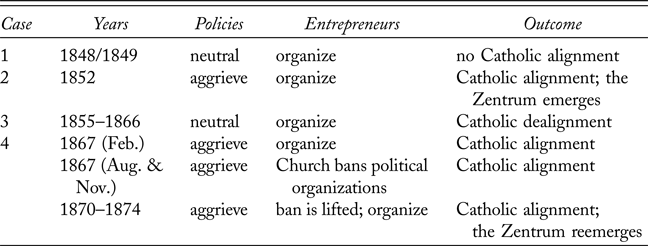
I begin my analysis with the first mass elections in Germany in 1848, the first opportunity for Catholic voters to form an ethnic-based coalition. In Table 1, I divide the period between 1848 and 1874 into four different cases: (1) no Catholic alignment in 1848 and 1849, (2) alignment in 1852, (3) dealignment between 1855 and 1866, and (4) realignment after 1867. Case 1 serves as a baseline for the voting behavior of Catholics. I establish the causal chain in cases 2 and 4 by investigating how voters and political entrepreneurs responded to government policies that aggrieved Catholics. The case comparisons serve as a counterfactual analysis of very similar scenarios in which government policies were neutral to Catholics (cases 1 and 3) and entrepreneurs were banned from mobilizing Catholic voters (part of case 4).Footnote 88 A quick look at the list of cases shows that it was only when government policies aggrieved Catholics that their voting behavior was aligned.
Government Policies, Political Entrepreneurs, and Catholic Voting: Outcomes

Case 1: Nonalignment in 1848/1849
The first mass elections in the German Confederation were held during the revolutions of 1848/1849. The Catholic Church saw the upcoming elections to the Frankfurt Assembly, the first national German parliament, as an opportunity to protect its interests in the constitution of the future German state. Accordingly, bishops, priests, and laymen began a mass campaign aimed at persuading Catholics to vote for candidates who were loyal to the Church. Between 1848 and 1849, entrepreneurs established hundreds of branches of Catholic associations in the German states, and priests and laymen nominated themselves as candidates.Footnote 89
At first, the Church had the upper hand in organizing voters, thanks to its broad organizations. But as the elections drew near, the political competition converged on a conflict between the radicals, who wanted to democratize Prussia, and the conservatives and liberals, who wanted to maintain the social and political hierarchy. In the election, the votes of Catholics were divided along this dimension. The radicals managed to appeal to the sentiment of elite resentment among the lower class, and they organized Catholics, especially in Rhineland and Westphalia, into a broad voter coalition of Catholics and Protestants. Other Catholics from the lower class, primarily rural, voted for candidates endorsed by the priest.Footnote 90 In contrast to the lower class, the Catholic middle class opposed the radical movement that wanted to transform the social order. The Bürger, Catholic and Protestant alike, believed that the middle class should stay united as a “ruling class, an elite,” and they supported the candidates who shared these values.Footnote 91 Ultimately, the Catholic delegates who were elected to the assembly won because of their ideological affiliation rather than their religious identity.Footnote 92 Overall, this evidence shows that in the absence of government policies against Catholics, and despite attempts by entrepreneurs to align the Catholic vote, the votes of Catholics were divided between ideological camps and were shaped by local loyalties.
Case 2: Alignment in 1852 and the Formation of the Zentrum
The Zentrum first emerged in 1852, after the Prussian government issued a series of decrees against the Jesuit order. Once the content of the decrees became publicly known, Catholics saw them as an attack on religious freedom and a violation of the constitution. The available evidence on the reactions of Catholics indicates that newspapers called on Catholics to vote together and the bishops of Cologne and Münster; the lower clergy; Catholic associations; upper-middle-class Catholics; and the local councils of the Rhine, Westphalia, and Silesia all sent petitions to the Prussian king and the ministry of internal affairs.Footnote 93
In the election of 1852 that followed the decrees, candidates who emphasized the Catholic issue in their platforms won sixty-three of the 352 legislative seats (18 percent) in the Prussian lower house.Footnote 94 This was a significant achievement for political Catholicism, as Catholics hadn't previously coordinated on candidates who explicitly advanced the interests of Catholics. Once in parliament, the pro-Catholic delegates founded the Zentrum and managed to defeat the decrees.Footnote 95
This process of cleavage formation is consistent with my theoretical expectations that the voting behavior of Catholics aligned when they were aggrieved by government policies. The alignment of the Catholic vote in response to the decrees contrasts with elite-centered theories that expect voters to organize because of entrepreneurs. Although there's limited evidence about how Catholic voters perceived the decrees, the alternative explanation that entrepreneurs crafted the Catholic cleavage isn't likely correct. By 1852, many of the Catholic associations formed in the revolutionary era had been dismantled, and the parish priest's moral authority was low. If anything, the capacity of entrepreneurs to organize voters was weaker in 1852 than it had been in 1848.
Case 3: Dealignment between 1855 and 1866 and Party Decline
In the following years, the Zentrum's delegates tried to sustain the party and pursued issues related to the rights of Catholics. Although the party branded itself in the 1850s as the protector of Catholics’ interests, after 1852 the rights of Catholics were not threatened.Footnote 96 In the Catholic provinces, the relationship between state administrators and the Catholic population was cooperative, and after the head of state was replaced by a moderate liberal, tensions eased between the state and the Church. Without a common threat to Catholics, the party lost its purpose and gradually declined.Footnote 97 Compared to the sixty-three seats it won in 1852, the party won only fifty seats in 1861 and lost nineteen the next year. In 1863, it won only twenty-nine seats, and in 1866, after winning only fifteen seats, it eventually dissolved.Footnote 98
Evidence from primary and secondary sources indicates that when the state was neutral to Catholics, the political relevance of the Catholic identity faded in party competition. Conflicts that dominated Prussian politics between 1859 and 1866 over the military budget and the rule of law polarized the lower house between liberals and conservatives. The parliamentary polarization in the left-right dimension posed a challenge to the Zentrum's cohesion. Without ecclesiastical conflicts to unite them, Zentrum delegates were divided according to their personal positions on the left-right dimension and this schism was reflected in their floor votes. Outside of parliament, they could hardly agree on a joint electoral platform and they settled on a middle position that couldn't capture the votes of both progressive and conservative Catholics.Footnote 99
There's little evidence from historical research that the failure to sustain the Catholic coalition was due to the weakness of either the Catholic mobilization networks or the clergy's moral authority. Even when the relationship between the state and the Church wasn't tense, the clergy acted independently from the Church hierarchy and continued to endorse pro-Catholic candidates.Footnote 100 The priests, concerned by the rise of the pp in the lower house since 1861 and by the anti-Catholic sentiment in European liberal circles, tried to organize Catholics by using their moral authority and the Catholic associations under their leadership. Together with Catholic laymen, they framed the elections to voters as “a struggle of faith against disbelief,” but failed to organize a large Catholic coalition.Footnote 101
In the absence of a threat to Catholics from policies in the early 1860s, entrepreneurs failed to organize Catholics around their shared identity.Footnote 102 Combined, this evidence is consistent with the argument that when Catholics didn't anticipate anti-Catholic legislation—and this was the case because the pp was the opposition and later was in an open conflict with Bismarck—the political allegiances of Catholics were determined by their other interests and ideologies. The evidence that entrepreneurs failed to rally the support of a large coalition of Catholics at the peak of the Catholic cultural revival, when the authority of entrepreneurs was high, significantly undermines the elite-centered argument that the efforts of political entrepreneurs cause the formation of an ethnic cleavage.
Case 4: Realignment after 1866 and the Revival of the Zentrum
Once again, Catholics supported candidates committed to protecting the interests of Catholics when policies against them and Church institutions appeared imminent. This happened after 1866, when Prussia began aligning itself against Rome. Bismarck engaged in a war with Austria, a Catholic state; supported the antipopery government in Italy; and ended the constitutional conflict with the right-liberals. The outcome of the Austro-Prussian war paved the way for a German unification without Austria, making Catholics an ethnic minority in a Protestant state built on the principles of national liberalism.Footnote 103
In response to the nlp threat to Catholics, the clergy began to organize. Before the next election, to be held in February 1867, the priests were joined by lay Catholics in campaigning around polling places and going door to door, handing out their candidates’ ballots and tearing up the ballots of competitors.Footnote 104
Evidence from historical studies indicates that entrepreneurs were responding tactically to Catholic voters rather than initiating a strategic plan to organize a Catholic voting bloc. Because the Zentrum had dissolved in 1866, Catholics in Prussia didn't have a political organization that could facilitate coordination across constituencies. Instead, entrepreneurs relied on local Catholic associations in cities and rural areas. Without political organization from above, priests in each constituency endorsed the candidate who was committed to protecting the interests of Catholics and the Church. In the election, Catholics supported pro-Catholic candidates regardless of party label; they voted for conservative candidates who protected the Church and for liberals who opposed Bismarck.
After this election, the Church hierarchy was alarmed by the behavior of those clergymen who openly defied the state, supported progressive candidates and Freemasons, and tore up the ballots of devout Catholic candidates who supported Bismarck. Hoping to maintain a positive relationship with the state, the Church banned clergymen from political activity. Because they were not backed by the coordination of the clergy, many of the candidates who had won seats in February lost them six months later in the next election.Footnote 105 But at that point, as the historian Jonathan Sperber observes, “it was not the lack of enthusiasm, or insufficient clerical influence, from which political Catholicism suffered throughout 1867, but a lack of organization.”Footnote 106
Even when entrepreneurs were unable to organize voters around pro-Catholic candidates, the voting behavior of Catholics was aligned. This evidence provides further support for the hypothesis that voters respond to policies, not to entrepreneurs. In the direct election to the Reichstag of the North German Confederation (the Norddeutscher Bund) in November 1867, many constituencies with a Catholic majority elected liberal delegates who opposed Bismarck, whereas very few constituencies with a Catholic majority elected delegates affiliated with the Conservative Party or the nlp.Footnote 107
In the following years, Catholic voters faced even stronger incentives to coordinate around the Catholic identity. In 1868 and 1869, the nlp and pp began taking more active steps to integrate Catholics into the German nation, and discussed two bills that challenged the Church's control over primary education.Footnote 108 In December 1868, the Prussian government decided to enforce an old cabinet order to suppress a Franciscan monastery,Footnote 109 and in the next year, the petitions committee issued a report that called for restricting monastic settlements. Also in 1869, a mob invigorated by the press vandalized a chapel near Berlin and attacked two priests. Instead of condemning these events, the pp called to limit the activity of religious orders in an effort to preserve the peace. By then the Catholic Church realized it could no longer rely on its previous informal channels of influence. Because it didn't expect a regime change that could bring these anti-Catholic policies to be abandoned, the Church allowed the clergy and lay Catholics to form political organizations.Footnote 110
In preparation for the next election, in 1870, and with the Church's permission to form political organizations, some previous leaders of the Zentrum saw an opportunity to relaunch a successful Catholic political organization. The Catholic political movement was based on a loose coordination between religious associations and social clubs, which developed as part of the expansion of civil society in Western Europe during the 1860s. The movement was willing to endorse any pro-Catholic candidate who adopted the main principles of a political program from 1866 that called to protect religious rights and to form a federal state with a weak central government. The anti-Catholic policies introduced a new dimension to party competition in Prussia. Because many conservatives aligned with Bismarck and liberal delegates turned against Catholics, a space was created in the Prussian party system for a political party representing the interests of Catholics.
In the election, pro-Catholic candidates were supported by a broad Catholic constituency that encompassed rural and urban districts and lower- and middle-class Catholics.Footnote 111 The scope of the Catholic coordination demonstrates the power of government policies to push voters into ethnic coalitions. During the 1860s, middle-class Catholics increasingly saw a conflict between their social class and religious identity.Footnote 112 But by the end of the decade, when the policies aroused grievances, many middle-class Catholics were pressured to choose their religious identity over their social class.
After winning almost one-fifth of the seats in the Prussian lower house, Catholic entrepreneurs codified the opposition movement in a political party and relaunched the Zentrum.Footnote 113 As the case evidence demonstrates, the causal chain began when voters responded to government policies. Entrepreneurs relaunched the ethnic party only when voters were already coordinating on the Catholic identity. By the next election, in 1871, the Zentrum became “a vehicle for the minority's desire for cultural validation and political power”Footnote 114 and the second-largest party in the Reichstag. By 1874, after a series of state-sponsored attacks against Catholics in the Culture Struggle (Kulturkampf), the Zentrum represented almost all the predominantly Catholic constituencies. A vote for the Zentrum candidate was an expression of loyalty to the group.Footnote 115
Evidence from Prussian State Elections
I complement the evidence from the case comparisons with a statistical analysis of electoral returns from Prussian state elections. Specifically, I test the hypothesis that the votes of Catholics across Catholic regions were aligned after 1866 because of government policies. I can estimate the causal effect of the policies on the voting behavior of Catholics for two reasons: (1) the policies weren't instrumentally initiated by elites in power for electoral gain, and (2) the policies were initiated at the state level and were not expected to be implemented selectively in constituencies.
The data set begins in 1863, before the anti-Catholic policies were initiated. This is the earliest year for which data on vote shares are available. The data set ends in 1873, three elections after the anti-Catholic shift and one election after the Zentrum's revival.Footnote 116 To ensure a clean comparison between elections that took place before and after the policies, I focus on territories that were under Prussian rule before 1864. Based on this selection criterion, I exclude the provinces of Hanover, Schleswig-Holstein, and Hesse-Nassau, as these became part of Prussia only after 1864. The constituency of Sigmaringen isn't included due to limited data availability, and the four Berlin constituencies are aggregated into a single synthetic constituency. More information about the geographic units is available in section D of the supplementary material.
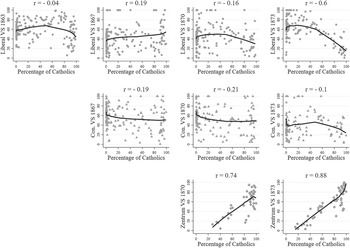
Figure 2 shows how the political alignment of Catholic districts changed from 1863 to 1873. Consistent with evidence from historical research, there is a weak relationship in 1863 between the percentage of Catholics and support for the liberal parties, seen in the first panel of the top row. In 1867, Catholics began to vote for candidates who opposed Bismarck, and the percentage of Catholics positively correlates with the vote share of liberals. The relationship becomes negative after 1870, when liberals took a stronger position against Catholics and the Zentrum was revived.
Correlations between the Percentage of Catholics and the Vote Shares of Liberals, Conservatives, and the Zentrum 1863–1873a
a The figure shows scatterplots of the percentage of votes received by liberal, conservative, and Zentrum delegates in the 1863, 1867, 1870, and 1873 elections with fitted Loess lines. Correlations are listed above each graph. The Zentrum did not field candidates in constituencies that were less than 15 percent Catholic.

Between 1867 and 1873, the correlation between the vote share of the Conservative Party and the percentage of Catholics, seen in the second panel of the second row in Figure 2, is negative. The Conservative Party gradually lost support in Prussia at the end of the 1860s. In the sample, the number of districts with Conservative Party candidates drops from 144 in 1870 to 125 in 1873. Particularly in majority Catholic districts, the Conservative Party fielded fewer candidates in 1873 compared to previous elections. The bottom panel demonstrates that after the Zentrum was revived, support for this party was almost proportional to the share of Catholics. Although the district-level data don't allow me to make inferences about the individual voting behavior of Catholics, they do provide evidence of the change in Catholics’ political alignment in Prussia.
I define electoral cleavages as the social traits that predict how people vote. Based on this definition, I expect to find a strong association between the percentage of Catholics and the change in the vote share of a particular party after a shift in the state's position.Footnote 117 Because the Zentrum was revived after the cleavage reemerged, I can't directly examine whether there was a Catholic realignment with regard to the Zentrum. Instead, my analysis focuses on the change in the vote share of liberal parties. I choose to focus on liberals over conservatives for three reasons. First, Catholics showed more support for liberals than for the Conservative Party in 1867. Focusing on the vote share of liberal candidates is therefore more suitable for analyzing realignment. Second, compared to Conservative Party candidates, liberal candidates relied on stronger organizations and had an advantage in urban districts due to gerrymandering in 1855.Footnote 118 Consequently, they had a greater raw capacity to mobilize voters. Third, liberals were able to make substantial gains in Prussian elections during the 1860s and won the majority of the seats in the Prussian lower house. A decline among Catholic support for liberal candidates would run counter to the state-wide trend. In the statistical analysis, I include controls for the mobilization capacity of political entrepreneurs and estimate the causal effect of policies on the vote choices of Catholics. The sample includes only constituencies in which liberal parties fielded candidates in 1863–1873 and contains 124 observations.
In all the regressions, the dependent variable is calculated as the difference between the liberal vote share before the Zentrum reemerged, and the liberal vote share in a later election. To construct this variable, I take the 1863 election results from Eugene Anderson's Prussian election statistics, which are calculated as the percentage of votes cast for Bismarck's opposition.Footnote 119 This includes the pp, other liberal candidates, an ethnic Polish party, and the Zentrum. Election returns from 1867, 1870, and 1873 are taken from Thomas Kühne's handbook of Prussian elections.Footnote 120 The vote share of liberals is calculated based on votes cast for the nlp, pp, Left Center (Linkes Zentrum), Old Liberals (Altliberale), and other liberal candidates who weren't endorsed by liberal parties. More information about data sources and calculations is available in section E of the supplementary material.Footnote 121
The key independent variable is the constituency's vulnerability to the policies, measured as the share of Catholics. It's taken from the ifo Prussian Economic History Database (ipehd)Footnote 122 and calculated as the ratio between the number of Catholics and the number of residents, both measured in 1864 before the change in the state's position. To account for unobserved heterogeneity in the enforcement of policies, or tensions between local administrators and the Catholic population, all regressions include province fixed effects.
In all the regressions, I include a set of confounders that might affect (1) the grievances that Catholics expected to suffer from the policies, or (2) the capacity of entrepreneurs to mobilize Catholics. It's possible that the distribution of Catholics across electoral districts is the outcome of past hostilities and therefore may encapsulate a latent potential to activate the Catholic identity. In the regressions, I include the distance of each constituency from the town of Wittenberg, where the Protestant Reformation began. The Reformation spread in a circular pattern from Wittenberg in the sixteenth century and shaped a spatial distribution of Catholics that was not determined by the tension between the state and the Church in the nineteenth century.Footnote 123
To account for confounders associated with the Church's capacity to organize Catholic voters, I include the number of priests and the number of Catholic monasteries, both per ten thousand Catholics. I assume that their effect on the Catholic population is nonlinear, and I therefore include the squared terms of both the number of priests and the number of monasteries. To see why the effect might be nonlinear, consider the following. When the ratio of priests and monasteries to Catholics is low, entrepreneurs are likely to reach fewer Catholics. In constituencies where the ratio is high, the marginal effect of adding Church agents decreases after reaching a certain point. Additionally, I add the percentage of men and women employed in industry, where electoral fraud that benefited liberal candidates was more likely.Footnote 124
Another set of confounders addresses the ability of political entrepreneurs to mobilize voters using civic rather than Church associations. The Napoleonic rule over parts of Prussia generated variation across constituencies in the capacity to mobilize voters. The French occupation replaced existing legal institutions with a new system that dissolved large estates, guaranteed better protection of property rights, and encouraged economic development and the expansion of civic associations.Footnote 125 Although the Napoleonic rule in Prussia ended in 1815, I expect it to have had a diffused effect beyond the territories that were under French control. I proxy for the impact of the French occupation using the distance between each constituency and Paris.Footnote 126 I also include in the regressions the district magnitude, which affects the number of parties fielding candidates and the choices available to voters.Footnote 127 And because parties have an advantage in organizing voters in urban areas, I include an indicator for whether the constituency comprised a city county (Stadtkreis). All the covariates were measured before the policies were initiated, and therefore the policies’ impact on voters was largely predetermined. Information about the construction of all the variables and summary statistics are available in section F of the supplementary material. I estimate the policies’ impact on the voting behavior of Catholics in the following equation:
 $${\rm Y} = {\rm B}_ 0{\rm} + {\rm B}_ 1{\rm Catholics} + {\rm B}_ 2{\rm X} + {\rm FE} + \epsilon , \;$$
where Y is the change in the vote share of liberals between elections. The coefficient of interest is B1, which measures the effect of the percentage of Catholics. X is a vector of pre-1866 confounders, and FE indicates that the model is estimated using province fixed effects. I expect B1 to show a negative relationship between the percentage of Catholics and the change in the vote share of liberal candidates.
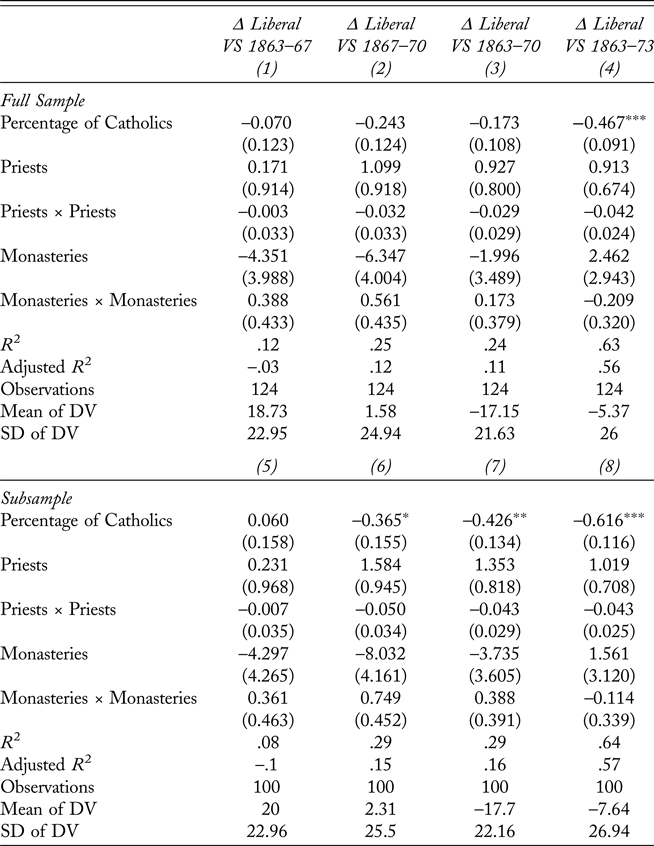
I begin by estimating the effect of the policies on the change in the vote share of liberal candidates in the full sample, presented in columns 1–4 of Table 2. In columns 5–8, I replicate the analysis with a subsample that excludes the eastern provinces of Posen and Silesia. These provinces had a large concentration of ethnically Polish Catholics who were mobilized around a Polish identity and voted for a Polish party before the Catholic cleavage reemerged.Footnote 128 I expect that in the constituencies in the subsample, where Catholics weren't already coordinating around the Catholic identity, the shift in the vote share of liberals will be more pronounced.
Change in Party Alignment of Catholics 1863–1873a

∗ p < 0.05, ∗∗ p < 0.01, ∗∗∗ p < 0.001
a OLS regressions with province fixed effects and standard errors in parentheses. The unit of observation is Prussian state constituencies. The dependent variable is the change in the vote share of liberals between the two election years given above each column. The full sample includes all constituencies that were part of Prussia in 1864. The subsample excludes two Prussian provinces, Posen and Silesia, which had large shares of ethnic Polish voters. All regressions include the following covariates: distance from Paris, distance from Wittenberg, indicator for urban district, district magnitude, percent employed in industry. VS = vote share; DV = dependent variable; SD = standard deviation.
In the first of four specifications, the coefficient for the percentage of Catholics is negative. Consistent with findings from historical research, in column 1, the relationship is weak between the share of Catholics and the change in the liberal vote share from 1863 to 1867. An increase of one standard deviation in the share of Catholics is associated with a drop of roughly 2.4 percentage points in the vote share of liberals, and the uncertainty around the estimate is substantial.Footnote 129 In 1867, Catholics coordinated around candidates who were committed to protecting their interests regardless of party label, and so the Catholic vote wasn't aligned by party. In addition, liberal delegates began to discuss anti-Catholic legislation after 1867, and therefore the impact of the state's anti-Catholic position was greater in 1870 and 1873.
In columns 2 and 3, an increase of one standard deviation in the percentage of Catholics is associated with a decrease of 8.2 and 5.9 percentage points in the vote share of liberals, respectively. The effect in column 2 falls just short of statistical significance at conventional levels (p = 0.053), possibly because the data on the electoral returns of 1867 are more precise than the returns from 1863. In column 3, the uncertainty around the estimate is large because the vote share of liberals dropped less sharply in rural constituencies that had supported the Conservative Party in 1863.
The coefficient estimate in column 4 indicates that an increase of one standard deviation in the percentage of Catholics is associated with a drop of 15.8 percentage points in the liberal vote share, and the coefficient is statistically significant (p < 0.001). This large effect is due to the Zentrum's coordinated efforts and the backlash to the Kulturkampf that escalated the conflict between the state and the Catholic Church after 1872.
In addition to the Catholic realignment, these results also show that the Church's organizational capacity doesn't predict the change in the voting behavior of Catholics. Through columns 1–4, the cumulative effect of priests on the change in the vote share of liberals is positive and indistinguishable from zero. The cumulative effect of monasteries is negative in columns 1–3 and positive in column 4, and there's considerable uncertainty around the estimated coefficients.
In column 5, consistent with the evidence from the case studies, the percentage of Catholics has a positive effect on the change in the liberal vote share. That's because in 1867 Catholics voted for candidates who opposed Bismarck, and among them were liberals. But the coefficient doesn't indicate a meaningful relationship—an increase of 2.1 percentage points with one standard deviation—and is indistinguishable from zero.
Columns 6–8 confirm the expectation that in constituencies with no ongoing Catholic coordination, the shift in the vote shares of liberals was more pronounced. In column 6, the coefficient for the percentage of Catholics indicates that a change of one standard deviation is associated with a decrease of 12.6 percentage points in the vote share of liberals. The coefficient estimates of the percentage of Catholics in columns 7 and 8 are also negative, with a change of one standard deviation being associated with a decline of 14.8 and 21.3 percentage points, respectively, and the coefficients in columns 6–8 reach statistical significance at conventional levels. As in the full sample analysis, the number of priests and the number of monasteries don't predict the change in the vote share of liberals.
In section H of the supplementary material, I address concerns for overfitting the model in the multilevel models and estimate the effect in ols without fixed effects. As expected, the coefficients of the percentage of Catholics in columns 2–4 are negative and distinguishable from zero. In section I of the supplementary material, I test the hypothesis that Catholic voters were responding to policies and not to entrepreneurs. I use constituency-level data about the number of Zentrum candidates from the party's formation in 1852 up until 1873. In the regression analysis, I interact election year with the variable of interest, the number of priests per Catholics. I find no meaningful differences in the effect of priests when Catholics are aggrieved by government policies and when the policies are neutral to Catholics. This evidence is consistent with my expectation that voters respond to policies and not to entrepreneurs.
Conclusion
Robert Dahl observed that grievances against the government shape the patterns of political opposition in democracies.Footnote 130 This logic, I argue, can be used to explain the underlying mechanism in the formation of ethnic cleavages. Whereas the existing literature argues that ethnic cleavages emerge because of the initiatives of political entrepreneurs, political institutions, and organizational capacity, this article demonstrates that voters drive electoral coordination around ethnicity and against government policies. Policies that create grievances along ethnic identities push voters to prioritize their ethnic identity and coordinate with coethnics to form parliamentary opposition to the policies.
Testing this argument required finding cases of government policies that were neither based on existing cleavages nor instrumentally initiated by elites in power to craft an ethnic cleavage. Prussia provided such rare cases. Several types of evidence support the argument that voters drive the formation of ethnic cleavages and that they do so in response to the actions of the state. The voting behavior of Catholics in Prussia was aligned when they were aggrieved by government policies and dealigned when the state was neutral to Catholics. Between 1848 and 1874, the growing tension in Western Europe between liberals and the pope, changes to the mobilization efforts of entrepreneurs, and improvements in priests’ moral authority or in the number of Catholic associations do not explain when Catholics from multiple subgroups chose to vote together. Overall, the evidence shows that government policies had an independent effect on voter decisions to coordinate around ethnicity.
Evidence from cases beyond Prussia further highlights the impact of government policies on the formation of ethnic cleavages. In Estonia, where one-quarter of the population is ethnically Russian, an ethnic party managed to win seats after an amendment to the language law created an occupational barrier for the Russian minority. When the law fueling the ethnic cleavage was amended, the party lost its momentum. Language became a dimension of party competition in Belgium in the second half of the nineteenth century, when industrialization was so rapid that Flemish speakers couldn't feasibly integrate into the francophone culture of the Belgian elite and began to see language as a barrier to social mobility. During the decade after legislation guaranteed the official status of the Flemish language, Belgians voted on economic policies. The cleavage reemerged when voters perceived regional differences in wealth as the outcome of discriminatory government policies. In another example, the regional cleavage in the party system of South Korea, where 99 percent of the population is ethnically Korean, emerged after the government invested unequally in industrial development and created distinct regional interests. In Malawi, where regional differences were robustly correlated with party choice, inclusive rhetoric and the introduction of universal programs that reduced regional imbalances in development managed to weaken ethnic voting blocs.Footnote 131
My theory can apply to cases in which voters can't avoid the impact of the policies by changing their identity, and thus they have incentives to collaborate to protect their interests. A second scope condition is the degree of party-system institutionalization. In contrast to institutionalized party systems, parties in a weakly institutionalized environment don't have the same capacity to structure public opinion around desirable dimensions of party competition, and are thus less able to lock voters into a self-perpetuating cycle of policy and ideological positions. Elites that operate in weakly institutionalized party systems have short time-horizons and struggle to precisely predict the possible gains from pursuing different mobilization strategies.Footnote 132 They are therefore more likely to develop policies that reinforce preexisting ethnic divisions and power structures, because policies of this kind produce relatively predictable voter coalitions in the short term. Moreover, because these elites operate under high uncertainty, they're also more likely to initiate policies that inadvertently divide a society in ways that encourage competition around ethnicity.
In the Prussian case, the emergence of an ethnic cleavage led to the formation of a new party. Undoubtedly, the societal organization of Catholics is different from the organization of other ethnic groups. Catholics have a single source of authority, the pope, and a single hierarchical organization, the Catholic Church, and these characteristics might explain why a single party emerged to represent their interests. In a context in which an ethnic group has several political leaders who claim to represent the group, it's possible that multiple parties will compete for the support of voters from the same ethnic group. The theory developed in this study expects voters to coordinate around the party they believe best represents their interests. It's certainly possible that in a permissive electoral system, voters from the same ethnic group will vote for different ethnic parties. In Israel, for example, Palestinian citizens traditionally divide their votes between a multiethnic socialist party, Arab nationalist parties, and an Islamist party. These voters’ own ideology and religiosity considerably predict their voting behavior, but the parties’ entrenchment in society, their preelectoral mergers, and the political climate also shape the parties’ electoral success among Palestinian voters.
The theory and evidence presented in this article don't exclude the possibility that competition between parties may also instigate the formation of a new ethnic cleavage. Testing the argument that entrepreneurial identity-creating can lead to the formation of an ethnic cleavage requires cases where ethnicity wasn't already a dimension of party competition, and where the state was neutral in its policies regarding the ethnic group. In the discussion of previous research, this article casts doubt about the conventional wisdom that all else being equal, entrepreneurs prefer to compete around ethnic differences rather than other social divisions. It's possible that existing parties may choose to use their public visibility, access to state resources, and influence over policy-making to increase the salience of an ethnic identity, make credible commitments to deliver resources to voters, and shape group-based policy preferences. Research on the formation of an ethnic cleavage as a result of party competition should establish that the decisions of parties, not voters, created an ethnic dimension in party competition. It should also discuss the trade-offs to voters and entrepreneurs between maintaining the status quo and competing around ethnicity, and identify the conditions that encourage existing parties to change their behavior and adopt competition along ethnic identities.
This article makes several additional contributions beyond the ethnic politics literature. The emergence of the Zentrum, its decline, and its subsequent reemergence revisit the conventional understanding of Catholic parties in Western Europe as organizations that were able to emerge because of the endorsement of the Catholic Church and the availability of grassroots organizations.Footnote 133 As the evidence demonstrates, Catholics organized around their shared identity regardless of the efforts made by entrepreneurs to form a Catholic coalition. As early as 1852, Catholics voted together when faced with collective grievances, and this happened even when the Church hierarchy was ambivalent about a Catholic party and Catholic associations were largely dismantled. When the state was neutral to Catholics in the 1860s, political campaigns by the clergy and lay Catholics failed to form a broad coalition of Catholics. Although the Zentrum was formed to represent the interests of a religious community, it shares similarities with other opposition parties that organized against the policies of elites in power.
This study expands the literature about the formation of political parties in the early stages of European mass democratization. Recent scholarship is largely elite-centered, but this article shows how improvements in data availability and research design, in addition to the accumulation of theory and evidence from cases outside Western Europe, can be combined to study voters’ agency in the formation of European mass political parties.Footnote 134
The analysis of party formation in Prussia turns the conventional wisdom about parties and policies on its head, and demonstrates that policies can indeed create new parties. Evidence from the multiple outcomes in the Prussian case shows that government policies created a new ethnic coalition based on voters who shared an ethnic identity but came from different regions, cultural backgrounds, and social classes. After the electoral success of the Catholic coordination, the opposition movement was codified in a political party and developed a broad agenda to advance the interests of Catholics through policy-making. In other words, government policies created a new ethnic constituency that formed a new political party.
This study also shows that government policies are crucial in determining the structure of party systems. Conventional theories expect social divisions and electoral rules to produce the main dimensions of party competition.Footnote 135 Yet these factors alone don't explain why contemporary party systems change even when electoral rules are static and the social structure is only changing gradually. This article points to a different factor, government policies, and shows that policies can change party systems by charging social divisions with new political content and creating incentives for voters to organize around new politically relevant divisions. Acknowledging the power of government policies to become focal points for new coalitions of voters is especially timely today, given the recent formation of new identity-based electoral cleavages in consolidated party systems.Footnote 136
Supplementary Material
Supplementary material for this article can be found at https://doi.org/10.1017/S0043887121000228.
Data
Replication files for this article can be found at https://doi.org/10.7910/DVN/IECK9V.
Acknowledgments
For feedback on previous versions of this article, I thank Francesc Amat, Rikhil Bhavnani, Carles Boix, Alexandra Cirone, Nikhar Gaikwad, Yoshiko Herrera, Noam Lupu, Zsuzsanna Magyar, Danny Metcalf, Jordi Muñoz, Dmitrii Kofanov, Nils Ringe, Dawn Teele, Omer Yair, participants of the Comparative Politics Colloquium at the University of Wisconsin–Madison and the 2018 annual meeting of the Historical Political Economy Working Group, and the editors and three anonymous reviewers at World Politics. I thank Matan E. Singer for his help with spatial calculations and Thomas Kühne for generously mailing me a copy of his handbook of Prussian elections.
Funding
Research for this article was supported by the Election Research Center, the Jean Monnet EU Center of Excellence, the Graduate School and the Office of the Vice Chancellor for Research and Graduate Education, and the Wisconsin Alumni Research Foundation, all at the University of Wisconsin–Madison.