Introduction
Reading lists are a key part of the curricula that shape how epistemologies are constructed in education and what is – and what is not – taught to students. However, many reading lists continue to contribute to a Eurocentric curriculum in art and design; further research on the methodologies of reading lists are needed to better understand how to intervene and decolonise curriculaFootnote 1. This issue is urgent; despite many campaigns in UK art and design Higher Education Institutions (HEIs) to expose institutional racism and sexismFootnote 2, recent data indicates that 95.3% of academic staff in art and design HEIs in the UK identify as whiteFootnote 3 contributing to a dominant set of white cultural norms.
Against this backdrop, my PhD research project to pluralise fashion design education seeks to contribute to decolonial research agendas in design to address the long-standing universality of white heteronormative norms built on Euro-centred modernity and the Western civilizing logic that underpins fashion design practices, research and pedagogies. The hope is that a more intersectional approach to teaching fashion design – alongside, from and with marginalized knowledges – will challenge body size, sexual, racial, religious, ableist, and geographical hierarchies in fashion and open new ways of teaching and learning in fashion design practice. A key aspect of this project has involved developing ways to re-centre ‘epistemologies of the south’Footnote 4 in fashion design education with the Decolonizing the Curriculum Toolkit, situated online with the library at Westminster University. This resource aims to offer an alternative non-Eurocentric set of reading lists to support teaching and learning in higher education in the UK.
Eurocentric Reading lists
In 2018 I began a new role as lecturer in critical and historical studies in fashion at an art and design higher education institution in the UK, College A. Only a few weeks into my role, I was approached by a student of colour who confided their concerns to me about a reading list they had been given for a mandatory module to support their critical and historical studies in fine art. During my decade long experience of teaching fashion, I had become used to such private exchanges between students of colour and myself; I identify as a woman of colour with South Asian ethnicity and Indian heritage. On numerous occasions students of colour would feel comfortable in raising concerns about racism in education with me, no doubt due to my position as one of the few visible lecturers of colour in art and design education in HEIs in the UK.
The student – student X – shared an audit they had undertaken of a reading list evidencing that most authors presented in their curricula were located in the global north; significantly, while the results showed gender equality, the majority of authors were white. Student X was upset for two reasons: firstly, that this reading list was Eurocentric; and secondly, because the response of College A had been to produce a second reading list for fine art students which included a majority of books by black authors, authors of colour and authors from the global south. Despite the good intentions of College A here, the consequence of this action was that there were now two reading lists in circulations built on the reproduction of a binary of white/non-white authors. This pedagogical intervention had therefore further embedded patterns of systemic racism in the curricula between the west and the rest. Instead, I reflected on what a decolonised reading list in art and design built around an agenda of epistemic racial and gender equality might look like and how to achieve this.
The concerns of both Student A and myself echo ongoing concerns at several other HEIs in both the UK and across the globe to address institutional and epistemological silences and misrepresentations, exclusions, colonial histories, and institutional racism through the project to decolonize the universityFootnote 5. These issues are urgent; current research points to a 13% attainment gap between the degrees awarded to white and non-white students in higher education in the UK which has been linked to a lack of visibility of plural voices in curriculaFootnote 6.
While it is vital to focus on exposing dominant Eurocentric narratives through academic research in fashion history and fashion theory, emerging debates in decolonising design stress the urgency for more research around the practice of decolonisation, including pedagogies, rather than current dominant theory-led debatesFootnote 7. So, what exactly could HEIs, lecturers, librarians and all those involved in curriculum development do to create and support pedagogies that expand beyond Eurocentric racist and sexist curricula? How could art and design references and resources counter the colonial histories that underpin art and design epistemologies and work towards creating resources built on cognitive justiceFootnote 8?
Decolonising Fashion Design Education
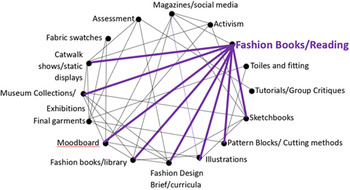
These kinds of questions have shaped the part-time PhD research project I have also been working on that explores ways to decolonise fashion design education, a subject I have taught for the past twenty years in London. In this research I have been investigating how and where the colonial logics underpinning racism operate in the fashion design process. To do this I have been critically analysing the fashion design process to examine how it reproduces Eurocentric thinking in fashion and a key influential role has been fashion books and reading lists (see figure 1); and, then experimenting with global south-led fashion epistemologies to re-think and overturn current hegemonic fashion narratives and histories.
The Fashion Design Process (diagram by the author).

To do this I have been drawing on decolonial feminist writings and thinkingFootnote 9, an approach that emerges from the experiences of women of colour, black women, and indigenous women and, their attempts to unpick the politics of difference to show how sexism, racism, heterosexism, capitalism and Eurocentrism link to the key concepts of patriarchy, racism and colonialism. Decolonial feminist thinking stems from addressing gaps, and the subsequent merging, of two key fields of study, decolonial studies and feminism. On one hand, decolonial feminist thought contrasts with the field of feminism, which it has been argued centres white women's’ experiences as synonymous with all women's’ experiencesFootnote 10; and, on the other hand, decolonial feminist thought emphasises the relations between gender, heterosexuality, capitalism, and racial hierarchies to argue that any understanding of gender must begin with how it is both racialized and gendered, questioning the limitations of both decolonial studies and feminismFootnote 11.
Applying a decolonial feminist pedagogy into fashion design has helped me to build on growing calls to transform design education, rather than tokenistic diversity gestures that reproduce systemic and institutional racism. This call to transform away from Eurocentric epistemologies in design education has been emphasised by Decolonising Design, a group of European based design academics who argue that the project to decolonise should be radical, rather than one that simply reforms current pedagogical modelsFootnote 12. Such an approach to decolonise design would therefore need to re-think and re-form the very foundations of hegemonic Eurocentric design epistemologies.
However, a key challenge facing design educators relates to how Eurocentric educated design educators continue to perpetuate Eurocentric design knowledges because they themselves have been limited by a Eurocentric design education. Design theorist Tony Fry describes this current problem,
‘Bluntly, designers are not adequately educated about the nature of design, its presence in the world and its futural consequences. One can even go as far as saying that in a real sense, design education is not an education about design. It is superficial, a great deal of what is being taught is redundant (it is about the past of designing, not its future) and, notwithstanding exceptions, is delivered mostly by educators who themselves have not been adequately educated.’Footnote 13
Fry's observation points to a serious challenge in addressing Eurocentric bias in the resources and references used to underpin fashion design education and the challenge for HEIs to employ educators and create educational platforms and spaces in which both the issues in decolonising learning and teaching are fully comprehended; and, secondly, a critical examination of curricula content and forms are undertaken so that new non-Eurocentric ways of teaching and learning can be imagined.
Decolonising Fashion Design
One approach to resisting the inequalities in fashion design curricula requires interrogating the systems that uphold fashion design's emphasis on ‘modernity, progress and the importance of technology and industry’Footnote 14. A key characteristic of fashion design is the constant drive for experimentation and innovation which contributes to its position at the apex of capitalist and patriarchal forms of designFootnote 15. This tension between dualist conceptions such as masculine and feminine and nature and culture therefore lies at the centre of how differences are shaped in fashion design and how it is defined; and, by doing so lay the foundations for how fashion design is taught, practiced, produced and sold.
This thinking contributes to the persistent and powerful Eurocentric definitions of fashion that continue to deploy a West/Rest distinction to represent Western fashion as modern and non-Western fashion as traditional – resulting in a problematic ‘fashion/non-fashion dichotomy’Footnote 16. Continuing challenges to the system of cultural hierarchies that problematically categorize fashion design around narratives of Western bias do however suffer from some serious limitations because they inadvertently continue to ‘preserve’ a biased classification system built on geographical difference that separates Western and non-Western fashions. While these studies document the process of ‘fashion globalization’ to show how different and select parts of the world also have their own fashions, thus helping demythologize the idea that fashion is Western, these studies do not fully explain why and how the Western fashion system operates to maintain the West/Rest binary. Moreover, these existing studies fail to resolve contradictions within globalized fashion narratives, such as how the West/Rest binary can become blurred through complex systems of co-option, cultural appropriation and the synthesis of Western and indigenous local ideasFootnote 17. To further reflect on these issues, the field of critical pedagogy has been useful in helping me further examine the power dynamics at play in maintaining racial hierarchies in fashion design.
Decolonising the Curriculum Toolkit
In 2017 I joined the Reading Group of the Critical Pedagogies GroupFootnote 18, based at The University of Westminster, UK and led by Dr. Jennifer Fraser, an academic in social sciences. The group began in 2011 at Birkbeck, University of London as a collective attempt to address educational inequalities by sharing texts from the field of critical pedagogy. There are at least 150 people on the mailing list, and 50–60 people regularly attend the sessions. Although this group was not related to the field of art and design or fashion, or an HEI where I was teaching, I found kindred spirits here who were focused on social justice oriented forms of pedagogy, and on education as a practice of freedomFootnote 19. Over the years these meetings have re-energised me and given me hope and strengthened my resolve to shift fashion design into new decolonial directions, in a more stimulating environment than I feel would have been possible with my colleagues in fashion design. The significance of speaking and critiquing outside of my discipline has given me space to recognise how embedded Eurocentric thinking is within fashion design pedagogies.
In 2019, Jennifer Fraser led a project for Westminster University called Decolonizing the Curriculum ToolkitFootnote 20. The project involved commissioning students and staff in a range of different subject disciplines to write decolonized reading lists; it was developed in collaboration with The University of Westminster subject librarians Sara Hafeez and Lorna Rosbottom using the TALIS reading list tool that the Library provides and was hosted on the University's Centre for Education and Teaching Innovation website and then the Pedagogies for Social Justice website. Over thirty different decolonising reading lists were written, from finance and accounting to journalism and law. I was invited to contribute and write two reading lists, one for fashion design and another for art and design. At first, I was unsure of how to do this, and this led me to undertake a deeper critical examination of how power operates in fashion globally to create cultural hierarchies and divisions which allows the Western fashion system to maintain a West/Rest distinction to produce racism and sexism; such as, through designs that culturally appropriate different culturesFootnote 21; the exclusion of non-white bodies in the fashion media and catwalk showsFootnote 22; and, the global dominance of European and western Anglo-America led fashion designFootnote 23.
I next began to construct a counter-hegemonic fashion reading list built upon de-hierarchising fashion practices and epistemologies. My approach in locating the exclusions in fashion was focused on the ‘sociology of absences’, coined by the Portuguese theorist Boaventura de Sousa Santos Footnote 24, to address the silences around certain forms of knowledge; and, the processes which enable those silences to be created and maintained. By asking these questions in fashion design I began to identify how certain types of fashion knowledges are marginalized and suppressed, and certain types of knowledges – capitalist, colonialist, patriarchal - dominate. ‘The sociology of absences’ argues for an understanding of the world based on counter-hegemonic non-universal and non-linear systems of knowledge creation through an engagement with local knowledges and local differences. Although fashion scholars have been quiet on the absences in fashion design, a great number of these debates have found their place outside of academic fashion literatures and through the increasing number of fashion sites concerned with hegemonic heteronormative and standardized values embedded in fashion design, such as through modest fashion Instagram accounts Footnote 25, zinesFootnote 26, blogsFootnote 27 and fashion exhibitionsFootnote 28.
Looking outside of academic fashion books I began to construct my alternative non-Eurocentric decolonised fashion design reading list for Decolonising the Curriculum Toolkit. For example, I devised one section based on the absences of black and brown bodies in fashion shows. Four fashion weeks dominate in fashion design, known as the ‘Big Four’ they receive most of the world's press coverage: Milan, Paris, London and New York. However, looking beyond Europe, the global south also has a history of hosting fashion weeks outside of the Northern European and Anglo-American centres, indeed several have existed for some time: for example, São Paulo Fashion Week which began in 1995 and other prominent fashion weeks which take place in Mumbai, Beirut, Dubai, Taipei, Shanghai, New Delhi, Sibiu, Jakarta, Jordan, and Borneo amongst many others. Constructing these reading lists provides valuable resources that build alternative fashion narratives that can challenge the global north's domination of fashion. For example, since 2009 São Paulo Fashion Week has a quota that requires that ten percent of catwalk models must be ‘black or indigenous’ and Lagos plus size fashion week celebrates non-standard body sizes, both of these examples validating non-heteronormative white bodies.
This approach to building a decolonial feminist fashion reading lists draws on non-academic sources and the online platforms provides an important space for non-Eurocentric fashion design narratives. This resource also shows an alternative pedagogical model, something not often available in curricula or on the library bookshelves. Most importantly, the Decolonising the Curricula Toolkit shows how education can play a vital role in opposing patriarchal, gendered and Eurocentric universalist values and the role that libraries can play in creating space for such projects.
Conclusion: Towards Decolonial Feminist Fashion Designs
In summary, while the urgent need to decolonise curriculum continues, caution should be applied to how readings lists are constructed in tokenistic ways through additive inclusions of black authors and authors of colour. Instead, the project to decolonise education must creatively explore the absences and exclusions emphasized by decolonial feminist thinking to address how knowledge construction is rooted in both racialized and gendered ways. Those engaged in decolonial pedagogical projects must aim to de-link from ongoing colonial thinking that continues to support hierarchical forms of knowledge which result in the domination of western forms of knowledge, while excluding and erasing knowledge from the global south and beyond; this way a new decolonial feminist conception of education can be fully realised and practiced.