By the postwar era, Albert Maltz had established himself as a significant force in American literature and film. Perhaps best known for his 1938 O. Henry Award-winning short story “The Happiest Man on Earth,” and his 1944 novel The Cross and the Arrow, he had also penned scripts for This Gun for Hire (Frank Tuttle, 1942), a film noir starring Veronica Lake, and Pride of the Marines (Delmer Daves, 1945), a biographical war film featuring John Garfield, and written for the short film The House I Live In (Melvyn LeRoy, 1945), with Frank Sinatra.Footnote 1 As a member of the Hollywood Ten, Maltz is recognized today for scripts written while on the blacklist, for the Jimmy Stewart western Broken Arrow (Delmer Daves, 1950) and for the biblical epic The Robe (Henry Koster, 1953).
Not surprisingly, Maltz's legacy tends to be understood solely through his reputation as a novelist and a screenwriter. But in his 2007 article “The House I Live In: Albert Maltz and the Fight against Anti-Semitism,” Art Simon urges historians of the Hollywood blacklist to look beyond his canonical works and consider his wide-ranging endeavors as a “citizen writer,” a moniker that Maltz himself preferred and that was chosen as the title of a 1950 collection of his speeches.Footnote 2 Simon also laments that Maltz's many lectures and fundraising efforts for progressive causes, proletarian writings and Popular Front film projects continue to “rest in the shadow of the New Masses affair.”Footnote 3 The “affair” in question begins with the publication of “What Shall We Ask of Writers?” in the 12 February 1946 edition of the journal, where Maltz addresses the “deep source” of the “sterile” left-wing literary output of the mid-1940s.Footnote 4 The row this piece causes among members of the cultural left, which results in a mea culpa in the 9 April issue where Maltz concedes that his initial call for a form-based approach to Marxist criticism and aesthetics was a “non-dialectical” one that would result in “the dissolution of the left-wing cultural movement,” is indeed taken by many as the defining moment of his activist career.Footnote 5
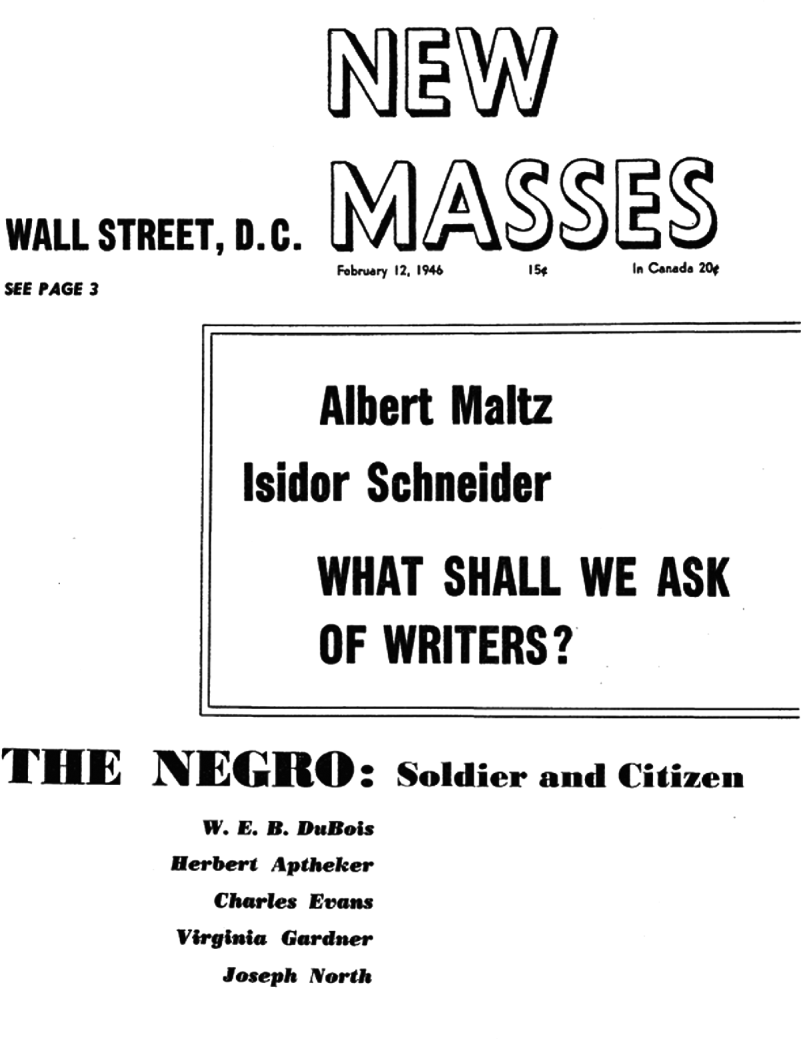
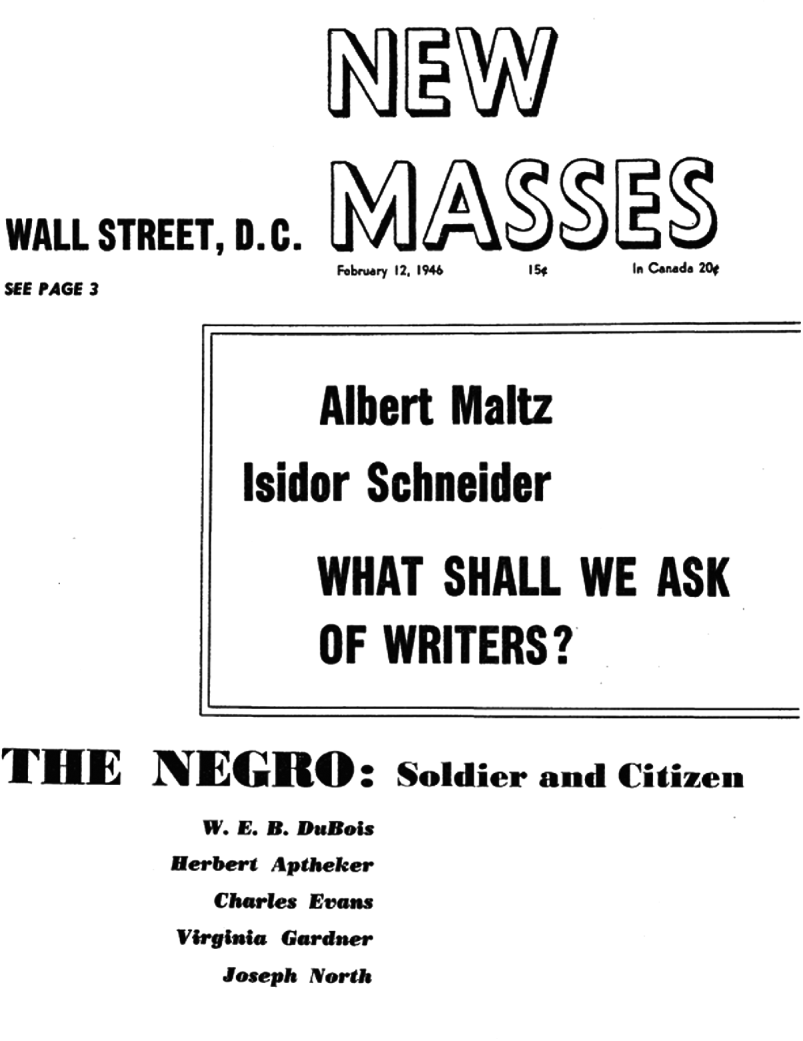
The more pressing difficulty with histories of the Maltz Affair is that scholars also tend to tie it to his screenwriting when his activities in Hollywood, as I intend to show, were hardly a concern in “What Shall We Ask of Writers?” or in the backlash it incurred. For Gerald Horne, for instance, “the ‘Maltz Affair’ lubricated the path” for the Congressional inquisition turned on Hollywood communists by the McCarthy-era House Un-American Activities Committee (HUAC) of 1938–75.Footnote 6 Such connections between the Maltz affair and the HUAC trials tend to favor our contemporary perception of Maltz as a beleaguered Hollywood scribe. Indeed, it is often alleged that he was targeted for his criticisms of communist literature because of his status as a screenwriter. However, only one of Maltz's critics during the entire affair, Mike Gold, mentions Hollywood and its adverse effects on the screenwriter's political views, and this in the form of a quip. He briefly declares in a 14 February edition of the Daily Worker, “Albert Maltz seems to have let the luxury and phony atmosphere of Hollywood at last poison him.”Footnote 7 If Maltz's screenwriting is only incidental to the affair, why in fact did he garner such a strong reaction – both against and for his 12 February polemic? (Figure 1).
Cover of the New Masses, 12 Feburary 1946.
In “What Shall We Ask of Writers?” Maltz presents a vision of the citizen writer that is, generally speaking, “para-Marxist,” an Engelian approach to art criticism that does not require good art to be systematically or didactically progressive. Maltz pulls few punches, calling attention to a leftist literary sterility that had been exacerbated by “the vulgarization of the theory of art which lies behind left-wing thinking: namely, ‘art is a weapon.’”Footnote 8 This, in tandem with the conflation of art with journalism, the writing of novels with the writing of leaflets, had left progressive writers largely confused about what counts as discriminating Marxist art, and had created a “conflict of conscience,” “resulting in wasted writing or bad art … induced in the writer by the intellectual atmosphere of the left wing.”Footnote 9 He pursues his point by distinguishing between the social novelist on the one hand, who “possess[es] a philosophic point of view, which permeates [his] work,” and the political novelist on the other, who has “a tactical axe to grind which usually requires the artificial manipulation of character and usually results in shallow writing.”Footnote 10 In the end, he wants to defend the approach to art espoused by Friedrich Engels, who claims, according to Maltz, that an “artist can be a great artist without being an integrated or a logical or a progressive thinker on all matters.”Footnote 11 Art should be judged according to its unique function, one irreducible to its role as a political weapon that prepares the way for revolution. Maltz signals such novelists as John Steinbeck, John Galsworthy, Dostoyevsky, Balzac (after Engels), and, most controversially, the Trotskyist James T. Farrell, each a writer of literary value irrespective of their ideological commitments. The nominal subject of Maltz's now infamous piece, then, is the state of both Marxist art and Marxist criticism and aesthetics in America.
However, as one John Prigher shows in a 28 February 1946 letter to Maltz, few at the time were inclined to consider this a “narrowly literary controversy.”Footnote 12 He shares Maltz's bemusement:
Just what is behind this renaissance of grim and absurd sectarianism? It's been absent, at least to this extent, for almost two decades. It cannot be understood, it seems to me, without attention to the cause celebre [sic] of Browder.Footnote 13
He explains:
the pious “Marxists,” stung by Duclos into an ecstasy of atonement for guilt, are today swinging into hyper-sectarianism, astrakhan hats and all, delivering the Left back into the fold of “Marxism” … They have sinned; they must atone through the lashing of sinners.Footnote 14
Many historians of mid-century American Marxism and the Hollywood blacklist have echoed Prigher's thesis about the cause and nature of the personal attacks Maltz faced for his transgression, about the storm of criticism that followed in the pages of the New Masses and the Daily Worker, and about his subsequent recantation in the former publication. In this way, the Maltz affair has been cast, almost since the first day, as a symptom of developments in the Communist Party of the United States of America (CPUSA) after Jacques Duclos's Stalin-approved denunciation of Browderism in an article published first in Cahiers du communisme in April 1945 and then translated for the Daily Worker in May.Footnote 15 Representative of this historiographic trend, Larry Ceplair and Steven Englund conclude that the “trial” of Albert Maltz in the New Masses is one of three events, alongside the ousting of party general secretary Earl Browder and the party's retraction of electoral sponsorship for Democratic candidates supported by former allies in the liberal camp, that signaled the CPUSA's adjustments in the face of a more assertive right wing, which in the film industry took the form of red-baiting in the Motion Picture Association, the FBI and HUAC “combing” the studios, and so forth.Footnote 16 Influential institutions were indeed adopting right-wing policies, and for Ceplair and Englund the “reversals” of party doctrine, in turn, marked years fraught with the “potential for cataclysm,” with “unyielding factionalism” in US politics.Footnote 17 The two years between the summer of 1945 and the summer of 1947 are a period described as a “prelude to repression.”Footnote 18 The infighting exemplified by the Maltz affair is taken as representative of larger historical trends that created the conditions for CP retrenchment and the arrival of a new phase of persecution for American communists.
From a certain perspective, the New Masses discussion about the role of art is relatively minor, for it would soon be rendered moot by the repression inflicted upon communists beginning in 1947. Yet the significance of the nonorthodox Marxist poetics advocated by Maltz and others is hardly “narrowly literary.” “What Shall We Ask of Writers?” and similar interventions in New Masses prior to 1947 appeared in the context, as is well known, of the unfolding of a coordinated right-wing effort to justify anticommunist purges under the cloak of national security concerns.Footnote 19 Maltz and his visionary Engelian supporters were formulating ideas that – in promoting a less didactic Marxist poetics and art, a subtler sense of the purpose and range of progressive artistic projection – might have been better equipped for this new state of affairs. In a period of repression, a strategically para-Marxist aesthetics would have explored and sanctioned a greater decree of nimbleness among critics as well as artists, or encouraged a Marxist critical eye that could adjust to new artistic forms like abstract expressionism and other modernist movements that sustained a progressive sensibility in American art and life without the overt ties and references to a communist outlook that would, after 1947, become anathema in many areas of society. Such was the promise of the New Masses's lamentably short-lived Engelian episode.
To illuminate this promise, this article reexamines the Maltz affair as the rehearsal of a fundamental debate within Marxist aesthetics between Leninist and Engelian approaches to literary and cultural criticism, considering this controversy in the light of developments in mid-century American and international Marxist theorizing about the political consequences of art. Numerous factors no doubt shaped the opposition Maltz faced. This episode erupted as the left was embroiled in an internal realignment over the question of Browderism, and as right-wing forces in the press, the government, and business were successfully tying progressive interests to an international conspiracy against the values and principles of American life and, more concretely, indicting the CP for the massive strike wave that hit the US in late 1945 and 1946 (even though the CP had very little to do with most of the big strikes).Footnote 20
Still, a complete account of the proximate mechanisms that gave rise to the Maltz affair must include the specific aesthetic principles that actually fueled and shaped this debate about art, politics and the practice of Marxist criticism in the US. At stake in the Maltz affair are, in the simplest of terms, two issues central to the progressive cultural movement: the crucial role of art in politics and the fundamental question of the relationship of form to content in works of art. Those who opposed and supported Maltz's “revisionism” both publicly in the pages of these periodicals and privately in correspondence may have been motivated by their political affiliations in the wake of Duclos's letter, as well as by the very real threats posed by the right, but they were also taking sides in a debate perceived as central to the concerns of progressive politics by a broad swath of Marxist literary and art critics as well as by “grassroots” members of the progressive movement, namely a debate about the politics of form and the consequences of “formalism” in this context. Crucial to this debate was the doctrine known as Zhdanovism, the result of an “art-as-weapon” campaign launched by commissar of ideological affairs Andrei Zhdanov in 1946. Yet Zhdanovism itself was only the latest manifestation of an orthodox Leninist conception of aesthetics that dates to November 1905 and conceives of art as “a small cog and a small screw” in a more complex formula of militant partiality.Footnote 21 Although historical accounts and contemporary public denunciations in the pages of American periodicals suggest that Maltz was alone in his criticism of the Leninist–Zhdanovite “art-as-a-weapon” thesis, both private correspondence and the published writings of concerned readers and Marxist critics (American and non-American) paint a slightly different picture, demonstrating that Maltz had a number of “para-Marxist” allies who held a view about art that would only gain purchase in the de-Stalinizing thaw period beginning in the mid-1950s.Footnote 22 Only then did it become acceptable for critics to debate subtler views about form–content relations in artworks and the purpose of proletarian art and Marxist criticism.
Maltz and other alternatives to Zhdanovism in the New Masses
Accounts of the Maltz affair suggest that his position piece on writing and art was idiosyncratic and thus anomalous in the pages of New Masses. This impression is surely the result of the singular controversy Maltz's original article stirred. The almost uniformly negative response its author garnered in the weeks and months after his 12 February intervention suggests that his argument was new and unique – better yet, unanticipated – in these pages. An important distinction should be made, however, between the distinctness of the position and the distinctness of the reaction it received. Paul Buhle and David Wagner describe Maltz's stance as reducing to an insistence “that artistic freedom must include the right to admire artists who were politically suspect (or worse).”Footnote 23 They see the defeat of Maltz's appeal for “artistic independence” as “a continuation of an old discussion on increasingly unfavorable ground for Party guidance, with the stakes set artificially higher than ever.”Footnote 24 This analysis simplifies Maltz's message and overlooks the tradition to which Maltz's position belongs. In his assessment of the controversy, Victor Navasky eschews the notion that the quarrel between a few artists and critics and the party line was in defense of a wide-eyed conception of artistic freedom: “Some of the Marxist aestheticians, undoubtedly sensitive to Party-line directives from New York or farther East, were nevertheless genuinely grappling with the peculiar task of analyzing truth and beauty in a class conflict”;Footnote 25 “libertarian values,” he insists, “were not a dominant concern of even the most sensitive artists on the left.”Footnote 26 For Navasky, a thinly veiled campaign of retribution for excellence explains the attack on Maltz: “Any serious student of Party-line aesthetics knows that for more than a decade before the Maltz episode, leftist literary hacks indulged in crudely violent polemics against their artistic superiors.”Footnote 27
In one way or another, these oft-cited histories seem to give the Maltz affair short shrift by overlooking the fact that Maltz intended to initiate a dialogue about progressive aesthetics, and in fact succeeded in some circles. In a personal letter from 18 February 1946, he castigates Mike Gold, one of the prominent voices that had attacked him in print:
Don't you see that the result of this personal attack on me can only be to stultify all discussion – to frighten people off who have come to any conclusion, (not necessarily mine), that disagrees with accepted tenets? …
Indignant as I am that you should dare to pin these labels on me, I am much more concerned lest the whole direction of this much-needed discussion be changed, the exchange of ideas be rendered impossible by rancour [sic] and distortion, the development of standards stopped dead by a kind of political blackmail.Footnote 28
In the end, whether one ought to accept “What Shall We Ask of Writers?” as a “conversation-starter” must be measured against the piece itself. The article finds that “under the domination of this vulgarized approach, creative works are judged primarily by their formal ideology,” “on the basis of their immediate political utility.”Footnote 29 What concerns him, however, is that the “art-as-weapon” restriction draws the writer away from questions regarding the impact of his or her formal choices on the reader. His example of complex characterization is a scene from Mikhail Sholokhov's realist novel about the Russian Revolution, And Quiet Flows the Don (1926–40).Footnote 30 The protagonist, Gregor, who had fought with the Reds and then the Whites during the Civil War, returns home, wishing to relinquish combat and politics for a simple agrarian life. A Communist pursues him and, despite Gregor's “earnest” plea, he is told, “No, we will not leave you alone; we will hound you.”Footnote 31 Maltz praises Sholokhov:
The social illumination of this novel and its political meaning would not be possible with a different handling of Gregor. This is so because profound characterization presents all characters from their own point of view, allowing them their own full, human justification for their behavior and attitudes, yet allowing the reader to judge their objective behavior. This is the special wisdom art can offer us. But if Sholokhov had had a narrow axe to grind, he would not have allowed Gregor his humanity, he would have wanted only to make the reader hate him – and so the breath of life would have gone from the book. It would have been weaker socially, psychologically, artistically and politically.Footnote 32
His praise for Sholokhov's sympathetic handling of a political enemy of the Soviet Revolution points to limitations in a strictly didactic form of writing that Marxist critics were calling for at the time. Sholokhov's art exemplified a kind writing that avoided angling characters and events to elaborate a political thesis – an overtly political form that had been dismissed by Engels (whom Maltz cites) as “pinch-penny” socialist literature.Footnote 33 If Maltz were arguing for freedom, it was not a freedom from but rather a freedom to – that is, a freedom for the writer to experiment with a realist form that has genuine artistic and political potential. Equally important is that this freedom benefits the reader as well. Maltz's argument is for a more sensitive approach to reading for critics and the public alike – a reading that is attuned not just to the ostensible messages offered by a novel and how it serves a current political policy, but also to the tensions (of character, in this instance) in the work itself.
A wave of harsh criticism followed the publication of “What Shall We Ask of Writers?”, but the print record reveals that critics of Maltz perhaps should not have been so scandalized by his position. On at least two other occasions in the previous year New Masses published articles that prefigured Maltz's rejection of the notion that art should be evaluated for its short-term political expediency alone. Indeed, if these articles, as well as letters from readers in response, are any indication, it appears that many on the left concurred that a truly sophisticated Marxist criticism of art – one equipped to provide aesthetic judgment on a variety of contemporary forms – was desperately lacking in the US.
A certain Charles Arnault reminds Maltz of the stakes of this debate in a letter of 2 March 1946:
For some time I have felt like you that the New Masses critics gloss over and underestimate the formal aspects of the work they are reviewing. This, understandably enough, can lead to distortions even when they are considering only matters of content.Footnote 34
Arnault suggests to Maltz an article, titled “Painting and Dialectics,” he had published in the same journal on 14 August 1945:
My thesis was that these critics fail to realize that form has its own dialectical features and that the historical development of an art form is conditioned, not only by the successive stages of societal evolution, but also by fundamental contradictions within the art form itself. In this special sense the art form can be said to have an evolution somewhat apart from that of society.Footnote 35
He adds that he “wholly expected [his] article to be answered with charges of ‘formalism’ and was surprised when there was very little response.” He speculates, “Perhaps this can be explained on the basis that painting, unlike literature, is not a subject of general interest. Or it is possible that the ‘content boys’ felt insecure about waging a war outside their home territory.”Footnote 36 These speculations suggest that for at least one contemporary the backlash to Browderism was irrelevant to the affair. More pertinent was Maltz's argument that the artistic choices of writers (not painters or sculptors) are partially independent from political purpose. This focus on writers explains why Arnault's proposed dialectics of form generated no reaction from the periodical's editorial board, more comfortable as it was with commenting on literary content.
Echoing Maltz's sentiment that artistic production is rendered difficult if the aim is to reproduce a prior theory, or to editorialize (“Let those who deny this ask working writers,” Maltz quips in his pieceFootnote 37), Arnault's New Masses article on painting deems “the unity of theory and practice” irrelevant to art.Footnote 38 This does not, in Arnault's view, mean that artworks will not embody dialectical principles – ones akin to the tensions Maltz reveals in his analysis of And Quiet Flows the Don. On the contrary, Arnault's text uncovers the “link between the creative process and dialectics,” for “this aspect of art theory (which might be called the ‘dialectics of pictorial composition’) has not yet been subjected to serious study.”Footnote 39 The “rather backward state” of Marxist criticism can be gleaned from “the tendency to underestimate the significance of form and method in painting, and overestimate, or more accurately, distort, the meaning and function of content.”Footnote 40 Arnault, like Maltz, emphasizes the gap between production and criticism:
Perhaps because he does not have to “sweat out” the creative process or perhaps because he is basically incapable of responding to a painting in any other than an intellectual way, [the critic or art historian] concentrates his attention on that which he is most equipped to discuss – “content.”Footnote 41
Arnault outlines an approach that would assist Marxist art critics in examining and evaluating the degrees to which pictorial artworks grapple with, and attempt to affirm, “the two-dimensionality of the picture plane and the three-dimensional character of reality.”Footnote 42 Only through such a model would critics be aware of the means painters employ to test the “potentialities” and “limitations” of the pictorial medium as a “materialization of dialectical laws.”Footnote 43 Arnault clearly has in mind a more sophisticated conception of style and its relation to content than that on offer in the New Masses art criticism.
Although the New Masses editorial board published Arnault's piece without comment, readers received “Painting and Dialectics” enthusiastically. Even as they quarreled with finer aspects of Arnault's logic, they praised him for launching a rich Marxist discussion about art. New Masses reader Herb Kruckman compliments Arnault in a “Readers’ Forum” letter on 28 August for “start[ing] the ball rolling in the direction of more profound art criticism,” even though he reverts to the sort of “classic” form–content divide that Arnault sought to overturn: “Picasso … has to some extent … brought the dynamic, abstract expression of our age into the social field. It is up to our generation of artists to carry on in this fusion of form and content.”Footnote 44 Another reader, Michael Carver, responds on 11 September 1945, “It is what [New Masses] readers have been needing for a long time as an antidote to the absurdities which have been filling your art columns.”Footnote 45 He then indicts the language of its critics: “Terms such as ‘ivory-tower,’ ‘escapism,’ ‘art-for-art's sake,’ etc. are conveniently flung about by Left-wing art critics in condemnation of works which do not reflect or illustrate the class struggle.”Footnote 46 A we will see, these terms play a prominent role in the castigation of Maltz. Objecting to the inconsistency and “opportunistic contradictions” of New Masses art critics, who tend, in this reader's eyes, to make concessions only for world-renowned artists like Picasso when they join the CP ranks, Carver calls for some “housecleaning” in art, nominates Arnault for the position of New Masses art critic, and reiterates a view expressed by Maltz six months later: he wants “clear-cut art analysis not influenced by whether the artist is Communist or not.”Footnote 47
This general feeling of discontent is reflected in letters about the journal's film criticism as well. Consider this eloquent rebuke by a poet and film critic sympathetic with the New Masses outlook, Robert Rahtz, published on 21 August 1945:
May I draw your attention to the cobwebs and dust that make breathing difficult in your movie department? … I think [New Masses]'s editors should seriously reevaluate the function of the movie critic of a left-wing weekly … I fail to see how they can justify criticism that has no apparent point of view, that takes no cognizance of film as film … Too much of your criticism had been written [sic] with a don't-miss-this-one or don't-waste-your-time-on-this-one attitude. At one time you even ran capsule comments on a whole raft of current films. [New Masses] is not Cue or the New Yorker.Footnote 48
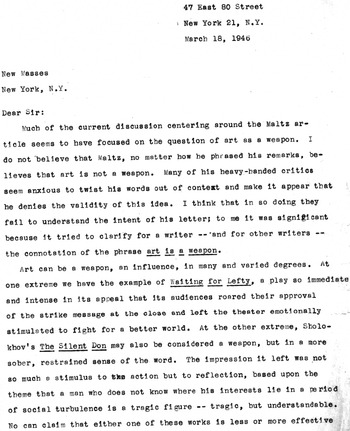
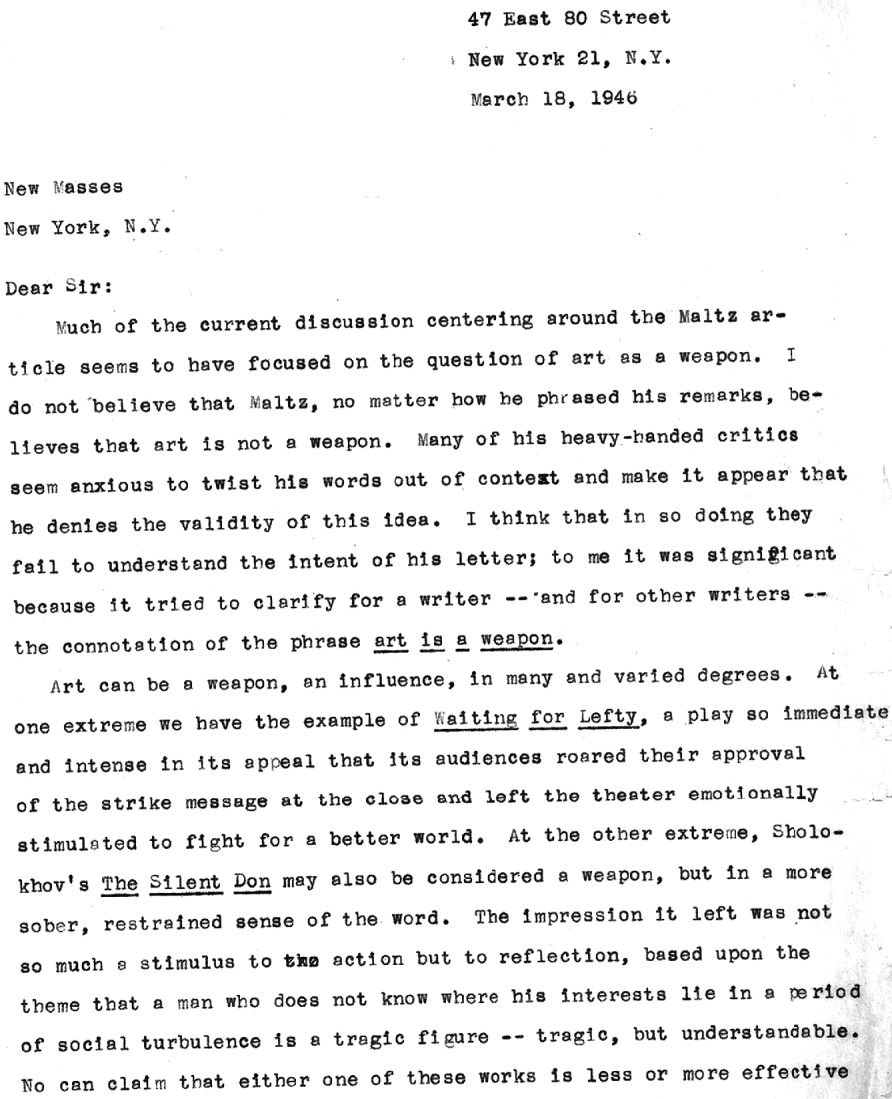
Although it was never published in New Masses, Rahtz wrote the journal a subtle response to the Maltz affair that summoned support for the position taken in “What Shall We Ask of Writers?” as well as the art-as-weapon theory (Figures 2 and 3). The Marxist critic has a pivotal role to play in the artist's creative process
by pointing out to him that a true understanding of Marxism (and not merely of its slogans) can be to enrich his art, to understand his material, and to present it in its truest, most dramatic light. In thus illuminating the stuff of life does the artist make his art a weapon, for then he assists his readers to understand more deeply the world and its people.Footnote 49
For Rahtz, this common ground between the Maltz position and the belief that art must serve as a weapon for progressive social causes can only be won by “beginning a Marxist literary magazine, something that has been needed for a [long] time.”Footnote 50
Robert Rahtz, unpublished letter to New Masses, 18 March 1946.

Like Maltz, Rahtz and others, Arnault suggested that critics abandon orthodox epithets designed to discredit approaches to art attuned to formal aspects – “formalism” being a favorite one. He envisioned an alternative conception of art history:
[The tendency to fall back on such epithets] is probably because of these critics’ tendency to think of form as something absolute, universal, and unchanging in the history of art; as a bag of tricks and devices from which the artists of different periods select the most appropriate means of presenting the content of their aspirations. Actually, the formal aspects of art undergo transfiguration along with content. The nature and direction of these changes are dictated both by changes within society and by the potentialities for development inherent within the pictorial medium itself. Only when form is understood as being dialectical in character, as playing a constantly dynamic role in painting, and as something which undergoes progressive change in itself will Marxism finally realize all of its possibilities in the field of art criticism.Footnote 51
This Marxist theory of art history supplements Maltz's viewpoint nicely; in historiography as well as criticism of individual works, the how should be just as relevant to the Marxist's critical analysis as the what.
Two weeks prior to Arnault's piece, New Masses published an essay by occasional poet Fred Basset Blair, titled “Poetry and the People,” which also supported an alternative Marxist criticism.Footnote 52 Described rather enthusiastically in his obituary as “the man long regarded as Wisconsin's No. 1 Communist,”Footnote 53 Blair advocated experimentation with “verse forms which facilitate communication, and for forms that make possible easy comprehension, memorizing, singing.”Footnote 54 This plea, in tandem with his idea that “[t]he poet is not a prophet or a world maker,” was once again greeted with excitement from readers.Footnote 55 George Hunt, the educational director of the Milwaukee-based South Side Branch of the CP, maintained that Blair's advocacy for formal experimentation “stands on firm Marxist ground in calling for a critical assimilation of our heritage of poetic forms instead of sterile and eclectic search for novelty.”Footnote 56 Zhdanov had himself called for principled formal experimentation at the 1934 Soviet Writers’ Congress:
[Zhdanov] urged the writers to make just such a critical assimilation of the literary heritage of all epochs; he urged them “to employ different genres, styles, forms, and methods of literary creation in their diversity and fullness, selecting all the best that has been created in this sphere by all previous epochs, to carefully gather up their heritage, to study it and advance it further.” And many of us in Wisconsin feel that Fred has obeyed his admonitions, that we have in him a people's poet whose verses and songs we comprehend in thought and feeling. New Masses should publish from them.Footnote 57
Hunt's letter signals a taste for debate and discussion amongst American communists on this issue. The reader Tony H. Adrean is even more inspired by Blair's discussion of form, offering this theoretical consideration in a letter of 16 October 1945:
Form channels the development of content, gives it direction, spurs development in some directions and restricts in others. The Marxist uses his concept of form and content to improve form in order to give the content the widest possible developments …
From such a point of view, I think the purpose of your magazine would be better served by presenting specific problems of individuals, indicating why they selected the forms they used and what they did to adapt their work to the forms they chose. The dialectical method would be better demonstrated and observed in its processes than it can possibly be explained in general theoretical articles.Footnote 58
The case made in Maltz's February 1946 piece was not without precedent. Those who had anticipated his stance argued that criticism attuned to formal choices, and not just to communist subject matter or affiliations, would encourage greater awareness of the dialectical processes operating in artworks themselves, or stimulate appreciation for the dialectics of practical artistic choice-making. More specifically, in the months leading up to the Maltz affair the readers and contributors of the New Masses were engaged in lively discussion about the limits of the standard Marxist “academic” approach to art that involved analyzing works for their political messages alone. Readers, historians and practitioners offered a number of alternatives to the narrowly applied, top-down Zhdanovite line of 1946 and beyond:Footnote 59 the study of the progressive aspects of artworks that may not on the surface be communist (Carver); of the historical and pictorial dialectics in painting (Arnault); of the rhetorical potential of traditional or folkloristic forms (Blair and Hunt); and of the poetics of art, or how and why poets and painters (in this case) choose the forms that they do (Arnault and Adrean). The future possibilities of this discussion seemed promising.
The Maltz affair; or, a defense of the orthodox Leninist theory of art
That the New Masses board did not respond to these anti-orthodox proposals should not be read as an editorial endorsement of the status quo. When board member Isidor Schneider contributes to the series on Marxist literary criticism (to which Maltz's article belongs) on 23 October 1945, he reassures the reader that the discussion will be held in the spirit of healthy debate, especially in light of the fact that previous meetings of New Masses editors, contributors and writers concluded that “no formulated Marxist criticism exists.”Footnote 60 In his article, “Probing Writers’ Problems,” Schneider expresses hope “that articles presenting all viewpoints … will emerge from the discussion.”Footnote 61 Despite this diplomatic invitation, his belief that the views of Marx and Engels on culture are “of value chiefly as cautions against rigid and schematic formulations,” and despite his sentiment that “American Marxists can strive, without feeling undue handicaps, to win a socialist competition in the creation of a Marxist criticism,” the terms of Maltz's demise, and of the asphyxiation of legitimate debate, are already outlined by Schneider.Footnote 62 Schneider effectively narrows the spectrum of acceptable response. After denouncing the overextension and exhaustion of such sobriquets as “escapism,” “ivory tower” and “decadence,” terms which are all too often paraded as “critical instruments,” he defends their premises with the following prediction:
When Marxist principles have been established in criticism it is likely to turn out that their main lines were already drawn in the social criticism of the Left. The impact of this criticism in its most influential period, the middle thirties, did not come from original contributions. For the criticism was, essentially, a restatement in more accurate, Marxist terms, of the effects of the social environment, upon culture …Footnote 63
Further:
What gave the work of the Left critics of the thirties its impact was their enthusiasm, tenacity and their boldness in applying social criticism to current work. With these they won a major intellectual victory. To place a work within its social frame has now become an obligation of the critic. Indeed, it is the only, so far, established critical principle that I know of. Even critics on the Right are compelled to use it and only renegades vainly seek to discredit it.Footnote 64
Exemplary of this social critical mode is the writing of Mike Gold, who in the 1930s “challenged the assumptions of the ‘esthetic’ criticisms of the time, exposing its evasions of reality.”Footnote 65 Schneider is prepared to dismiss any aesthetic or formal considerations as politically suspect.
Adopting the Marxist “code” of the moment (in which references to the writer's concern for the merely artistic value of his work are rendered as an interest in “lasting works”), Schneider concedes that writers are split in their commitment to writing that “endures” and to “writing for the moment” – that is, writing that serves “to report immediate events or to propagandize for immediate objectives.”Footnote 66 The latter is the more “honorable” and “useful” function, however, because making “lasting works” ultimately means offering “correct” representations of reality.Footnote 67
The alternative role for writers advocated by Maltz had been anticipated, and was thus unlikely to have been celebrated on the Marxist terms embraced by the communist literary establishment. Of the seven major figures who rejected Maltz's line of argument in the New Masses and the Daily Worker in the month or so after its publication – Schneider himself, Mike Gold, Howard Fast, Samuel Sillen, Joseph North, Alvah Bessie and John Howard Lawson – not a single author deviates from the orthodox Zhdanovite–Leninist theory of art.Footnote 68 In “Background to Error,” Schneider slams Maltz for failing to consider the history of American Marxist criticism, most of which had critics on their guard: “Thus a conditioning of political emergency characterized every stage of the development of the cultural Left.” “It is for that reason,” he adds, “that the achievements of the left criticism are to be found not in the esthetic but the social dialectic of art.”Footnote 69 He sees the traumas of the postwar era as sufficient for being “as submerged as ever in emergency,” which has direct bearing on the social purpose of writers: “It means for writers to make themselves formidable as writers, to train themselves for their part in the class struggle as writers, to perfect literary weapons of the struggle.”Footnote 70 Mike Gold, for his part, accuses Maltz of Browderism: “That way lies the Ivory Tower, the floundering in the marsh, the negative and passive literature of the cafes and esthetic cliques.”Footnote 71 Fast draws on this “pathway” metaphor: “he must be reminded that the road he charts here leads to sterility – whether it be the sterility of the esthete, the mediocrity, or the neo-fascist.”Footnote 72 He relies upon another familiar image as well:
Left-wing art is the result of a conscious use by the artist of a scientific understanding of society, of an identification with the working class, that class which is vital and in the ascendancy, and of a sharing of the vital ideology of that class. Such art is always a weapon – a weapon in the struggle for a better world.Footnote 73
Samuel Sillen, who publishes numerous rejoinders to Maltz, accuses him of misdirection:
Maltz arrives at false and dangerous conclusions about literature by substituting a bourgeois liberal for a Marxist approach. Maltz's non-Marxist analysis would not lead to the correction of certain admitted defects in left-wing writing. It would lead to the complete dissolution of the working-class and progressive literary movement.
… [H]e dissolves class consciousness and class-struggle in a rarefied mist not distinguishable from “Art for Art's Sake.” To bolster his position, he misreads the views of Marx and Engeles [sic] on literature.Footnote 74
The following day Sillen invokes the authority of Lenin to justify the art-as-a-weapon thesis:
This is not a question of whether art “should be” a weapon. It inevitably is. If the term “weapon” seems crude, remember that the struggle is grim …
As Lenin notes as far back as 1905: “The freedom of the bourgeois writer, artist or actress is nothing but a self-deceptive (or hypocritically deceiving) dependence upon the money-bags, upon bribery, upon patronage. And we Socialists expose this hypocrisy, we tear away this fake front – not in order to attain a classless art and literature (that will be possible only in a Socialist, classless society), but in order to oppose a literature hypocritically free, and in reality allied with the bourgeoisie, a literature truly free, OPENLY allied with the proletariat.”Footnote 75
The option of defending Maltz is quickly blocked by New Masses editor-in-chief Joseph North, whose invitation to contribute to the forum suggests that “What Shall We Ask of Writers?” qualifies as neither Marxist nor progressive:
To conclude, New Masses welcomes a full discussion of the artist's role and problems today, within the context of a Marxist and progressive approach to the issues involved. That is the reason for this brief piece, in which I have indicated only a few of the fundamentals in question. We shall return to this subject in subsequent issues, and indicate further New Masses’, and the Left's, responsibility of this subject.Footnote 76
Although tactical positioning and personal gripes undoubtedly shape the stances taken during the Maltz affair,Footnote 77 by and large it rests on the judgment that in a period of increased communist persecution and of recovery from the concessions of Browderism, “art as a weapon” is the only Marxist theory of art. Although an alternative conception of art, advocated by Maltz, Arnault and Blair, among others, may not have had sufficient support to coalesce as a unified movement in America, they were defending a Marxist position advocated by some relatively prominent critics and aestheticians facing similar conditions internationally.
The promising future of the para-Marxist alternative: an international perspective
As historians of Marxist criticism and aesthetics have shown, the period from the Russian Revolution to the Thaw was a period of negotiation and internal debate amongst writers and theorists concerning the possibilities for a Marxist theory of art. As George Steiner points out, three canonical texts rest at the origin of Marxist conceptions of literature (and, to a certain degree, art): two letters by Engels and an essay by Lenin. Engels argued in a letter to Minna Kautsky in November 1885,
I am by no means an opponent to tendentious, programmatic poetry (Tendenzpoesie) as such. The father of the tragedy, Aeschylus, and the father of comedy, Aristophanes, were both strong Tendenzpoeten no less than Dante and Cervantes; and it is the finest element in Schiller's Kabale und Liebe that it is the first German political Tendenzdrama. The modern Russians and Norwegians, who produce excellent novels, are all Tendenzdichter. But I believe that the thesis must spring forth from the situation and action itself, without being explicitly displayed. I believe that there is no compulsion for the writer to put into the reader's hand the future historical resolution of the social conflicts he is depicting.Footnote 78
Writing now in April 1888 (in a letter to Margaret Harkness), Engels is more assertive about the Marxist writer avoiding the overt expression of policies and solutions:
I am far from finding fault with you for not having written a point-blank socialist novel, a “Tendenzroman” as we Germans call it, to glorify the social and political views of the author. That is not at all what I mean. The more the opinions of the author remain hidden, the better for the work of art.Footnote 79
The third text suggests an altogether different approach. In his essay on “Party Organization and Party Literature,” published in Novaia Jizn in November 1905, Lenin argues,
Literature must become Party literature … Down with un-partisan littérateurs! Down with the supermen of literature! Literature must become a part of the general cause of the proletariat, “a small cog and a small screw” in the social-democratic mechanism, one and indivisible – a mechanism set in motion by the entire conscious vanguard of the whole working class. Literature must become an integral part of the organised, methodical, and unified labours of the social-democratic Party.Footnote 80
Reflecting on the discrepancies between these two positions, Steiner reminds us that Lenin's tactical polemic against aestheticism, “and call for Tendenzpoesie in the most naked sense, has come to be regarded as a general canon of the Marxist interpretation of literature.”Footnote 81 Ultimately, however, the subtlest Marxist critics did not adopt the Leninist position whole cloth, but rather tried to resolve the “formal contradiction” between Engels and Lenin. One such critic, Georg Lukács, attempted between 1935 and 1945 to reconcile Engels and Lenin:
The attempt to reconcile the image of literature implicit in Lenin's essay with that put forward by Engels is a rather desperate response to the pressures of orthodoxy and to the Stalinist demand for total internal coherence in Marxist doctrine. Even the most delicate exegesis cannot conceal the plain fact that Engels and Lenin were saying different things, that they were pointing toward contrasting ideals.Footnote 82
Whatever Lukács's success in resolving these tensions, his work represents an attempt to move materialist aesthetics in a new direction.
More importantly for our purposes, Lukács's efforts suggest a way to reevaluate the significance of the Maltz affair. First, in this dispute, Maltz, citing Engels, insisted that there is more to writing and art than offering a “thesis” or “programmatic bias” (Steiner's preferred translations of Tendenz), and thus on one level exposed a basic tension in the views of Engels and Lenin.Footnote 83 Maltz's 1946 intervention came at a point in the development of Marxist aesthetics when the line between the orthodox Zhdanovite–Leninist theory and what Michel Crouzet has identified as the “para-Marxist” alternative (indebted more to Engels than to Lenin) was just being drawn.
Second, while in the mid-1930s Zhdanov called for formal and stylistic recuperation, he simultaneously lobbied for a stricter Leninist philosophy, and on this front his position garnered wide support. He uses Engels's terminology in the name of a Leninist policy at the First Soviet Writers’ Congress in 1934:
Our Soviet Literature is not afraid of the charge of being “tendentious.” Yes, Soviet literature is tendentious, for in an epoch of class struggle there is not and cannot be a literature which is not class literature, not tendentious, allegedly non-political.Footnote 84
Schneider's classification of the postwar era as a moment of “emergency” draws on Zhdanovite reasoning. Howard Fast's 1950 book Literature and Reality was a central pillar of the orthodox school in the West, and Steiner shows that under the orthodox teaching, “a critic has only two functions: he is an interpreter of Party dogma and a discerner of heresy.”Footnote 85 It seems fair to conclude that Schneider, Gold, Fast and others played one or the other role in the Maltz affair. To encourage support during the war, the Soviet state and its supporters enforced the “Leninist–Zhdanovite thesis that literature is an instrument of battle, that its ultimate values lie in the rhetoric of persuasion and total commitment.”Footnote 86 The outcome of Maltz's opposition to this thesis had to a large extent been determined.
What, then, did the para-Marxist alternative to the orthodox view entail? Maltz, Arnault, Blair and the readers that supported them were developing ideas that in the work of others were reaching a level of nuance that escaped Gold, Sillen and the editors of the New Masses:
The belief that literature is centrally conditioned by historical, social, and economic forces; the conviction that ideological content and the articulate world-view of a writer are crucially engaged in the act of literary judgment; a suspicion of any aesthetic doctrine which places major stress on the irrational elements of poetic creation and on the demands of “pure form” … para-Marxists approach a work of art with respect for its integrity and for the vital center of its being. They are at one with Engels in regarding as inferior the kinds of literature which, in Keat's phrase, have a palpable design upon us. Above all – and it is this which distinguishes them from the orthodox – para-Marxists practice the arts of criticism, not those of censorship.Footnote 87
While admittedly not all aspects of this position motivate Maltz's “What Shall We Ask of Writers?”, the blacklisted screenwriter did extol the virtues of a criticism that acknowledges the writer's “literary judgment,” the “integrity” of the work of art, that does not “censor” literary works, and that denounces literary “leaflets” that seek to have a “palpable design upon us.” Maltz was certainly not a fully developed para-Marxist aesthetician, but his polemic did express ideas that would have been recognizable to supporters of Engels.
A number of writers on both sides of the Atlantic took up para-Marxist positions similar to Maltz's, and faced scrutiny from their Marxist brethren. In the US, the sociologist of music Sidney Finkelstein took an Engelian position in his 1947 study Art and Society, which argued that the artistic tradition of realism owes much of its continued force to “the germinating power of folk art.”Footnote 88 Finkelstein divided artists into two types: “Those who tend to repeat themselves, developing mainly in a greater finish and refinement of style, and those who seem constantly to renew their contact with life.”Footnote 89 Steiner comments, “he argues that Bach's fugal style derived its strength and clarity from the fact that it was based on the division of voices and contrapuntal parts of current folk song.”Footnote 90 This approach reminds us of the emphasis both Maltz and Arnault place on the evaluation of edifying dialectical tensions at play in the best artworks. Predictably, Finkelstein's six case studies (of Giotto, Brueghel, Goya, Picasso and others) in Art and Society earned derision from Daily Worker literary critic Barnard Rubin, who charged that Finkelstein had granted too much import to “a formalist concept of ‘art as communication’ – art as a human activity divorced from the class struggle.”Footnote 91 John R. Martin's account of the climax of this episode in his 1951 article “Marxism and the History of Art” recalls the denouement of the Maltz Affair: “Finkelstein's retraction duly appeared in the same journal, only three days after his reprimand.”Footnote 92 “But,” Martin adds, “Finkelstein was not to get off so lightly”:
The controversy over his book was prolonged in further articles and letters, including one by Louis Harap, who found Finkelstein's work to be “full of loose, imprecise thinking, which naturally beclouds the class character of concepts dealt with.” Mr. Harap's eagerness must have been somewhat dampened, however, when his own book, Social Roots of the Arts [1949], was itself attacked five days later by Samuel Sillen [also in the Daily Worker] for sharing certain of Finkelstein's errors, especially regarding the formalism of T. S. Eliot.Footnote 93
This game of Zhdanovite censorial one-upmanship quite visibly plagued American Marxist letters in a postwar period of right-wing hysteria and oppression of those on the left and decided the fate of many attempts to develop a nonorthodox Marxist criticism.
Lukács faced similar opposition. Joseph Revai, “the Hungarian Zhdanov,” launched a “murderous” campaign against Lukács in his 1950 pamphlet Literature and Popular Democracy, in which Lukács is accused of placing “‘pure’ and ‘formalistic’ literary canons above Party and class interests.”Footnote 94 Steiner sees this (as we might see the Maltz affair) not merely as a debate between “a Zhdanovite hack and a great critic” (or, in the case of Maltz, not merely between anti-Browder literary hacks and a successful novelist and screenwriter with name recognition), but as “a confrontation between the ‘Engelian’ and Leninist conceptions of art and the role of artist in a revolutionary society.”Footnote 95
Only during the period of de-Stalinization from 1953 to the mid-1960s does the orthodox Marxist critical establishment in the East and the West loosen its grip and consider the benefits of the Engelian, or more broadly formalist, model. According to historians of literary criticism, the ultimate measure of critical-literary nonconformity (in this as well as other periods) remains whether a critic could render a positive judgment of the work of Dostoyevsky. And this became possible during the Thaw, Steiner explains: “During the period of ‘de-Stalinization,’ the forbidden ground of Dostoevskyan studies was reopened to Marxist scrutiny. We owe to this fact a distinguished essay by Vladimir Yermilov (Soviet Literature, February 1956). Its critical assumptions are plainly derived from Engels.”Footnote 96 He reports further, “[a] few months after the appearance of Yermilov's essay, French orthodox criticism followed suit” with the publication of G. Fridlander's discussion of The Idiot (1869) in La nouvelle critique in May of 1956.Footnote 97 While neither critic discovered a progressive outlook in Dostoyevsky, both set aside the author's reactionary tendencies in order to bring insight into the social and psychological conflicts of his stories. Perhaps more important for our purposes, this development helps us put into perspective Maltz's brief reference to Dostoyevsky in “What Shall We Ask of Writers?” as one among many novelists whose writings yield socially valuable tensions and themes without being narrowly communist. While there remains little doubt that Maltz's praise for Trotskyist novelist James Farrell was a significant factor in the backlash he received, his reference to Dostoyevsky was controversial in its own right, perhaps reminding the Marxist literary establishment of a long-standing lacuna in the orthodox approach. Developments in Marxist poetics and formalism during the following decades – Pierre Macherey's Pour une théorie de le production littéraire (1966; A Theory of Literary Production, 1978), Fredric Jameson's Marxism and Form: Twentieth-Century Dialectic Theories of Literature (1971), Terry Eagleton's “Marxism and Form” (1973) and Marxism and Literary Criticism (1976), to name but a fewFootnote 98 – would be pursued in conditions much less volatile, much less driven by a concern for immediate persecution by the right and, just as importantly, by a renewed commitment to Zhdanovism as the only legitimate aesthetic doctrine.
It could be argued that Maltz's position, like those of Arnault and Finkelstein, was expressed a decade early. Only in the Thaw period did orthodox strictures become loosened in favor of exploring the Marxist potential of formalist methods. Not coincidentally, it was also at this time, as Tony Bennett shows in his classic 1979 text Formalism and Marxism, that literary scholarship in the West was introduced to Russian formalist theories of art – crucial to the film scholarship of David Bordwell and Kristin Thompson, who in the early 1980s developed neoformalist paradigmsFootnote 99 – with the publication in 1955 of Victor Erlich's Russian Formalism: History and Doctrine and in 1965 of Tzvetan Todorov's Textes des formalistes russes.Footnote 100 The belated exposure of the West to the works of the formalists was in no small measure due to Stalinist pressures and censorship faced by figures like Victor Shklovsky and Boris Eichenbaum after the 1920s. As a result of their opposition to orthodox Marxist aesthetic theories that saw art as a bald reflection of reality (rather than as a transformation of it), they became the subjects of scrutiny and persecution during the shift to the ideology of socialist realism in the 1930s and to Zhdavovism in 1934.
Conclusion: towards an integrated approach to the works of Albert Maltz
While he was certainly not an aesthetician of the stature of Lukács or the Russian formalist Roman Jakobson, Maltz's case for a new Marxist criticism and reading practice in the New Masses should be read in light of developments in para-Marxist aesthetics internationally. He was harshly condemned for four main reasons, most of which have been concealed by the attention scholars tend to give to the HUAC trials and their related circumstances – events, it must be conceded, that were far more traumatic for and emblematic of postwar American life that those that took place between intellectuals in private and public letters written in 1945–46. First, Maltz argued for greater sensitivity to the dialectical tensions within character and form; second, he suggested special considerations and formal liberties for writers (previous calls for a Marxist formal approach to sculpting and painting were not met with the same opposition); third, he was such a prominent literary figure and therefore made a large target whose public denunciation would echo throughout the American Marxist literary world; and finally, he championed writers notoriously and consistently derided by many Marxist critics in his case against the shortcomings of the cultural left. Although we have only touched on the subject here, most of Maltz's critics – Mike Gold, Isidor Schneider, Samuel Sillen and so forth – focussed much of their criticism on his attempt to rescue Farrell's writings from obscurity and dismissal.
These four causes are, among other things, noteworthy for how little they relate to Maltz's career as a Hollywood screenwriter. The findings of this reexamination of the New Masses affair are nonetheless relevant to an understanding of his scriptwriting, particularly if we are to develop what might be called an integrated approach to his many works as a citizen writer. Granted, there are no references in “What Shall We Ask of Writers?” to Maltz's Hollywood experiences, nor does he offer any prominent screenwriters as exemplary of the kind of writing he wishes to defend. In this way, it would be wrong to assume that Maltz appears primarily in the guise of the screenwriter in the affair. On the contrary, the question of the political value of screenwriting is conspicuously absent from virtually the entire discussion. This omission suggests that the American left in this era had other priorities, and may even have underestimated the role that screenwriting could play in advancing proletarian causes. The same should not be said of Maltz. As scholars like Art Simon have shown, Maltz used scripts like those for The House I Live In to express leftist messages.
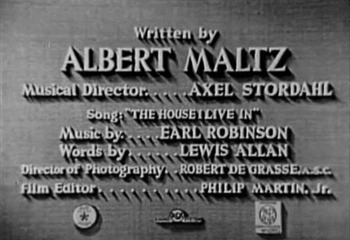
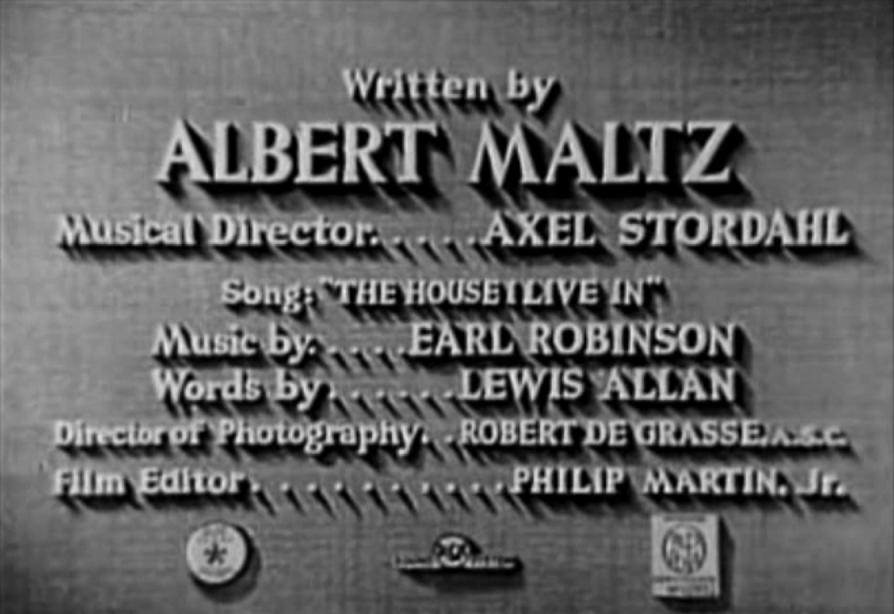
Evaluating “What Shall We Ask of Writers?” alongside his other writings and interventions helps us draw inferences about his development as a Marxist artist and thinker. In 1946, Maltz was in a strong position to pronounce on the limitations of propagandistic fiction, and had his many critics taken his film work into consideration, they may well have been more sympathetic to his perspective (despite the ecumenical impulse expressed therein). His name prominently displayed in the credits (Figure 4), he had written the rather didactic, ten-minute film The House I Live In the previous year to promote a multiethnic ecumenism and combat anti-Semitism, a cause he first adopted during the Popular Front of the late 1930s.Footnote 101 The postwar nationalistic short, culminating with an instrumental rendition of “America the Beautiful,” presents a straightforward thesis articulated by Frank Sinatra: religious bigotry is not in keeping with the democratic values of America. Motivated by their dislike of his religion, a mob of youngsters chases a Jewish boy (although he is never explicitly identified as such) into an alleyway where Sinatra allows himself a cigarette break in the interval between song recordings. Intervening on the young victim's behalf, Sinatra relates the boy's plight to his heritage as the son of Italian immigrants, and reminds the gang (and the audience) of the lessons of the war: “Look fellas, religion makes no difference, except to may be a Nazi or someone that's stupid. God created everybody. He didn't create one people better than another. Your blood's the same as mine; mine's the same as his.” The film was distributed on 16 mm to twenty thousand schools throughout the nation and shown in RKO, Warner Bros. and Paramount theaters,Footnote 102 and while it makes effective use of popular song and Sinatra's stardom to convey a progressive political message, the characters are ultimately thinly sketched and the moral dilemma is starkly drawn. “What Shall We Ask of Writers?” argues for a leftist fictional tradition that surpasses the “narrow tactical purposes” that shaped Maltz's own homiletic script for The House I Live In.Footnote 103
The House I Live In (Melvin LeRoy, 1945).
If Maltz's use of cinema, the novel and other forms to take positions on issues central to the cultural left is to be fully understood, future research ought to consider how his para-Marxist stance – in favor of an art of salutary tensions in the lives of characters who confront proletarian challenges and ethnic and racial discrimination – informed or functioned as a reflection on the limits of his own artistic development before and after the publication of “What Shall We Ask of Writers?”.
The Maltz affair perhaps stands most crucially as a lesson on the firm bonds that form between didactic theories of art and progressive politics in moments of crisis. The political aspects of the Maltz affair remain uncontestable, particularly given the recent traumas of the anti-Browderite campaign and the renewed vigor of right-wing forces and their efforts to shame communists by painting them as collaborators in a sinister international conspiracy against American life. But these political aspects are imbricated in the legitimate and deep-rooted Marxist aesthetic concerns that are vital to a full appreciation of this episode. On these terms, not only does Maltz's position piece echo developments in the New Masses over the previous year and overseas in the same period, but it also anticipates the efforts of later critics to explore the full breadth of the para-Marxist alternative to the art-as-a-weapon theory – of an alternative conception of progressive aesthetics attuned to a wider range of works that challenge the status quo with a subtler array of perceptual, emotional and conceptual experiences for the reader or viewer. In the end, one might take Maltz as a victim not of the latest wave of CP reversals, but of the deleterious hold that the Leninist–Zhdanovite theory had on Marxist aesthetics in mid-century American leftist criticism. A subtler view, however, sees Maltz's piece, and his vision for the citizen writer, as anticipating efforts to develop a more sophisticated handling of form–content relations in the context of Marxist thought. The contemporary dismissals of Maltz fail to register these long-range developments and continuities in the history of Marxist aesthetics.