We present in this article a model of turnout based on the social incentives set up by informal social networks. Our claim is that a significant proportion of turnout can be explained by voters conforming to the expectations of the informal social networks (ISNs) – of family, friends, work colleagues and perhaps neighbours – of which they are part. The incentives arise from the importance most people attach to their acceptance by those they are close to and the desire to avoid their disapproval.Footnote 1 Voting, we argue, takes place in those networks in which politics is treated as important (at least around elections), and in a game theoretic model we offer a rational choice account of this informal network approach. We show why it is rational under certain conditions for the individual to vote; and also why it is rational for others to sanction those who do not vote, even when that is costly to them. We then show in a large dataset that individual turnout is significantly related to political discussion among one's friends, to the belief that they will disapprove of one not voting, and to the likelihood of their voting. We also present other evidence to show that ISNs – while typically classified by income, occupation or education – are seldom formed because of a common interest in politics. And other evidence again shows ISNs to be positively correlated with income and education, while poverty shuts them down: thus offering explanations of other standard correlates of turnout.Footnote 2
Our informal network approach is distinct from recent work in the rational choice tradition, although that literature too places emphasis on the role of groups. Feddersen, one of the leading contemporary contributors to the field, writes in a recent survey that:
the literature appears to be converging toward a ‘group-based’ model of turnout, in which group members participate in elections either because they are directly coordinated and rewarded by leaders as in the ‘mobilization’ models or because they believe themselves to be ethically obliged to act in a manner that is consistent with the group's interest as in ‘ethical agent’ models.Footnote 3
For either group model of turnout in large N elections to work, the group has to be big enough to be a probabilistically pivotal voter, and therefore in national elections only very large groups qualify. In our model, by contrast, informal social networks are not pivotal voters, and we argue that it is informal networks that are critical in explaining turnout in the modern world of elections. Since rational choice theory has neglected the role of informal social networks, as opposed to much larger and typically more formal groups, it has, we believe, run into difficulties explaining the microfoundations of voting as a rational act. Our ISN model, we will argue, has a well-developed microfoundation that does not require the network to be a pivotal voter.
This does not mean that large formal organizations are unimportant in explaining turnout. In particular, we argue that political parties provide the information of multiple sorts and in multiple ways which ISNs use as the basis of their normative positions about the importance of voting.Footnote 4 And it may also be the case that unions or churches act in a similar manner, so that our approach is complementary to the Group Mobilization theory of Morton and Uhlaner.Footnote 5 Yet ISNs are not formed because of the strategic behaviour of organizations and political parties, and nor is the incentive structure in ISNs an outcome of such behaviour. Moreover, in our econometric tests, we find that the inclusion of ISN variables, which very significantly reduce the unexplained variance, hardly affect the coefficient on formal group membership: this suggests that ISNs do not function via the mechanism through which formal groups operate. This is why it is important to model ISNs as independent sources of turnout, which is what we do in this article.
The differences between this model and existing rational choice models can be summarized as follows:
(1) The pivotal voter assumption. In the existing literature, rational choice models either assume that the individual is a probabilistic pivotal voter as Ledyard as well as Palfrey and Rosenthal have argued;Footnote 6 or, in the group models, the group is assumed as a probabilistic pivotal voter. The Ledyard–Palfrey–Rosenthal approach, seminal though it is in small-N elections, implies a virtually zero pivotal voter probability in large-N elections with the smallest bit of uncertainty.Footnote 7, Footnote 8 In group mobilization models, group members are given incentives to vote in the group interest;Footnote 9 in ethical agent models, members are assumed to do so for ethical reasons.Footnote 10 That individuals are virtually never pivotal voters in large-N elections has made the move to the group attractive. And whether we consider the mobilization or ethical agency version of the pivotal group model, the key common assumption is that the group is large enough to influence the outcome of elections. The key move in both models is to recreate the probabilistically pivotal voter at the group level. It is this assumption which enables the models to draw conclusions about turnout rates.
In our approach, by contrast, the informal social networks (of friends, family, work colleagues, etc.) which we see as increasingly critical in voting behaviour in modern large-N elections can very seldom influence electoral outcomes. Thus, we do not believe that the pivotal voter can be institutionally recreated at an aggregate level. This is an empirical fact, not an analytic one: it may be the case in exceptional circumstances, and may have been the case to a greater extent in the past. This is reinforced by our econometric results which show that, while formal group membership is significant in explaining turnout, it accounts for only a small proportion of the explained variance compared with informal social network variables. Our point is that the institutional pivotal voter can explain at most a small part of current turnout rates. This brings us back to the rational choice paradox, save that it is now at the ISN level; and that is why we see a different approach as necessary.
(2) Predicting strategic voting in large N elections. The popularity of group pivotal voter models (whether mobilization or ethical agency version) certainly stems from their escape from reliance on the individual pivotal voter. They also have strong predictive power: In a seminal contribution, Cox showed that the rational strategic behaviour of actors in the Ledyard–Palfrey–Rosenthal pivotal voter type model in very small-N elections are empirical regularities in large-N elections.Footnote 11 For example, plurality elections with more than two candidates end up empirically as races between just two candidates; and, as another example, turnout is higher the narrower the perceived gap between the top two candidates. It is not difficult to see that group pivotal models reproduce these predictions by carrying over the pivotal voter logic to the large-N context.
We will argue that our ISN model can also reproduce these results – but via a quite different mechanism, and this is the second difference from the group pivotal voter mainstream. In our approach, political discussion in informal networks implicitly (inter alia) establishes norms about the importance of a particular election. Much of the material for political discussion comes from the media and political campaigning; and members of networks tend to co-ordinate on both their choice of media and broad political preferences, as well as having personal linkages to the relevant political party at the local level. Rational party behaviour under financial constraints is then to mimic the strategic voting models.Footnote 12 Thus, we believe our approach both avoids the empirical rarity of pivotal voter groups while providing an alternative mechanism to explain strategic voting behaviour in ISNs.
Where pivotal voter groups remain important (most obviously political parties), we analyse them in similar ways. Group leaders can work out the constituencies in which to deploy limited resources.Footnote 13 But we do not see these as selective benefits. Rather, they can concentrate information and messages to relevant ISNs in those constituencies. It is the ISNs which then supply the rational microfoundations of turnout, as we will see, replacing the pivotal voter group microfoundations or providing pivotal voter group theory with alternative microfoundations. Members of formal groups may receive selective incentives, but such membership is declining while the role of informal groups is rising. In our empirical results, the latter are far more important than the former for turnout.
(3) Microfoundations. The third major difference lies in the microfoundations of our model in comparison to the group pivotal voter models. The microfoundations of the two group pivotal models are quite different from each other; but in our view those of neither model are analytically satisfactory from a rational choice perspective. We briefly sketch these two models to understand where our approach is different. Analytically attractive though these models are, we will argue that they do not meet the rational choice criterion at the micro level.
In both models, it is assumed that voting is costly for the potential voter, and that the probability of being pivotal for the individual voter is effectively zero. Potential voters are members of groups of like-minded individuals. In the mobilization model, each group has a leader with preferences over candidates.Footnote 14 The leader can control the proportion of members of his/her group who vote by supplying suitable incentives to them at rising marginal cost to the leader; and for the potential voter this is the incentive for voting. Since there are a finite (small) number of leaders – the group pivotal voter assumption, the probability that the group as a whole can influence the election result, is central. Thus, there is an equilibrium in which leaders choose some fraction of their group to vote, given the strategies of the other leaders, and make vote–reward agreements to ensure they do so. The microfoundations of the model are that these vote–reward agreements provide the selective incentives for individuals to vote in the interests of the group and/or leader.
The ethical agent model is formally close to the mobilization model, but with a different interpretation. In the ethical agent model, each member of the group shares the same objectives; and s/he can work out the optimal fraction of the group which should vote – hence, what his or her mixed strategy should be, given the strategies of the other groups, and given that all the other members of the group have the same mixed strategy as he or she does. Group members thus behave as group rule-utilitarians.Footnote 15 Coate and Conlin explain why as follows:
The approach postulates that individual group members want to ‘do their part’ to help their group win. This is not because they receive a transfer from other group members for doing so; they simply adhere to the belief that this is how a citizen should behave in a democracy.Footnote 16
The original model is in fact from Harsanyi.Footnote 17, but the specific form was developed by Feddersen and Sandroni, and nicely extended further by Coate and Conlin.Footnote 18
The third difference between our model and the two group approaches lies in the mechanisms involved in explaining individual turnout behaviour. In the ethical agent model, individuals are assumed to behave ethically. But this begs the rational choice question, and returns us to Brian Barry's critique of the duty term in early models:Footnote 19 instead, we make the standard rational choice assumption that people behave selfishly. Indeed, Coate and Conlin end their 2004 article thus: ‘Finally, more thought should be given to the justification of the behavior postulated here. Why should we expect citizens to behave as group rule-utilitarians in elections?’Footnote 20
The mobilization model does not rely on individuals solving the mixed strategy rule which maximizes the expected utility of the group. The group leader does that, and then sets the level of reward for voting to ensure the turnout which maximizes group utility.Footnote 21 Whatever precise form the individual incentive takes, the problem which arises is that the group must be big enough for it to be a probabilistically pivotal player; in large N elections, that implies that the group must be large. But the assumption of large groups casts doubt on the enforceability of the contract between leader and member. As Feddersen says: ‘The biggest difficulty for mobilization models is explaining how leaders affect the micro-level decision-making of voters.’Footnote 22 Feddersen points to three difficulties: (1) Tangible rewards for voting are not legal in most advanced countries. Social pressure is then an obvious alternative, but without a micro theory of how individual members relate to each other, it is not easy to see how a leader can put social pressure on members who do not vote. (2) In essence, the leader has a voting–reward contract with each individual member. But how does a leader with thousands of followers enforce such a contract when (in advanced societies) he or she cannot monitor whether each member has voted? (3) If the leader cannot monitor and punish non-conforming members, why would individuals in the group enforce the contract by being unpleasant to others (to whom they are presumably close) if that is a costly activity for them? In summary: perhaps some large groups have developed mechanisms for enforcing voting–reward agreements across group members, but they are surely a rare occurrence in advanced democracies where votes for money trading is illegal and detailed monitoring of individual behaviour of members of large groups is practically impossible.
Our model avoids these problems by dropping the assumption that groups are pivotal and that their leaders can turn collective goods into private, enforceable contracts. Instead, the ISN model focuses on the rational incentives of individuals to vote in small informal groups, which are not pivotal in national elections. The basic argument is straightforward: if politics is seen as important during an election period in one's network of friends and family, then voting gains social approval and not voting leads to social disapproval. We know from mounting evidence in social psychology that social acceptance and the avoidance of social disapproval is exceptionally important to most people. As discussed in the highly-cited review article of Baumeister and Leary:
Existing evidence supports the hypothesis that the need to belong is a powerful, fundamental and extremely pervasive motivation … The need is for frequent non-aversive interactions within an ongoing relational bond … [P]eople form social attachments readily under most conditions and resist the dissolution of existing bonds … [A] great deal of human behavior, emotion, and thought is caused by this fundamental interpersonal motivation.Footnote 23
While existing rational choice models emphasize large group interests, at the individual level there is no question that social motivations play a critical role – especially in settings where neither individual nor informal social network affects aggregate outcomes.
We also show below why it pays members of informal networks to express social disapproval even when it is costly for them to do so; and we argue, based on the evidence that members of ISNs are usually co-located as well as knowing about each other’s activities, that the likelihood of being discovered not to have voted is high enough to deter lying (especially if lying attracts substantial social disapproval).Footnote 24
Our focus on informal groups does not imply that organized groups and political parties are unimportant. Political parties understand that social networks have a critical impact on the individual decision to vote, and they actively seek to influence these networks through personal contacts and targeted messages during elections. As noted above, the microfoundations fit into a model of expenditure of resources by resource-constrained parties which can then explain what looks like strategic behaviour by voters. It would in fact be possible to do so by amalgamating our micromodel with the macromodel of Shachar and Nalebuff.Footnote 25 Yet it is important to reiterate that networks of friends and families are not formed for political purposes, and it is not possible to view them as part of organized political groups. Informal networks are autonomous from political and organized interests, but they have received little attention in rational choice explanations of turnout. We think it is a serious omission that has blinded rational choice theory to a set of rational motivations that relies neither on pivotal group behaviour, nor on ethical standards.
The rest of this article is organized into three sections. In the first, we relate the argument to other works emphasizing the role of networks, and we suggest how it can help explain a range of long-standing puzzles of turnout. The following section formalizes the ISN model while the next tests it on new data from a mass survey of American voters specifically designed for our purposes. The conclusion suggests how our argument can be applied to the comparative study of voter turnout and political information.
Networks, Rationality and Turnout
The social logic we have in mind can be illustrated by an analogy to baseball. Most fans are not motivated to support a team because they, or the group of friends with whom they discuss baseball, believe they have an individual impact on their team winning if they watch games – even though they do attach importance to it doing so; but they care about their acceptance in groups for which baseball is an important matter. Many people with no prior interest in baseball will develop such an interest to be able to participate productively in the discussions and activities of a group (for example, colleagues in a new job) that happens to care about baseball. The same is true for groups which engage in political discussion and participation, even if they are not political groups in any formal sense, but rather made up of family, friends, neighbours and colleagues and in which politics may only be important from time to time. If by voting and acquiring political information people raise or maintain their standing in these “groups”, they do so regardless of whether their preferred party wins. The individual rationality of voting is largely unrelated to the outcome of voting, but closely tied to social interaction. The ISN model is related to the seminal rational choice analysis of esteem in social groups by Brennan and Pettit, although their book does not discuss political participation.Footnote 26
Our focus on individually rational behaviour in a social context has implications that are in wide agreement with many of the empirical findings in the sociological, civic and institutional literatures – literatures that typically downplay rational motivation. The pioneering work of Lazersfeld and Berelson and their associates attached a central role to discussion within informal networks in explaining voting choices;Footnote 27 this was subsequently reprised by Knoke,Footnote 28 and most notably by Huckfeldt and Sprague and by Kenny.Footnote 29 Indeed, it is a long-standing empirical finding that exposure to others who are politically active raises the probability of participation,Footnote 30 and network effects are at the centre of recent ‘structural’ accounts of voting associated with Zuckerman.Footnote 31 A recent field experiment by Gerber, Green and Larimer offers striking confirmation of the approach adopted here,Footnote 32 while another field experiment by Nickerson shows a ‘contagion’ effect between spouses.Footnote 33 And Fowler talks of a ‘turnout cascade’ as the consequence of one voter in an informal network being externally influenced to vote.Footnote 34 Our aim in this article is to provide an understanding of what it is about interactions inside these networks that gives some people a rational incentive to vote, but not others.
Our focus is on informal groups that were neither formed nor joined for political reasons, but whose members often engage in political discussion (especially during election periods) and frequently support the same political party. This might seem a central paradox for a theory of political participation based on social approval in informal groups and networks. But we believe there is a relatively straightforward answer to this: namely, that many, perhaps most, informal groups are fairly homogeneous in terms of economic conditions and interests, whether through income, occupation or education. This homophilic character of informal groups and networks of friends – ‘birds of a feather flock together’ – is a central finding in the social group literature.Footnote 35 There are two reasons for this. First, groups organize themselves around a range of activities and entertainment that tends to be stratified in respect to their cost. One particularly important activity, the semi-competitive discussion of each other’s consumer durables (automobiles, home entertainment systems, etc.), houses (kitchen improvements, house values), holidays, children and their schools, careers and associated status, and so on, depends on approximate similarity in economic resources. Secondly, many informal groups and networks develop from the interaction of those in similar economic circumstances – most obviously families, schools and colleges, neighbourhoods and friendships with colleagues and professionals. As we argue later, even groups which might appear economically heterogeneous, such as church congregations, may in fact not be so – and hence lend themselves to the support of particular parties. This is because it pays potential churchgoers to choose their congregation on the basis of social homogeneity, which will help them feel comfortable and be easily integrated. If kin relationships are disregarded, economic homogeneity is even more pronounced.Footnote 36
Thus, underpinning the argument in this article is a social reality of largely informal relationships that are heavily stratified economically. This is what makes many parts of the relational structure of society potentially divisible into political interests, which in turn is the foundation for political discussion, participation and acquisition of political knowledge. That said, our model nevertheless implies an important role for formal political groups – in particular political parties. The reason is that for politics to become a marker for group standing, interest homogeneity requires common knowledge about those interests. Political elites, through party organizations and interest groups, play a key role in inducing such common knowledge. In turn, the incentives and effectiveness of elites vary with the closeness of elections as well as with the design of political institutions, especially electoral institutions. Our account thus provides a coherent explanation of why macro-level institutions and conditions matter for turnout in the way they do.
The ISN model can help make sense of a series of puzzles about turnout, other than the fact that large numbers of people vote. Some of these puzzles can be accounted for by one or another of the existing models; our point here is to suggest that they can all be explained by our model.
(1) Income is positively correlated with voting.Footnote 37 In the ISN approach, those on low incomes entertain less and go out less with friends; hence, they are less connected on average to informal social networks; hence, they are less likely to be involved in groups in which political discussion takes place. Living in poor neighborhoods is significantly negatively associated with social network size independent of race.Footnote 38 Once political discussion is controlled for, we show that income becomes unimportant in explaining voting.
(2) Education is positively correlated with voting in most empirical work.Footnote 39 This can also be explained in a social network approach: this is because research on social networks shows education to be the most significant indicator of the size of an individual's network.Footnote 40 This can be reinforced: since education reduces the cost of acquiring political knowledge, and as this is a cost of voting, it might be thought to be supported by the standard model. But the problem is that there is no reason why anyone should incur the cost of acquiring political knowledge in the first place. In the ISN approach, by contrast, if the groups of which one is a member discuss politics – even if only from time to time – there is a clear incentive to be knowledgeable about politics; and those with higher education can acquire this knowledge more easily.
(3) Religious attendance is generally positively associated with voting and has become more so recently.Footnote 41 The ISN argument is that churchgoing is a social activity (in addition to being a religious activity), and informal social networks may form within church congregations. Hence, moral issues can become focal points of discussion, and be translated into political issues. Social approval and disapproval within these church-based social groups can then operate as sanctions to persuade church members to vote. This is reinforced by the fact that different churches implicitly attract (or act as co-ordinating social mechanisms for) different socio-economic groups, making natural relationships with political parties; and, more recently, some churches have moved to a decentralized discussion format. We discuss the case of the Evangelical movement in the empirical section. As with income, once the ‘social’ explanatory variables are included in our tests, religious attendance becomes insignificant.
(4) Students have relatively low participation rates. The ISN explanation is that although students may well be part of social networks, and although they may well discuss politics in those networks, these networks are short-lived and, critically, students can easily move from one to another. Hence, social approval and disapproval will have little bite. But note that this also allows an explanation of Obama-like phenomena in which a student contagion effect may operate and in which peer approval and disapproval may play a much more important role.
(5) Age increases turnout, and this does not appear to be merely a generational effect. This is readily explained in the ISN model because people tend to expand their number of friends and their membership in stable networks over time. The exception is for very old people where networks tend to break down due to illness and death.
(6) Expected turnout of others within one's social network (i.e., whether people think few or many others in their informal social networks will participate) is strongly positively related to voting. As far as we are aware, this is the first time this sort of data has been collected in a large non-experimental sample.Footnote 42 There is no reason why this should affect voting in the atomistic rational choice model. It is arguable that this would arise in group mobilization models, but the role of informal social networks within large formal groups is not specified in that literature. We show empirically that expected turnout in one's social network strongly predicts participation; and that this is central to the ISN model in which voting is related to group approval.
(7) Turnout varies across countries and is empirically linked to proportional electoral systems, as Franklin has shown.Footnote 43 A common ‘loose’ rational choice interpretation of this is that one's vote counts for more under proportional representation (PR) than under plurality voting; in fact, this makes little sense from a rational choice perspective since the effect of an individual's vote is still infinitesimal. Indeed, the ‘natural experiment’ afforded by New Zealand's switch from a majoritarian to a PR system since the 1996 general election shows no change in voting participation. The ISN model explains this since the pre-existing PR countries are marked by their density of social networks or ‘social capital’ while New Zealand is not.Footnote 44 Such social capital includes the informal workplace networks organized around unions, as well as local communities where members have long tenures and interact repeatedly. As emphasized in the varieties of capitalism literature, some economies (linked to PR political institutions) tend to be less horizontally mobile than others (linked to majoritarian institutions).
(8) Turnout has been declining since the 1960s, especially in the United States, but the factors usually invoked to explain higher turnout at the individual level – especially income and education – have been rising.Footnote 45 The ISN model accounts for this puzzle with reference to the greater mobility of people, which undermines the opportunities to build up stable long-term networks where political discussion is more likely to emerge.
(9) Finally, there is a range of motivations for voting which is difficult to explain by rational choice within a group motivation theory, let alone in an atomistic rational choice model. Largely, indeed, ignored in the rational choice literature, these include candidate popularity, responses to patriotism or a focus on recent incumbent economic performance. Much of the stuff of political discussion in informal social networks is of this sort and arises during electoral periods. Informal social networks, we suggest, offer a rational choice way of understanding the role of what we might call ‘collectively-agreed’ emotions in voting behaviour.
A Model Of Rational Voting With Socially Embedded Individuals
The ISN we present assumes self-interested rational behaviour, but it departs radically from the standard calculus of a voting model. The only variable retained from the standard model is the cost of voting to an individual i, Ci. The PiBi term should have no practical influence since the probability of i's vote being pivotal is effectively zero, Pi ≈ 0, at least in the vast majority of large-scale national elections. Although both P and B may matter empirically for the reasons explained by Aldrich – namely, that parties may focus more resources on states in which the vote is narrow, so that, in the argument of this article, the relevant social networks may become more centred on politics for the election period – PB cannot be treated as an explanatory variable in the individual rational choice calculus if it reflects the individual's belief that his individual vote will influence the result of the election.Footnote 46
In our model, the benefits of voting to an individual voter, i, derives instead from the social approval, Ai, which results from voting and the social disapproval Di (on which we have data) from not voting. As explained in the previous section, this follows from assuming that individuals are embedded in a set of social networks and groups, where the others’ views about them matter to their welfare. As in the standard model, we assume that i votes only when the benefits of voting outweigh the costs, ci, to i. But instead of the classic rational choice variable Pi.Bi, what matters to i is gaining or maintaining social approval from voting and avoiding social disapproval from not voting – so long as the cost is not too high: thus, i votes if Ai + Di > ci. The novelty of our contribution lies in modelling the benefits of voting from the social incentives of individuals, but the model in fact also speaks to the cost term, since it is widely recognized that a major cost of voting is the acquisition of information about the candidates. Knowledge acquisition, in turn, is governed by many of the same mechanisms as voting. We measure knowledge in the empirical section, but we do not try to model it.
The importance of approval and disapproval (A and D) for i's decision to vote (and acquire knowledge) depends on (1) the importance of informal groups for i, and (2) the importance of politics within those informal groups, in particular the importance of voting. With respect to (1), research in the social group literature shows that, beyond family relations, the factors which influence the size and importance of informal networks are income, education and membership in voluntary (but formal) organizations, notably churches. The reason why voluntary organizations matter for the importance of informal networks is that most voluntary organizations, even churches, tend to be socially homogeneous (in terms of social status, wealth and so on), and therefore function as places where making friends and contacts is easy. Since some voluntary organizations are also politically active, people may in part join them for the same reasons they vote, which produces an endogeneity problem. We address this issue in the empirical section; the point here is simply to note their potential effect on the salience of informal networks.
Two additional factors are likely to affect the importance of informal networks. One is age, since membership of informal networks is likely to develop with age, at least to a certain point; and the second is residential tenure, since people are more likely to become embedded in informal networks when they are settled – hence also to care more about their standing in these networks.
The second factor determining the effect of networks on voting is the importance of politics and voting within these networks. We do not offer a complete model of how politics becomes a focal point for discussion and activities, but we have already noted that informal networks tend to be homophilic (by class, education, etc.), so that it is reasonable to expect economic and political interests to be well aligned. Homogeneity in turn facilitates political discussion and consensus about appropriate views and behaviour.Footnote 47 Still, the importance of politics to groups will vary, in part as a function of tenure, education and the related factors discussed above, and we measure it by how often i is engaged in political discussion within i's informal networks. We also measure i's perception of the probability that others in i's network will vote, since this is likely to reflect i's understanding of the salience of voting to the group.
This last variable, expected turnout in one's network, is of particular significance in the modelling. This is because it turns voting into a network or strategic complementarities game. The more i believes other network members will vote, the greater is the probability that i will vote. This is important for the following reason: if some exogenous factor increases the probability that one group member votes, there will be positive feedback, leading other members of the network to be more likely to vote, and so on. This in turn leads to a greater likelihood of both high turnout groups and low turnout groups. And, as has been argued, modelling voting as a network game also brings the voting literature into line with socially-embedded rational choice literature in other areas of political science. But it carries a potential endogeneity problem in the econometrics, and therefore it is important to show that, under plausible assumptions, expected turnout is exogenous.
The core of our model is thus a network game where the equilibrium depends on the (dis)approval of (non)voting, which is itself a function of the set of social network variables discussed above.
The Basic Structure of the Voting Model
We start with a basic model. Let vi = 1 mean that i does vote, and vi = 0, that i does not vote. So:  or in index function form vi = 1[Ai + Di − ci > 0]. Assume that K variables, x 1,i,..,xK ,i, (the explanatory variables discussed above such as tenure, political discussion in one's social network, expected turnout, etc.) linearly determine the social approval attached to i's voting,Footnote 48 so that

the Kth variable, xK ,i, will be reserved for i’s expected group turnout; if xK + 1,i is the measure of disapproval if i does not vote, so that Di = αK + 1xK + 1,i , then

Using the central limit theorem, it is assumed that ci∼N(0, σ 2).Footnote 49 Thus, we can write

where  and
 with
 , and hence:Footnote 50

where Φ(z) is the Cumulative Standard Normal Distribution (CSND); we define  for convenience.Footnote 51
Equation 1 is useful for two reasons. First, it is the exact form of the Probit model so that we can use Probit maximum likelihood estimation. Setting aside for now some other econometric issues discussed below, this means that the Empirical Implications of Theoretical Models (EITM) desideratum that the procedure is one which ‘econometrically implements a theory-derived model’ is satisfied. Secondly, Equation 1 enables us to solve explicitly the strategic complementarities game discussed above. It is to this game that we now turn.
The Strategic Complementarities Network Game
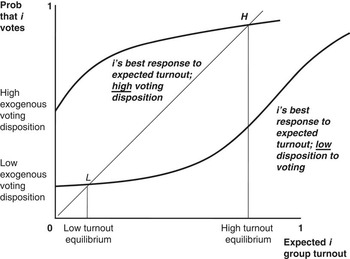
Analytically, in the strategic complementarities game, one explanatory factor in Ai + Di is of particular importance. This is the turnout rate expected by i, xK ,i, of the other members of i's network (we have data on xK ,i). Figure 1 illustrates this core game. We just consider i's network, all members of which are assumed identical.Footnote 52 The probability that i votes is measured on the vertical axis from 0 to 1, and the probability – as perceived by i – that the other members of i's network vote (expected group turnout) is measured on the horizontal axis. Two types of groups are identified, those whose members have a high disposition and those whose members have a low disposition to vote independent of expected turnout, that is those with high or low values of

excluding k = K. We will see later that these two groups may be distinguished as sanctioning groups and non-sanctioning groups, with xK + 1,i (the belief by i that other members of the group will disapprove if i does not vote) high or low, respectively.
The expected turnout game

The probability that i votes is given by

where we define  , so that
 is the value to i of all the exogenous approval variables, the value of the approval variables less the value of the expected turnout of other members of i's group, αKxK ,i. Thus,
 can be thought of as the exogenous or initial disposition to vote; for convenience, we define
 .
If we assume for convenience that αK = 1, the probability that i votes  is given by:

In Figure 1,  is shown on the vertical axis, and the expected turnout in i’s group xK ,i on the horizontal (with xK ,i = 0 at the origin). With low
 is low as is the marginal increase in
 in response to increasing
 . As
 increases, the slope becomes steeper, and then with high
 the slope levels off again while the probability of voting is now high. Hence, consider two possible groups, in one of which
 is low, and in the other
 is high. With
 intersects, the vertical axis (with
 ) low down at
 and i's ‘response function’ to higher expected turnout will look like the bottom, S-shaped, curve in Figure 1.
If the initial disposition to vote is high, i's response function will be shifted upwards, and only an upper portion of the CSND schedule will be relevant (shown as the top curve in Figure 1). The equilibrium rate of turnout is reached when the probability of an individual voting is equal to the expected rate of voting in the group (assuming that all members of the group are identical). In Figure 1, this is where the curve intersects the 45° line. Differences in the initial (social) conditions for voting – or the exogenous disposition to vote – are thus magnified through strategic interaction within the group.
In constructing the game formally, we assume that it is common knowledge that each individual i knows ci (his or her own cost of voting) and knows that the cj 's of the other players have a standard normal distribution but not their realizations (actual values). The expectation of i expectation that another member j of the group will vote is  . Thus, if there are NG members of i's network, i's expected turnout rate of the rest of the network is

i now votes if

Thus, it is common knowledge to each of the NG members of the relevant network that the probability of another player i voting is given by

where Φ is the Cumulative Standard Normal Distribution.
The equations in (2) above are significant in two main ways. First, we can find the value for  for all i = 1, …, NG by solving these NG simultaneous equations. These define the Bayesian Nash solution to the strategic complementarities game. The game can be most easily understood if all the group members have the same values of the K + 1 exogenous variables, excluding the expected turnout variable, so
 for all j in i's group, where for convenience we define this initial or exogenous group disposition to vote as
 . It is implied from Expression 2 that the expected turnout of each group member is the same, say
 for all i in group G.Footnote 53 Each of the NG equations in Expression 2 is then
 . It can be seen that
 , where
 , since Φ′ is the standard normal probability distribution. Thus, if
 ),
 always rises monotonically with
 (the weighted sum of the K − 1 exogenous variables). We show in Web Appendix 1 that
 is equivalently the condition for there being a unique equilibrium for every value of
 .
Therefore, if all group members have the same  , an increase in
 both directly increases the probability that each group member will vote and has a multiplier effect as each member realizes that group expected turnout has risen, and so on. From
 , the first round effect is
 and the subsequent multiplier effects are given by
 or
 . It is a game of strategic complementarities, since an increase in the expected turnout of other players raises each player's payoff from voting. Given the structure of the model, increases in
 have a small impact on turnout when z is low, because Φ′ is then low; as
 increases further, Φ′ becomes larger and, then, at high values of
 …Φ′ declines again. Thus, turnout is more likely to be generally low or generally high in the group.
Secondly, the NG in Expression 2 are significant because of the insight they give into the econometrics of i's expected group turnout variable,

An easy mistake (which we have encountered several times) is to think that xK ,i is endogenous on the grounds that if others believe that i is more likely to vote, they will be more likely to vote themselves. Hence, xK ,i will be correlated with the equation error in the vi observation. But it can be seen from Expression 2 that Pr{vi = 1}, i = 1,.., NG depends solely on  , where
 Hence, each Pr{vi = 1}, i = 1,.., NG, is exogenous and so, therefore, too is xK ,i, i = 1,.., NG.
Explicating the Game: Voting and Punishment as Sub-Game Perfect Equilibrium Strategies
We have so far treated the network game as a simultaneous move game with a Bayesian Nash Equilibrium solution. This is useful to analyse the game as one of strategic complementarities, but it assumes that the degree of social disapproval was an automatic response to not voting. Now, we need to see under what circumstances it does in fact pay other network members to engage in costly punishment of ‘defectors’, non-voters. What will be shown is that there are two Sub-Game Perfect (SGP) equilibria: in one, there is a relatively high probability of turnout and social disapproval for non-voters. In the other, there is a lower probability of turnout and social disapproval is zero. In terms of the model so far, and still assuming no within-group variation, there is some value of A, where Ai is defined as before by  (i being both the ith group and the ith individual in our sample), such that for groups with Ai ⩾ A*, there exist SGP strategies of the group that generate high turnout plus social disapproval; while for Ai < A*, the only SGP equilibrium is one where turnout is low and there is no social disapproval.
Rules of the Game
We assume that there is the same number of players in each group, NG. Each player votes or not simultaneously in the first move, m = 1. All subsequent moves are sanctioning moves or not. We assume that NG (the size of the network) is small enough and the network sufficiently co-located etc. that the history of the game at each point in time is common knowledge, as are the continuation strategies of all the players. Therefore, the turnout moves are common knowledge in m ⩾ 2 (but known only to the individual in m = 1). The following definition is common knowledge among the players:
Definition: At each move m > 1, a player is defined as G (guilty) or non-G at the start of the move. A player is G at the start of move m iff (i) the player was G at the start of move m − 1 and was not punished in m − 1 (and so remains unpunished at the start of m, hence still G); or (ii) the player did not vote in m − 1 (in the case that m = 2) or did not disapprove/punish a G player in m − 1 (did not punish the G player, hence becomes G himself at the start of m).Footnote 54
Preferences
There is a uniform discount factor of β. The immediate payoff from voting for the jth member of the group is A − cj, where A is common to all members of the group, and the payoff in any subsequent period for a player who is not G and not punishing is A. The immediate payoff from not voting is A (it being assumed that the fact of not voting is only known in m = 2).Footnote 55
Now we turn to the (negative) payoffs from being ostracized by and ostracizing one's friends. If a person is the object of social disapproval in a sub-game, his or her payoff in that period is −D; and the payoff in a period in which one is carrying out punishment on another member of the group is −P (we do not like having to ostracize our friends). We assume that D > P > 0 (we do not like ostracizing friends but what we really do not like is being ostracized ourselves). But the more people are ostracized in a period, the more painful is it to carry the disapproval out. Hence, we assume that the cost of disapproving is proportional to the numbers, N, being disapproved of, −PN.
Definition of A*
A* is the level of A above which the number of non-voters in equilibrium is less than the sanctionable number.Footnote 56 It is derived as follows: the payoff to punishing N G members in a particular period is  , while the payoff from non-punishment is
 ;Footnote 57 hence, the non-G member punishes iff
 . Therefore,
 is the maximum number of non-voters consistent with an A member just sanctioning them. The (expected) number of those not voting is
 . We define A* by
 as the level of A where the equilibrium number of non-voters is equal to the maximum number of non-voters consistent with an A member just sanctioning. At a higher level of A, the equilibrium non-voter number is lower and the maximum sanctionable number higher. Since
 rises and
 falls with A, a unique equilibrium value of A* exists.Footnote 58
(1) The high turnout sanctioning game, A ⩾ A*
Strategy σ*: The strategy, σ*(ci), of each player i is:
(i) Vote v in move 1, unless β(A + D) < ci.Footnote 59
(ii) For all m > 1, and if i is not G: Then if
 , punish iff any player is G at the start of m. If do not punish.
 , punish iff any player is G at the start of m. If
 do not punish.
Sub-game perfect equilibrium
We now show that these strategies constitute a SGP equilibrium iff A ⩾ A*:
PROPOSITION 1: If A ⩾ A*, then (1)  Group A, is an SGP equilibrium set of strategies; and (2) all non-voters along the equilibrium path will be punished.
proof: (1) (i) If i votes, the payoff is  , and if not, it is
 Hence, i votes iff
 . (ii) If, at the start of any subsequent subgame
 , the payoff to i punishing is
 and from not punishing
 Hence, i punishes since
 . (iii) If, at the start of any subsequent subgame
 , the payoff to i punishing is
 and from not punishing
 Hence, i does not punish since
 . (2) The number of non-voters along the equilibrium path is
 . By the definition of A*,
 ; since,
 and
 , it follows that
 so that all non-voters on the equilibrium path are punished. Hence, n(G) = 0 in all subsequent moves along the equilibrium path, so that all Gs are punished on the equilibrium path. •
corollary: If A < A*, some Gs on the equilibrium path will not be punished. Proof by extension from Expression 2 above. •
Renegotiation-proofness
As it stands, the model is not renegotiation-proof; that is, it would pay all the participants to agree to write off past crimes, because punishment is costly for the punishers as well as the punished. But a simple way in which renegotiation-proofness can be introduced is by modifying the definition of G as follows:
A player is G at the start of move m iff (i) the player was G at the start of move m − 1 and was not punished in m − 1 (so remains unpunished at the start of M); or (ii) the player did not vote in m − 1 (in the case that m = 2) or did not punish a G player in m − 1 or voted to renegotiate the strategies (assuming a unanimous vote was necessary for renegotiation).
This last condition, or something along similar lines, means that it does not pay to raise the renegotiation issue; for whoever does so gets punished next period and no renegotiation takes place anyway.Footnote 60
(2) The low turnout non-sanctioning game
The following set of strategies is an SGP equilibrium for all A, including A ⩾ A* (parallel to the {defect, defect} SGP equilibrium in a repeated Prisoner's Dilemma game).
Strategy σ**: Here is the (identical) strategy, σ**, of each player i:
(i) Vote v in move 1, iff ci < 0.
(ii) For all m > 1, do not punish.
Sub-game perfect equilibrium: We now show that these strategies constitute an SGP equilibrium:
PROPOSITION 2: For all A,  Group A is an SGP equilibrium set of strategies.
proof: (i) If i votes, the payoff is  , and if not, it is
 Hence, i votes iff ci < 0. (ii) In sub-games in which
 players i ≠ j are G, the payoff to j punishing is
 and from not punishing
 Hence, j never punishes.
Relationship to the Standard Model
What distinguishes our model from the standard atomistic rational choice model of turnout is that  . The former measures the importance of social disapproval from not voting; and the latter the importance of voting on the turnout rate. If significantly positive, they acknowledge that people’s welfare – in the very tangible sense of how much others respect and value them – depends on the prevailing views and behaviour in the groups to which they belong. In the standard model, voters are atomistic and αK = 0 and αK ≤ 0 – being negative when the expected vote is exactly split.Footnote 61 This implies that turnout is zero unless some other motivating factor is introduced.Footnote 62 That factor is a ‘duty’ term or some intrinsic pleasure from voting. Quite apart from how individuals can develop a sense of duty in isolation from others, this solution is clearly unsatisfactory. Our solution is instead to abandon the notion of atomistic individual behaviour, which rests on the radical ontological position – implicit in both the standard and pivotal group models – that social groups are unimportant to the individual unless they have an impact on policy outcomes. By doing so, we bring the explanation of turnout into line with the rational choice literatures on strikes, mass protests and ethnic conflict, and we build a bridge to sociological approaches that are usually seen as hostile to rational choice.
Testing The Argument
Estimating Equation
In the model, the probability of an individual i voting (and acquiring political knowledge) is a function of expected group turnout, xK ,i , of expected disapproval from not voting, xK + 1,i, as well as a further set of factors, xK ,i , that together determine the approval and disapproval from voting (and acquiring political information) and not doing so. From Expression 2,

where, again, Φ(z) is the Cumulative Standard Normal Distribution. The equation has the form of the Probit model and can therefore be estimated directly using Probit Maximum Likelihood.
The set of xk ,i and xτ ,i factors can be thought of in terms of a chain of causes that affects the incentives of the individual to vote or abstain. The most proximate mechanism in the chain is approval and disapproval, and we have a measure for the latter. Since political knowledge affects the cost of voting, this variable can also be seen as a direct influence on the turnout decision. Of course, political knowledge is itself affected by group incentives, but we do not try to estimate those effects in this article.
Whether approval and disapproval will be applied by the group to political actions, and how much the individual will care about these, itself depends on group turnout, the length of tenure in the group, and how often politics emerges as a topic of discussion in the social networks to which people belong. These group variables are, therefore, next in the causal chain.
One step further down that chain, discussion in informal groups might be related to the mobilizational efforts of political parties and organized groups.Footnote 63 Here, we have in mind not only the attempts by political parties to reach individuals and groups through election campaigns, but also the effects of being members in organized political groups. As implied by the mobilization models of Morton and Uhlaner,Footnote 64 organized political groups offer incentives for political participation to their members. These might include social incentives that are transmitted through informal networks, but we have argued that behaviour inside networks is likely to be largely independent of the strategic behaviour of organized groups. The empirics will help us sort this out; if formal groups affect membership behaviour through social incentives, the turnout effects of membership should diminish when we control for the social mechanisms we have identified. Church attendance, which we also enter at this stage of the causal chain, might be different, because churches are more like informal social networks than formal political organizations.
Finally, at the end of the chain of causation, we find the standard set of socio-economic status (SES) variables, especially income and education, which affect the opportunities to be involved in social networks, as well as the ease by which people are able to acquire political information and participate in political discussion. Though both education and income are probably associated with social dynamics that we have not fully captured by our measures, and that are likely to have an impact on turnout, at least some of the effect of these variables is likely to go through the social mechanisms that we do measure.
Following the logic set out here, the empirical analysis begins with a simple model that includes only the set of SES variables. We then move down the chain of causation by adding each set of intermediate variables or mechanisms: first, the political mobilization variables (campaigns and formal group membership), then the informal group variables (tenure and discussion), and finally the disapproval and political knowledge variables. We end the analysis with a brief discussion of how habit-forming aspects of voting may affect our results. But, first, there is a word about the data.
Data and Measurement
The data we use is part of a larger survey of the American electorate organized by The Economist and technically managed by YouGov, a relatively new polling firm. The Economist commissioned a large time-series panel study in an attempt to understand American opinion, attitudes and electoral dynamics better. Thus, an online panel of 10,000 people was recruited by YouGov in the spring of 2004 and roughly 2,000 respondents were given a survey each week. When joining the panel, respondents supplied a great variety of background demographic and other information, which helped ensure that each wave of approximately 2,000 respondents was representative.
Our component of the larger survey was sampled over 25–27 October 2004 – only weeks before the presidential election. In addition to the regular demographic, political preference and consumption (i.e. news, etc.) data, we wrote 151 questions specifically designed to test the micro-logic of our argument.Footnote 65 We enlarged our sample from 2,000 to 4,000 in order to generate more variance for our measures and ultimately ended up with 3,171 completed and valid responses. We weighted the sample to be representative nationally.
The dependent variable, the individual choice to vote or not, is captured by a question that asks whether the respondent intended to vote in the upcoming presidential election. We attempted to circumvent the well-known problem of vote over-reporting by giving people options in their answers, which would reveal their ‘true’ intention without people actually having to declare that they intended not to vote. The question read:
Many people don't vote in presidential elections – either because they don't want to, or because, on the day, they find they are unable to do so. How about you – how likely are you to vote in the Presidential election on November 2?
The respondent could answer 1. Definitely will, 2. Probably will, 3. Might or might not, 4. Probably won't, or 5. Definitely won't. Counting only those who answered ‘Definitely will’ as likely voters, we get a ‘turnout’ rate of 78 per cent. This is below the typical vote response of about 85 per cent in surveys such as the American National Election Studies, but it is still well above the actual turnout rate of 55 per cent in the 2004 election.Footnote 66 To get the reported rate closer to the actual, we experimented with a tougher test for being counted as a voter where the respondents also had to declare that he/she had voted in 2000, and remembered who he/she had voted for. This ‘filtered’ variable reduces the ‘turnout’ rate to 63 per cent, more in accordance with the actual turnout rate. But using this variable turns out not to make any difference to the substantive results, and since we want to be able to test the effect of including vote in 2000 as an independent variable, we use the intended vote variable (coded 0–1) throughout.
On the independent side of the equation, we have the following set of variables, roughly organized in order of proximity to the vote decision:
Political knowledge is based on three questions about political information: (1) How important is it to know about current events generally? (2) How important is it to know about politics? and (3) How important is it to know about the present political campaign and the upcoming election. Five-point response categories were offered in each question and the responses were coded as ‘high political knowledge’ when the respondent offered an answer in the top two categories on each of the three questions.
Social Disapproval is derived from survey items that read: ‘If I didn't vote, my friends or family [or co-workers] would: 1. Disapprove, 2. Not care, or the topic would never come up.’ Our variable is a dummy that is equal to 1 if the respondent answered ‘disapprove’ to either question, and 0 otherwise.
Length of tenure is the length of time a respondent has resided within a particular community, where the range of answers is ‘less than a year’, ‘1–3 years’, ‘4–5 years’, ‘6–10 years’ and ‘10 years or more’. We treat the measure as a continuous variable.
Political discussion is measured by three questions that ask people, ‘Do you discuss politics in the workplace?’ ‘Do you discuss politics with friends or family?’ and ‘Do you discuss politics in your neighbourhood/local community?’ To each question, the respondent could answer 1. ‘No, never’, 2. ‘Rarely’, 3. ‘Occasionally’, 4. ‘Yes, about once a week’, and 5. ‘Yes, daily’. The variable is a simple additive index ranging from low to high discussion.
Group turnout rate is captured by a question that asks, ‘How many of your friends and co-workers do you think vote in presidential elections?’ The respondent could answer 1. ‘Almost everyone’, 2. ‘More than half’, 3. ‘About half’, 4. ‘Less than half’, 5. ‘Almost no one’, 6. ‘Don't know’. We coded the variable so that the percentage increments between the answers are assumed to be the same. Higher numbers indicate higher turnout.
Formal group membership captures membership in a range of political and quasi-political organizations, including political parties, lobby groups, American Association of Retired People (AARP), National Rifle Association (NRA), National Association for the Advancement of Colored People (NAACP), the Sierra Club and the Now group. Membership in any of these groups is coded 1; otherwise 0.
Party mobilization is not captured by any variable in our data, but since we have information on the respondent's state of residence we can use the 2004 National Election Study (NES) and measure the number of party contacts, which we imported into our dataset by using averages by state. The NES variable asks, ‘As you know, the political parties try to talk to as many people as they can to get them to vote for their candidate. Did anyone from one of the political parties call you up or come around and talk to you about the campaign this year?’ The political parties subjected the so-called ‘battle-ground’ states – such as Ohio and Florida – to greater mobilization efforts than the ‘safe states’, such as Massachusetts and Texas. We use a dummy variable for high contact to capture the effects of party mobilization.Footnote 67
Church attendance is derived from a question that asks how often the respondent attends religious services other than weddings and funerals. The variable ranges from ‘never’ to ‘once a week’, with four intermediate levels.
Religiosity is a dummy coded 1 if respondents said they considered ‘religion an important part of [their] life’; otherwise 0.
SES variables consist of household income (income groups from low to high), education (level ranging from less than high school to a graduate degree) and age.
Finally, we control for vote in the previous election (2000). Part of our motivation in asking this question was to address the argument that people who turn out to vote once (for whatever reason) acquire a habit of voting.Footnote 68 Another was to control for unobserved heterogeneity, such as pre-adult socialization, which is always a concern when using observational data. Certainly, there is much empirical evidence to the effect that those who voted in the past are more likely to vote in the future.Footnote 69 We show that our ‘social model’ results remain robust to the inclusion of past voting, suggesting that there may be a case for explaining habit within a rational choice framework.
Findings
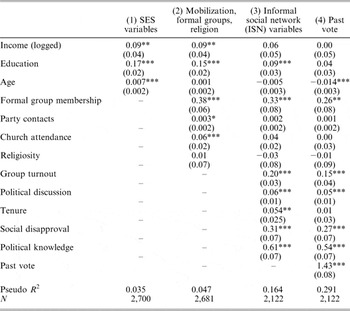
Table 1 shows the Probit estimates, starting with a set of basic SES variables (Model 1), and then adding variables according to the causal chain explained above.
Probit Estimates of the Determinants of Voter Turnout

Note: Standard errors in parentheses; *** p < 0.01; ** p < 0.05; * p < 0.10 (two-tailed tests).
Income, education and age all have the expected effects and simply confirm what many studies before this one have shown. The impact of income levels is, however, fairly small. Going from the lowest income group ($15,000) to the highest ($140,000) raises the predicted probability of voting by just under 7 per cent (with all other variables held constant at their means). The effects of education and age are larger. Comparing someone with less than a high school diploma to someone with a graduate degree is associated with an increase in the probability of voting of 33 per cent. This is similar to the gap of 35 per cent in the probability of voting between a newly eligible voter at age 18 and someone retiring at age 65. These variables, however, do not account for much of the total observed variance in turnout. Only a little more than 3 per cent is explained by the model (using the pseudo R 2 as the basis).
Model 2 adds membership in formal groups, party mobilization (as captured by party contacts), church attendance and religiosity. Not surprisingly, formal group membership significantly raises the likelihood of participation by about 12 percentage points. As in the group mobilization models discussed above, this may be a result of groups providing selective incentives to members, where these incentives are in turn derived from the impact groups have on public policies. But it may also be that those individuals who choose to become members of formal, policy-related groups are motivated by the same factors that cause them to vote. In that case, the effect is spurious and represents an omitted variable bias. In other words, caution is advised in interpreting the result for this variable.
The finding for church attendance suggests that religious organizations, even when they are organized around worship, encourage interest in politics.Footnote 70 Attending church every week raises the probability of voting by nearly 10 per cent compared to never attending, and this effect is not due to being a believer and perhaps therefore more bound by moral imperatives than others. This is clear from the absence of any effect of the religiosity variable. Rather, church attendance is likely to be an effect of the social dynamics inside churches, which sometimes spills over into politics.
Recent ethnographic work on one of America's most powerful and best-organized voting coalitions – the so-called ‘Christian coalition’ – illustrates its importance for political mobilization. Gladwell has documented the rise of the ‘cellular church’, a very large church that has been created ‘out of a network of lots of little church cells … groups of tightly knit groups … who meet in one another's homes during the week.’Footnote 71 Regular meetings and small groups – which create a larger network and ultimately a larger church – have enabled mega-churches like Saddleback or Lakewood to grow and still remain cohesive with tens of thousands of members. These large churches, and the evangelical movement more generally, do not restrict themselves to prayer and religious contemplation. In recent years, churches have become active political players and certainly do not shy away from political topics.Footnote 72 It has been widely documented that the evangelical movement has become a powerful political force within American politics over the past two decadesFootnote 73 – which correlates nicely with the founding and rise of these mega-churches and their discussion networks.
There is also some evidence in our results that more deliberate efforts by political parties to mobilize voters are paying off. Like formal group membership and church attendance, the estimated parameter for the party contact variable implies that voter turnout is about 6 per cent higher in states with many compared to states with few contacts on average (although the effect is imprecisely estimated). We suspect that this variable would pick up considerably more of the variance if it varied across individuals as opposed to just states, since most party contacts are targeted to particular groups within states. As we show below, the fact that the party contact variable loses its effect when we add the social group variables suggests that party mobilization works, in part at least, through informal social networks.
A final noteworthy aspect of the results for Model 2 is that the effect of age virtually disappears. This is partly a result of older people being more likely than young ones to attend church, but it is also because there are many over 50 who are members of AARP – one of the organizations included in the formal group membership variable. The AARP is deeply engaged in policy analysis, commentary and advocacy – especially on issues pertaining to Social Security and Medicare – and it spends much time and effort on informing its members about policy issues and engaging them in public debate and advocacy.Footnote 74 The fact that the effect of age disappears when controlling for group membership and church attendance strongly suggests that older people vote in greater numbers for reasons that cannot be explained by generational differences in civicness.
Model 3 adds the key variables in the ISN approach: group turnout, political discussion, tenure and social disapproval. Since political knowledge is at least partially a function of group incentives to be informed about politics, we also include this variable here. All work in the predicted direction, and together they more than triple the explained variance (from 4.7 to 16.4 per cent). Focusing on the first three variables, as turnout rises in the social groups to which people belong (referring to friends, family and colleagues), the probability of an individual deciding to vote increases by as much as 24 per cent (holding all other factors constant). The estimated effect of going from the lowest to the highest level of political discussion is 20 per cent (and this has been estimated very precisely). Finally, if we compare an average individual with long tenure in his or her community to one with short tenure, the probability of voting is higher by a more modest 6 per cent.
In addition to these direct effects, there are indirect effects. As we have argued, informal groups with high turnout and repeated interaction and which discuss politics frequently will induce individuals to acquire political knowledge, which is a major cost of voting. Moreover, non-voting (and lack of information) is more likely to be met by social disapproval in these types of groups. Indeed, both the expectation of social disapproval and political knowledge are powerful determinants of turnout. Though both are simple dummy variables, they raise the probability of voting by nearly 30 per cent. They also predictably reduce the effects of the other social group variables. Without the knowledge and disapproval variables in the model, the effects of group turnout, discussion and tenure increase by between 25 and 80 per cent. Still, not all the effects of the latter are transmitted through the disapproval and knowledge variables. We suspect the explanation is that much of the effect of informal groups is the result of positive social incentives, such as the pleasure of others expressing approval of your contributions to group discussions and related activities. After all, people presumably join and remain in voluntary groups more for their positive than their negative incentives. Yet we only have a measure of disapproval.
All told, if we compare a hypothetical person with short tenure in a group where few vote, where politics rarely emerges as a topic of conversation, and where non-voting is not met by disapproval to a person with long tenure in a group where most vote, where politics is the frequent topic of discussion, and where non-voting leads to disapproval, the predicted probability of voting increases by an estimated 61 per cent.Footnote 75 If we include the indirect effects of these variables through political knowledge, the figure is 77 per cent.Footnote 76 In other words, social influences through groups can make nearly all the difference in whether a person goes to vote or stays at home. Clearly, the ISN model adds some important pieces to the puzzle of understanding turnout, and the results highlight the two equilibria in the theoretical model where some social networks induce almost universal turnout while others completely fail to do so.
Finally, it is also noteworthy that the social group variables cause a significant drop in the importance of other factors. The income and party contacts variables are no longer significant, and the effects of education and church attendance drop by 66 and 35 per cent, respectively. Evidently, much of the effects of these variables, as hypothesized, go through the social group variables. The implication is that any model that omits these variables not only misses a large part of the turnout story, but may produce seriously misleading estimates of the effects of other variables.
There are only two non-ISN variables that retain significance in Model 3. One is formal group membership. This is notable because it means that formal groups appear to be affecting turnout largely through selective incentives other than social ones. It is not the case, in other words, that the social network incentives we have identified are simply transmission mechanisms for the effects of formal groups; informal networks are truly independent causes of turnout. They are also much more important than formal groups in explaining turnout; formal group membership only raises turnout by about 10 per cent, and much of this effect could be spurious, considering that some people may join formal groups for the same reason that they vote.
The other variable that retains an effect is education. Here, the residual effect may be a result of well-educated people being better able to process political information, and hence also to infer what is in the group interest, and what type of political behaviour is expected of them. But even if we exclude education and formal group membership from the model, it still explains more than three times the variance explained if we retain the former variables and instead drop the social group variables (15.2 versus 4.7 per cent).
Finally, in Model 4 we included voting in 2000 as a control. Not surprisingly, this variable is important, with the R 2 rising from 16 to 29 per cent. It makes sense to attribute the higher R 2 to unobserved characteristics, which may include habit but also, inter alia, pre-adult socialization. Since we would expect voting in 2000 to be explained the same way as in 2004, a major problem is that we lack the values of the social variables used in Model 3; hence, voting in 2000 may represent habit and socialization, but it may also reflect social variables in 2000. As far as we know, this particular problem has not been addressed econometrically; but, using a theorem of Yatchew and Griliches, it can be shown that if  is the estimated coefficient of the kth social variable, this is asymptotically biased downwards.Footnote 77 That is, the effects of our social variables are stronger than the coefficients suggest. We show this formally in Web Appendix 2, but the intuition is this: if high social factors in 2004 are associated with high social factors in 2000, then there will be a higher probability of voting in 2000 quite independently of habit; thus, some of the effect of high social factors in explaining voting in 2004 will be wrongly attributed to the fact of voting in 2000, thus biasing the social factor effects downwards.
This ties in well with a rough comparison of the estimated coefficients in Models 3 and 4, (even though differences in the unadjusted error variance mean we cannot perfectly compare them). The estimated coefficients of almost all the explanatory variables falls when Model 4 is compared to Model 3, as the asymptotic downwards bias of the effect of including voting in 2000 might lead us to expect. However, the falls are relatively small, and only one social variable, tenure, and one other variable, education, loses significance. But this is exactly what one would expect since tenure in 2004 and education in 2004 are the most likely factors to have taken the same value in 2000.
Whatever the nature of the unobserved variables suggested by Model 4, our approach shows, we believe, that a social network model is necessary to embed this unobserved heterogeneity. For example, suppose the heterogeneity represents habit, then it suggests that in some election social factors were strong enough to get someone to vote who had not previously voted. If they continued to vote, a rational choice interpretation is not that habit makes people subsequently vote blindly, regardless of social factors: it suggests that the first voting experience lowers future costs by learning how to vote, where to go and so on; this would tie in with another interpretation of why tenure in a given locality loses importance once previous voting is introduced. All this indicates the need for the ISN model to be tested in the future using experimental panel and field data.
Conclusion
Since it is difficult to understand voting in standard rational choice models as investments in desirable outcomes, participation is often seen as quasi-irrational. Voting becomes an act that is poorly linked to the real interests of groups, and that is easily manipulated by elites. By contrast, we have argued in this article that voting and political knowledge are in fact anchored in group interests and can indeed be understood as an investment in desirable outcomes. As implied by sociological network theory, the objective for individuals is not to influence the result of an election, but to maintain and improve their standing in the networks and communities to which they belong. Being knowledgeable about group interests and being prepared to act in the interest of the group are key ingredients in establishing such standing.
Using new opinion survey data, we find considerable evidence for these propositions at the individual level. Discussion of politics and group turnout lead individuals to believe that it is important to know about politics and to vote, and this in turn predicts whether people actually vote. Consistent with the notion that common knowledge is a precondition for participation, we also find that people who live in the same neighbourhood or community for a long time are more prone to think voting and politics are important, and to discuss politics. In combination, these results paint a very clear and coherent picture of the most basic political activity in a democracy. Together, the informal social group variables almost perfectly predict whether an individual will vote or not. When people vote and read about politics, it is because this is a way to get the respect and approval of other people in their social networks. There is nothing irrational about voting, and it need not be motivated by altruism, duty or selective incentives in formal organizations. Indeed, selective incentives are probably less and less important with the decline of formal political organizations like mass parties and unions.
The ISN model also helps explain why democratic politics tends to be fairly stable and structured around economic interests, and why people are often knowledgeable about these interests. This is a function of the socio-economic stratification of individuals into informal groups and networks. It is also likely to be affected by differences in national institutions. For example, the poor in high-vote countries may be better informed about politics and their interests as a result of lower geographical and occupational mobility, greater integration into stable social networks and more incentives for politicians in countries with PR electoral systems to cultivate interest in politics among low resource individuals. Yet the rational incentives to vote are produced in informal social networks that are rarely pivotal in elections and that are not part of political parties or other organized groups. We see the strategies used by political elites to make use of informal groups as an important area for future research. Since both social structure and political institutions vary across countries, cross-national differences in turnout and political knowledge acquisition are part of this research agenda.
Finally, we encourage new research that tests the causal micro-mechanisms we have proposed by looking beyond correlations in survey and macro-level data. While it might be difficult to devise a controlled experiment of voting that would realistically capture the social mechanisms that we have in mind, there are opportunities for natural experiments. For example, since our model predicts a discontinuity in participation between otherwise similar networks around the ‘tipping point’ where networks either develop effective enforcement or not, it is in principle possible to identify otherwise identical communities (in terms of economic, demographic, and so on, conditions) with different turnout rates and then examine whether newcomers develop different levels of participation. If adjacent communities are virtually identical with respect to the factors that people use in their decision to move, we can treat exposure to different voting norms as randomly assigned. The testable predictions are that exposure to political discussion and social surveillance of newcomers with respect to voting will vary by community, and that turnout among these will converge over time to the (different) community norms.Footnote 78
 inside the bracket on the right-hand side. Then each equation takes the form
 , with
 , so each equation is identical apart from the
 . Hence, any solution
 holds for all i. If a solution exists this implies
 . With
 , so
 and
 must intersect at least once since Φ is continuous and increases monotonically; and it is easy to see there are an odd number of equilibria.
 , while
 . For simplicity, we assume: (1) that N is continuous; (2)
 if A ⩾ A*.
 .