Introduction
Ecological challenges such as climate change, deforestation and the degradation of the soil, water and air suggest a qualitatively different environmental and welfare policy governance network, which, as Gough and Meadowcroft (Reference Gough, Meadowcroft, Dryzek, Norgaard and Schlosberg2011) have argued, would need to redistribute environmental impacts such as carbon emissions, pollution and waste, on the one hand, and work, time, income and wealth, on the other. Not only will social policies need to address the inequalities and conflicts that are likely to emerge in the transition towards more sustainable production and consumption patterns (Pye et al., Reference Pye, Skinner, Meyer-Ohlendorf, Leipprand, Lucas and Salmons2008; Gough, Reference Gough2013), it will also be increasingly necessary to formulate them in ways that create synergy with environmental goals and that are acceptable to the electorate. According to researchers such as Dryzek et al. (Reference Dryzek, Downes, Hunhold, Schlosberg and Hernes2003; Dryzek, Reference Dryzek, Gough, Meadowcroft, Dryzek, Gerhards, Lengfield, Markandya and Ortiz2008), social-democratic welfare states are in a better position to manage the intersection of social and environmental policies than more liberal market economies and welfare regimes. As a collorary, he holds that the ‘relationship between environmental policy effort and social policy effort does not have to be conflictual’ (Dryzek, Reference Dryzek, Gough, Meadowcroft, Dryzek, Gerhards, Lengfield, Markandya and Ortiz2008: 334–5). However, this relationship has as yet not been scrutinised in comparative empirical research. In this paper, we intend to contribute towards filling this gap in research by carrying out two research operations. First, we contrast the macro-structural welfare and sustainability indicators of thirty countries and ask whether clusters largely follow Dryzek's hypothesis that social-democratic welfare states also perform best in ecological terms. Of special interest is the temporal dimension: are there indications that social-democratic welfare states move towards becoming eco-social states, and, if so, are they doing this in more pronounced ways than conservative and liberal countries? And is this reflected in ecological key indicators such as the Ecological Footprint? Second, we raise the issue of whether these differences in the institutional and organisational capabilities of combining welfare with environmental policies are reflected in people's attitudes and opinions. Are, for example, people who live in a country with a social-democratic welfare tradition more environmentally aware and prepared to adjust their standard of living and to bring it in line with ecological needs than people living in liberal countries?
Theorising and comparatively analysing eco-social policies and states
Both social and environmental policies are political responses to long-term societal trends related to capitalist development, industrialisation and (sub)urbanisation (Koch, Reference Koch2012). Both modify these processes through regulation, fiscal transfers and other measures, thereby affecting conditions for the other (Fitzpatrick, Reference Fitzpatrick2011; Koch, Reference Koch2014). Exploring and analysing these policy interactions and their complex institutional coordination is a relatively new research field (Gough, Reference Gough2010). A developing body of literature addresses the distributive consequences and implications of environmental policies for social justice and social policy (Gough, Reference Gough2013). Different societal groups have different responsibilities for ecological issues, and experience different impacts. Responsibilities and impacts sometimes work in opposite ways, constituting ‘double injustice’ (Walker, Reference Walker2012), since the groups and populations likely to be most harmed by environmental issues are the least responsible for causing them and have the least resources to cope with the consequences (Büchs et al., Reference Büchs, Bardsley and Duwe2012). There have also been attempts to comparatively understand state strategies in relation to environmental performance. In 1999, Scruggs (Reference Scruggs1999) was already proposing the comparative advantages of corporatism as opposed to pluralism for dealing with environmental issues. More recently, Liefferink et al., (Reference Liefferink, Arts, Kamstra and Ooijevaar2009) produced a study on the policy output of twenty-four countries during the period 1970–2000, highlighting high environmental problem pressures, neo-corporatist institutional structures, EU membership and a high level of economic development as favourable to the advancement of environmental regulation.Footnote 1 In relation to greenhouse gas emissions, Christoff and Eckersley (Reference Christoff, Eckersley, Dryzek, Norgaard and Schlosberg2011) found that domestic political institutions (proportional representation versus first-past-the-post electoral systems and the presence of green parties in parliament and government) and corporatist systems that include business and labour, play an important role. The study pointed out that while national vulnerability to climate change is a poor indicator, both reliance on fossil fuel extraction and energy-intensive industry heighten opposition to carbon reduction. Of further significance are the kinds of ideological discourses on environmental issues. Indeed, depending on how these discourses are framed at the national level, these can ‘give rise to quite different cost/benefit calculations’ (Christoff and Eckersley, Reference Christoff, Eckersley, Dryzek, Norgaard and Schlosberg2011: 442). Similarly, Görg (Reference Görg2003) asserts that what actually counts as ‘environmentally relevant’ is in fact variable over time and across space and thus must be identified as an object of research in the context of changing societal integration and regulation patterns. Societal power relations and the corresponding discourse patterns frame which ecological facts and processes are perceived as ‘problems’ and deserve to be tackled.
Still another stream in the existing literature, which is of particular relevance for this paper, suggests that different welfare regimes (Esping-Andersen, Reference Esping-Andersen1990; Arts and Gelissen, Reference Arts and Gelissen2002) implement environmental policies and the green dimension of the state with different rates of success. Dryzek, for example, arrives at the ‘provisional conclusion’ (Dryzek et al., Reference Dryzek, Downes, Hunhold, Schlosberg and Hernes2003; see Dryzek, Reference Dryzek, Gough, Meadowcroft, Dryzek, Gerhards, Lengfield, Markandya and Ortiz2008) that social-democratic welfare states, and also coordinated market economies, are ‘better placed’ to handle the intersection of social and environmental policies than more liberal market economies and welfare regimes (Dryzek, Reference Dryzek, Gough, Meadowcroft, Dryzek, Gerhards, Lengfield, Markandya and Ortiz2008: 333; see Dryzek et al., Reference Dryzek, Downes, Hunhold, Schlosberg and Hernes2003). One reason Dryzek mentions is the discourse on ecological modernisation, which he regards as especially widespread in social-democratic welfare regimes: the idea that environmental policies can be good for business, and that green growth presupposes coordinated governance structures. Rather than trusting in the invisible hand of the market, social-democratic welfare regimes would generally make a ‘conscious and coordinated effort’ and regard ‘economic and ecological values as mutually reinforcing’ (Dryzek, Reference Dryzek, Gough, Meadowcroft, Dryzek, Gerhards, Lengfield, Markandya and Ortiz2008: 334–5). The ‘contemporary result’ would be the ‘mainstreaming of both environmental and equality concerns’ (Dryzek, Reference Dryzek, Gough, Meadowcroft, Dryzek, Gerhards, Lengfield, Markandya and Ortiz2008: 330). In the following, we refer to the assumption of a mutual reinforcement of welfare and environmental policies and corresponding outcomes in terms of environmental performance, popular attitudes, values and opinions as the ‘synergy hypothesis’. However, Dryzek also mentions the possibility that environmental policies do not develop in synergy but in conflict with social policies, thereby weakening traditional concerns of social justice. He emphasises that the green state may ‘demand a re-allocation of government expenditure to compensate its victims … or develop low-polluting forms of energy production’ (Dryzek, Reference Dryzek, Gough, Meadowcroft, Dryzek, Gerhards, Lengfield, Markandya and Ortiz2008: 334). He also points to the ‘double injustice’ as described above by suggesting that many policies that make sense from an environmental perspective ‘hurt the poor disproportionately. Thus a clash between environmental and social policy looms’ (Gough et al., Reference Gough, Meadowcroft, Dryzek, Gerhards, Lengfield, Markandya and Ortiz2008: 334).
Similarly, Meadowcroft (Reference Meadowcroft, Barry and Eckersley2005; Meadowcroft, Reference Meadowcroft, Gough, Meadowcroft, Dryzek, Gerhards, Lengfield, Markandya and Ortiz2008) advocates the synergy hypothesis when highlighting that there is a range of linkages between social and environmental policies that together have the potential of bringing about sustainable development. According to Meadowcroft, it was around forty years ago that advanced states began to ‘build up highly complex systems of environmental rule’ so that ‘it makes sense today to refer to the emergence of an environmental state … much as we talk about the historical development of the welfare state’ (Meadowcroft, Reference Meadowcroft, Gough, Meadowcroft, Dryzek, Gerhards, Lengfield, Markandya and Ortiz2008: 331). Yet there are also differences to welfare state development, since the environmental state is comparatively new and weakly institutionally embedded. Environmental functions have been grafted onto state structures that were developed for ‘other purposes (security, economic management and welfare provision), and the economic interests associated with environmental protection remain less developed than those in other domains’ (Meadowcroft, Reference Meadowcroft, Gough, Meadowcroft, Dryzek, Gerhards, Lengfield, Markandya and Ortiz2008: 331). Unsurprisingly, struggles over the distribution of the costs and benefits of environmental intervention and non-intervention constitute a ‘central feature of environmental politics and policy’ (Meadowcroft, Reference Meadowcroft, Gough, Meadowcroft, Dryzek, Gerhards, Lengfield, Markandya and Ortiz2008: 331). Meadowcroft stresses that the green state takes on somewhat different forms in different national contexts and that there is ‘no elegant typology of environmental states equivalent to the well-known classification of welfare states’. This is partly due to the fact that the environmental state has been ‘layered on top of well-established economic variants (“forms of capitalism”), political-institutional set-ups, and welfare-state types. National environmental states are strongly coloured by what has gone before’ (Meadowcroft, Reference Meadowcroft, Gough, Meadowcroft, Dryzek, Gerhards, Lengfield, Markandya and Ortiz2008: 331–2).
In summary, the ‘synergy hypothesis’ claims that social-democratic welfare regimes provide a better institutional basis for the introduction and development of the green dimension of the state than conservative and liberal welfare regimes. However, Dryzek, Gough and Meadowcroft are in agreement that this institutional basis is no guarantuee that green states de facto develop in synergy with welfare states. The possibility of competition, clashes and conflicts between the welfare and green dimensions of the state, which is considered by all mentioned authors, is even more emphasised by environmental economists such as Victor (Reference Victor2008), Jackson (Reference Jackson2009) and Daley and Farley (Reference Daly and Farley2009), who point to the weak empirical evidence for absolute decoupling of economic growth and the resource input and throughput of production and consumption processes.Footnote 2 On this empirical basis, these researchers have started to question both the synergy hypothesis of the welfare and green dimensions of the state and the green growth policy option that follows on from it (Koch, Reference Koch2013). Instead, both welfare and the environmental performance of a country is primarily regarded as a reflection of its development in economic terms, that is, of GDP. Not only has the welfare state itself a significant ecological footprint, but its redistribution effect, in combination with economic growth, enables large groups in society to participate in production and consumption patterns that are, all other things being equal, environmentally harmful, for example in terms of CO2 emissions. Hence, while ‘green growth’ and ‘economic modernisation’ discourses claim that the pursuit of economic growth can be combined with sustainable development and the International Panel on Climate Change (IPCC) climate targets by building on existing institutions, among which the welfare state plays an important role, ‘nogrowth’ theories and the mentioned environmental economists would regard economic growth itself as the problem. GDP growth would need to be deprioritised in policy making across the advanced capitalist world – that is, irrespective of welfare affiliation – in order to allow for efficient environmental policy making and to achieve sustainability.
Whether or not synergy or conflict between the welfare and the green dimension of the state prevails, and whether or not an advanced welfare state indeed facilitates the creation of such synergy, cannot be decided at a merely theoretical level. It is instead an empirical question as to how the welfare and green dimensions of the state vary comparatively. In the following analysis, we focus on the question of if, and to what extent, different welfare regimes correspond with different environmental performances and citizen attitudes. Hence, the emphasis is not on policy output (for example, the existence and advancement of environmental legislation and regulation) but on the stress on the environment from existing national economic and welfare arrangements.
Method and operationalisation
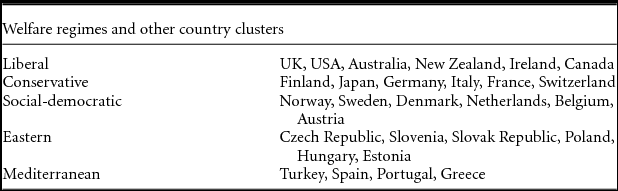
Overall, we analyse the welfare and ecology indicators of thirty countries (Table 1), which we allocated to welfare regimes by building on Esping-Andersen's framework (Esping-Andersen, Reference Esping-Andersen1990).Footnote 3 Space does not allow for a detailed consideration of the debate connected to Esping-Andersen's original work. Overall, however, this debate seems to confirm rather than falsify his approach, insofar as more recent typologies did not suggest totally different clusters. Later approaches propose four or five ‘worlds of welfare’ rather than three, yet with significant overlap in the allocation of countries (Arts and Gelissen, Reference Arts and Gelissen2002; Ferragina and Seelaib-Kaiser, Reference Ferragina and Seelaib-Kaiser2011). In their influential overview of welfare regime typologies, Arts and Gelissen also point out that the remarkable degree of theoretical consistency, which characterises Esping-Andersen's approach, would decrease through the adaptation of alternative theoretical arguments. However, we present the data for both welfare regimes and countries separately so that alternative welfare clusters can be constructed. For example, one could follow Ferrara (Reference Ferrara1996) and locate Italy within the Mediterannean countries or Japan and South Korea together within the conservative countries. Yet the vast majority of these countries belong to Esping-Anderson's original welfare regimes: the social-democratic welfare regime (Norway, Sweden, Denmark, the Netherlands, Belgium, Austria) characterised by the highest degree of decommodification and the lowest degree of stratification; the conservative welfare regime (Finland, Japan, Germany, Italy, France, Switzerland) with medium decommodification and stratification; and the liberal regime (UK, USA, Australia, New Zealand, Ireland, Canada) featuring the lowest degree of decommodification and the highest values for stratification. Beyond these classical types, we suggest two complementary welfare clusters and two additional countries to broaden the empirical reach of the comparative analysis: A ‘Mediterranean’ cluster (Turkey, Spain, Portugal and Greece), a cluster of ‘Eastern European’ countries (Czech Republic, Slovenia, Slovak Republic, Poland, Hungary and Estonia) and South Korea as representative of the East Asian industrialised countriesFootnote 4 as well as the extremely wealthy Luxembourg.
Welfare regimes and countries analysed
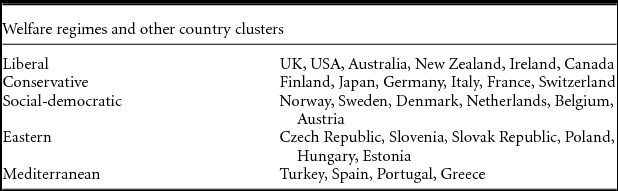
Note: Not classified: Luxembourg, Korea.
We operationalise the welfare and ecology dimensions as follows: in relation to the welfare dimension, we build on Esping-Andersen (Reference Esping-Andersen1990; Arts and Gelissen, Reference Arts and Gelissen2002: 141–2) and consider stratification/inequality using the Gini index for income inequality, and the degree of decommodification measured by the overall expenditures for social protection as percentage of GDP. With respect to the green dimension of the state, we consider ecological performance in terms of electricity generated from renewable sources as a percent of gross electricity production, CO2 emissions per capita and national ecological footprints per capita. We further include green regulation in terms of environmental taxes as a percent of GDP. According to Jacobs (Reference Jacobs2012: 11), green taxes are used as correction for market failures. These taxes can be reasonably assumed to be higher in social-democratic and conservative countries than in liberal ones, due to more advanced traditions of market regulation and redistribution. Furthermore, the extent of such taxation can be expected to be positively correlated to environmental performance, since – all other things being equal – it increases the costs for ecologically harmful practices by companies and households. Finally, we include gross domestic product (GDP) per capita and purchasing power parity (PPP) as an indicator for economic development and the standard of living of a country.Footnote 5
We apply correspondence analysis in order to explore empirically the relations between the welfare and green dimensions at country level. While cluster analyses are often used to situate countries with similar characteristics into more or less homogenous groups, our focus is on the usually hidden relationships between welfare and ecology indicators among all countries under observation. Correspondence analysis allows for visually depicting these latent structures and correlations within maps (Bourdieu, Reference Bourdieu1984; Blasius and Greenacre, Reference Blasius, Greenacre, Greenacre and Blasius2006; Greenacre, Reference Greenacre2007). To give every indicator and every country the same weight, the macro data are standardised by the use of the two-step procedure of ranking and doubling.Footnote 6 In total, we compiled and analysed data for seven indicators (two for the welfare dimension and four for the green dimension of the state as well as GDP) for thirty countries and two points in time (1995 and 2010). Data were collected from EUROSTAT, the World Bank, the OECD and the Global Footprint Network (AppendixTable A1). We interpret the resulting maps as follows (see Blasius and Graeff, Reference Blasius, Graeff, Graeff and Mehlkop2009):
• The greater the distance of a variable or country from the centroid, which depicts the overall average of all thirty countries, the stronger its contribution to the respective axis within the two-dimensional map. If, for example, the indicator ecological footprint is on the first dimension furthest away from the centroid, this dimension is mostly determined by ‘footprint-differences’ between the countries.
• The correlation between two indicators is expressed by the angle of their trajectories in the map, whereby a 90° angle reflects complete independence, that is, the absence of a correlation between variables.
• Both distances between variables and distances between countries are interpreted as associations: the closer two variables or two countries are located on the map, the more similar they are. If, for example, footprint is close − that is, similar, to environmental taxes − but far − that is, dissimilar, from GINI − this indicates a pattern of the ecological footprint being higher in countries where environmental taxes are also relatively high but where the GINI is lower.
• The doubling and ranking procedure results in two endpoints for each variable/indicator, a positive and a negative one (indicated as _hi and _lo), which are both depicted in the maps and which are perfectly mirrored by the centroid. If, for example, GINI_hi (the positive endpoint of inequality indicating the highest degree of inequality) appears at x = 1 and y = 1 in the map, GINI_lo (the negative endpoint of inequality indicating the lowest inequality) is located at x = −1 and y = −1.
Analysis
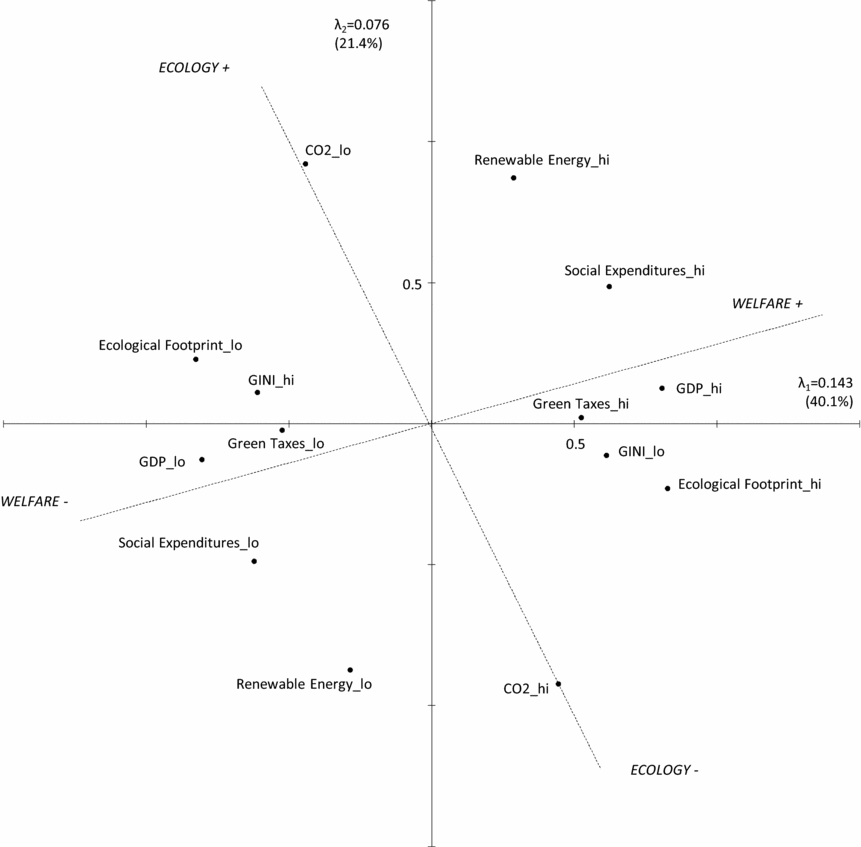
Figure 1 diplays the results for 1995.Footnote 7 For better visualisation, latent dimensions for welfare and ecological performance (ECOLOGY) were inserted as dotted lines with minimised distances to the respective indicators. In this way, clusters of indicators and single indicators can be examined with regard to their relationship towards each other and in respect to both the welfare and ecology dimension.
Ecology and welfare in 1995

First of all, the latent dimensions for welfare and ecological performance are nearly orthogonal. This indicates statistical independence or, in other words, that the two are not linked to each other in the way the synergy hypothesis would suggest. A closer look at the several indicators confirms this result: a cluster of variables appears in the right part of the map, around the positive side of the welfare dimension. Here, relatively high expenditures for social protection are associated with lower levels of income inequality – indicating the effective functioning of welfare states in the reduction of social risks – relatively high environmental taxes but also comparatively huge ecological footprints. Countries which share these characteristics also tend to have a higher GDP per capita. Conversely, the left part of the map indicates an association between smaller GDP per capita, relatively low social expenditures, low environmental taxes, small ecological footprints and huge income inequality. The correspondence between higher environmental taxes and social expenditures is in accordance with the synergy hypothesis or the idea that the green state is being built on top of already existing welfare institutions that also enable the state to regulate ecological challenges. However, additional revenue from green taxes did not translate into improved ecological performance. There is no correlation between green taxes and the ecology dimension. The fact that the ecological footprint as an indicator for ‘human appropriation of ecosystem products and services’ (Borucke et al., Reference Borucke, Moore, Cranston, Gracey, Iha, Larson, Lazarus, Morales, Wackernagel and Galli2013) tends to increase where also the welfare dimension is relatively advanced, contradicts the synergy hypothesis and rather confirms the alternative view developed by Jackson (Reference Jackson2009: 48–50) and others − that welfare regulation largely reflects economic development in terms of GDP and that the latter has not been sufficiently decoupled from environmental pressures.
Renewable energy as percentage of gross electricity production and, particularly, CO2 emissions per capita are disconnected from the welfare indicators. As one might expect, both indicators are linked to each other so that relatively high levels of renewable energy are accompanied by low levels of CO2 emissions per head. Yet it is remarkable that this has no effect on the ecological footprint, since there is no overall pattern among the thirty countries that would indicate a connection between a greater percentage of renewable energy in electricity production and relatively low environmental burdens.Footnote 8 Overall, the analysis of the 1995 data indicates that economic development, advanced welfare and poor ecological performance are inextricably linked.
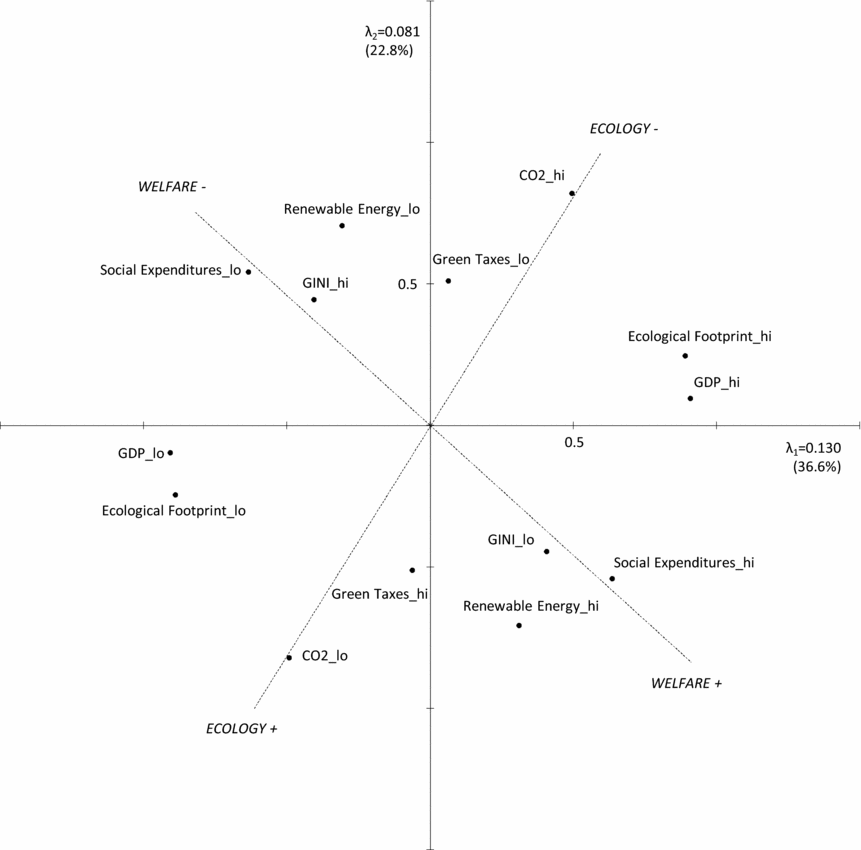
In 2010, the situation changed somewhat (Figure 2).Footnote 9 The welfare indicators are now not only detached from GDP per capita and the ecological footprint, they are also more associated with the ecology indicator, renewable energy. In accordance with the synergy hypothesis, a comparatively high percentage of renewable energy in electricity production is connected with advanced welfare provision and relatively high green taxes. The fact that GDP and welfare are less associated indicates that the fruits of economic growth were less equally (re)distributed in 2010 than in 1995. Yet, contrary to the synergy hypothesis, the very strong relationship between GDP per capita and the ecological footprint continued over the fifteen-year period. This indicates a persistent effect of the production and consumption parameters and the material standard of living on ecological conditions, while social expenditures and the GINI – key indicators of welfare – hardly influence the extent of the ecological footprint.
Ecology and welfare in 2010
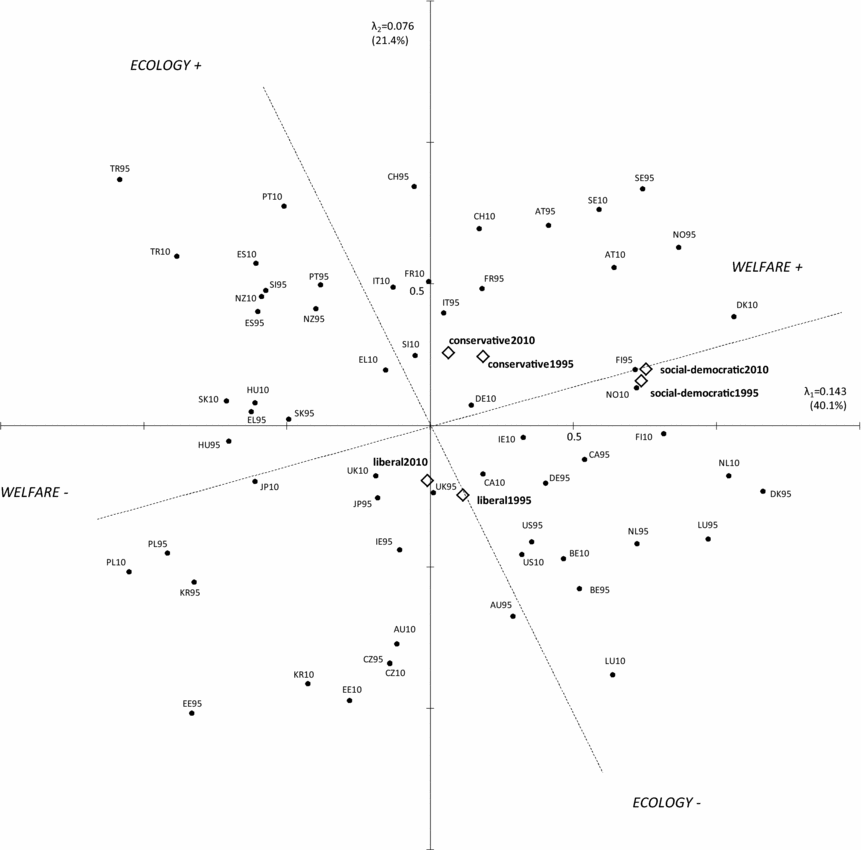
The next stage of our macro-analysis is a calculation and interpretation of the positional changes of the thirty countries between 1995 and 2010 (Figure 3).Footnote 10 We also included the positions of Esping-Andersen's three welfare regimes as mean values of the respective countries (see Table 1). With regard to the welfare dimension, the differences between social-democratic countries, conservative and liberal countries follow Esping-Andersen's theory very closely. Yet, while social-democratic countries display higher income equality and social expenditure than conservative and liberal ones, their ecological performance does not differ sigificantly from other countries, and not from the liberal regime in particular. In fact, countries with a conservative welfare tradition are the most sustainable.
Positional changes of 30 countries in the eco-social field
At country level, the synergy hypothesis, according to which advanced welfare states and particularly the social-democratic regime also perform well ecologically, holds for two countries only.Footnote 11 Sweden and Austria display above-average values on the welfare as well as on the ecology dimension. The same is true for the ‘conservative’ Switzerland and, less so, for Italy and France.Footnote 12 Other countries with a comparatively good ecological performance include the liberal New Zealand, Slovenia and the Mediterranean Spain, Portugal and Turkey, and, to a lesser extent, Hungary, the Slovak Republic and Greece. The Mediterranean countries, particularly, combine relatively low CO2 emissions, considerable percentages of renewable energy and lower ecological footprints. The fact that these countries display relatively modest levels of GDP per capita underlines Jackson and others’ doubts about the possiblity of effectively decoupling GDP growth from environmental stress. Turkey is another interesting case in this regard. Due to its delayed socio-economic modernisation, it was the most sustainable country of the thirty in 1995. By 2010, the country's GDP per capita had tripled. This ‘progress’ was made at the expense of environmental performance. Not only did CO2 emissions and the ecological footprint rise considerably, but the percentage of renewable energy in electricity production even declined. Countries with a comparatively bad ecological performance include – in accordance with the synergy hypothesis – liberal Australia and the USA, which both display extremely high CO2 emissions per capita, but also – in contradiction to this hypothesis – the Netherlands and Belgium as representatives of the social-democratic welfare regime. In the latter two countries, a comparatively advanced degree of economic development and an accordingly high standard of living as indicated by GDP per capita coincides with high values for CO2 emissions and ecological footprints. CO2 emissions and ecological footprints are exceptionally high in the country with the most luxurious living standard among the thirty countries compared: Luxembourg. However, there are also some less rich countries that demonstrate a below-average ecological performance. This applies to Eastern European countries such as Poland, the Czech Republic and Estonia as well as South Korea.
Overall, there is very little support for the synergy hypothesis in regard to the countries’ ecological performance. This applies above all in a somewhat ‘negative’ way, since most liberal countries indeed perform less well at establishing sustainability than conservative and social-democratic countries. Conversely, there are social-democratic and conservative countries that perform relatively well in terms of ecology, while others do not.
A preliminary typology of ecostates
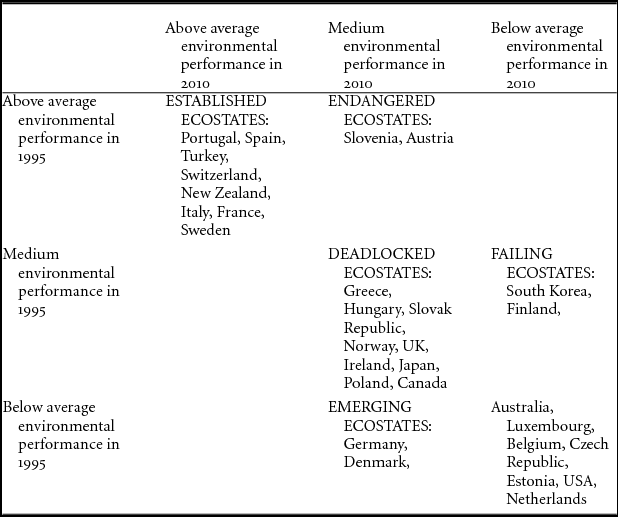
Table 2 groups countries according to their ecological performance in 1995 and in 2010. Distinguishing between above and below average as well as medium ecological performances,Footnote 13 we empirically arrive at the following typology of (emerging) ecostates:
State environmental performance compared
The countries that display a relatively good ecological performance with a tendency to keep or even improve their level of sustainablity come closest to established ecostates: New Zealand, Sweden, Switzerland, Italy, France, but also Portugal and Spain. Despite lower scores for 2010, Turkey is still among the countries with the higher ecological performance. The fact that this group of established ecostates includes countries from all welfare regimes, and also countries with very different levels of economic development and material standards of living, indicates that the relations between welfare, economy and ecology are more complex than the synergy hypothesis suggests.
A second group of countries, which we might call deadlocked ecostates, is characterised by a continuity of middle positions in terms of their ecological performance. Like the first group, this group involves countries from all three welfare regimes as well as from Eastern and Mediterranean Europe. Cases such as Norway seem to be especially promising for future in-depth research since, from the perspective of ecological modernisation and the synergy hypothesis, one would have expected more efforts to reduce ecological damage and implement effective ‘green’ policies in this social-democratic country.
Failing ecostates are those with regressive or continuously bad ecological performances: South Korea, the Netherlands, Luxembourg, Belgium, Estonia, Finland and the Czech Republic as well as Australia and the USA. The fact that we find representatives of the social-democratic welfare regime in this group provides further reason to question and/or reformulate the synergy hypothesis according to which advanced welfare institutions would facilitate the buildup of efficient green institutions and the introduction of measures.
Finally, Germany and Denmark may be labelled emerging ecostates, since they are the countries that improved their ecological sustainability the most. Both countries reduced their Ecological Footprints and their CO2 emissions per capita, not least through state investment in renewable energies. In contrast, Slovenia and Austria mark the opposite pole of endangered ecostates. While these countries performed rather well in 2010, they had done so better in 1995. A slow increase in the material standard of living in combination with insufficient efforts for ecological regeneration and preservation has led, somewhat unnoticed, to small but significant rises in CO2 emissions and footprints.
The environment, economic prosperity and the (welfare) state: what do people think?
The debate on possible links between the welfare and environmental dimensions of the state is not reduced to institutional features and policies but also includes assumptions on attitudes, discourses and the environmental awareness of the public. Dryzek (Reference Dryzek, Gough, Meadowcroft, Dryzek, Gerhards, Lengfield, Markandya and Ortiz2008), for example, suggests, first, that the discourse on ecological modernisation in traditionally social-democratic welfare states leads to a generalisation of the perception of environmental protection and economic growth as mutually reinforcing rather than being two opposite policy goals. The latter characterises countries with a liberal market and welfare tradition. Second, building on Dryzek, one would assume people living in social-democratic and, less so, in conservative welfare environments to be more prone to accept state intervention in terms of environmental concerns than people who live in liberal countries. We add to this that, third, people in social-democratic and conservative welfare states will also be more likely to accept cuts in their standard of living if this is seen as beneficial for the protection of the environment.
We test these hypotheses through an analysis of data from the International Social Survey Programme 2010 (ISSP Research Group, 2012)Footnote 14 and operationalise them through the following questions:
• How much do you agree or disagree with the following statement? Economic growth always harms the environment.
• If you had to choose, which one of the following would be closest to your views? Governments should let ordinary people decide for themselves how to protect the environment, even if it means they don't always do the right thing OR Governments should pass laws to make ordinary people protect the environment, even if it interferes with people's rights to make their own decisions.
• How willing would you be to accept cuts in your standard of living in order to protect the environment?
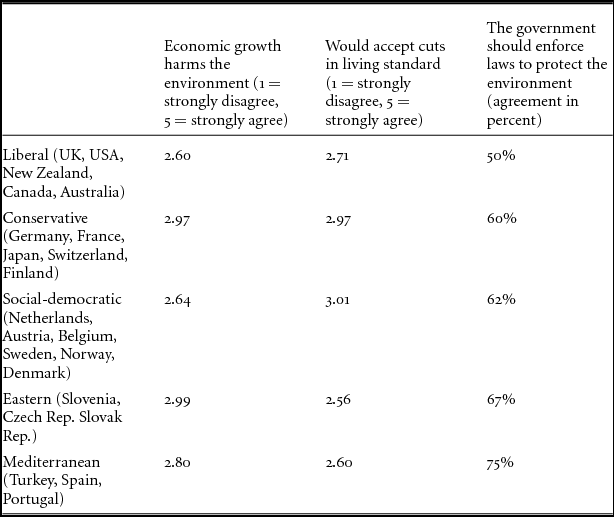
Regarding the first question – how citizens perceive the relation between economic growth and environmental protection – the pattern follows Dryzek's reasoning insofar as antagonist views of the relationship between economic growth and ecology are least widespread in most social-democratic countries (Figure 4 and Table 3). Exceptions are Belgium and Austria where public opinions are more similar to those of the conservative welfare type, which features the highest agreement scores to the statement that economic growth always harms the environment. The fact that almost as few citizens from the liberal countries express agreement to this statement as in the social-democratic countries is more difficult to reconcile with Dryzek's approach.
Means of regimes and country clusters; attitudes towards growth, the environment and the role of the state
Public perception of the relationship between economic growth and environmental protection
Source: ISSP Research Group (2012), Ns between 1.000 and 1.500 per country, weighted data, mean values from a 1–5 scale where 1 means ‘strongly disagree with statement’ and 5 means ‘strongly agree with statement’
In terms of the willingness to accept governmental measures to protect the environment rather than leaving environmental protection to individuals we arrive at the following picture (Figure 5 and Table 3): in accordance with the ecological modernisation thesis, about 75 per cent of Danish respondents prefered state initiatives over individual efforts. Also in other social-democratic countries such as Norway, Sweden and Austria support for governmental initiatives is high. Similarly, people in most conservative countries prefer state regulations over individual initiatives, particularly in Switzerland and Germany. Hence, overall, citizens from social-democratic and conservative countries are more likely to approve legal restrictions to protect the environment than citizens from liberal countries. Exceptions include Canada, where citizens are more in favour of enforcing laws than relying on the voluntary efforts of individuals. Conversely, people in the Netherlands, Finland and Belgium are more individualistic or sceptical of their governments than one would surmise on the basis of their welfare regime affiliation. The consideration of Eastern European and Mediterranean countries indicates that citizens’ preferences for governmental initiatives to protect the environment are not a specific feature of generous welfare states. On the contrary, citizens of these countries would prefer their governments to introduce corresponding legislation even more than those of social-democratic countries.
Willingness to accept governmental measures for environmental reasons
Source: ISSP Research Group (2012), Ns between 1.000 and 1.500 per country, weighted data.
Figure 6 and Table 3 largely verify the ecological modernisation hypothesis, according to which people in social-democratic welfare states are most likely to accept cuts in their standard of living if the environment benefits from this. Also citizens of most conservative countries, especially Switzerland, are willing to reduce their standard of living for environmental protection. It is thus in line with the synergy hypothesis that citizens of liberal countries are significantly less prone to accept cutbacks in their living standard for the sake of the environment. The same applies to the economically less developed countries of Eastern Europe and the Mediterranean region. However, a comparison of the country-level answers to this item beyond the economically developed countries is problematic, since few people would morally expect Turkish or Czech citizens to reduce their living standard even further, while this case can more reasonably be made for Swedish or UK citizens.
Willingness to accept cutbacks in standard of living
Source: ISSP Research Group (2012), Ns between 1.000 and 1.500 per country, weighted data, mean values from a 1–5 scale where 1 means ‘strongly disagree with statement’ and 5 means ‘strongly agree with statement’.
Discussion and conclusion
This paper departed from the theoretical discussion of the links between the welfare and the green dimensions of the state initiated by authors such as Dryzek, Gough and Meadowcroft (see Gough et al., Reference Gough, Meadowcroft, Dryzek, Gerhards, Lengfield, Markandya and Ortiz2008), who – without excluding the possibility of conflictive and contradictory relations between the two – expressed some hope in the ability of social-democratic welfare regimes to develop the green dimension of the state more successfully than conservative and, especially, liberal welfare regimes, and, consequently, to perform better in terms of ecological key indicators. We called this the synergy hypothesis, which we confronted with recent studies that question the compatibility of GDP growth, welfare and sustainability (Victor, Reference Victor2008; Jackson, Reference Jackson2009; Koch, Reference Koch2013) and which we set out to empirically scrutinise in terms of institutional and subjective indicators for thirty countries and over the time period 1995−2010.
Our results suggest that there is no ‘automatic’ development of the green state on top of existing advanced welfare institutions. Overall, welfare development is largely unrelated to ecological development, and social-democratic countries do not perform better in terms of ecology than liberal ones. In fact, it is the conservative countries that are most ecologically sustainable. The lack in correspondence between welfare regime affiliation and environmental performance is also expressed by the fact that countries of all welfare traditions are spread across our empirically constructed and preliminary typology of ‘ecostates’: established, deadlocked, failing, emerging and endangered ecostates. However, empirically measured ecological performances do not exclude the fact that the existence of the institutional basis of social-democratic welfare states is indeed beneficial to the development of the green state. All other things being equal, countries with comparatively lower levels of social inequality also feature lower levels of status competition (Wilkinson and Pickett, Reference Wilkinson and Pickett2010). While this potential could doubtless be used to contain the extreme forms of consumption that crucially contribute to CO2 emissions, and cause other environmental stress, this potential would need to be politically actualised much more than is currently the case.
In terms of the issue of whether the discourse on ecological modernisation, which, according to Dryzek (Reference Dryzek, Gough, Meadowcroft, Dryzek, Gerhards, Lengfield, Markandya and Ortiz2008), is more advanced in social-democratic than in other countries, indeed leads to a generalisation of the perception to regard environmental protection and economic growth as mutually reinforcing and whether this is accompanied by citizens of social-democratic welfare states being more prone to adjust their lifestyles to reflect environmental needs, the results are mixed. While responses to the statement ‘governments should pass laws to make ordinary people protect the environment’ did not vary according to welfare regimes, responses to the statement, ‘how willing would you be to accept cuts in your standard of living in order to protect the environment’, did: citizens of social-democratic and conservative countries indeed expressed more willingness to carry out such lifestyle change than citizens from liberal countries. However, people in social-democratic countries are closer to the liberal world in their lack of agreement for the statement ‘economic growth always harms the environment’. Citizens of conservative welfare traditions affirm this statement much more often – and our analyses of economic, welfare and environmental data confirm their point of view.
The main conclusion is that the links between the welfare and green dimensions of the state are far more complex than suggested in the synergy hypothesis. Factors other than welfare may be significant for the explanation of the cross-country differences in ecological regulation and performance. Liefferink et al., (Reference Liefferink, Arts, Kamstra and Ooijevaar2009) identified institutional and other factors that influenced environmental legislation and regulation between 1970 and 2000. However, the existence of an encompassing environmental policy network in a given country does not necessarily influence its environmental performance in a positive way. The examples of the Netherlands, Finland or Belgium (Table 2) seem to indicate that a country may well have strict and advanced environmental policies and nevertheless perform below average on the ecology dimension. In relation to environmental performance, it appears promising to consider factors such as the political representation of green parties, facilitating the lobbying for environmental issues within the state and the exertion of pressure from ‘below’ (Christoff and Eckersley, Reference Christoff, Eckersley, Dryzek, Norgaard and Schlosberg2011), as well as the degree of political decentralisation with correspondingly different roles and responsibilities for local authorities to develop green politics. Another issue that emerged from the present study and is worth exploring further is why, overall, countries with a conservative welfare tradition perform better on the environmental dimension than on social-democratic ones.
While these factors and issues should be considered in future research, the present analysis dealt with the role of welfare regimes in building the eco-social state. Overall, it has given support to previous studies that emphasise the conflict between the welfare and the ecological dimensions of the state due to the lack of evidence for absolute decoupling of GDP growth and resource intensity (Daley and Farley, Reference Daly and Farley2009; Jackson, Reference Jackson2009; Koch, Reference Koch2012). The development of the welfare dimension of the advanced capitalist countries has, as yet, largely reflected their development in economic terms and failed to be accompanied by satisfactory performance in terms of sustainability. Far from it, the dialectic of the welfare state appears to lie in the fact that the same mechanism that defuses the socio-economic inequalities inherent in capitalist development ensures the inclusion of an increasing amount of people in environmentally problematic production and consumption practices. Policy proposals to provide prosperity and welfare in both social and ecological terms should therefore focus on strategies to decouple the two from economic growth or, if this continues to prove impossible, to de-prioritise economic growth in policy making.
Acknowledgement
The cooperation between the two authors of this paper is the result of a guest scholarship that GESIS-Leibniz Institute for the Social Sciences, Cologne, Germany, awarded to Max Koch in April 2013 (Attitudes towards Climate Change and Environmental Policies – a Comparative View).
APPENDIX
Macro data tables 1995 and 2010: indicators used in the correspondence analyses