Introduction
The phylogenetic relationships within the lichen family Teloschistaceae were recently analyzed using three DNA loci in a combined analysis (Arup et al. Reference Arup, Søchting and Frödén2013). A total of 39 genera were recognized in that study, of which 31 were newly described or resurrected. One of the new genera was Parvoplaca Arup et al., a small genus in the subfamily Xanthorioideae, currently including P. athallina (Darb.) Arup et al., P. servitiana (Szatala) Arup et al., P. suspiciosa (Nyl.) Arup et al. and P. tiroliensis (Zahlbr.) Arup et al. In addition, Arup et al. (Reference Arup, Søchting and Frödén2013) included three undescribed species, referred to as Parvoplaca sp. 25–27. One of these, Parvoplaca sp. 26, is described here as new to science. Caloplaca chelyae Pérez-Vargas, a recently described species from the Canary Islands (Pérez-Vargas & Pérez de Paz Reference Pérez-Vargas and Pérez de Paz2009), is shown to belong to the genus and accordingly transferred to Parvoplaca.
Material and Methods
This study is based on material from BG, ERH, LD and PRA. The sequences of Parvoplaca sp. 1 and sp. 2 in this study correspond to Parvoplaca sp. 25 and sp. 27 in Arup et al. (Reference Arup, Søchting and Frödén2013). Unfortunately, the material of these is still too scanty for a formal description and is not elaborated further in this study. The specimens were examined by interference contrast and light microscopy. Anatomical features were measured on hand-cut sections or squash preparations mounted in water. Morphological characters were measured on dry material using a dissecting microscope (×40). Spore dimensions are average values from ten measurements per specimen. Data on spore dimensions are presented in the following way: (min. extreme) 85% of the variation (max. extreme). The measurements of anatomical and morphological characters mainly follow the guidelines of Vondrak et al. (Reference Vondrák, Frolov, Arup and Khodosovtsev2013). The term blastidia is used here sensu Smith et al. (Reference Smith, Aptroot, Coppins, Fletcher, Gilbert, James and Wolseley2009), where blastidia are produced through budding from the thallus and are partly corticate whereas soredia lack any kind of cortical tissue.
PCR-amplification and sequencing
PCR amplification of the ITS regions including the 5.8S gene of the nuclear rDNA was made without an extraction step. Direct PCR as described by Arup (Reference Arup2006) was used where no DNA extraction is needed prior to the PCR as pieces of either thalli, apothecia or soredia/blastidia are put directly into the PCR tube. The quantity of tissue used can be adjusted according to its age. Usually the procedure works well with 1–2 hand-cut slices of apothecia (0·1–0·2 mm thick), less then 1 mm2 of thallus tissue or 10–20 soredia/blastidia when the material (within Teloschistaceae) is up to five years old. More material can be used in older collections if needed, but normally not beyond the age of 20–25 years. Primers for amplification were ITS1F (Gardes & Bruns Reference Gardes and Bruns1993) and ITS4 (White et al. Reference White, Bruns, Lee and Taylor1990). The PCR settings used followed the manufacturer’s recommendations (Five Prime). In each PCR tube we added: 21 µl of water, 2·5 µl of buffer, 0·5 µl of dNTP, 0·4 µm of each primer and 0·125 µl of polymerase. PCR products were electrophoresed in a 1% agarose gel and visualized using GelRedTM (Biotium). Products were cleaned using a Cycle Pure Kit (Qiagen or Five Prime). The primers used for the PCR were also used in the sequencing reaction; sequencing was carried out by Macrogen Inc., Korea.
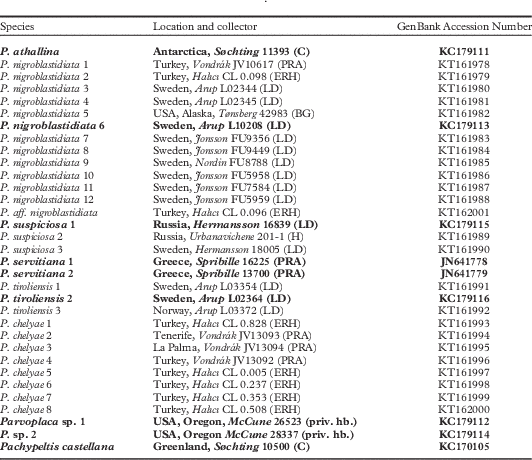
An alignment was produced with 33 sequences (Table 1) of Parvoplaca and Pachypeltis castellana (Räsänen) Arup et al. as outgroup, since this genus has been shown to be closely related to Parvoplaca (Arup et al. Reference Arup, Søchting and Frödén2013). A suitable model of molecular evolution was selected using the Bayesian Information Criterion (BIC) as implemented in jModeltest ver. 2.1.4 (Guindon & Gascuel Reference Guindon and Gascuel2003; Darriba et al. Reference Darriba, Taboada, Doallo and Posada2012), evaluating only the 24 models available in MrBayes 3.2.0 (Ronquist et al. Reference Ronquist, Teslenko, van der Mark, Ayres, Darling, Höhna, Larget, Liu, Suchard and Huelsenbeck2012). The SYM+G model was found to be optimal. Bayesian tree inference was carried out using Markov chain Monte Carlo (MCMC) as implemented in MrBayes 3.2.4. The number of discrete categories used to approximate the gamma distribution was set to 4. The following priors were used: beta (1, 1) on the transition-transversion rate, fixed on the state frequencies, uniform (0·001, 200) for the gamma shape parameter, and all trees a priori equally likely. The prior on branch lengths for the analyses was set to an exponential with mean 1/10. Three parallel runs were performed, each with 6 chains, 5 of which were incrementally heated with a temperature of 0·10. Analyses were diagnosed every 100 000 generations and automatically halted when convergence was reached. Convergence was defined as a standard deviation of splits (with frequency b ≥0·1) between runs below 0·01. Every 1000th tree was sampled and the first 50% of runs were removed as burn-in. FigTree 1.4 (http://tree.bio.ed.ac.uk/software/figtree/) and Adobe Illustrator CS4 were used to construct and illustrate a phylogenetic consensus tree.
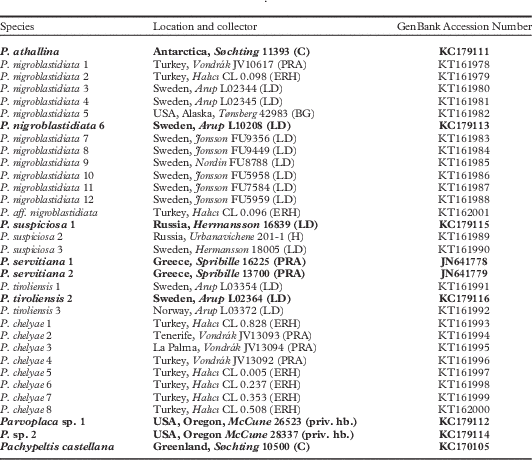
Location, collector and GenBank accession numbers for species of Parvoplaca and the outgroup Pachypeltis castellana used in this study. Specimens collected before this study are in bold
Secondary chemistry
The secondary metabolite pattern was identified using HPLC and analyzed separately for thallus and apothecia. The relative composition of the secondary metabolites was calculated based on absorbance at 270 nm, according to Søchting (Reference Søchting1997). Pigment nomenclature for non-anthraquinones follows Meyer & Printzen (Reference Meyer and Printzen2000).
Results and Discussion
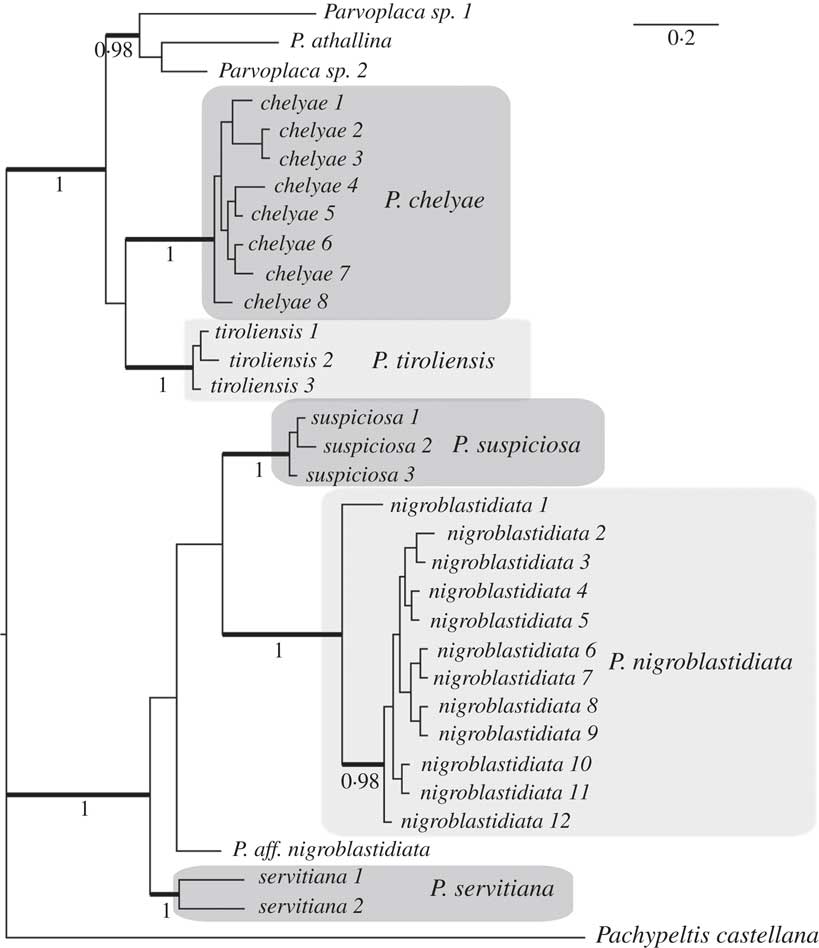
A 50% majority-rule consensus tree from the post burn-in tree samples is presented in Figure 1. The ingroup split into two major clades, one including P. athallina, P. chelyae and P. tiroliensis together with two undescribed species, and the other including P. suspiciosa, P. servitiana, P. nigroblastidiata and a specimen similar to P. nigroblastidiata, but separate from the core group of that species. The new species forms a fully supported clade with some minor genetic variation within it. It appears to be sister to P. suspiciosa, but this relationship is not supported in the analysis. Parvoplaca aff. nigroblastidiata is placed outside this sister relationship and has greater genetic similarity with P. servitiana.
Majority-rule consensus tree for all compatible groups of Parvoplaca used in this study. Average branch lengths are based on a Bayesian posterior tree sample comprising 2238 trees. Bayesian posterior probabilities are displayed at nodes. Pachypeltis castellana was used as the outgoup.
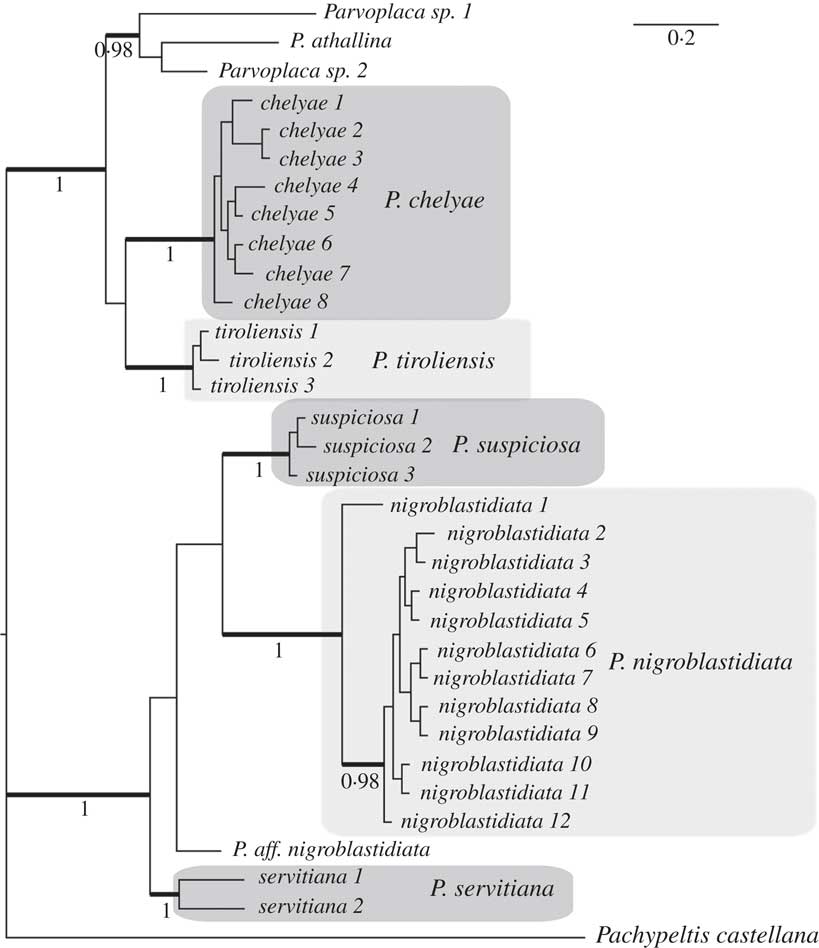
In the other clade, P. athallina and the two undescribed species form a supported clade (PP=0·98) with P. tiroliensis and P. chelyae as sister species (PP=1·0). The clades representing these species are fully supported. Parvoplaca chelyae is morphologically very similar to P. tiroliensis, but seems to be well separated genetically. The two species are also ecologically distinct and it seems reasonable to recognize P. chelyae as a separate species in Parvoplaca. However, P. tiroliensis is a more complex species than shown here (U. Arup & J. Vondrák, unpublished data) and requires further study.
Parvoplaca nigroblastidiata Arup, Halıcı & Vondrák sp. nov.
MycoBank No.: MB 812855
Similar to Caloplaca turkuensis, but with zeorine-lecanorine apothecia, a darker thalline margin, endophloedal thallus and black blastidia in small spots, usually darker and less extensive than in C. turkuensis.
Type: Sweden, Jämtland, Nyhem par., SE-facing slope of Bodberget, on Populus tremula, alt. 415 m, 30 June 2012, F. Jonsson FU9356 (LD—holotype; UPS—isotype).
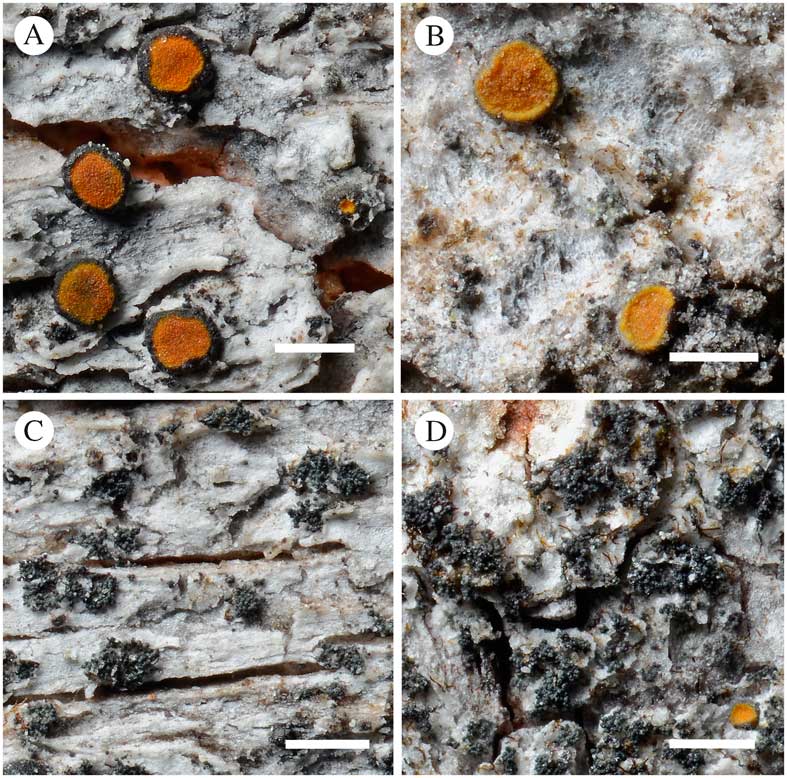
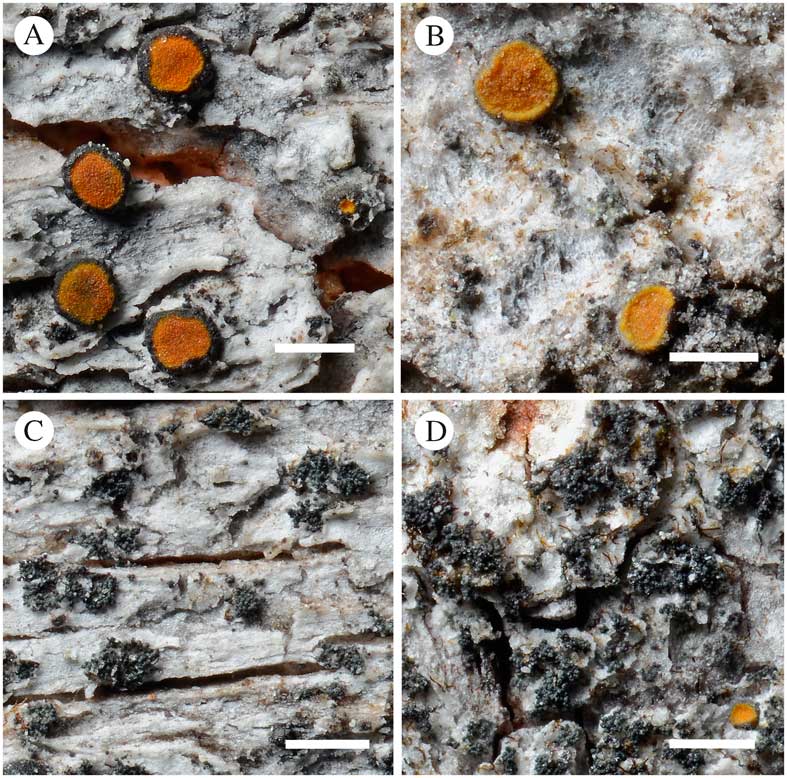
Parvoplaca nigroblastidiata. A, typical apothecia with some blastidia on the thalline margin (Jonsson FU5959); B, morphotype common in Turkey where a proper margin is present (Nordin FU8788); C, typical soralia with dark blastidia (Jonsson FU5959); D, (holotype) well-developed soralia with one young apothecium. Scales=0·5 mm.
Thallus endophloeodal, sometimes staining the substratum dark grey, often covering several cm2; prothallus not observed. Blastidia present, sometimes very sparse, (grey-)dark grey to black, sometimes with bluish or greenish tinge, as scattered, 0·1–0·5 mm large, thin, flat irregular spots, sometimes coalescing to 1 mm width, (15–)20–30(–35) µm (n=70), orbicular, covered by a paraplectenchymatous cortex, sometimes forming conblastidia.
Apothecia often present and sometimes abundant, but always scattered, immersed at first but soon adnate to sessile, round to irregular, (zeorine-)lecanorine, 0·3–0·5(–0·8) mm diam.; disc slightly concave to slightly convex, yellow-orange or rarely darker; proper margin usually absent, but occasionally present and very thin, yellow; thalline margin slightly raised above or level with disc, dark grey-black, sometimes paler or with brownish tinge, K+ violet, N+ red, 25–60(–75) µm, smooth or partly granular from blastidia, with fairly well-delimited paraplectenchymatous cortex, 12–35 µm thick; epihymenium yellowish orange, granular inspersed; hymenium (50–)65–80(–110) µm thick, hyaline; hypothecium 50–100 µm thick, hyaline or pale brown; paraphyses simple and lax, sometimes weakly branched above, 2·0–2·5 µm broad with upper cells hardly wider, up to 3·5(–4·5) µm; asci cylindrical, 40–45×12–13 µm, 8-spored; spores polaribilocular, ellipsoid to broadly ellipsoid, (10·0–)10·5–15·0(–17·5)×(4–)5–8(–9) µm, septum (2·5–)3·0–5·0(–5·5) µm (n=75), ratio of spore length/width (1·47–)1·67–2·70(–3·50), ratio of septum/spore length (0·22–)0·25–0·38(–0·42).
Pycnidia not observed.
Chemistry. The apothecial disc and true exciple contain parietin as a major compound, and small amounts of fallacinal, emodin, teloschistin and parietinic acid, which corresponds to chemosyndrome A of Søchting (Reference Søchting1997). The thallus and thalline exciple do not contain anthraquinones but instead contain the pigment Sedifolia-grey which reacts K+ violet and N+ brownish red.
Habitat and distribution. In Sweden this species usually grows on trunks of Populus tremula. In Turkey it has been collected at high altitudes on Juniperus excelsa and Abies cilicica. It seems to grow in both shady and open conditions. The known distribution comprises Sweden, Turkey and Alaska. In the Mediterranean it is probably confined to higher altitudes. There is also one record from Alaska, where it was found on Populus.
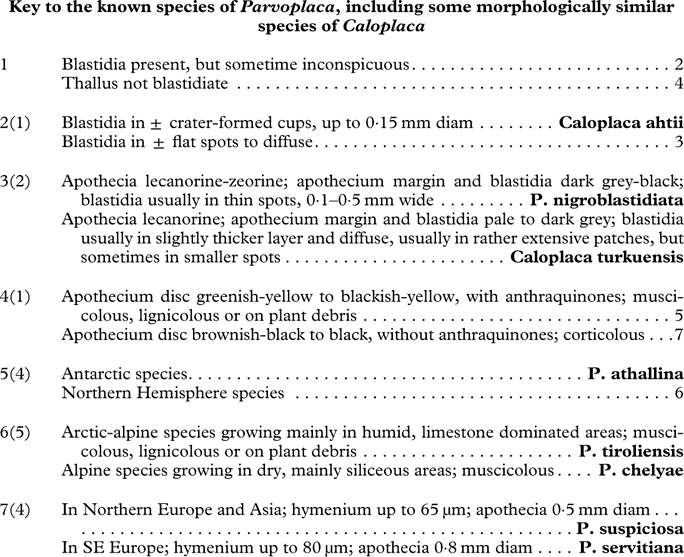
Remarks. This species is characterized by an endophloeodal thallus with scattered blackish blastidia and small, scattered yellow to orange apothecia with a grey to black outer margin. Morphologically it is very similar to Caloplaca turkuensis (Vain.) Zahlbr., with which it has been previously confused. Šoun et al. (Reference Šoun, Vondrák, Søchting, Hrouzek, Khodosovtsev and Arup2011) had already pointed out the presence of the new species and its similarity with C. turkuensis. It differs from C. turkuensis in the generally darker blastidia and thalline margin, thinner and more discrete blastidia and, in some specimens, the presence of zeorine apothecia. Parvoplaca nigroblastidiata can also be confused with Caloplaca ahtii Søchting, which differs in that the blastidia appear in crater-formed, dark bluish grey formations and in the more colourful apothecia with a less pronounced grey margin. Another possible risk for confusion is Caloplaca borealis (Vain.) Poelt, but this species lacks asexual propagules and has biatorine apothecia, usually with a faint grey (rarely almost black) outer portion of the proper margin.
Phylogenetically, the new species is well established in Parvoplaca on the basis of a three-gene analysis (see Arup et al. Reference Arup, Søchting and Frödén2013, as Parvoplaca sp. 26). Within Parvoplaca it is most closely related to P. suspiciosa, but differs from this in several aspects. Parvoplaca nigroblastidiata has endophloeodal thalli normally several cm wide, scattered apothecia, anthraquinones in the epihymenium and proper exciple, a hypothecium 65 µm or thicker and often brownish, and usually a thalline margin with a well-delimited cortex while P. suspiciosa has small and thin epiphloedal thalli normally 5–10 mm wide with small groups of apothecia, no anthraquinones in the apothecia, a hypothecium that is hyaline and normally below 60 µm thick, no vegetative propagules, and a thalline margin with a poorly delimited cortex.
The quantity of blastidia varies within and among specimens and they are sometimes hardly visible, especially in Turkish specimens. The colour of the blastidia and the thalline margin is usually very dark but can occasionally be pale grey, and in fresh material there is often a green-blue tinge. A proper margin is usually not present in the Nordic and American material, but in Turkish specimens it is often present (Fig. 2B).
Selected specimens examined. Sweden: Dalarna: Särna par., Mt. Hornberget, on Populus tremula, elev. 560 m, 2002, Arup L02344, L02345 (LD). Gästrikland: Hamrånge par., between Svartsjön and Romsån, on Populus tremula, alt. 72 m, 2012, Nordin FU8788 (LD). Jämtland: Borgvattnet par., SW of Bergflon, on Populus tremula, 2009, Jonsson FU5958, FU5959 (LD); Kall par., NW of Berge, elev. 500 m, on Populus tremula, 2010, Arup L10208 (LD); Bräcke par., E of Rövarstenen, on Populus tremula, alt. 402 m, 2012, Jonsson FU9449 (LD). Östergötland: Malexander par., N. Dalberga, on Populus tremula, 2012, Jonsson FU7584 (LD).—Turkey: İçel: Gülnar-Silifke highway, on Juniperus excelsa, 40·23666°N, 36·549566°E, alt. 1000–1020 m, 2012, Halıcı CL0.098 (ERH); Taurus Mts., Çamlıyayla, alt. 1350 m, 37·177500°N, 34·583889°E, on Abies cilicica in lit forest, 2012, Halıcı & Vondrák JV10617 (PRA).—USA: Alaska: Katmai, on Populus, 2013, Tønsberg 42983 (BG).
Parvoplaca aff. nigroblastidiata. Turkey: Konya: Taşkent, Gevne valley, Eşekkırıldı, on Juniperus excelsa, alt. 1530 m, 36·796619°N, 32·416348°E, 2010, Halıcı CL0.096 (ERH).
Parvoplaca chelyae (Pérez-Vargas) Vondrák, Halıcı & Arup comb. nov.
MycoBank No.: MB 812856
Basionym: Caloplaca chelyae Pérez-Vargas, Bryologist 112: 840 (2009); type: Spain, Canary Islands, Tenerife, El Teide National Park, Montana de Los Pinos, basaltic rocks, C. Hernández-Padrón & P. L. Pérez de Paz (TFC Lich 6247).
This species was described recently from the Canary Islands, Tenerife and La Palma (Pérez-Vargas & Pérez de Paz Reference Pérez-Vargas and Pérez de Paz2009), where it grows on bryophytes in the dry alpine zone. However, it is not endemic to these islands, as it has recently been recorded from Turkey (Vondrák et al. Reference Vondrák, Halıcı, Kocakaya and Vondráková2012). The species is probably strictly muscicolous and restricted to siliceous bedrocks in dry alpine or dry continental sites.
The morphology of the species is described in Pérez-Vargas & Pérez de Paz (Reference Pérez-Vargas and Pérez de Paz2009) and Vondrák et al. (Reference Vondrák, Halıcı, Kocakaya and Vondráková2012). Although it can hardly be distinguished from P. tiroliensis by morphology, the two species are ecologically distinct. Parvoplaca tiroliensis is an arctic-alpine species, that is restricted to more humid limestone areas in its alpine localities.
Additional specimens examined. Spain: Canary Islands: Tenerife, Corona forestal, Mt Montaña del Cascajo, 28°24'35''N, 16°25'15''W, alt. 1600 m, 2013, Vondrák 13093 (PRA); La Palma, Roque de los Muchachos, alt. 2400 m, 28°45'15"N, 17°53'5"W, 2014, Vondrák 13094 (PRA).—Turkey: Giresun: Şebinkarahisar, Eğribel Geçiti’nin güneyi, silisli kayalar, 40·461355°N, 38·403021°E, alt. 2276 m, on mosses on siliceous overhanging rocks in alpine zone, Vondrák 13093 (PRA); Şebinkarahisar, south of Eğribel Pass, on mosses, 40°27'41"N, 38°24'11"E, alt. 2276 m, 30 viii 2012, Halıcı et al. (CL 0.508). Kayseri: western slope of Mount Ali, Çaybağları Position, on mosses, 38°40'N, 35°32'E, alt. 1240 m, 26 v 2008, Halıcı (CL-0.005). Bursa: Uludağ, above the Hotel area, 40°06’12"N, 29°09’01"E, alt. 1800–2000 m, 24 v 2012, Halıcı (CL 0.237). Malatya: Hekimhan, north-east of Güzelyayla Village, 38°44'13"N, 37°50'54"E, alt. 1830 m, 20 v 2010, Halıcı (CL 0.353). Ankara: Kızılcahamam, north-west of Dereiçi Village, on mosses, 40°36'44"N, 32°31'39"E, alt. 1380 m, 21 vii 2012, Halıcı & Candan (CL 0.828).
A list of specimens from East Turkey was published by Vondrák et al. (Reference Vondrák, Halıcı, Kocakaya and Vondráková2012).
This work was made possible through financial support to UA from the Swedish Species Information Centre (project No. 144/10 1.4). F. Jonsson, U. Nordin and T. Tønsberg are thanked for putting material of the new species at UA’s disposal. GH acknowledges the Tübitak (111T927 coded project). JV was supported by long-term research development project no. RVO 67985939.