




No CrossRef data available.
The Arctic thaw: A new imperial dawn
Published online by Cambridge University Press: 04 September 2026
Abstract
Since 2022, the Arctic region has entered a period of significant instability, which has placed considerable strain on the institutional frameworks established during the post-Cold War era. With the conclusion of that historical phase, the future of Arctic governance is being contested by Russia and the United States – two pivotal polar powers essential to defining the regional order. Following the return of Donald Trump to the White House in January 2025, both nations have exhibited signs of diplomatic rapprochement, despite deploying distinct strategic postures. These postures situate the Arctic within competing metanarratives, wherein the region becomes the subject of new political imaginaries that instrumentalise imperialism. While the United States has resumed an assertive rhetoric towards its northern neighbours, Russia is attempting to resolve its long-standing civilisational identity debate by positioning the Arctic as a new centre of geopolitical gravity. Confronted with the threat of a division into spheres of influence, this paper contends that the Nordic states and Canada face the challenge of addressing the fragmenting polar governance regime that is essential in the context of the planet’s rapidly changing climate regime and growing geo-economic competition for natural resources.
Information
- Type
- Commentary
- Information
- Copyright
- © The Author(s), 2026. Published by Cambridge University Press
References
Alberque, W. & Schreer, B. (2022). Finland, Sweden and NATO Membership. Survival, 64(2), 67–72. doi:10.1080/00396338.2022.2078046.CrossRefGoogle Scholar
Alessio, D. & Renfro, W. (2022). Building empires litorally in the South China Sea: Artificial islands and contesting definitions of imperialism. International Politics, 59(4), 687–706. doi:10.1057/s41311-021-00328-x.CrossRefGoogle Scholar
Andreeva, S. & Rottem, S. V. (2024). How and why the Arctic Council survived until now – an analysis of the transition in chairship between Russia and Norway. The Polar Journal, 14(1), 229–246. doi:10.1080/2154896X.2024.2342111.CrossRefGoogle Scholar
Archer, C. & Joenniemi, P. (Eds.). (2003). The Nordic Peace. London: Routledge. 228 pp.Google Scholar
Ashford, D. (2018). “Orc Talk”: Soviet linguistics in middle-earth. Journal of the Fantastic in the Arts, 29(1), 26–40.Google Scholar
Balton, D. & Haig, S. (2026). Revitalizing the Arctic Council. Harvard Kennedy School, Belfer Center for Science and International Affairs. https://www.belfercenter.org/sites/default/files/2026-03/Balton%20Haig_Revitalizing%20the%20Arctic%20Council_20260317.pdf (accessed 15 April 2026).Google Scholar
Bassin, M. (1991). Russia between Europe and Asia: The ideological construction of geographical space. Slavic Review, 50(1), 1–17. doi:10.2307/2500595.CrossRefGoogle Scholar
Bell, D. S. A. (2006). Empire and international relations in Victorian political thought. The Historical Journal, 49(1), 281–298. doi:10.1017/S0018246X05005133.CrossRefGoogle Scholar
Bello, W. (2023). From partnership to rivalry: China and the USA in the early twenty-first century. Journal of Contemporary Asia, 53(5), 828–851. doi:10.1080/00472336.2023.2199760.CrossRefGoogle Scholar
Belmessous, S. (Ed.). (2014). Empire by Treaty: Negotiating European Expansion, 1600–1900. Oxford: Oxford University Press. 304 pp.10.1093/acprof:oso/9780199391783.001.0001CrossRefGoogle Scholar
Bennassar, B. (1992). Tordesillas: El primer reparto del mundo. Política Exterior, 6(25), 151–159.Google Scholar
Berg, R. C. (2026). The Shield of Americas Gathering and an Amplified Strategy to Counter China in the Western Hemisphere. Center for Strategic and International Studies, 5 March. https://www.csis.org/analysis/shield-americas-gathering-and-new-strategy-counter-china-western-hemisphere (accessed 15 April 2026).Google Scholar
Borgå, K., McKinney, M. A., Routti, H., Fernie, K. J., Giebichenstein, J., Hallanger, I., & Muir, D. C. (2022). The influence of global climate change on accumulation and toxicity of persistent organic pollutants and chemicals of emerging concern in Arctic food webs. Environmental Science: Processes & Impacts, 24(10), 1544–1576. doi:10.1039/D1EM00469G.Google ScholarPubMed
Breum, M. (2019). Why President Trump’s Idea of Buying Greenland Is No Joke. High North News, 29 August. https://www.highnorthnews.com/en/why-president-trumps-idea-buying-greenland-no-joke (accessed 15 October 2025).Google Scholar
Brosig, M. (2025). How do crises spread? The polycrisis and crisis transmission. Global Sustainability, 8, 11. doi:10.1017/sus.2025.14.CrossRefGoogle Scholar
Cassidy, J. (2025). What Imperialist Game Is Donald Trump Playing with Greenland? The New Yorker, 13 January. https://www.newyorker.com/news/the-financial-page/what-imperialist-game-is-donald-trump-playing-with-greenland (accessed 15 October 2025).Google Scholar
Counter, R. & Latimer, E. (2025). Alberta’s New Separatists. Maclean’s, 8 September. https://macleans.ca/longforms/albertas-new-separatists/ (accessed 20 October 2025).Google Scholar
Culp, J. M., Goedkoop, W., Christensen, T., Christoffersen, K. S., Fefilova, E., Liljaniemi, P., …, Lento, J. (2022). Arctic freshwater biodiversity: Establishing baselines, trends, and drivers of ecological change. Freshwater Biology, 67(1), 1–13. doi:10.1111/fwb.13831.CrossRefGoogle Scholar
Danilevsky, N. Y. (1888). Russia and Europe: A Look at the Cultural and Political Relations of the Slavic World to the German-Romanesque (St. Petersburg: The Publication of N. Strakhov). https://www.prlib.ru/en/node/362297 (accessed 20 October 2025).Google Scholar
De Lucia, V. (2025). Arctic Governance is Dead. Long Live Arctic Governance! SSRN. https://ssrn.com/abstract=6040655 (accessed 15 April 2026).Google Scholar
Devyatkin, P. (2023). Arctic exceptionalism: A narrative of cooperation and conflict from Gorbachev to Medvedev and Putin. The Polar Journal, 13(2), 336–357. doi:10.1080/2154896X.2023.2258658.CrossRefGoogle Scholar
Dodds, K. (2025). President Trump, Hemispheric Security and the Greenland Connection. Groupe d’Études Géopolitiques, 21 February. https://geopolitique.eu/en/2025/02/21/president-trump-hemispheric-security-and-the-greenland-connection/ (accessed 15 October 2025).Google Scholar
Dodds, K. & Nuttall, M. (2016). The Scramble for the Poles: The Geopolitics of the Arctic and Antarctic. Cambridge: Polity Press. 240 pp.Google Scholar
Dyck, C. (2024). On thin ice: The Arctic Council’s uncertain future. Marine Policy, 163, 106060. doi:10.1016/j.marpol.2024.106060.CrossRefGoogle Scholar
Edvardsen, A. & Hansen, B. A. (2024). Norway to Consider the Future of the Barents Euro-Arctic Council as Finland Withdraws. High North News, 27 November. https://www.highnorthnews.com/en/norway-consider-future-barents-euro-arctic-council-finland-withdraws (accessed 15 October 2025).Google Scholar
Fee, C. R. (2025). The Art of Trump’s Greenland Deal: A New Chapter of an Ancient Saga. High North News, 20 February. https://www.highnorthnews.com/en/art-trumps-greenland-deal-new-chapter-ancient-saga (accessed 15 October 2025).Google Scholar
Ford, J. D., Pearce, T., Villaverde Canosa, I., & Harper, S. (2021). The rapidly changing Arctic and its societal implications. WIREs Climate Change, 12(6), 27 pp. doi:10.1002/wcc.735.CrossRefGoogle Scholar
Fukuyama, F. (1992). The End of History and the Last Man. New York: Free Press. 418 pp.Google Scholar
Gorbachev, M. (1987). The Speech in Murmansk at the Ceremonial Meeting on the Occasion of the Presentation of the Order of Lenin and the Gold Star Medal to the City of Murmansk. Novosti Press Agency, 01 October. https://www.marxists.org/history/ussr/publications/soviet-news/1987/sovietnews_6395_1087.pdf (accessed 15 April 2026).Google Scholar
Grillo, F. (2025). Europe is Perfectly Placed to Lead a World Abandoned by the US – But Will It Meet The Moment? The Conversation, 10 June. https://theconversation.com/europe-is-perfectly-placed-to-lead-a-world-abandoned-by-the-us-but-will-it-meet-the-moment-258030 (accessed 15 October 2025).Google Scholar
Gvosdev, N. K. (2007). Russia: “European But Not Western?”. Orbis, 51(1), 129–140. doi:10.1016/j.orbis.2006.10.008.CrossRefGoogle Scholar
Gunitsky, S. (2026). Commentary The Carney doctrine: Is Canada breaking with America? Survival, April–May 2026, 49–58. doi:10.4324/9781003780984.CrossRefGoogle Scholar
Halperin, C. J. (1982). George Vernadsky, Eurasianism, the Mongols, and Russia. Slavic Review, 41(3), 477–493. doi:10.2307/2497020.CrossRefGoogle Scholar
Hamilton, R. F. (2006). President McKinley, war and empire. Vol. 1: President McKinley and the coming of war, 1898. Piscataway: Transaction Publishers. 274 pp.Google Scholar
Henig, D. & Knight, D. M. (2023). Polycrisis: Prompts for an emerging worldview. Anthropology Today, 39(2), 3–6. doi:10.1111/1467-8322.12793.CrossRefGoogle Scholar
Hirtenstein, A., Rashad, M., & Dang, S. (2025). Exclusive: Exxon Signs Initial Agreement with Rosneft to Chart Possible Path to Recoup Russian Losses, Sources Say. Reuters, 23 September. https://www.reuters.com/business/energy/exxon-signs-initial-agreement-with-rosneft-chart-possible-path-recoup-russian-2025-09-23/ (accessed 15 October 2025).Google Scholar
Holland, S. (2025). Trump Tells NATO Chief the US Needs Greenland. Reuters, 14 March. https://www.reuters.com/world/trump-expresses-confidence-that-us-will-annex-greenland-2025-03-13/ (accessed 15 October 2025).Google Scholar
Homer-Dixon, T., Walker, B., Biggs, R., Crépin, A. S., Folke, C., Lambin, E. F., …, Troell, M. (2015). Synchronous failure: The emerging causal architecture of global crisis. Ecology and Society, 20(3), 6. doi:10.5751/ES-07681-200306.CrossRefGoogle Scholar
Huebert, R. (2019). A New Cold War in the Arctic?! The Old One Never Ended! Arctic Yearbook 2019, 4 pp.Google Scholar
Immerwahr, D. (2025). Why Donald Trump Is Obsessed with a President from the Gilded Age. The New Yorker, 16 June. https://www.newyorker.com/magazine/2025/06/23/why-donald-trump-is-obsessed-with-william-mckinley (accessed 15 October 2025).Google Scholar
Ivie, R. L. (1972). William McKinley: Advocate of imperialism. Western Speech, 36(1), 15–23. doi:10.1080/10570317209373721.CrossRefGoogle Scholar
Jacques, M. (2009). When China rules the world: The end of the western world and the birth of a new global order, 2
e ed. New York: Penguin. 848 pp.Google Scholar
Jacobsen, M. (2025). Is the White House Calculating the Cost of Taking Over Greenland? The Arctic Institute, 10 April. https://www.thearcticinstitute.org/white-house-calculating-cost-taking-over-greenland/ (accessed 15 October 2025).Google Scholar
Johansson, M. & Callaghan, T. V. (2025). The rise and fall of science diplomacy in the Arctic: The “INTERACT” experience. Polar Record, 61(e8), 1–10. doi:10.1017/S0032247425000014.CrossRefGoogle Scholar
Kapoor, I. (2025). Trump’s Tariff and Land Grab Threats Signal U.S. Expansionist Ambitions. The Conversation, 23 February. https://theconversation.com/trumps-tariff-and-land-grab-threats-signal-u-s-expansionist-ambitions-249924 (accessed 15 October 2025).Google Scholar
Karaganov, S. A. & Omelchuk, A. (2023). Cибирский поворот 2.0. От Ермакова поля до Каракорума [Siberian Turn 2.0. From Yermakov field to Karakorum]. Tyumenskaya Guberniya, 24(520), 12–13. https://karaganov.ru/sibirskij-povorot-2-0/ (accessed 20 October 2025).Google Scholar
Karaganov, S. A. (2025). Europe: A bitter partying. Russia in Global Affairs, 23(4), 14–29. doi:10.31278/1810-6374-2025-23-4-14-29.CrossRefGoogle Scholar
Koivurova, T. & Shibata, A. (2023). After Russia’s invasion of Ukraine in 2022: Can we still cooperate with Russia in the Arctic? Polar Record, 59(e12), 1–9. doi:10.1017/S0032247423000049.CrossRefGoogle Scholar
Lancereau, G. (2025). Poutine, le Groenland et le grand partage de l’Arctique : son discours en réponse à Trump [Putin, Greenland, and the Great Arctic Divide: His Response to Trump]. Le Grand Continent, 29 March. https://legrandcontinent.eu/fr/2025/03/29/poutine-le-groenland-et-le-grand-partage-de-larctique-son-discours-en-reponse-a-trump/ (accessed 15 October 2025).Google Scholar
Laruelle, M. (2016). The Izborsky Club, or the new conservative Avant-Garde in Russia. The Russian Review, 75(4), 626–644. doi:10.1111/russ.12106.CrossRefGoogle Scholar
Laruelle, M. (2018). Russian nationalism: Imaginaries, doctrines, and political battlefields. London: Routledge. 256 pp.10.4324/9780429426773CrossRefGoogle Scholar
Laruelle, M. (2022). Illiberalism: A conceptual introduction. East European Politics, 38(2), 303–327. doi:10.1080/21599165.2022.2037079.CrossRefGoogle Scholar
Lawrence, M., Homer-Dixon, T., Janzwood, S., Rockstöm, J., Renn, O., & Donges, J. F. (2024). Global polycrisis: The causal mechanisms of crisis entanglement. Global Sustainability, 7(e6), 1–16. doi:10.1017/sus.2024.1.Google Scholar
Lobanov-Rostovsky, A. (1929). Russian imperialism in Asia. Its origin, evolution and character. The Slavonic and East European Review, 8(22), 28–47.Google Scholar
Markley, P. T., Gross, C. P., & Daru, B. H. (2025). The changing biodiversity of the Arctic flora in the Anthropocene. American Journal of Botany, 112(2), 1–16. doi:10.1002/ajb2.16466.CrossRefGoogle ScholarPubMed
Mearsheimer, J. (2025). War and international politics. International Security, 49(4), 7–49. doi:10.1162/isec_a_00507.CrossRefGoogle Scholar
Monroe, J. (1823). Message of President James Monroe at the Commencement of the First Session of the 18th Congress (The Monroe Doctrine). U.S. National Archives and Records Administration, 10 May 2022. https://www.archives.gov/milestone-documents/monroe-doctrine (accessed 20 October 2025).Google Scholar
Offner, J. L. (2004). McKinley and the Spanish-American War. Presidential Studies Quarterly, 34(1), 50–61.10.1111/j.1741-5705.2004.00034.xCrossRefGoogle Scholar
Oksamytna, K. (2023). Imperialism, supremacy, and the Russian invasion of Ukraine. Contemporary Security Policy, 44(4), 497–512. doi:10.1080/13523260.2023.2259661.CrossRefGoogle Scholar
Paukkunen, S. & Black, J. (2024). Arctic cooperation with Russia: At what price? International Affairs, 100(6), 2637–2648. doi:10.1093/ia/iiae226.CrossRefGoogle Scholar
Palen, M.-W. (2015). The imperialism of economic nationalism, 1890–1913. Diplomatic History, 39(1), 157–185.10.1093/dh/dht135CrossRefGoogle Scholar
Penlington, N. (1965). Canada and imperialism, 1896–1899. Toronto: University of Toronto Press. 304 pp.10.3138/9781487577483CrossRefGoogle Scholar
Previdi, M., Smith, K. L., & Polvani, L. M. (2021). Arctic amplification of climate change: A review of underlying mechanisms. Environmental Research Letters, 16(9), 1–25. doi:10.1088/1748-9326/ac1c29.CrossRefGoogle Scholar
Putin, V. (2025). The Arctic: Territory of Dialogue International Forum. Presidency of the Russian Federation, 27 March. https://en.kremlin.ru/events/president/transcripts/speeches/76554 (accessed 15 October 2025).Google Scholar
Riasanovsky, N. V. (1960). Russia and Asia. Two nineteenth-century Russian views. California Slavic Studies, 1, 170–181.Google Scholar
Rekvig, G. (2024). The Nordic Peace: Current state and a belligerent background. In De Sousa, L. & Perez-Garcia, M. (Eds.), The Nordic Peace and Northeast Asia: Approaches, solutions, and principles of conflict transformation (pp. 23–38). Cham: Springer.10.1007/978-981-97-2749-0_3CrossRefGoogle Scholar
Reuters. (2025). Greenlanders Overwhelmingly Oppose Becoming Part of the United States. Poll Shows, 29 January. https://www.reuters.com/world/poll-shows-85-greenlanders-do-not-want-be-part-us-2025-01-29/ (accessed 15 October 2025).Google Scholar
Rossi, C. (2025). The Arctic Großraum: Geopolitics and the high north. New York: Bloomsbury Publishing. 248 pp.10.5040/9781509988358CrossRefGoogle Scholar
Rowe, J. C. (2004). Culture, US imperialism, and globalization. American Literary History, 16(4), 575–595. doi:10.1093/alh/ajh033.CrossRefGoogle Scholar
Rumeu de Armas, A. (1992). El tratado de Tordesillas. Madrid: Editorial Mafre. 320 pp.Google Scholar
Shvets, D. & Hossain, K. (2022). The future of Arctic governance: Broken hopes for Arctic exceptionalism. Current Developments in Arctic Law, 10, 49–63. https://urn.fi/URN:NBN:fi-fe2022120769777 (accessed 20 October 2025).Google Scholar
Slezkine, Y. (1994). Arctic mirrors: Russia and the small peoples of the north. Ithaca: Cornell University Press. 456 pp.Google Scholar
Smith, W. D. (1986). The ideological origins of Nazi imperialism. Oxford: Oxford University Press. 352 pp.Google Scholar
Stallings, B. (2025). Changing international hegemony and dependency in peripheral countries: A case study of Latin America. Competition & Change, 29(3–4), 315–333. doi:10.1177/10245294241235686.CrossRefGoogle Scholar
Steinmetz, G. (2005). Return to empire: The new U.S. imperialism in comparative historical perspective. Sociological Theory, 23(4), 339–367. doi:10.1111/j.0735-2751.2005.00258.x.CrossRefGoogle Scholar
Sukhorukov, V. D., Gladkiy, Y. N., & Kulik, S. V. (2021). The Russian Arctic World as a “cultural circle” and an object of development. IOP Conference Series: Earth and Environmental Science, 816(1), 012010. doi:10.1088/1755-1315/816/1/012010.Google Scholar
Sukhova, N. G. & Yu Skrydlov, A. (2018). The Russian Geographical Society and the Polar Studies in the second half of the 19th century. IOP Conference Series: Earth and Environmental Science, 180(1), 012001. doi:10.1088/1755-1315/180/1/012001.Google Scholar
Tsygankov, A. P. (2007). Finding a civilisational idea: “West,” Eurasia,” and “Euro-East” in Russia’s foreign policy. Geopolitics, 12(3), 375–399. doi:10.1080/14650040701305617.CrossRefGoogle Scholar
U.S. Department of War. (2026). Remarks by Secretary of War Pete Hegseth at the Americas Counter Cartel Conference (As Delivered), 05 March. https://www.war.gov/News/Speeches/Speech/Article/4424673/remarks-by-secretary-of-war-pete-hegseth-at-the-americas-counter-cartel-confere/ (accessed 15 April 2026).Google Scholar
Vidal, F. (2025). The Arctic in the era of global change: An international security perspective. In Finger, M. & Rekvig, G. (Eds.), GlobalArctic: The new dynamics of Arctic governance (pp. 127–161). London: Palgrave Macmillan.10.1007/978-981-96-4868-9_6CrossRefGoogle Scholar
Vidal, F. & Saas, L. (2025). Fragmented Arctic science: Permafrost as a salient feature in the divergence between geopolitical and chronopolitical perspectives. Polar Science, 40, 101207. doi:10.1016/j.polar.2025.101207.CrossRefGoogle Scholar
Wilkinson, E. (2025). The 49th Parallel: Canadian Philosophy and American Imperialism. Blog of the APA, 30 January. https://blog.apaonline.org/2025/01/30/the-49th-parallel-canadian-philosophy-and-american-imperialism/ (accessed 20 October 2025).Google Scholar
Ward, S. (2022). Decline and disintegration: National status loss and domestic conflict in post-disaster Spain. International Security, 46(4), 91–129. doi:10.1162/isec_a_00435.CrossRefGoogle Scholar
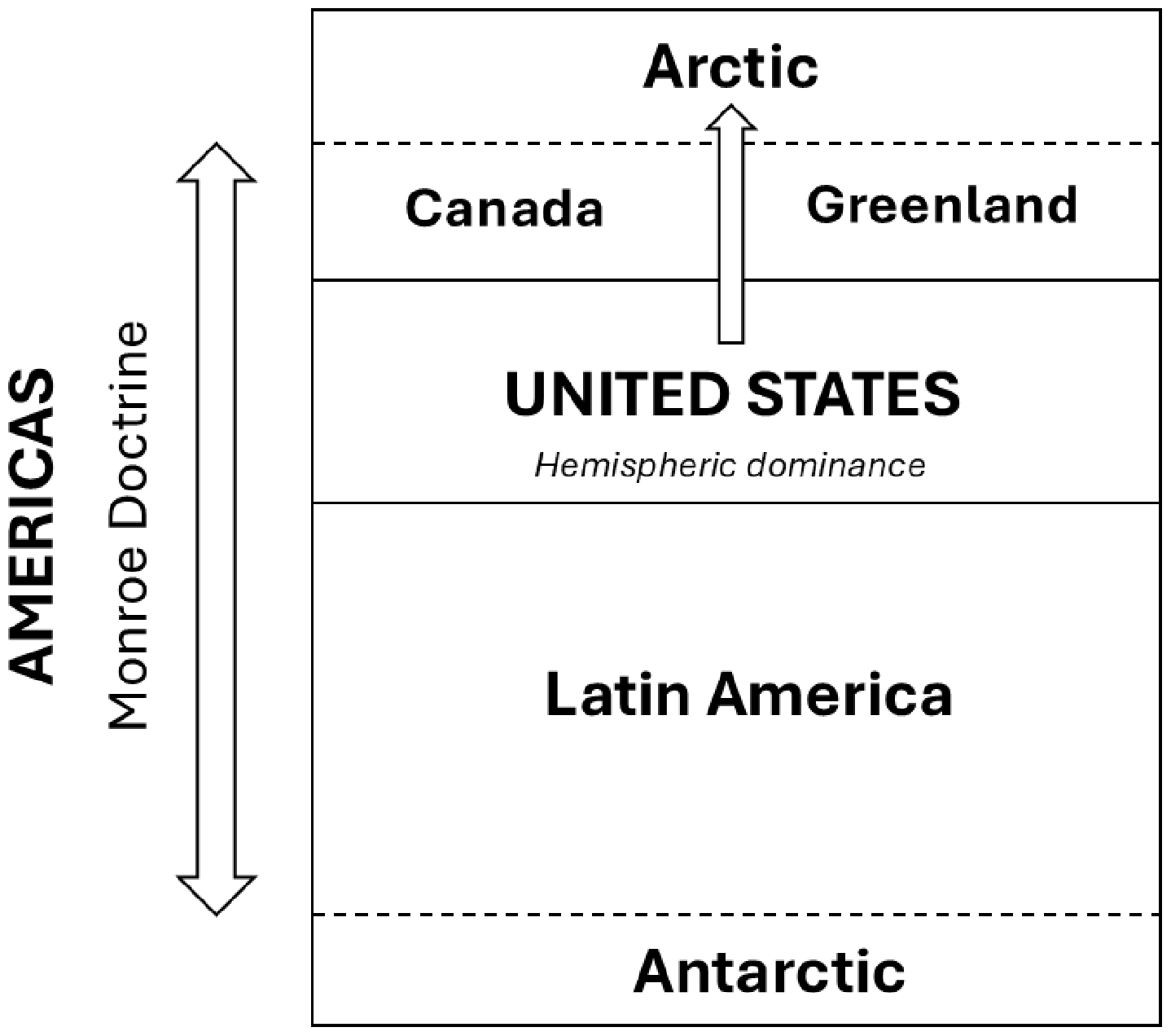
Figure 1. Figure 1 long description.The architecture of a US imperial system in the Americas, first blueprinted in the 19th century.
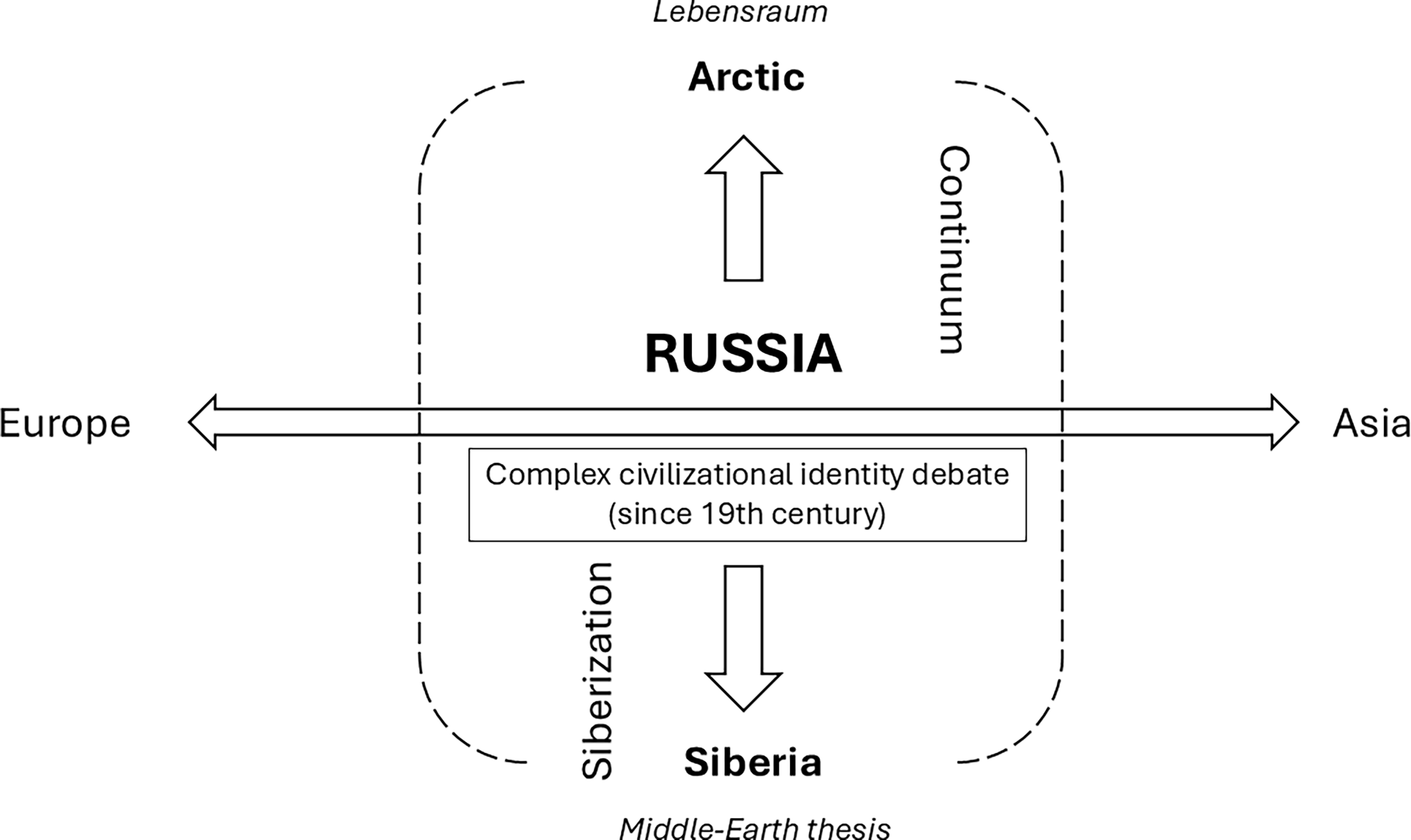
Figure 2. Figure 2 long description.The shifting civilisational identity towards a vertical integration driven by Siberia and the Arctic.
 You have
Access
Introduction
The Treaty of Tordesillas (1494) instituted a demarcation line that simultaneously created a geopolitical reality and a cartographic abstraction. It effectively partitioned the non-European world between the Iberian kingdoms of Spain and Portugal (Bennassar, Reference Bennassar1992; Rumeu de Armas, Reference Rumeu de Armas1992). Historians widely regard this division as a foundational moment in the genesis of global interconnectedness, formalising the ascendancy of a European-centric world order that would endure for over four centuries. The treaty heralded the dawn of an imperial paradigm without historical precedent: the age of planetary-scale empires. The technological and logistical capacities unleashed during 19th-century industrialisation – exemplified by the British Empire under the Victorian era (Bell, Reference Bell2006) – intensified this model of global hegemony.
This historical precedent of extra-territorial division acquires renewed salience in the contemporary era. Among the hypotheses under consideration in the current global context, the question of the emergence of an imperial regime is central. The decline of the post-1945 international order, together with its constitutive institutions and legal frameworks, is manifest in a revival of imperial practices on the part of great powers, such as the United States, China, and Russia (Alessio & Renfro, Reference Alessio and Renfro2022; Oksamytna, Reference Oksamytna2023; Steinmetz, Reference Steinmetz2005). Each of these powers endeavours to promulgate its own narrative; these narratives may develop along parallel lines, only eventually to clash. The Arctic is a case in point where the Trump–Putin summit held in Alaska in August 2025, though more symbolic than strategic, represents the resurgence of an imperial-style reunion aimed at negotiating the division of spheres of interests and influence (Belmessous, Reference Belmessous2014). The current global geopolitical and historical moment, increasingly characterised by the convergence of systemic failures – a condition scholars term a polycrisis regime (Brosig, Reference Brosig2025; Henig & Knight, Reference Henig and Knight2023; Homer-Dixon et al., Reference Homer-Dixon, Walker, Biggs, Crépin, Folke, Lambin and Troell2015; Lawrence et al., Reference Lawrence, Homer-Dixon, Janzwood, Rockstöm, Renn and Donges2024) – reinforces such imperial logics, albeit in a reconfigured and distorted form. The unipolar moment of the late 20th century has given way to a fragmented landscape defined by renewed great power competition and the assertion of spheres of influence.
Since the early 2020s, the arc of this competition – comprising geopolitical, public health, climate, and military affairs – has accelerated. It has the potential to produce a lasting reconfiguration of the international system. This arc has now entered a phase of disintegration, thereby highlighting underlying structural trends that have been present since the turn of the century. A realignment of the international order is taking place with the emergence of new powers, primarily China (Jacques, Reference Jacques2009). This dynamic is further entangled by the systemic rivalry between China and the United States, whose relationship is becoming increasingly aggressive (Bello, Reference Bello2023).
Within the confines of this analytical framework, the Arctic serves as a prime example of this global phenomenon, with major economic powers exerting influence over the region and its resource potential (Dodds & Nuttall, Reference Dodds and Nuttall2016). The polar region is also a critical indicator of planetary-scale stressors, evidenced by an accelerated rate of climate change (Ford, Pearce, Villaverde Canosa, & Harper, Reference Ford, Pearce, Villaverde Canosa and Harper2021; Previdi, Smith, & Polvani, Reference Previdi, Smith and Polvani2021), significant biodiversity shifts (Culp et al., Reference Culp, Goedkoop, Christensen, Christoffersen, Fefilova, Liljaniemi and Lento2022; Markley, Gross, & Daru, Reference Markley, Gross and Daru2025), and the pervasive presence of persistent pollutants (Borgå et al., Reference Borgå, McKinney, Routti, Fernie, Giebichenstein, Hallanger and Muir2022). In the Arctic, the convergence of these two fast-paced dynamics – planetary crisis and resource competition – structurally reshapes the regional governance architecture, within which post-Cold War institutions, particularly the Arctic Council, have been weakened (Balton & Haig, Reference Balton and Haig2026; De Lucia, Reference De Lucia2025; Dyck, Reference Dyck2024; Koivurova & Shibata, Reference Koivurova and Shibata2023; Paukkunen & Black, Reference Paukkunen and Black2024). In light of these developments, the Arctic appears to be in the grip of an emergent pluriverse of hegemonic spheres of influence, also conceptualised as Großräume (see Rossi, Reference Rossi2025).
The line of inquiry pursued in this article proceeds as follows: it first examines the erosion of post-Cold War Arctic governance, analysing how the United States and Russia, as dominant Arctic powers, seek to reframe the region in accordance with their respective national interests. It then argues that other Arctic nations, notably the Nordic countries, could nonetheless envisage a future governance model that safeguards key cooperative mechanisms, including scientific collaboration. Such a model would be explicitly calibrated to emerging geopolitical realities without abandoning the principle of functional cooperation.
The collapse of the post-Cold War order in the Arctic
The Arctic space had been largely insulated from geopolitical upheavals due to the favourable context of the post-Cold War era. However, the expansion of the polycrisis is now universal and is directly affecting the region, putting an end to the exceptionalism the Arctic appeared to enjoy during the brief period of governance initiated by its littoral states (Devyatkin, Reference Devyatkin2023; Shvets & Hossain, Reference Shvets and Hossain2022). From 1991 to 2014, a phase of building and consolidating institutional mechanisms fostered cooperation and dialogue among regional actors, as well as the establishment of a governance framework focused on resolving common problems, such as environmental protection, economic development, and becoming more sensitive to the rights and recognition of Indigenous populations. In this sense, the creation of the Arctic Council in 1996 and its subsequent growth reflect this trajectory, which overlapped with a global trend of economic and liberal globalisation and the widespread democratisation of human societies (Fukuyama, Reference Fukuyama1992; Mearsheimer, Reference Mearsheimer2025).
In the Arctic, however, this dynamic has experienced a series of interruptions. Three key moments mark the weakening of the polar region’s governance structures. First, Russia’s annexation of Crimea in 2014 ruptured trust between the Western Arctic states and Moscow. Second, the arrival of Donald Trump at the White House in 2016 disrupted the stability of the governance architecture by rejecting the principles of multilateralism. Finally, the COVID-19 pandemic, beginning in 2020, hindered practical discourse and functions and created distance among the actors. This confluence of factors signalled latent fragilities within the governance structures.
Russia’s full-scale invasion of Ukraine in February 2022 brought an end to this post-Cold War interlude and destroyed normal relations between the West and Russia. For the Arctic, the lasting consequences of this geopolitical realignment are leading to a slow erosion of the governance architecture and its institutional instruments. Particularly, Balton and Haig (Reference Balton and Haig2026) describe the Arctic Council as an irreplaceable intergovernmental structure that cannot function properly without the effective inclusion of Russia. Recognition of the Council’s role as a producer of expertise and institutional broker renders it an unparalleled entity in regional governance (Andreeva & Rottem, Reference Andreeva and Rottem2024). Nevertheless, its state of deterioration has led to “serious operational constraints and a significantly reduced scope and diplomatic profile” (Balton & Haig, Reference Balton and Haig2026), making a tangible evolution of its functioning and composition indispensable to ensure its long-term survival (De Lucia, Reference De Lucia2025). This state of crisis is the result of a cumulative crisis that began in 2014 and continues to expand across several layers, including the transatlantic dispute over Greenland, which has significantly hampered the regional body. All in all, the political degradation of the Arctic Council has mimicked a process of “zombification” – a condition in which the institution has lost control of its ability to set a direction or initiate new dynamics, while its vital functions gradually weaken.
More saliently, the effective suspension of the Barents Euro-Arctic Council, created in 1993, following Russia’s withdrawal in September 2023 and the cessation of the organisation’s funding by Finland from 2026 onward, illustrates the region’s shift into a new era (Edvardsen & Hansen, Reference Edvardsen and Hansen2024). The accession of Finland and Sweden to the North Atlantic Treaty Organization (NATO) in April 2023 and March 2024, respectively, constitutes a further factor in this ongoing transformation, accentuating the region’s strategic dependence on various theatres of confrontation (Alberque & Schreer, Reference Alberque and Schreer2022). From NATO’s perspective, these memberships streamline its defense policy for the northern and eastern flanks of the European continent, chiefly by enabling a more coherent articulation of the Barents–Baltic security architecture (Rossi, Reference Rossi2025; Vidal, Reference Vidal, Finger and Rekvig2025). Overall, it effectively marginalised post-Cold War Arctic governance aspirations to centre the schism between the NATO bloc and Russia, thereby creating a lasting fracture across the polar region.
The weakening of the post-Cold War Arctic governance architecture and the rearrangement of security structures open the prospect of new dynamics in this phase of the transitional regime. Such dynamics are bolstered not only by geopolitical and security-related factors but also by domestic dynamics at play in the two main Arctic nations – the United States and Russia. Both exhibit patterns in the polar region consistent with imperial postures, fuelled by their respective metanarratives.
Donald Trump and the shadow of McKinley
The return of Donald Trump to the White House in January 2025 occurred at a pivotal juncture for Arctic geopolitics, adding a new layer of complexity in light of the previous momentum that marked the deterioration of the polar region’s governance structures. Within this increasingly fragmented geopolitical context in the polar region, Greenland has emerged as a central point of contention, exacerbating tensions between the United States and the Kingdom of Denmark and, more broadly, the European Union (Cassidy, Reference Cassidy2025). The autonomous island has effectively become the epicentre of an expanding transatlantic crisis. President Trump’s ambition to acquire Greenland, first articulated in 2019 (Breum, Reference Breum2019), was promptly reaffirmed at the outset of his second term, justified through a discourse of national security and geo-economic imperatives (Holland, Reference Holland2025; Jacobsen, Reference Jacobsen2025). The growing transatlantic rift manifests in a strategic competition among major global powers, with Greenland emerging as a pivotal theatre. The United States is seeking to expand its influence across the polar region, marking its emphasis on the strategic landscape.
Despite the aggressive and often caricatured rhetoric from the US President and members of his administration, ambitions regarding Greenland have not at this stage materialised. This unperfected ambition is largely due to firm opposition from the Greenlandic population, which intends to retain control of its political future – a status guaranteed by its autonomy within the Kingdom of Denmark. This sentiment is quantified by a January 2025 poll, in which 85% of Greenlanders expressed disapproval of the prospect of joining the United States (Reuters, 2025). However, these postures infuse a divergent perspective on how the Arctic is conceptualised as a strategic space and reflect a more deeply entrenched trend: that of an imperial trajectory. As illustrated in Figure 1, the United States has historically sought to establish comprehensive hemispheric dominance, spanning from the Arctic to the Antarctic Peninsula. This dynamic is particularly evident in US efforts to reassert a dominant foreign policy initiative in Latin America, a region where China has substantially expanded its presence and influence (Berg, Reference Berg2026; Stallings, Reference Stallings2025). In the context of contemporary systemic rivalry with China, this strategic objective portends a significant reinforcement of US efforts to consolidate control over the Western Arctic. The promotion of the concept of “Greater North America” by the Department of War, which encompasses the entire territory north of the equator, is intended to tighten US control in the region (U.S. Department of War, 2026). As a result, such a policy could potentially pose a threat to the sovereignty of neighbouring countries. The imperial rhetoric therefore directly affects its relations with its northern neighbours – Canada and Greenland (Fee, Reference Fee2025; Kapoor, Reference Kapoor2025).
The architecture of a US imperial system in the Americas, first blueprinted in the 19th century.
Figure 1. Long description
This figure describes the U.S. imperial vision for the Americas, founded on the Monroe Doctrine in the nineteenth century. It extends from the Arctic to the Antarctic Peninsula, encompassing Latin American states, Canada, and Greenland.
The offensive rhetoric directed at Canada signals a shift in approach in relations with its northern neighbour. This shift, however, echoes a two-centuries-old anxiety about the threat the United States poses to the Canadian Confederation (see Penlington, Reference Penlington1965). In 1812, the United States invaded Canada, driven by a cumulative set of grievances against the British Empire, foremost among them British support for Indigenous peoples who resisted Washington’s westward expansionist aspirations. The war, which concluded with the Treaty of Ghent on 24 December 1814, resulted in a strategic loss for US expansionism, as it failed to annex Canadian territory. This long-standing fear holds that the Confederation could fragment due to internal secessionist movements within the Prairie provinces (Wilkinson, Reference Wilkinson2025). The tensions surrounding the province of Alberta are representative of these fears, as any potential attempt to organise a secession referendum is viewed as a development that would fuel the US imperial project in the High North (Counter & Latimer, Reference Counter and Latimer2025).
Regarding Greenland, US strategic interests in the Arctic region have historically included the aspiration to gain control of the island. This objective was pursued from an early stage in the nation’s history. In 1867, during the process of acquiring Alaska from the Russian Empire, the federal government deliberated on the potentiality of extending an analogous offer to the Danish crown, sovereign over Greenlandic territory. Since then, there have been several unsuccessful attempts to achieve this objective in 1910 and 1946, respectively, which suggests the presence of a fundamental geopolitical ambition: the desire to anchor this territory within the American sphere. Beyond the geographical dimension (Fig. 1), this aspiration recalls one of the pillars of the Monroe Doctrine, which aimed to end European colonisation in the Americas. In his address to Congress in December 1823, President Monroe stated that,
“(…) the American continents, by the free and independent condition which they have assumed and maintain, are henceforth not to be considered as subjects for future colonisation by any European powers.” (Monroe, Reference Monroe1823)
Monroe defined a long-standing foreign policy objective that the United States intended to pursue – a policy that reached its apogee at the end of the 19th century under President William McKinley (1897–1901). From this perspective, Donald Trump has held up McKinley, the 25th President of the United States, as a model to drive towards the end of the liberal order (Immerwahr, Reference Immerwahr2025; Palen, Reference Palen2015). A proponent of the Monroe Doctrine, McKinley was also the president who, in 1898, engaged the country in a military confrontation against Spain, a waning empire then grappling with a war against Cuban nationalists (Hamilton, Reference Hamilton2006; Offner, Reference Offner2004; Ward, Reference Ward2022). This notable episode, which marked the end of the Spanish presence in the Americas, echoes a now-eroded trust between the two sides of the Atlantic (Grillo, Reference Grillo2025). As Ivie (Reference Ivie1972, 15–16) observes, McKinley also pursued an expansionist foreign policy, a stance clearly illustrated in his rhetoric advocating for the annexation of the Philippines. This position solidified his reputation as a major advocate of an imperial path for the nation. This more assertive imperial strategy does not constitute a departure from the softer form of US imperialism that has been operational since the end of the Second World War (Rowe, Reference Rowe2004). For Trump, engaging in a diplomatic standoff with Denmark is a way of aligning his policy with that of his predecessor, while also asserting Washington’s imperial projection ambitions in the Arctic (Dodds, Reference Dodds2025).
The Russian civilisational debate: a Middle-Earth empire?
For its part, Russia remains entrenched in a protracted debate over its civilisational identity – a discourse concerning its geographic belonging that has been crystallising since the 19th century (see Danilevsky, Reference Danilevsky1888; Riasanovsky, Reference Riasanovsky1960). The construction of the Russian Empire since the 16th century and its expansion into the Arctic and the Far East continue to be the subject of a contemporary debate, one reinvigorated in ideological circles, many of which have ties to the Russian government, following the crisis in relations with the West since 2014 (Laruelle, Reference Laruelle2016). As Figure 2 illustrates, the core driver of the civilisational identity debate relates to Russia’s geographical identity – in other words, which civilisational sphere Russia belongs to. The fundamental tension between Western-oriented “Westernizers” and nativist “Eurasianists” has historically structured the pendulum swings of Russian state policy for centuries (Bassin, Reference Bassin1991; Gvosdev, Reference Gvosdev2007; Halperin, Reference Halperin1982; Laruelle, Reference Laruelle2018; Tsygankov, Reference Tsygankov2007). Since Russia’s full-scale invasion of Ukraine in February 2022, the Asian pivot undertaken by President Putin has accelerated markedly against the backdrop of comprehensive economic and financial sanctions imposed by Western countries.
The shifting civilisational identity towards a vertical integration driven by Siberia and the Arctic.
Figure 2. Long description
This figure explains the complex civilizational debate regarding Russiaʼs identity between the West and the East. One hypothesis discussed may find an alternative through a vertical approach, connecting the Arctic and Siberia as a continuum and an in-between space.
A strategic reorientation is underway, one in which the Arctic is becoming a central component in the consolidation of Russia’s civilisational identity. In his speech held in Murmansk in March 2025, Putin explicitly mentioned the historical and geographical significance of the polar region (Putin, Reference Putin2025). Consequently, the Arctic’s future is envisioned as a pivotal nexus of industrial and logistical activity. This vision anticipates the migration of Russian settlers – distinct from the excluded Indigenous peoples of the Arctic such as the Nenets, Chukchi, Yakuts, and Komi – for brief periods, thereby creating a continuous flow of workers between the centre and its Arctic periphery (Lancereau, Reference Lancereau2025). Nevertheless, their presence would lastingly reinforce the integration of this far northern region with the rest of the Russian state. By leveraging its extractive infrastructure – from geological research institutions (e.g. Rosgeo and Institute of Geology of Ore Deposits, Petrography, Mineralogy and Geochemistry of the Russian Academy of Sciences (RAS)) to mining enterprises – Russia intends to continue its long-standing policy of natural resource exploitation in the region. As Slezkine (Reference Slezkine1994) describes, this relationship with the Arctic follows a logic of conquering a territory perceived as backward, a process undertaken at the expense of the circumpolar peoples. Following this logic, the Russian state, through the Russian Geographical Society, founded in 1845 and promoting scientific expeditions, has treated the Arctic as a priority region for full integration (Sukhova & Yu Skrydlov, Reference Sukhova and Yu Skrydlov2018).
Putin thus depicts a strategic space, redefining the boundaries of a region that is now perceived as vital to the Russian state. The reinforcement of the polar territories’ incorporation into the central power can be characterised as a form of Lebensraum, or “living space,” vital for the survival of the Russian state. Developed by German geographer Friedrich Ratzel (1844–1904), the concept of Lebensraum became a stated geopolitical objective of the German Empire during World War I and was promoted by German nationalists such as the Pan-German League (Alldeutscher Verband). The Nazi regime later exploited it to define and justify its expansionist policies in Central and Eastern Europe (see Smith, Reference Smith1986). In his Murmansk speech, Putin (Reference Putin2025) bridged the Arctic to Siberia as he stressed, “the potential of the Arctic’s inland waterways, our great rivers – the Lena, Yenisei, and Ob – must be unlocked at a new technological level to develop the Trans-Arctic route.”
This continuum between the Arctic and Siberia (Fig. 2) is a critical pattern that Russia aims to pursue to revitalise its civilisational project. Lobanov-Rostovsky (Reference Lobanov-Rostovsky1929) conceptualised the geographical expanse of the Russian territory as stretching from the Baltic to the Pacific and from the Arctic to the Gobi. It is arguably this final, vertical dimension in which the Russian state may seek to consolidate its civilisational project by materially realising the hypothesis of a Middle-Earth empire (see Fig. 2). The geographic concept of a central landmass, inspired by Tolkien’s Middle-Earth, has been employed by Eurasianists and Western intellectuals alike (Ashford, Reference Ashford2018; Rossi, Reference Rossi2025). Some Russian intellectuals advocate for the Siberization of the Russian state, shifting its centre of gravity towards the Urals and Siberia to break with three centuries of European integration and develop a strategic eastern territory (Karaganov & Omelchuk, Reference Karaganov and Omelchuk2023; Karaganov, Reference Karaganov2025). This re-centreing aligns with the Middle-Earth theory, wherein the Arctic catalyses the country’s civilisational refoundation (Rossi, Reference Rossi2025; Sukhorukov, Gladkiy, & Kulik, Reference Sukhorukov, Gladkiy and Kulik2021). The framing of this narrative aims to reinforce the anchoring of the Arctic as a fundamental part of Russian identity. This posture echoes the one emerging in the United States with respect to the Arctic. For these two powers, the Arctic is becoming a compass in the continuation of their imperialist posture.
The diplomatic re-engagement initiated between the United States and Russia in January 2025 signalled a readiness to reset a bilateral dialogue and envision a potential venue to restore cooperation in some segments. Facilitated by the resumption of bilateral exchanges, these interactions have revealed a convergent and predominantly mercantilist vision of the Arctic, centred on resource exploitation. For instance, the possibility of resuming economic cooperation in the energy sector is illustrative of this common understanding between both countries (Hirtenstein, Rashad, & Dang, Reference Hirtenstein, Rashad and Dang2025). While this outcome remains a speculative thesis at present, the notion of a bilateral imperial partitioning of the polar region reflects a tacit recognition of the profound structural transformations underway.
Anti-imperial resistance and Nordic dilemmas
Due to the ongoing symmetrical process in the United States and Russia, this dynamic is marked by a notable concordance of views on illiberalism. According to Laruelle (Reference Laruelle2022), illiberalism is, among other things, a backlash against contemporary liberalism in its various forms: political, economic, cultural, geopolitical, and civilisational. This pushback is often articulated in the name of democratic principles and achieved by securing popular support. Against this backdrop, the future of polar regional governance is threatened by a gradual slide towards an imperial regime. As the Arctic may serve as an imperial venue, the structural and long-term weakening of regional governance mechanisms is occurring within the context of a generalised deterioration of the international system established after 1945, undermining peace and stability. This development underscores the ascendancy of power dynamics to the detriment of international law and intergovernmental bodies that privilege dialogue and negotiation within multilateral formats. This trajectory induces a more evident reaffirmation of practices rooted in the pre-1945 period. Citing perceived threats to national security, major powers are increasingly inclined to pursue geopolitical aims unilaterally, demonstrating a readiness to employ military force where deemed expedient. Within the turbulent geopolitical landscape of the 2020s, the Arctic region has become enmeshed in this wider structural erosion of the international security architecture (Koivurova & Shibata, Reference Koivurova and Shibata2023; Vidal, Reference Vidal, Finger and Rekvig2025). The trajectory of Arctic governance is therefore rendered profoundly uncertain, a predicament exacerbated by the impending strain on its resilience mechanisms in the face of resurgent imperial practices.
In response, other Arctic nations attempt to navigate hostile geopolitical conditions and develop mechanisms to resist a transitional regime whose outcome remains unknown. Interestingly, the discourse of resistance articulated by Canadian Prime Minister Carney in Davos in January 2026 is illustrative of this dynamic, as it called for achieving emancipation within a network of middle powers founded on liberal and democratic values (Gunitsky, Reference Gunitsky2026). In the Arctic context, Canada and the Nordic countries seek to create a balance of power against Russian and American imperial ambitions. For these states, the goal is to reduce their collective anxiety induced by a profoundly degraded geostrategic environment that undermines the stability of regional societies. All in all, the Nordic countries and Canada may be compelled to accelerate their strategic convergence as a countermeasure to protect international cooperation and scientific infrastructure, which are uniquely vulnerable at this critical juncture.
For the Nordic states, the confluence of the Russian security threat and the crisis in transatlantic relations destabilises the long-standing principles that have shaped their regional posture across numerous decades. Indeed, the repercussions of this geopolitical shift portend a phase of strategic marginalisation, jeopardising the established political, diplomatic, and security order in the region. This new historical phase raises a fundamental question of contextualisation: within what continuum is it situated? Some scholars posit that the Arctic is experiencing a resurgence of Cold War mentality, a latent conflictual attitude that has merely transmuted into a new form. Huebert (Reference Huebert2019) suggests that the Cold War persisted and that the Arctic region remained an integral component of this broader historical continuum. The post-Cold War metanarrative, which was built upon the Murmansk Initiative – a speech delivered by Gorbachev in Murmansk in 1987 – envisioned the future of the Arctic as a zone of peace and cooperation (Gorbachev, Reference Gorbachev1987). However, this new vision of “exceptionalism” was fundamentally predicated on the consolidation of ties between the West and post-Soviet Russia. This interpretation underscores the failure of post-Cold War endeavours to reconstruct a stable Western relationship with Russia. From this perspective, the existing framework of Arctic governance, a product of the immediate post-Cold War era, appears fundamentally unbalanced and desynchronised from the accelerated pace of contemporary geopolitical realignments.
The present course of events in the Arctic governance domain calls into question the consistency and future resilience of the prevailing institutional architecture. The continued existence and preservation of the Arctic Council may serve as an indication that the post-Cold War legacy could endure amidst the prevalent shifts in the region. In Northern Europe, the structural shift in the Arctic’s geostrategic environment is perceived by Nordic governments as an existential threat that extends across multiple historical eras, reaching back even further than the Cold War period. Indeed, the weakening of the regional order, in conjunction with the deteriorating conditions of the security architecture in Europe, has the potential to signal the conclusion of a two-century interlude. For a considerable period, the Nordic countries were regarded as the heirs to a model of peacebuilding in Europe. Furthermore, they have played a direct role in the establishment of an Arctic governance system, a distinctive regime at the international stage that has served to strengthen cooperation, particularly in the scientific domain. The observed fragmentation of the Arctic region may induce a corresponding disintegration of its cooperative frameworks. Since 2022, scientific collaboration has suffered significant setbacks, entering a state of survival in which its core functions are severely constrained (Johansson & Callaghan, Reference Johansson and Callaghan2025; Vidal & Saas, Reference Vidal and Saas2025). The “Nordic peace,” which has served as a model of stability on the European continent since the post-Napoleonic period (Archer & Joenniemi, Reference Archer and Joenniemi2003; Rekvig, Reference Rekvig, De Sousa and Perez-Garcia2024), now faces dissolution.
Consequently, current developments may not signify the continuation of a perpetual Cold War; rather, they may represent a more profound historical rupture: the demise of the Nordic peace paradigm dating from 1814. The accession of Finland and Sweden to NATO, in conjunction with the extensive regional militarisation, indicates a substantial shift in this paradigm. For Northern Europe, the intensification of hostilities with Russia arguably signals the most pressing security concern since the Second World War. The dynamic of tensions and the line of fracture spanning the entire European continent from the Barents Sea to the Black Sea are weakening the position of the Nordic countries and exposing them to the establishment of a permanent regime of security tensions. This context could facilitate the consolidation of an imperial understanding founded on a mercantilist vision of the polar region and a complacent acceptance of the transformation of its climatic regime at the expense of international scientific cooperation. To oppose this scenario, the Nordic countries and Canada may develop a counter-metanarrative that shields science, international law and transparent governance against predatory temptations in the region.
Conclusion
Since 2014, the Arctic region has undergone a series of overlapping crises that have gradually led to a breakdown of trust among the region’s states. These cumulative crises are driving a transformative shift away from the governance framework established in the post-Cold War era. The institutional architecture inherited from that period is now imperilled, and the window of opportunity to preserve it is closing rapidly. The ongoing expansion of military activities in the polar region, along with a rising trend of anti-science policies in Western democracies, is eroding both the functioning and the diplomatic posture of the Arctic Council, an institution that emerged during the height of the liberal international order. Even if the characterisation of the Arctic as an imperial venue per se remains a hypothesis rather than an established reality, the ongoing effort by the United States and Russia to narratively construct the region as a shared sphere of influence constitutes a meaningful signal. Such a configuration threatens to marginalise both the other Arctic states and other critical stakeholders who have been instrumental in shaping regional governance, chief among them Indigenous communities.
In that context, the prospect of dual Groβraum – pursued by both Russia and the United States – positions the Arctic as a central strategic stake for the major powers in the 21st century, thereby revealing their underlying imperial postures. Echoing the great power rivalries of the 19th century, this dynamic implies a growing risk of open conflict. Compounding these geopolitical ambitions, planetary environmental changes, whose effects are disproportionately amplified in the Arctic, further exacerbate the risk of systemic instability. Within this context, the hypothesis of a long-term understanding between Russia and the United States to partition the Arctic into spheres of influence warrants serious consideration. Such a tacit condominium would ostensibly aim to exclude extra-regional geo-economic powers, notably China, and create an entente on controlling regional natural resources.