Congenital cardiac malformations account for the majority of all birth defects, affecting around 8 of every 1,000 live-born infants.Reference Bernstein, Behrman, Kliegman and Arvin1, Reference Ferencz, Loffredo, Correa-Villasenor and Wilson2 Before the 1950s, when surgery for congenital heart defects was introduced, about one third of children afflicted with congenital cardiac defects died within the first year of life. Surgical and medical advances now enable up to nine-tenths of children with congenital cardiac malformations to live to adulthood.Reference Ferencz, Loffredo, Correa-Villasenor and Wilson2 The lesions themselves range in severity from those that are deemed simple, such as atrial septal defects, to complex malformations, such as hypoplasia of the left heart. Children with simple defects often experience little to no symptomology, while those with complex defects often undergo several surgical procedures, and take medication daily. In reference to the psychosocial impact of severity, children with complex defects were rated by parents as more withdrawn, having more social problems, and engaging in fewer activities compared to those with innocent heart murmurs.Reference Casey, Sykes, Craig, Power and Mulholland3
Although the specific physiological pathologies of a child with a congenital cardiac malformation are often not visible, there may be marked effects on their overall physical appearance and their psychological state. Small stature and cyanosis may affect their body image and sense of normalcy.Reference Wray and Maynard4, Reference Green and Levitt5 Restrictions of physical activity can lead to social isolation and low self-esteem.Reference DeMaso, Beardslee, Silbert and Fyler6, Reference Sparacino, Tong, Messias, Foote, Chesla and Gilliss7 In addition, elevated levels of anxiety have been noted amongst both the children and their parents.Reference Gupta, Mitchell, Giuffre and Crawford8–Reference Spurkland, Bjornstad, Lindberg and Seem10
Summer camps have grown in popularity as one means of addressing the various psychosocial needs of children with congenital cardiac defects and other chronic illness. The proposed benefits of camp, such as enhancement of self-esteem and socialization,Reference Meltzer and Rourke11, Reference Wellisch, Crater, Wiley, Belin and Weinstein12 map directly onto the needs of children with complex medical conditions. Although medical conditions and special needs are not ignored at camp, they are not the focus. The camping experience is intended to teach children independence and self-discipline in their approach to their medical condition, and to life as a whole.13 The goals of the camp can range from providing a rewarding and enjoyable experienceReference Smith, Gotlieb, Gurwitch and Blotcky14 to providing opportunities to develop a sense of mastery and efficacy in peer relations.Reference Swenson15
Research examining the effects of camping for children has been promising. Improvements in the attitudes of the children toward themselves, and decreases in anxiety, have been observed in camps for children with asthma,Reference Briery and Rabian16, Reference Creer17 diabetes, and spina bifida.Reference Briery and Rabian16 In addition, decreases in negative affect have been observed in children living with cancer.Reference Wellisch, Crater, Wiley, Belin and Weinstein12 The social benefits of camping have also been noted.Reference Meltzer and Rourke11, Reference Shepanski, Hurd, Culton, Markowitz, Mamula and Baldassano18 Moons and colleaguesReference Moons, Barrea and De Wolf19 have conducted one of the first studies with children with congenital cardiac malformations, finding that, after a sports camp, participants reported improved health-related quality of life.
Parents also seem to benefit from the attendance of their children at camp. The parents of children with chronic renal failure indicated that attendance at camp provided them with a temporary respite from the responsibility for the health care of their children, as well as the chance to spend more recreational time with their other children. Some parents also commented that they were surprised at the ability of their children to succeed independently, and recognized how they might have been impeding their development by being overly protective.Reference Primack and Greifer20 The relief in the demands on the providers of care, and the decrease in parental psychological distress, has been observed recently across several camping populations, including those suffering with asthma, cancer, epilepsy, and renal disorders.Reference Meltzer and Johnson21
Taken together, these findings support the efficacy of paediatric summer camps in having a positive impact on children and parents for the most commonly studied conditions. Although there is initial data supporting the benefit of sports camps for children with congenital cardiac malformations, no data exists examining their parents. In this study, therefore, we investigated the psychosocial changes in the parents and children associated with the children attending a summer camp for those with complex congenital cardiac defects. The extant research suggests that children with congenital cardiac defects experience higher levels of psychological distress, including anxiety, social difficulties, low self-esteem, and poor body image when compared to healthy peers.Reference Wray and Maynard4 Although the cardiac camp we investigated does not incorporate specific psychological interventions into its curriculum, it does provide a naturalistic setting that includes exposure to challenging, efficacy-building experiences, such as swimming, ropes courses, archery, and mountain biking. On the last day of camp, a professionally-edited 40 minute video of the children participating in the camping activities is shown to a large group of parents. Observing their children safely enjoying challenging physical activities may encourage the parents to have more confidence in the ability of their children to be independent, thus decreasing their anxiety about the experiences of separation.
We also examined factors related to changes in levels of anxiety existing before the camp to those at the end of the camping experience. Although, as far as we are aware, this study is the first known study to examine correlates of changes in levels of anxiety amongst children undergoing the experience of camping, Thurber and colleaguesReference Thurber and Sigman22 have extensively explored predictors of homesickness of children during camping. In our study, we expected that the factors that have been found to be associated with homesickness would also be associated with higher levels of anxiety prior to camping, and at the end of the camp. Among the factors that we expected to be correlated with anxiety are younger age,Reference Thurber23 fewer experiences of separation,Reference Thurber and Sigman22–Reference Thurber and Sigman24 and negative expectations by the children of the camping experience.Reference Thurber and Sigman22 In addition, we anticipated that parental anxiety concerning separation, their expectations for the camp, and their perception of experiences of separation, will be associated with the level of their children before the camp and at its conclusion. Prior research has suggested a relationship between greater parental anxiety regarding separation prior to the camp, and higher levels of homesickness amongst the children whilst at camp.Reference Thurber and Sigman24
Materials and methods
Participants and setting
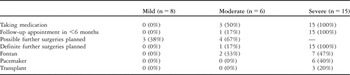
Of the 60 children attending the camp, 54 were eligible for inclusion in the study. We excluded 6 campers who were younger than 8 years of age due to their lower reading ability. A total of 33 children diagnosed with a congenital cardiac malformation participated, along with their families. Of these, 3 children did not complete measures at camp, and one did not complete self-report forms prior to camp. The final sample of campers, therefore, consisted of 29 children, giving a rate of participation of 54% amongst the eligible attendees who provided the necessary data both before and after the camp. The follow-up sample consisted of 18 individuals, or 62% of the 29 participants. The participants ranged in age from 8 to 17 years, with a mean of 12.3 years, and standard deviation of 2.7, and 52% were male. The sample was predominantly Caucasian, at 72%, with a small proportion of African-Americans and Asians, at 7% each, and 14% who did not endorse any ethnicity. The majority of the sample reported income equal to middle and upper socioeconomic state, with 72% reporting earnings by their parents of $30,000 or above annually. Parents who completed forms consisted of 76% mothers, 15% fathers, and in one case the mother and father completed forms together. Of the sample, 76% had attended a previous camp. Approximately half of campers were in the mild (28%) to moderate (21%) range of severity of disease, with 52% in the severe range, as assessed by a paediatric cardiologist who reviewed charts and assigned severity based on criterions that included medications, number and type of previous and potential future surgeries, and frequency of outpatient follow-up (see Table 1). No significant differences were found across parameters for demographics and disease between the full sample and the follow-up sample.
Characteristics of the severity of disease.

The camp, lasting for 5 days, was held in a rural area in a facility that was built specifically for children with special needs. The volunteers at camp included physicians, nurses, child life specialists, and other volunteers. There were also paid camp employees who assisted with horseback riding, archery, boating, and other activities. The camp is designed for children aged from 7 to 18. There was no charge to the families for participation. The mission of the camp is to create a positive life experience for all children with complex cardiac defects through an educational programme that promotes self-esteem, socialization among peers, support from families, and many enjoyable activities. At camp, children participate in activities such as swimming, horseback riding, arts and crafts, archery, boating, fishing, dancing, and mountain-biking. All eligible families were sent a brochure from Children’s Healthcare of Altanta inviting them to camp, with an application attached. In addition, brochures are placed in all outpatient cardiology waiting rooms at Children’s Healthcare of Atlanta and satellite clinics for patients to take and complete.
Parental measures
The Camp and Separation Experience Survey is a four item survey developed for this investigation. It assessed whether the child had previously attended camp. In addition, three questions assessed other experience of separation apart from camping, such as number of sleepovers. The ratings for each of these separation experience was rated from 0 to 3, the scale representing zero for none, 1 for a few, 2 for some, and 3 for several, and were added, resulting in scores ranging from 0 to 9.
The Maternal Separation Anxiety Scale, adapted Reference Thurber and Sigman24 is a 28-item measure originally designed for mothers to complete about their own reactions to separations from their infant. Each item is rated on a 5-point Likert-type scale ranging from 1 for “strongly disagree” to 5 for “strongly agree”. There are two separate scales on this measure. Of the items, 21 assess parental anxiety concerning separation, and 7 address the perception of the experiences of separation. The latter experiences reflect positive or negative parental attitudes toward separations from their child. Responses from each scale are totalled separately. The version of the Maternal Separation Anxiety Scale used in our study was adapted and validated for use for mothers or fathers of school-aged children and adolescents.Reference Punnett and Thurber25 They reported high 4-week test-retest reliability of .82 for the total score. This scale demonstrated good internal consistency of .90 in this sample.
The Parental Camp Expectations is a 5 question scale developed by Thurber and colleaguesReference Thurber and Sigman22 to assess parental perceptions of summer camps, and their expectation of the level of homesickness in their child. Questions are scored on a 1 to 5 Likert-type scale, with a range of potential scores from 5 to 25. This scale demonstrated good internal consistency of .87 in this sample.
Child measures
The Child Camp Expectations is adapted from Thurber & Sigman,Reference Thurber and Sigman22 measuring the expectations of the children prior to camping, using 8 camp-related questions to which each child responded on a 1 to 5 Likert-type scale. The questions included “How ready do you feel to come to camp?” and “How well do you think that you will get along with the other kids at camp?” This scale demonstrated adequate internal consistency of .65 in this sample.
The Revised Children’s Manifest Anxiety Scale Reference Reynolds and Richmond26 is a 37-item self-report instrument designed to assess the level and nature of anxiety in children and adolescents from 6 to 19 years old. Children respond to each item by marking a “yes” or “no” response. Only the total anxiety score was used for all analyses. Reliability and validity are well-established for this popular measure.27
Procedure
To recruit participants for the proposed study, we mailed informed consent materials, questionnaires to be completed at home, and a self-addressed stamped envelopes 4 weeks prior to the camp to the family of each child invited to attend. All aspects of this study were approved by the Emory University, Children’s Healthcare of Atlanta, and University of Georgia Institutional Review Boards. Families returned the measures by mail, at the cardiology clinic, or during registration on the first day of camp. On the evening of the last day of camp, campers completed the Revised Children’s Manifest Anxiety Scale. Camp staff monitored administration in order to maintain validity, and clarify any questions for the campers. Four weeks following the camp, measures were mailed to participating families, along with a self-addressed, stamped envelope. Researchers conducted reminder calls to increase the percentage of completed measures. Each child who participated was eligible to receive up to $40 in gift cards, $20 at the end of camp, and $20 at follow-up.
Results
For preliminary analyses, we examined the percentage of children who reported clinically significant overall anxiety, defined as a T-score greater than 60. Approximately 28% of participants reported clinically elevated anxiety prior to camp, and approximately 17% of children reported clinically elevated anxiety at the end of camp, indicating an overall decrease in number of individuals who met the cut-off for clinically significant anxiety levels.
Impact of Camp – within group analyses
We had anticipated that children with congenital cardiac defects would report decreases in anxiety from before camp to the end of camp, and that these changes would be maintained at the one month of follow-up. So as to evaluate this hypothesis, we carried out a repeated measures analysis of variance. Campers reported a statistically significant decrease prior to the camp, with a mean of 12.0, and standard deviations of 7.0, to the conclusion of camp, when the mean was 10.3, with standard deviation of 6.2, for levels of overall anxiety (F(1, 28) equal to 4.95, p equal to 034, partial etaReference Ferencz, Loffredo, Correa-Villasenor and Wilson2 equal to 0.15). For those who completed follow-up, their follow-up scores regarding anxiety were similar to the levels found at the conclusion of camp, with a mean of 10.7, and standard deviation of 6.3 (F(1, 17) equal to 1.85, p equal to 0.192, partial etaReference Ferencz, Loffredo, Correa-Villasenor and Wilson2 equal to 0.10), with the differences prior to camping not being statistically different compared to those found at follow-up.
In addition, a repeated measures ANOVA was conducted to examine changes in parental anxiety with regard to separation prior to the camp as compared to follow-up. Parents reported a statistically significant decrease prior to the camp, when the mean was 63.7, with standard deviation of 9.4, to follow-up, when the mean was 58.2, with standard deviation of 10.1 in this domain (F(1, 17) equal to 13.60, p equal to 0.002, partial etaReference Ferencz, Loffredo, Correa-Villasenor and Wilson2 equal to 0.44).
Factors associated with higher anxiety prior to and at the end of camping
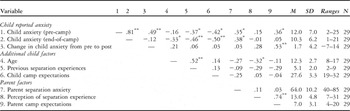
We had anticipated that higher levels of anxiety would be significantly associated with new camper state, younger age, fewer experiences of separation, negative expectations for the camp by the child and parent, greater parental anxiety concerning separation, and negative parental perception of the experience of separation. Pearson Product Moment correlational analyses and a one-way ANOVA (for camper status) were conducted to determine which factors were significantly related to higher levels of anxiety reported prior to camp, at the end of camp, and factors related to changes in the level of anxiety, measured through a difference score. Camper state had a non-significant effect on anxiety before camp and at the end of camp, and on changes in the levels of anxiety. In Table 2, we show the correlations, means, and standard deviations for each variable. Fewer prior experiences of separation, negative expectations by the child and the parents for the camp, and parental anxiety concerning separation, were all associated with higher levels of symptoms of anxiety reported by the children prior to the camp. These variables were entered simultaneously into a regression analysis. Factors that were not significant were trimmed from the model. The final regression included the expectations of the child and the parents concerning the camp, which accounted for 29.3% of the variance in anxiety amongst the children prior to camping (F(2, 26) equal to 5.39, p equal to 0.011).
Correlations, means, and standard deviations for anxiety levels, change in anxiety, child factors, and parent factors.

Note: *p<.05, **p<.01
Although negative parental expectations were not significantly associated with anxiety reported by the children at the end of the camp, all other significant associations prior to the camp persisted when examined in relation to the scores provided by the children at the end of the camp. In addition, younger age emerged as significantly associated with higher levels of anxiety reported at the end of the camp. These variables were entered simultaneously into a regression analysis. Factors that were not significant were trimmed from the model. The final regression included the expectations of the child for camping, and previous experiences of separation, which accounted for 40.4% of the variance in the anxiety noted by the children at the end of the camp (F(2, 25) equal to 8.47, p equal to 0.002).
In reference to level of reduction in the levels of anxiety reported by the children at the end of the camp compared to the initial reports, negative parental expectations about the camping experience was the sole factor significantly associated with greater reductions in anxiety amongst the children, with the magnitude of the relation being r = 0.53.
Discussion
Our results support the value of summer camping for children with congenital cardiac malformations for promoting decreases in their levels of anxiety. Lower levels of anxiety were observed after the camp, and these reductions tended to be maintained at follow-up. These findings are consistent with similar studies conducted at camps with children with asthma,Reference Briery and Rabian16, Reference Creer17 diabetes, and spina bifida,Reference Briery and Rabian16 and the more recent study with children with congenital cardiac disease at a special sports camp.Reference Moons, Barrea and De Wolf19 In addition to reductions in anxiety amongst the children, ours is the first study to show that parents also reported a significant decrease in their anxiety about separating from their children. These data support prior anecdotal reports by parents of their new-found recognition of the ability of their children to succeed independently at camp,Reference Primack and Greifer20 as well as their perceptions of their increased independence following camp.Reference Punnett and Thurber25 Parental anxiety concerning separation related to participation in camping, and other aspects of separation from their child, is an area deserving of further research.
Among the findings of factors associated with symptoms of anxiety in the children, the expectations of both the children and the parents for the camping experience emerged as most influential. In reference to levels of anxiety at the end of the camp, the expectations of the children, and previous experiences of separation, accounted for the greatest amount of variance. Expectations of the camp for the children and their parents, as well as the number of prior experiences of separation, are easily assessed, and potentially malleable factors that may in turn reduce the anxiety of the children.
Decreases in anxiety amongst the children were associated only with negative parental expectations of the camp. The children of parents with negative expectations about camp were the ones who benefited most from the camping experience. It is possible that negative parental expectations may have been promoting anxiety amongst the children prior to the camp. Once at the camp, the children were able to experience its benefit. Unfortunately, it is possible that parents whose expectations were more negative than those assessed in our study would not allow their children to attend camp. For this reason, it will be important to educate parents who are most hesitant to send their child to camp, since those children may be the ones who might derive the most benefit from the efficacy-building experiences camp offers. It is possible that enhanced parental education prior to camp might allay the fears of parents, and also enhance the benefit for the children who attend.
The findings of our study should be tempered in light of its limitations. One potential limitation involves the means of collection of data. Measures of the experience prior to camping were mailed to families, therefore no supervision during administration was provided to verify the integrity of responding, or to clarify any questions during completion. Future strategies may include having children and parents complete measures during a pre-camp orientation for all potential campers, to allow investigators to monitor administration and answer potential questions. An additional limitation was the lack of a control group of children with congenital cardiac defects who were not camping. This limitation is representative of the published research in this area, and probably indicative of the difficulty in collecting data from this group, as there are no articles that include a comparison sample of children not attending a camp. Those not attending camps also seem to be non-participants in investigations of the outcome of camping. At this point, determining the characteristics that differentiate those who camp from those who do not remains an elusive goal. Additionally, although the Revised Child Manifest Anxiety Scale has extensive reliability and validity, it has been suggested recently that it may be a better measure of overall distress rather than anxiety. Newer measures of anxiety, such as the Multidimensional Anxiety Scale for Children, may be more appropriate for measuring specific domains of anxiety.Reference Reynolds and Richmond26
Our study suggests several directions for future research on improving adjustment of children with congenital cardiac defects through informal interventions, such as summer camping. The experience of camping serves as a naturalistic “exposure” to social interaction, novel and often challenging encounters, and independence. For many, camping is the first context in which children with congenital cardiac defects share their physical scars and the emotional experiences of living with their defect. Currently, there are few specific psychosocial programmes to target adjustment at camp. The positive effects of the social and recreational activities could potentially be supplemented by offering structured groups that teach social skills, communication skills, and build a positive sense of self. In addition, year-round activities, such as weekend events or support groups, could provide a continuity of care.
Parents also seemed to benefit from their children attending camp. A challenge for parents of children with chronic illness, and more specifically, parents of children with congenital cardiac defects, is struggling with overprotecting their child.Reference Sparacino, Tong, Messias, Foote, Chesla and Gilliss7 Reductions in the anxiety of parents concerning separation may lead to decreases in overprotectiveness in general, with concomitant increases in appropriate independence by the child. It is possible that parents could be encouraged and taught effective ways to promote the independence and autonomy of their children in situations throughout the year.
The results of research showing the benefits of attending a paediatric summer camp could be summarized for parents who may be reluctant to send their child to camp. These data could be combined with attractive video recordings of children experiencing the enjoyment of activities at the camp for the previous year. Such professionally edited videos are routinely provided to the attendees following the camp at the site where we undertook this investigation. Providing videos to prospective attendees could help facilitate their attendance. Finally, parents could be trained on how to communicate about camping, enthusiastically emphasizing the positive aspects of attendance, and encouraging a sense of anticipation, rather than focusing primarily on the anxious behaviours of their children. Through interventions of this type, an even greater number of children who have congenital cardiac defects and other chronic medical conditions may benefit from attending therapeutic camps.
Acknowledgements
This study was conducted at Children’s Healthcare of Atlanta, and was supported by a grant from the Cardiac Research Committee at this centre.