Introduction
Recent years have seen much interest amongst researchers in the role played by lexical processing in the bilingual lexicon. Early studies of the bilingual brain examined whether bilinguals have shared or separate language representations (Keatley, Reference Keatley1992). The majority of the existing literature relating to bilingual memory representation assumes that meanings and/or concepts are largely shared (e.g. Kroll & Stewart, Reference Kroll and Stewart1994). Evidence supporting this assumption comes from numerous studies, which suggest that highly proficient users of two languages make use of the same networks when compared to individuals with less proficiency in their L2. Chee, Tan and Thiel's (Reference Chee, Tan and Thiel1999) study, for instance, showed that individuals who were highly proficient in both languages activated the same regions of the brain for both languages.
Precisely how to establish proficiency in relation to L1 mediation, however, appears to be a problematic and complex area of study. Studies of concept mediation tend to rely on reaction-time tasks such as lexical decision tasks (e.g. Fitzpatrick & Izura, Reference Fitzpatrick and Izura2011) or translation equivalent recognition tasks (Talamas, Kroll & Dufour, Reference Talamas, Kroll and Dufour1999). Such studies show that faster reaction times imply stronger connections and are thus attributed to L1–L2 shared meanings. Yet Verspoor's (Reference Verspoor, Boers and Lindstromberg2008) work on word associations with Dutch learners, for instance, suggests that abstract non-cognate concepts do not overlap and that, in the process of L2 acquisition, learners bring their L1 associations with them. Pavlenko (Reference Pavlenko and Pavlenko2009, p. 127), similarly, questions whether we can assume shared categories given the potential influence of many factors (e.g. context of acquisition, use, level of activation, similarity of word forms, and frequency of word pairs).
With the aim of avoiding problems like those mentioned above, the current study examines bilingual proficiency from word association response data. Several studies exploring the bilingual lexicon have attempted to draw conclusions related to L2 proficiency from word association response data (e.g. Den Dulk, Reference Den Dulk1985; Kruse, Pankhurst & Sharwood Smith, Reference Kruse, Pankhurst and Smith1987; Randall, Reference Randall1980). With a view to adding to this work, the present study explores the extent to which associations provided in the L2 might be mediated via the L1 and whether this relates to differences in proficiency amongst a group of L2 learners.
A number of papers suggest that an emerging L2 interacts with an L1. Grabois (Reference Grabois, Palmer and Occhi1999), for instance, attempts to observe the conceptual organization in bilinguals by examining the semantic structure of concepts such as love, happiness, and death in Spanish and English monolinguals, as well as Spanish L2 learners and Spanish bilinguals. Grabois found that Spanish and English monolingual groups exhibited different associations for prompts from each other. Conversely, advanced Spanish L2 learners and Spanish bilinguals both exhibited associations similar to those chosen by the Spanish L1 group. Grabois’ findings appear to suggest a restructuring of mental representations as a result of L2 exposure, which is supported by other studies (Grosjean & Py, Reference Grosjean and Py1991; Pavlenko & Malt, Reference Pavlenko and Malt2011).
A similar extrapolation may be gleaned from Meara's (Reference Meara2006) exploration of Boolean networks. Meara reports how early networks emerge with discrete items that are initially not linked to each other and how subsequently newly added items are then attached to nodes in the network. He suggests that, with an understanding that words link to each other and the means by which they are activated, a self-sustaining set of activated units emerge in the form of a network. Meara's work implies that the links formed between items within a network emerge at a faster rate than words that are newly added to a network. This cumulative process of link formation, according to Meara, offers an important perspective on how we might conceptualise vocabulary development and emerging L2 networks.
Jared and Kroll (Reference Jared and Kroll2001) show that L2 proficiency affects L1 performance. In their study, they wanted to establish whether the naming of words in English by English–French and French–English bilinguals would be influenced (slowed down) by English and French words with a similar spelling, but diverging pronunciation (L1 and L2 “enemies”). Their results suggest that when there is no prior L2 activation, the L1 naming task is only influenced by L1 enemies, which would be indicative of a lack of cross-language influence. However, with prior activation of the L2 as a result of naming a block of French words aloud there was an influence of the French enemies on the ability of all native English speakers to name the English words but was more pronounced for those who were more proficient in French.
There are, however, other studies that suggest that this sort of pre-activation is not required for L2 influence on L1. Van Hell and Dijkstra (Reference Van Hell and Dijkstra2002) examined trilinguals (L1 Dutch, L2 English, and L3 French) by presenting L1 stimulus words of three different types: cognates with their translations in English, cognates with the translations in French, or non-cognates. Van Hell and Dijkstra show that access and activation of words in the bilingual or trilingual memory system was non-selective with regard to language. However, their paper suggests that when bilinguals perform word recognition tasks in their L1 without knowledge that their L2 or L3 is required, there are only cross-language interactions if there is sufficient proficiency associated with the language not in use.
A further study by Talamas et al. (Reference Talamas, Kroll and Dufour1999) suggests that with increasing L2 proficiency performance on other measures may also change. Talamas et al. found differences between two groups of L2 Spanish learners divided according to proficiency. In their study, subjects were presented with word pairs, one in the L2 (Spanish) and the other in the L1 (English), and were asked to determine whether a given translation was correct. The given L2 words represented one of three types of translation: a correct translation, an incorrect but orthographically related translation, or an incorrect but semantically related translation. The error analysis showed that the less proficient L2 subject group tended to select incorrect translations based on orthography, compared with the more proficient L2 subject group who tended to select incorrect translations based on semantics. Talamas et al. concluded that more proficient L2 learners make greater use of the semantic link.
Sunderman and Kroll (Reference Sunderman and Kroll2006) extend this work by showing that all of their subjects, irrespective of proficiency, were influenced by lexical neighbours for meaning-related pairs, but that less proficient L2 subjects were more reliant on translation equivalents. Sunderman and Kroll's task required their subjects, two groups of native L1 English speakers organized according to their L2 Spanish proficiency, to decide whether two words presented in each language were translation equivalents. They found that only less proficient subjects showed an effect of form relatedness via the translation equivalent, and concluded that L1 activation attributable to the translation equivalent is influenced by L2 proficiency.
Fitzpatrick and Izura's (Reference Fitzpatrick and Izura2011) study suggests that there is also a difference in associative response behaviour between proficient and less proficient L2 learners. They used two word association tasks, one in the L1 (Spanish), and the other in the L2 (English). Subjects were asked to produce a single association to a single cue, from which Fitzpatrick and Izura determined whether each subject had mediated through the L1 by assessing the extent to which access to each target word was accelerated by the presentation of a prime (a Spanish L1 translation equivalent of a cue from the English L2 word association task). The use of the prime resulted in faster activation of the target, which Fitzpatrick and Izura interpreted as evidence of successful activation of the primes. The size of the priming effect suggests that L1 mediation occurs less frequently amongst more proficient subjects.
There are related studies (e.g. Guo, Misra, Tam & Kroll, Reference Guo, Misra, Tam and Kroll2012; Thierry & Wu, Reference Thierry and Wu2007), however, that suggest that native language access operates in everyday second language use, regardless of L2 proficiency. In Thierry and Wu's (Reference Thierry and Wu2007) study of event-related potentials (ERPs), highly proficient Chinese–English bilingual subjects, who were immersed in an English-speaking environment, still accessed translation equivalents in Chinese. Their results indicated an automatic translation process in their fluent bilinguals. A similar finding was obtained in another ERP study involving highly proficient Chinese–English bilinguals (Guo et al., Reference Guo, Misra, Tam and Kroll2012). In this study, however, timing was found to be an influencing factor. Tasks were time-constrained, and if time was available, and the task encouraged access, the subjects would access translation equivalents only after they had retrieved the meaning of an L2 word.
The aim of the current paper is to build on the body of work that implies that differences in L1–L2 interaction might relate to L2 proficiency. Bilingual lexical mediation models such as Kroll and Stewart's (Reference Kroll and Stewart1994) Revised Hierarchical Model (RHM) appear to account for such differences by claiming that as L2 proficiency advances, bilinguals mediate less.
The RHM proposes a series of connections of various strengths between words and concepts in the L1 and L2. There is a shared conceptual store from which language-specific lexicons are accessed via translation, as well as by conceptual mediation. According to the RHM, words from each language are interlinked at the lexical level, but the link from the L2 to the L1 is stronger than the link from the L1 to the L2. This linkage reflects the potential behaviour in which, during L2 learning and use, translations are made from the L2 to L1 in order to access meaning. Accordingly, the links between L1 words and their meanings is presumed strong.
The RHM also suggests that, at an early stage of acquisition, lexical links between L1 and L2 words are stronger than conceptual links between the concept and corresponding L2 word. The RHM therefore implies that while less proficient bilinguals demonstrate knowledge of lexical links, more proficient bilinguals show more evidence of (L2–L2) conceptual links between words. The RHM thus appears to account for developmental shifts in the sense that, as individuals become more proficient in their L2, they tend to rely less on mediation and access concepts directly, whereas less proficient learners tend to access L2 words by translating from L1 equivalents.
Since the RHM hypothesizes how bilinguals organize their languages and describes the structure of lexical representation as proficiency increases, it might help us to examine how the nature of the relation between words and their meanings might change as a function of fluency in a learner's L2. When we examine responses to a simple word association task, we begin to see how learners might be accessing and producing words in this way. My hypothesis is that more proficient bilinguals are potentially more able, and therefore more likely, to demonstrate their knowledge of L2 collocations and thus conceptual links for L2.
Support within the literature examining word association response behaviour suggests that learners provide more collocations as proficiency increases (Fitzpatrick & Munby, Reference Fitzpatrick and Munby2013; Read, Reference Read1993; Riegel & Zivian, Reference Riegel and Zivian1972). In addition, Meara (Reference Meara, Schmitt and McCarthy1997) suggests that there are numerous emerging links between words within the lexicon (i.e. grammatical, associational, etc.), with collocational links amongst them. Important for the current study is the point that an increase in the number of words known by a learner “will also increase the possible number of links between words” (Milton & Fitzpatrick, Reference Milton and Fitzpatrick2013a, p. 7) and, the following cursory examination supports this: the greater number of L2 collocations identified appears suggestive of L2 proficiency.
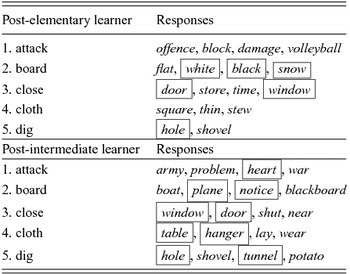
In a preliminary investigation to the main study presented below, two subjects’ responses to five L2 word association cues were examined. The two subjects, a post-elementary L2 English learner, and a post-intermediate English learner, were not part of the experimental group. Two expert bilingual Japanese–English raters with L1 Japanese were asked to identify L2 collocations and thus likely L2 conceptual links in their responses. If the subjects produced what appeared to conceptually linked words in the L2, it was considered possible that they did not mediate the cue or respond through or via the L1. Table 1 shows the potential proportion of L1-mediated (not collocational) and not L1-mediated links (collocational links marked by a surrounding box) given by each of the two subjects.
Analysis of subject responses to five L2 cues. Potential collocational links are indicated by a surrounding box.

The analysis indicates that the more proficient learner provides a greater proportion of collocational links and, as a consequence, potentially mediated less when compared with the less proficient learner. The rationale for the current study is, then, that it might be profitable to observe how bilinguals provide evidence of associations in the second language. It is not, however, primarily concerned with individual development, and so does not relate task performance to overall proficiency or attempt to disentangle the extent to which presumed links might have been transferred from participants’ L1 (see Verspoor, Reference Verspoor, Boers and Lindstromberg2008). Instead, it focuses on the extent to which evidence from L2 word association behaviour might support the RHM rather than the potential divisions between L1 and L2 access.
The preliminary study just presented indicated that the proportion of likely mediated responses was smaller for the more advanced L2 learner. With this finding in mind, the research question for the current study is:
Do less proficient L2 learners mediate more through their L1 than more proficient L2 learners?
Method
Subjects
The subjects were 50 university students (28 males and 22 females, age range 18–23 years) studying English as a foreign language (EFL). The majority were Japanese L1 speakers, and the remainder (5%) speakers of L1 Mandarin, L1 Korean, and L1 Cantonese. The students, with an average number of eight years prior L2 English study, were taking three hours of English language classes a week at Osaka University. The classes took the form of speaking practice, in which students discussed social issues. The English proficiency of the subject group was judged by their teacher to range from pre-intermediate to advanced. The students did not take an independent test, such as TOEFL or TOEIC.
Instruments
The experiment employed two tasks: (i) Lex30 (Meara & Fitzpatrick, Reference Meara and Fitzpatrick2000); (ii) the Eurocentres Vocabulary Size Test (EVST; Meara & Jones, Reference Meara and Jones1990). The responses to (i) were subsequently scored by independent raters.
The first task, Lex30, was used as a word-association task, even though it was not designed as such (Fitzpatrick & Meara, Reference Fitzpatrick and Meara2004, p. 55). However, it is principally “an effective and efficient elicitation tool, which can be combined with a range of analytical measures” (Fitzpatrick & Clenton, Reference Fitzpatrick and Clenton2010, p. 551). Hence, Lex30 was used with the broad aim of eliciting a variety of responses alongside other tasks in this experiment; the responses provided the dependent variable.
Lex30 presents non-native speaker subjects with a list of 30 stimulus words in the L2 (English). Subjects are required to produce up to four L2 words in response to each stimulus word provided. All of Meara and Fitzpatrick's (Reference Meara and Fitzpatrick2000) stimulus words came from Nation's (Reference Nation1984) 1k word list. The stimulus words were selected on the basis that they did not usually elicit a single, dominant response. In the Lex30 pilot study (Meara & Fitzpatrick, Reference Meara and Fitzpatrick2000), Lex30 scores represented the total number of infrequent words a subject produced. In later Lex30 studies (Fitzpatrick, Reference Fitzpatrick, Daller, Milton and Treffers-Daller2007; Fitzpatrick & Clenton, Reference Fitzpatrick and Clenton2010; Fitzpatrick & Meara, Reference Fitzpatrick and Meara2004), individual scores were calculated by adding up all of the infrequent words that were then scored as a percentage of the total number of words produced by each subject, to minimize the influence of the subjects producing variable number of responses. The same approach to scoring was employed in the current study.
The second task, the EVST (Meara & Jones, Reference Meara and Jones1990), was used to determine the subjects’ proficiency in English as the main independent variable to divide the learners into five groups. The EVST is a receptive vocabulary test, which has shown high correlations with other measures of L2 vocabulary (e.g. Meara, Lightbown & Halter, Reference Meara, Lightbown and Halter1994; Wesche & Paribakht, Reference Wesche and Paribakht1996), as well as with Lex30 (Fitzpatrick & Meara, Reference Fitzpatrick and Meara2004; Fitzpatrick & Wray, Reference Fitzpatrick and Wray2006; Meara & Fitzpatrick, Reference Meara and Fitzpatrick2000). It has also been described as “suitable” as a placement test (Schmitt, Reference Schmitt2000, p. 175) and “believable” at providing “estimates of vocabulary size” (Milton & Alexiou, Reference Milton, Alexiou, Richards, Daller, Malvern, Meara, Milton and Treffers-Daller2009, p. 198).
The EVST tests knowledge of words up to a ceiling of 10,000 words from the Thorndike and Lorge (Reference Thorndike and Lorge1944) list. The final test score is considered representative of subjects’ vocabulary size. It tests receptive knowledge of vocabulary in the form of yes/no questions as to whether subjects “know” a given word, assuming a direct relationship between the likelihood that a subject will know the word and its frequency. The test begins with the easiest (or most frequent words) and gets progressively more difficult (with less frequent words). Hence, the test starts with the first thousand words and proceeds in sequence up to the tenth thousand words. At each 1000-word band, the program tests subjects with a random sample of 20 words. The EVST stops once performance falls below a particular threshold and carries out a detailed analysis at that level.
In the EVST, one third of the test items are non-words, and subjects score according to the number of correctly identified words, or “hits”, while marks are deducted for incorrectly identifying non-words as known (“misses”). Consequently, subjects who identify only words they really do know are credited.
Two fully bilingual Japanese–English speakers acted as expert raters on the responses provided to the cues of the Lex30 task. Both expert raters were Japanese with fluent L2 English. Their task was to identify subject responses that likely represented an L2 collocational link to a Lex30 cue (see Table 1 as an example).
Procedure
Both tasks were administered to the subjects within class time. First, the subjects were given the paper version of the Lex30 task. As was done in Meara and Fitzpatrick (Reference Meara and Fitzpatrick2000), the Lex30 cue words were presented as a list. The task took approximately 15 minutes. Second, subjects took the lexical decision (EVST) task, which took approximately 10 minutes.
The identification of collocational links by the two expert raters was conducted separately in the raters’ own time. The raters were given printed copies of each subject's Lex30 responses and were asked to identify any occurrences of L2 collocations with the Lex30 cues. They were asked to circle the cases where they considered a collocational link had been made. Rating for each subject took approximately 10 minutes.
Scoring
Each set of Lex30 responses was typed into a computer text file in order to score the data using the Lex scorer software (v. 2.01; Fitzpatrick & Meara, Reference Fitzpatrick and Meara2004), correcting any obvious misspellings. In the same way as in the original Lex30 study (Meara & Fitzpatrick, Reference Meara and Fitzpatrick2000, pp. 29–30), subject data were lemmatized using Bauer and Nation's (Reference Bauer and Nation1993) word family categories for Level 2 and 3 affixes. By choosing only to lemmatize words with relatively frequent affixes (Level 2 and 3 of Bauer and Nation's (Reference Bauer and Nation1993) lists), credit was given for use of less frequent morphology. For instance, one subject's response “virtually” to the 19th Lex30 cue “real” contains a Level 3 affix -ly and was lemmatized to virtual.
Each text was processed using the Lex scorer (Fitzpatrick & Meara, Reference Fitzpatrick and Meara2004), which produces a frequency profile according to Nation's (Reference Nation1984) frequency list. The scorer profiles subjects’ responses according to the number of Level 0, Level 1, Level 2, and Level 3 words. I followed Meara and Fitzpatrick's (Reference Meara and Fitzpatrick2000) procedure in data preparation and scoring. All proper nouns were counted as Level 0 words. Each subject's Lex30 score was calculated in the same way as Meara and Fitzpatrick (Reference Meara and Fitzpatrick2000), where any word produced outside of the Level 0 and 1 band scored one point (i.e. Lex30 score = Level 2 + Level 3 words).
Each set of Lex30 responses was given a rating score which was equivalent to the number of perceived L2 collocational links provided. To calculate a mediation score, the rating score was subtracted from the total number of words produced for the Lex30 task (i.e. mediation score = number of words produced for Lex30 − L2 collocation rating score). In order to match individual Lex30 percentage scores with mediation scores, as well as to minimize the influence of the subjects producing a variable number of responses, individual mediation scores were calculated by adding up all of the recorded mediated words that were then scored as a percentage of the total number of words produced by each subject.
Results
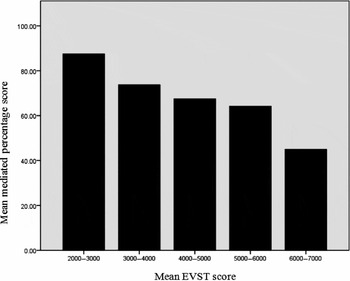
The results of the tasks can be seen in Table 2. The mean EVST scores were used as the independent variable to establish five learner groups. Table 2 shows the EVST scores compared with the mean mediated percentage scores.
Mean EVST scores and mean L1-mediated percentage scores (SDs in parentheses).

Correlations between mean mediated percentage scores and mean EVST scores suggest that a subject scoring lower on the EVST will tend to mediate via the L1 a greater number of times compared to a subject scoring higher on the EVST. The standard deviations suggest that there was minimal variation across the task scores.
How the EVST scores relate to mediation can also be graphically seen in Figure 1 below. Spearman's rank order correlation between the EVST scores and the mediated percentage scores was r = .871 (p < .01). This indicates that subjects with a high EVST score also tended not to mediate via their L1 in response to the word association task, and that these tasks appear largely predictive of one another.
Comparison of mean mediated percentage scores and mean EVST scores.

In addition, Spearman's rank order correlation between the EVST and Lex30 task scores was r = .633 (p < .01), indicating that subjects with a high proficiency in English, as judged by the EVST, also tended to produce a relatively high number of infrequent words in response to the Lex30 task.
Discussion
The main purpose of the work described in this paper has been to examine the extent to which the L2 developmental changes predicted by Kroll and Stewart's (Reference Kroll and Stewart1994) Revised Hierarchical Model (RHM) can be understood by word association response behaviour. The RHM attempts to account for the relative “strength of the links between words and concepts in each of the bilingual's languages” (Kroll, Van Hell, Tokowicz & Green, Reference Kroll, Van Hell, Tokowicz and Green2010, p. 373) and suggests that subjects with higher L2 proficiency rely less on L1 mediation, while less proficient L2 learners do rely on mediation and access L2 words by translating from L1 equivalents.
The results reported in this paper appear broadly supportive of Kroll and Stewart's hypothesis. The two expert raters’ mediation scores relate to the independent measure (the EVST): a low EVST score tended to reflect a high mediation score, and a high EVST score tended to reflect a low mediation score. The results lend tentative support to the notion that mediation via the L1 diminishes with a change in L2 proficiency in terms of word association response behaviour, and therefore to the developmental changes predicted by the RHM. The current study does not examine reaction times and does not consider potential influencing factors (Pavlenko, Reference Pavlenko and Pavlenko2009) assumed from shared categories. The current study might, however, have the potential to act as a quick tool to assess bilingual response behaviour. This line of argument, however, is far from straightforward, and the assumptions behind it need examining in somewhat more detail.
A concern is whether the perceived access to and production of L2 collocations occurred in the manner anticipated. The collocations were understood as being representative of L2 collocational knowledge and, as a result, demonstrative of L2 semantic understanding. Yet Kroll et al. (Reference Kroll, Van Hell, Tokowicz and Green2010) point out that the literature on bilingual memory is equivocal when it comes to understanding the extent to which even highly proficient L2 learners are fully able to access such semantic information in the L2. This suggests that additional studies should further explore the extent to which L2 collocational knowledge fully reflects L2 semantic usage before claims can be made about the semantic relationship with L2 proficiency. This concern also relates to Verspoor's (Reference Verspoor, Boers and Lindstromberg2008) suggestion, presented in the Introduction to this paper, that conceptual stores do not overlap and that students bring their L1 associations with them irrespective of L2 proficiency gains.
It is not impossible to imagine cases where subjects’ assumed L1 mediation may not be consistent with the way they actually conceive L2 words since it is difficult to ascribe responses as representative of only the L2, for instance, responses to the cue attack understood to be L2 associations of kidnap, struggle, offence. Thus, rather than offering a global indication of L2 proficiency mediation, word associations might actually be word-dependent (Kroll & Tokowicz, Reference Kroll, Tokowicz, Kroll and de Groot2005, pp. 538, 546). In other words, subjects may provide what appear to be L2 collocations, but the given associations might be considered, by raters, differently in both languages and might be consistently word-dependent regardless of language or proficiency.
Two studies support this claim (De Groot & Poot, Reference De Groot and Poot1997; Van Hell & De Groot, Reference Van Hell and De Groot1998). De Groot and Poot's (Reference De Groot and Poot1997) study implies that there is a concrete–abstract word distinction inconsistent with the L2 proficiency predictions of the RHM. Moreover, Van Hell and De Groot's (Reference Van Hell and De Groot1998) word association study suggests that word type or grammatical class might influence mediation via the L1, as a consequence of the word's lexical category. Their study of Dutch–English bilinguals showed that concrete words and cognates are translated more often than abstract words and non-cognates, and, in terms of grammatical class, nouns are translated more often than verbs.
Two further issues stem from the language backgrounds of the subject group. The first of these relates to the particular orthographic backgrounds of the subject group. The group was predominantly made up of L1 Japanese subjects, with a minority of L1 Mandarin, L1 Korean, and L1 Cantonese speakers. Kroll et al. (Reference Kroll, Van Hell, Tokowicz and Green2010, pp. 2–3) suggest that bilingual subjects with “two languages [that] do not share the same written script” might be expected to respond in different ways when compared to same-script subjects. This suggests that a further study comparing the word association response behaviour of same-script bilinguals and different-script bilinguals might be worthwhile.
The second and related issue relates to the potential influence of cross-linguistic differences in the selected cues. Pavlenko (Reference Pavlenko and Pavlenko2009) cites numerous studies that avoid cross-linguistic differences (Caramazza & Brones, Reference Caramazza and Brones1980; Chen, Reference Chen1992; Dufour & Kroll, Reference Dufour and Kroll1995; McElree, Jia & Litvak, Reference McElree, Jia and Litvak2000) and suggests that even studies that eliminate clear translation equivalents (e.g. McElree et al., Reference McElree, Jia and Litvak2000) “distort(s) the picture of the bilingual lexicon” (Pavlenko, Reference Pavlenko and Pavlenko2009, p. 129). In this second regard, a further study examining the differences between different sets of cues, including and excluding translation equivalents, might shed light on this important issue.
Conclusion
This study has examined the hypotheses of Kroll and Stewart's (Reference Kroll and Stewart1994) Revised Hierarchical Model (RHM) in relation to responses provided for a word association task. The data reported suggests that this preliminary study has some potential to investigate possible changes during L2 development. Kroll and Stewart's (Reference Kroll and Stewart1994) RHM predicts that more proficient L2 subjects might rely less on L1 mediation as a consequence of L2 development. The results from the study presented here lend tentative support to Kroll and Stewart's model. The reported incidences of L1 mediation correlated with the independent variable task scores across the five learner groups. There are, of course, a number of outstanding issues which need examining, including the need to determine the extent to which L2 collocations also occur within the L1, same-script as well as different-script differences, and potential cross-linguistic influences that arise from cue selection. It is hoped that this study might stimulate further debate in this important area of research.