This article aims to illustrate, through a case study, the importance of the identity constitution of historical subjects to support the exercise of property rights. The focus is on a type of property, communal lands, which are the subject of an extensive literature and heated debates (Baden and Noonan, Reference Baden and Noonan1998; Dietz et al., Reference Dietz, Dolšak, Ostrom, Stern, Stonich and Weber2002; Bardhan and Ray, Reference Bardhan and Ray2007). It also emphasises the importance of membership of a neighbourhood as a requirement for civil rights and citizenship (Izquierdo, Reference Izquierdo2001; Carzolio, Reference Carzolio2002; Herzog, Reference Herzog2006). The case that I analyse does not follow the standard form of privatisation of common lands in Spain, but the result is similar, to not only the Spanish but also the European pattern (Lana, Reference Lana-Berasain2008; Iriarte-Goñi, Reference Iriarte-Goñi2002; Jiménez-Blanco, Reference Jiménez-Blanco2002; Demèlas and Vivier, Reference Demélas and Vivier2003). It focuses on one very small village in the north of Spain, but this does not detract from its interest. Rather, reducing the scale of observation through a specific and localised point of view, helps to formulate general laws. The analysis of a particular example, while recognising the extent of its exceptionality, can provide the basis of a more realistic understanding of the general processes of which the case study is part (Levi, Reference Levi1999: 53).
The village of Sansomáin is located twenty-eight kilometres south of Pamplona city, in northern Spain. Its population went from fifty-three inhabitants in 1796 to thirty-two in 1887 and two in 1981, and its territory embraces 327.63 hectares. Located between 400 to 600 metres above sea level, its slope factor ranges between five and ten per cent and the annual rainfall averages 500 to 600 millimetres, with significant summer aridity, and the naturally argillaceous lands are not particularly fertile.Footnote 1 A sober Gothic church and a palace with a coat of arms chiselled into its ashlar masonry, together with the fact that most of the land belongs to a single owner, suggest a linear history: from an ancient feudal estate to a great farm. However, appearances are often deceptive, and Sansomáin hides a much less linear past than one might think, at a first glance. In fact, the village hides a drama that will develop in three acts and a coda.
I
On 10th July 1509, in a countryside chapel not far from Sansomáin and Pueyo, the neighbours and authorities of both villages assembled. They came together in order to restate and enhance the rules governing their coexistence and the management of their resources. Well aware of the fact that ‘the boundaries of Pueyo and Sansomáin are quite small’ and that cooperation could help solve problems of scarcity, they had seen how ‘small and large livestock proliferate each day, by the will of God, causing plentiful damage to the crops’. Like many other rural communities in Europe (De Moor, Shaw-Taylor and Warde, Reference Moor, Shaw-Taylor and Warde2002: 250–251; Winchester, Reference Winchester2000: 79–82), they all agreed to limit the number of livestock that each settler could keep in shared grazing land to 300 sheep and twenty head of cattle. Additionally, they commissioned one person from each village to draw up new bylaws for the good governance of both localities, in accordance with custom. The final document enumerates forty-one articles regulating the religious, political, labour-related, economic and environmental aspects of social life. A wide array of penalties was established, including cash fines of widely varying amounts and in some cases major payments in kind.Footnote 2
The final affidavit produced by the notary shows that both Pueyo and Sansomáin were acting as recognisable political subjects, although ‘they had been living and had lived as one together some time ago’. Even if the village barely numbered five homes, its legitimacy was not questioned. A repeated formula in this and other documents is the civil triptych of ‘jury, neighbours and council’ (jurado, vecinos y concejo). This gives material form to the communal institution formed by the executive authority (the jury) rigorously served in turn by the houses, the politically visible, rights-bearing individuals (the neighbours), and the congregation of all of the latter in the public assembly (the council).
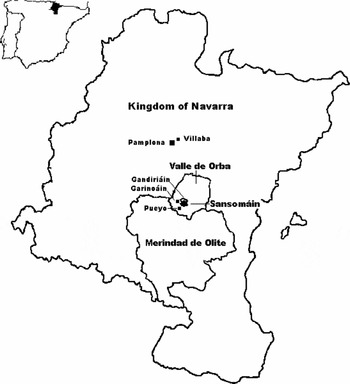
The village community enjoyed political visibility through a vertical nested succession of larger political bodies: the council of Sansomáin formed part of the Valle de Orba, the Valle was part of the Merindad de Olite, the Merindad was part of the Reino de Navarra, and this Kingdom formed part of the Spanish Crown from 1513 (see Map 1). As a basic political unit, the council was made up of those who exercised full political rights: the ‘neighbours’ (vecinos). Being a neighbour entailed a series of privileges and duties. Among the former were the right to exploit and administer communal resources and the right to speak out and vote at the town hall. Among the latter were the obligations to carry out public duties and trades, to be held both jointly and severally liable to communal expenses and military duties, and to pay tax (Herzog, Reference Herzog2006:235–83; Izquierdo, Reference Izquierdo2001: 245–372; Fernández-Albadalejo, Reference Fernández-Albadalejo1992; Monsalvo, Reference Monsalvo1988).
Villages and territories cited in the text

Not all of Sansomáin's residents were neighbours, nor did all of its neighbours reside there. Being a neighbour was not a condition related to an individual's character but rather to his property ownership status. The 1645 fiscal census identified six households, but for three of them, the occupants were labelled as moradores or village dwellers, meaning those residents who were denied property ownership rights. One of these dwellers was the parish priest and the other two lived as tenants in houses belonging to two foreign owners. The latter were known as vecinos foranos (foreign neighbours), and through them the tenants were able to obtain access to communal pastures for their livestock (Floristán-Imízcoz, Reference Floristán-Imízcoz1985).Footnote 3
These vecinos foranos were probably the descendants of early resident neighbours who had either sold their houses and belongings, or emigrated.Footnote 4 This is the case of the owner of the palace of Sansomáin, who moved into another palace located five kilometres away from the village in the early seventeenth century, finally leaving the region a century later (Olcoz-Ojer, Reference Olcoz-Ojer1971: 408–10). The link between nobility and foreign neighbour status was not uncommon, given that the former was a condition for the latter. The feudal parliament (Cortes) of the Kingdom of Navarre, joined in 1743–1744, described foreign neighbourhoods as a ‘characteristic example of the Kingdom's graciousness and nobility’ which ‘bestow grazing rights on whomever have them, in those places in which they are foreign neighbours’ (Cuadernos, 1964, I: 204–8). Yet the foreign neighbours also had responsibilities. The 1509 regulations describe them in detail: should they wish to exercise their rights, they had to appear before the council each year on St. Michael's Day (29th September) and pay a bail in kind of twenty-two kilograms of wheat. In addition, should they wish to sell their neighbourhood rights, they were limited to a maximum price of 2,500 silver reales, and were required to notify the council in advance about their decision, so that it could buy them within a year. In fact, the council of Sansomáin exercised this right in 1716 paying 715 reales for a piece of land with neighbourhood rights, on the grounds that the buyer ‘is very well-off, has a lot of livestock and if he were to be admitted. . ., the land being so small, and there being only three resident neighbours, all of their grazing lands would be consumed’.Footnote 5
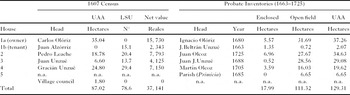
From what has been explained up to this point, one can tell that this was not a community of equals, but a ‘stratified, hierarchical society with complex mechanisms of solidarity’ (Levi, Reference Levi2002: 196). Between 1560 and 1630, a major share of the conflicts arose from the struggle for the acknowledgement of hierarchy, with the local church as a venue.Footnote 6 The owner of the palace was also trying to distinguish himself from the rest of the neighbours by trying to avoid all duties intrinsic to the neighbour status, such as the obligation to serve as juror and the payment of direct tax (cuarteles).Footnote 7 The census of the country's wealth made in 1607 provides a global estimate of wealth differences. The general picture (Table 1) shows a significant gap between most of the villagers and Carlos Olóriz, the owner of Sansomáin palace. A tenant, who also declared his livestock, farmed the palace's thirty-five hectares, whilst the other three farms ranged from six to twenty-five hectares. The 1607 statements show eighty-seven hectares of arable lands, while public inventories from 1680 to 1725 indicate 130 hectares of arable lands, accounting for 39.5% of the total territory, from which fourteen per cent were enclosed by stone walls and the rest remained as an open field. This difference may be due to the fact that neighbours were free, according to custom, to ‘plough uncultivated common lands between the lots’ which were ‘given in property and possession to the neighbours who first cleared them’.Footnote 8
Land property and wealth distribution in Sansomáin in the seventeenth century from several sources

UAA: Utilised Agricultural Area; LSU: Livestock Units (according to Eurofarm coefficients.)
Note: The same numeration of the houses will be used in subsequent tables.
Sources: [AGN, Comptos, cj. 32047, n° 33] Rodríguez-Garraza (Reference Rodríguez-Garraza1995); [AGN/PN, JL 1680 n° 42; BE 1726/2 s/n; JL 1688 n° 31; JL 1709 n°66; JL 1685 n°72; MH 1663 n° 67]; http://epp.eurostat.ec.europa.eu
The local jury declared, on behalf of the council, that they were in possession of a modest oak forest which served as an ox pen and two common allotments which were in leasing and that when their herds had no sustenance due to the critical scarcity of grass caused by summer aridity, it should be grazed abroad for three months of the year.Footnote 9 On a few occasions and in order to finance extraordinary expenses, the council rented the scrubland and one of the meadows which were used to feed draft animals.Footnote 10 Thanks to the grazing agreements (facería) with Pueyo, the village enjoyed a larger usable area than that encircled by the half-buried marker stones indicating its perimeter. In turn, Pueyo's livestock could use its lands, except for the enclosed and forbidden areas (vedados). This shared use of land resulted in multiple disputes between the stockbreeders and the other neighbours from both villages, but up to the mid eighteenth century, these conflicts posed no threat to the established grazing sharing agreement.Footnote 11 Furthermore, the village enjoyed another commonwealth of pastures, with Pueyo and Garínoain. This area, also known as Gandiriáin, was a medieval, uninhabited ninety-hectare area north of Sansomáin, where neighbours of the three villages had unlimited grazing and farming rights.Footnote 12
The ‘village republic’ of Sansomáin appears to meet conditions that could ensure a long life for their communal institutions. The small scale means that ‘members can have face-to-face contact with one another’ (Olson, Reference Olson1965: 62; Wade, Reference Wade1994). The boundaries of both common resources and the user community were clearly defined. Conditions of usage and restrictions according to time, place and intensity of use were established by local rules which could be modified at will by the users themselves. Some mechanisms of community surveillance existed and were enhanced by a range of fines and other penalties. Local justice would settle minor conflicts while more severe disputes were resolved in the Kingdom's courts, which were accessible in terms of both distance and cost. The community enjoyed political standing and freedom to organise itself without external interference, being also part of the larger institutional systems within which it operated reasonably well (Ostrom, Reference Ostrom1990: 90; McKean, Reference McKean, Gibson, McKean and Ostrom2000; Agrawal, Reference Agrawal, Bradham and Ray2007). Nonetheless, between the eighteenth and nineteenth centuries, the community of Sansomáin collapsed. The small size, along with other factors, proved to be a trap. The second act begins.
II
Joaquín-José Labiano, the vicar of Villaba, a village located next to Pamplona city, is our new leading character. Being the son of Juan Labiano, a notary from Pueyo, he possessed good inside information on the economics of the region. His father witnessed countless contracts, both public and private, including private wills, municipal bylaws, marriage contracts, inventories, purchases and sales, rentals, loans and mortgages. Moreover, his family was undergoing a process of upward social mobility. This notary was promoted to the nobility in 1693 and two of his sons were accepted as Knights of the Order of Santiago, a distinction only granted to nobles. Manuel-Silvestre Labiano, who was one of these Knights, had a career as a servant of the Crown and obtained a nomination as governor of the Quijos y Macas province, in the Viceroyalty of New Granada. In his will, signed in July 1745 in Quito, Manuel-Silvestre appointed his brothers as his heirs, reserving a fund of forty thousand pesos, or 320,000 reales, for the establishment of a Carmelite convent in Pueyo. He appointed Joaquín-José as his executor, giving him the responsibility of initiating the legal proceedings necessary to repatriate the capital taken from the Americas and invest it in Europe.Footnote 13 His attention was drawn to the three houses in Sansomáin belonging to resident neighbours, of whose financial problems he was aware.
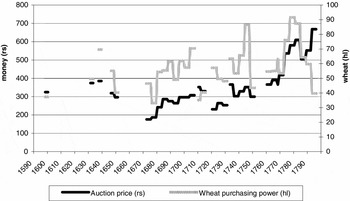
Things had not gone too well during the previous century for the people in Sansomáin. As in many parts of Europe (DuPlessis, Reference DuPlessis1997; van Zanden, Reference Zanden2009: 241; Moore, Reference Moore2010a, Reference Moore2010b), the mid seventeenth century produced signs of environmental, demographic and economic exhaustion and in the early decades of the eighteenth century the bad years were repeated. Sources refer in 1669 to ‘the years that have run extremely needy’, and in 1720 allude to ‘the unfruitful years and their scanty harvests’.Footnote 14 The evolution of the auction price of the parish primicia (the second of the rights the Church exercised on the crop, in addition to the tithe), serves as a relative indicator.Footnote 15 Between the 1630s and the 1670s, prices plummeted; both in nominal value and in real value (see Figure 1). This fall coincided with a general deflation and a decline in demand. The nearest urban market, Pamplona, saw its population decrease from 1,829 households in 1647 to 1,752 in 1677, while average prices of wheat fell by thirty-four per cent between 1630–45 and 1660–75 (Garcia-Zuniga, Reference García-Zúñiga1996; Arízcun, Reference Arízcun1989). During the first third of the eighteenth century, primicia's auction prices fell again, to recover only when Sansomáin and Pueyo's first fruits were collectively put up for auction in 1732. In brief, the 1637–39 auction price was not reached until 1764–67.
Auction of Sansomáin's tithes (Primicia), 1598–1796: auction prices and wheat purchasing power, in Pamplona's average prices

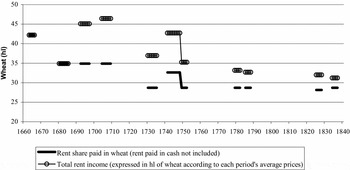
Another useful indicator is the rental price of the palace and its adjacent lands (see Figure 2).Footnote 16 Only some of the clauses of the rental agreement were modified between 1664 and 1825. Up to 1692, the transfer of property rights excluded a two hectare enclosed vineyard, which was kept by the seller together with the winery and grazing rights for his livestock. In 1704 and 1741, a rent reduction was agreed for the event that the owner ceased to keep his livestock on the property. With these explanations, the rent bid curve can be better understood. The drop in value that took place between 1666 and 1680 is real but the increase shown immediately afterwards, with the addition of the vineyard, is not. The decline of land rental is an important aspect to be borne in mind when viewing things over the long term since it probably provides evidence of soil exhaustion, a drop in yield and a process of tenant farmer impoverishment.
Sansomáin palace rent prices, 1663–1838, expressed in hl of wheat

The difficult conditions that triggered low harvests and suddenly plummeting prices in the context of a general depression left the village families in a structurally weak financial position. This was reinforced by the inheritance rules prevailing in the region. Property was transferred as a lump sum to a single heir who, in exchange, was committed to compensate his or her siblings with a dowry that was generous enough for them to marry into a social stratum that might be considered appropriate (Moreno and Zabalza, Reference Moreno and Zabalza1999: 300–53; Anderson, Reference Anderson2007). If we add these amounts to other expenses the neighbours had to pay, such as taxes and the six long and costly lawsuits defended between 1663 and 1738 before the courts, we come to the conclusion that saving became simply impossible.Footnote 17 And with no savings, there was no possibility of investing even in the most basic repair and maintenance tasks (Malanima, Reference Malanima2003: 224–35). There are abundant references to the state of deterioration of vineyards, buildings and fences (see Tables 1 and 3), as well as the abandonment of farmlands and the exhaustion of the soil. A rental contract for a farm, confiscated in 1665, shows that the creditor, acting as landlord, requires the tenant, for the full six years of duration of the contract, to ‘add some earth to the grounds as agreed’, that is, to put on a layer of fertile soil as a way of improving the productivity of the ground.Footnote 18 The financial difficulties and the ecological crisis that resulted from soil mining are shown in this anecdote as two sides of the same coin (Cunfer and Kraussmann, Reference Cunfer and Kraussmann2009; Moore, Reference Moore2010a).
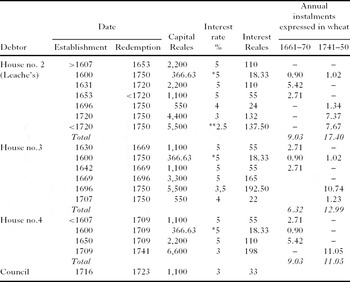
The weakening of income and the increase in expenses led these families into ever increasing debt. Table 2 shows all the long term mortgage loans (known as censo consignativo) which were taken out by the resident neighbours between 1600 and 1720. The fatal pattern of self financing indebtedness appears clearly. Previous loans were redeemed by new and more expensive ones, in a well known vicious circle (Bhaduri, Reference Bhaduri1987: 102–21; Tello, Reference Tello, de Dios, Infante, Robledo and Torijano2007; Minard and Woronoff, Reference Minard and Woronoff2003; Schofield and Lambrecht, Reference Schofield and Lambrecht2009). Interest rates tend to descend from the six per cent average prevailing at the end of the sixteenth century to an average 2.5 per cent in the 1730s, but the annual return rate does not cease to increase. The last two columns convert the annual return rates into wheat amounts, for the time period between 1660 and 1750, using decennial average prices in Pamplona. Because of the combined effects of an escalating debt and plummeting wheat prices, the three families went from having to earmark 24.38 hectolitres of wheat for repayment of loans in the 1660s to a total of 41.44 hectolitres in 1740. The real burden of the interest on their debt had, in fact, grown by seventy per cent, without taking default interest into account.
Long-term loans on the three houses of resident neighbours in Sansomáin between 1600 and 1750.

* The original loan was jointly borrowed at six per cent. This interest rate was reduced to five per cent in 1630.
** Original loan at 3%. It was reduced to 2.5% in 1732.
Fuentes: AGN/PN, JYM 1630 n° 64; JYM 1653/1 n° 136; AI 1696 n° 5; JL 1696 n°124; JL 1709 n° 66; ML 1707/1 n° 69; BE 1726/2 s/n; BE 1733 n° 11; BE 1740/1 n°95; BE 1748 n° 103; BE 1749 n° 30; JMA 1720 n°11, n°12. For wheat prices, see Arízcun (Reference Arízcun1989: 82–3).
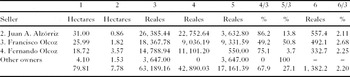
Sales of Sansomáin properties which ended up in the hands of the priest Joaquín-José Labiano, 1748–52

Note: 1. Total area for sale; 2. Enclosed area; 3. Sales value of the goods (including buildings); 4. Debt; 5. Amount of money collected in cash by the seller; 6. Value of rents collected by the new owner for these goods in 1749–54 (the collected wheat has been valued according to average prices in Pamplona for that period)
Sources: AGN/PN, BE 1740/1 n° 95; BE 1741 n° 116; BE 1748 n° 103; BE 1749 n° 23, n° 30, n° 31, n° 32, n° 33; AGN/TTRR, n° 061879; Arízcun (Reference Arízcun1989: 82–83).
Between 1720 and 1750 this increasing indebtedness plagued the three impoverished families. In 1726 Juan Lastiri, a prosperous merchant from Pamplona who became a creditor after having bought some credit titles while also granting a few himself, obtained a court order which ruled in favour of the forceful holding and auction of the profits of the Leache household assets.Footnote 19 Lastiri collected its rents, although the property continued to belong to the debtor, who gave the creditor permission to make repairs to the house which was ‘wrecked and in urgent need of repair’. The cost of dividing two homes was added to the cost of the forceful holding procedures; new defaults in the mortgage; crop sowing loans; rent debts from the time when the owners were tenants, and even debts from the funeral and burial of the debtor, who ‘died indigent and was buried by compassion’. Financial statements from 1741 and 1748 reflect the accelerated worsening of the situation. Between these two dates, the net debt (that is, net of the value of embargoed profits and the debtor's payments on account) grew by twenty-three per cent.Footnote 20 It was at this time that Joaquín-José Labiano played a significant part. He bought the mortgage credit on the house from Lastiri's heirs and offered a way out to the impoverished and illiterate Juan Alzórriz. The sales contract was signed in 1749 and, after valuing the house and its lands and paying off all the debts, Labiano handed the seller fourteen per cent of the property's real value.
Things went in a very similar way for the other two houses. The one which had belonged to Juan Unzué in 1607 was also embargoed by a court in 1737, and the rent for four years was auctioned in favour of the creditor, as established by law.Footnote 21 In 1748, payments in arrears accounted for around forty per cent of the mortgage capital and amounted to just over eleven yearly instalments. Labiano also took advantage of the circumstance by paying three instalments worth fifty per cent of the value of the goods in cash, and redeeming the mortgages. Francisco Olcoz, the seller, was soon signing a rental agreement for the lands he once owned.Footnote 22 The last house, which had belonged to Gracián Unzué in 1607, had by then already been handed to creditor Juan Lastiri by Fernando Olcoz, who was ‘very ill and aged’. The 1741 donation agreement did not even put a price on what was being transferred and merely ensured a few comforts for what was left of the donor's life.Footnote 23 In October 1748, Labiano acquired the house and its lands from Lastiri's heirs. In 1752 he completed the process by purchasing some lots from different owners as well as a final house that owned foreign neighbourhood rights.
The priest had, thus, partially achieved his goals. He had profitably invested the American capital, but he had been less successful in his second aim of founding a convent. In March 1751, the council of Pueyo opposed this venture by stating it would be ‘seriously burdensome, by reason of the smallness of the village, which possesses barely fifty neighbours, and its cost will surely absorb all of the village's assets in only a few years and all the best lands and properties will be requisitioned, since monasteries and convents always take possession of the places in which they are founded’. Finally, in 1789, an ecclesiastical court ruled that the founding of the convent was unsuitable and that the bequest should be distributed among the Labiano siblings.Footnote 24 Labiano was left alone to deal with the task of securing his privileged position in Sansomáin. In 1757 he demanded the courts acknowledge him as feudal lord, or ‘master or owner of his own taxes and serfs’, and also release him from paying direct tax. He failed. He litigated again in 1758, trying to get the council of Sansomáin to account for the rental of grazing lands and to give him the part that he thought belonged to him. The ruling denied Labiano the right to receive that money because he did not enjoy the status of neighbour. He returned to the courts again, in this case to insist on being recognised as a foreign neighbour. This time the ruling favoured him, and in November 1761, after honouring the villagers with ‘a decent meal which is customary on such occasions’, he was formally admitted as a vecino forano.Footnote 25
These events dealt a death blow to the community. Of the initial resident neighbours, one (Juan Alzórriz) emigrated, another (Francisco Olcoz) explicitly included his neighbourhood rights in a sales certificate and the third (Fernando Olcoz), who had kept the rights of speaking and voting at the council, died. The only one left was the local vicar, José Iriso, who took part in a dispute over the common goods in 1761, as ‘sole resident neighbour’.Footnote 26 After his death and the vacancy of the church, the only ones claiming full neighbourhood rights for themselves were two foreigners: Juan-José Salaberri, the owner of the palace, and Santiago Labiano, heir to his brother.Footnote 27 There had been a failure in resilience. It is time to begin the third act.
III
Madrid, 22nd May 1821. Representatives Dolarea and Giraldo were in the Constitutional Courts, supporting a ruling by the Law Commission to abolish foreign neighbourhood rights as feudal privileges being ‘incompatible with the Constitution’. In the words of the Commission itself, such rights (vecindad forana) were defined as follows: ‘grazing rights and other communal entitlements in one or more towns in which the foreign neighbour does not reside, with no subjection to neighbourly burdens, when said neighbour is related to the nobility and may acquire nobility status by the sole act of purchasing a common or noble house of a certain dimension in towns, whereas, such act of purchase produces no effect, whatsoever, if it is carried out by someone of a different class’.Footnote 28 The ruling was in response to a previous petition by ninety-nine towns from the province of Navarre, among which the council of Sansomáin can be found. With the support of a Parliamentary majority, the decree was forwarded to the provincial authorities. Five aristocrats addressed the Courts in defence of ‘the respectable grazing rights and usage of other village resources’, but their petition was rejected.Footnote 29 The military coup by the Holy Alliance re-established absolute monarchy in Spain in 1823 and so caused this and other laws to be revoked.
The issue had also been addressed five years earlier by the feudal parliament of Navarre. In September 1817, a petition from several villages started a debate on the political rights and usage of communal resources of those who resided in such places. In many places some families enjoyed the status of neighbours, while other villagers, summarily dismissed as caseros or tenants, were denied that right, even though they were landowners. The Courts’ Law Commission went further than the original petition. It proposed a law by which, in any town, any inhabitant who owned a house or a piece of land of at least 1.8 hectares ‘is recognized as and considered to be a lawful neighbour and, as such, has conciliar rights and participates in all communal expenses and benefits, public employments and costs and is to be treated in the same way as anyone who, possessing no house or property, has lived in the town for ten consecutive years in an open house, even if it were rented’.Footnote 30 The drafted law went on but could not be passed, due to the fact that the period granted to the Courts to function came to an end in August 1818. After the government change triggered by the revolution in 1820, the government's representative in the province declared in 1821 he had ‘taken pertinent measures to ensure that those currently known as caseros or who live in rented houses be considered in their lawful right to live as true neighbours with full rights’.Footnote 31
The challenge to the new constitutional regime, therefore, offered two dimensions: on the one hand, the full set of rights for all inhabitants of the villages who already suffered from their burdens and responsibilities; on the other, the privilege of noblemen who enjoyed full rights in places where they did not live, in most cases without fiscal or any other responsibilities. The above mentioned petition presented to the liberal courts expressed this point unambiguously:
If, according to the general principles of law, neighbourhood rights are only acquirable by residence, it will be as unfair for the person who resides in a town with his family for the time and in the conditions established by the law, not to be granted neighbourhood rights and all related benefits and privileges, as it will be that such rights and privileges should be enjoyed by those who do not reside in the village for the better part of the year, for not only are such situations against the general principles of law but, they are also an obstacle to the increasing of general wealth, population and agriculture, as has been proven.Footnote 32
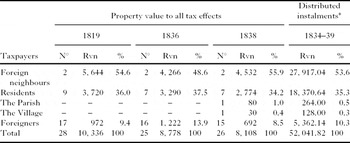
The final settling of this problem occurred, however, in a difficult, uncertain and violent context. The Napoleonic military occupation in 1808 and the Peninsular War which lasted until 1813 gave occasion for the first trial of a liberal political regime in Spain: the Courts of Cádiz (1810–14). The absolute monarchy was restored immediately through a coup d'etat, but six years later, the revolutionary movement of 1820 put into practice the work of Cádiz. Counter-revolutionary insurrection and international legitimism were to put an end to this brief interlude in 1823. But, the new ideas saw their triumph one decade later, first in the form of a charte otorgée system (1834) that allowed integration of the more moderate sectors of liberalism and traditionalism; and soon after, in a more radical manner in the social unrest of 1835 and 1836 facilitated by the pressure of the 1833 Carlist counter-revolutionary uprising and the state of civil war that succeeded it lasting until 1839. During that period, neighbourly burdens and responsibilities were enormously heavy. In Sansomáin, as in other towns, one of the main topics of concern was how the fiscal effort had to be distributed (Ragan, Reference Ragan, Ragan and Williams1992). The palace had enjoyed the privilege of not paying direct tax and Labiano had also unsuccessfully tried to attain that privilege from the courts. The Napoleonic occupation and the subsequent tax spiral enforced new game rules in which exemptions were no longer an option (De la Torre, Reference De-la-Torre1991). In 1808 the authorities of the Valley of Orba seized the tithes from all the parishes and forcefully held the rent wheat of the palace of Sansomáin in 1810.Footnote 33 Even after the end of the war, the fiscal hardship continued. In 1818, feudal Courts addressed the creation of a land registry which provides a clear picture of wealth distribution in Sansomáin (Table 4). In this document, both the owners with foreign neighbourhood rights are marked as ‘owners of the village’. It would seem that the domination of these two neighbours had been firmly established, but two years later Sansomáin would sign the petition to the Constitutional Courts. The 1838 land register adds two taxpayers whose identity had, until then, been kept hidden: the parish and El Pueblo (the village). This was a sign of the community's desire to come back under the new political framework.
Sansomáin, 1834–39: Distribution of the war levy on the base of taxable capital listed in the land registers. Expressed in reales vellón of 34 maravedís (rvn)

* Total amounts of instalments that were given to each taxpayer on 2nd November 1836 (at 202%), 24th December 1838 (at 330%) and 26th August 1839 (at 90.5%). This list excludes the distributions (at 100%) of 27th August 1838 and 1st January 1839, as those were advance payments.
Sources: AGN/PN, JBA 1836/1 n° 8; JBA 1838/1 n° 17; JBA 1838/2 n° 154; JBA 1839/1 n° 28; JBA 1839/1 n° 21.
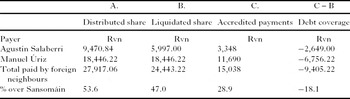
The counter-revolutionary uprising and the 1833–39 civil war caused a new skyrocketing of fiscal pressure. According to the four public settlements signed before a notary, the troops had taken more than thirty thousand rations from the village in those six years.Footnote 34 Including disbursements in cash and in kind, Sansomáin had handed over fifty thousand reales de vellón (copper coins), an amount which was worth five to six times the fiscal property value, according to the 1819, 1836 and 1837 land registers. The distribution of this burden was not equitable. The presence of the troops allowed them to coerce the local inhabitants to pay them, by means of intimidation and violence, whereas foreigners were safe from these exactions. Hence, when the war was over, the council found that the two owners with foreign neighbourhood rights had only paid in advance for half the value of the payments handed out to them in 1836, 1838 and 1839 (see Table 5). In addition, the owner of the palace resorted to his status as a member of the National Militia to evade tax, since a ministerial decree between 1835 and 1837 had established that privilege for whoever had enrolled in the militia. As a result, he was finally charged a third less than the initial amount. This discount affected the residents, who were themselves quite aware that ‘the non-collectable part of all debts’ ultimately resulted in ‘damage to the residents in the village’.Footnote 35
War supply payments in Sansomáin between the village and the two foreign neighbours, 1834–39. Expressed in reales vellón de 34 maravedís (rvn)

Sources: AGN/PN, JBA 1836/1 n° 8; JBA 1838/1 n° 17; JBA 1838/2 n° 154; JBA 1839/1 n° 28; JBA 1839/1 n° 21; JBA 1840/2 n° 48.
From the tensions arising from these operations of collection and distribution of the fiscal burden, emerged the harsh dispute over the status and political rights of both groups. The jury of Sansomáin, now called the regidor, went to meetings organised by the Valley of Orba to distribute fiscal burdens between the villages, ordered the updating of the land register, distributed instalments to each taxpayer, played a role in tax collection and hired an experienced accountant from Pamplona to help with the financial statements.Footnote 36 For those who were unacquainted with taxpaying, the freedom with which the regidor acted must have seemed an unbearable act of insolence. The representative of Salaberri resisted paying, claiming a host of pretexts but, above all, he disparaged that ‘regidor Elizalde is a mere wage-earner whom no one knows about and who, up to this moment, has earned his bread by working as a watchman in the owners’ fields’.Footnote 37 In its response to provincial authorities, the council defended the accuracy and transparency of its proceedings and complained that the representative of Salaberri ‘has treated the jury and the neighbours with unbearable harshness and contempt and has even threatened them in multiple ways and all this to relegate them to the worst possible place among the valley residents’, when they ‘all pay their taxes with great punctuality’.Footnote 38 This clash entails a struggle for recognition or a logomachy (Honneth, Reference Honneth1997: 193–205). Those who used to register as caseros now claimed to be recognised as vecinos (neighbours) and wanted the local authority to be fully respected, with its composition based upon nothing else but the rights of citizenship that come with the new liberal political structure. Owners with foreign neighbourhood rights, on the other hand, claimed to be ‘the only neighbours and owners of houses, crop and scrublands, and other possessions in the region, whose inhabitants are mere tenants and lodgers with no rights or belongings whatsoever’, and denounced the ‘inappropriate behaviour of those tenants’.Footnote 39
The controversy over the rights of use on communal land lay beyond the issue of recognition as political subjects. Salaberri complained that ‘with the excuse of the lawful owners’ absence and the circumstances of war, they have ploughed and are ploughing many lots with no right to do so and with serious consequences for the owners themselves’. He then requested the provincial authority to compel the ‘settlers to leave all the lands they have unlawfully ploughed, and pay off the rents due on those lands they have farmed, under supervisors’ scrutiny, and warn them so they refrain from doing it again in the future’. Once again, therefore, the core issues were the neighbourly status and its transfer into the new constitutional order, both of which had come to the fore in 1817 and 1821. The first problem to be solved was whether all residents, including those who were tenants only, were to be granted full neighbourhood rights, including access to communal goods. Additionally, it was to be decided whether or not owners who did not live in the village could continue to enjoy full neighbourhood rights, as a result of their noble rank. In this respect, Salaberri requested not only that the grazing rights be safeguarded but also that the right be transformed into an ownership right over the land which yielded such pastures. His petition also implied the denial of full neighbourhood and citizenship rights to tenants. The final decision belonged to the provincial council (Diputación Foral).
Between September 1839 and June 1840, the dispute was settled. In 1839 the ‘jury and neighbours’ had summoned the foreign owners, giving them adequate notice to submit the tax liquidation payment. While acknowledging receipt of the notice, they did not appear. In January 1840 the provincial council issued a decree approving the tax liquidation. In regard to the residents’ ploughing, the Diputación Foral sidestepped the matter through an ambiguous expression: ‘in regard to all other matters, make use of your rights’. Perhaps it wanted to indicate that Salaberri should defend his case in court, but we know that such litigation did not take place. In June 1840, a new council meeting which was attended by the representatives of Salaberri and Uriz, with Domingo Olcoz serving as regidor and without Elizalde, finally settled the outstanding payments for the war. The notary wrote, as an annex to the approving subpoena, that it remained ‘the responsibility of the owners or their representatives to settle the newly ploughed croplands, leave a few of the previous ones for pasture and ensure that the caseros’ draft animals do not perish’.Footnote 40 From that point on, we possess no further data. We do not know what passed through the villagers’ minds, compelling them to resume the disparaged status of caseros and accept that it was the privilege of the amos (lord) to privately control communal lands. Nevertheless, it is not hard to guess their reasoning. Financially worn out, under the veiled threat of eviction, distressed by the sole alternative of embarking on endless, costly legal processes and, maybe, even frightened at their own boldness, the resident farmers gave up. When information on communal goods was gathered in 1861, in compliance with the Disentailment Law, the municipality stated there was none, ‘as the tenants themselves acknowledge’.Footnote 41 In Sansomáin, the deep institutional transformations brought on by the liberal revolution had been of no use in extending full neighbourhood rights to resident tenants, or in eradicating foreign neighbourhood rights. After the May 1821 decree issued by the Constitutional Courts fell into oblivion, the Supreme Court's jurisprudence determined, in May 1867, that foreign neighbour status would continue to exist (Lacarra, Reference Lacarra1965: 503, 546–7, 634; Alonso, Reference Alonso1964, 2: 323–4; Toni-Compains Reference Toni-Compains1907: 240–1). Remarkably, just a year before, both of the properties with foreign neighbourhood rights had been united, after Isidoro Salaberri, Marquis of Murillo, had sold the palace house and its lands to Manuel Úriz. The area included by the latter in his name accounted for 216.36 hectares in 1867, i.e. 92.79 hectares more than appears in the 1837 land register.Footnote 42 However, nobody demanded to see the titles for those additional lands (Congost, Reference Congost2007: 253–78).
IV
By the time the houses and lands of Sansomáin were sold using a public deed for the last time, the village was on the brink of depopulation. This was in July 1957. The 1960 census had recorded only eight inhabitants. A story had been circulating in the village for some time, suggesting that it was an ancient feudal lordship which used to belong to a single owner. The contract pointed out that they kept ‘whatever resource made available to the sellers to claim lands belonging to the Lordship of Sansomáin and which appear registered under any other person’. This trumped up tale was first heard at the turn of the century. In 1902, a new secretary arrived to do the council's paperwork. Unlike his predecessor, who identified the members of the council as vecinos (neighbours), the new secretary refers to them as ‘the sole five tenants who form this Lordship’.Footnote 43 Four decades later, things were taken even further. The lawyer of the Ochoa siblings (the heirs of Úriz and, through him, of Labiano) claimed that ‘Sansomáin is not even a council, nor an administrative entity of any kind. It is nothing but a Lordship, Sansomáin, of the Marquis of Murillo, who sold it to Don Manuel Úriz’.Footnote 44
Signed in 1866, the deed of sale was prone to such manipulation, due to the numerous archaisms it contained, citing ‘the rights, honours and privileges that it has in the church and parish’, which were inherent to the palace. It also claimed that the buyer ‘with this addendum (for the rest of Sansomáin belongs to him) is left as sole owner, under a single regime of inheritance, or single-ownership’. The deed itself refuted this last assertion, for it listed eight nearby owners of lots adjacent to the lands that were being sold. Furthermore, twenty of the thirty-two lots sold were registered as being adjacent to ‘communal lands’ and ‘village commons’. This incriminating information, passed on from deed to deed, became relevant in 1933. After the Second Spanish Republic was proclaimed, one of the main issues on the political agenda was land distribution (Robledo, Reference Robledo1990; Riesco, Reference Riesco2006). The 1932 Land Reform Act established a national registry of farmlands which could be subject to expropriation. Under the name of Fernanda Lapoya-Uriz, that catalogue lists 228.24 hectares in Sansomáin. Out of a total forty-two lots, sixteen figure as adjacent to communal lands. It is not, therefore, strange that in such a progressive context an attempt was made to recover communal goods. A woman, Paula Flamarique, held the presidency of the council at the time. On her own behalf, she required the provincial council to approve an extraordinary expense of 3,500 pesetas to carry out the demarcation of communal lands and goods (deslinde). Her intention was to pay for that loan later, using the tolls which could be collected from the use of such lands.Footnote 45 The 1936 coup did away with all hope of making this initiative prosper.
Once the Civil War was over, Franco's regime established a new order which included the administration of the villages. Passed in 1945, the Local Regime Law interfered with certain aspects of the Navarrean autonomous municipal administration. When it was finally enforced in 1949 and the process began of forming town halls and councils in accordance with this new law, Sansomáin did not even fulfil the requirements.Footnote 46 By 1950 it had eighteen inhabitants, compared to thirty-one in 1930, and it simply ceased to exist as a local political and administrative unit. It had faded away like a dying candle. Around this time, the Ochoa siblings were litigating in court against the town halls of Pueyo and Garínoain, which had agreed to replace the traditional free grazing system in the lands of Gandiriáin with another system, based on auction rights and annual rents. They claimed ownership over a third of the lands, as lawful owners of the ‘Lordship’ of Sansomáin, and demanded that no action could be taken without their consent. Pueyo and Garínoain replied that Sansomáin was an ‘open council’ and that grazing rights were ‘exclusively neighbourly’, as opposed to patrimonial, rights. The ruling, however, was in favour of the plaintiffs, disregarding the existence of the council of Sansomáin and any form of communal property.
V
These events raise questions about the foundation of property rights and the basis on which they are supported. The economic literature on property rights is very abundant (Alchian and Demsetz, Reference Alchian and Demsetz1973; North and Thomas, Reference North and Thomas1978: 33–41; Schlager and Ostrom, Reference Schlager and Ostrom1992; Eggertsson, Reference Eggertsson1995; Getzler, Reference Getzler1996; Barzel, Reference Barzel1997; Aoki, Reference Aoki2001; Colombatto, Reference Colombatto2004), but, in most cases, operates in the abstract, without a recognition that there must always be a subject to whom these rights have been previously assigned. It is for this reason that the analysis of the historical evolution of property rights must take into account not just the study of abstract ideas, doctrines and laws, but also the concrete consideration of where the property rights are embodied in particular subjects. It should be borne in mind that such subjects operate within a specific context that establishes a framework and limits within which these rights can be exercised. Thus, instead of a linear, idealist, teleological, state-centred and top-down sequence, the study of social history reveals complex processes, with advances and setbacks and with tensions between social actors who struggle to reach solutions in their favour. It also shows that the same laws can produce very different results, depending on the specific actors and their contexts (Congost, Reference Congost2003; Congost and Santos, Reference Congost, Santos, Congost and Santos2010).
The present narrative builds a thread of continuousness and meaning from a set of unconnected fragments, across a period of five centuries. On the individual scale, it presents us with a case of downward social mobility, impoverishment and eviction. On the community scale, it traces a process by which communal goods were privatised. Seen in this light, there is not much to it. It fits the general process of primitive accumulation of capital, which was extensively observed in Europe at that time (Demelas and Vivier, Reference Demélas and Vivier2003). But, the peculiarity of this case lies in the way such a process occurred. One of the keys is, undoubtedly, money: profits, dowries, loans, taxes, and investment. And that is the reason why we have decided to follow the money trail. But, a second, equally important key are words, which ‘did not just reflect social and political reality; they were instruments for transforming reality’ (Hunt, Reference Hunt1989: 17). The social subjects use rhetoric, characterised as a ‘technology of persuasion’ (Candau, Reference Candau1998: 20), to define themselves and the others, to establish their place in the world, to dominate or to resist domination. They use words to build their identities and to define their battlefields and their rights (Bourdieu, Reference Bourdieu1992: 106). For even property rights belong to the realm of rhetoric. In the very act of speaking, invisible boundaries are drawn and, through words, an attempt is made to persuade others to refrain from crossing them. Thus, words interfere with reality, permeate it and sculpt it. But, they do not achieve this by themselves, by the power of ideas; they do it through the power that real agents can wield in their defence. It is those social subjects who count, in the end.
All three of Sansomáin's family heads described themselves as being of noble rank (hidalgos), and members of a privileged class. They had begun, in the sixteenth century, a stubborn fight for recognition among themselves, by fighting for a hierarchy which was symbolically expressed inside the church. However, from our position as outside observers, we would not hesitate to describe them as peasants, considering the value of their possessions, their way of life, and their participation in the community. Simultaneously noblemen and peasants, they were primarily neighbours. Their membership rights granted them political visibility, allowing them to self-govern and make use of communal resources, but they also gave them burdens of responsibility.
A fatal combination of events destroyed that framework. Situational hardships and structural weaknesses on the local stage led to a weakening of an already scanty saving capacity, a fall in production rates and an impossible indebtedness. Once their ownership of the land was lost, they also lost their neighbour's status. This they accepted but the community had not yet disappeared. The same burdens, responsibilities, conciliar tasks, common expenditures and taxes still existed and the tenants assumed them with responsibility. The zoning of the land had not been modified and neither had its use, or the communal status of the woodlands and grazing lands, even though the enjoyment of the latter was now controlled by the two owners who enjoyed foreign neighbourhood rights.
It was in this framework that the great disturbance caused by the French Revolution took place. At that defining moment, the struggle for recognition had broader implications (Tilly, Reference Tilly1995). Were the villagers neighbours or tenants? Was there a single citizenship or was the community riven by class distinctions? In spite of the establishing of legal precedents between 1817 and 1821 which could justify an outcome favourable to the residents, the final result was the exact opposite. The key lies in the highly unequal power structure that emerged at the precise moment when the new regime was becoming established after a devastating civil war. Given the weakness of the inhabitants of Sansomáin, only firm action from the new state could have generated a different outcome. Degraded to the condition of mere tenants all over again, the villagers also lost their grip on the ownership and management of communal lands. In the light of all that has been written about the inadequacies and limitations of the liberal revolution in nineteenth-century Spain (Fontana, Reference Fontana1975: 149–213), the end of the story is not surprising, after all. But, it adds a new outline, because it invites us to focus on a process of citizenship building. If the new state had wanted to extend neighbourhood rights to everyone and abolish the privileges of those who enjoyed rights without assuming the costs in 1821, it abandoned that idea in 1840. Instead of a complete citizenship, it provided for the creation of an implacable divide between owners and tenants. Ultimately, this led to the consolidation of a corrupted memory of the past.
Abbreviations
Reales: 16 quarters or 36 maravedís silver Navarrean reals
Rvn: 34 maravedís Castilian copper reals
1,000 Reales = 1,882.356 Rvn
Sources
AGN/TTRR. Archivo General de Navarra, sección Tribunales reales, Procesos (Royal Courts, Trials)
AGN/DFN. Archivo General de Navarra, sección Diputación Foral de Navarra (Regional Government)
AGN/R. Archivo General de Navarra, sección Reino (Kingdom)
AGN/ASRC. Archivo General de Navarra, sección Real Consejo, Archivo Secreto (Royal Court, secret files)
AGN/PN. Archivo General de Navarra, sección Protocolos notariales (Notary Records): AI (Agustín Iriarte); BE (Bernardo Echauri); FAE (Francisco-Antonio Echauri); FAZB (Francisco-Antonio Zubicoa de Badostáin); FB (Fulgencio Bengoechea); JAI (Juan Antonio Iriarte); JBA (Juan-Bautista Almazán); JDI (Juan-Dionisio Iriarte); JL (Juan Labiano); JMA (Juan-Manuel Ayerra); JYM (Juan Yelz de Monreal); LG (Lorenzo Garín); MAZ (Marcos-Antonio Zubicoa); ME (Manuel Echalecu); ML (Martín Leoz); SZ (Sebastián Zubicoa).
Acknowledgements
This paper has benefited from the OTRI-Contract 2009-005025 and from the research project HAR2009-09700, financed by the Spanish Ministry of Science and Innovation. I am indebted to Fernando Serrano-Larrayoz for his help in this research, and to Claudio Tagliapietra, Miguel Laborda-Pemán, Samuel Garrido, Lourenzo Fernández-Prieto, Josemari Aizpurua and the referees for valuable comments. The usual disclaimer applies.