Type 2 Diabetes Mellitus (T2DM) is a serious progressive endocrinology disease characterized by insulin resistance and/or impaired insulin secretion, which imposes great financial burden to health systems internationally. To date, there are approximately 20 million diabetes sufferers in China, and the number is expected to reach 50 million in 2025 (Reference Tang, Chen and Chen30).
According to COED-2 study conducted in Europe, a breakdown of cost drivers showed hospitalization contributed 55 percent of all direct medical costs for patients with T2DM, whereas insulin and other anti-diabetic drugs’ costs only accounted for 7 percent of total healthcare costs. Furthermore, this study also recognized that the presence of different diabetic-related complications was the single factor having the largest impact on costs of patients with T2DM, thus, highlighting complication costs as a substantial contributor of the direct medical cost burden of T2DM (Reference Jonsson13).
Liraglutide is a glucagon-like peptide-1 (GLP-1) receptor agonist, which is an incretin hormone analogue. It has just been introduced into China on October 9, 2011. As an anti-diabetic agent, liraglutide is the first once-daily human GLP-1 analogue with actions of stimulating insulin secretion from β-cell in glucose-dependent manner, inhibiting glucagon secretion, hepatic glucose output, decelerating gastric emptying and reducing appetite and food intake (Reference Flint, Raben, Astrup and Holst8;Reference Gutzwiller, Goke and Drewe10;Reference Naslund, Gryback and Backman20;Reference Ranganath, Beety and Morgan27). It has been indicated in early studies that incretin-based therapy is a promising option in the continuum of T2DM management (Reference Thomas, Critchley, Tomlinson, Cockram and Chan31).
The efficacy and safety of liraglutide in different populations have been extensively reported by a global phase 3 developmental program. The program comprised of six randomized controlled trials conducted at more than 600 sites in 40 countries involving more than 4,000 patients. In LEAD 1 to LEAD 6 trials, substantial and sustained improvements in HbA1c, fasting plasma glucose and postprandial glucose have been achieved with liraglutide treatment (Reference Buse, Rosenstock and Sesti2;Reference Garber, Henry and Ratner9;Reference Marre, Shaw and Brandle17;Reference Nauck, Frid and Hermansen21;Reference Russell-Jones, Vaag and Schmitz28;Reference Zinman, Gerich and Buse43). Recently, a study conducted in an Asian population using glimepiride as comparator also showed similar results (Reference Yang, Chen and Ji41).
However, the acquisition costs for liraglutide is high when compared with other available anti-diabetic treatments. It is imperative to ascertain whether the administration of liraglutide is cost-effective in the long-term, as healthcare decision makers will need these data to determine its optimum place in therapy and justify its value for money.
Hence, we conducted an economic evaluation of liraglutide using the UKPDS Outcome Model to estimate the long-term cost-effectiveness comparing liraglutide and glimepiride both as add-on therapy to metformin in treating T2DM.
MATERIALS AND METHODS
Model Description
The UKPDS Outcomes Model forecasts long-term life expectancy, quality adjusted life expectancy and cost consequences in patients with T2DM (Reference Clarke, Gray and Holman4). Our data used in the modeling were drawn from local clinical trials, and when local data were not available, the opinions from experts were supplemented.
Treatment Effects
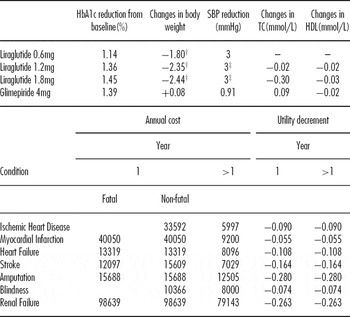
Treatment effects were taken from the Asian study comparing liraglutide with glimepiride, both as add-on to metformin (Reference Yang, Chen and Ji41). This study was conducted in several Asian countries including China, South Korea, and India using a similar study design as LEAD-2 trial except the lack of metformin plus placebo arm (Reference Nauck, Frid and Hermansen21). Among the patients recruited, Chinese subjects from seventeen different sites accounted for 51.3 percent of total 928 participating subjects. After a treatment period of 16-week, liraglutide led to improvement in glycemic control similar to that with glimepiride but with less frequent major and minor hypoglycemia, significant weight loss and reduced systolic blood pressure. Treatments with liraglutide 1.2 and 1.8 mg were noninferior to glimepiride in terms of HbA1c reduction. Liraglutide was associated with an improvement in HbA1c of 1.14 percent (0.6 mg), 1.36 percent (1.2 mg), and 1.45 percent (1.8 mg), respectively. Meanwhile, Glimepiride 4 mg led to a 1.39 percent reduction in HbA1c. These reduction rates were modeled as an initial decrease from baseline levels (Table 1) followed by a natural progression in line with that observed in the UKPDS (Reference Turner32). Overall, results obtained in country subgroups were similar to the whole population (Reference Yang, Chen and Ji41).
Changes from Baseline and Modelled Management Costs and Utility Decrements

*Comparing with Glimepiride
†p<0.0001
‡p<0.05
Simulated Cohort
The baseline characteristics and risk factors of the simulated cohort of 1000 subjects were based on the Asian study (Reference Yang, Chen and Ji41). Additional baseline risk factors (cholesterol and HDL cholesterol) were supplemented with data from the Shanghai diabetes studies (Reference Jia, Pang and Chen12) and other published sources (Reference Thomas, Critchley, Tomlinson, Cockram and Chan31;Reference Valentine, Palmer, Nicklasson, Cobden and Roze34;Reference Xu, Xie, Wang, Wang and Jonas40) (Supplementary Table 1, which can be viewed online at www.journals.cambridge.org/thc2012061). The effects of liraglutide and glimepiride in lowering HbA1c, body weight, systolic blood pressure, and lipid profile were obtained from Asian trials and economic evaluation regarding liraglutide (Table 1) (Reference Valentine, Palmer, Lammert, Langer and Brandle33;Reference Yang, Chen and Ji41). Data regarding the development of seven major diabetes-related complications was based on the study conducted by Palmer et al. (Reference Palmer, Beaudet, White, Plun-Favreau and Smith-Palmer25). The risk factors at diagnosis of T2DM were obtained from two published studies of Chinese patients newly diagnosed with T2DM (Reference Mu, Chen and Lu18;Reference Zhou, Ji and Luo42).
Costs and Perspective
The economic evaluation was undertaken from the health care system perspective, thus we included costs of managing diabetes, anti-diabetic treatments, and addressing clinical complications.
The usage of health resources was abstracted from previous published literatures regarding the economic evaluation of anti-diabetic treatment in Chinese diabetes population (Reference Palmer, Beaudet, White, Plun-Favreau and Smith-Palmer25;Reference Palmer, Gibbs and Scheijbeler26;Reference Xie and Vondeling39) and inflated to 2010 value (Table 1 and Supplementary Table 2, which can be viewed online at www.journals.cambridge.org/thc2012061). Acquisition costs of liraglutide, glimepiride, and metformin were derived from publications (Reference Xie and Vondeling39) or official web sites (22) or estimation of experts (in the case of glimepiride) (Supplementary Table 2). Because none of the current therapies influence the progressive loss of beta-cell function, most people with T2DM will eventually require insulin. Therefore, our treatment duration was set to 5 years in attempt to replicate clinical practice.
Utilities
In our model, we used quality adjusted life-years (QALYs) gained as our principal outcome. The initial utility score was adapted from a study conducted in sixteen hospitals in China to investigate the association between side effects of oral anti-diabetic drugs and self-reported mental health and quality of life among patients with T2DM (Reference Chen, Zhang and Yang3). Based on this study, patients with non–insulin-treated T2DM were assumed to have an EQ-5D score of 0.92 (Reference Chen, Zhang and Yang3). Disutilities associated with diabetes-related complications were obtained from UKPDS and another study (Reference Clarke, Gray and Holman4;Reference Kiberd and Jindal15) (Table 1).
Discounting and Time-horizon
Both costs and QALYs were discounted at a rate of 3 percent, according to the recommendation made by World Health Organization (WHO) (36). The time horizon was set to 30 years to capture the long-term mortality and morbidity of diabetes. The administration of liraglutide was set to 5 years, after which the same insulin treatment was used in both groups (Reference Valentine, Palmer, Lammert, Langer and Brandle33), so both outputs would continue to discount at a rate of 3 percent in the subsequent years.
Cost-utility Analysis
In our Monte-Carlo simulation, we set the number of internal loops per subject as 1,000 to address parameter uncertainty and estimate confidence intervals regarding the main outputs (Reference Clarke, Gray and Briggs5). An incremental cost per QALYs gained was calculated to compare each of different treatment regimens. However, there is no official Willingness-to-Pay (WTP) per QALY threshold in China. According to the recommendation of the Commission on Macroeconomics and Health of the World Health Organization, the maximum value of one year of healthy life is around one to three times the Gross Domestic Production (GDP) per capita (35). Some studies had used this recommendation to establish the threshold for their economic evaluations (Reference Borgstrom, Johnell and Kanis1;Reference Murray, Lauer and Hutubessy19;Reference Palmer, Beaudet, White, Plun-Favreau and Smith-Palmer25). Because the GDP per capita was CNY 29,748 (USD 4,428) in China in 2010 according to National Bureau of Statistics of China, we take CNY 100,000 (USD 15,099) as threshold in our evaluation. (DEC 2010, 1 USD = 6.6227CNY)
Sensitivity Analysis
We conducted several one-way sensitivity analyses to assess the effect of varying primary model parameters on the final outcomes. To explore the uncertainty around the cost data reported by different studies, two analyses were performed with the complication costs and management costs increased and decreased both 20 percent. The impact of discount rate was addressed by using different discount rates to costs and benefits (0 percent and 6 percent, respectively).
Additionally, the time horizon was also changed to investigate the influence of various time periods on projected outcomes. Because the initial utility score of T2DM patients in China might not be identical with those captured by the UKPDS study, we incorporated UKPDS utility outcome into sensitivity analysis to test the stability of our outcome as well. Furthermore, we reset the current level of HbA1c and systolic blood pressure equivalent in all four groups, to identify which aspect of the profile contributed most to the outcomes under the same treatment effect. Lastly, prolonged treatment duration (liraglutide and glimepiride treated for 10 years) and varied acquisition cost of liraglutide (10 percent, 25 percent, 50 percent, and 75 percent discount off the official price) were evaluated in the sensitivity analyses.
RESULTS
Clinical Outcomes
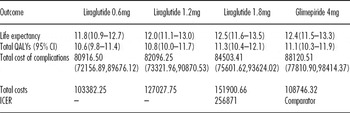
Over a period of 30 years, liraglutide (1.8 mg) treatment was associated with improvements in discounted life expectancy of 0.1 years per patient compared with glimepiride (12.5 [95 percent confidence interval {CI}: 11.6,13.5] versus 12.4 [95 percent CI: 11.5,13.3]) (Table 2). When the health-related quality of life (HRQoL) was included in the analysis, liraglutide 1.8 mg treatment was associated with a 0.168 QALYs increase per patient compared with glimepiride (11.3 [95 percent CI 10.4,12.1] versus 11.1 [95 percent CI 10.3,11.9]). However, the liraglutide 0.6 and 1.2 mg treatments were not superior to glimepiride in terms of life expectancy and QALYs over 30 year's simulation.
The Results of Cost-Effectiveness Analysis (In CNY)

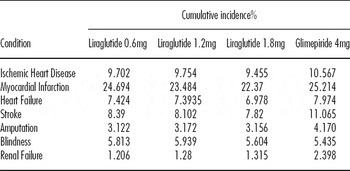
Nevertheless, patients received liraglutide therapy (of all three doses) enjoyed a reduced cumulative incidence of most diabetes-related complications compared with glimepiride (Table 3). The reduction of incidences ranged between 0.996 and 3.245 incidences for ischemic heart disease, myocardial infarction (MI), heart failure, stroke, amputation, and renal failure. The most notable decrease occurred in the incidence of MI which accounted for the second largest complication costs. Another relatively significant reduction reducing from 2.398 (glimepiride) to 1.206 (liraglutide 0.6 mg) took place in the incidence of renal failure, which constituted the largest amount of complication costs. In comparison, glimepiride treatment only showed a maximum advantage in a reduced incidence of blindness of 0.504.
Cumulative Incidence of Diabetes Related Complications over 30-year Period

Cost Outcomes
Treatment with liraglutide was associated with an increased direct cost compared with glimepiride primarily due to higher drug acquisition costs, which would be partially offset by lower diabetes-related complication costs. Direct medical cost of administration liraglutide (1.8 mg) over 5 years were CNY 45,479 higher per patient than glimepiride, while the complication costs averted by using liraglutide was CNY 7,204.01, 6,024.26, 3,617.106 for 0.6 mg, 1.2 mg, and 1.8 mg doses, respectively (Table 2).
Evaluation of Cost-effectiveness
From our base-case analysis, administration of liraglutide (1.8 mg) was associated with an ICER of CNY 256,871 per QALY gained (95 percent CI: 132159, 440762). Because the 0.6 and 1.2 mg liraglutide were not superior to glimepiride in terms of gain in life expectancy or QALYs, no attempt was made to calculate the ICER for those groups (Table 2). Comparing with the WTP per QALY threshold in China adopted in our current study, we cannot conclude liraglutide as cost-effective when using glimepiride as the comparator.
Sensitivity Analyses
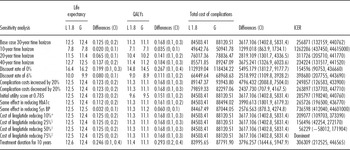
Sensitivity analyses indicated that the base case findings were most sensitive to variation in the systolic blood pressure benefit of liraglutide and the assumption regarding the time horizon. Shortening the time horizon diminished the clinical benefits associated with liraglutide in terms of complication avoided as diabetes-related complications require time to develop. As a result, the ICER of liraglutide 1.8 mg versus glimepiride was increased from CNY 256,871 to CNY 1,262,286 when shortening time horizon from 30 years to 10 years. Discount rate also exerted positive influence on the consequences. However, variations in the cost of complications, initial utility score and the effect of reducing the level of HbA1C had little impact on the incremental findings (Table 4).
Results of Sensitivity Analyses

*treatment with Liraglutide 1.8mg were 64641.10 after discount
§ treatment with Liraglutide 1.8mg were 50534.25 after discount
† treatment with Liraglutide 1.8mg were 33689.50 after discount
† treatment with Liraglutide 1.8mg were 16844.75 after discount
Sensitivity analysis by varying the treatment effect produced cost-effectiveness findings very similar to those in the base case. In the analysis, assuming that glimepiride had the same effect as liraglutide in reducing systolic blood pressure created an ICER of CNY 736,598 per QALY gained, providing evidence that this parameter is the main clinical driver in the modeling study. Whereas eliminating the benefit of liraglutide in reducing the level of HbA1c (although this result was not statistically significant in the Asian study), the modeling finding was relatively stable, with an ICER of CNY 265,726 per QALY gained. Similarly, although the QALY gained was augmented (0.125), prolonging treatment duration to 10 years did not decrease the cost per QALY probably because increased acquisition cost of liraglutide cannot be compensated by the reduced complication costs. In contrast, the sensitivity analyses by varying the acquisition cost for liraglutide had significant influences on the ICER outcome. Specifically, a reduction of the drug price of liraglutide by 50 percent, would result in an ICER of CNY 56,229 per QALY, rendering liraglutide as a cost-effective option against the CNY 100,000 WTP threshold (Table 4).
DISCUSSION
In the UK, the National Institute for Health and Clinical Excellence has issued recommendations for the optimum management of T2DM (22;23). According to the recommendations, liraglutide may be considered as a third-line option in combination with metformin and sulphonylurea or in dual therapy (with metformin or sulphonylurea) in certain circumstances (22;23). However, the relative high acquisition cost may prevent its use. So a modeling analysis to project the long-term outcomes and benefits based on the clinical trials and epidemiologic studies of liraglutide is necessary. This is of particular importance in the Asian setting where health care resources are relatively limited.
In the Asian setting, a study group using CORE Diabetes Model had performed an evaluation based on the same clinical trial data as we used (Reference Yang, Chen and Ji41). As a conference abstract, detailed information was not provided and neither the ICER was reported, but their results were in favor of liraglutide 1.2 and 1.8 mg over glimepiride on the ground that it improved the life expectancy and quality adjusted life-years by 0.051 year and 0.107 QALY, respectively (Reference Wu, Wu and Chang38). So to the best of our knowledge, our study is the first economic evaluation regarding the long-term cost-utility analysis using efficacy, utility score and costs data from local studies, implemented in UKPDS Outcomes Model. Our analysis provided evidences that administration of liraglutide was associated with improvements of life expectancy and quality adjusted life expectancy, as well as reduced incidence of diabetes-related complications compared with glimepiride.
However, the ICER value obtained from our cost-utility analysis exceeds the threshold of CNY 100,000 per QALY, thus we cannot conclude liraglutide as cost-effective when using glimepiride as comparator. To interpret the results of modeling analysis, we can see that the greater reduction of HbA1c from baseline, the higher liraglutide dose is required with corresponding increasing costs. Therefore, if lower dose of liraglutide demonstrates better performance on this parameter, the cost-effectiveness profile of liraglutide would be improved. Our sensitivity analysis showed that even with same effect in reducing the level of HbA1c, liraglutide was still superior to glimepiride in terms of life expectancy, quality adjusted life expectancy and cost of complications probably because of the benefit in lowering systolic blood pressure and lipid profile. Additionally, the sensitivity analysis identified acquisition cost of liraglutide as another major factor underlying the ICER outcome. A reduction of acquisition cost used in our model by at least 50 percent is required to produce an acceptable ICER against our predefined threshold.
There were economic evaluations worldwide performed regarding liraglutide for T2DM, which were unanimously in favor of liraglutide compared with traditional antidiabetic comparators (Reference Dolezal, Niewada, Rychna and Czech7;Reference Ilavska, Uliciansky, Wrona, Lacka and Czech11;Reference Niewada, Wrona, Czech, Schubert and Skrzekowska-Baran24;Reference Sullivan, Alfonso-Cristancho, Conner, Hammer and Blonde29). Additionally, liraglutide was also compared with other kinds of GLP-1 analogs such as exenatide (Reference Valentine, Palmer, Lammert, Langer and Brandle33;36). Both studies concluded that liraglutide was a cost-effective treatment option for T2DM when comparing to exenatide.
Economic evaluations comparing the effect of liraglutide with glimepiride were performed in different countries as well. Davies et al. (Reference Davies, Chubb, Smith and Valentine6) estimated an incremental cost per QALY gained for 1.2 and 1.8 mg liraglutide versus glimepiride as £9,449 and £16,501, respectively. A Health Technology Assessment (HTA) report submitted by Nova Nordisk also presented an ICER of £13257 and £19837 separately for liraglutide 1.2 and 1.8 mg when glimepiride was used as the comparator (23). Comparing to the recommended threshold for economic evaluation (£20,000) in UK, all the results favored liraglutide.
The difference in cost-effectiveness result arising from our modeling study could be interpreted from two aspects. First, the initial utility score used in our model was much higher than the UKPDS default utility. We derived such utility score from a T2DM based population under oral anti-diabetic drugs treatment in China (Reference Chen, Zhang and Yang3). Because the profile of participants in that particular study was not identical with the Asian study (Reference Yang, Chen and Ji41), this may lead to overstating the utility of those Asian cohort (for example, the participants in the Asian study had longer duration of diabetes and higher HbA1c levels). When comparing with the demographic data of the UKPDS (Reference Clarke, Gray and Holman4), the subjects from the UK study had higher mean age and longer diabetes duration than the Asian and Chinese cohort (Reference Yang, Chen and Ji41). Moreover, a proportion of them had a history of diabetes-related complications, thus providing a reasonable explanation for the poorer HRQoL compared with ours (Reference Clarke, Gray and Holman4). However, it was worth noting that the utility score did not have major influence on the findings. When we performed the sensitivity analysis using the same utility score from UKPDS study, the ICER was relatively stable (CNY 285,797 per QALY gained).
The second explanation came from the intrinsic limitations of the UKPDS Outcomes Model. This model only predicts the first event in any single category of diabetes-related complications, and does not allow series of events such as sequential amputations to be modeled directly as such multiple events in the UKPDS data were relatively infrequent (Reference Clarke, Gray and Briggs5). Furthermore, the benefits of reduction in weight and other treatment-related adverse events were not taken into consideration. Lastly, comparing with CORE diabetes outcomes model, UKPDS Outcomes Model does not incorporate certain important diabetes-related complications, including peripheral vascular disease/peripheral artery disease, retinopathy, foot ulcer/diabetic foot syndrome, neuropathy/peripheral neuropathy/nerve and vascular system. The benefits (in terms of reduced incidences of these complications and their associated costs, and improved health-related quality of life) may not be fully captured and therefore underestimated. As such, the use of UKPDS Outcomes Model may result in an overestimation of incremental cost-effectiveness ratio to some extent (Reference Clarke, Gray and Holman4;Reference Kiberd and Jindal15). This offered an important interpretation for our unfavorable results toward the use of liraglutide.
There are also some limitations in our study. Because the Asian trial just included members with HbA1c ranged between 7.0 percent and 11.0 percent, the subjects with more unsatisfactory blood glucose control were excluded. This selection bias may affect the generalizability of the results from applying into real-life clinical setting. The duration of T2DM also posed an uncertainty. Patients of T2DM with varying duration of disease may have different response to the anti-diabetic drugs because their pancreatic function would deteriorate with disease progression. Another limitation is that the UKPDS Outcomes Model was developed based on the data of 3642 patients (white, Asia-Indian, and Afro-Caribbean) with T2DM from UK, the risk equation derived from this population may not be applicable to other racial groups including Chinese. Another concern is that the majority of efficacy data in our model were based on the Asian study of relatively short duration (in our case, 16 weeks). In T2DM, inadequate treatment durability is a key concern because it complicates ongoing glycemic control over time (Reference Kahn, Zinman and Lachin14). Furthermore, we assumed that all the simulated subjects adhere to the original treatment through their lifetime without considering treatment discontinuation, however, this is true with all modeling practices. This assumption may not represent true clinical practice, because patients with unsatisfied glycemic control would switch to other therapies like insulin injection when the target level of blood glucose and HbA1c were not achieved.
By adopting CNY 100,000 (USD 15,099) per QALY gained as the threshold, we calculate the maximum acquisition cost to make liraglutide (18 mg) cost-effective would be CNY 228.02 (USD 34.43). This new maximum price of liraglutide is 62 percent of CNY 369.2 (USD 55.75) of the drug cost that was used in our modeling.
As shown in Supplementary Table 4, if we adopted the 1–2 times GDP per capita as WTP thresholds, our result would show liraglutide to be a cost-effective option among the developed Asian countries or regions, namely, Hong Kong, Taiwan, South Korea, Singapore, Macau, and Japan. Whereas among the Asian developing countries, even when we used three times of GDP per capita, the results would still exceed the cost-effective threshold.
One of the critical uncertainty impacting cost-effectiveness in our modeling was the drug cost which we derived from British National Formulary (22). However, if different WTP thresholds were to be used for different countries, the acquisition cost for liraglutide must be different in different countries for the drug to be considered cost-effective. Differential drug pricing for different countries is not an unreasonable assumption or option because the price of a specific drug has the negotiable procurement discount and other consideration that the company would apply for marketing the drug. Thus we estimated the cost-effective price of liraglutide in different settings based on the data from present study. Except for the high income economies (where one time GDP per capita was used), one to three times of GDP per capita were used as the WTP per QALY threshold to calculate the cost-effective price of liraglutide in different economic settings (Supplementary Tables 3 and 4, which can be viewed online at www.journals.cambridge.org/thc2012061). From this exercise, the cost-effective price of liraglutide is estimated to range from USD 20.08 to 21.08 in low income regions, and from USD 54.51 to 56.00 in high income economies. These estimates would provide some suggestions for the pharmaceutical companies when seeking reimbursement for liraglutide in distinctive healthcare systems and for health administrators or health insurance to negotiate price.
Furthermore, the approved doses of liraglutide (1.2 mg) did not show to be superior to glimepiride in terms of improvements in life expectancy and QALYs gained in our present study. Undoubtedly, the lower dose would mean lesser costs of liraglutide, if future RCT could demonstrate better therapeutic effects of 1.2 mg liraglutide versus glimepiride, the cost-effective profile of liraglutide would be different and so will be the ICER for liraglutide.
Finally, another theoretical consideration would be whether different WTP threshold should be applied for different diseases as WTP is highly associated with the physical and psychological effects of specific illness. However, this is an issue that can apply in the evaluation of all new drugs and not unique for this case.
Because the healthcare system differs from country to country, health resource usage and medication cost due to T2DM could vary substantially. Furthermore, even with identical reduction in HbA1c after treatment with liraglutide as shown in the Asian trial, QALYs gained could still be different due to psychological and cultural factors. Hence, CUA study should use local cost and effectiveness data to be truly reflective of the cost-effectiveness for the specific jurisdiction, and the results are difficult to be transferable. However, we have partially overcome this problem but using per capita GDP of individual countries and the recommended WHO WTP thresholds to estimate the “cost-effective” price for a new drug. Such approach could provide valuable guidance for drug price setting and reimbursement.
In conclusion, our present modeling suggested that the administration of liraglutide was associated with improvements in life-year and QALYs gained, and lower incidences in diabetes-related complications than glimepiride regardless of country-specific issues. However, the economic status of individual country would exert substantial influence in interpreting the cost-effectiveness analysis. As such, the incremental cost-effectiveness ratio is not just positively connected with the effectiveness and acquisition cost of that drug, but also with country-specific issues.
POLICY IMPLICATIONS
Based on the long-term simulation in our model, 1.8 mg liraglutide was associated with improvements in life expectancy, QALYs gained, and decreased incidences in diabetes-related complications, comparing to glimepiride. When the UK cost of liraglutide was discounted by 38 percent, the administration of liraglutide would be cost-effective in China using CNY 100,000 per QALY as the WTP threshold. If adopting three and one time of GDP per capita per QALY as the WTP threshold, the cost-effective price of liraglutide 18 mg is estimated ranging from USD 20.08 to 21.08 in low income regions and from USD 54.51 to 56.00 in high income economies. This information would assist policy makers and health insurers in deciding the reimbursed price for liraglutide for their respective regions.
SUPPLEMENTARY MATERIAL
Supplementary Tables 1–4: www.journals.cambridge.org/thc2012061
CONTACT INFORMATION
Lan Gao, MMed, School of Biomedical Sciences and Pharmacy, University of Newcastle, Callaghan, NSW, Australia
Fei-Li Zhao, PhD, School of Medicine and Public Health, University of Newcastle, NSW, Australia
Shu-Chuen Li, PhD, MBA, School of Biomedical Sciences & Pharmacy, University of Newcastle, Callaghan, NSW, Australia
CONFLICTS OF INTEREST
All authors report they have no potential conflicts of interest.