INTRODUCTION
As heterotrophic inhabitants of the sediment-water interface, biofilm-dwelling ciliates play a crucial role in the functioning of microbial food webs by mediating elements and energy flux from plankton to benthos in aquatic ecosystems (Franco et al., Reference Franco, Esteban and Téllez1998; Fischer et al., Reference Fischer, Sachse, Steinberg and Pusch2002; Parry, Reference Parry2004; Kathol et al., Reference Kathol, Norf, Arndt and Weitere2009; Norf et al., Reference Norf, Arndt and Weitere2009; Xu et al., Reference Xu, Zhang, Jiang, Min and Choi2011a, Reference Xu, Zhang, Jiang, Zhu, Al-Rasheid, Warren and Songb; Zhang et al., Reference Zhang, Xu, Jiang, Zhu and Al-Reshaid2012). They can form complex communities of many different taxonomic and functional types in both freshwater and marine ecosystems (Parry, Reference Parry2004; Früh et al., Reference Früh, Norf and Weitere2011; Kathol et al., Reference Kathol, Fischer and Weitere2011). Pratt & Cairns (Reference Pratt and Cairns1985) classified protozoa into five trophic-functional (hereafter functional) groups based on their feeding strategies: bacterivores (B), algivores (A), saprotrophs (S), raptors (R) and non-selectives (N). Some bacterivorous consumers can tolerate extreme environmental conditions and play an important role in maintaining and improving water quality by their grazing activities (Risse-Buhl & Küsel, Reference Risse-Buhl and Küsel2009; Morin et al., Reference Morin, Pesce, Tlili, Coste and Montuelle2010; Xu et al., Reference Xu, Warren, AL-Rasheid, Zhu and Song2010; Zhang et al., Reference Zhang, Xu, Jiang, Zhu and Al-Reshaid2012). Furthermore, with their rapid responses to environmental changes, easy sampling and spatial/temporal discriminations, biofilm-dwelling ciliates have successfully been used as a useful bioindicator of water quality (Xu et al., Reference Xu, Zhang, Jiang and Yang2014).
Biofilm-dwelling protozoan grazers (e.g. groups B, A, R and N) feed on a variety of food particles, such as bacteria, algae, flagellates, small ciliates and detritus particles (Geesey et al., Reference Geesey, Mutch, Costerton and Green1978; Parry, Reference Parry2004; Scherwass et al., Reference Scherwass, Fischer and Arndt2005; Risse-Buhl & Küsel, Reference Risse-Buhl and Küsel2009). Their general modes of food acquisition are either the collection of food particles from plankton origin as filter feeders (e.g. groups B and A) or the active search for food particles in the biofilm as gulper feeders (e.g. groups B, A and R) (Franco et al., Reference Franco, Esteban and Téllez1998; Kathol et al., Reference Kathol, Fischer and Weitere2011; Zhang et al., Reference Zhang, Xu, Jiang, Zhu and Al-Reshaid2012). Thus, the functional structure of the biofilm-dwelling ciliates may significantly vary during the initial colonization period due to the food supply (Norf et al., Reference Norf, Arndt and Weitere2009; Wey et al., Reference Wey, Norf, Arndt and Weitere2009; Früh et al., Reference Früh, Norf and Weitere2011; Zhang et al., Reference Zhang, Xu, Jiang, Zhu and Al-Reshaid2012). So far, a number of relevant investigations on the colonization of the biofilm-dwelling ciliates have been carried out (Kiørboe et al., Reference Kiørboe, Grossart, Ploug, Tang and Auer2004; Norf et al., Reference Norf, Arndt and Weitere2009; Wey et al., Reference Wey, Norf, Arndt and Weitere2009; Morin et al., Reference Morin, Pesce, Tlili, Coste and Montuelle2010; Früh et al., Reference Früh, Norf and Weitere2011; Zhang et al., Reference Zhang, Xu, Jiang, Zhu and Al-Reshaid2012). However, as regards the colonization dynamics of carbon flux in biofilm-dwelling ciliate communities, there is little information.
In the present study, the colonization dynamics of carbon flux in the ciliate communities were studied in the coastal waters of the Yellow Sea, near Qingdao, northern China from May to June 2015. Our aims were: (1) to reveal colonization features of carbon flux in the ciliate communities; (2) to document the temporal variations in functional structure of biofilm-dwelling ciliate communities in terms of carbon biomass during the colonization period; (3) to compare the carbon flux in biofilm-dwelling ciliate communities between different depths; and (4) to provide information for ecological research on carbon flux from plankton to benthos in marine ecosystems.
MATERIALS AND METHODS
Study site and data collection
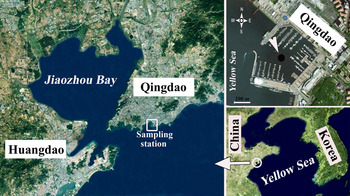
This study was carried out in the coastal waters of the Yellow Sea, near Qingdao, northern China from 18 May to 16 June 2015 (Figure 1). This coastal area is ~8 m deep with a transparency (Secchi depth) of ~3 m during the study period. The glass slide systems were designed, deployed, anchored and sampled as described by Xu et al. (Reference Xu, Zhang, Jiang, Zhu, Al-Rasheid, Warren and Song2011b).
Map showing the study area, which was located in the coastal waters of the Yellow Sea, northern China.

A total of 280 microscopy glass slides (2.5 × 7.5 cm) were used as artificial substrata for collecting biofilm-dwelling ciliates at depths of 1 and 3 m below the water surface. For each depth, a total of seven PVC frames were used to hold a total of 140 slides, which were used as two parallel sampling replicates. A total of seven sampling events were conducted, and samples were from different slides pooled. For each replicate, 10 glass slides were randomly collected from one PVC frame at the time interval of 1, 3, 7, 10, 14, 21 and 28 days, during the study period. From both depths, samples were collected simultaneously (Xu et al., Reference Xu, Zhang, Jiang, Zhu, Al-Rasheid, Warren and Song2011b). The glass slides were transferred into Petri dishes containing water from the sampling site, and then stored in a cooling box before transporting to the laboratory within 2 h for identification and enumeration (Xu et al., Reference Xu, Zhang, Jiang, Zhu, Al-Rasheid, Warren and Song2011b).
Identification and enumeration
Identification and enumeration of periphytic biofilm-dwelling ciliates were carried out following the methods outlined by Xu et al. (Reference Xu, Zhang, Jiang, Zhu, Al-Rasheid, Warren and Song2011b). Taxonomic classification of ciliates was based on published keys and guides such as Song et al. (Reference Song, Warren and Hu2009).
The enumeration of biofilm-dwelling ciliates was carried out in vivo at a 100× magnification under an inverted microscope within 24 h after sampling (Xu et al., Reference Xu, Zhang, Jiang, Zhu, Al-Rasheid, Warren and Song2011b). For recovering all species colonizing the glass slides, one surface of an entire slide from a total of 20 slide-replicates was examined at each colonization period using bright field illumination and the individual abundances were recorded according to the method described by Xu et al. (Reference Xu, Zhang, Jiang, Zhu, Al-Rasheid, Warren and Song2011b). The cell numbers were calculated to confirm the average abundance of the ciliate individuals (ind. cm−2).
Biovolume estimates based on 3-dimensional measurements and approximations of shape to standard geometric configurations (Winberg, Reference Winberg1971) were made for most ciliate species fixed with 2% (v/v) formalin. The volumes of individual ciliates were converted to biomass using a conversion factor of 0.14 pg C µm−3 (Putt & Stoecker, Reference Putt and Stoecker1989).
Different biofilm-dwelling ciliate species were assigned to the corresponding functional groups, which comprised bacterivores (B), algivores (A), raptors (R) and non-selectives (N), according to the literature (Pratt & Cairns, Reference Pratt and Cairns1985; Fernandez-Leborans & Fernandez-Fernandez, Reference Fernandez-Leborans and Fernandez-Fernandez2002; Xu et al., Reference Xu, Warren, AL-Rasheid, Zhu and Song2010). The different ciliate species recorded were assigned to the corresponding trophic-functional group taking into account both the data from the literature (Fenchel, Reference Fenchel1969; Pratt & Cairns, Reference Pratt and Cairns1985; Xu et al., Reference Xu, Warren, AL-Rasheid, Zhu and Song2010) and direct observation (e.g. non-selective Euplotes spp. feeding on both bacteria and algae and algivorous Diophrys spp. mainly feeding on algae).
Data analyses
The increase of individual carbon biomass of each functional group over the total experimental phase was tested to ascertain if it fitted to the logistic model:
 $$B_{\rm t} = {\rm} B_{{\rm max}} /[1{\rm} + {\rm} e^{({\rm a-rt})} ]$$
where B t = the individual carbon biomass at time t; B max = the carrying capacity of individual carbon biomass (maximum biomass); r = the growth rate constant; a = the coefficient constant of initial biomass; and T 50% = the time to 50% B max.
All parameters (e.g. B max and T 50%) were estimated using the SIGMAPLOT. Fitness tests were carried out to determine whether the biomass recorded at each time interval fit with the logistic model at the 0.05 significance level (Zhang et al., Reference Zhang, Xu, Jiang, Zhu and Al-Reshaid2012).
All multivariate analyses were conducted using PRIMER v7.0.10 and the PERMANOVA + for PRIMER (Clarke & Gorley, Reference Clarke and Gorley2015; Anderson et al., Reference Anderson, Gorley and Clarke2008). Bray–Curtis similarity matrices were computed on fourth root-transformed data. The separate clusters of samples were assigned by the routine dbRDA (distance-based redundancy analysis) of PERMANOVA + (Anderson et al., Reference Anderson, Gorley and Clarke2008).
RESULTS
Taxonomic composition and functional structure
A total of 75 ciliate species were recorded from both depths over the survey period, of which 69 and 57 taxa were identified at depths of 1 and 3 m, respectively. The 75 ciliate species were assigned into four functional groups.
Temporal variations in biomass
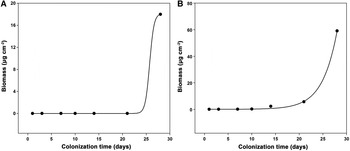
The temporal variations in biomass of biofilm-dwelling ciliate communities and all four functional groups with colonization times of 1, 3, 7, 10, 14, 21 and 28 day at depths of 1 and 3 m during the study period are shown in Figures 2 & 3.
Colonization dynamics of biomass of total biofilm-dwelling ciliates collected at depths of 1 (A) and 3 m (B) in the coastal waters of the Yellow Sea, northern China, during the study period.

Colonization dynamics of biomass of four functional groups of biofilm-dwelling ciliate communities collected at depths of 1 m (A–D) and 3 m (E–H) in the coastal waters of the Yellow Sea, northern China, during the study period. B, bacterivores; A, algivores; R, raptors; N, non-selectives.

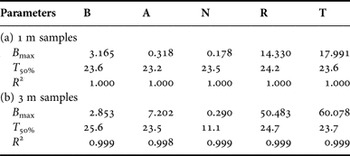
Regression fitness test showed that the total ciliates and all four trophic-functional groups were well fitted to the logistic model equation (Table 1). It should be noted that the estimated maximum biomass (B max) of total ciliates and functional groups were generally higher at a depth of 3 m than at 1 m (P < 0.05) (Table 1).
Parameters of increase curves of carbon flux fitness to the logistic model for each trophic-functional group of biofilm-dwelling ciliate communities at depths of 1 and 3 m in coastal waters of the Yellow Sea.

T, total biomass; A, algivores; B, bacterivores; R, raptors; N, non-selectives; B max (μg cm−2) the carrying capacity of individual biomass (maximum biomass), T 50% (d) the days to 50% B max, R 2 coefficient of determination.
Temporal variations in functional structures
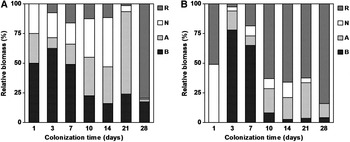
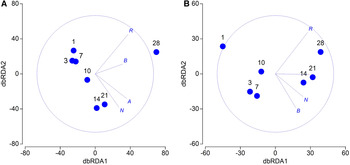
The colonization patterns of the biofilm-dwelling ciliate communities in terms of relative biomass at two depths are summarized in Figures 3 and 4. The dbRDA ordinations resulted in the colonization process of the ciliate communities falling into two groups: the first canonical axis (dbRDA 1) separated the young samples (1–10 days) (left) from the mature communities (14–28 days) (right) (Figure 5). PERMANOVA test revealed that there were significant differences in community patterns between the two groups (P < 0.05). However, no significant difference was found in the colonization patterns between the two depths (P > 0.05).
Temporal variations of relative biomass of four functional groups of biofilm-dwelling ciliates communities collected at two depths of 1 (A) and 3 m (B) in the coastal waters of the Yellow Sea, northern China, during the study period.

Distance-based redundancy analysis (dbRDA) on Bray–Curtis similarities for the average species-biomass data of heterotrophs (A) and photoautotrophs (B) in 14 samples from depths of 1 and 3 m during the study period, respectively; and correlations of species numbers of four functional groups with the two dbRDA axes.

DISCUSSION
Mediating functionally similar community members at different spatial and temporal scales is an effective protocol for ecosystem-level research (Pratt & Cairns, Reference Pratt and Cairns1985; Burkovskii & Mazei, Reference Burkovskii and Mazei2001; Xu et al., Reference Xu, Warren, AL-Rasheid, Zhu and Song2010; Zhang et al., Reference Zhang, Xu, Jiang, Zhu and Al-Reshaid2012). In our study, the biofilm-dwelling ciliate communities in the coastal waters of the Yellow Sea represented five functional groups: algivores, bacterivores, raptors and non-selectives. In terms of carbon biomass, the groups B and N were generally the primary contributors to the young ciliate communities compared with the groups A and R which mainly predominated in the mature communities. This finding was not consistent with the previous reports on benthic microfauna in terms of abundance since the raptors commonly occurred in low abundance and high biomass due to large sizes (Cairns & Henebry, Reference Cairns, Henebry and Cairns1982; Azovsky, Reference Azovsky1988; Have, Reference Have1993; Fernandez-Leborans & Fernandez-Fernandez, Reference Fernandez-Leborans and Fernandez-Fernandez2002; Burkovskii et al., Reference Burkovskii, Mazei and Esaulov2011; Zhang et al., Reference Zhang, Xu, Jiang, Zhu and Al-Reshaid2012).
The protozoan colonization of a new substratum surface generally follows the succession: at first, autotrophic flagellates colonize the substratum surface, followed by vagile bacterivores (e.g. amoebae and ciliates); the next groups are larger species with a broader feeding spectrum and sessile feeders (Railkin, Reference Railkin1995; Franco et al., Reference Franco, Esteban and Téllez1998; Strüder-Kypke, Reference Strüder-Kypke1999; Zhang et al., Reference Zhang, Xu, Jiang, Zhu and Al-Reshaid2012). Previous studies have demonstrated that during the primary colonization process, the individual abundances of functional groups generally increase and then equilibrate, following the logistic growth model equation (Zhang et al., Reference Zhang, Xu, Jiang, Zhu and Al-Reshaid2012; Wang & Xu, Reference Wang and Xu2015). Based on our data, the increase in carbon biomass of all four functional groups were significantly fitted to the logistic equation.
It should be noted that although the times to 50% maximum biomass of total ciliates (mainly groups A and R) generally represented a similar value, the maximum biomass was definitely higher at a depth of 3 m than at 1 m. This may be mainly due to the raptors with large size that predominated the ciliate communities at a depth of 3 m. Additionally, this study was conducted based on one dataset of the coastal waters collected in summer. Thus, further studies on a range of marine waters and over extended time periods are needed in order to verify this conclusion.
In summary, the carbon biomass of both total ciliates and trophic-functional groups increased following the logistic growth curve model. During the whole colonization period, there was a significant temporal shift in functional contributors to the carbon flux. At different depths, the primary contributors to the carbon flux were functionally different at depths of 1 and 3 m. These results may provide useful information for ecological research on carbon flux from plankton to benthos in marine ecosystems.
FINANCIAL SUPPORT
This work was supported by ‘The Natural Science Foundation of China’ (project number: 41076089).