INTRODUCTION
Oxystominidae Chitwood, Reference Chitwood1935 is a common family widely distributed from marine to freshwater environments (Smol et al., Reference Smol, Muthumbi, Sharma and Schmidt-Rhaesa2014). Members of the family are often numerically dominant or subdominant in nematode samples, occupying about 4–16% of the total nematode abundance (Tietjen, Reference Tietjen1991; Vopel & Thiel, Reference Vopel and Thiel2001; Lambshead et al., Reference Lambshead, Brown, Ferrero, Hawkins, Smith and Mitchell2003; Miljutina et al., Reference Miljutina, Miljutin, Mahatma and Galéron2010; Pastor de Ward et al., Reference Pastor de Ward, Lo, Villares, Milano, Miyashiro and Mazzanti2015). The family now contains nine genera and over 160 species (Smol et al., Reference Smol, Muthumbi, Sharma and Schmidt-Rhaesa2014; Tchesunov et al., Reference Tchesunov, Thanh and Tu2014).
So far, only a few taxonomic studies have been performed for deep-sea species of the family, for various reasons (Miljutina et al., Reference Miljutina, Miljutin, Mahatma and Galéron2010; Tchesunov et al., Reference Tchesunov, Thanh and Tu2014). First, in spite of their high species diversity, deep-sea nematodes are mostly in rather low abundance, making the collection of sufficient specimens for description rather difficult. Second, deep-sea nematodes including those of Oxystominidae are usually several times smaller in body size than those in shallow-water habitats (Widbom, Reference Widbom1984; John, Reference John1989; Vanhove et al., Reference Vanhove, Vermeeren and Vanreusel2004). Third, members of the family Oxystominidae have usually a much slenderer body, making features for distinguishing species indistinct. Thus, Oxystominidae has been indicated as one of the most ‘underinvestigated’ families of deep-sea nematodes (Miljutin et al., Reference Miljutin, Gad, Miljutina, Mokievsky, Fonseca-Genevois and Esteves2010).
Both Litinium Cobb, Reference Cobb1920 and Wieseria Gerlach, 1956 are small genera in the family Oxystominidae. Species of them are usually rare, accounting for merely a small proportion of the marine nematode assemblages (Gerlach, Reference Gerlach1958a; Tietjen, Reference Tietjen1971; Soetaert et al., Reference Soetaert, Vincx and Heip1995; Mokievsky et al., Reference Mokievsky, Tchesunov, Udalov and Toan2011). For instance, individuals of Litinium and Wieseria constituted only about 0.87 and 2.91%, respectively, of the total nematode abundance in our samples collected from the southern Philippine Sea, as described below. Most species of Litinium and Wieseria were described on the basis of a single specimen. Even worse, about 18% of Litinium species and 40% of Wieseria species have been erected on the basis of only a single female specimen. Nevertheless, species of the two genera are generally well-defined and present few problems in species separation (Tchesunov et al., Reference Tchesunov, Thanh and Tu2014).
During our investigation of meiofauna in the Philippine Sea near the Southern Kyushu-Palau Ridge in the tropical Western Pacific Ocean with a water depth of 4117–5035 m, two new Oxystominidae species belonging to the genera Litinium and Wieseria were discovered from the sediment and are described herein.
MATERIALS AND METHODS
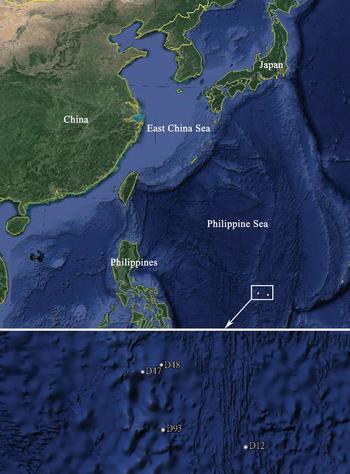
Sediment samples were collected at the stations D47, D48, D93 and D12 (Figure 1), from an abyssal plain of the Philippine Sea near the Southern Kyushu-Palau Ridge in the Western Pacific Ocean in June 2014 by R/V KEXUE, using a 0.25 m2 Gray-O'Hara box corer. For stations D47 and D48, meiofauna samples were taken from the core samples by inserting tubes of 9.5 cm inner diameter. Each tube samples were sliced into 0–1, 1–2, 2–4, 4–6 and 6–10 cm subsamples. For stations D93 and D12, due to disturbance, qualitative meiofauna samples were taken from the 0–5 cm layer only. All samples were preserved with formalin (5% final concentration) onboard. In the lab, the fixed samples were stained with 0.1% Rose Bengal for 12 h, washed on a 300 µm sieve to remove large particles and a 31 µm sieve to retain meiofauna. Ludox HS 40 was used to extract meiofauna from the remaining sediments by centrifugation. The extracted samples were sorted out under a dissecting microscope. Nematodes were transferred into a 9:1 (v/v) solution of 50% alcohol-glycerol in a cavity block to slowly evaporate to pure glycerol, and then mounted into permanent slides (Huang & Zhang, Reference Huang and Zhang2005).
Sampling stations (dots) in the southern Philippine Sea.

The descriptions were made from glycerine mounts (Platt & Warwick, Reference Platt and Warwick1983) using a differential interference contrast (DIC) microscope (Nikon E80i). Line drawings were made with the aid of a drawing device. All measurements are in μm, and all curved structures are measured along the arch.
Abbreviations are as follows: a, body length divided by maximum body diameter; b, body length divided by pharynx length; c, body length divided by tail length; c’, tail length divided by anal body diameter; a.b.d., anal body diameter; c.b.d., corresponding body diameter; V, distance of vulva from the anterior body end; V%, position of vulva from anterior end expressed as a percentage of total body length.
SYSTEMATICS
Order ENOPLIDA Filipjev, Reference Filipjev1929
Family OXYSTOMINIDAE Chitwood, Reference Chitwood1951
Subfamily OXYSTOMININAE Chitwood, 1935
Genus Litinium Cobb, 1920
Litinium dispariseta sp. nov.
(Figures 2A–E, 3A–D, 4; Table 1).
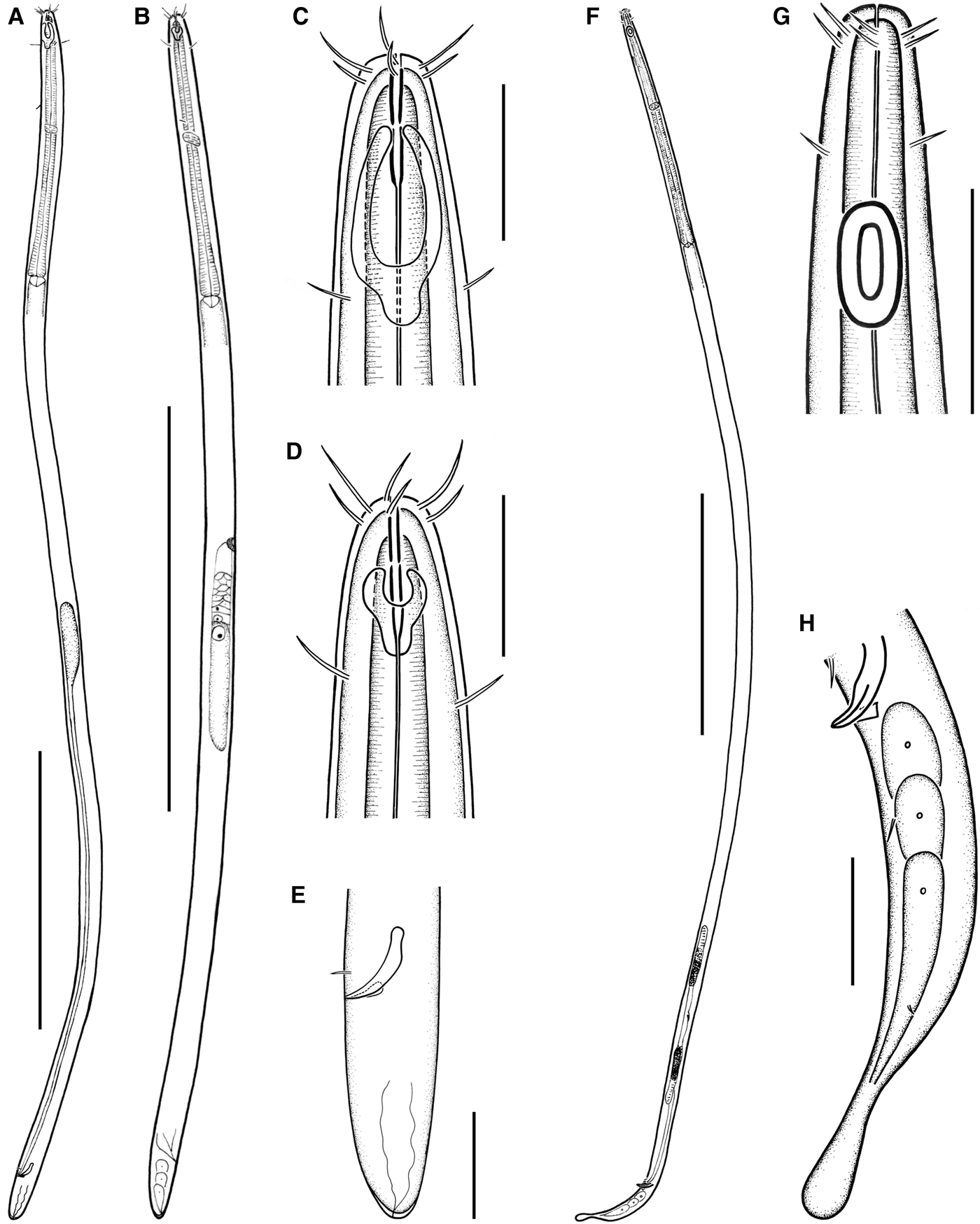
Litinium dispariseta sp. nov. (A–E; A, C, E, male holotype; B, D, female 1) and Wieseria minor sp. nov. (F–H; male holotype): (A, B, F) overall view, showing the testes or ovary; (C, D, G) lateral view of anterior end, showing the anterior setae, buccal cavity and amphideal fovea; (E, H) lateral view of posterior end, showing the spicule, gubernaculum and precloacal supplementary seta. Scale bars: A, B, F, 200 µm; C–E, G, H, 15 µm.

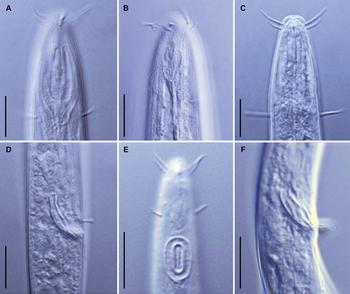
Litinium dispariseta sp. nov. (A–D; A, C, D, male holotype; B, female 1) and Wieseria minor sp. nov. (E, F; male holotype): (A, B, E) lateral view of anterior end, showing the anterior setae and amphideal fovea; (C) lateral view of anterior end, showing the anterior setae and buccal cavity. Note that Litinium dispariseta has distinct longer inner labial setae relative to outer labial setae; (D, F) lateral view of male cloacal region, showing the spicule and precloacal supplementary seta. Scale bars: 10 µm.

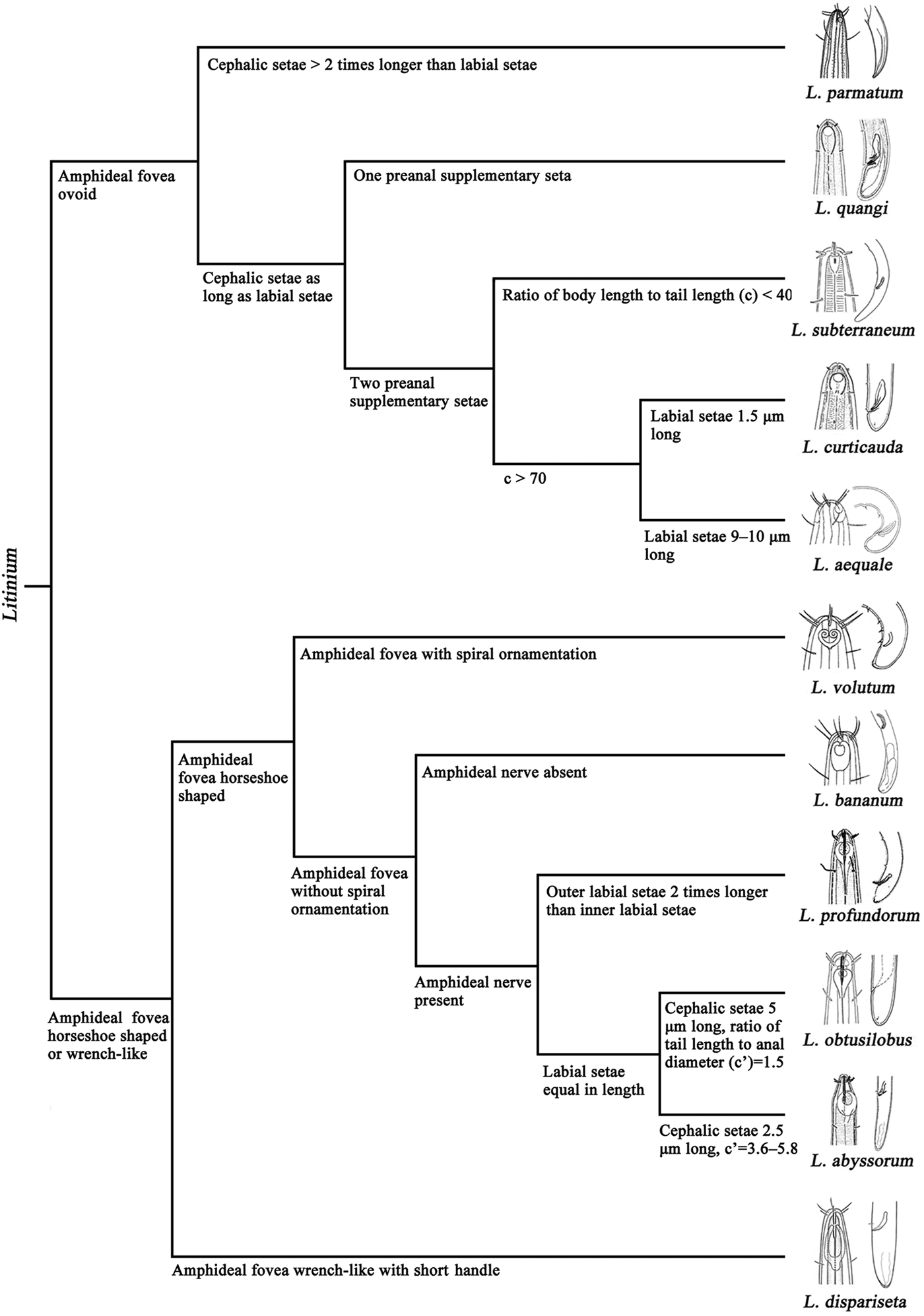
Pictorial key to species of Litinium. Images of species taken from published descriptions: abyssorum – Tchesunov et al., Reference Tchesunov, Thanh and Tu2014; aequale – Gerlach, Reference Gerlach1958b; bananum – Gerlach, Reference Gerlach1956; curticauda – Tchesunov et al., Reference Tchesunov, Thanh and Tu2014; dispariseta – orig.; obtusilobus – Bussau, Reference Bussau1993; parmatum – Wieser, Reference Wieser1954; profundorum – Tchesunov et al., Reference Tchesunov, Thanh and Tu2014; quangi – Tchesunov et al., Reference Tchesunov, Thanh and Tu2014; subterraneum – Tchesunov et al., Reference Tchesunov, Thanh and Tu2014; volutum – Gerlach, Reference Gerlach1962.

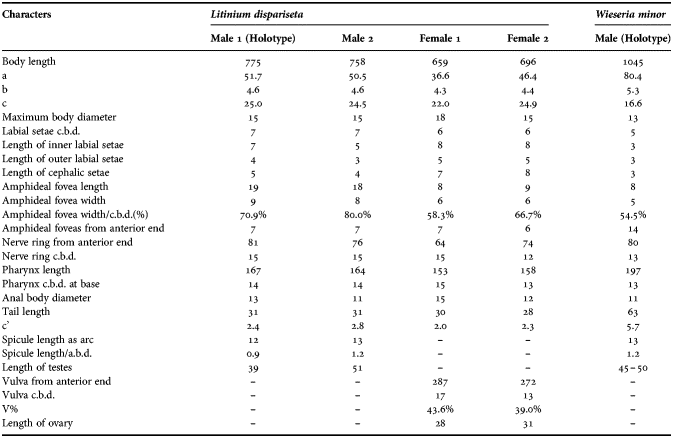
Morphometric data and individual measurements (in μm) of Litinium dispariseta sp. nov. and Wieseria minor sp. nov.

DIAGNOSIS
Body length 659–775 µm. Inner labial setae 5–8 µm long and outer labial setae 3–5 µm long. Amphideal foveas wrench-like with short handle. Cephalic setae at the same level of short handles of amphideal foveas. A single cloacal midventral supplementary seta, located at about 3 µm anterior to cloacal vent. A short cylindrical tail with bluntly rounded tip.
TYPE MATERIAL
Two males and two females. Male 1 (Holotype) on slide KP-20140629-D48-(0–1)-II-3. Male 2 on slide KP-20140628-D93-3. Female 1 on slide KP-20140629-D48-(2–4)-I. Female 2 on slide KP-20140622-D12-1. All type specimens have been deposited in the Marine Biological Museum of Chinese Academy of Sciences, Qingdao, China.
TYPE LOCALITY AND HABITATS
Muddy sediment at stations D48 (14°9′N 134°51′E), D93 (13°19′N 134°51′E) and D12 (13°4′N 135°56′E) in the Philippine Sea near the Southern Kyushu-Palau Ridge in the tropical Western Pacific Ocean. Station D48, water depth 4692 m, surface 0–1 cm sediment layer, median particle diameter 4.9 µm, and organic matter content 0.50%. Station D93, water depth 4117 m, surface 0–5 cm sediment layer. Station D12, water depth 5035 m, surface 0–5 cm sediment layer.
ETYMOLOGY
Composite of the Latin adjective dispar (unequal) and the Latin noun seta (bristle), refers to a main feature of the species, viz., the distinctly unequal length of the inner and outer labial setae.
DESCRIPTION
Males: Body slender, nearly cylindrical, with two terminals slightly narrower than body trunk. Cuticle smooth and evenly thick (about 1 µm) over entire body. Only one somatic seta observed, distributed in pharyngeal region, 3–4 µm long (Figure 2A; Table 1). A circle of six inner labial setae close to the circle of six outer labial setae. All labial setae slender, inner labial setae 5–7 µm long, situated about 1 µm from the anterior end; outer labial setae 3–4 µm long. Amphideal foveas large, wrench-like with short handle. Four slender cephalic setae, each 4–5 µm long, situated at the same level of short handles of amphideal foveas, about 20 µm posterior to the circle of outer labial setae (Figure 2C).
Mouth opening tiny. Internal lining of anterior pharynx thickened and cuticularized, forming a narrow buccal capsule about 11 µm long and 1 µm wide. Pharynx cylindrical and slightly widened at base, with clear internal cuticular lining and weak radial muscular striation, occupying about one fifth of total body length. Cardia small, cordate, surrounded by intestine tissue. Nerve ring located at middle of pharynx. Ventral gland and excretory pore not visible.
Single anterior outstretched testis on the right of intestine, 39–51 µm long. Arcuate and cuticularized spicules, 0.9–1.2 a.b.d. long, with a small proximal capitulum and pointed distal end. Elongate droplet-shaped gubernaculum, parallel to spicules, about 4 µm long. A midventral setae about 3 µm long, located 3 µm anterior to the cloacal opening present. Tail cylindrical with bluntly rounded tip, 2.4–2.8 a.b.d. long, terminal cuticle thickened; with a terminal pore and ducts of caudal glands. Caudal glands barely distinguishable (Figure 2E).
Females: Similar to males but with a slightly smaller body (659–696 µm vs 758–775 µm) and much smaller amphideal foveas (8–9 × 6 µm vs 18–19 × 8–9 µm; Table 1). One or two somatic setae observed, irregularly arranged in pharyngeal region, 4–6 µm long. Single posterior reflexed ovary on the right of intestine, 28–31 µm long. Vulva located at about two-fifths of body length from anterior end (Figure 2B, D). Three caudal glands, confined within the tail or slightly extending precaudally.
SPECIES COMPARISONS
Litinium dispariseta sp. nov. differs from all congeners by the relative length of inner labial setae to outer labial setae and the peculiar shape of amphideal foveas. In L. dispariseta the inner labial setae are almost two times longer than the outer labial setae, while in the other Litinium species the inner labial setae are either equal to or shorter than the outer labial setae. The amphideal foveas in L. dispariseta are wrench-like with short handle, while in all other congeners the amphideal foveas are either horseshoe shaped or ovoid with round to oval anterior apertures. Moreover, L. dispariseta has only a single midventral preanal supplementary seta, a feature found only in two congeners: L. abyssorum Tchesunov, Nguyen Dinh Tu & Nguyen Vu Thanh, 2014 and L. quangi Tchesunov, Nguyen Dinh Tu & Nguyen Vu Thanh, 2014. However, L. dispariseta differs from L. abyssorum, a species found in deep-sea sediment from the South-east Atlantic Ocean, also by its spicules equal in length (vs unequal), and a shorter tail relative to body length (ratio of body length to tail length about 25 vs 13–16). It differs from L. quangi also by its much smaller body size (659–775 µm vs 2523–2918 µm long) but much longer tail relative to body length (ratio of body length to tail length about 25 vs 72–97), distinctly shorter spicules (12 µm vs 30–33 µm) and much shorter distance of the midventral preanal supplementary seta to cloaca (3 µm vs 32–35 µm).
Up to now, the genus Litinium contains 11 valid species including the new species L. dispariseta. Based on the review of Litinium by Tchesunov et al. (Reference Tchesunov, Thanh and Tu2014) and the description of L. dispariseta sp. nov., we propose a pictorial key to species of Litinium (Figure 4).
Genus Wieseria Gerlach, 1956
Wieseria minor sp. nov.
(Figures 2F–H, 3E, F, 5; Table 1)
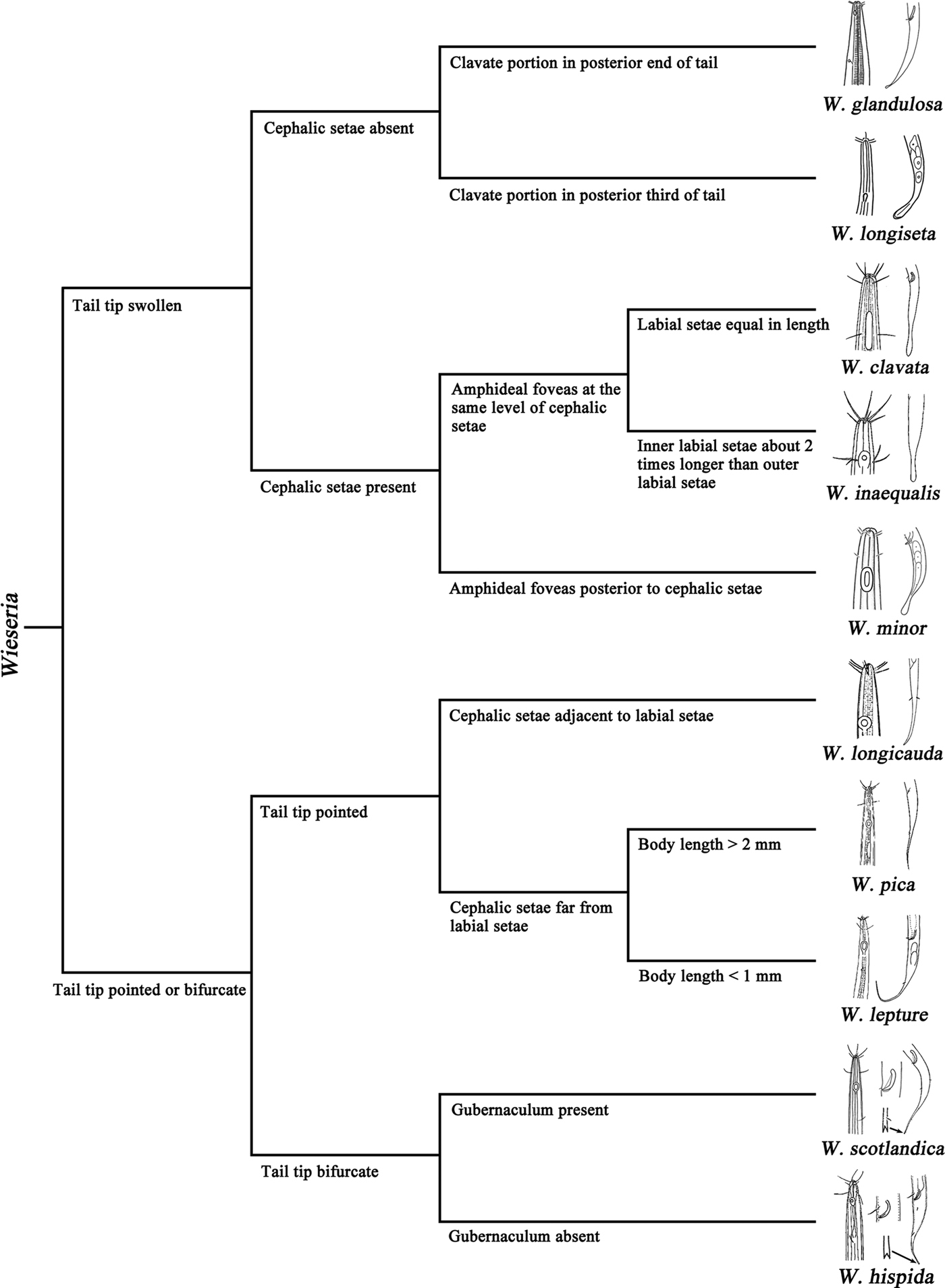
Pictorial key to species of Wieseria. Images of species taken from published descriptions: clavata – Gerlach, Reference Gerlach1956; glandulosa – redrawn from Kreis, Reference Kreis1929; hispida – Vitiello, Reference Vitiello1972; inaequalis – Gerlach, Reference Gerlach1956; lepture – Vitiello, Reference Vitiello1972; longicauda – Timm, Reference Timm1961; longiseta – redrawn from Allgén, Reference Allgén1947; minor – orig.; pic – Gerlach, Reference Gerlach1956; scotlandica – Zhang, Reference Zhang1983.

DIAGNOSIS
Body length 1045 µm. Anterior setae 3 µm long, arranged in three circles: a circle of six inner labial setae close to a circle of six outer labial setae, and a circle of four cephalic setae situated about 7 µm posterior to outer labial setae. Amphideal foveas oblong with double contour, 4 µm posterior to cephalic setae. Tail clavate.
TYPE MATERIAL
Holotype male on slide KP-20140628-D47-(2–4)-II. The holotype has been deposited in the Marine Biological Museum of Chinese Academy of Sciences, Qingdao, China.
TYPE LOCALITY AND HABITAT
Muddy sediment at station D47 (14°4′N 134°36′E) from an abyssal plain near the Southern Kyushu-Palau Ridge in the tropical Western Pacific Ocean. Water depth 4430 m, surface 2–4 cm sediment layer, median particle diameter 5.0 µm, and organic matter content 0.49%.
ETYMOLOGY
This species is named for its smaller body relative to similar congeners.
DESCRIPTION
Male/Holotype: Body slender, nearly cylindrical, with two terminals slightly narrower than body trunk. Cuticle smooth. Somatic setae not observed (Figure 2F; Table 1). A circle of six inner labial setae situated about 2 µm from the anterior end and close to a circle of six outer labial setae. A circle of four cephalic setae situated about 7 µm posterior to outer labial setae. All labial and cephalic setae slender, about 3 µm long. Amphideal foveas oblong with double contour, 14 µm from anterior body end and 4 µm posterior to cephalic setae (Figure 2G).
Buccal cavity minute, slit-like. Pharynx cylindrical and slightly widened at base, with clear internal cuticular lining and weak radial muscular striation, occupying about 18.9% of total body length. Cardia small, cordate, and surrounded by intestine tissue. Nerve ring located at about two-fifths of pharynx length from anterior end. Excretory pore about 41 µm anterior to nerve ring.
Two opposed testes, outstretched, anterior branch on the left of intestine and posterior branch on the right (Figure 2F). Arcuate and cuticularized spicules, blunt in the proximal end and pointed in the distal end, with an internal stripe and an apophysis in the middle, 1.2 a.b.d. long. Small cuneate gubernaculum, about 4 µm long. A midventral setae about 3 µm long, positioned 6 µm anterior to the cloacal opening, in a backward orientation and thus difficult to recognize under light microscope. Clavate tail, 5.7 a.b.d. long. Spinneret and terminal duct not visible. Three caudal glands, confined within the tail (Figure 2H).
SPECIES COMPARISONS
Wieseria minor sp. nov. belongs to a subgroup of the genus Wieseria with a swollen tail tip. These include W. glandulosa (Kreis, Reference Kreis1929), W. longiseta (Allgén, Reference Allgén1947), W. clavata Gerlach, Reference Gerlach1956 and W. inaequalis Gerlach, Reference Gerlach1956. Wieseria minor sp. nov. differs from congeners with a swollen tail tip by its much smaller body (1045 µm vs 2120–3125 µm) and oblong amphideal foveas with double contour (vs a single oblong or ovoid loop). Moreover, it differs from W. glandulosa and W. longiseta also by the presence of four cephalic setae (vs absent); and from W. clavata and W. inaequalis by the position of cephalic setae relative to the amphideal foveas (4 µm anterior to vs at the same level of the amphideal foveas) and much shorter anterior setae (3 µm vs 10–24 µm). Besides, Wieseria minor sp. nov. differs from W. glandulosa also by the much shorter labial setae (3 µm vs 7.8–9.1 µm), and from W. clavata by the presence of gubernaculum (vs absent).
DISCUSSION
Within the family Oxystominidae, the shape of tail has been considered as a main feature distinguishing similar genera. For instance, Nemanema Cobb, 1920 differs from Oxystomina Filipjev, Reference Filipjev1921 only by its conical or cylindrical tail with a rounded tip (vs clavate tail with a swollen tip), and Litinium Cobb, 1920 differs from Thalassoalaimus de Man, Reference De Man1893 mainly by its short, cylindrical or occasionally conical tail with a rounded tip (vs mostly conical tail with a caudal capsule).
The genus Wieseria Gerlach, 1956 is most similar to Litinium and Thalassoalaimus in having three circles of anterior setae, but differs by the shape of tail and the location of amphideal foveas relative to cephalic setae. Wieseria has a conico-cylindrical tail with swollen, pointed or bifurcate tip, while Litinium has a short, cylindrical or occasionally conical tail with rounded tip. Most Thalassoalaimus species have a conical tail with a terminal structural elaboration, forming a so-called tail capsule equipped with distinctly thickened inner cuticle (Tchesunov et al., Reference Tchesunov, Thanh and Tu2014). The amphideal foveas in Wieseria are situated at the same level of or posterior to cephalic setae, while in Litinium and Thalassoalaimus the amphideal foveas are situated anterior to cephalic setae.
The most recent generic diagnosis of Wieseria was given by Smol et al. (Reference Smol, Muthumbi, Sharma and Schmidt-Rhaesa2014). However, several important features used to distinguish species of Wieseria are either absent or incompletely stated in the generic diagnosis. For instance, Smol et al. (Reference Smol, Muthumbi, Sharma and Schmidt-Rhaesa2014) defined all species of Wieseria as having a sharp tail tip. However, half of the known species of Wieseria have a conico-cylindrical tail with swollen tip (clavate), while W. scotlandica Zhang, Reference Zhang1983 and W. hispida Vitiello, Reference Vitiello1972 have a bifurcate tail tip. The location of amphideal foveas relative to cephalic setae is another important feature separating Wieseria from Litinium and Thalassoalaimus. However, this feature is also lacking in the generic diagnosis. Last but not least, Smol et al. (Reference Smol, Muthumbi, Sharma and Schmidt-Rhaesa2014) defined the genus Wieseria as having four cephalic setae in backward position. However, the known species W. longicauda Timm, Reference Timm1961 has four cephalic setae in forward position (just behind the labial setae), and W. glandulosa (Kreis, Reference Kreis1929) and W. longiseta (Allgén, Reference Allgén1947) have no cephalic setae at all.
Based on the generic diagnosis of Smol et al. (Reference Smol, Muthumbi, Sharma and Schmidt-Rhaesa2014) and the features discussed above, we provide an emended diagnosis for Wieseria: Marine Oxystominidae. Inner and outer labial sensilla setiform; four cephalic setae if present. Amphideal foveas in various shapes mainly with double contour, situated at the same level of or posterior to cephalic setae. A precloacal supplementary seta present in males. Tail conico-cylindrical with a swollen, pointed or bifurcate tip.
Up to now, the genus Wieseria contains 10 valid species. Based on the features discussed above and the description of Wieseria minor sp. nov., we propose a pictorial key to species of Wieseria (Figure 5).
ACKNOWLEDGEMENTS
We thank Drs Yuhang Li, Benze Shi and Ju Li and Ms Miao Wei for their help in the measurements of environmental parameters, and Dr Feng Zhao and the crew of RV ‘Kexue’ for assistance in sample collection.
FINANCIAL SUPPORT
This work was supported by the Strategic Priority Research Programme of the Chinese Academy of Sciences (No. XDA11030201), the National Basic Research Programme of China (973 Programme; No. 2015CB755902) and National Programme on Global Change and Air-Sea Interaction.