Collapsed structure incidents gain wide publicity in large part because they can result in individuals being entombed alive, often in difficult-to-breach debris. Structural collapse has a variety of causes, but earthquakes are the most frequent and feared hazard causing widespread structural failure. The search for and the subsequent rescue of entrapped individuals then becomes a desperate and overwhelming initial priority for incident responders.Reference Barbera and Macintyre1
The prioritization of search and rescue activities after an earthquake, with the accompanying intense resource requirements, competes with many other similarly urgent medical and nonmedical population needs. Activities such as providing shelter, distributing food, restoring water supplies and sanitation facilities, and ensuring available general medical services are also resource-constrained priorities.2 In addition, search and rescue operations are inherently risky, especially in the setting of heavy structural collapse (eg, reinforced concrete or steel structures) and aftershocks. How long entrapped survivors may remain alive is a critical question that, in part, drives the decision-making processes and allocation of resources by political leaders and response managers. Clinicians associated with the response may be approached to offer professional medical opinions regarding the potential for lengthy survival in collapsed structures. An affirmative answer generates continued rubble delayering and search efforts, extending the high risks for rescuers and the diversion of attention and resources away from nontrapped survivors; a negative answer may abandon a viable survivor.
Little operationally useful research has been conducted to support a deliberate decision process that accurately answers this critical question, especially in the emergency response context.Reference Macintyre, Barbera and Smith3 A common approach has been to assume there is a universally constant time interval for all entrapment situations, after which survival likelihood becomes nonexistent. Early teachings in the US response system emphasized only a “golden 48 hours,” in which the chance of live finds is highest during the first 2 days.Reference Barbera and Cadoux4 This approach was based on work related to a wide range of earthquake incidentsReference Safar5 Reference Noji, Kelen, Armenian, Oganessian, Jones and Sivertson6 which preceded the modern era of the sophisticated, integrated urban search and rescue capability.
Anecdotally, some international rescue teams adhere to a “rule of fours,” which assumes that entrapped individuals can survive 4 minutes without air, 4 days without water, and 4 weeks without food.Reference Macintyre, Barbera and Smith3 Using these types of rigid, universal time frames to end search efforts may be grievously inaccurate, because variation in survival probability is likely across the range of collapsed structure incidents. Differing collapse patterns, ambient conditions, entrapment locations within structures, and other factors have the potential to affect survival duration.Reference Macintyre, Barbera and Smith3 Reference Durkin, Coulson and Ohashi7 Reference Murakami, Takemoto and Sakamoto8 Reference Lu, Kohiyama and Horie9 Reference Van Der Tol, Hussain and Sever10
This article promotes avoidance of any absolute time-interval approach for guiding transition from rescue to recovery across all incidents. Historical data are reviewed and empirical observations related to prolonged postearthquake entrapments are presented from the 2010 Haiti earthquake. The factors that may contribute to victim survival in collapsed structures are discussed. Many of these variables, in the end, are not directly medical in nature. Finally, the authors propose a strategy, based upon current understanding, for the decision-making process that determines when further search and rescue activity is no longer warranted.
HISTORICAL EVIDENCE AND THE 2010 HAITI EARTHQUAKE EXPERIENCE: LATE RESCUES
Based on experience after many earthquakes, the majority of documented live rescues are accomplished within the first 5 to 6 days.Reference Macintyre, Barbera and Smith3 The veracity and completeness of the data for this conclusion, however, are problematic. A common phenomenon in the immediate aftermath of collapsed structure incidents, especially earthquakes, is the lack of detailed reporting of the rescued survivors' entrapment situation. This is likely a consequence of multiple factors including the chaotic circumstances encountered during these complex incidents and the geographically distributed nature of the emergency response. In addition, many technically simple rescues are accomplished by incident bystanders (eg, family, neighbors).Reference de Bruycker, Greco and Annino11 Reference Noji, Armenian and Oganessian12 Reference de Ville de Goyet13 These “perishable data” have never been captured in real time using objective and verifiable methods.
Data used in time-to-rescue discussions are often derived from 2 commonly available sources: traditional peer-reviewed medical literature and media reports. Both have their advantages and disadvantages when conducting analyses to determine factors that contribute to survival and the resultant survivable entrapment interval.
In the medical literature, publications related to this subject generally focus upon injury patterns sustained in trapped person cohorts, with little objective detail about the time to rescue of entrapped people or the conditions in which they were confined. This deficiency was noted in a 2006 systematic review of the medical literature that searched for descriptions of prolonged time to rescue of survivors.Reference Macintyre, Barbera and Smith3 The research identified 34 major earthquakes occurring during the period 1985-2003. In the published English-language medical literature during the study interval, the longest reported time to rescue was an imprecise 13 to 19 days after the 1988 Armenian earthquake in the Soviet Union.Reference Klain, Ricci and Safar14 The next longest documented rescue was 8.7 days after the 1985 Mexico City earthquake,Reference López and León15 and 5.6 days after the 1999 Marmara earthquake in Turkey.Reference Sever, Erek and Vanholder16 It should be noted that certain large earthquakes such as the Tangshan earthquake in China in 1976 predate the study interval. At least 1 Tangshan-related publication presents data about 34 patients rescued at 5 days and 1 rescued as late as 13.3 days postcollapse.Reference Sheng17
Since the 2006 publication of the systematic review, other researchers have become more consistent in relating time to rescue when presenting patient data from earthquake entrapments. For example, publications related to the 2008 Wenchuan earthquake in China reveal some late rescues occurring at 5.01 and 6.4 days, respectively.Reference Li, Qian and Liu18 Reference Quan, Pan and Deng19
Close scrutiny of this time-to-rescue reporting in the medical literature, however, reveals recurrent problems with the data. Many articles rely on retrospective data-collection methods, some using only significantly delayed interviews with response officials.Reference Klain, Ricci and Safar14 Other methods of retrospective data collection, such as surveys filled out by hospitals that treated injured people, have been used.Reference Sever, Erek and Vanholder16 Some studies report only the time interval between collapse impact and hospital arrival.Reference Erek, Sever and Serdengeçti20 This interval can obviously vary significantly from the actual time to rescue due to distance and disrupted transportation. In other studies, it is even hard to ascertain whether patients in the data sets were ever entrapped by an earthquake-induced collapsed structure or instead were injured by falling debris or other nonentrapment mechanisms. The majority of articles in the medical literature focus on hospital-based care, and hence almost none report factors surrounding the rescue that could be important for the field personnel making determinations about overall survivability immediately after the incident.
Media reports are the second commonly used source for rescue information. More detail is generally available, and given technological capabilities in the modern media era, some rescues are even videotaped or broadcast live as they evolve. The review by Macintyre et al included a comprehensive LexisNexis search of the English-language media for the postearthquake periods of 34 identified large seismic incidents.Reference Macintyre, Barbera and Smith3 Criteria for a “credible” report were prospectively developed. The research produced some interesting results: of the 34 earthquakes studied, prolonged time to rescue was described by the media during 18 events. The longest time to rescue was after a 1990 earthquake in the Philippines, with a 14-day entrapment under a collapsed hotel. Most reports noted that live saves were recovered by days 5 to 6 after the impact. Some media reports included conditions such as state of the building, weather, and preexisting medical conditions. These details about the incident parameters are helpful in the overall analysis. It is obvious, however, that media reporting can be highly variable in specificity, and the veracity can be difficult to assess.
Furthermore, both the medical literature and media reports may be confounded by a factor rarely discussed in the professional literature. Actual earthquake-caused entrapments can be difficult to differentiate from “crawlback” situations: individuals who enter the collapsed structures at some point after the earthquake, only to be trapped subsequently or feign entrapment when detected within the rubble.Reference Coulson21 Reference Wagner, Jones and Smith22 Secondary collapses, especially during aftershocks, can confine individuals who entered weakened structures at some point after the initial structural failure. Although these individuals may still require rescue, the time of their rescue can erroneously raise the hope that others missing since the initial earthquake may also remain alive under the rubble, thus prolonging the decision to transition to recovery. “Rescue” from these presumably prolonged entrapment situations is commonly presented as dramatic, with widespread media attention. The crawlback issue, however, is only occasionally raised by the media and is not consistently investigated. Amended reports are infrequently published23; when they do occur, they are rarely as well publicized as the initial rescue.
Consistent data reporting by professional rescue teams could address much of the current data deficit. To date, there is no consistent data collection process and no central repository for aggregating and archiving these data. If one existed, it could be considered a prime source for researchers. To illustrate this concept, 1 rescue team's recent experience in responding to the January 2010 Haiti earthquake is presented. It provides insight into times to survival and the many factors that may contribute to or compromise survival.
The Fairfax County Urban Search and Rescue Program is a US-based team that is sponsored by the federal government and Fairfax County, Virginia. There are 28 federal/local jointly sponsored urban search and rescue task forces for domestic emergencies in the United States. Federal support for these programs is provided by the Federal Emergency Management Agency/Department of Homeland Security. Fairfax is 1 of 2 task force programs also sponsored by the Office of US Foreign Disaster Assistance/US Agency for International Development for international deployment. The Office of US Foreign Disaster Assistance dispatched a comprehensive Fairfax heavy urban search and rescue task force (USA-1) to Haiti immediately after the earthquake. A second, intermediate capability from Fairfax was deployed the following day.
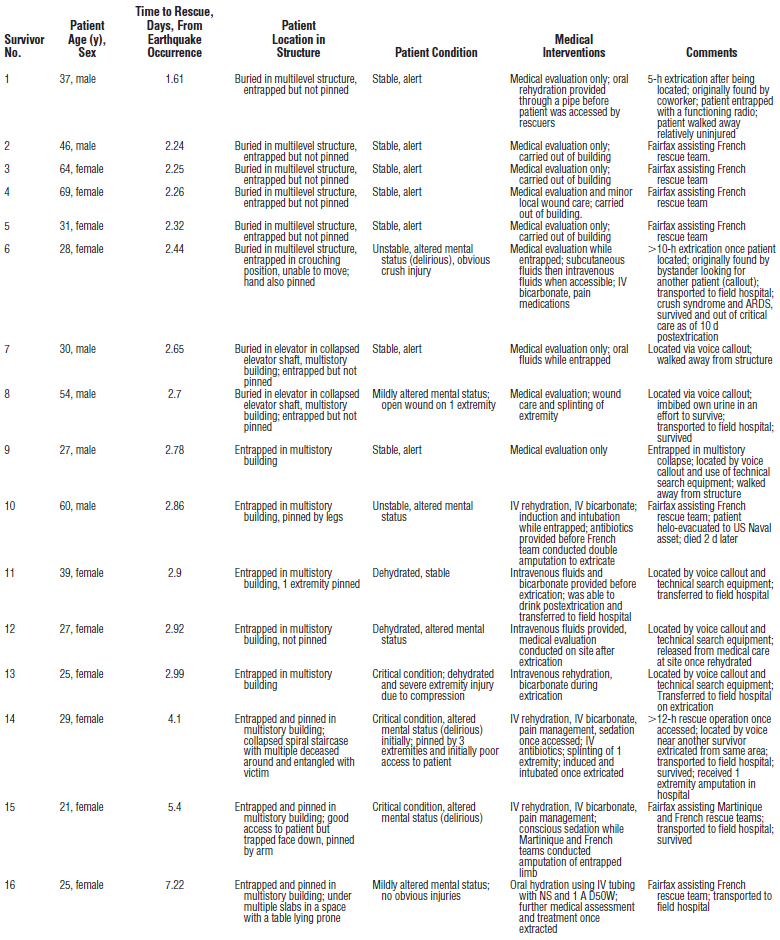
During the Haiti earthquake response, Fairfax County's Urban Search and Rescue task forces recorded the details of rescues in which they participated. The overarching factors surrounding patients' entrapment and subsequent rescue are presented in Table 1.
Fairfax County Urban Search and Rescue Patient Data From Rescues Responding to Haiti 2010 Earthquake

It is important to understand the rescue context for the data presented in the table:
-
• All of the cases cited in Table 1 required the use of specialized equipment for successful rescue: all of the individuals were entrapped to such a degree that bystanders with or without hand tools could not extricate the person. Even with sophisticated training and rescue equipment, most of the extrications entailed hours of intensive effort.
-
• Some of the individuals required critical medical intervention while entrapped. Other successful rescues produced clinically stable patients without apparent injury who even declined transport to a hospital. The latter entrapped cohort would not be included in any traditional medical reports thatcapture patient data only through hospital treatment of survivors.
-
• Most of the entrapped individuals were located by bystanders or by rescuers using voice callout search methods.
-
• Multiple rescues were reported by other international teams. As an example, other US teams rescued 22 individuals after day 5. The final rescues by US-based teams occurred on day 7, when a total of 7 survivors were extricated.
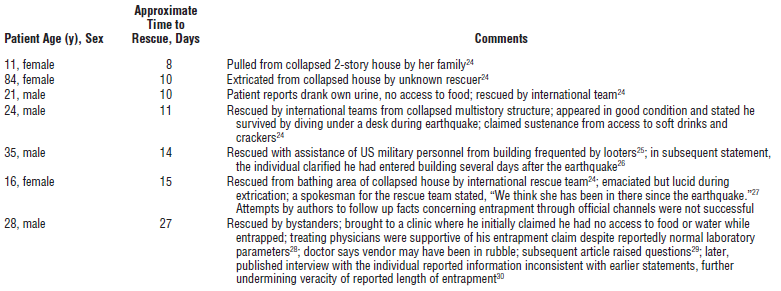
Several extremely late rescues were reported in the media following the Haiti earthquake. These are summarized briefly in Table 2, with details discerned from the media reports. Media reports typically are not specific, providing days rather than hours of entrapment postearthquake to rescue. As can be discerned from Table 2, some of the reports of late rescues provided by the media included information suggesting that the veracity of time spent in the rubble is difficult to ascertain, and some claims are doubtful.
Media Reports Describing Survivors From Prolonged Entrapment After the 2010 Haiti Earthquake

It is evident that accurate data for times to rescue are often difficult to obtain using current methods, and associated factors related to each entrapment situation are even less available. For many earthquakes, documented live rescues are reported to happen only within a few days of the earthquake. For others such as Haiti, rescues are reported for an extended period after the impact (at a minimum, US data can verify multiple rescues of earthquake-entrapped survivors on day 7). Better understanding of this critical issue requires consistent reporting of all entrapments, with additional data on factors predisposing to survival captured by the data collection process.
FACTORS CONTRIBUTING TO OR COMPROMISING SURVIVAL
Factors that promote or compromise entrapment survival have been evaluated through empirical observation of several decades of experience in collapsed structure response. Some of these factors have been researched and reported in the engineering rather than the medical literature. The detailed rescue data from the Fairfax County Urban Search and Rescue experience in Haiti provides further objective support for the validity of many previously suggested factors. Analysis of the variables develops support for a general algorithm for responders and political leaders alike in determining when rescue efforts are no longer warranted. Given the wide variability of earthquakes and their effects, it now seems more prudent to search for information that supports the development of decision tools rather than pursuing an absolute time interval for entrapment survival.
Important variables that affect survivability include the following:
-
• Cause of structural collapse: This article focuses on the earthquake as the cause for structural collapse, but a wide range of causes can induce building failure. Many of the other causes, including explosions, tsunamis, and fires, have additional effects such as heat, smoke, shrapnel, and drowning that can affect survival negatively. For example, data indicate that fires after earthquakes decrease survivability.Reference Coburn, Spence and Pomonis31 Alternatively, structures affected by subsistence or construction errors may fail in a more controlled fashion, providing more void spaces and air exchange that promote survival.
-
• Ambient meteorological conditions: Temperature extremes can affect survivability. Cases are documented in which survivors of earthquakes are extricated having hypothermia or hyperthermia.Reference Noji, Kelen, Armenian, Oganessian, Jones and Sivertson6 Even mild temperatures can cause rapid onset of hypothermia if people are trapped against concrete with little ability to move around. Other meteorological conditions beyond temperature should be considered (eg, humidity, freezing rain, snow), with their potential to affect both survival and rescue efforts.
-
• Air supply/microclimate: Individuals need adequate air exchange within the entrapment space to survive. In addition, specific substances common to collapse scenarios, such as dust, smoke, and hazardous chemicals, can present fatal inhalational injury to entrapped survivors.
-
• Status of patients preimpact: Significant comorbidities, when present before the collapse, have the potential to negatively affect survivability. Although comorbidities have been documented to decrease survivability in at least 1 earthquake,Reference Wen, Shi and Li32 it should be noted that survivors with comorbidities are often extricated and do survive. In addition, many entrapment situations present a challenge in prospectively factoring this into any decisions about a transition from rescue to recovery. Alternatively, some human conditions may increase the likelihood of survival. The collapsed wings of 2 hospitals in the 1985 Mexico City earthquake yielded 40 newborns and infants days after the earthquake struck, possibly protected due to their small size and their positions in incubators and cribs.Reference Stockton33 Reference Cody34
-
• Survivor behavior: Several researchers have, with mixed success, examined survivor behavior at the time of impact that may influence survivability.Reference Durkin35 Reference Armenian, Noji and Oganesian36 Reference Angus, Pretto and Abrams37 This can be highly variable due to both human and earthquake characteristics. In the Haiti earthquake, it appears that the 35- to 37-second earthquake created the greatest surface jolt toward the end of the shaking. Many victims were found in hallways and stairwells where they were trapped in their escape attempt. In the Tangshan earthquake, which occurred at night and was preceded by a significant preshock, many individuals were trapped while sitting in bed. The resultant spinal hyperflexion has been thought to be the leading factor in the large amount of paralysis created by the earthquake. People's behavior after entrapment may also influence survival. Fluid conservation (including individuals' drinking their own urine), actions to attract attention, and movement within a void space have been reported anecdotally as factors that presumably extend survival. Recent technological developments, particularly cellular telephones and texting capability, have provided expanded opportunity for survivors to influence their rescue. For example, in one 2010 Haitian rescue situation, an international team located a trapped survivor in a food market by tunneling to the area reported by the survivor through her cellular telephone as the entrapment location (author's observation).
-
• Access to water and/or food: Access to water has a powerful impact on survivability, especially in extremes of temperature and as entrapment time evolves. Conscious survivors can access fluids for hydration from a range of sources, such as broken water lines, rainwater, or even fluids externally furnished by bystanders who, although unable to extricate the person, provide drinks.Reference Macintyre, Barbera and Smith3 38 The authors participated in a rescue in the Haiti earthquake aftermath in which 1 survivor received water through a pipe inserted in the rubble, and in a rescue in the Philippines in 1990 in which a trapped survivor was fed juice through an intravenous line that was snaked into the debris. Food availability may prolong survival in extremely lengthy entrapments, especially if the food source contains fluid. Multiple cases of entrapped individuals eating food colocated with them during entrapment have been documented: biscuits,24 pancakes,Reference Macintyre, Barbera and Smith3 and apples.Reference North39 For decision makers, the interval for successful rescues may be extended if periods with significant rainfall are encountered. Alternatively, collapsed structures without running water, such as those in some areas of Haiti, may decrease overall survival chances, particularly during dry weather.
-
• Injuries sustained: Even though individuals may survive the initial collapse to become entombed, injuries sustained may be severe enough to affect short- and/or long-term survivability. A provocative study using postmortem examination has confirmed that some entrapped people clearly survive the initial collapse, but succumb to their injuries before they are rescued.Reference Papadopoulos, Kanakaris, Triantafillidis, Stefanakos, Kainourgios and Leukidis40 Although these findings support efficient response, rapid search for survivors, and sophisticated medical care available to treat entrapments, they are difficult to integrate into decisions about transitioning from rescue to recovery (ie, if survivors are not accessed, their conditions are not known).
-
• Availability and sophistication of medical infrastructure: It is important to recognize that medical care provided during and immediately after extrication can influence survivability. In addition to traumatic injuries from the initial collapse, patients can have compressed muscle tissue that results in “crush syndrome” when a compressed body area is released. This phenomenon has been demonstrated repeatedly, causing seemingly stable patients to rapidly deteriorate shortly after rescue. For example, experience in the 2008 Wenchuan earthquake noted that patients could “survive many days only to suffer poor outcomes when released without fluids.”Reference Chen, Lai and Liu41 Vigorous fluid resuscitation prerelease and during rescue is indicated to reduce or even prevent these effects despite extensive rhabdomyolysis.Reference Better42 Reference Ensari, Tüfekçioglu, Ayli, Gümüs, Izdes and Turanli43 Reference Sever, Vanholder and Lameire44 The level of medical sophistication in the teams performing rescue may therefore affect survival. The lack of medical infrastructure to care for severely injured survivors in the postextrication period is an additional consideration in particularly remote or severely affected areas. This, too, has been documented to affect the outcome of extricated survivors negatively.Reference Van Der Tol, Hussain and Sever10
-
• Speed and sophistication of available search and rescue capabilities: Numerous authors have documented that most postearthquake rescues are performed by unsophisticated rescue assets (eg, bystanders). At least 1 credible study documented that a number of difficult-to-rescue patients had the potential to survive but were not rescued.Reference Chen, Lai and Liu41 This highlights the concept that the rapid availability of comprehensive search and rescue capabilities (including medical and structural engineering expertise) has the potential to affect outcomes in many collapse incidents. The Haiti experience demonstrated numerous technically complicated rescues that required sophisticated equipment and techniques.
-
• Survivor location in building: Both engineering and medical studies have examined survivor location in a structure and its influence on survival.Reference Coburn, Spence and Pomonis31 Reference Armenian, Noji and Oganesian36 Reference Angus, Pretto and Abrams37 A benefit of these types of investigations may be to better train the population in earthquake zones, promoting more protective actions when a seismic incident occurs. Clearly, location can affect survivability in individual cases or in individual building types. For example, it is well known in the rescue community that location next to stairwells, elevator shafts, or large appliances can increase the chance of survivability. Although this factor may be difficult to extrapolate into a decision algorithm for transitioning from rescue to recovery, it is an important consideration for late interval search strategy.
-
• Structure type and void space formation: Perhaps the most critical factor in survival during structural collapse is the formation of a viable void space (ie, a “pocket” or “survival space” so the survivor escapes fatal injury as the rubble settles). A survivor entrapped in a void large enough to move freely will likely survive longer than one pinned by rubble or confined to a severely constricted situation. The structure type greatly influences the size and number of voids as the building fails. Research conducted in various engineering forums supports this clear link between the voids and survival.Reference Lu, Kohiyama and Horie9 Reference Coulson21 Reference Durkin and Murakami45 Reference Horie, Hayashi and Okimura46 Some studies are indirect, examining types of injuries associated with specific types of structural collapse.Reference Van Der Tol, Hussain and Sever10 In other research, the evidence is more direct. Engineers examining the survivability of collapse after the 1995 Kobe, Japan, earthquake demonstrated an increased chance of survival after entrapment in reinforced concrete structures vs unreinforced adobe construction.Reference Murakami, Takemoto and Sakamoto8 Although this may appear counterintuitive, the potential for reinforced concrete to form voids large enough for people to survive is much greater than that for adobe construction. Adobe and other unreinforced masonry commonly become reduced to compact rubble during seismic events. This understanding has utility in estimating potential overall survivability, especially in communities with relatively homogenous construction types. Survival probability depends, therefore, upon a positive answer to 1 simple question: As the structure disintegrates, has a void space formed in which someone can reasonably survive?
Some authors have researched other potential factors that may contribute to or compromise survival. For example, the socioeconomic status of entrapped individuals has been examined by Chou et al.Reference Chou, Huang, Lee, Tsai, Chen and Chang47 Although a relation of low income to increased mortality was noted, this is likely due to more direct factors such as building design and construction. Further work is required to relate these socioeconomic issues to a decision support tool.
It is intuitive that the interplay between the above-noted factors provides the final determinant of survivability. The optimal example is the survival from lengthy entrapment of a man entombed for 14 days after the 1990 Philippines earthquake collapsed a large multistory reinforced concrete hotel.Reference Macintyre, Barbera and Smith3 This individual benefited from baseline good health, was not injured by the collapse, was trapped in a large void space in which he could move around, and was able to collect water from daily rainfall that flowed down concrete slabs to reach him on 1 of the lower levels.
If any 1 factor is to be weighted more heavily than the other, the potential for void space formation is clearly the predominant variable allowing survival. Without a void space large enough for the individual to maintain vital organ function, human life is incompatible with extended rubble entrapment. In addition, void spaces can be estimated and located based upon structure types and other factors, focusing search techniques. This reasoning weighs heavily in some professional search and rescue initiatives that develop formal structural triage and search strategies.48 49
DECISION-MAKING PROCESSES: THE TRANSITION FROM RESCUE MODE TO RECOVERY OF BODIES
Collapsed structure incidents, especially those resulting from earthquakes with resultant widespread damage, present a challenge: determining when rescue efforts should be suspended so that other important response and recovery activities can receive available focus and resources. The ramifications of this decision, together with the variability between earthquake impacts, suggest that an incremental decision process be followed rather than proposing a single time frame to be universally applied. Decreasing the uncertainty of whether live survivors remain under the rubble requires an integrated interdisciplinary approach: structural engineering, technical and canine search, rescue, hazardous materials, and medical professionals may provide relevant input.
Although this multidisciplinary approach may be intuitive, it must be recognized that the individuals making the authoritative decisions regarding transition to rescue are commonly governmental leaders in the affected area. Providing recommendations to support this difficult decision may therefore be problematic without additional published and verified guidance. In the experience of the authors (A.G.M., J.A.B.), the search and rescue mode is unnecessarily extended in many situations by political leaders responding to public emotion, even with little realistic hope for additional survivors. The goal in closing the search phase is to eliminate the uncertainty of live survivors remaining under the rubble or to reduce the uncertainty to levels that are acceptable to those responsible for the final decision.
Elements of a decision support tool already exist. In the United States, federal urban search and rescue assets have strategies that are designed to improve the effectiveness of the search for survivors.48 In addition, international structural triage guidelines have been published.49 Although the ultimate purpose of these processes is slightly different than determining transition from rescue to recovery, much of this material is relevant. Current search strategies are broadly based upon 2 main factors: predictability of human presence in the target structures and the structure/collapse types.
The ability to predict population density rests largely on the timing of the earthquake impact and the intended purpose of the collapsed structures. For example, school collapse during a weekday, daytime earthquake creates a higher probability of entrapped individuals in the rubble. This was the case in Port-au-Prince, Haiti, because the earthquake struck while many universities were in session. It should be noted that some structures, such as hospitals, are densely occupied at all times.
The types of structures involved and collapse patterns similarly are important mainly because they generally determine the probability of survivable void formation. As noted earlier, unreinforced stone, brick, and adobe construction tend to fail catastrophically, leaving few void spaces. This rubble, however, is typically easier to search because much work can be done by hand to clear the debris. For example, during the catastrophic 2001 Gujarat earthquake in rural India, many of the affected structures were constructed of unreinforced masonry that was reduced to collapsed, compact piles.Reference Jain50 Reinforced concrete, depending on the quality of the construction, can also fail easily but commonly results in multiple void spaces that can contain survivors; the voids are, however, more difficult to access without specialized expertise and equipment. This was a recurring pattern in Haiti, where construction standards are lax but reinforced concrete is a predominant building design.
Any proposed strategy for determining transition from rescue to recovery should take into account the 2 above-described factors of population location and structure/collapse type as a primary step. This may be summarized as a strategy based upon determining the following: Were the people there before the collapse? and if so, what is the likelihood of void space formation in those collapsed structures? More focused searches may be conducted by considering other factors that play a role in void space formation. For example, nonstructural elements (eg, large appliances, walk-in safes) or structural elements (eg, elevator shafts, basement elements) can promote the formation of void spaces. Two of the individuals rescued in Haiti were located in a collapsed elevator shaft (Table 1). Focused search in these areas, although potentially difficult, may be fruitful in locating survivors. Alternatively, potential void space areas subjected to intense smoke, fire, or major hazardous materials release may become a lower priority in the resource-constrained search environment. Unreinforced masonry without a basement that fails catastrophically is another example of a potential low-priority assignment under these circumstances (except where young children may be present).
Beyond schools, other structures with significant numbers of missing children should be targeted as high priority. Beyond the human sensitivity of saving children, this priority is justified by their smaller size, increasing the likelihood of survival even in extremely constrained voids.
As the search interval evolves, other factors can influence the likelihood of continued survival. As long as the potential for viable void spaces exists, the strategy should take into consideration other variables such as access to ventilation, water and, to a lesser extent, food. Tightly sealed spaces can protect for a short period against heat, smoke, and fire; however, lack of ventilation will prevent extended survival. Areas (eg, broken pipes, holding tanks, bathing areas) where water from the failed building can collect or where rainfall may collect within structures may sustain survivors who remain entombed in ventilated spaces. Potential access to food and water in other ways should be considered (eg, entrapment in a supermarket in Haiti). Some of the most extreme time-to-rescue survivors summarized earlier had access to water or other acceptable fluids.
The dramatically visible components of large collapsed structures are the upper floors, but prolonged survivors more likely are located on the ground floor or in below-grade spaces, where support for void space creation, access to water, and protection from climatic elements such as heat may be enhanced. Suggesting that these areas be accessed for extended search through elevator shafts, tunneling, and other routes may be important before transitioning efforts away from the search.
Concentrating the search in locations where these above-mentioned factors are prominent may focus the most promising activity in the late stages of collapsed structure response, while awaiting the official declaration for the end to search and rescue activities. In fact, rather than an all-or-nothing decision, transition from active search and rescue mode to recovery mode may be incremental as resources are retired and remaining resources focus upon only the areas with factors supporting longer-term survival. Refocusing the search to areas with remaining survival possibility may be more politically appealing and will decrease resource needs, redirect the authorities' focus, and release resources toward other pressing human priorities. Trained medical personnel may be an essential element of a multidisciplinary process assisting political authorities in this strategy that conducts transition from rescue mode to the recovery of bodies.
An example of input into this type of decision making occurred after the September 11, 2001, terrorist attacks in New York City. Relevant discipline experts from urban search and rescue provided input into the mayor's strategy for transitioning the focus of response. A process was outlined for the transition from full-scale search to a broader delayering and more expedient search methodology (J.A.B. was a direct participant). Finally, a finite time for declaring missing people to be deceased was established. The medical input into this process was based upon preliminary data compiled by the authors (J.A.B., A.G.M.) for their 2006 published survival study.
It is important to recognize that decision making by government leaders may be influenced by politics, public confidence, and the media reporting of late “live finds.” Urban search and rescue experts, including trained medical personnel, can assist in providing balanced advice that addresses each of these issues. The veracity of any publicized late rescues should be rapidly investigated and if indicated, publicly corrected because this can have adverse effects on an otherwise responsible decision to end the search phase of an emergency response.
During the response to the 2010 Haiti earthquake, the importance of understanding the influence of contributing survival factors was highlighted. The 2 lead authors (A.G.M., J.A.B.) directly experienced multiple situations in which widespread literal interpretation of the survival findings from their 2006 study were used to argue for continued high-risk search in situations with no survival probability. During planning discussions and other venues, including explanatory sessions with families of missing people, the 14-day duration from the 2006 publication was repeatedly cited and considered a definitive milestone for full-scale search without apparent consideration of other factors (A.G.M., J.A.B., personal observations). The present article is in part motivated by a desire to provide a better understanding of survival probabilities under realistic, situation-specific conditions. Furthermore, any decision-support algorithm must be written such that it can be understood by nontechnical populations such as responsible political authorities and the family members of missing people.
Any decision algorithm should be vetted against collected data regarding times to rescue. For this to occur, more reliable sources must be developed. One such potential resource for developing and maintaining this database is the International Search and Rescue Advisory Group (INSARAG), an advisory body under the guidance of the Office for Coordination of Humanitarian Affairs within the United Nations. A recent proposal has been made to this body to more formally study rescues by international response teams made after earthquakes. The proposal is structured in such a way to capture not only rescue times but also other relevant factors that may contribute to or negatively affect survival. In addition, it suggests formal epidemiologic definitions that only a few researchers have considered.Reference de Bruycker, Greco and Annino11 Reference Coulson21 For example, a survivor of a complicated technical rescue is currently not distinguished in most data sets from those released from confinement with only minimal assistance. The importance of these distinctions affects further evolution of a decision algorithm, and this is recognized in the INSARAG proposal under consideration.
The findings from these studies may be extrapolated, with care, to other, nonearthquake situations involving potential collapse entrapments. For example, if asked questions regarding the probability of live entrapments after mudslides and other ground failures, medical personnel should request an evaluation of the collapse area to discern evidence of survivable void spaces. This may, for example, be accomplished using ground-penetrating radar and other sophisticated methods. If no voids are found, then survival by missing people is extremely improbable.
CONCLUSIONS
Earthquakes will continue to affect urban areas and unfortunately precipitate widespread structural collapse. Competing priorities in the face of scarce response resources usually will be experienced by those assisting the affected population. Despite this, search and rescue focused upon entrapped survivors will remain a high priority in every affected location. The duration of this high-risk and resource-intensive activity must be considered carefully. In multiple collapsed structure settings, 2 of the authors (J.A.B., A.G.M.) have encountered the command-level question “is anyone still alive in there?” Stopping search efforts prematurely may become a self-fulfilling prophecy, because no further “live finds” are likely and the nature of these incidents may preclude sophisticated forensic investigation to determine time of death in recovered bodies. Unnecessarily extending search and rescue risks further casualties in responders and misallocation of scarce resources.
The evolving body of published data about entrapped victims suggests a significant variability in survival across earthquake experiences. Rather than proposing a simplified, absolute time limit for the entrapped individual's survival interval, a more cogent decision methodology should be developed that considers the factors presented in this article. The potential existence of void spaces is believed to be the most influential factor to incorporate into this decision support algorithm, followed by factors related to ventilation, available water (and to a lesser extent food), and then other considerations. The decision process must factor in important political and social considerations unique to the country that is affected. Proposals for future data collection, such as the one under consideration by INSARAG, can improve understanding of factors influencing the survival interval. Current understanding strongly supports the concept that projected survival time will vary from incident to incident and even location to location within an incident, and thus should not be based on an absolute number.
Author Disclosures:
The author reports no conflicts of interest. The opinions expressed in this manuscript are those of the authors alone and should not be construed to represent official policy or opinion of the Fairfax County Urban Search and Rescue Program, or of the Office for US Foreign Disaster Assistance (OFDA)/ United States Agency for International Development (USAID).