
Introduction
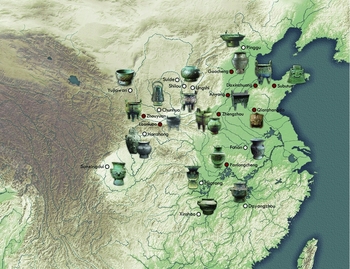
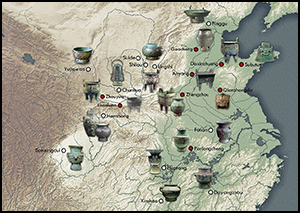
A new and systematic approach to metal chemistry, alloys and lead isotopes aims to characterise the circulation of copper and its alloying metals (Bray et al. Reference Bray, Cuénod, Gosden, Hommel, Liu and Pollard2015), rather than to link an object linearly to its source. This methodology has primarily been applied to areas dominated by relatively small-scale social structures, but we now wish to extend it to the vast and highly centralised society of ancient China. Although, in all probability, bronze technology was introduced to China from the steppe (e.g. Li Reference Li2005; Linduff & Mei Reference Linduff, Mei, Roberts and Thornton2014; Mei et al. Reference Mei, Wang, Chen, Wang, Wang and Liu2015), the bronze-making traditions that emerged were distinct from those in the rest of Eurasia. The products of the many diverse bronze-making groups within China (Figure 1) shared a combination of technical features unique to the area, namely an almost exclusive concentration on complex casting using decorated ceramic multiple-piece moulds (rather than a combination of casting, forging and cold working), and the addition of lead to the predominant alloy of tin and copper. Despite such shared similarities, however, this overall territory has to be viewed as at least three major and contrasting regions.
Diversity of bronze-making groups within China.

At the heart are the Central Plains, the rich agricultural areas along the Yellow River, which were extended in the late Shang and early Zhou up the Wei River and towards the Yangtze, especially along the Suizao Corridor in Hubei province. The Shang centres of power during the Erligang phases (c. 1500–1300 BC) and, later, at Anyang (c. 1300–1045 BC), generated a huge bronze industry, casting large ritual vessels intended to be used in sets for offerings to the ancestors, and also weapons and chariot fittings. These vessel sets are the defining feature of Shang ritual and cultural power, and were similarly adopted by the Western Zhou elite (1046–771 BC). That these vessels are also found north and south of the Central Plains highlights extensive networks of contact. This did not, however, involve the regions to the north and south of the Central Plains in adopting the rituals and culture of the Shang, as they did not generally employ the vessels in standard ritual sets. Instead, they used their casting skills to make many different and striking bronze artefact types.
To the south, the mountainous topography along the Yangtze created fertile basins in which agricultural production was already well developed by the Bronze Age (c. 1600 BC). Although no single ritual culture developed across this area, there was significant interaction between the basins. These diverse communities were to a greater or lesser extent participants in the technological system of the Central Plains. They used complex piece-moulds to cast a wide range of artefacts, and shared the preference for leaded alloys with their northern neighbours. The scale of some of these castings, such as the figure and heads from Sanxingdui, and the bells from Hunan, Jiangxi and Anhui, suggest that some of these completely distinct bronze industries must have had their own large and stable supplies of metal, as first suggested by Kane (Reference Kane1974) and Bagley (Reference Bagley1977).
To the north of the Central Plains is an area, defined here as ‘the Arc’, following a proposal made by Tong Enzheng in 1987 (Tong Reference Tong and Tong1987; Rawson Reference Rawson2015). The Arc is a distinct region of highland, with varied ecologies ranging from deserts to very high mountainous plateaux, and characterised by the predominance of herding, but with some sedentary agriculture. The boundaries of the Arc are defined qualitatively (using modern data) through reference to a series of overlapping physical and cultural characteristics, principally based upon elevation, precipitation and dominant regional economy. The cultures of this region, part of which is often referred to as the Northern Zone (Lin Reference Lin and Chang1986), had diverse subsistence strategies, with both agriculture and pastoralism. They shared far more with the societies of the Eurasian steppe, in terms of lifestyle and weaponry (knives, daggers and axes), than with the polities of the Central Plains. As in the south, some vessels were brought into the Arc by exchange or capture, and others were produced as local copies or variants. These metallurgical traditions, however, remained relatively small-scale in comparison to those of the Central Plains or the South.
The widespread presence of Shang- and some early Zhou-type vessels in both the South and the North, where they were not fundamental elements of the local culture, demonstrates that peoples of these regions were in contact with those of the Central Plains. A highly organised supply and control network would have been required to sustain the metal-producing centres of the Central Plains. This network may have spread the techniques of mould-making, metallurgy and the very concept of cast bronze vessels, across much of China, from south of the Yangtze, across the Central Plains to the Arc in the north and west. Shifts in the political structures of the Shang in the Erligang and Anyang phases, which may have been responsible for this extraordinary expansion of contacts, have received much attention (Bagley Reference Bagley, Steinke and Ching2014). Campbell (Reference Campbell2009: 835) discusses the existence of a network as a political phenomenon, but does not explore the implications for metallurgy. Thus far, the overall effects of the enormous demands placed upon this network by the scale of bronze casting at Anyang have not been fully assessed. Other materials were no doubt also sought, such as ivory and jade (Deng Reference Deng1994), but probably did not require quite as comprehensive a network, nor did they absorb labour on the same scale as the bronze industry (IA CASS Reference CASS2015).
The Shang were probably attracted to the South by the abundance of copper and tin ores, known today from mines along the southern edge of the Yangtze basin and in Jiangxi province. Interactions with the North may have taken a rather different form. The inhabitants of the Arc, with good access to the steppe and its abundant horses, posed a serious military threat to the Shang, particularly in the Anyang period. The vessels that appear at northern sites may in part, therefore, have been exchanged for horses (Cao Reference Cao2014: 198–205). In addition to these large-scale relationships, some non-Shang groups, including the pre-dynastic Zhou, also imitated the Shang in their ritual practices, including the use of vessel sets. The task facing all students of the Chinese Bronze Age is, therefore, to understand how this part of the wider Shang interaction network functioned and changed over time.
Given the scale of Shang bronze production, as attested by elite tombs such as that of Fu Hao with her 200 bronze vessels (some massive in size; IA CASS Reference CASS1980), it is assumed that many sources of metal were accessed, and that casters would have become aware of copper and tin from different mines (Liu & Chen Reference Liu and Chen2003: 36–56). Likewise, lead shows variations that suggest the involvement of a number of distinctive source regions (Cui & Wu Reference Cui and Wu2008; Jin Reference Jin2008). It is also known that some metal was recycled, especially by the Zhou. The looting of Shang tombs in the early Zhou period is well documented. While it is known that some of these vessels were reburied intact (Huang 2013/Reference Huang2014; Ding & Wang Reference Ding and Wang2016), the potential socio-political significance for the Zhou of reusing and perhaps recycling such vessels into new forms was so great that it seems unlikely to have been entirely ignored by the Zhou. Major vessels missing from such tombs (Jing Reference Jing2010; He Reference He2014) suggest that large quantities of metal may have been reused over time. Western and Eastern Zhou bronze inscriptions and texts also give clear indications that the re-melting of both weapons and vessels took place (Wu Reference Wu2012).
The Oxford system for interpreting chemical and isotopic data
The authors interpret the archaeological and textual evidence discussed above as indicating the existence of a complex supply network driven by the demand for vast quantities of raw materials (copper, tin and lead, or perhaps preformed bronze) in the Central Plains. Current evidence for the relatively small scale of contemporaneous mining operations (Liu & Chen Reference Liu and Chen2003: 38–41; Chen Reference Chen2014: 44–53) suggests that metal smelted from the ores in different mines, and even perhaps from different regions, is likely to have been required to satisfy this demand. By the time metal from more than one mining region has been mixed, and allowance made for the possibility of the recycling of objects, it becomes very difficult to determine the provenance of the metal of an individual object. The Oxford system, however, is not focused specifically on the provenance of individual objects, but is designed to characterise, using trace elements and isotopes in an assemblage of material, the nature of the underlying metal circulation system (Bray et al. Reference Bray, Cuénod, Gosden, Hommel, Liu and Pollard2015). In a complex supply network, the composition of the metal in circulation at any one time and place is dependent on the balance of inputs from different mining areas and on the extent of recycling. If Shang bronzes were looted and recycled by the Zhou, then the composition of the metal used by the Zhou would have been influenced by that of the Shang. This type of complexity has been recognised by some scholars in other parts of the world (Needham Reference Needham, Mordant, Pernot and Rychner1998), but here the authors introduce their system (which has been described elsewhere: Bray et al. Reference Bray, Cuénod, Gosden, Hommel, Liu and Pollard2015; Pollard & Bray Reference Pollard and Bray2015) to quantify and visualise these effects for the Chinese Bronze Age.
The aim is, given sufficient chemical and isotopic evidence, to understand how the patterns within these data vary according to geography, chronology, object typology and archaeological context. It is first useful to separate conceptually the object from the metal from which it is constructed, before considering the metal in use at any one place and time (either manifested as objects or raw materials) to be characterisable by three inter-related parameters:
-
I. A set of 16 ‘Copper Groups’ defined by the simple presence/absence of the four most commonly reported trace elements (arsenic, antimony, silver and nickel) in archaeological copper artefacts (see online supplementary material for an exact breakdown of each group). These ‘Groups’ do not necessarily map to specific mines, but do reflect the chemistry of the parent ores. These are used initially in preference to absolute values of trace elements in the metal because they are subject to change by subsequent human processing, such as dilution, enrichment or oxidative loss during high-temperature processes (McKerrell & Tylecote Reference McKerrell and Tylecote1972). Presence or absence patterns revealed by Copper Groups can be used to give a preliminary characterisation of the copper, as it is instantiated in specific sets of objects, and can provide a useful tool to enable comparison between different regions and over time. No assumptions are made at this stage concerning the origin of the copper, although subsequent mapping of Copper Groups and detailed analysis of the distributional profiles of trace elements within assemblages may often suggest particular source areas, which can then be verified by mine data (where available).
-
II. A similar non-parametric initial approach is taken to the definition of alloy types, based on the assumption that not all objects are made from primary designed alloys (i.e. from an alloy made to a controlled recipe). A presence/absence classification for the presence of the major alloying metals (lead and tin in ancient China) is used, defining ‘present’ as being >1%. The quantities of these alloying metals will be affected by mixing, but can also be altered by re-alloying to give specific properties—e.g. a copper-tin bronze can have lead added to increase fluidity when casting. The distribution profiles of tin and lead in groups of objects can be used to distinguish ‘primary’ (designed or deliberate) alloys from those resulting from mixing. Essentially, assemblages that show an approximately normally distributed profile of lead or tin can be assumed to contain objects of ‘designed’ alloys. Assemblages with non-normal distributions of lead or tin are more likely to contain objects that come from different places, or have been made from mixed or recycled alloys.
-
III. Our new approach to the presentation of lead isotope data is more sensitive to evidence for mixing (Pollard & Bray Reference Pollard and Bray2015). Rather than use ‘conventional’ isotope ratio biplots, the authors plot 1/lead against each individual ratio. The advantage is that each diagram not only represents the lead isotope value for each object, but also gives the lead concentration in that object. This allows us to distinguish between objects in which the isotope ratio is dominated by the signal from the lead source (as in a leaded bronze) and those with very low lead, where the lead isotope ratio is probably coming from the copper. Mixing lines can, therefore, potentially show where lead from different sources is being combined, or when copper from one source is mixed with lead from another.
In this paper we consider the use of ‘Copper Groups’ combined with lead isotope data to investigate the circulation of metal in Bronze Age China.
i) Trace elements and ‘Copper Groups’
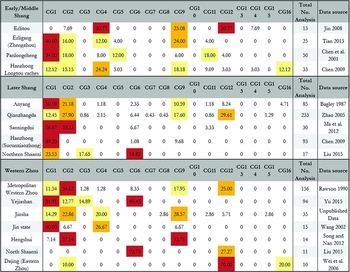
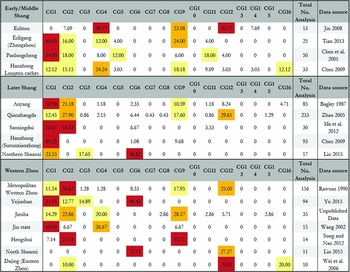
Figure 2 shows a summary of the ubiquity of each of the 16 Copper Groups as a percentage of the total number of available analyses for each site, divided into three major periods—Early/Middle Shang (pre-Anyang, c. 1600–1300 BC), Late Shang (Anyang period, c. 1300–1045 BC) and Western Zhou (c. 1045–771 BC). The total numbers of samples are given at the extreme right, and the ubiquities of the Copper Groups are colour coded—red is 30–50% ubiquity, orange is 20–30%, and yellow is 10–20%. Figures 3–5 map the Copper Group profiles for each site by period.
A summary of the ubiquity of each of the 16 Copper Groups as a percentage of the total number of available analyses for each site, divided into three major periods—Early/Middle Shang (pre-Anyang, c. 1600–1300 BC), Late Shang (Anyang period, c. 1300–1045 BC) and Western Zhou (c. 1045–771 BC). The total numbers of samples are given at the extreme right, and the ubiquities of the Copper Groups are colour coded—red is 30–50% ubiquity, orange is 20–30% and yellow is 10–20%.

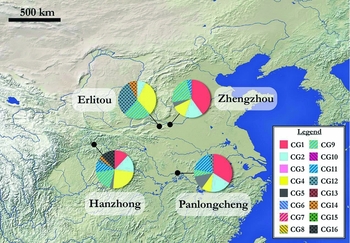
Spatial variation of Copper Groups in Pre/Middle Shang.

Figure 4 (Early/Middle Shang) shows the Copper Group profiles for the two Central Plains sites of Erlitou and Zhengzhou (Erligang), as well as Panlongcheng and the Middle Shang contexts of Hanzhong. Analysis suggests a marked difference between Erlitou and Zhengzhou, with the former dominated by Copper Groups 4 (Cu+Ag, 31%), 12 (Cu+As, Sb, Ag; 31%) and 9 (Cu+As, Ag; 23%), and the latter by Copper Groups 1 (Cu only; 40%) and 9 (Cu+As, Ag; 24%). It must be noted, however, that there are only 13 and 25 samples for each site respectively; any conclusions based on these data should be considered extremely preliminary. More convincing are the comparisons with Panlongcheng and Hanzhong. Panlongcheng, a site of the Erligang period, is situated to the south of the Central Plains on the Yangtze River, close to an important mining region. Figure 4 shows a strong signal of Copper Groups containing nickel at Panlongcheng (Copper Group 5 (Cu+Ni) and Copper Group 11 (Cu+As, Ni), together making up 30% of the total assemblage), which is rare among mainstream Erligang and Anyang bronzes. This shows that a significant proportion of the bronzes at Panlongcheng were not made at the major Erligang centre of Zhengzhou (as no nickel-containing objects have yet been reported from there), and also that Panlongcheng had access to copper sources that were not being used at Zhengzhou (Chi-squared test confirms that this is a statistically significant difference at 95% confidence). These differences suggest that the connection between the two areas was perhaps not as direct as is sometimes argued (e.g. Wang Reference Wang, Steinke and Ching2014). The Longtou caches of Hanzhong, dated to the Middle Shang, also show the presence of copper containing nickel. Here, Copper Groups 5 and 11 are only represented in 12% of the assemblage, but Copper Group 16 (Cu+As, Sb, Ag, Ni) contributes to a further 12%; a total of 24% of the assemblage, therefore, contains nickel. The remainder is dominated by Copper Groups 4 (Cu+Ag; 24%), 9 (Cu+As, Ag; 18%), 2 (Cu+As; 15%) and 1 (Cu only; 12%). Given this evidence, it is tempting to see the presence of nickel as indicative of copper coming from the west or south-west.
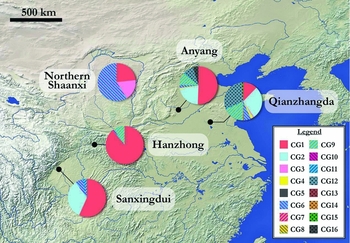
Spatial variation of Copper Groups in Late Shang.

Figure 4 compares the Copper Groups in the Central Plains (Anyang and Qianzhangda) during the Anyang phase of the Shang Dynasty (c. 1200–1045 BC), with material from Sanxingdui (Ma et al. Reference Ma, Jin, Tian and Chen2012), Hanzhong (Sucunxiaozhong, dated to Late Shang; Chen Reference Chen2009), and northern Shaanxi (Liu Reference Liu2015). The most striking feature here is the relative complexity of the metal in use at both Anyang and Qianzhangda, compared to that at other sites in the northern and western borderlands. Both of these sites have at least four Copper Groups represented at significant levels, whereas Hanzhong (dominated by Copper Groups 1 (Cu only; 89%) and 9 (Cu+As, Sb; 10%)), Sanxingdui (Copper Groups 1 (Cu only; 57%) and 2 (Cu+As; 33%)), and northern Shaanxi (Copper Groups 6 (Cu+As, Sb; 59%), 1 (Cu only; 24%) and 3 (Cu+Sb; 18%)) have much more restricted variation. This suggests that the Central Plains network was capable of attracting copper from a wide variety of places, whereas the regional centres of Hanzhong, Sanxingdui and northern Shaanxi used a more restricted range of local resources. This difference also correlates with archaeological evidence from these areas. Although many Shang-type bronzes have been found in these regions, the inhabitants certainly had their own culture and their own bronze-casting traditions (Rawson Reference Rawson2015). The authors also note that the northern Shaanxi data differ from those at Hanzhong and Sanxingdui, in that they are dominated by copper containing arsenic and antimony (Copper Group 6, 59%) or just antimony (Copper Group 3, 18%), which could indicate a north-western origin for some of the copper.
The data for Western Zhou (Figure 5) shows a more complex set of relationships. The metropolitan Zhou state was surrounded by a series of subordinate states or independent centres, most of which show a wide range of Copper Groups. The most noticeably distinct is northern Shaanxi, which is dominated by Copper Groups 6 (Cu+As, Sb; approximately 70%) and 12 (Cu+As, Sb, Ag; 27%). The dominance of Copper Group 12 discovered at the mining site of Dajing (presently dated to the late Western/early Eastern Zhou) suggests that this Copper Group might have been the major product of this region, although only ten objects have so far been analysed. Another related mine to the west, Xiquegou (radiocarbon dated to the late Shang and Zhou periods), may, together with Dajing, have contributed to bronzes of the north and north-east and possibly to the metropolitan Zhou foundries (Li & Han Reference Li and Han1990; Wang & Fu Reference Wang and Fu2015).
Spatial variation of Copper Groups in Western Zhou.

A more remarkable shift affected the south at this time. Evidence for the several large independent bronze industries at Sanxingdui, and in Hunan and Jiangxi, declines in the early Western Zhou, although activity in Sichuan continued at Jinsha (Chengdu Archaeological Institution & Jinsha Museum 2013/2014). While some Sichuan sites were in contact with the western Wei Valley, the metropolitan centres seem likely to have had more contact with the South via areas within present-day Hubei province. The early Zeng state, whose first phases have been recently identified at Yejiashan in the Suizao Corridor, seems to have taken over as one of the major southern centres. Unlike the earlier southern centres, the Zeng state followed Central Plains practices in elite burials and the use of vessel sets (Hubei Provincial Institution of Archaeology & Suizhou Museum 2011). Situated north of the large mining area at Tonglüshan, the Zeng state may have controlled the transport of copper northwards. Ingots and malachite excavated from tombs at Yejiashan suggest that the Zeng elite were conscious of their role in the copper network serving the metropolitan Zhou centres.
ii) Lead isotope data
A different set of diagrams is introduced to present lead isotope data, which plot the inverse of the lead concentration against each isotope ratio in turn (Pollard & Bray Reference Pollard and Bray2015). This has the advantage that mixtures from two sources show up as linear mixing lines. This is particularly important for understanding Chinese bronzes, which typically contain several per cent of lead from at least the Erlitou period onwards. The chemical and isotopic analysis of the Sackler Collections provides a useful case study to demonstrate this (Bagley Reference Bagley1987; Rawson Reference Rawson1990), although the unprovenanced nature of most of the items force reliance on visual identification for the attribution of dates and origin.
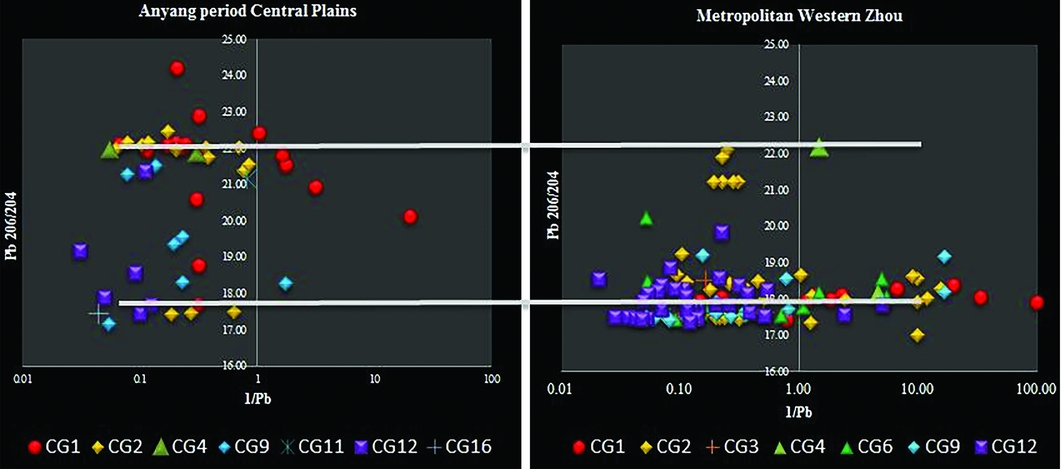
Figure 6a shows a plot of (1/lead) against 206Pb/204Pb, classified by Copper Group for the Anyang-period Shang vessels in the Sackler Collections, which are thought to originate from the Central Plains. The Sackler Collections, as catalogued in Bagley (Reference Bagley1987) and Rawson (Reference Rawson1990), provide the only large body of bronze vessels for which good trace element and lead isotopic evidence has so far been published. In these diagrams, objects with the same lead isotope ratio form horizontal lines parallel to the x-axis. This diagram, therefore, shows two isotopically distinct groups, corresponding to the ‘high’ (206Pb/204Pb ≈ 22) and ‘low’ (206Pb/204Pb ≈ 17.5) lead sources previously identified as ‘radiogenic’ and ‘common’ lead, respectively (Jin Reference Jin2008). The most significant lead source present in these data is that corresponding to the ‘high’ (‘radiogenic’) source (206Pb/204Pb ≈ 22), with most of the objects made of copper from Copper Groups 1 and 2 being combined with lead of this type. Objects made from copper of Copper Groups 9 and 12 are predominantly alloyed with lead from the ‘low’ source (206Pb/204Pb ≈ 17.5), although a number of objects potentially contain lead that is a mixture of these two sources, as shown by points which fall between these two parallel lines.
1/Pb against 206Pb/204Pb: Anyang-period Central Plains and metropolitan Western Zhou.

Another advantage of this form of presentation is that unlike conventional biplots, it shows the lead concentration in the vessels, as well as the lead isotope values. As the horizontal axis is 1/lead, a value of 1 on this axis denotes objects with a lead concentration of 1%. Points to the right of this value have less than 1% lead, and points to the left have more. Thus, objects plotting around 10 on the 1/lead axis (where the lead concentration is 0.1%) have little or no lead added, and therefore the lead isotope value probably reflects the source of the copper itself; points to the left of 1/lead = 10 most probably show the isotope value in the added lead. The Anyang-style vessels from the Central Plains, shown in Figure 6, present five vessels made from Copper Group 1 (‘clean’ copper) containing less than 1% lead (the points to the right of 1 on the horizontal axis). The arrangement of these points suggests a mixing line between the sources of the copper with that of the added lead. The authors suggest that this line represents the alloying of copper with an isotopic value similar to that in the lower lead source (206Pb/204Pb ≈ 17.5) with lead from the higher (‘radiogenic’) source (206Pb/204Pb ≈ 22). If we further assume that copper and lead with similar lead isotope values could come from the same geological area, then this might suggest that copper from the same locality as the isotopically lower (‘common’) lead source is being mixed, not with this lead but with that from the higher (‘radiogenic’) source. It might, however, be pointed out that the geographic distinction between sources of ‘common’ and ‘radiogenic’ lead, widespread in the Chinese literature, need not necessarily represent two geographically distinct sources. In the southern Yangtze metallogenic zone, for example, modern isotopic data shows that metalliferous deposits within the same geographic region can provide both ‘common’ and ‘radiogenic’ lead, although the latter much more rarely (Jin et al. forthcoming).
The Anyang-style vessels from the Central Plains and those of the Western Zhou can also be compared (Figure 6b: for both figures we only plot the most significant Copper Groups, i.e. 1, 2, 6, 9 and 12). In the Western Zhou data, the lead and virtually all the copper have 206Pb/204Pb values that are consistent with the relatively small number of late Anyang-style Shang vessels with isotopically lower lead values (206Pb/204Pb between 17 and 18) relating mainly to vessels containing copper of Copper Groups 9 and 12. This suggests that the Western Zhou continued to benefit from the supply and practices of the latter part of the Anyang tradition. There is, however, a significant change in alloying practice. The mixing line between low-lead copper (mostly Copper Groups 1 and 2) and the added lead is now horizontal, suggesting that this copper was being mixed with lead characterised by ‘low’ isotope values (206Pb/204Pb ≈ 18), in contrast to the mixing of Copper Group 1 with ‘high’ (radiogenic) lead in the Shang. Some lead of the higher value is also present, associated primarily with Copper Group 2, which may represent the reuse of Shang metal, or some continued access to lead of the higher 206Pb/204Pb type.
Conclusions
Application of the Oxford system to existing trace element and isotopic analyses of Chinese Bronze Age metalwork reveals new information concerning the circulation networks for copper and lead and the patterns of alloying lead with copper, adding to that established in previous research (Jin Reference Jin2008; Chen Reference Chen2014; Mei et al. Reference Mei, Wang, Chen, Wang, Wang and Liu2015). The new information provides a clearer understanding of the supply network of metal that was drawn into the Central Plains, and which brought this area into contact with neighbouring societies to the north and south. Our study leads to the following conclusions:
-
1. The similarity in copper groups between the bronzes of the Erligang and Anyang phases (although with a different intensity of use for the groups) indicates not only continuity in the lines of communication within the network supplying the Central Plains, but also a somewhat different balance in the use of regional metal sources between these two periods.
-
2. During the Erligang phase, metal sources used at Panlongcheng appear to have been slightly different (i.e. to have included sources containing nickel) from those used at Zhengzhou, with significant implications for the relationship between these two areas.
-
3. The strong continuity in copper supply between the Late Shang and the Western Zhou (shown in the trace elements) indicates that much the same network supplied both the Late Shang and Western Zhou bronze casting workshops. Thus, the success of the Zhou may have depended on taking over Late Shang organisational structures. When these copper groups are combined with lead isotope data, however, the two well-known ‘common’ and ‘radiogenic’ lead sources (referred to here as ‘low’ and ‘high’ 206Pb/204Pb values, respectively) become visible, and provide much additional information about the way in which different sources of copper were alloyed with lead. The early and mid Anyang-period vessels of the Central Plains commonly contained lead from a different source (high or ‘radiogenic’) to that most generally used in the Western Zhou; hence there was a continuity of copper supply, but a change in the dominant source of lead during the latter part of the Anyang period.
-
4. The role of the southern regions as sources of metal is evident from the development of bronze cultures in the Shang period, most significantly at Sanxingdui. That the South remained significant under the Zhou is evident from the abundance of Zeng state tombs. The death of King Zhao (c. 977 BC) on a southern campaign confirms the importance of the South.
-
5. During the Zhou, there may have been new efforts to obtain copper from the North. The mines in the Dajing area are challenging in their mineralogical complexity and their dating. As in the Upper Xiajiadian culture, however, an increase in the quantity of Central Plains vessels buried in hoards in north-east China, and a growth in production of northern bronze types (such as swords and daggers), suggest a rise in metallurgical activity in the north. Supplies of copper and lead here were unlike those available to their steppe neighbours, where arsenical copper was preferred (Hsu et al. Reference Hsu, Bray, Hommel, Pollard and Rawson2016).
The authors’ intention here has been to demonstrate that by conceptually separating the metals of which objects are made from the objects themselves, and by combining trace element, major element and isotopic data within a single systematic framework, we can provide information that can complement existing archaeological knowledge. Moreover, our methodology allows new questions to be asked about the organisation of metal supply in China, and about China's relationships with its neighbours to the north and south. Although the number of objects analysed here cannot give a comprehensive picture through time and space, future analyses can easily be fitted into this model.
Acknowledgements
The work presented here has been under development over the last ten years, and has received support from various sources, including a Hastings Senior Scholarship, the Oxford University Press John Fell Fund, Leverhulme Trust Grants (F/08 622/D and F/08 735/G), China Oxford Scholarship Fund, the Santander travelling fund and the Reed Foundation. The current work is supported by European Research Council Advanced Grant 1300505 (FLAME) and an Oxford Clarendon DPhil scholarship. We are indebted to the extensive work previously carried out in China, a large part of which is summarised in the work of Mei Jianjun, Chen Jianli, Chen Kunlong, Zhao Chunyan and their colleagues.
Supplementary material
To view supplementary material for this article, please visit https://doi.org/10.15184/aqy.2017.45