Introduction
Health anxiety (HA) is an anxiety disorder characterized by excessive concern about one’s health caused by the misperception of physical sensations or symptoms (Salkovskis and Bass, 1997). Its intensity ranges from slight concern to persistent and severe anxiety, with hypochondriasis being the extreme case (Bourgault-Fagnou and Hadjistavropoulos, Reference Bourgault-Fagnou and Hadjistavropoulos2009). Usually, people with severe HA repeatedly consult health professionals and hope to receive reassurance. However, they often seek further examination. Such repeated help-seeking behaviors lead to a decline in the quality of life of these individuals and an increased consumption of healthcare resources (Seivewright et al., Reference Seivewright2004; Snyder and Stanley, 2001).
HA is a common psychological distress or mental illness. An Australian study illustrated that the lifetime prevalence of HA is 5.7% in the general Australian population and lifetime and current prevalence rate of HA were 6.55% and 3.84% in people aged 55–64 years, respectively. They were 4.04% and 2.75% in people aged 64–85 years, respectively (Sunderland et al., Reference Sunderland, Newby and Andrews2013).
Many factors may affect HA in the elderly, such as aging, comorbidity, interpersonal relationships, and social and cultural background (Montorio et al., Reference Montorio, Nuevo, Márquez, Izal and Losada2003; Rodin and Timko, 1992; Skarborn and Nicki, Reference Skarborn and Nicki1996; Wisocki, Reference Wisocki1988). China is rapidly developing with enormous changes in its social structure; such as aging of the population, changes in social life caused by the disappearance of large and traditional families, and a prolongation of life expectancy. As a result, HA has become a common health problem among the elderly population. However, little is known about the epidemiology and influencing factors of HA in the elderly living in the communities in China. This study explored HA in the elderly in a community. It also characterized the prevalence of HA and its related factors. This provides evidence for a better understanding of the condition and thus may assist with developing effective interventions in the future.
Methods
Participants
The permanent residents who volunteered for this study had lived in the Jinjiang district in Chengdu city for more than 12 months. A multistage cluster sampling method was used in this study. Four communities were randomly selected in the Jinjiang district: Longzhou, Hebin, Shunjiang, and other communities. A total of 893 individuals were enrolled between October 2016 and March 2017.
The inclusion criteria were as follows: age ≥ 60 years, having clear consciousness and normal verbal communication, having no cognitive dysfunction, depressive disorder, nor other neuropsychiatric diseases; no severe and active physical diseases; and no severe physical dysfunction.
The study was approved by the Ethics Committee of West China Hospital of Sichuan University. Written informed consent was obtained from all the participants.
Study design
Face-to-face interviews were conducted by students from the West China School of Public Health and psychiatrists from Jinxin Psychiatric Hospital of Chengdu in the interviewee’s home. The interviewers received unified training before the interview was conducted. They were accompanied by staff from the community healthcare center, where the participants were located during the interviews.
The elderly’s demographic characteristics, physical function status, and health status were collected using self-developed surveys. Their HA levels were assessed using the Short Health Anxiety Inventory (SHAI). The SHAI was compiled by Salkovskis in 2002 and is primarily used to evaluate an individual’s status during the past six months (Salkovskis et al., Reference Salkovskis, Rimes, Warwick and Clark2002). The Chinese version of the scale was adopted in this study. It has good reliability and validity. A total score of 15 was defined as the diagnostic threshold for the HA (Zhang et al., Reference Zhang, Liu, Li, Mao and Yuan2015). The participants with a score ≥15 were defined as having HA, and participants with a total score <15 were classified as non-HA.
The participants’ cognitive status were evaluated using the Mini-Mental State Examination (MMSE). The MMSE score ranges from 0 to 30, with the severity of cognitive dysfunction increasing as the score decreases. Only participants with MMSE scores of ≥ 17 were enrolled in this study to exclude potential interference from severe cognitive dysfunction. The Geriatric Depression Inventory (GDI) (Xie et al., Reference Xie2015) was used to screen for depression in the geriatric population. A GDI score of ≥ 3 was defined as having possibly severe depression. To avoid the impact of severe depressive symptoms, only participants who scored < 3 were included in this study.
Statistical analysis
IBM’s Statistical Package for the Social Sciences (SPSS) version 19.0 was used for the data analysis. Chi-square tests were conducted to assess the differences in the demographic characteristics and physiological and psychological conditions between the non-HA and HA groups. “Community” was included as a categorical covariate, given that people residing in the same community may share homogeneity. A multistage logistic regression was used to explore the potential association factors for HA. Statistical significance was defined as p < 0.05.
Results
General information
A total of 893 participants were enrolled in the study, of which 379 were excluded before data analysis. This included 163 participants who refused to participate in the SHAI surveys, 75 with missing key information, and 34 with a total score of < 17 for the MMSE. A total of 514 patients were included in the study, with 465 people being defined as non-HA, and the remaining 49 as having HA.
The prevalence and characteristics of HA
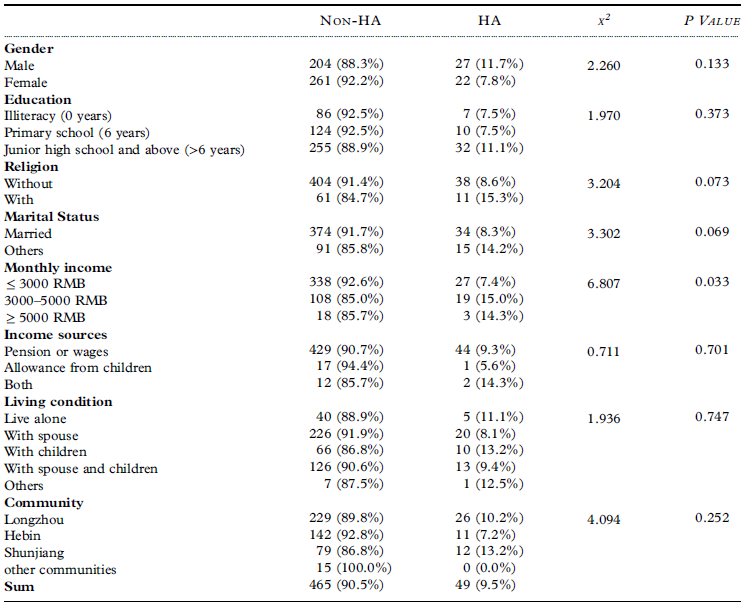
A total of 49 (27 men and 22 women) individuals were diagnosed with HA in a total of 514 participants. This resulted in an overall prevalence of 9.53% in this population (95%CI = 6.99%–12.07%). This suggested a potentially higher prevalence in the elderly, as compared to the prevalence of 5.7% found in the general population in Australia (Sunderland et al., Reference Sunderland, Newby and Andrews2013). Demographic characteristics and social status were compared between the HA (n = 49) and non-HA groups (n = 465). Factors, such as gender, education, monthly income, income sources, and living status were assessed. It was found that monthly income was significantly different between the two groups. Community was included as a categorical covariate to control the potential impact of the sampling stratum. No difference was found between the two groups (Table 1).
Demographic characteristics between with HA and non-HA

Relationship between physical and psychological conditions and HA
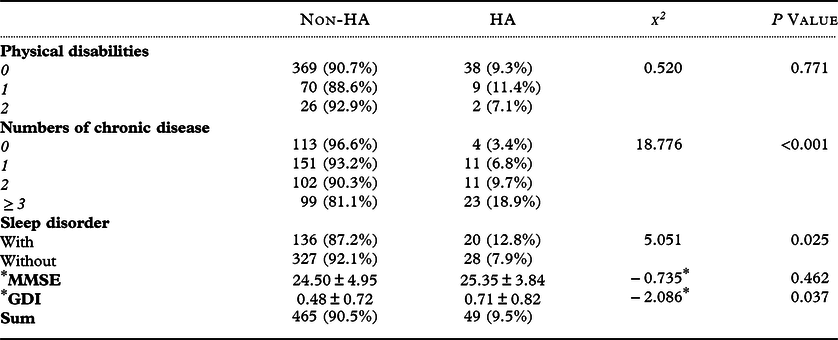
Having assessed the participants’ demographic and social factors, the physical and psychological conditions were studied to further explore other factors potentially related to HA. The percentage of people suffering from HA in the participants with physical disabilities was 22.4% (11/49). This is similar to the percentage in the non-HA group (20.6%, 91/465). The Chi-square test also showed that there was no significant difference between the non-HA and HA groups in terms of physical disabilities. There were significant differences in the number of chronic diseases (p < 0.001) and sleep disorders (p < 0.05) between the non-HA and HA groups. The GDI score was significantly higher in the HA group (0.71 ± 0.82) than in the non-HA group (0.48 ± 0.72) (p < 0.05). This was while no significant difference was found in the MMSE scores between the two groups (Table 2).
Physical and psychological factors between HA and Non-HA

* : Rank sum test was performed for MMSE and GDI data because the data were not normally distributed. MMSE: Mini-Mental State Examination; GDI: Geriatric Depression Inventory.
Impact of chronic diseases on HA
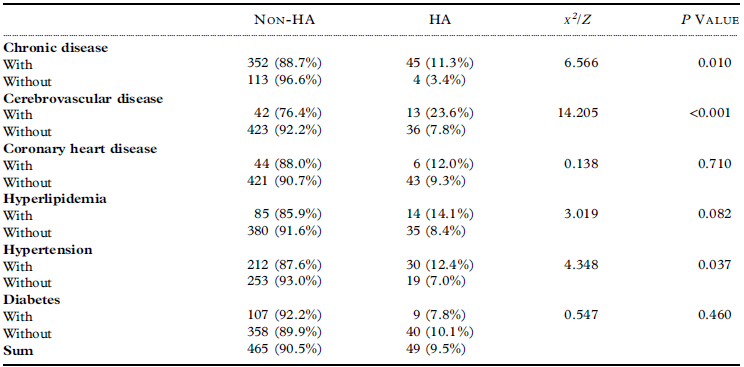
To explore the impact of chronic diseases on HA in the elderly, several chronic diseases commonly present in the elderly population were assessed between the non-HA and HA groups. These included cerebrovascular disease, coronary heart disease, and hypertension. A total of 75.7% (352 out of 465) presented with chronic diseases in participants without HA. The percentage was higher in the HA group (91.8%, 45 out of 49). The Chi-square tests showed significant differences between the non-HA and HA groups regarding chronic diseases. This suggested a potential positive association between chronic diseases and HA in the elderly. When the different types of chronic disease were further investigated, a statistical significance was detected regarding cerebrovascular disease and hypertension between the HA and non-HA groups (Table 3).
Analysis of physical chronic disease and disabilities among of HA and Non-HA

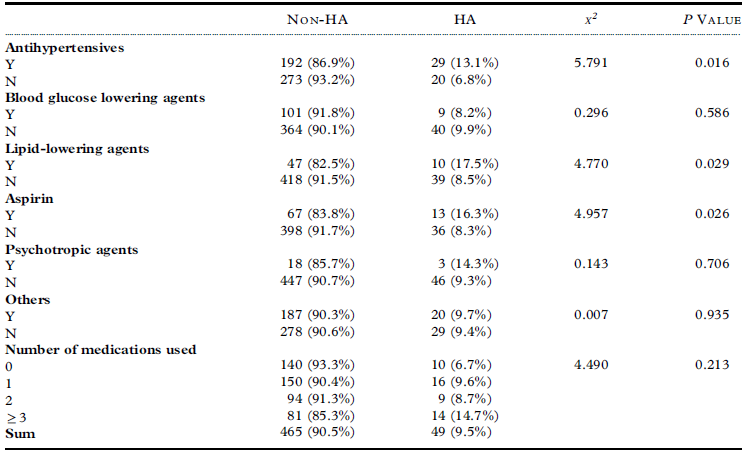
When medications commonly used for chronic diseases were examined, it was discovered that the use of medications related to hypertension and the vasculature system was also significantly different between the two groups. These were such as; antihypertensive drugs, lipid-lowering agents, and aspirin. However, medications for diabetes were not (Table 4).
Comparison of medication use in non-HA and HA

Multiple regression analysis of factors related to HA
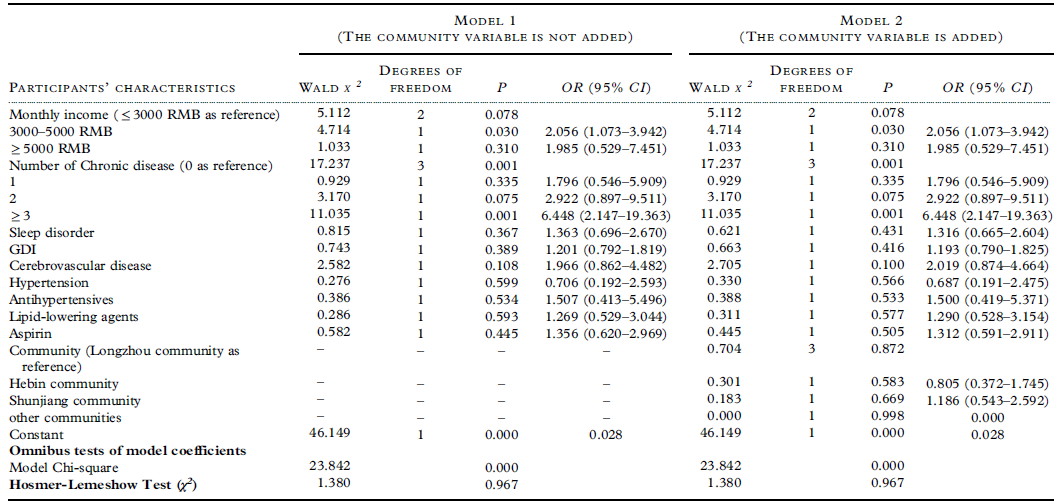
Having examined the impact of various social, physical, and psychological factors on HA, a backward stepwise conditional logistic regression analysis was conducted to further analyze the factors potentially associated with HA. Using anxiety as the dependent variable, factors that were shown to be significantly different between the non-HA and the HA groups in the χ2 tests were included as independent variables. These comprised variables such as monthly income, number of chronic diseases, sleep disorder, GDI, cerebrovascular disease, hypertension, and medication use of antihypertensives, lipid-lowering agents, and aspirin. The results indicated that the number of chronic diseases was a positive factor related to participants’ HA. Interestingly, although their monthly income did not have a significant impact on the participants’ HA, as compared to the participants with a monthly income of ≤ 3000 RMB, people had higher odds of suffering from HA with a monthly income of 3000–5000 RMB (OR = 2.056; 95%CI = 1.073–3.942) and > 5000 RMB (OR =1.958; 95%CI = 0.529–7.451). Conversely, as compared to the participants without a chronic disease, people with one (OR = 1.796; 95%CI = 0.546–5.909), two (OR = 2.922; 95%CI = 0.897–9.511), and three chronic diseases (OR = 6.448; 95%CI = 2.147–19.363) had higher odds of suffering from HA (Table 5).
Logistic regression analysis of factors related to HA

Discussion
HA in the elderly not only increases the consumption of medical services but also presents great mental agony and burden to the elderly and their families (Barrett et al., Reference Barrett, Tyrer, Tyrer, Cooper, Crawford and Byford2012). HA may progress into hypochondria without proper counseling or intervention. This may, in turn, adversely affect the elderly’s physical and mental health and quality of life. Currently, the clinical manifestations and diagnostic classification of HA belong in the category of anxiety disorders. However, it has not yet become a diagnostic item for the International Classification of Diseases or the Diagnostic and Statistical Manual of Mental Disorders. Therefore, further research needs to be conducted to elucidate this question.
The overall prevalence of HA was 9.53% in the elderly in the urban community health services in Chengdu, China. Sunderland et al. (Reference Sunderland, Newby and Andrews2013) conducted a survey among Australians and found that 5.7% of people had HA at some point in their lives, 4.2% had experienced HA in the past 12 months, and 3.4% experienced HA at the time of the survey. They also reported that about 60% of people suffering from HA had previously experienced HA in their lives. The prevalence of HA seemed to peak at 7.4% in middle-aged patients and almost decreased by half in old age (Sunderland et al., Reference Sunderland, Newby and Andrews2013). However, Bourgault-Fagnou and Hadjistavropoulos (Reference Bourgault-Fagnou and Hadjistavropoulos2009) found that older people with high frailty were more likely to suffer from HA because health problems threaten their lives. Data from this study indicated that the prevalence of HA may have been underestimated in the elderly. A possible reason could be that HA could be masked by other health issues in the elderly.
The Chi-square test suggested that some social, physical, and psychological factors were potentially associated with HA in the elderly. These factors included monthly income, the number of chronic diseases, sleep disorders, GDI, the type of chronic diseases (such as cerebrovascular disease and hypertension), and the use of certain medications. Only the number of chronic diseases was statistically significant in the logistic regression analysis.
This study found that the percentage of participants with chronic diseases such as cerebrovascular disease and hypertension with HA was significantly higher in those with HA than in those without. The odds of experiencing HA increased with an increase in the number of chronic diseases. The participants with three chronic diseases were six times more likely to suffer from HA than those without. Anxiety diathesis and anxiety disorders were predisposing factors for chronic diseases. Anxiety disorders and chronic diseases have a high comorbidity rate with related underlying pathological mechanisms and may influence each other. This leads to the deterioration of their physical and mental status and increased disease-related disability. Tyrer et al. (Reference Tyrer2011) found that the disease burden from physical illnesses aggravates HA in elderly patients. Elderly people with chronic diseases tend to be more concerned about health issues. Under the influence of emotional agony, physical discomfort may be magnified. This leads to repeated visits to the doctor. These elderly individuals usually undergo various tests to determine whether there is a serious disease. However, their anxiety is often overlooked or simply considered to be hypochondria. HA may persist due to a lack of effective intervention. This may lead to long-term agony for the patients and a substantial medical burden (Tyrer et al., Reference Tyrer2011). Therefore, further investigations should be conducted to dissect this condition and develop a proper diagnosis and intervention plan.
In this study, several factors showed significant differences between the non-HA and HA groups in Chi-square tests. These factors include monthly income, sleep disorders, depressive symptoms, certain chronic diseases, and the use of certain medications. Although these factors were not statistically significant in the logistic regression analysis, their relationship with HA still needs to be explored in future studies. China has become an aging society combined with economic development. An increasing number of elderly people are free of poverty and are living a financially well-off life, with the pursuit of a healthy and happy life becoming the focal point of their lives. Conversely, people normally pay great attention to their physical health, while lacking recognition and acceptance of the psychological problems under the influence of traditional Chinese culture. These factors may increase the risk of HA among the elderly in China (Preston, Reference Preston1975; Zhou and Ke, Reference Zhou and Ke2011).
Little is known about HA in the elderly. This study has helped to explain this issue. Data from this study showed that the prevalence of HA is high in the elderly, and it identified some positive factors of HA in the elderly population. Therefore, when the elderly show signs of excessive concern about their health, healthcare professionals should take potential HA into consideration. They should also seek assistance from clinical psychologists or psychiatrists to conduct effective interventions and help them understand HA.
Limitations
This pilot study was conducted to analyze the current situation of HA in the elderly. Unfortunately, no interventions were performed for those with HA. Therefore, it is difficult to assess HA in this population in a more holistic manner. Hence, more studies need to be conducted to further clarify the phenomenon of HA in the elderly population.
Conflict of interest
None.
Source of funding
Dr. Weihong Kuang received grant support from National Clinical Research Center for Geriatrics, West China Hospital, Sichuan University (Grants Z20191006). Other sources of funding are as follows: National Natural Science Foundation of China (Grants 81621003), National Key Technology R&D Program of China (Grants 2015BAI13B01).
Description of authors’ roles
S Rao, P Qiu, J Li, and W Kuang were all involved in the collection of data. G Yang, L Tian, Y Wang, and W Kuang were all involved in the analysis of data, interpretation, drafting, and completion of the manuscript. All authors approved the final manuscript.
Acknowledgement
We would like to thank Editage (www.editage.cn) for English language editing.