I. INTRODUCTION
Al-based metal matrix composites (MMCs) have found some application due to their high specific stiffness and strength, attractive damping capability, and tailorable coefficient of thermal expansion (CTE). Many ceramics have been assessed as reinforcements in a variety of morphologies, with SiC and Al2O3 being the most widely used due to their availability, affordability, and properties.
AlN has long been regarded as an attractive reinforcement for aluminium. It has comparable density, strength, and hardness to SiC and Al2O3 but higher thermal conductivity (320 W·m−1·K−1). In addition, it has a low CTE (4.5 × 10⁻⁶ K−1), close to that of silicon, making it a promising material for electronic packaging. From a processing standpoint, AlN is compatible with Al.Reference Sercombe and Schaffer1, Reference Prin, Baffie, Jeymond and Eustathopoulos2 It is wettable by molten Al, which is essential to ensure good interfacial bonding when fabricated by a solidification approach.Reference Kida, Bahraini, Molina, Weber and Mortensen3 In addition, unlike SiC, AlN is inert to the Al matrix, free from interfacial reactions during fabrication or elevated temperature service. However, Al–AlN MMCs have received little attention compared with Al–SiC and Al–Al2O3 MMCsReference Qian, Kondoh, Kent, Umeda, Yu and Schaffer4 primarily due to the availability and affordability of AlN. Currently, AlN powder is ∼100 times more expensive than SiC or Al2O3 powder.
In situ fabrication of the ceramic reinforcement has the potential to significantly reduce the material and processing cost. This has been applied to a variety of reinforcement phases and matrices to produce a range of useful properties.Reference Yu, Deng, Ma, Yau and Ng5–Reference Sudarshan, Surappa and Raj11 The in situ fabrication of AlN in an Al matrix might therefore provide an attractive processing route for Al-based composite materials.
Recent breakthroughsReference Kondoh and Takada12–Reference Sercombe and Schaffer15 in the sintering of aluminium alloys under nitrogen have opened a way for the in situ fabrication of Al–AlN composites. For instance, in situ Al–AlN composites containing a small volume fraction of AlN (<5 vol%) have been fabricated by direct nitridation of Al powder compacts in nitrogen, followed by hot extrusion.Reference Kondoh and Kimura16 The composites exhibit superior wear resistance and cavitation resistance compared with ex situ fabricated Al–AlN MMCs.Reference Kondoh, Umeda and Watanabe17, Reference Kondoh and Takeda18 An alternative processing route is to nitride Al powder to produce Al–AlN composite powder and then consolidate that by hot extrusion or other means. This approach offers increased capability of composite design (e.g., large volume fractions of AlN) and flexibility of consolidation compared with direct nitridation of powder compacts. This article presents a systemic study of the microstructure of the Al–AlN composite powders fabricated this way, their consolidation by hot extrusion, and the resulting microstructure and mechanical properties of the fabricated Al–AlN MMCs.
II. EXPERIMENTAL
Argon-atomized AA6061 powder (Al–0.56Si–0.19 Fe–0.216Cu–0.98Mg–0.08Cr, in wt% throughout) with a particle size range of 10–53 μm was used. The AA6061 powder was mixed with 2% Mg, 1% Sn, and 3% nylon powders using a Turbula mixer. The Mg and Sn powders had a particle size of <45 μm. The powder mixture was nitrided in nitrogen at atmospheric pressure. A batch of 400-g loose powder mixture was placed in a steel crucible (dimensions: 200 × 200 × 60 mm3) and covered with a loose fitting lid. The crucible was placed in an electrical resistance furnace, which was evacuated with a rotary pump to 10 Pa before it was filled with flowing nitrogen at 5 L·min−1. The furnace was then heated at 2 °C·min−1 to 560 °C and held for nitridation for 6–18 h. The partially nitrided powder mixture was subsequently cooled to room temperature in the furnace. The weight gain due to nitridation was calculated from the weight of the powder mixture before and after nitridation. The as-nitrided powder mixture was crushed for 30 s using a Siebtechnik ring mill. The particle size distribution was determined using a Mastersizer analyzer.
The in situ fabricated Al–AlN composite powder was consolidated by direct extrusion using a flat-face die at an extrusion ratio of 11:1. In each extrusion, 35 g of loose Al–AlN composite powder was poured into an extrusion container (20-mm diameter) and heated for 30 min before extrusion. An extrusion temperature of 450 °C and a ram speed of 0.9 mm·s−1 were used. The extrusion force was monitored using strain gauges attached to the plunger head. The density of the as-extruded samples was measured using the Archimedes method.
Tensile specimens of Ø3 mm × 30 mm were machined from extruded bars along the extrusion direction and tested on an Instron machine at a crosshead speed of 1 mm/min. Linear CTE (10−6/°C) was measured from cylinder samples of Ø5 mm × 10 mm using a Netzsch DIL 402C dilatometer (Netzsch, Selb, Germany). Three heating cycles were performed under flowing Ar (0.3 L·min−1) in the temperature range 100–500 °C with a heating rate of 3 °C·min−1 and a cooling rate of 5 °C·min−1. The CTE was determined by calculating the first derivative of the dilatometer curve.
The as-extruded samples were polished without etching, their microstructures and those of partially nitrided powders were examined using a polyvar optical microscope and a Philips XL 30 scanning electron microscope (SEM, Philips Electronic Instruments, Mahwah, NJ). The microstructures of the as-extruded samples were investigated using a Tecnai F20 transmission electron microscope (TEM, FEI Company, Hillsboro, OR) equipped with an energy dispersive x-ray spectroscopy (EDS).
III. RESULTS AND DISCUSSION
A. In situ fabricated Al–AlN composite powder
For nitridation of Al to occur at 560 °C in nitrogen, the oxygen partial pressure needs to be <2.66 × 10−36 PaReference Qian, Schaffer and Fang14 under which AlN will be more stable than Al2O3, namely no oxidation of Al will occur. The elemental Mg powder was introduced as a potent oxygen scavenger to reduce the local oxygen content to enable nitridation.Reference Lumley, Sercombe and Schaffer13 The role of Sn is to control the rate at which the AlN forms.Reference Qian, Schaffer and Fang14, Reference Sercombe and Schaffer15 Both Mg and Sn will be consumed during nitridation. The nylon powder in the mixture will be burned out during heating to 560 °C creating a porous structure for the penetration of nitrogen into the powder mixture.
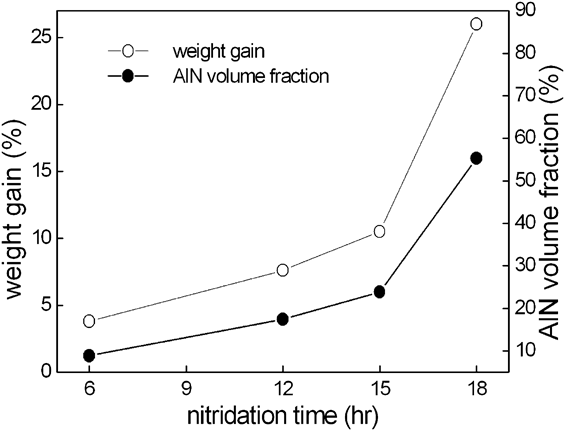
Nitridation leads to a noticeable weight gain of the powder mixture. Figure 1 shows the weight gain of the nitrided powder versus nitridation time and the corresponding AlN volume fraction calculated from the weight gain. Nitridation proceeded slowly in the first 15 h under the control of Sn but occurred at a much faster rate thereafter when Sn had been consumed. The resulting volume fraction of AlN was 8.9, 17.5, 23.8, and 55.3% corresponding to 6, 12, 15, and 18 h of nitridation, respectively.
Weight gain of AA6061–2% Mg–1% Sn–3% nylon powder mixtures during nitridation at 560 °C and the attendant AlN volume fraction calculated from the weight gain.
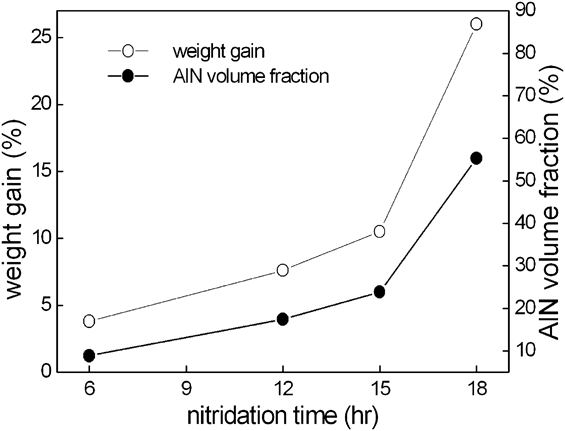
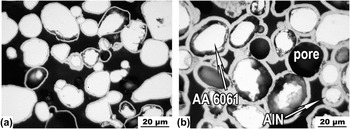
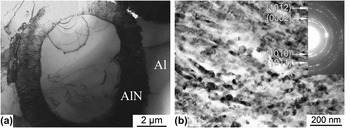
Figure 2 shows typical optical microstructures of AA6061 powders nitrided for 6 and 15 h. AA6061 powders nitrided for 12 and 18 h (not shown in the figure) exhibit similar structures. AlN shells are seen enveloping each particle. The shell thickness was measured from 10 randomly selected nitrided aluminium particles and listed in Table I. The thickness increases with nitridation time. To understand the shell structure, samples nitrided for 12 h at 560 °C were studied in detail by TEM. Figure 3(a) is a TEM bright-field (BF) image showing an AlN shell enveloping a remaining Al core. An enlarged view detailing the shell structure is shown in Fig. 3(b). The shell is a composite layer comprising a large number of nanoscale AlN whiskers dispersed in an Al matrix; it is not a single phase AlN layer. Most AlN whiskers are aligned almost perpendicularly to the core–shell interface. This is similar to the observations made previously.Reference Yu, Yan, Schaffer and Qian19, Reference Kent, Qian and Schaffer20 The inset in Fig. 3(b) is a selected area electron diffraction (SAED) pattern taken from a local area shown in Fig. 3(b), confirming that the in situ formed AlN has a close-packed hexagonal structure (a = 0.31 nm, c = 0.50 nm).
Optical microstructures of AA6061 powders nitrided at 560 °C: (a) 6 h and (b) 15 h.

TEM characterization of the AlN phase formed in the sample nitrided for 12 h at 560 °C. (b) is a high magnification image of the AlN shell region in (a) showing the AlN nanocrystals in an Al matrix.

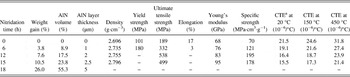
Summary of the weight gain and AlN composition of AA6061 powder nitrided at 560 °C for 0, 6, 12, and 15 h and the density, tensile properties, and coefficient of thermal expansion (CTE) of samples extruded from the nitrided powder at 450 °C at an extrusion ratio of 11:1.

a Extrapolated values.
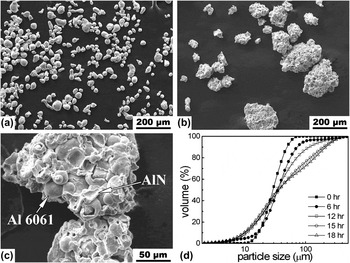
The nitrided powder was then milled by a ring miller. Figure 4 shows the as-received AA6061 powder used for nitridation and the Al–AlN composite powders nitrided 15 h and milled by the ring miller. Agglomeration and/or sintering occurred after 15 h of nitriding at 560 °C as shown in Fig. 4(b). As a result, particle aggregates greater than 100 μm in size are readily noticeable. Figure 4(c) shows one such aggregate focusing on the Al–AlN core–shell structure. The particle size distribution of the Al–AlN composite powder is depicted in Fig. 4(d). The as-received AA6061 powder falls in the size range of 10–70 μm, whereas the nitrided and milled powder showed a much wider range of particle size distribution. Particles that are greater than 100-μm size are a result of agglomeration and/or sintering during nitridation as shown in Figs. 4(b)–4(c), whereas those particles noticeably smaller than 10 μm are mainly from the debris of the broken AlN layers by milling.
SEM micrographs of (a) as-received AA6061 powder and (b) milled powders after nitridation for 15 h, where (c) is a magnified view of the particles shown in (b) focusing on the Al–AlN core–shell structure formed during nitridation. (d) Undersize volume fraction of AA6061 and milled AA6061–AlN composite powders.

B. Direct extrusion of Al–AlN composite powder
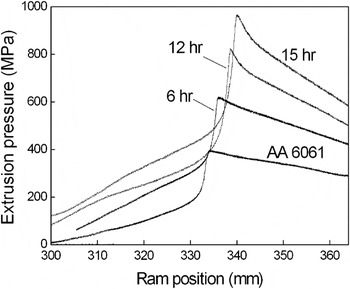
Extrusion pressure is a critical parameter used to gauge the feasibility of a material for industrial extrusion. The maximum extrusion pressures acceptable to industrial operations are about 800–900 MPa due to the limited load capacity of the extrusion containers. Figure 5 shows the extrusion pressure curves of the partially nitrided Al–AlN composite powders and the as-received AA6061 powder recorded during extrusion. All curves are divided into two segments by a breakthrough point at which the extrusion pressure reaches the maximum. Before the breakthrough point, densification occurs gradually with increasing compaction pressure. Beyond that, the Al–AlN composite powder starts to be extruded out of the die. As a result, the extrusion pressure decreases with extrusion time due to a gradual reduction of the material left in the container and the consequential decline in the friction force.
Pressures during direct extrusion of as-atomized AA6061 powder and nitrided powders (nitridation time: 6, 12, and 15 h).

Powders with a higher AlN content yield higher resistance to deformation and therefore higher breakthrough pressures for direct extrusion. The breakthrough pressures recorded are 395 MPa for the as-received AA6061 and 625, 825, and 965 MPa for powders nitrided for 6, 12, and 15 h, respectively. Considering that process scaling up will noticeably lower the extrusion pressures needed due to the more favorable surface-to-volume ratios of the industrial scale dies, the extrusion pressures recorded for these Al–AlN composite powders are acceptable for industrial operations. For powders that underwent 18 h of nitridation, the breakthrough pressure needed is higher than 1.5 GPa (not shown in Fig. 5). They are thus impractical for industrial direct extrusion at this temperature. However, because the Al–AlN interface is stable and free from reactions up to the melting point of the Al matrix, there is potential for employing a higher extrusion temperature to reduce the breakthrough pressure. Hence, industrial direct extrusion of Al–AlN composite powder containing AlN higher than 23.8 vol% is still possible.
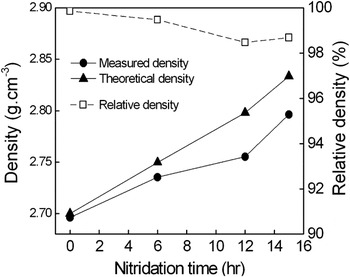
Figure 6 shows the densities after extrusion. The theoretical density was calculated from the volume fraction of AlN listed in Table I, where the densities of Al and AlN are taken to be 2.70 and 3.26 g·cm−3, respectively, without considering the effect of Mg and Sn. Because AlN is denser than Al, the density of the Al–AlN composite samples increases with increasing nitridation time or AlN content. The relative density achieved after extrusion is >98% theoretical density even for samples containing 23.8 vol%AlN, demonstrating that hot extrusion is an effective method to consolidate Al–AlN composite powders.
Densities of samples extruded from as-received AA6061 powder and AA6061–AlN composite powders that were in situ fabricated by nitridation of AA6061 powder at 560 °C for 6, 12, and 15 h.

C. Microstructure of as-extruded Al–AlN composites
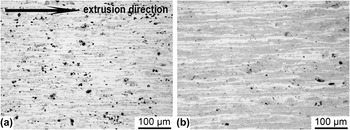
Figure 7 shows optical micrographs along the extrusion direction of samples extruded from AA6061–AlN composite powders that were in situ fabricated by nitridation of the AA6061 powder at 560 °C for 6 and 15 h. Lamellar microstructures are resulted from the extrusion. The elongated gray phase region shown in Fig. 7 is composed of Al and AlN, whereas the white phase region is Al, essentially free of AlN. The composite produced by extrusion is thus of the type of Al–(Al–AlN). The dark contrast particles shown in Fig. 7 are Mg2Sn or Mg2Sn0.6Si0.4, identified previously.Reference Yu, Yan, Schaffer and Qian19 They formed during nitridation through reactions between Mg and Sn in the powder mixture. Because Mg and Sn are consumed gradually during nitridation, the amount of Mg2Sn decreases with nitridation time.
Optical micrographs along the extrusion direction of samples extruded from AA6061–AlN composite powders that were in situ fabricated by nitridation of AA6061 powder at 560 °C for (a) 6 h and (b) 15 h The gray phase region is composed of Al and AlN, whereas the white phase region is Al, essentially free of AlN. The dark contrast particles are Mg2Sn or Mg2Sn0.6Si0.4, identified previously.Reference Yu, Yan, Schaffer and Qian19

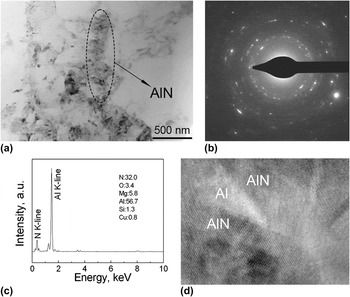
The microstructure of the AA6061–AlN composite extruded from AA6061 powder nitrided for 12 h was studied in detail by TEM. Figure 8(a) is a TEM BF image of a selected area from the sample showing the presence of a large number of second phase particles. TEM SAED analysis [Fig. 8(b)] of the phases in the dotted ellipse confirms that the second phase is AlN. Figure 8(c) shows the TEM EDS results from the same area, indicating that it is mainly composed of Al (56.7 at.%) and N (32 at.%). Figure 8(d) is a high resolution TEM image examining the AlN–Al phase boundaries. The AlN reinforcement bonds well with the Al matrix, free of decohesion and voids, indicative of the advantages of in situ fabrication. Another point to note is that the partially nitrided aluminium powder particles are all enveloped by a layer of AlN (see Fig. 2); oxidation of this AlN layer at the extrusion temperature of 450 °C is slow. As a result, no oxide particles were observed in the extruded microstructure by both SEM and TEM assisted with EDS. The extruded microstructure is a composite of Al and AlN.
(a) TEM bright-field images of AlN reinforcements in the AlN-containing regions; (b) selected area electron diffraction patterns of the area circled in (a); (c) TEM energy dispersive x-ray spectroscopy spectrum; and (d) a high resolution TEM image of the Al–AlN interface. The composite was extruded from AA6061 powder that was nitrided for 12 h at 560 °C.

D. Tensile properties and CTEs
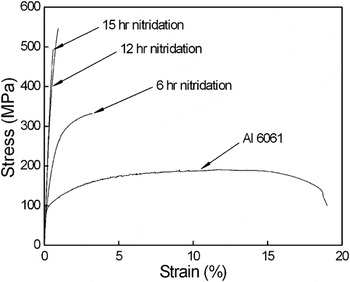
Figure 9 shows typical tensile testing curves of the as-extruded composites. The tensile strength increases sharply with increasing AlN content. However, all samples containing a high volume fraction of AlN fractured prematurely before yielding. The tensile property data are summarized in Table I. The extruded composites containing 17.5 and 23.8 vol%AlN exhibit high specific strengths, comparable to Ti alloys (190–310 MPa·cm−3·g).Reference Leyens and Peters21 In contrast, both the extruded AA6061 (AlN free) and the extruded AA6061–AlN composite that contains 8.9 vol%AlN show much lower specific strengths. The significant difference in strengthening is clearly related to the presence of the AlN phase, namely to the nonshearable nanoscale AlN particles in the elongated gray regions (Fig. 7). According to the Orowan mechanism, the initial yield stress can be treated as the sum of two contributions, the yield stress of the matrix, τ m, and the particle by-passing stress, τ p.Reference Cahn and Haasen22 The by-passing stress τ p depends on the average free distance between the particles or the metal ligament size, λ m, following either an inverse linear or square root relationship,Reference Cahn and Haasen22–Reference Ashby and Jones24 and the particle size in relation to the dislocation core size.Reference Cahn and Haasen22 The greatest strengthening occurs with strong, closely spaced dispersions.Reference Ashby and Jones24 In the extruded Al–AlN composites, the in situ formed nanoscale AlN whiskers or particles are distributed in the elongated gray regions (Fig. 7). The value of λ m decreases with increasing volume fraction of AlN. This generally explains the difference in the strengthening effect observed as a function of the volume fraction of AlN. However, it should be noted that the white phase regions shown in Fig. 7 are essentially free of the AlN reinforcements. The composite fabricated is a unique AlN-free and an AlN-containing lamellar structure.
Typical tensile curves of samples extruded from as-received AA6061 powder and AA6061–AlN composite powders that were in situ fabricated by nitridation of AA6061 powder at 560 °C for 6, 12, and 15 h.

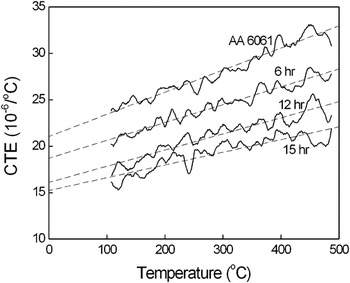
Little or zero tensile ductility is a common problem for MMCs. It is encouraging that the composite containing 8.9 vol%AlN exhibited 3% tensile elongation after extrusion. Although the composites containing 17.5 and 23.8 vol%AlN showed little ductility, the disadvantage can be alleviated to a certain extent by temperature (e.g., for elevated temperature applications) assuming the composite has good dimensional stability. It is thus useful to assess the CTE of the as-extruded composites. Figure 10 shows the thermal expansion profiles of the as-extruded AA6061 and composites from 100 to 450 °C. Detailed results are summarized in Table I. The CTE of the as-extruded composites decreases noticeably with increasing AlN content because of the low CTE of AlN and the excellent interfacial bonding between the AlN and Al matrix [Fig. 8(d)] originating from the in situ fabrication. This imparts low CTEs to the composites at elevated temperatures. The CTE of the as-extruded AA6061–23.8vol%AlN at 150 °C (17.3 10−6/°C) is much smaller than that of the as-extruded AA6061 at room temperature (21.5 10−6/°C) and even at 450 °C, it is just about the same (21.4 10−6/°C).
Coefficient of thermal expansion of samples extruded from as-received AA6061 powder and the AA6061–AlN composite powders that were in situ fabricated by nitridation of AA6061 powder at 560 °C for 6, 12, and 15 h.

IV. SUMMARY AND CONCLUSIONS
Al–AlN composite powder containing up to 55.3 vol%AlN has been in situ fabricated by nitriding AA6061 powder in nitrogen at atmospheric pressure. The composite powder particles are featured by a core of Al and a shell of nanosacle AlN whiskers aligned almost perpendicularly to the core–shell interface. The composite powder can be consolidated into nearly fully dense (>98%) composites by hot pressing at 450 °C with an extrusion ratio of 11:1. The as-extruded composites show a lamellar structure consisting of AlN-containing and AlN-free regions along the extrusion direction. The in situ formed nanoscale AlN whiskers are dispersed in the AlN-containing lamella, where the Al–AlN interface shows excellent bonding, free of decohesion and voids after extrusion. The lamellar composite containing 8.9 vol%AlN has an ultimate tensile strength of 332 MPa and a tensile elongation of 3%. Composites containing a larger volume faction of AlN (≥17.5 vol%) achieve much higher tensile strengths (538 MPa) but zero tensile elongation. However, they show a low CTE up to 450 °C.
ACKNOWLEDGMENTS
This work was funded by the Australian Research Council (ARC). Dr. M. Balog acknowledges the financial support of an Australian Go8 European Fellowship.