Introduction
South Asia faces great challenges in achieving food security in the coming decades as there is a need to double food production by 2050 by using resources more efficiently while minimizing environmental problems (Tilman et al., Reference Tilman, Balzer, Hill and Befort2011; Ladha et al., Reference Ladha, Rao, Raman, Padre, Dobermann, Gathala, Kumar, Sharawat, Sharma, Piepho, Alam, Liak, Rajendran, Reddy, Parsad, Sharma, Singh, Saha and Noor2016). In many regions, demand for food is increasing with population and dietary changes creating increased competition for land, water, energy and other inputs into food production (Garnett et al., Reference Garnett, Appleby, Balmford, Bateman, Benton, Bloomer, Burlingame, Dawkins, Dolan, Fraser, Herrero, Hoffmann, Smith, Thornton, Toulmin, Vermeulen and Godfray2013). Moreover, climate change poses additional challenges to agricultural development in developing countries such as India with food security, economic and political ramifications (Parry et al., Reference Parry, Rosenzweig, Iglesias, Livermore and Fischer2004; Chattopadhyay, Reference Chattopadhyay, Lal, Sivakumar, Faiz, Rahman and Islam2011; Dagar et al., Reference Dagar, Singh, Singh and Arunachalum2012; Dubash, Reference Dubash2013).
In many regions and countries, current farming practices are not sustainable and are also a major source of greenhouse gas (GHG) emissions (Grace et al., Reference Grace, Harrington, Mabesh, Robertson, Ladha, Hill, Duxbury, Gupta and Buresh2003; Smith et al., Reference Smith, Martino, Cai, Gwary, Janzen, Kumar, McCarl, Ogle, O'Mara, Rice, Scholes, Sirotenko, Howden, McAllister, Pan, Romanenkov, Schneider, Towprayoon, Wattenbach and Smith2008; Sapkota et al., Reference Sapkota, Jat, Shankar, Singh, Rai, Grewal and Stirling2015; Ladha et al., Reference Ladha, Rao, Raman, Padre, Dobermann, Gathala, Kumar, Sharawat, Sharma, Piepho, Alam, Liak, Rajendran, Reddy, Parsad, Sharma, Singh, Saha and Noor2016; Tongwane et al., Reference Tongwane, Mdlambuzi, Moeletsi, Tsubo, Mliswa and Grootboom2016). Agriculture in the Indo-Gangetic Plains (IGP) of South Asia is dominated by fully or partially irrigated rice–wheat systems with associated productivity and sustainability problems (Ladha et al., Reference Ladha, Pathak, Tirol-Padre, Dawe, Gupta, Ladha, Hill, Duxbury, Gupta and Buresh2003b, Reference Ladha, Rao, Raman, Padre, Dobermann, Gathala, Kumar, Sharawat, Sharma, Piepho, Alam, Liak, Rajendran, Reddy, Parsad, Sharma, Singh, Saha and Noor2016; Gathala et al., Reference Gathala, Kumar, Sharma, Saharawat, Jat, Singh, Kumar, Jat, Humphreys, Sharma, Sharma and Ladha2013), including stagnating crop yields, depletion of water resources and high production costs (RWC-CIMMYT, 2003; Erenstein and Laxmi, Reference Erenstein and Laxmi2008; Humphreys et al., Reference Humphreys, Kukal, Christen, Hira, Balwinder-Singh, Sudhir-Yadav and Sharma2010; Balwinder-Singh et al., Reference Balwinder-Singh, Humphreys, Gaydon and Sudhir-Yadav2015; Keil et al., Reference Keil, D'Souza and McDonald2015). Therefore, there is a need to enhance the sustainability of current stressed production systems of the IGP into more vibrant production systems, while climate change calls for making them more climate-resilient. These challenges vary by geographic location – and are particularly challenging in the eastern Gangetic plains, especially in the state of Bihar, one of India's most populous and poorest states that urgently needs to develop its agricultural potential and ensure food and nutritional security (Erenstein et al., Reference Erenstein, Hellin and Chandna2010; Erenstein and Thorpe, Reference Erenstein and Thorpe2011; GOB, 2015).
In recent years, several technologies that enhance the sustainability of rice–wheat production systems, such as minimum or zero tillage (ZT), seeding using a drill, crop residue retention, crop rotation with legumes and laser land levelling, have been evaluated in the IGP (Ladha et al., Reference Ladha, Hill, Duxbury, Gupta and Buresh2003a, Reference Ladha, Rao, Raman, Padre, Dobermann, Gathala, Kumar, Sharawat, Sharma, Piepho, Alam, Liak, Rajendran, Reddy, Parsad, Sharma, Singh, Saha and Noor2016; Erenstein and Laxmi, Reference Erenstein and Laxmi2008; Gathala et al., Reference Gathala, Ladha, Kumar, Saharawat, Kumar, Sharma, Sharma and Pathak2011, Reference Gathala, Kumar, Sharma, Saharawat, Jat, Singh, Kumar, Jat, Humphreys, Sharma, Sharma and Ladha2013; Aryal et al., Reference Aryal, Mehrotra, Jat and Sidhu2015a; Das et al., Reference Das, Bandyopadhyay, Bhattacharyya, Sudhishri, Sharma, Behera, Saharawat, Sahoo, Pathak, Vyas, Bhar, Gupta, Gupta and Jat2016). Production of wheat under ZT has been adopted on a significant area in the rice–wheat system in north-western IGP with positive impacts on wheat yield, profitability and resource-use efficiency (Erenstein and Laxmi, Reference Erenstein and Laxmi2008; Gathala et al., Reference Gathala, Timsina, Islam, Rahman, Hossain, Harun-Ar-Rashid, Ghosh, Krupnik, Tiwari and McDonald2015; Ladha et al., Reference Ladha, Rao, Raman, Padre, Dobermann, Gathala, Kumar, Sharawat, Sharma, Piepho, Alam, Liak, Rajendran, Reddy, Parsad, Sharma, Singh, Saha and Noor2016). A recent study indicated that ZT practices without full residue retention on farmers' fields led to a robust yield gain over conventional-tillage wheat across different agro-ecological zones in the state of Bihar (Keil et al., Reference Keil, D'Souza and McDonald2015). In recent years, there is increased interest in direct drill-seeding of rice under non-puddled/non-ponded conditions due to increasing labour scarcity, energy constraints and rising input costs (Kumar and Ladha, Reference Kumar and Ladha2011; Ladha et al., Reference Ladha, Rao, Raman, Padre, Dobermann, Gathala, Kumar, Sharawat, Sharma, Piepho, Alam, Liak, Rajendran, Reddy, Parsad, Sharma, Singh, Saha and Noor2016). This practice helps to bring more rice under conservation agriculture (CA) while avoiding negative impacts on yield, income and overall system performance. Moreover, the integration of legumes in the rice–wheat rotation system improves soil and plant health, increases system productivity and enhances nutritional balance (Johansen et al., Reference Johansen, Duxburv, Virmani, Gowda, Pande and Joshi2000). However, the potential of these conservation agricultural technologies and practices to adapt to climate change have not been explored in-depth in the current literature.
In the era of climate change and declining water resources, optimizing crop distribution could bring both cropping system and nutrition benefits to conventional systems in many areas of the world, particularly to rice–wheat systems in South Asia (Davis et al., Reference Davis, Rulli, Seveso and D'Odorico2017). Recent field studies with different futuristic cropping systems and management scenarios in comparison with current management indicated that best agronomic management practices (BMPs), combined with CA and cropping system diversification increased the productivity and cost-effectiveness of the rice–wheat-based cropping system in South Asia while reducing the global warming potential of the system (Gathala et al., Reference Gathala, Kumar, Sharma, Saharawat, Jat, Singh, Kumar, Jat, Humphreys, Sharma, Sharma and Ladha2013; Ladha et al., Reference Ladha, Rao, Raman, Padre, Dobermann, Gathala, Kumar, Sharawat, Sharma, Piepho, Alam, Liak, Rajendran, Reddy, Parsad, Sharma, Singh, Saha and Noor2016). Although those studies provide empirical evidence on the potential of sustaining crop production in the IGP, it is not known how the different cropping systems considered could perform under the future climate and how they contribute to adaptation. This is particularly the case in Bihar where rainfall, maximum and minimum temperatures, and evapotranspiration (ET) are expected to increase over the coming decades with the magnitude of change varying with time, season and location (Tesfaye et al., Reference Tesfaye, Aggarwal, Mequanint, Shirsath, Stirling, Khatri-Chhetri and Rahut2017a). Therefore, prioritization of adaptation investments to climate change requires the assessment of various possible cropping system options and their uncertainties under both current and future climate conditions (Guan et al., Reference Guan, Sultan, Biasutti, Baron and Lobell2017; Hochman et al., Reference Hochman, Horan, Reddy, Sreenivas, Tallapragada, Adusumilli, Gaydon, Laing, Kokic, Singh and Roth2017a; Reference Hochman, Horan, Reddy, Sreenivas, Tallapragada, Adusumilli, Gaydon, Singh and Roth2017b; Dalla Marta et al., Reference Dalla Marta, Eitzinger, Kersebaum, Todorovic and Altobelli2018). Any successful adaptation is expected to be able to cope with short-term climate variability and also reduce the negative impacts of climate change in the long-term (Saba et al., Reference Saba, Biasutti, Gerrard and Lobell2013; Lobell, Reference Lobell2014; Hochman et al., Reference Hochman, Horan, Reddy, Sreenivas, Tallapragada, Adusumilli, Gaydon, Laing, Kokic, Singh and Roth2017a).
Process-based cropping system models, such as the Cropping Systems Model for Decision Support System for Agrotechnology Transfer, CSM-DSSAT (Jones et al., Reference Jones, Hoogenboom, Porter, Boote, Batchelor, Hunt, Wilkens, Singh, Gijsman and Ritchie2003), are useful tools to assess genotype × environment × management effects (Boote et al., Reference Boote, Jones, White, Asseng and Lizaso2013), identify future crop management practices and cropping systems and assess risks to crop production in the face of greater climate variability (Matthews et al., Reference Matthews, Rivington, Muhammed, Newton and Hallett2013). The CSM-DSSAT allows simulation of crop residue, mulching, crop rotation and organic amendment effects over an extended period of time, and in doing so provides a means to asses and improve the potential efficiency of cropping systems under different environments and climatic conditions.
The objectives of the current study were (1) to assess the biophysical and economic performance of different cereal-based cropping systems under current and future climates, and (2) to quantify the climate change adaptation potential of the different cropping systems options in the state of Bihar using a cropping systems model.
Methods and materials
Description of study area
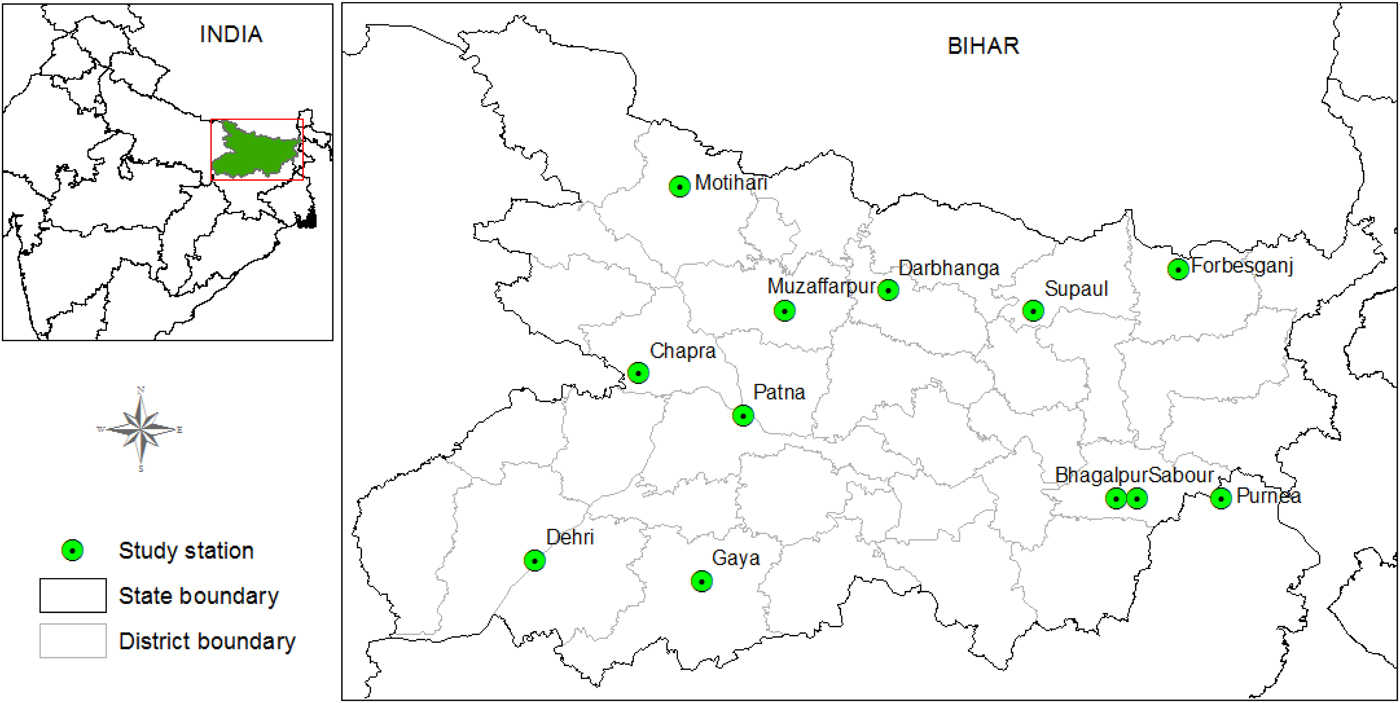
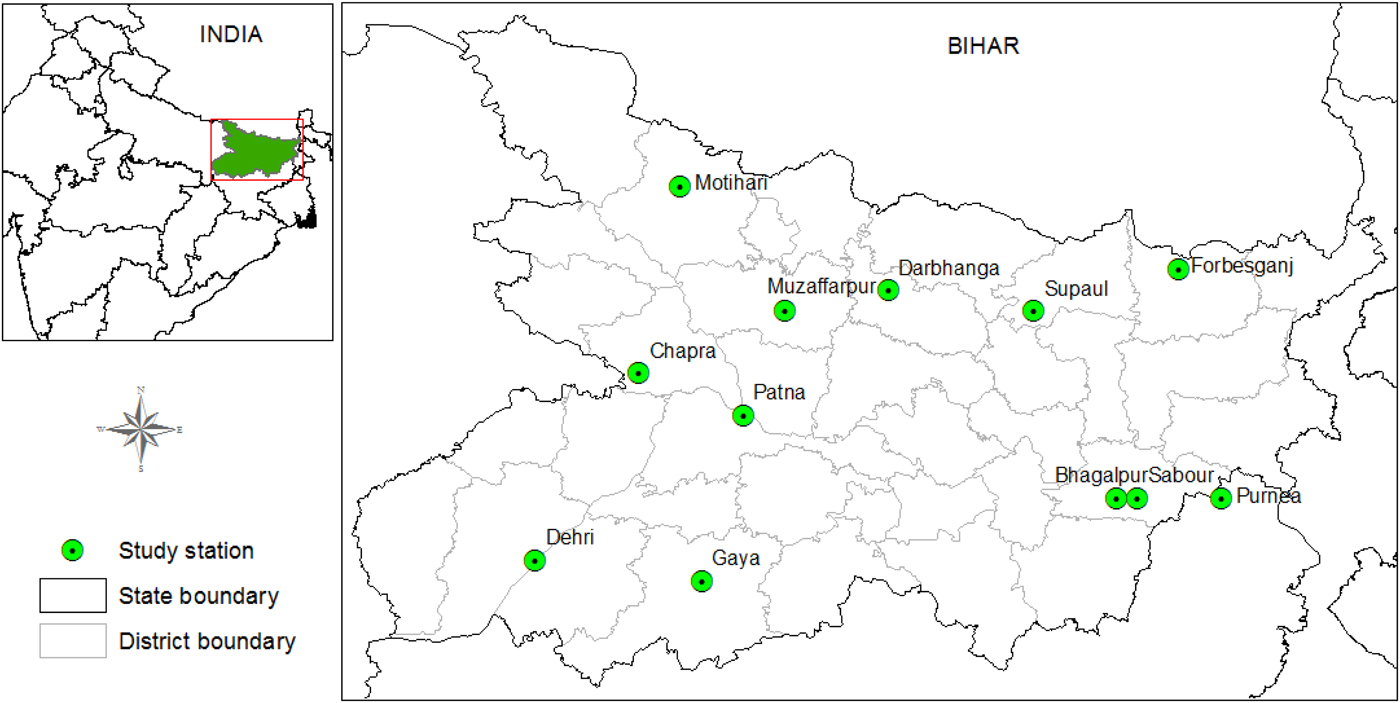
The current study was conducted using climate and soil data from 12 stations located across the state of Bihar, India (Fig. 1). Bihar is located in the north-east part of India and lies in the plains of the Ganga river basin. It is endowed with fertile alluvial soil with abundant water resources, especially groundwater resources. Bihar has a geographical area of 9.36 million ha with three important agro-climatic zones: North-West, North-East and South. The North-West zone has 13 districts and receives an annual rainfall of 1040–1450 mm. The soil is mostly loam and sandy loam. The North-East Zone has eight districts, receives rainfall ranging from 1200 to 1700 mm, and has loam and clay loam soils. The South Zone has 17 districts, receives an average annual rainfall of 990–1300 mm and has sandy loam, loam, clay and clay loam soils (GOB, 2015).
Location of study sites in the state of Bihar, India.
Rice (Oryzasativa L.), wheat (Triticumaestivum L.) and maize (Zea mays L.) are the major cereal crops in the state. Rice is cultivated in all districts of Bihar, mainly during the Kharif (July–October) monsoon season, while wheat is a major crop of the Rabi (October–March) season. The total annual production of rice and wheat in 2015/16 was 6.8 and 4.7 million metric tonnes, respectively (DoA, 2018). Maize is also a major crop cultivated mainly in the Kharif season, with an average annual production level of approximately 2.5 million metric tonnes and a steady positive trend in production. Pulses such as mung bean, peas and lentil are mostly grown in the southern parts of Bihar (GOB, 2015; DoA, 2018).
Model description
The model used for the current study was CSM-DSSAT model, Version 4.6.1 (Hoogenboom et al., Reference Hoogenboom, Jones, Wilkens, Porter, Boote, Hunt, Singh, Lizaso, White, Uryasev, Ogoshi, Koo, Shelia and Tsuji2014) which is a process-based, management-oriented model that utilizes water, carbon, nitrogen and energy balance principles to simulate the growth and development of plants within an agricultural system. The model runs with a daily time step and simulates crop growth, development and yield of specific cultivars based on the effects of weather, soil characteristics and crop management practices (Jones et al., Reference Jones, Hoogenboom, Porter, Boote, Batchelor, Hunt, Wilkens, Singh, Gijsman and Ritchie2003). In DSSAT, tillage affects soil bulk density, saturated soil hydraulic conductivity, soil runoff curve number and soil water content at saturation (Andales et al., Reference Andales, Batchelor, Anderson, Farnham and Whigham2000). Tillage events also cause mixing of soil components such as soil water, soil organic matter pools and inorganic soil nutrients within the specified tillage depth and increase the decomposition rate of the soil organic matter pools for a period of 30 days after the tillage event (Porter et al., Reference Porter, Jones, Adiku, Gijsman, Gargiulo and Naab2010). When there is no tillage, all crop residues remain on the soil surface. The CSM-DSSAT simulates mulching effects on soil water balance through three major inter-related processes: rainfall interception by the mulch, reduction of soil evaporation rates and reduction of surface water runoff (Porter et al., Reference Porter, Jones, Adiku, Gijsman, Gargiulo and Naab2010).
The CSM-DSSAT has been used as a tool to assess the performance of different cropping systems and production technologies in diverse environments (Hasegawa et al., Reference Hasegawa, Labavitch, McGuire, Bryant and Denison1999, Reference Hasegawa, Bryant and Denison2000; Jagtap et al., Reference Jagtap, Abamu and Kling1999; Fofana et al., Reference Fofana, Tamélokpo, Wopereis, Breman, Dzotsi and Carsky2005; Walker and Schulze, Reference Walker and Schulze2006; Yu et al., Reference Yu, Saseendran, Ma, Flerchinger, Green and Ahuja2006; Saseendran et al., Reference Saseendran, Ma, Malone, Heilman, Ahuja, Kanwar, Karlen and Hoogenboom2007; Liu et al., Reference Liu, Yang, Drury, Reynolds, Tan, Bai, He, Jin and Hoogenboom2011; Caviglia et al., Reference Caviglia, Sadras and Andrade2013). The model simulates the effects of tillage and surface crop residues on soil water and organic matter dynamics (Porter et al., Reference Porter, Jones, Adiku, Gijsman, Gargiulo and Naab2010) and has been used to model conservation agriculture under current (Corbeels et al., Reference Corbeels, Chirat, Messad and Thierfelder2016) and future climate scenarios (Ngwira et al., Reference Ngwira, Aune and Thienrfelder2014).
Model input data
The minimum data sets required to run the DSSAT models and simulate a crop at a given site include location and crop characteristics, weather, soil and crop management (Jones et al., Reference Jones, Hoogenboom, Porter, Boote, Batchelor, Hunt, Wilkens, Singh, Gijsman and Ritchie2003). For the current study, data on conventional and recommended crop management (including planting date, plant density, fertilization and irrigation) were obtained from previous studies conducted in the IGP (Saharawat et al., Reference Saharawat, Ladha, Pathak, Gathala, Chaudhary and Jat2012; Kumar et al., Reference Kumar, Saharawat, Gathala, Jat, Singh, Chaudhary and Jat2013; Gathala et al., Reference Gathala, Timsina, Islam, Rahman, Hossain, Harun-Ar-Rashid, Ghosh, Krupnik, Tiwari and McDonald2015; Sapkota et al., Reference Sapkota, Jat, Shankar, Singh, Rai, Grewal and Stirling2015; Ladha et al., Reference Ladha, Rao, Raman, Padre, Dobermann, Gathala, Kumar, Sharawat, Sharma, Piepho, Alam, Liak, Rajendran, Reddy, Parsad, Sharma, Singh, Saha and Noor2016). Soil profile data of experimental stations were obtained from several sources including country-level secondary sources and the World Inventory of Soil Emission (WISE) database (Batjes, Reference Batjes2009, Reference Batjes2012). Baseline (1980–2009) daily rainfall, maximum temperature, minimum temperature and solar radiation data for the 12 stations were obtained from the Indian Meteorology Department (IMD); data quality controls were made and missing values filled before importing the data into DSSAT (Tesfaye et al., Reference Tesfaye, Aggarwal, Mequanint, Shirsath, Stirling, Khatri-Chhetri and Rahut2017a). Whenever radiation data were missing or became unavailable, estimated data provided by National Aeronautics and Space Administration-Prediction Of Worldwide Energy Resource (NASA-POWER) (http://power.larc.nasa.gov/) were used. Future daily rainfall, maximum and minimum temperature data for the periods 2030 and 2050 were down-scaled from 20 General Circulation Models (GCMs) which are among those GCMs that have been used by the Intergovernmental Panel on Climate Change (IPCC) to produce its fifth assessment report, AR5 (IPCC, 2014). The 20 GCMs were selected based on the availability of data for the representative concentration pathways (RCP4.5 and RCP8.5) used in the current study. A statistical bias correction method which uses a transfer function derived from observed and projected climate cumulative distribution functions was used to downscale the GCM projections (Piani et al., Reference Piani, Weedon, Best, Gomes, Viterbo, Hagemann and Haerter2010). The method is based on the assumption that both observed and projected intensity distributions are well approximated by the gamma distribution for precipitation and by normal distribution for temperature.
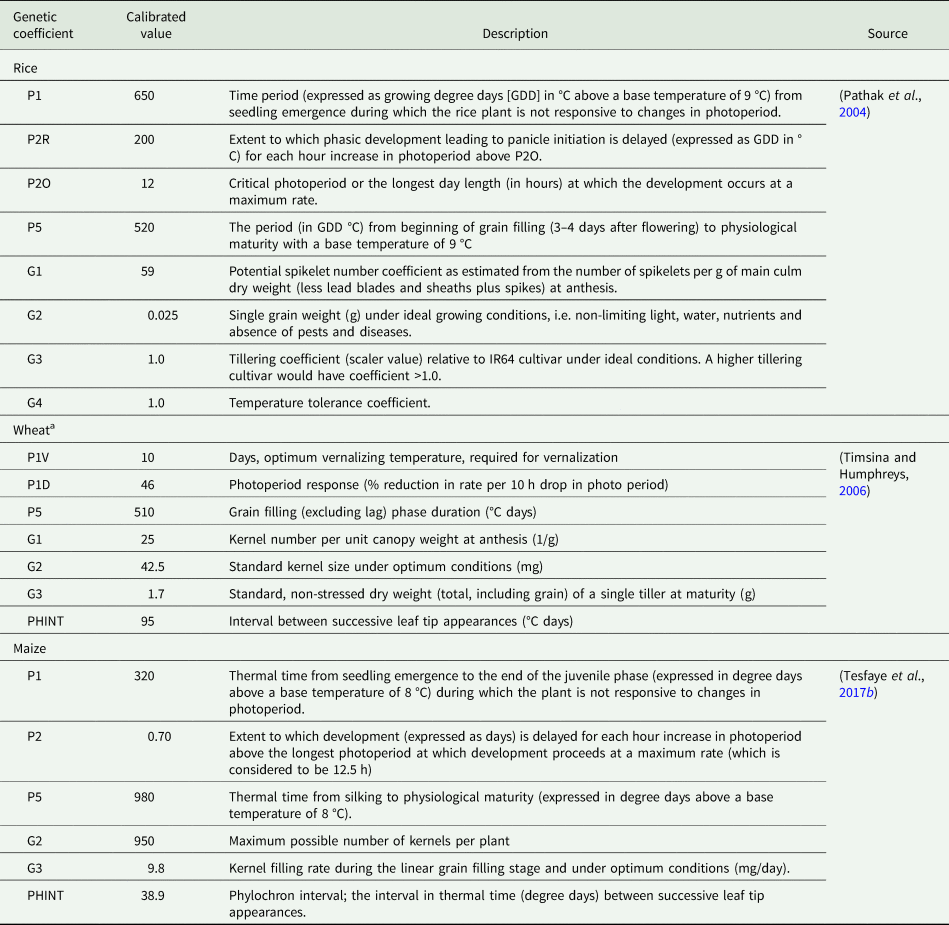
The genetic coefficients of rice (PR114), wheat (HD2009) and maize (31Y45) were obtained from previous studies that calibrated the DSSAT model for different environments in India (Table 1). For pigeon pea, the genetic coefficients were taken from the DSSAT list of calibrated varieties for the variety CPL88039 which was developed by ICRISAT in India.
Genetic coefficients of the rice (PR114), maize (31Y45) and wheat (HD2009) cultivars used in the current study

a Coefficients converted to DSSAT V4.6 from DSST V3.5.
Cropping system options/treatments
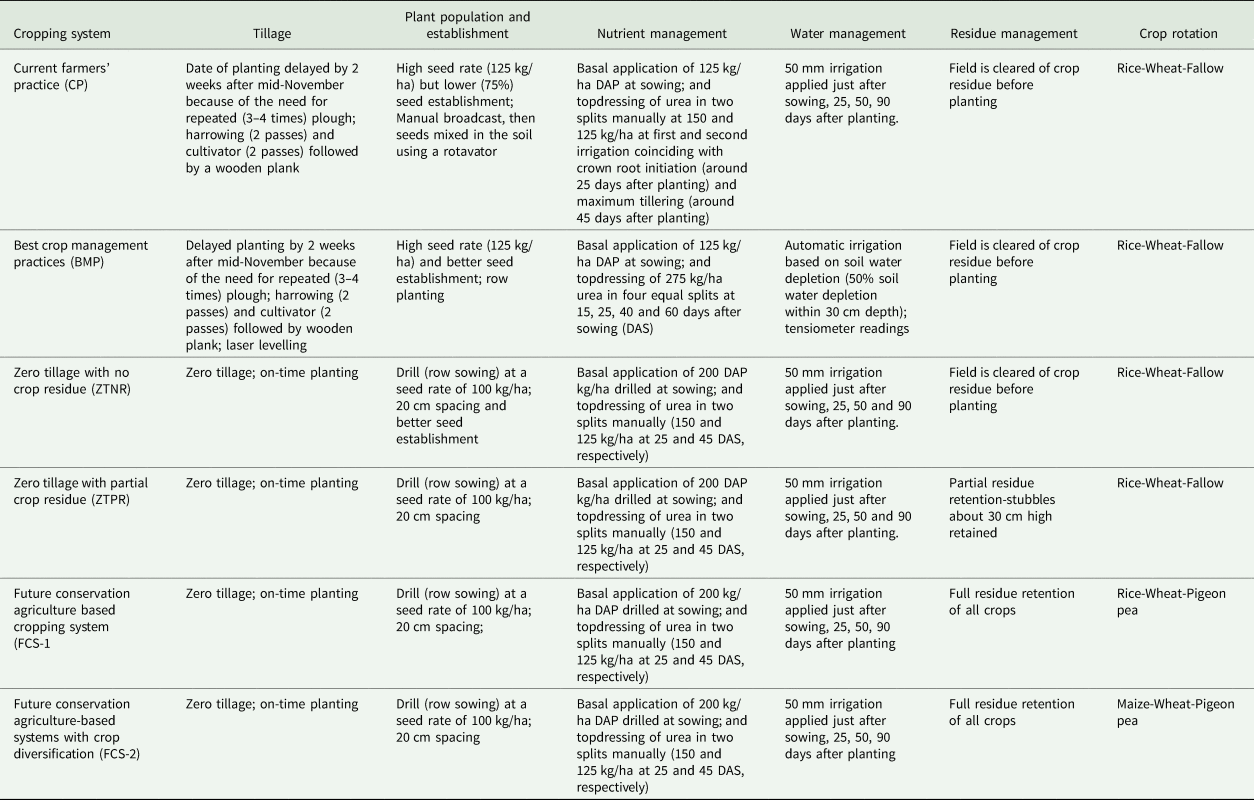
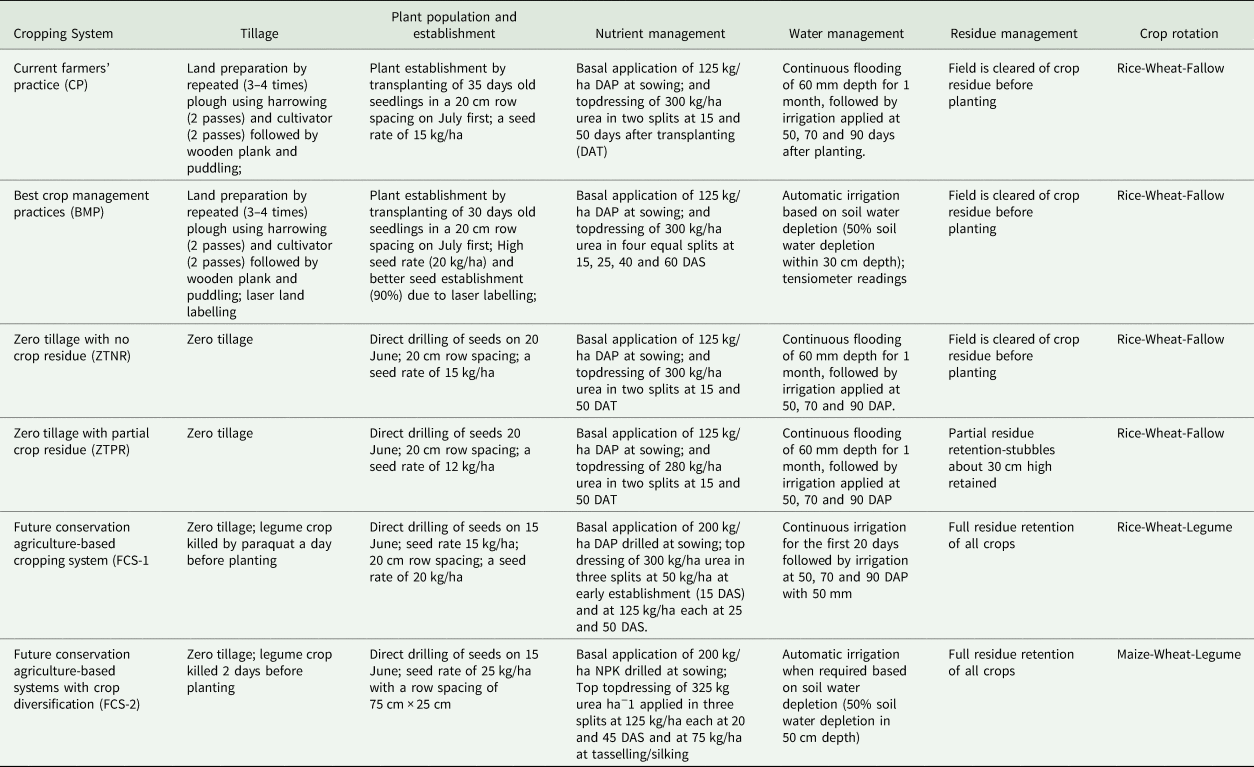
Based on previous field experiment studies on the rice–wheat cropping system in IGP (Gathala et al., Reference Gathala, Kumar, Sharma, Saharawat, Jat, Singh, Kumar, Jat, Humphreys, Sharma, Sharma and Ladha2013; Ladha et al., Reference Ladha, Rao, Raman, Padre, Dobermann, Gathala, Kumar, Sharawat, Sharma, Piepho, Alam, Liak, Rajendran, Reddy, Parsad, Sharma, Singh, Saha and Noor2016), six cropping system treatments that vary in crop sequence, tillage, crop establishment method, residue management and fertilizer and water management practices were developed for the cropping system simulation study (Tables 2 and 3). The cropping system treatments or options were developed based on key challenges of agricultural development in the region such as the impacts of climate change, declining resource base, rising labour and energy costs, growing demand for nutritious food and the environmental footprint of intensive agriculture (Grace et al., Reference Grace, Harrington, Mabesh, Robertson, Ladha, Hill, Duxbury, Gupta and Buresh2003; Ladha et al., Reference Ladha, Pathak, Tirol-Padre, Dawe, Gupta, Ladha, Hill, Duxbury, Gupta and Buresh2003b, Reference Ladha, Rao, Raman, Padre, Dobermann, Gathala, Kumar, Sharawat, Sharma, Piepho, Alam, Liak, Rajendran, Reddy, Parsad, Sharma, Singh, Saha and Noor2016; Gathala et al., Reference Gathala, Ladha, Kumar, Saharawat, Kumar, Sharma, Sharma and Pathak2011, Reference Gathala, Kumar, Sharma, Saharawat, Jat, Singh, Kumar, Jat, Humphreys, Sharma, Sharma and Ladha2013, Reference Gathala, Timsina, Islam, Rahman, Hossain, Harun-Ar-Rashid, Ghosh, Krupnik, Tiwari and McDonald2015; Sapkota et al., Reference Sapkota, Jat, Shankar, Singh, Rai, Grewal and Stirling2015). Therefore, the cropping system treatments in the current study are designed to address one or more of these challenges by maintaining or improving crop productivity, economic returns, input use efficiency and the soil and water resource base under the current and future climate conditions. While the details of the six treatments are given in Tables 2 and 3, a short description of each cropping system, summarized based on previous field works (Gathala et al., Reference Gathala, Kumar, Sharma, Saharawat, Jat, Singh, Kumar, Jat, Humphreys, Sharma, Sharma and Ladha2013; Ladha et al., Reference Ladha, Rao, Raman, Padre, Dobermann, Gathala, Kumar, Sharawat, Sharma, Piepho, Alam, Liak, Rajendran, Reddy, Parsad, Sharma, Singh, Saha and Noor2016), is presented below.
Description of crop management options for the wheat component

Description of crop management options for the rice/maize component

Current farmers' practice
This treatment represents the farmers' conventional management practices (business-as-usual scenario) which involve intensive tillage (3–4 passes) and residue removal in a rice–wheat–fallow system. Rice is grown by transplanting 30–45-day-old seedlings manually in puddled fields. Flood irrigation is the most common water management practice and rice is mostly kept under continuous flood conditions during most parts of the growing period. Wheat is planted after rice-residue is removed or burnt and it receives 4–5 flood irrigations with about 50 mm of water at each application. Fertilizer application is mostly unbalanced and sub-optimal in terms of both rate and timing. Planting is mostly delayed due to the need for frequent tillage and this impinges on the length of the available growing season whilst plant distribution is mostly random and uneven. Weeding and pest management is done by manual and/or chemical means depending on the situation. This treatment was used as a baseline to compare the effects of the five cropping system treatments on productivity, income and adaptation.
Best crop management practices
Although this treatment is similar to current farmers' practice (CP) in terms of tillage and crop residue management in a rice–wheat–fallow system, it involves the application of recommended fertilizer rates with applications and optimization of irrigation using laser levelling and soil-water balance procedures for each crop. It also involves better crop establishment using recommended seed rates and chemical control of weeds and pests. This treatment was designed to simulate increased productivity and income through the currently recommended best management practices.
Zero tillage with no crop residue retention
This treatment involves a rice–wheat–fallow system where crop residues are removed but tillage is avoided, and rice and wheat crops are sown by direct drilling of seeds using tractor-drawn seed-cum-fertilizer drilling machines. Zero tillage with no crop residue retention (ZTNR) allows early sowing but nutrient, water, disease and pest management practices remain similar to the CP treatment. Weeds are controlled by pre- and post-emergence herbicides. This treatment was considered to increase farmers' income whilst reducing labour demand, production costs and soil degradation.
Zero tillage with partial crop residue retention
The ZT with partial crop residue retention (ZTPR) treatment is similar to that of ZTNR except that at least half of the crop residue from the previous crop remains on the field. This treatment was designed to increase productivity, reduce production costs and improve climate adaptation and soil health.
Future conservation agriculture-based cropping system
The future conservation agriculture-based cropping system (FCS-1) treatment involves a rice–wheat–legume rotation system under ZT with full crop residue retention. Wheat is drilled into full rice residue and the legume is drilled after wheat harvest. Rice is dry-drilled into the legume and wheat residues after an early harvest of the legume before mid-June every year. The legume used in the current study was a short-maturing pigeon pea variety to represent mung bean, which is commonly grown in Bihar but not yet included in the list of crops simulated by DSSAT. This treatment was designed to address the increasing scarcity and/or cost of water, labour and energy, soil degradation and the impact of climate change while increasing farm productivity and income.
Future conservation agriculture-based system with crop diversification
This treatment involves a maize–wheat–legume rotation system to represent a diversified cereal-based cropping system as an alternative to the rice–wheat based system to deal with the same issues as FCS-1 but with greater water scarcity conditions and diversified nutritional requirements that increase demand for maize for animal feed (Shiferaw et al., Reference Shiferaw, Prasanna, Hellin and Bänziger2011; Hellin et al., Reference Hellin, Krishna, Erenstein and Boeber2015). All crops are grown under ZT with full crop residue retention of previous crop(s). In terms of management practices, future conservation agriculture-based maize–wheat intensive cropping system (FCS-2) is similar to FCS-1 except that maize replaces rice and irrigation is scheduled based on soil water depletion thresholds.
Simulations
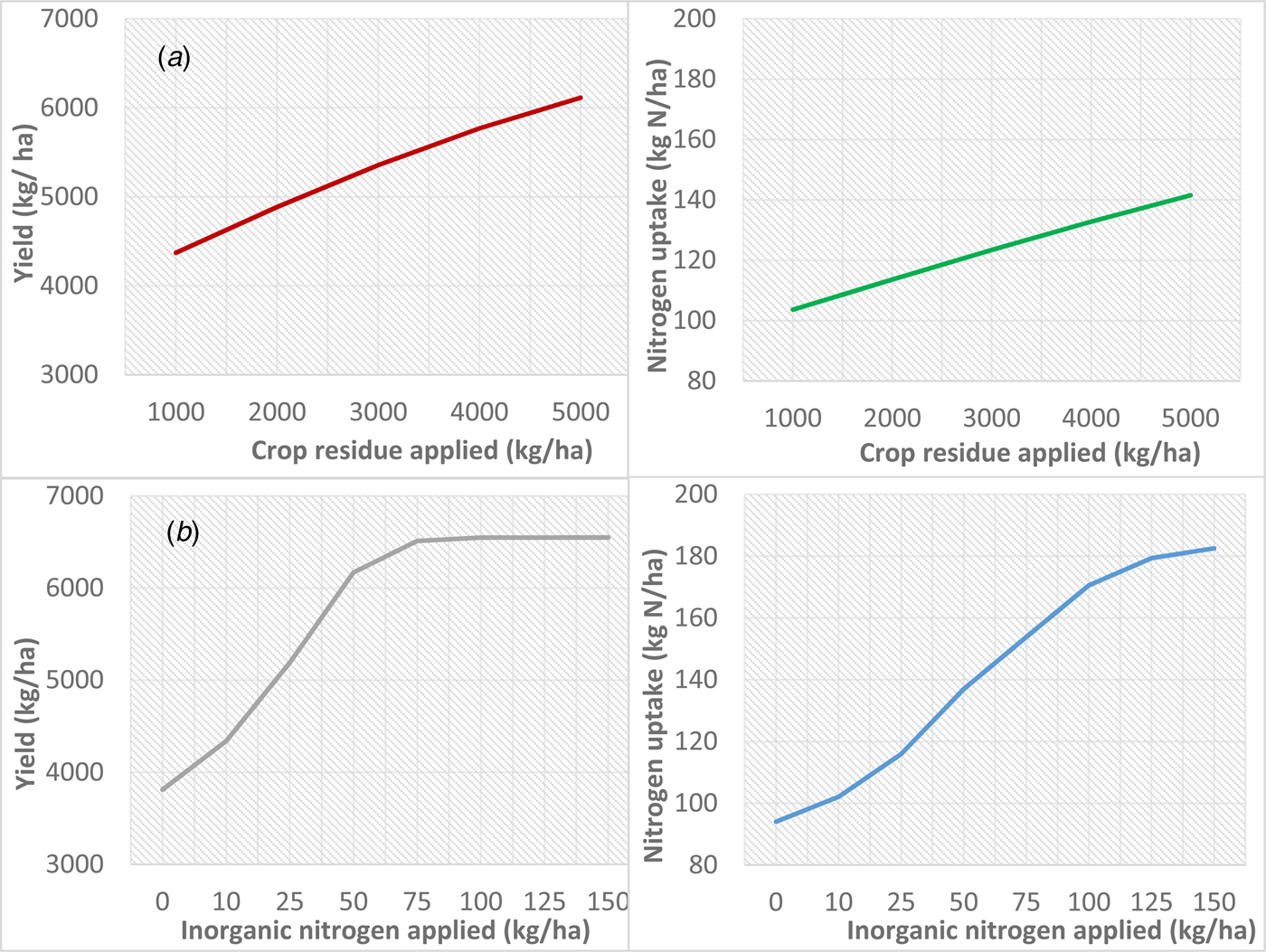
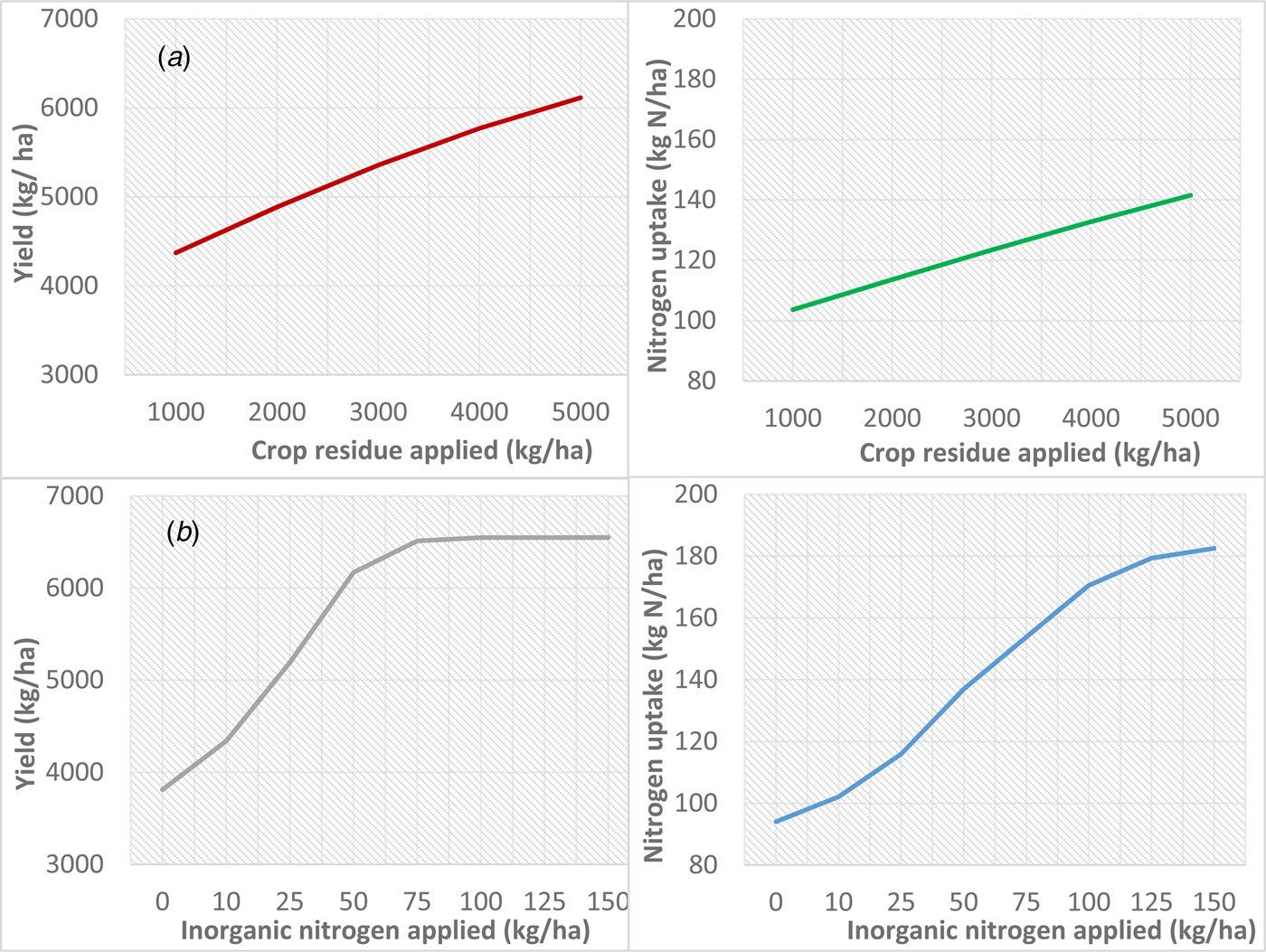
After assembling all input parameters, a separate crop management file was created for each treatment in the sequence analysis module of DSSAT. The DSSAT sequence analysis allows simulation of the effect of crop rotations over an extended period of time by carrying the rotation effects on soils from one season to the next. Among the methods provided in DSSAT, the CENTURY model was used to simulate soil carbon and nitrogen dynamics (Gijsman et al., Reference Gijsman, Hoogenboom, Parton and Kerridge2002) and the Ritchie model to simulate soil water balance (Ritchie et al., Reference Ritchie, Porter, Judge, Jones and Suleiman2009). The CENTURY model simulates surface residue decomposition, immobilization/mineralization of nitrogen and transformation of part of the organic matter into more stable organic matter pools in the soil (Gijsman et al., Reference Gijsman, Hoogenboom, Parton and Kerridge2002). Mineralized nitrogen from decomposing surface organic matter is assumed to be available for plant uptake. Once the simulation methods were selected, a model sensitivity analysis was conducted by switching tillage and crop residue treatments on and off in order to assess the response of the model to the effects of the treatments. The model was found to be sensitive enough to the effects of tillage and crop residues, similar to recent studies (Ngwira et al., Reference Ngwira, Aune and Thienrfelder2014; Corbeels et al., Reference Corbeels, Chirat, Messad and Thierfelder2016) that used the model to simulate conservation agriculture. After the sensitivity analysis (e.g., Fig. 2), the model was run for a period of 30 years using climate data from each GCM in each climate period (baseline, 2030 and 2050) and RCP (4.5 and 8.5) at each study site and the simulation outputs were extracted for further analysis. The simulation assumes that weeds, diseases and inspect pests were well controlled in each treatment, and hence their effects were not simulated.
Example of model sensitivity analysis using maize yield and total nitrogen uptake as dependent variables and applied crop residue (a) and inorganic nitrogen (b) as independent variables.
Data analysis
Biophysical data analysis
The simulation outputs were organized based on climate inputs and treatments and then subjected to different analyses at state, site and climate period level. Variability in the input weather data was assumed to describe seasonal climate uncertainty and hence distributions of yields and economic returns were produced, converting uncertainty in weather into uncertainty in yield and economic returns for the different crop management treatments. In order to compare the productivity of different crops and total system productivity of the different treatments, the yield of non-rice crops was converted into rice equivalent yield using the following equation:

where Y nr is yield of non-rice crop (t/ha), P nr is the minimum support price of non-rice crop (US$/ha) and P r is the minimum support price of rice (US$/ha).
Yield-water productivity, WP (referred hereafter as water productivity) was calculated as follows:

A mixed-effects model was employed to analyse treatment effects on grain yield and water productivity using R (Bates et al., Reference Bates, Mächler, Bolker and Walker2015) by assigning treatments as fixed effects and sites as random effects.
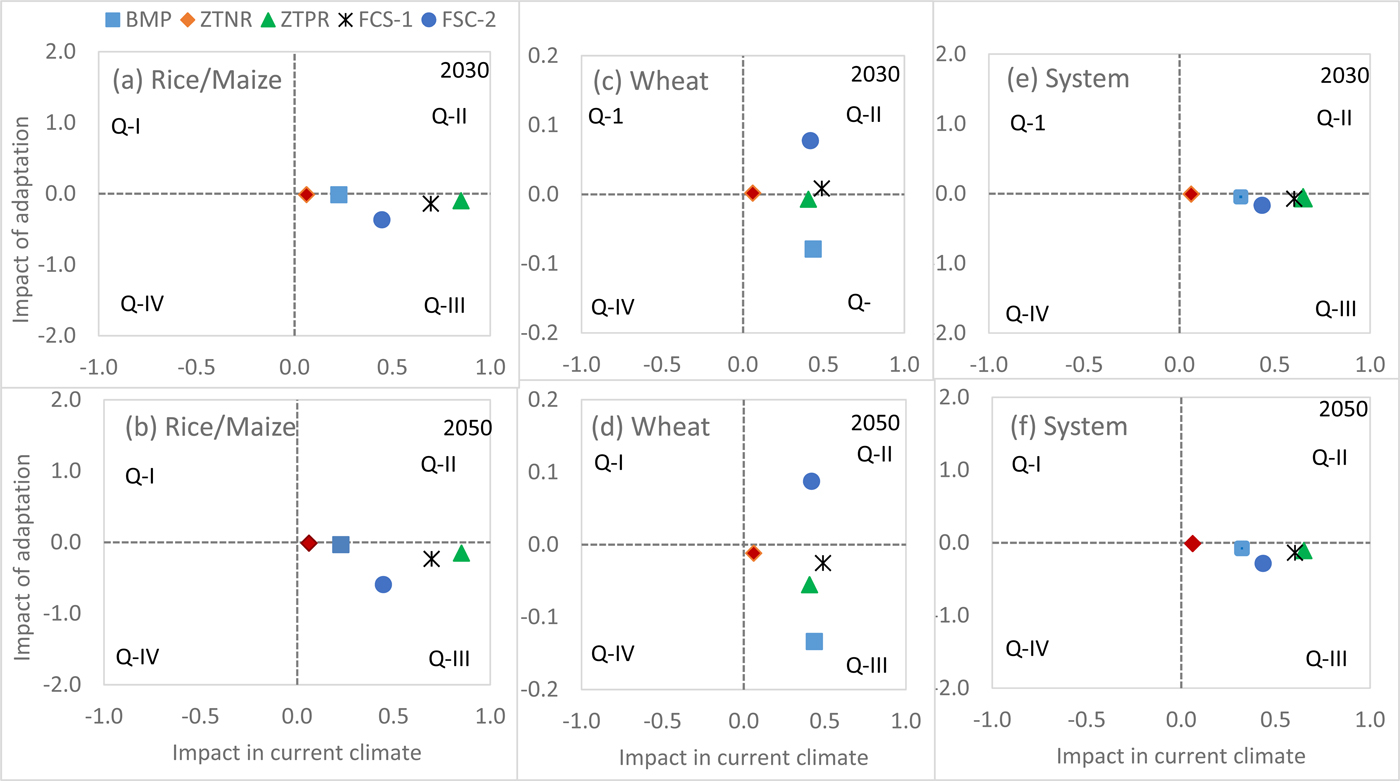
The impact of the cropping system treatments in the current climate and their adaptation potential to future climate scenarios was evaluated using the framework provided by Lobell (Reference Lobell2014). Based on this framework, the following were calculated:


Where A is yield of a new technology under the baseline climate, B is yield of the conventional technology under the baseline climate (CP in this study), C is yield of the new technology under future climate and D is the yield of the conventional technology under the future climate.
In a X–Y plane where the impact in the current climate is on the X-axis and the impact of adaptation is on the Y-axis, the upper-right quadrant (referred to here as Q-II), where both the baseline/current climate impact and adaptation impact are positive, is the most favourable option; options in the bottom-right quadrant (positive impact in current climate and negative adaptation impact; referred to here as Q-III) are good for the current climate but do not contribute toward reducing climate change impacts; and options in the bottom-left quadrant (negative values in impact in the current climate and adaptation impact; referred to here as Q-IV) are neither good for the current nor the future climate (i.e., maladaptation) and thus should be avoided. On the other hand, options in the upper left corner quadrant (negative impact in the current climate and positive adaptation impact; referred to here as Q-I) are not good in the current climate but could have potential adaptation impact under the future climate (Guan et al., Reference Guan, Sultan, Biasutti, Baron and Lobell2017).
Although simulations were made for RCP4.5 and RCP8.5 for the future climates, only the data for RCP8.5 is presented here because of lack of significant difference between the emission scenarios in most cases, the need to focus on the ‘business-as-usual’ scenario and to avoid the complication of data presentation.
Economic analysis
The current study estimated net return and benefit : cost ratios for all treatments and climate change scenarios. Current market value for input and output data were collected from various sources and relative prices are assumed to remain constant for future scenarios. Costs of tillage, seed, fertilizer, labour, machinery and irrigation for the rice, maize and wheat crops in the study area were collected from the cost of the cultivation data published by the Directorate of Economics and Statistics, Ministry of Agriculture, India (DES, 2015). This data also provides total per hectare labour requirement for the cultivation of rice, maize and wheat and value of production of these crops. Market prices of technology were used for zero-tillage machine, crop residues and a tensiometer for soil moisture-based irrigation guidance. The total cost of cultivation was the sum of the cost of machinery use (tillage, harvesting, threshing, transport, etc.), seed, fertilizer, irrigation (including tensiometer if used), crop residues (if used) and total labour for all activities.
Results
Current and future climate conditions
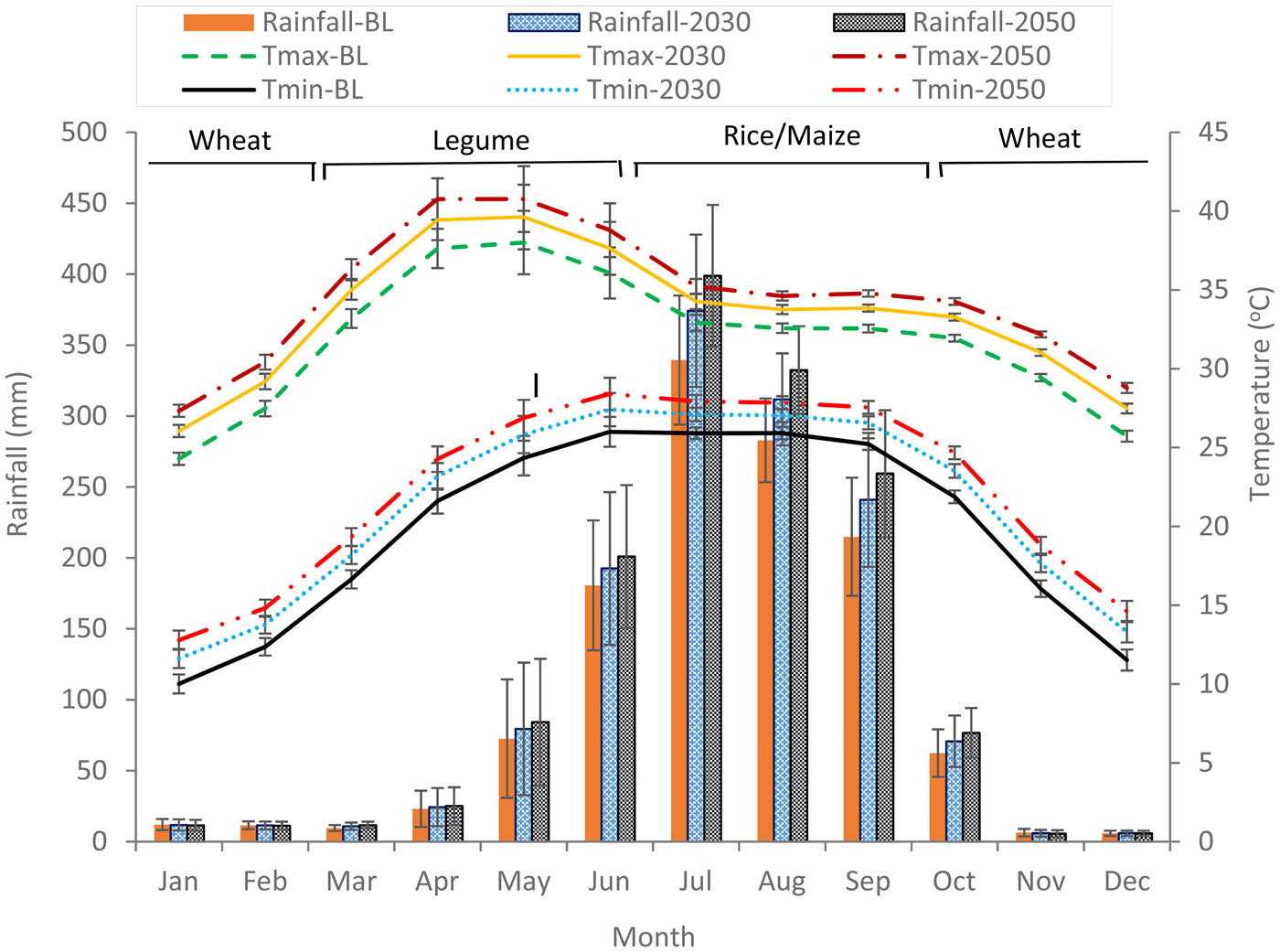
A summary of baseline climate data from 12 sites indicates that the monsoon season in Bihar extends from May to October while the dry season stretches from November to April (Fig. 3). The monthly rainfall in the rainy season ranges from 62 mm (October) to 339 mm (July), while it ranges from 6 mm (November and December) to 23 mm (April) during the dry season. The mean monthly maximum temperatures remained above 30 °C from March to October with the highest recorded (36–38 °C) in the months of April–June. The mean monthly minimum temperature for the period from April to October remained above 22 °C with the highest value (26 °C) occurring between June and August.
Monthly rainfall, maximum temperature (Tmax) and minimum temperature (Tmin) for the baseline climate (1980–2009) and future climate under the business as usual emission scenario (RCP8.5) in 2030 (2011–2039) and 2050 (2040–2069) in Bihar, eastern Indo-Gangetic Plains. Vertical bars indicate standard deviation of the means from 12 stations and horizontal bars indicate a growing period of crops (rice/maize, wheat and legume).

Climate projections to 2030 and 2050 indicate that rainfall could increase during the rainy season (May–October) with no change during the dry season (November–April). The increase in rainfall during the rainy season would be higher in 2050 than in 2030 (Fig. 3). The mean annual maximum and minimum temperatures are expected to increase by 1.6 and 1.5 °C in 2030 and by 2.7 and 2.5 °C in 2050, respectively. The increases in mean monthly maximum and minimum temperatures in both 2030 and 2050 are lower between the months of July and October compared to the other months. Details of the climate analysis are available in Tesfaye et al. (Reference Tesfaye, Aggarwal, Mequanint, Shirsath, Stirling, Khatri-Chhetri and Rahut2017a).
Effect of climate and management on life-cycle of crops
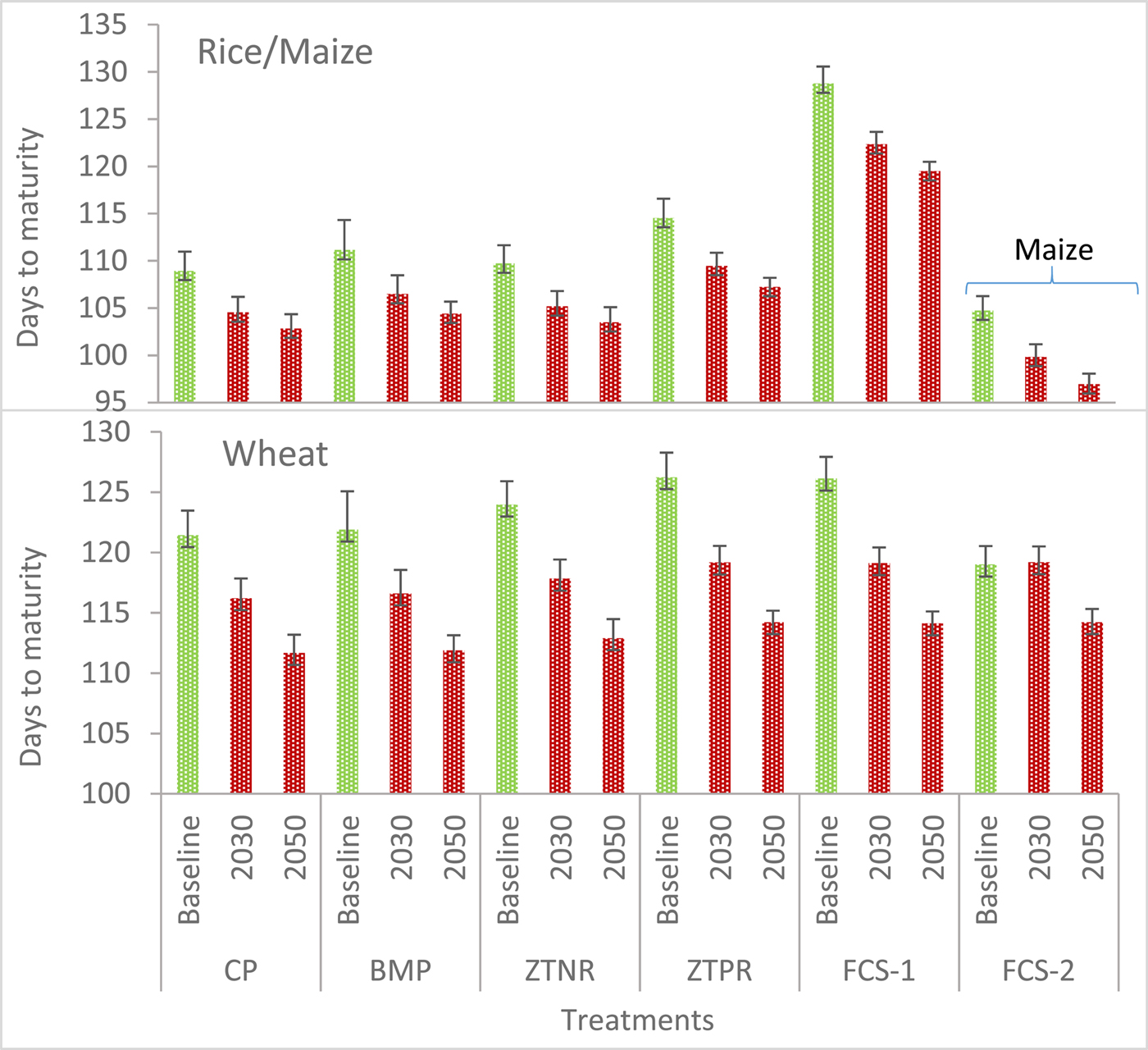
The number of days required to reach maturity (DTM) for rice, maize and wheat crops differed significantly (P < 0.05) among crop management options within a climate period and across climate periods (Fig. 4). For example, the DTM of rice ranged from 109 (in CP) to 129 days (in FCS-1) while that of wheat ranged from 119 (in FCS-2) to 126 days (in ZTPR and FCS-1) under the baseline climate. Maize required 105 days to mature under the baseline climate. Compared with the baseline, the future climate shortened the life-cycle of all crops studied significantly (P < 0.05). In 2030, the DTMs of rice and wheat were shortened by 5–6 days and 5–7 days (except FCS-2), respectively. The maturity periods of both rice and wheat were further shortened by 6–9 days and 10–12 days (except FCS-2) in 2050, respectively. Compared to the value under the baseline climate, the DTM of maize was shortened by 5 and 8 days in 2030 and 2050, respectively (Fig. 4).
Influence of current and future (2030 and 2050 under RCP8.5) climates and cropping system treatments on days to maturity of rice, maize and wheat crops in Bihar, Eastern Indo-Gangetic Plains.
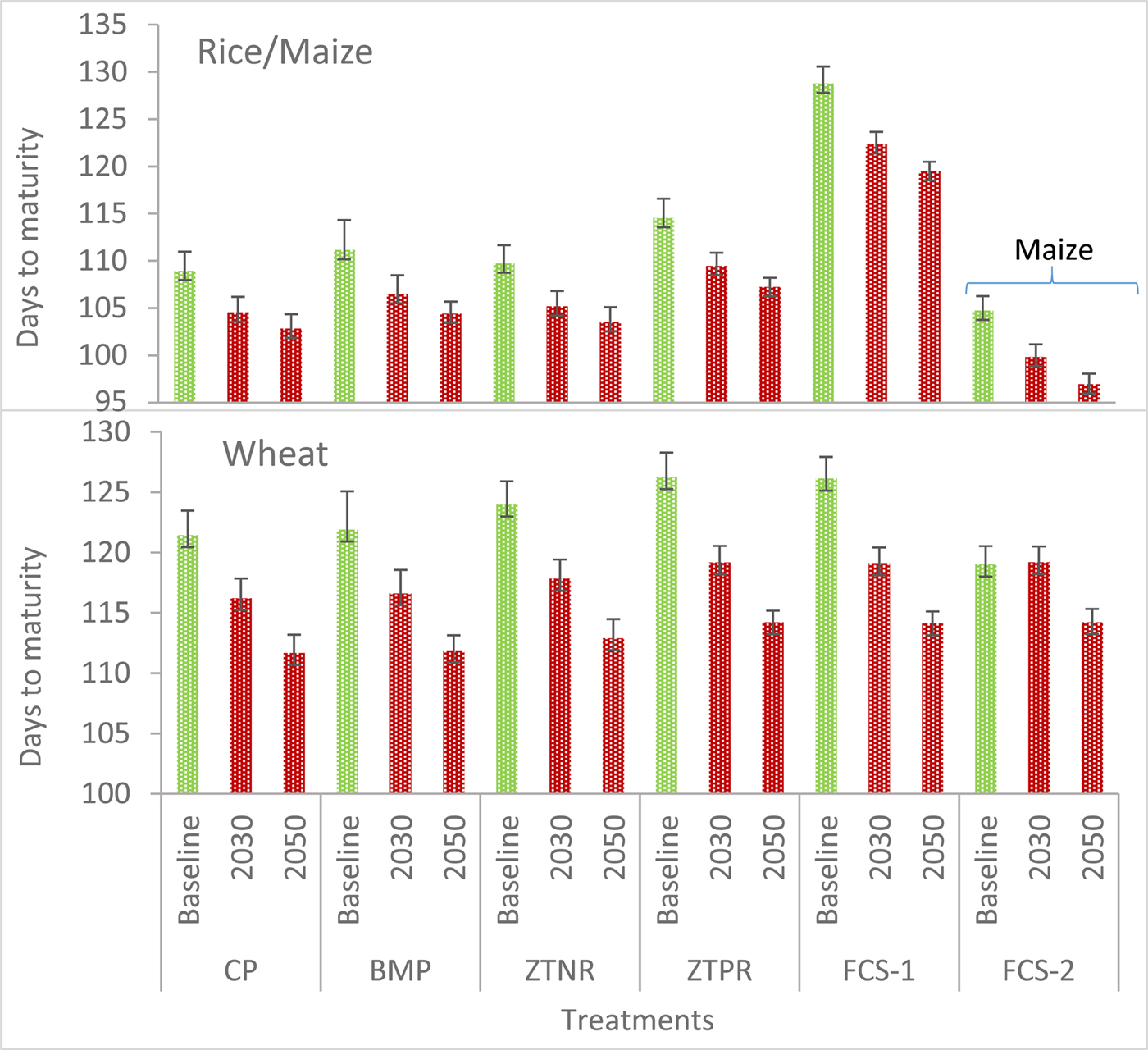
Among the crop management options, DTM of rice was significantly (P < 0.05) longer in the FCS-1 treatment followed by ZTPR. For wheat, the DTM was significantly (P < 0.05) longer in FCS-1 and ZTPR than in the other treatments, while the DTM of wheat in the FCS-2 treatment was not significantly affected by climate change in 2030 (Fig. 4).
Absolute crop and system yields
The results indicate that climate change may reduce rice yields by an average of 4% in 2030 and 8% in 2050 under the CP treatment but could increase wheat yield by the same magnitude. This could lead to a reduction of rice–wheat system productivity by 4% in 2030 and 2050. Compared to the baseline climate, climate change could also reduce rice/maize yields and system productivity in the crop management options studied (BMP, ZTNR, ZTPR, FCS-1 and FCS-2) in 2030 and 2050.
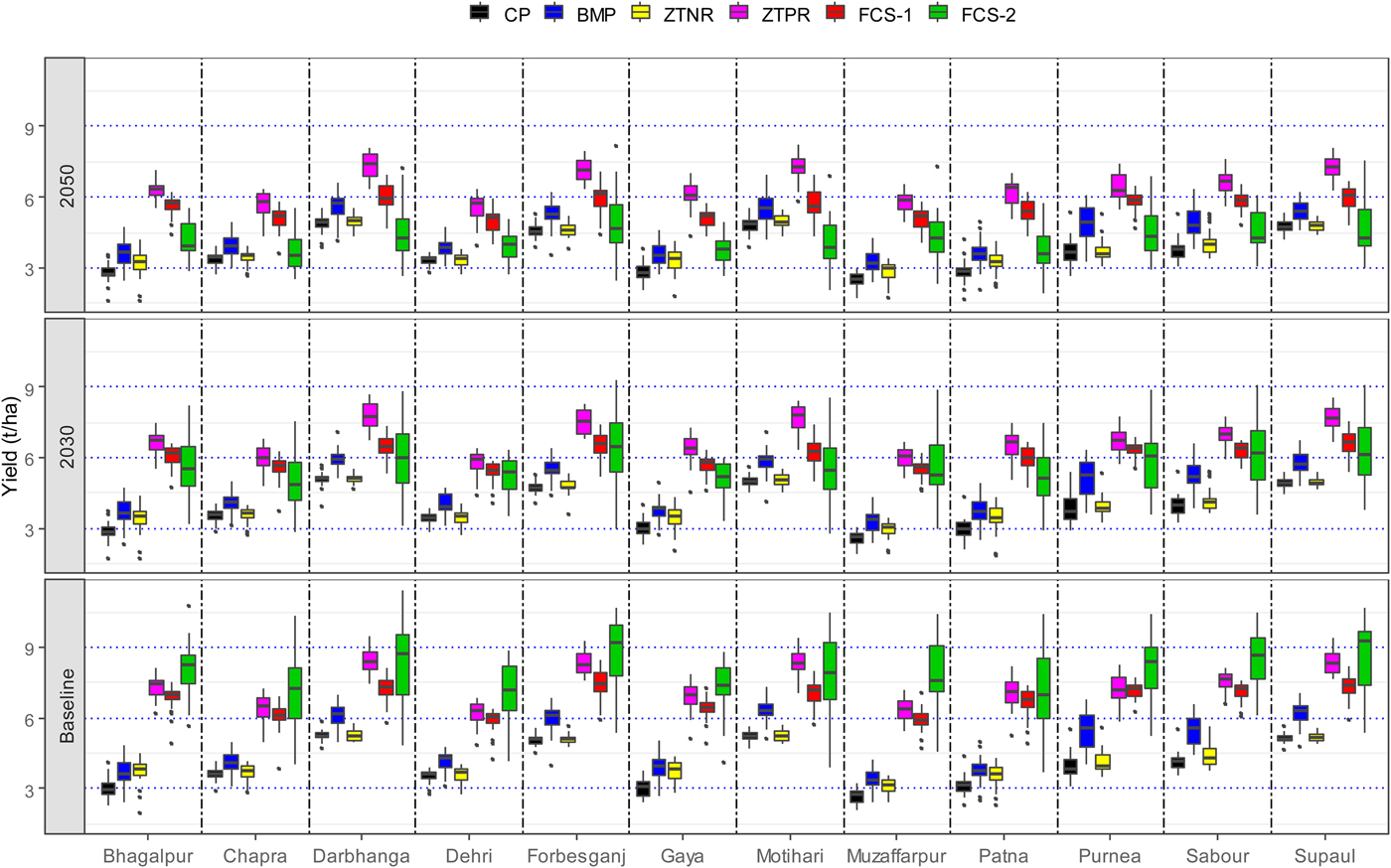
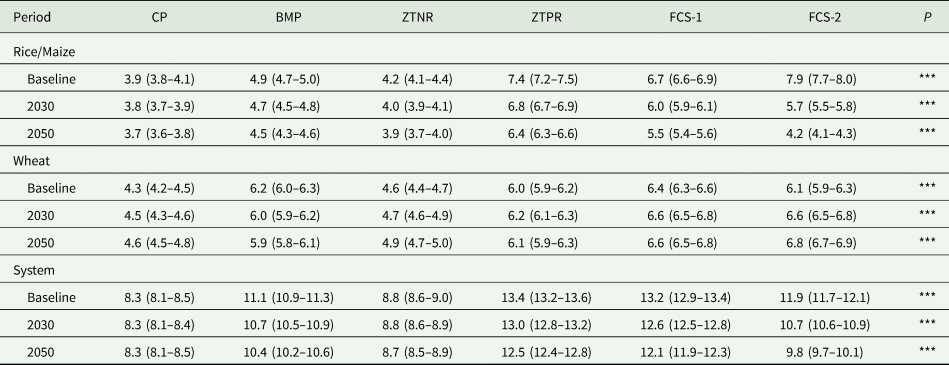
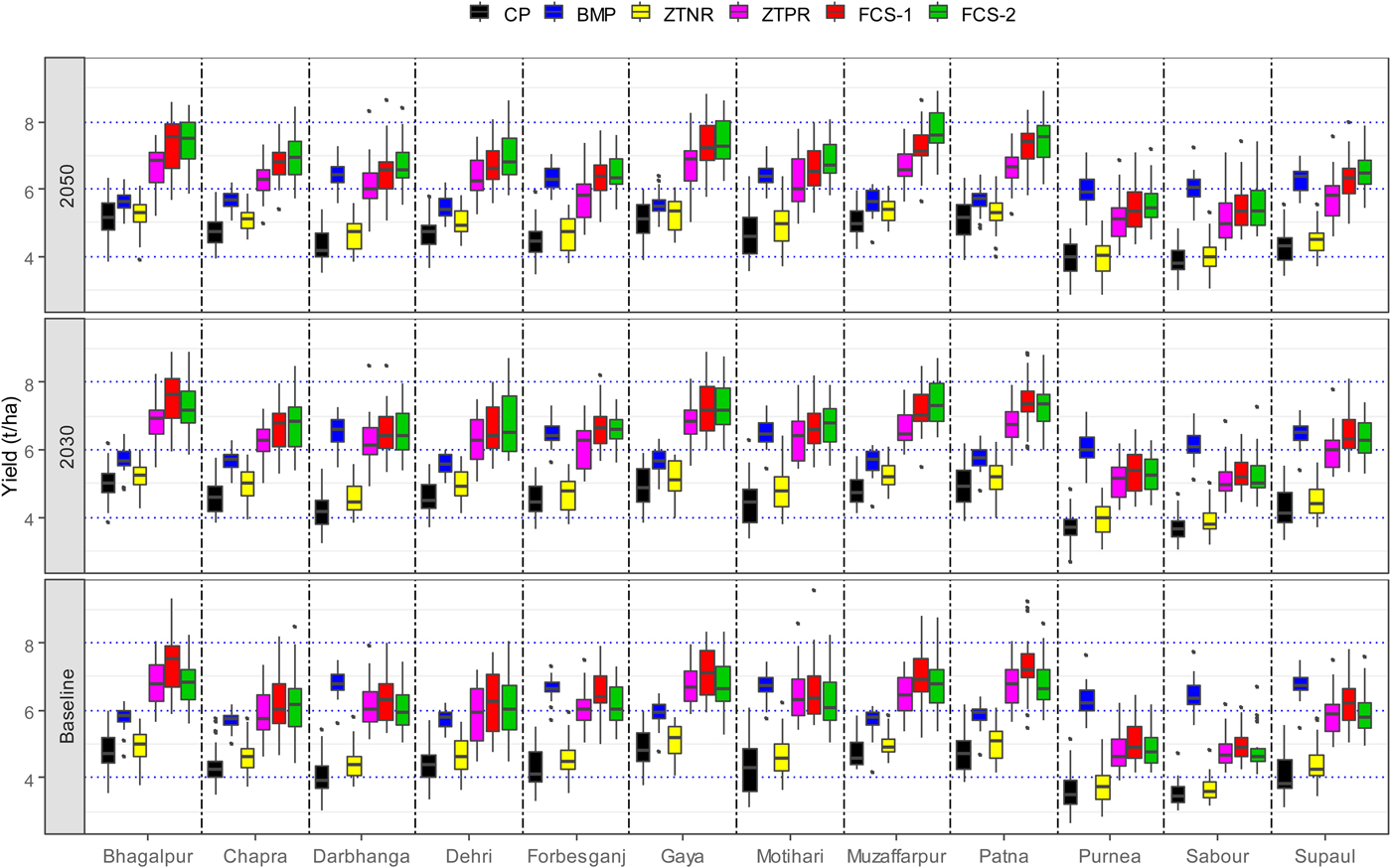
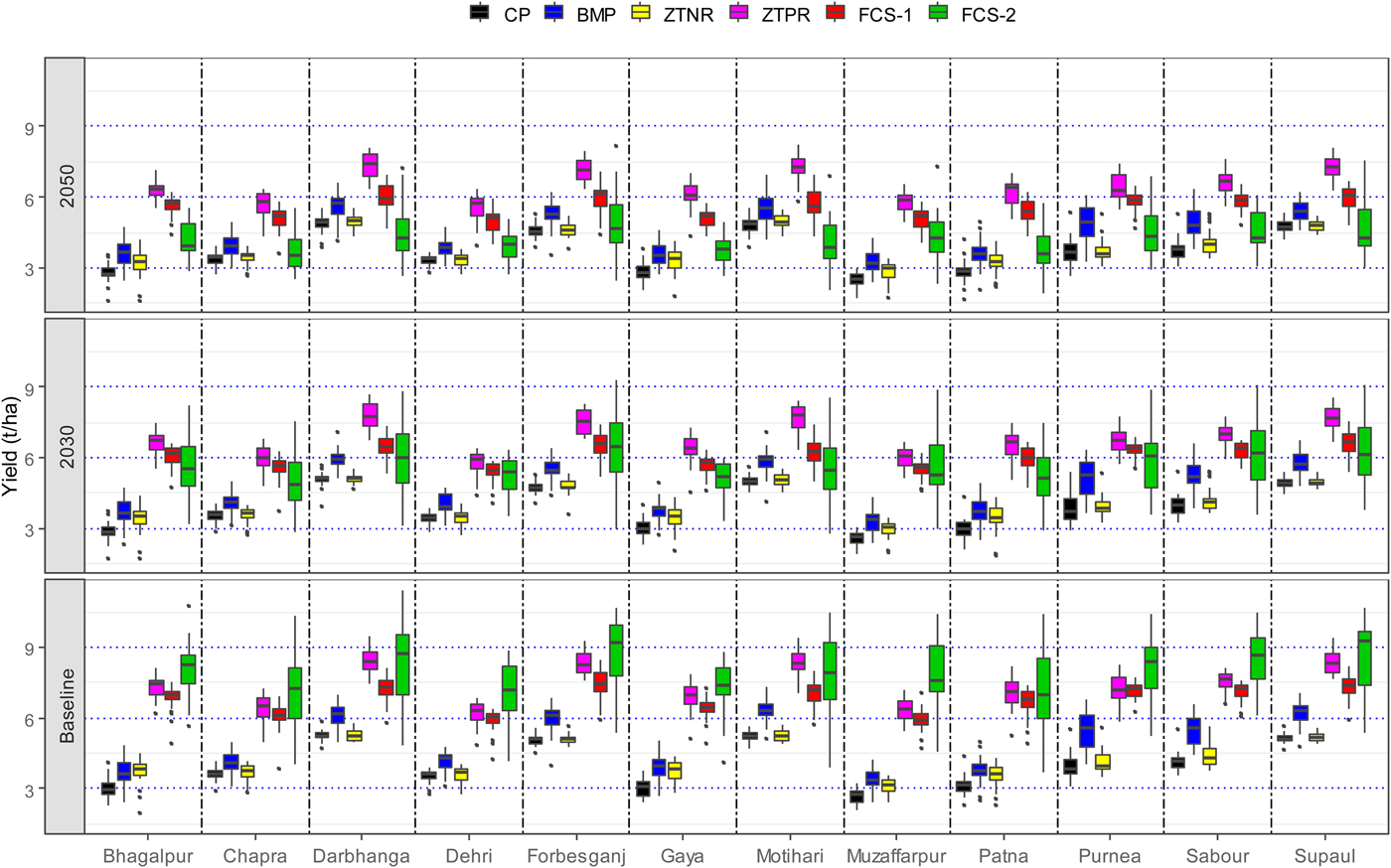
However, rice/maize, wheat and system yields differed significantly (P < 0.001) between the crop management treatments under both the baseline and future climates (Table 4). In the rice/maize component, FCS-2 (maize treatment) followed by ZTPR (rice treatment) gave significantly (P < 0.001) higher grain yield than the other treatments under the baseline climate, whereas the ZTPR treatment followed by FCS-1 gave significantly (P < 0.001) higher yields in both 2030 and 2050. Among sites, the yield from ZTPR was significantly (P < 0.01) higher in Darbhanga, Forbesganj, Motihari and Supaul under the 2030 and 2050 climates (Fig. 5). The increase in minimum temperature at these sites is projected to be relatively lower than the other sites in the June–September season in both 2030 and 2050 (Tesfaye et al., Reference Tesfaye, Aggarwal, Mequanint, Shirsath, Stirling, Khatri-Chhetri and Rahut2017a). The lowest rice/maize yield was observed in the CP treatment followed by ZTNR in all the sites and climate periods studied (Fig. 5).
Effect of crop management options on the yield of rice/maize across study sites under the baseline, 2030 and 2050 climate periods.
Grain yield (t/ha) of rice/maize, wheat and system productivity (rice equivalent) under different cropping systems and climate periods

*** = Treatment effect significant at P < 0.001; Number in parenthesis are 95% confidence intervals.
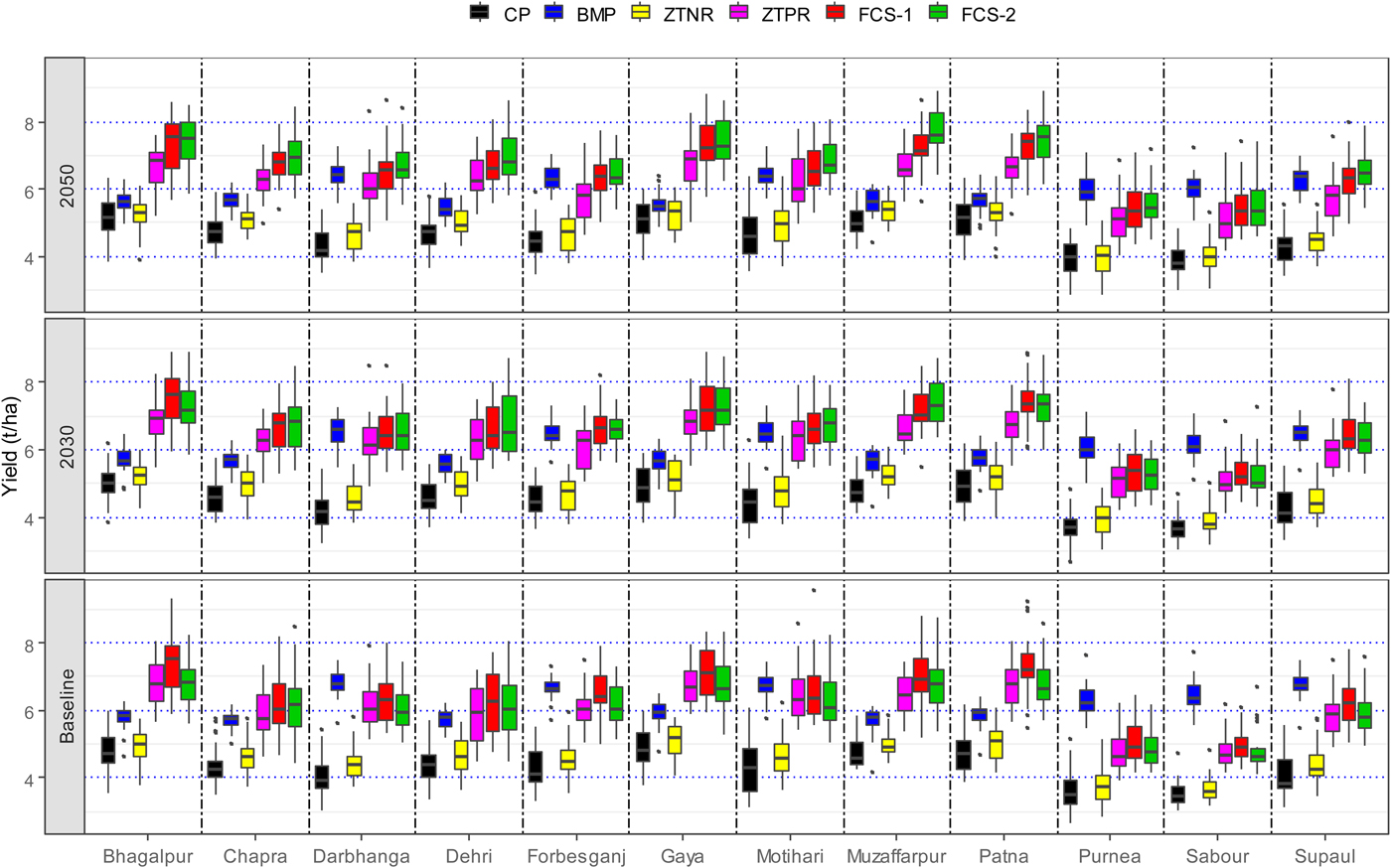
For wheat, FCS-1 and FCS-2 followed by ZTPR gave significantly (P < 0.001) higher grain yield than the rest of the treatments in the baseline and future climates (Table 4). However, the effect of crop management options on wheat yield varied across sites; the BMP performed better than other crop management options at Purnea and Sabour, which have lower minimum temperatures in the October–January season compared to the other sites, under the baseline and future climates (Fig. 6). The CP and ZTNR options gave consistently lower wheat yield across sites and climate periods (Fig. 7).
Effect of crop management options on the yield of wheat across study sites under the baseline, 2030 and 2050 climates.
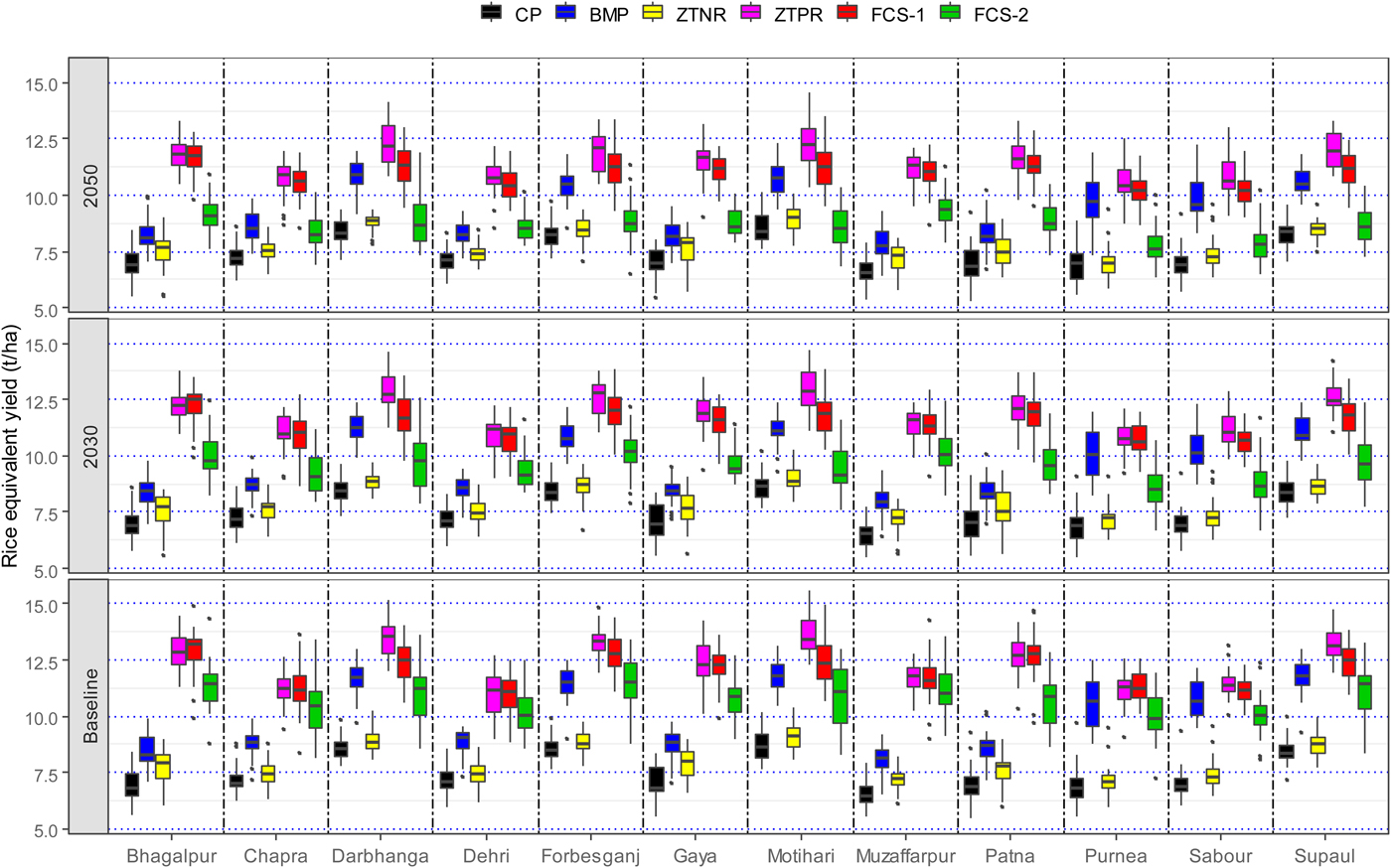
Effect of crop management options on system yield across study sites under the baseline, 2030 and 2050 climates.
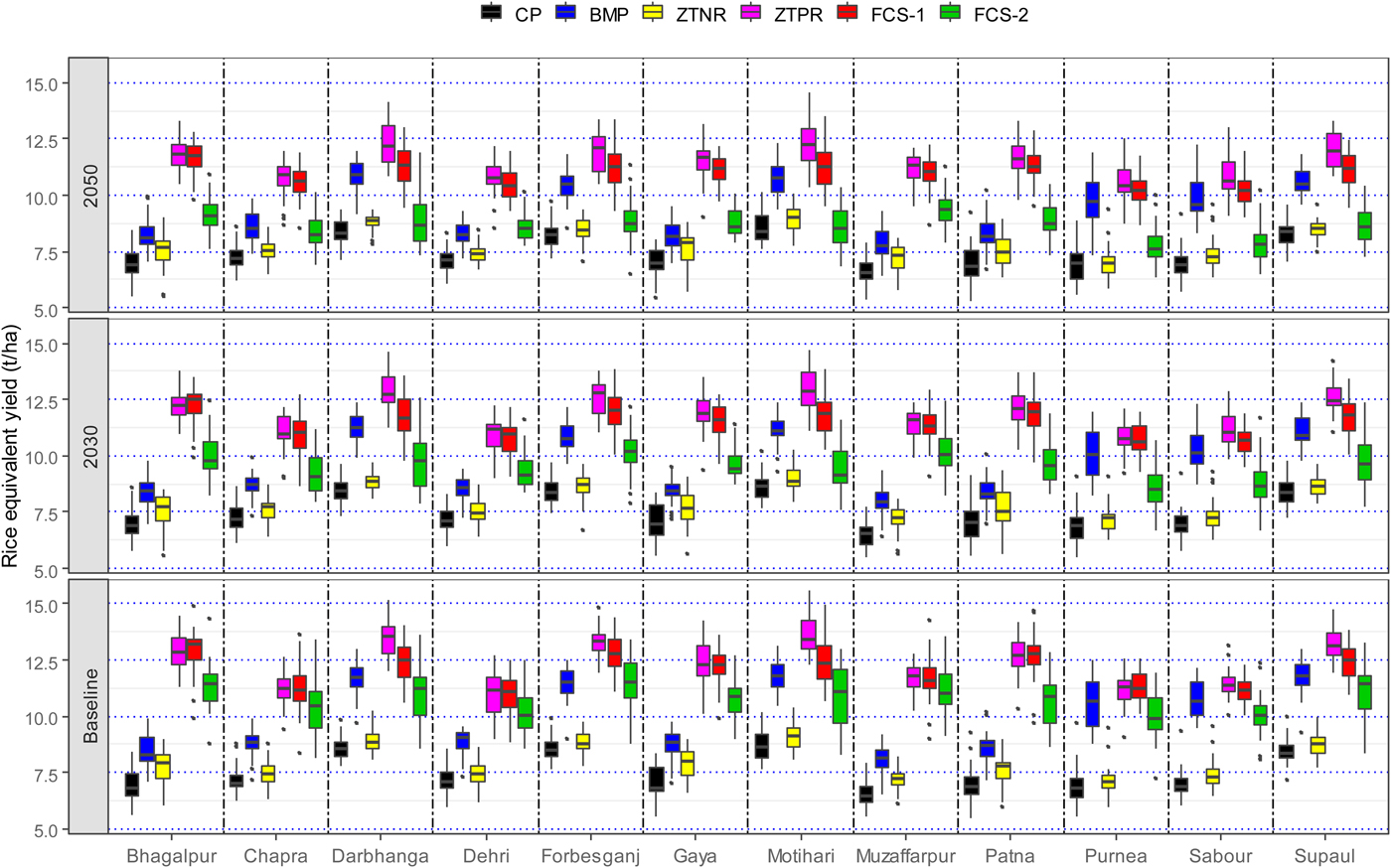
System mean yield was significantly (P < 0.001) higher in ZTPR and FCS-1 than the other treatments across sites and climate periods (Table 4 and Fig. 7). The FCS-2 treatment gave significantly higher system yield than the CP and ZTNR treatments in the baseline climate but its performance declined across all sites under the future climate, particularly in 2050 (Fig. 7). System yields from the BMP treatment were significantly (P < 0.001) higher than those from FCS-2 in half of the study sites and from CP and ZTNR in all sites across the climate periods. System yields from the ZTNR treatment were significantly (P < 0.001) higher than the one from CP but remain significantly (P < 0.001) lower than the rest of the treatments in all the sites and climate periods (Fig. 7).
Relative crop and system yields
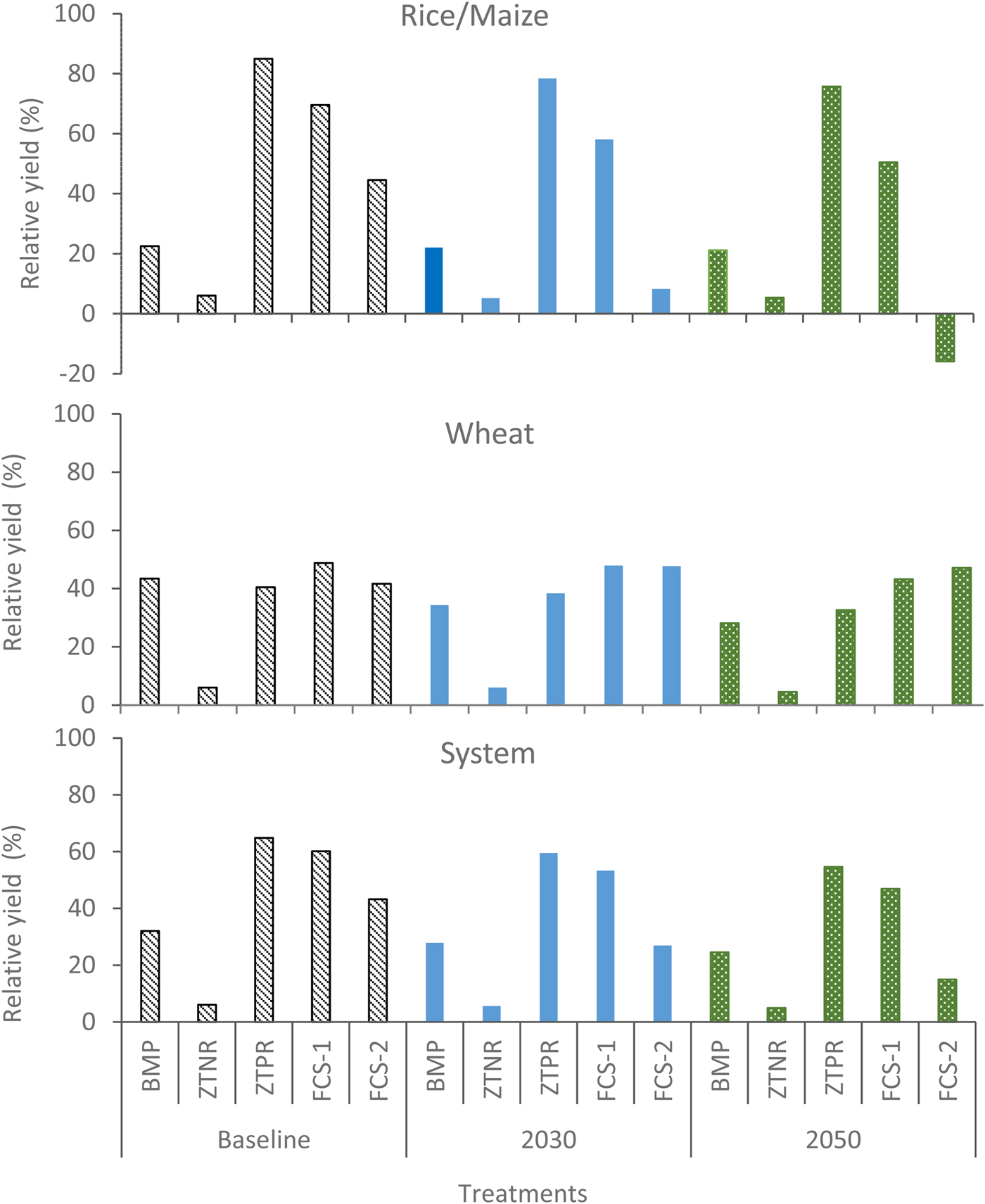
The simulated yields of the crop and system components (all scaled by the yield of CP under the baseline climate) are presented in Fig. 8, showing the performance of each of the management option under the baseline and future climate scenarios. With the exception of FCS-2 in 2050, all the crop management practices had significantly (P < 0.001) higher crop and system yield than the CP in the baseline and future climates. Compared to the baseline climate, yield of the rice/maize component and that of the system decreased with climate change, while that of wheat generally remained stable.
Relative simulated yield of five crop management options under the baseline and future climate scenario (RCP8.5) in 2030 and 2050 in a cereal-based cropping system in Bihar. Data were an average of 12 stations across the state of Bihar.
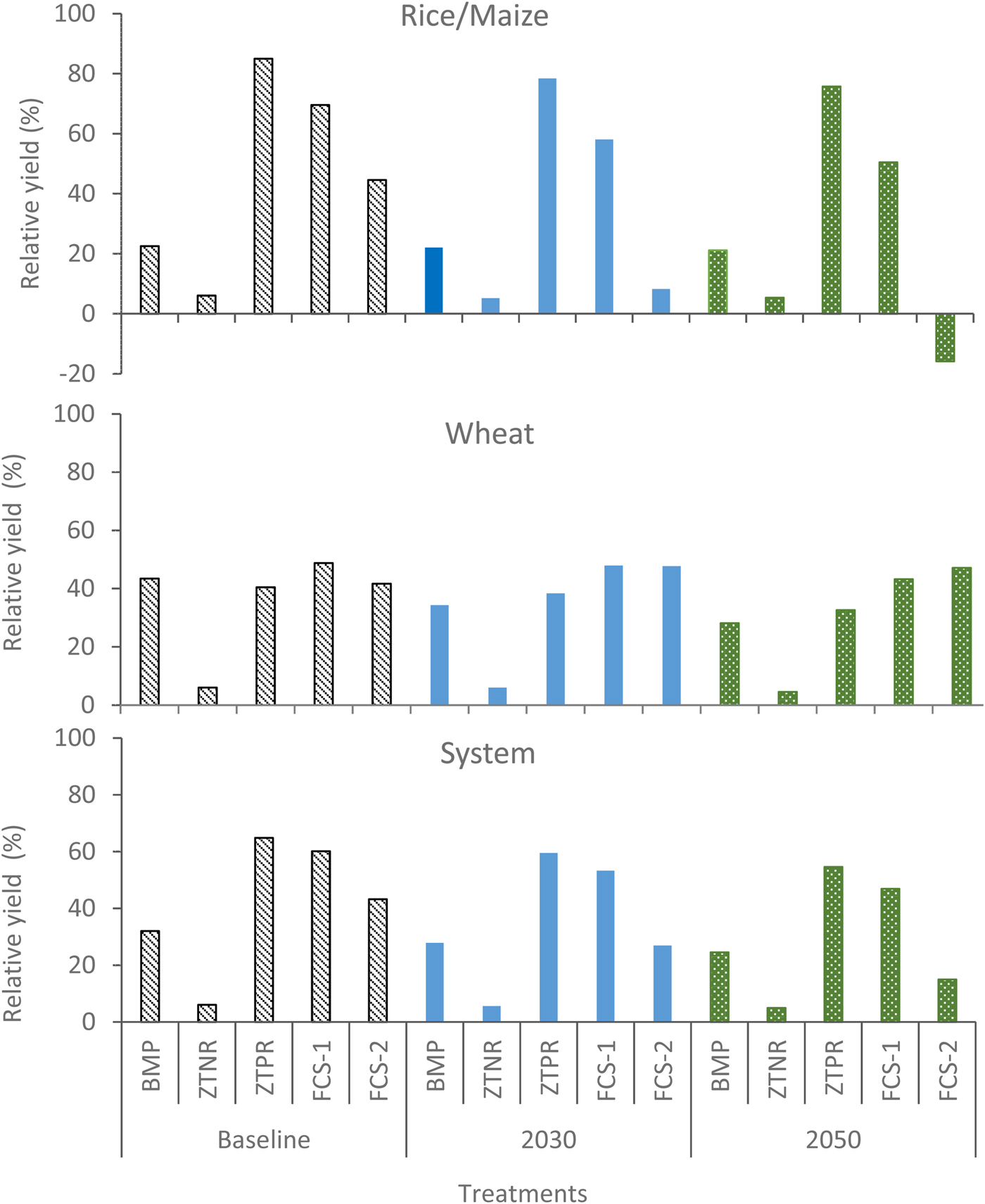
Relative rice yields were higher (75–80%) in the ZTPR treatments followed by FCS-1 (50–70%) and BMP (21–23%) across the climate periods. The relative yield in FCS-2 (maize) decreased from 45% in the baseline climate to 5% in 2030 and –16% in 2050 (Fig. 8). Except for the ZTNR treatment, the relative yield of wheat in different crop management treatments ranged between 40 and 49% in the baseline, 34 and 48% in 2030, and 28 and 47% in 2050. The ZTPR and FCS-1 gave consistently higher (47–65%) relative system yield than the rest of the treatments across climate periods. The relative crop and system yield increase from ZTNR was only 5–6% and did not change with climate periods (Fig. 8).
Crop and system water productivity
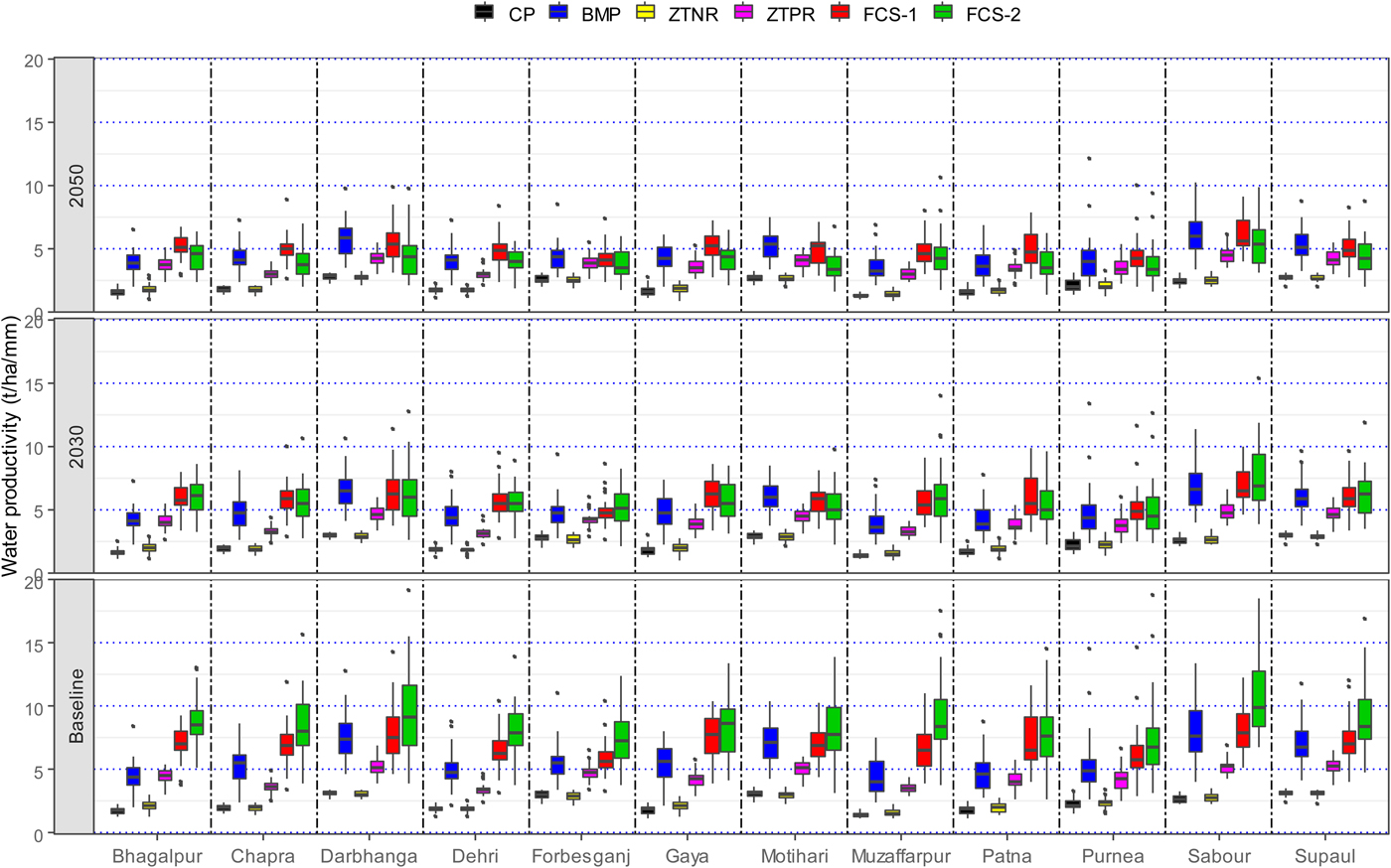
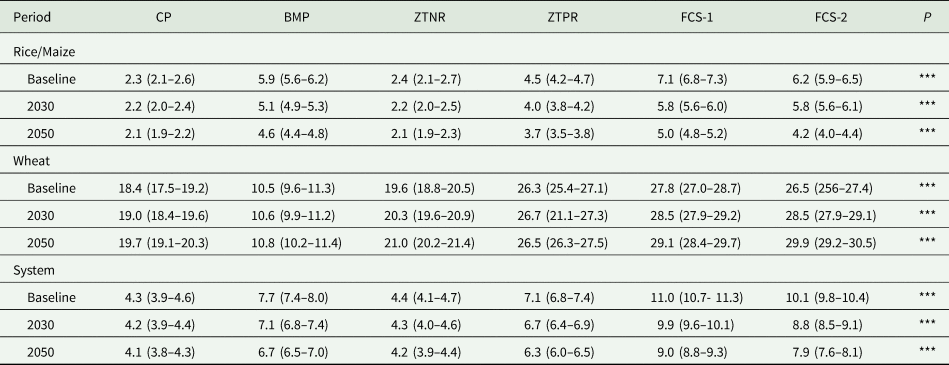
For the rice/maize component, FCS-2 had significantly (P < 0.001) higher water productivity in the baseline climate while FCS-1 had the highest water productivity in 2030 and 2050 (Table 4). The CP and ZTNR treatments had significantly (P < 0.001) lower rice/maize water productivity values over the climate periods while BMP and ZTPR had intermediate values.
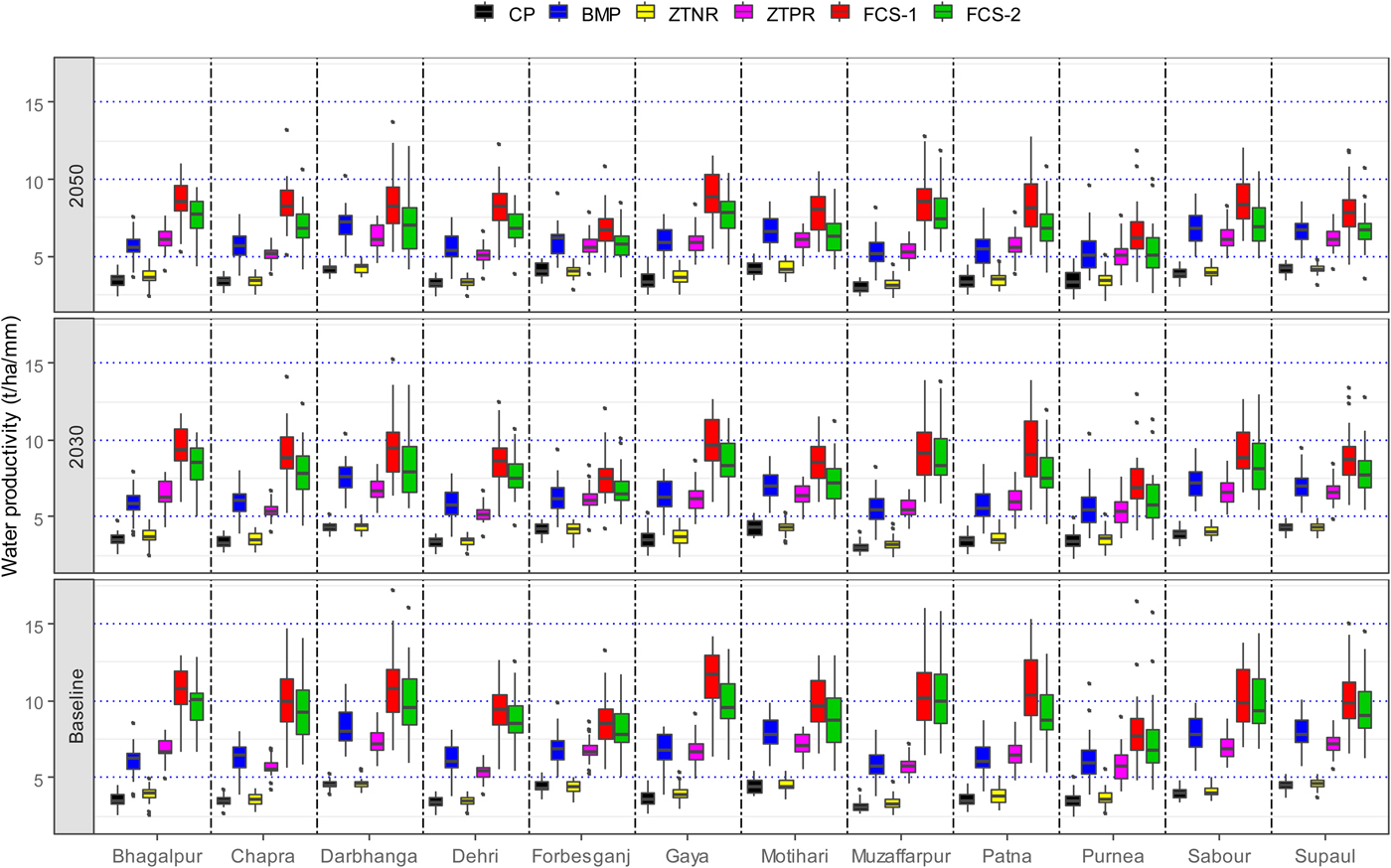
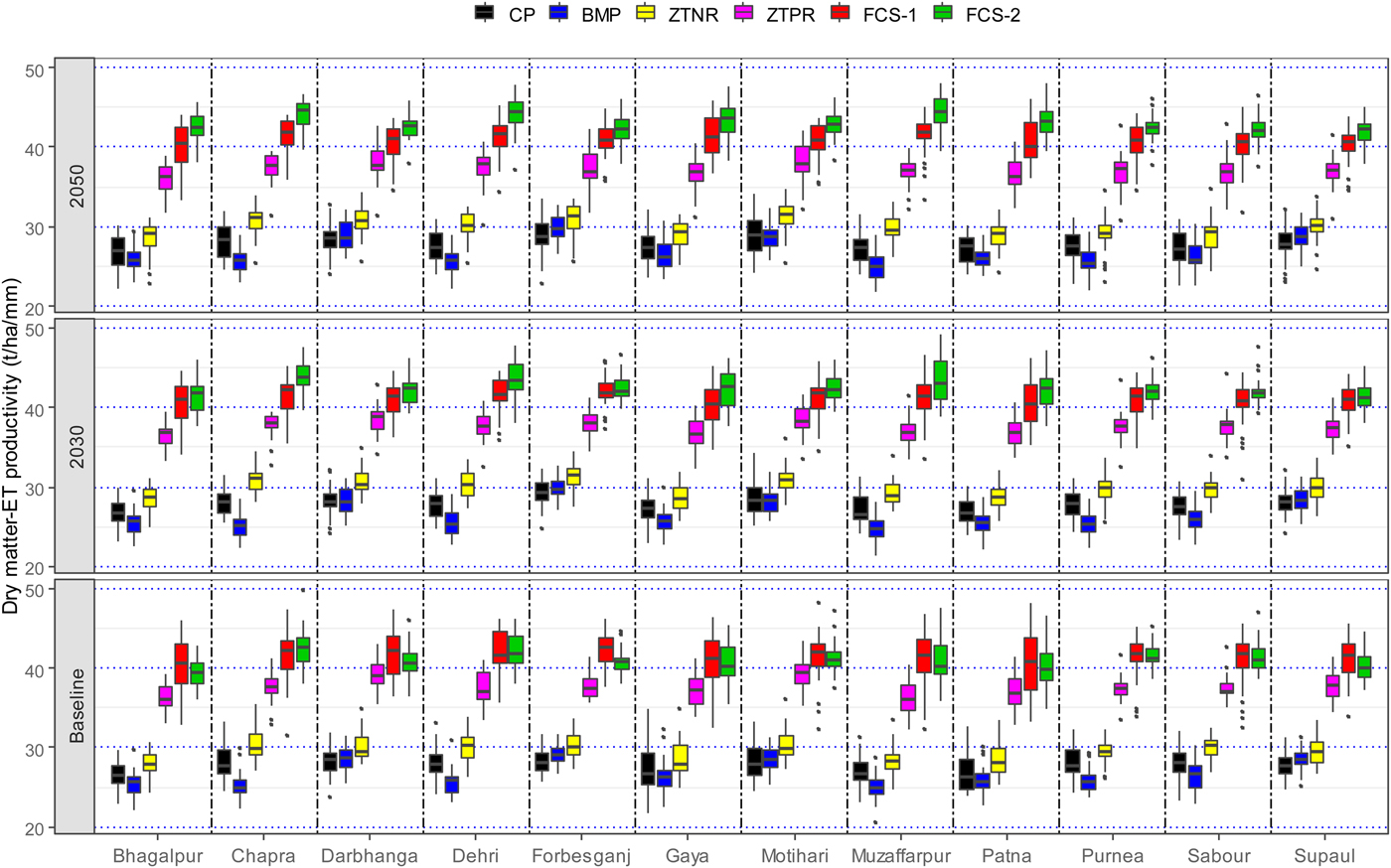
In wheat, FCS-1 and FCS-2 had significantly (P < 0.001) higher water productivity than the rest of the treatments under the baseline and future climate conditions. Water productivity of wheat was significantly (P < 0.001) lower in BMP followed by CP in all climate periods, while ZTPR had an intermediate level of water productivity between BMP and CP on the one hand and FCS-1 and FCS-2 on the other hand (Table 5). The treatment effects on system water productivity were similar to those observed in wheat except that BMP had significantly (P < 0.001) higher system water productivity than CP in all climate periods. Unlike wheat, the rice/maize and system water productivity decreased with climate change in 2030 and 2050 compared with the baseline climate. The crop and system water productivity values of each treatment did not differ much across the study sites (Figs 9 and 10).
Effect of cropping system treatments on yield-ET productivity of rice/maize across study sites and climate periods.
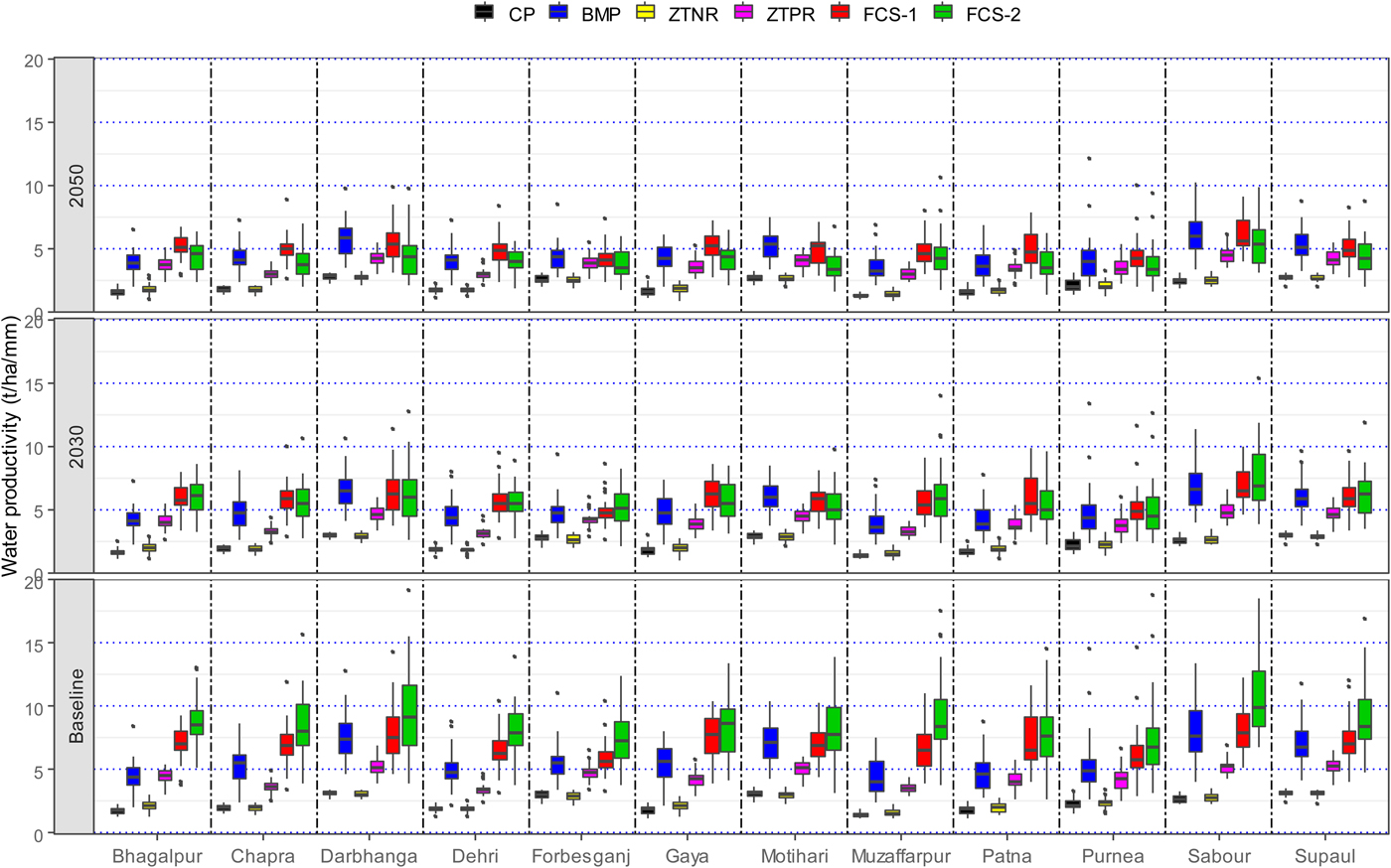
Effect of cropping system treatments on yield-ET productivity of wheat across study sites and climate periods.

Water productivity (kg/ha/mm) of rice/maize, wheat and system (rice equivalent) under different cropping systems and climate periods

*** = Treatment effect significant at P < 0.001; Numbers in parenthesis are 95% confidence intervals.
Contribution of crop management options to climate change adaptation
The adaptation impacts of the different crop management practices in the current and future climates are presented in Fig. 11. The results indicated that all crop management options studied had some positive impacts on yields of the component crops and the system as a whole under the current climate but their adaptation impact varied between crops and future climate periods.
The impact of the different crop management options on the mean yield in the baseline climate and their impact of adaptation under the future climate in 2030 (upper panel) and 2050 (lower panel) for the rice/maize (a and b), wheat (c and d) and the whole cropping system (e and f) in Bihar. All the yield changes have been normalized by the simulated yield of the conventional practice under baseline climate.

In the rice/maize component, ZTPR and FCS-1 had a greater impact on yield than the rest of the treatments under the current climate with no or limited adaptation impact under the future climate. On the other hand, FCS-2 had a greater positive impact than the rest of the treatments under the current climate but with strong negative adaptation impact under the future climate, particularly in 2050 (Figs 11(a) and (b)). The impacts of ZTNR and BMP on maize/rice yield are smaller than the rest of the treatments under the current climate with near to zero adaptation impact.
In wheat, however, FCS-2 had a greater positive impact under the current climate and a strong adaptation impact under the future climate in both 2030 and 2050 (Figs 11(c) and (d)). In addition, FCS-1 had a strong positive impact under the current climate with positive adaptation contribution in 2030 but no adaptation impact in 2050. While the impact of ZTNR on wheat yield was very small (mean relative yield <6%) under the current and future climates, BMP had a strong positive impact under the baseline climate but with no adaptation impact under the future climates (Figs 11(c) and (d)).
For the system, the ZTPR and FCS-1 treatments had a greater positive impact in the current climate than the rest of the treatments while their adaptation impact under the future climate was not significantly different from zero. The BMP and ZTNR also had a positive but lower impact on system yield under the current climate with no adaptation impact under the future climates (Figs 11(e) and (f)).
Economic benefits
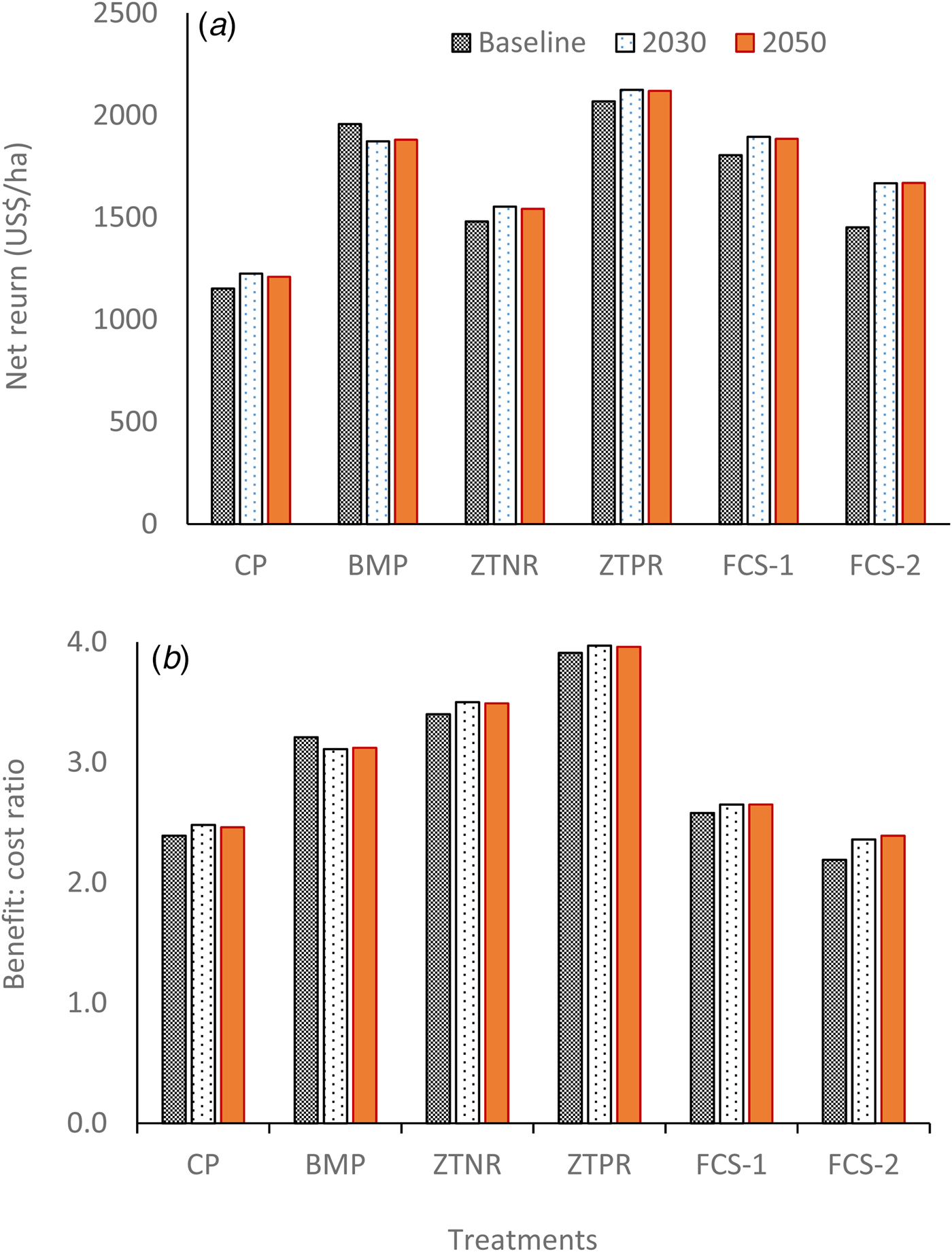
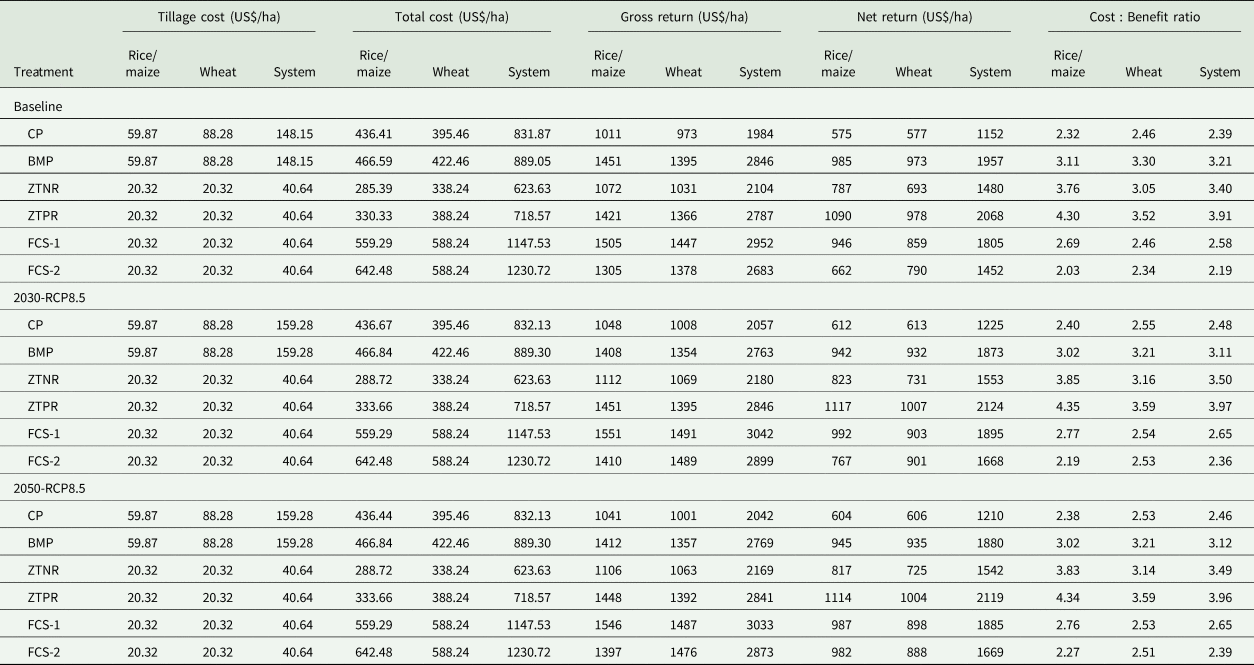
A summarized economic analysis of different crop management options under current and future climates is presented in Fig. 12 while the details are provided in Table 6. Results show that the net returns can increase in all cropping systems compared to the farmers' conventional method. Net returns at the system level in the current setting were higher (80%) in the ZTPR treatments followed by BMP (70%) and FCS-1 (57%) compared to the conventional method (CP). Similarly, benefit : cost ratios were higher in ZTPR, ZTNR and BMP treatments than in CP. However, these ratios were not significantly different between CP, FCS-1 and FCS-2 treatments. Cost of nutrient management and residue retention in FCS-1 and FCS-2 treatments increased the total cost of cultivation compared to BMP treatment. Application of BMP can be more profitable than CA methods where the cost of residue retention is high.
Present net return (a) and benefit-cost ratios (b) for different cropping system treatments under baseline and future climate periods.

Economic analysis of different crop management options under current and future (2030 and 2050) climates in Bihar (current price)

The current study also showed that under conservation agriculture the rice–wheat system (FCS-1) would be more profitable than the maize–wheat system (FCS-2). A lower net return of about 25% was found in the maize–wheat system than in the rice–wheat system with low benefit : cost ratio. The highest benefit : cost ratios were found for the rice component under ZTPR (4.3) followed by ZTNR (3.76), and for the wheat component under ZTPR (3.52) and BMP (3.30). At a system level, benefit : cost ratios were >3 under the BMP, ZTNR and ZTPR treatments (Fig. 12). Although net returns were higher, the benefit-cost ratios from the FCS-2 treatment were similar to the CP for both the system and the rice/maize and wheat components (Fig. 12). There was no significant difference in net return and benefit-cost ratios between current and future climates periods for all treatments – in part because we assumed constant prices and inputs so that differences primarily reflect differential simulated yields.
Discussion
The sustainability of the current rice–wheat production system (CP) in Bihar and elsewhere in the IGP is challenged by increasing labour, energy and water requirements (Gathala et al., Reference Gathala, Ladha, Kumar, Saharawat, Kumar, Sharma, Sharma and Pathak2011; Kumar et al., Reference Kumar, Saharawat, Gathala, Jat, Singh, Chaudhary and Jat2013; Ladha et al., Reference Ladha, Rao, Raman, Padre, Dobermann, Gathala, Kumar, Sharawat, Sharma, Piepho, Alam, Liak, Rajendran, Reddy, Parsad, Sharma, Singh, Saha and Noor2016), stagnation and/or declining productivity (Grace et al., Reference Grace, Harrington, Mabesh, Robertson, Ladha, Hill, Duxbury, Gupta and Buresh2003; Ladha et al., Reference Ladha, Hill, Duxbury, Gupta and Buresh2003a; Gathala et al., Reference Gathala, Ladha, Kumar, Saharawat, Kumar, Sharma, Sharma and Pathak2011), depletion of groundwater and soil nutrients (Humphreys et al., Reference Humphreys, Kukal, Christen, Hira, Balwinder-Singh, Sudhir-Yadav and Sharma2010), impacts of climate change (Hundal and Prabhjyot-Kaur, Reference Hundal and Prabhjyot-Kaur2007; Prabhjyot-Kaur and Hundal, Reference Prabhjyot-Kaur, Hundal and Jha2010) and emissions of greenhouse gases (Mosier et al., Reference Mosier, Duxbury, Freney, Heinemeyer, Minami and Johnson1998; Gupta et al., Reference Gupta, Sahai, Singh, Dixit, Singh, Sharma, Tiwari, Gupta and Garg2004). There is, therefore, a need to design and evaluate cropping systems and management options that are biophysically and socio-economically sustainable and meet the food production needs of the region.
Impacts of climate change
The climate in Bihar is going to change and the average temperature will increase, on average, by 1.5 °C in 2030 and 2.5 °C in 2050 with a relatively small increase in rainfall during the rainy season (June–September). This change will reduce rice/maize yields and system productivity in the short- and mid-term, despite a positive effect on wheat yield in all the cropping systems studied. The differential response of rice/maize and wheat to climate change may be mainly due to the fact that the temperature increases in 2030 and 2050 may have caused heat stress on rice and maize, which are grown during the summer season, compared with wheat which is grown during the winter season. It is indicated that exposure to temperatures exceeding 35 °C for a period of 1 h during the reproductive period could cause pollen desiccation in maize and spikelet sterility in rice (Luo, Reference Luo2011). As shown in the current study and reported in previous works (Thaler et al., Reference Thaler, Eitzinger, Trnka and Dubrovsky2012; Mishra et al., Reference Mishra, Singh, Raghuwanshi, Chatterjee and Froebrich2013; Reynolds et al., Reference Reynolds, Quilligan, Aggarwal, Bansal, Cavalieri, Chapman, Chapotin, Datta, Duveiller, Gill, Jagadish, Joshi, Koehler, Kosina, Krishnan, Lafitte, Mahala, Muthurajan, Paterson, Prasanna, Rakshit, Rosegrant, Sharma, Singh, Sivasankar, Vadez, Valluru, Prasad and Yadav2016), climate change shortens the life-cycle of crops because of accelerated development. In the current study, crop maturity duration explained 1, 37 and 57% of the variation in the yield of wheat, rice and maize, respectively across sites, cropping systems and climate periods. This perhaps explains why wheat was less affected than rice and maize by climate change in 2030 and 2050 despite a shortening of its maturity duration by almost a week in 2030 and a week and a half in 2050. Previous studies which used the DSSAT model to study the effect of climate change on cereals in the IGP indicate a decrease in the maturity duration and yield of rice and wheat (Hundal and Prabhjyot-Kaur, Reference Hundal and Prabhjyot-Kaur2007), an increase in rice yield across environments (Aggarwal and Mall, Reference Aggarwal and Mall2002), or a spatially variable response in wheat and rice yields (Mishra et al., Reference Mishra, Singh, Raghuwanshi, Chatterjee and Froebrich2013). If adaptation measures are not taken, global or regional studies that included India in their analysis indicated a reduction of yield of the studied crops due to climate change (Balkovič et al., Reference Balkovič, van der Velde, Skalský, Xiong, Folberth, Khabarov, Smirnov, Mueller and Obersteiner2014; Asseng et al., Reference Asseng, Ewert, Martre, Rötter, Lobell, Cammarano, Kimball, Ottman, Wall, White, Reynolds, Alderman, Prasad, Aggarwal, Anothai, Basso, Biernath, Challinor, De Sanctis, Doltra, Fereres, Garcia-Vila, Gayler, Hoogenboom, Hunt, Izaurralde, Jabloun, Jones, Kersebaum, Koehler, Müller, Kumar, Nendel, O'Leary, Olesen, Palosuo, Priesack, Rezaei, Ruane, Semenov, Shcherbak, Stöckle, Stratonovitch, Streck, Supit, Tao, Thorburn, Waha, Wang, Wallach, Wolf, Zhao and Zhu2015; Liu et al., Reference Liu, Asseng, Müller, Ewert, Elliott, Lobell, Martre, Ruane, Wallach, Jones, Rosenzweig, Aggarwal, Aldeman, Anothai, Basso, Biernath, Cammarano, Challinor, Deryng, Sanctis, Doltra, Fereres, Folberth, Garcia-Vila, Gayler, Hoogenboom, Hunt, Izaurralde, Jabloun, Jones, Kersebaum, Kimball, Koehler, Kumar, Nendel, O'Leary, Olesen, Ottman, Palosuo, Prasad, Priesack, Pugh, Reynolds, Rezaei, Rötter, Schmid, Semenov, Shcherbak, Stehfest, Stöckle, Stratonovitch, Streck, Supit, Tao, Thorburn, Waha, Wall, Wang, White, Wolf, Zhao and Zhu2016; Zhao et al., Reference Zhao, Liu, Piao, Wang, Lobell, Huang, Huang, Yao, Bassu, Ciais, Durand, Elliott, Ewert, Janssens, Li, Lin, Liu, Martre, Müller, Peng, Peñuelas, Ruane, Wallach, Wang, Wu, Liu, Zhu, Zhu and Asseng2017; Tesfaye et al., Reference Tesfaye, Kruseman, Cairns, Zaman-Allah, Wegary, Zaidi, Boote, Rahutc and Erenstein2018).
Benefit of new cropping systems
The results from the current study show significant benefits from the new crop management options compared to the current practice on crop and cropping system yield, water productivity and economic profitability. Compared to the conventional practice, all the crop management options studied but ZTNR significantly increased the yield and water productivity of component crops (rice, maize and wheat) and the system under the baseline and future climates. The relative yield gain from the crop management options studied was greater for the rice/maize component than the wheat one, particularly under the baseline climate. Overall, ZTPR and FCS-1 were the best treatments over CP in improving yield and water productivity of rice and the cropping system under both the baseline and future climates. In wheat, however, relative yield and water productivity were greater for the ZTPR, FCS-1 and FCS-2 treatments under the baseline climate but FCS-2 and FCS-1 became the best under the future climate. The BMP had a similar positive effect (significantly higher than ZRNR and CP but lower than the rest of the treatments) on the yield and water productivity of the component crops and the system across sites although its effect decreases under climate change in all cases.
The current study evaluated crop management options that integrate more than one component (rotation, tillage, residue, planting method, fertilizer and water management) in a system; hence it was not possible to quantify the benefits of a single component within a given treatment. Although each component included in a treatment contributes incrementally to a system, some components can play a greater role than others (Ladha et al., Reference Ladha, Rao, Raman, Padre, Dobermann, Gathala, Kumar, Sharawat, Sharma, Piepho, Alam, Liak, Rajendran, Reddy, Parsad, Sharma, Singh, Saha and Noor2016). In the current study, treatments that combined ZT, direct seeding of rice and residue retention (ZTPR) and cereal-legume rotation (FCS-1 and FCS-2) contributed most to overall system productivity. Zero tillage improves soil physical properties such as infiltration rate, bulk density and water stable aggregation (Hati et al., Reference Hati, Singh, Mandal, Bandyopadhyay, Somasundaram, Mohanty, Sinha, Chaudhary and Biswas2016), crop establishment and timely sowing (Gathala et al., Reference Gathala, Timsina, Islam, Rahman, Hossain, Harun-Ar-Rashid, Ghosh, Krupnik, Tiwari and McDonald2015), lowers production costs and boosts income (Erenstein and Laxmi, Reference Erenstein and Laxmi2008; Aryal et al., Reference Aryal, Sapkota, Jat and Bishnoi2015b). Surface residue retention conserves soil moisture, suppresses weeds, and improves soil organic matter and soil structure (Balwinder-Singh et al., Reference Balwinder-Singh, Humphreys, Eberbach, Katupitiya, Yadvinder-Singh and Kukal2011; Verhulst et al., Reference Verhulst, Sayre, Vargas, Crossa, Deckers, Raes and Govaerts2011; Kumar et al., Reference Kumar, Saharawat, Gathala, Jat, Singh, Chaudhary and Jat2013). When ZT was combined with partial crop residue retention in the current study (ZTPR), it improved both rice and wheat yields over CP under the current and future climates. Similarly, Keil et al. (Reference Keil, D'Souza and McDonald2015) reported that zero-till wheat with partial crop residue retention out-yielded conventional-tillage wheat across different agro-ecological zones in the state of Bihar. Moreover, avoiding puddling through direct seeding of rice reduces water, labour, production costs and methane emissions (Kumar and Ladha, Reference Kumar and Ladha2011; Kumar et al., Reference Kumar, Saharawat, Gathala, Jat, Singh, Chaudhary and Jat2013). It also improves soil physical properties such as infiltration rate, aggregate stability and distribution when it is combined with crop residue retention (Gathala et al., Reference Gathala, Kumar, Sharma, Saharawat, Jat, Singh, Kumar, Jat, Humphreys, Sharma, Sharma and Ladha2013) improving the performance of the subsequent crop as observed in the ZTPR and FCS-1 treatments of wheat in the current study.
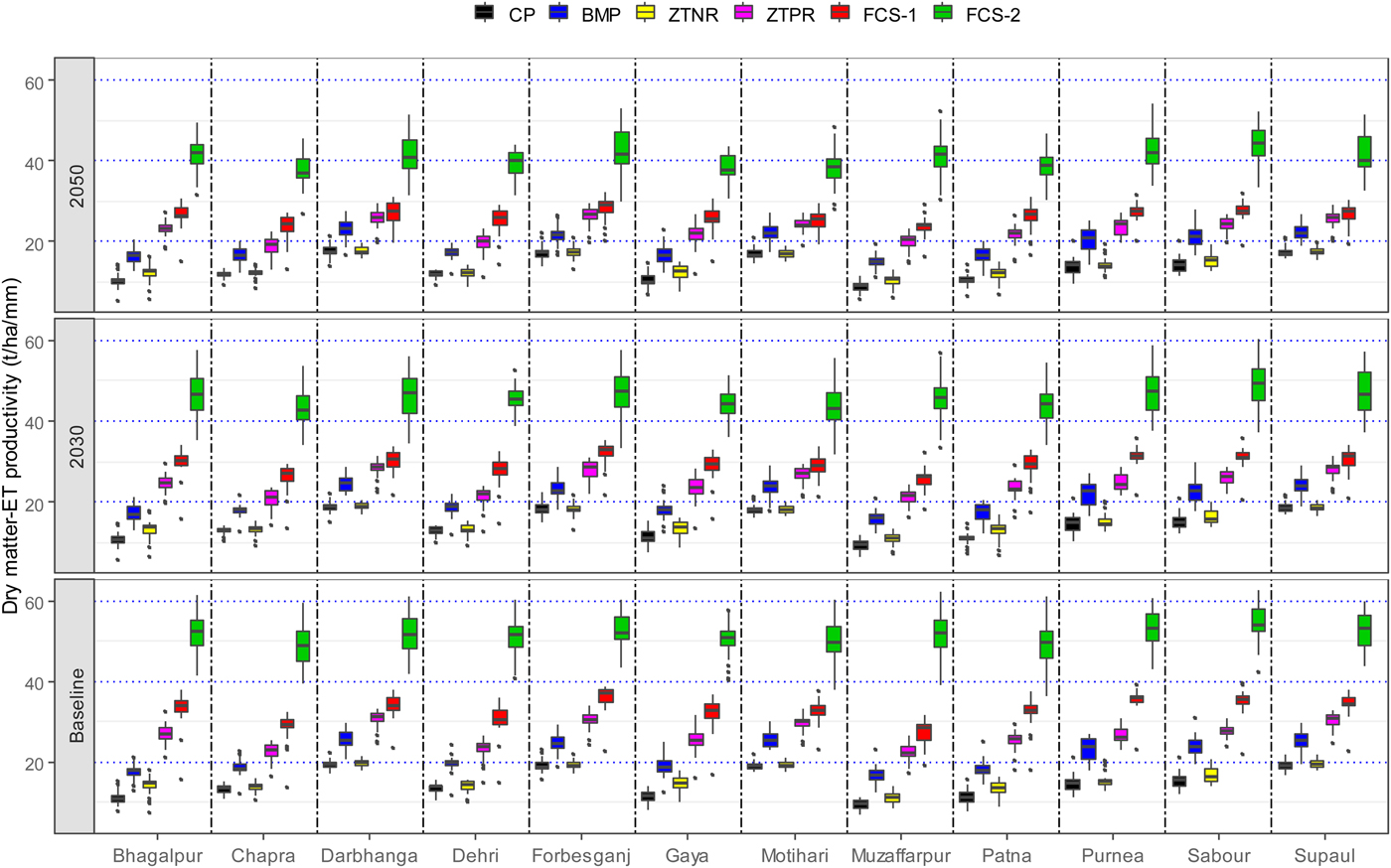
Although excess water and flooding are common during the monsoon season in the eastern IGP such as Bihar, water shortage due to low storage capacity and declining groundwater levels is a problem for the irrigated rice–wheat system in the region (Humphreys et al., Reference Humphreys, Kukal, Christen, Hira, Balwinder-Singh, Sudhir-Yadav and Sharma2010). This problem is expected to be aggravated under climate change because of an increase in ET level which is higher than the projected rainfall increase in Bihar (Tesfaye et al., Reference Tesfaye, Aggarwal, Mequanint, Shirsath, Stirling, Khatri-Chhetri and Rahut2017a). For these areas, farming systems that are both productive and water-efficient are required. In the current study, crop management treatments that gave higher yield (FCS-1, FCS-2 and ZTPR) also had higher water productivity and ET water productivity (Figs 10, 13 and 14 and Table 6). It is indicated that technologies that decrease ET and increase the amount of crop produced per unit of water lost as ET will be a solution to the water scarcity problem that the rice–wheat system is facing in south Asia (Humphreys et al., Reference Humphreys, Kukal, Christen, Hira, Balwinder-Singh, Sudhir-Yadav and Sharma2010).
Dry matter-ET productivity of rice/maize for different cropping systems under current and future climates.
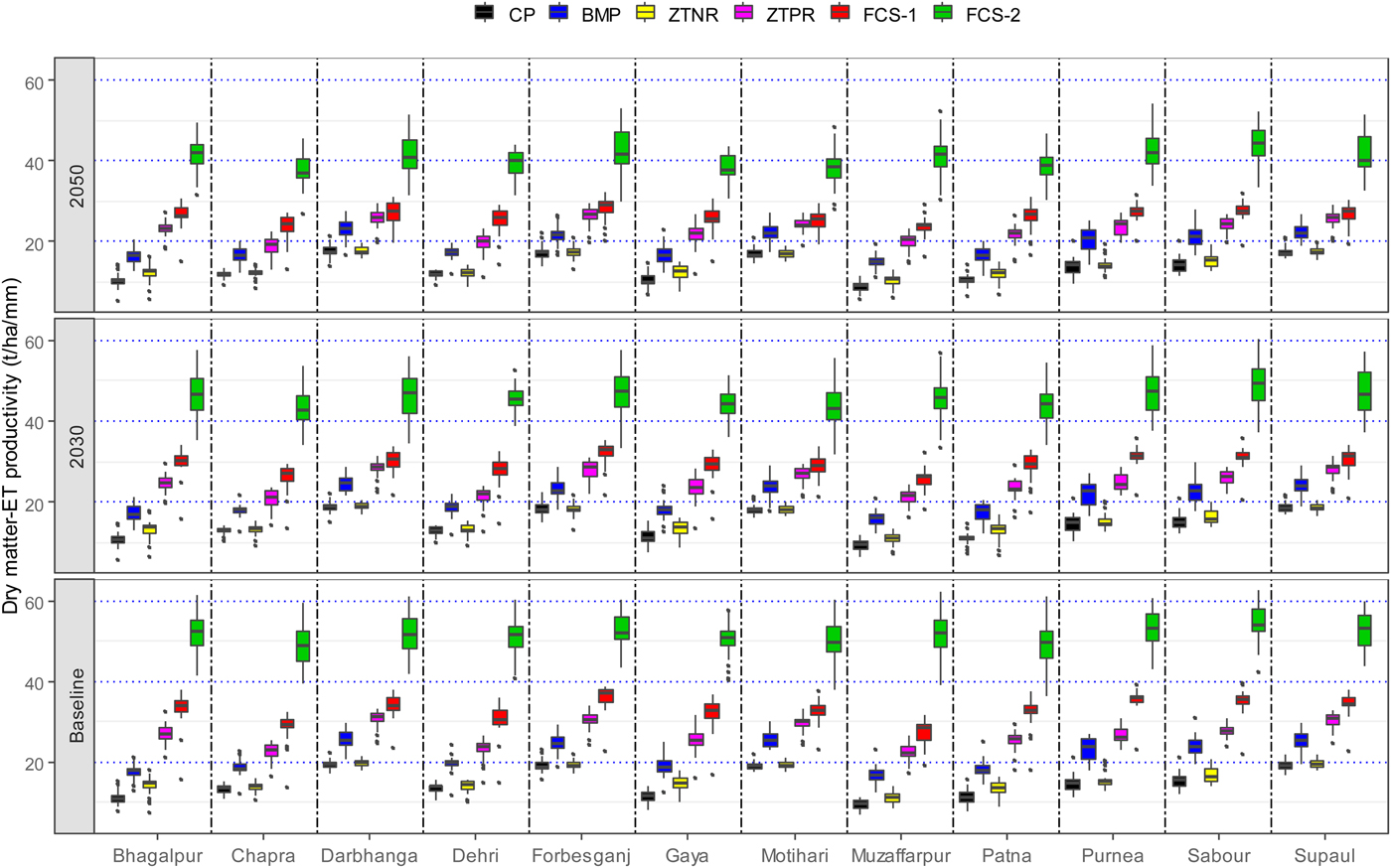
Dry matter-ET productivity of wheat for different cropping systems under the current and future climates.

Net returns from all the treatments studied were higher than conventional practices under both the baseline and future climates, indicating a large adoption benefit of farming system innovations in the rice–wheat and maize–wheat systems in Bihar and similar areas in the IGP. Similarly, previous studies conducted in the study area (Jat et al., Reference Jat, Sapkota, Singh, Jat, Kumar and Gupta2014; Sapkota et al., Reference Sapkota, Jat, Shankar, Singh, Rai, Grewal and Stirling2015; Aryal et al., Reference Aryal, Sapkota, Jat and Bishnoi2015b, Reference Aryal, Sapkota, Stirling, Jat, Jat, Rai, Mittal and Sutaliya2016; Keil et al., Reference Keil, D'Souza and McDonald2016; Khatri-Chhetri et al., Reference Khatri-Chhetri, Aryal, Sapkota and Khurana2016) showed that conservation agriculture-based farming practices had the potential to increase crop yield and income under the current climate. Unlike previous reports, however, the current study went further and showed the productivity and economic benefit potentials of different farming practices under current and future scenarios, which is a new contribution.
Contribution of cropping systems to adaptation
Although the crop management options studied had a greater impact in the current climate, they failed to have an adaptation impact in the future climate (2030 and 2050). The current study focused only on crop management options and did not consider crop genetic options such as heat, drought and/or combined heat and drought tolerance. Studies in maize, for example, indicated that incorporation of heat, drought and/or combined heat and drought traits into current benchmark varieties had the potential to offset yield loss under climate change in South Asia (Tesfaye et al., Reference Tesfaye, Zaidi, Gbegbelegbe, Boeber, Rahut, Getaneh, Seetharam, Erenstein and Stirling2017b, Reference Tesfaye, Kruseman, Cairns, Zaman-Allah, Wegary, Zaidi, Boote, Rahutc and Erenstein2018). The results obtained in the current study suggest that crop management options alone may not be sufficient to bring the adaptation impact required under the future climate. Therefore, crop management options need to be integrated with new crop varieties that have stress tolerance traits, e.g., for heat, in order to have an adaptation impact under the future climate. In line with this, a recent study that compared different adaptation options in West Africa indicated that the treatment that involved heat stress tolerance was the only option to have an adaptation impact (Guan et al., Reference Guan, Sultan, Biasutti, Baron and Lobell2017). In the current study, the only treatment which had an adaptation impact was the FCS-2 treatment for wheat (maize–wheat rotation system). This indicates that growing wheat after maize will increase wheat yield and water productivity under both the current and future climates. This suggests that growing wheat after maize improves soil physical properties unlike the case in the rice–wheat system, particularly under puddled rice. For example, a yield decline of 8–9% has been reported in wheat when grown after puddled rice (Gathala et al., Reference Gathala, Ladha, Kumar, Saharawat, Kumar, Sharma, Sharma and Pathak2011; Kumar and Ladha, Reference Kumar and Ladha2011). The trade-off in the maize–wheat rotation system, however, is that maize yield is highly variable under the current climate and productivity will decrease under the future climate. However, the problem of yield variability and high-temperature sensitivity could be improved by growing heat-tolerant maize varieties (Tesfaye et al., Reference Tesfaye, Zaidi, Gbegbelegbe, Boeber, Rahut, Getaneh, Seetharam, Erenstein and Stirling2017b).
Role of crop models in cropping system evaluations
Crop simulation models enable evaluation of technologies over the likely range of seasonal conditions and management factors and are important to explore options in environments such as IGP where production is limited by resource constraints (Humphreys et al., Reference Humphreys, Kukal, Christen, Hira, Balwinder-Singh, Sudhir-Yadav and Sharma2010). The DSSAT model has been used to assess the impact of crop management options including tillage and rotations (Soldevilla-Martinez et al., Reference Soldevilla-Martinez, Martin-Lammerding, Tenorio, Walter, Quemada and Lizaso2013), crop residue retention (Scopel et al., Reference Scopel, Da Silva, Corbeels, Affholder and Maraux2004) and conservation agriculture (Ngwira et al., Reference Ngwira, Aune and Thienrfelder2014; Corbeels et al., Reference Corbeels, Chirat, Messad and Thierfelder2016) in several environments. In the current study, the simulated rice and wheat yields under the baseline climate for the CP, ZTPR, FCS-1 and FCS-2 were similar to the average yields of similar management options reported from field experiments in the IGP (Gathala et al., Reference Gathala, Kumar, Sharma, Saharawat, Jat, Singh, Kumar, Jat, Humphreys, Sharma, Sharma and Ladha2013). However, like many other studies, the current study involved some important assumptions. Firstly, DSSAT does not include crop pest and disease losses, and hence these factors are assumed to be well controlled. Secondly, the effect of CO2 fertilization on crop yield is not included because of model uncertainties to CO2 fertilization (Challinor et al., Reference Challinor, Ewert, Arnold, Simelton and Fraser2009; Ruane et al., Reference Ruane, Cecil, Horton, Gordón, McCollum, Brown, Killough, Goldberg, Greeley and Rosenzweig2013). This indicates scope for future studies on assessing the adaptation and economic benefit of cropping system options in the diverse environments of South Asia.
Conclusion
The current study indicates opportunities to develop cropping systems that can be more resilient in the face of climate change and improve productivity and profitability in the rice–wheat and maize–wheat systems in eastern IGP and similar farming systems. The transition to intensified minimum/no-tillage systems, with recommended nutrient and water management, can be both productive and environmentally sound. Under the current climate, minimum/no-tillage systems with partial (ZTPR) or full (FCS-1) crop residue retention can improve the yield, water productivity, and net return of the rice–wheat and maize–wheat systems. Therefore, moving from conventional practices to a combination of conservation agriculture-based technologies and practices can increase crop yields, water productivity and net return to investment in both the current and future climates indicating the biophysical and socio-economic incentives for adoption of the practices. However, such improved crop management options alone will not be enough to adapt the rice–wheat system to the future climate unless they are combined with heat-tolerant crop varieties and an enabling environment that incentivizes farmers to adopt technologies that enhance adaptation to climate change. Future model-based studies should also incorporate both genetic and cropping system interactions in order to assess the full range of adaptive options.
Acknowledgement
We thank Tesfaye Shiferaw Sida for assistance during data analysis.
Financial support
This work was implemented as part of the CGIAR Research Program on Climate Change, Agriculture and Food Security (CCAFS), which is carried out with support from the CGIAR Trust Fund and through bilateral funding agreements. For details please visit https://ccafs.cgiar.org/donors.The views expressed in this publication are those of the authors and cannot be taken to reflect the official opinions of the associated and/or supporting institutions. The usual disclaimer applies.
Conflicts of interest
None.
Ethical standards
Not applicable.