According to the World Health Organization, more than one billion people worldwide (about 15%) live with disabilities. These groups constitute the largest minority in the world. 1 The high population of people with disabilities in the past 2 decades has drawn more attention toward the impact of disasters on them. Evidence regarding previous disasters suggests that people with disabilities are the most vulnerable population group; therefore, they are more susceptible to injury, death, disease, destitution, and displacement compared with the general population.Reference Stough and Kang 2 - Reference Wolf-Fordham, Twyman and Hamad 6 For example, during the 2011 tsunami in Japan, the death rate of people with disabilities was more than twice that of others and the shelters could not provide safety for disabled individuals.Reference Stough and Kang 2
On the other hand, because of the increase in the population density in different areas of the planet, human accommodation in hazard-prone areas has amplified.Reference Boroschek and Retamales 7 People with disabilities often live in marginal and less-safe areas because of their economic problems that make them more exposed to the harmful impacts of disasters. Previous experience with disasters confirms the lack of planning and disability management and highlights the importance of paying special attention to these people.Reference Twigg, Kett and Bottomley 8 - Reference Rathore, Farooq and Muzammil 10 People with disabilities are the most forgotten and the most disadvantaged population groups in critical situations.Reference Putkovich 11 , Reference Wolbring 12
The United Nations Office for Disaster Risk Reduction, considers developing a culture of safety, pre-disaster planning, and disaster recovery as solutions for reducing the negative effects of natural and man-made disasters. 13 Further, by considering the importance of safety, Article 11 of the Convention on the Rights of Persons with Disabilities emphasizes on ensuring the safety of these people in the times of risk, including armed conflicts, humanitarian emergencies, and natural disasters. 14 However, studies show that such people are very anxious about their personal safety in critical conditions.Reference Ha 15 Issues of safety and cost are usually contradictory and are weighed against each other. However, earthquake safety policies should be developed considering building collapse and victims.Reference Tsang and Wenzel 16 Regarding the importance of structural safety, World Health Organization, in its 2005 tsunami report, declared that many permanent injuries, such as spinal cord injuries, were caused by collapsing buildings.Reference Hemingway and Priestley 3
Therefore, by considering the importance of safety needs and limited international studies about the needs of people with disabilities during and after disasters,Reference Phibbs, Good and Severinsen 17 , Reference Stough, Sharp and Resch 18 and the lack of in-depth studies in this field in Iran, with figures of well over a million people with disabilities, 19 this qualitative study aimed to clarify the safety needs of people with disabilities in order to value the human rights of persons with disabilities, reduce their suffering from disasters,Reference Djalali, Khankeh and Öhlén 20 , Reference Pakjouei, Vameghi and Dejman 21 and listen to their opinions about their needs.
Methods
This study was conducted with a qualitative approach, because, in the exploration of needs and evaluation of their development, utilization of quantitative methods can be very restrictive. Hence, this issue can be better explored in qualitative studies.Reference Pope, Ziebland and Mays 22
Participants
Participants were identified through in-person visits by one of the research team members (SP) of State Welfare Organization of Iran, cooperation with welfare directors of quake-hit cities of Ahar and Varzaqan, collaboration with active non-governmental organizations in the field of rehabilitation, and by posting announcements in social networks of people with disabilities. Purposive sampling was first carried out by snowballing and then by maximum variation.Reference Zaletel-Kragelj and Bozikov 23
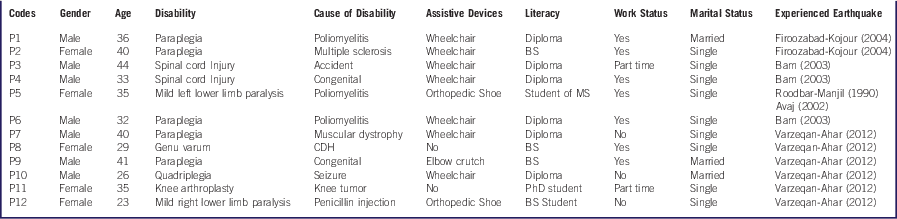
Inclusion criteria consisted of having movement disability, literacy, age between 18 and 60 years, 24 and having an experience of facing earthquakes at the time of disability. Variations in the characteristics of participants were considered in terms of type and severity of disability, employment status, education level, marital status, and gender; ultimately, 12 people (5 women and 7 men) were enrolled to reach data saturation.
Data collection
The research team used semi-structured interviews to gather the views of the subjects.Reference Creswell 25 The interview guide was prepared with the least possible questions based on the objectives of the study, theoretical foundations of the issue, and the review of literature. The possible defects were then resolved based on the comments and advice of experts and professionals in the field of the research topic. In order to verify that the interview is practical, useful, and understandable 3 pilot interviews were performed and possible improvements applied.
Interviews were recorded, by considering the satisfaction of the participants, through a digital audio recorder. The interview began with a question about the experience of the person with disabilities regarding earthquakes and, subsequently, continued with other questions by the interview guide that determined the necessary needs and requirements and the process of service delivery during an earthquake. In cases in which the participant mentioned topics that were worth researching, the investigator probed further by asking follow-up questions such as “tell me more?” and “What do you mean?”. Interviews took ~45-60 minutes and were carried out from July 2015 to May 2016.
Analysis of data
After the stermination of each interview the audio-taped interviews were listened to and transcribed. A single code was assigned to both audio files and forms in order to facilitate further follow-up investigations and to maintain confidentiality of the names of participants.
In addition to the interviews, in order to increase the trustworthiness of the data, related documents were evaluated and used during the collection and analysis of data to match information, which led to theory triangulation.Reference Speziale, Streubert and Carpenter 26
Thematic analysis was used for data analysis.Reference Pope, Ziebland and Mays 22 At first, data were transformed to codes by a member of the research team and, subsequently, the provided codes were evaluated by other team members to reach an agreement. MAXQDA software, version 10, was used to organize the process of coding.
Ethics
At the beginning of each interview, the interviewer explained the study and its objectives as well as measures taken to maintain confidentiality of information. After consent was granted, the interviewees were assured that they can withdraw from the study in any time. This study was approved by the Ethics Committee of Iran University of Medical Sciences.
Results
Table 1 shows the demographic characteristics of participants. Based on the analysis, safety needs of people with disabilities were categorized into 3 phases—before, within, and after earthquake—are provided in Table 2. As the findings of this study indicate, safety needs are issues that, upon being ignored, endanger the lives and health of people with disabilities.
Demographic Characteristics of Participants

Results of Data Analysis

Safety needs of people with disabilities before an earthquake
Considering building codes, resistant construction, and structural modification for houses of people with disabilities
Due to mobility problems in escaping from dangerous situations and the impaired ability for self-protection, compliance with building codes in the construction of buildings for people with disabilities is very important. “If they want to give permission to a building for disabled people, the constructors must follow the principles of construction in a way that in case of an earthquake the building does not collapse on the heads of the residents” (P5).
Besides, as the majority of people with movement disability are less capable of leaving their place of residence or work, they requested that their homes be made more robust and less likely to be destroyed. “Our homes should be safe. All crumbling rural houses collapsed. The building should be earthquake-proof and have armature. We should not blame god for everything” (P9).
They also regarded the lack of safety in their houses as a threat to their lives. “The house is the first thing that should be strong, since it is the first thing that can take the life of residents” (P10).
Building safe and resistant-to-climate-change shelters to accommodate people with disabilities
Living in tents is accompanied by many difficulties for people with disabilities compared with healthy individuals. These problems include difficulty in installing tents, tents’ insufficient space to accommodate the required amenities for persons with disabilities (such as beds, etc.), the effect of ambient temperature on the temperature inside the tent (warm days and cold nights), and countless other problems. “When the sun rose the tent became very hot. The nights were cold, and the tent was also cold” (P10).
In addition to the above issues, muscle weakness, cardiovascular problems, poor physical stamina, and comorbidities in this population reduce their ability to tolerate heat and cold and climate change. Therefore, they regarded allocation of a safe shelter to resolve these issues as one of their needs. “We feel the cold more than others. There should be various stable, and earthquake-proof places for people with disabilities. Somewhere bounded by four walls and impenetrable to rain and snow. We need a place to go to in times of earthquake, snow, rain, and flood” (P7).
Securing the room of people with disabilities at home
By stating their numerous motor problems, people with disabilities acknowledged the difficulty in leaving their location. They raised their need for a secure room in order to increase their safety when they stay in their location in case of an earthquake. “The rooms of people with disabilities should be adapted for them. If a picture is installed on top of their heads, a small earthquake can make it fall. Their beds should not be near window or wardrobe. So as, if they cannot go outside the room, at least no harm be inflicted on them” (P5).
In some cases, lack of safety in the room of people with disabilities and not fixing things such as wardrobes, coat hangers, and book shelves cause more physical damage and difficulties when they are leaving the room. “At the first moment the earthquake threw me two meters to the other side. I fell prone on the ground, a wardrobe near me fell on my head, the ceiling collapsed on the wardrobe and one of my knees broke and I stayed on the ground. The clothes and the wardrobe fell on me. I was shocked and confused and did not know what to do” (P3).
Securing the workplace and considering a safe area for people with disabilities
Participants, because of their inability to quickly leave the insecure place and because of a lack of trained people to transport and relocate them to a safe place, considered the vulnerability of non-structural components, such as glass, partitions, and suspended ceilings, as a threat to their health. “There are all glass here. A small earthquake can cause destruction and injury. There are all partitions which is not safe” (P2).
Moreover, given that people using wheelchairs, whether in fixed or moving situation, are positioned lower in height than healthy people, it is more likely that glass broken at the time of an earthquake falls on their heads and causes damage. Therefore, participants declared being glass-free as one of the features of safe spaces in the building. “There are patios in some buildings, or where the ceiling height is tall and not surrounded by glass objects. Here, unfortunately, everywhere is glass” (P1).
Safety needs of people with disabilities during an earthquake
Existence of facilities for personal protection during an earthquake:
Given the limitations in mobility for people with movement disability during the evacuation of unsafe places, as well as the non-compliance with the standards for facilitating transportation of these people, such as ramps, entrances, etc., they need to take measures to protect their personal safety in cases that earthquakes are likely to occur. “If there is the possibility of earthquake in the night, they should preferably sleep near the exit and have someone to help them at the time of emergency” (P4).
Safety needs of persons with disabilities after the earthquake
Adaptation of bathrooms for persons with disabilities in secure areas
Most of the participants acknowledged that they had to use the bathrooms in their half-destroyed homes. They used to do that despite the fear of destruction as they had no access to suitable bathrooms. “We used the shower and bathroom in the house, since it was not proper to do it outside. We kept the door open to have a chance to escape if the earthquake happened. It was too risky” (P12).
Some people with disabilities avoid using the toilet altogether. Lack of urination and defecation resulted in some complications for them including serious health problems. “In our village, there were no public showers or bathrooms, and all the people went to the bathrooms of their own house. I had many problems with this issue and I had to go to the bathroom once every 1-2 days. People with disabilities will face serious problems with this issue. I think they should install some bathrooms when earthquake happens” (P11).
Prioritizing conex containers for people with disabilities instead of tents
In addition to the difficulties of living in tents, some other events, such as fire, threatened people with disabilities in tents. On the other hand, the firmness of the conex containers, their ability to be fixed and connected by bolts and nuts, and their sturdy texture that was resistant to wind and rain was some of the advantages that could reduce accommodation problems after the earthquake. “We were in a conex container, and it is something that cannot kill you, since it is consisted of four panels that are tightened by bolts and nuts, and it is much safer than house and tent. A tent was burned in our village and some people burned. When an earthquake happens, healthy people had some problems too, but my problems were three times bigger. If we had a conex container in our village, with basic welfare amenities from the first day, I would be more comfortable” (P9).
Sheltering in a safe and vermin-free area
Considering safe and custom-built shelters for the accommodation of people with disabilities is one of the issues that seems necessary because of the aftershocks and the difficulties in the movement and self-protection of these people. “From the first day that we slept outside, the earth shook every time. I thought that the earth will devours us all. It was like the doomsday” (P12).
One of the problems after the earthquake is the proliferation of insects and vermin because of corpses, poor hygiene, and complications from the destruction, which make insect bites more likely when people are accommodated in the open air and in tents. People with disabilities are more vulnerable in these situations compared with healthy people, because of their poor physical conditions and their inability to escape from precarious circumstances. Therefore, they have an urgent need to be accommodated in insect- and vermin-free places. “There was a scorpion in the garden that wanted to bite us, it was the God’s will that it did not” (P7).
Discussion
The findings of this study suggest that the most fundamental needs of people with disabilities before, during, and after the earthquake are compliance with building codes, resistant construction and structural modification for houses of people with disabilities, building a safe and resistant-to-climate-change shelter to accommodate them, securing their room at home, securing the workplace, and considering a safe shelter for people with disabilities, existence of facilities for personal protection during an earthquake if there is no possibility to leave the unsafe place, making proper bathrooms for them in secure areas, prioritizing conex containers for people with disabilities instead of tents, and accommodation in a safe and vermin-free area. In fact, most of the aforementioned needs for persons with disabilities are the needs of normal people as well; however, disabled people are more vulnerable than healthy people if these needs are unfulfilled.
In other studies, the lack of compliance with safety principles for the vulnerable and disabled people in Iran and other countries have also been reported as harmful.Reference Abbasi Dolatabadi, Seyedin and Aryankhesal 27 In India, despite the early development of seismic safety, a moderate earthquake can lead to thousands of deaths because of the lack of resistance in the structures.Reference Jain 28 For the same reason, the earthquake in Haiti, in 2010, injured 1 million people with disabilities and it also led to new disabilities, such as spinal cord injuries and amputations.Reference Stough and Kang 2 The building codes in New Zealand do not include design standards for accessibility for people with disabilities and manufacturers are only obliged to adhere to public access codes.Reference Phibbs, Good and Severinsen 17 The absence of legal requirements for compliance with building codes cause people with disabilities to face a huge challenge in terms of safety. In this regard, participants in this study considered compliance with building codes, resistant construction, and structural modification of their homes as some of their needs. Earthquakes that were experienced by the participants in this study happened in both rural and urban areas, and most destruction and deaths occurred in homes that were created using mud bricks.
In a study conducted in the United States in 2011, McClure et alReference McClure, Boninger and Oyster 29 investigated the readiness of people using a wheelchair in emergency evacuation during natural disasters, and a high percentage of participants said they were able to evacuate from their workplace safely. Despite this, the participants in the present research indicated the difficulties in evacuation of their workplace due to their movement problems and architectural barriers, which often led to their inability to leave the place. They regarded establishing a safe place for sheltering in their workplace as one of the crucial needs for protecting their safety and life. Similarly, Rooney and White, in their study in Kansas, found problems of people with disabilities in becoming prepared to face disasters to be the lack of community and workplace evacuation plans, being left out at the time of evacuation, a lack of temporary accommodation, and the elimination of infrastructure.Reference Rooney and White 30
Another important issue for persons with disabilities is the access to safe and proper bathrooms. The design of toilets in shelters is usually inappropriate in a way that make it inaccessible to them, especially, for those who use a wheelchair. Even in cases in which the buildings are accessible to people with disabilities, the toilets are not easy to reach.Reference Hemingway and Priestley 3 , Reference Mitchell and Karr 31 , 32 The participants claimed that because of their special circumstances regarding the control of their bladder and the associated stress of the situation, they were more in need of bathrooms. However, most of them used the bathrooms in their half-destroyed homes because of the inaccessibility and inappropriateness of the available toilets. This issue is a fear factor for them, which can compromise their safety because of aftershocks and the risk of re-collapsing of the building. These difficulties have caused people with disabilities to avoid going to the toilet, which, in turn, can lead to other problems. Besides, in concordance with cultural issues, in many places only squat toilets are available, which are inaccessible to them. There is also the issue of showers causing numerous problems, especially for people with bedsores. Therefore, the special situations of people with disabilities should be considered in building showers and bathrooms in shelters.
Many of the participants had experienced cold weather and rain when living in tents. This issue, along with the difficulties of living in tents including the challenges of installing the tent, being influenced by the ambient temperature and heat and cold transfer into the tent, not being safe against the wind and rain, a lack of enough capacity for welfare facilities of persons with disabilities (such as bed, wheelchair, walker, etc.), the entrance of insects and vermin into the tent, and not being safe against risks like fire had made the situation twice as difficult for them.
World Health Organization regards considering disability when building houses and making urban development policies, building codes, safety standards, as well as when planning for the place of accommodation, building shelters, and temporary settlements for maintaining safety and accessibility at the times of disasters as necessary. For example, establishing ramps, washing facilities, elevators, and other measures promotes independence of access. 32
Therefore, the development of houses and shelters for people with disabilities along with appropriate modifications to meet their specific needs in emergency situations is necessary. The participants preferred living in conex containers to tents in case of the lack of a safe building for accommodation. Therefore, in case of prioritizing the resources, the needs of disabled individuals should be given preference over the needs of others, and the required facilities should be provided for these people and their families in order to fulfill their needs and provide justice in access.
Conclusion
Unlike most studies that evaluate the needs based on the opinions of managers and respondents, in this study, we focused on the views and experiences of disabled people from Iran who had the experience of dealing with earthquakes. The findings revealed that the needs of people with disabilities during an earthquake and in the subsequent phases of disaster management after the earthquake have not been sufficiently considered and there still are numerous deficiencies in the provided services. It seems that one of the reasons for such inadequacies is the ignorance and failure to identify the needs people with disabilities by the service providers, managers, and planners.
On the other hand, given that people with disabilities are less capable to protect their safety during an earthquake compared with healthy people, serious consideration of their safety needs can have a great impact on their health and life. The result of this study indicates that providing a clear picture of the views of people with disabilities can help healthcare and disaster management planners, in countries with similar economic and social conditions to Iran, toward designing better interventions in order to improve the quality of services provided and, subsequently, improving health and safety of people with disabilities.
Acknowledgments
This study is funded by Iran University of Medical Sciences and is the result of a research project coded IUMS-25266.
Support
This study is funded by Iran University of Medical Sciences and is the result of a research project coded IUMS-25266.