


In recent years, considerable emphasis has been placed on community-based development as a way of improving the well-being of the poor. The World Bank alone has more than doubled its spending on such projects over the last 10 years (Mansuri and Rao Reference Mansuri and Rao2004). In the presence of state failure, community-based projects can be an alternative avenue for citizens to provide the goods and services needed to improve their well-being (Abers Reference Abers1998; Dongier et al. Reference Dongier, Van Domelen, Ostrom, Ryan, Wakeman, Bebbington, Alkire, Esmail and Polski2002; Hirshman Reference Hirschman1984). The emphasis on community-based projects is due not only to their direct benefit of providing citizens with public goods but also their perceived indirect benefit of building trust and cooperation so as to facilitate future community-based activities (Fox Reference Fox1994; Hadenius and Uggla Reference Hadenius and Uggla1996). And although collective action problems could theoretically limit the success of community-based activities (Olson Reference Olson1971), empirical and experimental research has shown otherwise (e.g., Baker Reference Baker2005; Bratton Reference Bratton, Harbeson, Rothchild and Chazan1994; Camerer Reference Camerer2003; Hadenius and Uggla Reference Hadenius and Uggla1996; Krishna Reference Krishna2002; Meinzen-Dick, Raju, and Gulati Reference Meinzen-Dick, Raju and Gulati2002; Ostrom Reference Ostrom2000; Shue Reference Shue, Migdal, Kohli and Shue1994; Wade Reference Wade1988). Over the last few decades, collective action theories have come to acknowledge that individuals’ preferences are not homogenous, but vary depending on the society in which they reside, as preferences are shaped by societal interactions (e.g., Blomquist Reference Blomquist1992; Camerer Reference Camerer2003; Granovetter and Swedberg Reference Granovetter and Swedberg1992; Ostrom Reference Ostrom2000; Reference Ostrom, Gintis, Bowles, Boyd and Fehr2005; Ostrom and Ahn Reference Ostrom, Ahn, Svendsen and Svendsen2009). It follows that the type of society in which individuals live has an impact not only on their ability to engage in collective action but also on the type of projects they can undertake. Whereas societies with strong horizontal ties should be able to tackle fairly complex and varied projects, those undertaken by fragmented societies would be relatively limited in their scope (Granovetter Reference Granovetter1983; Putnam Reference Putnam1993).
Most collective action studies implicitly assume that social interaction occurs between individuals of relatively equal status and power. Yet, of course, this is often not the case, and particularly so in rural societies. The literature on rural development has extensively documented the existence of patron-client networks, characterized as relationships of dependence and inequality, with the resource rich having considerable control over the activities of their peasant clients (Auyero, Lapegna, and Poma Reference Auyero, Lapegna and Poma2009; Bardhan Reference Bardhan1984; Basu Reference Basu1986; Eisenstadt and Roniger Reference Eisenstadt and Roniger1984; Pitt-Rivers Reference Pitt-Rivers1954; Powell Reference Powell1970; Scott Reference Scott1972b). When discussing collective action, these studies tend to have a more pessimistic outlook on the chances for community-based self-provision under such networks. For instance, in his study of Italy, Putnam (Reference Putnam1993) argued that collective action within hierarchical networks would be fairly limited because of the asymmetric distribution of power. Furthermore, and more important for this article, Eisenstadt and Roniger (Reference Eisenstadt and Roniger1984) stipulated that the presence of hierarchical networks has a detrimental impact on peasants’ ability to engage in collective action within their horizontal networks. This negative impact is both indirect, by making peasants compete against one another for the patrons’ resources, and direct, by patrons’ investing in ways to minimize horizontal linkages, out of fear that peasant-based collaboration may reduce their dependence and enable them to collectively bargain for better terms of exchange (Eisenstadt and Roniger Reference Eisenstadt and Roniger1984; Popkin Reference Popkin1979; Putnam Reference Putnam1993).Footnote 1
Contrary to this pessimistic view of clientelist networks, this article argues that patrons’ ability to influence their clients’ horizontal relationships is highly dependent on the environment in which the hierarchical network exists. In areas that are relatively isolated and where there is high inequality, peasants would have few options other than the patron to satisfy their needs. Such an environment leads to the establishment of “authoritarian clientelism” (Fox Reference Fox1994), in which patrons are in essence monopolists/monopsonists in the rural economy (Bhaduri Reference Bhaduri1977), thereby enabling them to influence their clients’ behavior and their third-party interactions (Basu Reference Basu1986). However, if one relaxes either of these two conditions (i.e., lowering inequality to create multiple patrons or increasing connectivity to provide peasants with exit options), patrons’ ability to impose sanctions—and thus control third-party interactions—are weakened considerably. The focus of this article is on the second condition. It argues that connectivity can lower peasants’ dependence on their patron by breaking his monopoly/monopsony in the village economy, and thereby the ability to block peasants’ decisions to engage in collective action.
Making use of case studies selected based on a natural experiment in rural Punjab, Pakistan, the article shows that increased connectivity brought about by the construction of roads substantially increased peasants’ ability to engage in collective action, even when dominated by a large patron. In fact, the case studies reveal that, when faced with the possibility of losing clients to the external market, patrons not only refrained from blocking peasants’ collective action but actually went as far as to assist them in such activities. Ironically, the patrons’ motivation for assisting clients in an activity that could possibly have weakened their level of control was a desire to maintain the integrity of the hierarchical network and thus their level of control.
Historical evidence suggests that the emancipatory effects of connectivity in asymmetric power relations are not unique to patron-client relationships. In medieval Europe, for instance, serfs tied to manors situated close to towns were often able to use the threat of flight to negotiate better terms with the lords of the manor (Anderson Reference Anderson1979; Dobb Reference Dobb1963; Martin Reference Martin1983; Raftis Reference Raftis1997; Sweezy Reference Sweezy1978). Less affluent serfs were particularly able to use this threat, because their extreme poverty made options in the town more attractive when faced with an exploitative landlord (Hatcher and Bailey Reference Hatcher and Bailey2002).Footnote 2 Similarly, urban slaves in North America tended to have more control over their lives than their rural counterparts (e.g., Berlin Reference Berlin1998; Bridenbaugh Reference Bridenbaugh1955; Dew Reference Dew1994; Morris Reference Morris1946; Sellers [1933] Reference Sellers1970; Wood Reference Wood1995). Although some urban slaves used their mobility and access to jobs to gain independence from their masters and improve their welfare (Berlin Reference Berlin1998), others went even further by ultimately buying their freedom (Dantas Reference Dantas2008). Proximity to the market also improved slaves’ social lives and their ability to organize. By interacting in the market, slaves were able to widen their social networks, which developed into community-based organizations that later helped improve their collective welfare (Berlin Reference Berlin1998; Sellers [1933] Reference Sellers1970; Wood Reference Wood1995; Reference Wood1996).Footnote 3
Overall, the experiences cited earlier support a general claim that connectivity can provide credible exit options for the poor, thus enabling them to enjoy greater control over their lives. Although this increased control is likely to manifest in many forms, this article focuses on how it affects peasants’ ability to engage in collective action for the purpose of self-provision. The remainder of the article is organized as follows: The first section briefly looks at the literature on collective action, highlighting how the environment in which individuals try to mobilize has a significant impact not only on their ability to successfully engage in collective action but also on the scope of the projects that they can undertake. The section then explores the role that clientelist networks play in peasants’ decision to engage in collective action, focusing particularly on the effect of a strong patron within an isolated village economy. Finally, it analyzes the change in this relationship when peasants get access to outside markets. The second section looks at four case studies based in rural Punjab, Pakistan, to illustrate the effect that connectivity, through road networks, can have on peasants’ ability to successfully undertake collective action projects, even when they reside in villages dominated by a strong patron. The third section concludes.
COLLECTIVE ACTION IN CONTEXT
Collective action is the ability of citizens to come together for activities thought to be in their common interest. Before Olson's (Reference Olson1971) work, it was generally believed that, in the presence of common interests, groups would form to take advantage of these benefits. Olson (Reference Olson1971) challenged this idea by arguing that rational individuals had an incentive to free-ride on other peoples’ efforts so as to minimize the costs to themselves while still enjoying the benefits. The implication was that for large groups, collective action would almost always fail in the absence of selective benefits. Yet, countless laboratory findings have since documented that collective action succeeds far more often than Olson's theory predicts (e.g., Camerer Reference Camerer2003; Cardenas and Ostrom Reference Cardenas and Ostrom2004; Ostrom Reference Ostrom2000; Ostrom and Walker Reference Ostrom and Walker2005; Walker and Ostrom Reference Walker, Ostrom and Mueller1997). For instance, Olson's assumption that individuals make their decisions relatively insulated from social relations is contradicted by laboratory experiments finding increased chances of successful collective action when people engage in face-to-face interaction (Reference Ostrom and Walker2005) and that an individual's decision to free-ride is significantly affected by his perception of the other participants’ trustworthiness (Ostrom and Ahn Reference Ostrom, Ahn, Svendsen and Svendsen2009). These are but two of the experimental results that indicate that, to investigate the dynamics of collective action more carefully, we need to move beyond the restrictive assumptions of Olson and understand how the social context shapes individuals’ preferences and motives (Ostrom Reference Ostrom2000).
Collective Action Based on Horizontal Networks
Village communities are often characterized by strong ties between individuals of relatively similar backgrounds—such as kinship groups or families (e.g., Ahmad Reference Ahmad1977; Epstein Reference Epstein1962). These networks build on what the social capital literature has referred to as “bonding social capital” (Gittell and Vidal Reference Gittell and Vidal1998; see generally, Putnam Reference Putnam2000). Due to their ability to transmit information effectively, these networks are able to curtail the collective action problem by making free-riding visible. This visibility provides a strong incentive to participate in collective action, becuase not doing so could lead to sanctions, some as strong as social ostracization (Svendsen and Svendsen Reference Svendsen and Svendsen2004). However, the potential of relying on such networks for collective action may be fairly limited for two reasons. First, ties between people of relatively similar backgrounds leads to little diversity, particularly among the poor who have few resources to bring to the network. Therefore, while the poor in developing countries may have extensive social ties among members of their kinship groups or families, these ties rarely enable them to improve their well-being, as members of such networks often lack sufficient skills and resources (Putnam Reference Putnam2000; Szreter Reference Szreter2002). As argued by Granovetter (Reference Granovetter1983), strong social ties can have the disadvantage of being closed to outside information regarding new opportunities, thus hampering innovation and effectiveness when engaging in collective action. Second, the ability of such networks to engage in successful collective action is limited to projects whose benefits are restricted to group members only. For projects with benefits spilling over to other communities, the free-riding problem arises once again.
Hence, for activities that require higher levels of resources and skills and whose benefits spill over to other groups, collaboration needs to span across communities. Such efforts need to enhance not bonding social capital but bridging social capital (i.e., relationships and cooperation between, rather than just within, communities; Gittell and Vidal Reference Gittell and Vidal1998; see generally Putnam Reference Putnam2000). For instance, rather than relying on a specific kinship group or family, collaboration would have to involve several groups. While relying on relatively weak ties—such as belonging to the same village—this form of cooperation enables individuals to enjoy access to varied skills, resources, connections, and information (Granovetter Reference Granovetter1983). It typically takes place in societies where individuals of different background have an opportunity to meet and are able to signal their trustworthiness so as to sustain cooperation (Greif, Milgrom, and Weingast Reference Greif, Milgrom and Weingast1994; Jansen Reference Janssen2006). Once established, such cross-collaboration can allow members to draw on a wide range of resources to successfully engage in relatively challenging forms of collective action (see for example Baker Reference Baker2005; Greif, Milgrom, and Weingast Reference Greif, Milgrom and Weingast1994; Krishna Reference Krishna2002; Wade Reference Wade1988).Footnote 4
Yet despite spanning communities, bridging social capital is still based on a horizontal network established between members with relatively equal levels of power (Halpern Reference Halpern2005). In societies with strong hierarchical networks, collective action would have to take into account asymmetric power relations and the impact they have on the effectiveness of horizontal networks. The insights on how bonding and bridging social capital can facilitate and sustain collective action therefore need to be complemented with an understanding of relationships between members of unequal status—such as in patron-client networks—and how they interact and influence horizontal networks. Unfortunately, few have investigated the dynamics of collective action under hierarchical networks in much detail, and as I argue, those who have tend to treat patron-client networks as homogeneous relationships independent of time and place, leading to somewhat simplified conclusions. Before proceeding, it is helpful to examine patron-client networks and their relevance for the chances and types of collective action.
Collective Action under Hierarchical Networks
In rural societies in many developing countries, the combination of state failure, market failures, and high levels of inequality has meant that peasants need to approach the local landlord to act as their patron to satisfy many of their basic needs. The patron provides peasants—his “clients”—with goods and services such as employment, housing, shelter, guaranteed subsistence, physical security, protection against third-party exploitation,Footnote 5 and access to public resources (Scott and Kerkvliet Reference Scott, Kerkvliet and Schmidt1977). In return, the client reciprocates by providing a steady supply of cheap labor, increasing the patron's social status by enhancing the size of his clientelist following and providing political support by agreeing to vote for the candidate supported by the patron.Footnote 6 The rate at which these goods and services are exchanged is determined by the relative bargaining power of the two parties. Scott (Reference Scott1972a) argues that the peasants’ bargaining power is largely affected by factors such as scarcity of land, population growth rates, and the state's ability to deliver goods and services.Footnote 7 In contrast, the patron's bargaining power is affected by the extent to which clients have alternative options in the form of support from their kin or village networks and the availability of unoccupied land for the peasants to use. As we see in what follows, this is key to understanding the dynamics of collective action in this context.
Moreover, relative bargaining power is also affected by the quantity of services provided by the patron. In villages with high inequality the patron essentially becomes the main provider of multiple services to the peasants, resulting in markets becoming interlinked (Bardhan Reference Bardhan1980; Basu Reference Basu1986; Bhaduri Reference Bhaduri1977).Footnote 8 As a result, the cost of disagreeing with the patron, in any market, becomes extremely high, because it has consequences in all the other markets in which the patron interacts with clients. This gives the patron considerable leverage over clients and enables him or her to make demands that can interfere with clients’ relationships that are independent of the patron (Basu Reference Basu1986). One example could be a demand that the clients ostracise any peasant who does not comply with the patron's wishes, something they would do to avoid being sanctioned themselves.Footnote 9
Thus it is perhaps not surprising that the literature on peasant collective action under patron-client networks has reached several pessimistic conclusions. First, Putnam (Reference Putnam1993) made the intuitive point that collective action between actors in an asymmetric power relationship (i.e., between the landlord and the peasant) is severely hampered by the difficulty of sanctioning the powerful.Footnote 10 Second, and more important for my purposes, several authors have noted that hierarchical networks may also preclude collective action within the horizontal networks themselves; (i.e., collective action among peasants) (Popkin Reference Popkin1979; Putnam Reference Putnam1993). To sustain his bargaining power, the patron minimizes the clients’ horizontal networks (Popkin Reference Popkin1979), whether through the use of violence, privileged access to state resources, or the ability to manipulate ties because of monopolistic control over village resources (Eisenstadt and Roniger Reference Eisenstadt and Roniger1984; Holzner Reference Holzner2004; Putnam Reference Putnam1993; Roniger Reference Roniger1990; Scott Reference Scott1972a). Following from this argument, participation in clientelist networks should significantly decrease the amount of collective action peasants engage in, regardless of its purpose.
In addition to directly blocking collective action, the patron-client network also has an adverse effect on peasants’ ability to engage in collective action because of the strain the network places on peasants’ horizontal relationships. There are two reasons for this negative impact. First, the fact that peasants can face ostracization for defying the patron limits the scope of horizontal networks, as peasants can no longer rely on each other for support when sanctioned by the patron. Such threats are also likely to minimize the level of trust and cooperation within a rural community, which will further impede collective action (Ostrom and Ahn Reference Ostrom, Ahn, Svendsen and Svendsen2009; Putnam Reference Putnam1993; Svendsen and Svendsen Reference Svendsen and Svendsen2004). Second, clientelist networks require peasants to compete against one another for the patron's limited resources so they can fulfil; their basic needs, once again possibly lowering the level of trust and cooperation (Eisenstadt and Roniger Reference Eisenstadt and Roniger1984). Combined, the effect is to reduce both the scope and cohesion of the network, which should significantly limit its ability to overcome the collective action problem. For this reason as well, the literature predicts low levels of collective action in a patron-client network.
However, this conclusion is based on the key assumption that clients have limited, if any, exit options and are thus firmly tied to the local patron. For instance, southern Italy, which was one of Putnam's (Reference Putnam1993) case studies, was found to be isolated from the center of the country by the absence of road networks and of any market center located near the hinterlands (Eisenstadt and Roniger Reference Eisenstadt and Roniger1984). As a result peasants who did not have the option to migrate northward had little choice but to approach the landed nobility to satisfy their needs. This case study raises the question of what happens when the environmental setting is changed by exposing villages to the external market. The next subsection argues that the patron-client network need not, in fact, be detrimental to peasants’ ability to engage in collective action. Provided peasants have access to alternative options, clientelist networks—even those in which the patron owns most village resources—should not necessarily weaken peasants’ horizontal networks or interfere with clients’ independent decisions to engage in collective action.
Connectivity, Patron-Client Networks, and Collective Action
The ability of the patron to exert high levels of control over clients is dependent largely on the peasants’ having few alternative options to satisfy their needs. As argued by Basu (Reference Basu1983) and Bhaduri (Reference Bhaduri1977), such control should arise when high inequality is found in areas that are isolated from the external economy: Inequality concentrates resources in the patron's hands, and isolation restricts the number of outside options available to peasants. However, neither inequality nor isolation is sufficient in and of themselves to enable the patron to control clients’ activities. It is rather the combined effect of the two that creates a monopolist/monopsonist patron (Bhaduri Reference Bhaduri1977) with the ability to interfere with peasants’ independent relationships (Basu Reference Basu1986). An increase in collective action under an authoritarian patron can, therefore, be achieved either by reducing the levels of inequality in the economy—through redistribution policies—or by reducing the level of isolation faced by the peasants.
The focus of this article is on isolation as a limiting factor to peasant collective action, and the key expectation that follows from these observations is simple: Even in the presence of inequality, the authority of any single patron will be weakened by breaking the isolation of the village economy, which will enable peasants to approach multiple service providers, thereby altering the relative bargaining power in the relationship.Footnote 11 Reducing isolation should have a threefold effect, all elements of which are relevant to understanding the dynamics of collective action under non-isolated patron-client networks. First, as mentioned earlier, connectivity should break the monopoly/monopsony power of the patron, resulting in a reduction in peasants’ dependency on his resources (Michie Reference Michie1981). Moreover, the new alternatives found in the external economy should increase the peasants’ opportunity cost of interacting with the patron—from a level below subsistence to the returns they can get from their outside options—thus making their time more valuable. Although the extent to which clients benefit from the outside market depends on the opportunities that the economy has for unskilled workers (Platteau Reference Platteau1995), even in their limited form opportunities in the market would typically be less exploitative than those found in an isolated village economy dominated by a large patron. Second, an increase in outside options should reduce the level of competition between peasants for the patron's resources, because any need not satisfied through the patron can potentially be serviced in the external market. This should reduce the friction that patron-client networks create in isolated villages among peasants’ horizontal ties. Furthermore, market access should also help peasants broaden their horizontal networks, as it provides households with a public space in which they can interact with households from different backgrounds. The facilitation of such interaction should arguably assist in the establishment of bridging social capital. Third, the increase in peasants’ access to exit options should limit the patron's ability to impose sanctions on peasants, because the patron is no longer able to use the threat of withholding access to resources to influence peasants’ actions (Blok Reference Blok1974; Wingrod and Morin Reference Weingrod and Morin1971). This should in turn also constrain the patron from using social sanctions against peasants, as he may no longer be able to coerce clients into ostracizing a noncompliant peasant. The absence of such social sanctions should help improve the cohesiveness of peasants’ horizontal relationships, enabling them once again to engage in collective action to self-provide.
In fact it can be argued that, in the presence of alternative options, it is now the peasants who can sanction the patron if he or she behaves in a manner they deem detrimental to their welfare. Depending on opportunities available in the external market (Platteau Reference Platteau1995), these sanctions could be economic, by choosing to work in the market rather than for the patron; political, by not agreeing to vote for the candidate supported by the patron; or social, by choosing to withdraw from the clientelist network completely. The outcome is then a change in the relative prices of the goods and services being exchanged within the network. Whereas the value of the clients’ time and support should go up in accordance with their increased opportunity cost, the patron's resources, when placed in competition with alternative forms of provision, would lose most of the monopolistic value they enjoyed under isolation (Michie Reference Michie1981). According to Scott and Kerkvliet (Reference Scott, Kerkvliet and Schmidt1977) such a change should cause the legitimacy of the patron, and thus the integrity of the patron-client network, to come into question, because the network is only deemed legitimate as long as the inequality of the exchange is maintained (i.e., the value of the goods and services given by the patron exceeds those that the clients offer in return).
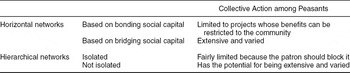
When faced with these changes the patron would weigh the costs and benefits of altering demands made on the clients. The costs would be a reduction in the level of control and limitations on the patron's extractive powers, whereas the benefits would be continued clientelist support, which could also be relied on to enable the patron to take advantage of new profit-generating activities available in the external market.Footnote 12 The patron would need to weigh these costs and benefits against the outcome of continuing to make high demands, which might cause the loss of his cliental following.Footnote 13 Therefore, given that the clients continue to be important, at least for political reasons, the patron has an incentive to modify his demands so that they reflect the changes in the local economy (Scott Reference Scott1972b). Along with other positive welfare effects, this should increase the clients’ freedom to engage in collective action. Hence, we need to look at the context in which patron-client networks exist to understand whether they are detrimental to collective action among peasants’ horizontal networks. Focusing on the connectivity of the network adds another level to our analysis of the chances and types of collective action in the patron-client context, as illustrated in the last cell of Table 1.Footnote 14
Collective Action under Horizontal and Hierarchical Networks

To investigate the levels and types of peasant collective action under clientelism, I turn now to four case studies based on a natural experiment in rural Punjab, Pakistan. I claim that the construction of a highway along with its link roads allows us to isolate the interaction effect between hierarchical networks and seclusion on the levels and types of collective action among peasants. Being case studies, they are intended merely as a starting point to investigate the relationships between clientelism, connectivity, and collective action. However, their conclusion is revealing: While giving peasants credible exit options from the village economy does not break patron-client networks completely, it can considerably increase peasants’ ability to engage in collective action for the purpose for self-provision.
EMPIRICAL ANALYSIS
Pakistan is a good choice for this study for two reasons. First, Pakistani villages have extensive and varied patron-client networks: While some areas are dominated by large landlords, who have almost complete control over peasants, others have a multitude of patrons competing against each other for peasants’ support, thereby making them relatively more responsive to the needs of their clients.Footnote 15 Second, poor infrastructure has meant that a large number of rural villages in Pakistan are extremely secluded from the external economy. Bad road networks make it extremely cumbersome to travel to unconnected villages, thus keeping traders out and resulting in most peasants having limited interaction with outsiders. Moreover, large-scale poverty makes the cost of the journey to the external market almost prohibitive, thus confining peasants to the rural economy (Rouse Reference Rouse1988).
In 1998, however, Pakistan built a highway connecting Lahore, a major cosmopolitan city, to Islamabad, the capital. Along the 365 kilometers of the road are multiple exits, each of which has a road that runs to the nearest city or town and passing through a number of villages that were previously isolated from the outside economy. Since the construction of the highway there has been a marked increase in traffic and a substantial reduction in transport costs for villagers in its proximity, enabling peasants to travel affordably to nearby cities and towns.
The decision regarding the placement of the highway was made by the federal government based on three main considerations—geography, connectivity, and military defense (Republic Engineering Corporation Limited 1988).Footnote 16 First, efforts were made to ensure that the roads traversed as few geographical hazards as possible so as to minimize the risk of road accidents.Footnote 17 Second, the federal government wanted to connect the two major cities with a highway that was not too close to the old highway and passed by as many towns and villages as possible without hampering the economic benefits to traders.Footnote 18 Third, there is an Air Force bombing range between Lahore and Islamabad, which made some of the suggested routes unusable. None of these factors are systematically related to specific village characteristics. There were rumors, however, that the route of the highway was changed from the original plan to allow it to run past the lands of large landlords. Although I was unable to find evidence to confirm this, I identified areas where the highway was not altered from the original plan. Among such areas was Hafizabad, Punjab, from which the village sample was drawn.Footnote 19
Within the district villages vary in terms of land distribution. While in some, land ownership is spread over a large number of households (henceforth referred to as peasant-based villages), in others land is concentrated in a few hands (henceforth known as landlord-based village). This variation was historically determined by the British revenue-collecting machinery and has remained intact since independence, despite Pakistani governments’ repeated attempts at land reforms.Footnote 20 Variation in land tenure systems matters, because it has a direct influence on power relations within the rural economy. In relatively egalitarian villages, dispersed land ownership results in the establishment of multiple small patrons, each competing against one another for the peasants’ clientelist support, thereby limiting the authority of each individual patron. In landlord-based villages, in contrast, patrons tend to enjoy considerable monopoly power in the economic, social, and political spheres by virtue of their control over the main economic assets in the village (Deininger and Binswanger Reference Deininger and Binswanger1999). The effects of land tenure systems on outcomes in the village economy have been documented by Banerjee and Iyer (Reference Banerjee and Iyer2005; Reference Banerjee, Iyer, Diamond and Robinson2009); for instance, they found that in rural India villages dominated by large landlords significantly underperformed in terms of public goods provision, when compared to villages with relatively disbursed land holdings (for similar results in Pakistan, see Shami Reference Shami2010).
Thus the variation in power structures, combined with the exogeneity of land tenure systems, makes peasant-based villages a useful control group against which the effects of connectivity on landlord dominated villages can be studied. Therefore the village selection process involved identifying land-holding patterns across the district and classifying the villages in the two categories. For the purpose of this study a village was classified as being landlord dominated if any single household's landholding was greater than 100 acresFootnote 21 and there were a maximum of three households in the village with such large landholdings. The latter criterion was based on Platteau's (Reference Platteau1995) finding that in South Asia large patrons often abide by the time-honored tradition of not accepting other patrons’ runaway peasants.Footnote 22 As a result, landlords are able to act as monopolists/monopsonists even when they coexist with one or two other large patrons in the village. Areas not meeting the aforementioned criteria were classified as peasant-based villages. Villages were also distinguished based on their level of isolation, thereby resulting in the establishment of four groups; isolated landlord-dominated and peasant-based villages and connected landlord-dominated and peasant-based villages. From this pool eight villages were randomly selected, with two villages belonging to each category. Among the selected landlord-dominated villages the patrons’ landholdings were found to vary between 100 and 300 acres. In peasant-based villages, the average patrons’ landholding was 23 acres.
Socioeconomic data on the villages come from three sources: 1998 population census data; a survey I designed, which was administered to 383 households in 2008; and key respondent interviews, also conducted in 2008. Because data collection in Pakistan has been fairly limited, the census only provides a few indicators for comparisons,Footnote 23 and I therefore draw on my own survey for a more holistic picture of the villages. Although some of the survey information pertains to outcomes prior to the construction of the road, many of the variables would not have changed too much over 10 years. Key respondents were individuals who enjoyed a special place in village society, such as headmasters, school teachers, maulvis (the Muslim priest), the household with the title of revenue collector under British rule,Footnote 24 the editor of the local newspaper. or the local patron. The household-level surveys were conducted over a period of three months by a team of 14 surveyors, whom I supervised. The surveying process involved mapping the villages,Footnote 25 identifying the biradery (kinship group) of each household, and then interviewing a random sample of 20% of households stratified along biradery lines, because literature on South Asia documents the biradery as being a good proxy for social status and relative bargaining power (see, for example, Ahmad Reference Ahmad1977; Alavi Reference Alavi1972; Cheema, Mohmand, and Naqvi Reference Cheema, Mohmand and Naqvi2007). The aim was to ensure that the sample was representative of all biraderies so that the results were not biased due to over- or under-sampling of particular social groups.
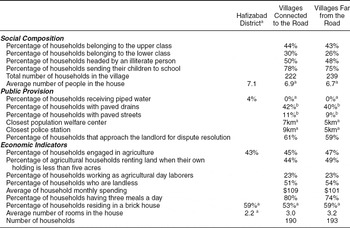
Descriptive statistics from the eight villages are provided in Table 2. The differences are small, and none are statistically significant.Footnote 26 In terms of social composition, more than 40% of households in all eight villages belong to the two main upper class biraderies, whereas 30% of households in connected villages of both types and 26% in all four isolated villages belong to the two main lower class biraderies.Footnote 27 With respect to education, around half the households in both types of villages are headed by an illiterate person, and about three-quarters of households send children to school. Turning next to public provision, none of the eight villages had piped water prior to the construction of the road. This is similar to the district average of merely 4% of villages with running water. In addition, although approximately 40% of households had drains provided to them, only around one in ten had the street outside their house paved. With respect to dispute resolution, state-provided police stations and population welfare centers are between 9 and 5 km away, respectively. Partly as a result, about 60% of households in both types of villages turn to their landlord for conflict resolution, and claim to have always done so.Footnote 28 The few households that approach the police do so through their patron, because they find hisFootnote 29 presence increased the chances of their complaint being heard.Footnote 30 Looking at economic indicators, around 45% of households derive their primary source of income as farm cultivators, either working as self-cultivators, sharecroppers, or tenant farmers. This is again comparable to the district average of 43%. Another 23% of households draw their primary source of income from working as day laborers on the fields in their own villages. However, even though almost 70% thereby draw their livelihood from land, a little more than half the households in both types of villages are landless. This is also reflected by the fact that almost half the households who cultivate land find their own landholdings too small and therefore have to rent.Footnote 31 Turning finally to household expenditure, households’ average monthly spending is just above $100 for all eight villages. These spending levels were meant to sustain, on average, eight people living in a three-room house and enabled approximately four out of five households in both sets of villages to consume three meals daily.Footnote 32
Descriptive Statistics

a Pakistan Census Report 1998.
b Provision levels pre-motorway.
Note: Significance calculated using the chi-square test, while comparing two groups. The differences between villages close and far from the road are statistically insignificant.
Given the considerable similarity between the villages we can make the counterfactual that, prior to the construction of the highway and its link roads, horizontal networks and outcomes in villages close to the road would have been fairly similar to those found in isolated villages. So let us now turn to the analysis, beginning with a description of the life in the two types of villages.
The Villages
As our bus carrying the surveying team goes on the road at the highway exit leading to Hafizabad City, you enter a village called Kot Serwar. Passing through we are struck by the hustle and bustle around the road, which does not taper off as we travel through other villages en route to Hafizabad City. People are either mingling in the various shops and cafes, or waiting for the bus to take them outside the village, or trying to hitchhike to their desired destinations. And then there are those that just loiter around the road, as this is now the center of the village where all the activity takes place. As our bus passes by, the villagers pay little attention, because ours is but one of the many vehicles that stream past in any given minute. Mobility is no longer foreign or unaffordable for these villagers: Peasants often travel outside their village—for work or to run errands or simply to take their children for a day out in town. But this was not always the case. I was told that before the construction of the road, traveling to Hafizabad City was quite an expedition, requiring peasants to leave at sunrise and return before sunset, because the dark and deserted road at night made them sitting ducks for thieves and robbers. Given that the journey took an hour each way, work in the city had to be rushed. Now, it takes 20 minutes to reach Hafizabad City, and with the constant traffic peasants have the luxury of leaving at around nine in the morning, are able to stay for dinner, and can return safely late at night by bus, rickshaw, or a hitchhiked ride.Footnote 33
As we take a turn off the road and drive to the “isolated” villages, the scene changes considerably. Very quickly the comfortable asphalt road is replaced by a bumpy dirt trail, requiring us to slow down considerably, as the road is infested with potholes. Traffic thins out the farther you go, and often 10 to 15 minutes pass before another mode of transport, private or commercial, is seen. In fact, it is more common to see people walking or sitting on donkey carts than to see cars, buses, or rickshaws. The closest isolated village we visited is situated only eight kilometers from the link road, yet traveling there took around 40 minutes. On a rainy day the journey would have taken even longer. As the “road”—or rather the trail—reaches the village, the scene we are greeted by is starkly different. No one is around to be seen, no people are waiting for rides, and there are no cafes and no loiterers. The path leading into the village narrows even more so we carry on by foot. The center is found deep within the village, but unlike the villages on the road there is only one general store there, which also functions as the village tea shop. The few other stores are run from private houses and are thus scattered around the village. Village socializing is done inside houses rather than in public areas.
As I made my field trips to other isolated villages, the landscape turned out to be very similar. For all these villages bad road networks meant that few outsiders came visiting, leaving the village economy relatively closed. For the peasants in the isolated villages, the journey to Hafizabad City typically took around an hour. Yet it was not so much the distance that villagers found to be an obstace; rather it was the lack of transport facilities. The peasants spoke of often having to wait for an hour and a half to get a ride into town, and once there they were faced with the problem of finding a way to make the journey back home. Therefore unless they had their own mode of transport, leaving their village was something they tried to avoid.Footnote 34
In addition to affecting peasants’ mobility, connectivity has far-reaching implications on their dependence on the village and its resources for fulfilling their basic needs. As can be seen from Table 3, far more peasants situated on the road felt they could rely on the external market for satisfying their needs than those in isolated villages. This can be attributed to the increase in traffic that exposes peasants to new opportunities not only outside the village economy but also within it. One of the ways households took advantage of these new opportunities was to sell small products to passers-by, which was something my surveyors and I experienced as we were constantly approached by villagers trying to sell us goods varying from slippers to food to little crowns made out of flowers and branches. In the isolated villages, in contrast, limited interaction with the external economy meant that most peasants felt confined to the village economy and its agricultural sector. Thus the only ones approaching us were little children curious about the “outsiders” from the city.
Employment Opportunities

Note: Significance tested using the chi-square test, while comparing two groups.
**Difference significant at 5%. ***Difference significant at 1%.
Levels of Collective Action
Walking around the isolated landlord-dominated villages it was hard to miss the low levels of public goods provision. Most neighborhoods had muddy streets, soiled with household waste due to the absence of functioning drains. Among the eight villages, peasants in this type of village had the lowest levels of public investment. Yet, although they thereby had the highest need to engage in collective action for the purpose of self-provision, few households had ever done so. Yet, equally poor and isolated households in peasant-based villages were much more active in working together to self-provide (see also the following discussion), despite the fact that they already had high levels of state provision.
The reason for the low levels of community-based projects in isolated landlord-dominated villages, as explained by my key respondents, was that the landlords greatly “frowned”Footnote 35 on such activities and asked peasants to approach them instead if they had a problem.Footnote 36 Disobeying one's landlord was not a feasible option. Inequality combined with isolation deeply entrenched the peasants’ dependence on the patron, because he was not only the main provider of employment but also the main source of credit, housing, dispute resolution, and access to the local politician (Shami Reference Shami2012). This empowered him to make high demands of his clients, one being to restrict their collective action. As one household noted, “The landlord is our village head, our elder,Footnote 37 and the protector of our children. If he tells us not to try and fix things ourselves, how can we possibly defy him?”Footnote 38 Villagers were perfectly aware that, given the isolated nature of their village, they would be excluded from the village economy and community if they went against the wishes of their landlords. “Where would we go if we defied him?”Footnote 39 one responded when I questioned why he so willingly obeyed the landlord's wishes, whereas another asked, “How would we feed our children if he cuts us off?”Footnote 40
The threat from the landlords, however, was not always implicit. In response to peasants trying to provide irrigation channels with the help of an NGO in one of the two landlord-dominated villages, the landlord had gone as far as to threaten with violence any household that assisted in these activities.Footnote 41 Not surprisingly, he denied ever making such a threat:
I have never stopped the villagers from engaging in collective action. But you must understand that these are poor people who are unable to fulfil their own needs. Also they are not educated people like you and me. They don't know how to provide themselves with the things they need. That is why I tell them that they should come to me and not try to self-provide.Footnote 42
His “belief” that uneducated people cannot engage in collective action was clearly misguided, because poor uneducated households in all other types of villages were found to have no difficulties engaging in community-based projects. Moreover, as was acknowledged by the patron in one of the landlord-dominated villages close to the road, “Being uneducated does not mean that the villagers are unaware of their needs and how to go about fulfilling them.”Footnote 43 Nonetheless, for the sake of argument, I asked the patron from one of the isolated landlord-dominated villages whether he was available to village peasants, given that he had told them to come to him instead: “They are like my children, I've told them, my door is always open and they can come to me whenever they need anything.”Footnote 44 The peasants, however, saw things differently. I observed how they tried to reach the landlord by loitering outside his main gate in the hope of talking to him. When his car pulled out of the driveway they swarmed around it, trying to catch his attention, but not once did he roll down his window to respond. The only time peasants in the isolated landlord-dominated villages could reach their respective patrons was when they held “court” a few times a month.Footnote 45 But despite their inability to communicate their needs, the patrons’ monopoly over village resources meant that peasants found it “cheaper” to simply refrain from engaging in collective action: Fixing or providing a public good might be important for a household, but not important enough to risk being punished or ostracized by the all-powerful landlord. The end result was a gross under-provision of public goods in these villages.
The situation in landlord-dominated villages close to the road was starkly different. Despite having higher levels of public investment, a large number of households reported engaging in collective action for the purpose of self-provision. And unlike the isolated landlord-dominated villages, peasants faced no constraints from their patrons when trying to undertake such activities. Given that peasants had access to alternative employment opportunities, both within and outside the village (see again Table 1), patrons were by no means monopolists/monopsonists despite controlling most of the village resources. Therefore, they had limited ability to interfere with their clients’ independent activities. Hence in contrast to peasants in isolated landlord-dominated villages, who spoke of an alliance driven out of necessity and desperation to fulfil their basic needs,Footnote 46 peasants in connected villages engaged in the clientelist relationship because they found it beneficial. This was evident from peasants’ responses when asked why they considered the landlord their patron: “He provides for our needs,”Footnote 47 was a typical response close to the road, or “he listens to us and does good work around the village.”Footnote 48
The patrons’ responsiveness to their clients was evident from their general availability. In one of the villages, this was easily observable: The landlord was often seen walking around the village socializing with the peasants—an activity that interviews confirmed was not unusual.Footnote 49 In the other village peasants said that if the need arose they could always reach the landlord through his manager (he did not himself reside in the village).Footnote 50 Furthermore, in contrast to patrons in isolated landlord-dominated villages, patrons were reported to have assisted in their client's collective activities. I was informed that the landlords often came to see how the projects were progressing and occasionally assisted financially or by giving management advice.Footnote 51 One patron had given peasants ideas for various projects they could undertake and encouraged peasants from all biraderies to come and assist in these activities.Footnote 52 During our fieldwork my surveyors and I heard many similar stories. Some households reported their patron “gave us money to buy the materials we needed,”Footnote 53 and others talked about how “he visited the site to see how the project was going.”Footnote 54 Thus in contrast with Popkin's (Reference Popkin1979) expectation, large patrons in villages closer to the road were not blocking their clients’ collective activities. On the contrary, in these villages, the hierarchical bonds between peasants and landlords actually appeared to be working in the peasants’ favor by giving them access to additional resources and expertise.
Yet, this was not always the case, because landlords’ responsiveness was much lower before the construction of the road. Previously, households had few options outside the village economy, and they therefore tended to be at their landlords’ beck and call and forced to follow their wishes.Footnote 55 After the construction of the highway, this changed considerably. As one household reported, “Now he has to tend to our needs as he needs us to work in his fields.”Footnote 56 Similarly, one landlord noted,
Things are very different since the construction of the motorway. Previously all I had to do was express a need and peasants used to come running to help. Now it is different. Now the peasants prefer to pursue the new alternatives made available by the motorway. As a result I can no longer expect them to do whatever I say, rather I have to give them something in return.Footnote 57
Thus as in the historical evidence presented at the beginning of this article, patrons in connected villages were aware that, to continue enjoying access to most of the services provided by the peasants (labor, political backing, etc.), they had to offer more in return. As the local schoolteacher in one village noted, “He helps us in our collective activities because he wants our votes. If he does not help the community get collective goods he would not be able to attain our political support.”Footnote 58 Similarly, several households noted they would not hesitate pursuing outside options if their exchange with the landlord was not beneficial.Footnote 59 One way patrons were able to sustain the desired balance of exchange was to facilitate collective action for the public goods that he was unable to broker through the local politician.Footnote 60 As one patron stated,
If I treat them well and help them in their collective activities, they will be more inclined to help me if I ever need anything.. . . They assist me in my fields during harvesting and sowing season. Also during elections the peasants are more likely to align with me politically if I help provide them with the goods and services they need.Footnote 61
Furthermore, because landlords were no longer able to stop collective action, joining it instead was a way to subdue any peasant resentment that might arise against them. Thus the change in patrons’ incentive structure brought about by connectivity meant that peasants actually relied on the hierarchical patron-client network to assist them in their collective activities. This change becomes even clearer as we look at the character of the collective projects.
Before examining those projects, let us end by turning to peasant-based villages. As alluded to earlier, collective action levels there were fairly high, both in villages close to and far from the road. In peasant-based villages dispersed land ownership had led to the establishment of multiple patrons, each having to compete against one another for peasants’ services and cliental support. Such competition worked in peasants’ favor by providing them with alternative options to their patron for satisfying their needs—the alternative being to join the network of another patron. These options significantly curtailed any single patron's ability to interfere with his clients’ independent relationships. Moreover, competition meant that, as in connected villages, peasants only chose to stay with their respective patron because they received certain benefits. These ranged from him catering to their needsFootnote 62 to having certain personality traits they found attractive, such as being a good leader or being a good person.Footnote 63 Given the competition among patrons in connected as well as isolated villages, it is not surprising then that patrons in both types of peasant-based villages assisted their clients in their collective activities by giving either financial support or offering advice and expertise.Footnote 64
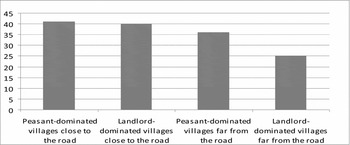
Therefore, it appears that the effect of connectivity has been to change patrons’ behavior in landlord-dominated villages to resemble that of patrons in relatively egalitarian villages. This is shown clearly in Figure 1. Before analyzing the figure it is worth noting that the question pertaining to households’ collective activities was deliberately kept open-ended in terms of time, because the construction of the highway had no significance for isolated villages.Footnote 65 Nonetheless, households always made a reference to time when describing the projects they undertook, thereby allowing me to verify that the collective activity reported in Figure 1 did in fact take place in the last 10 years.Footnote 66 Looking at the figure we find that whereas only 25% of households engaged in collective action in isolated landlord-dominated villages, 40% did so in similar tenured villages when situated close to the road. This difference is significant at the 5% level. Moreover, once connected to the external market, levels of collective action in landlord-dominated and peasant based villages tended to converge (the difference between the levels of collective action in the two types of villages is insignificant). Lastly, the quantitative data support the findings of field interviews that, even when isolated, households in peasant-based villages faced few obstacles to engaging in collective activities, as the difference in levels of collective action in isolated and connected peasant based villages is insignificant.
Has the Household Ever Engaged in Collective Action?

However, Figure 1 does raise the question that, given the level of control enjoyed by patrons in isolated landlord-dominated villages, how did 25% of households still manage to engage in collective action? The explanation, perhaps, could lie in the types of projects these households engaged in, particularly if they differed in nature and substance from those undertaken in other villages.
Types of Collective Action
Household projects undertaken in the villages can be broadly divided into two types: neighborhood- and village-level projects. Neighborhood-level projects were small-scale activities, such as paving streets and building or repairing drains. These projects typically involved people from the same biradery coming together, because biraderies tended to cluster around the same area in the villages; the projects thus made use of bonding social capital. Village-level projects, in contrast, involved activities such as repairing the wall around the mosque or the school building, cleaning the village water well, or repairing the village transformer station. These projects’ benefits extended to most households in the village and thus required peasants from different biraderies coming together, thereby making use of bridging social capital.
Of the 25% of households who engaged in collective action in isolated landlord-dominated villages, around half were involved in projects to provide themselves with functioning drains and paved streets. The scale of these projects was so small that they were unlikely to provide peasants with the critical mass needed to collectively bargain with the landlord. Moreover, although the projects may have resulted in stronger bonding social capital among the poorest communities, this did not necessarily threaten the landlords’ control as it is questionable how much these communities could achieve, even in a group.Footnote 67 Therefore, landlords had little incentive to invest time and energy in blocking such activities of their clients. Yet most households that engaged in these community-driven projects lacked the goods they had tied to provide, thus indicating that their attempts to self-provide had failed. Nonetheless, these households did not believe they could communicate their needs to the landlord, because they felt that their poverty made them irrelevant in their patrons’ eyesFootnote 68: “He would never listen to us as we are too poor.”Footnote 69 As a result they continued to live with muddy and soiled streets.
The other type of projects undertaken in isolated landlord-based villages were village-level projects, which required peasants from different biraderies to come together. Such type of collective action should be threatening to the landlords’ control, and thus we would have expected the patrons to have blocked them. However, the ability of households to engage in such projects stemmed from the specific nature of those projects. Only two village-level projects were undertaken by these peasants: repairing the mosque wall and the wall around the school premises. In Muslim societies repairing a mosque is considered a holy activity, which was evident from the pride households expressed in having provided their assistance. Refusing the maulvis’ request for their help, the households reported, would have been a sin because providing such help was their religious duty.Footnote 70 So if landlords tried to bar peasants from engaging in such projects, they would be branded as un-Islamic and thus stand to lose their legitimacy very quickly. Although working on the school wall was not considered a holy activity, it did provide the children of the village with a safer environment to study in, which again would be difficult for patrons to stop.
In landlord-dominated villages close to the road, the households that engaged in collective action were also equally split between undertaking small-scale neighborhood-level projects and more elaborate village-level ones. Yet not only was the scope of the projects much wider in these villages but their success rate was also much higher. Most households engaging in neighborhood-level activities reported having done so with the assistance of the local patron. They mentioned how the patron would visit the site while they were workingFootnote 71 and at times offer advice on how to improve the workFootnote 72 or offer financial assistance (see also the earlier discussion).Footnote 73 Unlike their isolated counterparts, these peasants were much more successful in their collective endeavors because of their access to more resources and expertise, which resulted in better functioning drains and well-paved streets. Furthermore, village-level projects in these villages were much more extensive than those in isolated landlord-dominated villages. Households reported not only assisting with the maintenance of the school and the mosque but also repairing the village transformer station, assisting in dispute resolutions, working on the provision of irrigation channels, and mending the graveyard wall. Collective action at this level drew on horizontal networks that spanned across biraderies. Such networks were facilitated by market access, which provided peasants the opportunity to socialize in the public domain and thereby diversify the group of people with whom they interacted.Footnote 74 Moreover, as in the case of neighborhood-level projects these activities were also undertaken with the support and assistance of their respective landlords. In fact, the patron was reported to have given the idea for some of the projects the households undertook. “Given that the graveyard wall was about to break our landlord suggested that we all come together and rebuild it. He said he would help us, which he did by giving us the materials and advice.”Footnote 75 Moreover, the patron was also reported to have suggested that households repair the transformer station and provided a substantial portion of the funding for the project.Footnote 76
Turning to isolated peasant-based villages, most households there were engaged in village-level projects rather than neighborhood ones. Because of the high levels of state provision in these villages, most peasants had no need to engage in neighborhood-level projects.Footnote 77 Still the few households that did undertake such activities were found to be more successful than those in equally isolated landlord-dominated villages, as patrons in the peasant-based villages assisted in the projects. In fact, as reported by one household “in order to ensure that we were able to get functioning drains quickly he sent some of his own workers to help us.”Footnote 78 Village-level projects included fixing the transformer, cleaning communal water wells, maintaining the school and mosque, and setting up a welfare committee. As with landlord-dominated villages close to the road, patrons not only threw their full support behind their clients’ collective activities but also initiated some of the projects by suggesting the idea to households. For instance, in one of the two isolated peasant-based villages the patrons had suggested that households with medical training set up a first-aid center, because the government basic health unit was located in another village. The peasants, of course, were very grateful for this initiative: “Thanks to his idea we now have some place close we can go if our kids get hurt or fall ill.”Footnote 79
Once connected to the road little changed in peasant-based villages in terms of the variety of village-level projects undertaken by households. However, because these peasants did not have as high a level of state provision as their isolated counterparts, considerable focus was placed on neighborhood-level projects. Patrons encouraged them to build and maintain their own streets and drains and assisted in these activities by providing funds and expertise.Footnote 80 With the added help from their patrons, it is no surprise that a large number of these projects were successful at providing peasants with functioning neighborhood-level public goods.
Therefore, although a quarter of households in isolated landlord-dominated villages did engage in collective action, the scope and relative success rates of these projects were limited when compared to the activities of peasants in all other types of villages visited. Isolation combined with inequality meant that patrons were assured of their peasants’ clientelist support. They therefore did not have to assist their clients’ collective projects and could even block them at will.
Collective Action, Connectivity, and the Landless
The analysis so far has compared peasants’ experiences with collective action across the different types of villages. Before concluding, it is worth investigating who within isolated landlord-dominated villages was engaging in collective action and who within the villages benefited from connectivity? Based on the previous discussion, we would expect some variation in peasants’ relationship with their patron depending on their economic status. Landless households, due to their extreme dependence on the patron, should find the impact of “authoritarian clientelism” much more constraining when compared to landowning households. Hence, even though both types of households are in a hierarchical relationship in landlord-based villages, we should expect systematic differences in their levels, types, and success in collective action activities.
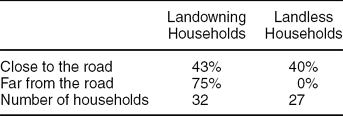
In isolated landlord-dominated villages, there was a clear distinction between the types of projects undertaken by landowning and landless households. Whereas the landowning households were more inclined toward village-level projects, the landless households were much more likely to engage in small-scale neighborhood-level projects. However, the limited resources of the landless meant that they failed consistently to provide themselves with functioning public goods (Table 3). This could give some weight to one of the patrons’ arguments that poverty made peasants unable to provide themselves with public goods (see the earlier discussion). This argument is further strengthened by the fact that the landowning households undertaking neighborhood-level projects had significantly higher success rates. However, just a few kilometers away the experience of landless households in landlord- dominated villages close to the road causes us to question whether it was poverty that limited peasants from gaining access to public goods through community-driven projects.
As can be seen from Table 4, equally landless households in connected villages were much more successful in such activities. Although the relatively small sample size does not allow us to test for significance, the table does highlight the substantiveness of the differences between success rates in isolated villages.Footnote 81 The difference between the experiences of isolated and connected landless households lies in the role their patron played in their collective activities. Whereas in isolated landlord-dominated villages the patron blocked such activities, in connected villages the patron assisted the landless,Footnote 82 with two of five projects being successful. Thus while poverty may have been a limiting factor for collective action because it restricted peasants’ access to needed resources, the experience of households close to the road illustrates that this barrier can be overcome.
Success Rate of Neighborhood-Level Projects in Landlord-Dominated Villages
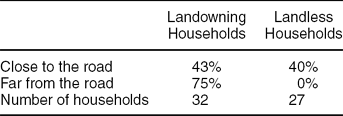
For landowning households Table 4 shows that connectivity had a curious effect on their success rates; connectivity seems to lower their chances of succeeding. This could be explained by the fact that landowning households in connected villages were more partial to paving streets, an activity that demands a higher level of skills, rather than fixing drains.Footnote 83 As a result, they were less successful at providing themselves with long lasting public goods.
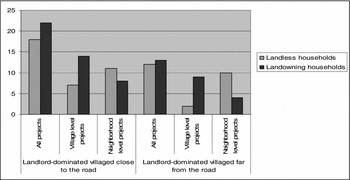
Village-level projects in isolated villages were mostly undertaken by landowning households. Patrons had less control over these households and therefore, were unable to block these projects. In connected landlord-dominated villages, these projects were also mostly undertaken by landowning households, but with a strong presence of landless households as well (see Figure 2). Interestingly, some of the village-level projects undertaken by landless households were initiated by their patron—for example, building the village transformer stationFootnote 84—and thus they were encouraged by him to participate.
Collective Action among Landless and Landowning Households

Differences in the village-level project experiences of landless and landowning households were also found in the quantitative survey data. In isolated villages landowning households were much more inclined to engage in village-level projects, whereas the landless tended to focus on neighborhood-level projects. The difference is statistically significant at the 5% level. However, once connected to the motorway, households’ economic status no longer had a significant impact on the type of project they engaged in. Not only were landless households more actively involved in community-driven projects in villages close to the road but the scope of their activities was also much wider. Thus it appears that the beneficial impact of connectivity is felt most strongly by the landless—and poorest—households in the village economy. Therefore, although field interviews highlighted patrons’ role in collective action in villages both close to and far from the road, the quantitative data illustrate the convergence taking place between households of different economic status in terms of the nature and scope of collective projects they can take part in. The implication is encouraging. The poorest have the most to gain from reducing the isolation of rural villages.
CONCLUSION
According to social science theory, collective action should be severely restricted in the presence of strong hierarchical networks. In rural developing economies in particular, patron-client networks should prevent peasants from engaging in community-based projects. This article has argued, however, that such predictions may be overly simplistic because they fail to consider the social and economic context in which patron-client networks exist. Hierarchical bonds need not always be detrimental to peasants’ ability to engage in collective action. In fact, under certain circumstances these bonds can be an added source peasants could draw on to ensure the successful completion of community-driven projects.
The case studies reveal that peasants in strong patron-client networks were much more likely to engage in successful and varied types of collective projects when they were connected to the outside economy. Unlike being subject to the “authoritarian clientelism” of isolated rural villages, their exposure to new opportunities significantly improved peasants’ bargaining power vis-à-vis their landlords. This, in turn, made them just as likely to engage in community-driven projects as peasants enjoying weaker hierarchical bonds in relatively egalitarian villages. In fact, in environments where peasants had higher bargaining power, landlords were reported to initiate and assist their clients in many community-driven projects as a way of maintaining the integrity of the patron-client network. The implication is that, although inequality defines the nature of clientelism, it may only be truly detrimental to peasants’ welfare when it interacts with isolation, making the landlord a monopolist/monopsonist. Furthermore, while evidence from field interviews and quantitative data highlighted an overall increase in the level of collective action in landlord-dominated villages, it also indicated that the beneficial impact of connectivity was felt most strongly by landless households. Once connected to the external economy, households’ economic status became irrelevant for the types of projects they engaged in and their relative levels of success.
These changes allow us to draw broader conclusions about the effect of connectivity on clientelist relationships. Isolation when interacted with inequality enabled large landlords to make demands of their clients that were detrimental to their welfare. Connectivity significantly curtailed such powers on the part of the patron by giving peasants the option to walk away from a relationship they deemed detrimental to their welfare. The change in the relationship is telling as not only were patrons in connected villages unable to exploit their clients but they also had to cater for their needs to ensure that the benefits of the relationship exceeded, or were at least at par with, the benefits of engaging with the external market. Hence overall connectivity is found to change the clientelist relationship from one focused on exploitation and maintaining control to one based on cooperation.
Given the emphasis on community-based development in recent years, these findings could have important implications. They illustrate the importance of analyzing the impact of asymmetric power relations on peasants’ ability to engage in collective action. Of course, future studies need to investigate the robustness of these results. As a first cut, however, they indicate that hierarchical bonds are not necessarily detrimental to peasants’ welfare in general, and to their ability to engage in collective activities in particular, as long as credible exit options are available. Thus it appears that a road can go a long way to assisting the rural poor.
APPENDIX
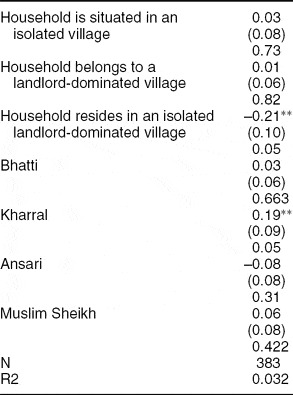
The tables that follow run more rigorous tests to see if the results in Figure 1 hold after controlling for household-specific characteristics. The logit regression model is as follows:

Yiv is a binary variable capturing whether household “i” in village “v” has ever engaged in collective action for the purpose of self-provision, taking the value of 1 if the household has done so. Distance from the road, MWv, is 1 if the household resides in an isolated village and 0 otherwise. Distance is analyzed as a binary variable because the research design looked at villages that were polar opposites (i.e., whereas half have the road running through them, the other half are far enough away to be classified as being isolated). With this setup, modest changes in distance are irrelevant. LLv is a dummy variable for whether the household resides in a village dominated by a large landlord. The variable MWv*LLv is an interaction term meant to capture the effect of belonging to a landlord-dominated village far from the road.
The last four variables control for the social status of the household. Bhiv and Khiv represent the upper class biraderies of Bhattis and Kharrals. These were historically the landowning classes, which enjoy a high status in village society, especially because they often share their biradery with the landlord. This high status protects them from gross exploitation as social norms and customs place restrictions on the landlord's extractive practices when dealing with them (Ahmad Reference Ahmad1977). Aniv and MSiv denote the lower class biraderies of Ansaris and Muslim Sheikhs. These two biraderies were historically not allowed to own land, which lowered their social status considerably. The reference category is the small middle class biraderies.
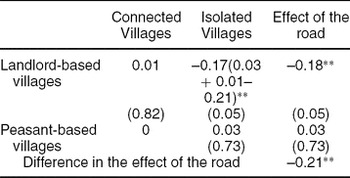
Tables 5 and 5a show that households in isolated landlord-dominated villages have a 17% (0.03+0.01−0.21) lower chance of engaging in collective action when compared to those living in connected peasant-based villages. This result is significant at the 5% level. Moreover, Table 5a shows that households in isolated landlord-dominated villages have an 18% lower probability of undertaking community-driven projects than peasants living in similarly unequal but connected villages. This result too is significant at the 5% level. Also, in line with the results of Figure 1, within isolated villages peasants in landlord-dominated areas are 20% (–0.17–0.03) less likely (significant at the 5% level) to engage in collective action than households living in equally isolated but relatively egalitarian villages. Furthermore, the data highlight the higher probability that Kharral households have of undertaking community-based projects. These households are 19% more likely than households from middle class biraderies to take part in collective activities.
Has The Household Ever Engaged in Collective Action?

Note: The specification reports robust standard errors clustered by villages in parentheses and p-values.
*p < 0.1, **p < 0.05, ***p < 0.01.
Partial Effects of Connectivity and Land Tenure Systems on Households’ Chances of Engaging in Collective Action

Note: Robust standard errors clustered by villages calculated; p–values in parentheses.
*p < 0.1, **p < 0.05, ***p < 0.01.
Overall the results from the logistic regression corroborate the findings of Figure 1 and the qualitative data presented earlier, thereby strengthening the argument that connectivity plays a significant role in enabling households living under hierarchical relationships to engage in collective action for the purpose of self-provision.




Comments
No Comments have been published for this article.