A common refrain during the 2019 protests in Hong Kong was the demand for “Democracy and Freedom.” The concluding lines of the protest anthem “Glory to Hong Kong” (祈求民主與自由萬世都不朽) pleaded for the timelessness of democracy and freedom.Footnote 1 Joshua Wong, a prominent youth activist, expressed his hope that the people of China would understand that “democracy, freedom and human rights are universal values that Hong Kong people are fighting for” (Tam Reference Tam2019).Footnote 2 Even in the opposing camp, a pro-establishment politician called the reformers’ treatment of the police commissioner at a District Council meeting to be “in violation of the universal values of democracy and freedom” (Wang 2020). Yet, democracy and freedom were far from being “timeless” and “universal” in the case of colonial Hong Kong—the British regime did not provide elaborate guarantees for freedom, much less democracy, until the closing decades of its rule. How did the colonial regime secure acquiescence to its rule?
Political legitimacy is different from political authority. While political authority entails the right of the government to be obeyed, political legitimacy depends on those in power justifying their formulation, application, and enforcement of rules (Buchanan Reference Buchanan2002). Democracy can engender such legitimacy. In areas under communist rule, economic performance can also justify the claim to rule (White Reference White1986). In the case of the People's Republic of China (PRC), the Chinese Communist Party (CCP) developed its “performance legitimacy” after the crisis of 1989 (Ci Reference Jiwei2020; Saich Reference Saich2021, chap. 9 and conclusion). Although Hong Kong falls outside the communist zone, its status as a colony in the age of decolonization and the absence of a fully representative government in the post-handover period call for an examination of its government's source of legitimacy. This article shows that economic performance, as well as the safeguarding of social order, allowed the colonial government to craft a narrative of its political legitimacy. Although this narrative was challenged at certain junctures, it sustained the governance of the city as well as the transition to Chinese sovereignty in 1997. As the city descends from ultra-high economic growth rates, however, deterioration of economic performance (or the perception thereof by some) disturbs this narrative.
Focusing on earlier colonial success in securing legitimacy in Hong Kong, Ian Scott (Reference Scott1989) credited the British regime with co-opting economic groups into the political structure. Finishing his book just before the June Fourth protests, Scott attributed the developing crisis of legitimacy to British unwillingness to incorporate the new middle class. Writing in the aftermath of June Fourth, Lau Siu-kai (Reference Siu-kai1990) found Hong Kong Chinese to be pragmatic and trusting in a set of political-administrative institutions. While supportive of democracy, Hong Kong Chinese worried about the effectiveness of a democratic political system in delivering “the goods which they treasure,” including “economic prosperity, social stability, improvement in standard of living, and better opportunity” (Lau Reference Siu-kai1990, 201). In the postcolonial era, studies have registered increasing frustration with the poor performance of the Hong Kong Special Administrative Region (HKSAR) government and argued that escalating public trust in the government could necessitate democratic legitimacy in the long run (Kuan and Lau Reference Kuan and Siu-Kai2002; Sing Reference Sing2001, Reference Sing2009). As for democratic development in Hong Kong after 1997, Ma Ngok (Reference Ma Ngok2007) attributed the slow progress to the underdevelopment of political society. Rather than following a binary of legitimacy through economic performance versus democracy as essential to political mandate, this article acknowledges the enduring appeal of socioeconomic benefits while exploring the burgeoning political demands.
The socioeconomic narrative of “Prosperity and Stability” largely secured for the British acquiescence to their rule of the colony and facilitated the transition of Hong Kong during the run-up to the handover in 1997. Although the notions of “Democracy and Freedom” began to challenge the currency of “Prosperity and Stability,” especially after the tumultuous events of 1989, the socioeconomic appeal endured. The two narratives continued to compete in the public discourse of Hong Kong during the mid-1990s. “Are democracy and stability and prosperity mutually exclusive?” asked a political commentary in the newspaper Ming Pao in 1994. The commentary was accompanied by an illustration of a brute wielding a bat labeled “stability and prosperity” chasing after Lady Liberty (figure 1). As the handover neared, democracy and freedom coalesced as a paired notion of political ideals.
The assault of Lady Liberty in the name of stability and prosperity. Source: Ming Pao, June 28, 1994, D4.

Keywords are pivotal to contention over values (Kipnis Reference Kipnis2006). Paired keywords can accentuate the complementarity of two notions.Footnote 3 Applying the “ways of readings” proposed by Joan Judge, Barbara Mittler, and Michel Hockx (Reference Judge, Mittler and Hockx2018), I follow two pairs of keywords—democracy/freedom and prosperity/stability—as I read them “vertically,” by tracing them as particular themes over time in specific periodicals, and provide a “situated reading,” by delving into the context of the debates, taking the periodicals as nodes of broader networks. Vertical reading allows us to “trace the sedimentation of discursive ideas in cultural memory,” while situated reading enables us to “deepen our knowledge of [the] sociohistorical context” (Judge Reference Judge2016, 39–48; Judge, Mittler, and Hockx Reference Judge, Mittler and Hockx2018, 8–10).
I focus primarily on three representative publications across the political spectrum in Hong Kong: the preeminent English newspaper, the South China Morning Post (SCMP), and for Chinese newspapers, the right-leaning Wah Kiu Yat Po 華僑日報 (WKYP) and the pro-Beijing Ta Kung Pao 大公報 (TKP). Using electronic archives of these newspapers (ProQuest for the SCMP and the Multimedia Information System of the Hong Kong Public Libraries for the WKYP and TKP), I tally the appearances of the paired terms in different configurations in Chinese and English to construct a longitudinal quantitative analysis of the use of these terms. The persistent appearance of prosperity/stability underscores how the authorities have resorted to socioeconomic benefits as their perennial justification for their legitimacy of governance, while the increasing number of references to democracy/freedom indicates escalating grassroots calls for political reform.
Rather than explicating the theoretical foundation of these concepts and their applications in the case of Hong Kong, I seek to underscore contention in the legitimacy of governance in Hong Kong since the closing decades of British rule.Footnote 4 I demonstrate how “Prosperity and Stability” came to be adopted as a slogan by the authorities in Hong Kong in their bid to shore up political legitimacy as uncertainty mounted over the future of Hong Kong. I then proceed to explore the ascendancy first of “freedom” and then of “democracy” as Hong Kongers’ political demands. I shall not echo or contest claims that recent protests in Hong Kong have stemmed from socioeconomic grievances (Sing Reference Sing2019). Also, rather than lamenting Beijing's interventions and narrowing political rights in Hong Kong (Davis Reference Davis2020), I track the currency of freedom/democracy over a longer period and pinpoint the emergence of such political assertions only in the last years of British colonial rule. The formulation of “Democracy and Freedom” has since become the rallying cry against the appointed governing regime in Hong Kong, which many consider to have increasingly curtailed basic rights in the postcolonial city.
As the post-handover government resorts to the perennial narrative and undermines political demands by invoking economic benefits, the allure of socioeconomic well-being in the face of the rising appeal of political ideals proves enduring, at least for some. Instead of taking “middle class” as a defined category, I understand it as an expression of socioeconomic aspiration and explore changes in social mobility (or perceptions thereof) as a motivating factor for political agitation. This emphasis on socioeconomic factors is necessary as we seek to appreciate the deepening divide across the political spectrum in today's Hong Kong. The common refrain of “Prosperity and Stability” among vested interests at the height of the crisis in 2019 stood in sharp contrast with the calls for “Democracy and Freedom” among those feeling disenfranchised. These public demands for political reforms, which have escalated since the Umbrella Movement, indicate that many in Hong Kong find the state's prosperity rhetoric increasingly hollow in an environment of socioeconomic regression. On the one hand, Hong Kong's lackluster economic performance and mounting inequality point to its government's failure to deliver on the growth proposition, resulting in erosion of its performance legitimacy. On the other hand, escalating Hong Kong/mainland tension has heightened Hong Kongers’ political consciousness, which emerged in British colonial Hong Kong in the aftermath of June Fourth. As these two developments converged, Hong Kong administrations misconstrued the discontent of the protesters, heedlessly ignored the gravity of the political demands, and foolhardily believed in their ability to resolve the situation with socioeconomic improvements (or claims thereof) alone. It would be unproductive for the governing authorities or the protesters to deny the earnestness of either the political or socioeconomic assertions in the ongoing contention of legitimacy to govern Hong Kong.
Scholarly attention to political narratives and slogans has focused primarily on the politics of the PRC (Geall and Ely Reference Geall and Ely2018; Lu Reference Lu1999; Wang Reference Wang2007). Yet, mobilization through the repetition of catchphrases knows no Cold War divide. Turning attention to the construction of political legitimacy not only by the British colonial regime but also by its successor, the HKSAR government, this article examines the circulation of two pairs of keywords—prosperity/stability and democracy/freedom. This analysis considers how socioeconomic mobility provided legitimacy for the governance of Hong Kong and suggests how the unravelling of such socioeconomic forces might have fueled recent unrest and escalating political demands.
Securing the Colonial Grip
The recent crisis in Hong Kong is characterized by a level of social unrest that the city has not seen since the riots of 1966–67.Footnote 5 A fare increase for the Star Ferry triggered unrest in 1966 that led to 59 deaths. The following year, a labor dispute kindled an eight-month struggle that resulted in 51 deaths, over 800 injuries, and more than 2,000 convictions. Among the 51 deaths, 15 died in bomb attacks. Disposal teams dealt with over 8,000 suspected bombs. According to government reports, there were close to 1,200 genuine bomb incidents and 253 uncontrolled explosions. The chaos that the leftists inflicted on Hong Kong was inspired, if not orchestrated, by their compatriots on the mainland. At the height of the unrest, the British regime felt sufficiently challenged that it made plans for an emergency evacuation of its officials, troops, and families. Ironically, not only did the British survive this confrontation, but the left-wing challenger in Hong Kong also suffered a setback as it saw its image tarnished by the bomb attacks (Bickers and Yep Reference Bickers and Yep2009; Cheung Reference Cheung2009; Loh Reference Loh2010). Rather than suffering an erosion of its legitimacy, the British regime came to enjoy enhanced recognition in the aftermath of the riots. The appeal of stability was apparent: with order restored, colonial Hong Kong stood in sharp contrast with mainland China in the throes of the Cultural Revolution.
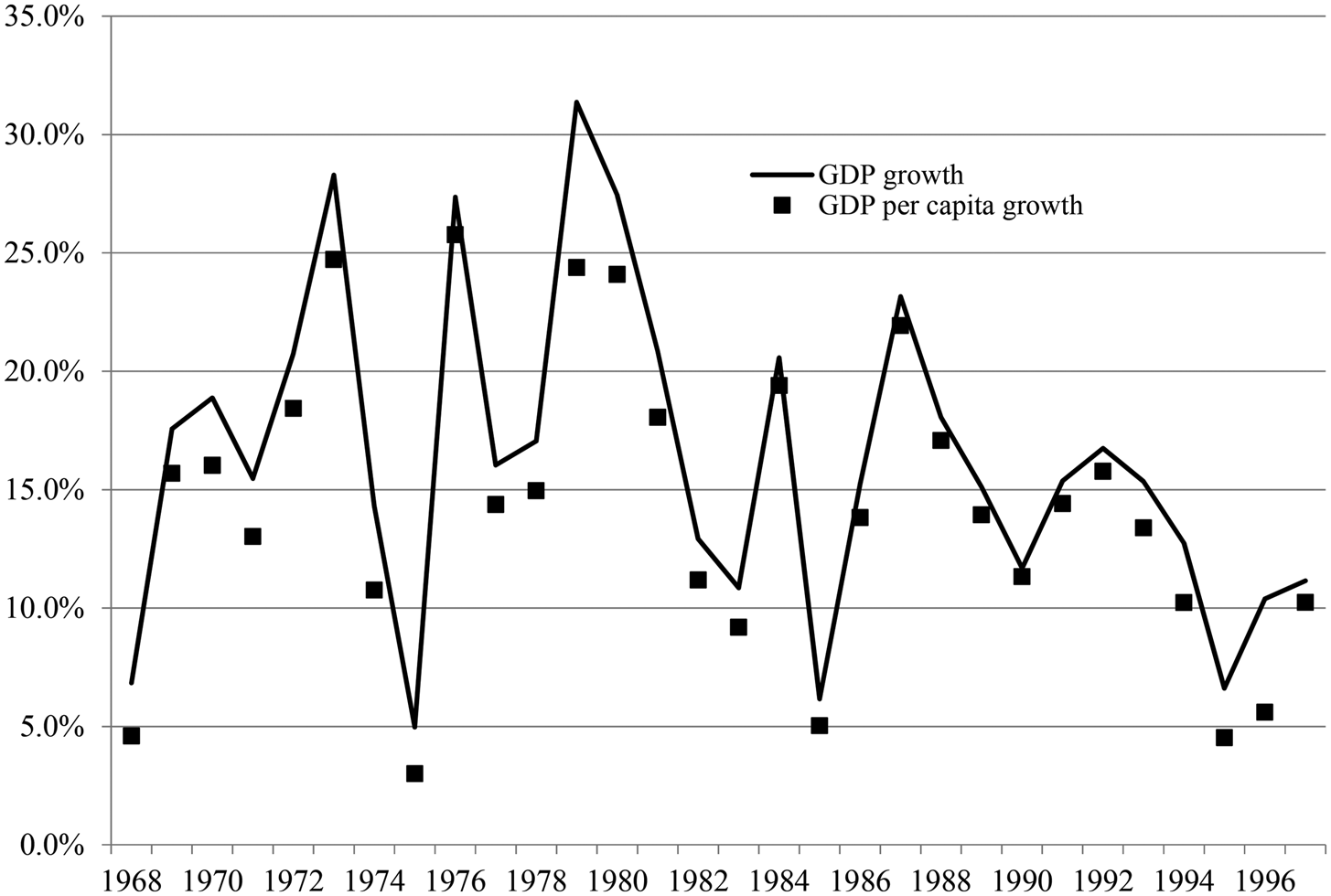
Having endured the most serious contest to its rule since World War II, the British regime stepped up its efforts to address socioeconomic issues in the colony in a bid to bolster its legitimacy. The colonial government launched reforms that encompassed educational initiatives and housing campaigns (Cheung Reference Cheung2009, 140; MacLehose Reference MacLehose1972). Such efforts, along with the tailwind of favorable geopolitics, fueled economic growth in Hong Kong. From 1970 through the 1980s, Hong Kong registered phenomenal economic expansion, with growth in both gross domestic product (GDP) and GDP per capita exceeding 10 percent in most years (figure 2). Even when adjusted for inflation, real GDP growth often exceeded 5 percent, reaching double digits in many years (Wong Reference Wong2017, 101–3). Such development in Hong Kong gave rise to the characterization of an “economic miracle,” or the experience of prosperity in the colony.
GDP growth in Hong Kong. Source: Hong Kong Annual Digest of Statistics (1978, 1981, 1990, 1993, 1997).

From this context emerged the aspiration for continued “Prosperity and Stability” in Hong Kong. Indeed, prosperity/stability was no neologism in Hong Kong in the late 1960s. In the age of decolonization, colonial regimes had resorted to this recipe to justify their rule. The paired notions first appeared in Hong Kong's South China Morning Post in the aftermath of World War II in conjunction with the report of British concerns over the settlement of the Dutch East Indies (SCMP, January 21, 1946, 10). The following year, the local English newspaper also quoted a British member of Parliament's view of Hong Kong's role in postwar “Far Eastern prosperity and stability” (SCMP, May 9, 1947, 12). In the Chinese newspapers of Hong Kong, mounting political tension in 1949 also precipitated invocation of the notions by opposing camps. The pro-business WKYP relayed the New Year's message of British colonial secretary Arthur Creech-Jones calling for cooperation to foster prosperity and stability, while the pro-communist TKP carried an article that celebrated the working class's creation of a new order of prosperity and stability (WKYP, January 10, 1949, 8; TKP, March 15, 1949, 2).
The formulation of this set of paired keywords remained fluid. Not only could the sequencing of the two keywords (in both English and Chinese) follow either order, but “stability” also appeared in Chinese phrasing as either wending 穩定 or anding 安定.Footnote 6 Yet, the appeal of these paired concepts was apparent in Hong Kong. The WKYP expressed a colony-wide desire in 1968 to retain Governor David Trench, who had fended off the riots “so that he could continue to lead the efforts to secure stability and prosperity for Hong Kong” (WKYP, April 17, 1968, 7; emphasis added). When Trench's successor, Murray MacLehose, assumed the governorship in 1971, a front-page article in a Chinese newspaper reported that the incoming governor anticipated “stability and prosperity” for the colony (Kung Sheung Evening News, November 20, 1971, 1). During that period, colonial officials were deliberate in implementing reforms, the desired results of which were to be encapsulated by prosperity/stability. As MacLehose explained to the machinery in London, “not only must legitimate demands be satisfied, but the population must be convinced that such satisfaction is genuinely the objective of the government.”Footnote 7 Rather than characterizing prosperity/stability as the unilateral effort of the colonial government to court public support, I understand the twin notions to be the joint product of the colonial regime and Hong Kongers who concomitantly crafted the notions and promoted acquiescence to continued British colonial rule after the disconcerting experience of 1966 and 1967.
Brokering Transition
During the 1980s, references to prosperity/stability surged in all three newspapers, marking another period of contention over the rule of Hong Kong. Socioeconomic development in Hong Kong had yielded considerable progress in social order and material well-being in the 1970s. As officials in London and Beijing initiated discussions in earnest over the political future of Hong Kong, both sides pledged to safeguard the prosperity/stability that the city enjoyed.
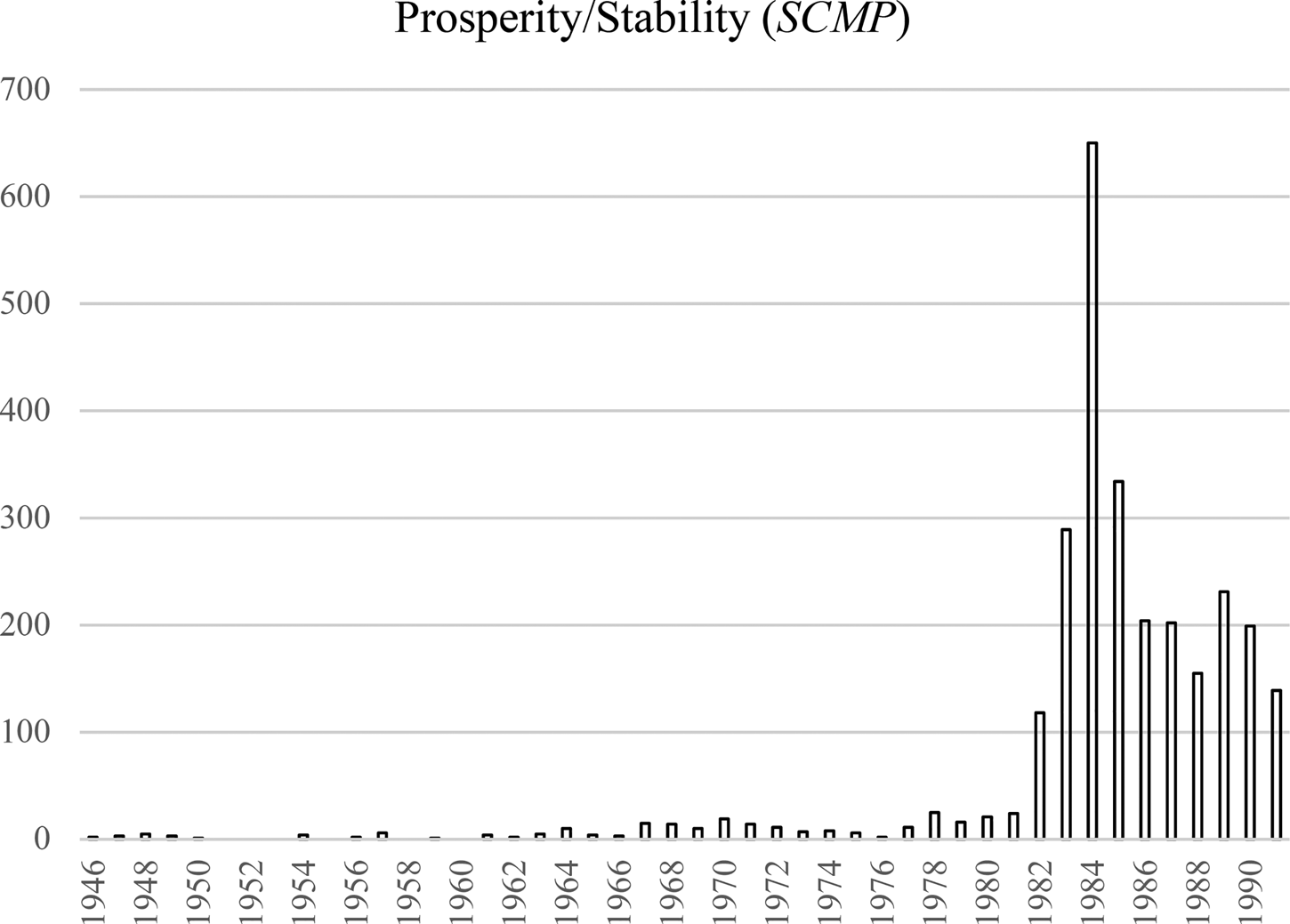
For the SCMP, the tally shows a prominent surge in references to prosperity/stability in the early to mid-1980s (figure 3). Similarly, the spike in the appearance of these terms (穩定繁榮/繁榮穩定/繁榮安定/安定繁榮) in the Chinese newspapers in the early to mid-1980s dwarfed their previous use. This slogan enjoyed sustained high currency in the headlines of the two Chinese newspapers throughout the 1980s, with the pro-Beijing TKP recording an earlier and sharper escalation (figure 4).
Frequency of the keywords prosperity/stability in the SCMP. ProQuest Historical Newspapers registers the frequency of the paired notions (both “prosperity and stability” and “stability and prosperity”) as they appeared in either headlines or the text of articles.

Frequency of the keywords prosperity/stability in the TKP and WKYP. The Multimedia Information System of the Hong Kong Public Libraries registers the frequency of the paired notions—繁榮 prosperity and 穩定 or 安定 stability—in either order as they appeared in the headlines or subtitles of articles in the two Chinese newspapers.

The ascendancy of prosperity/stability marked key moments in the Sino-British negotiations. Their appearances in all three newspapers crescendoed in 1984 when the PRC and UK governments signed the Sino-British Joint Declaration, which stipulated the political and socioeconomic arrangements for Hong Kong after 1997. From 1983 to 1984, references to prosperity/stability more than doubled in the SCMP and WKYP and tripled in the TKP. In the SCMP and TKP, appearances of the slogan peaked in 1984, and in the WKYP, its use was only surpassed in the late 1980s.
Prosperity/stability had not merely underwritten the legitimacy of the British colonial regime in the minds of many Hong Kongers; the notions also became a bargaining chip in the ensuing Sino-British negotiations. MacLehose hoped that the perception of good British governance would produce a negotiating environment favorable to continued British administration (Mok Reference Mok2018). The CCP denied the indispensability of continued British governance but acknowledged the mutual goal of prosperity/stability, insisting on its realization through joint Sino-British efforts. The surge in appearances of the slogan in the pro-Beijing TKP ahead of the uptick in the right-leaning WKYP in the early to mid-1980s (figure 4) signaled that the Chinese regime was an equal, if not the dominant, partner in enshrining the cherished values as a slogan in Hong Kong's collective mindset. The notions that had begun as a justification for the British colonial mandate over Hong Kong first became a site of contention between Beijing and London in their negotiation for control, and then a galvanizing call for joint efforts to ensure a smooth transition of power.
Upon the conclusion of Sino-British negotiations in late 1984, the pro-Beijing TKP reported the signing of a draft agreement of “historical significance,” claiming that the “One Country, Two Systems” proposition was to “ensure the prosperity and stability of Hong Kong” (TKP, September 27, 1949, 1; emphasis added). Governor Edward Youde asserted that the post-1997 uncertainties over the future of Hong Kong had been eradicated, and he asked business elites to take a leadership role in “maintaining the prosperity and stability of Hong Kong” (WKYP, October 1, 1984, 1; emphasis added). Both sides of the Sino-British negotiations considered sustaining prosperity/stability a top priority for the city in transition.
While Cold War juxtaposition had accentuated the appeal of prosperity/stability after the 1966–67 riots in Hong Kong, the slogan's enhanced popularity in the early 1980s represented an orchestrated effort to stem Hong Kongers’ eroding conviction of their sustainability. As Britain and the PRC entered into delicate negotiations over the city's future, various state and business actors, through media such as newspapers, acted in concert to shore up confidence in Hong Kong. Although the economy maintained respectable growth during this period (figure 2), the Hang Seng Index, the barometer of the city's stock market, plummeted more than 60 percent in 1982 and remained stagnant for the two following years, signifying a collapse of confidence in the economic future of Hong Kong (figure 5). In a bid to project a festive and prosperous image, the colonial government relaxed a ban on fireworks, which had been imposed after the riots of 1967, and inaugurated what became Hong Kong's annual Chinese New Year fireworks spectacle. The first such display was a million-dollar production in 1982, sponsored by the British hong Jardine Matheson to commemorate its 150th anniversary (SCMP, January 8, 1982, 1, 20; SCMP, January 24, 1982, 11; TKP, January 8, 1982, 5). The tremendous uptick in references to prosperity/stability in the three newspapers representing different political persuasions reflected the struggle of political actors and corporate entities to sustain the narrative of socioeconomic well-being. In other words, the higher frequency of the slogan's appearance in print media signified an inverse erosion in Hong Kongers’ belief in the sustainability of prosperity/stability. The proposition that this slogan underscored, backed by actual performance throughout the 1970s, had once reinforced the legitimacy of British colonial rule. In times of uncertainty, contenders for political power in Hong Kong redoubled their efforts to invoke the slogan in a bid to reassure the city's residents of their collective determination to maintain orderly economic growth.
Performance of the Hong Kong stock market, 1975–85.

The recovery of the city's confidence, evidenced by the rebound of the Hang Seng Index by 1985, attests to the efficacy of the prosperity/stability narrative. Indeed, the signing of the Joint Declaration alleviated uncertainty over Hong Kong's future. What were the primary concerns of the signatories? While it is difficult to ascertain each party's motive, especially on the side of the PRC, recent archival releases offer important clues. In her letter to US president Ronald Reagan dated September 25, 1984, informing him of the pending Sino-British agreement, British prime minister Margaret Thatcher underscored the British success in securing “a high degree of autonomy for Hong Kong in all fields, especially in the financial and economic fields and in aviation and shipping.” Emphasizing the importance of the agreement in “play[ing] a stabilising role in the area,” she referred repeatedly to Hong Kong's prosperity for which she requested US support. She asked that the United States take a leadership role and express its confidence in “Hong Kong's future prosperity” so as to ensure “the survival of Hong Kong as a flourishing capitalist society.” Nowhere in this exchange between two leaders of the free world did they allude to the issues of democracy and freedom in Hong Kong.Footnote 8
Arousal of Political Consciousness?
With the handover of 1997 looming on the horizon, did the people of Hong Kong not petition for democratic reform and further guarantees of freedom? Reflecting a rising consciousness in Hong Kong of these political issues, references to democracy/freedom did spike in the three newspapers, but not until 1989. The currency they enjoyed underscored a temporal peculiarity: a surge in their use not during the Sino-British negotiations in the early to mid-1980s when prosperity/stability was all the rage, but in the aftermath of June Fourth, which shook the confidence of Hong Kongers.
Democracy was indeed considered a worthy cause, but Hong Kongers prioritized the maintenance of prosperity/stability. “Don't hurry democracy,” read the headline of an article on May 23, 1984, as officials in London and Beijing prepared the Joint Declaration. In Britain, the House of Lords recognized that democratization was essential but expressed concerns over hasty implementation. Political analysts and community leaders in Hong Kong were said to urge the gradual introduction of democratization as the city prepared for the handover “in order to maintain prosperity and stability.” Edward Chen, who directed the Centre of Asian Studies at the University of Hong Kong, concurred, asserting that Hong Kong needed “more time to educate the masses politically and to produce political leaders.” Local politicians agreed. A district councilor was quoted calling for gradual implementation “so as not to ‘rock the boat’ as Hongkong was still in a confidence crisis” (SCMP, May 23, 1984, 13).
Democracy/freedom did not register frequent appearances in the three newspapers in the mid-1980s. In the SCMP, the tally of democracy/freedom registered a slight uptick around the signing of the Joint Declaration in 1984, but it was hardly a noticeable increase (figure 6). In the two Chinese newspapers, references to democracy/freedom had mostly subsided after the fervor in the decade after World War II. In the mid-1980s, the WKYP registered an increase in appearances of democracy/freedom in its headlines, while the uptick was barely observable in the pro-Beijing TKP (figure 7). These tallies show that the notions of democracy/freedom did not seem to enjoy high currency even as the future of Hong Kong was sealed with its stipulated return to Chinese sovereignty in 1997.
Frequency of the keywords democracy/freedom in the SCMP. ProQuest Historical Newspapers registers the frequency of the paired notions (both “democracy and freedom” and “freedom and democracy”) as they appeared in either headlines or the text of articles.

Frequency of the keywords democracy/freedom in the TKP and WKYP. The Multimedia Information System of the Hong Kong Public Libraries registers the frequency of the paired notions—民主 democracy and 自由 freedom—in either order as they appeared in the headlines or subtitles of articles in the two Chinese newspapers.

In 1989, appearances of democracy/freedom showed a marked increase, especially in the SCMP and WKYP. In that year, not only did Beijing witness an outpouring of support for the democratic movement, but also many authoritarian regimes collapsed in the communist bloc, epitomized by the fall of the Berlin Wall. While the waves of democratic movements ignited demands around the world, the issue became more pressing in Hong Kong after the tragic event in Tiananmen Square, eight short years before the city was to be handed over to the regime that had suppressed the movement in Beijing. To safeguard basic freedom, in 1990, the colonial government introduced the Hong Kong Bill of Rights Ordinance, which the Legislative Council passed in June 1991.Footnote 9 In this regard, freedom (or human rights) as a legal notion signaled increasing global interconnectedness.Footnote 10 Precipitated by events on the mainland in the last years of British administration, the enshrinement of freedom or rights in the city's legal codes was but belated colonial benevolence.
The Bill of Rights was to safeguard freedom in Hong Kong. How about the provision for democracy? Recently released documents reveal that when the senior members of the Executive and Legislative Councils in Hong Kong met with Thatcher in June 1989 as “[t]he whole community [in Hong Kong] was in a state of shock, first at the events in Tiananmen Square and now with the reign of terror which had followed,” democracy was not front of mind for the Chinese elites. Senior Executive Council member Dame Lydia Dunn spoke of the “unique society” that Britain had created in Hong Kong, “with freedoms which no other Chinese society had every [sic] enjoyed.” However, even as Thatcher and her administration wanted to emphasize in the drafting of the Basic Law faster development in “the process of representative government in Hong Kong,” neither Dunn nor the accompanying senior legislative councilor, Allen Lee, concurred. Instead, Dunn pushed Britain to grant citizenship or right of abode to holders of British passports in Hong Kong, which Thatcher was not in a position to offer.Footnote 11 While freedom came to be celebrated as a British contribution to Hong Kong in the aftermath of June Fourth, democratic reform gained traction only later. In fact, Hong Kong's British colonial master had initiated the flawed political structure that limited democracy and freedom—a system that the present regime was all too happy to adopt and adapt (Wasserstrom and Hawkins Reference Wasserstrom and Hawkins2020, 45–47).
Even the shock of Tiananmen Square, which produced a “frightened population” in the city soon to be reverted to Chinese sovereignty, did not trigger demands for immediate democratic reforms.Footnote 12 The Basic Law, the city's de facto constitution, which stipulated democratic reform “in accordance with the principle of gradual and orderly progress,” was promulgated by the National People's Congress (NPC) in Beijing in April 1990 (Constitutional and Mainland Affairs Bureau 2017). Although the exigencies of the historical moment could have required more immediate implementation, the practice of democracy was to be a process of gradual introduction, a compromised arrangement negotiated by the Basic Law Drafting Committee that included representatives from Beijing and Hong Kong. As such, the notions of democracy and freedom did not march in lock-step. The asynchronous demands for democracy and freedom notwithstanding, it is evident from the tallies that these notions did not become prevalent in Hong Kong's print media until the last years of colonial rule.
The Meeting of the Two Narratives
As democracy/freedom emerged as issues in Hong Kong, pundits made reference to these notions, at times in conjunction with prosperity/stability. In April 1992, Chris Patten, as the governor-designate, pledged to defend Hong Kongers’ “freedom, stability and prosperity” (自由穩定繁榮) (Hong Kong Economic Times, April 25, 1992, 2; WKYP, April 25, 1992, 10). The British faction was not alone in amalgamating the long-standing slogan of prosperity/stability with the more recently articulated concerns of democracy/freedom. Days before Patten assumed the governorship in Hong Kong, Hong Kong Basic Law Consultative Committee member Chan Wing-kee, a businessman in Hong Kong sympathetic to the CCP, contributed an article to the pro-Beijing Wen Wei Po (文匯報) titled “The Basic Law Is to Protect Freedom and Democracy, as Well as Stability and Prosperity, in Hong Kong” (基本法保障香港自由民主穩定繁榮). Chan explained that the Basic Law listed the freedoms of speech, of assembly and demonstration, and of religion, “as well as other freedoms [that Hong Kongers had] always enjoyed.” As for democracy, Chan asserted that the Basic Law provided Hong Kong “a timetable for democratization.” He allowed that “some Hong Kongers became concerned about the Basic Law due to the impact of June Fourth three years ago” but averred that the Basic Law was the guarantee for Hong Kong after 1997. If both China and Hong Kong would proceed according to the Basic Law, “Hong Kong could be certain of continued freedom, stability and prosperity.” In his conclusion, he reiterated, “The earnest implementation of the Basic Law on all sides by China, Britain and Hong Kong is the best guarantee for the maintenance of freedom, stability and prosperity of Hong Kong” (Wen Wei Po, July 6, 1992, 11). Note that both Patten and Chan underscored freedom and muted the emphasis on democracy at this stage.
When democracy/freedom emerged as popular concerns, how did these new demands appeal to the people of Hong Kong long conditioned to the slogan of prosperity/stability? A survey conducted by the Social Science Research Centre at the University of Hong Kong in October 1993 found that more than 70 percent of the respondents in a survey of the general public preferred “prosperity and stability” over “democracy.”Footnote 13 Characterizing the results as a reflection of Hong Kongers’ long-standing pragmatism, a critic questioned whether the survey should have presented a binary choice between prosperity/stability, on the one hand, and democratic development, on the other. Instead, the critic asked whether prosperity/stability was antithetical to democratic development (Hong Kong Economic Journal, October 31, 1993, 6).
Epitomized by the cartoon presented in the opening section of this article (figure 1), this was the mood in Hong Kong during the years leading up to the handover. From the perspective of Beijing diplomats, hasty political moves would derail Hong Kong's orderly transition. Opposing Patten's calls for broader electoral reform, the Chinese side accused the governor's proposal of being “harmful to stability and prosperity” (The Standard, December 4, 1993, 4). This was by no means the only view. In 1996, an article titled “Democracy and Freedom Are about Prosperity and Stability” (民主自由關乎繁榮穩定) called for the pursuit of these political ideals in tandem with continued socioeconomic welfare (Hong Kong Economic Journal, April 16, 1996, 23). In a similar vein, in a letter to the SCMP months before the handover, a writer alluded to the economic success of Hong Kong and the stability that underpinned that success. He saw no reason to deny Hong Kongers “the right to make their own decisions” and underscored in the title of his contribution that “prosperity and democracy go hand in hand” (SCMP, February 4, 1997, 16).
Quantitatively, how did the appeal of democracy/freedom since the late 1980s compare with the long-standing refrain of prosperity/stability in the print media? In the SCMP (figure 8), as in the two Chinese newspapers, the TKP and WKYP (figure 9), even with the spike in the late 1980s, the currency of democracy/freedom paled in comparison with that of prosperity/stability. In spite of calls for political reforms ahead of the handover, the print media reflected what the University of Hong Kong's survey indicated of the pragmatic attitude of Hong Kongers who privileged socioeconomic well-being over political ideals during that period.
Frequency of the keywords prosperity/stability and democracy/freedom in the SCMP. Source: ProQuest Historical Newspapers.

Frequency of the keywords prosperity/stability and democracy/freedom in the WKYP and TKP.

The predominance of references to prosperity/stability in comparison with democracy/freedom was evident in the print media during the period leading up to the handover in 1997. In view of the perception of escalating political agitation in post-handover Hong Kong, one would expect the trend to reverse in the recent years. In reality, quite the contrary—except in 2019, prosperity/stability continued to dominate the print media, more so than democracy/freedom, even at the height of periods of political unrest. In the SCMP, while the appearance of democracy/freedom registered an uptick in 2003 and 2004 (after the proposal to legislate Article 23 of the Basic Law against treason and subversion), as well as in 2014 (Umbrella Movement), the same periods saw an even more pronounced spike in references to prosperity/stability (figure 10). As for the Chinese newspapers, it is not possible to track the data in the same manner as I did for the pre-handover period. The Hong Kong Public Libraries system does not continue tracking the two newspapers into the later period, and the WKYP ceased publication in 1995. However, using Wisenews (another search platform that canvasses a wider range of print materials), an examination of the Chinese newspapers in Hong Kong yielded results similar to the tally in the SCMP: references to democracy/freedom increased during periods of political unrests but paled in comparison with the surge in references to prosperity/stability. Evidently, the print media continued to record an insistence of a certain segment of Hong Kong in invoking prosperity/stability.
Frequency of the keywords prosperity/stability and democracy/freedom in the SCMP since 1993. Source: ProQuest.

Who remains steadfast to the perennial narrative of prosperity/stability? It might be no surprise that as protesters demanded democracy and freedom, those eager to suppress the movement sang a different tune. On August 1, 2019, as Chen Daoxiang, commander of the People's Liberation Army Hong Kong Garrison, addressed his audience at the celebration of the 92nd anniversary of the Chinese military, he observed that “the series of extremely violent incidents” in Hong Kong had “seriously undermined the structure of prosperity and stability” in the city (Xinhua 2019b; emphasis added). A few days later, in her first appearance in two weeks at the height of the city's unrest, Hong Kong chief executive Carrie Lam appeared with an array of her chief ministers to reject the protesters’ demands, claiming that their extensive disruptions had gone “far beyond their original political demands” and would “destroy the city's prosperity and stability” (SCMP, August 5, 2019; emphasis added). Two weeks later, in defense of an ambiguous advertisement that Li Ka-shing placed in local newspapers, his spokesperson explained that Li believed Hong Kong's “long-term prosperity and stability” depended on the sustainability of “One Country, Two Systems” (Ming Pao 2019; emphasis added). The common refrain appeared again when Xi Jinping condemned the protests in Hong Kong in November as he attended the BRICS summit in Brazil, asserting that “the sustained radical, violent, and criminal activities in Hong Kong” were inflicting “serious damage to Hong Kong's prosperity and stability” (Xinhua 2019a; emphasis added). In response to the protests in 2019, the military, a prominent tycoon in Hong Kong, the city's political chief, as well as the leader of the PRC, echoed a shared theme. They condemned the protests staged in the name of democracy/freedom by inciting the tried and true mantra of prosperity/stability—a narrative that they hoped would secure for the ruling regime a mandate to sustain their governance of the troubled city.
By 2021, it had become more evident that the authorities viewed the prosperity/stability mantra as a compensatory offset to the yet-to-be-fulfilled promise of democracy/freedom. Impatient with the Hong Kong government's inability to legislate for national security according to Article 23 of the Basic Law, the NPC moved to establish the mechanism “to safeguard national security” in May 2020.Footnote 14 Following this Beijing directive, the HKSAR government swiftly implemented the National Security Law in Hong Kong,Footnote 15 a move that some considered “extraordinary and chilling” (Mai and Zheng Reference Mai and Zheng2020). Such fear proved well founded, as forty-seven activists were arrested and “charged with conspiring to subvert state power.” The authorities linked their organization of an unofficial primary for the democratic camp to a plot to overthrow the government (Wong Reference Wong2021). The Legislative Council election—the activists’ primary target—was subsequently postponed by the ruling regime in Hong Kong, while the authorities in Beijing moved to change the election procedures to ensure that “patriots administer” Hong Kong. These moves have been widely viewed as restrictions to curtail freedom and democracy in Hong Kong.
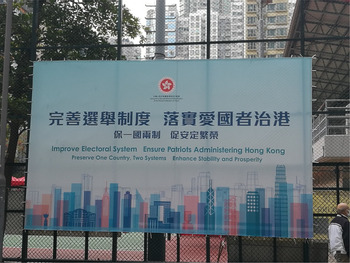
Responding to concerns about the erosion of freedom and democracy, the authorities once again reverted to socioeconomic claims. Ahead of her trip to Beijing to attend the NPC, Carrie Lam wrote on her Facebook page in March 2021 that “the prosperity and stability of the Hong Kong SAR are inseparable from national affairs.”Footnote 16 After the NPC confirmed Beijing's determination to overhaul Hong Kong's electoral system, Lam, along with her counterpart in Macau, thanked Beijing's support of their administration and “pledged to maintain the cities’ prosperity and stability.” Asked to remark on comments that the electoral overhaul would harm democratic development in Hong Kong, Chinese foreign minister Wang Yi said, “During the colonial times, there was no democracy in Hong Kong to talk about. In the 24 years since the handover, no one is more concerned about Hong Kong's democratic developments, prosperity and stability than the central government” (Cheung Reference Cheung2021). Upon her return to Hong Kong, Lam said that she was “gratified” to undertake Hong Kong's electoral overhaul after the enactment of the National Security Law, asserting her belief that the move would ensure stability and prosperity while safeguarding the “One Country, Two Systems” principle (Lam Reference Lam2021). Lam's statement reflected Beijing's official position. Xinhua news agency followed with reports on the NPC's resolution of “improving electoral system to promote Hong Kong long-term prosperity, stability” (Xinhua 2021). The practice of democracy was to include “Hong Kong characteristics.” A new formulation is emerging from the ruling regime: certain practices of freedom and democracy could be granted so long as stability was ensured, and prosperity could be sustained (figure 11).
Government propaganda linking electoral reform to prosperity/stability in 2021. Author's photograph.

In spite of the insistence of the ruling regime, the perennial narrative of prosperity/stability does not resonate with many Hong Kongers. The prosperity message in the absence of general affluence has become a weak rhetorical strategy on the part of the state. Instead of blockbuster GDP growth that often exceeded 10 percent prior to the 1990s, the Hong Kong economy has not only failed to register a single year of double-digit growth but also logged contractions in six years since the handover (Hong Kong Annual Digest of Statistics, 1998–2019). Against this backdrop of slower economic growth, income inequality has widened noticeably, as evidenced by the GINI coefficient, which rose from 0.45 in the 1980s (1 denotes most inequitable) to 0.539 in 2016 (the eighth worst of 174 places surveyed; more inequitable than China, ranked 73th) (CIA 2021). While real estate prices have skyrocketed fivefold since the low of 2003 (Centanet 2021), median monthly income increased only 58 percent from 1996 to 2016 (Hong Kong Census and Statistics Department 2001, 2016). Although the issue of housing affordability plagues many metropolitans in an era that decries income inequality worldwide, it is particularly problematic for the regime in Hong Kong, which strives to establish its credibility through the narrative of prosperity/stability. The people of Hong Kong are by no means all impoverished, but the confluence of these developments has resulted in a conspicuous erosion of upward mobility, making it difficult at least for the younger segment of the population to embrace the perennial narrative. In the name of democracy/freedom, this agitated segment of the population struggles against vested interests in the city, which staunchly adhere to the tried and true mantra of prosperity/stability.
Conclusion
The grassroots demands of recent protests in Hong Kong have focused on democracy/freedom, while the governing regime sticks to the perennial narrative of prosperity/stability to justify its ruling mandate. In reality, the gap between the socioeconomic proposition and the lived reality in Hong Kong has been widening for many. This mismatch, along with perceptions of dwindling possibilities for democratic reforms and constricting provisions for freedom, sowed the seeds for escalating political demands.
A 2019 opinion survey showed that most protesters appeared to be “highly educated,” while at the same time, 41.7 percent of the respondents identified themselves as “lower class.” The research team that conducted the survey observed that this sense of downward social mobility noted by some respondents did not necessarily imply an economic motivation for their participation in the protest (Lee, Yuen, and Cheng Reference Lee, Yuen, Tang and Cheng2019, 12). Indeed, the protesters have not necessarily staged their discontent for economic reasons, but their political demands could still be animated by perceptions of their slippery socioeconomic standing. Acknowledging the protesters’ fear of their eroding freedom, one could also question how the increasingly educated masses in Hong Kong perceive their socioeconomic status when such elementary needs as homeownership elude them. Linking the political demands to recent socioeconomic trends is especially warranted in light of the ruling regime's insistent invocation of the slogan of prosperity and stability. Ironically, for the most radicals in recent protests, the mantra fits: when there is no equitable sharing of prosperity in the city, they refuse to facilitate stability. This mentality is evident in the notion: “If we burn, you burn with us!”
Why, then, would the HKSAR government continue to rehearse the worn-out prosperity/stability narrative when it fails to mobilize the city's residents? Does this perennial narrative still resonate with some in the city? Is the government's emphasis on socioeconomic issues blinding it to political issues? Indeed, we cannot be too dismissive of the enduring impact of the old mantra. In the landslide victory in November 2019, forces not sympathetic with the governing regime won more than 80 percent of the seats in the District Council elections. Yet, in this election, which boasted record-high turnout, over 42 percent of some three million voters cast ballots in favor of the pro-establishment camp, even after months of anti-government demonstrations.Footnote 17 In spite of the election outcome, one cannot ignore the voices of this significant minority that continues to adhere to the governing regime. Prosperity is not evenly shared in Hong Kong. While not all who are economically prosperous are pro-establishment, the power of vested interests—those who have done well for themselves in the era of prosperity and stability—continues to be substantial.
The governing regime has demonstrated ample readiness to suppress opposition with force. The government's strategy parallels the desire of those inclined to protect the status quo—stability is their priority. That the Hong Kong government remains convinced of the enduring impact of the perennial narrative is understandable. Over 40 percent of the popular vote in what has most closely resembled a referendum in Hong Kong indicated that prosperity and stability is more than just the rhetoric of politicians. Not surprisingly, the pro-Beijing Democratic Alliance for the Betterment and Progress of Hong Kong (民建聯) has recently launched its campaign “Reform Hong Kong” with the tagline, “for stability, equality, prosperity” (in the Chinese version, 保穩定 促公平 享繁榮) (DAB 2021). In essence, the ruling camp has acknowledged that the appeal of the old mantra has eroded. The city does not provide a fair system in which everyone shares in the economic gains. Even if the city were to return to its former equilibrium brokered by socioeconomic promises in the absence of political guarantees, general prosperity and social stability would not suffice without more equitable distribution.
Few would dispute that democracy and freedom, as well as prosperity and stability, are noble aspirations. Their invocations in recent years in Hong Kong indicate that various parties have deployed strategically these aspirations as rallying cries to justify or challenge the legitimacy of governance. Viewed through this lens of the Hong Kong experience, it is more understandable why Chinese mainlanders, who are experiencing the prosperity of their own economic takeoff, would acquiesce to a regime that emphasizes stability over political reforms. Some even consider Beijing's strategy of “Let Hong Kong burn” to be a warning to the rest of China of the mess that ensues from the pursuit of “democracy and freedom” (Dapiran Reference Dapiran2020). While repressive when dealing with challenges to its authority, the CCP responds, on its own terms and selectively, to economic and social demands of the populace without being accountable to them through elections. That approach has sustained the party's rule. In fact, for many mainlanders, democracy is not calibrated by elections but fulfilled by what the state delivers in terms of governance, economic performance, and quality of life. Rooted in the belief that the state should act in the people's interests (more akin to minben 民本), this brand of democracy is already at work in the minds of many in China who are therefore less likely to call for democratic reforms according to Western frameworks (Dickson Reference Dickson2021).Footnote 18 Similarly, different conceptualizations of democracy could also have split the Hong Kong society, accounting for the sizable bloc that voted in the 2019 election, albeit futilely, for pro-establishment candidates.
Are Hong Kongers evolving from homo economicus to homo politicus? The coalescence of forces that crystalized the prosperity/stability mantra produced a population that privileged socioeconomic factors. Since the late 1980s, geopolitical shifts, along with Hong Kong's accommodation of and adjustments to such shifts, have precipitated a rising consciousness about individual rights and political representation. In recent rounds of escalating anti-establishment movements, democracy/freedom consumes the attention of protesters. However, this process is not a binary transformation from a focus on economic well-being to political preoccupation. Deeply divided voters’ allegiance exposes the ongoing negotiations among Hong Kongers.
Deng Xiaoping's formulation of the “One Country, Two Systems” model provided fifty years of status quo for Hong Kong. That stipulation was to allow “[t]he present capitalist system [to] remain unchanged for 50 years after 1997,” Deng explained in 1987 as he cautioned against Western democracy and hasty political reforms in Hong Kong (SCMP, April 17, 1987, 1; WKYP, April 17, 1987, 1; TKP, April 17, 1987, 1). While current discussions in Hong Kong usually insist on Hong Kong's political autonomy in the interpretation of “Two Systems,” Deng's idea seems to have emphasized two different economic ways of life. Former Legislative Council president Rita Fan even openly stated that the “One Country, Two Systems” principle referred to “the economic system, but not the political system” (The Standard 2021). Ironically in that regard, mainland China and Hong Kong have indeed converged—on the flourishing capitalistic mode of operations on either side of the Shenzhen River.
As for political reforms in Hong Kong, Deng and his successors had not presented its development as a foregone conclusion. Articles 45 and 68 of the Basic Law specify the “ultimate aim” of the selection of the Chief Executive and the election of all legislators by universal suffrage. Nonetheless, these articles are preceded by the yet-to-be-enacted Article 23, which requires that Hong Kong provide for legislation against, among other things, “any act of treason, secession, sedition, subversion against the Central People's Government” (Constitutional and Mainland Affairs Bureau 2017). In the blueprint that the CCP endorsed, the development of democracy and freedom was to entail ongoing elaborations that required Beijing's intervention.
Equally ironic is the CCP's adoption of catchphrases used by the British colonial authorities that it once challenged. It is important to note that this is no isolated incidence, as other states (for instance, Singapore) that have emerged from anticolonial struggles are now governed by regimes that privilege order and stability in their bid to create a good business environment. The enduring efficacy of this strategy points to a problematic emphasis on stability and harmony in certain Asian societies. Yet another parallel that transcends political divide is the strategy to blame unrest on external forces. The British colonial regime blamed infiltration of Mao's communist China for the riots of 1966–67 (Scott Reference Scott1989, 97). Similarly, CCP authorities under Xi, in conjunction with the HKSAR government, attribute recent unrest in Hong Kong to foreign powers. To execute their legitimation strategies, the different regimes sought to delegitimize their opponents as instigators of social and economic upheavals.
The two narratives—prosperity and stability, on the one hand, and democracy and freedom, on the other—underscore the contesting forces that vie for the mandate to govern Hong Kong. Negotiations of these various notions go beyond political legitimacy as the discourse penetrates the core of Hong Kong's unique position as a forerunner in the reform (at least economically) of Greater China. Only through earnest and delicate engagement that promises not to exclude any crucial contingent could Hong Kong craft the next narrative that sustains the city's prowess and propel it to the next stage of development.
Acknowledgments
I presented earlier versions of this article at the Civil Unrest in Hong Kong Conference at the Faculty of Law of the University of Hong Kong, at a talk for the Hong Kong Studies Initiative at the University of British Columbia, and at the Yale MacMillan Center's Council on East Asian Studies colloquium. I would like to thank Louise Edwards, Leo Shin, and Andrew Wong for their thoughtful comments on this article. Michael Ng shared with me materials from the “Future of Hong Kong” files at the National Archives in the United Kingdom. Kelvin Chan and Jason Chu provided research assistance. Two anonymous reviewers offered meticulous and engaging comments.
Author Bio
John D. Wong is Associate Professor in the Hong Kong Institute for the Humanities and Social Sciences and the School of Modern Languages and Cultures at the University of Hong Kong.