Introduction
Biological collections provide a foundation for many fields of study, including agriculture, human health, global change biology, and natural resource management (Pyke and Ehrlich Reference Pyke and Ehrlich2010; Rocha et al. Reference Rocha, Aleixo, Allen, Almeda, Baldwin and Barclay2014; Tewksbury et al. Reference Tewksbury, Anderson, Bakker, Billo, Dunwiddie and Groom2014). Nowhere is this more evident than in entomology. Insect collections provide current and historical information on insect natural history, biodiversity, and biogeography, and are essential to research in taxonomy, evolution, ecology, and conservation.
While insect collections are an important aspect of entomological research, they do involve the permanent removal of insects from their habitat. Concerns over the loss of wildlife biodiversity have given rise to policy and legislation to protect wildlife from harm and loss. The federal Species at Risk Act came into effect in 2003 as a measure to guide the protection of wildlife in Canada. With an increase in the number of insects protected under federal and provincial legislation, researchers should be aware of their duty to help protect and conserve protected wildlife. This study aims to demystify some of the legislations and policies relating to insect species at risk, and to provide the necessary information to help entomologists conduct their research in compliance with that legislation.
Conservation status and species at risk
The conservation status of a species is intended to reflect the likelihood that it will go extinct. Systems used to assign conservation status assess a variety of quantitative and qualitative criteria to produce a rank reflecting extinction risk. Species may be assessed at different geographic scales, including globally, nationally, or regionally; in the case of scales smaller than global, the status then reflects the risk of extirpation from that region. Two major systems that are used for conservation status assessment include those developed by the International Union for the Conservation of Nature Red List (International Union for the Conservation of Nature 2012) and NatureServe (Faber-Langendoen et al. Reference Faber-Langendoen, Nichols, Master, Snow, Tomaino and Bittman2012; Master et al. Reference Master, Faber-Langendoen, Bittman, Hammerson, Heidel and Ramsay2012).
Provincial and regional conservation data centres (e.g., the Natural Heritage Information Centre in Ontario, the Atlantic Canada Data Centre) and members of the National General Status Working Group assign conservation status ranks to species in Canada using the NatureServe system. The National General Status Working Group and the conservation data centres assign national and subnational ranks (N-ranks and S-ranks), respectively. These ranks have no legal standing under endangered species legislation in any jurisdiction in Canada. However, they can inform the prioritisation of candidate species for assessment under endangered species legislation as well as have implications for land use planning; in addition, they may be more important in jurisdictions with no formal lists of species at risk.
The Committee on the Status of Endangered Wildlife in Canada (COSEWIC) under federal legislation assigns ranks to species at risk in Canada. The Committee on the Status of Endangered Wildlife in Canada is an arms-length, independent panel composed of species experts from academia, government, nongovernmental organisations, and private sectors. The members of the Committee on the Status of Endangered Wildlife in Canada use a modified version of the International Union for the Conservation of Nature system to assess species at risk in Canada, which may then be protected under federal law. Some, but not all, of the provinces and territories have their own bodies that assign ranks to species at risk in their jurisdictions. These processes are covered in more detail in the following sections.
Federal species at risk
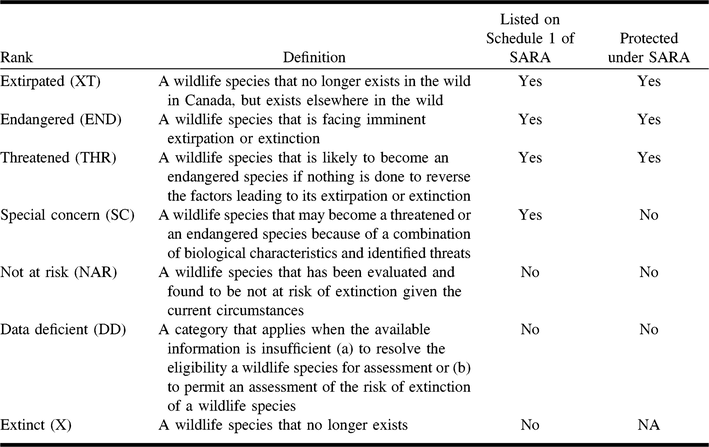
The federal endangered species legislation is the Species at Risk Act. Under the Species at Risk Act, the Committee on the Status of Endangered Wildlife in Canada is mandated to carry out scientifically sound classification of wildlife species at risk of extinction. Full details on the assessment process and quantitative criteria used by the Committee on the Status of Endangered Wildlife in Canada are available on their website (www.canada.ca/en/environment-climate-change/services/committee-status-endangered-wildlife.html). The Committee on the Status of Endangered Wildlife in Canada includes 10 species specialist subcommittees, including one that deals with arthropods. The Arthropod Species Specialist Subcommittee currently has 14 members and two co-chairs; Catling et al. (Reference Catling, Packer and Goit2009) provided a useful overview of how the subcommittee works. Briefly, the species specialist subcommittees assess the status of species and make recommendations for their inclusion on the federal species at-risk list, under the status categories of extirpated, endangered, threatened, or special concern. Species may also be assessed as not at risk or data deficient (see Table 1 for definitions of ranks).
Definitions of species ranks as used by the Committee on the Status of Endangered Wildlife in Canada, and whether or not species with that rank are listed on Schedule 1 and protected from harassment, harm, etc., under the federal Species At Risk Act (SARA).

A species only becomes formally listed as at risk federally once the Minister of Environment and Climate Change adds it to Schedule 1 of the Species at Risk Act. While species of all four at-risk status categories are listed on Schedule 1, only those species designated as extirpated, endangered, or threatened are protected from killing, harming, harassing, capturing, etc., under federal legislation. Species listed as special concern on Schedule 1 are not protected under the Species at Risk Act; however, the government is responsible for producing a management plan for these species, which sets goals and objectives for maintaining sustainable population sizes. Species listed as extirpated, endangered, or threatened under Schedule 1 must also have a recovery strategy prepared, which identifies what needs to be done to arrest or reverse the decline of the species.
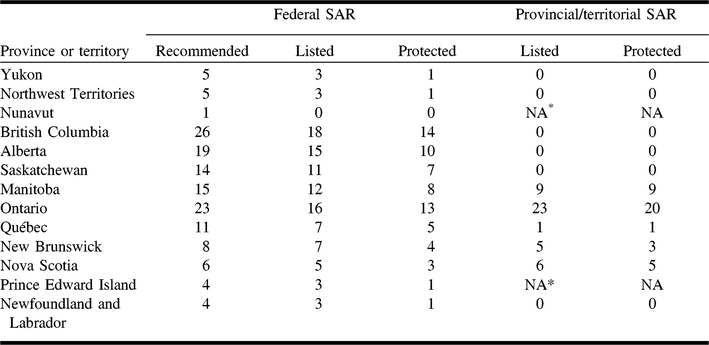
All of the provinces and territories have at least one insect species that has been recommended for listing by the Committee on the Status of Endangered Wildlife in Canada, ranging from one in Nunavut to 26 in British Columbia (Table 2 and Supplementary Table 1). In addition, all of the provinces and territories except Nunavut have at least three insect species listed on Schedule 1 of the Species at Risk Act. However, in all cases, the number of protected insect species is lesser than the number of listed insect species, which is lesser than the number of insect species recommended for listing.
Summary of the number of insect and spider species at risk (SAR) that have been recommended, listed, and protected under federal and provincial/territorial legislation as of January 2019.

* No species at risk have been listed in either Nunavut or Prince Edward Island.
Provincial and territorial species at risk
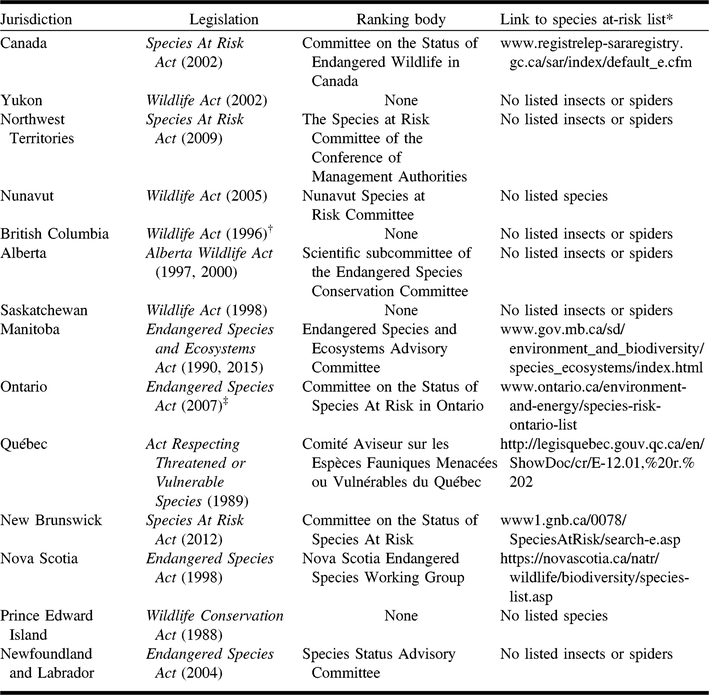
All provinces and territories have some legislation that addresses endangered species (Table 3), but there are important differences. Nixon et al. (Reference Nixon, Page, Pinkus, Podolsky and Russell2012) provided a critical assessment and comparison of endangered species legislation across the country. Six provinces and territories cover endangered species under various types of wildlife acts, whose primary purpose is to regulate activities like hunting and trapping. The other seven provinces and territories cover endangered species under acts that specifically outline requirements for the identification and protection of species at risk. We note that these provinces and territories with species at risk acts may also have wildlife acts, and that both may have relevance for insects and other arthropods. Most of the provinces and territories use species ranks with names and definitions that are similar to those used by the Committee on the Status of Endangered Wildlife in Canada (i.e., endangered, threatened) with some minor differences. Québec’s legislation, the Act Respecting Threatened or Vulnerable Species, only defines two categories of endangered species: threatened and vulnerable.
Endangered species legislation across Canada, including the ranking bodies responsible for assessing the status of species at risk as well as a link to the list of species at risk in that jurisdiction if any insects or spiders have been listed as of January 2019.

* These links are to full lists of species at risk in these jurisdictions; lists for Canada, Ontario, and New Brunswick can be searched by taxon to identify insect and spider SAR; the list for Québec is a regulation associated with the Act Respecting Threatened and Vulnerable Species (only animals are listed in this regulation; plants are listed under a separate regulation).
† British Columbia has recently introduced Bill M 244 2017 – Endangered Species Act, 2017. If passed, this legislation will establish the Scientific Committee on Endangered Species as the provincial ranking body, and this body will begin the work of assessing species and assigning each assessed species a provincial conservation status.
‡ The government of Ontario began the process of reviewing the Endangered Species Act in January 2019; at the time of publication of this paper, it was unclear what the proposed changes may be or how they will affect the information presented here.
While most of the provinces and territories have listed at least some species at risk under their provincial or territorial legislation, only five provinces have listed insect species at risk: New Brunswick (5), Nova Scotia (6), Québec (1), Ontario (23), and Manitoba (9) (Table 2 and Supplementary Table 1). Like the federal Species at Risk Act, the legislation in the provinces of Nova Scotia, New Brunswick, Ontario, and Manitoba only protects species listed as extirpated, endangered, or threatened. In Québec, both ranks of threatened and vulnerable are protected. Thus, the number of legally protected insect species is lesser than the number of listed species at risk in Nova Scotia, New Brunswick, and Ontario. We note that some provinces and territories have insect species in the queue for assessment (e.g., three bumble bees (Bombus Latreille; Hymenoptera: Apidae) in the Northwest Territories; Northwest Territories Species at Risk Committee 2018), and that in some cases, insect species have been recommended for listing by the provincial ranking body but not yet approved by the relevant minister (e.g., Tegeticula yuccasella (Riley) (Lepidoptera: Prodoxidae) in Alberta; Government of Alberta 2016).
For the most part, the insects listed federally are the same as those listed provincially, as most provincial bodies responsible for assessing the status of species use the Committee on the Status of Endangered Wildlife in Canada lists to inform their own lists. However, the provincial ranks and federal ranks may not always be the same; for example, Manitoba’s Endangered Species and Ecosystems Advisory Committee has assessed Hesperia ottoe Edwards (Lepidoptera: Hesperiidae) as threatened, while the Committee on the Status of Endangered Wildlife in Canada has assessed it as endangered. In addition, provinces may assess and list species not on the federal list: currently, Manitoba has two additional listed insect species (Hesperia uncas Edwards and Neominois ridingsii (Edwards) (Lepidoptera: Nymphalidae)) and Ontario has one (West Virginia white, Pieris virginiensis (Edwards) (Lepidoptera: Pieridae)).
Collecting and permits
Purposefully collecting a species at risk should only be done for the purposes of research that may help in the protection or recovery of that species. Anyone conducting activities that may affect a species at risk should at least discuss their project with a permit coordinator to see whether a permit is required; for example, if you are planning a general arthropod biodiversity study in the habitat of a known insect species at risk, you may require a permit. The same would apply if your collection methods may result in incidental catches of nonarthropod species at risk – for example, if you are planning on using pitfall or pan traps in the habitat of an endangered salamander.
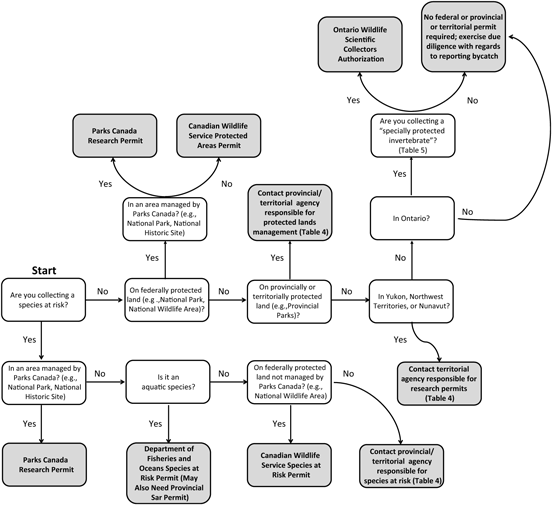
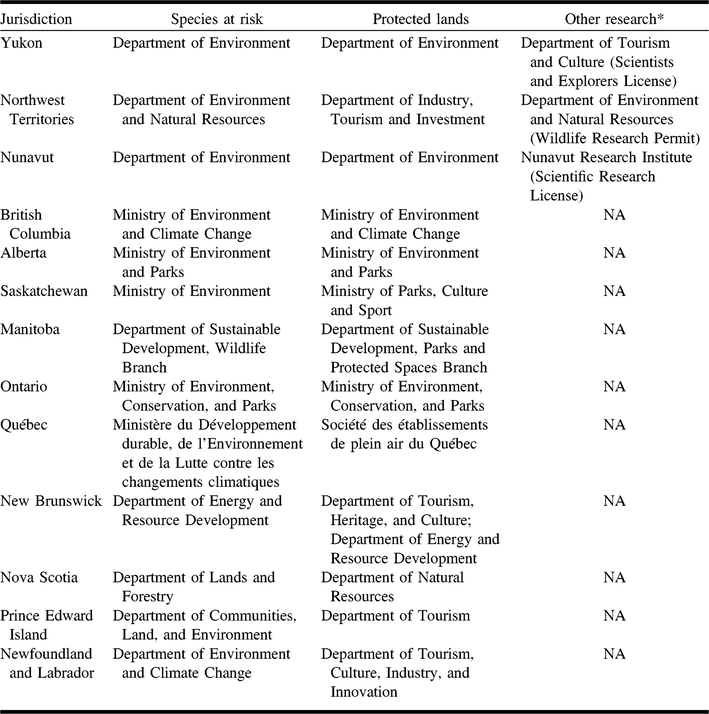
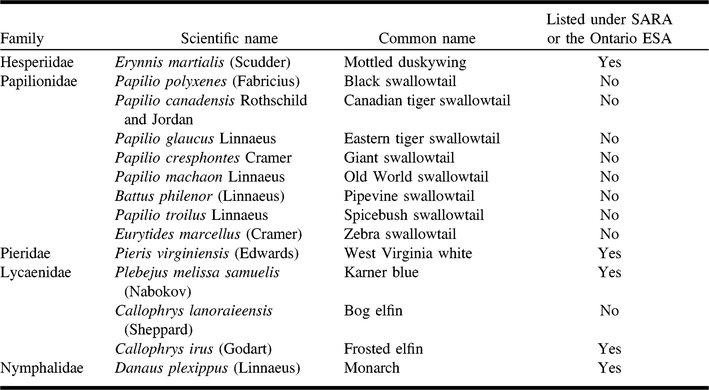
Different permits are required to collect species at risk, depending on the general habitat of the species (i.e., terrestrial versus aquatic), the jurisdiction, and the land ownership type. In addition, some jurisdictions require permits for collection of any species in any location (e.g., Yukon, where a Scientists and Explorers License is required; Table 4) or particular species in any location (i.e., specially protected invertebrates in Ontario, which are not all species at risk; Table 5). Figure 1 provides information on the permits required in a number of different situations for those wishing to collect insects in Canada – whether they are species at risk or not. Note that this only covers federal and provincial or territorial permits – additional permits may be required on lands managed by local agencies, such as conservation authority lands in Ontario or First Nations lands anywhere in the country. If you are planning on collecting insects in Canada, you should familiarise yourself with the local natural resource management policies and authorities, and seek advice from local experts on which permits may be needed early on in the planning process. We note that while our flowchart indicates single endpoints in some situations, additional permits may be required in some rare situations (e.g., a provincial species at risk permit may be required in addition to a Parks Canada permit). Although the permitting agencies responsible would generally inform applicants if this were the case, researchers should be aware of this possibility.
Situational guide to permitting in Canada, for research activities involving the collection of arthropods. Note that we strongly recommend that anyone carrying out such research familiarise themselves with the local and federal legislation, and contact the relevant provincial or territorial authorities early on in the planning process. SAR, species at risk.

Provincial and territorial agencies responsible for permits relating to species at risk, protected lands management, and research relating to wildlife collection not covered by the first two categories, as of January 2019.

* The three northern territories require permits for most research activities in their jurisdictions, regardless of whether or not other permits are also required.
Specially protected invertebrates listed under the Ontario Fish and Wildlife Conservation Act *, as of January 2019, as well as whether they are listed under the federal Species at Risk Act (SARA) or the Ontario Endangered Species Act (ESA). All taxa listed are in the order Lepidoptera.

* The Fish and Wildlife Conservation Act can be read here: www.ontario.ca/laws/statute/97f41; any updates to the species on this list may be found under Regulations, Schedule 11.
Transport of specimens
It may be necessary in some instances to transport specimens across provincial borders. We would again advise researchers to seek advice from local authorities in all provinces and territories where specimens may be transported as to the legalities surrounding transport, and any additional permits that may be required for such transport.
The subject of international transport of species at risk is not specifically covered by the Species at Risk Act and is outside the scope of this article. Researchers wishing to find more information may consult a recent publication by Mason et al. (Reference Mason, Bennett and Fraleigh2018), which briefs on the issues of international transport.
By-catch
Protected species are occasionally found as unintentional collections, or by-catch, during projects targeted at other taxa. If the project was operating under a permit, the by-catch should be reported as outlined in the permit. If the project was not operating under a permit, the by-catch should still be reported to the provincial or territorial agency responsible for species at risk. There are no legal repercussions for genuinely accidental harm to a species at risk, as long as the research is not conducted in a frivolous or reckless manner. Studies should be well planned, and carefully executed so as to minimise the risk of accidental harm. In instances where a species at risk is accidentally captured, data from the collection record may provide important information for the recovery and management of the species.
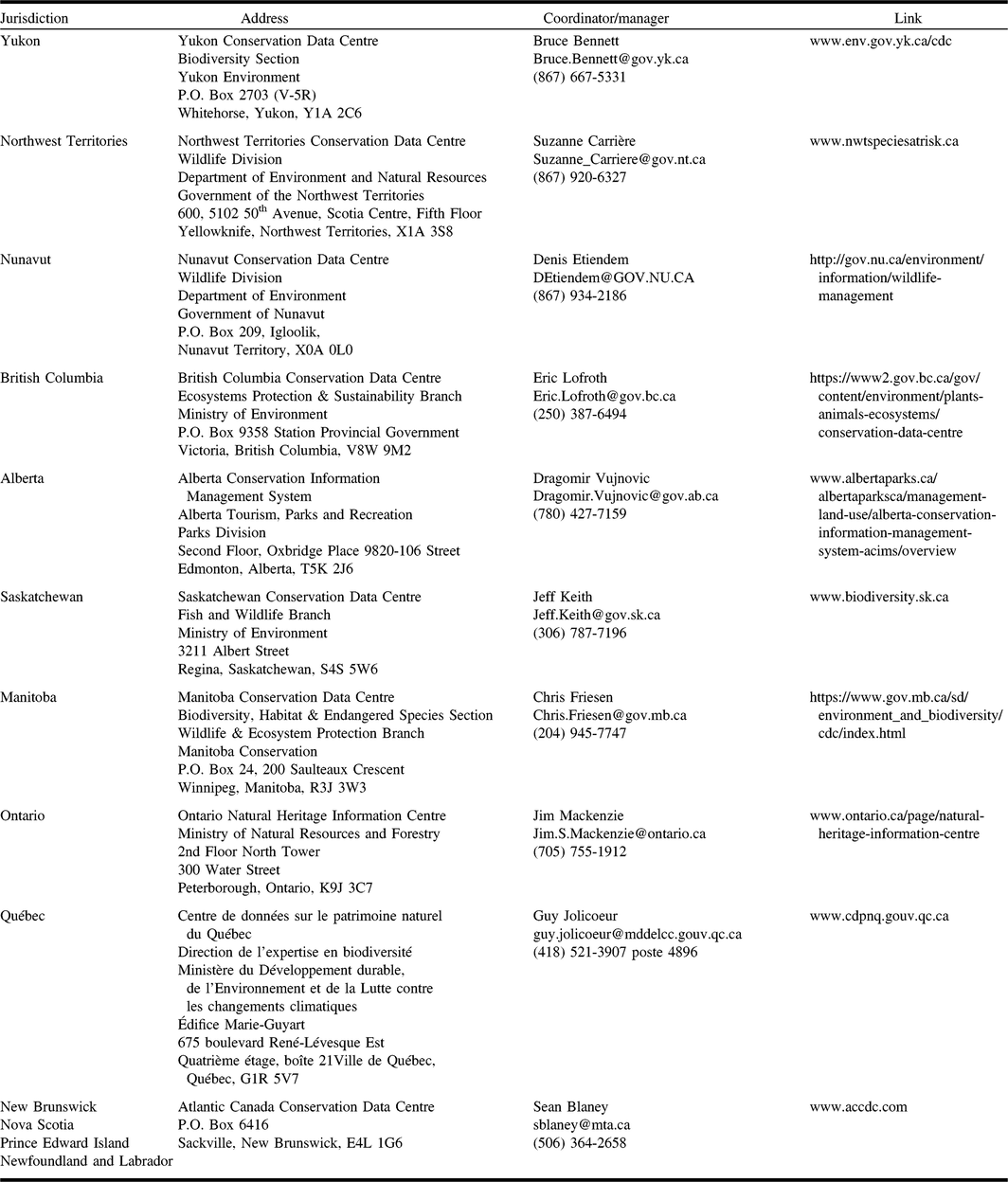
Conservation data centres across Canada have assigned S-ranks to at least some of the arthropods in all provinces and territories. Those with ranks S1–S3 are considered to be species of conservation concern – these species have the highest risk of extirpation from the region where the assessment took place. Not all species with ranks S1–S3 are at risk; either because they do not meet the criteria for species at risk or because they have not been assessed. There are no formal requirements for the reporting of collection of an S1–S3 species. However, we encourage all researchers to exercise due diligence and report these species to their local conservation data centre when they are encountered (Table 6). Data on arthropods are sorely lacking, making every collection record useful – for example, if the species does come up for assessment by the Committee on the Status of Endangered Wildlife in Canada or by a provincial or territorial committee.
Conservation data centres across Canada, with their addresses, names, and contact information for their coordinators, and website link, as of January 2019.

Penalties under the Species at Risk Act
The Species at Risk Act indicates that permits are required for those engaging in activities that may affect species that are listed as extirpated, endangered, or threatened under Schedule 1 of the Species at Risk Act. Permits are also required for activities that may violate the Species at Risk Act general or critical habitat prohibitions. These prohibitions include harassing, harming, killing, collecting, possessing, buying, selling, or trading a species listed as extirpated, endangered, or threatened, and/or damaging or destroying the residence of these species (Government of Canada 2002). Anyone engaging in these activities without a permit, or who fails to comply with the terms of a permit, is in violation of the Species at Risk Act, and subject to penalty. Under the federal legislation, penalties for individuals who commit an offense can range from fines to terms of imprisonment. Corporations in violation of the Species at Risk Act are also subject to fines. The court also has the right to make additional orders to any imposed punishments. Some examples include community service, subjecting offenders to environmental audits, publication of details surrounding an offense, additional payments for the remediation and preventative action resulting from the offence, and prohibiting an individual from engaging in activities that could result in repetition of an offense (Government of Canada 2002).
The implementation of the Species at Risk Act is the responsibility of the Parks Canada Agency, Fisheries and Oceans Canada, and Environment and Climate Change Canada. As of 2016, there have been a total of 27 convictions brought by federal agencies under the Species at Risk Act (Environment and Climate Change Canada 2016). These cases have included violations such as unlawful capture and/or possession of species at risk, disturbing the habitat of a species at risk, harassing and/or killing species at risk. In 2009, two photographers were convicted of damaging the habitat of the endangered Western yellow-breasted chat (Icteria virens (Linnaeus); Aves: Icteriidae) while taking photographs of the birds. They were sentenced to 12 months of probation, in addition to court order to pay a total of CAD$6000 to the Canadian Wildlife Service for research into the protection of the species. They were also prohibited from sharing or profiting from any of the photographs taken. In 2014, an individual was fined CAD$2500 under the Species at Risk Act after swimming in a restricted area of Banff National Park that houses the threatened Banff Springs snail (Physella johnsoni (Clench); Gastropoda: Physidae) thus disturbing its habitat. In April 2018, two homeowners dredged the shoreline adjacent to their properties. In doing so, they unknowingly damaged the habitat of the threatened spotted gar (Lepisosteus oculatus (Winchell); Actinopterygii: Lepisosteidae). They were each fined CAD$3500. CAD$6000 of the total CAD$7000 fine was allocated to the Environmental Damages Fund to support recovery work for the spotted gar (Cision 2018).
There have been no convictions brought under the federal the Species at Risk Act for violations involving at-risk insects or their habitats. The above examples, however, highlight the seriousness of violating the Species at Risk Act and the importance of acting to protect species at risk.
Conclusion
Canada has implemented legislation and policies to ensure the conservation and protection of species at risk and their habitats. At-risk species and their habitats are protected in Canada under both the federal Species at Risk Act and corresponding provincial acts protecting endangered wildlife. There are steep penalties for individuals who violate the prohibitions of legislation protecting species at risk. Although there have been no convictions under the federal Species at Risk Act for violations involving at-risk insect species, researchers whose work may affect any species at risk – whether that species is the focus of the study or not – are advised to correspond with permit coordinators and provincial or local authorities to determine if they require a permit. In addition, the submission of data related to the collection of species of conservation concern can benefit research and assessment of these potentially rare species. All Canadians have a duty to help conserve and protect wildlife. We encourage Canadian researchers to play an active role in protecting Canadian wildlife by ensuring that their research is conducted in accordance with federal and provincial legislation.
Supplementary material
To view supplementary material for this article, please visit https://doi.org/10.4039/tce.2019.22.
Acknowledgements
This article was written as an exercise of the Entomological Society of Canada’s Science Policy Committee. We are grateful to the other members of the committee for their input and encouragement – Amanda Roe, Dezene Huber, and Christopher Ernst. Many experts across the country contributed information on legislation and permitting in their respective regions via an email questionnaire, which was coordinated by Patrice Bouchard. Finally, we thank two anonymous reviewers for helpful comments on an earlier draft of the manuscript.