INTRODUCTION
Phosphorus (P) is an essential macronutrient for crop growth. Maximum P availability to crops in soils generally occurs at a pH range of 6 to 7. Phosphorus deficiency in tropical acid soils (predominantly Ultisols and Oxisols) is a problem as soluble forms of inorganic P are fixed with iron (Fe) and aluminium (Al) (Adnan et al., Reference Adnan, Mavinic and Koch2003). The high affinity of Fe and Al for P causes considerable immobilization of P fertilizers applied to Ultisols and Oxisols. Liming and regular application of P fertilizers such as phosphate rocks are the conventional practices that are used to mitigate P fixation in acid soils. To maintain an adequate supply of plant-available P, liming is carried out to decrease Al and Fe ions solubility. Over-liming can cause P fixation by calcium (Ca), and excessive or unbalanced use of P fertilizers may result in eutrophication (not environmental-friendly). Liming may also not be economical in regions where it is expensive.
In order to mitigate P fixation in tropical acid soils, organic amendments are used to reduce P sorption sites (Ohno and Amirbahma, Reference Ohno and Amirbahma2010; Ohno et al., Reference Ohno, Fernandez, Hiradate and Sherman2007). Addition of green manures and animal wastes to acid soils reduced P fixation (Berek et al., Reference Berek, Radjagukguk and Mass1995; Hue, Reference Hue1992). Organic residues have also been used to increase P uptake and crop growth on P-deficient acid soils (Hue, Reference Hue1990; Hue et al., Reference Hue, Ikawa and Silva1994). Incorporation of organic amendments in highly weathered soils enhances dissolution of phosphate rocks. This is because of the competition between the decomposition products of organic amendments and free phosphate ions for sorption sites, and the release of H+ ions and phosphatase enzymes from microorganisms (Guppy et al., Reference Guppy, Menzies, Moody and Blamey2005). Addition of organic soil amendments enhances the microbial activity and releases microbial metabolites such as organic acids (Giacomini et al., 2009; Lin et al., 2006). The hydroxyl and carboxyl groups of organic acids chelate the cations (Al and Fe) bound to phosphate, thereby converting the phosphate into soluble forms, and increase P availability in the soil (Cheng et al., Reference Cheng, Lehmann and Engelhard2008).
Although there exists some information on P sorption and fixation using organic matter (Ohno and Amirbahma, Reference Ohno and Amirbahma2010; Ohno et al., Reference Ohno, Fernandez, Hiradate and Sherman2007), there is dearth of information on the use of compost with large surface area and negative charges to minimize P fixation in acid soils. The problem of P fixation in soil can be solved by the addition of organic materials. This process will enable long-term chelation of Al and Fe by compost instead of P. Biochar and compost are alkaline in nature and may increase the soil pH. The negatively charged functional groups of humic/fulvic acids and humin in compost will preferably chelate Al and Fe ions in alkaline condition and release phosphate ions (Geckeis et al., Reference Geckeis, Rabung, Ngo-Manh, Kim and Beck2002). Addition of biochar or compost may improve porosity and surface area, and these materials bear functional groups with negative charges, which can sorb Al and Fe, thus minimizing P fixation in soil (Iyamuremye and Dick, Reference Iyamuremye, Dick and Baham1996; Violante and Gianfreda, Reference Violante and Gianfreda1993).
The objectives of this study were to (i) improve soil P availability using biochar and compost produced from poultry manure and pineapple leaves, respectively, and (ii) determine whether the use of biochar and compost in a tropical acid soil could improve nitrogen (N), P, potassium (K), Ca and magnesium (Mg) uptake and dry matter production of Zea mays L.
MATERIALS AND METHODS
Soil sampling
Soil samples used in this study were collected from an uncultivated site (50 × 50 m) at Universiti Putra Malaysia Bintulu Sarawak Campus (03°20' N, 113°07' E), and belong to Bekenu series (Typic Paleudult). This soil series was selected because it is cultivated with different crops in Malaysia and elsewhere and is characterized by high P fixation due to the high contents of Al and Fe in this soil. The soil samples were air-dried, ground and sieved to pass 2-mm (for incubation study) and 5-mm sieve (for pot experiment). Afterwards, the soil samples were bulked and used subsequently for incubation and pot experiments.
Analyses of soil and organic amendments
Before the incubation and pot experiments were carried out, the soil samples were analysed for pH and electrical conductivity (EC) using pH meter and EC meter, respectively (Peech, Reference Peech1965). Soil texture was determined following the hydrometer method (Bouyoucos, Reference Bouyoucos1962). Total organic matter (OM) was determined following the loss on ignition method (Chefetz et al., Reference Chefetz, Hatcher, Hadar and Chen1996), and the total carbon (C) was derived from the total OM using a conversion of factor of 0.58 (Tan, Reference Tan2003). Total N was determined by the micro-Kjeldahl method (Bremner and Lees, Reference Bremner and Lees1949). The total P was estimated following the aqua regia method (Bernas, Reference Bernas1968; Tan, Reference Tan2003) whereas the soil-available P was extracted using the Mehlich No. 1 double acid method (Mehlich, Reference Mehlich1953; Tan, Reference Tan2003), and estimated by the molybdenum blue method (Murphy and Riley, Reference Murphy and Riley1962). Potassium, Ca, Mg, Na and Fe were extracted using ammonium acetate, and estimated using Atomic Absorption Spectrophotometer (AAS) (Tan, Reference Tan2003). Exchangeable acidity and Al were determined by following the method as described by Anderson and Ingram (Reference Anderson and Ingram1993). Biochar with a brand name of ‘Better Earth Products’ was used in this study. The biochar is from poultry manure, which is subjected to pyrolysis at a constant temperature of 550 °C for 20 min. (The system is a continuous-flow pyrolysis system and converts virtually all the retained C in a fixed form with extremely low CO2 emissions.) The compost used in this study was prepared by co-composting pineapple leaf residues and chicken manure slurry produced in our previous study (Ch'ng et al., Reference Ch'ng, Ahmed, Kasim and Majid2013). The biochar and compost were analysed for pH, EC, total OM, total C. Total N, P, K, Ca, Mg, Na, Zn, Cu, Fe and Al contents in biochar and compost were estimated following the dry ash method as described by Cottenie (Reference Cottenie1980). Cations K, Ca, Mg, Na, Zn, Cu, Fe and Al were determined by AAS and P using the molybdenum blue method (Murphy and Riley, Reference Murphy and Riley1962). C/N and C/P ratios of soil, biochar and compost were calculated using the respective total C, N and P contents.
Incubation study
An incubation study was carried out for 90 days at Universiti Putra Malaysia Bintulu Sarawak Campus, Malaysia. From the bulked 2-mm soil sample, 300 g of soil was weighed using a digital balance for each treatment in a 500-mL beaker. Each treatment was replicated for three times. Christmas Island Rock Phosphate (CIRP) was the source for P fertilizer, but no source was used for N or K fertilizers in this study. CIRP, compost (Ch'ng et al., Reference Ch'ng, Ahmed, Kasim and Majid2013) and commercial biochar were used at the rates of 60 kg P2O5 ha−1, 10 t ha−1 and 20 t ha−1 respectively. These rates were based on the standard recommendation for maize (Zea mays L.) cultivation (John et al., Reference John, Uwah, Iren and Akpan2013; Malaysia Agricultural Research and Development Institute (MARDI), 1993; Zhang et al., Reference Zhang, Liu, Pan, Hussain, Li, Zheng and Zhang2012). Biochar and compost were applied at the recommended rates of 20 t ha−1 and 10 t ha−1 respectively (John et al., Reference John, Uwah, Iren and Akpan2013; Zhang et al., Reference Zhang, Liu, Pan, Hussain, Li, Zheng and Zhang2012). Based on these recommendations, 28.8 g of biochar and 14.4-g compost were applied per 500-mL beaker. Soil, CIRP, biochar and compost were mixed thoroughly. Beakers with the treatments were sealed with perforated para-film to prevent moisture loss and to ensure good aeration. The treatments were as follows:
-
T0 – soil only
-
T1 – 300-g soil + 7.7-g CIRP
-
T2 – 300-g soil + 7.7-g CIRP + 28.8-g biochar
-
T3 – 300-g soil + 7.7-g CIRP + 14.4-g compost
-
T4 – 300-g soil + 7.7-g CIRP + 14.4-g compost + 28.8-g biochar
The treatments were arranged in a factorial completely randomized design. Separate sets of (15 each) samples were incubated for 30, 60 and 90 days after incubation (DAI). The soil samples were maintained at field capacity (70%) throughout the incubation period. The room temperature during the incubation study was maintained at 27 °C. The soil samples after each incubation period were air-dried and analysed for pH, exchangeable acidity, exchangeable Al, Ca and Fe. Inorganic P (Pi) fixed by Al, Fe and Ca were fractionated at the end of the incubation study. All incubated soil samples were analysed for P fractions (Al–Pi, Fe–Pi, redundant soluble Pi, Ca–Pi and organic P (Po) as described by Kuo (Reference Kuo1996).
Pot experiment
A pot experiment was conducted in a net house at Universiti Putra Malaysia Bintulu Sarawak Campus, Malaysia, using the test crop, Zea mays L. hybrid F1. Pots (22 cm in height and 30 cm in diameter) were filled with 7 kg of soil (5-mm bulked sample). To study the effects of biochar and compost on the chemical properties of soil, nutrients uptake and dry matter production of Zea mays L., N, P and K fertilizers were used in this pot experiment. Urea, CIRP (30% P2O5) and muriate of potash (MOP) were applied at the rates of 60 kg N ha−1, 60 kg P2O5 ha−1 and 40 kg K2 O ha−1 respectively. These rates were based on the recommendation of the Malaysia Agricultural Research and Development Institute (1993). The fertilizers were applied in two equal splits, i.e. at 10 and 28 days after sowing (DAS). Compost and biochar were applied at the rates of 10 t ha−1 and 20 t ha−1 respectively. The compost and biochar rates used in this study were based on the standard recommendation for maize (Zea mays L.) cultivation (John et al., Reference John, Uwah, Iren and Akpan2013; Zhang et al., 2013). The treatments were as follows:
-
T0 – 7-kg soil (no input of N, P and K)
-
T1 – 7-kg soil + recommended N, P and K (5-g urea + 7.7-g CIRP + 2.58-g MOP
-
T2 – 7-kg soil + 5-g urea + 7.7-g CIRP + 2.58-g MOP + 769-g biochar
-
T3 – 7-kg soil + 5-g urea + 7.7-g CIRP + 2.58-g MOP + 385-g compost
-
T4 – 7-kg soil + 5-g urea + 7.7-g CIRP + 2.58-g MOP + 385-g compost + 769-g biochar
Soil, urea, CIRP, MOP, compost and biochar were mixed thoroughly. Maize seeds were soaked in water for 24 h, sown at a depth of 4 cm and covered with loose soil. Five seeds were sown per pot, and these were thinned to two at seven DAS. The pot experiment was conducted in a completely randomised design with three replications. The soil moisture was maintained at 70% field capacity throughout the experiment.
The plants were monitored for 48 days (tasseling stage), and were harvested and partitioned into leaves, stems and roots. The plant parts were oven-dried at 60 °C, and the weight was determined. The soil samples in the pots after harvesting (48 DAS) were collected, air-dried, crushed and sieved (2 mm). The samples were analysed for pH, exchangeable acidity, exchangeable Al, total N, total P, available P and exchangeable K, Ca, Mg and Fe following the methods cited above. The P fractions in the soil fixed by Al, Fe and Ca were fractionated and determined following the method described by Kuo (Reference Kuo1996). The dry ash method (Cottenie, Reference Cottenie1980) was used to extract P, K, Ca and Mg from the plant parts (roots, leaves and stems). The extracts were analysed for K, Ca and Mg using AAS. Phosphorus was determined following the blue method (Murphy and Riley, Reference Murphy and Riley1962). Total N was determined following the micro-Kjeldahl method (Bremmer and Lees, Reference Bremner and Lees1949). The contents of N, P, K, Ca and Mg in roots, leaves and stems were multiplied by the respective dry weight of plant parts to obtain the amounts of N, P, K, Ca and Mg taken up by the maize plants.
Statistical analysis
Analysis of variance was used to detect the treatment effects, if any, whereas Tukey's test was used to compare treatment means at p ≤ 0.05 in the incubation and pot experiments. The Statistical Analysis System (SAS) version 9.2 was used for statistical analysis.
RESULTS
Incubation study
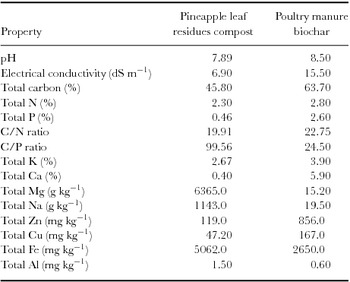
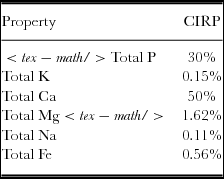
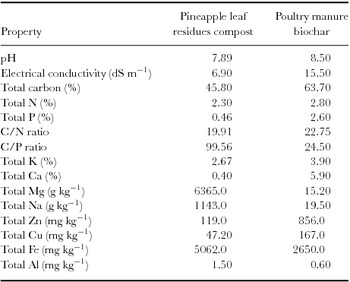
The observed physico-chemical properties of the soil used in this study (Table 1) were within the range reported by Soil Survey Staff (2014) for Bekenu series (Typic Paleudult). The pH and EC values, and C, N, P, K, Ca, Zn, Al and Cu were higher but Mg and Na were lower in biochar compared with compost (Table 2). The elemental composition of CIRP is shown in Table 3. The CIRP contains 30% total P and relatively high concentration of Ca (50%) and Mg (1.62%).
Selected physico-chemical properties of Bekenu series soil.

Selected chemical properties of poultry manure biochar and pineapple leaf residues compost.
Selected elemental composition of Christmas Island rock phosphate (CIRP).

Selected soil chemical properties during incubation study
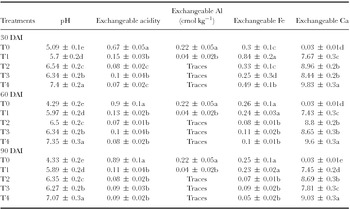
Period of incubation significantly affected soil pH, exchangeable acidity and exchangeable Al and Fe (Table 4). Effect of the treatments on pH is summarized in Table 3. At 30, 60 and 90 DAI, organic amendments (T2, T3 and T4) significantly increased exchangeable Ca and pH, whereas there was decrease in exchangeable acidity and exchangeable Al and Fe (Table 4).
Effects of treatments and incubation time on soil pH, exchangeable acidity and exchangeable Al, Fe and Ca.

Mean values within columns with different letter(s) indicate significant differences between treatments by Tukey's test at p ≤ 0.05.
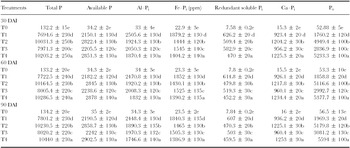
Treatments with organic amendments (T2, T3 and T4) increased total and available P contents compared with non-organic amendments (T0 and T1) at 30, 60 and 90 DAI (Table 5). Also, in T2, T3 and T4, Al–Pi, Fe–Pi, redundant soluble Pi and Ca–Pi decreased compared with T0 and T1 (Table 5). Al–Pi was the dominant P fraction followed by Ca–Pi, Fe–P i and redundant soluble Pi. In T2, T3 and T4, Po increased compared with the T0 and T1 (Table 5). At 90 DAI, the concentrations of Po were relatively higher than at 30 and 60 DAI.
Effects of treatments and incubation time on soil total P, available P, Al–Pi, Fe–Pi, redundant soluble Pi, Ca–Pi and total organic P (Po).

Mean values within columns with different letter(s) indicate significant differences between treatments by Tukey's test at p ≤ 0.05.
Pot experiment
Soil pH, exchangeable acidity, exchangeable Al, K, Ca, Mg and Fe and total N at the end of the pot experiment are shown in Table 6. The pH of the soil with organic amendments increased compared with non-organic amendments. The treatments with organic amendments significantly reduced exchangeable acidity and exchangeable Al and Fe compared with the non-organic amendments at 48 DAS (Table 6). Exchangeable Al was negligible under organic amendments (T2, T3 and T4) at 48 DAS (Table 6). T2, T3 and T4 significantly increased soil total N, soil exchangeable K, Ca and Mg contents (Table 6) compared with T0 and T1. The treatments with organic amendments increased total P, available P, but Al–Pi, Fe–Pi and redundant soluble Pi contents were decreased (Table 7). This observation is also consistent with the findings of incubation study.
Effects of treatments on selected soil chemical properties at harvest (48 DAS).

Mean values within columns with different letter(s) indicate significant differences between treatments by Tukey's test at p ≤ 0.05.
Effects of treatments on the soil total P, available P, Al–Pi, Fe–Pi, redundant soluble Pi, Ca–Pi and total organic P (Po) at harvest (48 DAS).

Mean values within columns with different letter(s) indicate significant differences between treatments by Tukey's test at p ≤ 0.05.
Dry matter production and total nutrient uptake by Zea mays L. during pot experiment
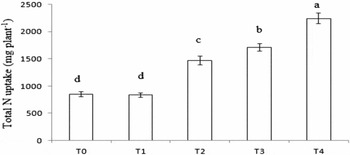
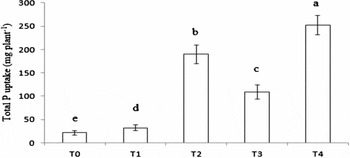
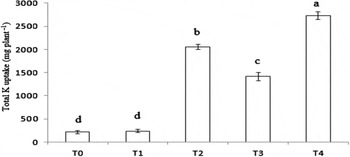
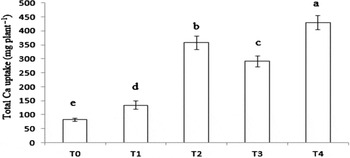
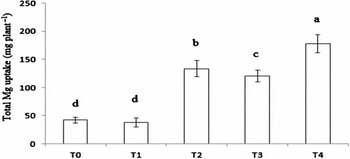
The biomass of leaves, stems and roots of the Zea mays L. hybrid F1, and their N, P, K, Ca and Mg concentrations are summarized in Table 7. There were significant differences in the dry matter production (leaves, stems and roots) of Zea mays. The N, P, K, Ca and Mg concentrations in leaves, stems and roots differed significantly (Tables 8). Treatments with organic amendments significantly improved the total N, P, K, Ca and Mg uptake compared with the non-organic amendment treatments (Figures 1–5).
Dry weight, N, P, K, Ca and Mg concentrations in leaves, stems and roots of maize hybrid F1 at harvest (48 DAS).

Mean values within columns with different letter(s) indicate significant differences between treatments by Tukey's test at p ≤ 0.05.
Effects of treatments on total N uptake (leaves + stems + roots) in maize hybrid F1 at harvest (48 DAS).

Effects of treatments on total P uptake (leaves + stems + roots) in maize hybrid F1 at harvest (48 DAS).

Effects of treatments on total K uptake (leaves + stems + roots) in maize hybrid F1 at harvest (48 DAS).

Effects of treatments on total Ca uptake (leaves + stems + roots) in maize hybrid F1 at harvest (48 DAS).

Effects of treatments on total Mg uptake (leaves + stems + roots) in maize hybrid F1 at harvest (48 DAS).

DISCUSSION
Incubation experiment
Increase in soil pH at 30, 60 and 90 DAI was because of rapid proton (H+) exchange between soil and organic amendments (Tang et al., Reference Tang, Sparling, McLay and Raphael1999; Wong et al., Reference Wong, Nortcliff and Swift1998). Increase in soil pH also relates to further decomposition of organic amendments, which further enhance the formation of organic anions, which consumed protons present in the soil and solubilise the inherent K, Ca, Mg and Na contents of organic amendments of soil, thus increasing the soil pH. The formation of phenolic and humic-like material during the initial decomposition of organic amendments (Narambuye and Haynes, Reference Narambuye and Haynes2006) leads to the formation of organic anions. These organic anions consumed protons present in the soil, thus causing increase in soil pH (Haynes and Mokolobate, Reference Haynes and Mokolobate2001). Another mechanism which explains increase in soil pH is the specific adsorption of humic material and organic acids (products of decomposition of organic materials) on the hydrous surfaces of Al and Fe oxides by ligand exchange with corresponding release of OH− (Hue et. al., Reference Hue, Craddock and Adams1986). Increase in the soil pH of T0 (soil only) across the incubation period was partly due to the inherent Ca and Mg contents in soil and further decomposition of organic materials of soil (Haynes and Mokolobate, Reference Haynes and Mokolobate2001). There was no leaching of basic cations from the 500-mL beakers used in the incubation study. Thus, the accumulation of basic cations might have raised the soil pH. Increase in the soil pH under T1 (soil with CIRP only) was due to the dissolution of Ca and Mg contained in CIRP. This is possible because CIRP contains substantial concentration of Ca (Table 3).
Reduction in exchangeable acidity, and exchangeable Al and Fe partly relates to the increase in soil pH (Table 4). Several authors have reported increase in soil pH as exchangeable Al decreases (Narambuye and Haynes, Reference Narambuye and Haynes2006; Noble et al., 1996; Opala et al., Reference Opala, Okalebo and Othieno2012). Zeng et al. (Reference Zeng, Liao, Jiang, Zhou, Tang and Zhong2005) had also reported a negative relationship between soil pH and soil exchangeable Al. Precipitation of exchangeable and soluble Al and Fe as insoluble Al and Fe hydroxides could be one of the reasons for increase in soil pH. Treatments T2 and T4 showed lower exchangeable Fe in soil solution than T3 at 30, 60 and 90 DAI because of the decomposition and solubilisation of the inherent Fe content in compost. Treatments with biochar (T2 and T4) were able to chelate the solubilised Fe ions from compost, thus lowering the exchangeable Fe in soil compared with T3. The higher content of exchangeable Ca in treatments (T2, T3 and T4) compared with T0 and T1 was due to the relatively higher contents of Ca in biochar and compost.
Increase in the availability of P with increasing period of incubation could also be due to the increased microbially mediated mineralization of soil organic P to inorganic P. This process might have been facilitated by organic amendments (biochar and compost). The low C/P ratio of biochar and compost (Table 2) also favours P mineralization, thus increasing the availability of P in soil. Increase in soil Ca–Pi fraction was due to the reaction of Ca released from biochar, compost and CIRP with P. This was possible because increase in soil pH due to release of Ca reduces Al hydrolysis. In general, organic amendments affect the chemical fractions of P, because P released from organic amendments turn into available forms over time (Halajnia et al., Reference Halajnia, Haghnia, Fotovat and Khorasani2009). Sharpley et al. (Reference Sharpley, Weld, Beegle, Kleinman, Gburek, Moore and Mullins2003) reported higher increase in Pi than Po in soils with organic amendments.
Pot experiment
Organic amendments (T2, T3 and T4) significantly increased the soil pH compared with non-organic amendments (T0 and T1) because of the higher pH of organic inputs (Table 2). Increase in soil pH after the pot experiment is consistent with that of incubation study. Increase in soil pH also relates to rapid proton (H+) exchange between the soil and the organic amendments used in this study (Tang et al., Reference Tang, Sparling, McLay and Raphael1999; Wong et al., Reference Wong, Nortcliff and Swift1998). This was due to the formation of phenolic and humic-like substances during the initial decomposition of organic amendments, and as the decomposition process progressed, organic anions were formed to consume protons present in the soil (Haynes and Mokolobate, Reference Haynes and Mokolobate2001; Narambuye and Haynes, Reference Narambuye and Haynes2006). Increase in soil pH under T0 (soil only) at 48 DAS was due to the inherent Ca and Mg contents of soil, which might have been released in the course of the study. Loss of basic cations through leaching is negligible, thus accumulation of basic cations (Ca and Mg) to raise soil pH across the planting period is possible. Increase in soil pH of T1 (soil with CIRP only) was probably due to the release of Ca and Mg from CIRP and decomposition process of soil to further release basic cations. This is possible because the CIRP contains high concentration of Ca (Table 3).
Potassium, Ca, Mg and Na in organic amendments might have also contributed to the increase in soil pH, which in turn resulted in lowering the exchangeable acidity and exchangeable Al. As soil pH increased, formation of more insoluble Al hydroxides might have been favoured.
Treatments with organic amendments (T2, T3 and T4) increased soil total N because of the enhanced retention of NH4 + and NO3 − from being lost (e.g., through volatilization; Yazdanpanah et al., Reference Yazdanpanah, Pazira, Neshat, Mahmoodabadi and Sinobas2013). The inherent N content in compost and biochar might have contributed to the increase of total N in soil. Studies had revealed that biochar and compost effectively reduced the contents of NO3 − and NH4 + in leachates by 34% and 34.7% respectively (Paulin and Malley, Reference Paulin and Malley2008; Yao et al., Reference Yao, Gao, Zhang, Inyang and Zimmerman2012). The inherent contents of K, Ca and Mg of organic amendments might have contributed to the increase in exchangeable K, Ca and Mg contents of soil (Table 5). Because of the increase in soil pH from 5.81 (initial pH of soil, soil without organic amendments) to between 6.57 and 7.03 (soil with organic amendments, i.e. T2, T3 and T4) at 48 DAS (Table 6), the organic acids of organic amendments might have outcompeted P ions for the adsorption sites on soil surfaces, hence increasing the total and available P contents in soil after the pot experiment (Table 6) (Violante and Gianfreda, Reference Violante and Gianfreda1993). The P availability reported in this study is comparable with those reported by Laboski and Lamb (Reference Laboski and Lamb2003), Spychaj-Fabisiak et al. (Reference Spychaj-Fabisiak, Dlugosz and Zamorski2005) and Opala et al. (Reference Opala, Okalebo and Othieno2012).
Treatment with both biochar and compost (T4) showed the highest amount of soil-available P because of the inherent P contents in these organic inputs (Table 6). Besides, the high affinity of functional groups such as humic substances of organic inputs might have reduced P fixation by Al and Fe (Cheng et al., Reference Cheng, Lehmann and Engelhard2008). Treatment with biochar (T2) showed higher amount of soil-available P compared with that of compost (T3; Table 6), because biochar had higher affinity for Al and Fe compared with compost (Novak et al., Reference Novak, Busscher, Laird, Ahmedna, Watts and Niandou2009). In a related study, higher levels of Al and Fe were detected within biochar structures upon the addition of biochar to soils (Nguyen et al., Reference Nguyen, Lehmann, Kinyangi, Smernik and Engelhard2008). A study by Cheng et al. (Reference Cheng, Lehmann and Engelhard2008) also showed that because biochar is more negatively charged, it readily binds to positively charged metal oxides such as Al2O3 and Fe2O3, a reaction that reduces the tendency of Al and Fe reacting with soil-available P. These explanations also hold good for the soil-available P in the incubation experiment reported previously (Table 4).
In organic amendments (T2, T3 and T4), Al–Pi, Fe–Pi and redundant soluble Pi decreased when compared with non-organic amendments (T0 and T1) because the organic amendments had increased soil pH, favouring the solubility of Al and Fe phosphates. This indicates that biochar and compost had suppressed the sorption of added P in soil. Similar findings of decreased P sorption upon organic amendments to soil had been reported by Erich et al. (Reference Erich, Fitzgerald and Porter2002) and Iyamuremye et al. (Reference Iyamuremye, Dick and Baham1996).
Decrease in Al–Pi, Fe–Pi and redundant soluble Pi fractions (Table 6) following organic amendments is believed to be due to the production of organic acids. The organic acids produced in the course of the decomposition process might have temporarily bound to the surfaces of clay particles (Iyamuremye et al., Reference Iyamuremye, Dick and Baham1996). This might be due to this reason that soil pH increased significantly and there was decrease in exchangeable acidity and exchangeable Al and Fe. Furthermore, decrease in Al–Pi and Fe–Pi suggests the precipitation of exchangeable and soluble Al and Fe as insoluble Al and Fe hydroxides. The Ca of CIRP might have partially precipitated as calcium phosphate. Biochar and compost were able to chelate Al and Fe and prevented their precipitation as phosphates. Al–P and Fe–P fractions are considered biologically labile because increasing soil pH causes dissolution of Al–Pi and Fe–Pi to release P. In acid soils, the loosely bound phosphates on Al and Fe oxides may re-precipitate as highly crystalline Al–Pi and Fe–Pi (not available to crops).
Effect of organic amendments on the total nutrient uptake of Zea mays L.
Treatments with organic amendments significantly improved N, P, K, Ca and Mg uptake compared with the non-organic amendment treatments (Figures 1–5) because the amendments significantly reduced P fixation in soil and favoured P uptake by Zea mays, which is evidenced by significant increase in the dry weight of roots of Zea mays plants grown with organic amendments (Table 7).
Treatments with organic amendments improved N uptake in leaves, stems and roots, compared with the treatments with non-organic amendments (Figure 1), which is an indication that there was less N loss from the soil–plant system. This could be due to the slow release of N from organic amendments, and the pattern on N release might be in synchrony with the demand of maize plant. The urea used in this study without any of organic amendments might have released N too fast and too early before the maize crop had developed an extensive root system to take it up. These forms of available N in soil may undergo volatilization and de-nitrification, or immobilised into forms not readily available to plants.
Phosphorus concentration in leaves, stems and roots of maize was significantly higher with the use of the organic amendments (Table 7). Phosphorus concentration in the maize plant tissues was higher, especially in stems and leaves, due to the increased P availability. Root growth better with organic amendments might be due to the reduction of Al toxicity to roots (Figure 2; Aziz et al., Reference Aziz, Rahmatullah, Maqsood, Tahir and Cheema2006).
Potassium concentrations were higher in leaves, stems and roots of maize with organic amendments than without organic amendments (Table 7). This could be due to the higher initial K content in biochar and compost that improved root growth and increased K uptake (Figure 3; Aziz et al., Reference Aziz, Rahmatullah, Maqsood, Tahir and Cheema2006).
Similar observations were noted for total Ca and Mg concentrations in leaves, stems and roots of maize (Table 7). Treatments with organic amendments showed higher total Ca and Mg uptake compared with the treatments without organic amendments (Figures 4 and 5). Higher Ca and Mg concentrations and uptakes were due to relatively higher concentrations of Ca and Mg in organic amendments.
The biochar and compost materials used in this study might have improved soil structure, porosity, aeration and friability (Calzolari et al., Reference Calzolari, Salvador and Torri2009). Improvement in soil's physical conditions might have enhanced root penetration and aeration in rhizosphere, favoured absorption of more water and essential nutrients from soil solution and resulted in the better growth and development of Zea mays plants.
CONCLUSIONS
The organic amendments significantly increased the soil pH to near neutral. Biochar and compost when applied with CIRP effectively fixed Al and Fe instead of P, thus rendering more available P to the plants for a longer period compared with the application of CIRP without organic amendments. Organic amendments also increased the availability of N, K, Ca and Mg in soil, and improved nutrients uptake and dry matter production of Zea mays. Use of biochar and compost can reduce the dose of phosphate fertilizers and lime.
Conflict of Interest . The authors declare that there is no conflict of interest regarding the publication of this paper.
Acknowledgements
The authors would like to thank Ministry of Education, Malaysia for financial assistance, and Universiti Putra Malaysia for providing research facilities.