Introduction
With youth unemployment in many high- and middle-income countries at unprecedented high levels since the global financial crisis of 2008, the transition from school into employment has become increasingly difficult, leaving many young adults in unstable, informal employment or unable to find work at all (Lloyd, Reference Lloyd2005; ILO, 2015).
In this context, there has been increased social policy interest in young adults who are failing to make a successful transition into employment. One indicator used to identify difficulties with making this transition is ‘NEET’ – not in employment, education, or training. The Organisation for Economic Co-operation and Development (OECD, 2015) estimated the average percentage of young adults (20–24 years of age) who were NEET in 2014 to be 18%. This group of young adults are more likely to have lower earnings, be in unstable employment conditions and face more frequent and longer periods of unemployment through adult life (Hale et al. Reference Hale, Bevilacqua and Viner2015; ILO, 2015). A young person's risk of being NEET depends on country-specific unemployment rates, government-led employment and training initiatives, and cultural factors (European Union Committee, 2014). Aspects of family background including socioeconomic status, parental employment, and parental divorce are also associated with NEET status in young adulthood (Coles et al. Reference Coles, Hutton, Bradshaw and Craig2002; Eurofound, 2012).
High rates of common mental disorders (i.e. anxiety and depression), suicide risk, and substance abuse have been observed in young adults who are NEET (Benjet et al. Reference Benjet, Hernández-Montoya, Borges, Méndez, Medina-Mora and Aguilar-Gaxiola2012; Baggio et al. Reference Baggio, Iglesias, Deline, Studer, Henchoz, Mohler-Kuo and Gmel2015), leading to questions around the extent to which earlier common mental disorders contribute to the risk of being NEET in young adulthood. Current evidence suggestive of an association between common mental disorders and NEET status in young adulthood mainly comes from cross-sectional studies with young adults from clinical or disadvantaged settings (Benjet et al. Reference Benjet, Hernández-Montoya, Borges, Méndez, Medina-Mora and Aguilar-Gaxiola2012; Nardi et al. Reference Nardi, Arimatea, Giunto, Lucarelli, Nocella and Bellantuono2013; O'Dea et al. Reference O'Dea, Glozier, Purcell, McGorry, Scott, Feilds, Hermens, Buchanan, Scott, Yung, Killacky, Guastella and Hickie2014). Such cross-sectional profiles are limited in their capacity to identify the directionality in associations, as an episode of depression or anxiety may be either a cause or consequence of being NEET.
Several prospective cohort studies have reported a relationship between common mental disorders in adolescence and subsequent NEET status. However, these studies have either measured NEET status before 20 years of age (Cornaglia et al. Reference Cornaglia, Crivellaro and McNally2012; Veldman et al. Reference Veldman, Reijneveld, Almansa Ortiz, Verhulst and Bültmann2015), used a definition of NEET that included working with a basic level of education (Veldman et al. Reference Veldman, Reijneveld, Almansa Ortiz, Verhulst and Bültmann2015), or only considered a limited set of potential confounders (e.g. socioeconomic status and gender) (Power et al. Reference Power, Clarke, Kelleher, Coughlan, Lynch, Connor, Fitzpatrick, Harley and Cannon2015). Further research is required to examine the relationship between common mental disorders in adolescence and the risk of being NEET in young adulthood, with adequate adjustment for family background and other potential risk factors. The current study includes the behavioural adolescent risk factors of high-risk cannabis and alcohol use and disruptive behaviour, which have been examined as risk factors for employment and education-related outcomes in previous studies.
Although there is strong evidence of an association between cannabis use and educational outcomes (Horwood et al. Reference Horwood, Fergusson, Hayatbakhsh, Najman, Coffey, Patton, Silins and Hutchinson2010; Silins et al. Reference Silins, Horwood, Patton, Fergusson, Olsson, Hutchinson, Spry, Toumbourou, Degenhardt and Swift2014), few studies have considered cannabis use as a potential risk factor for being NEET. Associations between cannabis use and NEET status in young adulthood have been reported in cross-sectional studies (Benjet et al. Reference Benjet, Hernández-Montoya, Borges, Méndez, Medina-Mora and Aguilar-Gaxiola2012; O’'Dea et al. Reference O'Dea, Glozier, Purcell, McGorry, Scott, Feilds, Hermens, Buchanan, Scott, Yung, Killacky, Guastella and Hickie2014; Nardi et al. Reference Nardi, Lucarelli, Talamonti, Arimatea, Fiori and Moltedo-Perfetti2015). Baggio et al. (Reference Baggio, Iglesias, Deline, Studer, Henchoz, Mohler-Kuo and Gmel2015) also found an association between cannabis use and NEET status for males, but cannabis use was measured around 20 years of age, when some participants were already NEET. Alcohol use has been examined as a risk factor for unemployment and educational outcomes separately, but there has been little examination of potential associations between drinking behaviour in adolescence and later NEET status. It is therefore important to examine the association between earlier substance use and NEET status using longitudinal data.
A final potential risk factor for being NEET in young adulthood is aggressive or disruptive behaviour in adolescence. Moore et al. (Reference Moore, Scott, Thomas, Sly, Whitehouse, Zubrick and Norman2015) examined the relationship between experiences with peer aggression (i.e. being a victim, perpetrator, or victim-perpetrator of threatening or nasty behaviour, hitting or kicking, or ostracism) at 14 years of age and employment and education status at 17 and 20 years (defined as an ordinal outcome of: enrolled in education; employed full-time or part-time; or NEET). Perpetrators and victim-perpetrators of peer agression were more likely to be in employment or NEET than in education at 17 years of age, with perpetrators also more likely to be NEET at 20 years of age.
Most published studies have only considered a definition of NEET in which participants with children are classified according to their activities (i.e. they are NEET if not also in employment, education, or training). The inclusion of young adults who have children in the NEET category may capture an important group of vulnerable people who face social and economic disadvantage. Research on early parenting, focused mainly on teenage pregnancy, has identified several risk factors for becoming a parent in late adolescence that are similar to those for young adults who are NEET (Woodward et al. Reference Woodward, Fergusson and Horwood2001; Nilsen et al. Reference Nilsen, Olsson, Karevold, O'Loughlin, McKenzie and Patton2012). Long-term consequences of early parenting similar to those for unemployment have also been reported, including fewer life opportunities, higher psychosocial disadvantage, and prolonged welfare dependence (Nanchahal et al. Reference Nanchahal, Wellings, Barrett, Copas, Mercer, Macmanus, Macdowall, Fenton, Erens and Johnson2005; Olsson et al. Reference Olsson, Horwill, Moore, Eisenberg, Venn, O'Loughlin and Patton2014). An argument against including young adults with children in the NEET group is that becoming a parent represents a level of responsibility and, particularly for females, may limit a young person's ability to participate in employment or education. Therefore, it may be important to examine young adults with children separately and not automatically classify them as being NEET.
In the current study, we use a prospective population-based longitudinal cohort to examine independent associations between common mental disorders, substance use (i.e. alcohol and cannabis), and disruptive behaviours in adolescence and being NEET in young adulthood. We also introduce a second outcome of ‘not in employment, education, parenting, or training’ (NEEPT), and investigate how results are affected when we include young adults with children in the same category as those in employment, education, or training.
Method
Study participants and analysis sample
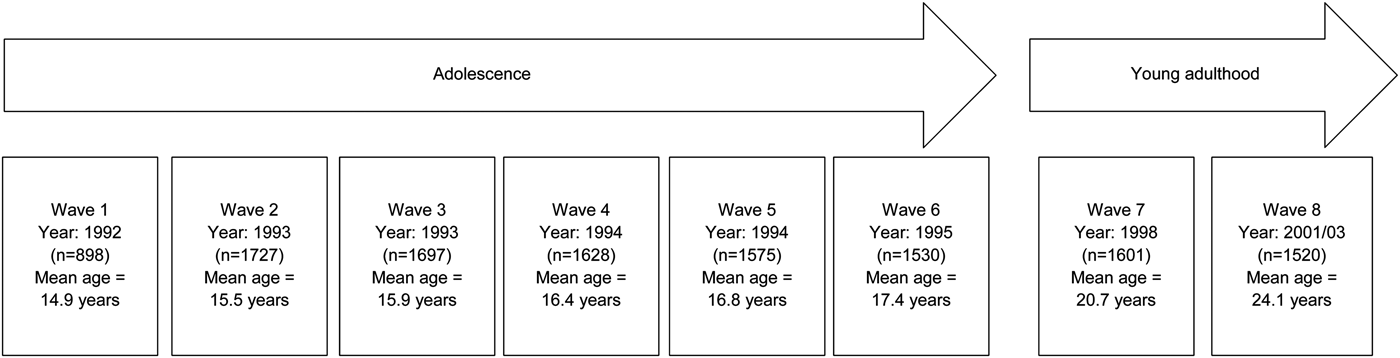
Participants were recruited into the Victorian Adolescent Health Cohort Study (VAHCS) at 14–15 years of age through a two-stage cluster random sampling procedure. In the first stage, a stratified sample of 45 government, independent, and Catholic secondary schools in Victoria, Australia were randomly selected. One school with 13 participants did not continue beyond the first wave and was withdrawn from the study, leaving 44 schools. In the second stage, two classes from each school were randomly selected to participate. Within each school, one of the classes entered the study in 1992, at the end of their ninth school year (wave 1), and the second class entered the study 6 months later in 1993 (wave 2). Participants from both entry waves were followed up a further four times in adolescence at 6-monthly intervals (waves 3–6), and four times in young to mid-adulthood at age 20–21 years (wave 7), 24–25 years (wave 8), 28–29 years (wave 9), and 34–35 years (wave 10). Figure 1 shows the flow of participants through the study.
Recruitment and follow-up of participants in the Victorian Adolescent Health Cohort Study, 1992–2003. There were two entry points (at wave 1 and wave 2).

In waves 1–6, participants self-administered the study questionnaire on laptops in their classrooms, with telephone follow-up attempted for anyone who was absent. In waves 7–10, participants were surveyed over the phone using computer-assisted telephone interviews. Participants’ parents or guardians provided written informed consent at the entry waves. Participants gave verbal consent at each wave after receiving information on the content of the questionnaire.
The study design omitted more than half of the cohort in wave 1; therefore, waves 2–6 were used to summarise behaviours in the adolescent period. Some participants (n = 56) completed the questionnaire at wave 1 and had no further participation in adolescence. As waves 1 and 2 were only 6 months apart, we considered it reasonable to fill in wave 2 data for these 56 participants using their responses on the same measures at wave 1. This method has been adopted in previous analyses of this cohort (Patton et al. Reference Patton, Coffey, Romaniuk, Mackinnon, Carlin, Degenhardt, Olsson and Moran2014). We restricted the measurement of the outcome (NEET status) to the young adult period, 20–25 years of age (waves 7 and 8). From the initial intended sample of 2032 participants, 1943 (96%) took part at least once across the adolescent waves and hence had available data on the predictors of interest. Five participants had died by wave 8 and were excluded from the analysis, leaving a total of 1938 participants.
Measures
NEET status
The primary outcome, NEET status, was defined at the young adult waves 7 and 8 (mean ages 20.7 and 24.1 years) using participant-reported information on employment, education, and training activities. Participants were asked whether they were currently enrolled in: university, private college, or an institute for vocational education and training. Participants were also asked about their current work status with options of: have a paid job, volunteering, receiving payment in kind (i.e. receiving goods or services in return for work), or unemployed. We classified participants who did not have a paid job and were not currently studying or in training as NEET.
Some participants had children by waves 7 and 8. For the primary analysis, these participants were classified according to their reported activities (i.e. if they were not in employment, education, or training, they were classified as NEET). For the secondary analysis, participants were classified using the outcome of NEEPT (not in employment, education, parenting, or training).
Adolescent risk factors
Information on common mental disorders, disruptive behaviour, cannabis use, and drinking behaviour was collected at each adolescent wave. Information across waves 2–6 was used to create summary measures that represent the severity or persistence of each risk factor during adolescence.
Common mental disorder
Common mental disorder was assessed at each adolescent wave using the revised Clinical Interview Schedule (CIS-R), a standardised assessment designed to measure symptoms of depression and anxiety in non-clinical populations (Lewis et al. Reference Lewis, Pelosi, Araya and Dunn1992). The total CIS-R score (range 0–57) measures the severity of common mental disorder based on 14 symptoms: depression, anxiety, worry, irritability, compulsiveness, obsessiveness, fatigue, somatic symptoms, concentration, sleep problems, worry over physical health, depressive ideas, phobias, and panic.
The CIS-R was designed to be administered by trained interviewers or self-administered using a computer. Reliability studies have shown a good level of agreement between CIS-R scores obtained by trained interviewers and psychiatrists [κ = 0.70, 95% confidence interval (CI) 0.51–0.88] and a moderately strong correlation (0.77) between the CIS-R score and a clinical judgement of severity made by a psychiatrist who could ask additional questions (Lewis et al. Reference Lewis, Pelosi, Araya and Dunn1992). Further, the correlation between CIS-R scores obtained through self-completed computerised assessments and those obtained from assessments with trained interviewers was 0.91 (Lewis, Reference Lewis1994).
Persistence of common mental disorders in adolescence was categorised as: no waves, one wave, or two or more waves with CIS-R ⩾12, the threshold at which clinical intervention by a family doctor would be appropriate (Lewis et al. Reference Lewis, Pelosi, Araya and Dunn1992).
Disruptive behaviour
Disruptive behaviour was assessed at each adolescent wave using nine items adapted from the Moffitt and Silva self-report early delinquency scale (Moffitt & Silva, Reference Moffitt and Silva1988), which covers interpersonal conflict, theft, property damage, and graffiti. At each wave, a variable was derived to identify if a participant had reported multiple disruptive behaviours. This could be the same behaviour more than once, or two or more separate behaviours. For the adolescent summary measure, a dichotomous variable was derived to represent persistent disruptive behaviours in adolescence, defined as multiple disruptive behaviours in two or more adolescent waves.
Cannabis use
At each adolescent wave, participants were asked to report their frequency of cannabis use in the previous 6 months. The response options were: never; not in past 6 months; a few times a year; monthly; weekly; daily. We derived a dichotomous variable to identify frequent cannabis use, defined as weekly or daily cannabis use at one or more waves.
Drinking behaviour
Drinking behaviour was measured at each adolescent wave using a 7-day retrospective alcohol diary. Participants reported the type, brand, and amount of alcohol consumed each day in the week before the questionnaire, from which the daily number of (10 g) units of alcohol was calculated. At each wave, participants were classified into one of three levels of drinking behaviour: no drinking; at least one occasion of drinking but no occasions of heavy binge drinking; or at least one occasion of heavy binge drinking [20 or more units for males, and 11 or more units for females on any day over the diary week (Livingston et al. Reference Livingston, Laslett and Dietze2008)]. For the adolescent summary measure, we used each participant's highest level of drinking behaviour across the adolescent waves.
Potential confounders
Parental education
Parental education was used as an indicator of socioeconomic status (Hauser, Reference Hauser1994). At each wave, participants were asked to report the education level of each parent, classified as: did not finish high school; finished high school or a technical college; or obtained a degree from a university or college. We used the information on the parent who had the highest level of education by the end of the adolescent waves to form the parental education variable.
Parental divorce or separation
Participants were asked about the marital status of their parents at each wave in adolescence, and at waves 7 and 8. We derived a dichotomous variable to indicate whether the participant's parents had divorced or separated prior to their wave 6 interview.
School location
Finally, we included a dichotomous variable to indicate whether the school that participants were enrolled in at the time of recruitment was located in a metropolitan area (i.e. Melbourne, Victoria) or outside this area.
Analyses
We estimated the prevalence of NEET in young adulthood and summarised the adolescent and family background characteristics, both overall and by gender. Logistic regression models for being NEET at waves 7 and 8 were fitted using generalised estimating equations (Liang & Zeger, Reference Liang and Zeger1986), assuming an exchangeable working correlation matrix with robust standard errors to allow for the repeated outcome measure. A series of models were fitted to estimate the association between the adolescent risk factors and the odds of being NEET. We estimated the effect of each adolescent risk factor using univariable models (model a), a multivariable model including the adolescent risk factors only (model b), and a multivariable model including the adolescent risk factors with additional adjustment for gender, parental divorce or separation, level of parental education, school location, and the wave at which the outcome was measured (model c). To examine whether effects were modified by gender or the wave at which the outcome was measured, we assessed the inclusion of interaction terms in model c. Main effects and interactions were assessed using (two-sided) Wald tests. All analyses were repeated for the secondary outcome, NEEPT.
Some participants did not respond at all adolescent and young adult waves. Of the 1938 participants included in this study, 1031 (53%) took part in all waves included in the analysis (i.e. waves 2–8), with 349 (18%) not participating in one wave, 216 (11%) in two waves, and 343 (18%) in three or more waves. Missing data were handled using multiple imputation (Rubin, Reference Rubin1987). We generated 100 imputed datasets and imputed at the wave level, separately for males and females, using the method of chained equations (van Buuren, Reference van Buuren2007). The adolescent summary variables were derived after imputation. All estimates were obtained by averaging results across the 100 imputed datasets with inferences under multiple imputation obtained using Rubin's rules (Rubin, Reference Rubin1987). Further details on the multiple imputation procedure are provided in the online Supplementary Materials. We used Stata version 14.1 (StataCorp, 2015) for all analyses.
Finally, after considering the results obtained from model c, we used the ‘mimrgns’ command (Klein, Reference Klein2016) in Stata to compute the average predicted probability of being NEET among young people who had reported all of the adolescent risk factors found to be associated with NEET status. We also computed the predicted probability of being NEET for young people who had none of these risk factors. Predicted probabilities were computed using observed values for the remaining variables in the model.
Results
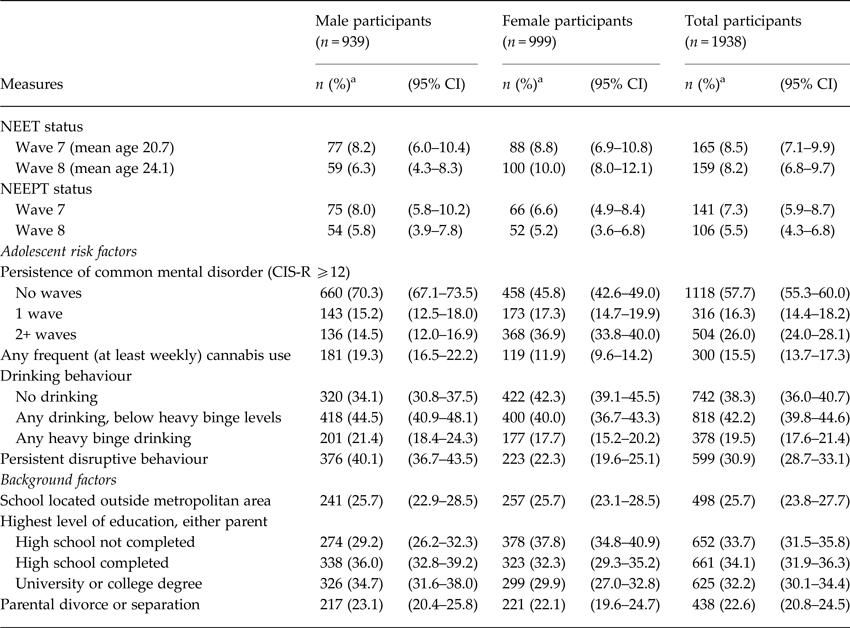
As shown in Table 1, 6–10% of males and females were NEET at waves 7 and 8, with an apparent divergence between genders at wave 8 due to a slight increase in the prevalence of NEET among females. This difference between the genders resolved when the outcome of NEEPT was used and participants with children were classified into the same category as those in employment, education, or training. The prevalence of common mental disorders in adolescence was higher for females than males, whereas males had higher rates of disruptive behaviour and frequent cannabis use, and tended to report riskier drinking behaviours during adolescence.
Summary of NEET and NEEPT status and adolescent predictors, by gender and overall

CI, confidence interval; CIS-R, revised Clinical Interview Schedule; NEET, not in employment, education, or training; NEEPT, not in employment, education, parenting or training.
a Estimated percentage of participants within each category, averaged over 100 imputed datasets.
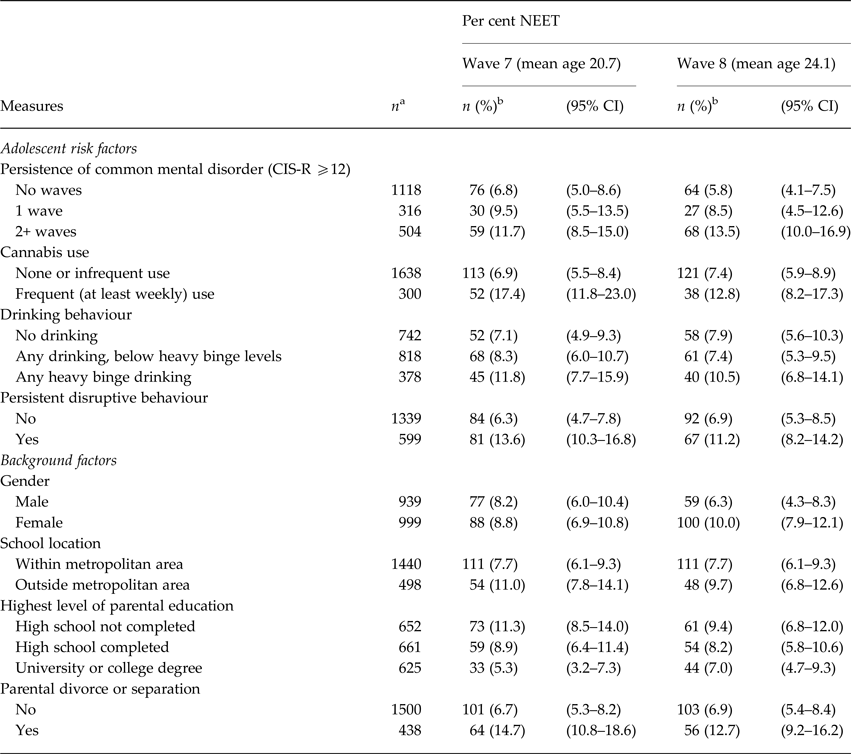
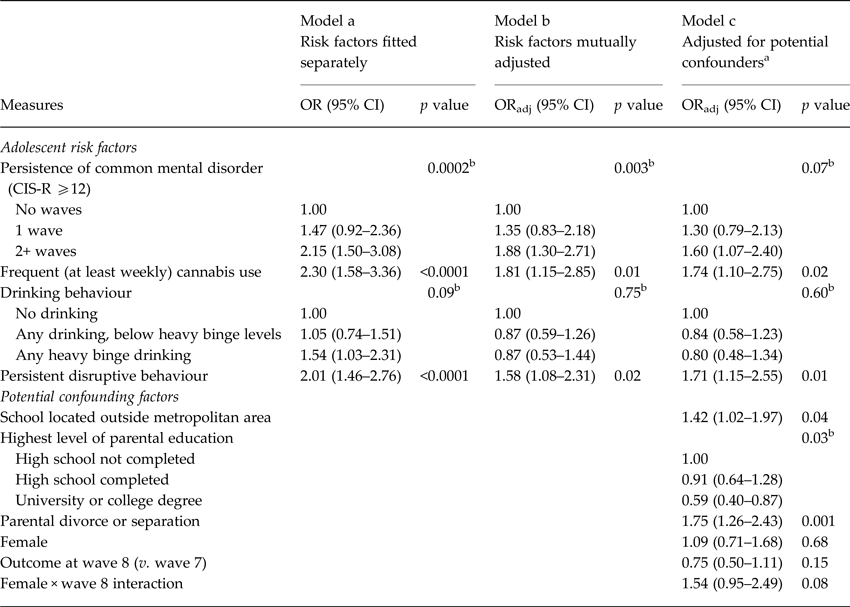
Table 2 shows the estimated prevalence of NEET status at each young adult wave for the adolescent risk and background factors and Table 3 presents estimates of the marginal odds ratios (OR) obtained from the series of logistic regression models for being NEET in young adulthood. When modelled separately (model a), there was strong evidence that persistent common mental disorders, frequent cannabis use, and persistent disruptive behaviours in adolescence were each associated with NEET status in young adulthood. These effects were slightly weaker when the risk factors were mutually adjusted in a multivariable model (model b). Finally, when we included potential confounders and examined whether there was any evidence of effect modification by gender or the wave at which the outcome was measured (model c), there was some evidence that the association between gender and NEET status differed by the age at which NEET status was measured; this interaction was retained in the final model. In model c, the persistence of common mental disorders in adolescence was independently associated with NEET status in young adulthood, with participants who experienced two or more waves of disorder more likely to be NEET than those with no waves of disorder in adolescence [adjusted OR (ORadj) = 1.60, 95% CI 1.07–2.40]. The odds of being NEET were also higher for participants who reported persistent disruptive behaviour in adolescence compared with those who reported no or low disruptive behaviour (ORadj = 1.71, 95% CI 1.15–2.55). Participants who reported frequent cannabis use in adolescence had higher odds of being NEET compared with those who used cannabis infrequently or not at all (ORadj = 1.74, 95% CI 1.10–2.75). There was little evidence of an association between drinking behaviour in adolescence and NEET status in young adulthood, particularly after controlling for other adolescent risk factors.
Prevalence of NEET status in young adulthood, by adolescent risk and background factors
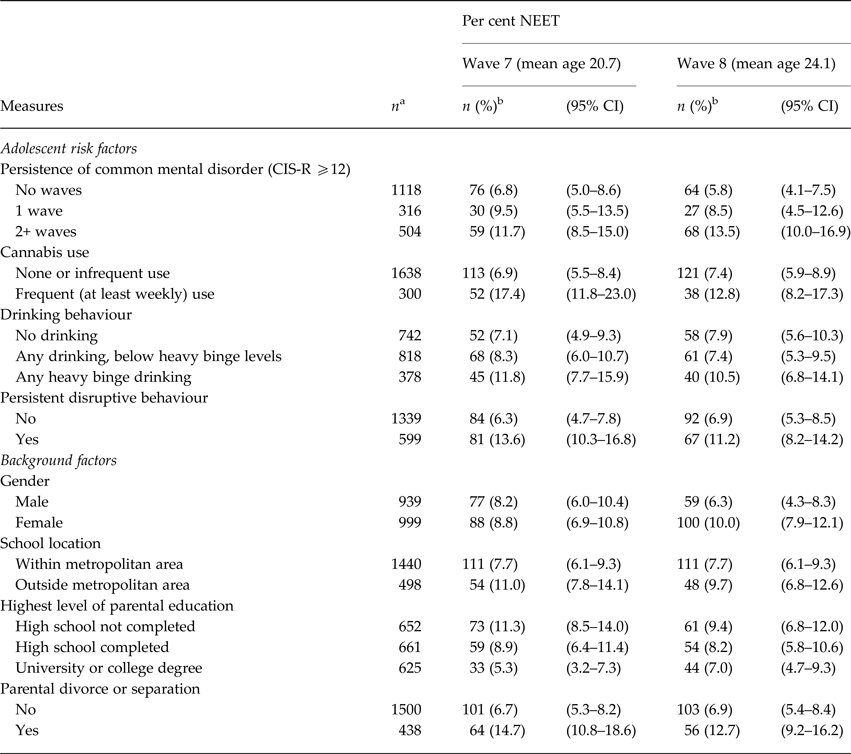
CI, confidence interval; CIS-R, revised Clinical Interview Schedule.
a Calculated using imputed percentage estimates and total number of participants.
b Estimated number and percentage of participants who are NEET (not in employment, education, or training), averaged over 100 imputed datasets.
Association between adolescent risk factors and NEET status in young adulthood (waves 7 and 8)

OR, odds ratio; ORadj, adjusted odds ratio; CI, confidence interval; CIS-R, revised Clinical Interview Schedule; NEET, not in employment, education, or training.
Note: ORs were obtained using generalised estimating equations assuming an exchangeable working correlation matrix with robust standard errors to allow for the repeated outcome measure.
a Also adjusted for wave at which outcome was measured.
b p value from joint test of significance.
An estimated 4.2% (95% CI 3.2–5.2%) of young people had all three adolescent risk factors (i.e. two or more waves of common mental disorder, persistent disruptive behaviour, and frequent cannabis use during adolescence), while 40.8% (95% CI 38.5–43.1%) had none of these risk factors. The predicted probability of being NEET for young people with none of the adolescent risk factors was 5.2% (95% CI 3.9–6.6%), whereas young people with all three risk factors had a 20.4% (95% CI 13.4–27.4%) probability of being NEET.
The results for the outcome of NEEPT are presented in the online Supplementary Materials (Tables B1 and B2). Around 7–8% and 5–6% of participants were NEEPT at waves 7 and 8, respectively. The associations between the adolescent risk factors and NEEPT status reflected the results for NEET, although the effect of persistent disruptive behaviour was weakened slightly in the model for NEEPT.
Discussion
The transition from school into employment is crucial to support a young person's development towards a point at which they can make their own decisions, accept responsibility, and be financially independent (Arnett, Reference Arnett2014). Young adults who fail to make this transition are at risk of long-term unemployment, economic disadvantage, and social exclusion (Hale et al. Reference Hale, Bevilacqua and Viner2015; ILO, 2015).
A range of social and contextual factors, particularly high unemployment rates, affect a young person's ability to obtain employment (ILO, 2015). The current study has also identified important adolescent risk factors associated with a failure to make a smooth transition from school into employment, or further education or training in young adulthood. Persistent common mental disorders (i.e. reported in two or more adolescent waves), persistent disruptive behaviours, and frequent cannabis use were each independently associated with being NEET in young adulthood. Although adolescents with all three risk factors represent a small percentage of the population, their risk of being NEET is around 20%, compared with only a 5% risk for those with no reported episodes of common mental disorder, and little or no disruptive behaviour and cannabis use in adolescence. There was little evidence that drinking behaviour was an independent predictor of NEET status. This result is consistent with studies on unemployment or educational underachievement, which suggest that there is only weak, if any, evidence that alcohol is a risk factor for these separate outcomes (Wells et al. Reference Wells, Horwood and Fergusson2004; Patton et al. Reference Patton, Coffey, Lynskey, Reid, Hemphill, Carlin and Hall2007).
The percentage of young adults who were NEET in this population ranged from 6% to 10%, depending on age and gender. While this result is consistent with the OECD estimate for Australians aged 20–24 years, which has been reported to average around 10% over the past decade, it is lower than the average global NEET rate of 18% (OECD, 2015). The rate of young people who are NEET is influenced by country-specific unemployment rates, as well as cultural factors. However, we consider it reasonable to assume that individual risk factors for being NEET may be similar in their relative effects across countries.
The current study involved a large prospective community-based cohort, frequent measurement points, and high rates of participation. It also examined a range of well-measured adolescent risk factors and controlled for an appropriate set of potential confounders. Nevertheless, this study also had some limitations. Data on adolescent risk factors were based on self-report and may have been subject to measurement error. However, the use of laptops for self-administered health surveys, as done in the current study, has been shown to enhance adolescents’ perceptions of privacy and confidentiality, which may reduce the potential for reporting bias and improve response on individual items (Watson et al. Reference Watson, Denny, Adair, Ameratunga, Clark, Crengle, Dixon, Fa'asisila, Merry, Robinson and Sporle2001). NEET status in the young adult waves was based on employment and education activities at the time of the questionnaire and possibly reflected a temporary situation. Counting participants who had only been NEET for a short time would produce more conservative estimates of associations, and it is likely that we correctly classified participants who had been NEET over a longer period. Not all participants responded at every wave in adolescence and young adulthood, which meant we were faced with the problem of missing data. Multiple imputation was used to reduce the potential bias caused by missing data, and the imputation models were carefully built to include predictors of response and predictors of the incomplete variables (Collins et al. Reference Collins, Schafer and Kam2001). Finally, although we considered the sensitivity of results to how participants with children were classified, there may have been other reasons for being NEET that were not considered, such as being in a full-time carer's role, having a physical disability or illness, or choosing to take time off for a holiday (Eurofound, 2016).
Very few studies on NEET have considered how the classification of participants in a full-time parenting role may affect results. We specified a second outcome measure, NEEPT status, in which we classified young adults who had children into the same category as those in employment, education, or training. The prevalence of NEEPT was slightly lower than that of NEET, particularly for females at 24–25 years of age, whereas the results for the adolescent risk factors were reasonably consistent between the two outcomes. While it did not appear to affect the conclusions for our study, it is possible that the classification of participants with children as NEET (if they are not in employment, education, or training) may begin to introduce unwanted heterogeneity as people move into their late 20s. It is therefore recommended that researchers who examine predictors and consequences of being NEET in adulthood, and policymakers who seek to reduce the NEET rate, carefully consider the composition of the group they define as NEET, provide details on how they have defined this group, and consider similar sensitivity analyses to those conducted for the current study.
The association between persistent common mental disorders in adolescence and being NEET in young adulthood may reflect a continuation of disorder. Indeed, although around 50% of adolescents who experience common mental disorders do not have further episodes in young adulthood, those exhibiting longer lasting or recurrent episodes are most at risk of experiencing persisting disorder (Patton et al. Reference Patton, Coffey, Romaniuk, Mackinnon, Carlin, Degenhardt, Olsson and Moran2014). The continuation of common mental disorders into young adulthood can directly limit a person's ability to gain employment, for example, by reducing the ability to maintain motivation or cope with stress during the job application process (Secker et al. Reference Secker, Grove and Seebohm2001). The relationship between common mental disorders and later NEET status might also be mediated by school-related factors including absenteeism due to anxious school refusal (Heyne et al. Reference Heyne, King, Tonge and Cooper2001; Egger et al. Reference Egger, Costello and Angold2003), although this is beyond the scope of the current manuscript. Further research examining the separate contributions of depression and anxiety may also help to explain the relationship between common mental disorders in adolescence and later NEET status.
Disengagement from school is also likely to be partially mediating the associations between cannabis use, disruptive behaviour, and NEET status. Previous studies have shown that heavy cannabis use in adolescence reduces the odds of high school completion (Horwood et al. Reference Horwood, Fergusson, Hayatbakhsh, Najman, Coffey, Patton, Silins and Hutchinson2010; Lynskey et al. Reference Lynskey, Coffey, Degenhardt, Carlin and Patton2003; Silins et al. Reference Silins, Horwood, Patton, Fergusson, Olsson, Hutchinson, Spry, Toumbourou, Degenhardt and Swift2014) and is associated with lower degree attainment (Silins et al. Reference Silins, Horwood, Patton, Fergusson, Olsson, Hutchinson, Spry, Toumbourou, Degenhardt and Swift2014). In their study focused on peer aggression, Moore et al. (Reference Moore, Scott, Thomas, Sly, Whitehouse, Zubrick and Norman2015) found that non-completion of high school explained the relationship between being a perpetrator of peer aggression and being NEET at 20 years of age.
Frequent cannabis use and disruptive behaviours in adolescence may also be indicative of a personality type, or peer group affiliations that reject the social norms associated with the levels of compliance, responsibility, and commitment required to engage with study or work (Fergusson & Horwood, Reference Fergusson and Horwood1997). High levels of disruptive, particularly aggressive, behaviour may also reflect problems with managing emotions that are likely to affect one's ability to gain and maintain employment.
An increasing amount of evidence suggests that heavy cannabis use impairs cognitive performance (Hall, Reference Hall2015). Although impairment in cognitive performance has mainly been acute, some research has suggested that heavy cannabis use impairs decision-making and planning, even after a period of abstinence (Crean et al. Reference Crean, Crane and Mason2011). The ability to plan and make decisions has an important role in tasks relating to job-seeking and other activities relating to employment and education. Adolescent cannabis users have also reported reduced interest in activities and lower energy levels (Palamar et al. Reference Palamar, Fenstermaker, Kamboukos, Ompad, Cleland and Weitzman2014). Such reductions in interest and energy have been identified as possible symptoms of cannabis induced ‘amotivational syndrome’ (Tennant & Groesbeck, Reference Tennant and Groesbeck1972).
To the extent that these associations reflect causal pathways, our study reinforces the importance of prevention and early clinical intervention for common mental disorders, cannabis use, and disruptive behaviours in adolescence. A particularly concerning statistic from a survey of youth who had presented at a primary mental health service was that only 10% of respondents who were NEET had received any specific vocational support in the previous year (O'Dea et al. Reference O'Dea, Lee, McGorry, Hickie, Scott, Hermens, Mykeltun, Purcell, Killackey and Pantelis2016). To reduce the potential for long-term disadvantage among young people who are, or at risk of, becoming NEET it is important that evidence-based programmes focused on vocational support be implemented. For example, a recent meta-analysis demonstrated that individual placement and support, which adopts a ‘place then train’ approach to vocational support for people with severe mental illness, was more than twice as likely to lead to competitive employment compared with traditional vocational rehabilitation methods that essentially adopt a ‘train then place’ model (Modini et al. Reference Modini, Tan, Brinchmann, Wang, Killackey, Glozier, Mykletun and Harvey2016). To target the disruptive behaviours, it is recommended that early interventions be aimed towards improving adolescents’ interpersonal skills and their ability to manage emotions (Obsuth et al. Reference Obsuth, Sutherland, Pilbeam, Scott, Valdebenito, Carr and Eisner2014).
The association between frequent cannabis use in adolescence and the increased risk of being NEET in young adulthood is particularly relevant given trends towards the legalisation of cannabis use in some countries. With the potential for increased availability and ease of access to cannabis, as well as a possible reduction in adolescents’ perception of the potential harms, there is a risk that a change in the legal status of cannabis may increase the rates of adolescent use (Ammerman et al. Reference Ammerman, Ryan, Adelman, Levy, Ammerman, Gonzalez, Ryan, Siqueira, Smith and Braverman2015). In this context, it is important that any legislation be accompanied by regulatory measures that minimise recreational adolescent cannabis use.
Supplementary Material
The supplementary material for this article can be found at https://doi.org/10.1017/S0033291717002434.
Acknowledgements
Data collection for this study was supported by the National Health and Medical Research Council of Australia (NHMRC) and the Victorian Government's Operational Infrastructure Program. GCP is supported by an NHMRC senior principal research fellowship (APP1019877). KJL is supported by an NHMRC career development fellowship (APP1053609). WN is supported by The Research Council of Norway (218373).
Declaration of Interest
None.
Ethics Statement
Ethical approval for the study was obtained from the Human Research Ethics Committee of the Royal Children's Hospital (Victoria, Australia). The authors assert that all procedures contributing to this work comply with the ethical standards of the relevant national and institutional committees on human experimentation and with the Helsinki Declaration of 1975, as revised in 2008.