




No CrossRef data available.
Article contents
- Abstract
- INTRODUCTION
- IMPORTANCE OF MICRO-DISCOURSE ANALYSIS
- QUALITATIVE VS. QUANTITATIVE ANALYSES
- MUTUAL INTERDEPENDENCE OF TALK, NONVOCAL BEHAVIORS AND USE OF TOOLS
- DATA
- NONPARTICLE QUESTIONS IN JAPANESE
- PREVIOUS STUDIES OF UNMODULATED UTTERANCES
- NONPARTICLE QUESTIONS AS NEXT TURN REPAIR INITIATORS
- THE FUNCTIONS OF NONPARTICLE QUESTIONS
- INDIVIDUAL SPEAKERS' USES OF NONPARTICLE QUESTIONS
- UNEQUAL DISTRIBUTION OF ACTIONS BETWEEN WOMEN AND MEN
- SOCIAL STATUS AND LINGUISTIC CHOICE
- CONCLUSION
- APPENDIX
- References
Speaker's sex or discourse activities? A micro-discourse-based account of usage of nonparticle questions in Japanese
Published online by Cambridge University Press: 02 May 2006
Article contents
- Abstract
- INTRODUCTION
- IMPORTANCE OF MICRO-DISCOURSE ANALYSIS
- QUALITATIVE VS. QUANTITATIVE ANALYSES
- MUTUAL INTERDEPENDENCE OF TALK, NONVOCAL BEHAVIORS AND USE OF TOOLS
- DATA
- NONPARTICLE QUESTIONS IN JAPANESE
- PREVIOUS STUDIES OF UNMODULATED UTTERANCES
- NONPARTICLE QUESTIONS AS NEXT TURN REPAIR INITIATORS
- THE FUNCTIONS OF NONPARTICLE QUESTIONS
- INDIVIDUAL SPEAKERS' USES OF NONPARTICLE QUESTIONS
- UNEQUAL DISTRIBUTION OF ACTIONS BETWEEN WOMEN AND MEN
- SOCIAL STATUS AND LINGUISTIC CHOICE
- CONCLUSION
- APPENDIX
- References
Abstract
A micro-discourse-based approach is employed to examine the usage of nonparticle questions (e.g., ii? ‘{Is that} okay?’) in Japanese university orchestra meetings. Women appear to ask such questions more often than men do there. It is shown that a detailed discourse analysis, including participants' talk, nonvocal behaviors, and the use of documents, can uncover how superficially sex-linked usage arises from differences in speakers' activities at the moment. By means of both sequential and quantitative analyses of 140 nonparticle questions, it is demonstrated that their use with different frequencies by women and men is not a direct consequence of the sex of the speaker per se. Rather, the speakers' engagement in activities specific to particular discourses (e.g., note-taking) affects their opportunities to ask nonparticle questions.I would like to express my appreciation to my former academic adviser, Amy Sheldon of the University of Minnesota, and to the other members of my dissertation committee, Junko Mori, Betsy Kerr, Jeanette Gundel, and Bruce Downing, for their invaluable comments on earlier versions of this article. I am also grateful to the editor of the journal and two anonymous reviewers of this article who helped me to refocus the argumentation. I also appreciate the help of Anthony Backhouse, Marjorie Harness Goodwin, Jane Hill, Noël R. Houck, Hiroaki Ishiguro, Etsuko Oishi, and Tomoharu Yanagimachi, who gave me useful and insightful suggestions. I also thank Anne-Marie Cusac and Jane McGary, who made many stylistic changes. I am solely responsible for any problems that remain in this article. An earlier version of this article was presented at the 2001 annual meeting of American Association for Applied Linguistics in St. Louis, Missouri. A related but different article concerning functions of nonparticle questions appeared as Okada 2005 in the Bulletin of Fuji Women's University 42 (Series I).
Information
- Type
- Research Article
- Information
- Copyright
- © 2006 Cambridge University Press
INTRODUCTION
In reaction to the notion that the concept of gender is both abstract (Eckert & McConnell-Ginet 1992:89) and polarizing (Bing & Bergvall 1996:16), recent sociolinguistic literature points out that “both language and gender are fundamentally embedded in social practice, deriving their meaning from the human activities in which they figure” (Eckert & McConnell-Ginet 2003:5; cf. M. Goodwin 1990, Ochs 1992, Bing & Bergvall 1996, Cameron 1996, Freed 1996, Freed & Greenwood 1996, Ehrlich 1997). In considering particular social practices, many studies also claim that the relationship between language and gender is “mediated” (Cameron 1996:45) by various other factors, such as a speaker's “social status” (O'Barr & Atkins 1980:102) or activities of the moment (M. Goodwin 1990, Ochs 1992, Bing & Bergvall 1996, Freed 1996, Freed & Greenwood 1996); as a result, “few features of language directly and exclusively index gender” (Ochs 1992:340; emphasis in original).
For instance, Freed & Greenwood 1996 suggest the possibility of intersection among language, gender, and activities specific to the individual conversation. In their experiments including several same-sex pairs of friends, they found that women and men used questions with equal frequency in response to “types of talk” (Freed & Greenwood 1996:1) linked to activities, such as filling out a questionnaire. They speculate that the similarities between the two sexes may be “more apparent under these controlled conditions” (1996:21). They note that “in our gender-differentiated society … some differences in the everyday speech of women and men may result … from various gender-assigned activities” (1996:21–22).
In the present article, I propose a micro-discourse-based approach which considers on a moment-by-moment basis how coparticipants' activities may be relevant to the occurrence of one type of question that is frequent in Japanese spontaneous conversations. I call these nonparticle questions; an example is Owari? ‘{Is that} the end {of the meeting}?’ In my recordings of ten hours of meetings involving 18 female and 12 male members of a Japanese university orchestra, nonparticle questions seem to be used more frequently by women than by men.
However, based on Schegloff's (1993) and Charles Goodwin's (2003) discussions, I will show that a detailed discourse analysis – including participants' talk, nonvocal behaviors, and use of artifacts such as documents – can uncover how superficially sex-linked usage can arise from differences in speakers' activities at the moment of the utterance. By carrying out a micro and a sequential analysis, as well as quantificational analyses of 140 nonparticle questions, I will demonstrate that the use of nonparticle questions with differing frequency by women and men is not a direct consequence of the sex or gender of the speaker per se. Rather, the individual speakers' engagement in activities specific to particular discourses affects their opportunities to ask nonparticle questions. For instance, a speaker who takes notes after asking a question is more likely to use nonparticle questions. In contrast, a speaker who is the sole announcer of practice schedules immediately before the questions is less likely to be in an environment where the use of a nonparticle question is possibly relevant. Thus, what often is important for frequency of usage is the discourse activity before, during, or after the use of the question.
This article concludes that some discourse activities are unequally assigned to women and men in the orchestra, and the unequal distribution of activities affects the superficially gendered usage of nonparticle questions. The linking of gender1
Regarding the notion of “gender,” Stokoe 2005 summarizes that Conversation Analysis (Schegloff 1997a) takes the view that any claims about the relevance of gender to interaction “must be evidenced by participants' orientations to such a category” (Stokoe 2005:120; emphasis in original). The present article proposes the usefulness of CA methodology as a tool to analyze environments in which NPQs occur, as well as the actions that users of NPQs produce there. However, when discussing the notion of gender, the present analysis uses some ethnographic information. In this respect, CA's “requirement that, for gender to be relevant to interaction, an overt reference must be made” (Stokoe 2005:123) is beyond the scope of the present analysis.
Discourse activities are closely linked with language use (M. Goodwin 1990, Ochs 1992, Freed 1996), including the use of nonparticle questions in Japanese. To understand and articulate the complex links between discourse activities and language use, detailed, moment-by-moment analyses of single occurrences of the form are required. In the following sections, I will elaborate on three methodological issues related to my analyses of nonparticle questions: (i) the importance of micro-discourse analysis, (ii) the relation between qualitative and quantitative approaches, and (iii) the “mutual interdependence” (C. Goodwin 2003:20) of language use, nonvocal behaviors, and the use of tools.
IMPORTANCE OF MICRO-DISCOURSE ANALYSIS
Claiming that discourse context is important in sociolinguistic investigation is neither new nor surprising in itself (e.g., Holmes 1984, Eckert & McConnell-Ginet 2003). However, the present study is more precise in its analysis than are most previous language and gender studies that include analysis in their examinations of questions. The present micro-discourse analysis is designed to examine closely how surrounding discourse activities, such as referring to part of an information sheet or note-taking, affect the use of nonparticle questions on a moment-by-moment basis. I use the micro-discourse approach because, as Schegloff (1993:104) points out, the occurrence of a linguistic form is “potentially an interactionally produced result.” This claim is, in particular, applicable to quantitative sociolinguistic analyses of (non)linguistic devices used by individuals. For instance, if some participants laugh less than others do, this might result in part from the fact that those participants who laugh less inhabit environments where there “may have been fewer of those sorts of talk and other action to which laughter is an appropriate response” (Schegloff 1993:104).
Having shown that linguistic choice may be an interactionally produced result, Schegloff (1993:104–5) notes that, before carrying out quantitative analyses of a particular linguistic form, researchers must (i) establish “environments of possible relevant occurrence” (1993:105) for a linguistic form (i.e., environments where the linguistic form is appropriate), and (ii) analyze “what someone is doing” (1993:105; emphasis in original) by using the form there. He emphasizes that “relevance” here refers to “relevance to the participants,” and that this needs to be evidenced “by the displayed orientation of a co-participant to some feature of what a speaker has done” (1993:101).
Micro, sequential analyses, which have been extensively practiced in Conversation Analysis (CA) (Heritage & Atkinson 1984, Goodwin & Duranti 1992), provide a powerful means of understanding the environments in which a particular linguistic form can occur and how it functions there. One “key to the CA enterprise” is “action sequencing in the production and interpretation of interactional meanings” (Ford, Fox, & Thompson 2002:7). In other words, “by producing their next actions, participants show an understanding of a prior action,” and, in the third turn, that display of understanding is “(tacitly) confirmed” (Heritage 2005:105) or disconfirmed by the prior speaker. Levinson (1983:329–32), based on Schegloff (1976), gives a precise description of the process by which two participants deal with the problem of determining the function of an utterance.
The detailed analysis practiced in CA thus has great potential as a tool for analyzing action – that is, the function of an utterance in sequential discourse – and this in turn can benefit language and gender studies. First, it enables us to see the functions of a linguistic form “in particular situated uses” (Eckert & McConnell-Ginet 2003:4). This view of function as embedded in a particular situation is essential in the discourse turn, which, as Eckert & McConnell-Ginet (2003:4) note, has recently attracted great interest in the language and gender field.
Second, as Stokoe (2005:123) argues, “(the) value of CA is that it provides a set of analytic criteria for establishing what is relevant.” In other words, the micro-analysis of actions in CA allows us to see “other potential relevancies” (Stokoe 2005:123) – possible contextual factors other than a speaker's gender, such as activities at the moment, which the coparticipants themselves may indicate are important to a particular discourse. These issues are discussed in detail in this article.
QUALITATIVE VS. QUANTITATIVE ANALYSES
The detailed, micro-discourse analyses that this article has proposed “precede” quantification, but they do not totally “preclude” quantification (Sheldon 1992:104). In my analyses in later sections, I use both (i) detailed discourse analyses which closely consider some functions of nonparticle questions, and (ii) quantitative analyses of the functions that several individuals' uses of nonparticle questions indicate.
For instance, one female participant frequently uses nonparticle questions to ask a coparticipant to check an information sheet. The function of this linguistic form is often made clear when the coparticipant responds to the question in a manner that displays the respondent's association of the nonparticle question with the act of reading the sheet, for example by pointing to the sheet when answering a nonparticle question.
This type of pattern exhibited by the coparticipants has led me to conclude that these speakers do not have equal opportunities to use nonparticle questions. Thus, as Sheldon puts it:
The more that is known about the patterns, the more productive interpretations will be, and the more meaningful the answers to the quantitative questions subsequently posed will be. Quantitative language research itself also requires interpretive work to create the categories of analysis and to decide which aspects of the complex discourse data are to be coded into categories. (Sheldon 1992:104)
In other words, micro-discourse analyses should form the foundation of any quantitative analysis. In addition, the results of micro analysis need to be reinforced by extended analysis of further data. In terms of quantification, the numbers that I am showing in my analyses are relatively small. Expanding the research described here would require data from more participants.
MUTUAL INTERDEPENDENCE OF TALK, NONVOCAL BEHAVIORS AND USE OF TOOLS
Finally, recent studies of social interactions (e.g. M. Goodwin 1995, C. Goodwin & M. Goodwin 1998, C. Goodwin 2000, 2003) have also shown that talk, nonvocal behaviors, and use of surrounding objects are mutually interdependent and produce meanings reciprocally (C. Goodwin 2003). Sociolinguistic analyses that attempt to account for the functions and circumstances of linguistic choices should also adopt the practice of looking at an “action complex” (C. Goodwin 2003:20) by examining relationships among these resources in detail on a moment-by-moment basis.
For example, my analysis notes that some nonparticle questions function as a means of retrieving relevant information from an information sheet. This function can be identified both by the respondent's body movements (e.g., pointing with her index finger after the nonparticle questions) and by the object pointed at, such as a particular spot on the document. These resources indicate her understanding of the prior action (the nonparticle question) as a request for her to check pertinent information on the sheet. The meaning of the gesture and the document can also be understood by looking at them in relation to this particular sequence of talk. Thus, as Charles Goodwin notes, “many forms of human action are built through the juxtaposition of quite diverse materials, including the actor's body, the bodies of others, language, structure in the environment, and so on” (2003:23). The meaning of nonparticle questions cannot be understood without looking at these “particulars of the local environment” (M. Goodwin 1980:308).
In summary, sociolinguistic inquiry requires a much closer look at a number of resources that may give situational meaning to talk. What speakers do by using certain linguistic forms constitutes a component of such vocal, kinetic, and “material” (C. Goodwin 2000:1489) environments.
DATA
Data for the present article were obtained from 18 female and 12 male Japanese university students during 605 minutes of transcribed conversations from nine orchestra club meetings. The orchestra belongs to a private university located in a large city in the Chubu region of Japan. The participants in each meeting were in the same university year: sophomores, juniors, or seniors. They spoke mainly standard Japanese, with occasional Chubu regional dialect. They had played together in the orchestra for 1.8 to three years and were in relatively close social contact with one another.
The present study complements a previous study of activity constraints on questions (Freed & Greenwood 1996) by examining conversation in a natural setting. Freed & Greenwood used an experimental setting in which researchers allocated similar tasks to each research participant. In contrast, in natural settings, individual speakers may be engaging in different activities or actions, and such differences may well affect question usage.
This article uses the term “sex” to refer to the biological categories male and female, and “gender” to mean social categories. However, I am aware that the binary categories of sex can also be “seen as socially developed statuses” (Wodak & Benke 1997:129) and that there is increasing evidence (e.g., Asahi Shimbun, September 2, 3, 5, 1998)2
For instance, one of the major Japanese newspapers (Asahi Shimbun, September 2, 3, 5, 1998) reported that some transgender individuals may feel that they are in between or do not belong to either category.
NONPARTICLE QUESTIONS IN JAPANESE
I consider nonparticle questions to be those involving noun phrases by themselves, the plain forms of verbs (e.g., -u nonpast, –ta past, and their negative counterparts), or the plain forms of i-adjectives (a type of adjective of which the nonpast prenominal form ends with i). With some exceptions, which I will describe in a moment, nonparticle questions are not followed in the utterance by any other linguistic form.
The noun phrases that occur by themselves and the plain forms are both characterized by the absence of the distal morphemes -des- or -mas-, which Japanese canonical grammar describes as “being less direct and more formal as a sign of deference to the person addressed … , rather than talking directly, intimately, familiarly, abruptly, or carelessly” (Jorden & Noda 1987:32). Since participants in each of the nine orchestra meetings belonged to the same school year, it is reasonable that their utterances would tend to end with these “direct” (Jorden & Noda 1987:32) forms. Nonparticle questions are further defined by the absence of various modal devices that commonly occur utterance-finally – for example, final particles which encourage “rapport between the conversation partners” (Maynard 1989:28). These modal devices also include the auxiliary -daro(o) or -desho(o), which indicates “the speaker's conjecture” (Makino & Tsutsui 1986:100). For instance, in (1), the sentence ends with a plain form of the verb shusseki-suru ‘attend’ alone, but the final particle ne ‘you know’ or ‘isn't it’, for example, could have been added in this position.

Excluded from this definition are (i) noun phrases followed by a case particle, such as kokonoka ni? ‘on the ninth?’ (the case particle ni indicates ‘time’), and (ii) noun phrases accompanied by a focus particle, such as itsuka wa? ‘as for the fifth?’ I include these linguistic forms among nonparticle questions because, as a native speaker of Japanese, I had an impression that noun phrases followed by these two types of particles sound abrupt, much as do noun phrases that appear by themselves. Also, when the so-called right dislocation of a phrase or a clause occurs in utterances, I consider the plain forms of verbs and the plain forms of i-adjectives to be nonparticle questions if they constitute the sentence ending in the original word order. I exclude from my count postposed noun phrases after the sentence ending.
Most nonparticle questions are pronounced with rising intonation. However, in defining nonparticle questions, I exclude from my count those utterances that did not receive a response from the coparticipants, even when the forms appeared to indicate a question in terms of rising intonation. I made this decision based on Heritage & Atkinson's (1984:8–9) discussion of CA methodology, in which they determine that the interpretation of an utterance “will be displayed in the recipient's next turn at talk” (Heritage & Atkinson 1984:8; emphasis in original).
PREVIOUS STUDIES OF UNMODULATED UTTERANCES
I focus on nonparticle questions as one type of unmodulated utterance. Unmodulated utterances include those that end with a noun phrase (with or without a case particle or a focus particle), with the plain forms of verbs or i-adjectives, and with the demonstrative adverbs koo ‘like this’, soo ‘like that’, and aa ‘like that’. All lack final particles, the auxiliary -daro(o) or desho(o), the extended predicate n da or no, the copula da ‘be’, and the distal morphemes -des- or -mas-. In the 605 minutes of data in the present study, the number of unmodulated utterances (3,126) is close to the number of modulated utterances that contain these modal devices (3,672).3
Modulated utterances in the present study include noun phrases, the demonstrative adverbs koo ‘like this’, soo ‘like that’, and aa ‘like that’, the plain forms of verbs (-u nonpast, ta past, and their negative counterparts), and the plain forms of i-adjectives, all of which are followed by (i) modal devices, which I counted in Okada 2001; (ii) the final particles ka ‘I see’ (translation by Maynard 1990:78), or wa (for emphasis), both of which are pronounced with falling intonation; or (iii) the copula -des- or -mas- ‘be’.
This result contrasts to some degree with Maynard's (1993a:156, 1993b) claim that plain verb forms “without final particle or the like attached” rarely appeared in “casual conversation” (1993a:155) between several same-sex, similar-age pairs of university students.4
The scope of Maynard's studies (1993a, 1993b) of plain verb forms alone partly overlaps with that of the present study, which also includes noun phrases. One may wonder if the presence of noun phrases affects the large number of unmodulated utterances in the present study. However, plain verb or i-adjective forms are not rare in the present study (1,486 occurrences), while the number of modulated verb or i-adjective forms is 2,008 occurrences.
Cook (1999:104) claims that the plain form5
The term “plain forms” in Cook (1999:90) refers to verbal clause (i.e., -(r)u present, -ta past), nominal + copula (N da present, N datta past), adjectival clause (-i present, -kat-ta past), and gerund (-(t) te/de).
To narrow the breadth of this study, I highlight nonparticle questions within unmodulated utterances and focus on examining what exactly may influence individual speakers' use of these questions. Because of the wider scope of previous studies of unmodulated utterances, including declaratives as well (Maynard 1993a, 1993b; Cook 1999), little has been said about what functions these forms serve when they appear as questions. For instance, Maynard (1993a:158–59) claims that in her data some verbal plain forms appear as “echo responses and questions,” as in the following conversation: A: [Tsuisuto no Tame-chan tte shitte-ru?/] (abrupt) ‘Do you know Tame of the group “Twist”?’; B: [Shitte-ru./] (abrupt) ‘Yes, I do’ (data from Maynard 1993a:158, shortened). She notes that these plain-form utterances may be motivated partly by “the rhythmicity of the language,” and that they are “made without going through the designing process that interactionally accommodates the addressee” (1993a:159), but she makes no further claims specifically for these forms as questions.
Cook (1999:96–104) also analyzes the use of plain forms of verbs and i-adjectives without any “affect keys,” such as final particles, and finds that they “never occur” as “a question turn” in her data. Cook claims that they mainly appear in such circumstances as a television interview program (as opposed to a neighborhood quarrel), and that they often occur as the interviewer's echo responses summarizing or evaluating the previous turn of the interviewee (Cook 1999:96). It is noteworthy that both Cook 1999 and Maynard 1993a claim that these forms are used when echoing or repeating the prior utterance. However, these findings also involve the use of these forms as declaratives. Thus, there is still a gap in our knowledge of how they function as questions.
Nakajima 1997, 2002 focuses on the use of unmodulated utterances as questions, and she does so from a gender perspective as one part of her analysis of sentakuyooin “variables that determine the choice of these forms” (1997:59; translation mine). However, her approach is problematic because she directly interprets the frequency of the form in terms of the sex or gender of the speaker; that is, if the numbers of forms used by women and men differ, that difference is said to be driven by the sex or gender of the speakers. However, Freed & Greenwood's (1996) study implies that even if the numbers of questions used by the two sexes differ, we should not overlook the possibility that this may be influenced by the individual speakers' different activities during the discourse.
In summary, we need more studies that examine in detail what kinds of actions coparticipants indicate by using these questions, in what linguistic and nonlinguistic environments they do so, and what factors may affect these usages.
NONPARTICLE QUESTIONS AS NEXT TURN REPAIR INITIATORS
I found 807 nonparticle questions in my initial quantitative analysis. Among the 807 nonparticle questions, I focus on 140 that function as “next turn repair initiations” (Schegloff 1997b:503) after a prior speaker's instruction or suggestion. Repairs are “practices for dealing with problems or troubles in speaking, hearing, and understanding the talk in conversation” (Schegloff 1997b:503). A next turn repair initiator is produced “by someone other than the speaker of the trouble-source … in the next turn after the trouble-source turn” (Schegloff 1997b:503; emphasis in original). I have defined “instruction” as “conveying information as if it is already finalized” (Okada 2001:19) and explicitly indicating one's “will, desire, or need to cause a certain state or action to take place” (2001:82), and “suggestion” as “presenting information as open to discussion” (2001:19). I distinguish between these two utterance types by looking at linguistic forms with reference to previous studies of Japanese linguistics (e.g., McGloin 1980, Teramura 1984, Kamio 1990, Smith 1992, Maynard 1993a) and a Japanese grammar dictionary (Makino & Tsutsui 1986).6
Some of the linguistic forms that I considered “instruction” included (i) nouns that occur by themselves, which Smith (1992:78) terms “Passive Power Strategy directives” which convey “the impression of passive but assured waiting” – an example is (announcing the orchestra practice schedule) Mein sabu ryoohoo ‘{We'll have practice for} the music for both the main program and the sub program’; (ii) plain non-past verb forms, which Teramura (1984:98) defines as indicating mirai no kakutei-teki jishoo ‘things which are certain in the future’, such as (announcing the orchestra practice schedule) Shikiten-setto zenbu yaru ‘{We'll} have practice for all the music for ceremonies’; (iii) noun phrases followed by the final particle ne, which Kamio (1990:76) describes as indicating that the “speaker forces the addressees to accept” her or his assertion, as in (announcing the orchestra practice schedule) 16, 17 wa tutti ne ‘{We'll have} tutti on the sixteenth and seventeenth’ (Okada 2001).
Linguistic forms which I regarded as “suggestions” included (among others) (i) the verb volitional form –oo or the “negative question” …nai with rising intonation, both of which indicate “invitation” (Makino & Tsutsui 1986:240–43), as in (assigning orchestra chores) Yoko to Aiko iretokoo ‘Let's put Yoko and Aiko {onto the task}’, or (discussing the practice schedule) Hatsuka o sa: ofu ni shichawanai? ‘Wouldn't {we} make the twentieth a day off?’; (ii) the topic marker …wa with rising intonation, as in (discussing when they should invite an outside conductor) Juugo wa? ‘How about the fifteenth?’; (iii) the verb conditional form -tara, as in (discussing whether they will invite orchestra members of another university) … kite morattara ichido-gurai ‘… why don't you invite them once?’ (Okada 2001:82–88).
An example of a nonparticle question that serves as a repair initiation after instruction appears in example (2), which shows a female manager, Emi, discussing the task of hanging orchestra recruitment posters, an activity done at the start of the school year. In line 5, Emi instructs Hana, another female member, to assign the task to a specific orchestra member named Megu-chan. In line 6, Hana directs to Emi a nonparticle question (henceforth NPQ) that functions as a repair initiation. Hana says, Ii? tsukatchatte ‘Is it okay {for us} to use {her in the task}?’
Heritage (1984:318–19) considers this type of “understanding check” to be “a simple variation in the design of other-initiated repairs.” He states that “the understanding check identifies a trouble with a previous turn's talk by proposing a solution to that trouble,” and it “invites that speaker to confirm (or disconfirm) the adequacy of that proposal” (1984:319). Similarly, in this example, Hana requests Emi to confirm that, by naming a particular orchestra member, Emi means that they can assign her to the task.

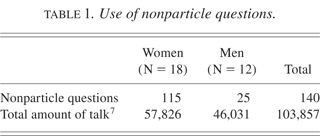
I will focus on the 140 NPQs that function as repair initiation after a prior speaker's instruction (such as the one in ex. 2) or suggestion because, on the surface, the differences between the sexes appear much more exaggerated in these two environments than they do in several others, such as after assessment or after non-orchestra-related tasks. From the figures in my initial quantitative analysis, shown in Table 1, it would appear that orchestra women use these NPQs 4.6 times as often as men do, and it is tempting to see this difference as driven by the speakers' sex or gender per se. However, more detailed discourse analysis demonstrates that we need to investigate the ways in which individual participation in conversation may affect use of NPQs. The first step of this analysis is to determine which of these 140 NPQs are comparable in terms of the “form and function problem” (Cameron, McAlinden & O'Leary 1988:76; emphasis in original; cf. Holmes 1984, Tannen 1993) – that is, whether these questions perform the same functions.
Use of nonparticle questions.To determine the participants' amount of talk, I counted a string of Japanese sounds transcribed by letters of the roman alphabet, which are dissected based on so-called wakachigaki ‘ways of separating a string of sounds into words’. Japanese grammar dictionaries and reference books have various different systems of wakachigaki. Among them, I followed examples provided in the Japanese language textbooks by Jorden & Noda (1987, 1988, 1990). I chose these textbooks simply because they included more examples of wakachigaki than did the others, since all the Japanese examples given by Jordan & Noda are written in roman characters instead of in Japanese and Chinese characters. Regarding romanization itself, I use the modified Hepburn system.

THE FUNCTIONS OF NONPARTICLE QUESTIONS
I divide the 140 NPQs in this study into the following categories, based on the sequence shown below8
Heritage (1984:319) identifies a similar sequence in English conversation when examining uses of oh after an “understanding check” as “repair initiation,” as shown in the following:

The present analysis differs from Heritage's study in that his analysis focuses on oh in the fourth position of the sequence, claiming that oh accomplishes “a mutually ratified exit from repair sequences” (Heritage 1984:318). In contrast, I examine some cases where the fourth position is occupied by an alternative “exit” device other than a(a) ‘oh’ in Japanese, such as the activity of form-filling, as shown in line 8 in conversation (2). Just like oh, the form-filling functions as a “means of achieving exit from a repair sequence” (Heritage 1984:344); thus, in line 9, Emi starts discussing the next chore assignment. This process is discussed in more detail in a later section.
(a) NPQs that request confirmation from the prior speaker;
(b) NPQs that disagree with the prior speaker; and
(c) NPQs that neither request confirmation from nor disagree with the prior speaker.
I consider NPQs to be indicating requests for confirmation when they are first followed by the prior speaker's confirmation of the question asked, and, next, by the questioner's reconfirmation of the interpretation when she or he accepts the confirmation.
This is the sequence in which NPQs function as requests for confirmation:
- A: instruction or suggestion
- B: NPQ as repair initiation
- A: confirmation (repair)
- B: reconfirmation of the interpretation of NPQs as requests for confirmation (i.e., acceptance of confirmation, and compliance with the instruction and suggestion)
This sequence fits conversation (2) above: In line 5, Emi instructs Hana to assign the task to Megu-chan. In line 6, Hana asks the NPQ Ii? tsukatchatte. In line 7, Emi gives the short response Un ‘Yeah’. This response shows that Emi interprets the question as a request for confirmation. Finally, Hana's immediate act of filling in the form (line 8) indicates that she is reconfirming Emi's interpretation of the NPQ as a request for confirmation.
Of the 140 NPQs that occur after instruction and suggestion in my data, 49 (35%) have this type of sequential organization. For the remaining 91 NPQs, the sequence shown above is disrupted in various ways. For instance, in the third position, speaker A may show his or her interpretation of a NPQ as disagreement with A's previous instruction or suggestion, as in example (3).
In (3), the participants are talking about the day on which they will invite an outside conductor for their top players' practice. After Midori proposes the twenty-sixth of the month (line 1), Rie suggests the eleventh (lines 4 and 7). In response to these suggestions, Midori (line 9) asks the NPQ Sonna mae? ‘That early?’ Rie responds (line 10) A mae- mae-sugite ikan? ‘Oh, is that no good because it is early – too early?’ She could have simply said Un, as Emi does in response to Hana's NPQ in (2). However, she reacts here as if Midori's NPQ is a criticism of her proposal of the eleventh.

Disruptions to the typical sequence also occur in connection with questions that neither request confirmation nor express disagreement. For instance, in the fourth position, speaker B may fail to acknowledge the person who answers the NPQ, even though B does not explicitly disagree with the answer (see Okada 2005 for more detailed discussion of an example that neither requests confirmation nor expresses disagreement).9
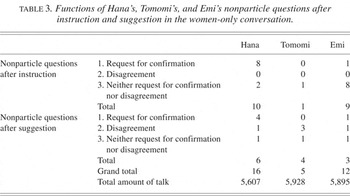
Okada 2005 points out that the orchestra manager Emi tends to ask NPQs which “neither request confirmation nor express disagreement,” as shown in Table 3. That article describes the process for determining function, based on Heritage's (1984) discussion of coparticipants' states of knowledge specific to the sequence of other-initiated repair. I observe that the answering party of a NPQ establishes the status of “the informative, knowledgeable, or authoritative party” (Heritage 1984:315) when the NPQ functions to request confirmation from the answerer. In contrast, when the manager Emi asks NPQs which neither request confirmation nor express disagreement, the answerer often denies her status as a knowing party by assigning responsibility for her claim to the information sheet.
In the process of identifying the sequence, and thereby determining the functions of NPQs, it is important to pay attention not only to talk but also to physical activities, such as filling out a form. Such physical activities constitute a part of the sequential context for the occurrence of a NPQ. For instance, in (2), Hana's immediate act of filling out the form (line 8) functions as a response to Emi's prior utterance, and it verifies Emi's interpretation that the NPQ is asking for her confirmation.
Although my video camera did not capture the exact words of Hana's notes when recording the meeting, it is very likely that she noted each name that Emi assigned to these tasks. Hana is typically the note-taker for this women-only meeting. I obtained the document from Hana after the meeting and made a name-by-name comparison between the names Emi recited and those on the document. I confirmed that Megu-chan, as well as many other names, was assigned the tasks that Emi designated.
Furthermore, in (2) the form-filling also marks the “boundary” (Sheldon, p. c.) of one task assignment involving Megu-chan which includes the NPQ. In other words, the form-filling activity indicates that Emi and Hana can now exit (Heritage 1984:318) the current repair sequence initiated by Hana's NPQs in line 6, and move on to the next task assignment.
Indeed, Emi appears to understand that the assignment of the job to Megu-chan has been finalized as the result of Hana's note-taking. In an utterance that precisely overlaps the final part of Hana's note-taking, Emi (line 9) moves on to the next activity, discussing an additional candidate for the same task. The final syllable of Emi's utterance in line 9, wa in To (.) ato wa: ‘And {I wonder} to whom else {we should assign the task}’, is pronounced simultaneously with Hana's act of pulling her writing hand away from the sheet. Emi, who is sitting next to and facing Hana, watches her writing throughout the conversation.
In short, the form-filling activity provides Emi with a context that helps guide the next response. As Marjorie Harness Goodwin (1995:185) puts it: “As talk is unfolding, participants make use of their local settings, interrogating the tools and resources in their environment to build appropriate, improvised responses.”
Although a previous study (Nakajima 1997:73) has also analyzed the functions of NPQs, e.g. as confirmation of a prior utterance, the present study demonstrates in more detailed ways how participants themselves indicate their interpretations of a NPQ in an unfolding discourse including talk, nonvocal behavior, and use of artifacts.
INDIVIDUAL SPEAKERS' USES OF NONPARTICLE QUESTIONS
Based on close sequential analyses, illustrated for conversation (2), I examined patterns of individual speakers' uses of nonparticle questions, including their functions, frequencies, and addressees. I found that, in this orchestra, individual women and men do not have equal opportunities to use these questions after an instruction or suggestion by a prior speaker. I analyze their differing likelihood of choosing NPQs in terms of (i) a coparticipant's activity of giving instruction to others regarding practice scheduling immediately before the NPQ; (ii) a coparticipant's activity of referring to part of an information sheet; and (iii) a questioner's activity of form-filling after a response to a NPQ.
Giving instruction to others regarding practice scheduling immediately before a nonparticle question
We first examine the chief10
In this study, I use the term “chief” to refer to those in the highest positions within the orchestra; “leader” additionally includes orchestra managers. Chiefs are the representatives of the orchestra; managers are in charge of management of the orchestra. Among the participants who appear in the text of the present paper, Takashi and Ken are chiefs, and Emi is a manager. The rest of the participants do not occupy either position.
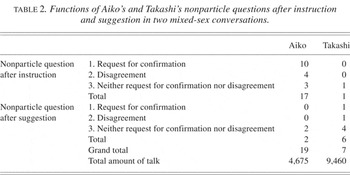
Functions of Aiko's and Takashi's nonparticle questions after instruction and suggestion in two mixed-sex conversations.

One factor contributing to Takashi's infrequent use of NPQs after instruction is his frequent, and almost sole, engagement in the activity of announcing practice schedules during these meetings. In other words, if Takashi is the only participant who gives instructions to others, he will not, as a matter of course, ask NPQs of himself. Hence, it is not surprising that his use of NPQs after instruction is very low, as indicated in Table 2.
In contrast, most of Aiko's NPQs – 17 of 19 – occur after instruction. Aiko directs 13 of 17 questions of this type to Takashi after instruction. Moreover, most of these questions request his confirmation in terms of the sequence defined above. These figures indicate that when Aiko uses NPQs after instruction, she tends to request Takashi's confirmation. Thus, we can consider Takashi to be participating less fully than Aiko in environments where this type of NPQ is relevant.
Participants other than Aiko in these two meetings also frequently address NPQs to Takashi after he provides scheduling instructions. These participants use NPQs after instruction a total of 20 times, of which 15 are directed to Takashi. Of the 15, about half request confirmation.
In these two conversations, several participants other than Takashi provide instruction before NPQs, but, for the most part, their instruction is directed to someone other than Takashi. For instance, they provide instruction regarding the practice schedule for training conductors of the string section, a topic that does not directly involve Takashi. In other words, their instruction before NPQs is different from Takashi's instruction, which often concerns the scheduling of a whole orchestra practice – a topic of interest to all the participants.
Also, some of the instruction they provide has originated in Takashi's instruction. For instance, Aiko provides Keiko with instruction regarding whether the meeting has ended. However, before Aiko gives this instruction, she asks Takashi if the meeting is over, and Takashi confirms it.
Referring to the information sheet: Male chief Takashi and female manager Emi
Takashi's infrequent use of NPQs after someone else's instruction contrasts with the female manager Emi's relatively frequent use of them after she receives instruction from another woman in one women-only conversation, as shown in Table 3. In the conversation, three women are discussing orchestra chore assignments and the procedures for some other tasks.
Functions of Hana's, Tomomi's, and Emi's nonparticle questions after instruction and suggestion in the women-only conversation.

I will first describe several similarities between Emi and Takashi in terms of their roles as addressees of NPQs. Then I will explore a difference in their uses of NPQs. I consider the difference between the two speakers to be affected by the presence or absence of another information provider, rather than by the sex or gender of the speaker per se.
Much like Takashi, Emi often provides instruction before NPQs. Another woman, Hana, frequently asks Emi NPQs. One example appears in (2), examined earlier. Emi is the manager of the orchestra, whereas Hana is the concert accountant. Hana is often a note-taker of Emi's statements, as in (2).
As shown in Table 3, Hana asks ten NPQs after instruction. They are all directed to Emi after Emi's instruction about chore assignments and the procedures for some other tasks. This question-asking closely resembles the way that Aiko directs most of her NPQs to Takashi after his announcement of the practice schedule. Furthermore, of the 10 questions Hana asks, eight request Emi's confirmation regarding her previous instruction. Thus, the function of the NPQs which Emi is often asked is also similar to the function of those asked of Takashi.
In spite of these similarities, Emi and Takashi do not resemble each other in the frequency with which they ask NPQs after a prior speaker's instruction. Unlike Takashi, who rarely uses NPQs in such circumstances, Emi asks nine NPQs after instructions provided mostly by Hana. Of the nine questions, seven are directed at Hana's instructions.
Emi is talking in environments where she can request the coparticipant's confirmation by using NPQs. In the case of Takashi, the instruction he receives from several other participants primarily concerns subjects unrelated to him. In contrast, in this women-only conversation, Hana is the only person who has the information sheet, and the two women discuss chore assignments and the chore schedule based on that sheet. In this context, Emi often asks NPQs of Hana, asking her to read or check the information sheet.
For instance, example (4) indicates Hana's treatment of Emi's NPQs as a request that Hana check information on the sheet. In this conversation, Hana demonstrates her interpretation of Emi's NPQs by pointing to a particular point on the information sheet. Hana looks at the sheet to determine whether their next discussion should decide on a candidate for the task of recruitment during new-student orientation.
In (4), after taking note of the names in line 2, which Emi has just assigned in line 1, Hana searches for the next chore assignment for discussion by moving her index finger back and forth on the sheet (line 3). In line 5, she points to a spot on the information sheet. She keeps her finger in that position throughout the instructive conversation sequence that follows: Owatta ‘{That was} done’ (line 6), Emi's NPQ Owatta? ‘{Was it} done?’ (line 7), and Hana's answer to the question, Un ‘yeah’ (line 8). The continuing finger position shows Hana's orientation: She is aware that she is supposed to answer Emi's NPQ based on the information sheet.

Thus, the conversation in (4) shows that the coparticipant Hana treats Emi's NPQs as requests to look at the information sheet.
Throughout this women-only conversation, Emi asks seven NPQs of Hana after Hana's instruction. Regarding five of the seven NPQs, Hana either provides instruction before the question or answers the question by checking the information sheet. Thus, Takashi and Emi may use NPQs differently because of the presence or absence of another information provider who can refer to the information sheet, rather than because of a difference in sex or gender. In other words, no one in the conversations that include Takashi possesses a similar information sheet. Thus, the occurrence of NPQs appears to be pertinent to the local activity of looking at the sheet.
In summary, my detailed analyses of (i) the questions asked by Aiko and Takashi and (ii) the questions asked by Takashi and Emi show that individual participants may use more or fewer NPQs depending on their discourse environments. Some environments have a greater potential for the occurrence of NPQs than do others.
Filling in a form: Within-gender differences between Hana and Tomomi
Furthermore, among women, depending on the activities they are engaged in, there may be “within-gender variability” (Okamoto & Smith 2004:4) in the frequency with which the speakers use a specific linguistic form. For instance, as shown in Table 3, Hana's amount of talk is similar to that of Tomomi. But after a previous speaker's instruction or suggestion, Hana uses NPQs 16 times, whereas Tomomi uses them only five times. What influences the difference in frequency?
Detailed sequential analysis shows that Hana's frequent use of NPQs is affected by the fact that she is the only person who is completing a chore assignment sheet, and that, in filling out the sheet, she is the sole recorder of her coparticipant's instructions and suggestions. In this situation, Hana's use of NPQs functions as a “preliminary” (Levinson 1983:306) to the act of recording information.
In other words, in this and the other conversations in my data, one speaker's instruction or suggestion plus the coparticipant's response to it constitute an adjacency pair (Schegloff & Sacks 1973:296), in which the first pair part (instruction or suggestion) “projects a relevant next action” (Heritage & Atkinson 1984:6), that is, the second pair part (compliance with or rejection of the instruction or suggestion).11
Failure to respond to instruction or suggestion is “noticeably absent” (Heritage and Atkinson 1984:6) for some participants, as in conversation (3). In line 7 in (3), Rie rephrases her first suggestion, originally expressed in line 4, after she receives no response to it. Thus, Rie shows her expectation that her suggestion should get some answer.
Given this sequential organization, Emi and Hana often produce the adjacency pair when discussing orchestra task assignments. In the pairs, Hana is a frequent respondent to Emi's instruction or suggestion regarding task assignments. Hana often responds by making a note of the assignment.12
Conversation (6) shows one typical sequence in which Hana responds to Emi's instruction by making a note.

In line 1, Hana explicitly expresses her responsibility as a recorder who is completing the task assignment sheet. In response to Emi's suggestion (line 2) that they assign ‘senior Tanaka’ to the job, Hana asks NPQs in lines 3 and 5. In line 5, in particular, the design of Hana's NPQ as a preliminary to her note-taking is apparent. The question includes the word kore ‘this’, which explicitly indicates a particular spot on the sheet. That word works together with her hand movement – she is about to make a note and is holding the pen very close to the sheet. After Emi answers the second NPQ (line 6), Hana makes a note of Emi's suggestion (line 7). In line 10, Tomomi explicitly starts the next chore assignment. This shows that Tomomi appears to interpret Hana's note-taking as finalizing Emi's suggestion; Hana complies with the suggestion. Also, at the same time, Tomomi's act of moving to the next task shows that there is no longer a problem with the current task assignment. This is to say that Hana's NPQ and Emi's answer to it work together as an effective preliminary for Hana's note-taking. Emi's answers to the NPQs have resolved the understanding problem that Hana expressed with her NPQs in lines 3 and 5.

Thus, only after solving an understanding problem that she has located in the prior instruction or suggestion can Hana proceed to record the instruction or suggestion. Hana, who is a frequent respondent to instruction, asks more NPQs than Tomomi, who is not a note-taker.
When Hana uses NPQs after instruction, in eight out of ten cases she either fills out a form or makes a note in the fourth position of the typical sequence. In contrast, in the same three-woman conversation, Tomomi is engaged in a private task: creating yobi-tooroku-yooshi ‘temporary registration sheets’ (sheets to be used when new orchestra members register for the club). At the same time, she is participating in the task of assigning orchestra chores, where Emi mostly gives instruction and Hana takes notes in response. Making the temporary registration sheets is a rather personal activity in this context, because the activity is not directly related to the ongoing public task.
In sum, my analyses in the preceding three subsections show that when women and men use NPQs with differing frequency, we cannot conclude that the sex or gender of the speaker is the only relevant determiner of this behavior. Rather, depending on the ways in which members of the group participate in a particular discourse, some speakers may be more or less likely than others to use NPQs. One speaker's activity, such as filling out a form, may increase his or her opportunities to use such questions. Another speaker who is the sole announcer of practice schedules may be less likely to speak in environments where such questions can be relevant. Furthermore, the presence of a coparticipant who often refers to an information sheet may also affect a speaker's likelihood of using these forms. Thus, detailed sequential analysis allows us to observe the close link between occurrence of NPQs and discourse activities.
UNEQUAL DISTRIBUTION OF ACTIONS BETWEEN WOMEN AND MEN
Individual participants' differing opportunities to use NPQs can be considered in terms of different “access to and control over resources and activities” (Ochs 1992:341) between women and men in this orchestra. In other words, women's and men's superficially sex-linked or gendered usages of NPQs, expressed as different frequencies of use, cannot be separated from the orchestra's “sexual division of labor” (Uchida 1992:559); that is, men engage more frequently in instructing others than do women. Such differing activities by women and men may affect their chances of using NPQs.
For instance, as one of the orchestra chiefs, the male participant Takashi alone gave instruction to others regarding the practice schedule. Consequently, he had fewer opportunities to use NPQs after his own instructions. In comparison, the other members of the same meetings, mostly female, found themselves more often in a discourse situation in which the use of NPQs was relevant. Their NPQs often requested confirmation from Takashi. Thus, if women and men engage in different discourse activities, the activities can affect the frequency of linguistic forms, such as NPQs, produced by the two sexes.
The question arises as to whether the imbalance between women and men in these conversations would disappear if a female participant were the only member giving instructions. In such a situation, would she be less likely to use NPQs after her own instructions? And would she also be more likely to be the recipient of NPQs from the men and women to whom she had given instructions?
A positive answer to this question is partly supported by several similarities between Takashi and the female manager Emi in their roles as addressees of NPQs. Both Takashi and Emi receive NPQs from coparticipants after they have given instructions. These questions often request confirmation.
If we think about which gender is more likely to be engaged in the activity of announcing practice schedules, and to be asked NPQs afterward, we cannot ignore the general exclusion of women from leadership positions in this orchestra. According to the data I collected in winter 1995 and in spring and winter 1998, all the orchestra chiefs are male, and only one of the three managers is female. A similar imbalance governed this orchestra for 20 years (1979–1999). Since 1979, there have been no female chiefs. During those same years, there have been only two female managers, both in the late 1990s.
Uchida (1992:559) has argued that we cannot overlook how much the sexual division of labor affects our everyday interactions. Freed has also noted:
Thus language and gender studies conducted in natural settings may often find differences not similarities in women's and men's speech simply because women and men are frequently engaged in different activities (see M.Goodwin 1990) and not because of any differences in women and men themselves. (Freed 1996:67)
Thus, the frequency and the function of a linguistic form may be directly affected by which gender is more or less likely to engage in an activity where the form is possibly relevant, rather than by the sex or gender of a speaker per se.
SOCIAL STATUS AND LINGUISTIC CHOICE
Finally, the connection between discourse activity and language use cannot be reduced to a simple association between higher status in the orchestra (such as that of chief) and linguistic choice. Although linguistic choice may indeed vary according to a speaker's social status (O'Barr & Atkins 1980:102), this study has shown that the surrounding discourse activities can also affect the occurrence of a particular linguistic form. In other words, being a chief (a position of higher status) does not in itself mean that the chief will use fewer NPQs than the other participants will.
For instance, in my data, chiefs have different opportunities for using NPQs, depending on the activities in which participants are engaged immediately before NPQs occur. Compared to Takashi, who is the sole announcer of schedules before NPQs, another chief, Ken, has more chances to use NPQs after a prior speaker's assessment. During the meeting involving Ken, members use NPQs primarily after a prior speaker's assessment of a particular piece of music, rather than after the announcement of a schedule. (During the meeting, all of the participants need to express their opinions about several pieces of music because they are representatives of their instrument sections and need to choose music for their next concert.) Because the assessment providers in the meeting include not only Ken but also several other participants, Ken has more opportunities to use NPQs than does Takashi, who simply gives instruction before NPQs. During that conversation, Ken's use of these questions resembles that of another male participant, Masao, who asks NPQs five times after a prior speaker's assessment. The two men's amounts of talk are similar: Masao, 2,713 words, vs. Ken, 2,905 words.
Thus, arguments that higher status or occupation are responsible for linguistic choice may be misleading if the individual's discourse activities before, after, or when the form is used are not taken into consideration. In the orchestra, roles are important simply because performing these roles allows speakers opportunities to engage in certain discourse activities. For this reason, we must examine how the activities of those in certain orchestra positions affect their opportunities to use a linguistic form at a particular moment. A sequential discourse analysis enables us to do this.
CONCLUSION
The position taken in this article is that careful investigation is needed for claims that language use varies primarily according to a speaker's social attributes. Importantly, we need to consider establishing grounds for quantitative analysis based on sequential discourse analysis that examines features of the context and their influence on usage of the linguistic forms made relevant to the discourse. What often matters are the discourse activities at the moment the form is used (M. Goodwin 1990, Ochs 1992, Freed 1996). We also need to understand how these activities are conventionally linked with one gender (Ide 1990, Ochs 1992, Freed 1996).
Close examination of the discourse environments for linguistic choices leads us to attend to individual women's and men's differing ways of participating in a conversation. It also allows us to look at within-gender differences (Okamoto 1995, 1996, 2002; Okamoto & Smith 2004) in the usage of particular forms among Japanese women and among Japanese men. I hope that this study will contribute to a more general recognition of the importance of close discourse analysis to any sociolinguistic investigation of linguistic choices.
APPENDIX

References
REFERENCES
Bing, Janet M., &
Bergvall, Victoria L.
(1996).
The question of questions: Beyond binary thinking. In
Victoria L. Bergvall
et al. (eds.),
Rethinking language and gender research: Theory and practice,
1–30.
New York:
Addison Wesley Longman.
Cameron, Deborah
(1996).
The language-gender interface: Challenging co-optation. In
Victoria L. Bergvall
et al. (eds.),
Rethinking language and gender research: Theory and practice,
31–53.
New York:
Addison Wesley Longman.
Cameron, Deborah;
McAlinden, Fiona; &
O'Leary, Kathy
(1988).
Lakoff in context: The social and linguistic functions of tag
questions. In
Jennifer Coates &
Deborah Cameron (eds.),
Women in their speech communities: New perspectives on language and
sex,
74–93.
New York:
Longman.
Cook, Haruko Minegishi
(1999).
Situational meanings of Japanese social deixis: The mixed use of the
masu and plain forms.
Journal of Linguistic Anthropology
8 (1):87–110.Google Scholar
Eckert, Penelope, &
McConnell-Ginet, Sally
(1992).
Communities of practice: Where language, gender, and power all
live. In
Kira Hall
et al. (eds.),
Locating power: Proceedings of the Second Berkeley Women and
Language Conference, 1:89–99.
Berkeley:
Berkeley Women and Language Group.
Eckert, Penelope, &
McConnell-Ginet, Sally
(2003).
Language and gender.
Cambridge:
Cambridge University Press.CrossRef
Ehrlich, Susan
(1997).
Gender as social practice: Implications for second language
acquisition.
Studies in Second Language Acquisition
19:421–46.Google Scholar
Ford, Cecilia E.;
Fox, Barbara A.; &
Thompson, Sandra. A.
(2002).
Introduction. In
Cecilia. E. Ford
et al. (eds.),
The language of turn and sequence,
3–13.
New York:
Oxford University Press.
Freed, Alice F.
(1996).
Language and gender research in an experimental setting. In
Victoria L. Bergvall
et al. (eds.),
Rethinking language and gender research: Theory and practice,
54–76.
New York:
Addison Wesley Longman.
Freed, Alice F., &
Greenwood, Alice
(1996).
Women, men, and type of talk: What makes the difference?
Language in Society
25:1–26.Google Scholar
Goodwin, Charles
(2000).
Action and embodiment within situated human interaction.
Journal of Pragmatics
32:1489–1522.Google Scholar
Goodwin, Charles
(2003).
The body in action. In
Justine Coupland& Richard Gwyn
(eds.),
Discourse, the body, and identity,
19–42.
New York:
Palgrave Macmillan.CrossRef
Goodwin, Charles, &
Duranti, Alessandro
(1992).
Rethinking context: An introduction. In
Alessandro Duranti &
Charles Goodwin (eds.),
Rethinking context: Language as an interactive phenomenon,
1–42.
Cambridge:
Cambridge University Press.
Goodwin, Charles, &
Goodwin, Marjorie H.
(1998).
Seeing as a situated activity: Formulating planes. In
Yrjö Engeström &
David Middleton (eds.),
Cognition and communication at work,
61–95.
Cambridge:
Cambridge University Press.
Goodwin, Marjorie H.
(1980).
Processes of mutual monitoring implicated in the production of
description sequences.
Sociological Inquiry
50(3–4):303–17.Google Scholar
Goodwin, Marjorie H.
(1990).
He-said-she-said: Talk as social organization among black
children.
Bloomington:
Indiana University Press.
Goodwin, Marjorie H.
(1995).
Assembling a response: Setting and collaboratively constructed work
talk. In
Paul ten Have &
George Psathas (eds.),
Situated order: Studies in the social organization of talk and
embodied activities,
173–86.
Washington DC:
International Institute for Ethnomethodology and Conversation
Analysis & University Press of America.
Heritage, John
(1984).
A change-of-state token and aspects of its sequential
placement. In
J. Maxwell Atkinson &
John Heritage (eds.),
Structures of social action: Studies in Conversation
Analysis,
299–345.
Cambridge:
Cambridge University Press.
Heritage, John
(2005).
Conversation analysis and institutional talk. In
Kristine L. Fitch &
Robert E. Sanders (eds.),
Handbook of language and social interaction,
103–47.
Mahwah, NJ:
Lawrence Erlbaum.
Heritage, John, &
Atkinson, J. Maxwell
(1984).
Introduction. In
J. Maxwell Atkinson &
John Heritage (eds.),
Structures of social action: Studies in Conversation
Analysis,
1–15.
Cambridge:
Cambridge University Press.
Holmes, Janet
(1984).
Hedging your bets and sitting on the fence: Some evidence for hedges
as support structures.
Te Reo
27:47–62.Google Scholar
Ide, Sachiko
(1990).
How and why do women speak more politely in Japanese? In
Sachiko Ide &
Naomi H. McGloin (eds.),
Aspects of Japanese women's language,
63–79.
Tokyo:
Kuroshio.
Jorden, Eleanor H., &
Noda, Mari
(1987).
Japanese: The spoken language. Part 1.
New Haven:
Yale University Press.
Jorden, Eleanor H., &
Noda, Mari
(1988).
Japanese: The spoken language. Part 2.
New Haven:
Yale University Press.
Jorden, Eleanor H., &
Noda, Mari
(1990).
Japanese: The spoken language. Part 3.
New Haven:
Yale University Press.
Kamio, Akio
(1990).
Joohoo no nawabari-riron: Gengo no kinoo-teki bunseki [A theory
of territory of information: Functional analysis of language].
Tokyo:
Taishuukan.
Levinson, Stephen C.
(1983).
Pragmatics.
Cambridge:
Cambridge University Press.
Makino, Seiichi, &
Tsutsui, Michio
(1986).
A dictionary of basic Japanese grammar.
Tokyo:
Japan Times.
Masuoka, Takashi, &
Yukinori, Takubo
(1989).
Kiso Nihongo bunpoo [Basic Japanese grammar].
Tokyo:
Kuroshio.
Maynard, Senko K.
(1989).
Japanese conversation: Self-contextualization through structure and
interactional management.
Norwood, NJ:
Ablex.
Maynard, Senko K.
(1990).
An introduction to Japanese grammar and communication
strategies.
Tokyo:
Japan Times.
Maynard, Senko K.
(1993a).
Discourse modality: Subjectivity, emotion and voice in the Japanese
language.
Amsterdam & Philadelphia:
John Benjamins.
Maynard, Senko K.
(1993b).
Kaiwa bunseki [Conversation analysis].
Tokyo:
Kuroshio.
McGloin, Naomi H.
(1980).
Some observations concerning no desu expressions.
Journal of the Association of Teachers of Japanese
15(2):117–49.Google Scholar
Nakajima, Etsuko
(1997).
Gimon-hyoogen no yoosoo [Aspects of interrogative
expressions]. In
Gendai Nihongo Kenkyuu-kai (ed.),
Josee no kotoba: shokuba-hen [Women's language at
work],
59–82.
Tokyo:
Hitsuji Shoboo.
Nakajima, Etsuko
(2002).
Shokuba no dansei no gimon-hyoogen [Interrogative expressions
used by men in the workplace]. In
Gendai Nihongo Kenkyuu-kai (ed.),
Dansee no kotoba: shokuba-hen [Men's language at
work],
47–61.
Tokyo:
Hitsuji Shoboo.
O'Barr, William M., &
Atkins, Bowman K.
(1980).
‘Women's language’ or ‘powerless
language’? In
Sally McConnell-Ginet
et al. (eds.),
Women and language in literature and society,
93–110.
New York:
Praeger.
Ochs, Elinor
(1992).
Indexing gender. In
Alessandro Duranti &
Charles Goodwin (eds.),
Rethinking context: Language as an interactive phenomenon,
335–58.
Cambridge:
Cambridge University Press.
Okada, Misao
(2001).
The use of nonparticle questions among women and men in Japanese
spontaneous conversation.
Dissertation,
University of Minnesota.
Okada, Misao
(2005).
Dynamic processes of coparticipants' understanding of some
functions of nonparticle questions in Japanese.
Bulletin of Fuji Women's University
42 (Series I):55–78.Google Scholar
Okamoto, Shigeko
(1995).
“Tasteless” Japanese: Less “feminine”
speech among young Japanese women. In
Kira Hall &
Mary Bucholtz (eds.),
Gender articulated: Language and the socially constructed
self,
297–325.
New York:
Routledge.
Okamoto, Shigeko
(1996).
Indexical meaning, linguistic ideology, and Japanese women's
speech. In
Jan Johnson
et al. (eds.),
Proceedings of the Twenty-second Annual Meeting of the Berkeley
Linguistics Society,
290–301.
Berkeley:
Berkeley Linguistics Society.CrossRef
Okamoto, Shigeko
(2002).
Ideology and social meanings: Rethinking the relationship between
language, politeness, and gender. In
Sarah Benor
et al. (eds.),
Gendered practices in language,
91–113.
Stanford:
Center for the Study of Language and Information.
Okamoto, Shigeko, &
Smith, Janet S. Shibamoto
(2004).
Introduction. In
Shigeko Okamoto &
Janet S. Shibamoto Smith (eds.),
Japanese language, gender, and ideology: Cultural models and real
people,
3–20.
Oxford:
Oxford University Press.
Schegloff, Emanuel A.
(1976).
On some questions and ambiguities in conversation.
Pragmatics Microfiche,
2.2, D8-G1 (reprinted in Atkinson & Heritage
1984).Google Scholar
Schegloff, Emanuel A.
(1993).
Reflections on quantification in the study of conversation.
Research on Language and Social Interaction
26(1):99–128.Google Scholar
Schegloff, Emanuel A.
(1997a).
Whose text? Whose context?
Discourse and Society
8(2):165–87.Google Scholar
Schegloff, Emanuel A.
(1997b).
Practices and actions: Boundary cases of other-initiated
repair.
Discourse Processes
23:499–545.Google Scholar
Schegloff, Emanuel A., &
Sacks, Harvey
(1973).
Opening up closings.
Semiotica
8(4):
289–327.Google Scholar
Sheldon, Amy
(1992).
Conflict talk: Sociolinguistic challenges to self-assertion and how
young girls meet them.
Merrill Palmer Quarterly
38(1):95–117.Google Scholar
Smith, Janet S.
(1992).
Women in charge: Politeness and directives in the speech of Japanese
women.
Language in Society
21:59–82.Google Scholar
Stokoe, Elizabeth H.
(2005).
Analysing gender and language.
Journal of Sociolinguistics
9(1):118–33.Google Scholar
Tannen, Deborah
(1993).
The relativity of linguistic strategies: Rethinking power and
solidarity in gender and dominance. In
Deborah Tannen (ed.),
Gender and conversational interaction,
165–88.
New York:
Oxford University Press.
Teramura, Hideo
(1984).
Nihongo no shintakusu to imi [Syntax and semantics of
Japanese],
vol. 2.
Tokyo:
Kuroshio.
Uchida, Aki
(1992).
When “difference” is “dominance”: A critique
of the “anti-power-based” cultural approach to sex
differences.
Language in Society
21:547–68.Google Scholar
Wodak, Ruth, &
Benke, Gertraud
(1997).
Gender as a sociolinguistic variable: New perspectives on variation
studies. In
Florian Coulmas (ed.),
The handbook of sociolinguistics,
127–50.
Oxford:
Blackwell.
Use of nonparticle questions.To determine the participants' amount of talk, I counted a string of Japanese sounds transcribed by letters of the roman alphabet, which are dissected based on so-called wakachigaki ‘ways of separating a string of sounds into words’. Japanese grammar dictionaries and reference books have various different systems of wakachigaki. Among them, I followed examples provided in the Japanese language textbooks by Jorden & Noda (1987, 1988, 1990). I chose these textbooks simply because they included more examples of wakachigaki than did the others, since all the Japanese examples given by Jordan & Noda are written in roman characters instead of in Japanese and Chinese characters. Regarding romanization itself, I use the modified Hepburn system.
Functions of Aiko's and Takashi's nonparticle questions after instruction and suggestion in two mixed-sex conversations.
Functions of Hana's, Tomomi's, and Emi's nonparticle questions after instruction and suggestion in the women-only conversation.
 You have
Access
- 4
- Cited by