Throughout history, earthquakes have caused extensive devastation and loss of life. Most recently, thousands were killed in earthquakes in Haiti (2010), Reference Merin, Miskin and Lin1 Japan (2011), Reference Fukuma, Ahmed and Goto2 and Nepal (2015). Reference Hall, Lee and Cartwright3
Earthquakes in Israel
Due to its geographical location at the eastern edge of the Mediterranean Sea, the State of Israel, as well as the entire Levantine region, exists on the Syrian-African fault. Since the early 19th century, at least a half dozen major earthquakes have impacted the region. The last major earthquake was in July 1927 with a reported magnitude of 6.2, killing more than 3000 and destroying 1000 homes. Reference Peleg, Reuveni and Stein4
Multi-casualty Incident Versus Disaster
A multi-casualty incident (MCI) is an event in which the number of health care providers and the resources available are insufficient to deal with the number of victims and the extent of their injuries. Reference El Sayed, Tamim and Mann5 In a disaster, not only are there not enough resources on a large scale, but also there is a complete breakdown in communication and the ability to deliver these resources. The rescue and health care workers may themselves become the victims and the local medical facilities may be destroyed. The health care providers must make an intellectual and emotional leap from attempting to save all lives, to saving as many lives as possible with the available resources.
Destructive Effects of an Earthquake
Earthquakes are unique among natural disasters due to their suddenness. Early warning signs make it possible to anticipate hydrometeorological disasters such as hurricanes or blizzards, giving populations time to prepare and protect themselves. In contrast, geological hazards such as earthquakes have historically not displayed sufficient evidence or identifying signs before they strike. Reference Andrews and Quintana6 When an earthquake occurs in the evening or at night, many people find themselves trapped inside their homes. Reference Shoaf, Sareen and Nguyen7 Following a severe earthquake, aftershocks may occur and can further affect buildings already damaged in the initial, stronger tremor.
A severe earthquake causes mass destruction and multiple victims in a matter of minutes. However, most of the injured who are rescued during the first 48 hours after the earthquake can be expected to survive. Reference Roces, White and Dayrit8 A large number of victims and their distribution over many sites make it extremely difficult to implement the processes necessary for appropriate medical care. In addition, the location and extent of damage to the buildings may impact the nature of the injuries. Those on the upper floors of collapsed buildings are more likely to have higher-acuity injuries, such as intracranial hemorrhage, intra-abdominal injury, and crush syndrome. Reference Pan, Cheng and Wu9
Rescue efforts may be hindered as a result of damaged infrastructure. There will be power outages and a lack of fuel to enable rescue workers to efficaciously arrive at the scene. Reference Adhikari, Mishra and Babu Marahatta10 Emergency medical services (EMS) workers may be injured in the earthquake or may need to attend to family members who were directly affected. The telephone-based, call-out system may not work, accesses may be blocked, the nearest hospitals may not be functional, and most of the components of the prehospital emergency medical system may become ineffective.
The response to disasters includes the chain of search and rescue, prehospital services, and more advanced medical care in clinics or hospitals. An earthquake is liable to affect every link in this chain. However, despite these challenges, prior experience has shown that good disaster management planning, including the role of EMS, can contribute to better outcomes, especially in the initial phases of the event. Reference Djalali, Khankeh and Öhlén11
Magen David Adom
Magen David Adom (MDA) is the official prehospital EMS response system in Israel and a member of the International Federation of Red Cross and Red Crescent Societies. Originally founded in 1930 as a volunteer service, it later became consolidated into a centralized national organization. Reference Ellis and Sorene12 The main components of MDA include dispatch, personnel, and ambulances.
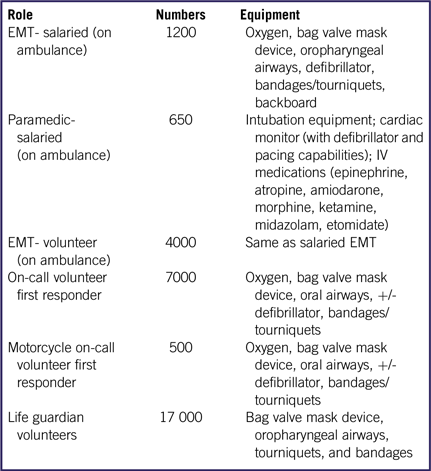
To summon an ambulance, one dials 101. The call is then routed to 1 of 9 regional call centers. Like many systems, the response is 2-tiered. Basic Life Support (BLS) is provided by emergency medical technicians (EMTs), which includes the ability to give oxygen, perform CPR, and apply bandages and tourniquets to stop bleeding. Advanced Life Support is provided by paramedics which includes the ability to provide advanced airway support, such as intubation as well as deliver medications necessary for resuscitation.
While there are currently approximately 1200 salaried EMTs and 650 paramedics, there is a robust multi-level system of over 40 000 volunteers out of a total population of 8.5 million. There are currently 11 000 youth volunteers who, starting at the age of 15, can undergo BLS training and ride as support staff on the EMT level ambulance. The over 4000 adult EMT level volunteers who are based out of the ambulance stations may also serve as drivers after supplemental training. Since the year 2000, there is a unique system of over 7000 on-call volunteer first responders who have BLS equipment in their vehicles. Reference Jaffe, Alpert and Lipsky13 There are also over 500 volunteers who use MDA provided motorcycles. The newest volunteer responders are the nearly 17 000 Life Guardians – mostly health care professionals who are provided with a kit that may include a bag valve mask device, oropharyngeal airways, tourniquets, and bandages. Their primary purpose is to respond to immediate life-saving cardiorespiratory events or severe trauma, but they can also be activated to an MCI Reference Jaffe, Dadon and Alpert14 (Table 1).
Magen David Adom Emergency Medical Services

EMT = emergency medical technician; IV = intravenous.
OBJECTIVE
The objective of this article is to describe the role of prehospital EMS, in general, and, in particular, MDA in earthquake response. This includes descriptions of the conceptual model of the ABC approach, the functional model of automatic and autonomous performance, and the integration of salaried and volunteer workers in disaster response. The role of EMS from search and rescue, triage and stabilization, and definitive medical care will be detailed.
THE ABCs OF EARTHQUAKE MANAGEMENT
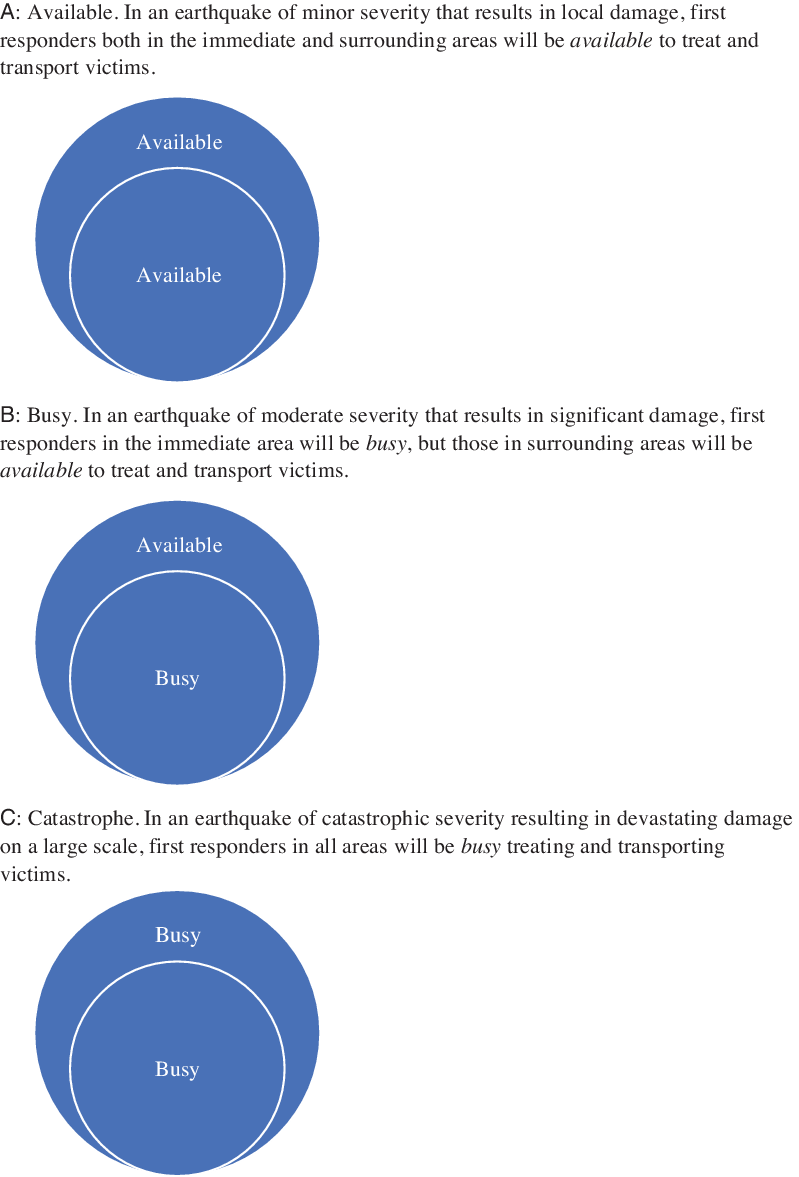
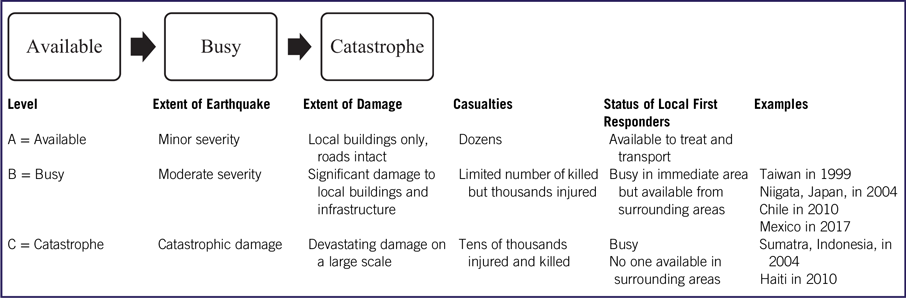
MDA has designed a unique earthquake disaster prehospital operating system known as the ABCs of earthquake management, which incorporates the salaried staff as well as volunteers. This focuses on the individual provider who will work within local neighborhoods located in predetermined geographic regions. This categorizes disaster response and the role of the EMS provider, based on escalating severity: “Available,” “Busy,” or “Catastrophe.” These classifications reflect the severity of casualties as well as the level of damage to the local infrastructure and provide guidelines for the emergency service provider with regard to organization, triage, treatment, and transport. Emergency personnel are charged with both evaluating the patient and undertaking a rapid, real-time systems-based assessment of what resources are available at a specific disaster site. The underlying theme of the protocol is for individual first responders to “decide what is the overall status of the earthquake in my specific location to determine how to further proceed.” First responders then categorize their specific situation as either one of the following.
Level A: “Available”
There are 1 or more MCIs in a defined geographic area that can be treated by the local EMS. There may be buildings that have collapsed and dozens of casualties, but there is not significant damage to the local infrastructure or roadways. Except for perhaps the few providers in the immediate vicinity of a damaged building, most in that area are available to treat and transport severely injured patients to hospitals via ambulance. Less severely injured patients can travel by themselves to the hospital for medical attention. Responders from surrounding areas where there is no damage are also available to help.
Level B: “Busy”
This level is defined as an earthquake of moderate severity where there is significant damage to local buildings and infrastructure in a wider geographic area. There may be victims who are killed as well as those who are severely injured requiring emergency services. There may be thousands who will be moderately injured and expected to require medical services. Most of the rescue can be anticipated to be finished within 48 hours, although it will require reinforcement by regional and national aid. The local EMS responders will be busy in the area of the disaster. Others from wider surrounding areas will be available to help and then they will become busy. Most recently, after the earthquake in Mexico in 2017 (initial magnitude of 8.1), local volunteers used social networking, such as Facebook and WhatsApp, to facilitate and organize the responders. This included volunteer rescue workers who removed survivors and victims from the rubble and doctors and nurses who manned makeshift treatment areas. Reference Fraser and Carvallo-Vargas15,Reference Jasso Ortega16 In the aftermath of the earthquake and tsunami that affected Chile in 2010 (magnitude of 8.8), medical and other professional students mobilized. Reference Reyes17 Other examples include the earthquakes in Taiwan in 199918 and Niigata, Japan, in 2004. Reference Nakamura, Kitamura and Someya19 There were challenges. In the immediate response to the earthquake in Nepal in 2015, there was a pre-existing lack of health care workers. Reference Hall, Lee and Cartwright3 In Bam, Iran, many of the medical volunteers weren’t trained, nor were the responders appropriately organized in teams. Reference Djalali, Khankeh and Öhlén11
Level C: “Catastrophe”
This level is defined as a devastating earthquake where there are tens of thousands who are killed. Expected casualties include large numbers of those severely injured and tens of thousands of those moderately injured. The initial search and rescue will last longer than the 48-hour window and may require international aid. In a national or regional catastrophe, all EMS providers who are uninjured will be busy in their local areas. Almost no one will be available to help outside of the area that they are currently located. Examples of this are the earthquakes in Sumatra, Indonesia, in 2004, Reference Yuzal, Kim, Pant and Yamashita20 and Haiti in 20101 (Figure 1; Table 2).
The ABCs of Earthquake Response. A: Available. In an earthquake of minor severity that results in local damage, first responders both in the immediate and surrounding areas will be available to treat and transport victims. B: Busy. In an earthquake of moderate severity that results in significant damage, first responders in the immediate area will be busy, but those in surrounding areas will be available to treat and transport victims. C: Catastrophe. In an earthquake of catastrophic severity resulting in devastating damage on a large scale, first responders in all areas will be busy treating and transporting victims.

The ABCs of Earthquake Response

The main principle of operation is that the individual responder who has extensive training and experience in routine emergencies will work automatically based on predefined protocols, as well as be able to function autonomously either near the site of destruction or from the local ambulance station. Based on this concept of the ABC approach to earthquake disaster, MDA can organize its members in just a few short hours to be able to respond to areas of destruction without direct supervision. This “guerrilla tactic” enables independent and autonomous actions that maximize prehospital care when there is no communication between teams, the absence of cellular communication, and the lack of a computerized command and control center. According to this approach, hundreds of ambulances can transport salaried and volunteer MDA workers to areas of need.
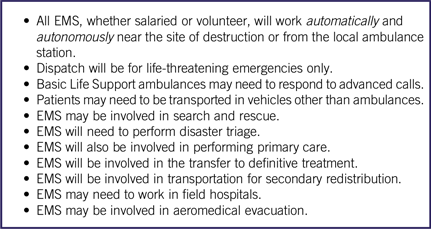
Fundamental changes in the conventional EMS structure will need to take place. Dispatch will be only for life-threatening emergencies, BLS ambulances may need to respond to advanced calls, and patients may need to be transported in vehicles other than ambulances.
PREHOSPITAL CARE
The prehospital response to a disaster such as an earthquake has 4 significant components: search and rescue, triage and stabilization, definitive medical care, and transfer to the hospital. Search and rescue operations may be difficult when outside medical teams are prevented from reaching the disaster site because of damage to roads, bridges, and landing strips. Also, due to the breakdown in communication, it may be difficult to know the extent of those missing.
Search and Rescue
First aid must be provided to victims in proximity to the place where they are found, and it must be carried out as quickly as possible. The time that passes from the occurrence of the incident until the rescue of the victims is an important factor.
From earthquakes in Turkey and China, we have learned that within 2 to 6 hours of the tremor, fewer than 50% who were trapped remained alive. Data from the earthquakes in Armenia (1988) and Costa Rica (1991) identified people whose deaths could have been prevented if they had received medical care during the first 6 hours. Reference Schultz, Koenig and Noji21
A survey of severe earthquakes from around the world shows that the rate of success of rescuing victims alive diminishes rapidly 24 hours after the quake. Reference Briggs22 Although cases have been reported where victims were rescued after being trapped 14 days, these are very rare. Reference Naghii23
Implementing basic first-aid and assistance by the local population considerably raises the chances of saving victims. Reference Angus, Pretto and Abrams24 Local responders must plan to be independently useful for up to 72 hours, although, in most cases, outside help will arrive before this time. Reference Stopford25
Triage and Stabilization
Accurate triage is essential to enable the maximum number of victims to survive. EMS workers will need to set up a triage and treatment center in proximity to the victims. This area must be easily accessible and safe from aftershocks. Medical care that will be delivered at these sites depends on the number of providers available, and the number and severity of the wounded. MDA uses START (Simple Triage and Rapid Treatment) but SALT (Sort, Assess, Life-Saving Interventions, Treatment, and/or Transport), Triage Sieve and Sort (using respiratory rate and either capillary refill or heart rate), or one of the other accepted triage systems will need to be implemented. Reference Ryan, George and Liu26 The lightly injured will receive treatment and remain in the area. Those victims requiring definitive care will be divided according to their chances of survival. Victims who do not appear to have any chance of survival will not be transported but will be placed in an area designated for the expectant or deceased.
Definitive Medical Care
In contrast to the usual EMS practice in which medical teams respond to the disaster scene, the assumption is that many injured people will swarm to the temporary treatment sites. EMS must also be ready to take responsibility that differs from its usual tasks, to reduce the extent of the disaster. Much of its activities will consist of primary medical and community care and making use of ad hoc volunteers.
Primary treatment areas will be set up in a secure zone, close to where the victims are located. This enables local care to be concentrated in one place. Any available medical professionals, including physicians and nurses, can join and help. EMS will be involved in the care of the “walking wounded.” They will be involved in wound care, administering tetanus vaccinations, dispensing antibiotics, giving pain killers, and assisting in care for fractures and lacerations. The severely injured will need to be stabilized and then evacuated by ambulance or private vehicles and taken, if possible, to the nearest functioning hospitals (including field hospitals). These areas are designed to operate for 48 hours, after which the government health authorities must step in and take over.
Medical Services After 72 Hours
The nature of injuries from earthquakes that present for medical attention changes during the days following the quake. After the earthquake in Los Angeles (1994), the highest number of those wounded appeared on the first day. After the third day, most of the treatment changed direction from trauma to care of medical illnesses. Reference Kazzi, Langdorf and Handly27
Many chronically ill patients will not be in their homes and will therefore not have their regular medications on hand. After several days, these patients are likely to overburden the health system. Their condition is likely to worsen and may require hospitalization.
Transfer to Definitive Treatment
The capability of transferring the wounded to a medical facility that can accept and treat them is dependent on the extent of damage to the infrastructure of roads and accesses, and to the condition of medical institutions themselves. In many earthquakes, hospitals were damaged to such an extent that any transfer of wounded to them merely shifted the chaos from the scene of the destruction to the site of the hospital. This occurred in California in 1971, Reference Kazzi, Langdorf and Handly27 Armenia in 1988, Reference Handrigan, Becker and Jagminas28 and Gujarat, India, in 2001. Reference Phalkey, Reinhardt and Marx29
Field Hospitals
Local field hospitals may be set up, or if it is a true catastrophe, there may be a need to rely on external aid. The Israel Defense Forces (IDF) Field Hospital was recently certified by the World Health Organization as being the first in the world to receive a Type 3 designation. By definition, it can maintain 2 operating suites, 40 inpatient beds, and 200 daily emergency department visits, in addition to laboratory and radiology services. Reference Alpert, Weiser and Kobliner30 The field hospital has responded to the earthquakes in Haiti in 2010 and Nepal in 2015. Reference Naor, Heyman and Bader31 Some EMS members may be incorporated into the work of the field hospitals.
Transportation for Secondary Redistribution
The transportation by EMS of the wounded from overcrowded hospitals near the scene of the disaster may be necessary. In most cases, this will not take place in the first 2–3 days.
Evacuation of Health Care Facilities
The earthquake may affect hospitals, nursing homes, and psychiatric facilities. Reference Igarashi, Tagami and Hagiwara32-Reference Yanagawa, Kondo and Okawa34 These may need to be evacuated and EMS may need to take an active role. Most will take place by ground ambulance, but if the need arises, helicopter evacuation may be necessary. Stable patients can be evacuated by buses.
Aeromedical Evacuation
Due to the inaccessibility of road transportation, the use of helicopters may be needed. Both MDA and the IDF use helicopters for both search and rescue and medical care. They can also be used to transport health care staff to the disaster site. During the 2016 earthquake in Japan, helicopters operated by EMS, the self-defense forces, fire department, and coast guard were used to transport victims. Reference Motomura, Hirabayashi and Matsumoto35 Iran also used helicopters to transport victims of the 2017 earthquake in Kermanshah. Reference Saberian, Kolivand and Hasani-Sharamin36
External Aid
The severity and variety of injuries, together with the number of victims, will be key factors in deciding whether the incident is too big for the local infrastructure to handle. Outside medical help is usually delayed and arrives only after local services have already provided emergency medical treatment (Table 3).
Key Points Summarizing the Role of EMS in Earthquake Response

CONCLUSION
MDA operates an effective system of salaried workers and volunteers for treating the wounded in routine and emergency times. During an earthquake, the infrastructure, communication systems, vehicles, roads, and even hospitals, may be damaged or destroyed. There may be large numbers of victims, and EMS will be involved with triage, treatment, and transporting the injured to the hospital. The prehospital provider may also need to care for the wounded who spontaneously show up at the nearest EMS station. The challenge will be to provide care for thousands with limited resources for the first 48 hours until the government health authorities can take over. The ABC approach to earthquake management, along with an emphasis on the autonomous and automatic work of salaried and volunteer EMS providers, is necessary to maximize an effective disaster response. These same principles discussed here can be used in other types of natural catastrophes and can be adopted by EMS systems worldwide.
Conflict of Interest Statement
The authors have no conflicts of interest to declare.