


As a professor, I tended to think of history as run by impersonal forces. But when you see it in practice, you see the difference personalities make.
– U.S. Secretary of State Henry Kissinger (Isaacson, Reference Isaacson1992, p. 13)
Introduction
Russia’s invasion of Ukraine in 2022 (Kirby, Reference Kirby2023), and the U.S. attacks on Iran in 2026 (Hjelmgaard, Reference Hjelmgaard2026), are just two examples of the ongoing threat of war between states. How can we explain why states initiate international conflicts? Traditional approaches to international conflict often emphasize factors such as the presence of a strategic rivalry (Goertz et al., Reference Goertz, Diehl and Balas2016), the relative power of states (Morgenthau, Reference Morgenthau1973), and regime type (Oneal & Russett, Reference Oneal and Russett1999). While these variables provide insight into interstate behavior, final decisions to initiate conflicts ultimately reside with leaders (Bueno et al., Reference Bueno, Siverson, Smith and Morrow2005).
For insight into a specific leader’s willingness to adopt aggressive foreign policies, both scholars (Goldgeier & Tetlock, Reference Goldgeier and Tetlock2001) and policy analysts (Payne, Reference Payne2003; United States Strategic Command, 2006) often look to psychological characteristics. Most studies of psychology and foreign policy rely on in-depth analyses of leaders’ speeches and press conferences, as well as country and leader experts who know leaders’ histories and backgrounds, to assess propensities toward aggression. One clear strength of these approaches is the detailed causal illustrations of how leader perceptions and predispositions shape foreign policy choices. A key obstacle, however, is limited generalizability to the thousands of leaders who held office.
The research below helps to fill this void by using a measure of leader characteristics based on theories from evolutionary psychology—the facial width-to-height ratio (FWHR). Although FWHR is applied in numerous settings, applications to international conflict are rare and often limited to the United States (Lewis et al., Reference Lewis, Lefevre and Bates2012; Miller, Reference Miller2022). The analyses below use a new dataset of 1,761 leaders spanning 174 countries across 63 years (1947–2010), thereby providing significant generalizability across leaders and time. A second strength of using a large dataset is that it allows researchers to isolate the effects of FWHR independent of traditional predictors of conflict. The results reveal that leaders with higher FWHRs are significantly more likely than those with lower FWHRs to initiate international conflicts. Moreover, as anticipated below, the influence of FWHR on conflict behavior is especially pronounced early in a leader’s tenure: in the initial year of their tenure, leaders with FWHR are at least three times more likely than low-FWHR leaders to initiate conflict. The results are robust to controls for rival explanations of conflict initiation, as well as different model specifications and sample sizes.
This paper begins with a summary of classic approaches to conflict initiation that traditionally emanate from scholars of international relations, and then it turns attention to psychological theories. Following this, it introduces the facial width-to-height ratio (FWHR) and how it links to a leader’s conflict behavior. Finally, the research design, empirical tests, and implications are discussed.
Theoretical and empirical issues
Classic approaches to international conflict
Hatemi and McDermott (Reference Hatemi and McDermott2012, p. 126) argue that “both policymakers and academics already have a pretty good idea of the pressures and environments that create the most political violence…” For example, rivalries between states over territory, religion, markets, and ideology can lead to war (Goertz et al., Reference Goertz, Diehl and Balas2016). Moreover, abrupt power transitions aggravate rivalries by generating commitment problems that make it difficult for states to offer concessions that avoid war (Fearon, Reference Fearon1995; Organski, Reference Organski1958; Organski & Kugler, Reference Organski and Kugler1980; Powell, Reference Powell2006). Similarly, democratic states are less likely to initiate conflicts against each other than non-democratic states, because democratic leaders encounter more constraints and accountability than their non-democratic counterparts (Oneal & Russett, Reference Oneal and Russett1999).
Despite progress identifying environmental pressures, Hatemi and McDermott (Reference Hatemi and McDermott2012, p. 126) conclude that knowledge gaps remain: “What we are not so good at knowing is which individuals within those regions are most likely to react to those environmental pressures and stresses with violence, as opposed to peaceful action.” Leader characteristics help bridge the gap. Below, the facial width-to-height ratio provides an early warning signal of the aggressiveness of leaders, and helps predict whether leaders initiate conflicts. Psychological theories offer a way to profile leaders in order to explain and to predict their conflict behavior.
Psychological approaches to conflict
Studies of leaders’ psychological characteristics and their foreign policy choices have a long history (Arana Araya, Reference Arana Araya2021; Boettcher, Reference Boettcher2005; Dafoe & Caughey, Reference Dafoe and Caughey2016; Foster & Keller, Reference Foster and Keller2014, Reference Foster and Keller2020; Gallagher & Allen, Reference Gallagher and Allen2014; George, Reference George1969; Hermann, Reference Hermann1979; Holsti, Reference Holsti1970; Holsti, Reference Holsti1962; Keller & Foster, Reference Keller and Foster2012; Kertzer, Reference Kertzer2016; Leites, Reference Leites1951; Macdonald & Schneider, Reference Macdonald and Schneider2017; Renshon, Reference Renshon2015, Reference Renshon2017; Suedfeld & Tetlock, Reference Suedfeld and Tetlock1977; Vertzberger, Reference Vertzberger1999; Walker, Reference Walker1990; Wallace & Suedfeld, Reference Wallace and Suedfeld1988; Yarhi-Milo, Reference Yarhi-Milo2018). While engaging this literature in depth is beyond the scope of this research, comprehensive reviews are available (Goldgeier & Tetlock, Reference Goldgeier and Tetlock2001; Levy, Reference Levy, Huddy, Sears and Levy2013; Walker, Reference Walker1990).
Central to psychological explanations of foreign policy is the idea that leaders enter office with their own predispositions to aggression and dominance, and scholars argue that in the foreign policy arena the impact of these characteristics is most pronounced. This is especially so for decisions to use military force (Bueno de Mesquita, Reference Bueno de Mesquita1983; Saunders, Reference Saunders2017; Yarhi-Milo, Reference Yarhi-Milo2018). The threat and use of military force are frequently considered more aggressive and riskier than other foreign policies (Bas & Schub, Reference Bas and Schub2016; Fey & Ramsay, Reference Fey and Ramsay2011). This stems from a combination of uncertainty about the outcomes of military confrontations and the relatively large penalties awaiting leaders for failed military operations (Mueller, Reference Mueller1973; Gartner & Segura, Reference Gartner and Segura1998; McDermott, Reference McDermott2001; Bueno et al., Reference Bueno, Siverson, Smith and Morrow2005; Koch & Nicholson, Reference Koch and Nicholson2016). In order to capture leaders’ predispositions, scholars have employed a variety of different approaches. Although discussing all is beyond the scope of this review, it is nonetheless worthwhile to get a sense of the approaches taken,
Boettcher (Reference Boettcher2005) and Keller and Foster (Reference Keller and Foster2012), for example, argue that a leader’s “locus of control”—their beliefs about whether they are able to exert control of events in their lives-can explain why some leaders are more willing than others to pursue aggressive foreign policies. Similarly, “operational code” research led by Leites (Reference Leites1951), George (Reference George1969), and Holsti (Reference Holsti1970), uses content analyses of leaders’ speeches and press conferences to identify their beliefs, values, and attitudes. The latter inform about leaders’ risk orientations, including their willingness to use military force (Macdonald & Schneider, Reference Macdonald and Schneider2017; Walker, Reference Walker1990, p. 919). Holsti’s (Reference Holsti1970) famous assessment of John Foster Dulles’ anti-Soviet attitudes and the effect of those attitudes on U.S. foreign policy is emblematic of operational code approaches. For Holsti (Reference Holsti1970), Dulles’ operational code was so anti-Soviet that it is unlikely that any policy of the Soviet Union would be sufficient to convince Dulles that the Soviet Union was not bent on world domination.
In earlier research, Holsti (Reference Holsti1962) identifies trust in others as a key determinant of a leader’s penchant for aggressive foreign policies. Leaders lacking trust in others see the world as more threatening than their trusting counterparts, and hostile environments require more aggressive foreign policies to ensure survival (Holsti, Reference Holsti1962). In related research, Yarhi-Milo (Reference Yarhi-Milo2018) offers self-monitoring as an indicator of leader’ predispositions for aggressive foreign policies. Leaders with high levels of self-monitoring believe that they can shape the behavior of others, and this leads to more aggressive foreign policies (Yarhi-Milo, Reference Yarhi-Milo2018, p. 11).
Dafoe and Caughey (Reference Dafoe and Caughey2016) employ a measure of leader aggressiveness that identifies the importance leaders attach to honor. In their work, Dafoe and Caughey (Reference Dafoe and Caughey2016, p. 371) show that U.S. Presidents who grew up in the South attach greater value to honor, and this in turn is associated with more conflict initiation. Similarly, Renshon (Reference Renshon2015, Reference Renshon2017) points to the importance leaders attach to status, theorizing that leaders with a heightened fear of losing status are more likely to adopt aggressive foreign policies. In related work, Gallagher and Allen’s (Reference Gallagher and Allen2014) research is directly inspired by the “Big 5” personality traits in psychology. Their research on U.S. Presidents reveals that those with higher levels of extraversion-in the form of excitement seeking—are more likely to initiate conflict than those with less of the extraversion trait.
Although each measure has its specific focus, one common theme is how leaders’ predispositions influence their decisions to initiate conflicts. Some individuals are naturally more inclined than others to undertake aggressive policies. While the nature of the predispositions varies across indicators, the goal remains the same: explain why some leaders choose aggressive foreign policies, while others opt for conciliatory ones.
As noted above, most indicators of a leader’s propensity toward aggressive foreign policies are limited in their spatial and temporal domains, reducing both their generalizability and also their ability to control rival explanations of conflict initiation. To the best of my knowledge, there are only two studies of psychological factors that avoid these limitations: Horowitz, Stam, and Ellis’ research on the military background of leaders (Horowitz et al., Reference Horowitz, Stam and Ellis2015), and Kim’s work on childhood war trauma and conflict initiation (Kim, Reference Kim2024a). Both provide large-scale evaluations, and each isolates a different dimension of leader characteristics.
Horowitz and Stam (Reference Horowitz and Stam2014), and Horowitz et al. (Reference Horowitz, Stam and Ellis2015) advance a theory of how military backgrounds shape the willingness to use military force. Leaders with prior military service (but no combat) are more likely than other leaders to initiate military force. Kim (Reference Kim2024a) uses a different strategy, but with the same goal. He collected data on childhood war-time trauma among leaders. He finds that autocratic leaders who experience war trauma as children are significantly less likely to initiate conflict than those that did not suffer the same childhood experiences.
FWHR complements and extends current measures of the aggressive tendencies of leaders in several ways. First, it provides an evolution-based measure of leader predispositions that is missing from almost all studies of international conflict. Second, like the work of Horowitz et al. (Reference Horowitz, Stam and Ellis2015), and Kim (Reference Kim2024a), it also provides broad coverage of leaders across both time and space. Finally, this article extends prior work on psychological characteristics and conflict initiation to account for how leaders’ conflict behavior may change over time, even if their predispositions toward aggression remain relatively constant.
Facial physiognomy and aggression
Much of the literature on facial characteristics and aggression lies at the intersection of evolution, psychology, and physiology, and evolutionary psychology provides some of the earliest theorizing in this area of study. Tinbergen suggests a strategy to bring together the discussion into a simple framework, and that is employed below. The section below draws heavily from Tinbergen (Reference Tinbergen1963), Stephen (Reference Stephen2013), Spisak (Reference Spisak2020), Neely et al. (Reference Neely, Eva, Madison and van Vugt2025), and Stewart et al. (Reference Stewart, Spisak and McNulty2023).
Tinbergen (Reference Tinbergen1963) encourages researchers to engage four questions to assess the causal effects of traits on behavior: (1) How did it develop (Ontogeny)? (2) Why did it historically evolve (Phylogeny)? (3) How does it work (Mechanism)? and (4) Why is it currently functional (Adaptive value)? Questions 1 and 2 focus on the development of the trait: they engage the “how” questions (proximate) and “why” questions (ultimate). Questions 3 and 4, on the other hand, are more short-term and contextual. They explore how the trait and attendant behaviors gained a foothold not only by leaders, but also generally in the population. Although the empirical focus of this paper is more relevant to questions 3 and 4, it is worthwhile to walk through all four questions (Stewart et al., Reference Stewart, Spisak and McNulty2023).
The discussion begins with questions of Ontogeny (#1 and #2 above): “How did it develop?” and “How did it historically evolve?” In evolutionary approaches (phylogeny), facial characteristics and behaviors evolve over time in response to survival and reproductive opportunities as well as to leadership and followership dynamics. FWHR research begins with an argument that humans evolved to be able to “read” faces and react accordingly. To facilitate survival and sexual reproduction—two key adaptive challenges that confront all species-humans developed traits, including physical characteristics and abilities, as well as psychological mechanisms, that assist in meeting those challenges (Buss, Reference Buss2005; Darwin, Reference Darwin2009; Stewart et al., Reference Stewart, Spisak and McNulty2023; Tooby & Cosmides, Reference Tooby, Cosmides and Buss2015).
The more successful a trait at facilitating reproduction and survival, the greater the likelihood that it becomes a “dedicated psychological mechanism”—a built-in response to external stimuli (Buss, Reference Buss2005; Darwin, Reference Darwin2009; Tooby & Cosmides, Reference Tooby, Cosmides and Buss2015). The dedicated psychological mechanisms are also known as predispositions. As Hibbing et al. explain (p. 15), predispositions “… can be thought of as biologically and psychologically instantiated defaults that, absent new information or conscious overriding, shape responses to given stimuli” (Hibbing et al., Reference Hibbing, Smith and Alford2024).
Two processes associated with the creation of predispositions are inter-sexual selection and intra-sexual competition. The former applies to characteristics and behaviors that attract mates, while the latter emphasizes competition within sexes. Research in inter-sexual selection emphasizes that wider faces provide cues to the opposite sex of an ability to acquire resources, leading to more mating opportunities (Weston et al., Reference Weston, Friday and Liò2007).
Although some of the early research on inter-sexual selection suggested that pubertal testosterone may explain both FWHR and aggression (Carré & McCormick, Reference Carré and McCormick2008), subsequent research challenged this on both theoretical and empirical grounds (Bird et al., Reference Bird, Jofre, Geniole, Welker, Zilioli, Maestripieri, Arnocky and Carre2016; Hodges-Simeon et al., Reference Hodges-Simeon, Hanson Sobraske, Samore, Gurven and Gaulin2016; Lefevre et al., Reference Lefevre, Etchells, Howell, Clark and Penton-Voak2014; Köllner, Janson & Schultheiss, 2018; Kramer, Reference Kramer2016). For example, Hodges-Simeon et al.’s analysis of 91 men, ages 8–23, revealed no empirical relationship between testosterone and FWHR.
In more recent accounts, scholars emphasize intra-sexual competition, which applies to traits that assist individuals competing with members of the same sex, that are needed both for survival and can also attract mates. In this research large FWHRs signal a greater ability to win competitions with other members of the same sex (Carré et al., Reference Carré, Murphy and Hariri2013; Petersen & Higham, Reference Petersen and Higham2020; Puts, Reference Puts2010). In one of the seminal articles in this research, Sell et al. (Reference Sell, Cosmides and Tooby2014, p. 425), argue that facial expressions of anger evolved to capitalize on this nonverbal signaling device: “during conflicts of interest, natural selection favored displaying those configurations of muscle activation that amplified others’ assessments of the sender’s fighting ability.” Facial behaviors that lower the brow and raise the upper lip are both associated with greater fighting ability; and, incidentally, lowering the brow and raising the upper lip both increase perceived FWHR (Sell et al., Reference Sell, Cosmides and Tooby2014, p. 429). Indeed, FWHR is considered by some scholars to be an “honest signal that may serve to guide adaptive behavioral responses to conspecific challenge” (Carré et al., Reference Carré, Murphy and Hariri2013, p. 224). Geniole and McCormick (Reference Geniole and McCormick2015, p. 279) opine that “snap judgements of threat based on exposure to the human face were likely maintained throughout history because they facilitated survival when encountering strangers.” Stirrat, Stulp and Pollet (Reference Stirrat, Stulp and Pollet2012) provide convincing physical evidence of the actual impact of FWHR on survival. Their analysis of 862 skeletal remains concluded that a one standard deviation increase in FWHR is associated with a 60% decrease in the probability of suffering death from contact violence (Stirrat, et al., Reference Stirrat, Stulp and Pollet2012, p. 553). It is therefore unsurprising that many of us share the same “angry face”—regardless of culture and other factors thought to shape our behavior (Matsumoto et al., Reference Matsumoto, Yoo, Chung, Potegal, Stemmler and Spielberger2010). Research on facial characteristics and aggression is based on this theory, and stresses the importance of cues gleaned from facial behaviors and facial structure that indicate both aggression and fighting ability (Brown et al., Reference Brown, Sacco, Barbaro and Drea2022; Sell et al., Reference Sell, Cosmides and Tooby2014).
Moving to Tinbergen’s (Reference Tinbergen1963) second question, we also observe developmental effects across a leader’s lifetime (question #2). In this category (Ontogeny [development]), leaders learn to use, read, and react to facial behaviors and characteristics throughout their lives. Those with wider faces may be perceived as more dominant and aggressive, and consequently, internalize these reactions. Aggression and dominance behaviors from high-FWHR individuals therefore occur through a combination of evolution, facial characteristics and behaviors, and social feedback loops, creating self-fulfilling behaviors. The FWHR-aggression link manifests throughout adolescence and adulthood (Stewart et al., Reference Stewart, Spisak and McNulty2023), and “these interactions form the template for future leadership and followership behaviors… (Stewart et al., Reference Stewart, Spisak and McNulty2023, p. 6).
There is a relatively large amount of empirical evidence that individuals with larger FWHRs are more aggressive and more likely to engage in dominance behaviors. One of the cornerstones of this body of work is the observation that humans perceive larger FWHRs as more aggressive and dominant. Kajonius and Eldblom (Reference Kajonius and Eldblom2020), for example, report that our brains are hard-wired to respond to FWHR. Using electroencephalographic (EEG) analysis, the authors found considerably more brain activity in response to exposure to high-FWHR images than to low-FWHR images. They attribute this difference to increased emotional arousal stimulated by high-FWHR compared to low-FWHR images. Moreover, subjects in the study also rated faces with high-FWHRs as more aggressive than the low-FWHR faces (Kajonius & Eldblom, Reference Kajonius and Eldblom2020, p. 3).
Empirical evidence is not limited to Kajonius and Eldblom (Reference Kajonius and Eldblom2020). Indeed, there is abundant research concluding that humans perceive large FWHRs as more aggressive and dominant (Alrajih & Ward, Reference Alrajih and Ward2014; Brown et al., Reference Brown, Sacco, Barbaro and Drea2022; Carré et al., Reference Carré, Morrissey, Mondloch and McCormick2010; Geniole et al., Reference Geniole, Molnar, Carré and McCormick2014; Geniole & McCormick, Reference Geniole and McCormick2015; Haselhuhn et al., Reference Haselhuhn, Wong and Ormiston2013; Jaeger et al., Reference Jaeger, Evans, Stel and Van Beest2019; Lefevre et al., Reference Lefevre, Etchells, Howell, Clark and Penton-Voak2014; Merlhiot et al., Reference Merlhiot, Mondillon, Méot, Dutheil and Mermillod2021; Palmer-Hague et al., Reference Palmer-Hague, Zilioli, Jagore and DeLecce2016; Slepian & Ames, Reference Slepian and Ames2016). The primary reason for our perceptions of a FWHR-aggression link is that large FWHRs signal both aggression and formidability (Brown et al., Reference Brown, Sacco, Barbaro and Drea2022; Carré et al., Reference Carré, Murphy and Hariri2013; Puts, Reference Puts2010).
There also exists a diverse body of research indicating that FWHR is—indeed—an honest signal of aggression and dominance. While Carré and McCormick’s study of hockey players’ FWHR and their aggression (measured as penalty minutes) is probably the most well-known (Carré & McCormick, Reference Carré and McCormick2008), other research demonstrates a link between FWHR and cheating and deception (Geniole et al., Reference Geniole, Molnar, Carré and McCormick2014; Haselhuhn & Wong, Reference Haselhuhn and Wong2012), threats (Geniole & McCormick, Reference Geniole and McCormick2015), physical aggression (Goetz et al., Reference Goetz, Shattuck, Miller, Campbell, Lozoya, Weisfeld and Carré2013), fighting ability (Třebický et al., Reference Třebický, Fialová, Kleisner, Roberts, Little and Havlíček2015; Zilioli et al., Reference Zilioli, Sell, Stirrat, Jagore, Vickerman and Watson2015), self-reported dominance and aggression in both men and women in the United States (Lefevre et al., Reference Lefevre, Etchells, Howell, Clark and Penton-Voak2014), intimate partner aggression by men and dominance behavior by women in China (Wen & Zheng, Reference Wen and Zheng2020), domestic repression from Russian regional governors (Kozlov et al., Reference Kozlov, Libman and Schultz2018), the corruptibility of federal and state officials in the United States (Lin et al., Reference Lin, Adolphs and Alvarez2018), and the achievement drive (Lewis et al., Reference Lewis, Lefevre and Bates2012), and the conflict behavior of, U.S. Presidents (Miller, Reference Miller2022). The last study most closely approximates the approach below: even controlling for rival explanations of U.S. presidents’ conflict behavior, Miller (Reference Miller2022) finds a positive and significant effect of presidential FWHR on the probability of conflict initiation.
At this stage, it is useful to draw parallels between FWHR and the indicators employed in previous studies on psychology and foreign policy. Locus of control, operational code, trust in others (Haselhuhn et al., Reference Haselhuhn, Wong and Ormiston2013; Ormiston et al., Reference Ormiston, Wong and Haselhuhn2017), self-monitoring, honor, the Big 5 personality traits (Kachur et al., Reference Kachur, Osin, Davydov, Shutilov and Novokshonov2020), and even military service (Loehr & O’Hara, Reference Loehr and O’Hara2013) are tapping into predispositions that are—in part—influenced by FWHR and others’ reactions to it. Beliefs about our ability to control our environment (locus of control, self-monitoring), our way of interpreting events (operational code), our trust in others, and the importance of responding to any perceived slights (honor) can be traced back to how others perceive us as well as how we perceive the world. In turn, life experiences such as childhood war trauma further shape orientations toward aggression. Thus, FWHR extends our knowledge of how and why leaders have aggressive predispositions.
I turn now to Tinbergen Questions 3 and 4, both of which emphasize short-term dynamics (Stewart et al., Reference Stewart, Spisak and McNulty2023; Tinbergen, Reference Tinbergen1963). In the short term (How does it work?), leaders perceive and react to potential threats, opportunities, and rewards. Our perceptions of faces in a split second also trigger quick physical reactions (fight or flight, for example). These reactions to faces and the use of our own facial behaviors and characteristics provide an important adaptive value (function). We are more likely to survive, reproduce, and attain our goals if we can read faces correctly and/or manipulate our own to achieve our goals. For leaders, this means being able to hold on to power, pleasing the followers that helped them to attain office.
Finally, moving to Question 4, Tinbergen (Reference Tinbergen1963) asks: Why is it currently functional in the population? On this latter question, work by Spisak and colleagues adds an additional layer of understanding.
Facial physiognomy, leaders, and followers
Spisak and colleagues (Reference Spisak, O’Brien, Nicholson and Van Vugt2015) opine that there is a “niche” construction at work, where leaders and their followers are not only shaped by their environments, but they also shape those environments. Indeed, the very notion of organizing a society with leaders is a key part of niche construction. But simply using leaders to solve coordination problems in order to ensure group survival is only the beginning. It is the interplay among facial characteristics, facial behaviors, and culture-between leaders and followers—that shapes the role of facial characteristics and behaviors in politics (Spisak et al., Reference Spisak, O’Brien, Nicholson and Van Vugt2015, p. 292).
Moreover, international context plays a role in the receptivity of followers to potential leaders, including factors such as relative power and strategic rivalries discussed in the “classic approaches” section above (Goertz et al., Reference Goertz, Diehl and Balas2016; Gomulya et al., Reference Gomulya, Wong, Ormiston and Boeker2017; Little et al., Reference Little, Roberts, Jones and DeBruine2012; Morgenthau, Reference Morgenthau1973; Spisak et al., Reference Spisak, Dekker, Krüger and Van Vugt2012; Van Vugt & Grabo, Reference Van Vugt and Grabo2015).
For leaders, FWHR has several potential vectors of influence on behavior. First, beginning in adolescence, individuals perceived as dominant and aggressive due to their high FWHRs internalize these perceptions, creating self-fulfilling prophecies (Haselhuhn et al., Reference Haselhuhn, Wong and Ormiston2013). They act more aggressively because they are expected to act that way. Moreover, research by Haselhuhn and Wong (Reference Haselhuhn and Wong2012) concludes that individuals with higher FWHRs actually feel more powerful than those with smaller FWHRs.
A second strand of research takes this basic structure and extends it to leaders. High-FWHR individuals capitalize on their “looks” and appeal to followers who value dominance and formidability (Little et al., Reference Little, Roberts, Jones and DeBruine2012; Murray, Reference Murray2014; Spisak et al., Reference Spisak, Dekker, Krüger and Van Vugt2012, Reference Spisak, Blaker, Lefevre, Moore and Krebbers2014). Advocating government policies like a “strong defense,” or “tough on crime” can appeal to specific segments of the population that endorse these policies. This can be particularly useful during times of international or domestic political upheaval, when questions of security and survival are at the forefront of followers’ minds. Similarly, leaders with softer facial features—e.g. baby-faced, more feminine, more trustworthy-also use followers’ perceptions of their peacemaking ability (Little et al., Reference Little, Roberts, Jones and DeBruine2012; Spisak et al., Reference Spisak, Dekker, Krüger and Van Vugt2012; Van Vugt & Grabo, Reference Van Vugt and Grabo2015). Indeed, research by Little and colleagues reports from a series of experiments that leaders with more attractive faces are preferred in wartime, while those with more trustworthy faces are preferred in peacetime (Little et al., Reference Little, Roberts, Jones and DeBruine2012). For example, U.S. President Jimmy Carter, with his signature smile, trustworthy face, and his reputation for honesty, found a welcome set of followers distrustful of government following the Vietnam War, the Watergate scandal, and the Church committee revelations about CIA covert operations (Gomulya et al., Reference Gomulya, Wong, Ormiston and Boeker2017; Hargrove, Reference Hargrove1988). In contrast, events that occurred during the Carter administration paved the way for a candidate that could appease security and survival concerns. After the Soviet Invasion of Afghanistan and the Iranian hostage crisis (both occurred the year before the 1980 election), Ronald Reagan’s “Keep America Strong” slogan resonated strongly enough with voters to help him secure victory in the 1980 election.
Thus, potential leaders use facial characteristics and behaviors to help them attract followers, and this manifests in the form of policies that will retain supporters in order to stay in power. If a leader achieves office on a “get tough” campaign, they have incentives to follow through on their promises and to implement policies that keep followers happy (Spisak et al., Reference Spisak, O’Brien, Nicholson and Van Vugt2015). Indeed, work by Keating and Rockey suggests that followers expect leaders to implement policies that are consistent with their facial characteristics and facial behaviors (Keating, Reference Keating and Senior2018; Rockey et al., Reference Rockey, Smith and Flowe2022). Moreover, followers react in predictable ways if leaders do not meet expectations. Gomulya and colleagues find that when a Chief Executive Officer (CEO) is removed from office due to financial misconduct at the firm, the successor CEO is likely to have a smaller FWHR, which is consistent with the appearance of trustworthiness (Gomulya et al., Reference Gomulya, Wong, Ormiston and Boeker2017). One overlooked area in the relationship between facial physiognomy, leaders, and conflict, is the role that tenure plays. This is developed further in the next section.
Facial physiognomy, leader tenure, and conflict behavior
Most leaders are in power for multiple years—and some for multiple decades—and their ongoing interactions with other states create learning opportunities that shape behavior. Leaders considering military action not only take into account the potential reactions from followers, they also consider the likely response of the country they intend to attack. Both policy analysts (Payne, Reference Payne2003) and policy makers (United States Strategic Command, 2006) rely on estimates of leader predispositions in order to explain and predict their behaviors, and these, too, are updated as more information is available.
In the approach here, although predispositions may remain relatively constant across a leader’s time in office, their behavior is likely to vary as a result of the actions and reactions of other states. This is representative of Tinbergen’s adaptive value (function). It also fits nicely with Spisak’s work applying Tinbergen to leaders (Spisak, Reference Spisak2020; Tinbergen, Reference Tinbergen1963). This approach –also called “strategic interaction”—centers on the idea that leaders do not make conflict decisions in a vacuum: they anticipate the reactions of others, and their beliefs are updated continuously. Early in a leader’s tenure, there is often a relatively large information gap: adversaries may not know much about a new leader’s resolve or aggressive predispositions, and this makes the first couple of years of a leader’s tenure particularly dangerous.
Wolford, for example, theorizes that new leaders are most likely to initiate conflicts early in their tenure to establish resolve, and adversaries may target new leaders to test resolve. They also may initiate conflicts to please followers. In a similar vein, Wang reports that new leaders are more likely to be targets of conflict if they are perceived as more willing to use military force (“hawkish”). Presumably, these actions are taken to establish resolve, and to “inform” new leaders that their adversaries cannot be easily exploited (Wang, Reference Wang2023). Similarly, Gelpi and Grieco conclude that democratic leaders are most likely to be both targets and initiators early in their tenure, with conflict risk declining precipitously after the first year in office (Gelpi & Grieco, Reference Gelpi and Grieco2001). Their research also resonates with work by Gaubatz, who describes democratic leaders initiating conflicts early in the electoral cycle but avoiding them as elections draw near (Gaubatz, Reference Gaubatz1991). Potter and Smith and Spaniel view tenure as a proxy for experience and uncertainty. The longer leaders are in power, the lower the likelihood of conflict as leaders adapt to their circumstances (Potter, Reference Potter2007; Smith & Spaniel, Reference Smith and Spaniel2019).
A consistent theme in this literature is that conflict behavior is more likely to occur early in a leader’s tenure: leaders use conflict as a means to establish resolve, to discover the resolve of others, and (especially in the case of democratic leaders) to undertake foreign policy actions early in their tenure in order to mitigate political damage that may occur due to a foreign policy failure. One area where FWHR approaches can add to the tenure literature is in helping to sort out not just when leaders are most likely to be involved in conflict (early in their tenure), but also what types of leaders are more likely to establish resolve or to use military force to achieve their foreign policy objectives during their first couple of years in office.
The approach below combines the logic of leader tenure with the individual predispositions of leaders. New leaders are more conflict-prone than their seasoned counterparts, as established by multiple scholars (Gaubatz, Reference Gaubatz1991; Gelpi & Grieco, Reference Gelpi and Grieco2001; Miller, Reference Miller2020; Potter, Reference Potter2007; Wang, Reference Wang2023; Wolford, Reference Wolford2007). But we should not expect all new leaders to be equally conflict–prone—some will be more willing than others to use military force to establish resolve, to please followers with hawkish policies, or to fulfill other foreign policy objectives. Higher-FWHR leaders should be more likely than their lower-FWHR counterparts to use military force to establish resolve early in their tenure because they are more aggressive and the “niche construction” that propelled them to office is likely to include followers that both welcome and expect a more aggressive foreign policy. Over time, however, as adversaries learn more about leaders’ predispositions (e.g., aggressive, meek, risk-takers), military conflict should be less likely to occur because leaders no longer need to establish resolve, and adversaries are less willing to provoke leaders they know are aggressive and likely to escalate disputes to war. Thus, FWHR should have a particularly strong effect on aggression early in a leader’s tenure, but once that aggressive tendency is revealed, other states will act to limit opportunities for aggression.
The above discussion motivates two hypotheses to be tested below:
H1: High-FWHR leaders are more likely than low-FWHR leaders to initiate international conflicts.
H2: FWHR should have the strongest effect on conflict initiation early in a leader’s tenure.
Materials and methods
The collection and analysis method described below complies with the terms and conditions for the sources of the data. Because our focus is on the behavior of leaders in interstate (dyadic) relations, the unit of analysis is the directed leader-year dyad, 1947–2010. Each pairwise leader combination generates two observations (e.g., one for Bush-Chavez and one for Chavez-Bush in 2002). I arbitrarily designate the first leader listed as “Leader 1” from “State 1,” and the second is “Leader 2” from “State 2.” Some variables below include information for each leader, and those variables will include a subscript designation identifying whether the variable applies to Leader 1 or Leader 2 (e.g., FWHR1, FWHR2).
Archigos Version 4.1 provides data on leaders (Goemans et al., Reference Goemans, Gleditsch and Chiozza2009). Following the lead of Bak and Palmer (Reference Bak and Palmer2010), most of the analyses are conducted using a sample restricted to politically relevant dyads—those that either include a major power or are contiguous by land or less than 500 miles of water (Stinnett et al., Reference Stinnett, Tir, Diehl, Schafer and Gochman2002). The justification for this choice is that some countries are unlikely ever to use military force against each other. Ecuador, for example, is unlikely to attack Chad, and vice versa. However, the tables below also report results from an analysis of all leader-leader-year dyads across all countries. As delineated in the next section, the estimates with all leader dyads are substantively identical to those estimated using politically relevant dyads.
The dependent variable, Dispute, equals one (1) if Leader 1 was a primary, original initiator of a militarized interstate dispute (MID) against Leader 2 in that year. MIDs include actions and words that are intended to communicate the willingness and/or ability of a leader to use military force, such as displays of military force, threats to use military force, and the actual use of military force. Data are from version 3.1 of the Dyadic Militarized Interstate Dispute Dataset (Maoz et al., Reference Maoz, Johnson, Kaplan, Ogunkoya and Shreve2019).
The main independent variable is leaders’ predispositions to aggression, indicated by FWHR. Ideally, our measure would include several facial characteristics, but the requirements for such analyses result in severe limitations due to both the difficulty of obtaining photos of high enough quality, and also the computational time required to calculate facial metrics across all the photographs (about 3,400 total). Although these limitations are unfortunate, the literature referenced above suggests that FWHR alone provides a simple, powerful measure of the aggressive proclivities of individuals.
Technically, FWHR is the bizygomatic width of the face divided by its height. The bizygomatic distance spans the outer part of the upper cheekbones of the face (near the outer eye sockets). Facial height is measured from the top of the upper lip to the mid-brow (Carré & McCormick, Reference Carré and McCormick2008; Kozlov et al., Reference Kozlov, Libman and Schultz2018; Lewis et al., Reference Lewis, Lefevre and Bates2012; Mileva et al., Reference Mileva, Cowan, Cobey, Knowles and Little2014). To estimate FWHR we rely on photographs of leaders. These were compared to information in Archigos to help ensure their accuracy (Goemans et al., Reference Goemans, Gleditsch and Chiozza2009). Photos were screened to make sure that leaders were not smiling or frowning and were facing toward the camera. Moreover, leaders’ faces could not have objects that obstructed measurement (e.g., sunglasses, veils, or hats).
ImageJ software on the FIJI open-source platform (Schindelin et al., Reference Schindelin, Arganda-Carreras, Frise, Kaynig, Longair, Pietzsch, Preibisch, Rueden, Saalfeld, Schmid, Tinevez, White, Hartenstein, Eliceiri, Tomancak and Cardona2012) assisted the hand-coding of images. The FIJI template provides a method to align the pupils of the eyes before imposing a digital rectangle measuring the facial width and height (Kramer, Reference Kramer2016; Lefevre et al., Reference Lefevre, Etchells, Howell, Clark and Penton-Voak2014; Rasband, Reference Rasband2012). For the rare cases where subjects’ eyebrows were raised or the mid-brow was difficult to identify (e.g., no visible eyebrows)-which constitute less than one-half of 1% of cases-the top of the lowest eyelid serves as the upper boundary of the vertical distance.
For over 90% of leaders in the dataset, two images are available, and each image was coded twice. The average FWHR of the two images is employed below (Mileva et al., Reference Mileva, Cowan, Cobey, Knowles and Little2014). The correlation between the FWHRs of the two different images is .9, indicating that, although there are differences in FWHR across photographs, these are minimal.
Figure 1 displays a photograph of Hugo Chavez (Casal, Reference Casal2008), President of Venezuela from 1999 to 2013, with the FIJI measurement outlined on the image (Schindelin et al., Reference Schindelin, Arganda-Carreras, Frise, Kaynig, Longair, Pietzsch, Preibisch, Rueden, Saalfeld, Schmid, Tinevez, White, Hartenstein, Eliceiri, Tomancak and Cardona2012). The FWHR for Chávez is 2.11, placing him near the 95th percentile in the data set, predicting that he would be prone to aggressive foreign policies. The average FWHR in the data set is 1.90 (SD = .14), with a minimum of 1.47 and a maximum of 2.48. A histogram of FWHR is available in the Supplementary Material. The estimates for FWHR are similar to those found in other studies. Zilioli et al. (Reference Zilioli, Sell, Stirrat, Jagore, Vickerman and Watson2015, p. 324) is probably the closest, with a mean FWHR of 1.95 (SD = .14). Haselhuhn and Wong (Reference Haselhuhn and Wong2012, p. 574) report a mean of 1.79 (SD = .15) for men and 1.73 (SD = .21) for women. One reason for the latter differences may be selection bias. This paper relies on leaders, who self-select into office, and Zilioli et al. (Reference Zilioli, Sell, Stirrat, Jagore, Vickerman and Watson2015) study UFC fighters—another group that self-selects. Both have reputations for aggressive and dominance behaviors. In contrast, the Haselhuhn and Wong (Reference Haselhuhn and Wong2012) study uses a pool of graduate students, who are probably less prone to aggression than either political leaders or UFC fighters.
Hugo Chavez (Casal, Reference Casal2008).

In the models below, facial width-to-height ratio measures are included for both Leader 1 and Leader 2 (FWHR1 and FWHR2), with the latter serving as a control to ensure that Leader 1’s decisions are independent of the characteristics of potential targets. The model also incorporates several other controls.
As noted earlier, we know from past research that foreign policy decisions of leaders do not remain constant across their tenures, even if their preferences remain the same (Gelpi & Grieco, Reference Gelpi and Grieco2001; Miller, Reference Miller2020; Wolford, Reference Wolford2007). Consequently, to evaluate H2, FWHR1 is interacted with the logarithm of leader tenure (FWHR1*Tenure1). Tenure data are from Archigos (Goemans et al., Reference Goemans, Gleditsch and Chiozza2009). For a typical leader, to indicate tenure, we subtract the last day of the year (December 31) from the day and year that the leader originally entered power, and this measure is cumulative across each year a leader is in power. In the year the leader leaves power, the exit date substitutes for the last day of the year. Following Bak and Palmer (p. 63), tenure is adjusted for those years when a dispute is initiated to capture properly how tenure relates to conflict (Bak & Palmer, Reference Bak and Palmer2010). A histogram of the tenure of Leader 1 is available in the Supplementary Material.
Controls for a wide range of competing explanations are included. First, state power is often identified as a predictor of decisions to initiate conflicts, with stronger states more likely to choose military force against their weaker equivalents. Accordingly, Relative power relies on the Composite Index of National Capability provided in the National Material Capabilities Data set, version 5.0, and is indicated by the percentage of the total capabilities in the dyad (State 1 and State 2 combined) accounted for by State 1 (Singer et al., Reference Singer, Bremer and Stuckey2012).
Some pairs of states—like India and Pakistan—have longstanding rivalries, making them prone to disputes, and therefore models include a dichotomous control for rivalry, using data by Goertz et al. (Reference Goertz, Diehl and Balas2016). Democratic political institutions are also hypothesized to affect conflict behavior, and two controls are included below: whether State 1 is democratic (Democratic1) and also whether both members of the dyad are democratic (Both democratic) (Gelpi & Grieco, Reference Gelpi and Grieco2001; Oneal & Russett, Reference Oneal and Russett1999). To be coded democratic the state must score above a six (6) on the Polity 2 indicator from the POLITY IV data set (Marshall & Jaggers, Reference Marshall and Jaggers2004).
Because gender is invoked as a rival leader characteristic explaining conflict behavior (Schramm & Stark, Reference Schramm and Stark2020), we include dichotomous controls for whether the leader is a woman (1) or a man (0) for both Leader 1 and Leader 2 (Gender1, Gender2, respectively). In the Supplementary Material, a model was estimated to compare whether FWHR had a different effect across genders, since there is debate in the FWHR literature about whether we should expect the same effect for men and women (MacDonell et al., Reference MacDonell, Geniole and McCormick2018). The results indicate no difference between men and women in the effect of FWHR on dispute initiation. As mentioned in the Supplementary Material, however, the results should be viewed with caution: there are only 30 dispute initiations by women, and 43% of these (13/30) are implemented by just two leaders: Tansu Ciller of Turkey and Indira Gandhi of India.
Analyses below also include measures of the age of each leader (Age1 and Age2) (Horowitz et al., Reference Horowitz, Stam and Ellis2015). Age is measured in years. Gender and age data are from Archigos (Goemans et al., Reference Goemans, Gleditsch and Chiozza2009). Contiguous states are significantly more likely to experience conflict than non-contiguous states, so the analyses below include a binary control for states that border each other by land or less than 500 miles of water. The measure relies on data from Version 3.2 of the Direct Contiguity data set (Stinnett et al., Reference Stinnett, Tir, Diehl, Schafer and Gochman2002).
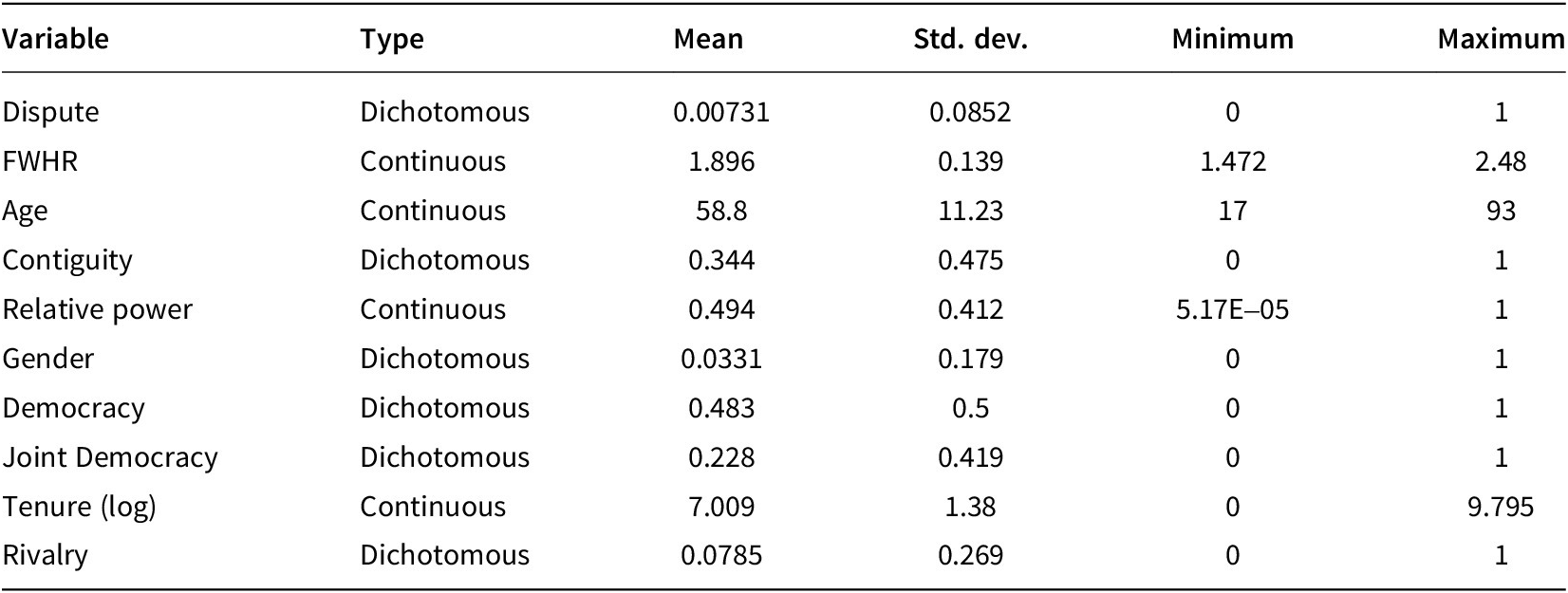
Summary statistics are displayed in Table 1 below. In addition to the substantive controls, all models include temporal corrections in the form of cubic splines, as recommended by Beck et al. (Reference Beck, Katz and Tucker1998), regional controls (column 1 of Table 2 below, with Asia as the reference category) or country dummy variables (column 3). The estimates for the dummy variables are excluded from display in the tables to conserve space. Data and instructions to replicate the analyses are available here: https://doi.org/10.7910/DVN/TJEN3F.
Summary statistics.
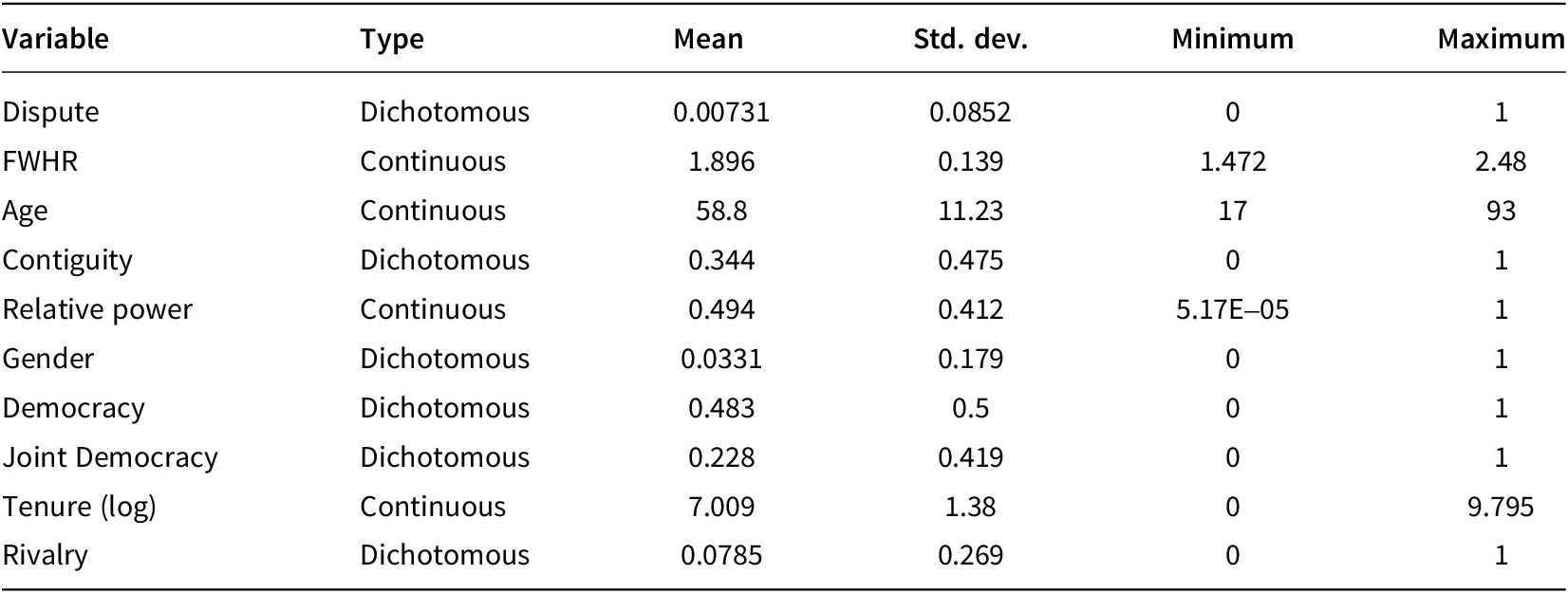
Table 1. Long description
The table contains six columns: Variable, Type, Mean, Std. dev., Minimum, and Maximum.
* Dispute: Dichotomous type, mean 0.00731, std. dev. 0.0852, minimum 0, maximum 1.
* F W H R: Continuous type, mean 1.896, std. dev. 0.139, minimum 1.472, maximum 2.48.
* Age: Continuous type, mean 58.8, std. dev. 11.23, minimum 17, maximum 93.
* Contiguity: Dichotomous type, mean 0.344, std. dev. 0.475, minimum 0, maximum 1.
* Relative power: Continuous type, mean 0.494, std. dev. 0.412, minimum 5.17E-05, maximum 1.
* Gender: Dichotomous type, mean 0.0331, std. dev. 0.179, minimum 0, maximum 1.
* Democracy: Dichotomous type, mean 0.483, std. dev. 0.5, minimum 0, maximum 1.
* Joint Democracy: Dichotomous type, mean 0.228, std. dev. 0.419, minimum 0, maximum 1.
* Tenure (log): Continuous type, mean 7.009, std. dev. 1.38, minimum 0, maximum 9.795.
* Rivalry: Dichotomous type, mean 0.0785, std. dev. 0.269, minimum 0, maximum 1.
Results
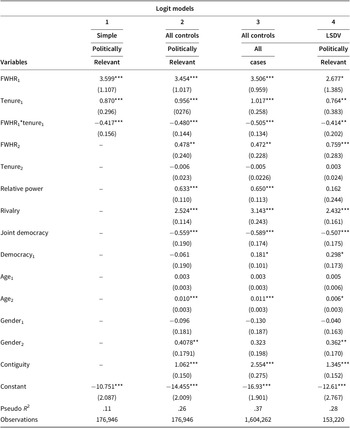
The analyses below employ both standard logit as well as multilevel logit models, all estimated using STATA, version 18.0. We begin with standard logit models of politically relevant dyads in the first two columns of Table 2—one with minimal controls in column 1 (with robust standard errors clustered by dyad) and one with controls for domestic and international factors (column 2). Column 3 contains estimates from an analysis of all dyads. Column 4 of Table 2 contains estimates from a least squares dummy variables (LSDV) estimation, which is intended as a substitute for fixed effects for individual countries, preventing spatial differences from influencing the estimates for the independent variables. Regarding the latter, there may be crucial differences in country-level FWHRs, and LSDV controls for cross-country differences. Table 3 takes the analysis a step further and applies multilevel models to help adjust for potential hierarchies in the data. The results are virtually identical to those obtained with standard logit models.
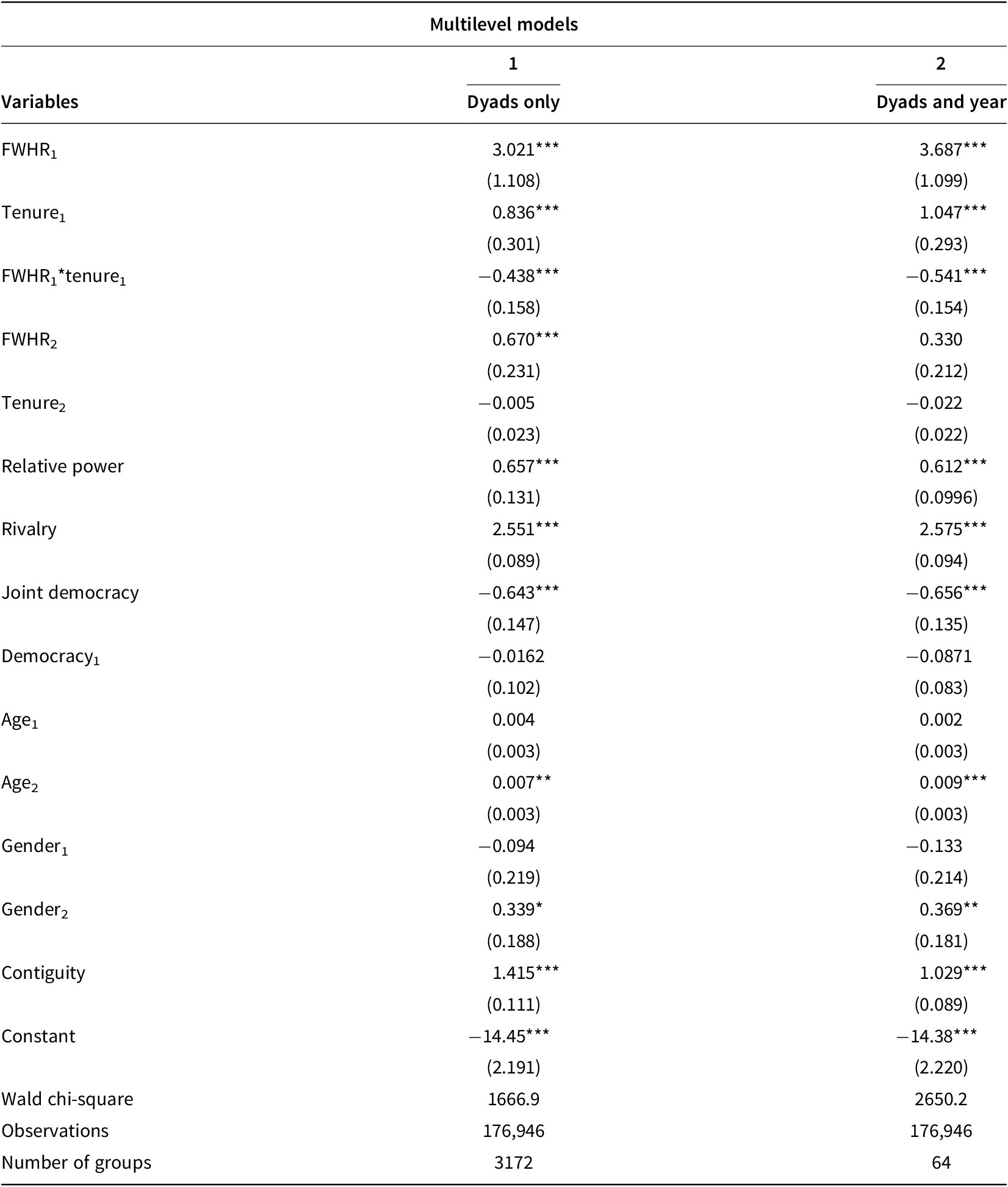
Facial width-to-height ratio, tenure, and dispute initiation.
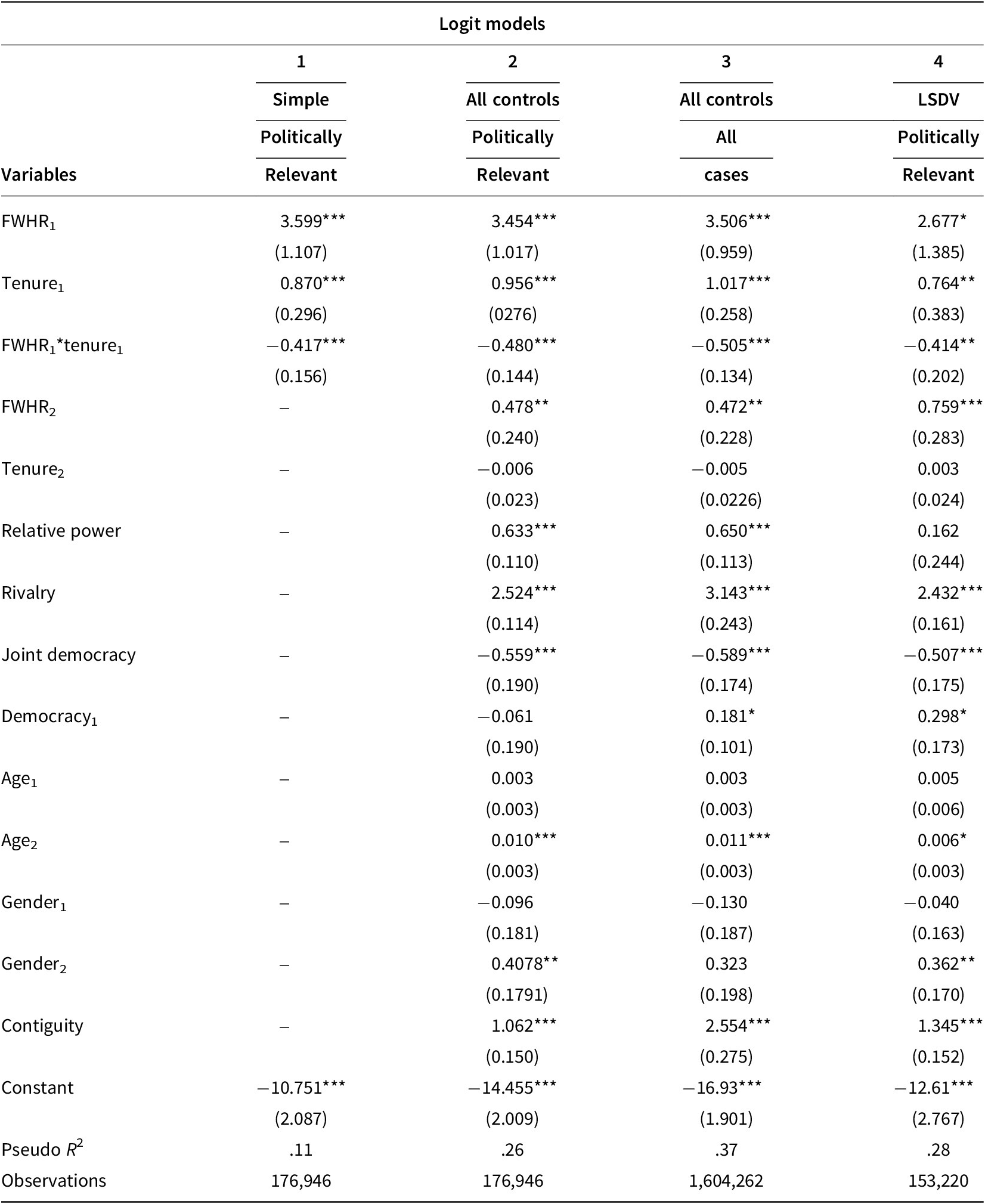
Table 2. Long description
The table presents coefficients and robust standard errors for four logit models. The columns are labeled 1 Simple Politically Relevant, 2 All controls Politically Relevant, 3 All controls All cases, and 4 L S D V Politically Relevant.
Key variables and their coefficients across models 1 through 4 include:
* F W H R sub 1: 3.599***, 3.454***, 3.506***, and 2.677*.
* Tenure sub 1: 0.870***, 0.956***, 1.017***, and 0.764**.
* F W H R sub 1 times tenure sub 1: -0.417***, -0.480***, -0.505***, and -0.414**.
* F W H R sub 2: Not listed in model 1, 0.478** in model 2, 0.472** in model 3, and 0.759*** in model 4.
* Relative power: 0.633*** in model 2 and 0.650*** in model 3.
* Rivalry: 2.524*** in model 2, 3.143*** in model 3, and 2.432*** in model 4.
* Joint democracy: -0.559***, -0.589***, and -0.507*** for models 2, 3, and 4 respectively.
* Contiguity: 1.062***, 2.554***, and 1.345*** for models 2, 3, and 4 respectively.
* Constant: -10.751***, -14.455***, -16.93***, and -12.61***.
Model fit and data size:
* Pseudo R super 2: ranges from .11 in model 1 to .37 in model 3.
* Observations: 176,946 for models 1 and 2; 1,604,262 for model 3; and 153,220 for model 4.
Significance levels are indicated by asterisks: *** p < 0.01, ** p < 0.05, * p < 0.1.
*** p < 0.01, ** p < 0.05, * p < 0.1.
Militarized interstate dispute initiation is the dependent variable. Entries are coefficients (robust standard errors below). Columns 1 through 4 are logit models with robust standard errors clustered by country dyads. Column 1 is the base model and includes the main variables plus cubic splines and regional country dummies (the latter are excluded to conserve space). Column 2 includes domestic and international control variables and cubic splines. Column 3 is the same model as Column 2 but includes all dyads. Column 4 displays estimates from a least squares dummy variable (LSDV) model that substitutes for a fixed effects logit.
Facial width-to-height ratio, tenure, and dispute initiation.
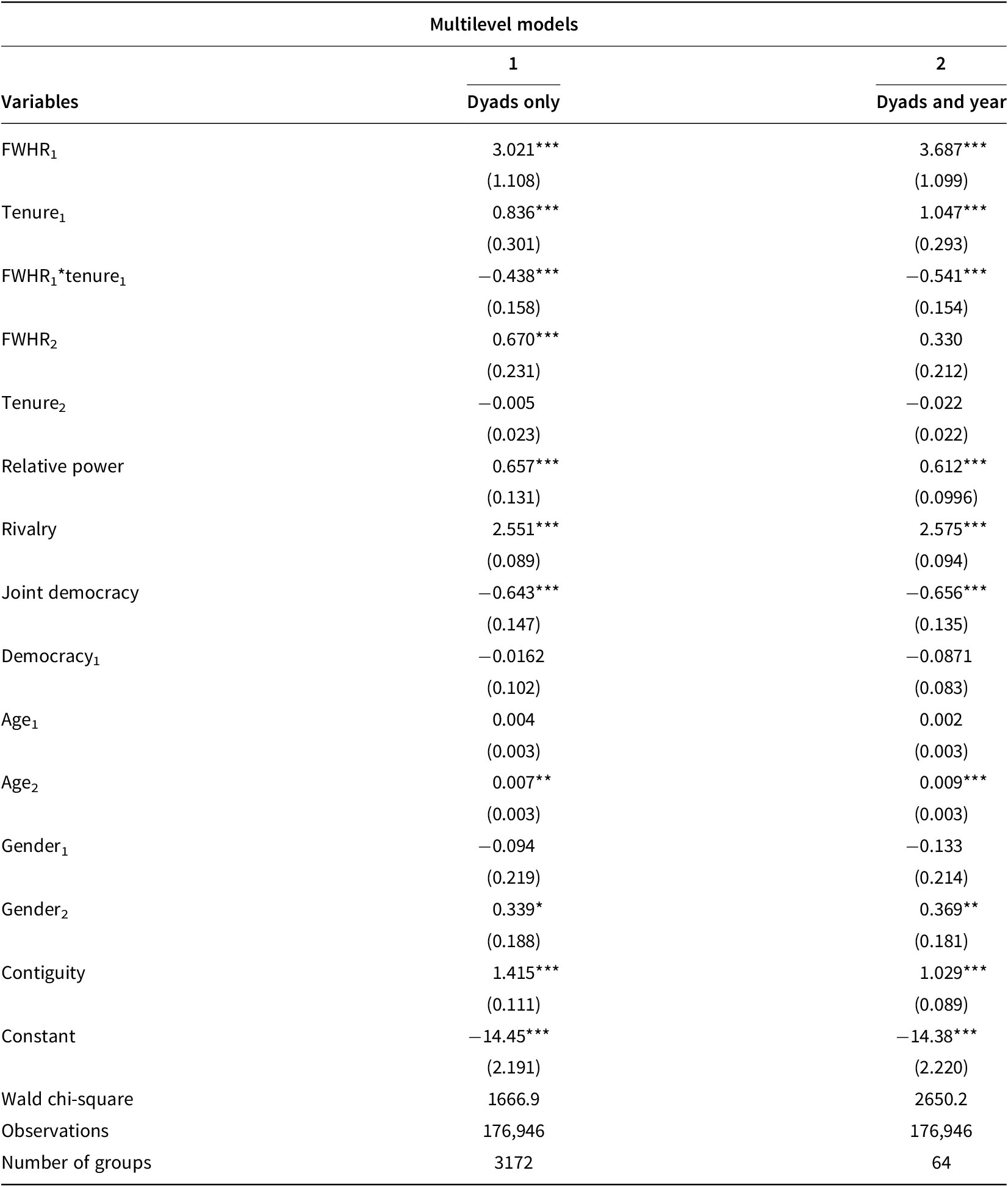
Table 3. Long description
The table presents coefficients and standard errors for two multilevel models. The columns are labeled 1 Dyads only and 2 Dyads and year.
Key variables and their coefficients for Model 1 and Model 2 respectively include:
* F W H R sub 1: 3.021 and 3.687 both significant at p < 0.01.
* Tenure sub 1: 0.836 and 1.047 both significant at p < 0.01.
* F W H R sub 1 times tenure sub 1: minus 0.438 and minus 0.541 both significant at p < 0.01.
* F W H R sub 2: 0.670 significant at p < 0.01 and 0.330.
* Tenure sub 2: minus 0.005 and minus 0.022.
* Relative power: 0.657 and 0.612 both significant at p < 0.01.
* Rivalry: 2.551 and 2.575 both significant at p < 0.01.
* Joint democracy: minus 0.643 and minus 0.656 both significant at p < 0.01.
* Democracy sub 1: minus 0.0162 and minus 0.0871.
* Age sub 1: 0.004 and 0.002.
* Age sub 2: 0.007 significant at p < 0.05 and 0.009 significant at p < 0.01.
* Gender sub 1: minus 0.094 and minus 0.133.
* Gender sub 2: 0.339 significant at p < 0.1 and 0.369 significant at p < 0.05.
* Contiguity: 1.415 and 1.029 both significant at p < 0.01.
* Constant: minus 14.45 and minus 14.38 both significant at p < 0.01.
Summary statistics at the bottom indicate:
* Wald chi-square: 1666.9 for Model 1 and 2650.2 for Model 2.
* Observations: 176,946 for both models.
* Number of groups: 3172 for Model 1 and 64 for Model 2.
*** p < 0.01, ** p < 0.05, * p < 0.1.
Militarized interstate dispute initiation is the dependent variable. Entries are coefficients (standard errors below) estimated by a multilevel model. Column 1 displays estimates from a multilevel model with leader-leader-year dyads nested in country dyads. In column 2, leader-leader-year dyads are nested in country dyads, which—in turn—are nested in years. Estimates for cubic splines are excluded.
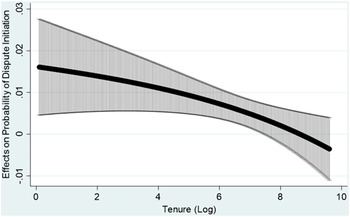
Estimates for FWHR1, Tenure1, and their interaction (FWHR1*Tenure1) are consistent across the models in Table 2. However, interaction terms in logit models may mislead, and marginal effects provide more accurate estimates (Brambor et al., Reference Brambor, Clark and Golder2006). Accordingly, Figure 2 presents the marginal effects of the facial width-to-height ratio of Leader 1 (FWHR1) across the tenure of Leader 1 (Tenure1), using the estimates from column 1 of Table 2 (Jann, Reference Jann2014). As displayed in Figure 2, Leaders with higher FWHR are significantly more likely to initiate disputes than their lower FWHR counterparts. The average marginal effect of an increase in FWHR on dispute initiation is .004 (p < .05), supporting Hypothesis 1. While this is relatively small in absolute terms, the average rate of dispute initiation across all dyads is only .0008, and for politically relevant dyads it is .007. Figure 2 also illustrates, however, that relying on average marginal effects alone is insufficient to understand the main effect of FWHR on dispute initiation: the influence of FWHR on dispute initiation is particularly strong early in a leader’s tenure, and those effects attenuate over time. This provides relatively strong evidence in support of Hypothesis 2, that the effect of FWHR on aggression should be most pronounced when a leader first assumes office and the opportunities and incentives for dispute initiation are highest. The longer leaders are in power, the more time adversaries have to counter those aggressive tendencies, and, accordingly, the effect of FWHR on dispute initiation diminishes.
Displays marginal effects of changes in Leader 1 Facial width-to-height ratio (FWHR1) on the probability that a leader initiates a militarized interstate dispute (Dispute) across the logarithm of tenure of Leader 1 (Tenure1). Estimates are based on results displayed in column 1 of Table 2.
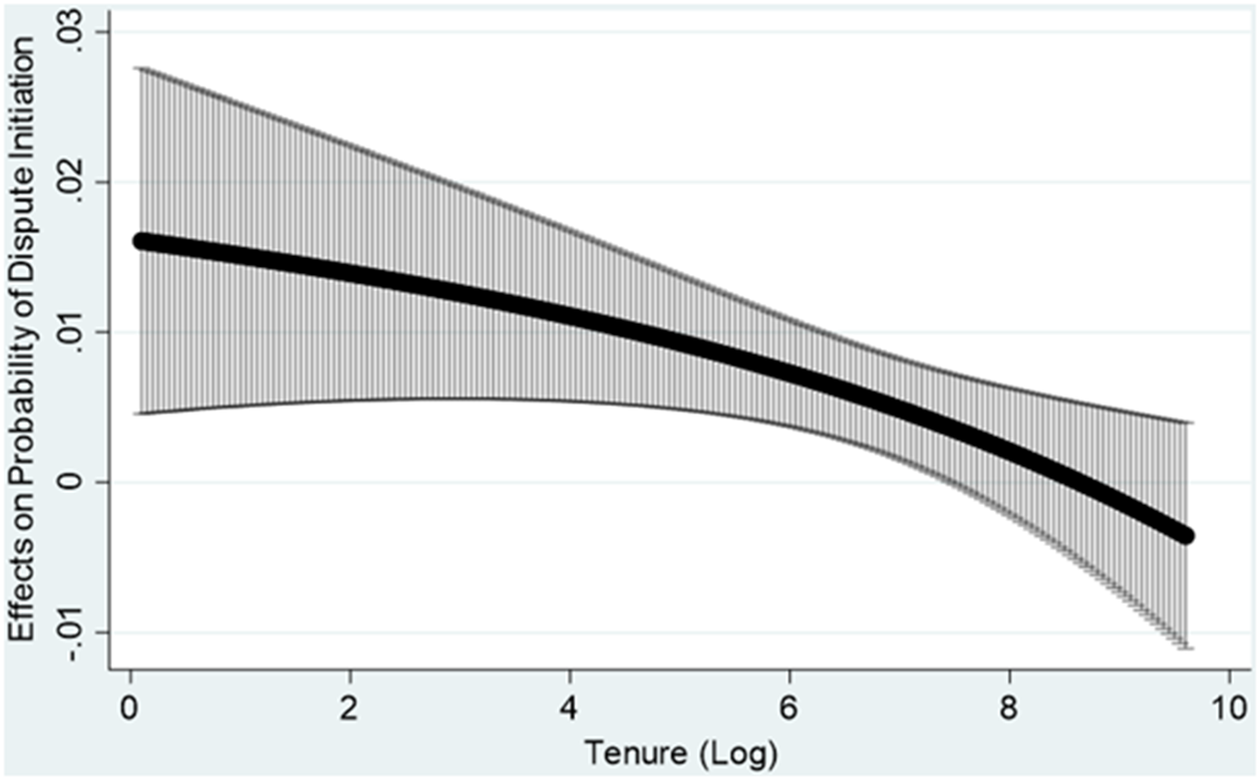
Figure 2. Long description
The x-axis is labeled Tenure (Log) and ranges from 0 to 10. The y-axis is labeled Effects on Probability of Dispute Initiation and ranges from negative .01 to .03. A thick black regression line begins at a y-value of approximately .016 when Tenure (Log) is near 0 and follows a downward concave curve, ending at approximately negative .004 when Tenure (Log) is near 10. Surrounding this central line is a shaded gray region representing confidence intervals, indicated by dense vertical lines. This shaded region is widest at the start (ranging from .005 to .027) and narrows slightly as it moves right, though the lower bound drops below the zero line when Tenure (Log) reaches approximately 8.5, indicating that the effect becomes statistically insignificant at higher levels of tenure.
To demonstrate that the effects displayed in Figure 2 are unexceptional, Figure 3 contains the marginal effects of FWHR1 on Dispute across Tenure for each of the four columns in Table 2. All four graphs demonstrate that FWHR has a positive and significant effect on the probability of conflict initiation, supporting Hypothesis 1. Moreover, across all four graphs, the effect of FWHR is especially large early in a leader’s tenure and declines the longer the leader retains power, providing additional credence to the argument that conflict behavior changes across leader tenure (Gelpi & Grieco, Reference Gelpi and Grieco2001; Miller, Reference Miller2020; Wolford, Reference Wolford2007).
Displays marginal effects of changes in Leader 1 Facial width-to-height ratio (FWHR1) on the probability that a leader initiates a militarized interstate dispute (Dispute) across the logarithm of tenure of Leader 1 (Tenure1). Estimates are based on results displayed in columns 1–4 of Table 2.
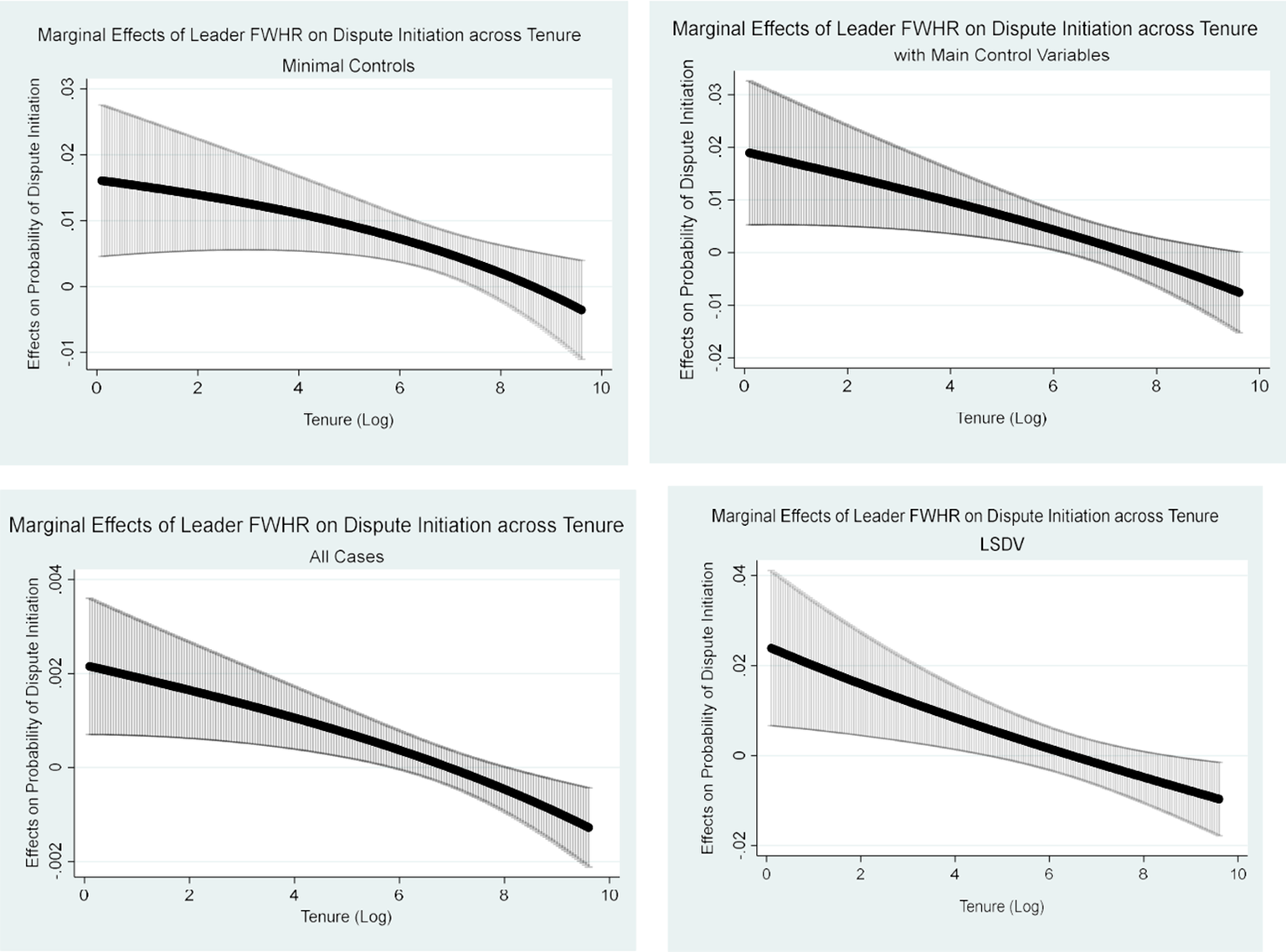
Figure 3. Long description
A four-panel set of line graphs. All panels share a common X-axis labeled Tenure (Log) ranging from 0 to 10 and a Y-axis labeled Effects on Probability of Dispute Initiation. Each graph features a thick black regression line surrounded by a shaded gray area representing confidence intervals.
* Top-Left Panel (Minimal Controls): The regression line starts at approximately 0.016 on the Y-axis and follows a gradual downward curve, crossing the zero line at a Tenure (Log) of approximately 9. The confidence interval is wide, spanning from 0.005 to 0.028 at the start.
* Top-Right Panel (with Main Control Variables): The line starts higher at nearly 0.02 and descends more steeply, crossing the zero line around Tenure (Log) 7. The confidence interval is narrower than the first panel but widens as tenure increases.
* Bottom-Left Panel (All Cases): The Y-axis scale is smaller, ranging from -0.002 to 0.004. The line starts at 0.002 and curves downward to approximately -0.0015 at Tenure (Log) 10, crossing zero at Tenure (Log) 7.
* Bottom-Right Panel (L S D V): The line starts at approximately 0.024 and descends linearly, crossing the zero line at Tenure (Log) 6.5 and ending near -0.01 at Tenure (Log) 10.
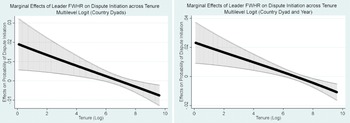
Table 3 extends the analysis further, displaying estimates from two separate multi-level logit models. One strength of multilevel models is they help to capture the influence of multiple hierarchies in the data, which—if present-challenge the assumption of the independence of observations (Rabe-Hesketh & Skrondal, Reference Rabe-Hesketh and Skrondal2008). The first model nests leader-leader-dyads (the unit of analysis) within country dyads. Leader interactions occur within the context of interstate relations, and therefore, while leader-dyads change (e.g. Xi rises to power in China, and Trump in the United States), the actions and opportunities of leaders reside within the context of longstanding US–China relations. A second model (Column 2 of Table 3), nests leader dyads in both country dyads and year. The latter specification includes year because it helps to capture the evolution of dyadic relationships over time. For instance, US–China relations in 2023 are quite different from those of 1973. Moreover, there are far more countries in 2010 than there were in 1947, and this affects opportunities for conflict initiation. Therefore, we expect both leader and state interactions to vary by year. As indicated below, even with the alternative model estimations, the results are consistent across specifications. More importantly, as displayed in Figure 4, the marginal effects of the changes in FWHR on dispute initiation across tenure are substantively identical to those displayed in Figure 3.
Displays marginal effects of changes in Leader 1 Facial width-to-height ratio (FWHR1) on the probability that a leader initiates a militarized interstate dispute (Dispute) across the logarithm of tenure of Leader 1 (Tenure1). Estimates are based on results displayed in columns 1–2 of Table 3.
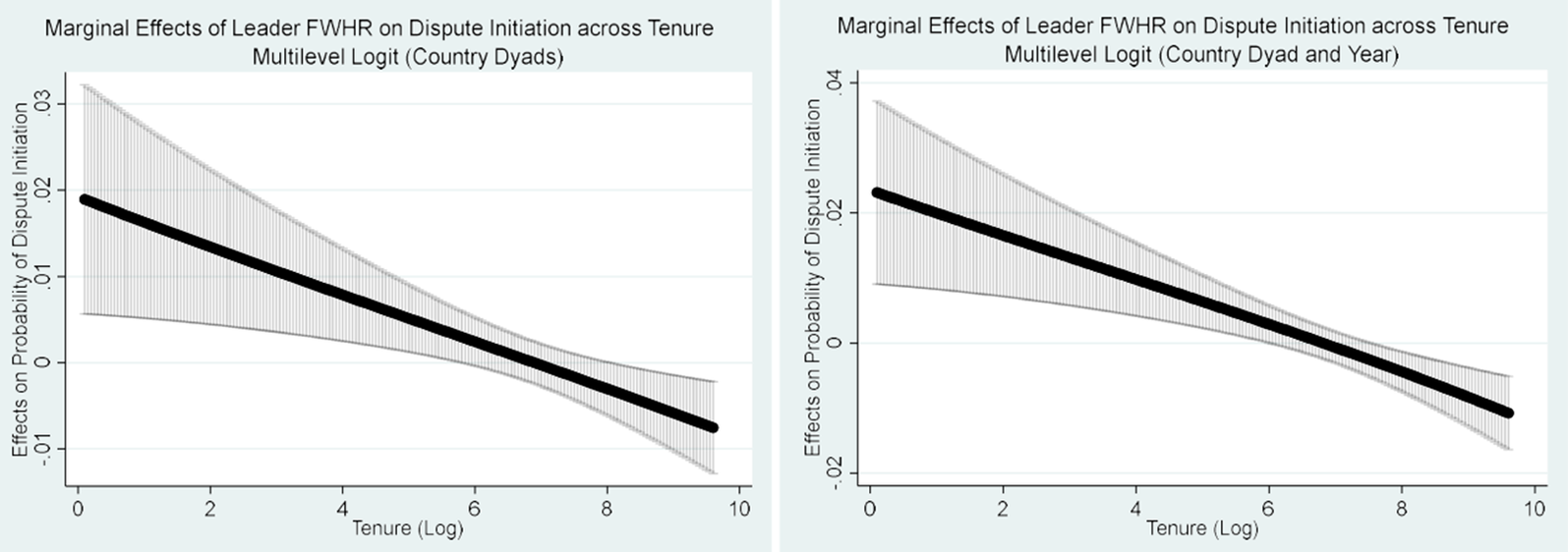
Figure 4. Long description
Two side-by-side line graphs illustrate statistical estimates.
Left Panel: Titled Marginal Effects of Leader F W H R on Dispute Initiation across Tenure Multilevel Logit (Country Dyads). The y-axis is labeled Effects on Probability of Dispute Initiation with a scale from negative 0.01 to 0.03. The x-axis is labeled Tenure (Log) with a scale from 0 to 10. A thick black line shows a linear decrease starting at approximately 0.019 at tenure 0 and ending at approximately negative 0.008 at tenure 10. A shaded gray area representing confidence intervals is wide at low tenure and narrows as it crosses the zero line at approximately tenure 6.
Right Panel: Titled Marginal Effects of Leader F W H R on Dispute Initiation across Tenure Multilevel Logit (Country Dyad and Year). The y-axis scale ranges from negative 0.02 to 0.04. The x-axis is identical to the left panel. The thick black line follows a similar linear decrease, starting at approximately 0.023 and ending at approximately negative 0.01. The confidence interval shading is broader than the left panel but follows the same narrowing trend, crossing the zero effect line at approximately tenure 7.
Estimates for control variables reported in Tables 2 and 3 are generally consistent with expectations. The FWHR of Leader 2 is positive and statistically significant in 5 of 6 models above, indicating that higher FWHR leaders are more likely than lower FWHR leaders to be targets of conflict. This finding is consistent with experiments by Haselhuhn et al. (Reference Haselhuhn, Wong and Ormiston2013), which conclude that participants are more likely to behave selfishly when confronted with high FWHR counterparts because they expect those counterparts to take advantage of them. Alternatively, it may be the case that higher FWHR leaders are more likely to be targeted because they are assumed to be less cooperative (and less trusted to follow through on any agreements). In the Supplementary Material, the question of how the FWHR of Leader 2 conditions the relationship between Leader 1 FWHR and dispute initiation is engaged directly. The estimates reveal that, when Leader 2 has a smaller FWHR (25th percentile or less), the FWHR of Leader 1 has the most pronounced effect, and the magnitude of the effect decreases as Leader 2 FWHR increases. Under all conditions, the effect of Leader 1 FWHR on dispute initiation remains consistent with those reported above: strongest in the early part of Leader 1’s tenure, and diminishing thereafter.
Continuing our discussion of control variables, powerful states are more likely than their weaker equivalents to initiate disputes, as are states involved in rivalries. Democratic dyads are less likely than other dyads to experience militarized disputes. At the country level, the effects of democracy are mixed—positive in one, but negative in the others. The Supplementary Material contains results from an additional check to see whether the effect of FWHR on dispute initiation depends upon if the state is democratic or non-democratic. The estimates suggest no substantive differences across regime type. That being said, there are certainly more nuances that can be explored in future research, especially with respect to non-democratic regimes.
Age is positive for initiators and targets, but only significant for the latter. The effects of gender are mixed. Generally, there is no effect of gender on conflict initiation. For targets, there is some evidence that women leaders are more likely to be targets than men. Contiguity is positively related to conflict. As mentioned above, follow-up analyses across Leader 2 FWHR, gender, and democracy are available in the Supplementary Material.
As with all studies of leaders and foreign policy, the research below is potentially influenced by significant challenges—including selection effects, selection bias, and endogeneity. These are discussed in the next section.
Selection effects, selection bias, and potential endogeneity
Before concluding, it is worth addressing potential concerns with selection bias and endogeneity. Leaders select themselves into politics and are probably more aggressive than average individuals, and this can result in sample selection bias. Although selection effects are always of concern in studies of behavior (Geddes, Reference Geddes1990; Signorino, Reference Signorino1999), in the current study the selection effects likely bias against finding significant results. Aggression can arise from sources other than FWHR, and a sample composed of overly aggressive leaders sets the bar high to isolate any independent effect of FWHR on conflict.
A related concern is endogeneity: It may be that countries confronting security threats (and therefore more likely to engage in military conflicts) are predisposed to select leaders with particular characteristics—such as those that appear more dominant and aggressive (Van Vugt & Grabo, Reference Van Vugt and Grabo2015). If this is the case, two points immediately follow. First, if leaders’ facial characteristics influence the probability of being in power when security threats exist, it supports the notion that we perceive larger FWHRs as more aggressive. Second, if states confronting security threats are more likely to put in power high-FWHR leaders, then given strategic interaction, potential targets should avoid provoking high-FWHR leaders because the perceived costs of doing so against high-FWHR leaders are greater than those when confronting low-FWHR leaders (Wolford, Reference Wolford2007). In fact, as displayed in the Supplementary Material, potential targets with high FWHRs were much less likely to become victims of military conflict compared to their low-FWHR counterparts. Thus, if the strategic interaction argument is correct, the context biases against finding more conflict initiated by high-FWHR leaders compared to low-FWHR leaders.
Conclusion
This research adds to the growing body of literature highlighting the key role of leader characteristics in explaining the foreign policies of state. Leaders confront many constraints and pressures that influence their decisions to initiate international conflicts. They also bring their own preferences and predilections. Until recently, finding systematic data on predispositions for the thousands of leaders that have held power has been limited to a handful of studies (Horowitz et al., Reference Horowitz, Stam and Ellis2015; Horowitz & Stam, Reference Horowitz and Stam2014; Kim, Reference Kim2024a).
The current research draws upon insights from theories of evolutionary psychology, physiology, and psychology, and uses facial metrics (the facial width-to-height ratio) to estimate a leader’s propensity for aggression. Analyses of over 1,700 leader-dyads across 174 countries, 1947–2010, demonstrate that leaders with higher facial width-to-height ratios are about three times more likely to adopt aggressive foreign policies than leaders with lower facial width-to-height ratios. This effect holds independent of traditional causes of military conflict, such as the presence of rivalries due to territorial disputes and other factors, like military power and regime type. The impact of FWHR on conflict initiation is especially strong early in a leader’s time in office. The results add to the growing body of research emphasizing the crucial role of biological and psychological factors in decision making, and how these interact with the environment to influence behavior (Hibbing et al., Reference Hibbing, Smith and Alford2013; Hibbing & Smith, Reference Hibbing and Smith2007; Horowitz et al., Reference Horowitz, Stam and Ellis2015; Kim, Reference Kim2024b). As McDermott (p. 281) explains, this is crucial, since
… without taking such factors into account, it will likely prove impossible to mitigate conflict in a meaningful way because, without adequate recognition of the underlying psychological motivations for conflict, it will be impossible to generate the kind of incentives that might successfully ameliorate it (McDermott, Reference McDermott2025).
The results also provide an additional tool for policy makers to use to assess individual leaders’ proclivities for aggression. A key component of the strategic profiles employed by defense analysts is an assessment of the values and psychological predispositions of leaders (Payne, Reference Payne2003; United States Strategic Command, 2006), and the evidence presented above suggests that FWHR provides a simple but powerful way to estimate the likelihood that a leader initiates conflict in the pursuit of foreign and domestic policy goals.
Although this research provides several contributions, there are limitations. While significant progress has been made both in developing the FWHR-aggression theory and also in establishing empirical support, there is room for improvement. First, FWHR is limited in the type of characteristics it measures, excluding other cues such as the width of the chin and the shape and movement of the eyes (Hermann, Reference Hermann1979; Sell et al., Reference Sell, Cosmides and Tooby2014). Second—and more generally-FWHR is only one indicator of a leader’s predisposition toward aggression. Third, other scholars dispute the empirical foundations of existing research (Caton et al., Reference Caton, Pearson and Dixson2022; Deaner et al., Reference Deaner, Goetz, Shattuck and Schnotala2012; Özener, Reference Özener2012; Palmer-Hague et al., Reference Palmer-Hague, Zilioli, Jagore and DeLecce2016). Deaner and colleagues (Deaner et al., Reference Deaner, Goetz, Shattuck and Schnotala2012), for example, show empirically that hockey players’ aggressiveness appears to be driven more by player size than by FWHR. Caton and colleagues similarly report no effect of FWHR on singular victories among UFC fighters (Caton et al., Reference Caton, Pearson and Dixson2022). Although the empirical critiques provide important guidance and cause for concern, engaging them directly is outside the scope of this paper.
Moreover, as with most observational studies, the challenge of ruling out all potential rival explanations is limited by both data availability and the statistical models used to test hypotheses. A related modeling challenge is endogeneity: not only does FWHR influence conflict initiation, but existing conflicts may influence the type of leader selected for office (Spisak et al., Reference Spisak, Dekker, Krüger and Van Vugt2012, Reference Spisak, O’Brien, Nicholson and Van Vugt2015; Van Vugt & Grabo, Reference Van Vugt and Grabo2015). Although endogeneity in the relationship between leader FWHR and conflict likely biases against finding significant results—for reasons offered above-the current research design is unable to entirely rule out endogeneity as a confound. While there are statistical models that can address endogeneity—such as simultaneous models with endogenous regressors-the primary obstacle in estimating such a model is locating an instrument for FWHR that satisfies both the exclusion and identification rules (Mallar, Reference Mallar1977).
An additional limitation is isolating whether the correlation between FWHR and conflict initiation is—as hypothesized—a form of aggression. That link may also be attributable to risk-taking propensity or a drive for domination. War initiation necessarily involves risk, since outcomes cannot be guaranteed. Likewise, there is a robust literature in international relations hypothesizing that states seek to dominate others, and conflict initiation is one way to accomplish this goal (Morgenthau, Reference Morgenthau1973). The current design is limited in its ability to sort out nuances such as these.
Finally, it is worth noting the absence of controls for race and ethnicity. Currently there are no cross-national datasets that code for this across the 1947–2010 period. The analyses provide some traction on this issue by controlling for region (column 1 of Table 2) as well as country-level dummy variables (column 4 of Table 2).
There are several avenues of research that can extend and improve the current effort. First, as noted above, FWHR is just one facial characteristic that may signal aggressive behavior. A possible expansion is to employ an artificial neural network to assess multiple facial metrics simultaneously (Kachur et al., Reference Kachur, Osin, Davydov, Shutilov and Novokshonov2020).
A second idea is to use the complementary measures available for large numbers of leaders across time to develop overall measures of leaders’ aggressive propensities. This may include the military background data collected by Ellis, Horowitz, and Stam (Ellis et al., Reference Ellis, Horowitz and Stam2015), along with the childhood trauma indicator developed by Kim (Kim, Reference Kim2024a). Although one study found that FWHR has a statistically significant and substantively powerful effect on U.S. Presidents’ conflict behavior independent of the presence of military background indicators, the sample is limited. Moreover, no effort is made to explore whether a combined indicator could improve overall model fit (Miller, Reference Miller2022). To the best of my knowledge, no studies incorporate childhood trauma into a model with military background or FWHR, and although such an effort is beyond the scope of this research, it may provide additional insights into the conflict propensities of leaders.
Additionally, the models above focus almost exclusively on conflict, ignoring whether FWHR may influence cooperation. Although beyond the scope of this study, ideally we are able to test the models with a continuum of cooperation/conflict between states.
A final extension is to explore how other factors condition the relationship between FWHR and behavior. Hahn and colleagues report that the effect of FWHR is conditioned by social rank (Hahn et al., Reference Hahn, Winter, Anderl, Notebaert, Wuttke, Clément and Windmann2017). Taking account of this, and other contextual factors, may provide key insights into how FWHR influences the behavior of leaders. As noted, the Supplementary Material contains additional analyses that break down the effect of Leader 1 FWHR on dispute initiation across Leader 2 FWHR, gender, and democracy (the latter are both for Leader 1), which provides a start.
Supplementary material
The supplementary material for this article can be found at http://doi.org/10.1017/pls.2026.10024.
Acknowledgements
I thank Zeenat Ahmed, Fatima Aigbomian, Dona-Gene Barton, Dave Gosselin, Ingrid Haas, Alex Hall, John Hibbing, Courtney Hillebrecht, Jaehun Jung, Alice Kang, Sukjae Lee, Geoff Lorenz, Joseph Maestas, Daniel Schaub, Rob Schub, Kevin Smith, Noelle Troutman, Sergio Wals, and Makayla Wendland for feedback and discussions on this project.
Data availability statement
Data and code necessary to replicate the analyses: https://doi.org/10.7910/DVN/TJEN3F.
Financial support
There are no outside funding sources for this project.
Competing interests
The author declares none.
Ethical standard
This article complies with Politics and the Life Sciences’ ethics and transparency policies.




 Open access


