One of the most important judicial policy issues in the United States is tort reform. Although the merits of tort reform have been debated by legal experts, the American public has been generally supportive of reform efforts, believing that frivolous lawsuits are quite prevalent. For instance, a 2005 Gallup poll found that 57% of Americans thought that the tort system represented a “crisis” or a “major problem” (Gallup Organization 2005). Why do Americans support tort reform, and why do they perceive the American judicial system to be overly litigious, characterized by fraud, and inconsistent with core values such as personal responsibility? One contention is that democratic deliberation on the issue is distorted by legal urban legends, or cultural memes and stories about tort cases that have propagated throughout the polity and are assumed to be true. Stories of frivolous lawsuits are unrepresentative (and often misleading or outright fabricated) but still may be highly influential.
Scholars have argued that legal urban legends profoundly shape American culture and people’s views on the judicial system. Further, researchers argue that the media represents an important conduit through which legal narratives are disseminated. For instance, Galanter (Reference Galanter1998) argues that people ignore the immense statistical evidence showing that lawsuits are, by and large, not frivolous due to “[legal] legends that are resilient and that resonate with many of the basic themes of our legal culture, such as individual responsibility and self-reliance” (722). The power of legal urban legends is most copiously explored in Haltom and McCann (Reference Haltom2004). Terming these urban legends “tort tales,” the authors employ a social constructivist approach, critically analyzing and interpreting social texts to show how cultural narratives spread from the media into legal, political, and popular discourse.Footnote 1 Haltom and McCann argue that three factors interact to distort the social construction of legal knowledge: (1) instrumental, motivated actors such as tort reform advocates; (2) institutions, such as the news media, which are incentivized to sensationalize coverage; and (3) mass ideological predispositions among the American public such as the norm of individual responsibility. Tort tales effectively operate within this confluence of factors.Footnote 2 Building on Haltom and McCann’s research, scholars have explored other venues through which anti-tort narratives influence citizens such as reality-based television judge shows (Kohm Reference Kohm2006; Wilson and Ackerman Reference Wilson2012) and films (Bergman and Asimow Reference Bergman2006).
Haltom and McCann claim that ordinary citizens are influenced by tort tales. For instance, the authors write: “The prevailing common sense about the lawsuit crisis inhibits sophisticated democratic discourse regarding public policy. … Prevailing norms stigmatize certain types of action while privileging others, disciplining citizens into enacting the visions celebrated by romantic [tort] reformers” (9). Further, their argument that legal narratives are consequential rests on the assumption that citizens adopt them into their reasoning: “To the extent that these widely circulated story lines figure prominently in the cognitive archives from which media-attentive citizens actively construct legal meaning, the narratives we identify can be expected to matter a great deal” (12–13). However, Haltom and McCann do not actually provide evidence that citizens internalize urban legends and use them to construct their attitudes on tort reform.
This study contributes to the literature by exploring how tort tales affect citizens’ policy attitudes. I employ quantitative techniques from political and social psychology to bring empirical evidence to the question. I conducted an original, national survey of 742 respondents to explore the urban legend of Stella Liebeck, the woman who spilled a cup of coffee on herself and sued McDonald’s for monetary damages. This tort tale is extensively discussed not only in Haltom and McCann’s book (see chap. 6) but also throughout the literature on legal legends.
This empirical approach draws upon psychological studies of memes. Theories of diffusion of cultural ideas have a long history in social psychology (Allport and Postman Reference Allport1947; Degh Reference Degh1971, Reference Degh1994; Fine Reference Fine1980; Brunvand Reference Brunvand1981). Most of this psychological literature on the cultural transmission of urban legends deals with issues or stories without political content (e.g., Halloween candy that contained razor blades, the fashion designer who made racist comments on a popular talk show, etc.). However, this literature can help us understand the popularity of not only commonplace urban legends, but also ones with political and policy implications. For instance, Heath, Bell, and Steinberg (Reference Heath2001) argue that urban legends that stimulate emotional responses are most likely to be adopted and passed on. The story of a woman filing a successful frivolous lawsuit is likely to stimulate various emotions, such as anger, jealousy, and resentment. Emotions are complex to study both theoretically and empirically; different types of people are likely to exhibit different emotions under different conditions (e.g., Fiske Reference Fiske2005). Further, emotions can have complex effects on policy attitudes (e.g., Ladd and Lenz Reference Ladd2008; Albertson and Gadarian Reference Albertson2014). An in-depth study of emotional responses to legal legends is beyond the scope of this study. Rather, my only contention is that the Liebeck case likely stimulated enough different types of emotions that it affected a broad swath of American people, hindering them from considering the totality of the evidence in formulating an opinion on tort reform and leading them to neglect base rates of frivolous lawsuits and damage amounts. Even if one prominent lawsuit is frivolous (which the McDonald’s lawsuit was not, as explained below), it does not mean that lawsuits are generally frivolous and that policy remedies would be socially efficient.
This line of reasoning is also consistent with Tversky and Kahneman’s (1973) concept of the availability heuristic. In estimating frequencies, people construct stereotypes based on available and easily accessible examples. The classic example is that people think there are more words that end in “ing” than words where the penultimate letter is an “n,” even though the former is a subset of the latter. People make this error because words that end in “ing” are highly accessible in memory. Similarly, when people think about tort reform and lawsuits, highly available examples of frivolous lawsuits, such as the McDonald’s coffee case, come to mind, while more commonplace and pedestrian examples of torts do not. It is the emotional impact of urban legends that makes them available in memory and which leads to base rate neglect.
Study Design
Overview
To explore these theoretical issues, I examine the case of Stella Liebeck, the woman who spilled hot coffee on her lap and sued McDonald’s for serving hot beverages at an unsafe temperature. This story has become ingrained as part of American (and perhaps global) consciousness, even spawning parodies on popular television shows such as Seinfeld. Tort reform advocates have used this story to push for legislation (Saladoff 2011). Every year the media report on the “Stella Awards,” a list of examples of frivolous lawsuits named after Liebeck.
As documented by others, Liebeck’s lawsuit was not frivolous (McCann, Haltom, and Bloom Reference McCann2001; Haltom and McCann Reference Haltom2004; Saladoff Reference Saladoff2011). Liebeck, an 85-year-old woman, was in the passenger seat of a car that her grandson was driving. After ordering coffee at the McDonald’s drive-through, the grandson parked the car. While the car was in a stationary position, Liebeck attempted to open the lid and in the process spilled the scalding coffee on her legs and genital area. Her burns were very serious, requiring skin grafts. Liebeck initially attempted to settle with McDonald’s for $20,000 for medical and other expenses, but the company refused, only offering $800. Only then did Liebeck pursue legal action, the result of which was the jury awarding her $2.9 million, a figure a judge later reduced.
In popular retellings of the story, many of the details are omitted or changed. Some imagine the woman as young. Other accounts have her driving the car, spilling the coffee while the vehicle was in motion. Others presume the injuries were minor and did not realize that Liebeck attempted to settle the lawsuit for a relatively small amount of money but McDonald’s rejected the offer. These changed details depict Liebeck as careless and opportunistic. Haltom and McCann (2004) show how early media coverage of the Liebeck case propagated these distortions by excluding relevant information about “the location of the car in the lot and of Liebeck in the car” and “the low-ball offer extended to Stella Liebeck for her crippling injuries” (206). These omissions then led editorial writers to completely make up facts about the case (e.g., the location of the car) in place of this missing information (213–14). I explore whether if people remember the story—and how they remember it—is related to their attitudes on tort reform. An experiment embedded in the survey allows me to assess whether exogenously providing people information about the Liebeck case increases support for tort reform policies.
Data
I conducted a survey of 742 respondents as part of the 2010 Cooperative Congressional Election Study (CCES). The CCES is a large-scale, omnibus survey on political issues which first asks a series of common content questions shared across all researchers participating in the survey, followed by the individual researchers’ studies. The CCES has been conducted six times since 2006 in advance of the November elections and has featured the participation of over 50 research institutions.Footnote 3 Interviews were conducted over the Internet by YouGov/Polimetrix between October 2, 2010, and November 1, 2010. The target population was US adult citizens. YouGov/Polimetrix uses a technique called sample matching to draw representative samples of the US population from its panel of voluntary survey participants (Rivers n.d.). YouGov/Polimetrix draws samples from nationally representative probability surveys (e.g., the American Community Survey, the Current Population Survey, the Pew US Religious Landscape Survey) and then matches panelists to this target sample based on observable characteristics such as age, race, education, technology usage, and several other factors. Recent studies have shown that YouGov/Polimetrix samples do as well as more traditional data collection techniques (e.g., RDD telephone interviewing) at matching known population benchmarks (Vavreck and Rivers Reference Vavreck2008; Ansolabehere and Schaffner Reference Ansolabehere2011).Footnote 4
Embedded Experiment
A randomized experiment was embedded within the survey. Approximately half of the respondents (hereafter, the treatment group) were randomly assigned (n = 360) to read a paragraph describing the Liebeck case before responding to a set of policy questions:
Please read the following account reported in a local newspaper:
In February 1992, Stella Liebeck, a woman from Albuquerque, New Mexico, ordered a cup of coffee from McDonald’s at the drive-thru window. As she tried to open the lid, she spilled the entire cup of coffee on her lap. Stella sued McDonald’s and was awarded a judgment in her favor.
The paragraph was written to be a dispassionate reporting of the events with minimal editorializing and detail. The goal was to see how this skeletal reporting of the event affected people’s policy views. Note that the paragraph is quite vague and omits crucial details (similar to the initial reporting of the Liebeck case discussed by Haltom and McCann [2004]), and this vagueness invites people to fill in erroneous details. In this sense, the manipulation is rather subtle and explores whether even a gentle reminder about the tort tale (without concocted details) is enough to shift people’s attitudes. Further, given that the paragraph mirrors the initial reporting of the case, the experiment has ecological validity.
One concern with the experiment is that attitudes are asked directly after the meme is presented and this might overstate the effect of the meme, either due to demand effects or due to heightened salience of the treatment information. While this may be the case, this is what often happens in the real world. When tort reform is being debated as part of public discourse, these memes are brought to bear as arguments in favor of reform. Consequently, people are often exposed to the memes near when they must make a decision (e.g., voting for or against an initiative or candidate). In fact, the experiment might understate the effects of urban legends given that people are exposed more frequently to such memes in the real world. In the experiment, by contrast, they were only exposed once. Nonetheless, an important caveat is that it is hard to make firm inferences regarding causation even with this experimental method. Legal legends and policy attitudes concurrently exist within people’s minds, and disentangling which is the antecedent can only be indirectly ascertained through an experiment.
The remaining respondents (n = 382; hereafter, the control group) answered the policy questions without any prompt. For this group, after they completed answering the policy questions, respondents were asked to report their version of the Stella Liebeck story in an open-ended text box (see the “Independent Variables” section below).
The treatment information can influence attitudes in two ways. First, respondents who had never heard about the Liebeck case were provided a novel tort tale. Among these respondents, the differences in attitudes between the control and treatment groups represent the causal effects of learning about a new legal legend. Second, even among the majority of respondents who had previously heard about the case, the treatment primes respondents to think about the lawsuit when making judgments. The information heightens the salience of the tort tale and makes it more accessible in memory (Iyengar and Kinder Reference Iyengar1987; Miller and Krosnick Reference Miller2000). Among these respondents, the treatment effect represents the causal effect of mentioning and making salient the tort tale in public discourse. Admittedly, the experimental design is unable to disentangle these two mechanisms. However, as discussed below, the open-ended descriptions of the tort tale in the control group suggest that both are operating. While most respondents were previously aware of the tort tale, some were unable to recall it.
This survey design allows me to conduct two analyses. First, I analyze whether policy attitudes differ between those who were randomly assigned to receive information about the case and those who were not. The experiment allows me to estimate the causal effect of the exogenous presentation of information about the Liebeck case on tort reform attitudes. Second, I examine respondents in the control group—who answered the open-ended question asking them to report their version of the story—in order to learn more about which specific aspects of the tort tale influence policy attitudes. While the textual responses provide nuance not usually found in closed-ended survey research, a disadvantage of this analysis is that it cannot resolve the issue of reverse causality. People’s attitudes on tort reform may be affected by the Liebeck story; conversely, people may construct their reporting of the events based on their ideological predispositions. Accordingly, I leverage both the observational and experimental evidence, as they have unique strengths and limitations.
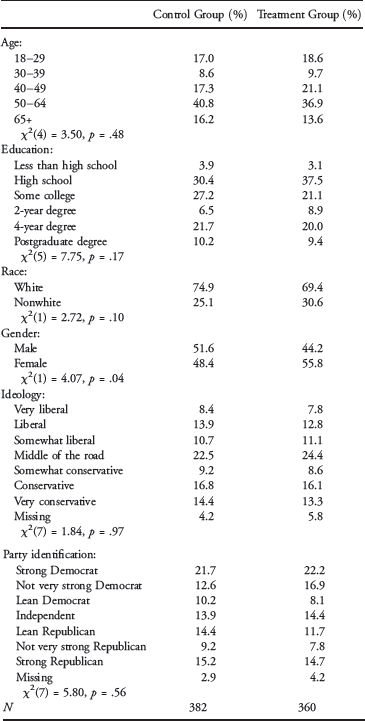
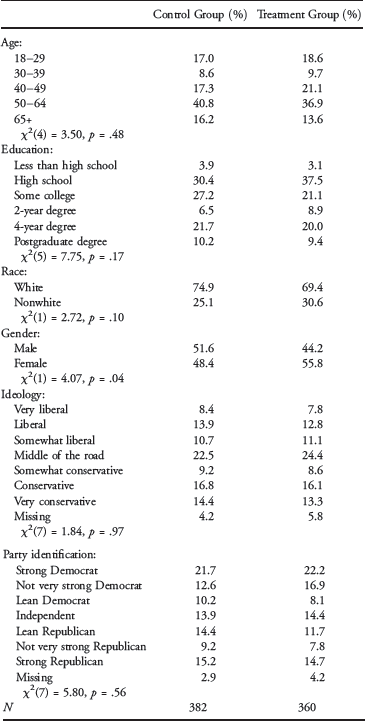
The process of randomization was successful. Distributions of pretreatment covariates were similar across experimental conditions, both in terms of statistical and substantive significance (see the appendix).
Dependent Variables
I asked the following five questions to measure people’s attitudes on tort reform:
Capped Damages. “Please read the following policy proposals and indicate the extent to which you agree or disagree with them. The amount of money that a jury or judge can award someone who is filing a lawsuit for non-economic damages such as pain and suffering should be limited.” (Response options: “strongly agree,” “somewhat agree,” “neither agree nor disagree,” “somewhat disagree,” “strongly disagree.”)
Capped Attorney Fees. “The percentage of money a lawyer makes from an award in a lawsuit should be limited.” (Same response options as Capped Damages.)
Loser Pay. “If someone sues another party and loses, then that person should have to pay for the other party’s legal expenses as well as court costs.” (Same response options as Capped Damages.)
Harm of Lawsuits. “How harmful are lawsuits to American society?” (Response options: “extremely harmful,” “very harmful,” “moderately harmful,” “slightly harmful,” “not harmful at all.”)
Cost of Lawsuits. “How much do you estimate frivolous lawsuits cost the United States each year?” (Response options: “$20 million,” “$200 million,” “$2 billion,” “$20 billion,” “$200 billion,” “$2 trillion.”)
All items were recoded to lie between 0 and 1, with 1 representing the most support for tort reform.Footnote 5 A principal components analysis revealed one primary dimension with the first factor having an eigenvalue of 2.06, the second an eigenvalue of 0.89, and the third an eigenvalue of 0.87. Cronbach’s alpha for the five questions was 0.62, adequate but not extraordinary. Consequently, in addition to averaging responses to the five items to create a “tort reform support index,” I show the results for each individual issue.
Independent Variables for Correlational Analysis
After asking respondents in the control group about their policy positions on tort reform, I asked people to report their version of the Stella Liebeck story in an open-ended text box: “You might have heard about a story in which a woman spilled a cup of McDonald’s coffee on herself and then successfully sued McDonald’s for damages. In the box below, please provide as many details about this story as you can remember in your own words. We would greatly appreciate it if you could provide as many details as you can remember.” I needed to ask people to report their version of the story after asking about their policy positions in order to properly conduct the experiment (i.e., to ensure that the only difference between the control and treatment groups was the blurb). There are advantages and disadvantages to this ordering of questions. On the one hand, this approach protects against confirmation bias, or people reporting their positions to be in line with the story. On the other hand, a limitation is that stating a policy position may cause people to better recall elements of the story (see Lodge and Taber 2013). Three undergraduate research assistants blind to the hypotheses coded whether the stories respondents wrote had various features. Intercoder reliability was strong; 85%–100% of codings were unanimous. In the case of discrepancies, I decided on the final coding. In all cases, the minority report was discarded.
Driving
I coded whether the respondent indicated that the woman was driving the car. This variable should be positively related to support for tort reform because people who believed that the woman was in the driver’s seat should also think that she was more at fault, given that she should not have been trying to operate a motor vehicle and drink coffee at the same time. Twenty-six percent of respondents’ stories included the driving element.
Motion
I coded whether the respondent indicated that the car was in motion at the time the coffee spilled. Again, I hypothesize that this variable should be positively related to support for tort reform as the woman would be more at fault if she attempted to open the coffee cup while the car was moving. Sixteen percent of respondents’ stories mentioned the motion element.
Serious Health
I coded whether the respondent mentioned that the woman experienced serious injuries as a result of the spill. Because the traditional urban legend downplays the severity of her injuries, I expect this variable (unlike the previous two) to be negatively related to support for tort reform policies. Seventeen percent of stories included this element.
Large Award
I coded whether the respondent mentioned that the woman received a large award from the lawsuit (e.g., “millions”). I expect that people who mentioned that the judgment was large are more supportive of the policies because they are more likely to perceive torts as costly, and may be more jealous and resentful of the woman. Twelve percent of respondents mentioned a large award.
Negative Comments
I also coded whether respondents made unsolicited negative or disparaging comments about the woman in the description of their story (e.g., “stupid woman”). Twenty-seven percent of respondents made negative comments about the woman.
Don’t Remember
I coded whether the respondent explicitly said that they did not remember the story or had never heard of it. These minority respondents (19%) were not exposed to this urban legend, and therefore I predict that they should exhibit less support for tort reform. If urban legends affect views on public policies, then those unfamiliar with the story should not be inclined to change the status quo to make filing lawsuits more difficult.
Story Element Index
I reverse coded Serious Health and Don’t Remember and created an index in which I simply counted the number of story elements (out of six) a respondent’s version of events contained. The mean value was 0.41, indicating that on average people’s text responses contained 2.5 (0.41 × 6) story elements.
Missing
Nine percent of respondents left the text box blank. I indicated missing responses with a dummy variable in the regression analyses.
Control Variables for Correlational Analysis
In the multivariate analyses, I also control for several individual-level demographic and political controls: age, race, gender, education, liberal-conservative ideology, and partisanship.Footnote 6
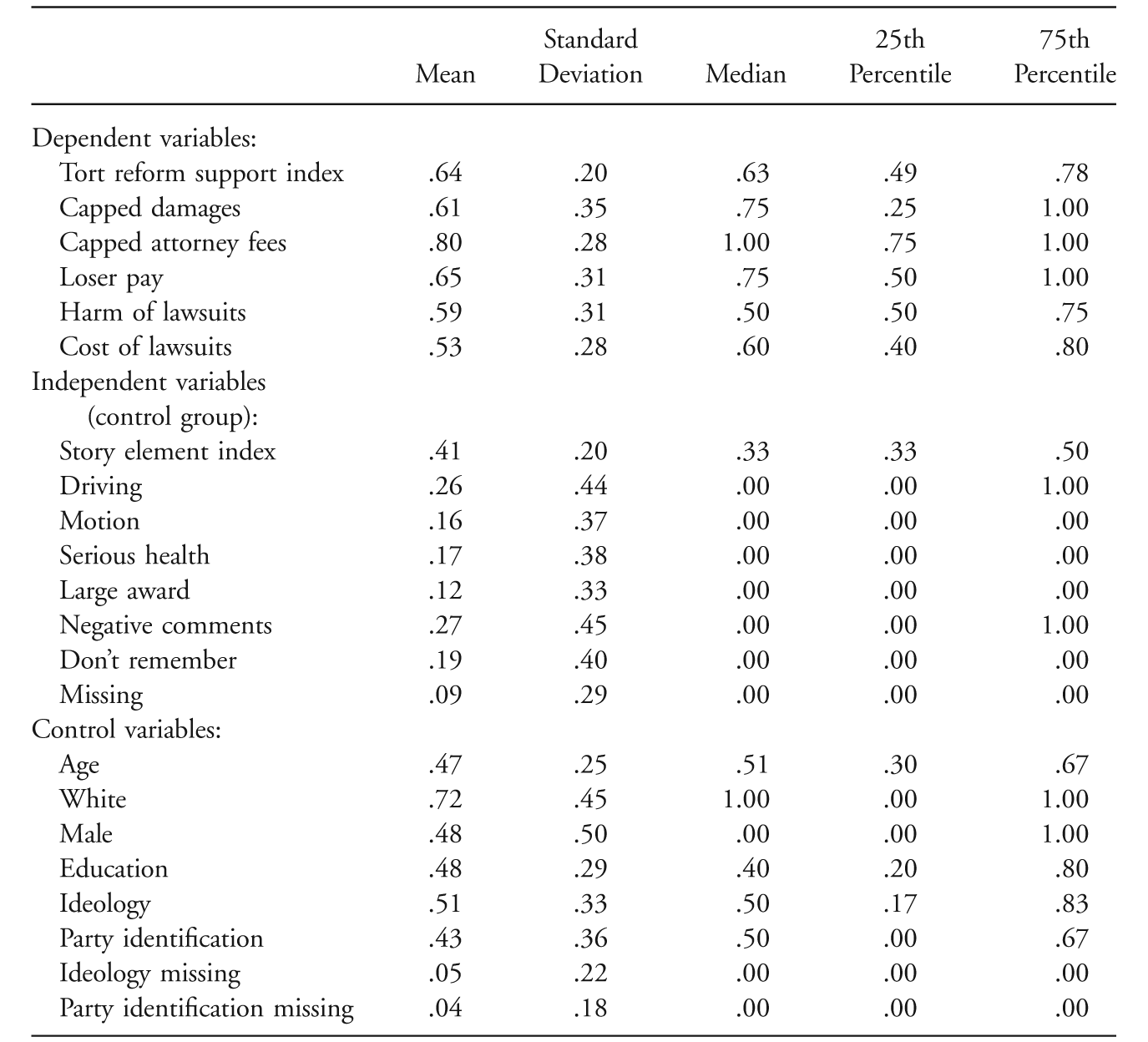
Descriptive statistics for the dependent variables, independent variables, and control variables are presented in table 1.Footnote 7
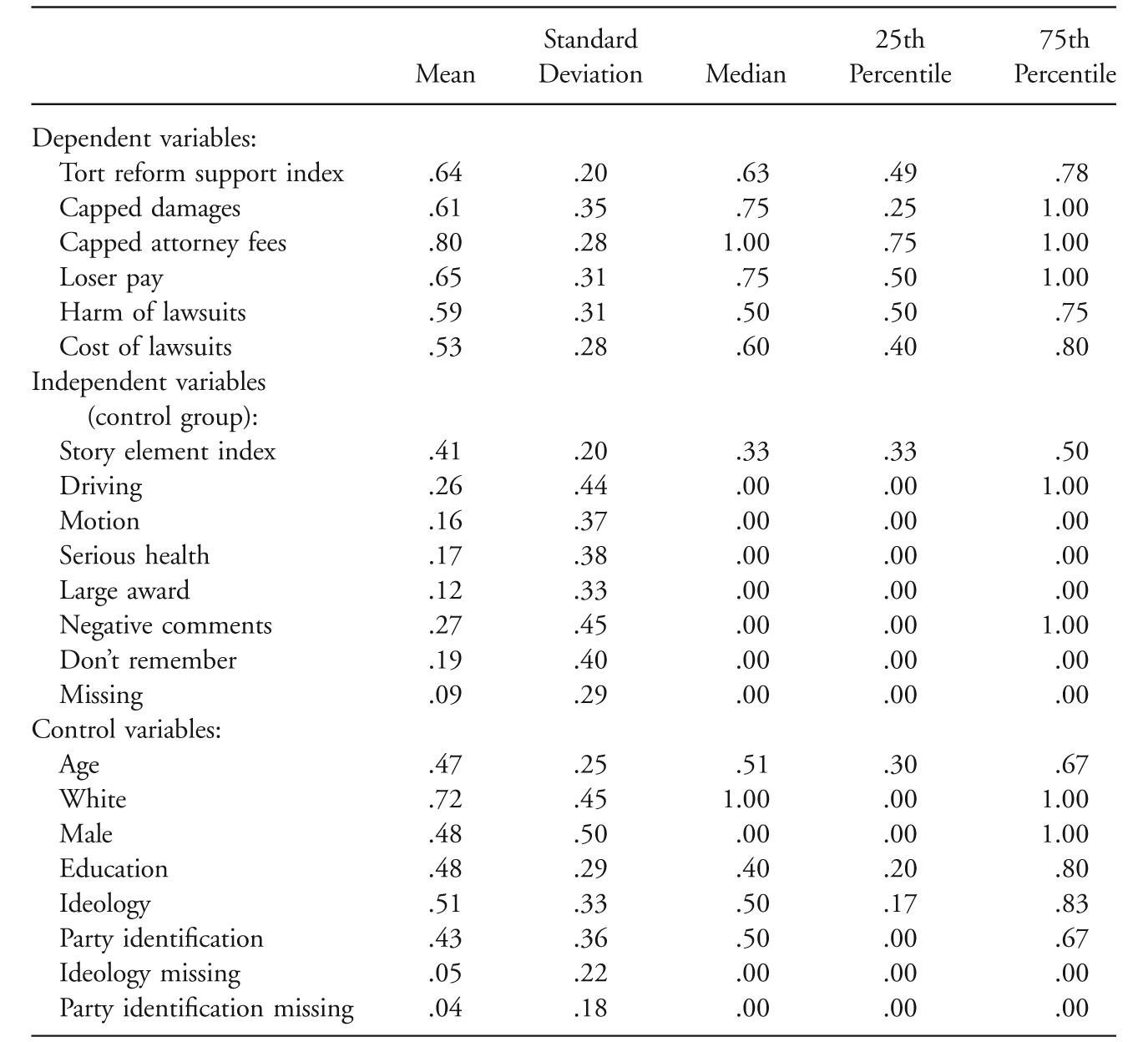
Note.— N = 742 in full sample. N = 382 in control group.
Results
Experimental Analysis
I estimate regressions predicting policy attitudes with a dummy variable indicating whether the respondent was assigned to the treatment group. I also include all the control variables in the regression in order to: (1) increase the efficiency of the statistical estimates (Gerber and Green 2012); and (2) benchmark the treatment effect against other pre-treatment covariates that would be theoretically expected to correlate with attitudes on tort reform. Regressions predicting the continuous support index score were estimated via OLS, whereas the regressions predicting the individual policy items were estimated via ordered logistic regression.
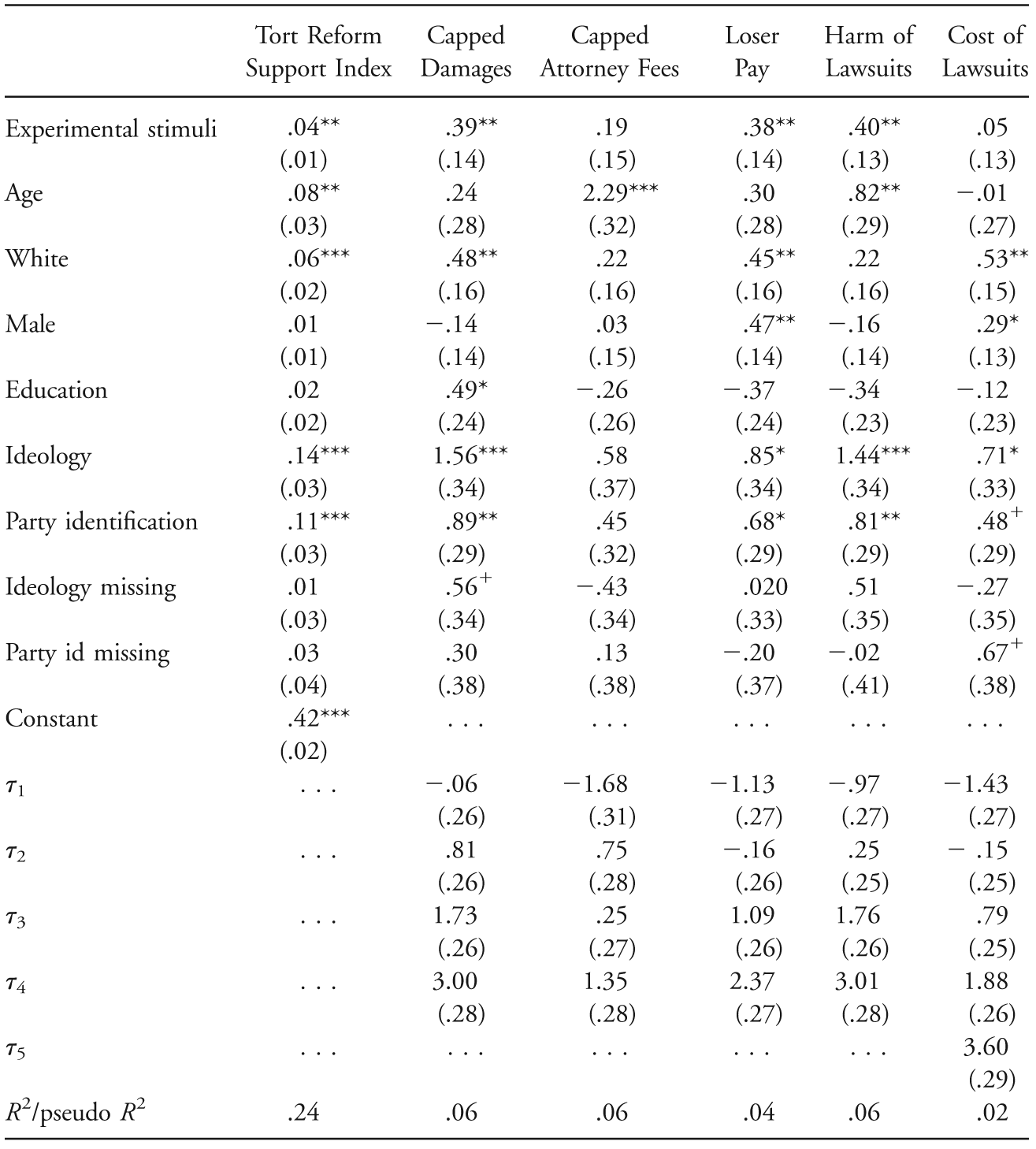
Exogenous exposure to the Liebeck urban legend was associated with higher support for tort reform initiatives. As shown in the first column of table 2, the experimental stimuli were associated with a 3.9% increase in the support index score, a statistically significant relationship (p = .002).Footnote 8 How big is this relationship substantively? The treatment effect is one fifth of the size of the standard deviation of the dependent variable, which is substantively meaningful. Further, it is about 28% of the size of the coefficient estimate associated with political ideology (i.e., moving from being very liberal to very conservative) on support for tort reform. As shown in columns 2–5 of table 2, the treatment effect is positive for all five subcomponents of the tort reform support index, but is only statistically significant for the capped damages, loser pay, and harm of lawsuits items.
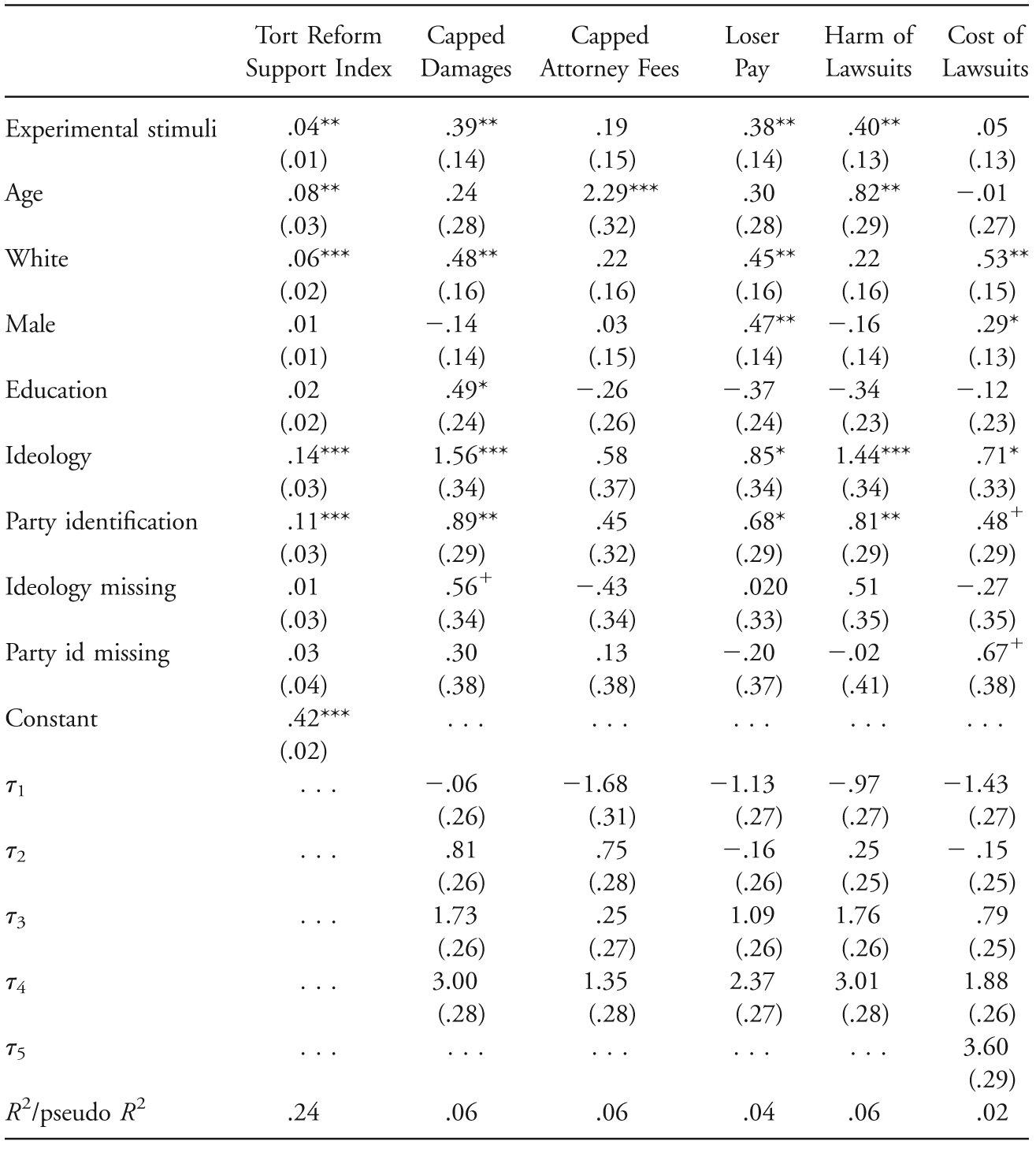
Note.— N = 742. Standard errors are in parentheses. Column 1 presents estimates from OLS regression. Columns 2–5 present estimates from ordered logit regression analyses.
+ p < .10 (two-tailed).
* p < .05.
** p < .01.
*** p < .001.
As discussed above, the treatment may have either provided new information or made existing information more salient. Either way, the experiment shows how the mentioning of a tort tale makes people more supportive of tort reform initiatives.
Correlational Analysis
What specific aspects of the tort tale were most impactful? To address this question, I analyze how respondents in the control group described the Liebeck case in an open-ended fashion after providing their policy opinions.
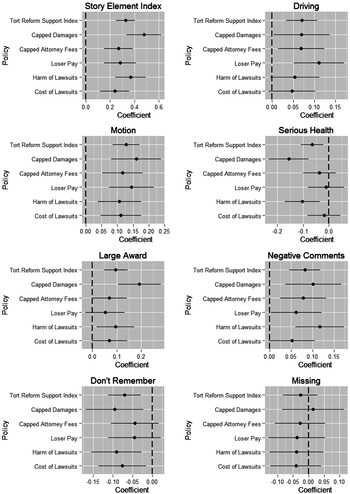
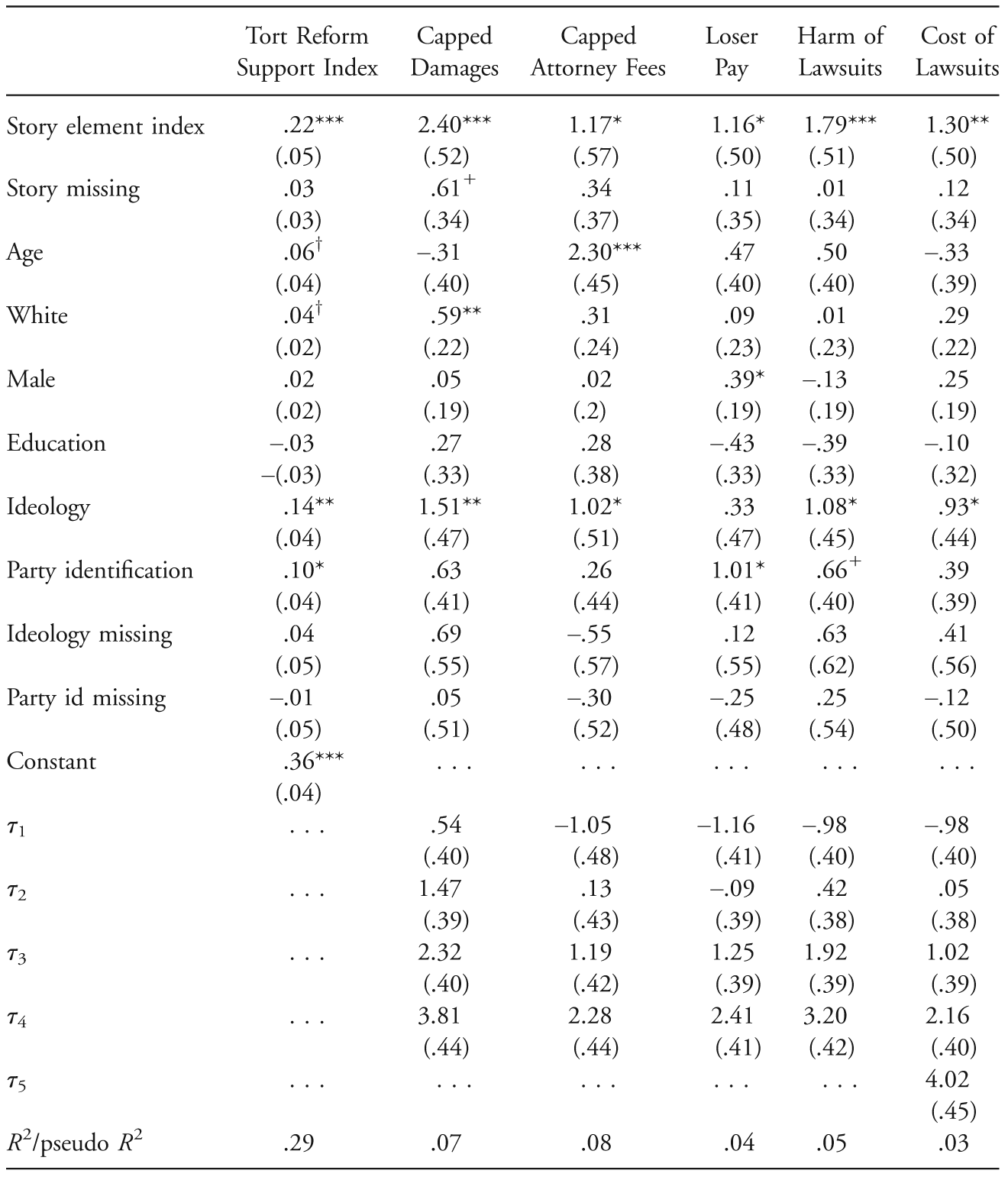
I first examine bivariate relationships between the story elements and support for tort reform measures estimated via OLS regression (see fig. 1). In this case, I present OLS estimates for the individual policy items instead of estimates from ordered logistic regressions for ease of graphical presentation. Both substantively and statistically, the OLS model does not materially differ from the ordered logit model for these specifications. Substantively, as shown in tables 2 and 3, the cutpoints from the ordered logit model are evenly spaced. This suggests that the discrete response scale can be interpreted in an interval fashion. Accordingly, the p-values associated with estimated regression coefficient of interest is similar across both models. I will describe a few results in detail and the others more generally.
Bivariate relationships between story elements and support for tort reform policies.

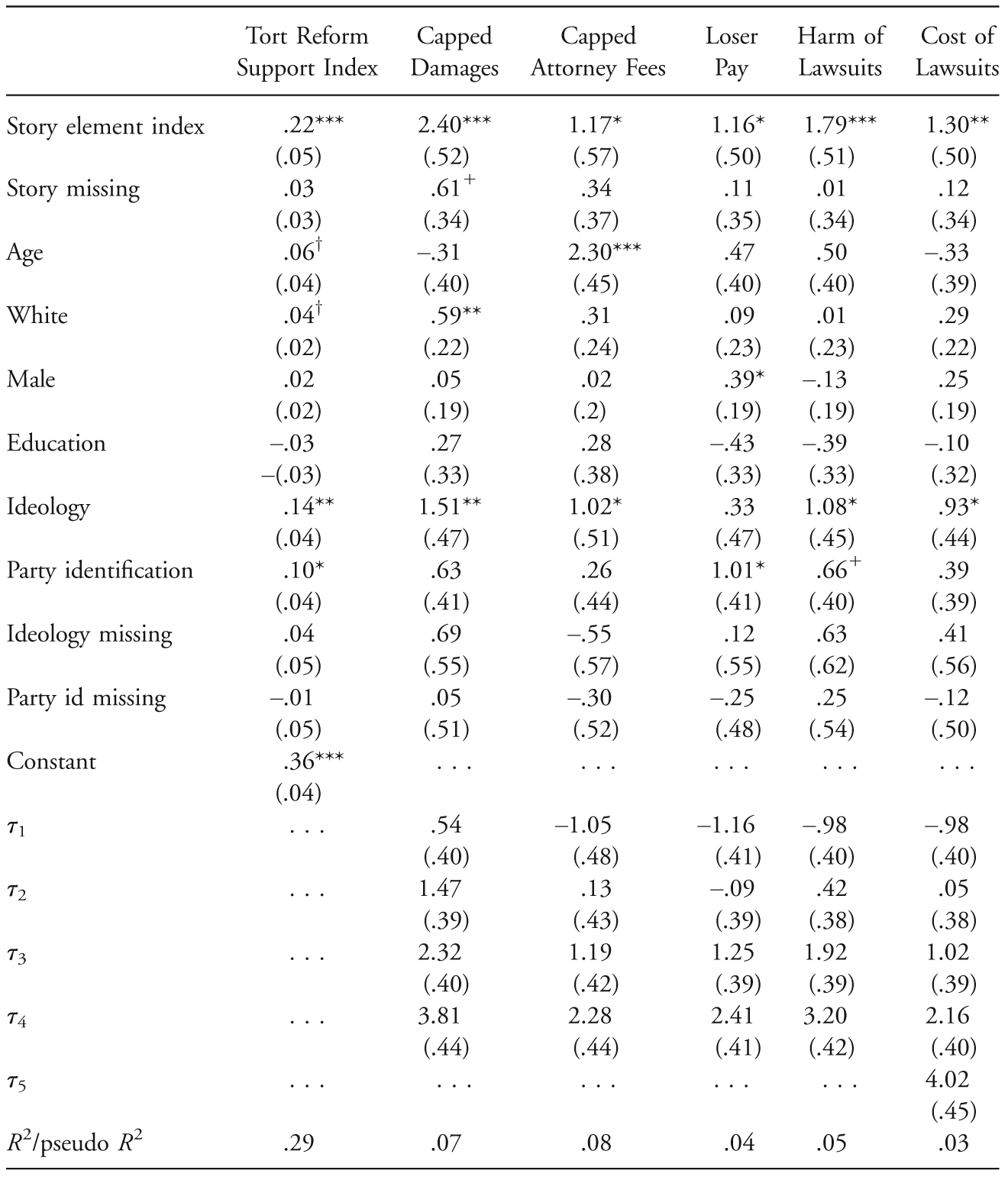
Note.— N = 382. Control group members only. Standard errors are in parentheses. Column 1 presents estimates from OLS regression. Columns 2–5 present estimates from ordered logit regression analyses.
+ p < .10 (two-tailed).
* p < .05.
** p < .01.
*** p < .001.
The upper-left panel of figure 1 plots coefficients (and 90% confidence intervals) from OLS regressions predicting tort reform attitudes with the story element index. The coefficient estimate of the parameter associated with the story index is 0.32. Because both the independent and dependent variable are coded to lie between 0 and 1, 100 times the coefficient estimate represents the percentage point (as well as percentage) change in the dependent variable associated with moving across the entire range of the independent variable. In other words, moving from having zero elements of the index to all six elements is associated with a 32% increase in support for tort reform measures (as proxied by the issue support scale), a relationship that is highly statistically significant (p < .001). The figure panel shows that the relationship for each of the component issues is similarly positive and statistically significant, and the effect sizes are comparable to one another. As expected, the confidence interval for the tort reform support index is tighter due to reduced measurement error from averaging the individual policy responses.
The upper-right panel of figure 1 shows the relationship between policy support and whether the “driving” story element was included in the respondent’s blurb. Respondents who mentioned that the woman was the driver of the car—an oft-repeated aspect of the urban legend—exhibited 7% greater support on the tort reform support index (p = .002). The results for the individual policies were similar in magnitude and consistently positive. As shown in the remainder of figure 1, the findings for the other story elements are consistent with the theoretical expectations. Respondents who reported that the car was in motion at the time of the spill were 11%–16% more likely to support tort reform policies. Those who reported that the woman received serious health injuries were 1%–16% less likely to support tort reform. Those who mentioned that the woman received a large award in the lawsuit were 5%–19% more supportive of tort reform. Finally, respondents who made unprompted, disparaging comments about the woman were between 5%–12% more supportive.
An interesting pattern emerges for those who said that they “didn’t remember” the story. These respondents were 7.1% less likely to support tort reform as measured by the five-item scale (p = .005). This is consistent with the theoretical mechanism laid out at the start of the article, as well as the experimental results. People not exposed to the cultural meme were least supportive of tort reform efforts. Respondents who reported familiarity with the story actually reported many elements that were incorrect (51% reported at least one false or negative aspect of the story), and these incorrect elements were associated with greater support for the policies. Lastly, I note that respondents who did not provide a story were no more or less likely to support tort reform than other respondents (see bottom-right panel of fig. 1).
I next explore the robustness of these results to including a set of control variables, including party identification and liberal-conservative ideology, which should be strongly associated with support for tort reform, given the Republican Party’s support of these initiatives. Including these two covariates is particularly important since we want to know if interpretation of the urban legend explains variance in policy attitudes above and beyond political predispositions, as Republicans and conservatives should be more supportive of tort reform and perhaps adopt the urban legend. As shown in table 3, an OLS regression controlling for ideology and party identification indicates that respondents who reported more elements of the urban legend had higher values on the tort report support index. Further, ordered logistic regressions in the table show similar results for each of the five component policies. Going from the lowest to highest value of the story element index—reporting none of the six elements to reporting all of them—was associated with a 22% increase on the tort reform index scale (p < .001). The size of this result is similar to the point estimate obtained in the bivariate regression. As shown in table 3, the relationship between the story element index and policy support is statistically significant for each of the five component items.
Conclusion
The purpose of this research note is to apply survey and experimental techniques from political and social psychology to the empirical study of “tort tales.” Legal scholarship has argued through qualitative analysis that cultural memes make citizens more supportive of tort reform and feel more negatively toward the tort system generally. I test these arguments using a quantitative, survey-based approach. An embedded experiment provides evidence that exposing people to the urban legend of Stella Liebeck, the “McDonald’s coffee lady,” causes people to be more supportive of tort reform policy proposals. Additionally, people’s remembrance of the story is significantly and substantially related to their views on tort reform. These findings are striking, given that Liebeck’s lawsuit is just one of thousands of torts filed in any given year. Further, the story is now over 20 years old yet has become a part of American popular consciousness.
There is ample opportunity to build on this research. Most obviously, other topics and urban legends can be analyzed beyond the single case study explored here. Once we study myriad types of “tort tales,” we can begin to create a typology and theorize about what makes some legends more consequential than others. Additionally, more research can be done to explore which kinds of people are most susceptible to “tort tales,” perhaps drawing upon psychological research on heterogeneous emotional response. The survey reported here also did not contain a measure of political sophistication or knowledge. It would be interesting to see if the least-informed individuals were most influenced by cultural memes. Subsequent scholarship can also more precisely establish normative benchmarks with which to compare an individual’s policy choice against some ideal standard, similar to the concept of “voting correctly” (Lau and Redlawsk 1997). The current analysis could only assess whether the urban legends were related to people’s attitude formation. It would be interesting to know if people influenced by cultural memes had “lower quality” attitudes by some objective metric. Finally, we need a better understanding of how citizen attitudes translate into legal policy (per Kagan 2006).
Appendix