Implications
Reducing the feed-food competition is a critical aspect for modern livestock production and will be further stressed in the near future due to the growing world population. Therefore, the search for alternatives to the common feed ingredients represent a key aspect for the future sustainability of the livestock sector and, in this context, insects are candidates with great potential. This study showed that insect meal from Hermetia illucens larvae can partly substitute conventional ingredients in the diet for broiler quails as their meat showed satisfactory nutritional quality. However, research to improve the fatty acid profile of larvae is required.
Introduction
In the perspective of a rising world population with growing meat requirements, insects are considered an alternative feed source for livestock, which would offer a possible solution to improve the sustainability of the livestock supply chain and thus meat production (Sánchez-Muros et al., Reference Sánchez-Muros, Barroso and Manzano-Agugliaro2014). Insects constitute a raw material that is included in the European Union feed material register and, although they are currently authorized only for pets and aquaculture animals, insect-derived feeds could also represent a suitable ingredient for pigs and poultry feed manufacturing. To allow a clear legislation and possible rapid industrial development of the sector, research efforts are currently being performed.
One of the most promising insect species is the black soldier fly (H. illucens), whose larvae can successfully grow on substrates made of various by-products such as digestate, vegetable and restaurant leftover (Spranghers et al., Reference Spranghers, Ottoboni, Klootwijk, Ovyn, Deboosere, De Meulenaer, Michielis, Eeckhout, De Clercq and De Smet2017). This aspect is interesting as it allows to transform potential wastes with an environmental impact into a nutrient rich product, and the final substrate can be successfully used as organic fertilizer (Lalander et al., Reference Lalander, Senecal, Gros Calvo, Ahrens, Josefsson, Wiberg and Vinneras2016). In addition, this new feed source would help in reducing the feed-food competition which is already a critical aspect for modern livestock production and which will be further stressed in the near future due to the growing world population. Regarding the poultry sector, soy is one of the main dietary ingredients and it is used both as a protein and a fat source but it is also a food for humans. Soy requires a lot of land and water to grow and therefore has a relevant environmental impact (Charlton et al., Reference Charlton, Dickinson, Wakefield, Fitches, Kenis, Han, Zhu, Kone, Grant, Devic, Bruggeman, Prior and Smith2015). Due to this, soy supplies represent a key aspect now and even more for the future. In fact, current poultry diets of the European Union use soy which is mainly imported from United States, Argentina and Brazil (Boerema et al., Reference Boerema, Peeters, Swolfs, Vandevenne, Jacobs, Staes and Meire2016), highlighting once more that the search for alternative feed ingredients is imperative.
Black soldier fly has recently been successfully tested as feed ingredient in conventional poultry diets as fat source (Schiavone et al., Reference Schiavone, Cullere, De Marco, Meneguz, Biasato, Bergagna, Dezzutto, Gai, Dabbou, Gasco and Dalle Zotte2017) and in laying hens as a protein meal (Al-Qazzaz et al., Reference Al-Qazzaz, Dahlan, Akit and Lokman2016; Maurer et al., Reference Maurer, Holinger, Amsler, Früh, Wohlfahrt, Stamer and Leiber2016). In addition, in the only study on meat quails, defatted black soldier fly larvae meal provided satisfactory results in terms of nutrient digestibility, carcass composition and meat physical traits (Cullere et al., Reference Cullere, Tasoniero, Giaccone, Miotti-Scapin, Claeys, De Smet and Dalle Zotte2016).
However, the impact of this new feed ingredient on the meat quality is a key aspect for consumers that will directly influence the concrete interest by the industry in this new feed source.
Based on these considerations, the present research studied the effect of a dietary inclusion of defatted insect meal from H. illucens larvae on several meat quality aspects of broiler meat quails: meat proximate composition, cholesterol content, oxidative status, fatty acid profile, amino acid and mineral contents, sensory profile and off-odours and flavours perception.
Material and methods
Animals and diets
The experiment was carried out in a private quail farm (“La Colombara” Società Agricola, Castelnovo di Isola Vicentina, VI, Italy), after the approval by the veterinary authority and in accordance with the article 2, DL 4 March 2014, No. 26 of the Official Journal of the Italian Republic (http://www.gazzettaufficiale.it/eli/id/2014/03/14/14G00036/sg), implementing the EC Directive 86/60963/2010 EU regarding the protection of animals used for experimental and other scientific purposes.
A total of 450 quails, 10-day-old (Coturnix coturnix japonica), of both sexes were housed in batteries in an environmentally controlled room. The chicks were allocated by 30 in 15 cages and received three dietary treatments (five replicates per treatment) until slaughtering: a control diet (C) which was formulated referring to the common grower diet used in the farm, H1 and H2 diets in which conventional protein/fat sources were partly substituted with defatted black soldier fly (H. illucens) larvae meal (H): 10% H for H1 and 15% H for H2. In H1, H replaced 28.4% of soya bean oil and 16.1% of soya bean meal, whereas in H2, H substituted 100% of soya bean oil and 24.8% of soya bean meal. Mashed feeds and water were provided ad libitum. All diets were formulated to meet the minimum requirements for Japanese quails (National Research Council, 1994). A detailed description of the origin, the chemical composition and the energy content of H, as well as the ingredients, the chemical composition and the energy content of experimental diets are reported elsewhere (Cullere et al., Reference Cullere, Tasoniero, Giaccone, Miotti-Scapin, Claeys, De Smet and Dalle Zotte2016).
Slaughtering, carcass dissection and samples preparation
At 28 days of age, quails were deprived from feed and transported to the commercial slaughterhouse ‘Quaja Veneta® Società Agricola’ (Malo, VI, Italy), which is located 8 km far from the farm. Fasting lasted 6 h, from feed withdrawal until slaughtering. Quails were electrically stunned, slaughtered and processed following commercial conditions. Stunned quails were bled, plucked, eviscerated and freed from head, neck, shanks and abdominal fat. Afterwards, they were refrigerated for 1 h in the refrigeration tunnel at +2°C, transported in chilled conditions to the Department of Animal Medicine, Production and Health (MAPS) of the University of Padova and stored at +2°C. The following day, breast muscles (right and left side) were excised from 96 quails/treatment and divided in accordance with the subsequent analytical step.
A total of 60 breasts/treatment (n=12 breasts/replicated cage) were vacuum-packaged by 10 using a CSV-41n ORVED machine (99% vacuum level) in polyethylene bags (water vapour transmission rate: 3.5±1 g/m2 day at 23°C and 85±2% relative humidity), and stored at −40°C for subsequent analysis: lipid oxidation (n=10 breasts/treatment), amino acid profile (n=10 breasts/treatment) and sensory analysis (n=40 breasts/treatment). The other n=36 quail breasts/treatment (n=7, 7, 7, 7 and 8 breasts/replicated cage) were randomly ground by three (to have enough sample to perform all the scheduled analysis) with a Retsch Grindomix GM 200 (7000 g for 10 s) for a total of 12 samples/treatment. Subsequently, meat samples were frozen at −40°C, freeze-dried and ground again (7000 g for 5 s) to obtain a fine powder which was used to determine proximate and fatty acid composition, cholesterol and mineral contents.
Meat proximate composition, cholesterol content and oxidative status
The proximate composition of meat was analysed in accordance with the AOAC (1995), whereas protein content, including glucidic molecules and their catabolites (0.25%), was calculated by difference (Ouhayoun et al., Reference Ouhayoun, Delmas, Monin and Roubiscoul1990).
The cholesterol content was determined through absolute quantitative analysis using HPLC following the method described by Casiraghi et al. (Reference Casiraghi, Lucisano, Pompei and Dellea1994).
After 2 weeks of storage, 10 quail breasts/treatment were allowed thawing for 12 h at +4°C, freed from polyethylene bags and individually ground with a Retsch Grindomix GM 200 (7000 g for 10 s). The extent of muscle lipid oxidation was evaluated with a spectrophotometer (Hitachi U-2000; Hitachi, Mannheim, Germany) set at 532 nm, that measured the absorbance of thiobarbituric acid-reactive substances and a 1,1,3,3-tetraethoxypropane calibration curve (Botsoglou et al., Reference Botsoglou, Fletouris, Papageorgiou, Vassilopoulos, Mantis and Trakatellis1994). Oxidation products were quantified as malondialdehyde (MDA) equivalents (mg MDA/kg muscle).
Mineral and amino acid contents of defatted Hermetia illucens meal, diets and meat
Aliquots of H, experimental diets and 12 freeze-dried meat samples/treatment were sent to the Department of Veterinary Medicine, University of Perugia to analyse the mineral content (AOAC, 2012). The methods to analyse the mineral content of the H and the experimental diets were: method 968.08 (Ca and Mg), method 995.11 (P), method 956.01 (Na), method 975.03 (K), method 968.08 (Cu, Fe, Zn and Mn). Differently, the methods used for meat samples were: method 991.25 (Ca and Mg), method 991.27 (P), method 956.01 (Na), method 975.03 (K, Cu, Fe, Zn) and method 921.02 (Mn).
The amino acid contents of the H, the experimental diets and the meat were analysed by EPTA NORD srl (Via Padova, Conselve, Italy, Internal method 693 rev 0 2007).
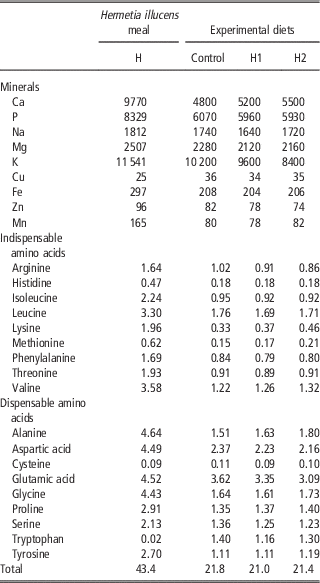
The mineral and the amino acid contents of the H and the experimental diets are presented in Table 1.
Mineral (mg/kg) and amino acid contents (g/100 g as fed) of the defatted Hermetia illucens larvae meal (H) and experimental diets for growing quails

H1 and H2 are diets corresponding to 10% and 15% H inclusion levels, respectively.
Fatty acid profile of defatted Hermetia illucens meal, diets and meat
Lipid extraction was performed combining the traditional Folch method (Folch et al.,Reference Folch, Lees and Stanley1957) with that provided by Lee et al. (Reference Lee, Trevino and Chaiyawat1996) and the Accelerated Solvent Extraction (M-ASE), in which petroleum ether (H and experimental diets) or chloroform/methanol 1 : 2 (meat) were the solvents used for the extraction. Total lipid content was determined gravimetrically after the removal of the solvent by evaporation under nitrogen stream at 50°C. Samples were then transmethylated using a methanolic solution of H2SO4 (4%) to determine fatty acid methyl esters (FAME). Biphasic separation was obtained by adding 0.5 ml of distilled water and 1.5 ml of N-heptane to each sample. Fatty acid methyl esters were quantified by gas chromatography (Shimadzu GC17A, equipped with an Omegawax (Sigma-Aldrich Co. LLC., Saint Louis, USA) 250 column (30 m×0.25 μm×0.25 μm)) and flame ionization detector. Helium was used as carrier gas at a constant flow of 0.8 ml/min. Injector and detector temperatures were 260°C. Peaks were identified based on commercially available FAME mixtures (37-Component FAME Mix; Supelco Inc., Bellefonte, PA, USA) and the data obtained were expressed as % of total detected FAME.
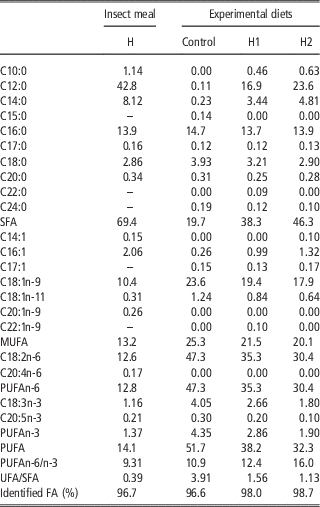
The fatty acid profiles of the H and the experimental diets are shown in Table 2.
Fatty acids (FA) profile (% of total fatty acids) of the defatted Hermetia illucens larvae meal (H) and experimental diets

SFA=saturated fatty acids; MUFA=monounsaturated fatty acids; PUFA=polyunsaturated fatty acids; UFA=unsaturated fatty acids.
H1 and H2 are diets corresponding to 10% and 15% H inclusion levels, respectively.
Meat sensory analysis
Quail breasts were subjected to a descriptive sensory analysis, to detect possible differences among the dietary treatments (C v. H1 v. H2). The sensory analysis was performed by an eight-member trained panel, which were qualified as experts according to ISO 8586 and had experience with descriptive tests (ISO 13299) on various food matrixes. All judges who perform tests with accredited methods undergo training every 3 years. Panelists underwent two pre-test training sessions of 1 h each to familiarize with the matrix and select appropriate descriptors, possible off-odours and off-flavours, also drawn from the literature. The panel received a list of descriptors to score on numerical and continuous scales from 0 (the lowest score for each attribute) to 10 (the highest score for each attribute).
Olfactory, gustative and textural aspects were evaluated. The descriptors were: odour intensity, off-odour intensity, flavour intensity, off-flavour intensity, juiciness, toughness, chewiness and fibrousness. The chosen off-odours and off-flavours were: game meat, liver, oil/fat, peanut/hazelnut. The meat used for the training sessions was that of the C group (n=8 quail breasts) and was processed, stored, handled and cooked in the same manner of the samples which were used for the subsequent sensory analysis.
For the experiment, a total of 32 quail breasts/treatment were used and 2 days of analysis were scheduled (16 quail breasts/treatment per session). After 1 month of frozen storage at −40°C, quail breasts were allowed thawing for 16 h at +4°C. Each sample was then placed in a cooking plate (model GR6010 XL Health Comfort, 2400 Watt; Rowenta, Erbach, Germany) set at thermostat position ‘2’ and cooked 5 min/side, until core temperature reached 74°C. Subsequently, samples were put in aluminium trays and served to the panel in random sequence. Samples were identified by a random three-digit code.
The evaluation sheet, distribution of samples to the judges and data acquisition were performed using FIZZ software (BIOSYSTEMES FRANCE, St-Ouen l’Aumône, France) installed in eight terminals in the tasting booths of the laboratory. In addition, for each sample, panelists were asked to indicate if and which of the listed off-odours and off-flavours they could recognize. Still water at room temperature and unsalted crackers were available to panelists throughout each sensory session.
Statistical analysis
Meat proximate composition, oxidative status, cholesterol, mineral and amino acid contents and fatty acid profile data were subjected to a one-way ANOVA with experimental diet (C, H1 and H2) as fixed effect, following the GLM procedure of the SAS 9.1.3 Statistical Analysis Software for Windows (SAS Institute, 2008). A mixed model (PROC MIXED) was used to detect any dietary influence on sensory analysis scores, therefore considering experimental diet and the eight panelists as fixed and random effects, respectively. Least square means were obtained using Bonferroni test and the significance was calculated at a 5% confidence level. A χ 2 test with Marascuilo (Reference Marascuilo1966) procedure was performed on off-odours and off-flavours characterization to detect the differences among treatments.
Results
Meat chemical composition and oxidative status
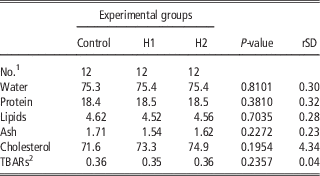
Independently to the inclusion level, H did not affect the proximate composition, cholesterol content and oxidative status of quail breast meat (Table 3) which exhibited an average 18.5% protein, 4.6% lipids, 73.3 mg/100 g meat cholesterol, and 0.36 mg MDA/kg meat.
Effect of the dietary inclusion of the defatted Hermetia illucens larvae meal (H) on the proximate composition (%), cholesterol content (mg/100 g meat) and oxidative status (mg MDA/kg meat) of Japanese quail breast meat

MDA=malondialdehyde; TBARs=thiobarbituric acid-reactive substances.
H1 and H2 are diets corresponding to 10% and 15% H inclusion levels, respectively.
1 Each sample is made from three quail breasts.
2 TBARs analysis was conducted on No.=10 samples/treatment.
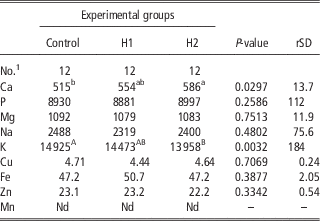
The mineral profile of the meat (Table 4) was comparable among treatments with the exceptions of Ca and K contents which followed the same trend displayed by the diets. The meat content of Ca linearly increased from C to H2 meat (515, 554 and 586 mg/kg for C, H1 and H2 meat, respectively; P<0.05), whereas K content followed an opposite trend (14 925, 14 473 and 13 958 mg/kg for C, H1 and H2 meat, respectively; P<0.01).
Effect of the dietary inclusion of the defatted Hermetia illucens larvae meal (H) on the mineral content (mg/kg) of Japanese quail breast meat

Nd=not detected.
H1 and H2 are diets corresponding to 10% and 15% H inclusion levels, respectively.
a,bValues within a row with different superscripts differ significantly at P<0.05.
A,BValues within a row with different superscripts differ significantly at P<0.01.
1 Each sample is made by three quail breasts.
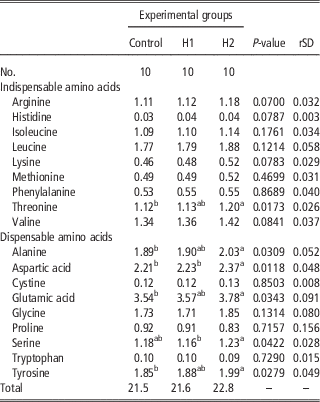
From the results displayed in Table 5, it was observed that the 10% and 15% inclusion of H in quail diets provided meat with satisfactory amino acid profile, which resulted improved (P<0.05) for aspartic acid, glutamic acid, alanine, serine, tyrosine and threonine in H2 group compared to C.
Effect of the dietary inclusion of the defatted Hermetia illucens larvae meal (H) on the amino acids content (g/100 g) of Japanese quail breast meat

H1 and H2 are diets corresponding to 10% and 15% H inclusion levels, respectively.
a,bValues within a row with different superscripts differ significantly at P<0.05.
Fatty acid profile of Hermetia illucens meal and quail meat
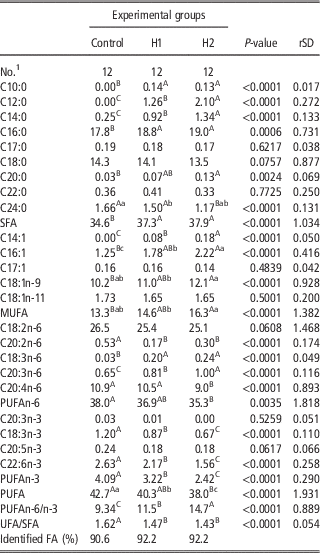
The fatty acid profile of H was mostly represented by saturated fatty acids (SFA) which accounted for more than 69% of total fatty acids with lauric (C12:0, 42.8%), palmitic (C16:0, 13.9%) and myristic (C14:0, 8.1%) fatty acids being the most representative. Oleic (C18:1n-9, 10.4%) and linoleic (C18:2n-6, 12.6%) fatty acids were the most abundant monounsaturated fatty acids (MUFA) and polyunsaturated fatty acids (PUFA), respectively. Consequently, the dietary inclusion of H greatly changed the fatty acid proportions of quail breast meat (Table 6). With increasing H level, SFA increased (34.6 v. 37.3 and 37.9% for C, H1 and H2, respectively; P<0.0001) because of raising C10:0, C12:0, C14:0, C16:0 and C20:0 fatty acids. A similar trend was observed for MUFA, which increased from C to H2 meat (13.3 v. 14.6 v. 16.3% for C, H1 and H2, respectively; P<0.0001). On the opposite, PUFA significantly decreased from C to H2 meat (42.7 v. 40.3 v. 38.0% for C, H1 and H2, respectively; P<0.0001) with the PUFAn-3 fraction showing the highest decrease. In fact, H2 meat had 41% less n-3 than C. The latter determined an increasing trend in the PUFAn-6/n-3 ratio from C to H2 meat (9.34 v. 11.5 v. 14.7, for C, H1 and H2 meat; P<0.0001).
Effect of the dietary inclusion of the defatted Hermetia illucens larvae meal (H) on the fatty acid (FA) profile (% of total fatty acids) of Japanese quail breast meat

SFA=saturated fatty acids; MUFA=monounsaturated fatty acids; PUFA=polyunsaturated fatty acids; UFA=unsaturated fatty acids.
H1 and H2 are diets corresponding to 10% and 15% H inclusion levels, respectively.
a,b,cValues within a row with different superscripts differ significantly at P<0.05.
A,B,CValues within a row with different superscripts differ significantly at P<0.01.
1 Each sample is made by three quail breasts.
Meat sensory profile, off-odours and off-flavours
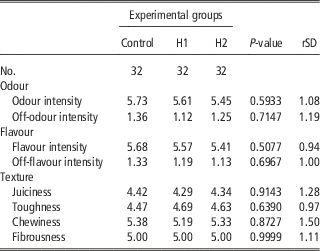
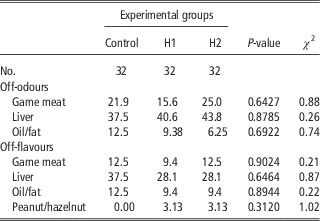
Results depicted in Table 7, showed that odour, flavour and texture attributes of quail meat deriving from H1 and H2 groups was not affected by the H inclusion level and resulted like the scores of C group. In addition, the average intensity perception of off-odour (score: 1.24 out of 10) and off-flavour (score: 1.22 out of 10) was very low. Regarding specific off-odours and off-flavours (Table 8), liver was the most frequently perceived (41% and 31% of the tested samples for off-odours and off-flavours, respectively) but this was independent to the treatment, thus suggesting it as a typical sensory characteristic of quail meat.
Effect of the dietary inclusion the defatted Hermetia illucens larvae meal (H) on the sensory profile scores of Japanese quail breast meat

n=8 breasts of the C group were used for the training sessions; H1 and H2 are diets corresponding to 10% and 15% H inclusion levels, respectively.
Effect of the dietary inclusion of the defatted Hermetia illucens larvae meal (H) on the off-odours and flavours perception (% on total tested samples) of Japanese quail meat

n=8 breasts of the C group were used for the training sessions; H1 and H2 are diets corresponding to 10% and 15% H inclusion levels, respectively.
Discussion
The proximate composition and cholesterol content of quail meat in the present experiment corresponded to values found in literature (Guven et al., Reference Guven, Kiliç and Ozer2015), with cholesterol being quite high if compared with data reported for some common meat species (Dalle Zotte and Szendrő, Reference Dalle Zotte and Szendrő2011) namely beef (48.7 mg/100 g Longissimus dorsi meat), pork (62 mg/100 g Longissimus dorsi meat) and chicken (55.3 mg/100 g breast meat). Even if some recent research papers dealt with the effect of feeding insects to poultry species, knowledge on the quality of the derived meat is still scarce (Maurer et al., Reference Maurer, Holinger, Amsler, Früh, Wohlfahrt, Stamer and Leiber2016). In the present study, it was demonstrated that the proximate composition, cholesterol content and oxidative status of insects-fed quails is comparable with birds fed on conventional diets, which is a key aspect from the nutritional point of view.
In general, the mineral content of H was in line to data reported by Makkar et al. (Reference Makkar, Tran, Heuzé and Ankers2014), but slightly higher than literature values reported for whole insects (Finke, 2013), which was probably due to the defatting procedure which presumably concentrated the minerals. Hermetia illucens is a good source of Ca and P, which is in accordance with the present experiment, especially for Ca. Despite K content of H showed to be about 67% higher than values showed by Makkar et al. (Reference Makkar, Tran, Heuzé and Ankers2014), it was not enough to provide a comparable K content in the three experimental diets, which reflected also in the meat content of this mineral.
The result of the amino acid profile of H, confirmed that this insect provides protein with high biological value, in line with literature data (Józefiak et al., Reference Józefiak, Józefiak, Kierończyk, Rawski, Świątkiewicz, Długosz and Engberg2016), but which is, once again, highly dependent on the chemical composition of the growing substrate (Tschirner and Simon, Reference Tschirner and Simon2015). The fact that the inclusion of H in the diet for growing quails increased the breast meat content of threonine, was not dependent on the content of this amino acid in the experimental diets. Except for alanine, also for the dispensable amino acids aspartic acid, glutamic acid, serine and tyrosine, their meat content increased with increasing the dietary H inclusion, but this was independent to the absolute amount of these amino acid in the experimental diets. This was not surprising as growing evidence suggests that the content and proportion of the amino acids of the body does not directly corresponds to the dietary ones, with discrepancies being particularly high for arginine, cysteine, glutamic acid, glycine, histidine, methionine, proline and serine. This is due to several factors as the different rates at which, in the small intestine, individual amino acids are catabolized and transformed. In addition, the amino acid composition in the diet does not correspond to their concentration in the blood circulation, individual amino acids in the plasma have a different metabolic destiny in different tissues and the pattern of dietary amino acids differs to that of amino acids in tissue proteins (Guoyao et al., Reference Guoyao, Fuller, Zhaolai, Defa, Junjun and Zhenlong2014). In general, however, it could be observed that breast meat of H2 quails showed an enhanced amino acid profile compared with that of C quails.
Black soldier fly was tested also in another recent trial on poultry but only as a fat substitute, where it replaced the soya bean oil (Schiavone et al., Reference Schiavone, Cullere, De Marco, Meneguz, Biasato, Bergagna, Dezzutto, Gai, Dabbou, Gasco and Dalle Zotte2017). Results were overall comparable with those of the conventional diet with the only drawback related to the fatty acid profile of the derived meat which is exactly what it was observed in the present study.
In fact, increasing the content of H lowered the healthiness of the meat as SFA increased to the detriment of PUFA. Both the defatted larvae meal tested in the present trial and the black soldier fat used in the trial by Schiavone et al. (Reference Schiavone, Cullere, De Marco, Meneguz, Biasato, Bergagna, Dezzutto, Gai, Dabbou, Gasco and Dalle Zotte2017) originated from larvae which were reared on a conventional substrate which was layer mash, therefore the two similar results on the fatty acid profile of quail and chicken breast meat, respectively, were expected. Interestingly, both the present and the above cited studies showed that a decrease in the dietary content of MUFA did not correspond to the same trend when considering meat. In fact, in the present experiment an increase in meat MUFA content with H inclusion was observed. The latter can be ascribable to elongase and Δ9 desaturase activities mainly from C12:0, C14:0 and C16:0 SFA whose content increased with increasing dietary H. The Δ9 desaturase is a lipogenic enzyme which was reported to be up-regulated by low-fat high-carbohydrate diets and down-regulated by the dietary addition of PUFA (Poureslami et al., Reference Poureslami, Turchini, Raes, Huyghebaert and De Smet2010). As C, H1 and H2 diets showed a decrease in crude fat content, an increase in nitrogen-free extracts (Cullere et al., Reference Cullere, Tasoniero, Giaccone, Miotti-Scapin, Claeys, De Smet and Dalle Zotte2016) and a reduction in PUFA, a higher Δ9 desaturase activity was hypothesized in H supplemented diets compared to C.
Based on results of the present trial, H. illucens can therefore not be considered a feedstuff with a healthy fatty acid profile namely low in SFA and high in PUFA, and with a favourably low n-6/n-3 ratio (Karami et al., Reference Karami, Ponnampalam and Hopkins2013). However, as larvae are monogastric animals, a possible solution to solve this key issue could be the modulation of the rearing substrate aiming to modify the fatty acid profile of black soldier fly. In fact, a recent study by Spranghers et al. (Reference Spranghers, Ottoboni, Klootwijk, Ovyn, Deboosere, De Meulenaer, Michielis, Eeckhout, De Clercq and De Smet2017) showed that the ether extract content of the larvae can vary greatly depending to the substrate, as well as the fatty acid profile. Similarly, also the study by Tschirner and Simon (Reference Tschirner and Simon2015) observed that mixture of middlings, dried distillers’ grains with solubles and dried sugar beet pulp, greatly changed the chemical composition of the larvae. Furthermore, farming black soldier fly larvae on fish offal was shown to provide a feedstuff substantially enriched in n-3 PUFA (St-Hilaire et al., Reference St-Hilaire, Cranfill, McGuire, Mosley, Tomberlin, Newton, Sealey, Sheppard and Irving2007). Therefore, it should be stressed that the research of the optimal feeding formulation for growing larvae is a key point for both a successful larvae production in terms of quantity and quality, as well as for a satisfactory nutritional quality of the meat derived from insects’ fed animals.
In the perspective of a potential successful application of insects-based feed to livestock animals and thus to be fruitfully introduced in the meat sector, consumers must be willing to accept insects as feed ingredients, and the sensory characteristics of meat deriving from insects-fed animals must be comparable with the conventional one. A recent study by Laureati et al. (Reference Laureati, Proserpio, Jucker and Savoldelli2016) showed that only 21.7% of Italian consumers recruited for the test were unwilling to accept insects as feed for livestock farming and that information plays a crucial role in driving the change towards acceptance. The present research is the first one in assessing the sensory attributes of meat coming from quails fed with black soldier fly larvae meal. Our findings agreed to those of Sealey et al. (Reference Sealey, Gaylord, Barrows, Tomberlin, McGuire and Ross2011) on rainbow trout fed with increasing levels of black soldier fly larvae as a replacement of fish meal, in which untrained panelists did not detect any significant difference in a blind comparison among the treatments. Differently, a recent study by Borgogno et al. (Reference Borgogno, Dinnella, Iaconisi, Fusi, Scarpaleggia, Schiavone, Monteleone, Gasco and Parisi2017) found that a dietary inclusion of H. illucens larvae meal induced significant differences in the sensory description of rainbow trout fish samples. However, similarly to our research, no defects or off-flavours were perceived in samples deriving from fish fed with H. illucens. Finally, Pieterse et al. (Reference Pieterse, Pretorius, Hoffman and Drew2014) found that the sensory profile of meat derived from chickens fed with a 10% Musca domestica larvae meal was slightly different from the control group for a higher perception of metallic aroma and aftertaste but a higher sustained juiciness and a lower mealiness (dry sensation) in the mouth.
In conclusion, the present research showed that a partial replacement with a defatted H. illucens larvae meal to the common soya bean meal and oil in the diet for growing broiler quails (up to 15% inclusion level) is technically feasible and provide meat of comparable quality to that of quails fed a conventional diet. The fact that the sensory profile of meat was not affected by H dietary inclusion is a fundamental aspect for the potential of this new feedstuff to be successfully included in commercial diets for growing quails. Differently, the fatty acid profile of the larvae must be surely improved to provide healthier meat for the modern consumer. Therefore, further studies should be planned to assess to what extent the fatty acid profile of H. illucens can be improved, thus allowing to design an optimal growth substrate to produce larvae with a nutritional composition in line with the required health standards.
Acknowledgements
Authors would like to thank Rino Cailotto (“La Colombara” Società Agricola, Castelnovo di Isola Vicentina, VI, Italy) for providing the quails, for the technical support and for allowing us to conduct the study in his farm. Special thanks to Quaja Veneta® Società Cooperativa Agricola (Malo, VI, Italy) for slaughtering and for the technical help which represented a fundamental basis to conduct a successful experiment. Finally, authors acknowledge the feed company FANIN Srl (San Tomio di Malo, VI, Italy) for supplying the raw materials for the diets. The research was supported by the University of Padova funds (ex 60%, 2016 – DOR1603318) and Senior Researcher Scholarship (Prot. n. 1098, 2015).