INTRODUCTION
The basis of social identity in Afghanistan is the concept of qawm, which refers to an individual’s solidarity group, such as village, tribe, subtribe, or even ethnic group. Scholars of Afghanistan have long argued that qawm is a more meaningful source of identity for Afghans than broad ethnic labels such as “Pashtun,” “Hazara,” or “Tajik,” which may be undisputable national categories but may mask substantial local conflict among those within these broader ethnic configurations (Barfield Reference Barfield2010; Roy Reference Roy1990; Rubin Reference Rubin2002). According to these scholars, political conflict in Afghanistan tends to be based on qawm differences. More recently, Coburn and Larson (Reference Coburn and Larson2014) suggest that qawm politics explains mobilization of voters in post-2001 Afghanistan.
In order to better understand the causal impact of qawm on political outcomes in Afghanistan, we assess results from a survey experiment in which candidates in a fictitious election are randomly assigned to share qawm membership with respondents. Contrary to expectations from the literature on Afghanistan and theories of identity politics, we find that respondents are no more likely to vote for a candidate or view that it is important that someone from their qawm represents them when the respondent is from the same qawm as the candidate. Moreover, we find that shared qawm affiliation actually undermines perceptions that candidates will work on an individual’s behalf. We explore whether a weakening of group identity, as measured through differences in education and urbanization and past experiences with violence, explains these findings. In addition, we consider how salience of qawm, as measured by past experience with violence, may help to understand these results.
The concept of qawm has a precise meaning for Afghans as solidarity group.Footnote 1 Roy (Reference Roy1990) viewed qawm, which he defined as a “closely knit group,” as a central ordering concept in Afghanistan and that Afghan society represents a constellation of such groups. Barfield (Reference Barfield2010) argues that Afghans are primarily loyal to their qawm, which may refer to kin, village, tribe, or ethnic group, and that the larger the “category being mapped, the less meaning the category will have” (Barfield Reference Barfield2010, 18). Rubin (Reference Rubin2002) observes that qawm is “sometimes translated as tribe, but is in reality a more protean term, referring to any form of solidarity . . . Qawm identity might be based on kinship, residence, or occupation” (Reference Rubin2002, 25). In common use, qawm may denote various forms of identity: tribal organization; residency, such as a village, valley, or town; or a linguistically-based ethnic group (Rubin Reference Rubin2002). The concept of qawm thus provides insight into how Afghans define their group identity.
Primordial, constructivist, and instrumental perspectives on social identity each view shared identities, and whether individuals are considered part of an in-group or out-group, as important determinants of voter perceptions and behavior (Dunning and Harrison Reference Dunning and Harrison2010; Ferree Reference Ferree2006; Posner Reference Posner2005). These theories broadly share a prediction that the social identity of candidates will influence voter behavior and perceptions. However, there are also studies that suggest identity politics does not have a clear impact on political outcomes even in diverse societies (e.g., Kasara Reference Kasara2013). The results here support perspectives suggesting that social identity of candidates have ambiguous or unanticipated influences on voter perceptions in local elections. We find that in an experimental setting of a local election, qawm does not appear to have the predicted effect. In terms of the literature on Afghanistan, this evidence is consistent with Christia’s (Reference Christia2012) finding that social identity is not the primary driving force behind conflict in Afghanistan.
Before presenting the findings, a few notes are in order. First, we do not reject the possibility of “ethnic voting” in Afghanistan, which in other contexts explains voting behavior (Chandra Reference Chandra2007; Dunning and Harrison Reference Dunning and Harrison2010; Wilkinson Reference Wilkinson2006). In some situations, qawm may refer to ethnicity, but it is also inclusive of other kinds of social identities. The conclusions here pertain to qawm voting in Afghanistan, rather than ethnic voting more generally. Second, although we consider how two broad mechanisms of weakening social ties and salience may explain these findings, we do not find any clear statistical evidence in support of a particular mechanism. Finally, we do not test explicitly whether qawm matters in national elections, or in higher stakes political conflicts. Qawm could very well matter in a national election or in a situation of higher stakes politics, such as mobilization of individuals to participate in political violence. Together, these caveats serve to narrow the scope of our findings, while motivating additional research on the subject of qawm voting in Afghanistan.
EXPERIMENTAL DESIGN AND THEORETICAL PREDICTIONS
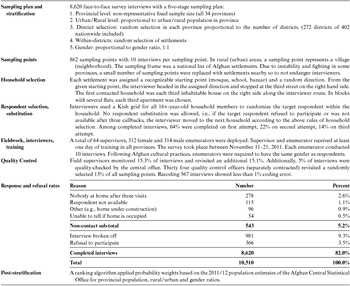
The survey experiment was part of a nationally representative public opinion survey conducted in 8,620 households across all the 34 Afghan provinces in November 2011. Table 1 provides details on the survey design; balance tables on key characteristics of respondents are provided in the online appendix.
Survey Design
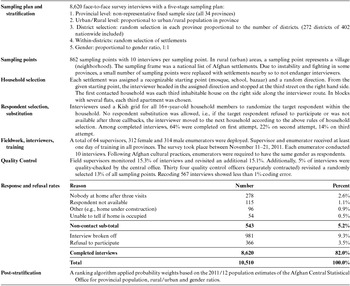
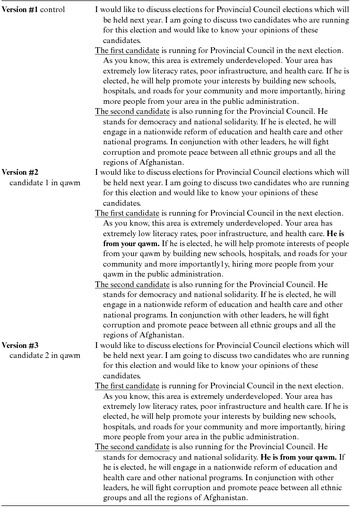
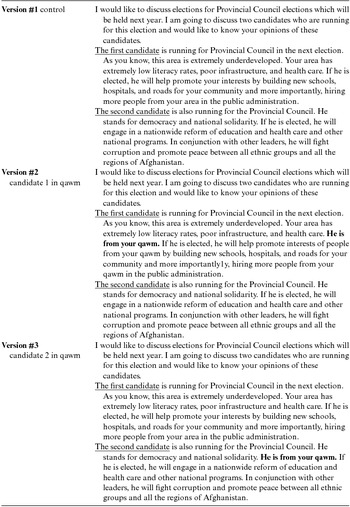
In the survey experiment, respondents were presented with a description of two nameless candidates running for fictitious district council elections.Footnote 2 One candidate has a local agenda (Candidate 1) and one has a national agenda (Candidate 2). In the baseline, neither candidate is affiliated with a qawm. In the first treatment, respondents were told that Candidate 1 is from their qawm; in the second treatment, Candidate 2 is from their qawm. Table 2 presents the experimental scenarios. After listening to candidate descriptions, respondents were asked:
-
1. Among these candidates, who would you vote for?
Table 2Electoral Scenarios (Treatments)

-
2. How likely is it that your chosen candidate will work for you?
-
3. How important is it that someone from your qawm represents you in the government?
A large literature affirms that social identities should influence political attitudes and behavior. Primordial perspectives on identity show how group ties reflect immutable differences between groups. In contrast, psychological and constructivist perspectives view such preferences and attitudes as outcomes of larger social and historical forces (Anderson Reference Anderson1991; Gellner Reference Gellner1983), while instrumental perspectives view identity as a strategic choice and also as a feature of politics that can be manipulated strategically, especially during elections (Chandra Reference Chandra2005; Fearon and Laitin Reference Fearon and Laitin2000; Posner Reference Posner2005). These perspectives view group identity as a primary factor influencing voting behavior, regardless of whether such identities are constructed or not. The literature on instrumental ethnic voting, whereby people vote for co-ethnics because they believe they will be more likely to receive benefits from them (Besley Reference Besley2005; Besley et al. Reference Besley, Pande, Rahman and Rao2004; Duflo Reference Duflo2005; Ichino and Nathan Reference Ichino and Nathan2013), suggests that qawm should influence political attitudes and behavior as this concept reflects attachments to in-groups, serves as a commitment device, or as a source of patronage. Qawm should therefore influence voter choices, perceptions of whether candidates will work on behalf of group members, and perceptions of the importance of representation by fellow qawm members.
Two general mechanisms may explain the extent qawm influences individual perceptions of candidates. One mechanism is the strength of social ties. Rubin (Reference Rubin2002) argues that qawm affiliation is important in Afghanistan, but such identities may have weakened during decades of violence. However, it is also possible that identity-based voting can exist even with weak ties (Posner Reference Posner2005). We explore the strength of identity by considering whether the impact of qawm varies by education and urbanization, ethnicity (Pashtun-majority districts, where social ties may be stronger), and by the extent of support in a region for “customary government” (which implies stronger qawm ties).
The second mechanism is salience. Posner (Reference Posner2004) finds that identity salience varies with events and context, such as during election periods. In Afghanistan, Lyall et al. (Reference Lyall, Blair and Imai2013) find that salience is affected by experience with violence. To account for salience, we analyze whether the strength of qawm-based voting is associated with regional violence, with the expectation that higher levels of regional violence is associated with higher levels of qawm-based voting.
EXPERIMENTAL FINDINGS
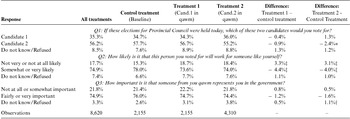
Table 3 presents the univariate results of the experiment. Introducing qawm to candidate affiliation does not yield a statistically significant change in whether an individual is likely to vote for a candidate. The (marginally significant) exception is that individuals are less supportive of the nationally-oriented candidate (candidate 2) when they are from the same qawm. Thus, we find very little evidence that introducing qawm affects candidate choice and only weak evidence that in some scenarios shared qawm affiliation actually decreases vote share.Footnote 3
Univariate Results
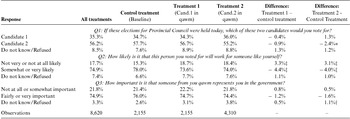
*, †, ‡ indicate statistical significance at the 10%, 5%, 1% significance level in 2-sided z-tests of differences in proportions.
The second question considers respondent perception that if elected, a candidate will work for them. When qawm is introduced for either candidate, the belief that candidates will work on behalf of respondents drops significantly by 4.0% and 4.4%, while disbelief significantly increases by 3.3% and 3.1% respectively. Both candidates suffer equally. One possible explanation for this result (further investigated below) is that qawm affiliation could stigmatize candidates, something expected in a divisive environment.
Question 3 examines how important it is for respondents that they are represented by a fellow qawm member. We find no significant changes across treatments when introducing a candidate from the respondent’s qawm.
Robustness
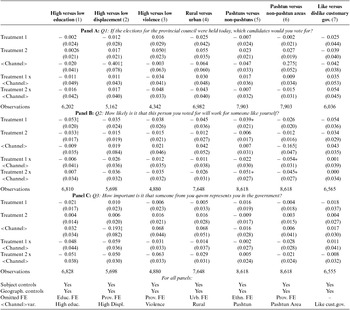
If treatments were properly randomized, the assignment of treatments should be orthogonal to respondents’ socio-economic and geographic characteristics. To mitigate concerns about any imperfect randomization, we repeat the analysis while controlling for a large set of subject- and geographic-specific factors obtained from survey demographics. This includes indicator variables for gender and household head and fixed effects for a set of ethnicity, age, income, education, religion, marital status, and employment categories. Geographic controls include fixed effects for seven major regions, 34 provinces and the degree of urbanization (village, town, city, metro), as well as a variable which classifies provincial security by the United Nations.
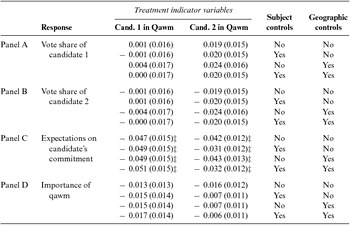
Each row in Table 4 corresponds to a Logit probability model where the dependent variable takes on the value 0 or 1. If the respondent voted in favor of candidate 1 (2) in Question 1, the dependent variable in Panel A (B) takes the value 1, else 0. In Panels C and D, if the respondent answered “somewhat or very likely” or “fairly or very important” in Questions 2 and 3, the dependent variable takes the value 1, while “somewhat or very unlikely” and “somewhat or not important at all” are coded as 0. The variables of interest are the two treatment indicators. The omitted category is the control treatment where neither candidate has a qawm affiliation. Marginal effects with robust, clustered standard errors are reported. Confirming the univariate findings, the statistical significance and the coefficients’ magnitudes are largely unchanged when including different sets of covariates.
Multivariate Results
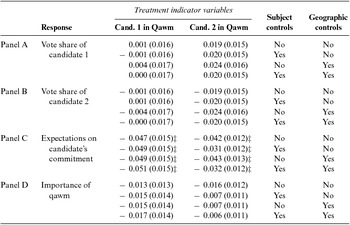
Note: Each row correspondents to a Logistic probability model (see main text for the coding of the dependent variables). The marginal effects are reported with their standard errors in brackets. The omitted category is the control treatment where any information about both candidates’ qawm characteristics was omitted. Subject controls include fixed effects for gender, head of household, 6 different age categories, 11 ethnicity categories, 9 income categories, 8 education categories, 5 religion categories, 4 marital status categories, 7 work status categories and 14 job type categories. Geographic controls include fixed effects for 7 regions, 34 provinces, and 4 degrees of urbanization (village, town, city, metro) as well as a variable about the security level at the province-level as classified by the United Nations. Each regression has 8,620 observations. All specifications include heteroskedastic-robust Huber-White standard errors and standard errors are clustered at the primary sampling unit (settlement). *,†,‡ indicate statistical significance at the 10%, 5% and 1% significance level.
Another concern could be that the treatment effects not only capture candidates’ qawm affiliation, but are confounded by a negative view of tribal politics in general. We argue that this is not the case for the following reasons. First, in the control treatment, 76% of respondents believe qawm is important (Table 3). Since this is the first time that the respondents in the control treatment hear the term “qawm,” such a high figure does not suggest a general negative view of qawm. Second, using a question from the general survey, we split the sample into those respondents deeming “customary governance and rule by elders” as “fairly or very good” versus those that deem it a “bad or very bad” form of governance. If a negative view of customary governance (which is qawm-based by definition) was responsible for our findings, we should find the effect amplified between those that like and those that dislike customary governance. We do not find such an amplification (Table 5, column 7): the interaction term of treatment 1 (candidate 1 with qawm affiliation) and affinity for customary governance does not show a significant increase in the vote share of candidate 1 (nor in the expectation of commitment or the importance of having a representative of the same qawm). Thus, the respondents’ view on customary authority in general is not correlated to their reaction when qawm identity is added to a candidate’s profile.
Mechanisms
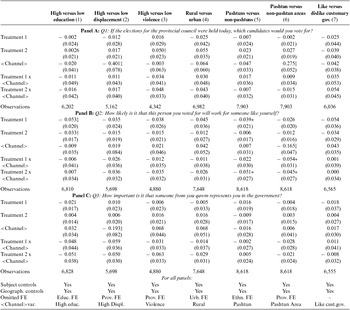
Note: Each column in each of the panels is based on the same Logistic probability model as in Table 4 (see main text for the coding of the dependent variables). “Treatment 1” and “Treatment 2” are indicator variables if the respondent was part of the corresponding treatment; the omitted category is the control/baseline treatment where none of the candidates was labeled as being from the respondent’s qawm. To investigate different mechanism, each regression divides the sample into two groups (e.g., “high education” and “low education”) and uses an indicator variable, denoted <Channel>, to investigate the channel’s statistical relevance. Each specification further includes interaction terms between the channel and the treatment indicators to investigate whether a channel is statistically relevant in any one particular treatment. The channel variable is given in the last row. The marginal effects are reported with their standard errors in brackets. *,†,‡ indicate statistical significance at the 10%, 5% and 1% significance level. Table 5 includes the same subject and geographic controls, and the same specifications for standard errors, that are described in Table 4.
Potential Mechanisms
We conducted a series of additional tests to identify whether the weakening of social ties or salience influences the extent to which qawm influences individuals perceptions of candidates.Footnote 4 First, higher levels of respondents’ education could lead to a decreased importance attached to qawm affiliation to the extent that education weakens social ties. Table 5, column 1 includes a “high education” indicator variable (1 represents 10 or more years of formal education, and 0 represents 4 or fewer years) as well as an interaction term for each of the treatments to see if education may have a differential effect in each treatment. In all the three panels (A–C), education is unrelated to the three outcomes.
We further explore the consequences of weakening social ties by looking at refugee inflows and outflows. Table 5, column 2 divides the sample by the top and bottom terciles of populations containing refugees using UNHCR data to explore whether hosting more internal refugees influences qawm-based voting. Hosting refugees may weaken qawm ties via greater qawm diversity or by having shared problems and interests. Although regions hosting more displaced populations have a lower vote share for the local-issues candidate (Panel A, − 40.1%) and attach significantly less importance to having one’s qawm represented in the government (Panel C, − 19.3%), hosting more displaced population does not change voter perceptions differently upon introducing qawm in one of the treatments compared to hosting few displaced population. To capture salience, UNHCR data is used in column 3 to separate provinces into those with the highest (top tercile) versus lowest (bottom tercile) outflow of internally displaced people due to violence. While the national-issues candidate (who promises to promote peace) again receives a greater vote share overall from respondents from provinces with high outflows (Panel A, 5.0%), introducing qawm does not affect voter perceptions differently in provinces with high versus low outflows even though such violence may have influenced salience.
Column 4 contrasts rural versus urban respondents since qawm may still be more important in rural areas while social ties might be weaker in urban areas. However, neither the vote shares nor the expectation or importance of qawm differ across the degrees of urbanization.
In column 5, the sample is split by ethnicity into Pashtuns versus non-Pashtuns since social ties may be stronger among Pashtuns. In addition, the strength of tribal ties in Pashtun communities may also help to understand why qawm affiliation reduces perceptions, individuals will work on behalf of individuals since stronger tribal ties may lead to an association of qawm with conflict. Again, there are no significant differences between the two samples in all three panels. Similarly, column 6 contrasts the sample by whether provinces have a Pashtun-majority. Respondents from Pashtun areas across all treatments vote more for the local-issues candidate (27.5%). Respondents in Pashtun areas also expect less from the candidates they voted for (− 16.5%) although there is no significant difference (relative to non-Pashtun areas) in the importance they attach to having a representative from their own qawm in their district councils. Though weakly significant, expectations that a candidate will work on behalf of respondents further decline by 4.5%–5.4% in Pashtun areas (relative to non-Pashtun areas) when qawm is introduced in the treatments. However, there are no differences in vote share or importance of qawm representation in Pashtun areas relative to non-Pashtun areas when qawm is introduced.
Given that our main findings are essentially null results, there still remain several alternative explanations which could have introduced noise into our treatment effects and which we cannot conclusively rule out. First, respondents could have interpreted qawm as ethnicity, tribe, or subtribe. If those interpretations were correlated with differential beliefs about the credibility of those social ties to deliver on promises of district-specific benefits—that is, some candidates were considered socially too distant—then this correlation could have introduced noise into the treatment effects. With larger standard errors we would have been less likely to find significant results. Second, local tribal geographies may have caused some respondents to vote for another tribe’s candidate who dominated the electoral district and was more likely to provide benefits to constituents. Since the composition of ethnicities is not available for most rural electoral districts, we could not design a test to rule out this possibility.
CONCLUSION
Although a large literature suggests that social identity drives voter behavior, the relationship between politics and identity in conditions of conflict is often complicated. The findings here are consistent with those of Kasara (Reference Kasara2013), who shows that group identity does not always influence voter perceptions and behavior in diverse societies. The findings here do not deny the importance of qawm in the Afghan society, but illustrate that a concept with clear social importance does not have an obvious impact on perceptions on local candidates.
Other factors might influence qawm-based voting in Afghanistan. As Dunning and Nilekani (Reference Dunning and Nilekani2013) show that ethnic voting is mediated by party organizations, it would therefore be useful to understand the relationship between qawm and political parties in Afghanistan. Second, Ichino and Nathan (Reference Ichino and Nathan2013) suggest that the type of public good influences the extent of ethnic voting since ethnic voting presumes that politicians can deliver selective benefits to constituents. Future research could extend beyond the general notion of qawm laid out in this paper and consider the extent to which the type of public good type provided by politicians may influence group voting.
SUPPLEMENTARY MATERIALS
To view supplementary material for this article, please visit http://dx.doi.org/10.1017/XPS.2014.28