Introduction
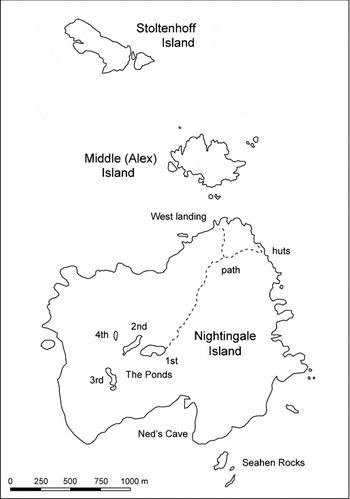
Nightingale Island, the smallest and oldest of the three northern islands in the Tristan da Cunha-Gough Island archipelago, is the only island in the group to have large offshore islets (Ryan Reference Ryan2007). Middle Island (approximately 10 ha) is a fairly low lying island located 250 m north of Nightingale, whereas Stoltenhoff Island (approximately 8 ha), 700 m northwest of Middle Island, is taller with 70 m cliffs around much of its coastline (Figs. 1, 2). There are two stacks at the eastern end of Stoltenhoff, the larger of which (0.8 ha) is capped in vegetation. Landing on Middle Island is straightforward from the sheltered coves that line the channel opposite Nightingale Island. As a result it has been visited historically by Tristan islanders, who traditionally call it Alex Island, in order to exploit breeding seabirds (mainly northern rockhopper penguins Eudyptes moseleyi, but also small numbers of Atlantic yellow-nosed albatrosses Thalassarche chlororhynchos) (Richardson Reference Richardson1984). It also would have been visited during the late 18th and 19th centuries to exploit sub–Antarctic fur seals Arctocephalus tropicalis (Ryan Reference Ryan2007). However, Stoltenhoff has seldom been visited because landing is only possible at the extreme northwestern end of island, and requires exceptionally calm conditions (Richardson Reference Richardson1984).
Nightingale Island, Tristan da Cunha, showing the outer islets, Stoltenhoff and Middle Island (drawn from GoogleEarth images).

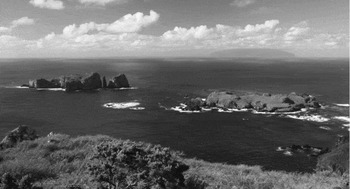
Stoltenhoff (left) and Middle Island (right) viewed from above the northwest point of Nightingale Island, with Tristan da Cunha partly obscured by clouds in the distance.

There are few scientific observations from either island. The only botanical collections were made by Erling Christophersen, who landed on both islands in February 1938 (Groves Reference Groves1981). Several ornithologists have commented on the avifauna of Middle Island (for example Hagen Reference Hagen1952; Elliott 1957), but Richardson is the only ornithologist to have landed on Stoltenhoff (Richardson Reference Richardson1984). Middle Island is especially important for northern rockhopper penguins, supporting an estimated 100,000 pairs in 1973 (Richardson Reference Richardson1984), almost half the entire Tristan and Gough population (Cuthbert and others Reference Cuthbert, Cooper, Burle, Glass, Glass, Glass, Hilton, Sommer, Wanless and Ryan2009). There are no penguins on Stoltenhoff, but both islands support several other breeding seabirds as well as populations of the endemic Tristan thrush Nesocichla eremita and Nightingale bunting Nesospiza questi (Richardson Reference Richardson1984; Ryan Reference Ryan2007). We report on the status of vascular plants and birds at the islands following landings there on 2–3 December 2009. We landed on Middle Island on both days, spending a total of 10 hours ashore, and spent 8 hours ashore on Stoltenhoff on 3 December 2009.
Vascular plants
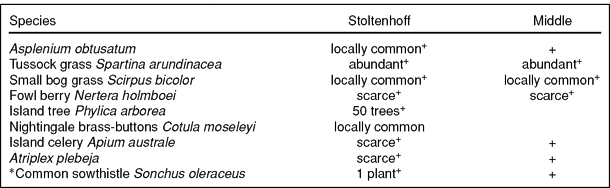
Both islands are cloaked in a dense cover of tussock grass Spartina arundinacea. Their terrestrial flora is a depauperate subset of that found on adjacent Nightingale Island (Groves Reference Groves1981; Roux and others Reference Roux, Ryan, Milton and Moloney1992). We recorded nine vascular plant species from Stoltenhoff and only three from Middle Island (Table 1), compared to 44 species on Nightingale Island (Roux and others Reference Roux, Ryan, Milton and Moloney1992; P.G. Ryan unpublished data). Interestingly, only one fern was found (Asplenium obtusatum), despite ferns comprising 41% of species (n = 18) on Nightingale Island. We failed to find any berry bush Empetrum rubrum, which Christophersen recorded from Stoltenhoff (Groves Reference Groves1981). Christophersen also found four species on Middle Island that we only recorded on Stoltenhoff (Table 1). It is possible that at least some of these species have become extinct on Middle Island, given the apparent expansion of the penguin colony on the island since 1938 (Hagen Reference Hagen1952; Elliott 1957). The most interesting plant found was a small herbaceous plant tentatively identified as Atriplex plebeja. This little known species, apparently endemic to Nightingale and the main island of Tristan da Cunha, has not been recorded at Nightingale since 1938. There is only one possible record of the plant from Tristan (1962) since it was first collected there in 1817 (Groves Reference Groves1981), despite several extended visits by botanists over the last 40 years. Stoltenhoff may be the last site where this enigmatic species occurs.
The status of vascular plants on Stoltenhoff and Middle Islands, Tristan da Cunha.
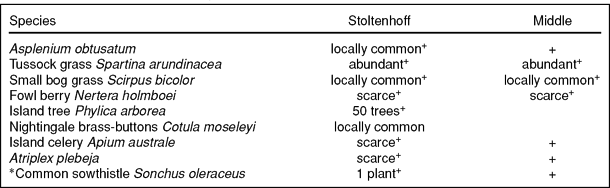
+species recorded by Christophersen in 1938 (Groves Reference Groves1981).
*alien species.
We recorded one new plant species not previously known from the islands. Cotula moseleyi, formerly considered to be endemic to Nightingale Island, was locally common in open areas around albatross nests on Stoltenhoff. This species also has colonised Inaccessible Island, 18 km northwest of Nightingale Island. It was first recorded on Inaccessible in 1999, when several plants were found along the scarp edge near North Point and a single plant was found on a boulder in the penguin colony north of Salt Beach. By 2009 it was much more abundant at both these sites (P. G. Ryan, personal observation). Dispersal between the islands may have been effected by seabirds. C. moseleyi typically grows in disturbed areas, often around bird burrows and albatross nests (Roux and others Reference Roux, Ryan, Milton and Moloney1992), and at least some seabirds move between the islands. Non-breeding yellow-nosed albatrosses ringed on Nightingale Island have been observed along the scarp edge at Inaccessible (P. G. Ryan, personal observation).
Only one non-native plant species was found on the islands: a single specimen of common sowthistle Sonchus oleraceus from Stoltenhoff. Christophersen also collected this species on Stoltenhoff in 1938 (Groves Reference Groves1981). It is a common weed of disturbed areas on all the main Tristan islands (Ryan Reference Ryan2007). Unlike most other alien plants at the islands, isolated plants are often found far from any other individuals, presumably as a result of its light, wind dispersed seeds. It is encouraging that none of the other seven alien species found on Nightingale (Cotula australis, Holcus lanatus, Poa annua, Phormium tenax, Rumex acetosella, Rumex obtusifolius, and Malus domestica) has reached either island. Their absence suggests either that they are not easily dispersed by seabirds, or that conditions on the outer islands are too harsh to allow them to become established. The latter hypothesis is unlikely, at least for Poa annua and Rumex obtusifolius, both of which are widespread in a variety of habitats at the Tristan islands (Groves Reference Groves1981; Roux and others Reference Roux, Ryan, Milton and Moloney1992).
The greater richness of plants on Stoltenhoff is somewhat surprising given its smaller size and greater isolation than Middle Island. Two factors probably account for this pattern. First, rockhopper penguins breed over much of Middle Island, trampling any ground cover under the canopy of Spartina. Second, Stoltenhoff is a taller island, which enhances orographic precipitation. This could account for the localised occurrence of island trees Phylica arborea at the highest part of the island. Richardson (Reference Richardson1984) reported only a single tree on Stoltenhoff in 1974, suggesting the population of trees has increased substantially over the last 35 years, although several of the 50 trees recorded there in 2009 appeared to have died recently.
Birds
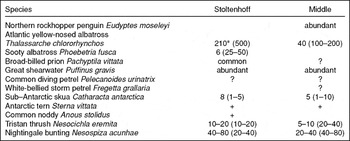
Our visit was too late in the season to estimate accurately the numbers of northern rockhopper penguins breeding on Middle Island, but they are widespread and abundant, breeding throughout roughly 80% of the vegetated area of the island. Counting of other surface nesting species was hampered by the rugged terrain and dense vegetation. However, we covered both islets quite carefully for Atlantic yellow-nosed albatrosses. Richardson (Reference Richardson1984) specifically mentions making accurate ground counts of albatrosses at the islands. He visited earlier in the breeding season (Middle Island on 11 September; Stoltenhoff on 15 October 1974) than our counts, but even allowing for breeding failures prior to our counts it is clear that numbers of yellow-nosed albatrosses have decreased by about a half (Table 2). The decline at Middle Island might be attributed in part to historical exploitation by Tristan islanders, but the decreases at Stoltenhoff almost certainly result from increased mortality at sea, presumably linked to fishing activity. Yellow-nosed albatrosses populations have decreased over the last few decades at Gough Island and at other islands in the Tristan group (Cuthbert and others Reference Cuthbert, Ryan, Cooper and Hilton2003), resulting in the species being listed as endangered (BirdLife International 2009). Sooty albatrosses Phoebetria fusca (endangered) also appear to have decreased markedly at Stoltenhoff since 1974 (Table 2), although this cliff nesting species is difficult to count accurately.
Birds recorded on Stoltenhoff and Middle Islands. Estimates of numbers of pairs are given for surface-nesting seabirds and landbirds, with estimates from Sept-Oct 1974 (Richardson Reference Richardson1984) in parentheses. For nocturnal, burrow-nesting seabirds ? denotes species only recorded in skua middens.

*includes at least 3 pairs on the eastern stack.
The status of burrow nesting species on the islands is poorly known. Richardson (Reference Richardson1984) estimated there were roughly 25,000 pairs of great shearwaters Puffinus gravis at each island, but he listed the status of the six other burrow nesting species found on Nightingale Island as ‘unknown’. Great shearwaters remain abundant at both islands, although they are confined to penguin free areas on Middle Island. We suspect that the population is greater on Stoltenhoff. The only other petrel confirmed to be present on the islands was the broad-billed prion Pachyptila vittata, which frequently was heard calling among rocky outcrops on Stoltenhoff, and a large chick was found in a burrow. Examining prey of sub–Antarctic skuas Catharacta antarctica provides an indication of the abundance of burrowing petrels (for example Ryan and others Reference Ryan, Whittington and Crawford2009), although it is not definitive proof of breeding because some prey may be caught at sea or on adjacent Nightingale Island. Prions dominated skua middens, but several common diving petrels Pelecanoides urinatrix were found at both islands, so they almost certainly breed. However, only one dead white-bellied storm petrel Fregetta grallaria was found on Middle Island, so the status of this species remains equivocal.
Richardson (Reference Richardson1984) recorded two species of terns, Antarctic tern Sterna vittata and common noddy Anous stolidus, breeding on Stoltenhoff Island. Both were seen flying around the island's cliffs, but we did not scan the cliffs from the sea, so could not estimate the numbers of breeding sites. At least one pair of Antarctic terns was seen on the cliffs at Middle Island, a site not reported for this species by Richardson (Reference Richardson1984).
Populations of the two native landbirds are hard to estimate accurately during brief visits ashore. Tristan thrushes are dietary generalists that prey on seabird eggs and chicks as well as a range of invertebrates and fruits (Fraser and others Reference Fraser, Ryan, Dean, Briggs and Moloney1994; Ryan and Ronconi submitted). They are relatively unobtrusive at Middle and Stoltenhoff compared to those on Nightingale Island. Pairs with fledged chicks were observed at both islands. We estimated modest populations at each island (Table 2), despite the large numbers of breeding seabirds. It is likely that their populations are limited by food in winter, when few if any seabirds are present on the islands. Richardson (Reference Richardson1984) also estimated 10–20 pairs on Stoltenhoff, but 20–40 pairs on Middle Island. Our opinion is that the population is larger on Stoltenhoff.
Numbers of Nightingale buntings were easier to estimate, because many males were singing, and we used song playback to assist catching buntings (to obtain blood samples and to test for differences in morphology compared to the population on Nightingale Island). We caught 10 males and 2 females on Stoltenhoff and 8 males and 1 female on Middle Island. It was evident that the density of buntings was greater on Stoltenhoff than on Middle Island, and we estimated that there were roughly twice as many pairs on Stoltenhoff (Table 2; contra Richardson Reference Richardson1984). Breeding was confirmed at both islands. A female with a well developed brood patch was caught on Stoltenhoff, and one on Middle Island was observed carrying nesting material.
Other fauna and conservation
Sub–Antarctic fur seals have recolonised Middle and Nightingale Islands following their local extinction during the sealing era (Ryan Reference Ryan2007). They are common along the island's rocky shores and adjacent slopes wherever landing is feasible. It appears unlikely that seals pup on Stoltenhoff; most of the coast consists of cliffs descending sheer into the water. Only one was hauled out at the northwest end of the island during calm weather; under normal conditions, this site is likely to be too exposed to wave action to allow seals to come ashore. There are no other mammals at the islands.
Little is known about the invertebrate fauna of Nightingale Island (Ryan Reference Ryan2007), and apparently nothing has been reported on the invertebrates on the outer islets. Unfortunately we did not have time to sample invertebrates, but this should be a priority for any future visits. Given the small numbers of landings relative to other islands in the Tristan group, particularly at Stoltenhoff, it is likely that the islets represent among the least modified habitats at Tristan. Anyone going ashore must take the strictest measures to prevent introducing any organisms, either alien or native, from the other islands (for example ensuring all clothing and equipment are completely clean). Landings are only allowed with permission from Tristan's Conservation Department.
Acknowledgements
We thank Captain Clarence October and the crew of the MV Edinburgh for assistance with landing on the islands, and for their hospitality aboard ship. The administrator and island council of Tristan kindly gave permission to visit the islands. Financial and additional logistical support was supplied by the South African National Antarctic Programme. RAR was supported by the Killam Trust, Dalhousie University.